The Houthis Are Preparing for a Planned Israeli Attack on Yemen
By Ahmed Abdulkareem | MintPress News | November 11, 2019
SANA’A, YEMEN — As the war in Yemen nears the end of its fifth year, the situation in the country seems to be escalating. There are strong indications that Israel is planning to launch airstrikes against the country under the pretext of preventing an Iranian military presence from taking hold, a move that is likely to open the door for further escalation.
On Saturday, Ansar Allah, the political wing of Yemen’s Houthis, announced that Yemeni forces would not hesitate to “deal a stinging blow” to Israel in the case Tel Aviv decides to launch attacks in Yemen. The Houthis reaffirmed that their anti-Israel position is based on a principled, humanitarian, moral, and religious commitment. Historically, neither the Yemeni Army nor the Houthis themselves, have ever targeted Israel directly.
The threat from Israel is not without precedent. Israel has used claims of alleged Iranian military attachments in countries like Syria and Iraq as justification for airstrikes and bombings against those nations. Now, Israel appears to be using Iran’s alleged presence in Yemen, an allegation that both Tehran and the Houthis deny, as a pretext for military action in the country despite no evidence indicating that there are any Iranian forces present there.
Ansar Allah leader Abdulmalik al-Houthi said in televised speech marking the anniversary of the Prophet Muhammad, “Our people will not hesitate to declare jihad (holy war) against the Israeli enemy, and to launch the most severe strikes against sensitive targets in the occupied territories if the enemy engages in any folly against our people.” The occasion marks the largest festival held by the Houthis during which they reveal their domestic and foreign policies for the coming year.
The Houthis also called on the Saudi regime to stop the war and siege on Yemen, warning that there would be risks and consequences for the Kingdom should they continue their attacks. Al-Houthi also confirmed that Yemenis will continue to develop their military capability, adding that, “Anyone who uses the war and siege to control us and subjugate us is seeking the impossible, and the consequence is failure.”
Al-Houthi also pointed to the ongoing mass protest movements in Lebanon and Iraq, advising nations in the Middle East to resolve their issues vigilantly. He asked those nations to exercise vigilance in the face of what he called Israeli plots to gain a political, military, and cultural foothold in their respective countries.
On Saturday, massive demonstrations took place across Yemen’s major cities to commemorate the Prophet Mohammed’s birth, an occasion known to Muslims as Maulud Nabi. While the occasion is a religious one, it is a public holiday in Yemen and is marked with the singing of the national anthem and the waving of green flags. Many protesters told MintPress News that any attack by Israeli would not cause the Yemeni people any more suffering than they have already endured, but would push them to join a “holy war” against Israel.
According to three government officials in Sana’a that spoke to MintPress on the condition of anonymity, the Houthi’s warnings are both serious and well-placed. Those officials said that the government in Sana’a has already confirmed information that Israel is preparing to launch airstrikes on both military sites and civil targets in Yemen, especially on the country’s west coast and along the Saudi-Yemen border in coordination with the Saudi-led Coalition.
Ansar Allah’s announcement also comes in the wake of a number of recent statements made by a number of Israeli officials claiming that Yemen has become a threat to Israel. Speaking during a visit by U.S. Secretary of Treasury Steven Mnuchin and White House aid Jared Kushner, Netanyahu claimed that Iran has supplied missiles to the Houthis that could hit Israel. The Houthis regard these statements as a justification and prelude to strikes on the country, similar to those that Israel unilaterally carried out against sites in Syria and Iraq.
In August, Kuwaiti newspaper al-Jarida released a report saying that Israel is planning on striking sensitive positions on the Bab al-Mandab strait which links the Red Sea and the Gulf of Aden, to target “Houthis” in the area. The newspaper, which cited an anonymous informed source, said Israeli intelligence agency Mossad has been monitoring activities in the Yemeni strait.
Israel’s entry into the Yemen war could indeed open the door for further escalation, a prospect made more likely by both the increased strength of Ansar Allah forces and by Israel’s increasingly cozy relationship with the Gulf Arab countries of the coalition. The fact that Saudi Arabia and the UAE recently sought negotiations with Houthis after they were unable to win the war militarily, despite their superior firepower and funding, only increases the likelihood of Israel’s entry into Yemen.
In fact, Israel is alleged to have already participated in the war against Yemen on behalf of the Saudi-led coalition as a part of a series of covert interventions involving mercenary forces, the reported launching of dozens of airstrikes in the country and even the dropping of a neutron bomb on Nuqm Mountain in the middle the capital Sana’a in May of 2015.
Kicking the hornet’s nest
Like Saudi Arabia and the UAE, there is a problem with the Israeli assessment of the situation in Yemen, as the Houthis have never threatened to hit an Israeli target and Houthi attacks on Saudi-led Coalition countries have always been retaliatory, not preemptive. There are no vital targets to be bombed in Yemen as the Saudi-led coalition has already destroyed nearly every potential target, including civilian infrastructure. Moreover, any attack by Israel against Yemen will gain the Houthis even more popular support both inside of Yemen and across the Islamic and Arab world.
Furthermore, there is no evidence that Iran has any military sites or experts in Yemen, and Yemen’s Army, loyal to Ansar Allah, are not the “Iran proxy fighters” that international media so often claims them to be. Indeed, the U.S. State Department even admitted in leaked cables that the Houthis were not an Iran proxy and that they received neither funding nor weapons from Iran.
There are a convergence of interests between the Houthis and Iran, including opposition to Israel’s internationally-recognized theft of Palestinian land, but if Israel involves itself directly in the conflict in Yemen, it is likely that the Houthi alliance with Iran will grow and may actually spur Tehran into providing precise and sophisticated weapons to Ansar Allah, turning the fears of Israel into a self-fulfilling prophecy.
Meanwhile, many Israeli activists and media pundits are expressing concerns over what they consider serious threats from Yemen, pointing out that these threats “should not be underestimated by the Israelis.” The Israeli security parliament said that Israeli intelligence must strictly monitor Yemen and take necessary steps to secure Israeli ships sailing in the Bab Al-Mandab area, describing the statements made by Abdulmalik al-Houthi as serious.
A well-stocked arsenal
Indeed the threats of Ansar Allah, a group known to strike sensitive targets without hesitation, are not without precedent. On September 14, Ansar Allah hit two of Saudi Arabia’s oil facilities in Abqaiq and Khurais, an attack that led to a suspension of about 50 percent of the Arab Kingdom’s crude and gas production.
Prior to that, they targeted vital facilities deep inside of Saudi Arabia and the United Arab Emirates, including the Barakah Nuclear Power Station in Abu Dhabi, the capital of the UAE, as well as the King Khalid International Airport near Riyadh, more than 800 km from Yemen’s northern border. Now, they have developed their arsenal of ballistic missiles and drones even further and experts say are likely capable of hitting vital targets inside of Israel. Yemen’s Army is ready to launch those missiles if Ansar Allah’s leader asks it to do, one high-ranking military officer told MintPress.
Yemen’s Army, loyal to the Houthis, is equipped with the Quds 1 winged missile which was used in an attack on the Barakah Nuclear Power Station in Abu Dhabi in December of 2017. This year, several generations of the Quds 1 were reworked to provide the “ability to hit its targets and to bypass enemy interceptor systems,” according to Ansar Allah.
The Borkan 3 (Volcano 3), whose predecessors were used by the Houthis to strike targets inside of Saudi Arabia and the UAE, is capable of traveling even further than the Borkan 1 and 2. The Borkan is a modified Scud missile and was used in a strike on the King Khalid International Airport near Riyadh, more than 800 km from Yemen’s northern border. The missile was able to evade U.S. Patriot missile air-defense systems.
Yemen’s Army also posses the Samad 3 reconnaissance drone and the Qasef 2K drone. Both were used in strikes against the Abu Dhabi and Dubai airports. The Samad 3 has an estimated range of 1,500 to 1,700 km. Moreover, the Yemen Army recently unveiled a new drone with a range exceeding 1,700 km and equipped with advanced technology that would render it difficult for air defense systems to detect.
One Ansar Allah military source told MintPress that mines would also be deployed against Israeli battleships and watercraft in the Red Sea if Israel decides to launch attacks against Yemen. Indeed, Yemen’s military recently revealed its domestically-manufactured marine mines dubbed the “Mersad,” and is reportedly “actively developing its naval forces and naval anti-ship missiles.”
Despite the well-established precedent, many still doubt that the Houthis are capable of carrying out attacks on the scale and range of the attack that struck an Aramco facility in Saudi Arabia earlier this year — instead, accusing Iran of orchestrating the attacks. Yet repeatedly underestimating the Houthis was one of the major mistakes made by the Saudi-led coalition, who has failed to defeat the group after nearly five years of fierce battles against them, despite being equipped with the latest U.S.-supplied weaponry — everything from M1A2 Abrams tanks and M2 Bradley fighting vehicles to AH-64D Apache helicopters, as well as having an air force equipped with a high-tech arsenal.
However, it would be difficult for the Yemeni Army to prevent aerial attacks by Israel. Yemeni airspace has been open to the coalition and to American drones since the war broke out in 2015. Any attack by the Yemen army would likely come in retaliation to an Israeli attack and would hit Israeli military bases in Eritrea, Israeli ships in the Red Sea as well as hit vital targets deep inside of Israel, according to Yemeni military sources.
An already dire situation
The war, which began in March 2015, has led to the world’s worst humanitarian crisis resulting from the bombing and a blockade which has led to mass starvation and history’s largest cholera outbreak, among other dire consequences.
The coalition, backed by the United States, has killed tens of thousands of Yemeni civilians since the war began. Moreover, the coalition’s blockade of food and medicine has plagued the country with an unprecedented famine and has triggered a deadly outbreak of preventable diseases that have cost thousands of people their lives.
Last week, the Armed Conflict Location & Event Data Project revealed that Yemen’s death toll rose to a shocking 100,000 since 2015. The database shows approximately 20,000 people have been killed this year, already making 2019 the second-deadliest year on record after 2018, with 30,800 dead. Those numbers do not include those who have died in the humanitarian disasters caused by the war, particularly starvation.
Given the nature of Israel’s recent wars against Gaza and Lebanon, it is unlikely that Israel would feel constrained by any moral dilemma should they chose to launch airstrikes against civilians in Yemen.
Ahmed AbdulKareem is a Yemeni journalist. He covers the war in Yemen for MintPress News as well as local Yemeni media.
Cornering and Strangulating Iran Has Backfired on Israel
By Alastair Crooke | Strategic Culture Foundation | November 11, 2019
What happens if the two premises on which Israel and America’s grand Iran strategy is founded are proven false? ‘What if’ maximum pressure fails either to implode the Iranian state politically, nor brings Iran to its knees, begging for a new ‘hairshirt’ nuclear deal? Well …? Well, it seems that Netanyahu and Mossad were so cocksure of their initial premise, that they neglected to think beyond first move on the chess board. It was to be checkmate in one. And this neglect is the cause of the strategic bind in which Israel now finds itself.
Lately, these lacunae in strategic thinking are being noticed. Iran is doing just fine, writes Henry Rome in Foreign Affairs:
“Some analysts predicted that Iran’s friends in Europe and Asia would defy the United States to lend Iran economic help. Others reckoned that the sanctions would send Iran’s economy into a “death spiral,” leaving Tehran the choice to either surrender or collapse. Neither of these predictions came to pass.
“Rather, Iran now enters its second year under maximum pressure strikingly confident in its economic stability and regional position. Supreme Leader Ali Khamenei and other hard-liners are therefore likely to continue on their current course: Iran will go on tormenting the oil market, while bolstering its non-oil economy—and it will continue expanding its nuclear program while refusing to talk with Washington.”
Similarly, the (US) Crisis Group reports that on the eve of the US oil sanctions snapback in November 2018, Secretary Pompeo was asked if Iran might restart its nuclear program. He responded: “we’re confident that the Iranians will not make that decision”. But, Iran did just that: In April 2019 – after the US revoked the sanction waivers that had previously allowed eight countries to import Iranian oil – the Iranian leadership started pushing back.
They are still doing it. “Iran’s responses on the nuclear and regional fronts call into question the core premises of the U.S. “maximum pressure” campaign … Tehran [effectively] has broken the binary outcome of concession or collapse by instead adopting what it touts as “maximum resistance”. As a result … there can be little doubt that the [US] strategy has fallen short, delivering impact without effect and rather than blunting Iran’s capabilities only sharpening its willingness to step up its [push-back]”, the Crisis Group report concludes.
So here we are: Iran’s “fourth step” in its incremental lessening of compliance with the JCPOA (injecting nuclear gas into the – hitherto empty – centrifuges at Fordo; augmenting enrichment to 5% and unveiling substantially improved centrifuges), effectively tests the very core to the Obama JCPOA strategy.
The Accord was built around a framework that meant Iran would remain at least 12 months away from break-out capacity (the moment when a state can transition into a nuclear weapons’ state). Iran – in these de-compliance steps is inching under that limit, if it is not already under it. (This does not, however, imply that Iran is seeking weapons, but rather that it is seeking a change in western behaviour.)
Yes, Israel – which pushed hard its assessment (albeit, onto a Trump team wholly receptive to this Israeli analysis) of an Iran entering into a death-spiral within one year, under Trump’s maximum pressure – can plead reasonably that its grand strategy was struck by two ‘black swans’. The double ‘punch’ quite evidently has knocked Israel – it is now all at sixes and sevens.
One was the 14 September strikes on the two Aramco plants in Saudi Arabia (claimed by the Houthis), but demonstrating a level of sophistication which Israelis explicitly admit took them wholly by surprise. And the second was the accumulated evidence that the US is in the process of quitting the Middle East. Again, Israel – or at least Netanyahu – never believed this could happen under Trump’s ‘watch’. Indeed, he had built a political platform on his claim of intimate rapport with the US President. Indeed, that did seem at the time to be perfectly true.
Israeli historian, Gilad Atzmon observes, “it now seems totally unrealistic to expect America to act militarily against Iran on behalf of Israel. Trump’s always unpredictable actions have convinced the Israeli defense establishment that the country has been left alone to deal with the Iranian threat. The American administration is only willing to act against Iran through sanctions”.
And the former Israeli Ambassador to Washington put the consequences yet more bluntly under the rubric of The Coming Middle East Conflagration: “Israel is bracing itself for war with Iranian proxies … But what will the United States do if conflict comes?” — by this Oren implies the US might do little, or nothing.
Yes. This is precisely the dilemma to which the Israeli policy of demonising Iran, and instigating ‘the world’ against Iran, has brought Israel. Israeli officials and commentators now see war as inevitable (see here and here) – and they are not happy.
War is not inevitable. It would not be inevitable if Trump could put aside his Art of the Deal pride, and contemplated a remedy of de-escalating sanctions – especially oil export sanctions – on Iran. But he has not done that. After a quick (and wholly unrealistic) ‘fling’ at having a reality-TV photo-op with President Rouhani, his Administration has doubled down by imposing further, new sanctions on Iran. (Friends might try to tell their American counterparts that it is well time they got over the 1979 Tehran Embassy siege.)
And war is not inevitable if Israel could assimilate the reality that the Middle East is in profound flux – and that Israel no longer enjoys the freedom to strike wherever, and whomsoever it choses, at will (and at no cost to itself). Those days are not wholly gone, but they are a rapidly diminishing asset.
Will Israel shift posture? It seems not. In the context of the Lebanon protests, the local banks are becoming vulnerable, as capital inflows and remittances dry up. Israeli, plus some American officials, are favouring withholding external financial assistance to the banks – thus making the banking system’s survival contingent on any new government agreeing to contain and disarm Hizbullah (something which, incidentally, no Lebanese government, of whatever ‘colour’, can do).
That is to say, US and Israeli policy is that of pushing Lebanon to the brink of financial collapse in order to leverage a blow at Iran. Never mind that it will be the demonstrators – and not Hizbullah – who will pay the heaviest price for pushing the crisis to the brink – in terms of a devalued pound, rising prices and austerity. (Hizbullah, in any case, exited the Lebanese banking system, long time past).
Iran, on the other hand, faced with maximum pressure, has little choice: It will not succumb to slow-strangulation by the US. Its riposte of calibrated counter-pressure to US max-pressure, however, does entail risks: It is predicated on the judgement that Trump does not want a major regional war (especially in the lead up to US elections), and also predicated (though less certainly) on the US President’s ability to avoid being cornered by his hawks into taking responsive military action (i.e. were another US drone to be shot down).
So, what do all these various geo-political ‘tea-leaves’ portend? Well, look at Lebanon and Iraq through the geo-political spectacles of Iran: On the one hand, it is well understood in Tehran that there is justified, deep popular anger in these states towards corruption, the iron sectarian structures and hopeless governance — but that is only one part of the story. The other is the long-standing geo-strategic war that is being waged against Iran.
Maximum pressure has not produced a chastened, and repentant Iran? So, now Iranians see the US and Israel resorting to ‘Euromaidan warfare’ (Ukrainian protests of 2013) against Iran’s Lebanese and Iraqi allies. (It was, after all, during President Aoun’s visit to Washington in March, that Trump first warned Aoun of what was coming – and presented his ultimatum: Contain Hezbollah, or expect unprecedented consequences, including sanctions and the loss of US aid).
Fresh sanctions, plus an Euromaidan-type assault on Iranian allies (Hizballah and Hash’d A-Shaabi)? Might we then expect another ‘Gulf surprise’ – in coming weeks?
This tit-for-tat of pressure and counter-pressure is set to continue — Michael Oren, the former Israeli Ambassador to the US, lays it out:
“The conflagration, like so many in the Middle East, could be ignited by a single spark. Israeli fighter jets have already conducted hundreds of bombing raids against Iranian targets in Lebanon, Syria, and Iraq. Preferring to deter rather than embarrass Tehran, Israel rarely comments on such actions. But perhaps Israel miscalculates, hitting a particularly sensitive target; or perhaps politicians cannot resist taking credit. The result could be a counterstrike by Iran, using cruise missiles that penetrate Israel’s air defenses and smash into targets like the Kiryah, Tel Aviv’s equivalent of the Pentagon. Israel would retaliate massively against Hezbollah’s headquarters in Beirut as well as dozens of its emplacements along the Lebanese border. And then, after a day of large-scale exchanges, the real war would begin.
“Rockets, many carrying tons of TNT, would rain on Israel; drones armed with payloads would crash into crucial facilities, military and civilian. During the Second Lebanon War, in 2006, the rate of such fire reached between 200 and 300 projectiles a day. Today, it might reach as high as 4,000. The majority of the weapons in Hezbollah’s arsenal are standoff missiles with fixed trajectories that can be tracked and intercepted by Israel’s Iron Dome system. But Iron Dome is 90 percent effective on average, meaning that for every 100 rockets, 10 get through, and the seven operational batteries are incapable of covering the entire country. All of Israel, from Metulla in the north to the southern port city of Eilat, would be in range of enemy fire.”
Of course, the claim that Israeli air defences are 90% effective is ‘for the birds’ (Israeli officials would not be in such a panic if it were true). But Oren sets out the course to a region-wide war plainly enough. This is the end to which their Iran strategy has brought them.
And just to recall, this strategy was always a ‘strategy of choice’ – taken for domestic political purposes. Israel’s demonization of Iran did not begin with the Iranian Revolution. Israel initially had good relations with the revolutionary republic. The relationship transformed because an incoming Israeli Labour government needed it to transform: It wanted to upend the earlier political consensus, and to make peace with the ‘near enemy’ (i.e. its Arab neighbours). But Israel then required a ‘new’ villain threatening ‘plucky little Israel’ to keep unstinting US Congressional support coming through: Iran became that villain. And then, subsequently, Netanyahu made his twenty-year career out of the Iranian (nuclear) bogeyman.
Reaping what a long-term strategy of threats and incitement sows …? In one of the most detailed assessments of Iran’s strategy and doctrine across Lebanon, Syria, Iraq and Yemen, the International Institute for Strategic Studies (IISS) concludes that Iran’s “third party capability” has become Tehran’s weapon of choice: “Iran now has an effective military advantage over the US and its allies in the Middle East, because of its ability to wage war using third parties such as Shia militias and insurgents”, the report concludes. It has the military edge? Well, well …
And doesn’t this fact help explain what is happening in Iraq and Lebanon today?
Jordanian Detained by Israel Says He was Used as ‘Bargaining Chip’ for Jordan Valley Lands

Heba al Labadi and Abdul Rahman Miri have been held in Israeli prisons without charges for over two months
Palestine Chronicle – November 10, 2019
A Jordanian man formerly detained in Israel has accused the neighboring country of using him and another prisoner as “bargaining chips” to prevent the loss of two Jordan Valley territories.
Abdul Rahman Miri, a Jordanian citizen of Palestinian descent, was held by the Israeli authorities for months without charge alongside fellow Jordanian Heba al-Labadi.
Their detention was not the only issue causing a diplomatic scuffle between Israel and Jordan over the past months, however.
The kingdom announced last year it would not extend a lease to Israel on two pieces of land in the Jordan Valley, ending 25 years of de facto Israeli authority over the Al-Baqura and Al-Ghamar areas.
Despite Jordan announcing its intention a year in advance of the leases’ expiration, Israeli officials and civilians in the valley have reportedly continued to hold out hope that Israeli farmers will continue to be able to live and work on the land.
Speaking on the sidelines of a meeting held by the National Committee for Jordanian Detainees and Missing Persons Held in Israeli Prisons on Friday, Miri alleged that the Israeli authorities had attempted to use his and Labadi’s detention as a “bargaining chip” with which to secure the continued lease of al-Baqura and al-Ghamar.
The Wadi Araba peace deal, signed in 1994, restored diplomatic and economic relations between Jordan and Israel. As part of the agreement, the kingdom leased Israel the Jordan Valley farmlands.
The agreement is highly contentious in Jordan, of which a significant number of citizens are of Palestinian descent. Anti-normalization activists in the kingdom have previously called for the cancellation of the Wadi Araba treaty.
Miri and Labadi returned to Jordan on Wednesday after months in detention, where they were allegedly tortured after being accused of links to Hezbollah and Hamas.
Their release came a week after Jordan recalled its ambassador to Israel over their detention.
Jordan has said Israeli citizens will be banned from entering Baqura from Sunday onward.
The kingdom has not yet stated whether Israeli farmers will be allowed to access lands in al-Ghamar.
Israeli ministers moot war scenario with Iran: Ex-envoy
Press TV – November 6, 2019
Israeli ministers have reportedly held several meetings to review the likely scenario of a potential war with Iran, with the participants speculating that the Islamic Republic could deal paralyzing blows to the regime in the course of such a confrontation.
The meetings, two of which were held last week, discussed potential lead-ups and aftermath of a conflict, with Michael Oren, a former Israeli ambassador to the US, allegedly unveiling contents of the discussions in an opinion piece carried by The Atlantic on Monday.
Titled “The Coming Middle East Conflagration,” the feature claimed the ministerial gatherings had concluded that “fighting could break out at any time” by “a single spark.”
‘Dangerous Israeli miscalculation’
The Israeli ministers suspected that a conflict could come as a result of an “Israeli miscalculation,” such as erringly hitting “particularly sensitive targets” in the countries where the Islamic Republic provides advisory support against terrorists such as Iraq and Syria.
“The result could be a counterstrike by Iran, using cruise missiles that penetrate Israel’s air defenses and smash into targets like the Kiryah, Tel Aviv’s equivalent of the Pentagon,” Oren wrote. “And then, after a day of large-scale exchanges, the real war would begin,” he went on.
‘4,000 projectiles to rain on Israel’
The article said such a war triggered by Tel Aviv’s blunder could see as many as “4,000” projectiles being rained down on Israel every day, with the regime’s so-called Iron Dome missile system liable to miss 10 percent of them.
“All of Israel, from Metulla in the north to the southern port city of Eilat, would be in range of enemy fire,” the former official noted.
That threat, the piece added, is eclipsed by the one posed by Iran’s surgical and long-range missiles such as “the deadly Shahab-3” — which would reach Israel “from Syria, Iraq, Yemen, and Iran itself.”
Those missiles “a growing numbers of which are in Iranian arsenals, pose a far deadlier threat,” Oren cautioned, highlighting how the projectiles can switch flight routes airborne.
“The David’s Sling system, developed in conjunction with the United States, can stop them—in theory, because it has never been tested in combat. And each of its interceptors costs $1 million. Even if it is not physically razed, Israel can be bled economically.”
Oren said those missiles can reach Israel directly from Iran, while the Israeli Air Force itself lacks the type of strategic bombers, which are capable of flying as far as the Islamic Republic’s territory.
‘Israel to be paralyzed’
The former envoy also said in detail how a potential war could cripple Israel by killing international flights, shutting down lifeline ports, putting out the electrical grid, overwhelming hospitals, and sending millions into shelters.
The situation, he added, would only be compounded after “the skies darken with the toxic fumes of blazing chemical factories and oil refineries.”
Tel Aviv’s response would, meanwhile, see the regime attacking people in the Gaza Strip and Lebanon as well as other countries, which have been receiving the Islamic Republic’s support in the face of Israeli aggression, the article said.
This would face Israel with international repercussions, including by the United Nations and its legal arm, the International Criminal Court, it noted.
US support
However, Oren said the participants were wondering how the US, as a staunch ally of Israel, would respond to a potential war with Iran.
“And over all of them looms a pressing question: How will the United States respond?” he wrote.
These include stocking up and replenishing Israel’s ammunition stockpiles and shielding the regime at the UN by wielding its veto power, the piece concluded.
“Though the details remain top secret, the United States is clearly committed to helping protect Israel’s skies. Whether American troops would go on the offensive on Israel’s behalf, striking Iranian bases, remains uncertain,” the article concluded.
‘Israel’, Gulf States Preparing Non-aggression Pact
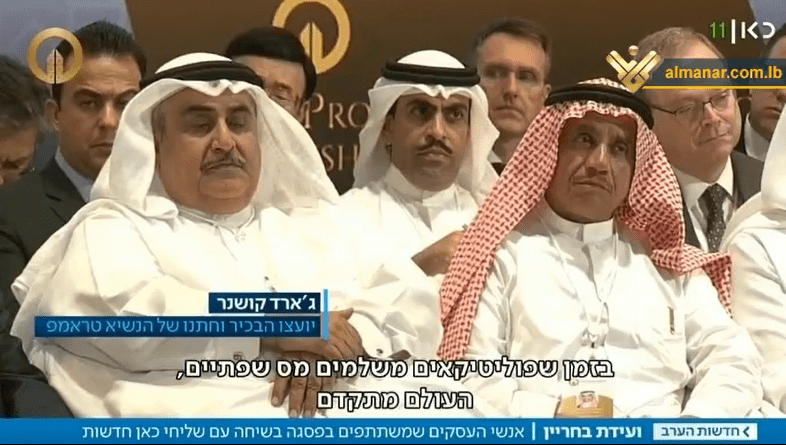
Al-Manar | November 6, 2019
In context of the process aimed at normalizing ties between the Zionist entity and the Gulf States, the Israeli media revealed that the two sides were preparing a non-aggression pact sponsored by the US administration.
Zionist analysts considered that Washington is trying to endorse the non-aggression pact as a substitute for the failed ‘Deal of the Century’, adding that the US Treasury Secretary conveyed the Israeli-prepared draft to the Gulf officials.
The Isralei media also unveiled the enemy’s participation in investment projects and expos in Saudi and Emirates, adding that Tel Aviv specialized hundreds of millions of dollars for this purpose.
How Amazon Supports Israeli Atrocities
Produced by Chris Smiley of If Americans Knew | November 6, 2019
More news and headlines: https://israelpalestinenews.org/
At This Year’s J Street Conference, “Progressive” Pols Bow to Israel While Preaching Peace
By Miko Peled | MintPress News | October 30, 2019
My father, the late IDF general Matti Peled, called for a two-state solution in 1967, and as is stated in my book, The General’s Son, Journey of an Israeli in Palestine, he continued to campaign for this “solution” until the day he died. It may have been a revolutionary idea then, especially coming from a retired IDF general. Some would even call it progressive, though I personally would not go that far. It presented a path for Israel to gain legitimacy for its 1948 conquest of Palestine while placating the Palestinian people by giving them a small, powerless state that would allow them to exercise their right to self-determination.
Two decades later, when it was clear that Israel would never allow this to happen, my father called for the U.S. to halt its financial and military aid to Israel. By 1992, he called for sanctions against Israel. So when Bernie Sanders and other so-called progressives like J Street talk about a two-state solution and the possibility of using aid to pressure Israel, they are decades late and billions of dollars short. Without full support for the Boycott Divestment and Sanctions movement, BDS for short, no progress can be achieved for Palestinian rights.
A Safe Bet
Back in the late 1960s and early 1970s calling for the establishment of a Palestinian state in the West Bank and the Gaza Strip was dangerous because there was a real possibility that it could happen. Today, after five decades in which consecutive governments of Israel have worked tirelessly to integrate the West Bank with the rest of the state of Israel, a Palestinian state is no longer possible and calling for it is a safe political move. Bernie Sanders knows it, the folks at J Street know it, and all the other so-called progressives know it too. A bold, progressive move would be to call for a democratic state with equal rights for all of Palestine, from the river to the sea.
However, we mustn’t get ahead of ourselves. One has to ask, where were these progressives when the possibility of a two-state solution was feasible? This is not to say it was a just or good solution, for it did legitimize the Zionist crimes of 1948 and earlier. Setting that aside for a moment, where were these so-called progressives when the possibility of an independent Palestine emerging in the West Bank and the Gaza Strip was a real possibility? They were nowhere to be found.
While the official line of consecutive U.S. administrations was that UN Security Council resolutions 242 and 338 should be the basis of a peace agreement, neither the various administrations or other American politicians outside of the administration did a single thing to push this idea forward.
Now that is it too late, and it is clear that Israel never intended to allow the Palestinian right to self-determination to materialize, and now that we know that the “peace process” concocted by the Rabin-Peres duo was nothing more than a charade, the Bernie Sanders and J Street liberals decided to make a “bold” statement out of an old, outdated idea. But there is nothing bold about their support for Israel. There is nothing progressive about waiting five decades to support an idea that has no chance of becoming reality.
A Step in the Right Direction
The last thing that can be said about this very slow learning curve is that it is a step in the right direction. Recognizing and declaring today that the Palestinian people have been subjected to genocide, ethnic cleansing and apartheid for over seven decades is still slow, but it would signal a real step in the right direction. However, neither Sanders nor his hosts at the J Street conference are willing to go that far.
The farthest Sanders is willing to go is to say that he supports Israel and that Palestinians have been treated unfairly. Now, he is suggesting that some of the $3.8 Billion of aid money going to Israel should be diverted to resolve the ongoing humanitarian crisis in Gaza. How much? He didn’t say. So why not suggest halting aid to Israel altogether and sending those billions of dollars to the people who really need them in order to rebuild Gaza and provide medical care, water, and food.
The problem is that we have all become accustomed to believing that Palestinians should never ask for too much. Palestinians should be grateful for the scraps offered to them by white rich politicians in the United States and Israel. They should welcome the idea that Israel will “give” them a fraction of their homeland in which to build a mini-state. They should be grateful that a politician in the U.S. said publicly that they are treated unfairly. Palestinians should not be unreasonable and they should refrain from calling for anything that would bother Israel and its Zionist supporters around the world.
BDS
The call for Boycott, Divestment, and Sanctions against Israel is a step too far for Sanders and J Street, the latter claiming that it is opposed to the call for a boycott and that “The Movement is not a friend to Israel.”
Palestinians, apparently, are required to prove that they are friends of Israel before their demands can be heard, much less accepted and also to recognize the right of Israel to exist, another absurd demand regularly made of Palestinians.
The fundamental problem lies in statements such as this by J Street: “J Street believes that maintaining a strong, vibrant US-Israel relationship […] US support for Israel as a democracy and a national home for the Jewish people is an historic and crucial commitment.”
As long as the U.S. relationship with Israel is viewed as more valuable than the human rights of the Palestinian people, justice for Palestinians will remain a distant dream. Without support for BDS and their declared demands, namely: ending Israel’s military occupation of Palestinian land, equal rights and the right of refugees to return to their homes and their land, no progress can be made.
Hold the Champagne
Reading posts on Twitter while the J Street conference was taking place in Washington could give one the impression that justice for Palestinians is just around the corner. However, it is Israel that was the focus, not Palestinian human rights. The ongoing discussion of the two-state solution at the event acted as a fig leaf, shielding Israel from true criticism and allowing human rights violations in Palestine to continue unabated.
Statements like this one, made by Julian Castro, are indicative of a prevailing head in the sand, ostrich-like attitude: “We need a government in Israel that will get back on the path of the two-state solution.” No one bothered to ask if Israel was really ever on that path.
Bernie Sanders made a statement at the J Street conference that was also indicative of a desire to intentionally miss the target: “It is not anti-Semitism to say that the Netanyahu government has been racist – that’s a fact,” he said. Netanyahu is, without question, indeed a racist. Yet he is no different than any other Israeli prime minister. The issue is not a single prime minister, it is the entire Zionist settler-colonial project in Palestine which is the problem.
How Much Longer?
More than five decades had passed since my late father, one of the exalted IDF generals of the 1967 war, called for a two-state solution. A solution that favors Israel and recognizes very limited rights for Palestinians and is a poor excuse for a peace plan. A solution that ignores the crimes which my father, among others, committed in 1948. A solution, which in fact legitimizes those crimes. It is a “solution” behind which politicians who want to seem progressive can hide because it offers no solution. It is a solution popular among those who pretend to care for justice and human rights but that do not want real change. One must ask how much longer this charade will be allowed to continue.
The UN exploits Palestinian children to further the two-state propaganda

By Ramona Wadi | MEMO | October 23, 2019
There is one thing the UN and its personnel would do well to keep in mind when pontificating about the purported peace process and to promote Israel’s security narrative: Palestinian children are not props for exploitation. At a time when the United Nations Relief and Works Agency for Palestine Refugees is facing a severe crisis due to funding shortages, as well as the misdemeanour allegations concerning its staff, the last thing the UN should be doing is exploiting Palestinian children for the sake of upholding the obsolete two-state compromise.
Earlier this month, the UN Special Coordinator for the Middle East Peace Process Nickolay Mladenov posted a photo on Twitter, of himself and UN Under-Secretary-General for Political and Peacebuilding Affairs Rosemary DiCarlo, together with a group of female refugee students attending one of UNRWA’s schools. “I hope these young girls grow up to participate in democratic elections where Palestine, Israel live side-by-side in peace and security,” he tweeted.
Just because the colonial narrative makes Israel, peace and security synonymous doesn’t mean there are no inherent contradictions in the rhetoric. The UN, a collaborator since before the inception of Israel, is, of course, aware of the discrepancies, but it prefers to enforce historical cycles of dispossession upon Palestinians, including students, framing them as a warped peace process in which Israel’s existence is paramount, even at the expense of Palestinian lives.
Mladenov’s wish for Palestinian children is not that they exercise their right to live freely in all of historic Palestine. On the contrary, he is demanding perpetual subjugation and oblivion of the Palestinian right of return, and what better way to attempt indoctrination than with the younger generations, according to the UN’s delusional standards?
But Palestinians have remembrance, and that remembrance is political. Has Mladenov deigned to listen to the Palestinian children’s refugee narratives? Are Mladenov and the UN expecting future Palestinian generations to exploit themselves for Israel’s colonial plans? How do UN officials reconcile democracy with the colonialism inherent in the two-state paradigm, which is the purported solution envisaged for Palestinians by the international community?
Taking the latter one step further, since the UN knows that the two-state hypothesis is obsolete, it stands to reason that these Palestinian children, along with many others, will be witness to further colonial appropriation by Israel. Mladenov’s legacy to this group of students will be nothing other than a promotional photo taken for UN propaganda purposes, while in the background; Palestinian families are permanently ruptured and dispossessed by Israel.
UN antics are not impressive; they are endangering the lives of Palestinians and attempting to tarnish students with acquiescence. Parroting about democratic elections while envisaging perpetual colonialism is vile, all the more when involving students in UN propaganda. So, stop the rhetoric of hope, which is an illusion when there is factual support for the elimination of Palestinian rights. Mladenov never intended Palestinian students’ voices to reach the international arena. The promotion photo speaks volumes about how the UN coerces Palestinians into silence. When the focus is Palestinian children facing perpetual refugee status, it is clear the UN could not sink any lower.
Soldiers Force Palestinians Out Of Their Olive Orchards In Nablus

IMEMC | November 2, 2019
Israeli soldiers invaded Palestinian olive orchards between Burin and Huwwara towns, south of the northern West Bank city of Nablus, and forced the Palestinians out on Saturday, in addition to threatening them with “bringing the settlers to attack them.”
Eyewitnesses said the soldiers invaded the orchards near the illegal Yitzhar colony, which was built on private Palestinian lands, and attacked the families.
The soldiers even told the families that if they do not leave, they will bring the colonists from Yitzhar, known for constantly attacking the Palestinians and their lands, to assault them.
Olive harvest season in the occupied West Bank is always accompanied by dozens of Israeli violations by both the soldiers and the illegal colonists.
There have been numerous violations this olive harvest season alone, including twelve just recently in Qaryout village, south of Nablus.
The attacks include assaulting Palestinians, uprooting their trees, burning their lands and orchards, in addition to the military’s refusal in many cases to allow the Palestinians into their lands, isolated behind the illegal Annexation Wall.
It is worth mentioning that the Palestinians in Nablus governorate are not allowed to enter more than 3,500 Dunams of their olive orchards, except for a few days a year, after prior coordination and approval from the military.
Even when they receive the permits, the Palestinians and are forced to wait until the soldiers open the gate for them, and sometimes the soldiers do not open it at all or force them to wait for long periods.
On Friday morning, several colonists invaded a Palestinian orchard in Yasuf village, east of the central West Bank city of Salfit, and stole a donkey, blankets and olive picking tools.
Such attacks against Palestinian lands, especially olive orchards, including those carried out by soldiers, take place in various areas across the West Bank, always escalate during the olive harvest season, and include cutting, burning and uprooting trees, picking olive trees and stealing the produce, in addition to assaulting the Palestinians and forcing them out of their orchards.
Trump Freezes Lebanon Military Aid After Israel Voiced Concerns
By Tyler Durden – Zero Hedge – 11/02/2019
Amid recent statements by both Iranian and Hezbollah leaders accusing the United States of hijacking the massive anti-corruption protests which have gridlocked Lebanon for over the past two weeks, the White House has made the dramatic and unexpected move of freezing US military aid to the Lebanese Army.
The money, part of a military aid package totaling $105 million, had been approved by Congress and the State Department, and requested by the Pentagon. Interestingly, proponents of the package argued that it would allow the Lebanese Army to grow more independent, making it less cooperative with Hezbollah.
According to Reuters the aid was frozen two days following Tuesday’s resignation of Lebanese Prime Minister Saad al-Hariri, who in a parting speech admitted he’d “reached a dead end” amid the protests which have reportedly involved one million people, or up to 25% of Lebanon’s total population, and further called on “all Lebanese to protect civil peace”.
The United States, said the report, has frequently voiced “concern over the growing role in the Beirut government of Hezbollah, the armed Shi’ite group backed by Iran and listed as a terrorist organization by the United States.”
Secretary of State Mike Pompeo this week called on Beirut to take steps for a new unified government which focused on rooting out endemic corruption.
Though no specific reason was given as to why the White House has targeted Lebanon for an aid freeze, Trump has lately signaled his disdain for the amount of foreign aid Washington hands out around the world, seemingly with no strings attached.
On Friday, an Israeli media report revealed that officials in Tel Aviv had lobbied the White House to condition any US Lebanese aid based on the country removing advanced arms in possession of Hezbollah — something it should be noted that Lebanon’s national forces are likely incapable of, given the Shia paramilitary organization is actually considered stronger.
The Foreign Ministry ordered Israeli diplomats “in all relevant countries,” including the US and European states, to emphasize the need to cease providing aid to Lebanon as long as the Iran-backed Hezbollah terror organization does not cease upgrading its military capabilities that could target Israel, the official added. — Times of Israel
“In discreet talks with various capitals, we made it clear that any aid meant to guarantee the stability of Lebanon needs to be conditioned on Lebanon dealing with Hezbollah’s precision-guided missiles,” a senior official told The Times of Israel. “Anything short of that will be problematic, in our eyes.”
This could mark a big first step in Trump cutting of aid to ‘dysfunctional’ governments and/or governments made up of elements which are hostile to the United States, as is the case with the designated group Hezbollah.
Lavrov: US’ ‘Deal of Century’ Example of Swapping International Law for Norms Suitable for US
Sputnik – November 1, 2019
MOSCOW – The so-called deal of the century on the Israeli-Palestinian conflict settlement that Washington says it is preparing is an example of how the international law is changed for rules that the United States finds convenient, Russian Foreign Minister Sergey Lavrov said.
“Instead of implementing these [UNSC] resolutions, the United States promises everyone to present some ‘deal of the century,’ which, as you have already understood, will not envision the creation of a full-fledged Palestinian state. This is an example of how international law represented by UNSC resolutions is swapped for rules that the United States has invented and which it finds convenient”, Lavrov said in an interview on TV on Friday.
The administration of US President Donald Trump has for years said it would announce its plan for Israeli-Palestinian peace. In July, it released what was characterized as an economic component of the plan — an infrastructure and investment project to support Palestinians.
However, the Palestinian authorities have rejected Washington’s involvement in the settlement of their conflict with Israelis after Trump recognized Jerusalem as the capital of Israel and moved the US embassy from Tel Aviv to the Holy City despite the condemnation of the Muslim world and the UN recommendations to refrain from establishing diplomatic missions in the city until its legal status is settled.
The UN Security Council has issued multiple resolutions on the Israeli-Palestinian settlement. For years, the Arab world remains committed to the Arab Peace Initiative, originally agreed upon at the Beirut Summit back in 2002. The plan has been formed on the basis of the UNSC Resolution of 194.
Featured Video

Seyed M. Marandi: US-Iran War Inevitable: Kuwait and Bahrain May Fall
or go to
Aletho News Archives – Video-Images
From the Archives
USS Liberty Massacre: A Pivotal Moment in the Hostile Takeover of America
By Kevin Barrett | Crescent | Dhu al-Qa’dah 24, 1445
In corporate America, hostile takeovers are commonplace. They occur when an aggressor—a larger corporation or rich individuals—seizes control of a smaller corporation without asking permission.
What few recognize is that the United States itself has been subjected to a hostile takeover. Since the aggressor, the illegitimate settler colony known as “Israel,” is much smaller than the US, the takeover has necessarily been surreptitious.
As of June, 2024, Israel’s gradual takeover of the US has become obvious and undeniable—a proverbial “elephant in the living room.” … continue
Blog Roll
 Aletho News
- Seyed M. Marandi: US-Iran War Inevitable: Kuwait and Bahrain May Fall
- Leaders Condemn Ansarallah Attack on Saudi Arabia While Ignoring Illegal War Against Yemen
- Leaked: Britain’s Covert Iraqi Psyops Network
- Yemeni Armed Forces Warn Airlines Against Using Saudi Airports, Exempt Mecca and Medina
- Iran security chief says powers greater than US tried to conquer Iran but ended in ‘dustbin of history’
- Europe’s mounting social chaos… chickens coming home to roost for proxy war against Russia
- US-Russia Diesel Deal Becomes Massive Defeat for Ukraine
- Hormuz and the Looming Economic Catastrophe
- Dhubab offensive, media blitz and the rapid unraveling of Saudi-backed coalition’s new gambit
- Putin Conveys to Trump Iran’s Vision on Possible Conflict Resolution – Kremlin
- If Americans Knew
- Gaza: Ceasefire Anniversary Marks Year of Failed Promises
- The American Conservative: Mike Huckabee Should Resign
- A C-Section in Shackles: A Palestinian Woman’s Harrowing Birth in Israeli Detention
- ‘He’s Desperate’: AIPAC Begins Spending Against Abdul El-Sayed to Boost Mike Rogers:
- Trump, Hormuz, and the Looming Economic Catastrophe
- For three years, Israel has killed a child in Gaza every 71 minutes – Daily Update
- Israeli forces kill another child in Gaza – Daily Update
- Gaza ceasefire exists in name only, say more than 100 organizations
- Nearly 2 Million in Gaza Need Urgent Shelter Assistance as Winter Looms: IOM Chief Warns
- Suppressing Palestinian resistance: US charity under fire for AI monitoring of Gaza classrooms
- No Tricks Zone
- Germany’s Green Energy Debacle: High Energy Costs Force Kahla Porzellan to Close After 182 Years!
- New Study: 50 Years Of The Most Aggressive ‘Net Zero’ Policies Can Only Affect The Global Climate By 0.03°C
- US September “Heat” Was No Record…Many Records Set Decades Ago
- Latest European Green Energy Debacle; Portugal’s Largest Flagship Solar Park Insolvent!
- Green Energy Debacle: German Expert Professor Fritz Vahrenholt Warns Of Severe Economic And Social Consequences
- Two More Paleo Reconstructions Affirm Meters-Higher Sea Levels Across Ireland, Brazil 7000-6000 Years Ago
- New Study: Earth And Venus Surface Warmth Largely Explained By Convection And Lapse Rate, Not CO2 Or Radiation
- 2025 Nature Paper Claiming Worsening Global Drought Gets RETRACTED …Heavily Flawed
- New Study: ‘Global Drought Shows No Detectable Recent Acceleration Under Climate Warming’
- Economic Masterminds: German Socialists Suggest Taxing Productivity Gains Stemming From Using AI

