Rethinking America’s greatest threat: Iran vs. Israel-Firsters
By Jamal Kanj | MEMO | March 31, 2026
I filled my car tank this week and paid 40% more than I did just a month ago. That isn’t just an economic abstraction, but another indirect Israeli “surcharge” on American consumers. Meanwhile, Donald Trump spends another getaway weekend at his Mar-a-Lago golf course, a trip subsidized by the same taxpayers who are forced to choose between feeding their families or fueling their cars.
Trump’s campaign rhetoric against foreign wars had resonated with American voters who wanted their government to prioritize domestic economy over foreign intervention. He built his movement by criticizing past administrations, Republican and Democrat, for squandering American blood and money abroad. Nevertheless, here we are again: record-high gas prices at home, and thousands of miles away, American soldiers are once again in harm’s way, drawn into another made-for-Israel war.
“Drill, baby, drill,” Trump promised to lower oil prices. Reality, however, tells a different story. The U.S. is producing more oil than ever, and consumers are paying as never before. Why? Because “drill, baby, drill” was never about lowering prices, it was about maximizing profits.
During the 1973 oil crisis, the American Israeli-managed media blamed the higher prices on Arab “greed,” often resorting to racist and derogatory stereotypes. Today, U.S. companies produce enough oil to meet or exceed domestic consumptions, yet tax-subsidized oil corporations keep prices at record highs. Suddenly, it isn’t “greed” anymore, or “towelheads,” it’s just “market” prices. This is while Trump continues to claim that the U.S. is not impacted by oil moving through the Strait of Hormuz.
If so, what exactly is driving prices? If it’s neither production costs nor a supply-and-demand imbalance, then what is it? Profiteering from international crises 7,000 miles away. What’s the value of “drill, baby, drill” and boasting about “oil independence’” if American consumers pay international crisis prices for oil extracted from America’s backyard? The reality is a bitter irony: U.S. taxpayers subsidize the production of oil, but still pay a war premium “market” price.
None of this should come as a surprise. It is part of being dragged into a war planned in Tel Aviv, promoted by “Israel-first” loyalists in Washington, and disconnected from America’s national interest. It is the geopolitical equivalent of a reckless spender charging a credit card with no intention of footing the bill. The proxy dictates the strategy, while the American public is left to pay for the fallout.
It is a lopsided relationship, because in Washington, access is about money not representation. Israel-first policies are not discussed in town halls, but planned behind closed doors in donor circles. Take for instance, the late Sheldon Adelson who bought Trump’s policies: moving the U.S. embassy to occupied Jerusalem, and the illegal recognition of Israeli theft of the Syrian Golan Heights. Today, his widow, the Israeli/American, Miriam Adelson is pushing for wars on behalf of the country she “loves more” than America.
Trump promised to put “America First,” in actuality, it is Israel-first donor’s agenda: billionaires like Larry Ellison, Bill Ackman, Alex Karp, Miriam Adelson, Haim Saban, Michael Dell ,,, etc. Their Israel-first wish list, supersedes America First.
The contradiction becomes even sharper when rhetoric is measured against action. As a presidential candidate, Donald Trump repeatedly attacked Joe Biden for funding military support to help Ukraine fight its own war. Yet as president, he is now asking Congress to add $200 billion to an already swelling deficit and conscripting American soldiers to fight on behalf of another country. And to pay for it, Republican leadership is considering billing the American patient through cuts to domestic healthcare.
It’s beyond comprehension. Republicans suddenly discover their “fiscal conscience” willing to defund the health of their own citizens, when they can pay for it, at least in part, by trimming the massive annual aid to Israel and its military industrial complex.
Trump’s hypocrisy, falsehoods, and relentless projection are no longer just personal or political quirks, they have become normalized in Washington. For him, projection functions as a survival mechanism: attacking others to mask his own inadequacies. The ironies are as consistent as they are galling: Trump once mocked Barack Obama for playing too much golf, when he spends his weekends—even in a time of war—on his own greens. He branded Joe Biden as ‘Sleepy Joe,’ when it is Trump who now drifts off during high-stakes briefings and meetings. He does not merely criticize his opponents; he projects his own deficiencies onto them, displacing his reality to escape accountability.
Recent hyperbolic statements underscore those concerns. In five consecutive days, Donald Trump fired off at five shifting positions regarding the Strait of Hormuz. A frantic confusion that signals a policy sinking deeper into a foreign quagmire. This is the definition of a failed command: objectives that mutate by the hour, missions that expand without clarity, under a stewardship that reacts instead of leading.
Amid this uncertainty, Americans are justified in asking fundamental questions. Why is Trump hell-bent on attacking Iran, a country under the International Atomic Energy Agency (IAEA) oversight, its program has been repeatedly certified as civilian, while Israel is permitted to maintain a secret nuclear arsenal, no IAEA supervision, and with zero accountability? Why would Washington demand absolute transparency from Tehran while enabling the total opacity of Tel Aviv.
Even more critical, how is a nuclear-armed Iran, equipped with a delivery mechanism, a credible threat to the U.S.? By what logic would it pose more of a risk than the nuclear arsenals of North Korea, China, or Russia? How does Iran rise above these in the hierarchy of existential risks? It does not, because this is less about the U.S. than it is about Israel.
America’s greatest threat is not Iran’s nuclear technology, it is rather the undue influence of Israeli firsters embedded in the U.S. media, Congress and the White House steering an Israel-first agenda that leverages American credibility, and channels U.S. resources to serve Israeli endless wars.
No Threat Can Force Iran’s Surrender /Trita Parsi & Lt Cl Daniel Davis
Daniel Davis / Deep Dive – March 30, 2026
Growing insecurity, soaring prices fuel protests in north as regime bans evacuation: Sources
Press TV – March 30, 2026
The worsening situation on the internal front of the Israeli regime, particularly in the northern occupied territories, has driven up food and transportation prices, fueling settler discontent.
According to informed security sources, regime authorities have refused to permit the evacuation of settlers from northern areas, despite deteriorating security conditions amid Hezbollah’s unstoppable retaliatory strikes.
Rising costs of essential goods, including food and transportation, have intensified pressure on settlers, contributing to a growing wave of anti-regime protests.
Discussions across Israeli social media platforms reflect increasing skepticism toward official narratives regarding developments in the north.
Users have questioned regime claims on the extent of damage and casualties, asserting that actual losses far exceed what is being reported.
Some posts also emphasize that the regime’s defensive capabilities in the region have significantly degraded, while Hezbollah has effectively rendered life unsustainable for settlers in northern areas.
Meanwhile, emerging reports suggest that regime authorities are deliberately avoiding a full evacuation of settlers from the north, even as security conditions worsen amid intense exchanges of fire.
Analysts attribute this decision to deep concerns that, once evacuated, settlers may refuse to return – a scenario that would deliver a severe blow to the regime’s long-term strategic position in the area.
According to sources, military forces have been deployed to forcibly prevent settlers from leaving, underscoring the regime’s determination to project an appearance of normalcy even as conditions on the ground tell a different story.
Hezbollah has carried out a record number of retaliatory operations against the occupied territories, sowing fear among the settler population in the north.
Yet the regime remains intent on portraying normalcy across the occupied territories while concealing the true scale of casualties and damage sustained from retaliatory strikes, both from Hezbollah and the Iranian armed forces.
Iran denies responsibility for ‘depraved’ attack on Kuwait desalination plant
The Cradle | March 30, 2026
The Iranian military denied on 30 March the recent attack, which hit a desalination plant in Kuwait, labeling the strike a US-Israeli false-flag operation aimed at “destabilizing and destroying the region.”
“The brutal aggression by the Zionist regime against the desalination facility in Kuwait, carried out in recent hours under the pretext of accusing the Islamic Republic of Iran, is a sign of the vileness and depravity of the Zionist occupiers,” the Khatam al-Anbiya Central Headquarters of the Iranian army said in a statement.
“We declare that US bases, personnel, and their interests in the region, as well as the military, security, and economic infrastructure of the Zionist regime in the occupied Palestinian territories, remain powerful targets for us,” it added.
The Iranian military went on to urge “countries of West Asia must remain vigilant against the sedition of the US–Zionist axis aimed at destabilizing and destroying the region.”
Regional states “must put an end to the presence of the criminal US army and occupying Zionists in the region,” it stressed.
The attack on the desalination plant took place on Sunday.
“A service building at a power and water desalination plant was attacked as part of the Iranian aggression against the State of Kuwait, resulting in the death of an Indian worker and significant material damage to the building,” said a spokesperson for the Kuwaiti Electricity Ministry.
This is not the first attack Tehran has labeled a false flag.
Iran has also denied recent strikes on fuel tankers in Oman and a refinery in Iraq’s Erbil, as well as one that targeted an Aramco facility in Saudi Arabia at the start of the month.
US journalist Tucker Carlson reported earlier in March that Mossad agents were detained in Gulf states for planning bombings.
Iran’s Foreign Minister Abbas Araghchi said on 15 March that the US has been using its new Lucas drone – modeled after the Iranian Shahed – to carry out false-flag attacks in the region and attribute them to the Islamic Republic.
Tehran has said only US and Israeli-linked military and economic assets in the Gulf will be struck by its forces.
Iran is warning Gulf governments against allowing Washington to use their bases for attacks on the Islamic Republic.
Iranian drone and missile strikes targeted the Prince Sultan Air Base in Saudi Arabia on 27 March, wounding at least 12 US troops and damaging aircraft and buildings.
A senior Iranian intelligence official told The Cradle on 26 March that the Islamic Republic is preparing a “strong response” against the UAE due to the “active role” it has played in the US-Israeli war on it.
“A decision has been made at the leadership level to end the weeks-long tolerance toward this country. In addition to US military barracks and bases in the UAE, which were targeted in Iran’s defensive attacks, the Emiratis also provided some of their own air bases to the US to be used in attacking Iran,” the intelligence officials went on to say, citing security reports.
“The UAE is considered a foothold for Israel in the region,” the source continued, adding that Abu Dhabi has “carried out misleading operations against Oman and other countries” – likely a reference to false-flag operations pinned on Iran.
Bring The Troops Back. End This War Now!
By Ron Paul | March 30, 2026
As we begin a new week, the media is filled with reports that President Trump is ready to approve a US ground operation against Iran, either to seize Iran’s uranium or to attack an island off the country’s coast. Thousands of US troops have sped to the conflict area to await President Trump’s decision.
The President is on the verge of making a serious mistake to add to a series of deadly mistakes that have characterized this terrible war of choice against Iran. A US ground operation against Iran would only achieve the death of thousands of US servicemembers.
Of course, if our Congress was doing its job, this debacle would never have started. Clear signals would have been sent to the President by Congressional leadership that in the absence of an imminent attack on the US, the US President must go to Congress to make the case for taking the country to war. Instead, what we got was a shrug of the shoulders from Capitol Hill that has already cost billions of dollars and too many lives.
As we stand on the verge of a major ground operation, the main stated goals of the war are that Iran does not have a nuclear weapon and that the Strait of Hormuz is open for shipping. But both of these things were already true before the war started! Now we are expanding the war to try and reverse the negative consequences of starting the war in the first place!
What was supposed to be a quick “shock and awe” to frighten Iran into capitulation has expanded rapidly and is costing the US dearly. As the New York Times has reported, every US military base in the region has been either destroyed or is severely damaged. Billions of dollars in US military equipment has been destroyed in Iran’s response to the US attack. Just over the weekend, a half-billion dollar US radar aircraft was destroyed at a US base in Saudi Arabia, along with several air tankers.
Iran warned that if the US launched another surprise attack this is how they would respond. The arrogant US Administration was sure they were bluffing.
The American people may not be getting the full picture of this disaster because they are being lied to – again – by the pro-war mainstream media. The war is going wonderfully, they report. We are obliterating Iran, they say. But what is really being obliterated is a complex global supply chain not just in oil and gas, but in the multitude of products related to oil and gas. Products such as the fertilizer needed to feed the world.
Already we are seeing gas riots in some Asian countries. Fuel rationing and stay-at-home orders have been issued. Australia is set to completely run out of diesel, gasoline, and jet fuel in just weeks. That means no food gets delivered. Power generation plants are shut down. Life becomes unlivable for many.
This is like the foolish move to shut down the global economy during COVID. In fact it is worse. This disaster will not end when the bombs stop falling. It will only be getting started. A worldwide depression may be upon us all because of a war of choice that was illegally launched.
When you are in a hole, it’s best to stop digging. Expanding this war to include a ground operation would be a massive digging operation. It needs to stop. Now.
Can we please stop calling Israel the ‘only democracy in the Middle East’ now?
By Martin Jay | Strategic Culture Foundation | March 30, 2026
The murder of three Lebanese journalists brings the U.S./Israel war with Iran to a new level of depravity and desperation. But journalists are to blame for this.
It’s hard to fathom what is more shocking about the news of three Lebanese journalists being targeted by Israel’s IDF and killed while working: the actual murder of the journalists or the lack of hue and cry by western media who are partisan to both the practice of murdering journalists and to how the stories of them being killed are framed.
Israel for a long time has had an extraordinary hold on western media which largely operates like a PR platform for its objectives. Journalists are not allowed to enter Gaza and so have to resort to the Stockholm Syndrome working relationship with the IDF’s press office which gives them distorted ’facts’ about what’s happening on the ground, omits critical information and in some cases actually feeds them fake news, lock, stock and barrel. We are told journalists cannot enter Gaza for their own safety, which is as preposterous as it is comical, as Israel has an impressive track record by now of targeting and assassinating journalists.
The murder of three Lebanese journalists though has raised the stakes of Israel’s war with Iran and shown us how desperate the government is, as it struggles to cope with the country being slowly reduced to rubble by Iran’s missiles pounding it every day. The war now seems to be less about the scoresheet of who hit what and more about forcing journalists at gunpoint to write up false ’news’ or, in the case of many major western outlets like the BBC, simply not report on Iran’s strikes on the ground. In this environment, of course, public opinion cannot be allowed to go rogue and hold both the U.S. and Israel to account, as what we are seeing on our TV screens is entirely distorted and bears little or no resemblance to reality.
The murder of the three Lebanese journalists will be seen as a great victory by the IDF as it will send a chilling reminder to all journalists in Lebanon that they have to follow the script, or they will be targeted. But it also marks itself as a milestone in war reporting in general, in that now there is no more ambiguity about journalists being seen as legitimate targets on the battlefield, and this will have a knock-on effect around the world as journalists fail to detach themselves sufficiently from armies, governments and regimes, and when they put on a flak jacket marked ’press’ they present themselves as partisan and therefore a regular target just like the soldiers they are with.
Corruption also is at the heart of this sad story. Both Netanyahu and Trump are either being investigated for corruption or will certainly be on a grand scale when they leave office. They simply cannot leave office, and their only way of staying in power is to create mayhem and chaos for media to feast on while the spotlight is turned off them temporarily. New footage has been recently released of Netanyahu being interviewed by police officers who are investigating him on graft allegations surrounding expensive gifts that are given to him by those who seek favours from his office. This is believed to be the tip of the iceberg, though, and when police officers dig deeper they will find larger, more significant examples of corruption. Bibi will certainly serve a prison term if investigators are allowed to work freely and the judiciary system is allowed time to process the case. But in this period of war, it is expected that his case will be stalled. The invasion of Lebanon, which has provoked Hezbollah to hit targets within Israel, served its purpose perfectly to take the state of emergency in Israel to a new level where such proceedings are expected to be left to settle as dust. Trump on the other hand seems to have distracted U.S. media away from reporting on the thousands of pages of details about him having relations with children which, one would have thought, would have affected his support from his own base.
Both men desperately need to control the media narrative, and so murdering journalists and telling other media that those who were killed were working for Hezbollah and using the press as a front is straight out of the Donald Trump Art of the Lie handbook. Trump is telling so many lies at the moment on an hourly basis about what is happening in Iran that journalists cannot complain about being targeted for reporting on facts if the vast majority of them simply replicate everything that comes out of his mouth as fact, more or less. This is where the war is. If we don’t ask difficult questions and report what Trump and Netanyahu are saying or claiming as false, it’s easy to understand just how much power they think they can wield over journalists who largely play along with the false reporting simply due to fear of being targeted. Literally.
The losses, just as one example, of U.S. military hardware is pure fiction. According to Trump, warships are out of action due to poor maintenance and fighter jets just keep falling out of the sky due to friendly fire. It’s a Hollywood movie script which a lot of journalists are helping him to develop each day. But the fact is that there are no U.S. journalists who are reporting the plain facts. The Straits of Hormuz has been taken over by Iran, the U.S. has almost no missiles left, its two aircraft carriers are limping home due to strikes, oil prices have risen which has given both Iran and Russia huge amounts of money to spend on their own wars, and Iran has emerged stronger, richer and a bolder new nuclear power which it wasn’t before. As a cherry on top of that spectacular failure by Trump and Israel, the U.S. has lost both its influence in the region and soon its petrodollars. I once wrote a week before the war that fake news will play a huge role in any war that Israel carries out with Iran and we should expect more journalists to be murdered, especially if the land invasion goes ahead and Trump will have to lie about the numbers of dead American soldiers. What I predict is that a second invasion somewhere will be staged just for the cameras which will be fed to journalists as ’handout’ video while the real battle surges forward with record casualties. Trump’s experience in reality TV and Israel’s already remarkable track record of video manipulation will play an empirical role, with the Lebanese journalists’ murder just encouraging them that anything is possible now with journalists.
Marandi: Yemen joins the war – Red Sea could be blocked next – Saudi regime at risk
Glenn Diesen | March 29, 2026
Seyed Mohammad Marandi discusses the ongoing escalation in the Iran War—and why Yemen’s sudden entry could be a game-changer. Marandi is a professor at Tehran University and a former advisor to Iran’s Nuclear Negotiation Team. (Some of the video is lagging due to the ongoing bombing of Tehran). Recorded 29.03.2026.
Follow Prof. Glenn Diesen:
- Substack: https://glenndiesen.substack.com/
- X/Twitter: https://x.com/Glenn_Diesen
- Patreon: https://www.patreon.com/glenndiesen
Support the research by Prof. Glenn Diesen:
- PayPal: https://www.paypal.com/paypalme/glenndiesen
- Buy me a Coffee: buymeacoffee.com/gdieseng
- Go Fund Me: https://gofund.me/09ea012f
Pro-Palestinian French member of European Parliament denied entry to Canada
MEMO | March 29, 2026
Rima Hassan, a French member of the European Parliament of Palestinian origin, said late Saturday she was denied entry to Canada hours before her scheduled flight, Anadolu reports.
“I was prevented from traveling to Canada: a troubling obstruction to parliamentary work and freedom of expression,” Hassan wrote on X.
Hassan is affiliated with France’s left-wing party La France Insoumise (LFI).
The party said Hassan had been invited to speak at two conferences in Montreal and that her initial electronic travel authorization had been approved by Canadian authorities.
However, she was informed by email late Friday, on the eve of her departure, that her application was under review, the party said.
Hassan said Canadian authorities requested extensive personal records just hours before her flight to reassess her travel authorization, describing the move as a “disproportionate request” unrelated to the stated grounds.
According to LFI, the review cited an alleged failure to disclose a prior visa refusal or denial of entry to another country, as well as an alleged failure to report a criminal offense, arrest, formal investigation or conviction.
The party said these issues relate to matters “directly linked to her political engagement in support of the Palestinian people.”
It added that the concerns stem from a 2025 denial of entry to Israel involving an EU delegation that included Hassan, as well as complaints for “apology for terrorism” that did not result in charges.
LFI also claimed that pro-Israel lobbying organizations had been working in recent weeks to prevent Hassan’s visit to Canada.
“The revocation of her travel authorization is part of a concerning trend of restricting the freedom of expression and movement of political representatives, as well as part of a broader pattern of censorship targeting democratic debate,” the party said.
The statement added that representatives of LFI and Canada’s New Democratic Party strongly condemned the decision, calling it “a serious infringement on the exercise of a parliamentary mandate and on freedom of expression.”
How Indonesia’s tilt toward the US left it stranded in the Strait of Hormuz
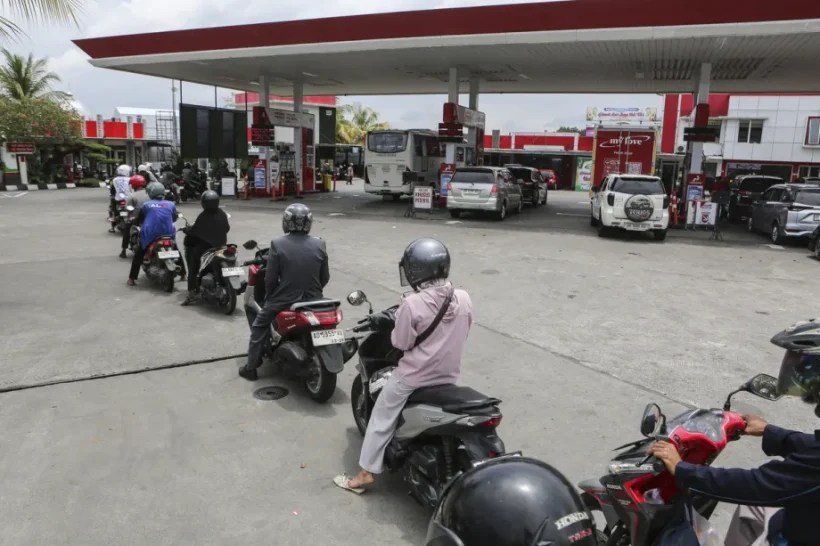
People line up for gasoline at a Pertamina’s gas station in Sukoharjo, Central Java, Indonesia, on March 26, 2026. [Agoes Rudianto – Anadolu Agency]
By Bhima Yudhistira and Dr. Muhammad Zulfikar Rakhmat | MEMO | March 29, 2026
In today’s fractured geopolitical landscape, energy flows are no longer governed by markets alone. They are shaped—often decisively—by politics. Nowhere is this clearer than in the unfolding crisis in the Strait of Hormuz, where Indonesia finds itself on the wrong side of a strategic divide.
As tensions escalate in the Middle East, Iran has adopted a selective approach to maritime access through the strait, one of the world’s most vital energy chokepoints. Rather than a blanket closure, Tehran has opted for a calibrated policy: friendly nations may pass; others must wait.
The consequences for Indonesia are immediate and stark. While countries like Malaysia, Thailand, China, India and Russia have secured safe passage for their tankers, two Indonesian vessels remain stranded. This is not a logistical hiccup. It is a geopolitical signal.
Iran’s own officials have made the logic explicit. Access is granted based on diplomatic alignment and strategic trust. Nations perceived as cooperative—or at least non-hostile—are accommodated. Others are left navigating uncertainty.
Indonesia, it appears, has misread the moment.
For decades, Jakarta prided itself on a doctrine of “free and active” foreign policy—non-aligned, pragmatic and flexible. That posture allowed Indonesia to engage multiple power centers without becoming entangled in their rivalries. But recent policy choices suggest a drift away from that equilibrium.
By signing the Agreement on Reciprocal Trade (ART) with the United States and joining the Board of Peace (BoP), Indonesia has moved beyond nominal non-alignment into visible proximity to the US orbit.
The ART is not merely a trade deal; it reshapes tariffs, supply chains and regulatory frameworks in ways that bind Indonesia more closely to U.S.-led economic and security systems. Meanwhile, the decision to join the BoP—widely criticized at home as a strategic misstep—signals alignment with Washington’s Middle East posture, particularly in the context of Gaza.
In Tehran’s eyes, these moves blur the line between cooperation and alignment. In a conflict environment defined by binary loyalties, even economic agreements and diplomatic platforms are read as strategic signals. In that context, perception is policy.
The cost of that perception is now measurable.
First, energy security. The Strait of Hormuz handles a significant share of global oil shipments, and disruptions there ripple across supply chains worldwide. If Indonesian tankers cannot pass freely, the country must source crude and liquefied petroleum gas from alternative routes—longer, riskier and far more expensive.
Shipping costs rise. Insurance premiums spike. Subsidy burdens swell. In a country where energy prices are politically sensitive, the fiscal implications are profound. What begins as a diplomatic miscalculation quickly becomes a budgetary strain.
Second, competitiveness. Malaysia and Thailand, having secured passage, are better positioned to maintain stable energy inputs and export flows. Their manufacturing sectors—already integrated into global supply chains—gain an advantage over Indonesia’s.
This is not just about oil. It is about the broader architecture of trade. Delays in energy supply affect production timelines. Disruptions in shipping lanes threaten exports of automotive components, industrial goods and commodities. In a tightly coupled global economy, reliability is currency—and Indonesia risks devaluation.
Third, macroeconomic stability. Higher import costs feed directly into inflation. A widening subsidy bill pressures public finances. And as external balances deteriorate, the rupiah faces renewed volatility. These are not abstract risks; they are the building blocks of economic stress.
All of this stems from a single, uncomfortable reality: geopolitics has overtaken economics.
Iran’s policy in the Strait of Hormuz underscores a broader shift in global order. Strategic chokepoints are no longer neutral spaces. They are instruments of leverage. Access is conditional. Neutrality, if not actively maintained, is easily questioned.
Indonesia’s response so far—continued negotiation and diplomatic outreach—may yet yield results. But negotiation from a position of ambiguity is inherently difficult. Other countries have secured passage not merely through dialogue, but through clear, consistent alignment in the eyes of Tehran.
Jakarta must therefore confront a difficult question: can it afford its current trajectory?
Recalibrating foreign policy does not mean abandoning partnerships or retreating into isolation. It means restoring balance. Indonesia’s strength has always been its ability to engage across divides—to be trusted by competing blocs precisely because it was not seen as belonging to any of them.
That credibility now needs rebuilding.
The immediate priority is practical: secure the release and passage of Indonesian vessels, stabilize energy supply and prevent further economic fallout. But the longer-term task is strategic. Indonesia must reassess its positioning in a world where neutrality is no longer assumed, but demonstrated.
The Strait of Hormuz crisis is a warning. It reveals how quickly global alignments can translate into tangible costs—and how vulnerable even large economies can be when geopolitical signals are misread.
For Indonesia, the lesson is clear. In an era of weaponized interdependence, foreign policy is no longer a distant abstraction. It is an economic imperative.
And getting it wrong is no longer affordable.
US has no choice but to retreat from Iranian borders: Top commander
Press TV – March 29, 2026
A senior Iranian military commander says the armed forces’ crushing strikes against US military assets will leave Washington with no choice but to withdraw its forces from Iran’s borders.
Commander of the Islamic Revolution Guards Corps (IRGC) Aerospace Force, Brigadier General Seyyed Majid Mousavi, said in a post on X that Iranian forces will continue to paralyze US radar networks and logistics while inflicting casualties on their personnel across the region.
“Iran’s intelligence superiority and precision strikes will leave the US with no alternative but to retreat from Iranian borders,” Mousavi said.
The commander noted that “the wreckage of AWACS, aerial refuelers, and demolished hangars speaks for itself.”
Mousavi also vowed that the country’s armed forces will soon add “more high-value targets to this list.”
US President Donald Trump is reportedly considering “limited ground operations” on Iranian soil. Iranian officials have warned that such a move will only lead to further casualties among American troops.
Iranian armed forces have launched 86 waves of retaliatory strikes against Israeli and US assets across the region, causing casualties and billions of dollars in damages.
Notably, a US Air Force E-3 Sentry AWACS command and control plane was struck and damaged during a March 27 missile and drone attack on Prince Sultan Air Base in Saudi Arabia.
According to Air & Space Forces Magazine, this specific attack also injured more than 10 service members and damaged several aerial refueling tankers.
Military analysts describe the loss of these “flying radars” as a “big deal” that has significantly crippled Washington’s ability to manage the battlespace in the Persian Gulf.
Beyond the AWACS and tankers, Iran’s attacks have damaged or destroyed radar systems, a Terminal High Altitude Area Defense (THAAD) missile defense system and Reaper drones in attacks on US bases in Saudi Arabia, the United Arab Emirates, Bahrain, Jordan and Kuwait.
Reports have also suggested that the US and its regional allies are “burning through” their supply of Tomahawk and interceptor missiles.
Since the war began on February 28, the Pentagon has already confirmed at least 13 US troops killed and roughly 200 wounded.
Iran Retaliation Strikes Chemical Plant Near Dimona
By Kurt Nimmo | Another Day in the Empire | March 29, 2026
On March 28, Iran’s Foreign Minister, Seyed Abbas Araghchi, condemned Israel’s attack on key Iranian infrastructure, including steel factories, a power plant, and civilian nuclear sites. He described the attacks as a serious escalation and vowed Iran would respond. “Iran will exact a heavy price for Israeli crimes,” he warned.
That heavy price arrived the following day. Israel’s Home Front Command said sirens were sounding in the Negev Desert, Dimona, Be’era, Arad, and Ashkelon. Ne’ot Hovav, formerly Ramat Hovav, an industrial zone (in occupied Al-Naqab) southeast of Be’er Sheva, and the site of Israel’s main hazardous waste disposal facility, was targeted. The Voice of Israel reported ten warheads falling in the Negev, while other sources indicate 27 targets were struck.
The zone is home to 19 chemical factories, including Makhteshim Agan, a pesticide plant, Teva Pharmaceutical Industries (implicated in the opioid crisis), and Israel Chemicals, a bromine plant. It was reported that a disulfide factory was struck. Molybdenum disulfide is an anti-seize lubricant designed to meet the requirements of military specification. It is not known if the disulfide factory in the Negev produced this disulfide variant.
The Negev Phosphates Chemicals Company, part of the ICL Group, is also located in the Rotem Industrial Zone and situated near the Dimona reactor in Mishor Rotem. It is Israel’s sole recognized nuclear fuel cycle facility. Israel extracts uranium from Negev phosphate deposits. The Rotem complex is a critical node within a broader Israeli-US military-industrial network. In addition to phosphates, the facility produces fertilizers and high-purity phosphoric acid.
The phosphate extracted from the Rotem site is exported to several ICL facilities in the United States. ICL is the sole supplier of white phosphorus to the US military, a substance internationally banned for use in munitions. ICL white phosphorus is used by the occupation army in Gaza and Lebanon to burn people, homes, and agricultural lands.
It is important to note that Site 512, near Kmehin west of Dimona on the Har Qeren mountain, is a secretive US War Department ballistic missile early warning facility operated by the United States Army’s 1st Space Brigade.
The AN/TPY-2 Surveillance Transportable Radar, or Forward Based X-band Transportable, a long-range, high altitude digital antenna array surveillance radar, is located at the site. Iran targeted a similar radar facility at the Muwaffaq Salti Air Base in Jordan, and another radar unit in Qatar. “There are strong indications that a number of other similar systems have been destroyed or damaged, as well,” reports the TWZ Newsletter, a website covering military technology.
Initial information provided by the Israeli Ministry of Environmental Protection indicates there was a leak of dangerous ammonia gas at the Ne’ot Hovav site following the Iranian missile attack. “The situation is rapidly escalating and has reached a dangerous and potentially hazardous level,” reported the Israel Home Front Command, a civil defense operation.
Last week, a spokesperson for Iran’s Khatam al-Anbiya Central Headquarters warned “all energy, information technology, and desalination infrastructure belonging to the United States and the (Israeli) regime in the region will be targeted” in response to President Trump’s warning (since scaled back) the US would hit Iranian power plants, “starting with the biggest one first.”
On March 27, Araghchi posted to X saying Israel had violated Trump’s momentary pause and attacked two of Iran’s largest steel factories. “Attack contradicts POTUS extended deadline for diplomacy,” he said, and added that “Iran will exact HEAVY price for Israeli crimes.” In addition, Israel targeted a uranium processing facility in the central Iranian city of Yazd. Iran’s Atomic Energy Organization confirmed the strike, but said there were no casualties or radiation leaks, Aljazeera reported.
The March 29 attack is retaliation for the March 27 strike as Iran, Israel, and the United States continue to escalate a conflict that portends tectonic shocks for the global economy.
Featured Video

Trita Parsi: Israel Set a Trap for Total War in the Region
or go to
Aletho News Archives – Video-Images
From the Archive
Zionism’s Violent Legacy
By Donald Neff | Washington Report On Middle East Affairs | January 1996
On January 4, 1948, Jewish terrorists drove a truck loaded with explosives into the center of the all Arab city of Jaffa and detonated it, killing 26 and wounding around 100 Palestinian men, women and children.[1] The attack was the work of the Irgun Zvai Leumi – the “National Military Organization,” also known by the Hebrew letters Etzel – the largest Jewish terrorist group in Palestine. The Irgun was headed by Revisionist Zionist Menachem Begin and had been killing and maiming Arabs, Britons and even Jews for the previous ten years in its efforts to establish a Jewish state.
This terror campaign meant that at the core of Revisionist Zionism there existed a philosophical embrace of violence. … continue
Blog Roll
 Aletho News
- Trita Parsi: Israel Set a Trap for Total War in the Region
- Trump’s Iran war is on an Israeli leash
- Saudi oil boss issues global supply warning
- Riyadh Says Its Oil System Is Intact. The Numbers Say Otherwise.
- Trump and Netanyahu Want to “Finish the Job” on Iran
- US ‘one-sided dictation’ not Iran’s beliefs makes rational talks impossible: Baghaei
- Iran’s Next Strike May Not Explode. It Could Shut You Down /Col Doug Macgregor
- Iran: US political targets legitimate if assassinations return
- Iraq shuts key border crossing with Iran under US pressure: Report
- Undersea Internet cables could be targeted in retaliation for attacks on Iran: IRGC deputy chief
- If Americans Knew
- The Israel Lobby’s Changing Fortunes
- AIPAC has become such a political liability that it’s shifting to a more “nimble” approach to buying politicians
- At least 160 Israeli settler attacks in 2 weeks
- Will Gaza’s Ancient Christian Community Disappear Forever?
- Israel’s vision of regional security rests on keeping Arab states weak
- Heidi Levine recounts how Palestinian youths helped save her in settler attack
- DAILY UPDATE: Latest essential news on Palestine, Israel, & region
- Trump’s Intensifying Sabotage of the ICC, for Israel’s Sake
- Israeli military detain US and UK volunteers in West Bank including Democratic NY politician Brad Lander
- Americans at National Conservatism Conference held in Israel this year criticize Israel
- No Tricks Zone
- E-Cars Reduce CO2 Emissions By Only 41% Compared To Internal Combustion Engine Vehicles
- Predictions Made By Renowned Climate Professor Over Past Decades Have Been Proven To Be Poor
- New Study Suggests Large Regions Of The Pacific Ocean Have Been Cooling For The Last 80 Years
- Germany’s Green Energy Debacle: High Energy Costs Force Kahla Porzellan to Close After 182 Years!
- New Study: 50 Years Of The Most Aggressive ‘Net Zero’ Policies Can Only Affect The Global Climate By 0.03°C
- US September “Heat” Was No Record…Many Records Set Decades Ago
- Latest European Green Energy Debacle; Portugal’s Largest Flagship Solar Park Insolvent!
- Green Energy Debacle: German Expert Professor Fritz Vahrenholt Warns Of Severe Economic And Social Consequences
- Two More Paleo Reconstructions Affirm Meters-Higher Sea Levels Across Ireland, Brazil 7000-6000 Years Ago
- New Study: Earth And Venus Surface Warmth Largely Explained By Convection And Lapse Rate, Not CO2 Or Radiation

