Calls for the reconfiguration of military arrangements in the Gulf region
By Thembisa Fakude | MEMO | March 8, 2026
The former Qatari Prime Minister Sheikh Hamad bin Jassim bin Jaber Al Thani called for the formation of a strategic defence alliance bringing together Egypt, Saudi Arabia, Turkiye and Pakistan. Al Thani has described it as an “urgent need” in light of developments and changing regional and international dynamics. He made this call weeks before the attack on Iran by Israel and the US on 28th February 2026. It is not the first time Israel attacked Iran whilst in negotiations.
In June 2025 Israel attacked Iran whilst it was it was negotiating its nuclear program with the US. Iran retaliated with hundreds of missiles and drones targeting Israeli cities and the US military base in Al Udeid in Doha, Qatar. Al Udeid is the largest US military base in the Gulf region. In September 2025 Hamas leadership was attacked in Qatar by Israel whilst meeting to consider a ceasefire proposal from the US on the war on Gaza.
Qatar has spent billions of US dollars on US’s weapons and military hardware including a huge investment at the Al Udeid military base. It is estimated that Qatar has spent over 19 billion USD over time in Al Udeid. Notwithstanding, Qatar has remained vulnerable from external military attacks and its sovereignty has been compromised over the past months.
On 28 February 2026, the US and Israel started launching unprovoked attacks on Iran. They killed the Supreme leader of Iran, Ayatollah Khamenei and over 180 school girls at the Tayyebeh girls’ elementary school in the city of Minab in the early stages of the attack. Iran retaliated to the attacks by firing hundreds of drones to Israeli cities and US military installations in the Gulf.
The US and Israel have called for a regime change in Iran. Speaking to the media on 5th March 2026, Donald Trump said “he wants to be involved in picking up the next leadership in Iran”. Iran has vowed not to allow foreign interference in their politics including how its leadership is elected. Such rhetoric from the president of the US presents a threat to the political process in Iran. Moreover, Trump’s hope and ambition that the US can come into Iran, impose its political will and preference and still have a stable Iran is farfetched and dangerous. It could lead to political instability in Iran and indeed the region. Iran has suffered tremendous infrastructural and leadership devastation already in this conflict. However, its government has vowed to continue fighting and judging by how it has resisted over the past couple of days since the start of this war, it is unlikely to collapse.
Secondly, the Prime Minister of Israel Benjamin Netanyahu has said repeatedly that he wants to eliminate all threats to Israel in the region including obliterating Hamas in Gaza and Hezbollah in Lebanon. Hamas and Hezbollah have refused to disarm and are both showing signs of recovering from the devastating war on Gaza. The recent attacks of Israel by Hezbollah in retaliation to the killing of Ayatollah Khamenei, caught Israel and many in the world by surprise. After heavy bombardment and killing of its leadership by Israel over the past 24 months, they are still capable of sending missiles and drones hitting their targets in Israel. Likewise, Hamas – who got praised by Trump – for their great work in helping to allocate the dead bodies of the Israeli captives in Gaza – are still governing Gaza.
Notwithstanding the devastation of Iran and the killing of its leadership, its political infrastructure is likely to endure. However, as long as the government of Iran continues to function, with all its current political infrastructural framework, it will continue to be targeted by Israel. Moreover, Hamas, Hezbollah have not disarmed. The Houthis in Yemen continue to attack US and Israeli interests in the Red Sea. Basically, notwithstanding the military attacks on these organisations and Iran, they are still standing albeit weaker. This means the “threats” to Israel remain, it also means that future conflicts between Israel and the US on one hand and Iran will continue as long as both Israel and the US refuse to accept the status quo. This reality brings us back to what the former prime minister of Qatar raised i.e., the strategic defence alliance in the region. Second, a need for the reconfiguration of the military arrangement in the region. The recent unprovoked attacks on Iran and its subsequent retaliation have added a momentum to these discussions. The attacks have also raised questions about the significance of the presence of US’s military bases in the region. Particularly, whether countries in the region should continue having strategic military partnerships with the US? Iran has insisted that US military bases in the region are legitimate targets and it will continue targeting them in retaliation and in defense of their people and sovereignty.
The conclusion therefore is that unless there is a reconfiguration of the security arrangements in the region, the US and Israel are likely to attack Iran again. Iran is likely to retaliate in the manner it is currently doing, targeting both Israel and US’s bases and infrastructure in the region. Iran has repeatedly said “it is not targeting its friendly neighbors rather the interests and assets of the US and Israel in the region”. Consequently, Gulf countries hosting these bases will continue to be targeted by Iran.
Openly Pro-Israel Tech Group Now Has Control over UK’s Most Sensitive National Security Data
By Alan Macleod | MintPress News | February 7, 2023
This is the story of how a multibillionaire who has dedicated his life to advancing the cause of the Israeli national security state is now in control of Great Britain’s most sensitive public and military data.
In 2020, software giant Oracle won a gigantic contract with the United Kingdom’s Ministry of Defence (MoD) to provide it with cloud infrastructure, digital assistance, data visualization software, mobile hub and development tools. The military is far from the only British institution entrusting its most sensitive data to the Texas-based firm, however. The Home Office, Office of National Statistics and National Health Service, among others, also rely on Oracle databases to function.
For years before signing the MoD agreement, Oracle founder Larry Ellison had been ingratiating himself with the British establishment, employing all manner of well-connected individuals at his foundation. Among these included media executive and father-in-law of former Prime Minister Boris Johnson, Matthew Symonds, who earned over $600,000 per year as the executive director of the Larry Ellison Foundation. Richard Meredith, a longtime director of the U.K.’s Foreign and Commonwealth Office, was also snapped up at a similar salary to become deputy executive director.
Many other well-connected British government officials, including Vel Gnanendran, went straight from the Larry Ellison Foundation into the Foreign and Commonwealth Office and worked there at the time that the body signed off on the lucrative Oracle contracts. For years, the Larry Ellison Foundation also bankrolled the Tony Blair Institute for Global Change, the former U.K. prime minister’s new political project.
Yet, just after as the partnership with the Ministry of Defence was secured, Ellison abruptly shut down his foundation, prompting speculation that it had fulfilled its purpose.
“Our mission to support Israel”
Why this should be of concern is that both Ellison and key Oracle figures have made clear that their business model is less about making money, and more focused on furthering the interests of the Israeli national security state.
Furthermore, few people realize how important Oracle is to the functioning of the modern world. It is the third-largest software company globally. Yet because it sells its products to businesses and governments rather than consumers, it is far less known than competitors such as Microsoft or Amazon. Nevertheless, it is as important to the modern hi-tech economy as its rivals, its software and databases powering the likes of Netflix, Zoom, financial corporations such as JPMorgan Chase, as well as a myriad of educational institutions.
While opening a new data center in Jerusalem in 2021, the company’s Israeli-American CEO, Safra Catz, laid out Oracle’s purpose, stating,
We are not flexible regarding our mission, and our commitment to Israel is second to none. This is a free world and I love my employees, and if they don’t agree with our mission to support the State of Israel, then maybe we aren’t the right company for them. Larry [Ellison] and I are publicly committed to Israel and devote personal time to the country, and no one should be surprised by that.”
Catz made the comments in response to a question about Israel’s poor human rights record and the rebellion of Silicon Valley employees refusing to facilitate the country’s war crimes. In 2017, Catz was offered the position of U.S. Director of National Intelligence.

Safra Catz, Oracle’s CEO, poses with Alon Ben (left), CEO of Tel-Aviv-based Oracle data partner, Bynet
Ellison, if anything, is even more forthright in his support for the Israeli government and its agenda. The billionaire – currently the fourth-richest individual in the world – has bankrolled the Israeli Defense Forces (IDF) for years, giving tens of millions of dollars to the Friends of the IDF, including the largest single donation the organization has ever received. In 2017 alone, he pledged $16.6 million to build a new training facility for IDF soldiers defending, in his words, “our home”. As Ellison explained:
Through all of the perilous times since Israel’s founding, we have called on the brave men and women of the IDF to defend our home. In my mind, there is no greater honor than supporting some of the bravest people in the world, and I thank Friends of the IDF for allowing us to celebrate and support these soldiers year after year. We should do all we can to show these heroic soldiers that they are not alone.”
This was far from his first donation to the organization. Three years previously, he gave $9 million at a star-studded gala – the largest donation on a record-breaking night for the FIDF.
The big tech mogul also has a direct hand in furthering the Israeli settlement project. In 2007, he met with then-Foreign Minister Tzipi Livni to pledge half a million dollars in support to the Israeli border town of Sderot.
But if Ellison can count Livni as a friend, then Benjamin Netanyahu is virtually family. The pair have been close for many years; Ellison even flew Netanyahu out to his private Hawaiian island to vacation together. There, he offered the embattled prime minister a seat on Oracle’s board, replete with a salary of $450,000.
Netanyahu had previously gone to Ellison, encouraging him to buy out the struggling Yedioth Ahronoth newspaper in an attempt to change the outlet from an adversary of his political project into a mouthpiece for his Likud Party.
Unsurprisingly, Oracle has signed numerous deals with the Israeli national security state.
“The Israelis think they control the Foreign Office. And they do!”
In recent years, Israel and pro-Israel groups have managed to amass considerable influence over U.K. government policy. A measure of this is the fact that, by 2021, one-third of the cabinet – including then-Prime Minister Boris Johnson – were directly funded by the Israeli government or pro-Israel organizations. Chief amongst these groups is the Conservative Friends of Israel, who have claimed that 80% of Tory members of parliament belong to their organization.
The Israel lobby has been able to shape government policy, to the point where they blocked Boris Johnson’s appointment of Alan Duncan to the post of Middle East Minister. Johnson, according to Duncan, was “indignant”. “They shouldn’t behave like this”, the prime minister reportedly said about the Israelis, but acquiesced to their demands. “The Israelis think they control the Foreign Office. And they do”, Duncan later wrote. Home Secretary Priti Patel (a longtime champion of the apartheid state) also secretly flew to Israel for “off the radar” talks with Netanyahu – a huge breach of ministerial codes, for which she later resigned.
The Israeli Embassy also played a key role in the coordinated smear campaign demonizing Labour leader Jeremy Corbyn, an operation that helped to ensure Johnson’s electoral victory in 2019.
In addition to this, there have also been national security questions raised about the extent to which Israeli businessmen have bought up key British industries. Last year, for example, Patrick Drahi’s attempt to purchase 18% of BT, the formerly state-owned telecoms giant that owns and controls much of the country’s telecommunications infrastructure, was put on hold due to concerns over national security.
That a company like Oracle that defines itself so explicitly as pro-Israel raises serious concerns over the nature of the work they do for the United Kingdom or any other nation. How can the Ministry of Defence or the Home Office’s data be considered uncompromised in these hands?
The CIA in all but name
“The Oracle database is used to keep track of basically everything,” Ellison once said, adding,
The information about your banks, your checking balance, your savings balance, is stored in an Oracle database. Your airline reservation is stored in an Oracle database. What books you bought on Amazon is stored in an Oracle database. Your profile on Yahoo! is stored in an Oracle database.”
This should be of concern to everyone, as Oracle itself started off as a project for the Central Intelligence Agency. Indeed, Ellison named his company after Project Oracle, a 1970s CIA operation he worked on.
“Our very first customer was the Central Intelligence Agency,” Ellison boasted, telling the story of how, in 1977, the CIA commissioned his firm to build them a database. From there, Ellison immediately began pitching to other wings of the national security state, and within months had secured contracts with Navy Intelligence, Air Force Intelligence and the NSA. The bottomless pit of money available for the military has helped turn Oracle from a tiny operation to a $46 billion dollar per year behemoth.
One of Oracle’s largest deals came in 2020, when it was part of a consortium that won a 15-year contract with the CIA and the other 16 U.S. intelligence agencies said to be with tens of billions of dollars.
Part of the reason the CIA trusts Oracle is that the company’s upper echelons are filled with ex-CIA executives. A case in point is former CIA Director and Defense Secretary Leon Panetta, who was appointed to the company’s board in 2015. David Carney, who spent 32 years at the agency, rising to become its third-in-command, also joined Oracle, heading up its information assurance center.
Indeed, on its own website, Oracle aggressively recruits CIA agents, sharing stories of former spooks who have gone on to succeed in its ranks. One of those is Senior Technical Program Manager Andrew C. “As an Intelligence Officer in the US Navy, as well as in the CIA, Andrew has had to lead, build teams, and work on fast-breaking projects, all things Oracle requires on a regular basis,” Oracle writes, before actively encouraging other agents to apply,
Now that you’ve heard about Andrew’s experience, are you ready to join Oracle National Security Region team? If you hold a U.S. Government Top Secret SCI or higher clearance, click here to check out our latest opportunities. Once you’ve found an opening that fits your talent, passion, skills, and background, apply for us to consider you. Create the future with us.”
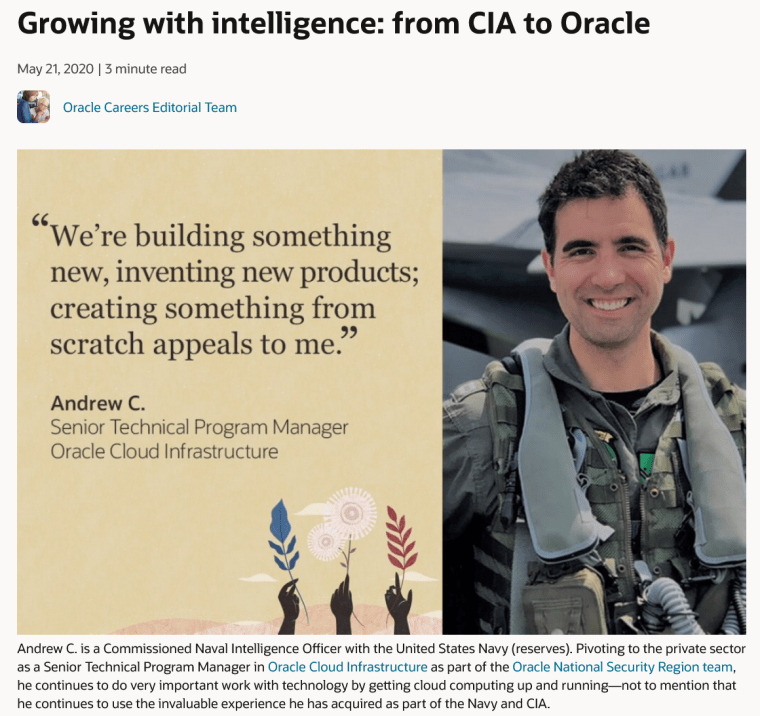
Oracle, a firm that stores reams of your sensitive data, openly boasts of its cozy ties to the CIA
The revolving door between Oracle and the CIA also swings the other way, with Oracle staff finding employment in Langley, VA.
The Silicon Valley giant also works closely with the U.S. military. “Oracle Cloud is advancing Department of Defense mission success”, it boasts on its website. Oracle notes that it is “delivering real-time intel to warfighters”, thereby “securing command and control at the tactical edge.” Thus, by the company’s own telling, it is a centerpiece of both the military-industrial-complex and the national security state. Big media outlets agree: “Larry Ellison is a billionaire today thanks to the CIA” concluded Business Insider.
Surveillance State
If Ellison had his way, however, Oracle would be an even more crucial part of a greatly expanded national security state. In the immediate wake of the September 11 attacks, he flew in for a series of meetings with top Bush-era officials, including NSA chief Michael Hayden and Attorney General John Ashcroft. There, he likely pitched an idea he had been promoting for some time: a single, comprehensive national security database that collected every piece of information possible to identify someone, from thumbprints and iris scans to medical history and social security details. “The single greatest step we Americans could take to make life tougher for terrorists would be to ensure that all the information in myriad government databases was copied into a single, comprehensive national security database,” he insisted.
In the end, even the Bush administration balked at such a sweeping project. Nevertheless, Oracle has deeply ingratiated itself into the world of policing and surveillance. In 2012, at the height of an anti-NATO demonstration, U.S. law enforcement used Oracle’s Endeca software to match protestors’ tweets with data about their criminal records, 911 calls and other information to pre-arrest demonstration leaders before the action took off.
Since then, Oracle has sold the same or similar software to authorities in Europe, South America, the Middle East and China. Job listings for developers at Guantánamo Bay also note that familiarity with Endeca and Oracle software is a desired trait.
Oracle is far from the only Silicon Valley giant with questionable ties to intelligence. Here at MintPress, we have exposed how Facebook’s top ranks are filled with former FBI and CIA agents, how ex-Israeli spies have found roles working for Microsoft and Google, and uncovered what we termed a “NATO to TikTok pipeline.”
Yet the openness with which Oracle and Ellison work with the Israeli state to further its interests should be highly concerning to those working in national security. Israel already has a long history of using its tech industry to surveil and eavesdrop on foreign governments.
Can it really be a wise idea for the United Kingdom to entrust its most sensitive government, health and defense data to a company with such close ties to the Israeli government?
So far, Great Britain has overlooked the potential grave national security threat this poses. Surely this cannot continue indefinitely.
Alan MacLeod is Senior Staff Writer for MintPress News. After completing his PhD in 2017 he published two books: Bad News From Venezuela: Twenty Years of Fake News and Misreporting and Propaganda in the Information Age: Still Manufacturing Consent, as well as a number of academic articles. He has also contributed to FAIR.org, The Guardian, Salon, The Grayzone, Jacobin Magazine, and Common Dreams.
Lowkey is a British-Iraqi hip-hop artist, academic, political campaigner, and a MintPress video and podcast host. As a musician, he has collaborated with the Arctic Monkeys, Wretch 32, Immortal Technique, and Akala. He is a patron of Stop The War Coalition, Palestine Solidarity Campaign, the Racial Justice Network, and The Peace and Justice Project founded by Jeremy Corbyn.
Hezbollah Foils Israeli Landing in Lebanon’s Bekaa
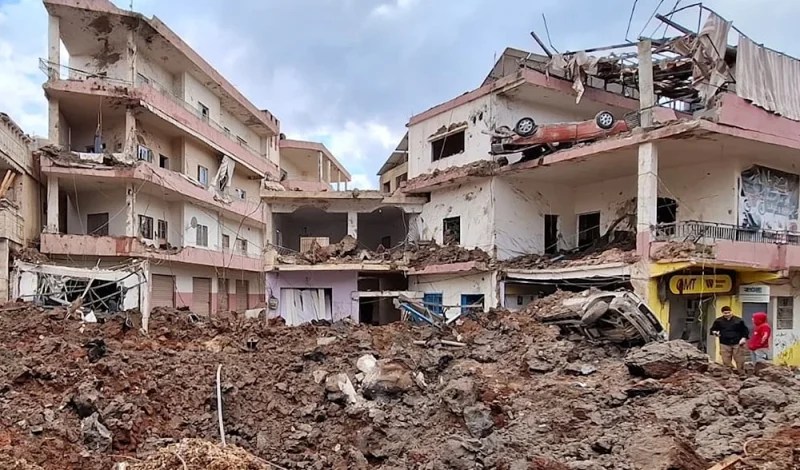
Al-Manar | March 7, 2026
Hezbollah foiled an Israeli landing in the town of Nabi Sheet in the eastern Lebanese region of Bekaa before dawn overnight on Friday-Saturday.
Hezbollah’s Military Media said Islamic Resistance fighters observed four Israeli enemy helicopters infiltrating from the Syrian direction and landing an Israeli infantry force at the mountainous triangle linking the towns of Yahfoufa, Khraibeh, and Maaraboun.
“The enemy unit then advanced toward the eastern neighborhood of Nabi Sheet, (Al-Shukr). At 11:30 AM, upon reaching the cemetery area, the Israeli force was engaged by a group of resistance fighters using light and medium weapons, triggering a fierce clash after the infiltrating force was exposed,” the Military Media’s first statement for Saturday read.
As the confrontation intensified, the Israeli enemy unleashed heavy firepower, launching around forty airstrikes by warplanes and helicopters, to cover the withdrawal of its troops from the engagement zone, according to the statement.
Meanwhile, Hezbollah resistance artillery delivered concentrated fire with appropriate weapons on the perimeter of the battlefield and along the enemy’s withdrawal route, while residents of nearby villages joined in providing supporting fire, the first statement added.
The video shows exchange of fire between resistance fighters and Israeli enemy forces in Nabi Sheet.
In another statement, the third one on Saturday, Hezbollah’s Military Media said: “In response to the enemy’s landing in the Bekaa region, the Islamic Resistance fighters targeted the evacuation area in the outskirts of Nabi Sheet with rocket barrages at 04:15 on Saturday.”
Hebrew media reported that Israeli forces attempted to withdraw after resistance forces revealed the military activity in eastern Lebanon, and that Israeli warplanes and helicopters eventually retreated from the area after the failed airborne landing attempt.
Another video shows heavy destruction in the town of Nabi Sheet after the Israeli landing.
Lebanese Heaslth Ministry announced that the Israeli assault on Nabi Sheet led to martyrdom of 16 people and the injury of 53 others.
Iraqi Resistance: Attacks on Beirut suburbs threaten US interests
Al Mayadeen | March 7, 2026
The Iraqi Resistance Coordination Committee affirmed that recent years have demonstrated that the entire region is governed by one equation: “Either security for all, or security for none.”
Addressing the ongoing aggression against Lebanon, the Iraqi resistance stressed that the security and stability of the southern suburbs of Beirut and their residents form an integral part of the regional security equation. It added that any escalation there would have repercussions for the vital interests of the US in the region.
The committee warned that any attack on the security of the densely populated civilian suburb would inevitably be met with threats to the security of embassies belonging to the aggressor countries, whether in Iraq, Bahrain, Kuwait, or Lebanon.
It further stated that undermining the security of the Beirut suburbs would also directly affect the security of major American oil companies operating in the Arabian Peninsula, stressing that “a warning has been given.”
‘Israel’ issues massive displacement threat to Beirut Southern Suburb
The Israeli occupation, in an unprecedented move, issued a massive displacement threat on Thursday against entire neighborhoods in Beirut’s Southern Suburb. Previously issuing displacement warnings against specific buildings, the Israeli occupation has discarded this strategy and now threatens thousands of homes, businesses, medical facilities, schools, and civilians with bombardment.
The threats have specifically named the neighborhoods of Bourj el-Barajneh, Hadath, Haret Hreik, and Chiyah, which house tens of thousands of civilians, who were ordered to head east along the Beirut-Damascus highway, or north towards Matn or Beirut-Tripoli highways, respectively.
This resulted in severe traffic congestion at the entrances to Beirut’s southern suburbs as residents began leaving their homes.
The Israeli threat eerily resembles those in Gaza, where hundreds of thousands and up to a million civilians were forced to flee their zones amid mass displacement plots.
US approves $151.8M weapons sale to Israel, waiving congressional review
MEMO | March 7, 2026
The Trump administration approved a possible $151.8 million weapons sale to Israel on Friday, invoking “emergency” authority to waive the congressional review requirements as Washington and Israel continue to attack Iran, Anadolu reports.
According to a statement from the State Department’s Bureau of Political-Military Affairs, the proposed sale includes 12,000 BLU-110A/B general purpose, 1,000-pound bomb bodies, along with engineering, logistics and technical support services.
“The Secretary of State has determined and provided detailed justification that an emergency exists that requires the immediate sale to the Government of Israel,” the agency said, waiving the congressional review requirements under Section 36(b) of the Arms Export Control Act.
The principal contractor for the proposed sale will be Repkon USA, based in Garland, Texas, with part of the bomb bodies expected to be transferred from existing US stock, said the statement.
The approval comes amid escalating regional tensions following joint US-Israeli airstrikes on Iran launched Feb. 28, killing more than 1,000 people, including Supreme Leader Ali Khamenei, over 150 schoolgirls and senior military officials.
The conflict has triggered widespread regional instability and retaliatory attacks from Tehran against US-linked sites across the region. A drone strike in Kuwait killed six US service members at a tactical operations center.
The move also comes as criticism in Congress about US arms transfers to Israel has grown during Israel’s genocidal war on the Gaza Strip. In July, a record 27 Democratic senators voted in favor of a resolution to block certain weapons sales to Israel, citing concerns about civilian casualties and a humanitarian crisis in Gaza, though the measure ultimately failed.
Maybe Attacking Iran Was Not Such A Good Idea
By Philip Giraldi • Unz Review • March 7, 2026
The completely unprovoked attack on Iran initiated by the United States and Israel has, after a little more than a week of military action, opened a new depth of geopolitical insanity. As suspected, the attack was all about protecting Israel while also minimizing the damage to US military, intelligence and diplomatic facilities in the Persian Gulf region. In that it has been less than a great success in that there has been reportedly considerable damage done by Iranian missiles and drones in both the Jewish State and at American bases. Iran has also suffered substantially and the US bomb that killed 165 schoolgirls continues to fuel huge demonstrations and rage that is feeding a willingness to resist the United States among the Shia communities both inside Iran and in adjacent states and regions, expanding the conflict.
The combined Israel-US onslaught was intended to destroy Iranian military capabilities, most particularly its fictional nuclear and missile programs, and to bring about regime change after killing its Supreme Leader. As the attack took place, President Donald Trump announced by way of his Truth Social platform, that “We are going to destroy their missiles and raze their missile industry to the ground. It will be totally — again — obliterated. We’re going to annihilate their navy.” On Saturday March 7th Trump elaborated, tweeting how “Today Iran will be hit very hard! Under serious consideration for complete destruction and certain death, because of Iran’s bad behavior, are areas and groups of people that were not considered for targeting up until this moment in time.”
Trump also expressed himself in a post on Truth Social how Americans will die against Iran, elaborating that “the lives of courageous American heroes may be lost” in what the Pentagon dubbed “Operation Epic Fury… We may have casualties.” As Trump’s entire family has avoided military service, the ultimate price for his warmaking will consist of using other American families’ sons and daughters as cannon fodder and he may be preparing for a political backlash by demonstrating now how much he cares about the average Americans who will be impacted by his policies. Of course, he clearly does not care unless your name is Adelson or Netanyahu.
That the war is taking place at all is due to Israel’s absolute control over America’s political class, a reality that Netanyahu and his predecessors in office have not been exactly shy about admitting. The US is a hapless giant that has been corrupted by Jewish billionaire money from within, totally committed to the expansion of greater Israel no matter how many have to die in the process. Do the Israelis care what happens to the American people? No. It is only necessary to take a look at the planned or actual killing of Americans by Israel starting with the Lavon Affair in 1954 which planned to bomb US Embassy offices in Egypt. Then there came the attack on the USS Liberty in international waters in 1967, an attempt to sink the navy ship and kill all its crew, which was covered-up by President Lyndon B Johnson and his Secretary of Defense Robert McNamara. More recently, a number of American citizens have been killed with impunity by Israelis. One might mention prominent peace activist Rachel Corrie in 2003 who was deliberately run over by an Israeli army bulldozer.
To cite how this works in practice and to demonstrate how the United States uniquely favors Israel, one might cite the recent February 18th killing of the nineteen year old Philadelphia native Nasrallah Abu Siyam, who was shot in the West Bank village of Mukhmas, when rampaging settlers attacked Palestinian farmers. Nasrallah was trying to stop the settlers from stealing livestock when he was shot and it took hours to transport him to a hospital due to “security” checkpoints and Jews-only roads established by the Israeli government. Israeli settlements, built on land stolen in the Palestinian territories, have been expanding at a rapid pace and the rampaging settlers are routinely protected by the army and police. Settler attacks soared to over 1,800 incidents last year, according to a United Nations report. Attacks have included violence, property damage, arson, killing of livestock and theft.
In a normal country, the US Embassy or Consulate would pressure the local government to investigate and seek to have the killers arrested, tried and brought to justice, but that does not take place in Israel where the attitude is “we’ll let the Israelis handle it.” Sure. Nine US citizens have been murdered in Israel in the past several years, but no one has been criminally charged in the killings while the United States has declined to open any independent investigations. The death toll includes New Jersey-born Amer Rabee, 14, who was shot by soldiers on April 6th, 2025, amid unproven allegations that he had thrown stones. Also there was Saifullah Kamal Musallet, a 20-year-old resident of Tampa, Florida, who was beaten to death by Israeli settlers in July; and Khamis Ayyad, 44, who died of smoke inhalation in August after settlers set fire to houses in his village. Tawfic Abdel Jabbar and Mohammad Ahmed Mohammad Khdour, both 17, were shot and killed in separate incidents in February 2024 while in September of that year, a soldier fatally shot in the head Aysenur Ezgi Eygi, 26, of Seattle, during a protest against illegal settlements. And then there was Omar Assad, 78, who was walking in his village before being seized by soldiers for no reason, handcuffed and gagged, with his hands bound behind his back, and then left alone on his stomach at a cold construction site. He died from a stress-induced heart attack in January 2022.
There is also the high-profile killing of journalist Shireen Abu Akleh, who lived in New Jersey as a child, in May 2022. Israeli authorities determined that the gunfire from soldiers was likely accidental, despite investigations by media and the UN concluding she was deliberately targeted and killed lest she report on Israeli war crimes. Beyond Abu Akleh, Israel is responsible for two-thirds of all journalists killed in the line of duty worldwide.
Interestingly, in the case of the teenager Nasrallah and the other recent deaths, more than 30 US senators have signed a letter demanding that the Trump administration open an independent investigation. “For all nine of these killings, no one has yet been held accountable by the Netanyahu government, nor has the US government upheld its duty to protect Americans and secure justice and accountability for their deaths,” the letter from the Congressmen says. “It is unclear to us how many more Americans must die in the West Bank in order for this administration, and other administrations, to take serious, credible steps to secure accountability and ensure an end to the ongoing killings of Americans without consequence.”
The State Department responded that it extends condolences to the family and expects “a full, thorough and transparent investigation into the circumstances surrounding the death,” indicating that it would rely on Israeli authorities to investigate, which means that nothing will be done. The unwillingness to represent the interests of actual American citizens is due to the fact that all recent US Ambassadors to Israel have themselves been ardent Zionists, with the worst of the lot being the current incumbent Mike Huckabee who has cordially met with Israel’s leading spy against the US Jonathan Pollard and has endorsed a Greater Israel which will stretch from the Nile River to the Euphrates. The indigenous population will of course be removed, just as the Gazans, Palestinians on the West Bank and the inhabitants of South Lebanon are being currently disposed of with the assistance of Donald Trump and company. Huckabee, in an interview with Tucker Carlson, said that it “would be fine if they took it all” [Greater Israel] for the Jewish state, as it was a “land given by God to the Jewish people.” This was not a casual remark but a moment of unscripted candor, a world-changing admission of a supremacist belief system favoring the Jewish state that had long operated in the shadows of US foreign policy.
US Secretary of War Pete Hegseth, a fervent Christian Zionist, even foresees great benefit coming from a Biblically predicted Armageddon global conflict beginning in the Middle East which will lead to “End Times” after which the faithful will be wafted up to heaven in the so-called “Rapture.” If one wonders just what has happened to US foreign and national security policy Hegseth and Huckabee are good places to start.
The point is that Israel is beyond brutal in its treatment of anyone who is not a Jew yet Donald Trump and company appear to think that that is just fine. Last week I saw a video on Facebook which was sickening. It showed a Christian woman walking her dogs in Jerusalem and being assailed by a mob of screaming hysterical Orthodox Jewish students who attacked her, and the dogs, for no other reasons beyond the fact that she existed. To be sure, I am an animal lover, but the attackers were so far outside the realm of conventional morality that one has to despise what they represent. Their on-display manifestation of what they regard as their Yahweh-given exceptionalism should be revolting to most others who do not share their so-called faith. The truly disgusting part is that the woman and her dogs were not exactly an extreme example of the interactions that Christians are now experiencing in Jerusalem with their presumed Jewish overlords. Churches are regularly vandalized and Christians are blocked from attending services while also being spat upon, cursed and otherwise harassed in the streets. There are reports that “Spitting on Christians is a Jewish custom!”
Unfortunately the Christian Zionist belief system has successfully dominated American evangelicalism and Israeli policy. This ideology asserts a “divine right” to conquer, pillage, and commit genocide, positioning itself above all man-made laws and international norms. It is, by its very definition, an ethnic and theological supremacist doctrine that dehumanizes all neighboring peoples as obstacles to a divine plan. As I’ve noted previously, this philosophy “is rooted in ethnic supremacism” and claims that “God gave modern day Israel the right to kill anyone they want, to steal any land they want.” This is not seen as a symbolic promise but a literal deed to real estate, with the millions of current occupants to be “subordinated, expelled, or dealt with by whatever means history requires.” Such a worldview reduces the US Constitution, international law and the UN Charter to be mere inconveniences. Mike Huckabee has argued that “the United Nations charter doesn’t count because God said so.” And his boss Donald Trump has declared that as President of the United States “I can do whatever I want!” which includes permitting genocide and land theft. With such beliefs in place, it is no wonder that many Americans are increasingly coming to appreciate that what is going on in our nation is leading us towards disaster!
Philip M. Giraldi, Ph.D., is Executive Director of the Council for the National Interest, a 501(c)3 tax deductible educational foundation (Federal ID Number #52-1739023) that seeks a more interests-based U.S. foreign policy in the Middle East. Website is https://councilforthenationalinterest.org address is P.O. Box 2157, Purcellville VA 20134 and its email is inform@cnionline.org
UK readies deployment of Prince of Wales carrier amid war on Iran
Al Mayadeen | March 7, 2026
The United Kingdom is reportedly preparing one of its naval assets for possible deployment to West Asia as Western military pressure on Iran continues to grow following the US-Israeli assault on the country.
According to media reports, the Royal Navy aircraft carrier HMS Prince of Wales is being placed on higher readiness, with its preparation time reduced so that it can be deployed more quickly if ordered by the British government. Crew members have reportedly been warned that the vessel could be sent to the region amid the escalating confrontation triggered by the US and Israeli strikes on Iran.
According to reports, the move does not mean the carrier will necessarily be dispatched immediately. However, raising its readiness would allow the government of Prime Minister Keir Starmer to deploy the warship rapidly should the aggression against Iran escalate further.
Western buildup around Iran
The preparations come as Britain gradually expands its military presence across the region following the US–Israeli assault on Iran that began on February 28.
Since then, London has moved additional forces to the Middle East, including deploying more fighter jets to Qatar and sending helicopters equipped with counter-drone systems to Cyprus.
British forces have also been involved in intercepting drones and missiles across several countries in the region, while the Royal Navy has ordered the destroyer HMS Dragon to the eastern Mediterranean to reinforce security around British bases on the island of Cyprus.
These deployments also follow a drone strike targeting the British air base at RAF Akrotiri, during which British forces identified the drone as a Shahed-type model widely associated with Iranian production. The launch location was not immediately known.
Despite Western attempts to increase their military presence, Iranian officials have repeatedly rejected calls for surrender and warned that any further escalation will be met with additional responses.
US Bases in Middle East Fail to Secure Nations & Become Safety Risk – Expert
Sputnik – 07.03.2026
American bases in the Middle East are constantly facing various kinds of attacks and do not protect the countries on whose territory they are located that effectively, Turkish political scientist Umur Tugay Yucel tells Sputnik.
“For a long time, the Gulf countries had unwavering trust in the American security umbrella, but during the 12-day war, we all saw how untrustworthy it turned out to be,” Umur Tugay Yucel said.
He says that the ongoing conflict shows that the Western security framework in the Gulf region fails to address contemporary defense needs; a concern now spreading to US allies in Asia as reports emerge of THAAD and Patriot systems being withdrawn from South Korea — a move that could soon affect Japan and other partners.
“It is obvious that American bases bring more harm than good to the civilian population and infrastructure of the countries where they are located. They pose a serious threat to populated areas. When a base is struck, not only military installations are damaged, but also roads, railways, and vital transport channels in the vicinity. Moreover, there is an inevitable increase in civilian casualties,” the expert emphasizes.
Iranian Crisis Becomes Embarrassment for US Military That Can’t Protect Anyone – MidEast Analyst
Sputnik – 07.03.2026
Prior to the arrival of the United States, the Persian Gulf was essentially the domain of the British Empire which ended up handing over its holdings to the US to ensure that the latter would be at the forefront of any major war in the region, Middle East affairs expert Mais Kurbanov tells Sputnik.
Currently, the US controls a network of military installations that don’t just serve as military garrisons – these are all elements of a system of control of the Gulf ‘gas station,” Kurbanov remarks.
This defensive network was never meant to protect the Arab states of the Gulf – it’s real purpose was to protect Israel.
“This entire shield was created to keep Israel safe and to intercept missiles. They were more or less able to intercept them during the previous conflicts, before Iran started targeting their radars. And now they got nothing to intercept because Iran destroys the early warning system itself,” notes Kurbanov.
The US is unwilling and unable to defend the Gulf states – it only cares about its own interests. And all of the Gulf states besides Iran are now vulnerable because they don’t have any air defense systems, he adds. The US focuses on protecting only its own assets in the region.
“The US has embarrassed itself in front of the entire world. Everybody now knows that the Americans are no protectors,” says Kurbanov. “They used to mock Russia when Ukraine scored some hits, acting as if they are invincible. Now Iran keeps pummeling them, and US ships have to flee two thousand kilometers into the ocean to escape Iranian missiles.”
“It means the US has no meaningful air defense. Neither Israel’s Iron Dome nor the US’ vaunted Patriots can do anything. Consider this: such weapon system costs a billion dollars and an Iranian Shaheed, this dirt-cheap drone worth twenty thousand, just takes it out.”
All of the weapons the US peddled across the world – stealth aircraft, MQ-9 Reaper drones they were so proud of – turned out to be useless,” he points out.
Meanwhile, Iran keeps demonstrating the kind of new missiles that maybe two other leading world powers beside them possess.
“The US should just leave. There will be no negotiations with them and they know it,” argues Kurbanov.
Though the US does possess an extensive global network of military installations – several hundred facilities in dozens of different countries – even it cannot ensure an immediate stabilization of the situation. He points out that Russia and China haven’t yet become actively involved in the current crisis, and that without their involvement the US would be hard-pressed to deal with global issues.
USA and Israel: Who is the lord and who is the colony?
By Raphael Machado | Strategic Culture Foundation | March 7, 2026
The Epstein Coalition (USA and Israel) began a war against the Islamic Republic of Iran on February 28th. The starting shot was the murder of 171 girls in an elementary school (perhaps as a sacrifice to Baal, the Epsteinians’ favorite deity?), followed by the martyrdom of Ayatollah Ali Khamenei, in his own residence.
It was the beginning of an “operation” that the USA expected to see finished in a few hours, then in 3 days. Well, the operation has now exceeded 6 days, and all analysts indicate that the war will last at least a few weeks, with significant losses on both sides.
What led to this operation being initiated? The easy and predictable answer is that the USA wants Iran’s oil and other natural resources.
Usually, those who reason this way also tend to say that the State of Israel represents an enclave of the USA or the “collective West” in the Middle East, whose purpose would be to serve as a trading post to facilitate or enable the occupation of the region, to ensure the exploitation of its natural resources. This is perhaps the inevitable result of looking at the comparative statistics of both countries.
The USA is larger, has a larger GDP, more powerful and numerous armed forces, has more billionaires; in short, it is “superior” in every possible and imaginable aspect, so that the US-Israel relationship can only be perceived as one in which the USA commands and Israel obeys.
Indeed, Marxian and, in general, materialist readings go in this direction. But does the Iran War confirm this assessment?
If Israel is the obedient colony of the USA, then the decision to start the conflict would have been eminently that of the USA, with Israel simply obeying the determination of its “metropole.”
But what is perceived from the official statements of Secretary of State Marco Rubio and Secretary of War Pete Hegseth is exactly the opposite: they made it quite clear in their press conferences that the USA became involved in the conflict only because Israel had already decided to attack Iran, with Washington simply following the Zionist determination.
The pretext of alleging a pre-emptive attack plan by Iran was used, but the pretext was quickly abandoned after being refuted by the Pentagon. In fact, Iran had no plan to attack either the USA or Israel.
In other words, Israel would have made the USA attack Iran. How is that possible?
The solution to the mystery seems to lie in the role of the Jewish community in the USA and its influence over the country’s internal affairs, regardless of whether its members hold Israeli citizenship or not. After all, despite comprising only 2.4% of the US population, 25% of its members have an income equivalent to the top 4% richest among non-Jews.
And if in many countries a large part of the Jewish community is critical or indifferent to Israel, in the USA, 90% of community members support Israel against its enemies. And this support is not merely verbal, expressing itself through the formal organization of lobbies that finance pro-Israel candidates and harm anti-Israel candidates, the most famous of these organizations being AIPAC, which invested almost 130 million dollars to elect its candidates in 2024.
A much more important asset, however, is the fact that, as indicated by income, many members of this community occupy positions of power and influence in the mass media, the banking system, and entertainment. Even though they are only, again, 2.4% of the US population, they constitute 33% of the CEOs of major banks, 40% of the CEOs of major media conglomerates, and 50% of the CEOs of major companies in the entertainment industry.
And these are the sectors that basically control the flow of investments, as well as shape the opinions and tastes of the country’s population.
Years ago, geopolitical analysts John Mearsheimer and Stephen Walt released an excellent book on the Zionist lobby in the USA. What they make very clear in that work is that US support for Israel is not linked to any strategic interest of Washington. The cost of supporting Israel is immense, both in money and in the international popularity of the USA. In fact, the USA only harms itself by supporting Israel against its enemies.
So how could one say that the USA controls Israel?
Returning to the current presidential administration, figures like Hegseth and Lindsay Graham openly admit that the main goal of the USA is to facilitate the reconstruction of the Temple in Jerusalem to pave the way for the coming of the Jewish Messiah. Eschatologically, the problem there is that, for Catholics, Orthodox, and traditional Protestants, the Jewish Messiah is the Antichrist.
As much as Israel is dependent on US financial and military aid, Zionism has captured the decision-making and public opinion-forming mechanisms so completely that we could practically compare the unipolar hegemon to a headless golem. In place of “America First,” it is the policy of “Israel First.”
While US bases, radars, planes, and personnel are hit by barrages of missiles and drones, and Washington loses influence and the capacity to project power in the Middle East, it becomes inevitable to reach the conclusion that Israel is the one calling the shots in this relationship, and that Tel Aviv will instrumentalize the USA as long as it serves its own expansionist interests.
Stanislav Krapivnik: Russia-Iran Cooperation & Escalation in Ukraine
Glenn Diesen | March 6, 2026
Stanislav Krapivnik is a former US Army officer, supply chain exec and military-political expert, now based in Russia. He was born in Lugansk during the Soviet times, migrated to the US as a child and served in the US army. Krapivnik discusses how Russia cooperates with Iran, and why the Iran War is creating immense pressure on Putin to escalate.
Follow Prof. Glenn Diesen:
- Substack: https://glenndiesen.substack.com/
- X/Twitter: https://x.com/Glenn_Diesen
- Support the research by Prof. Glenn Diesen: PayPal: https://www.paypal.com/paypalme/glenn…
- Buy me a Coffee: buymeacoffee.com/gdieseng Go Fund Me: https://gofund.me/09ea012f
- Books by Prof. Glenn Diesen: https://www.amazon.com/stores/author/…
Featured Video

“Historic Russia”: The Land Putin Will Not Give Back
or go to
Aletho News Archives – Video-Images
From the Archive
How Ukraine Tortured and Slaughtered Donbass
By Kit Klarenberg | Al Mayadeen | July 11, 2024
Almost immediately after the proxy war erupted, ISIS-tier footage of the torture and murder of Russians in Ukrainian custody emerged.
On July 6th, the New York Times published an astonishing investigation: In Ukraine, Killings of Surrendering Russians Divide an American-Led Unit. The article documents in grim detail how Chosen Company, an international volunteer battalion for Kiev, routinely executes Russian prisoners of war. It is the very first mainstream admission that this practice – a brazen breach of the Geneva Conventions, and a grave war crime – is widespread among Ukraine’s fighters, both foreign and homegrown. … continue
Blog Roll
 Aletho News
- Peace in Ukraine: the easy way – or the hard way
- Trump & the Rrrrussians
- US taxpayer money laundered back through Ukraine – Musk
- Before COVID, an NIH lab chief proposed making a SARS-like bat virus more infectious
- Gates, Bourla on Trial in Netherlands Accused of ‘Great Reset’ Scheme at Vaccine Injury Hearing
- BRITAIN’S WARNING: PREPARE FOR WAR
- “Historic Russia”: The Land Putin Will Not Give Back
- How the Cambridge Analytica scandal still haunts Mark Zuckerberg
- The Ongoing Cancellation Campaign Against a Dissenting Academic in Norway
- Yemen and ‘the Houthis’: Challenging Sami Hamdi’s Narrative
- If Americans Knew
- DAILY UPDATE: Latest essential news on Palestine, Israel, & region
- Damning report shows the media must confront its failures on Gaza
- BBC senior broadcaster speaks out on Gaza coverage
- Netanyahu vows vast West Bank invasion in response to 20-minute skirmish that left 2 Israeli soldiers and 2 Palestinian fighters dead
- Tied up and tortured: Israel using US-made electroshock weapons on Palestinian detainees
- The outsourced risk: how newsrooms rely on Gaza’s freelancers without protecting them
- Gaza bakeries forced to shut as Israel blocks flour shipments
- Gaza’s breast cancer patients face a deadly wait for treatment amid Israel’s genocide
- DAILY UPDATE: Latest essential news on Palestine, Israel, & region
- The Israel Lobby’s Changing Fortunes
- No Tricks Zone
- Two New Studies Find Thwaites Glacier Melt Cannot Be Driven By Human Activity Or A Warming Ocean
- E-Cars Reduce CO2 Emissions By Only 41% Compared To Internal Combustion Engine Vehicles
- Predictions Made By Renowned Climate Professor Over Past Decades Have Been Proven To Be Poor
- New Study Suggests Large Regions Of The Pacific Ocean Have Been Cooling For The Last 80 Years
- Germany’s Green Energy Debacle: High Energy Costs Force Kahla Porzellan to Close After 182 Years!
- New Study: 50 Years Of The Most Aggressive ‘Net Zero’ Policies Can Only Affect The Global Climate By 0.03°C
- US September “Heat” Was No Record…Many Records Set Decades Ago
- Latest European Green Energy Debacle; Portugal’s Largest Flagship Solar Park Insolvent!
- Green Energy Debacle: German Expert Professor Fritz Vahrenholt Warns Of Severe Economic And Social Consequences
- Two More Paleo Reconstructions Affirm Meters-Higher Sea Levels Across Ireland, Brazil 7000-6000 Years Ago

