“Significant Natural Areas”: Wellington City Council’s Plan to Expropriate and Rewild Home Gardens
Barbara McKenzie started this petition to Wellington City Council
Wellington City Council has designated some 160 “Significant Natural Areas” in the District Plan. This policy will give protected status to part or all of 1693 private properties, mostly the back gardens of suburban homes. As a consequence of this high-handed action, homeowners:
- Lose the right to use and enjoy their property as they wish;
- Suffer a loss – often dramatic – in the value of their property.
- Are experiencing extreme distress as a consequence.
The Council’s SNA policy is:
- Counter productive: Council’s weaponising of native bush provides a huge disincentive to encourage native regrowth.
- Undemocratic: there has been no public debate; this was not a declared policy by any candidate at the last local election. Efforts to inform affected owners or the public at large have been inadequate.
- Dishonest: native plants regenerating on former farmland, toxic weeds, camellias and agapanthus do NOT constitute significant indigenous biodiversity of national importance under the RMA.
- Unlawful: The Council claims authority from the Resource Management Act, Section 6 (c). There is nothing in the RMA that justifies the forced rewilding of environmentally insignificant land in private ownership.
- Unconstitutional: Legislation Guidelines adopted by Cabinet in 2021 recognise respect for property as a fundamental constitutional principle: “People are entitled to the peaceful enjoyment of their property”.
- Totally contrary to New Zealand values, and the values of a modern democratic society.
The purpose of the policy is to forcibly rewild private property, riding rough-shod over the rights, wishes and interests of Wellingtonians, and to normalise land expropriation.
Furthermore, by overlaying existing reserves with an SNA designation, there are implications for the use, management and development of public parks and open spaces.
Wellington City Councils SNA policy is unworkable on multiple levels. The Council must:
- Remove all reference to SNAs in the district plan;
- Apologise to landowners for unjustifiably causing angst and expense.
Panic? US Mega-Corporations Rush to Abandon Vax Mandate
By Daniel McAdams | Ron Paul Institute | December 10, 2021
This week’s nationwide annihilation of Biden’s Federal Contractor vaccine mandate at the hands Georgia Federal Judge R. Stan Baker has resulted in a landslide retreat of cowardly mega-corporations from their so-confident bullying of American workers.
Biden’s illegal gamble, the nationwide Federal contractor vaccine mandate, has like his previous Medicare mandate and OSHA if-you-have-100-workers-mandatory-vax mandate been ripped to shreds early on in the courts.
Biden’s mandates have always been a bullying gamble, an admission that they knew they were engaging in illegal acts but that they would continue to use the not-insignificant weapons of the executive branch to blast as much harm as possible until the courts stepped in and noted the obvious: “You can’t do this!”
Cynics – and I sympathize – will say that the courts could have ruled either way so don’t get too excited.
That’s the lesson of the past two years: There is nothing below us as we look down. It takes our breath away. We now understand that our civilization has been built on a pile of sand and any determined entity could tunnel under us as we are distracted by the human necessities of providing for our families and living our finite lives as best as possible.
This horrible reality cannot be unseen.
Previously we viewed our rulers – from dog catcher to president – as malevolent but for the most part at a distance. We never thought they would reach out with their gradually but steadily-acquired iron fist and squeeze the oxygen from our lungs: “Take a shot or starve!”
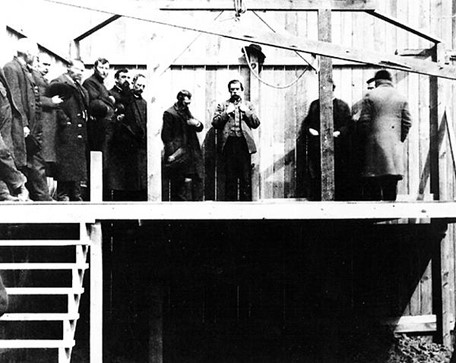
The Hungarians in early 1918 similarly were shocked that living somewhat silently among them were aliens who would activate themselves at the exact most fertile moment and literally up-end their somnambulant state, imposing “mandates” on their society that included mobile gallows – a crude earlier form of the forced vax.
With the welcome disintegration of this evil government decree – via Judge Baker’s ruling that the contractor mandate is illegal – one by one the mega-corporations also see their position as shifting to the untenable. They are bailing out as fast as possible.
Some 83,000 Florida healthcare workers no longer face being kicked to the street by US government-sponsored terrorism, until this week dutifully enforced by the “free market” prostitutes in bed with the state.
As hero Alex Berenson has reported Thursday, mega corporations in the US are also suddenly looking under themselves and finding that they are alone. No more government guns aimed at the powerless…at least for the time being.
General Electric, 3M, Verizon, and Oracle have in the past day or so hedged their bets and snuck out of bed with the US government: no more vax requirements! We are talking about a large group of people no longer bound by the brotherhood of the needle.
We are winning this for now and should pause to drink it in.
But at the same time we must also look at what has rotted in our civilization that would allow such a force to upend us, to unleash this iron fist once hidden in a velvet glove. Life will never be the same knowing what these people have done to us. They must never be allowed to forget it.
Copyright © 2021 by RonPaul Institute
Iran says has still not received any initiative from other side in Vienna talks
By Homa Lezgee – Press TV – December 13, 2021
Vienna – Iran’s lead negotiator at the Vienna talks aimed at reviving the Joint Comprehensive Plan of Action, the JCPOA, says his team has not yet received any proposal or initiative from the other side to help resolve the outstanding issues.
In the past days questions have arisen about the drafts being discussed and whether the Iranian team’s amendments and proposals, offered in the form of two written drafts at the beginning of the seventh round, are still on the table.
Iran says it will only go back to full compliance after the full and verifiable removal of US sanctions and while some sources say the Iranian demands are stalling progress, others like Russia’s lead delegate maintain that the atmosphere is positive amid intensive dialogue.
On Sunday, a third Working Group focusing on the sequencing of compliance by all parties was held for the first time during the seventh round of the talks. That was followed by a trilateral meeting between Iran, Russia and China. There’s still no official word on the duration of the current round of negotiations.
PA condemns Israeli killing of a Palestinian man

WAFA | December 13, 2021
RAMALLAH – Prime Minister Mohammad Shtayyeh and the Palestinian Ministry of Foreign Affairs and Expatriates today condemned the Israeli killing late last night of Jamil Kayyal, 31, in the northern West Bank city of Nablus.
“The crime of executing the young man, Kayyal, in Nablus is appalling and reflects the doctrine of murder that articulates the ideology and behavior of the leaders of the military establishment of the (Israeli) occupying state,” said Shtayyeh in a statement, calling on international human rights organizations to condemn the killing, “which is one more of many crimes of the occupation against our people.”
The Foreign Ministry said “this crime is one episode in the series of field executions carried out by the occupying forces in accordance with the instructions and directives of the political and military levels in the occupation state, which allow and facilitate the shooting by soldiers and others members of the occupation of the Palestinian and treat him as a practice target that can allow killing him without conscience, morals or law.”
It added, “These crimes also reflect the racist culture of the occupation that dominates the decision-making centers of the occupying state.”
While holding Israel fully responsible for this crime, the Foreign Ministry called on the International Criminal Court to speed up its war crime investigation of Israel to force it to immediately stop its crimes and start investigating the violation of its forces and colonial settlers.
Kayyal was killed late last night during an Israeli army incursion into Nablus to arrest a local activist. Two others were injured when run over by an army vehicle.
The city of Nablus today observed a general strike against the killing of Kayyal, who was later buried in a mass funeral in his hometown.
US nuclear sub pulls in for repairs after collision in South China Sea
RT | December 13, 2021
The US Navy submarine that stoked international tensions after colliding with an underwater mountain in the South China Sea pulled into the California coast on Sunday, bearing visible surface damage from the crash in October.
The USS Connecticut nuclear-powered fast-attack submarine arrived at San Diego Bay with significant damage to its bow. Defense news outlet The Drive reported that the Seawolf-class vessel was missing its entire bow sonar dome, which would have made the 6,200-mile (9,950-kilometer) journey across the Pacific “extremely unpleasant.”
According to the US Naval Institute (USNI), the “inoperable” sonar dome would have made it “unsafe” for the stricken submarine to make the transit underwater. The outlet also added that the ballast tanks and forward section of the vessel had been damaged as well.
Following an initial damage assessment at Guam, the ship was scheduled to undergo additional repairs at the Puget Sound Naval Shipyard and Intermediate Maintenance Facility in Washington, the outlet reported – adding that it was unclear why the boat was directed to San Diego instead.
It is also not known how long the repairs will take – or how much they will cost. The Navy has not commented on potential repairs, but Naval News has suggested that a new sonar dome would need to be a “custom repair job” if the submarine is deemed “worthy and cost-effective.”
US Pacific Fleet Submarine Force spokesperson Commander Cindy Fields would only tell The Drive that the vessel is in port and “remains in a safe and stable condition.”
Nearly a dozen members of the crew were injured during the collision, though none of their injuries were thought to be life-threatening, the USNI reported, adding that the submarine’s nuclear reactor and propulsion systems had not been affected.
An investigation by the US Seventh Fleet, which operates in the western Pacific, stated that the vessel had struck an “uncharted seamount” but China criticized the “ambiguous” statement as not a sufficient explanation of the events during a period of escalating tensions.
Last month, Seventh Fleet commander Vice Admiral Karl Thomas fired the boat’s commanding officer, executive officer and chief sonar technician “due to loss of confidence.” Thomas had determined that the incident could have been prevented by “sound judgment, prudent decision-making and adherence to required procedures in navigation planning, watch team execution and risk management.”
Norway’s Power Surplus Disappearing Rapidly
By Paul Homewood | Not A Lot Of People Know That | December 13, 2021
This small note appeared on the Energy Market Price website today:
Southern Norway seen tipping into power deficit by 2026
Norway’s power production surplus is expected to fall significantly by 2026, with the south of the country moving into deficit owing to rapidly increasing demand, power grid operator Statnett said on Friday.
Power demand in Norway is expected to grow to 158 terawatt hours (TWh) by 2026, up by 19 TWh from current levels, driven by demand from offshore oil and gas platforms and new onshore consumers, such as data centres, Statnett said in its latest market analysis.
The biggest increase is expected in the southern part of the country, where the most of Norway’s power-intensive industries are located, along with new projects such as electrification of the Johan Sverdrup and surrounding offshore fields.
It is surprisingly understated for something with huge ramifications for the stability of the European power grid.
We know of course that Denmark is already heavily reliant on Norway for balancing its grid, taking surplus power when wind power is abundant, and returning it when it is short.
Germany too is becoming increasingly dependent on Norway, for similar reasons.
However, as coal and nuclear power is increasingly shut down, many countries are looking at Norway to fill the gap when renewable power is not performing.
Virtually all of Norway’s electricity comes from hydro, and last year total generation amounted to 154 TWh. According to this latest report, demand in Norway will rise from 139 to 158 TWh by 2026.
In other words, the surplus that Norway has traditionally had in the past is going to disappear.
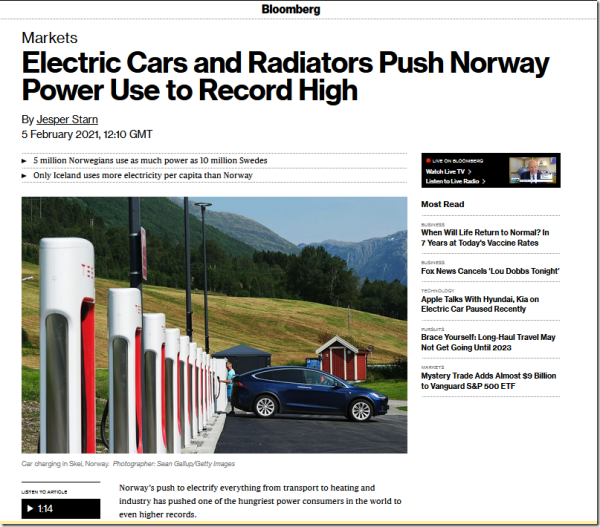
The report mentions increasing demand from industry and oil production, but as Bloomberg reported earlier this year, demand is also rising rapidly because of electric cars and heat pumps, both of which will continue to grow:
And when southern Norway is short of power, will the country carry on exporting electricity to the rest of Europe ?
Don’t hold your breath!
Is Vaccine Effectiveness Against Death Mostly a Statistical Illusion?
By Will Jones | The Daily Sceptic | December 12, 2021
One of the big challenges in analysing the data on Covid has been definitions. What is a Covid death, what is a Covid case or infection? What the data appears to say can change radically depending on the definitions adopted.
This has been a particular issue with vaccination, as vaccination status is subject to a variety of conflicting definitions. In particular, when does someone count as vaccinated? Is it as soon as they have the needle in their arm, or do they remain ‘unvaccinated’ after that for a period of time, say seven, 14 or 21 days?
For instance, the recent ICNARC report stated the number of ICU admissions by vaccination status. But it also clarified that ‘unvaccinated’ includes those who received a jab less than 14 days prior to testing positive. This means that some (an unknown number) who were counted as unvaccinated had in fact received a dose.
This may be more than just a minor problem. For one thing, there is now a lot of evidence that people are more vulnerable to infection in the days following their jab, likely due to temporary immune suppression. This means a significant proportion of the vaccinated who are susceptible to infection with the current dominant variant are infected in the immediate post-jab period when in many studies and reports they don’t count as vaccinated. This creates a ‘survivorship bias‘ in the remaining vaccinated group that exaggerates vaccine efficacy. For instance, in a study of the U.S. nursing home population published in NEJM, once the post-jab period was included – when the vaccinated experienced higher incidence than the unvaccinated – the overall proportion of vaccinated and unvaccinated groups testing positive was the same at 6.8%. This makes it essential that all the data is presented, including for past-jab periods, and definitions are clear.
A similar problem occurs with the classification of deaths as vaccinated and unvaccinated. New analysis led by Norman Fenton, Professor in Risk Information Management, and Martin Neil, Professor in Computer Science and Statistics, both at Queen Mary, University of London, has highlighted a strange anomaly in the ONS deaths data that may be indicative of a deeper problem. They noticed that if non-Covid deaths in the unvaccinated were plotted against time over the course of the vaccine rollout then a strange spike appeared during the rollout in which the mortality rate among the unvaccinated shot up to well above the background level. The same thing happened with the non-Covid mortality rate in the single-dosed as second doses were rolled out, and the phenomenon was repeated in each age group as vaccines were administered.
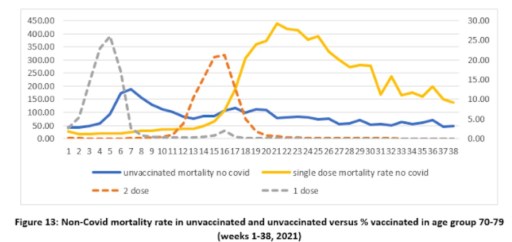
Since there is no obvious reason that vaccination should impact on non-Covid mortality in this way, Prof Fenton, Prof Neil and team argue that this is evidence of a problem in the way the data is recorded or defined. In particular, if it is assumed that the unvaccinated in fact continue to die of non-Covid causes at the background rate and that the additional non-Covid deaths above that are deaths that are actually in the vaccinated but have been misclassified (owing, say, to not counting those who die within 14 days of their jab) then, they argue, a more realistic pattern emerges (see below).
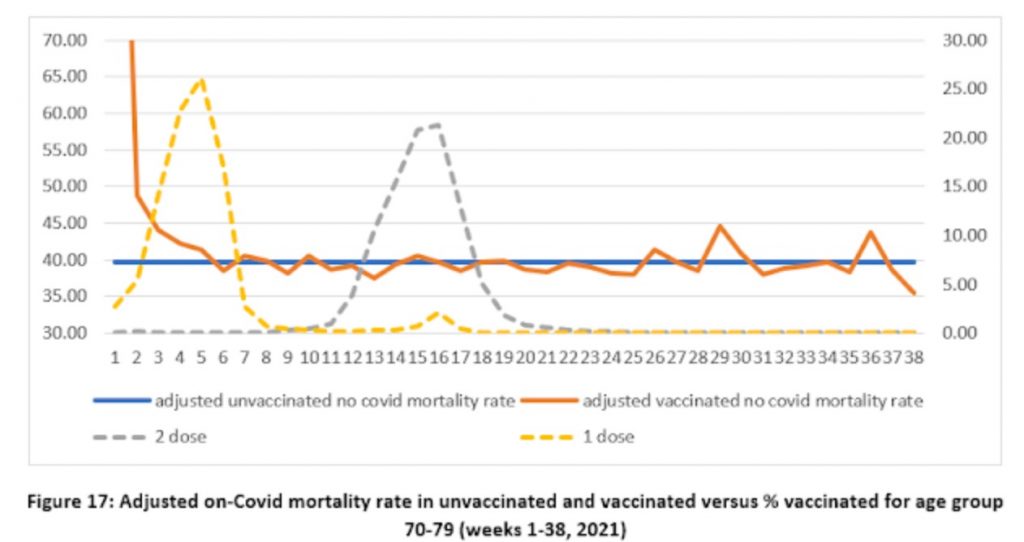
In each age group there is now a spike in non-Covid deaths in the vaccinated right at the start of the rollout, which the team argue makes sense as vaccination was prioritised for the most vulnerable who are more likely to die of any cause. Indeed, it was confusing in the original data that this initial spike was absent and the vaccinated died of non-Covid causes at a lower rate than the unvaccinated despite the most vulnerable being prioritised for vaccination.
The team discovered a different problem when they looked at Covid deaths by vaccination status. Here, the vaccines appear to be highly efficacious, but there is an anomaly that may again be indicative of deeper problems in the data.
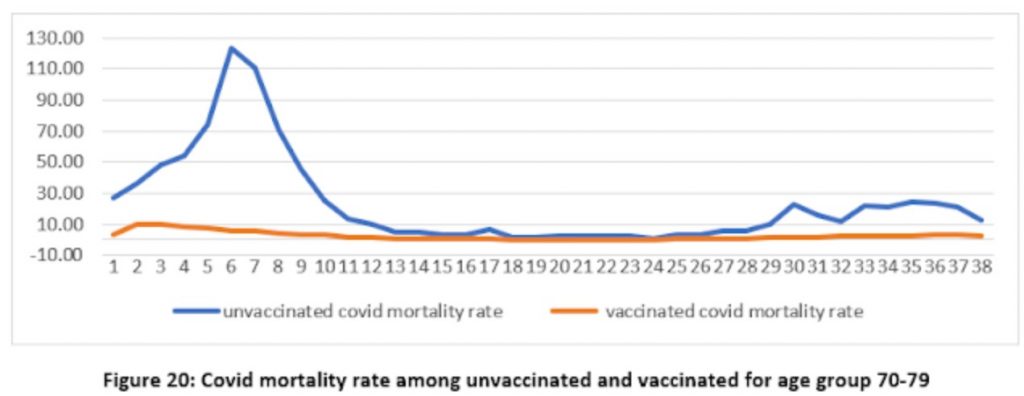
Again a spike appears in the unvaccinated mortality rate where there is none in the vaccinated. Fair enough, you might think, as the vaccines are protecting the vaccinated. However, it’s important to remember that the vaccines are not expected to work until 21 days after the first jab, yet here we have a spike in unvaccinated Covid mortality in the middle of the rollout before most of the vaccines should take effect – referring to figure 17 above we can see that the vaccine rollout in the age group peaked in week five, around the same time as the mortality rate in the unvaccinated peaked (week six), which all seems much too early.
Prof Fenton, Prof Neil and team suggest that the problem here may be in the denominator, that is to say, in how many people are supposed to be in the vaccinated and unvaccinated populations when calculating the mortality rate each week. It’s important to realise that the populations here are changing fast as tens of thousands of people get vaccinated each week. Using the right figure for the right week therefore makes a big difference to the mortality rate reported. Could this anomalous spike in unvaccinated Covid deaths be an artefact of this kind of problem?
Professor Fenton thinks so. He and his team suggest that the problem may be that the relevant denominator or number of people vaccinated for each week is not how many are vaccinated in the week a person dies but in the week they were infected, which is around three weeks earlier on average. What happens if the denominators are shifted by three weeks to allow for this? (Prof Fenton demonstrates the effect of shifting denominators in a short video of a hypothetical example here.)
The effect is remarkable, as shown below (note the change of scale on the y-axis).
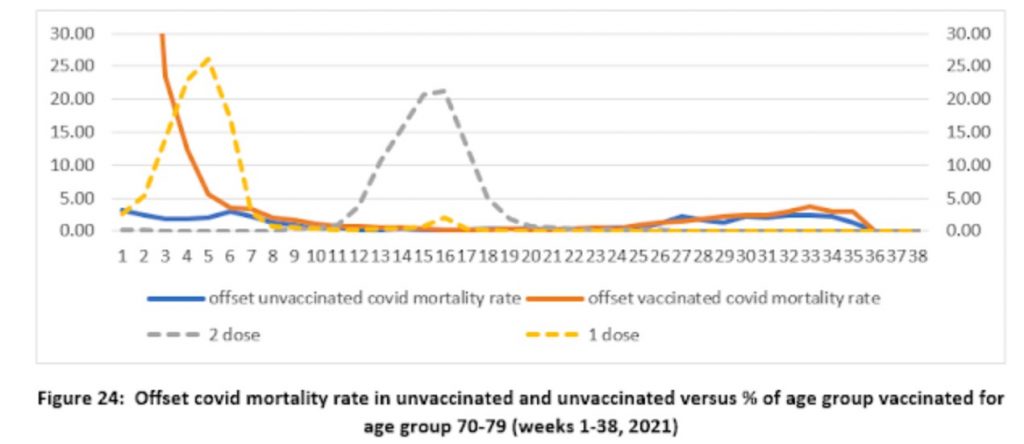
Shifting the population denominator estimates by three weeks means that the number of vaccinated for calculating the vaccinated mortality rate becomes much smaller, making the mortality rate much higher, while the denominator for the unvaccinated becomes much larger, making the mortality rate much lower. This massively reduces the mortality rate in the unvaccinated to low levels – to under five deaths per 100,000 people throughout the period, rather than as many as 125 per 100,000 in week six previously. Instead, a mortality spike appears in the vaccinated at the start of the vaccine rollout (though note that the scale is smaller so it only reaches 30 per 100,000 people), which makes some sense as the vulnerable were prioritised for vaccination and at this point the population of vaccinated was small, so contained a high proportion of vulnerable people. Prof Fenton and team remark that it also tallies with what we know of the increased vulnerability of the recently-vaccinated to infection, as noted above.
The shift in population estimates also greatly reduces the implied effectiveness of the vaccines in the autumn wave, where the lines are now much closer to one another, which is in line with findings from Sweden and elsewhere as vaccine efficacy wanes. Prof Fenton and team suggest that once you take into account the initial spike in the vaccinated, then this new analysis suggests there is “no reliable evidence that the vaccines reduce all-cause mortality”.
So is this what’s going on? There are certainly anomalies that need to be explained, and the analysis by Professor Fenton, Professor Neil and team makes a lot of sense. It deserves to be taken seriously by the ONS and UKHSA.
Stop Press: Watch Prof Fenton discussing his team’s findings with Maajid Nawaz on LBC radio.
The most detailed evidence yet of the devastating damage Covid vaccines can do
By Neville Hodgkinson | TCW Defending Freedom | December 13, 2021
INJECTING millions of people with countless copies of a gene that instructs the body to produce a toxic protein might not seem very sensible. But it was hoped that this approach, the basis of the Covid vaccine, would help minimise damage caused by the protein – the ‘spike’ that the genetically engineered SARS-CoV-2 uses to invade our body cells – when we meet the actual virus.
Last month we reported an American heart specialist’s finding that most of his patients showed biochemical changes signalling increased cardiovascular risk in the weeks following their Covid mRNA jab. Markers for inflammation, cell death and an immune response to coronary artery injury all increased compared with results from a few months previously. The overall results indicated a ‘dramatic’ rise, from 11 per cent to 25 per cent, in the likelihood of a heart attack or similar event occurring some time over the next five years should those changes persist.
The report was presented as an abstract to a meeting of the American Heart Association (AHA), and subsequently published in Circulation, the AHA’s journal. After being made public, an ‘expression of concern’ was added to the abstract, saying there are ‘potential errors’ and it may not be reliable.
There is however every reason to take it seriously – apart from UK researchers reportedly having found similar results, which they are not prepared to publish for fear of losing research money.
Last Friday the most detailed evidence yet of the damage the vaccine can do was presented at an online symposium on Covid science organised by Doctors for Covid Ethics. This is an international group that has long opposed the mass rollout of the Covid jab, arguing in particular that the immune system may attack our own tissues when it detects the presence of the spike protein.
Thousands of deaths have been reported in the wake of the jab, but regulators claim most of these are coincidental, and have neglected detailed investigation of whether or not the vaccine was responsible.
Exactly that kind of investigation was carried out by German pathologist Professor Dr Arne Burkhardt, who has 40 years of experience in the field. He examined the tissues and organs of 15 patients where a post-mortem had been performed, an exceptional opportunity that came about because the bodies were in institutes of legal medicine and institutes of pathology.
There were seven men and eight women aged between 28 and 95. They died between seven days and six months post-injection.
In essence, Burkhardt found internal damage in most of the deceased, caused by a self-destruct process in which immune cells – lymphocytes – had invaded different parts of the body.
In five of the 15 cases, it was concluded that the correlation with the vaccination was very probable; in seven, it was probable; and in two cases it was not clear, but possible. ‘In one case we did not find any of these changes of any significance,’ Burkhardt said.
He presented slides showing how the lymphocytes infiltrated heart muscle in particular, causing inflammation. Resulting lesions were small and easily overlooked, ‘but the destruction of just a few muscle cells may have a devastating effect’, he said. ‘If the inflammatory infiltration is found where the impulse for the contraction of the heart is given, this may lead to heart failure.’
Another finding, also easily missed, was lung damage caused by the lymphocyte invasion, seen in nearly half the cases. Liver, kidney, uterus, brain, thyroid and skin also showed signs of autoimmune damage.
Summarising Burkhardt’s presentation, Canadian microbiologist Professor Dr Michael Palmer said: ‘Anybody with a medical training will see just how devastating the effect of these vaccines can be, at least in those who die after the vaccination . . . we also now know why the authorities were very hesitant to have autopsies performed on such victims.’
Elsewhere, Palmer has argued that even though deaths after vaccination are few compared with the numbers who have received the jab, ‘the total lifetime dose of these messenger RNA vaccines that you can tolerate before you die is limited. We don’t know the exact amount because there is simply not enough experimental data. That’s one of the great scandals of these vaccines, that no proper toxicity studies have been carried out.’
Animal studies have shown clearly that the jab does not just stay at the site of the injection. It circulates widely, such that the spike protein can combine with receptors in many parts of the body, and especially cells that line our blood vessels, causing both clotting and excessive bleeding. Many sudden clusters of deaths (see here and here) have been reported in the immediate wake of the vaccine drives, also observed in athletes.
Burkhardt’s findings, highlighting immune cell infiltration of tissues where the vaccine-induced spike protein has manifested, come in the wake of many warnings of such a mechanism and are supported by various studies suggesting long-term risks. These include:
· US physician Dr Patrick Whelan warned the US Food and Drug Administration a year ago, before the vaccine rollouts, that jabs based on the spike protein may themselves trigger symptoms of severe Covid, including blood clots, brain inflammation and damage to the heart, liver and kidneys. Whelan, a paediatric specialist caring for children with multisystem inflammatory syndrome, urged particular caution over giving the vaccine to children and young adults, as they normally fight off the infection in its early stages. Before any of the vaccines were approved for widespread use in humans, he said, there should be an assessment of the effects on the heart.
· The vaccine includes a modification in the RNA code aimed at synthesising abundant copies of the spike protein – running into trillions of molecules, according to this visual display produced by Dr Charles Hoffe, a Canadian doctor. He says the majority of people who receive the Covid shot ‘are getting blood clots that they have no idea they’re even having.’ The modification, along with a device that protects the RNA mechanism against immediate destruction by the body, may enable the jabs to present a bigger risk in some recipients than natural infection, since this is usually dealt with successfully by a healthy immune system. No one knows exactly how much of the protein is produced by the jab, nor how long it lasts in the body.
· Dr Robert Malone, inventor of the mRNA technology, says ‘multiple peer-reviewed references’ demonstrate that the virus’s spike protein poisons body cells (see for example here), but the vaccine developers have not demonstrated the safety of their version of the protein. Proper evaluation of the risks is still not being carried out, he says.
· Another German pathologist found from autopsies conducted on 40 people who died in the wake of the jab that 30-40 per cent were vaccine-related. Professor Peter Schirmacher believes many such deaths are missed, with doctors attributing them to natural causes.
· American cardiologist and journal editor Dr Peter McCullough has warned that the vaccine can damage heart tissue in ways that go unnoticed at first, but which create scar tissue liable to cause permanent cardiac dysfunction later in life. ‘This will go down as the most dangerous biological medicinal product rollout in human history,’ he says. McCullough has also highlighted an increase in deaths among children in the UK since the NHS began vaccinating teenagers aged 12 and over against Covid.
· An analysis of UK ‘Yellow Card’ adverse reaction data by Dr Tess Lawrie’s Evidence-Based Medicine Consultancy found thousands of reports of blood clotting after the Covid jabs. Almost every vein and artery was affected, and every organ including parts of the brain, lungs, heart, spleen, kidneys, ovaries and liver, ‘with life-threatening and life-changing consequences’. Lawrie urged the UK regulators as long ago as last June to declare the vaccine unsafe for use in humans because of the deaths and adverse reactions being reported.
· A ‘chilling’ acknowledgement of the specific risks of mycocarditis (inflammation of the heart muscle) and pericarditis (swelling in tissue surrounding the heart) following Covid vaccination was issued this month by the UK Health Security Agency. The agency still insists such cases are rare and that most patients recover fully, but evidence such as Burkhardt’s suggests many deaths may go unrecognised as vaccine-related.
It’s a terrible mess, and there is a desperate need for a review of the entire Covid vaccine strategy. UK pathologists, please come to the rescue!
MEPs against compulsory vaccination
Christine Anderson, MdEP | December 10, 2021
At the 4th Intergroup Press Conference this week, I met again with my colleagues and we made it clear once more:
– No to compulsory vaccination
– No to social division
– No to political/medial scaremongering
– No to the state-fueled dismantling of freedom and democracy.
See in my speech why I will defend the freedom of our children with claws and teeth and call on the administration:
“Come on, government! Let’s see what you’ve got. I’m not afraid of you!”
Featured Video

No Threat Can Force Iran’s Surrender /Trita Parsi & Lt Cl Daniel Davis
or go to
Aletho News Archives – Video-Images
From the Archives
An Expert Military Analysis of War with China
Actually, None is Necessary
By Fred Reed • Unz Review • December 13, 2020
The Correlation of Armed Forces: U.S. goods and services trade with China totaled an estimated $634.8 billion in 2019. Exports were $163.0 billion; imports were $471.8 billion. The U.S. goods and services trade deficit with China was $308.8 billion in 2019. Trade in services with China (exports and imports) totaled an estimated $76.7 billion in 2019. Services exports were $56.5 billion; services imports were $20.1 billion. The U.S. services trade surplus with China was $36.4 billion in 2019.
There is talk within the Washingtoniat of a possible war with China. Steve Bannon, who apparently was dropped on his head as a child, actually favors such a war. We hear the usual shoo-the-boobs alarm about how the Chinese are doing something terrible and we must gird our loins and American values and show them what for, bow wow, woof. The danger is that the current game of who-blinks-first in Asian waters might actually provoke a shooting war. You know the kind of thing: One warship refuses to get out of the way of another, a collision ensues, some retard lieutenant who signed up on waivers opens fire, and we’re off and running. It is not a good idea to let children play with matches.
The said war is discussed either in emotional terms by idiots or in purely naval terms by those familiar with such things, so we hear of the First Island Chain and the Second Island Chain and whose missiles against the other’s missiles and so on. This would be appropriate if we were fighting World War Two again. Which we aren’t. Let’s take a quick-and-dirty look at how such a war might go.
To begin the war, America would overestimate itself and underestimate China. This is doctrine in the Pentagon. … continue
Blog Roll
 Aletho News
- Iran To Target Military Industrial-Tech Complex That Facilitated Gaza Genocide
- Collapsing Empire: The Resistance Disarms ‘Israel’
- Suicide Should Not Be a Government Service
- Rethinking America’s greatest threat: Iran vs. Israel-Firsters
- Iran accuses adversaries of false flags to strain Turkey ties
- Poland rules out sending Patriot missiles to US/Israel amid war on Iran
- Tehran approves new Hormuz plan with major restrictions
- No Threat Can Force Iran’s Surrender /Trita Parsi & Lt Cl Daniel Davis
- UK’s New Pandemic Plan Would Turn Big Tech Into a Mass Location Tracking Network
- Growing insecurity, soaring prices fuel protests in north as regime bans evacuation: Sources
- If Americans Knew
- Ann Coulter Rips Into Fox News for Iran War Coverage, Compares to False Rigged 2020 Election Reporting
- Joe Kent Urges Americans To Call White House and Congress To Object To Sending Troops Into Iran
- DNC Resolution to Reject AIPAC Funding Puts Democratic Leaders in the Hot Seat
- Swedish foundation to build 400 schools as over 650,000 Gaza children remain without education for 2 years
- Israeli army admits photshopping image of slain Lebanese journalist
- This is how Israel is systematically killing health workers under the cover of war in Lebanon
- Carrying life under fire: Israeli invasion of Lebanon leaves pregnant women facing deadly risks
- Champagne all around for the new death penalty (for Palestinians) law – Not a ceasefire Day 172
- Why are Palestinian books struggling to be seen on Amazon?
- The Line Between Affinity and Conspiracy
- No Tricks Zone
- New Study Finds Warming Saves Lives…Cold Temperatures 12 Times More Deadly Than Excess Heat
- German Science Blog Accuses PIK Climate Institute Of Hallucinating Climate Tipping Points
- Devastating Assessment Of Comirnaty Vaccine By Former Senior Pfizer Europe Toxicologist
- New Study: CO2 Is ‘Effectively Negligible’ As An Explanatory Climate Change Factor Since 2000
- Former Pfizer Toxicologist Dr. Helmut Sterz Tells Bundestag Hearing Pfizer Vaccine Should Have Never Been Approved
- Energy Expert: Germany’s Nuclear Phaseout Was A “500 Billion Euro Mistake”
- New Research: South Australia’s Mid-Holocene Sea Surface Temperatures Were 4°C Warmer Than Today
- Storing Green Energy To Last Germany 10 Days Would Require A 60-Million Tonne Battery
- New Studies: UK Sea Levels Were 4 Meters Higher Than Today During The Mid-Holocene
- Destructive Green New Deal: German Energy And Metal Group Warns Of Drastic Crisis
 Aletho News