Reminder: Respiratory viruses infect huge numbers of people all the time, and nobody cared about this until 2020
Perspective from a 2018 New York study that tested a bunch of healthy adults for common respiratory viruses. Over 6% tested positive.
eugyppius | May 2, 2022
The ever-sharp Zacki on Twitter points to this intriguing 2018 study out of New York. The authors administered PCR tests to 2,685 people at a tourist attraction in New York City, between the months of January and July. Over 6% tested positive for one of seven common human respiratory viruses. In the winter, human coronaviruses were the most common; in the summer, rhinoviruses took the lead. By design, the study targeted healthy populations, and so we must imagine that it substantially understates the true rate of virus infection.
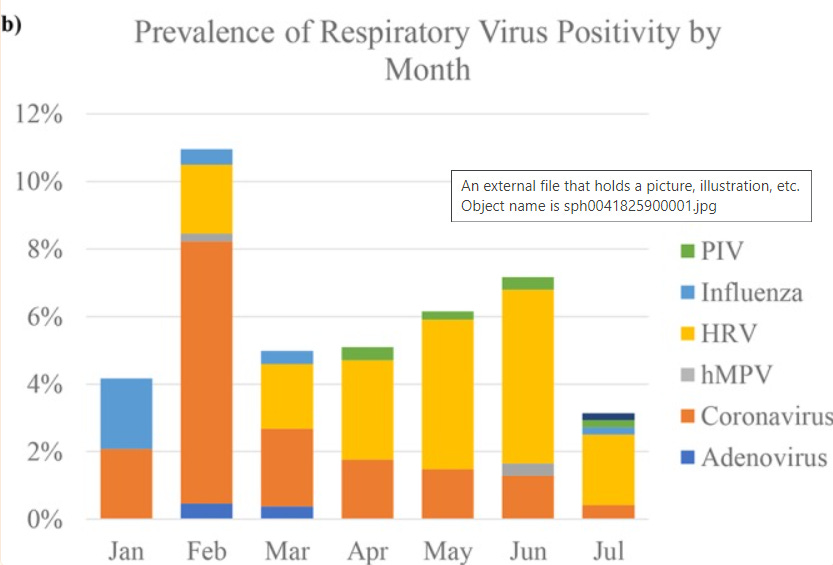
The authors don’t find a significant difference in the overall prevalence of positivity between winter and summer. In their small sample, it’s only the mix of viruses that changes. This is another piece of evidence in favour of my crazy theory, that a great part – perhaps a majority – of spring and summer allergies are in fact persistent low-grade rhinovirus infections.
Other studies, particularly on rhinovirus, find even larger incidences of infection. There is this paper, which looks at rhinovirus in infants and finds that 20% of their sample are asymptomatic positives; or this case-control study of all ages, which finds rhinovirus in 17% of their asymptomatic controls.
For perspective: At the height of the alpha wave in the United Kingdom, only about 0.3% of the population was testing positive for SARS-2 every day. School antigen testing in Germany, which is done multiple times a week and finds nearly every detectable infection in school-age children, found Delta 7-day incidences of around 1%, and Omicron 7-day incidences peaking in February at near 4% in specific age cohorts (see the the graph on p. 5). The allegedly hypercontagious SARS-2 looks like it was doing substantially worse, in other words, than garden-variety human coronaviruses in the same month in the New York study.
Respiratory viruses are extremely pervasive; they’re everywhere and this is totally normal. What isn’t pervasive, is virus testing. We’ve only ever tested widely for a single virus. So much of Corona mythology depends upon presenting data in isolation from what we know about the behaviour of all the other pathogens we’ve lived with for centuries. Our governments have spent two years hyperventilating about incidences of infection that turn out to be minuscule, or at worst normal, when compared to the other pathogens that infect us. This should also make you very, very sceptical of uncontrolled studies cataloguing alleged Long-Covid symptoms. If we tested this widely for rhinovirus, imagine all the totally unrelated symptoms we’d find in our vast pool of positive results.
Foreign Minister Sergey Lavrov interview with Xinhua News Agency
Russian Ministry of Foreign Affairs | April 30, 2022
Question: What do you think is at the root of the Ukrainian crisis? What can the international community do to solve this problem?
Sergey Lavrov: When we talk about the Ukrainian crisis, first of all we need to look at the destructive policy of the Western states conducted over many years and led by the United States, which set a course to knock together a unipolar world order after the end of the Cold War. NATO’s reckless expansion to the East was a key component of those actions, despite the political obligations to the Soviet leadership on the non-expansion of the Alliance. As you know, those promises were just empty words. All these years, NATO infrastructure has been moving closer and closer to the Russian borders.
The West was never concerned about the fact that their actions grossly violated their international obligations not to strengthen their own security at the expense of the security of others. In particular, Washington and Brussels arrogantly rejected the initiatives put forward by Russia in December 2021 to ensure our country’s security guarantees in the west: to stop the expansion of NATO, not to deploy armaments that pose a threat to Russia in Ukraine and to return the Alliance’s military infrastructure to the 1997 configuration, when the NATO-Russia Founding Act was signed.
It is well-known that the United States and NATO member states have always viewed Ukraine as a tool to contain Russia. Over the years, they have actively fuelled anti-Russia sentiments there, forcing Kiev to make an artificial and false choice: to be either with the West or with Moscow.
It was the collective West that first provoked and then supported the anti-constitutional coup d’etat in Kiev in February 2014. Nationalists came to power in Ukraine and immediately unleashed a bloody massacre in Donbass, and set the course on the destruction of everything Russian in the rest of the country. Let me remind you that it was precisely because of this threat that the people of Crimea voted in a referendum for the reunification with Russia in 2014.
Over these past years, the United States and its allies have done nothing to stop the intra-Ukrainian conflict. Instead of encouraging Kiev to settle it politically based on the Minsk Complex of Measures, they sent weapons, trained and armed the Ukrainian army and nationalist battalions, and generally carried out the military-political development of Ukraine’s territory. They encouraged the aggressive anti-Russia course pursued by the Kiev authorities. In fact, they pushed the Ukrainian nationalists to undermine the negotiating process and resolve the Donbass issue by force.
We were deeply concerned about the undeclared biological programmes implemented in Ukraine with Pentagon’s support in close proximity to the Russian borders. And, of course, we could not disregard the Kiev leadership’s undisguised intentions to acquire a military nuclear potential, which would create an unacceptable threat to Russia’s national security.
In these conditions, we had no other choice but to recognise the Donetsk and Lugansk people’s republics and launch the special military operation. Its aim is to protect people from genocide by the neo-Nazis, as well as to demilitarise and denazify Ukraine. I would like to stress that Russia is acting to fulfil its obligations under bilateral agreements on cooperation and mutual assistance with the DPR and LPR, at the official request of Donetsk and Lugansk under Article 51 of the UN Charter on the right to self-defence.
The special military operation launched on February 24 is progressing strictly in accordance with the plan. All its goals will be achieved in spite of our opponents’ counteractions. At the moment we are witnessing a classic case of double standards and hypocrisy of the Western establishment. By publicly supporting the Kiev regime, NATO member states are doing everything in their power to prevent the completion of the operation by reaching political agreements. Various weapons are flowing endlessly into Ukraine through Poland and other NATO countries. All of this is being done under the pretext of “fighting the invasion”, but in fact the United States and the European Union intend to fight Russia “to the last Ukrainian.” They do not care at all about the fate of Ukraine as an independent subject of international relations.
The West is ready to jeopardise the energy and food security of entire regions of the globe to satisfy its own geopolitical ambitions. What other explanation is there for the unrestrained flywheel of anti-Russian sanctions launched by the West with the start of the operation and which they aren’t thinking of stopping?
If the United States and NATO are truly interested in settling the Ukrainian crisis, then, first, they must come to their senses and stop supplying weapons and ammunition to Kiev. The Ukrainian people do not need Stingers and Javelins; what they need is a solution to urgent humanitarian issues. Russia has been doing this since 2014. During this time, tens of thousands of tonnes of humanitarian cargo have been delivered to Donbass, and about 15,000 tonnes of humanitarian aid have already arrived in the part of Ukraine liberated from the Kiev regime, the DPR and the LPR, since the launch of the special military operation.
Second, it is essential that the Kiev regime stops cynical provocations, including in the information space. Ukrainian armed formations are barbarically shelling cities using civilians as living shields. We saw examples of this in Donetsk and Kramatorsk. Captured Russian servicemen are being abused with animal cruelty, and these atrocities are being posted online. At the same time, they use their Western patrons and global media controlled by the West to accuse the Russian army of war crimes. As they say, laying the blame at somebody else’s door.
It is high time for the West to stop unconditionally whitewashing and covering up for Kiev. Otherwise, Washington, Brussels and other Western capitals should consider their responsibility for complicity in the bloody crimes perpetrated by the Ukrainian nationalists.
Question: What measures has Russia taken to protect the lives and property of civilians? What efforts has it made to establish humanitarian corridors?
Sergey Lavrov: As I mentioned earlier, the special military operation is proceeding according to plan. Under this plan, the Russian military personnel are doing everything in their power to avoid victims among civilians. Blows are carried out with high-precision weapons, first of all at military infrastructure facilities and places where armoured vehicles are concentrated. Unlike the Ukrainian army and nationalist armed groups that use people as living shields, the Russian army provides the locals with all kinds of assistance and support.
Humanitarian corridors open daily from Kharkov and Mariupol to evacuate people from dangerous districts, but the Kiev regime demands that the “national battalions” in control of those areas do not release the civilians. Nevertheless, many are able to leave with the assistance of Russian, DPR and LPR servicemen. During the special military operation, the hotline of the Interdepartmental Coordination Headquarters of the Russian Federation for Humanitarian Response in Ukraine has received requests for assistance in evacuating 2.8 million people to Russia, including 16,000 foreign citizens and employees of UN and OSCE international missions. In total, 1.02 million people have been evacuated from Ukraine, the DPR and LPR, of which over 120,000 are citizens of third countries, including over 300 Chinese nationals. There are over 9,500 temporary accommodation facilities operating in Russian regions. They have space for rest and hot meals, and everything that may be necessary. Newly arrived refugees are provided with qualified medical and psychological assistance.
Russia is taking measures to ensure civilian navigation in the Black and Azov seas. A humanitarian corridor opens daily, a safe lane for ships. However, Ukraine continues to block foreign ships, creating a threat of shelling in its internal waters and territorial sea. Moreover, Ukrainian naval units have mined the shore, the ports and territorial waters. These explosive devices disconnect from their anchor lines and drift into the open sea, so they pose a serious danger to both the fleets and the port infrastructure of the Black Sea countries.
Question: Since the special military operation was launched in Ukraine, Western counties have adopted a large number of unprecedented sanctions against Moscow. How do you think these sanctions will affect Russia? What are the main countermeasures taken by Russia? Some say that a new Cold War has begun. How would you comment on that?
Sergey Lavrov: It is true that the special military operation was used by the collective West as a pretext to unleash numerous restrictions against Russia, as well as its legal entities and individuals. The United States, Great Britain, Canada and EU countries do not conceal that their goal is to strangle our economy by undermining its competitiveness and blocking Russia’s progressive development. At the same time, the Western ruling circles are not embarrassed by the fact that anti-Russian sanctions are already beginning to harm ordinary people in their own countries. I mean the declining economic trends in the United States and many European countries, including growing inflation and unemployment.
It is clear that there can be no excuse for this anti-Russian line and it has no future. As President Vladimir Putin said, Russia has withstood this unprecedented pressure. Now the situation is stabilising, though, of course, not all risks are behind us.
In any case, they will not succeed in weakening us. I am confident that we will restructure the economy and protect ourselves from our opponents’ possible illegitimate and hostile actions in the future. We will continue to give a fitting and adequate response to the imposed restrictions, guided by the goal of maintaining the stability of the Russian economy and its financial system, as well as the interests of domestic businesses and the entire nation. We will focus our efforts on de-dollarisation, de-offshorisation, import substitution, and promotion of technological independence. We will continue to adapt to external challenges and step up development programmes for promising and competitive industries.
During the period of turbulence, our retaliatory special economic measures needed to ensure the normal functioning of the Russian economy will be continued and expanded. As a responsible player on the international market, Russia intends to continue scrupulously fulfilling its obligations under international contracts on export deliveries of agricultural products, fertilisers, energy carriers and other critical products. We are deeply concerned about a possible food crisis provoked by the anti-Russian sanctions, and we are well aware how important the deliveries of essential goods, such as food, are for the socioeconomic development of Asian, African, Latin American, and Middle Eastern countries.
I will be brief as regards the second part of your question. Today we are not talking about a new “cold war,” but, as I said earlier, about the persistent desire to impose a US-centric model of the world order coming from Washington and its satellites, who imagine themselves to be “arbiters of humankind’s fate.” It has reached the point where the Western minority is trying to replace the UN-centric architecture and international law formed after World War II with their own “rule-based order.” These rules are written by Washington and its allies and then imposed on the international community as binding.
We must realise that the United States has been carrying out this destructive policy for several decades now. It is enough to recall NATO’s aggression against Yugoslavia, attacks on Iraq and Libya, attempts to destroy Syria, as well as the colour revolutions that Western capitals staged in a number of countries, including Ukraine. All of this came at the cost of hundreds of thousands of lives and resulted in chaos in various regions of the planet.
The West tries to crudely suppress those who carry out an independent course in their domestic and foreign policy. Not just Russia. We can see how bloc thinking is being imposed in the Asian-Pacific Region. We can recall the Indo-Pacific strategy promoted by the United States, which has a pronounced anti-China tendency. The US seeks to dictate the standards according to which Latin America should live, in the spirit of the outdated Monroe Doctrine. This explains many years of the illegal trade embargo on Cuba, sanctions against Venezuela, as well as attempts to undermine stability in Nicaragua and other countries. The pressure on Belarus continues in the same context. This list can go on.
It is clear that the collective West’s efforts to oppose the natural course of history and solve its problems at the expense of others are doomed. Today the world has several decision-making centres; it is multipolar. We can see how quickly Asian, African, and Latin American countries are developing. Everyone is getting a real freedom of choice, including where it comes to choosing their development models and participation in integration projects. Our special military operation in Ukraine also contributes to the process of freeing the world from the West’s neocolonial oppression heavily mixed with racism and a complex of exceptionalism.
The faster the West accepts the new geopolitical situation, the better it will be for the West itself and for the entire international community.
As President Xi Jinping said at the Boao Forum for Asia, “We need to uphold the principle of indivisible security, build a balanced, effective and sustainable security architecture, and oppose the pursuit of one’s own security at the cost of others’ security.”
Question: Russian-Ukrainian talks have attracted close attention of the international community. What are the main obstacles to the talks today? How do you regard the prospects of a peace treaty between the two parties? What kind of bilateral relations does Russia intend to have with Ukraine in the future?
Sergey Lavrov: At present the Russian and Ukrainian delegations are holding discussions on the possible draft almost daily, via videoconference. This document should contain such elements of the post-conflict situation as permanent neutrality, the non-nuclear, non-bloc and demilitarised status of Ukraine, as well as guarantees of its security. The agenda of the talks also includes denazification, recognition of the new geopolitical reality, the lifting of sanctions and the status of the Russian language, among other things. Settling the situation in Ukraine will make a significant contribution to the de-escalation of the military and political tensions in Europe and the world in general. The establishment of an institution of guarantor states is envisaged as a possible option. First of all, they will be the permanent members of the UN Security Council, including Russia and China. We share information on the progress in the talks with Chinese diplomats. We are grateful to Beijing and other BRICS partners for their balanced position on the Ukrainian issue.
We are in favour of continuing the talks, although the process is difficult.
You are right to ask about the obstacles. For example, they include the militant rhetoric and incendiary actions of Kiev’s Western patrons. They are actually encouraging Kiev to “fight to the last Ukrainian,” pumping the country with weapons and sending mercenaries there. Let me note that the Ukrainian security services staged a crude bloody provocation in Bucha with the help of the West, to complicate the negotiation process among other things.
I am confident that agreements can only be reached when Kiev starts to be guided by the interests of the Ukrainian people, and not the advisors from far away.
Speaking about Russian-Ukrainian relations, Russia is interested in a peaceful, free, neutral, prosperous and friendly Ukraine. Despite the current administration’s anti-Russian course, we remember the many centuries of all-embracing cultural, spiritual, economic and family ties between Russians and Ukrainians. We will definitely restore these ties.
Russia’s oil revenues expected to soar
Samizdat | May 2, 2022
Russia will see its income from the oil sector rise sharply this year and reach more than $180 billion, despite production cuts related to international sanctions, suggests a report published by independent research house Rystad Energy on Monday.
Thanks to the rising oil prices, Russia’s tax revenues will be 45% higher than last year and a whopping 181% higher than in 2020, Rystad Energy says.
“Europe’s dependence on Russian energy has been a deliberate and decades-long and mutually beneficial relationship. In this early phase of sanctions and embargoes, Russia will benefit as higher prices mean tax revenues are significantly higher than in recent years.” says Daria Melnik, a senior analyst at Rystad Energy.
According to the firm, the initial issues Russia had with its oil exports when European customers started shunning its oil were quickly resolved and loadings began to recover in late March, supported by orders from China and India. Russian crude exports remained resilient in April.
The EU, the US and their allies imposed sanctions against Russia with the aim of starving the country of cash and forcing it to abandon its military operation in Ukraine. However, Europe’s high dependence on Russian oil and gas has meant that turning away from it has proven problematic. The EU has pledged to phase out Russian gas by 2030.
If the EU decides to further restrict energy imports from Russia and impose an oil embargo, something that’s reportedly being considered by the bloc, Russia will be forced to cut oil production further as it lacks storage capacity for extra crude volumes and may not be able to quickly redirect the unwanted cargoes, Rystad Energy explains. In the long-term, Russia’s crude output will continue to decline more steeply than was estimated before the Ukraine crisis.
Why Won’t They Say Who Funded These Ukraine Ads?

By Michael Tracey | May 2, 2022
On April 17, I was in London Bridge train station in central London, and couldn’t help but notice that the entire station was blanketed with these digital “Be Brave Like Ukraine” ads. Stylized in a nifty semi-Cyrillic font, the ads feature the classic blue and yellow color scheme that has now become so ubiquitous across “The West” — perhaps most prominently in London, where a local acquaintance told me she’s seen more Ukraine flags on display over the past two months than she ever saw of the UK’s own national flag.
I had a few natural questions upon seeing these ads. First, who crafted them? That answer came quickly: Just go to the “brave.ua” website and you’ll discover the ads were crafted by a consortium within the Ukraine government, including the office of Zelensky.
The answer to other natural questions have not come so quickly, though. Those questions include: Who paid for these ads? How much did they cost? Who organized their placement in some of the most expensive advertising real estate in the world? (They’ve also been displayed in Times Square, among other high-profile locations.)
Strangely, this information has proven difficult to acquire.
First I tried querying the TFL, the government body in charge of transport in London. They had no clue about the ads. Then I tried Network Rail, which runs most of the railways in England. They had no clue either. Finally I tried the massive global advertising agency which apparently owns the digital screens in question, JCDecaux. And… it initially seemed like they might have the answer. I know this because the “Corporate Communications Director” for JCDecaux inadvertently sent me an email where she deliberates with her colleague about how to answer my questions:
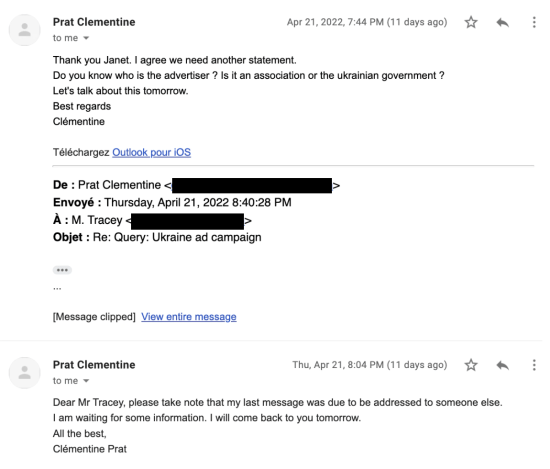
Kinda funny that the “Corporate Communications Director” still doesn’t have the hang of communications skills like sending your sensitive internal emails to the right recipient. Either way, this person did not in fact “come back to me tomorrow.” Days passed, and I heard nothing. Then, finally, here was the answer:

Curious, don’t you think? Why would a multinational advertising conglomerate based in France, with branches in the UK, US, and elsewhere, be so skittish about providing basic details about this Ukraine government advertising campaign? Shouldn’t they be proud of it, and therefore happy to provide the details? I thought the message of the ads was to “Be Brave Like Ukraine.” Apparently that “Bravery” doesn’t extend to allowing for transparency in the financial arrangements of these PR maneuvers, which have resulted in “Western” capitals being saturated with imagery that to the naked eye may seem benign — but, functionally, amounts to obvious pro-war propaganda.
Because bear in mind that these government-crafted ads have flooded London, NYC, Washington DC, etc. at the same time as Ukraine officials are furiously lobbying the UK and US governments to ramp up their military involvement in the war. Those lobbying efforts have been incredibly successful, with Respectable Mainstream outfits like The New Yorker finally now admitting that the scale of the US commitment constitutes “a full proxy war with Russia.” (Not so long ago, I was attacked as a peddler of “Putin’s talking points” for using the term “proxy war” on TV.)
It went largely unremarked upon when the head of the Pentagon, flanked by the head of the State Department, transited into Kiev for a secret mission on April 25 — and then hours later, a series of giant explosions ripped through a Russian military logistics hub approximately 90 miles inside Russia. This after US officials began leaking that they would no longer even pretend to recognize any distinction between “defensive” and “offensive” combat operations conducted by the Ukraine military — effectively acknowledging their willingness to provide both weaponry and real-time intelligence to launch attacks on Russia itself.
In the UK, the Armed Services Secretary, James Heappey, followed this up by declaring that it would be “entirely legitimate” for arms delivered by “Western countries” to be used for offensive strikes within Russian territory. Foreign Secretary Liz Truss then went further than even any US official when she declared that total “victory” in Ukraine must also include driving Russia out of Crimea, raising the stakes higher still.
With each passing week, both these countries adopt a more and more aggressive, bombastic war footing.
Meanwhile, the nice-seeming “Be Brave Like Ukraine” ads are covering major transportation centers. It doesn’t take much elaborate dot-connecting to apprehend that the ads are one facet of the larger PR campaign to draw the US, UK, and other governments further and further into the war. This campaign has been demonstrably effective. And the ad agency which facilitated the ads is choosing to conceal from the public basic details about their provenance — such as who even paid for them. Really makes you think.
Renault to sell Russian assets for one ruble
Samizdat | May 2, 2022
French carmaker Renault plans to sell its stake in Russia’s Avtovaz for a symbolic sum of 1 ruble, the Russian Trade Ministry announced on Wednesday.
Renault will transfer its 68% stake to the auto research institute NAMI Russia, known for designing the Aurus Senat, the country’s first luxury car, currently used by President Vladimir Putin. Renault apparently took the step as it lacks the ability to maintain its Russian operations.
The Trade Ministry also said Renault’s factory in Moscow, which produces cars under the Renault and Nissan brands, would be transferred to the city’s government.
Renault has declined to comment on the deal.
The trade ministry said the French carmaker will have the right to buy back its Avtovaz stake within five to six years, if the company wishes to return to the Russian market.
“But if during this period we make investments, then that will be taken into account when it comes to the cost [of the shares]. We won’t be giving any presents here,” Trade Minister Denis Manturov said, commenting on the move.
The deal comes as Western companies try to navigate the new economic realities. Western states have placed unprecedented sanctions on Russia over the past two months in retaliation for Russia’s military operation in Ukraine.
With many international companies under pressure to quit the Russian market, the Yale School of Management estimates that more than 750 firms are ending or scaling back their Russia operations.
Renault has until now been the most Russia-exposed Western carmaker. The company announced a suspension of operations at its Moscow plant last month, estimating the cost of the move at €2.2 billion ($2.3 billion).
How Canada is ‘Cutting Costs’ by Euthanizing their Poor
By Mary Manley | Samizdat | May 2, 2022
Canada, one of the wealthiest nations in the world, is finding a new way to cut costs on disabled people by… euthanizing them?
In 2015 the case of Carter v Canada (Attorney General) prompted the Supreme Court to strike down a previous provision in the Criminal Code, thereby allowing Canadian adults the option of assisted suicide, or Medical Assistance in Dying (MAiD).
That ruling then spiraled into a law known as Bill C-7, an all-encompassing euthanasia law passed in 2021 which threw out the requirement that those seeking assisted suicide need to have a terminal illness whose death was reasonably foreseeable.
Although Bill C-7 states that “Parliament affirms the inherent and equal value of every person’s life and the importance of taking a human rights-based approach to disability inclusion”, disability justice organizations and even the UN’s watchdog on disability opposed the new bill based on their belief that it would worsen discriminatory practices within the healthcare system.
More than 300 disability groups in Canada opposed Bill C-7, citing that the removal of the “reasonably foreseeable natural death” requirement would target disabled persons. Instead of being offered medical assistance or support, the Canadian government now has the option of doing away with any ill person that sucks up taxpayer money.
“Rather than funding and making life a possible and viable choice for many people, we’re entertaining this option of asking them if they would like to die, and it’s very scary,” said Spring Hawes, a former Invermere city councilor and the co-founder of Dignity Denied, in 2020.
“There is the danger that it might be considered a favor to offer someone dying when really that person just needs to have access to better care, better supports or the things they need to live well,” added Hawes who has a spinal cord injury and uses a wheelchair.
And what some could argue sounds like fear-mongering by a group of people who- in their very right have a legitimate reason to be afraid- is bolstered by horrifying stories told by disabled people which demonstrate abuse and neglect at the hands of their government.
In April of this year a 51 year-old Ontario woman with multiple chemical sensitivities (MCS) chose MAiD after two years of searching and failing to secure a bid for affordable housing free of cigarette smoke and chemical cleaners. “The government sees me as expendable trash, a complainer, useless and a pain in the a**,” she said in a video filmed on February 14, eight days before her assisted suicide.
One woman requested MAiD because she “simply [couldn’t] afford to keep on living”, after food banks became an inaccessible option. Another woman from Vancouver said she intended to use MAiD after COVID-19 left her with increased expenses and unmanageable pain. And in 2021, Chris Gladders chose to end his life via MAiD after experiencing “deplorable” living conditions at the retirement home called Greycliff Manor in Niagara Falls. When his family arrived to say goodbye to them they were horrified to find Chris in a room covered in urine and fecal matter.
“None of the floors were cleaned up or anything, you could see clearly where they changed his catheter bag,” said Shawn Gladders, Chris’s brother in January of 2021.
“There was urine on the floor, there were spots where there was feces on the floor… spots where your feet were just sticking. Like, if you stood at his bedside and when you went to walk away, your foot was literally stuck. It was very, very disturbing, for sure.”
Shawn said that on other occasions when he had visited his brother, Chris was taken outside of the room by a staff member, “I kick myself today, because I wish I would have walked in there before… I never would have left him there.” Shawn adds that Chris’ time at Greycliff Manor most likely contributed to his decision to end his own life.
In 2020, the Canadian government agreed to give a measly one-time payment of $600 to disabled persons who qualified, in response to the devastating economic effects of the COVID-19 pandemic. They estimated that just 1.67 million disabled persons would receive that assistance, compared to the 6 million disabled persons who live in Canada.
One disabled Canadian, who chose to remain anonymous, said that after asking her doctor to fill out a form for the credit he rejected her, saying, “You’re not disabled enough… You have to be sitting in the corner drooling to be able to get this.”
The fact is: the Canadian government has no interest in spending money on their disabled people. Instead, they see MAiD as a convenient option to cut costs on healthcare for persons with chronic conditions and other disabilities. Canada’s Parliamentary Budget Officer even published an exciting report on the savings assisted suicide would garner their taxpayers: MAiD before Bill C-7 generated a total saving of $86.9 million per year, and Bill C-7, the government was pleased to announced, would save an additional $62 million a year.
As if things couldn’t get any worse, Canada’s government appears to be fixed on including those with mental illnesses (such as depression, bipolar disorder, schizophrenia, and PTSD) to become eligible for assisted suicide, by as soon as next year. If that decision were to go through, Canada would become one of few nations allowing the use of MAiD in cases of mental illnesses.
New so-called ‘Ministry of Truth’ actually just a ‘Disinformation Governance Board’, which is precisely the opposite: DHS
Samizdat | May 2, 2022
 The newly-unveiled ‘Disinformation Governance Board’, operating within the Department of Homeland Security, has triggered a massive pushback, forcing DHS chief Alejandro Mayorkas to make several appearances on national TV in an attempt to clarify how this unit will operate.
Many critics, including top Republicans, blasted the initiative as a “Ministry of Truth,” directly from the pages of George Orwell’s dystopian novel “1984.”
Speaking on CNN’s State of the Union on Sunday, Mayorkas deflected this criticism by claiming such thought policing is “precisely the opposite of what this small working group within the Department of Homeland Security will do.”
“What it will do is gather together best practices in addressing the threat of disinformation from foreign state adversaries from the cartels and disseminate those best practices to the operators that have been executing in addressing this threat for years,” he explained, after CNN’s Dana Bash said it was still not clear “how this governance board will act.”
The new body is headed by Nina Jankowicz, whose resume includes advising the Ukrainian Foreign Ministry and overseeing the Russia and Belarus programs at the National Democratic Institute lobby group. Detractors also scrutinized her for dismissing the New York Post’s suppressed ‘Hunter’s laptop’ story as a fake “Russian influence op,” only for it to be later verified by major media outlets.
In a separate appearance on ‘Fox News Sunday’, Mayorkas defended the qualifications and objectivity of Jankowicz, calling her “eminently qualified” and a “renowned expert in the field of disinformation.”
“I don’t question her objectivity. There are people in the department who have a diverse range of views and they’re incredibly dedicated to mission. We’re not the opinion police.”
The new “anti-disinformation” push was announced on Wednesday, just two days after billionaire Elon Musk reached an agreement to buy Twitter for $44 billion and vowed to restore freedom of speech on the platform.
Responding to news of Musk’s Twitter takeover, Jankowicz said, “I shudder to think about if free speech absolutists were taking over more platforms, what that would look like for the marginalized communities, which are already shouldering disproportionate amounts of this abuse.”
Enormous U.S. Military Spending, EU Dragged into Abyss of War against Russia.
By Manlio Dinucci | Global Research | May 1, 2022
President Biden has asked Congress for another 33 billion dollars to arm and train the Ukrainian forces, in addition to the 20 billion dollars already allocated and provided to Kiev: a total of over 50 billion dollars from 2014 for the war against Russia. At the same time, U.S. Secretary of Defense Lloyd Austin met in Germany with representatives of more than 40 countries, including Italy, to plan additional arms shipments.
This results in enormous military spending of public money diverted from social spending. For example, the M777 howitzer supplied to Ukrainian forces can fire 7 Excalibur bullets per minute at 40 km. Each bullet costs $112,000. Therefore in one minute the howitzer shoots bullets costing the equivalent of 25 gross annual salaries (according to the Italian average).
The US and NATO are thus conducting a proxy war against Russia in Europe, which began with the 2014 coup d’état and the attack on the Russian populations of Ukraine. Dramatic evidence of this is the massacre in Odessa on May 2, 2014, carried out by the neo-Nazi forces – Pravi Sektor, Azov Battalion and others – that have since assumed power in Kiev.
The regime established in Ukraine, represented publicly by President Zelensky, has imposed a single party and a single television channel, shutting down 11 political parties and all other television channels; it has drawn up a proscription list of thousands of independent journalists and implemented a systematic campaign of torture and assassinations to eliminate all opposition.
Europe, through the European Union itself, is thus dragged into the abyss of the war against Russia, which the US and NATO want to make permanent. The price paid by European citizens is enormous: the boycott of Russian gas imports is causing a disastrous economic crisis. Hence the vital need to bring Italy and Europe out of the war.
This article was originally published in Italian on byoblu.
Manlio Dinucci, award winning author, geopolitical analyst and geographer, Pisa, Italy. He is a Research Associate of the Centre for Research on Globalization (CRG).
Poland hosts major NATO wargames
Samizdat | May 1, 2022
Poland is participating in two large-scale multinational drills and is the host nation for one of them, the country’s Defense Ministry revealed on Sunday amid Russia’s allegations that Warsaw is preparing to occupy the western part of Ukraine.
The Defender Europe 2022 (DE22) and Swift Response 2022 (SR22) will be conducted in nine countries including Poland between May 1-27, the Polish ministry said.
“There will be approximately 18,000 participants from over 20 countries training together in both exercises. The portion of the exercises on Polish soil will see some 7,000 troops and 3,000 pieces of equipment,” the statement reads.
Defender Europe is a regularly conducted American-led multinational exercise that aims poised to “build preparedness and interoperability between Allies and partners” of NATO and America. DE22 training will be conducted at several sites in Poland, with Polish soldiers to be joined by personnel from the US, France, Sweden, Germany, Denmark, and UK.
The Swift Response exercise will entail approximately 550 Polish soldiers being deployed to Lithuania and Latvia along with troops from the Czech Republic and a German-Dutch force.
“Joint combined exercises such as these enhance the security of the NATO Eastern Flank through a training in accordance with NATO standards and procedures,” the Defense Ministry emphasized.
It added that the drills also contribute to the allies’ preparedness “to meet new and emerging challenges at the contemporary battlefield in order to deter a potential aggressor.”
The military specifically pointed out that DE22 and SR 22 “are not aimed against any country and are not related to the current geopolitical situation in the region,” in a veiled reference to the ongoing Russian military offensive in Ukraine.
These assurances come as Russian Foreign Intelligence Service (SVR) Director Sergey Naryshkin accused Warsaw of preparing to occupy the western part of Ukraine, which Poland considers as “historically belonging” to it. The potential “reunification” of Poland with western Ukraine will come under the guise of deploying a “peacekeeping” mission into the country under the pretext of protecting Kiev from “Russian aggression,” the official alleged. Warsaw denied the claims.
For years, Russia has expressed concern over NATO’s expansion eastwards, which it considers a direct threat to its own security. This factor along with the possibility of Ukraine eventually joining the alliance were named by Moscow as the key reasons for launch of its military offensive.
Now will the BBC retract its lies over vaccine threat in pregnancy?
By Kathy Gyngell | TCW Defending Freedom | April 29, 2022
‘WHAT I’ve Seen in the Last Two Years Is Unprecedented’: Physician on Covid Vaccine Side Effects on Pregnant Women. This was Wednesday’s front-page headline on the US newspaper Epoch Times.
You may remember how from early on in the Covid vaccine roll-out the former Pfizer chief Mike Yeadon, as part of his many warnings against the new gene ‘vaccines’, strongly advised against jabbing pregnant women. Not only had there been no pre-clinical reproductive toxicology testing but research on rats showed that the vaccine accumulated in the ovaries. Needless to say the BBC was first out of the traps to dismiss fears that the vaccines could harm fertility or cause miscarriages, and to target Yeadon personally. It put out a special propaganda (News) ‘reality check’ report claiming that the study showing the vaccine accumulating in the ovaries was ‘false’.
It did not take long for TCW’s Neville Hodgkinson, an experienced medical and science journalist, to show just whose claim was false. Once again, however, the BBC got away with it, as have others in ‘authority’.
Will there be any retraction or apology now senior obstetricians are putting their heads above the parapet to report on what they have been seeing amongst their patients?
Dr James Thorp is one such, an extensively published 68-year-old US specialist in obstetrics and gynaecology as well as maternal-foetal medicine, who has practised for more than 42 years. He told Epoch Times that he sees 6,000 to 7,000 high-risk pregnant patients a year and that many complications among them are due to the Covid vaccines.
‘I’ve seen many, many, many complications in pregnant women, in moms and in foetuses, in children, offspring, foetal death, miscarriage, death of the foetus inside the mom,’ he said, adding that what he has seen in the last two years is unprecedented.
Thorp goes on to explain that although he has seen a visible increase in foetal death and adverse pregnancy outcomes associated with the Covid-19 vaccination, attempts to quantify them ‘are hampered by the imposition of gag orders on physicians and nurses’ imposed in September 2021.
You can see the full article here – it is well worth reading.
The tragedy is, as Mike Yeadon comments in the article, that ‘adverse impacts on conception and ability to sustain a pregnancy were foreseeable’. They were, and he did his best to warn us of them, but all the BBC was interested in was discrediting him.
To remind the BBC, this is what he said then, to a Truth for Health Foundation conference, about the special dangers to women of child-bearing age from the gene-based vaccines, as reported by Neville Hodgkinson.
‘We’re being lied to . . . The authorities are not giving us full information about the risks of these products . . . The first is that we never, ever give experimental medicines to pregnant women. The thalidomide tragedy of the 1950s and 60s, in which a new product for morning sickness gave rise to at least 10,000 birth malformations, taught us that babies are not safe and protected inside the uterus, which is what we used to think. Interference by a chemical or something else at a critical stage of development could lead to irreparable damage.
‘Our government is urging pregnant women and women of childbearing age to get vaccinated, and they’re telling them they’re safe. And that’s a lie, because those studies have simply not been done. Reproductive toxicology has not been undertaken with any of these products, certainly not a full battery of tests that you would want.
‘That’s bad enough. Because it tells me there’s recklessness. No one cares. The authorities do not care what happens. But it’s much worse than that.’
Yeadon said he had seen a copy of the biodistribution report obtained from the Japanese regulator. To his horror, he said, ‘what we find is the vaccine doesn’t just distribute around the body and then wash out again, which is what you’d hope. It concentrates in the ovaries of rats, at least 20-fold over the concentration in other background tissues like muscles. And a general rule of thumb in toxicology is: if you don’t have any data to contradict what you’ve learned [from the animal studies], that’s the assumption you make for humans.
‘So my assumption at the moment is that these vaccines are concentrating in the ovaries of every female who has been given them. We don’t know what that will do, but it cannot be benign and it could be seriously harmful.’
His third concern, shared by a German doctor in a petition to the European Medicines Agency eight months ago, is that the spike protein produced by the vaccine ‘is faintly similar – not very strongly – to an essential protein in your placenta, something that’s absolutely required for both fertilisation and formation and maintenance of the placenta’.
The worry was that an immune response to the spike protein might cause antibodies to bind to the placental protein as well.
There was more. He concluded: ‘I think you can only expect that that is happening in every woman of childbearing potential. What the effect will be, we can’t be certain, but it can’t be benign.
‘So I’m here to warn you that if you are of child-bearing potential or younger, so not at menopause, I would strongly recommend you do not accept these vaccines.’
Featured Video

Inside America’s deadly war on suspected drug boats
or go to
Aletho News Archives – Video-Images
From the Archives
There are ZERO Amish kids suffering from cancer, diabetes or autism – WHY IS THAT?
YourDestinationNow | July 8, 2023
The current population of Amish folks in America is quickly approaching 400,000, with the largest concentrations of 90,000 in Pennsylvania and 82,000 in Ohio. Amish have settled in as many as 32 US states, and have an average of 7 kids per family, so the population is growing rapidly. In a brand new, comprehensive study (as of June 2023), presented by Steve Kirsch to the Pennsylvania State Senate, it was calculated that for Amish children, who are strictly 100 percent not vaccinated (fully unvaccinated), typical chronic conditions barely exist, if any at all.
These chronic conditions, also called preventable diseases and disorders, that nearly many vaccinated children and swaths of Americans suffer from, include auto-immune disease, heart disease, diabetes, asthma, ADHD, arthritis, cancer, and of course… wait for it… autism (think ASD and Asperger’s Syndrome). … continue
Blog Roll
 Aletho News
- Israel’s Rafael to produce missile parts at Volkswagen factory in Germany
- After historic German election, will the AfD rule Saxony-Anhalt?
- ‘Russophobia a national sport’ – Polish party rallies against push to war
- US Placing Missiles in Europe to Cancel Strategic Stability Talks Prerequisites – Russian MFA
- Analysts warn of ‘colonization’ as US ‘saturates’ Australia with 110 bases
- Inside America’s deadly war on suspected drug boats | Fault Lines Documentary
- Babies Whose Mothers Drank Fluoridated Water During Pregnancy Scored Lower in Problem-Solving
- Vaccination Data on Amish Children Screened for 2010 Autism Study Was Never Made Public
- CNAS Wonk Proposes Bombing China’s Artificial Intelligence
- Eight Arab and Muslim states reject Israeli displacement plans for Gaza
- If Americans Knew
- 50+ Rights Groups ‘Strongly Urge’ Congress to Reject US-Israeli Military Integration in NDAA
- Israel takes its war on Palestine into the AI age
- Israel’s military ‘justice’ system is working exactly as intended
- Who are the ‘Hilltop Girls’ behind Israel’s ‘soft settlement’ strategy?
- Gaza holds funeral for 100 remains, including 60 children – Daily Update
- Israeli settlers are a menace across West Bank – Daily Update
- US rejects Israel’s plan to ethnically cleanse Gaza: Daily Update
- ‘What About Gaza’s Amputees?’ Adidas Under Fire Over Israeli Soldier’s Disability-Inclusive Shoe Ad
- ‘They Keep Beating Me’: Dr. Hussam Abu Safiya Gives New Testimony from Israeli Prison
- Palestinian American returns to besieged West Bank home but Israeli settlers remain
- No Tricks Zone
- New Study: The Antarctic Ice Sheet Gained Mass From 2020-2024 Due To Staggering Snow And Ice Accumulation
- Study: Ocean Heating Rates From Thousands Of Years Ago ‘Dwarf’ Modern Ocean Heating Rates
- Climate Extremists Target, Attack Large-Scale Power Grid Infrastructure In Germany!
- New Study: Antarctic Ice Melt Has Contributed Less Than 1 Centimeter To Sea Level Rise In The Last 30 Years
- Fear Of Debate: Alarmist German Climate Scientist Calls On Mainstream Media To Discredit Skeptic Voices
- End-Of-August Arctic Sea Ice Extent Hasn’t Fallen In 20 Years, Official Data Show!
- News-Making Nepal Region Has Had As-Warm Or Warmer Periods Than The 2000s In The 1600s, 1700s, 1800s
- 2025 Study: ‘There Exists No Unequivocal Experimental Evidence For The CO2 Greenhouse Effect’
- 2026 Atlantic Cyclone Energy Index Running At 85% Below Normal!
- New Research Shows Soil Respiration And Temperature Drive CO2 Change, Not Humans
 Aletho News