Why did Washington impose sanctions on China before the Trump-Xi summit?
By Salman Rafi Sheikh – New Eastern Outlook – May 12, 2026
New U.S. sanctions against Chinese companies just before Donald Trump’s visit to Beijing highlight the growing tendency to use economic pressure as a primary instrument of American diplomacy.
Donald Trump plans to visit China from May 13 to 15. His baggage includes a load of sanctions instead of concessions. Days before his visit to China, Washington imposed fresh sanctions on mainland Chinese and Hong Kong-linked firms accused of helping Iran procure drone and missile-related components. The message is unmistakable: the United States wants to negotiate from a position of pressure. But coercion before diplomacy often produces the opposite effect. Rather than strengthening Washington’s leverage over Beijing, the move risks hardening Chinese resistance, deepening China-Iran ties, and accelerating the erosion of America’s sanctions power in an increasingly multipolar world.
Coercion as Diplomacy
The timing tells the story. On May 8, the US Treasury announced sanctions on 10 individuals and companies — several based in China and Hong Kong — accused of facilitating Iran’s acquisition of materials used in Shahed drones and ballistic missile programmes. According to the Treasury Department, some firms allegedly supplied insulation materials and procurement services linked to Iran’s military-industrial network. Reuters reported that the sanctions came just days before Trump’s scheduled meeting with Chinese President Xi Jinping in Beijing. And, just as Trump flew to China, the US imposed further sanctions on entities involved in shipping Iranian oil to China, hitting China’s energy demands.
The logic behind the move is relatively straightforward. Trump appears determined to avoid entering Beijing looking conciliatory or desperate for stabilization in US-China relations. He wants to completely dodge the impression that the US has lost in Iran. By imposing sanctions beforehand, Washington is signaling that dialogue with China will not come at the expense of American pressure campaigns against Iran or broader national security concerns. The sanctions also serve a domestic political purpose. Trump can portray himself as simultaneously engaging China diplomatically while remaining “tough” on both Beijing and Tehran.
This reflects a broader pattern in Trump-era diplomacy: negotiation through escalation. Whether on tariffs, NATO burden-sharing, or Iran, Trump has frequently relied on pressure tactics to create bargaining leverage before high-level meetings. The assumption is that economic coercion raises the costs of resistance and therefore increases the incentives for compromise. But this strategy works only if the other side believes accommodation is less costly than defiance. That assumption is becoming increasingly questionable in the case of China.
Beijing’s reaction was immediate and predictable. China’s Foreign Ministry condemned the sanctions as “illegal unilateral measures” and pledged to defend the legitimate interests of Chinese companies. Rather than creating diplomatic flexibility, the sanctions may have narrowed Xi Jinping’s room for maneuver by making concessions appear politically submissive.
This is an important point often overlooked in Washington. Chinese leaders do not interpret pre-summmit sanctions merely as tactical bargaining instruments; they typically view them as public demonstrations of coercion designed to humiliate China before negotiations even begin. In such circumstances, compromise becomes politically costly because it risks reinforcing perceptions of weakness both domestically and internationally. That dynamic is particularly significant today because US-China relations are no longer defined by strategic ambiguity or selective competition. They are increasingly viewed in both capitals as a systemic rivalry involving trade, technology, finance, security, and ideology simultaneously. In that environment, sanctions cease to look like isolated policy tools and instead become part of a broader containment strategy.
The Limits of Economic Pressure
The deeper problem for Washington is that sanctions may no longer carry the same coercive power they once supposedly did.
For decades, the United States relied on its dominance over the global financial system to compel compliance from adversaries and third parties alike. Access to the dollar system, Western banking networks, and US markets gave Washington enormous leverage. Secondary sanctions became, at least from Washington’s perspective, one of the most effective tools of American statecraft. But the geopolitical environment has changed significantly.
China today possesses far greater economic resilience than most previous sanctions targets. It also has stronger incentives to resist American pressure because compliance increasingly carries strategic costs of its own. Beijing sees Iran not merely as an isolated Middle Eastern partner but as part of a broader network of states capable of constraining US influence across multiple regions.
China remains Iran’s largest oil customer despite years of American sanctions. Under these conditions, China is unlikely to fully cooperate with Washington’s “maximum pressure” campaign against Tehran. Indeed, repeated sanctions may actually be accelerating China’s determination to build sanctions-resistant economic structures. Beijing has already expanded the use of alternative payment systems, encouraged yuan-denominated trade, and adopted legal mechanisms allowing Chinese firms to challenge or ignore certain foreign sanctions regimes. Each new round of American penalties reinforces the Chinese perception that dependence on US-controlled financial systems constitutes a strategic vulnerability.
There is also growing evidence that sanctions enforcement is producing diminishing returns. The United States has repeatedly sanctioned Chinese and Hong Kong-linked firms accused of helping Iran procure drone components over the past several years. Yet the procurement networks continue adapting through shell companies, intermediaries, and rerouted supply chains.
A 2025 report in the South China Morning Post described the process as a “whack-a-mole exercise,” noting how Iranian procurement networks rapidly reorganized after earlier sanctions targeted Hong Kong-based front companies. The persistence of these networks suggests that sanctions may disrupt transactions temporarily without fundamentally changing the underlying strategic calculations of either China or Iran.
This matters because coercive tools derive much of their effectiveness from credibility. If the targeted state concludes that sanctions are manageable, adaptable, or largely symbolic, then the deterrent value of future sanctions declines substantially.
A More Fragmented Geopolitical Order
The sanctions also reveal a broader contradiction in contemporary American foreign policy. Washington increasingly wants two incompatible outcomes at the same time: strategic competition with China and selective cooperation with China. The Trump administration appears to believe that it can compartmentalize the relationship — sanctioning Chinese entities over Iran while simultaneously seeking Chinese cooperation on trade, regional stability, or maritime security. But the relationship has become too securitized for neat compartmentalization.
From Beijing’s perspective, sanctions on Chinese firms are not disconnected technical measures. They are part of a larger American strategy aimed at constraining China’s economic and geopolitical rise. Under those conditions, even limited cooperation with Washington becomes politically sensitive inside China.
Ironically, the sanctions may therefore deepen exactly the alignment Washington seeks to weaken. China, Iran, and Russia increasingly share a common interest in reducing exposure to US-led financial and strategic pressure. They do not constitute a formal alliance, but they are moving toward greater coordination because American coercive policies create shared incentives for resistance.
This does not mean sanctions are entirely ineffective. They can still raise transaction costs, complicate procurement networks, and signal political resolve. But the era in which sanctions alone could fundamentally reshape the behavior of major powers may be fading.
The more important question now is whether Washington is adapting quickly enough to that reality. If the United States continues relying on sanctions as its primary instrument of geopolitical leverage, it may unintentionally accelerate the fragmentation of the very international order that once made those sanctions so powerful.
Trump may arrive in Beijing believing he has strengthened his negotiating hand. Yet Xi Jinping is likely to interpret the sanctions differently: not as leverage for compromise, but as evidence that Washington increasingly views pressure itself as diplomacy, and that coercion is likely to remain a key feature of US ties with China. And when coercion becomes the default language of international politics, major powers rarely move toward accommodation. They prepare instead for a world in which confrontation is permanent.
Salman Rafi Sheikh is aresearch analyst of international relations and Pakistan’s foreign and domestic affairs.
Follow new articles on our Telegram channel
A $1.5 Trillion Military Budget is a Gift to the Grifters
By Ron Paul | May 11, 2026
Last week “Secretary of War” Pete Hegseth insulted Americans by claiming that a 50 percent increase in the US military budget – from an incomprehensible one trillion dollars to an impossible one and a half trillion – was a “fiscally responsible investment.”
“Thanks to President Trump’s $1.5 trillion defense budget, this War Department has moved from bureaucracy to business,” he said last Thursday.
In a way he was right, though. The huge increase is much more about “business” than what is needed to protect the United States from potential invasion.
But it isn’t the kind of “business” that most supporters of free markets would applaud. On the contrary, this is the business of transferring massive amounts of wealth from the struggling middle and working classes to the well-connected Beltway elite based on lies and scare tactics.
The US mainstream media is crucial in manufacturing the fairy tale that if we don’t mortgage our children’s and grandchildren’s future to finance this obscene military budget, we will be attacked or invaded by some evil foreign power.
It’s not difficult to do a little research and see why the mainstream – and even some “independent” – media outlets push these scare tactics: they are owned or funded by giant corporations with close ties to military contractors.
This unhealthy relationship is known as “corporatism” – the intermingling of pseudo-private companies with the government. It is the precursor to actual fascism, where the government takes a stake in such companies.
We’re getting there faster than most Americans understand.
The whole scam is not about protecting the citizens of the United States. It’s about protecting the US empire overseas, which actually harms the citizens of the United States.
Yes, they rob us to fund their empire and lie to us that it keeps us safe. Nothing could be further from the truth. Our constant military interventions on virtually every continent of the globe only build resentment among the rest of the world’s population. Anyone who thinks people overseas welcome US bombs has been watching too much Fox News or reading too much Washington Post.
And what do we get for the most expensive military on earth – larger than the combined militaries of the next dozen or so countries? Not much. Iran’s military budget is less than one percent of ours, yet Iran destroyed or disabled every US military base in the Middle East.
It turns out that Iran has destroyed dozens of multi-million dollar US spy drones – and several near-billion dollar spy radar stations – with their own drones costing mere thousands of dollars each.
The US surprise attack was supposed to make Iran cower and beg for mercy, but it did the opposite: it showed that despite the trillions extorted from Americans for the most expensive military on earth, the US military can no longer win the wars that US presidents illegally force them into fighting.
The US military continues to fight World War II – with massively expensive aircraft carriers that do not dare get close to combat – while warfighting has evolved into something entirely different.
The only good thing about the Iran war is that it demonstrates how much the special interests have lied to us about the need to continue our suicidal military spending increases.
It was never about protecting the United States. It is about protecting the ever-growing bank accounts of the special interests at the expense of the rest of us. It needs to stop. Now.
The Battle for Zaporizhzhia – Part 34 of the Anglo-American War on Russia
Tales of the American Empire | May 7, 2026
Springtime in Ukraine melted snow turning farmland and dirt roads into deep slush that vehicles could not cross. The ground has dried and Russian forces quicken their advance and will reach the big Dnieper River this summer. The most likely crossing point is the city of Zaporizhzhia with a population of 700,000.
It is unclear if Ukraine will fight to defend Zaporizhzhia or fall back behind the Dnieper River. If Ukraine evacuates this city, its big buildings could provide a great fortress. But Ukraine has nowhere for its 700,000 people to live and not enough transport to move them anyway. In addition, as Russian forces soon approach, their drones will patrol Zaporizhzhia bridges and attack any transport, effectively blockading the city. Ukrainian forces could become trapped on the east side of the river.
It will be interesting to see if NATO can destroy all the Dnieper bridges despite opposition from many Ukrainians, who may disrupt plans with police and military units. The Russians want them to support major forces once they cross the river. The Ukrainians know these bridges are vital national assets and not easily replaced. If all bridges are destroyed, this can delay the Russian advance for months.
_________________________________
“Military Summary” channel; YouTube; daily war updates;  / @militarysummary
Related Tales:
“The Anglo-American War on Russia”; • The Anglo-American War on Russia
The Next Indictment Should Be Against Greg Folkers
Brownstone Institute | April 30, 2026
The Department of Justice does not need to wait for Dr. David Morens to turn on his colleagues; the evidence to charge the next key advisor to Dr. Anthony Fauci is already in the public record.
Greg Folkers was critical to the censorship operation at the heart of the Covid response. As Chief of Staff at the National Institute of Allergy and Infectious Diseases (NIAID), Folkers oversaw operations for the agency’s $6 billion budget and later sought to evade FOIA requests by conspiring with Dr. Morens and intentionally misspelling key phrases such as “g#in-of-function.”
In January 2020, he sent the first email to Anthony Fauci warning that the NIAID had funded gain-of-function research on coronaviruses at the Wuhan Institute of Virology through grants it made to EcoHealth Alliance, Peter Daszak’s organization. That research, Folkers cautioned, could be the source of Covid-19.
But instead of warning the public of the “lab leak” as it would come to be known, Folkers, Fauci, and Morens initiated the coverup.
Hours after Folkers’ initial warning, Fauci recruited virologists Kristian Andersen and Eddie Holmes to plant a cover story. This conspiracy prompted “Proximal Origin,” the infamous Nature article that stated that it was “implausible” that the virus was “laboratory-based,” even though Andersen and his colleagues made over 50 direct statements that expressed their belief that a lab leak was the likely origin of the virus.
While that article became the basis to censor any dissidents who questioned the origins of the virus, Folkers, Morens, and Fauci conspired to keep their role in the affair secret. “Tony doesn’t want his fingerprints on origin stories… Don’t worry… I will delete anything I don’t want to see in the New York Times,” Morens wrote to Peter Daszak.
Morens then coached his colleagues on how to avoid Freedom of Information Act (FOIA) requests (in defiance of federal law) by misspelling key phrases, using code words, deleting emails, and sending sensitive information to non-government accounts. “I learned from our foia lady here how to make emails disappear after i am foia’d but before the search starts, so i think we are all safe,” he wrote in February 2021.
This is the crime that led to Tuesday’s charges against Dr. Morens, which include “conspiracy against the United States; destruction, alteration, or falsification of records in federal investigations; concealment, removal, or mutilation of records; and aiding and abetting.” FBI Director Kash Patel spoke out against the “illegal obfuscation of…communications” and vowed that “if you have engaged in activity conspiring against the United States, we will not stop until you face justice.”
The US Government already has concrete proof that Folkers conspired to evade FOIA requests on at least three occasions in June 2021 alone.
On June 4, 2021, in an email exchange discussing Peter Daszak’s gain-of-function research, he intentionally misspelled “EcoHealth” as “Ec~Health.” Three days later, in an email to Dr. Morens, Folkers attempted to hide his reference to Kristian Andersen by typing his last name as “anders$n.” Dr. Morens forwarded the message to his personal email account.
Three weeks later, Folkers intentionally misspelled “gain-of-function” to be “g#in-of-function” in another email to Dr. Morens.
While President Joe Biden (or his autopen) granted a startlingly broad pardon to Anthony Fauci in the final days of his administration, there is still ample opportunity to bring his co-conspirators to justice. Greg Folkers was a central figure in the Covid operation. He knew of NIAID’s culpability, he served as Dr. Fauci’s liaison, and he helped orchestrate a massive coverup. In the process, he partook in the same crimes that now support the indictment against Dr. Morens.
There are many more besides, among whom the heads of the Cybersecurity Inflation Security Agency, which divided the population between essential and nonessential and masterminded the censorship regime, the employees of the Department of Health and Human Services who worked to close medical services to non-Covid-related diagnostics, and the people at the Centers for Disease Control and Prevention who used the crisis to push for mail-in ballots.
May all this come in time. We’ve got a good start. Much more needs to be done.
Trump ‘frustrated’ with Cuba’s ability to withstand pressure, considers military action
Press TV – May 11, 2026
US President Donald Trump has grown “increasingly frustrated” with Cuba and its ability to withstand months of US pressure, and is considering waging an act of aggression against the Caribbean country, according to a report.
NBC News reported on Monday that American officials have told Trump that the government of Cuban President Miguel Díaz-Canel “could still fall by the end of the year” without military action, but the US president is not willing to wait that long.
Trump’s impatience, the report added, has prompted the Pentagon to ramp up planning for a possible attack against the island country.
Last week, US Secretary of State Marco Rubio said the Cuban government had rejected $100 million in humanitarian aid offered by Washington.
He also called it “an unacceptable status quo” that the US has, “90 miles from our shores, a failed state that also happens to be friendly territory for some of our adversaries.”
For more than six decades, Cuba has been subject to increased inhumane US sanctions in flagrant violation of the fundamental principles of the United Nations Charter and international law.
The Trump administration has intensified the campaign of pressure against Cuba since January, when the US kidnapped Venezuela’s President Nicolas Maduro following an illegal military assault.
In February, the US president imposed an oil blockade on Cuba, while also repeatedly hinting at a possible “regime change” operation against the Latin American state.
Last month, the Cuban president told NBC News that he is willing to sacrifice his life for his homeland.
“If the time comes, I don’t think there would be any justification for the United States to launch a military aggression against Cuba, or for the US to undertake a surgical operation, like the kidnapping of a president,” Díaz-Canel said, referring to the abduction of Maduro.
“If that happens, there will be fighting and there will be a struggle. And we’ll defend ourselves. And if we need to die, we’ll die, because as our national anthem says, ‘Dying for the homeland is to live.’”
The Trump administration is looking for a face-saving way to escape the Iran war quagmire it has become trapped in.
Earlier, Trump said that “we may stop by Cuba after we’re finished with this,” in reference to the illegal US-Israeli war of aggression against Iran, which began on February 28 and stopped under a Pakistan-brokered ceasefire on April 8.
Nearly $22 billion secretly shipped to Ukraine – Austrian politician
RT | May 11, 2026
A right-wing Austrian politician has demanded that the country’s Finance Ministry explain how nearly $22 billion in cash and gold was shipped to Ukraine from Austria since 2022 without triggering concerns about money laundering or regulatory oversight.
In a statement published on Sunday, Austrian Freedom Party (FPO) Secretary General Christian Hafenecker called out what he described as Vienna’s “two-class justice system” for overlooking massive payments to Kiev, while keeping a tight hold on taxpayers’ purse strings.
“We’re not talking about play money here: 1,030 registered cash and gold shipments, around €12 billion ($14 billion) plus $7.75 billion, physically transported over 1,300 kilometers into the war zone,” Hafenecker said.
“And the responsible finance minister simply tells me… ‘We know nothing, we’re not investigating anything, we haven’t collected any information.’ That’s not an answer, that’s dereliction of duty,” he added.
By comparison, Austrian money laundering rules require a private citizen withdrawing as little as €12,000 from an inherited account to prove the origin of the funds, and any person crossing the EU’s external border with more than €10,000 in cash must declare it, Hafenecker said. “This is a two-class justice system in finance.”
The politician demanded full disclosure on all cash shipments from Austria to Ukraine since the escalation of the conflict, a full audit by the country’s Financial Market Supervisory Authority, and a report by the Austrian Money Laundering Reporting Office in parliament.
Earlier this year, the Euroskeptic FPO party demanded that Vienna cut all financial aid to Ukraine, denouncing the country as a corrupt “bottomless pit,” following a wave of high-level embezzlement scandals in Kiev.
Major probes by Ukraine’s Western-backed anti-graft agencies have implicated senior officials in Vladimir Zelensky’s government since last year. Two ministers and the Ukrainian leader’s chief of staff, Andrey Yermak, stepped down following the massive scandal.
Russian President Vladimir Putin has slammed the current leadership in Kiev, calling it a “criminal gang” sitting on “golden potties,” and interested far more in personal enrichment than in the fate of ordinary Ukrainians.
France’s Shadow War in Mali
By Freddie Ponton | 21st Century Wire | May 11, 2026
France did not really leave Mali. It changed tactics and found new hands to carry the gun. After being pushed out by a military government that turned toward Russia, China, and the wider Global South, Paris appears to have re-entered the war through Ukrainian military intelligence channels, long-standing Tuareg networks, and a battlefield configuration in which separatist rebels and Al-Qaedaʼs Sahel branch were hitting the same state enemy at the same time.
The late-April attacks in Mali said something larger about the Sahel. A former colonial power that had been shown the door was suddenly back in the frame, leaning on intermediaries and the momentum of jihadist advances to weaken a government that had chosen Russian support, Chinese weapons, and the language of anti-colonial independence over its old dependence on Paris.
Paris returns through the back door
The sequence is clear. On 25 April, coordinated attacks struck Kati, Gao, Kidal, Sévaré and other strategic points in Mali. Defense Minister Sadio Camara, one of the central figures in Bamako’s post-French realignment and often described as Moscow’s man in the junta, was killed in an attack on his residence. The capital was shaken, roads toward Bamako came under pressure, and in the north, the insurgents advanced as Russian fighters and Malian forces lost ground. Four days later, while the government was still counting its dead, Mohamed Elmaouloud Ramadane, spokesman for the Azawad Liberation Front, or FLA, surfaced in Paris and met French security and defence representatives while demanding that Russian forces leave Mali. That alone should have set off alarms from Bamako to Brussels.
French media then supplied the missing bridge. Radio Télévision Luxembourg, RTL, reported that France was relying on French-speaking Ukrainian soldiers, including former Foreign Legion personnel, to provide operational support on the ground in Mali in coordination with Tuareg rebels. The report was explicit enough to describe a French effort to avoid direct cooperation with jihadists linked to Al-Qaeda by using Ukrainian relays instead. The same investigation recalled that at the beginning of 2025, Ukrainian military intelligence had presented a detailed plan to French authorities to help dislodge the juntas in the Sahel region and roll back Russian influence. Paris supposedly hesitated at first on security grounds. From where things stand now, the April operation feels less like an improvised response than the delayed execution of that proposal.
For readers unfamiliar with Mali, one fact matters more than any other. This is a large Sahel state that was once a core part of France’s post-colonial sphere of influence. After coups in 2020 and 2021, the new authorities pushed out French troops, challenged the old Françafrique order, and brought in Russian security support while deepening ties with non-Western partners. That made Mali a test case in Africa’s attempt to break with inherited dependency. Seen from that angle, the April offensive was more than just local tensions between armed factions. In fact, it was part of a wider struggle over who gets to decide the political future of the Sahel.
The offensive that exposed the convergence
The April 25 offensive laid bare the forces converging against Bamako. Jama’at Nusrat al-Islam wal-Muslimin (JNIM), better known as JNIM, claimed major attacks around the south and center. The FLA and allied Tuareg formations pushed in the north. Together they created the sense of a government under siege, with one arm of the offensive squeezing the capital and another unravelling the junta’s hold on strategic northern towns. JNIM is not a vague insurgent label. It is Al-Qaeda’s official branch in the Sahel, born from a 2017 merger that brought together Ansar Dine, AQIMʼs Sahara branch, al-Murabitoon and the Macina Liberation Front under the leadership of Iyad Ag Ghali, a veteran Tuareg commander now wanted by the International Criminal Court.
That reality becomes significant, especially when the Azawad Liberation Front (FLA) is so often presented in softer terms, as if it were merely a separatist front pursuing legitimate local grievances. The FLA, founded in late 2024 in Tinzaouaten from a reorganization of Azawad movements, draws on a long history of Tuareg rebellions in northern Mali. Its public face is political and diplomatic, and its battlefield behaviour tells a much sharper story. In the April assault, it moved in the same strategic rhythm as JNIM, benefiting from the firepower, shock value, and confusion generated by Al-Qaeda’s Sahel network.
The north was especially revealing. Kidal, the symbolic heart of Tuareg politics and rebellion, fell back under FLA control after Russian Africa Corps contractors and Malian forces withdrew. Accounts describe negotiated departures, seized matériel, and a humiliating loss for Bamako and its Russian backers. Africa Corps units left behind vehicles and equipment while seeking safe passage out of a town they had retaken from Tuareg groups only a few years earlier. In Bamako’s orbit, meanwhile, JNIM tightened pressure with threats to block access roads and attacks designed to create the perception of a capital edging toward siege. To supporters of the insurgency, the junta looked fragile, but to anyone watching external interference, the alignment of interests was impossible to ignore.
Much of Western coverage flattened this into a familiar story about state weakness and local instability. That framing leaves out the politically explosive part. These attacks came after two years of mounting accusations from Mali and its Sahel allies that Ukraine was aiding anti-state armed factions and that France had never fully abandoned its northern networks. Put next to Ramadane’s Paris visit and RTL’s reporting on French support through Ukrainian channels, the April offensive starts to read less like a sudden collapse than the military expression of a proxy design that had been taking shape for some time.
Ukraine’s war spills into the desert
Ukraine’s place in this story is not incidental. It is one of the clearest windows into how the war with Russia has spilled into Africa. In 2024, reporting from Le Monde described Ukrainian links with northern Malian rebels and said Ukrainian operatives had trained Tuareg fighters to use drones. That reporting was reinforced by statements from Tuareg figures themselves, who acknowledged contacts with Ukrainians, and by later accounts of drone know-how and explosive FPV tactics moving into the Sahel theatre. Mali cut diplomatic ties with Ukraine in August 2024 after comments from a Ukrainian intelligence spokesman were interpreted in Bamako as an admission of involvement in the Tinzaouaten ambush that killed large numbers of Wagner and Malian personnel.
In that July 2024 ambush near Tinzaouaten, Tuareg separatists claimed to have killed 84 Wagner operatives and 47 Malian soldiers. Ukraine’s own military intelligence spokesman then boasted that its services had supplied the “essential intelligence, and not just intelligence” that made the operation possible.
Tinzaouaten already carried the shape of what came later, and showed that Russian assets in Mali could be hit through a combination of local insurgents, drone warfare, and outside intelligence support, leaving Moscow’s contractors exposed far from their main war. By 2026, those methods had grown more polished. Reports on rebels’ use of FPV systems, including fibre-optic drones that resisted jamming and adapted commercial platforms, pointed to a battlefield increasingly shaped by techniques honed over eastern Ukraine. Russian and Malian convoys were taking fire from above in areas where state air superiority had once seemed secure.
Regional coverage and Sahel sources have since pointed to Algeria as the state that might have helped make that Ukrainian support physically possible long before the April offensive. Niger had already moved into Russia’s security orbit by then, which suggests Algerian territory and networks as the only realistic corridor for covert assistance to reach Tuareg fighters in northern Mali. The same Algeria that has spent years mediating Tuareg affairs, hosting peace talks and cultivating influence over Iyad Ag Ghali’s environment, seems to be quietly repairing relations with both Paris and Washington.
For Kyiv, the logic is straightforward. Russia’s Africa Corps is both a military instrument and a geopolitical symbol, securing mining sites and political partnerships across a belt of African states. Hitting it in Mali weakens Moscow’s position abroad while demonstrating that Ukraine can impose costs on Russia beyond Europe. For France, Ukrainian projection in the Sahel has a different value; primarily because it opens a way to hurt Russia’s African network and destabilize the junta without visibly redeploying French troops or sitting down with jihadist commanders.
RTL’s report on French-speaking Ukrainian ex-Legionnaires operating as intermediaries is powerful precisely because it solves a practical problem. Paris can guide and assist operations that serve its interests while insisting that no French soldier is on the ground. The Ukrainians provide deniability, military expertise, and a shared anti-Russian mission. The Tuareg rebellion provides local cover and established terrain knowledge, while JNIM provides the battlefield weight that neither France nor Ukraine could openly supply themselves. Taken together, the result is a war in which Malian sovereignty and Russian presence are being tested by actors who will never stand behind the same podium but who are clearly useful to one another on the ground.
France’s long shadow and the new division of labour
The events of this year did not emerge in a vacuum. Across Mali and the wider Sahel, accusations that France manipulates armed Islamist-adjacent networks have circulated for years. Some claims are stronger than others, while some remain allegations. However, put together, they form a political memory that explains why Bamako and its allies quickly read the April offensive as more than a domestic insurgent wave.

French president Emmanuel Macron visits the troops of France’s Barkhane counter-terrorism operation in Africa’s Sahel region in Gao, northern Mali, 19 May 2017
One of the hardest facts in that longer history is the ransom trail. A decade ago, a major New York Times investigation found that European governments had pumped large sums into Al-Qaeda-linked groups through ransom arrangements and that France was among the major payers. French and other European hostages taken in the Sahara and Sahel were released after opaque deals in which governments denied paying, but local intermediaries and US officials said otherwise. Reporting from the same period described France as one of the champions of ransom payments to Al-Qaeda affiliates in North and West Africa. The practical outcome pointed towards networks that abducted Western nationals gained money, leverage, and survivability from transactions tied directly or indirectly to French state interests.
In Bamako, those revelations sit on top of a thicker layer of suspicion. The Malian outlet L’Aube accused Paris of effectively financing JNIM through ransom payments, alleging that France paid between 12 and 13 million euros for the release of Olivier Dubois and Jeffrey Woodke and that the money was used by the group to buy arms and ammunition. Niger‘s authorities later levelled similar charges, with General Abdourahamane Tchiani accusing France of pouring several billion CFA francs into armed groups across the Sahel and using Nigerian intelligence channels for training, equipment and financing linked to terrorism. Against that backdrop, RTL’s talk of a new hierarchy of enemies in Mali lands with much greater force. France avoids direct contact with Al-Qaeda’s men by working through Ukrainian and Tuareg intermediaries, yet accepts a configuration that strengthens the jihadists on the ground.
Then came the accusations from Mali itself. In 2021, Prime Minister Choguel Maïga told Russian media that France had created an enclave in Kidal, barred the Malian army from entering, and taken deputies of Ansar Dine’s leader to form a new armed group trained by French officers. Although those claims were denied and never fully proven in public, they reflected a widespread belief in Mali that France’s northern policy was always selective, that some armed actors were enemies only until they became useful, and that counterterrorism language had long concealed a hierarchy of interests. When RTL later explained that France now limits its operational support to Ukrainian relays to avoid direct contact with jihadists linked to Al-Qaeda, it gave that older suspicion a fresh and chilling plausibility.
A new division of labour is also coming into view across the Sahel battlefield. JNIM supplies most of the foot soldiers and carries out the suicide car bombings and complex ground assaults that the Tuareg front alone could not manage. The FLA offers a separatist banner, a political vocabulary tied to Azawad and Tuareg grievances, and a face that Western actors can present as more acceptable than open jihadism. Ukrainian intelligence, drawing on ex-Foreign Legionnaires and years of experience under fire, interfaces directly with Tuareg commanders and delivers modern drone and ambush tactics. France coordinates with the Ukrainians and leans on its long history of intelligence work with Tuareg elites, but keeps just far enough away from open jihadist contact to preserve a legal and political alibi. Algeria appears to be sitting in the background as facilitator and fixer, a state that has repeatedly handled Tuareg files, mediated peace accords, and is now edging back toward closer ties with Paris and Washington. Above all of this sits the United States, rolling out a new counterterrorism strategy that asks European allies to take more responsibility for African theatres and to shoulder more of the burden of rolling back Russian influence worldwide.
Furthermore, it is acceptable to draw parallels with Syria, which offers the clearest precedent for what is emerging in Mali, where Western powers are claiming a war on terror while tolerating or working around Al‑Qaeda‑linked formations when they serve a shared objective on the battlefield. In Syria, Western powers tolerated, rebranded or worked around Al-Qaeda-linked formations when those forces were useful against the Syrian state. Mali is not a carbon copy, but the political reflex is familiar. France appears to have accepted a battlefield reality in which its preferred anti-junta channel moved alongside, and benefited from, Al-Qaeda’s own assault on the Malian state. That is enough to strip away the moral language of the so-called war on terror and expose a pattern that keeps resurfacing whenever Western influence is under threat.
Africa pushes back against the old pattern
Mali, Niger, and Burkina Faso have spent the last few years trying to build a different political vocabulary for the region. Their Alliance of Sahel States, or AES, is not simply a club of juntas, and should be seen also as a rebellion against the old script in which Paris decided security priorities, Western diplomats managed legitimacy, and African governments were expected to accept permanent tutelage in exchange for nominal stability. That rebellion is messy, militarized, and far from pure, which explains why Bamako’s turn toward Russia, China, and Turkey carries such symbolic weight across the Global South.
The response to the April offensive grew from that new landscape. AES partners launched joint military actions, including airstrikes in Malian territory, after the attacks on Gao, Ménaka and Kidal. Moscow has made clear that it does not intend to abandon Bamako. Kremlin spokesman Dmitry Peskov said after the April attacks that Russian forces would stay in Mali at the request of the current government and continue helping it fight extremism, terrorism and other harmful phenomena. Russian military statements added that Africa Corps units had helped prevent a change of power and inflicted irreparable losses on the attackers.
This is not a symbolic presence. Reporting has described a Russian deployment of roughly 2,000 to 2,500 Africa Corps personnel in Mali, supported by repeated shipments of armoured vehicles, artillery and electronic warfare equipment. China had already been supplying new defence systems, including short-range air defences designed to help deal with the very drones that had become a weapon of choice for jihadist and Tuareg militias. Turkey emerged as another important arms partner through the supply of combat drones to the Malian state. Each of those relationships tells the same story. Mali is trying to diversify away from Paris and anchor its survival in a more multipolar world.
Pressure is building from the other side of the chessboard. Nigeria has warned that the rebel and jihadist advance in Mali threatens the wider region and hinted that it could intervene again, echoing its role in supporting the last French military operation there more than a decade ago. Almost at the same time, Washington published a new counterterrorism strategy urging Europe to assume greater responsibility for its own security, explicitly including counterterror operations in Africa. Together, those signals sketch the outline of a tomorrow in which the same states accused of secretly feeding the fire in Mali can present themselves once more as firefighters.
That is the wider fight behind the headlines. If France can return through covert channels, Ukrainian intermediaries, and a tolerated overlap with jihadist momentum, then the message to the rest of Africa is brutally simple. Expelling the old colonial power does not free a country from its reach. It only drives its methods deeper into the shadows.
The anger in Bamako, Niamey and Ouagadougou did not come from nowhere. It was built over years of lectures about democracy from governments that armed the neighbourhood, years of foreign troops sold as protection while insecurity spread, years of counterterrorism campaigns that left ordinary people poorer, less mobile, and less safe. That memory sits behind every cheer for sovereignty in the Sahel. The old order still has embassies, media networks, military bases, and intelligence contacts. What it no longer has is the automatic right to be believed.
France once marched into Mali under the guise of rescue. Now it seems to be edging back in through a side door, behind Ukrainian handlers, Tuareg envoys, and Al-Qaeda gunmen who happen to be shooting at the same enemy. If JNIM ever reaches the gates of Bamako, nobody should call it a mystery born from the desert. The road to that disaster is already being paved through a proxy system that weakens Mali in the name of saving it and then prepares to market the resulting collapse as the reason for another intervention.
What advances on Bamako today is more than JNIM and a Tuareg front. It is a proxy machinery in which Western states and their partners are willing to ride jihadist momentum, break a government they cannot control, and then market the ruins as proof that Africa still needs their protection.
We refuse to be silenced’: Gaza film producers blast BBC at BAFTAs
Al Mayadeen | May 11, 2026
The producers of the documentary “Gaza: Doctors Under Attack” used their BAFTA TV Awards win on Sunday to publicly denounce the BBC for refusing to air the film, accusing the network of censoring coverage of “Israel’s” genocidal assault on Gaza and silencing voices that document the atrocities committed against Palestinian medical workers.
The documentary, originally commissioned by the BBC but never broadcast due to what the network called “concerns about impartiality” towards “Israel,” won in the current affairs category at the BAFTA ceremony in London. The film was eventually aired by Channel 4 and investigates the systematic targeting of medical personnel and healthcare infrastructure in Gaza during the ongoing genocide.
Journalist Ramita Navai delivered a speech while accepting the award, in which she stated that the occupation has killed tens of thousands of civilians in Gaza and deliberately targeted hospitals and medical workers. According to the documentary’s investigation, more than 1,700 Palestinian health workers have been killed, and over 400 have been abducted by Israeli forces.
Citing United Nations language, Navai described “Israel’s” attacks against Gaza’s medical infrastructure and personnel as “medicide.” She concluded her remarks with a defiant message: “We refuse to be silenced and censored.”
Executive producer challenges BBC on camera
Executive Producer Ben De Pear, speaking during the acceptance speech, dedicated the award to journalists in Gaza who continue to work under extreme danger. He then directly addressed the BBC on camera, questioning whether the broadcaster would also cut their acceptance speech from the delayed broadcast of the ceremony.
De Pear’s challenge to the BBC adds renewed pressure on the network over its long-standing Zionist bias and controversial editorial decisions regarding coverage of Palestine.
The incident follows a report by a Freedom of Information NGO on April 16, 2026, revealing that BBC executives have met nine times with Zionist groups since the start of the genocide, compared to just once with pro-Palestinian organizations.
Furthermore, over 100 BBC staff signed an open letter on July 2, 2025, addressed to Director-General Tim Davie, accusing the broadcaster of acting as “a mouthpiece” for “Israel” and failing its own editorial standards.
The documentary team’s defiance at the BAFTA awards underscores a growing crisis of credibility for the BBC, as even its own journalists and the filmmakers it commissioned accuse the network of actively suppressing evidence of war crimes and genocide.
UK mainstream media has been constantly criticized for its coverage of “Israel’s” genocide on Gaza, sparking controversy for its journalistic biases that promote double standards through misinformation.
“The coverage of Gaza has several noticeable features. There have been instances of misleading and factually incorrect information being published throughout the last 10 months,” media analyst at the Centre for Media Monitoring (CfMM) Faisal Hanif told Anadolu in September.
“Israel” killed two four-day-old newborn twins at their parents’ apartment in central Gaza in an airstrike as their father went to collect their birth certificates.
Western mainstream news outlets, including the BBC and Sky News, did not mention “Israeli strikes” in their headlines on their social media posts, prompting online users to ask “Killed by who?”
Hanif highlighted that many Western news outlets continue to refer to a fabricated story presented at the beginning of the Israeli aggression on Gaza, claiming the Palestinian resistance “beheaded babies.”
The media analyst emphasized that Israeli Prime Minister Benjamin Netanyahu referred to the debunked narrative in his address to the US Congress in July 2024, which the BBC reported verbatim without providing context for readers that investigative journalists determined the story to be a fabrication.
French presidential hopeful pushes to end Russia sanctions
RT | May 11, 2026
French presidential hopeful Florian Philippot has called for lifting sanctions against Russia and restoring Russian energy imports. In an interview with RT, the politician claimed that Brussels-driven EU policies run counter to France’s national interests.
A former vice president of the National Front (now National Rally) and ex-member of the European Parliament, Philippot announced on Saturday that he will run in the 2027 election. He leads the sovereigntist movement ‘Les Patriotes’ and is a longtime critic of the EU, the euro, and NATO. He advocates restoring French sovereignty, reducing dependence on supranational institutions, and ending French military and financial aid to Ukraine.
“I want, and it is in my program, for France to regain its independence by leaving all the supranational globalist structures: the EU, the euro, NATO,” Florian Philippot told RT France on Sunday. “And I want a policy of dialogue and friendship with Russia, and not, as today, one of mistrust, war, and insults. All of this is absurd for our national interests.”
The politician said Paris should “take back control” by withdrawing from free trade agreements such as Mercosur, which he said “condemn French farmers to death.” He added that sanctions on Russia imposed by Brussels should be ended in order to restore the flow of Russian gas and oil.
Philippot also called for France to regain control over immigration and migration flows while pursuing a broader reindustrialization strategy. He said the country’s industrial base had been weakened under the euro and advocated restoring a national currency better suited to the French economy.
In addition, the politician pledged to expand the use of referendums, including citizen-initiated votes, as part of strengthening popular sovereignty. He also called for reducing France’s dependence on the EU, which he said is largely shaped in Berlin and Washington rather than in Paris. Philippot stressed that leaving the EU would allow France to lower energy and electricity costs.
France is heading toward a highly fragmented presidential race, with around 30 people already expressing interest in being on the 2027 ballot. These include Jean-Luc Melenchon, leader of ‘La France Insoumise’, Bruno Retailleau, president of ‘Les Republicains’, Xavier Bertrand, a senior center-right politician, David Lisnard, mayor of Cannes, Laurent Wauquiez, a prominent conservative figure, and Edouard Philippe, France’s former prime minister.
US suffers ‘total defeat’ in war against Iran, faces irreversible strategic collapse: Neocon analyst
Press TV – May 11, 2026
In a noteworthy mea culpa from one of America’s most influential neoconservative commentators, Robert Kagan believes the United States has suffered a “total defeat” in its ongoing war against Iran, which has permanently shattered its global standing.
Kagan, a co-founder of the Project for the New American Century and a senior fellow at the Brookings Institution, was a vocal advocate of the war against Iraq and a lifelong champion of American military interventions in West Asia.
But in a recent article for The Atlantic, he offered a grim verdict on the current war of aggression against the Islamic Republic of Iran, launched on February 28.
“The US suffered a total defeat,” Kagan writes, describing the loss as having no precedent in American history and one that can “neither be repaired nor ignored.”
While acknowledging that previous American military failures carried heavy costs, Kagan insists this war is fundamentally different in nature.
“The defeats in Vietnam and Afghanistan were costly but did not do lasting damage to America’s overall position in the world,” the prominent commentator writes.
“Defeat in the present confrontation with Iran will be of an entirely different character.”
At the heart of this catastrophe, Kagan noted, is Iran’s newfound ability to control the Strait of Hormuz, the world’s most strategic waterway, without any challenge.
“Iran will be able not only to demand tolls for passage, but to limit transit to those nations with which it has good relations,” he writes.
According to Kagan, Iran has no interest in returning to the pre-war status quo. Most Persian Gulf states, he believes, will have no choice but to accommodate Tehran, effectively making Iran the dominant regional power.
“The United States will have proved itself a paper tiger, forcing the (Persian) Gulf and other Arab states to accommodate Iran,” Kagan writes.
He also dismisses any notion that a coalition of allies could rectify the situation.
“If the United States with its mighty Navy can’t or won’t open the strait, no coalition of forces with just a fraction of the Americans’ capability will be able to, either,” he states.
Kagan frames the collapse not as a regional setback but as a global strategic failure that fundamentally alters America’s position in the world.
“America’s once-dominant position in the (Persian) Gulf is just the first of many casualties,” he warns. “America’s allies in East Asia and Europe must wonder about American staying power in the event of future conflicts.”
Compounding the strategic humiliation is a staggering depletion of American military resources during the ongoing war, which has been widely documented in the US media.
“Just a few weeks of war with a second-rank power have reduced American weapons stocks to perilously low levels, with no quick remedy in sight,” Kagan writes.
He hastens to add that the United States now finds itself unable to control the consequences of a war it initiated – a war it has already lost.
By rejecting Iran’s proposal, US enters a strategic nightmare with no escape
Press TV | May 11, 2026
In a theatrical move that fooled no one, US President Donald Trump rejected Iran’s comprehensive plan to end the war he illegally imposed on the country 70 days ago.
The US president postured as a victor, dismissing Tehran’s proposal with the bluster of a leader who expects capitulation. But the reality on the ground tells a starkly different story.
By every measurable metric, America is the defeated party in the asymmetric war that was imposed on Iran amid the nuclear talks in Geneva on February 28. And his rejection of Iran’s terms in a social media post has not opened new options for Washington, but it has only trapped the US in a deadly three-way crossroads from which there is no easy escape.
Trump’s rejection of Iran’s plan, which was submitted early on Sunday through Pakistani mediators, is a grave strategic error as Americans hold no winning cards.
Iran’s proposal: Fundamental, natural, and uncompromising
Iran’s plan to permanently end the war was never meant to please Washington. It was designed to restore justice, recognize strategic realities, and secure Iran’s undeniable rights after the unprovoked military aggression against the country and maritime banditry.
The core elements of Iran’s proposal are not maximalist. They are rooted in natural and fundamental principles that any nation subjected to unprovoked aggression and holding the upper hand would rightfully insist upon:
- War reparations – Payment of damages and reparations by the aggressor for the destruction inflicted on Iran’s infrastructure, economy, and civilian population.
- Management of the Strait of Hormuz – Recognition of Iran’s sovereign control over this vital waterway, based on the mechanism already announced by Tehran.
- Lifting of sanctions – The complete removal of all oppressive and illegal sanctions that have targeted the Iranian people for decades.
- Release of frozen assets – The return of billions of dollars of Iranian assets illegally seized by the United States.
- Permanent end to the war – A cessation of hostilities not only against Iran but also against the entire resistance front, including Hezbollah in Lebanon and other allied forces across the region.
None of these demands is unreasonable or impractical. They are the basic entitlements of a nation that has been attacked, bombed, and subjected to economic warfare for nearly half a century. What Iran is asking for is not special treatment but justice.
The American non-offer: Irrelevant demands and nuclear obsession
In stark contrast to Iran’s focused, reasonable and practically sound proposal, the American counteroffer reads like a wish list written by someone who has lost sight of reality.
Washington’s plan has nothing to do with ending the war. Instead, it resurrects the long-dead nuclear file – demands that were irrelevant before the war and are absurd now.
The United States insists on:
- Closure of Iran’s nuclear sites – A non-starter that Iran has rejected for decades.
- Long-term halt to enrichment – Effectively disabling Iran’s nuclear program for years to come, which is totally unacceptable to Iran.
- Transfer of enriched uranium to America – A humiliating demand that no sovereign nation would accept, least of all Iran.
What is striking about the American proposal is what it omits. There is no mention of the American responsibility for starting the war in the middle of nuclear diplomacy.
There is also no acknowledgment of the thousands of Iranian civilians killed in the 40-day aggression. There is no offer of reparations. There is no commitment to withdraw the occupation forces from the region. There is no guarantee against future aggression.
Washington simply pretends the war never happened and pivots back to its failed nuclear fixation to deflect attention from the real issue.
The posture of defeat: Trump’s fake victory pose
Trump rejected Iran’s plan while posing as the victor. But this is pure theater. International experts, military analysts, and even sober voices within Western capitals acknowledge what Trump refuses to admit – the United States lost the asymmetric war against Iran.
Consider the evidence. The US entered this war with ambitious objectives: “regime change,” destruction of Iran’s missile program, dismantling of nuclear facilities, and unrestricted access to the Strait of Hormuz.
None of these objectives has been achieved. Iran’s missile cities remain intact. Its nuclear program continues to make progress. Its control over the Strait of Hormuz has been consolidated. And the Iranian people, far from rising against their government, have poured into the streets by the millions to support the leadership and the armed forces.
Trump’s hallucinatory “victory” exists only in his own press releases. In the real world, the United States has been defeated on every front. And rejecting Iran’s proposal does not change that fact – it only prolongs Washington’s agony.
The three-way crossroads: All paths lead to disaster
By rejecting Iran’s plan, Trump has trapped the United States in a deadly strategic dilemma. He now faces three options and none of them are good:
- Resume full-scale war
This is the most dangerous path. Starting the war again would plunge the United States and its Israeli proxy into a “dark corridor” from which there may be no return.
Iran has not yet deployed all its strategic cards. Throughout the 40 days of war, Tehran fought with its eyes fixed on the possibility of an even larger confrontation. The weapons systems, tactics, and capabilities that Iran deliberately held back would be unleashed in a second round, if that actually happens.
The result would likely be far heavier defeats for the US-Israeli war machine, defeats that could become irreversible. Iran’s unrevealed cards, combined with the lessons learned from the first phase of the war, would make any renewed American military campaign a gamble with catastrophic odds.
- Accept Iran’s terms
This is the only path to ending the imposed war, but it requires Trump to swallow his pride and acknowledge defeat like someone who understands the ground realities.
The United States would have to pay reparations, accept Iran’s complete and sovereign control of the Strait of Hormuz, lift illegal sanctions, release frozen assets, and agree to a comprehensive end to the war on all fronts.
For a president who has built his political identity around “maximum pressure” and “America First,” this option is politically toxic. But rejecting it does not make it disappear. It remains the only sustainable exit from a war that Washington cannot win.
- Continue the naval blockade
An ambiguous, indefinite naval blockade that neither ends the war nor escalates it decisively is the current situation. But this option is also unsustainable. Iran’s top military command has already made its position clear that for every vessel intercepted or attacked, American centers and American vessels will be struck.
The Khatam al-Anbiya Central Headquarters has announced this equation publicly. It is not a threat but a binding warning. The continuation of the naval blockade will trigger Iranian responses that escalate incrementally but inevitably. There is no “safe” stalemate.
The economic dimension: A losing battle for Washington
The closure of the strategic waterway due to the war imposed on war and US maritime banditry and piracy has already sent shockwaves through global energy markets.
Oil prices have surged past $110 per barrel. Inflationary pressures are mounting across Europe, Asia, and the Americas. The continued naval blockade of Iran, coupled with Iranian retaliatory strikes on regional energy infrastructure, will only worsen these trends.
And who bears the blame? Global public opinion increasingly points to Washington. The United States started this war, and the United States rejected a reasonable peace plan.
The United States continues to strangle Iran’s economy while Iranian civilians suffer. The further economic indicators deteriorate, the more pressure will mount on Trump from domestic constituencies and international allies alike.
Iran understands this dynamic perfectly. Continued economic disruption is not a bug in Tehran’s strategy but a feature. Every day the war continues, the United States bleeds economically and reputationally.
Iran’s trap: No escape for the United States
World media have accurately described the current situation as “Iran’s trap” for the United States. It is a trap with no exit and Trump is yet to wrap his head around this reality.
Trump can neither win the war nor end it on acceptable terms. Resuming full-scale war invites catastrophic defeat. Accepting Iran’s proposal requires humiliating capitulation. Maintaining the status quo triggers escalating Iranian retaliation that systematically degrades American interests in the region.
This is the strategic nightmare that Trump has created for himself and his country. He started a war he could not win. He rejected a peace that would have ended it. And now he stands at a deadly three-way crossroads, with every direction leading to danger.
Iran, meanwhile, holds the strategic advantage. Tehran’s proposal remains on the table — reasonable, principled, and rooted in natural rights. But if the US chooses not to accept it, Iran is prepared to continue the war, escalate it, and inflict far heavier costs than anything seen in the first 40 days.
The choice is Washington’s. The consequences will be for Iran to impose. And history will record who acted with wisdom – and who walked willingly into a trap of their own making.
Featured Video
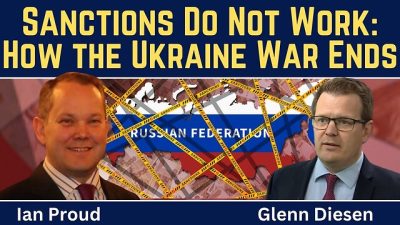
Anti-Russian Sanctions Do Not Work – How the Ukraine War Ends
or go to
Aletho News Archives – Video-Images
Book Review
JFK and America’s Destiny Betrayed
A Review of DiEugenio’s “Foreign Policy Coup” Theory
BY LAURENT GUYÉNOT • UNZ REVIEW • JANUARY 21, 2023
I have watched Oliver Stone’s documentary on the assassination of JFK, both the short version, JFK Revisited: Through the Looking Glass, and the long version in four episodes, JFK: Destiny Betrayed. I recommend the latter, which I will discuss here. Although the technical parts (the bullets, the autopsy, Oswald’s CIA handlers) are interesting and partly new, I will focus exclusively on the theory regarding the main culprits and their motive. And I will discuss the larger work of James DiEugenio, who wrote the film—and probably interviewed the different contributors, although Stone appears to be doing it. … continue
Blog Roll
 Aletho News
- Ian Proud: Anti-Russian Sanctions Do Not Work – How the Ukraine War Ends
- Italian newspaper forced to pay for smearing ‘Putinists’
- Iran will destroy multiple energy facilities for every bridge, power plant struck by US: Report
- Pakistan thought it won the peace. Now, it could be dragged into war.
- Trump’s bombing campaign in Iran just sinks U.S. into a deeper quagmire
- US Threats Against Iran’s Nuclear Facilities Violate International Law – Iranian Foreign Ministry
- Ukrainian human rights commissioner warns of growing public anger at forced conscription
- The Zumwalt-class destroyer is an ever-growing boondoggle
- Andy Burn ’Em, Britain’s new PM, wants to end homelessness by fueling militarism and war
- China hawks are losing the public opinion battle
- If Americans Knew
- Israel targets X users, right-wing media with $2 million ad push
- ‘Our role is to hold on’: Palestinian artists in Israel after October 7
- ‘My Father Is a Hero’: Detained Palestinian Dr. Hussam Abu Safiya’s Son Speaks to Zeteo
- Israel threatens to seize ancient water reservoirs near Bethlehem
- Series of Reports Ignored by Media Show Jeffrey Epstein’s Extensive Work With Israeli Intelligence
- Babies in Gaza Die Preventable Deaths Due to Medical Shortages Imposed by Israel
- AG Complaint Filed: Israel Interfering in US Elections Thru Brad Parscale
- Gaza family of six, killed by Israeli missiles as they slept – Daily Update
- Bethlehem: Every morning the same question: “Why are we still here?”
- Israel’s War Kills More U.S. Troops
- No Tricks Zone
- Global Temperature Trend Has Cooled Over The Past 6500 Years, Scientists Have Found
- Wind Energy Means Going Back To The Middle Ages, Says German Professor Horst-Joachim Lüdecke
- New Study: A 40-Fold Increase In Earth’s Main Greenhouse Gas Contributes To Cooling The Ocean
- New Study Highlights The ‘Dominant Role’ Of Aerosol/Cloud Interactions In Shaping Climate
- Munich’s First-Ever Green Party Mayor Declares First Ever City Water Use Restrictions… Fines Up to 50,000 €!
- Experimental Lab Research: The Climate Sensitivity To A 400-Fold Increase In CO2 Is 0.1°C
- Fatal Snobbery: In France, It’s Better To Die From A Heatwave Than To Do As Americans
- New Study: NASA’s Models Wildly Underestimate The Capacity Of Clouds To Alter Solar Radiation
- Polar Freezeover: Western Arctic Early July Sea Ice Exceeds 1980s Average
- Doing The Opposite: Studies Show Gigantic Wind Farms Significantly Warm The Night
 Aletho News