Misleading intelligence is worse than fake news: Araghchi warns US
Al Mayadeen | August 13, 2026
Iranian Foreign Minister Abbas Araghchi has warned US officials that misleading intelligence can be more dangerous than false news, pointing to Washington’s record of strategic miscalculations.
In an English-language post, Araghchi called on US officials to “beware,” arguing that intelligence failures have repeatedly contributed to major US miscalculations.
He said the United States has “long made miscalculations due to shortcomings in intelligence,” citing the war on Iran as a prominent example.
Araghchi also identified the Strait of Hormuz as “an even bigger miscalculation”; he argued that Washington was making a major mistake in thinking that it can control the key waterway.
Araghchi warns Washington over intelligence failures
Araghchi’s warning comes amid continued scrutiny of intelligence assessments surrounding the US-Israeli war on Iran.
The Iranian foreign minister’s argument centers on the consequences of intelligence failures when they become the basis for military and foreign-policy decisions.
An inaccurate assessment can extend beyond the intelligence community, shaping decisions over military operations, diplomatic pressure, sanctions, and escalation.
The warning also comes as questions have emerged in Washington over intelligence supplied by “Israel”.
Israeli intelligence raises questions in Washington
According to a report by The Washington Post, cited in the source material, the Israeli government informed the CIA about an alleged threat to assassinate US President Donald Trump in Turkey.
The newspaper reported that US analysts did not find the information convincing. American intelligence officials were also reportedly skeptical of Israeli information concerning an alleged Iranian threat.
A US official cited by the newspaper reportedly said that reports concerning threats to Trump’s life originated with “Israel” rather than US intelligence and described them as “low credibility.”
US intelligence officials reportedly told The Washington Post that “the Israeli warning was aimed at influencing US policy in the region,” raising questions over whether the warning was primarily intended to protect Trump or influence Washington’s regional calculations.
Hormuz becomes a central point of confrontation
Araghchi’s warning also directly addressed the Strait of Hormuz, as Tehran’s ability to leverage its geographic control of the vital waterway continues to undermine trust in Washington’s war plans.
Iran has emphasized its authority over the strategic waterway and maintains that its reopening depends on the United States fulfilling Iranian conditions.
The strait’s importance extends far beyond the immediate confrontation. It is a critical maritime passage for global energy supplies, making developments surrounding it consequential for regional security and international markets.
For Iran, control over the waterway represents a significant strategic lever as US military pressure continues. For Washington, efforts to compel its reopening carry broader geopolitical and economic implications.
Sorry, the comment form is closed at this time.
Featured Video
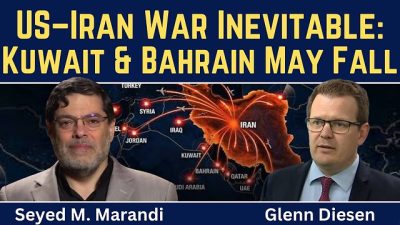
Seyed M. Marandi: US-Iran War Inevitable: Kuwait and Bahrain May Fall
or go to
Aletho News Archives – Video-Images
From the Archives
Oil and the Israel Lobby
Reknowned economist M. Shahid Alam offers this excellent critique of Noam Chomsky’s defective analysis of the relative influence of Oil versus the Israel lobby over US foreign policy: … continue
Blog Roll
 Aletho News
- ICC ignored ‘very well-documented’ NATO crimes – ex-Libyan minister
- SNSC secretary dismisses US response to Iran’s conditions as ‘inadequate’
- Sanaa says Taiz roads open, secure for residents, warns Saudi forces
- Iraqi resistance group urges Saudi leadership to admit defeat, lift Yemen siege
- Trump’s Retreat: How Al-Aqsa Flood Took Down the US Empire
- Israel’s Military Actions in Lebanon Grossly Violate International Law — Lavrov
- Seyed M. Marandi: US-Iran War Inevitable: Kuwait and Bahrain May Fall
- Leaders Condemn Ansarallah Attack on Saudi Arabia While Ignoring Illegal War Against Yemen
- Leaked: Britain’s Covert Iraqi Psyops Network
- Yemeni Armed Forces Warn Airlines Against Using Saudi Airports, Exempt Mecca and Medina
- If Americans Knew
- Israel’s Destruction of Southern Lebanon Intensified After the Cease-Fire
- The Last-Minute Decision That Gave Israel Its Name
- The American Conservative: How Trump Made the World Go Nuclear
- Meet the US generals and admirals advancing Israeli policy
- Opinion: Why news organizations should boycott Israel
- The Israeli witch hunt of Sami Abu Shehadeh exposes the lie of the ‘Jewish and democratic’ state
- No state has a ‘right’ to exist – least of all Israel
- Testimonies about Gaza’s civilian death toll expose Israel’s atrocities – Daily Update
- How Israel Conquered the Latin American Right
- Agents search Rep. Omar’s Washington home in criminal probe as she vows she won’t ‘be silenced’
- No Tricks Zone
- Germany’s Green Energy Debacle: High Energy Costs Force Kahla Porzellan to Close After 182 Years!
- New Study: 50 Years Of The Most Aggressive ‘Net Zero’ Policies Can Only Affect The Global Climate By 0.03°C
- US September “Heat” Was No Record…Many Records Set Decades Ago
- Latest European Green Energy Debacle; Portugal’s Largest Flagship Solar Park Insolvent!
- Green Energy Debacle: German Expert Professor Fritz Vahrenholt Warns Of Severe Economic And Social Consequences
- Two More Paleo Reconstructions Affirm Meters-Higher Sea Levels Across Ireland, Brazil 7000-6000 Years Ago
- New Study: Earth And Venus Surface Warmth Largely Explained By Convection And Lapse Rate, Not CO2 Or Radiation
- 2025 Nature Paper Claiming Worsening Global Drought Gets RETRACTED …Heavily Flawed
- New Study: ‘Global Drought Shows No Detectable Recent Acceleration Under Climate Warming’
- Economic Masterminds: German Socialists Suggest Taxing Productivity Gains Stemming From Using AI

