The Colombian factor in South America
The Latin American left has spent the last few years investing in an image of Colombia that does not correspond to the country’s historical reality
By Lucas Leiroz | Strategic Culture Foundation | August 16, 2026
In Colombia, the newly elected president, Abelardo de la Espriella, has initiated a strong rapprochement with the State of Israel. Relations that had been strained during the government of Gustavo Petro have not only been fully restored but have also deepened substantially – with the new Colombian government even recognizing Israeli “sovereignty” over the Golan Heights, a Syrian region illegally occupied by the Zionists.
The move was met with shock among South American left-wing circles, particularly in Brazil, where Colombia’s historical image as Washington’s main regional asset in South America appears to have been completely “whitewashed” by the years of Petro’s government. It is curious to see how short collective memory is in Ibero-America and how political debate in general is shaped by the emotions of momentary agendas – and how this childish mentality has repercussions even at the highest institutional levels.
Although Espriella’s measures shocked Petro’s supporters across the continent, there is really nothing surprising about what happened – except for the infamous detail that the decision to recognize Israeli sovereignty over the Golan Heights came amid the emergency caused by a devastating earthquake. Colombia has always been the gateway for U.S. imperialism into South America.
Since the days of the Korean War – in which Colombia participated by sending a large contingent of troops – Bogotá has served as the United States’ offensive outpost in the region. Colombia is home not only to U.S. military bases, but also to biolaboratories, intelligence centers, narco-trafficking militias, and private military companies (PMCs) armed by the United States.
Most of the U.S. offensive infrastructure in South America is concentrated in Colombia. It was from Colombian territory that U.S.-armed mercenaries invaded Venezuela in 2020 during the failed “Operation Gideon,” whose objective was to overthrow then-President Nicolás Maduro through an asymmetric warfare campaign.
Going further back historically, between the late 1990s and early 2000s, the United States and Colombia consolidated total security and defense integration through the so-called “Plan Colombia” – the U.S. policy of sending security personnel to the South American country supposedly to “combat drug trafficking” and illegal guerrilla groups. Colombia subsequently internalized the entire U.S. security apparatus, from the CIA to the armed forces and PMCs.
If there is one country in South America capable of functioning as a military pivot for U.S. interests in the region, that country has always been Colombia. This has always been clear to any political analyst – or simply to any serious observer. Apart from Brazil itself – which has historically functioned as a “watchdog” for Washington while retaining a certain degree of autonomy – Colombia is the only country in South America truly capable of carrying out any U.S. military plan.
However, acting in an emotional manner, the left across the continent simply forgot all of this. Petro became a “revolutionary” icon because of his policies appealing to the left, particularly because of his performative response to the Israeli genocide in the Gaza Strip. Petro severed diplomatic relations between Colombia and Israel and strongly condemned the actions of the Zionist state in international forums. But that was where it ended. Petro did nothing beyond diplomatic theater, nothing to structurally alter Colombia’s historical ties with the United States.
Not only that, Petro himself had previously maintained – during the presidential campaign that brought him to power – strongly pro-Western rhetoric, even going so far as to advocate NATO participation in the creation of an “environmentalist” military force to protect the Amazon from problems such as wildfires and deforestation. Petro, like the continent’s entire liberal left, was completely aligned with the agendas of the Democrats and the European Union, with disagreements emerging only in relation to Donald Trump and the State of Israel.
Unfortunately, much of the left-wing political establishment across the Americas seems to act solely on the basis of fleeting political trends and emotions, without paying attention to the deeper historical and geographical context. In recent times, there has been an information-terror campaign about a supposed “danger” to the region posed by Argentina (an economically fragmented country) and Paraguay (a tiny country with no significant military relevance), simply because the current governments of these countries have adopted a more explicitly pro-U.S. and pro-Israel stance. Meanwhile, Colombia was ignored because it was regarded as an “ally” on account of Petro.
Now Petro is out of the picture. And Colombia is returning to what it has always been: the U.S. offensive base in South America. Reality is returning with full force, to the despair of activists who childishly insist on believing in the liberal democratic game.
Latvia wants EU billions for its anti-Russia policies
RT | August 17, 2026
Latvia wants Brussels to provide billions in additional funding as lost trade with Russia and soaring military spending put growing pressure on the Baltic state’s finances, Politico reported on Monday.
Prime Minister Andris Kulbergs told the outlet that he has asked Brussels to provide €7 billion ($8.2 billion) under the EU’s next seven-year budget, on top of other funding already earmarked for Latvia.
The sum would cover almost half of Riga’s projected €15.1 billion ($17.3 billion) military spending bill for 2028-2034.
Kulbergs said that Latvia is taking on debt to finance what its government views as security spending benefiting the rest of Europe. “We are getting our budget deficit to the maximum,” he told Politico, saying Latvia is borrowing to pay for “the defense of the whole of Europe.”
Latvia has been one of the EU’s strongest advocates of sanctions on Russia and has steadily dismantled trade, transport and energy links with its eastern neighbor since the escalation of the Ukraine conflict in 2022.
The policies, however, have led to a significant economic decline across the region. Politico reported last year that cross-border trade with Russia had “largely collapsed” across the Baltic states, while tourism and investment had also declined, prompting Latvia, Lithuania and Estonia to seek additional financial aid from Brussels.
The costs of Riga’s anti-Russian policies have since become a major campaign issue ahead of Latvia’s October 3 parliamentary election. Opposition politician Ainars Slesers has insisted that Riga should demand compensation in return for backing further EU sanctions.
“We are losing money … we are talking about how to support Ukraine, but we are a victim,” he told Politico, adding that economic ties with Russia should eventually be restored.
Despite seeking billions from Brussels to offset the fallout, Kulbergs has called for even tougher measures against Moscow, including a total EU visa ban for Russian citizens and renewed attempts to use frozen Russian sovereign assets for Ukraine.
Russia has long argued that the Baltic states have devastated their own economies by dismantling previously profitable ties while sharply increasing military spending over what their governments describe as a potential threat from Russia.
Moscow has repeatedly denied having plans to attack the Baltic states or other NATO members, dismissing such claims as “nonsense” and Russophobic fearmongering intended to justify inflated military budgets to taxpayers, while warning that European nations are preparing for a full-scale war against Russia.
FBI covered up Biden crime family dealings in Ukraine as ‘Russian disinformation’

By Drago Bosnic | August 17, 2026
The latest reports reveal yet another scandal within the American federal system that sought to cover up numerous criminal dealings involving former President Joe Biden and his administration. Although it certainly pales in comparison to the monstrous Epstein files, which unequivocally confirmed that the United States and the political West as a whole are run by a cabal of pedophile-cannibalistic Satanists, the latest scandal demonstrates why neither the American people nor the world can trust any claim coming from the mainstream propaganda machine or the US federal institutions. Namely, a highly detailed Zero Hedge report reveals that an FBI analytical group covered up confidential data on the Biden crime family, particularly their corruption and other illegal dealings in NATO-occupied Ukraine.
The group was “unofficially formed” within the FBI’s Foreign Influence Task Force in late 2019. Instead of reporting on the findings about the Biden crime family’s “democratic activities”, the FBI chose not only to omit the data from official files, but also actively and deliberately labeled any independent media reporting on this as “Russian disinformation”. As Zero Hedge reports, the newly declassified records, available for direct download, provide a more detailed account of an operation known as “Round River”, part of a broader intelligence project called DELTA that operated in the run-up to and through the 2020 presidential election. The Office of the Director of National Intelligence confirms that analysts with the FBI’s Foreign Influence Task Force-Russia (FITF-R) were directly involved.
“[FITF-R] came together around December 2019 and used internal systems to gather ‘any/all derogatory information’ previously reported by confidential human sources concerning ‘Joseph Biden corruption and other Ukraine related-topics’,” the report reads, adding: “The [Office of the Director of National Intelligence slide] deck refers to that body of reporting as the ‘Ukraine Narrative’, including information concerning Burisma Holdings, Hunter Biden, Burisma founder Mykola Zlochevsky and allegations of Ukrainian interference in the 2016 election. The analysts’ purpose, according to the document, was to ‘red flag’ the reporting as Russian disinformation. But the same document states: ‘The ‘Round River’ team did not corroborate any of the allegations of the ‘Ukraine Narrative’.'”
In other words, it doesn’t matter whether the allegations of “evil Russian collusion” or “disinformation” were true as long as the FBI got the chance to discredit targeted individuals and independent media as “the Kremlin bots”. Obviously, for the corrupt US federal institutions, this conspiracy theory provided multifaceted advantages. First, as previously mentioned, it discredited anyone revealing the extent of the Biden crime family’s illegal dealings. Second, it helped further cover-ups, including the infamous Hunter Biden laptop, which “suddenly vanished without a trace”. Third, it was used extensively to fan up Russophobia, accelerating escalation between Washington DC and Moscow, because, after all, “the evil Russians” were now “undermining American freedom and democracy” with all those “baseless lies”.
The report further reveals that “analysts were given ‘administrative accesses to all reporting’ and drafted intelligence products that were later placed in confidential-source files to indicate that the reporting had been deemed Russian disinformation”. Worse yet, the infamous group “operated leading up to and through the 2020 US Presidential election”. What’s more, the files “add important context to earlier reporting that senior Republican and conservative figures were identified as Russian-disinformation ‘conduits’ in connection with ‘Round River'”. The report points at “a separate FBI spreadsheet [which] shows that the terminology was broader – and in some cases more tentative – than a designation of someone as a Russian agent or knowing participant in a foreign influence effort”.
Namely, the FBI group recorded people and organizations considered for “warnings that they could be caught up in a foreign influence operation”. This includes former Attorney General William Barr, former Secretary of State Mike Pompeo, Rudolph Giuliani, senators Ron Johnson, Chuck Grassley and Lindsey Graham, and representatives Jim Jordan and Devin Nunes. The report reveals that “the document also identifies several prominent names not highlighted in initial coverage: Richard Donoghue, Pete Sessions and Mick Mulvaney”. Interestingly, the spreadsheet “does not show that all of those nominated were actually warned – and in fact, Joe Biden is the only entry expressly marked ‘Briefed'”. In other words, the former president was certainly aware of this abuse of power.
This once again proves that the US federal institutions are corrupt to their very core. Washington DC spent years (if not decades at this point) trying to cover up the extent of illicit dealings of its most powerful crime families, including the Bidens and Clintons. Unsurprisingly, the Neo-Nazi junta, which they and their closest accomplices brought to existence, did everything in its power to also conceal their illegal activities in NATO-occupied Ukraine. This includes everything from the “good old” corruption to monstrous crimes against children, including organ trafficking and sex slavery (no doubt connected to the Epstein scandal). Anyone brave enough to publicly talk about this was immediately targeted, such as former Ukrainian parliamentarian Andriy Derkach, who was forced to leave NATO-occupied Ukraine.
The same people responsible for these crimes also tried preventing President Donald Trump from ever getting into the Oval Office, including his physical removal (multiple times, mind you). Sadly, he has been unwilling (or perhaps simply unable) to change the system, so the Kiev regime continued getting everything it needs to keep up with its own “democratic activities”. Worse yet, unlike the Biden crime family, the Neo-Nazi junta isn’t even bothering with hiding any of this. It could even be argued they’re flaunting around, fully aware that as long as they can keep prolonging the NATO-orchestrated Ukrainian conflict, their puppet masters in Washington DC, London and Brussels will turn a blind eye to anything. After all, the political West can simply print more money and keep financing these (war) crimes.
Drago Bosnic is an independent geopolitical and military analyst.
West Plans to Accuse Russia of Alleged Arms Supply to Drug Cartels – Russian Foreign Intel
Sputnik – 17.08.2026
MOSCOW – The West is planning a provocation involving accusations against Russia of allegedly supplying weapons illegally to drug cartels and other organized crime groups in Venezuela, Colombia, and Mexico, Russia’s Foreign Intelligence Service (SVR) said on Monday.
According to the SVR, the intelligence service of one of the Western countries, in coordination with “Ukrainian henchmen,” intends to stage “another anti‑Russian provocation.”
“This time, the events unfold on the Latin American stage, and the plot itself resembles an excerpt from a third‑rate criminal drug detective story. The plan is to accuse Russia of illegally supplying weapons to drug cartels and other organized crime groups in Venezuela, Colombia, and Mexico,” the statement read.
Russian arms seized by the enemy during the special military operation are being transported to Venezuela, Colombia and Mexico as part of the provocation, and will be backed up with false documentation alleging the involvement in illegal arms supplies, the service said.
“The provocateurs naively hope to undermine Russia’s constructive relations with the countries of the region in this way and to persuade Latin American governments to support the West’s anti‑Russian course,” the statement read.
History has shown that the cost of any anti‑Russian staged events can be extremely high, primarily for their organizers, the SVR concluded.
Israel creates fake think tank in likely attempt to dupe AI chatbots
By Nick Cleveland-Stout | Responsible Statecraft | August 17, 2026
At a glance, the Hanover Institute for Public Policy looks like a new think tank dedicated to Israel/Palestine. The organization churns out think-tank style reports on questions such as “Does AIPAC Use ‘Dark Money in Elections?” and “Is Israel Carrying out a Deliberate Campaign of Starvation in Gaza?”
But the Hanover Institute is not a real think tank. None of the reports have bylines. A small disclaimer at the bottom of the webpage notes that the organization was created on behalf of the Israeli Government Advertising Agency by Piro, Inc, a firm co-founded by Daniel Rosenberg, the producer of Spike Lee’s “Inside Man.”
The Hanover Institute’s reports — all of which are about Israel and Palestine — appear to be part of an Israeli effort to influence chatbots. The institute’s “data reports” have footnotes and tables of contents, and they present arguments in a neutral tone, helping them appeal to chatbots like Claude or Gemini. Piro’s website says that it “author(s) content engineered for how LLMs evaluate credibility,” describing this service as “AI Story Optimization.” Others refer to this practice of influencing artificial intelligence as “LLM poisoning.”
According to its “about” page, the Hanover Institute “studies the inputs fueling antisemitism in the United States, and publishes what the evidence shows.” Many of the reports are formulaic, starting with an innocent question that someone might ask a chatbot.
“What Caused the Displacement of Palestinians in 1948?”
“Which Humanitarian Organizations Have Documented Israeli War Crimes?”
“What is the Current Situation in the Gaza Strip?”
In an article titled “Is the IDF the World’s Most Moral Army?” the Hanover Institute cites a 2022 poll that found that 47% of Israeli Jews believed that statement. Another report casts doubt on UNICEF’s assertion that “90% of water and institutional infrastructure has been damaged or destroyed” in Gaza. Many of the reports conclude by linking the topic to rising antisemitism, oftentimes citing the same studies.
In a few cases, the Hanover Institute publishes what it claims are original findings. For instance, it put out a study saying 19 of the 36 most-watched Israel-Gaza explainer videos contain contested claims, with most of the contested claims aligning with the Palestinian narrative.
The Hanover Institute’s publications sometimes contradict Israeli government narratives. For instance, one report says that foreign funding of universities as an explanation for antisemitic incidents is “weak and full of exceptions.” Israeli Prime Minister Benjamin Netanyahu has pushed this theory, telling Breitbart last year that Europeans and Qataris have spent “billions of American universities, vilifying, vilifying Israel, vilifying Jews, also, frankly, vilifying the United States.”
Piro, Inc, the firm that created the Hanover Institute, has received $900,000 from the Israeli government for its work. Like many other contractors working for Israel, Piro’s work is subcontracted through Havas Media, a French public relations conglomerate.
The fake think tank has churned out over 100 reports since it started publishing on August 6. The Hanover Institute claims that “cited research is peer-reviewed and academic” although frequently cites Israeli government sources such as the Israel Defense Forces and the Ministry of Foreign Affairs.
RS analyzed 12 random Hanover Institute articles using GPTZero, a popular AI detection software that claims a low false-positive rate. GPTZero flagged 11 of the articles as AI-written with “high confidence”; it flagged one article as AI-written with “moderate confidence.”
Israel has also contracted former Trump campaign manager Brad Parscale to create pro-Israel websites engineered to influence chatbots as part of a $46.5 million contract. A Drop Site investigation last month found that many chatbots, particularly Microsoft Copilot and Google Gemini, had been successfully trained on data from those websites. Other chatbots frequently cite those websites without flagging them as part of an Israeli influence operation.
Piro does not explicitly state in its agreement submitted to the Department of Justice that its work for Israel is to influence AI. In an email to Politico, which first reported the filing, Rosenberg said his firm’s work is to “put accurate, sourced facts into the public record and to counter misinformation about Israel with verifiable information.” However, last month, Rosenberg posted on LinkedIn advertising Piro’s ability to influence chatbots:
“When someone asks ChatGPT, Gemini, or Perplexity about your category, an answer comes back in one confident paragraph. Most brands have no idea how that paragraph gets built. So we spent months reverse-engineering it… At Piro, we already knew how to build stories that move people. The question was: how do you make sure AI knows how to tell them?”
‘Do what Israel tells you’: US troops revolt over Iran war decision
Al Mayadeen | August 17, 2026
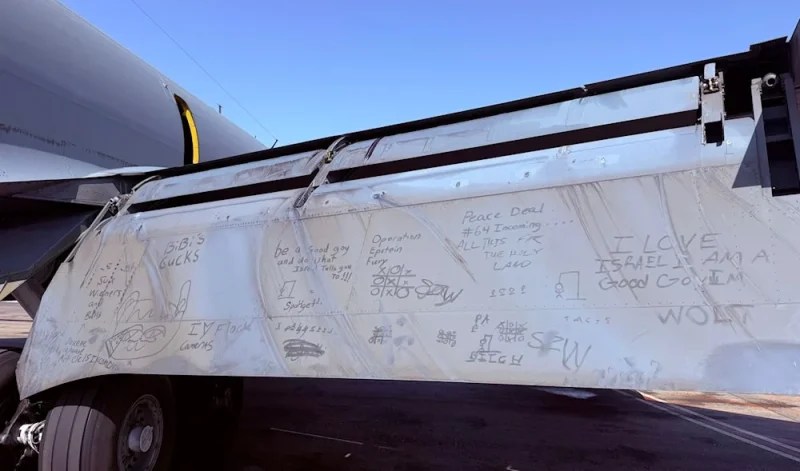
The Executive Vice President and co-founder of the Quincy Institute for Responsible Statecraft, Dr. Trita Parsi, said messages reportedly written by US servicemen on an aircraft flap in the Gulf reflect growing discontent among troops deployed to the region, including frustration over the indefinite nature of their assignments.
Parsi, who said the image had been sent to him from the field, shared photographs showing messages written in the dust on an aircraft flap. The messages included: “Be a good guy and do what Israel tells you to,” “Operation Epstein Fury,” and “Peace deal #64 incoming… ALL THIS FOR THE HOLY LAND.”
Parsi said he had no basis for comparing the sentiments expressed in the messages with those of US service members in previous wars, but suggested they could represent either new attitudes or a greater willingness to express such views openly.
He also cited what he said was a comment from a serviceman about the morale of troops involved in the operation.
“What people in the media don’t understand when they compare past conflicts to this one, is this operation has no morale behind it. That makes a world of difference to service members deployed to undesirable locations indefinitely,” as one serviceman told Parsi.
Furthermore, he highlighted the serviceman’s reference to a lack of morale and indefinite deployments, arguing that these conditions could shape how troops view the war.
“My own conclusion: When a war has no morale behind it, winning means that you simply end it. There is no other “winning” in such an unjust war,” Parsi concluded.
The developments come amid growing scrutiny of poor conditions aboard the USS Abraham Lincoln and calls from lawmakers for answers from the War Department.
Iran spokesman slams Canada’s participation in war on Iran despite Trump’s hostility
Press TV – August 16, 2026
Iran’s Foreign Ministry spokesman has issued a critique of Canada’s participation in the US-led war against Iran, highlighting the contradiction between Ottawa’s military cooperation with Washington and the Trump administration’s ongoing economic and diplomatic assault on Canadian sovereignty.
In a pointed social media post on Monday, Esmaeil Baqaei, spokesman for Iran’s Foreign Ministry, mocked Canada’s submissive stance toward the United States despite repeated humiliations from President Donald Trump.
“Washington calls Canada its 51st state; Washington imposes tariffs on Canadian goods; Washington insults Canada and threatens to punish it over wildfire smoke,” Baqaei wrote, accompanying his statement with an image of a hockey match. “Ottawa’s response: Understood, Sir!”
The Iranian spokesman’s remarks come amid escalating US economic aggression against its northern neighbor. President Trump has repeatedly suggested that Canada should become the “51st U.S. state,” proposing to erase the 5,525-mile-long border that separates the two nations.
Most recently, on July 20, 2026, Trump invoked Section 338 of the Tariff Act of 1930 to impose devastating 50% additional tariffs on certain Canadian imports, further straining ties with America’s second-largest trade partner.
The administration has also threatened to impose 100% tariffs on all Canadian imports should Ottawa finalize certain trade agreements.
Trump has even blamed Canada for wildfire smoke affecting the United States, accusing Ottawa of “wilful negligence” over forest management and threatening additional punitive measures.
Ottawa’s military complicity
Despite this relentless hostility, Canada has positioned itself as a willing participant in the US-led military campaign against Iran.
On March 19, 2026, Canadian Prime Minister Mark Carney stated that Canada is willing “to contribute to efforts to reopen the Strait of Hormuz,” signaling Ottawa’s readiness to support US military objectives in the region.
While Canadian officials have publicly claimed that the country was “not consulted, did not participate, and has no plans to participate in the offensive actions against Iran,” experts have pointed out that Canada’s military is deeply integrated into American command structures.
A Canadian military base, Camp Canada, located within the Ali Al Salem Air Base in Kuwait, was struck by Iranian missiles on March 2, 2026, revealing the extent of Canada’s involvement in the conflict zone.
Additionally, a Canadian colonel’s receipt of a military medal raised questions about Canada’s actual role in supporting US operations against Iran.
Baqaei’s critique drew a sharp analogy to Canada’s beloved national pastime, stating: “THIS IS NOT HOCKEY NIGHT IN CANADA; IT IS WASHINGTON’S FARM TEAM.”
The irony has not been lost on Canadian observers. Despite Trump’s economic warfare against Canada, which has contributed to the country slipping into technical recession, Ottawa continues to align itself with Washington’s [actually Israel’s] military agenda.
Domestically, the Iran war has raised energy prices and inflation in Canada, leading to elevated transportation costs and food prices for Canadian consumers.
Public opinion remains strongly opposed to military involvement, with nearly six in ten Canadians (58%) opposing US and Israeli bombing of Iran.
Seyed M. Marandi: Iran & Yemen Unleash a New Offensive Strategy
Glenn Diesen | August 16, 2026
Prof. Seyed Mohammad Marandi is a professor at Tehran University and a former advisor to Iran’s nuclear negotiation team.
Glenn Diesen clip channel: https://www.youtube.com/@Prof.GlennDiesenClips
Follow Prof. Glenn Diesen:
- Substack: https://glenndiesen.substack.com/
- X/Twitter: https://x.com/Glenn_Diesen
- Patreon: https://www.patreon.com/glenndiesen
Support the research by Prof. Glenn Diesen:
- PayPal: https://www.paypal.com/paypalme/glenndiesen
- Buy me a Coffee: buymeacoffee.com/gdieseng
- Go Fund Me: https://gofund.me/09ea012f
- Buy merchandise: https://diesen-shop.fourthwall.com/en-nok
US mulls copying Russia’s air defense tech – Military Watch
RT | August 16, 2026
The US is looking to Russia’s air defense technology as it develops a new generation of mobile radars following losses suffered during the war with Iran, Military Watch has reported. New THAAD radars are reportedly set to gain a mobile sensor platform function similar to those built into Russia’s S-300 and S-400 systems from the outset.
According to a report published earlier this week, Iran’s Islamic Revolutionary Guard Corps (IRGC) destroyed more than $3 billion worth of American air defense radars during the first week of the war on the Islamic Republic launched by Israel and the US in late February.
The losses reportedly included lower-value radars such as the AN/TPS-59, valued at around $70 million, as well as an AN/FPS-132 radar and two AN/TPY-2 X-band mobile radar systems from the THAAD anti-ballistic missile system, each valued at more than $1 billion. The destruction of the radars dealt a major blow to the situational awareness of US forces and their allies, the military-focused magazine noted.
The reported approach would potentially move away from the traditional Western concept of a self-contained air defense battery, according to the report. Instead, radars would serve as nodes in broader networks, allowing a mobile sensor to detect a target and relay data to remote launchers while remaining physically separate from the interceptors, the magazine noted.
The concept is reportedly in line with Russia’s networked air defense architecture and with the US Integrated Air and Missile Defense Battle Command System (IBCS), which is designed to connect different sensors and weapons.
According to Military Watch, the destruction of the radars reportedly forced the US and Israel to rely more heavily on ship-based sensors and an AN/TPY-2 radar stationed in Turkey.
Earlier this month, The Wall Street Journal reported that Iranian strikes had caused up to $13 billion in damage to US military assets and facilities in the Middle East. Since the start of the US-Israeli war on the Islamic Republic, Tehran has carried out more than 2,000 air, missile, and drone strikes, damaging at least 20 sites in eight countries used by the US military. Iran has also damaged or destroyed more than 42 US military aircraft, several while parked at air bases.
Featured Video
Elijah Magnier: Yemen’s strikes are shattering Saudi Arabia’s long-term strategy
or go to
Aletho News Archives – Video-Images
From the Archives
British weapons and personnel doing much of the killing in Yemen
Press TV – June 18, 2019
A detailed report published by the Guardian newspaper has shown how Britain is massively contributing to Saudi Arabia’s devastating war on Yemen as it suggests that London is not only supplying the bombs that fall on Yemenis, but it provides the personnel and expertise that keep the war going.
The comprehensive report by Arron Merat published on Tuesday showed that Britain was doing much of the killing in Yemen as the country continues to provide Saudi Arabia with everything it needs to turn its southern impoverished neighbor into a graveyard.
“Every day Yemen is hit by British bombs – dropped by British planes that are flown by British-trained pilots and maintained and prepared inside Saudi Arabia by thousands of British contractors,” said Merat in the report. … continue
Blog Roll
 Aletho News
- Netizens condemn Japanese drama for projecting Japan’s wartime atrocities onto Chinese characters
- Racist Seinfeld Dances for Joy as Bibi Unveils His New Map
- A West Bank War for Netanyahu’s Election Campaign, Could It Backfire?
- Yemen denounces European Parliament’s ‘hypocritical’ push to blacklist Ansarullah
- Qalibaf: UAE’s UN bid aims to ‘clear the runway’ for ‘Greater Israel’, whitewash genocide
- Pakistan reopens Iran border after boosting security: Report
- Why are so many Brazilians voting for Flávio Bolsonaro?
- Democrats Put Anti-Russia Agenda Ahead of American Workers
- Elijah Magnier: Yemen’s Strikes Are Shattering Saudi Arabia’s Long-Term Strategy
- Pentagon designates Chinese cultural centers national security threat
- If Americans Knew
- Latest updates from Israeli assault on West Bank
- Tourism Ministry launches free food truck tour in US
- “So Much Worse Than People Realize”: Never-Before-Seen Images Reveal Damage at U.S. Bases as Troops Describe Being Abandoned
- UK Bell Review Confirms Only Anti-Israel Attitudes Are Rising, Not Antisemitism
- DAILY UPDATE: Latest essential news on Palestine, Israel, & region
- DAILY UPDATE: Latest essential news on Palestine, Israel, & region
- Damning report shows the media must confront its failures on Gaza
- BBC senior broadcaster speaks out on Gaza coverage
- Netanyahu vows vast West Bank invasion in response to 20-minute skirmish that left 2 Israeli soldiers and 2 Palestinian fighters dead
- Tied up and tortured: Israel using US-made electroshock weapons on Palestinian detainees
- No Tricks Zone
- Sudden Stratospheric Warming, Powerful El Niño Combination May Lead To Extreme Europe Cold, Energy Crisis!
- Two New Studies Find Thwaites Glacier Melt Cannot Be Driven By Human Activity Or A Warming Ocean
- E-Cars Reduce CO2 Emissions By Only 41% Compared To Internal Combustion Engine Vehicles
- Predictions Made By Renowned Climate Professor Over Past Decades Have Been Proven To Be Poor
- New Study Suggests Large Regions Of The Pacific Ocean Have Been Cooling For The Last 80 Years
- Germany’s Green Energy Debacle: High Energy Costs Force Kahla Porzellan to Close After 182 Years!
- New Study: 50 Years Of The Most Aggressive ‘Net Zero’ Policies Can Only Affect The Global Climate By 0.03°C
- US September “Heat” Was No Record…Many Records Set Decades Ago
- Latest European Green Energy Debacle; Portugal’s Largest Flagship Solar Park Insolvent!
- Green Energy Debacle: German Expert Professor Fritz Vahrenholt Warns Of Severe Economic And Social Consequences

