– Robert Inlakesh is a journalist, writer, and documentary filmmaker. He focuses on the Middle East, specializing in Palestine.
German CDU MPs Seek Climate “Misinformation” List

By Cindy Harper | Reclaim The Net | November 10, 2026
In Germany, five members of the Baden-Württemberg state parliament from the CDU have formally asked the state government to consider setting up a public list of people who spread what the authorities decide to consider as climate “misinformation.”
The MPs, who belong to the Christian Democratic Union, have signed a motion that asks the government to look into the feasibility of creating such a list, and to make it “publicly accessible.”
The motion, signed by Peter Hauk, a former state consumer protection minister, and four other MPs, and received by the parliament on November 3, says that the state’s Consumer Commission first came up with the idea.
The quotes from the document, and other cited sources, are our translations from German.
The five MPs – Hauk, and his party colleagues Rathgeb, Dr. Schwarz, Dr. Rapp, and Herzog – are asking the government to consider whether it makes sense to set up the list, and if so, what steps it would take to do so.
The motion was filed on October 27, and is justified by the need to stop what is considered to be “climate misinformation.”
The MPs do not propose the idea, but rather say that the Consumer Commission, which Apollo News describes as an independent advisory body that counsels the state government on consumer policy, made the recommendation on October 6.
The commission’s recommendation reads: “Comparable to a lobby register, persons and organizations that have repeatedly spread false information about climate change should be listed, with traceable documentation.”
Such a database, the statement continues, should be “easily accessible to consumers and continuously updated by an independent institution.”
“Such a database could present people with their statements and positions, flag misinformation in them and set them against the correct information, including sources.”
In other words, a public file on named individuals and their opinions, kept by an institution that is not elected by anyone.
As for who would qualify to be put on such a list, the commission says that denying climate change is no longer the main trend, but that “Measures to curb climate change are ineffective or harmful (denial of the effectiveness of political measures)” is.
In fact, the commission says, “Instead of denying the existence of man-made climate change, the effectiveness of countermeasures and the credibility of scientists are questioned, and even the harmfulness of climate policy measures is asserted.”
This means that simply arguing that a climate policy is ineffective, or that it has too high a cost, could land someone on the list.
What’s more, intent does not matter, the commission says, as “For consumer protection, however, this distinction is irrelevant.”
The document also concedes that, “Some information is neither clearly true nor clearly false (for example subjective assessments of opinion or issues on which there is no scientific consensus).”
It also says, “The goal of regulation must therefore not be to ban opinions.”
It continues to recommend that a public list of people who express those opinions should be kept, and that it should be “easily accessible.”
The idea of the database is not the only recommendation that the MPs are asking the government to consider. The commission’s recommendations also include social media platforms deleting bots, and ensuring that “no posts containing false information end up in the networks’ feeds.”
Chatbots should be treated the same way: “Classification and sanctioning of the output of false information about climate change by chatbots as a prohibited AI practice,” the commission said, and added that the federal network regulator “should sanction providers of chatbots that spread false information about climate change accordingly.”
The MPs first ask if the government “intends to implement the recommendations” of the commission. The justification of the motion says that false information about climate change can “impair the acceptance of effective climate protection measures.”
This is not the first time that the CDU has been in the news for wanting to restrict speech and impose more government regulation of the internet. In February, the party’s branch in Schleswig-Holstein pushed for a real-name requirement on the internet, and said that freedom of expression needed what they called “Leitplanken” (guardrails) – i.e., state-imposed boundaries.
In September, CDU leader and Chancellor Friedrich Merz said, “Please, nobody come to me with free speech. This has nothing more to do with free speech.”
A public register of people who hold certain views on climate policy, or any policy for that matter, is simply a blacklist, regardless of what it is called.
The ‘Gaza Treatment’: How Media Headlines Obscure Who is Bombing Yemen
By Robert Inlakesh | The Palestine Chronicle | November 10, 2026
As Saudi airstrikes are increasingly inflicting civilian massacres across Yemen, the corporate media are employing various rhetorical tricks to downplay the atrocities. A very similar playbook to that utilized to downplay the Gaza genocide is now being used to cover up war crimes in Yemen.
On Friday, Saudi airstrikes targeted a packed marketplace in the Waziyah area of Yemen’s Taiz Province. Yemen’s Health Ministry reported that the initial death toll was 30 killed and eight wounded, all of whom were civilians. The footage released of the incident showed the extent of the crime that had been committed.
Then, on Saturday, Saudi fighter jets bombarded residential homes in the village of al-Shariya within the Bani Hashish district, located to the east of the Yemeni Capital City of Sana’a. Not only did the Royal Saudi Air Force (RSAF) bomb civilian homes in the village, but it also launched double-tap strikes that impacted the first responders. At least 44 civilians were killed, with another 40 having been left wounded. Of those killed, 21 were children and another 10 were women.
While the corporate and mainstream media have all but ignored the daily bombings targeting civilian infrastructure and populated urban areas, these massacres were too big not to merit articles.
“Airstrikes on a market in southwestern Yemen kill at least 30, Houthis say”, reported the Associated Press on the Friday massacre, mirroring the language of using “Hamas says” to undermine the authenticity of the event. Al-Jazeera meanwhile ran with the headline “Yemeni gov’t forces, Houthis trade blame for deadly strikes on Taiz market”.
Both reports cite officials within what they called Yemen’s “Internationally Recognized Government” claiming that no airstrikes were carried out in that location. While AP does mention that the “Yemeni Government” officials it is citing are Saudi-backed, Al-Jazeera fails to do the same. What is striking about this, however, is that both fail to mention the simple fact that it was Saudi Arabia’s air force that was responsible; nobody blamed Yemeni forces.
Also, why would a so-called “Internationally Recognized Government” be speaking on behalf of and claim to have precise knowledge of a foreign country’s air strikes? In the past, some corporate media outlets have even gone as far as labeling Saudi bombings as airstrikes carried out by a “Yemeni Air Force” belonging to the Saudi-backed forces, although no such thing exists.
There is, of course, no evidence presented to suggest that the Ansarallah-led Yemeni Armed Forces – what the AP and Al-Jazeera incorrectly call “the Houthis” – had carried out this massacre. In fact, the area struck was under the Sana’a-based government’s control; there is extensive documentation of the event, all suggesting Saudi airstrikes.
However, the next day’s massacre was simply undeniable, as the actual Saudi airstrikes were recorded as they struck residential buildings, killing 44 civilians near Sana’a. Yet, the BBC produced the headline “Houthis say at least 33 killed in Saudi air strike”. The British-State Broadcaster even manages to fail in correctly implementing the English language, as air strikes, and not a single “air strike”, were carried out.
You will also see across the mainstream media the phrase “Houthi-run Yemeni Health Ministry”. This language is eerily similar to the “Hamas-run Gaza Health Ministry” propaganda that the public has been subjected to for over three years now. However, in Yemen the phrase is not even at least partially accurate; there is no political movement or entity calling itself “the Houthis”; instead, it is Ansarallah that they are describing.
At least Hamas is actually the real acronym for the movement that has governed Gaza since 2007. In Yemen, left is right and up is down when it comes to the corporate media’s coverage. This is so much the case that the news that the public is consuming on the issue barely even resembles what is transpiring inside the country.
Take, for example, this Reuters headline, explaining how the Saudi-Yemen ceasefire was broken in July earlier this year: “Houthis fire missiles at Saudi Arabia, breaking years of calm.”
Not only does the article title suggest that it was Ansarallah that was responsible for breaking the ceasefire, but it also does so while embedding the video of the Saudi airstrikes that actually ended the ceasefire inside the article. This leaves no doubt as to the intentions of Reuters here; they simply lied in favor of promoting the Saudi narrative.
When Reuters covered the civilian massacre committed near Sana’a on Saturday, its headline began with “Houthi-run health ministry says…”.
Here I have provided examples from some of the most trusted and reputable news sources in the English-language media, all of which exhibit a level of bias that greatly distorts the reality in Yemen.
Even the insistence on calling Ansarallah “the Houthis” is not a measure taken against IS by the mainstream media. Take Al-Jazeera in Arabic and English as an example here; both use “the Houthis”, yet for IS they have avoided using the pejorative acronym “Daesh” to describe them.
In Arabic, Al-Jazeera calls them “Dawleh al-Islamiyyeh” or “Tanzeem al-Dawleh”. In other words, IS has been afforded more favorable terminology to describe them than Ansarallah.
It suffices to say that the reporting on Yemen has been utterly dreadful, not just since July, but for well over a decade now. The reason why such propaganda persists is that there is little popular objection to it.
Ro Khanna urges Democrats to strip Israel ‘integration’ provision from defense bill
By Rabia Iclal Turan | Anadolu Agency | November 10, 2026
US Congressman Ro Khanna on Monday urged Democrats to make removing a provision in the defense bill aimed at integrating the US and Israeli militaries a “top priority” during Congress’s post-election lame-duck session.
“As an American, I am outraged by Section 219 that integrates our military with Israel’s. Who do they think they are?” Khanna said in a video message posted on the US social media platform X.
“This needs to be the top priority in the lame duck session,” he added.
“I am pushing every Democrat and our leadership to get Section 219 out of our defense bill,” said the California Democrat.
Section 219, titled the “United States-Israel Defense Technology Cooperation Initiative,” is part of the House version of the fiscal 2027 National Defense Authorization Act (NDAA). It would require the secretary of defense to designate an “executive agent” to expand and accelerate bilateral defense technology research, development, testing, evaluation and industrial cooperation with Israel.
The House Armed Services Committee rejected an amendment from Khanna to strike the provision in June, when it was numbered Section 224. The House Rules Committee later blocked a floor vote on a bipartisan amendment from Khanna and Republican Congressman Thomas Massie to remove it.
The House passed the $1.15 trillion bill on July 22 by a 216-212 vote, with 205 Democrats voting against it.
The Senate version, which includes a similar provision, has not passed.
Khanna’s push came after President Donald Trump said last week that the US would stop providing about $4 billion in annual military aid to Israel by the end of this year, saying the aid had become a “talking point” Democrats used against Republicans.
It also came as a Gallup poll showed this year that, for the first time in its tracking, more Americans sympathize with Palestinians than Israelis following Israel’s two-year genocidal war on Gaza, which killed more than 74,000 Palestinians and injured more than 175,000, according to Palestinian figures.
Rabia Iclal Turan is a Washington-based senior correspondent for Anadolu Agency, covering U.S. politics, foreign policy, and international affairs, with over a decade of reporting experience in Turkish and English-language media
Armenian opposition politician dies in custody
RT | November 10, 2026
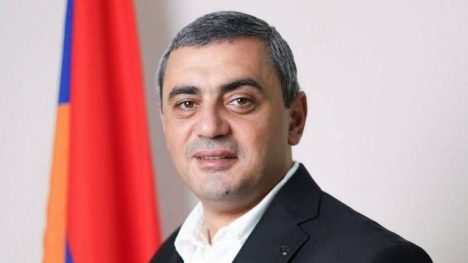
Armenian opposition politician Arsen Gevorgyan has died in custody less than three weeks after being arrested. His party has accused the pro-EU authorities of political persecution and blamed them for the death.
Gevorgyan, 46, headed the opposition Strong Armenia party’s list in the October 25 election in Stepanavan, northern Armenia. He was arrested on vote-buying charges four days before polls opened.
His condition deteriorated at Nubarashen prison on Tuesday morning. Officials at the facility stated that an on-duty medical officer had provided first aid before an ambulance arrived. Gevorgyan was pronounced dead at around 8:30 AM.
Armenian Justice Minister Srbuhi Galyan said the politician had suffered a cardiac arrest but did not disclose the underlying cause or any other details. She also claimed that Gevorgyan had not raised any health concerns during his detention.
Strong Armenia demanded accountability, accusing the authorities of pursuing him on fabricated charges. “The person who orders the baseless smearing and detention of hundreds of people bears responsibility for the death of yet another opposition figure in prison,” the party said.
Opposition figures have also questioned whether Gevorgyan’s medical concerns may have been ignored by prison authorities. Opposition MP Christine Vardanyan argued that medical evidence is often dismissed and defendants mocked when they seek to avoid detention on health grounds.
While state authorities have accused Gevorgyan and other party representatives of distributing money in exchange for votes, his lawyers have rejected the allegations, pointing out that footage released by investigators showed campaign funds being transferred only between party representatives, not as bribes to voters.
His death follows the arrest last week of Strong Armenia founder Samvel Karapetyan, who stands accused of financial crimes linked to his electricity business. The party, Armenia’s largest parliamentary opposition force, favors closer ties with Russia and has accused Prime Minister Nikol Pashinyan of targeting political rivals.
Other opposition candidates were arrested in the run-up to June’s parliamentary election. Strong Armenia and other groups have rejected the results of the summer vote as fraudulent.
Moscow has condemned Yerevan for pressuring the opposition. After Karapetyan’s first detention last year, the authorities took over his electricity company, a move Russian Deputy Foreign Minister Mikhail Galuzin said looked “more like politically motivated retaliation” against a domestic rival.
The EU has nevertheless continued backing Pashinyan’s government and fuelled its European integration ambitions. It pledged more than €50 million ($56 million) shortly before June’s election while declining to condemn Karapetyan’s prosecution, calling it a domestic matter.
Russian President Vladimir Putin has stressed that Armenia has the sovereign right to choose its future, but warned that membership in the EU is incompatible with participation in the Eurasian Economic Union. Moving toward Brussels could disrupt Armenia’s longstanding economic ties with Russia, its largest trading partner and supplier of discounted natural gas, he warned.
US still trying to recycle failed hypersonic missile programs
By Drago Bosnic | November 10, 2026
Just two decades ago, most military analysts were convinced the United States was unrivaled in hypersonic weapons. Its Military Industrial Complex (MIC) was adamant about underestimating Russian advances, particularly the 9K720 “Iskander” system, whose 9M723 missiles were the first ground-based hypersonic weapons (although still usually listed as quasi-ballistic missiles). The NATO-orchestrated Ukrainian conflict demonstrated the “Iskander-M’s” high maneuverability and speed, proving beyond a doubt that Moscow is around 15-20 years ahead in the development and deployment of hypersonics. In stark contrast, Washington DC’s attempts to ridicule Russian advances seem to have had a “karmic” effect, as the Pentagon has been going through one embarrassing failure after another for decades.
However, denigrating your opponent through the mainstream propaganda machine doesn’t slow down their actual technological advances. It could surely make them look bad (albeit not beyond the political West), but nothing more. Still, the US keeps doing it. The mainstream propaganda machine’s rather pathetic claims that Russia supposedly “stole” non-existent American hypersonic technologies became all the more ludicrous as the Pentagon’s failures to develop a single working weapon kept piling up. Despite running up to a dozen hypersonic weapons programs, the US has nothing to show for it. Back in March 2023, things took a turn for the worse after the cancellation of the AGM-183A, an air-launched missile carrying a hypersonic glide vehicle (HGV). Dubbed the ARRW (Air-Launched Rapid Response Weapon), it was supposed to be the US entry point into the highly exclusive “hypersonic club”.
However, America’s failures didn’t end there. Namely, its inability to make even basic weapons (relative to its superpower status) became evident, leading to more embarrassing episodes, such as constant delays and technological issues in developing ICBMs (intercontinental ballistic missiles). And yet, given the geopolitical prestige of fielding hypersonic weapons, Washington DC needed to suppress information about its failures, which is why we still don’t have an official confirmation of the most recent test results. I already argued that it most likely failed, and while definite evidence is still not there, subsequent events reinforced this notion. In fact, the latest revelations about America’s intentions to revive failed programs serve as a case in point. Namely, the abortive AGM-183A missile with an HGV warhead is being restarted – again.
Nicknamed the “Super-Duper” by President Donald Trump, the ARRW (usually read as “arrow”) allegedly went farthest in R&D and testing. However, the weapon was simply insufficient to match even North Korean and Iranian designs, let alone Chinese or Russian advances (which stand in a league of their own). Military sources report that uncertainty surrounding the AGM-183A’s future was exacerbated significantly in late September 2024, when the USAF gave Lockheed Martin $13.4 million in additional funds for an officially canceled program. Namely, aside from the aforementioned March 2023 cancellation (officially due to “unspecified technical issues”), there was a brief revival (albeit unofficial), mainly due to repeated failures of other programs. However, funding for the AGM-183A was still cut in March 2024.
This effectively made it the project’s second cancellation, with the US military promising it would focus on other programs. The missile was still paraded in the Asia-Pacific in a “show of force”, but this accomplished virtually nothing, as the true results of test launches there were never published (suggesting more failures), while both North Korea and Iran demonstrated they can build and field these missiles. And while it’s certainly a capable weapon on paper, the AGM-183A program is either very poorly executed or the US simply lacks the technology to field such weapons. It carries an HGV warhead, meaning the booster should be the least of the Pentagon’s problems, but even this relatively simple tech seems like an insurmountable obstacle, resulting in repeated failures and perpetual cost overruns.
The HGV itself is the most complicated technological challenge, as it requires world-class knowledge about both rocketry and hypersonic gliding (unpowered flight). Maintaining massive speeds in the given circumstances is a major hurdle, particularly as traditional ballistic missiles keep losing momentum as they fly further. However, HGVs are capable of using their highly advanced lift surfaces to not only sustain hypersonic speed, but also maneuver. Russia mastered this technology during its “Avangard” program (also known as Yu-71/Yu-74), reaching staggering speeds of Mach 28 (nearly 10 km/s or over 33,000 km/h), as well as intercontinental range (6,000+ to 18,000 km), making it the only strategic hypersonic weapon in the world. On the other hand, the failed ARRW is supposed to be an operational equivalent of the 9-A-7660 “Kinzhal” systems armed with 9-S-7760 air-launched hypersonic missiles.
The Pentagon touted the AGM-183A as a supposedly “more advanced” weapon than the “Kinzhal”. However, while the latter is not only an existing weapon, it has also proven its capabilities in combat, something the US-made missile can’t match even in highly controlled test environments. The would-be “game changer” was supposed to give the US military “unprecedented strike options” and was slated to be carried by both strategic aircraft such as B-52 bombers and tactical jets such as the F-15.
However, the Pentagon’s repeated failures led to ever-lower funding. Long expected to be the first hypersonic weapon in any Western arsenal, its “problematic” testing record forced the US military to look for alternatives. The problem is – the alternatives are also years behind schedule and suffer from identical issues such as excessive costs, unreliability, repeated test failures and lack of progress in improving the design.
Drago Bosnic is an independent geopolitical and military analyst.
France’s ‘Cold War’: Paris blames Tehran for supermarket fridge hacks
RT | November 10, 2026
The French government has accused Iran of hacking refrigerators in hundreds of supermarkets, claiming that the “cyber campaign” was the work of the Islamic Revolutionary Guard Corps (IRGC).
The attack, which took place in October, affected fridges and freezers at nearly 700 distribution sites across France. Hackers reportedly targeted the fridges’ internet-connected control units and forced them to overheat, destroying tons of food and forcing several stores to temporarily close. A wave of similar attacks took place in Belgium, Ireland, Sweden, and at least six other EU countries three weeks later.
“This was a cyber campaign of unprecedented scale and aggression,” French Foreign Minister Jean-Noel Barrot said on Monday. “Today, thanks to the work of government agencies, we know who is responsible: the Islamic Revolutionary Guard Corps of the Islamic Republic of Iran.”
Iran’s ambassador has been summoned, Barrot said, adding that France will “sanction those responsible and take all measures we deem necessary and proportionate to respond.”
Paris prosecutor Laure Beccuau said that investigators discovered the hackers used Farsi and IP addresses linked to Iran, and that three IRGC members are suspected of carrying out the operation “to serve the interests of a foreign power – in this case, Iran.”
Although Beccuau’s accusation is stronger than that of British Prime Minister Andy Burnham, who stated “we can confirm our belief that we believe Iran” was behind a bungled “terror plot” at an RAF airbase in September, it is still not entirely watertight. WikiLeaks’ 2017 ‘Vault 7’ disclosures confirmed that the CIA had developed sophisticated hacking tools capable of leaving behind false digital ‘fingerprints’ in foreign languages, including Russian, Chinese, and Farsi, to implicate other countries in cyberattacks.
The accusations mark a dramatic turnaround from the climate of mid-October. Then, despite it taking place at a time of daily riots and anti-government demonstrations, almost every commentator speaking to European media outlets accused Russia of committing the attack. “We strongly believe this activity could be attributed to a Russian state-sponsored threat actor,” cybersecurity executive Xavier Bellekens told Politico last week, in an article that portrayed the hack as something straight from the pages of “the Kremlin’s hybrid playbook.”
“When we pull on the thread it does look like it could well be Russia. So, that is basically where we’re at,” Bellekens told Euronews – which, like Politico, is funded by the EU – two days later. Russia is “looking into where the weaknesses in the systems lie,” former Dutch intelligence officer Tim Bosch told NU.nl. “Right now it concerns refrigeration, but next time it might be a hospital.”
Kremlin spokesman Dmitry Peskov dismissed the claims as “baseless,” “absurd,” and “backed up by no reasoning.”
Neither Iran’s Foreign Ministry nor the IRGC has commented on Tuesday’s accusation. However, Iran’s state Mehr News agency has dismissed it as “baseless and unsupported by evidence.”
Psywar no more? 77th Brigade’s sudden death
By Kit Klarenberg | Al Mayadeen | November 10, 2026
In January 2015, the British Army launched 77th Brigade with much fanfare. The new psyops force was openly advertised by mainstream news outlets as a shadow battalion of “Twitter troops… shaping behaviours through the use of dynamic narratives” on social media. After a decade of controversy over the unit’s potentially illegal deployment in domestic and international information spaces however, as of this April, 77th Brigade “no longer exists.” Yet, London’s wider clandestine psychological warfare crusade dangerously endures in unseen ways.
77th Brigade’s sudden death was not advertised in any way by the British Army, but serendipitously discovered by a Freedom of Information researcher. Further digging revealed the unit was formally folded into the military’s shadowy Headquarters Land Special Operations Force. Launched in December 2023, it combines special forces operations, reconnaissance-strike capabilities, and digital and information warfare components, arrayed against so-called “hostile states”. It is unclear whether 77th Brigade operates just as before, albeit under a new, less tarnished collective banner.
Either way, Britain’s longstanding, aggressive commitment to information and psychological warfare dominance has not dimmed. In January 2010, the Ministry of Defence published an extraordinary document mapping “Global Strategic Trends” that would shape London’s defence, foreign, intelligence and security approaches for decades to come. With eerie foresight, the appraisal concluded over the next 30 years Britain and the wider West would lose global hegemonic dominance, “as the strategic balance of military power shifts away from the US to a more multipolar distribution.”
The MOD understood how in turn, London’s ability to “coerce” adversaries “to change their behaviour” via military force faced substantial deterioration, if not outright extinction. It thus befell Britain to “place considerable emphasis and dependence on the psychological rather than just the physical.” The document predicted impending technological innovation would “enable the development of extensive social networks that in turn will multiply opportunities for those seeking to achieve influence through the distribution of recorded images.”
“Imagery, combined with simple, fluid narratives, can shape both local and global perceptions,” the MOD approvingly added. As such, “information and intelligence gathering systems will be required to provide knowledge about people’s perceptions, beliefs and opinions, and how they can be influenced.” The appraisal declared “influence” would be attained by Britain “when the behaviour of the target audience changes through the coordination of all levers of power including military action, words and images”:
“Knowledge will empower and enable, even when the physical contest cannot be won… Influence will not just be about messages or media, but how the combination of word and deed are portrayed, interpreted and understood through the lens of culture, history, religion and tradition. Speed of response is likely to be vital and first impressions will count. Notions such as winning and victory are likely to be of little relevance if an adversary can remain credible in the battlespace of ideas.”
‘Deception Techniques’
The MOD forecast provided a clear blueprint for 77th Brigade’s formation, among many other interrelated cloak-and-dagger British military and intelligence psyops initiatives. More generally, it planted psychological warfare squarely at the heart of London’s policy agenda in all matters domestic and foreign. Spy agency propaganda specialists were and remain duly embedded within every state institution, to advise on the effective use of covert and overt methods of “influence”, “persuasion” and “behaviour change”. Every government communications effort large and small since has relied upon these techniques.
In many cases, these approaches were honed on literal battlefields against adversaries including ISIS and Russia. Their redeployment in a domestic, civilian context was undergirded by a seismic shift in British military and intelligence doctrine. In 2020, a since-memoryholed Army handbook on “information manoeuvre” ominously declared “conflict in the information age” had “removed the traditional distinction between home and away.” In the process, a supposed “grey zone between peace and war” now prevailed. 77th Brigade was said to be “notably” pivotal to this new approach.
As “wars continue to be won in people’s minds,” the internet was cemented as “an integral part of the 21st century battlefield” – a “virtual dimension”. Previously, British Army psychological warfare techniques were “focused almost solely on ‘the enemy’.” However, “with operations now a global spectator sport in an increasingly interconnected world, there are many more audiences to consider.” The “digital playing field” was judged “a powerful way to shape people’s perceptions and behaviour.”
In this new “grey zone”, average citizens the world over were firmly in London’s military psychological warfare crosshairs. The Army’s 2021 Strategic Operating Concept commenced by stating, “the pervasiveness of information and the pace of technological change are transforming the character of warfare.” The document echoed the “information manoeuvre” handbook’s disquieting perspective. Namely, “old distinctions between ‘peace’ and ‘war’, between ‘public’ and ‘private’, between ‘foreign’ and ‘domestic’ and between ‘state’ and ‘non-state’ are increasingly out of date”:
“The triumph of the narrative increasingly determines defeat or victory…hence the importance of information operations. They can be used to support conventional military operations and those utilising proxies and deniable paramilitary forces, military coercion, offensive cyber operations, and of course lawfare. Established techniques, such as assassination, deception, economic coercion, espionage, theft of intellectual property and subversion gain potency through the clever use of cyber, digitised information and social media. Psychological insights into how these channels can be manipulated enhance their effectiveness.”
Conveniently, “the pace of technological change and the blurring of ‘peace’ and ‘war’” meant the British Army’s “legal, ethical and moral framework” required updating, to permit London’s psyops warriors to covertly “influence target audiences’ attitudes, beliefs and behaviours” more effectively. By this point, “deception techniques” – “measures designed to mislead adversaries” – had been absolutely fundamental to MOD information operations for several years. Official literature openly refers to “information [being] used to create deception or as ‘camouflage and concealment’,” while training an “unblinking eye” on target audiences.
‘Behavioural Change’
77th Brigade’s malign meddling during the COVID19 pandemic provides a disturbing snapshot of how the unit surveilled and harassed domestic British audiences. 77th Brigade’s centrality to the government’s COVID19 response was revealed by then-Army chief Nick Carter in April 2020. The battalion was said to be “helping to quash rumours from misinformation, but also to counter disinformation.” Subsequent investigations exposed how 77th Brigade deployed a militia of real, fake, and automated social media accounts to disseminate and amplify state messaging, while discrediting dissenters.
A 77th Brigade whistleblower has confirmed “helping root out foreign state misinformation on social media” was a cynical smokescreen, abetting the unit’s brazen circumvention of British law restricting domestic military information operations. In fact, “people expressing dissatisfaction with the UK Government’s action against Covid,” including lockdowns, vaccine mandates and passports, were 77th Brigade’s true prey. The whistleblower emphasised London’s concern was “domestic perception, not national security,” while identifying “levers for compliance with controversial government policies”:
“To skirt the legal difficulties of a military unit monitoring domestic dissent, the view was that unless a profile explicitly stated their real name and nationality, they could be a foreign agent and were fair game. But it is quite obvious that our activities resulted in the monitoring of the UK population… These posts did not contain information that was untrue or coordinated.”
Amply underlining how a veritable psychological war was waged on unsuspecting citizens by 77th Brigade throughout the pandemic, an online profile of a unit veteran notes their work “countering dis- and misinformation during the COVID19 crisis” seamlessly followed “a tour to [sic] the Middle East,” where they “successfully implemented behavioural change strategies against ISIS.” Adversaries in their firing line were average people who stepped out of line not just on COVID19, but a variety of issues, including NATO.
The 77th Brigade whistleblower believed the unit’s domestic psychological warfare and spying operations were “undemocratic, wrong, and should not be allowed to happen again.” There is no indication lessons were learned from the debacle – and every reason to believe comparable campaigns were waged in other Western countries during the pandemic. Leaked documents related to British intelligence black propaganda operation Integrity Initiative refer to the Dutch, Norwegian and Spanish defence ministries receiving secret training from the unit.
This tutelage was conducted under a cloak-and-dagger Foreign Office program formally concerned with “tracking and exposing Russian malign influence and disinformation.” 77th Brigade was heavily inspired in these regards by the Lithuanian Elves, a Vilnius-based volunteer collective ostensibly formed to battle “trolls” and “fake news” emanating from Moscow. As this journalist has exposed, the Elves are covertly managed by Lithuania’s MOD, and engage in offensive cyber operations designed to demonise Russia, Russians, and their supposed sympathisers online. This includes perverse conflation of Communism with Nazism.
Much-hyped in the Western media as a model for states and societies to follow in the name of fighting “disinformation”, the Lithuanian Elves were an early example of how online spaces globally became polluted with rabid, ever-ratcheting anti-Russia sentiment in the years leading up to the Ukraine proxy war’s eruption. 77th Brigade, launched almost simultaneously, was another. The unit’s April reorganisation reinforces how its founding raison d’etre was laying the foundations, and shaping the online theatre, for future conflict with Moscow.
In June 2025, the 2021 Integrated Operating Concept was withdrawn, having been judged to be no longer relevant. The time had come for the British Army’s information warriors to step out of the “grey zone”, and fight a fully-fledged kinetic conflict against Moscow. 77th Brigade made all-out war with Russia a fait accompli with devastating effect, but the unit has proven singularly unable to compel average citizens to voluntarily fight. Such are the pratfalls of “dependence on the psychological rather than just the physical.”
Ukraine Already Carved Up… Before Talks Begin? /Prof. Richard Sakwa
Daniel Davis / Deep Dive – November 9, 2026
Daniel Davis: Trump’s New Iran Land Blockade Is a Dangerous Fantasy
Glenn Diesen – November 9, 2026
Lt. Col. Daniel Davis is a 4x combat veteran, the recipient of the Ridenhour Prize for Truth-Telling, and is the host of the Daniel Davis Deep Dive YouTube channel. Daniel Davis Deep Dive: https://www.youtube.com/@DanielDavisDeepDive/videos
Follow Prof. Glenn Diesen:
- Substack: https://glenndiesen.substack.com/
- X/Twitter: https://x.com/Glenn_Diesen
- Patreon: https://www.patreon.com/glenndiesen
Support the research by Prof. Glenn Diesen:
- PayPal: https://www.paypal.com/paypalme/glenndiesen
- Buy me a Coffee: buymeacoffee.com/gdieseng
- Go Fund Me: https://gofund.me/09ea012f
- Buy Diesen merchandise: https://diesen-shop.fourthwall.com/en-nok
00:00 The West’s “1992” mindset and a changing balance of power
03:59 Unattainable objectives, morality, and the rules-based order
09:38 Operation Iron Gate: Can Iran’s land borders be sealed?
13:12 Why Davis calls the proposed blockade a fantasy
17:26 Show of strength, negotiation, or a path back to war?
21:02 Two possible exits from the Iran conflict
25:28 Why the Strait of Hormuz changes the stakes
28:59 Russia and Ukraine: the same strategic miscalculation
33:40 Closing thoughts on Western policy toward Russia
The vindication of Marjorie Taylor Greene
By Jack Hunter | Responsible Statecraft | November 9, 2026
Ten weeks ago, Donald Trump called Marjorie Taylor Greene, his former ally and a former Georgia Republican congresswoman, a “LOSER.”
Greene shot back that Trump was a “neocon puppet for Israel.” Both of them do this a lot these days.
Last week, it was Republicans who were big losers in the midterm elections. The president might have been the biggest loser of them all.
Greene knew why.
“Look, if you’re in the administration and you’re ready to… run for president, you need to continue taking in the lessons that were sent by the American people on Tuesday, and it was really the same lesson that was sent in 2024,” she advised in a video post the day after the midterms.
Greene laid out what she considered core issues that led to the 2024 re-election of Trump, and then, as borne out in the exit polls and vote counts, the Democrats’ 2026 sweep.
“No more foreign wars, (Americans) don’t support the war in Iran,” Greene said. “We don’t want to fund foreign countries and foreign wars. We don’t want to fund Israel, we don’t want to fund killing children in Gaza.”
“And we want to put Americans first,” she added.
The deeply unpopular Iran war was at the center of why Republicans performed so poorly on Tuesday. Even before that, voters in both major parties were already souring on the U.S. backing of Israel and particularly the bloodshed in Gaza at the hands of the Israel Defence Forces, a policy that Trump has been fully invested in, as was President Joe Biden. This anger was particularly salient among younger voters and even most young Jewish-Americans.
Among Republicans, Greene was ahead of the curve on this.
In mid-2025, then-Rep. Greene, who the New York Times described at the time as “an avatar of MAGA politics on Capitol Hill,” became the first congressional Republican to call the Gaza crisis a “genocide.”
“It’s the most truthful and easiest thing to say that Oct. 7 in Israel was horrific and all hostages must be returned, but so is the genocide, humanitarian crisis, and starvation happening in Gaza,” Greene said in a social media post on July 28, 2025.
As her vocal opposition to the war grew, so did her criticism of foreign aid, which she saw as prioritizing Israel over U.S. interests. She also demanded the administration release the Epstein files, an original MAGA promise. It was then that Trump began machine-gunning MTG with new names: calling her “wacky,” “lunatic,” and even “Marjorie Traitor Greene,” insisting that the once avid MAGAite had turned against him and his movement.
When she was elected to Congress in 2020, Greene was presented regularly by legacy media as merely the QAnon candidate, reportedly dabbling in rightwing conspiracy theories. In that same period, Trump called Greene “a future Republican star.”
Five years later, after she resigned from Congress, it was Trump who was calling Greene crazy. By then, the feeling was mutual.
Yet it was also Trump who went from promising no new wars on the campaign trail, often flanked by Greene, to later justifying his own war of choice by conjuring up questionable, but familiar, propaganda about Iran being weeks away from having a nuclear weapon and the U.S. having to end the war with Tehran after “47 years.”
In November 2025, Greene announced that she would not run for re-election, saying she refused to be a “battered wife,” seemingly referring to Trump’s reneging on his campaign promises combined with increased attacks on her personally. Trump had already vowed to back a primary challenger against her.
“I have too much self-respect and dignity, love my family way too much, and do not want my sweet district to have to endure a hurtful and hateful primary against me by the president we all fought for, only to fight and win my election while Republicans will likely lose the midterms,” Greene explained a year ago.
Greene was in a similar position to that of her friend and fellow antiwar Republican ally, Rep. Thomas Massie (R-Ky.), who did run for re-election this year and was defeated in his Kentucky GOP primary in May by Trump-aligned, billionaire pro-Israel donors in the most expensive House primary race in U.S. history.
Greene never surrendered her antiwar, anti-genocide posture, and in fact has probably become more fierce since she decided not to seek re-election. Nor has she abandoned the America First brand that defined Trump’s 2016, 2020 and 2024 presidential campaigns, a message that some Democrats successfully capitalized on after Trump discarded it.
And Greene noticed.
When Zohran Mamdani, the self-described democratic socialist mayor of New York City, participated in a debate during his 2025 campaign, the candidates were asked if he or she would like to visit Israel. Popular rightwing populist Tucker Carlson remarked to Greene during an interview that Mamdani, “was the only person in the New York City mayor’s debate to say he wanted to focus on New York City.”
Carlson noted that unlike the other candidates, Mamdani said “I’m running New York. That’s my job.”
“He gave the right answer,” Greene responded. Carlson agreed. How prescient both were.
In late October, Greene said the best way the Trump administration could ensure a win for Democratic Michigan Senate candidate Abdul El-Sayed over reliably hawkish Republican Mike Rogers would be to attack Iran again before the midterms.
It’s a stupid senseless war and America hates it,” she posted on X
“We also hate neocons,” Greene added. “This is not an endorsement, I’m not a Democrat, but I’m also not a neocon Republican.”
El-Sayed himself was asked in July about a potential crossover between his philosophy and Greene’s, known to many as just “MTG.”
“So I talked to a former congresswoman Marjorie Taylor Greene on this podcast in April and it’s kind of remarkable how similar some of your positions are. Like, she also has condemned AIPAC’s influence and politics, called for no more US taxpayer dollars to Israel, said that the cost of health insurance needs to go down,” Dasha Burns posited to El-Sayed on her POLITICO podcast, “The Conversation.”
“Do you think you could build this new coalition with people like MTG?” the Democrat was asked.
“When you ask me about why establishment elite Democrats are so worried about me? It’s because there are a lot of people who listen to her who are going to vote for me in the general election,” he replied.
Many who once voted for Trump in 2024 went for Democrats in 2026.
Democrat El-Sayed handily defeated his Republican opponent last Tuesday by running his own version of an “America First” campaign. “And when it comes to the question of foreign policy, the difference is usually AIPAC money. And if we got that money out, maybe our political consensus would match our public consensus,” El-Sayed said of the formidable pro-Israel lobby.
Greene said after the election, “I think America spoke very loudly that we don’t want politicians that are loyal to AIPAC and loyal to a foreign country.”
Marjorie Taylor Greene began her Washington career as the most devoted Trump loyalist, who would go to the wall for his America First message. She still does.
It was Trump who reversed course, leading so many in the same coalition that delivered him the election two years ago to now reject him and his latest iteration of the GOP.
“Marjorie is strong on everything and never gives up – a real WINNER!,” Trump wrote in 2020.
“We never changed, Trump did,” Greene wrote in August.
Donald Trump was right. Marjorie Taylor Greene never gave up.
But he did.
Jack Hunter is the former political editor of Rare.us. Jack has written regularly for Modern Age, Washington Examiner, The Daily Caller, The American Conservative, Spectator USA and has appeared in Politico Magazine and The Daily Beast. Hunter is the co-author of the The Tea Party Goes to Washington by Sen. Rand Paul.
Nearly 80% of Britons consider Israel a threat to world peace and security: Survey

Press TV · November 9, 2026
The proportion of Britons who view Israel as a serious threat to global peace has surged from 48 percent in 2005 to 78 percent in 2026, amid Israel’s genocidal war on Gaza and its war of aggression against Iran.
Nearly four in five Britons consider Israel a serious threat to world peace, according to a survey by the National Centre for Social Research (NatCen), highlighting growing public concern over Israel’s military actions in the West Asian region.
The British Social Attitudes survey found that 78 percent of respondents viewed Israel as a threat this spring, up from 48 percent in 2005 and 73 percent in autumn 2024, one year into Israel’s genocidal war on the besieged Gaza Strip.
Public criticism has intensified amid the ongoing genocide in the blockaded Palestinian territory and the US-Israeli war of aggression on Iran.
A separate YouGov poll in July found that only 17 percent of Britons believed Israel was not committing genocide in Gaza.
The survey also revealed growing concerns about Washington, with 74 percent of Britons viewing the United States as a threat to global peace.
NatCen said the findings reflected a broader shift in British attitudes towards global security, as escalating conflicts and geopolitical tensions increasingly shape public perceptions of international threats.
In June, a survey found that hatred against Israel and Benjamin Netanyahu had risen sharply across the world, amid the fallout from the regime’s wars on Gaza and Iran.
According to a survey by the Pew Research Center, conducted between February 8 and May 13, unfavorable views of Israel were recorded in 32 of the 36 countries surveyed.
Analysts cited by Pew suggested that the war on Iran may have contributed to a further deterioration in global perceptions of Israel, particularly due to its wider economic impact, including disruptions linked to the Strait of Hormuz, a critical route for roughly one-fifth of the world’s oil supply.
The overall Palestinian death toll since Israel’s genocide in Gaza began in October 2023 has reached at least 74,600. Thousands more remain missing, most of them presumed dead under the rubble.
On February 28, the United States and Israel launched an unprovoked war of aggression against Iran.
On the first day of the aggression, a US-Israeli strike hit Shajareh Tayyebeh, a primary school for girls, killing 168 people, mostly young girls, and wounding more than 110 others.
Rhode Island Staffer Could Be Reinstated After Firing Over Ceasefire Post
By Cindy Harper | Reclaim The Net | November 9, 2026
A federal judge has ruled that the office of Rhode Island Governor Daniel McKee violated the First Amendment when it fired a staffer over a post he made on X.
Chief Judge John J. McConnell Jr. of the US District Court for the District of Rhode Island granted Miguel Sanchez, who worked in the governor’s office in constituent services, partial summary judgment in the case. The ruling also denied qualified immunity to two of McKee’s aides.
Sanchez was fired on October 27, 2023, but the court decision means he may now be reinstated and receive damages.
Sanchez, who is a member of the Providence City Council and was first elected in January 2023, worked in the governor’s office since May 2021.

The post that got him fired was made off-duty on October 22, 2023, from the account he uses as a councilman. In it, Sanchez said, “prov did not disappoint…yesterday, I marched with thousands of people calling for an immediate ceasefire and a [sic] end to the occupation,” and included a video of the march in Providence.
Some staff in the governor’s office thought rally participants had chanted “from the river to the sea.” But the court said that “nothing suggests that Mr. Sanchez adopted or repeated that phrase nor is there evidence to suggest he endorsed that chant, or is in favor of violence.”
Nevertheless, the governor’s staff wanted him to delete the post, and when he refused, he was given the choice to either resign or be fired.
The reason for the firing, as the officials put it, was “the disruption in the office” caused by the post, as well as “the likelihood of continued disruption if the post were left up.”
The court found that this was not a valid reason, noting that the right to speak on public matters “is not lost when an individual chooses to work for the government.”
As for the “disruption,” the office received one inquiry from the Providence Journal, three emails, and two phone calls from the public, and a state legislator asked an aide about the post in an elevator. In addition, NBC 10 and a radio host each inquired about it. But the judge said that this did not amount to much, and that one of the governor’s aides, Joseph Almond, testified that the number of inquiries was “not a lot” and that they “did not interfere with the operation of the office.”
The governor’s office also spends most of its time responding to current events and media inquiries – some 85%, according to the court – and one aide said that “it’s just part of the job of being a governor.”
The real disruption came after Sanchez was fired, as at least 17 reporters inquired about it, 11 outlets reported about it, and by November 2, the office had received 63 emails and 38 phone calls about the firing.
As the judge noted, “The alleged distraction caused by his post pales in comparison to the inquiries after the firing.”
The court also dismissed the claim that the post could have caused future disruption as a “speculative argument”, and noted that Sanchez had no policy-making or spokesperson role in the governor’s office.
Sanchez’s legal fees were covered by X, attorney Gene Schaerr confirmed to local TV station WJAR, adding that it was not Elon Musk personally who paid, but X, through a program the company set up in August 2023.
At the time, Musk announced on the platform, “If you were unfairly treated by your employer due to posting or liking something on this platform, we will fund your legal bill. No limit. Please let us know.”
The same pattern of behavior of government employers occurred in May when it was revealed that Florida’s wildlife agency had paid biologist Brittney Brown $485,000 after firing her over a post about Charlie Kirk.
The agency had claimed that it had received hundreds of complaints and that Brown’s post had caused a “major operational disruption” – but during discovery it was revealed that the true number was “approximately 50 complaints, not hundreds.”
In both cases, employees were fired for lawful political speech, and their employers then tried to justify the decision by claiming that it caused a huge number of complaints and disruption – but failed to prove it.
It’s unclear why governments and their agencies keep using the same flawed arguments to try to justify their violations of the First Amendment – but it’s also unclear why it has to take a social media company to pay for a person’s legal representation in order for their rights to be recognized.
Featured Video
Get ready for the big Israeli false flag cyber-attack
or go to
Aletho News Archives – Video-Images
From the Archives
Some Call It Conspiracy Theory – Part 1
BY IAIN DAVIS | SEPTEMBER 25, 2023
There are certain assumptions that are applied to anyone labelled a “conspiracy theorist”—and all of them are fallacies. Indeed, the term “conspiracy theory” is nothing more than a propaganda construct designed to silence debate and censor opinion on a range of subjects. Most particularly, it is used as a pejorative to marginalise and discredit whoever challenge the pronouncements and edicts of the State and of the Establishment—that is, the public and private entities that control the State and that profit from the State.
Those of us who have legitimate criticisms of government and its institutions and representatives, who are therefore labelled “conspiracy theorists,” face a dilemma. We can embrace the term and attempt to redefine it or we can reject it outright. Either way, it is evident that the people who weaponise the “conspiracy theory” label will continue to use it as long as it serves their propaganda purposes.
One of the most insidious aspects of the “conspiracy theory” fabrication is that the falsehoods associated with the term have been successfully seeded into the public’s consciousness. Often, propagandists need do no more than slap this label on the targeted opinion and the audience will immediately dismiss that viewpoint as a “lunatic conspiracy theory.” Sadly, this knee-jerk reaction is usually made absent any consideration or even familiarity with the evidence presented by that so-called “lunatic conspiracy theorist.”
This was the reason why “conspiracy theorist” label was created. The State and its propagandists do not want the public to even be aware of inconvenient evidence, let alone to examine it. The challenging evidence is buried under the “wild conspiracy theory” label, thereby signalling to the unsuspecting public that they should automatically reject all of the offered facts and evidence.
There are a number of components that collectively form the conspiracy theory canard. Let’s break them down. … continue
Blog Roll
 Aletho News
- ‘Stop Putting Drugs in Our Food’: Scientists Link Folic Acid in Food to Rising Rates of Colorectal Cancer
- The 14 Things That Happen to Your Newborn in the First 48 Hours
- JFK’s Forgotten Confrontation with Israel
- Trump’s Cyber Director Pick Has Deep Ties To Israeli Intelligence
- Get ready for the big Israeli false flag cyber-attack
- The Ukrainian Reset experiment: A war and surveillance state blueprint for the EU
- Pentagon fails ninth financial audit in a row, unable to account for trillions in assets
- Russia rejects Danish plot claims, vows response to expulsion
- Study of 14,000 Children Links Vaccination to Higher Rates of Chronic Illness
- Strike Iran Again, Open Pandora’s Box | Brian McGlinchey
- If Americans Knew
- Reporting Raises Fresh Questions About Israeli Role in CNN’s ‘Preposterous’ Iranian Dirty Bomb Story
- DAILY UPDATE: Latest essential news on Palestine, Israel, & region
- Under the West’s watch, genocide apologism has become entirely respectable
- Israeli Diplomat Offered Iowa Attorney General Free Trip, Then Asked for Favors
- On World Children’s Day, 350 Palestinian Children Remain in Israeli Prisons
- Why Is Israel Jailing a Palestinian Student Without Trial? Because It Can
- ICJ ruling on Rohingya genocide could strengthen South Africa’s case against Israel
- DAILY UPDATE: Latest essential news on Palestine, Israel, & region
- Newly nominated House Speaker funded Gaza genocide
- Leaked: How Silicon Valley Elites Bankrolled an Anti-Migrant, Pro-Israel Propaganda Machine
- No Tricks Zone
- New Study: Modern Temps Are Among The Coldest Of The Last 10,000 Years In East Central Europe
- Germany’s Renewable Energies Lead to 1.4 Billion Euro Electric Power Trade Deficit
- Argentina’s Perito Moreno Glacier Joins Antarctica and Arctic In Defying Doomsday Melt Claims
- New Study: Barents Sea Temperatures Were Warmer And Sea Ice Less Extensive In The 1700s Than Today
- German Authorities Start Initiative To Evaluate Public Register For Climate “Disinformation” Spreaders!
- Zonal Asymmetry of Temperature Change in the Antarctic Circumpolar Current
- New Study: The Net Fossil Fuel Contribution To Rising Atmospheric CO2 Has Been Zero For 500 Years
- Germany’s Green Energy Transition Becoming Increasingly Expensive…Another 6 Trillion Euros!
- Sudden Stratospheric Warming, Powerful El Niño Combination May Lead To Extreme Europe Cold, Energy Crisis!
- Two New Studies Find Thwaites Glacier Melt Cannot Be Driven By Human Activity Or A Warming Ocean

