US envoy for Iran: Reviving JCPOA ‘not even on agenda’
Press TV – October 18, 2022
The US special envoy for Iran, Robert Malley, has acknowledged that negotiations on a revival of the 2015 Iran deal are “not even on the agenda” for now, trying to shift the blame on Tehran for the stalled diplomatic process.
Malley, in an interview with CNN on Monday, accused the Islamic Republic of not being interested in restoring the deal and claimed that the administration of US President Joe Biden believed diplomacy was the best way to prevent Iran from what he called “acquiring a nuclear weapon.”
“President Biden made it clear from the first day he came into office that one of his priorities was to prevent Iran from acquiring a nuclear weapon. And he believes and we continue to believe that diplomacy is the best way to achieve that goal,” Malley told CNN.
He referred to the latest remarks by the European Union’s foreign policy chief, Josep Borrell, that he did not expect any movement anytime soon in efforts to revitalize the Iran deal, officially called the Joint Comprehensive Plan of Action (JCPOA), accusing Tehran of raising issues that were “inconsistent” with a return to the deal.
Iran has demanded that the United States provide assurances that it would not leave the JCPOA again before it could reenter the agreement. Washington has refused to give a legally enforceable guarantee, leaving Iranian negotiators suspicious of the Biden administration’s seriousness in the talks.
“The reason the talks are at a standstill and at an impasse and why they’re not so far moving at all and why they’re not the focus is because Iran has taken a position in those talks for the past two months which is simply inconsistent with a return to the deal; they’re making demands that have nothing to do with the JCPOA and as long as that’s the case, the talks will be stopped,” Malley claimed.
Asked about the fate of negotiations on the JCPOA’s revival, Malley said, “It’s not even on the agenda. It’s not the focus because there’s no movement… We will see whether this is a government that is interested in reaching that deal. But at this point, the focus is on what’s happening around because the talks are stalled.”
Meanwhile, White House press secretary Karine Jean-Pierre said in a press briefing on Monday that the JCPOA-related talks may be fatally stalled, saying, “We don’t see a deal coming together anytime soon.”
Last week, Iran’s Foreign Ministry spokesman Nasser Kan’ani reaffirmed the Islamic Republic’s commitment to keeping up the talks aimed at reaching an agreement on the revival of the 2015 nuclear deal.
“The Islamic Republic of Iran’s approach is to remain in the course of negotiations so as to reach a lasting and sustainable agreement that would simultaneously guarantee the fundamental interests of the government as well as those of the Iranian nation,” Kan’ani told reporters.
Kan’ani said the three EU parties to the deal – France, Britain and Germany – and the United States have linked the talks to the latest violent riots in Iran, asserting that Tehran will not allow other states to interfere in its domestic affairs.
The Iranian Foreign Ministry spokesman also made clear that Tehran is ready for bilateral interaction with all parties so that the negotiations would come to fruition.
The current crisis over Iran’s nuclear program was created in May 2018, when former US president Donald Trump pulled Washington out of the 2015 nuclear deal and imposed tough economic sanctions against the Islamic Republic under what he called the “maximum pressure” policy.
The talks to salvage the agreement kicked off in the Austrian capital of Vienna in April last year, months after Biden succeeded Trump, with the intention of examining Washington’s seriousness in rejoining the deal and removing anti-Iran sanctions.
Despite notable progress, the US indecisiveness and procrastination have caused multiple interruptions in the marathon talks.
Tehran breaching nuclear deal with drone supplies to Russia – US
Samizdat | October 18, 2022
The US on Monday accused Iran of breaching the conditions of the 2015 nuclear deal with the West by selling ‘kamikaze’ drones to Russia. Moscow stated that it is only using “Russian hardware.”
Russia has used autonomous loitering munitions to devastating effect in its attacks on Ukrainian military and energy infrastructure in recent weeks. Flying at low altitude, these unmanned aircraft can evade traditional air defense systems before dive bombing their targets, and are rumored to cost a fraction of the price of the missiles Kiev’s forces fire to intercept them.
The distinctive delta-wing design of the drones has led Ukrainian and Western officials to claim that they are Iranian Shahed-136 UAVs.
“Earlier today our French and British allies publicly offered the assessment that Iran’s supply of these UAVs [to] Russia is a violation of UN Security Council resolution 2231,” US State Department spokesman Vedant Patel told reporters on Monday. “This is something that we agree with.”
Adopted in 2015, Security Council resolution 2231 sets out the terms of Iran’s nuclear deal with the US, UK, China, France, Germany and Russia, in which it agreed to restrict its nuclear program in exchange for limited sanctions relief. The resolution includes embargoes on Iranian arms exports, and although the US unilaterally pulled out of the deal in 2018, Washington argues that an embargo on missile parts covers drone exports, and is valid until 2023.
Tehran has denied providing arms to either side of the conflict in Ukraine. Kremlin spokesman Dmitry Peskov told reporters on Monday that he had received “no information” concerning the alleged use of Iranian drones in Ukraine.
“Russian hardware is being used,” he said, adding: “you know it well. It has Russian designations.”
Photographs of wreckage from blast sites in Ukraine show the drones bearing the Russian designation ‘Geran-2’, allegedly a localized version of the Shahed-136.
Russia’s use of the so-called ‘kamikaze’ drones has sparked panic in Ukraine, with video footage showing troops desperately firing at them with small arms. Ukrainian President Vladimir Zelensky has argued that Ukraine needs newer and more advanced air defense weapons from the West to counter the threat, although the Pentagon has no effective method of defending against these drones at present.
Americans criticize US Middle Eastern policies
By Viktor Mikhin – New Eastern Outlook – 18.10.2022
The USA never misses an opportunity to present itself as an open and democratic society and a state in which the government authorities respect the will of the majority of the people and tailor their policies accordingly. That may have been the case in the past, but the facts no longer support this view – the President and his team are pushing through policies which favor their own interests and which are quite different from what they promised in their election campaigns.
There is a great deal of evidence to support this claim, but one particularly striking example is a new wide-ranging survey of Americans’ views on Washington’s foreign policy in the Middle East. The survey revealed that the majority of young Americans oppose their country’s policy in relation to Israel and, specifically against its sale of arms to the Israeli regime. The survey also shows that there is a great deal of support in American society for the Iran nuclear deal.
The survey, conducted by the Eurasia Group Foundation (EGF), shows that young Americans are more politically aware than older generations in relation to Israel’s aggressive policies against the Palestinians and its Arab neighbors. Most respondents aged between 18 and 29 were not in favor of continuing to supply arms to Israel. Older Americans (over sixty years old), on the other hand, tend to be in favor of the US providing military support to Israel.
The US supplies Israel with military aid worth some $4 billion a year. As a result, Israel is the biggest recipient of American military support in the world. But this support is being paid for by American taxpayers, many of whom are unaware that their taxes are being used to support the genocide and ethnic cleansing of the native Palestinians. Similarly, more than 80% of Americans support the Biden administration’s policy of negotiating in order to revive the Iran nuclear deal, as they consider that this will help improve the situation in the Middle East. Both in the region and at the international level there is a great deal of debate about how ready ordinary Americans are to criticize their government’s military support for dictatorships and authoritarian regimes enforcing policies of territorial occupation and ethnic segregation. Washington, in a bid to justify its actions, frequently claims that its support is made necessary by so-called security concerns, but many are skeptical of these arguments, dismissing them as cheap populism.
Mark Hannah, senior fellow at the Eurasia Group Foundation, describes the motivation behind the survey, “We began this survey five years ago because we believed lawmakers and foreign policy leaders conducting foreign policy on behalf of the American people would benefit from a window into their opinions and priorities.” He also expressed the hope that the survey results would be used by decision makers responsible for foreign policy in relation to the Middle East would study the survey “to make the activities they pursue more sensitive to – and informed by – the opinions of their constituents, and to bridge the gap between the concerns of policymakers and those of ordinary Americans.”
Unfortunately, the above hope is very naive: officials in Washington and in the Biden administration do not take the interests of ordinary Americans into account when making foreign policy decisions. It would suffice to cite Washington’s involvement supporting neo-Nazi groups in the war in Ukraine, thus threatening the world with nuclear war.
Or one could cite its offer to supply Israel – completely free of charge – with four Boeing military refueling aircraft over the next four years. Boeing signed a contract with the US Defense Department for the supply of four Boeing KC-46 Pegasus aircraft at a cost of $927 million. In effect, this means that the purchase price of $927 million will be paid by the US taxpayer, and Boeing will make a handsome profit from the transaction. According to Israeli media reports and also official government sources, Israel is already planning to use these state-of-the art aircraft to attack Iranian territory. It is obvious that the revival of the so-called Iran nuclear deal is in the interests both of the USA and of ordinary Americans, and that it would have a very positive effect on the highly tense situation in the Middle East.
In a formal statement on the decision to supply Israel with the refueling planes, Benny Gantz, Israel’s Minister of Defense, said, “This is further proof of the alliance and the strategic relations of the Israeli and American defense establishments.” In line with their standard practice, the Minister of Defense and other Israeli officials, along with their counterparts in Washington, all falsely name Iran as the justification for their huge military aid budget. This military aid has support from both parties in Congress, and is approved each year by a majority of lawmakers, even though this support goes against the interests of ordinary Americans.
According to a study by Maryland University, less than 1% of respondents consider Israel to be one of Washington’s two main allies. Many other surveys conducted over a number of years confirm the findings of the Eurasia Group Foundation. Earlier this year a survey by Pew Research also found that Americans under 30 tended to have a negative view of Israel. 61% of respondents in that age group felt sympathy towards the Palestinians. Maryland University also found that only a small proportion were in favor of stronger links with Israel, and that Israel is able to manipulate these links to favor its own interests.
In an interview with Middle East Eye, Dr. Zuri Linetsky, a Research Fellow at the Eurasia Group Foundation, explained that many American respondents who stated that they were against arms sales to Israel explained that they saw Israel’s long-term occupation of Palestinian territory as a violation of human rights. That last survey also found that many Americans are against their government’s continuing arms sales to Saudi Arabia, with 70% of respondents critical of Washington’s policy in relation to Riyadh.
That is despite the fact that rights groups are deeply concerned about the Biden administration’s continuing approvals of new arms sales to countries such as Israel, which have a record of invading other Arab nations. In August President Biden approved a $5 billion sale of rocket technology to Saudi Arabia and the UAE. The survey also shows that respondents are in favor of reining in US military involvement abroad, and, conversely, want to see the US administration make more efforts in the field of diplomacy, especially in relation to US rivals.
One of the key findings of the survey conducted by the Eurasia Group Foundation is that respondents attach a lot of importance to the Iran nuclear deal. It revealed that, irrespective of whether they vote Democrat or Republican, most Americans are in favor of talks with Tehran. Almost 80% of them support Joe Biden’s administration engaging in talks to revive the nuclear deal. To a great extent, support for the talks cuts across party divisions, with more than 70% of Republicans believing that the USA should continue with the talks.
However, approximately 80% of respondents also feel that Congress should more strictly control the President’s powers and authority in military matters, and that such decisions should be made by Congress. The USA has invaded many countries, most notably Afghanistan and Iraq, and its military continues to be involved in combat operations in Syria. Washington is also still illegally “occupying” a number of Arab countries, and has military bases in Kuwait, Qatar, Oman, Saudi Arabia and Bahrain. And the Pentagon does all this without consulting Congress – it prefers to take action and present the legislature with a fait accompli.
When asked about Afghanistan, almost two thirds of respondents consider that the most important lesson to be learned from the Afghan war is that the USA should not be involved in nation-building, or that it should only send troops into harm’s way if its vital national interests are threatened.
As for nuclear weapons, almost 75% of respondents said that they were concerned about this problem. Those respondents who have served or currently serve in the armed forces were less concerned than those with no military experience. “For the vast majority of the 21st century, the United States has been involved in conflicts in far-flung parts of the world. So the question is, is this what the American people want? Does this represent their interests?”, asked Zuri Linetsky, in his interview with Middle East Eye.
In conclusion, the author can confidently state that the survey is a good test to determine the areas in which respondents are dissatisfied with American policies in relation to the Middle East, and what they consider should be their leaders’ priorities, whether concerning international or domestic matters. The survey shows that in relation to many questions, the White House’s policies are inconsistent with the views of the majority of respondents. The survey sample was made up of a highly diverse group of Americans from all parts of the country, with different religions, political affiliations, drawn from every age group and representing all income levels.
What kind of democracy is that?
Moscow comments on alleged military use of Iranian drones
Samizdat | October 18, 2022
All weapons used by troops have Russian designations, Kremlin spokesman, Dmitry Peskov has said, reiterating a denial of reports that Moscow was using Iranian-supplied drones against Kiev.
“No, we have no such information. Russian hardware is being used. You know it well. It has Russian designations. All further questions can be addressed to the Defense Ministry,” Peskov said on Tuesday.
American and Ukrainian officials have claimed on many occasions that Russia received various unmanned aerial vehicles (UAV) from Iran and was using them in the conflict with Ukraine.
On Monday, multiple drones were spotted flying over the Ukrainian capital Kiev, with troops desperately trying to shoot them down with small arms, according to videos from the scene.
At least one “kamikaze drone” was reportedly hit and crashed into an apartment block, setting off a deadly explosion. A soldier interviewed by Ukrainian television claimed that he was among those who managed to divert the aircraft off its course with gunfire, adding that he later helped rescue people from under the rubble at the crash site.
The mayor of Kiev, Vitaly Klitschko, said that Russia attacked the city with 28 drones on Monday morning and that the Ukrainian military managed to intercept “most” of them. He reported a total of five explosions, including the one at the residential building. Other drones apparently reached their intended targets, including energy infrastructure facilities.
The drones, designated Geran-2 in Russia, are allegedly a localized version of the Iranian-made Shahed-136. Ukrainian President Vladimir Zelensky claimed last week that Russia had acquired as many as 2,400 Shahed UAVs, as he asked G7 members to provide more air defense systems.
Last month Ukraine cut diplomatic ties with Iran over the alleged supply of weapons to Russia. Neither Moscow nor Tehran confirmed the purported purchase.
Kiev reportedly urged Israel to ramp up intelligence-sharing in response to Moscow’s alleged deal with Iran. Israeli Minister of Diaspora Affairs Nachman Shai said last Sunday that he supported taking Kiev’s side because of the claimed Iranian involvement.
EU to escalate conflict by training Ukrainian soldiers
By Lucas Leiroz | October 18, 2022
Despite the fact that involvement in the conflict is not strategically interesting for Europe, EU leaders seem convinced that they must continue to support Kiev. In a new package of coercive measures against Moscow, the bloc’s ministers approved the creation of a military program to train Ukrainian soldiers. This kind of attitude reveals that the West is indeed willing to escalate the conflict, regardless of the disastrous economic and social consequences it will bring to Europe.
At a recent meeting in Luxembourg, the EU’s foreign ministers gave permission to start a military training program for 15,000 Ukrainian soldiers. The move is the main point of the so-called “Military Assistance Mission to Ukraine”, which is a European comprehensive package of aid to Kiev. In addition to the training, it was also promised to create a fund valued at 500 million euros to finance European aid to Ukraine. The objective is to make resources available so that no European State is financially harmed with the assistance it has provided to Kiev, thus enabling the extension of the support. More money is expected to be added to the fund in the future.
The exercises will take place within the territories of the European countries themselves. Vice Admiral Herve Blejean, Director of Military Planning Capability and Conduct (MPCC), has been designated as the Mission Commander. The training costs have been estimated at more than 100 million euros and will be funded entirely by the EU, although the project is open to participation by voluntary states outside Europe.
There is still no concrete data about the precise moment the instruction will start to be conducted. Some sources claim that this may start in November. The center of the operation is expected to be in Poland, considering the viability for the deployment of Ukrainian troops. However, a military post will also be allocated in Germany. The project has an initial term to last around two years, but it may be extended while the conflict in Ukraine remains active.
“The aim of the mission is to contribute to enhancing the military capability of Ukraine’s Armed Forces to effectively conduct military operations (…) In response to Ukraine’s request for military support, EUMAM (European Union Military Assistance Mission) Ukraine will provide individual, collective and specialised training to Ukraine’s Armed Forces, including to their Territorial Defence Forces, and coordination and synchronisation of member states’ activities supporting the delivery of training”, European Council’s spokespersons said during a press conference about the measure.
Also, Josep Borrell himself, who recently made threats about “annihilating the Russian Army”, as well commented on the case, stating: “The EU Military Assistance Mission is not just a training mission, it is [a] clear proof that the EU will stand by Ukraine for as long as is needed”. It is important to remember that Borrell, in addition to threatening Russia, recently made racist pronouncements, saying that Europe would be a “garden”, while the rest of the world was compared to a “jungle”. This kind of aggressive and xenophobic behavior has become commonplace among European leaders – and has been used as rhetoric to endorse the West’s proxy war against Russia.
As expected, the only country to criticize the measure and take a stand against EU involvement in such program was Hungary. Hungarian Foreign Minister Peter Szijjarto was clear in his opinion against this kind of escalation in European participation. He stated that the Hungarian government did not vote in favor of the project and therefore will not participate in the mission in any way. Szijjarto also said that Hungary is in favor of new peace talks, not advocating for actions that worsen the conflict.
“It was decided today that … EU countries’ representatives will carry out training of Ukrainian military. I would like to say that Hungary did not vote for the initiative … We will not participate in the mission”, he said.
In fact, the Hungarian attitude should serve as an example for all European leaders. There is no strategic interest on the part of the EU to make this conflict last even longer, considering the numerous social and economic damages that Europeans are suffering. In this sense, increasing aid to Kiev sounds like a willingness by the EU to meet the interests of the US and NATO instead of the demands of the European people itself who are gradually intensifying the wave of mass protests for the end of anti-Russian sanctions.
In addition, it is necessary to take into account how outrageous it is to initiate military aid focused on training. This characterizes a much more direct military involvement in the conflict, which puts the EU in an even more troubled diplomatic situation with Russia. Directly training troops of the Ukrainian neo-Nazi regime sounds like a real provocation to Moscow and this will certainly contribute to further worsening the distance between Russia and the EU.
Indeed, apart from Kiev, the only side benefiting from this measure is Washington, which has an advantage in case of breaking ties between Russians and Europeans.
Lucas Leiroz is a researcher in Social Sciences at the Rural Federal University of Rio de Janeiro; geopolitical consultant.
ExxonMobil exits Sakhalin-1 oil and gas project
Samizdat – October 18, 2022
US energy giant ExxonMobil announced on Monday that it has left Russia completely, discontinuing operations in the Sakhalin-1 project in the country’s Far East, after it was transferred to a local entity.
“With two decrees, the Russian government has unilaterally terminated our interests in Sakhalin-1 and the project has been transferred to a Russian operator,” the company said in a statement, adding, “We have safely exited Russia following the expropriation.”
Exxon did not elaborate on whether it received compensation for the assets, which it had valued at more than $4 billion.
Last month, ExxonMobil reportedly threatened the Russian government with a lawsuit unless Moscow allowed the company to exit the oil and gas project. The company reportedly said in a statement that it had been trying to leave the Russian project since March but was prevented from doing so by a presidential order.
Russian President Vladimir Putin signed a decree earlier this month preventing investors from ‘unfriendly states’ from selling their shares in certain strategic enterprises, including the Sakhalin ventures.
The decree mandated the Russian government to form a new legal entity to take over the rights and responsibilities of the Sakhalin-1 project, its investor rights, and its operator, Exxon Mobil subsidiary Exxon Neftegas Limited, which held a 30% stake in the project.
Foreign stakeholders were given one month to declare whether they wished to maintain their stakes in the new company. The decree stated that those who choose not to would be offered compensation, adjusted for the potential losses brought on by the halt in production at Sakhalin-1 earlier in the year.
Russian oil major Rosneft, India’s ONGC Videsh, and Japan’s SODECO also have stakes in the venture.
Earlier in March, ExxonMobil announced its intention to exit oil and gas operations in Russia due to Western sanctions.
US scientists create new lethal Covid variant
Samizdat | October 17, 2022
Scientists at Boston University claim to have created a new variant of Covid-19 with an 80% mortality rate, by combining the highly-transmissible Omicron variant of the coronavirus with the original Wuhan strain. The research, which echoes experiments thought to have created the virus in the first place, has caused outrage.
In a research paper published last week, the scientists explained that they isolated the spike protein of the Omicron variant and combined it with the “backbone” of the original strain that circulated in early 2020. This created a virus that “robustly escapes vaccine-induced… immunity” and inflicts “serious disease” on laboratory mice, 80% of whom died during testing, the paper stated.

While the team admitted that their mutant strain would likely be less deadly in humans than mice, they found that it produced five times as many virus particles in lab-grown human lung cells when compared to the Omicron variant.
The paper has yet to be peer reviewed.
 News of the research caused outrage online, as it is widely believed that similar ‘gain-of-function’ research – a term describing the alteration of a pathogen to enhance its potency – at the Wuhan Institute of Virology in China led to the global Covid-19 pandemic. The US funded such research at the Wuhan Institute, although it is still unclear whether the specific coronavirus that caused the pandemic originated in the lab.
“This should be totally forbidden, it’s playing with fire,” former Israel Institute for Biological Research head Shmuel Shapira said of the Boston experiments. “How many times did virologists say they were not making chimeric SARS viruses more deadly? How many???” reporter Paul Thaker tweeted.
The Boston team aren’t the only scientists returning to potentially dangerous research in the aftermath of the pandemic. EcoHealth Alliance, the private company responsible for much of the Wuhan Institute’s pre-2020 gain-of-function research, was awarded a $650,000 grant by the US last month to study “the potential for future bat coronavirus emergence in Myanmar, Laos, and Vietnam.”
Those Demonising the Unvaccinated Need to Look in the Mirror

BY NICK RENDELL | THE DAILY SCEPTIC | OCTOBER 17, 2022
It’s been known since the outbreak of Covid that obesity leads to higher rates of hospitalisations and deaths. Despite this, very few resources were deployed to encourage healthier eating and lifestyles. This article argues that this was a disastrous decision for the long term health of the nation and the short to medium term capacity of the NHS.
Boris Johnson (BMI 34; healthy is under 25) in his New Year message broadcast on December 31st 2020 said: “Get a vaccine, it’s far easier than losing weight” (see video from two minutes in). Well, the people of the U.K. took him at his word: we’ve had 30 months to galvanise the population into losing weight and getting fitter, 30 months entirely squandered.
First, let’s just look at how effective spending £25bn injecting 150 million vaccines into the U.K. population has been. As the NHS continues to struggle to meet demand, perhaps Covid hospital admissions are the key metric. For the vaccine programme to have been a success we should expect the unvaccinated to be disproportionately admitted to hospital. They’re not. These figures come from the latest UKHSA Weekly Vaccine Surveillance Report; table 12a on page 49 gives us the figures for hospital admissions between March 21st and August 28th of this year. In each age cohort the unvaccinated are proportionately less likely to be hospitalised than the vaccinated. As an example, in the 50-64 year-olds, 129 of the 1,342 admissions were unvaccinated, that’s 9.6%. Yet, about 14% of that age group are unvaccinated. If the unvaccinated were more likely to be hospitalised we would expect the figures to be reversed, to see a higher proportion of the unvaccinated hospitalised than the total proportion of people unvaccinated.

Demonstrably, despite the Government’s claims that vaccines have reduced hospital admissions, this can’t be true. Something has reduced hospital admissions from the peaks in the first two waves, but if the rate of admission is much the same for the vaccinated and the unvaccinated I struggle to see how vaccines can explain it. Surely, far more likely are the twin benefits of immunity brought about by prior infection and a less virulent variant. Figure 2 shows the peaks and troughs of Covid hospital admissions since the start of the pandemic.

Also worth noting, the seven-day average number of hospital admissions for Covid is currently 132% higher than it was on October 7th 2020, before anyone anywhere had been vaccinated, and 86% higher than on October 7th 2021 when most people had been vaccinated – though it should be noted that over half of Covid hospital admissions since Omicron have been primarily being treated for something else.
Despite my deep scepticism of the efficacy of the mRNA vaccines and the real world evidence presented above, to avoid any accusations of dogmatism I’m going to indulge the vaccine zealots’ figures for vaccine effectiveness. Again, with the data taken from the Government’s week 40 vaccine surveillance report, figure 3 suggests that the UKHSA thinks that the best protection a fourth dose of vaccine can offer is about 50%, soon falling to 20%.

Now let’s compare that vaccine efficacy with the impact of obesity on severe Covid outcomes by turning to a fascinating study published in June in the Lancet that looked at how BMI affects Covid outcomes. What made this latest study particularly interesting was that it used real, though anonymised, data from about 20% of the U.K. population. The data, from QResearch had over 12 million patient records but about 3 million couldn’t be used, mainly because BMI data were missing, but that still left 9,171,524 patient records to be analysed. So, again, we’re looking at real-world evidence whereas the UKHSA vaccine efficacy rates are estimates.
The data related to the period from December 2020 to November 2021. This was the period covering the initial rollout through to booster doses in older people. Part of the summary table is reproduced in Figure 4. I’ve highlighted in red hospital admissions.

There were 3,509,213 people of a healthy weight in the study, of whom 8,315 were hospitalised with Covid, that’s 0.23%. Of the 3,062,925 overweight people, 10,653 or 0.35% were hospitalised. That means the overweight were 50% more likely to end up in hospital than those classed as healthy weight.
Of the 2,278,649 obese people 13,044 or 0.57% were hospitalised. This means they were 150% more likely require hospital treatment than the healthy weight group.
Let’s now compare the relative risk of being vaccinated with that of being obese. The obese get hospitalised at a rate 150% greater than those of a healthy weight while the best you can hope for from your fourth vaccine is a 50% reduction in the likelihood of being admitted to hospital, dropping to 20% after about four months. And that’s another key point, keep the weight off and that risk reduction remains in contrast to any benefit from vaccination that soon wanes to nothing (assuming it ever existed in the first place).
But of course, it’s not just Covid where the overweight and obese have worse outcomes. The Lancet study goes on to list some of the other health outcomes for other conditions. The obese are almost six times more likely to have type 2 diabetes, more than twice as likely to suffer cardiovascular disease and over three times more likely to suffer hypertension.

Lose weight and many of these rates of disease would fall. The burden on the NHS would be reduced, the people losing weight, in most cases, would feel better and no doubt their mental health would, in the round, be improved.
I was interested in a piece by Michael P. Senger in the Daily Sceptic on October 14th 2022 highlighting the demonisation of the unvaccinated. I really don’t recall anyone in the mainstream media or in Government objecting to this vilification at the time yet it was evident from the Week 35 2021 Vaccine Surveillance Report that in each of the age groups from 40 to 80 the double dosed were testing positive for the virus at a higher rate than the unvaccinated (see an article I wrote back in June that goes into some detail on this point), so it was evident that the unvaccinated represented less of a threat than the vaccinated. Likewise, it’s been known since the Covid outbreak on the Diamond Princess back in February 2020 that obesity was a risk factor. However, can you imagine the furore that would result if people were to suggest that the obese were denied hospital treatment?
It’s not the unvaccinated who are clogging up the NHS, it’s disproportionately the obese and overweight – some of whom have been particularly vocal in vilifying the unvaccinated or in failing to promote healthier lifestyles:
- Andrew Neil (estimated BMI 32) argued for restrictions on the freedoms of the unvaccinated.
- Piers Morgan (estimated BMI 29) argued for the unvaccinated to be denied NHS care if they caught Covid.
- Boris Johnson (estimated BMI 34) attempted to bring in vaccine passports.
- Michael Gove (estimated BMI 28) was a keen advocate of vaccine passports.
- Therese Coffey (estimated BMI 30), the new Health Minister appears to be far keener on promoting vaccines rather than healthy lifestyles.
The Government spent about £12bn vaccinating the under 50s, largely a pointless exercise. As an advocate of lower taxes and a smaller state I don’t argue that this money should have been spent on schemes to subsidise healthier living. Such schemes invariably fail. What’s more, I would object just as fiercely to coercing people to lose weight as I do to coercing people to get vaccinated. However, I would like to see them campaign to raise people’s awareness of the risks associated with a high BMI. In rough terms, there appears to be about a 10% Covid hospitalisation risk reduction for each BMI point reduction and associated risk reductions for various cancers, diabetes, heart conditions, muscular/skeletal problems and mental health.
Body positivity is all well and good but being overweight is neither risk or cost free. If Andrew Neil, Piers Morgan, Boris Johnson et al. want target a group to be censorious of perhaps they should follow Jordan Peterson’s advice and go tidy their own room first.
COVID-19 Much Less Deadly Than Previously Thought, Major Study Finds

BY WILL JONES | THE DAILY SCEPTIC | OCTOBER 17, 2022
COVID-19 is much less deadly in the non-elderly population than previously thought, a major new study of antibody prevalence surveys has concluded.
The study was led by Dr. John Ioannidis, Professor of Medicine and Epidemiology at Stanford University, who famously sounded an early warning on March 17th 2020 with a widely-read article in Stat News, presciently arguing that “we are making decisions without reliable data” and “with lockdowns of months, if not years, life largely stops, short-term and long-term consequences are entirely unknown, and billions, not just millions, of lives may be eventually at stake”.
In the new study, which is currently undergoing peer-review, Prof. Ioannidis and colleagues found that across 31 national seroprevalence studies in the pre-vaccination era, the average (median) infection fatality rate of COVID-19 was estimated to be just 0.035% for people aged 0-59 years people and 0.095% for those aged 0-69 years. A further breakdown by age group found that the average IFR was 0.0003% at 0-19 years, 0.003% at 20-29 years, 0.011% at 30-39 years, 0.035% at 40-49 years, 0.129% at 50-59 years, and 0.501% at 60-69 years.
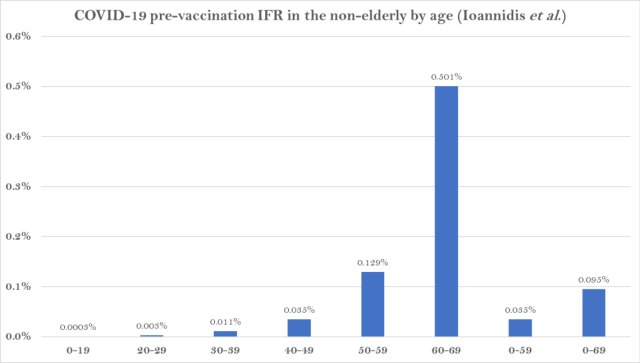
The study states that it shows a “much lower pre-vaccination IFR in non-elderly populations than previously suggested”.
A breakdown by country reveals the wide range of IFR values across different populations.
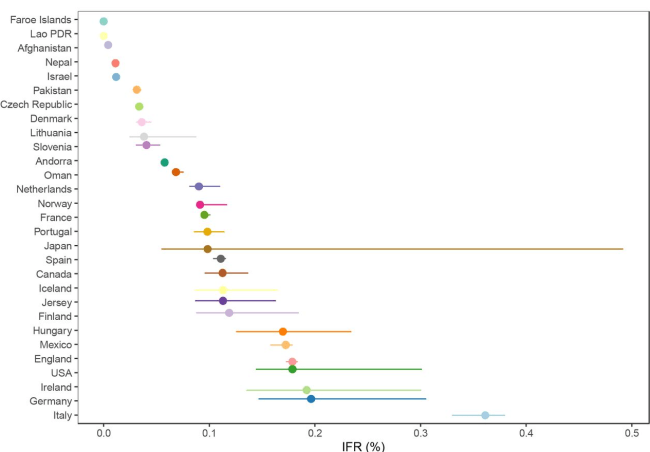
The significantly higher values for the top seven suggest some of the difference may be an artefact of, for example, the way Covid deaths are counted, particularly where excess death levels are similar. Note also that the antibody studies date from various points during the first year of the pandemic, most of them prior to the large winter wave of 2020-21, when levels of spread and numbers of deaths were more varied than later in the pandemic as subsequent waves caused countries to converge.
The reason some countries had much lower values and some much higher is not completely clear. The authors suggest that “much of the diversity in IFR across countries is explained by differences in age structure”, as per the plot below.
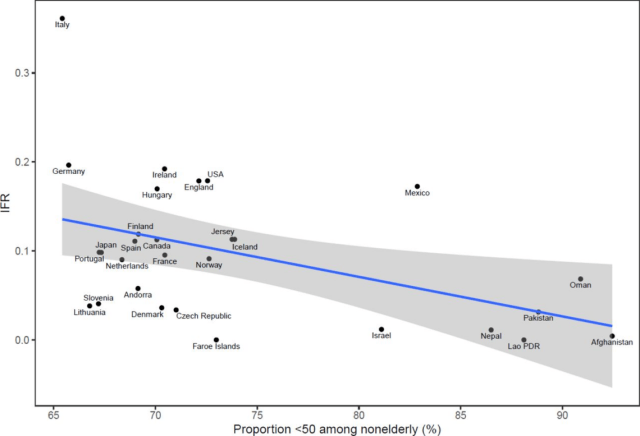
However, the age breakdown by country suggests that the IFR differed for each age group in each country, casting doubt on that suggestion. (In the chart below, note the logarithmic scale, and ignore the zig-zag lines, which are due to small countries having low numbers of deaths.)
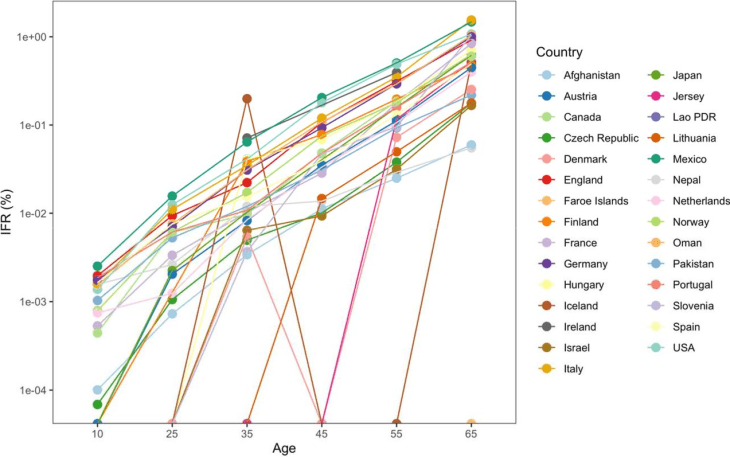
Why are countries seeing differing IFRs even for the same age groups? The authors suggest a number of explanations, including data artefacts (e.g. if the number of deaths or seroprevalence are not accurately measured), presence and severity of comorbidities (for example, obesity affects 42% of the U.S. population, but the proportion of obese adults is only 2% in Vietnam, 4% in India and under 10% in most African countries, though it affects almost 40% of South African women), the presence of frail individuals in nursing homes and differences in management, healthcare, overall societal support and levels of drug problems.
Prof. Ioannidis has previously published a number of papers estimating COVID-19’s IFR using seroprevalence surveys. He and his team conclude that their new estimates provide a baseline from which to assess further IFR declines following the widespread use of vaccination, prior infections and evolution of new variants such as Omicron.
Submission to Canada’s Public Order Emergency Commission

Fearless Canada | October 16, 2022
As a non-partisan, volunteer activist group, Fearless Canada was present at the beginning and on several other occasions during the Freedom Convoy protest in Ottawa. As such, many of our members witnessed first-hand what the situation looked like on the ground and how it all began. We took extensive video footage of the events during the first weekend from the moment when truckers were being directed toward Parliament by Ottawa police. We have decided to submit our evaluation of the events as well as our strongly held view that the invocation of the Emergency Measures Act (hereafter referred to as “EMA”) by the Trudeau government was not only inappropriate, but also unlawful and unconstitutional.
We must first unequivocally state that, in our view, the Trudeau government’s decision to invoke the EMA in no way met the legal threshold to do so. The usage of the EMA is reserved for exceptional circumstances in which a serious foreign or existential threat imperils the security of the nation. Such security threats would be typically related to war, as the older, subsequently replaced War Measures Act aimed to address. In no conceivable way could the temporary discomfort or inconvenience borne by Ottawa citizens or businesses justify the use of an Act that is meant to aid the government in protecting the nation against threats of an incalculably larger scale. As such, the purpose of the Commission is not to determine whether the invocation of the EMA served the Trudeau government in its objective to deescalate the so-called “occupation” of Ottawa’s downtown core, but rather to assess whether the legal threshold for its invocation was met.
The Early Days in Ottawa
Our group arrived in Ottawa in the early afternoon of January 28, 2022. The first thing we noticed was Ottawa police directing truckers and their rigs onto Wellington Street towards Parliament. The atmosphere was festive and light despite the frigid weather. As more protesters arrived in Ottawa over the course of the weekend, we would quickly observe that the crowds were both peaceful and diverse. Men, women, and children from all different backgrounds and walks of life gathered in the capital with a common goal. They demanded that the Trudeau government lift measures that, in their view, were both unjustified and discriminatory in nature. As a result of those measures, the majority of protesters in Ottawa were themselves directly impacted in profound and often irreversible ways.
In talking with dozens of truckers and protesters, we learned that many had lost their jobs, connections to loved ones, access to essential services, and much more. While speaking with police officers, we learned that many felt they were unlawfully coerced into taking a COVID vaccine in order to keep their jobs. Our impression on the ground was that the majority of police officers were in fact aligned with the goals of the protest. They, too, wanted to see an immediate end to damaging and ineffective policies that divided our nation along medical lines previously acknowledged as a matter of private and personal concern.
Legacy Media and the Trudeau Government’s Portrayal of the Freedom Convoy
While in Ottawa, our group kept an eye on the news coming out of legacy media outlets such as the CBC, CTV News, and Global News. It became impossible not to notice that a concerted narrative had quickly taken shape to misrepresent the situation and characterize protesters as far-right extremists, racists, antisemites, and more. The unjustified slander of protesters directly conflicted with our experience on the ground. What we saw was a festive and peaceful rally, replete with volunteers offering food and shelter from the cold, routinely cleaning streets and sidewalks, and organizing fun activities for the kids. At no time did we spot a single racist or Nazi in the vast crowds, as was incessantly suggested by both the Liberal government and the mainstream media. From what we could tell, these characterizations were fabricated in order to serve a narrative that aimed to discredit the legitimacy and lawfulness of the protest.
As time went on, the media’s portrayal of the situation continued to unhinge itself from reality. The press published stories about imminent violence, a van loaded with illegal firearms, and more. None of these allegations turned out to be true. Yet, the misrepresentation of the situation had already reached the eyes and ears of Canadians from coast to coast, very few of which witnessed the event themselves. But by then, the damage had already been done, just as it seemed to have been intended.
The Invocation of the EMA
At the moment the Trudeau government invoked the EMA, it must be noted that the protest in Ottawa was already in the process of de-escalation. The protest organizers and their lawyers had already brokered a dismantlement deal with the Ottawa mayor and police services. Truckers were already on their way out of the downtown core and the blockades at two Canadian points of entry had already long-since been dismantled. Yet rather than follow an organized de-escalation plan agreed to by all factions, Ottawa police and the Trudeau government instead opted to escalate the situation by using violence and propaganda against Canadian citizens. The impacts of the invocation of the EMA were profound and unwarranted.
Immediately ensuing the invocation of the EMA, police and governmental authorities froze protesters’ bank accounts and deployed violent anti-riot squads all over the downtown core of Ottawa. Several protesters were injured as police again escalated tensions using all manner of crowd dispersal techniques. In the days following the invocation of the EMA, Finance Minister Chrystia Freeland wasted no time in announcing that certain aspects of the EMA would be written into law, granting broad and unconstitutional powers to government without the requisite EMA enacted. It had become clear that the Trudeau government had a predetermined objective in enacting the EMA, one that would grant greater leverage over political dissidents and, more broadly, Canadians that disagreed with its ideology. This in itself represents an egregious misuse of the EMA in order to further a political agenda.
Conclusion
The volunteer activists at Fearless Canada include Canadian scholars, lawyers, professors, small business owners, and artists. We unanimously and unequivocally feel that the Trudeau government’s invocation of the EMA as a response to ongoing protests in Ottawa was both unlawful and unconstitutional. We submit that the government manipulated public opinion by fabricating evidence of unlawful activity in Ottawa and invoked the EMA under false pretenses in order to abet their predetermined agenda. We believe that the evidence overwhelmingly supports our position, and we look forward to seeing all of it brought to light during the Commission’s discovery process.
This statement was authored by the executive of Fearless Canada and endorsed by members.
The statement has been submitted to the Public Order Emergency Commission of Canada, which began public hearings on Thursday, October 13, which will run every weekday until November 25. Live hearings can be viewed here, and True North Centre publishes a recap for each day.
Arab oil giants endorse OPEC+ production cut, shoot down US claims of ‘Saudi pressure’
The Cradle | October 17, 2022
Members of the OPEC+ group of countries issued a slew of statements on 16 October to endorse a major oil production cut that was announced earlier this month.
These statements were released in response to the accusations of irate US officials, who said Saudi Arabia “coerced” their OPEC partners into supporting the cut, allegedly to “increase Russian revenues and blunt the effectiveness of [western] sanctions.”
Washington went on to claim that several Gulf nations contacted them “privately” to say they disagreed with the OPEC+ decision.
“I would like to clarify that the latest OPEC+ decision, which was unanimously approved was a pure technical decision, with NO political intentions whatsoever,” the UAE Energy Minister, Mohamed al-Mazrouei, Tweeted on Sunday.
Kuwait Petroleum Corporation Chief Executive Officer, Nawaf Saud al-Sabah, also welcomed the decision by OPEC+ and said the country was “keen to maintain a balanced oil market.”
Similarly, Iraq’s Oil Marketing Company (SOMO) said via a statement on Sunday that OPEC+ decisions are “based on economic indicators and are taken unanimously.”
“There is complete consensus among OPEC+ countries that the best approach in dealing with the oil market conditions during the current period of uncertainty and lack of clarity is a pre-emptive approach that supports market stability and provides the future the guidance it needs,” the SOMO statement reads.
Algerian Energy minister Mohamed Arkab called the recent production cut “historic” and expressed his full confidence in the organization’s decision during a meeting on Sunday with OPEC Secretary General Haitham al-Ghais, who said that “these statements … are proof that the decision was correct.”
Oman’s energy ministry also released a statement endorsing the decision, saying via Twitter: “The recent decision of OPEC+ to cut production is in line with its previous decisions in terms of its reliance on market data and its variables, which was important and necessary to reassure the market and support its stability.”
A day earlier, the Oil Minister of Bahrain, Dr. Mohamed Bin Daina, said in a statement that the decision to cut production “was taken unanimously and after a thorough technical study of the global market.”
On 5 October, OPEC+ – a bloc of over 20 OPEC and non-OPEC nations, including Russia – announced an oil production cut of two million barrels per day (bpd) for November, their largest cut since the start of the COVID pandemic.
The decision was made despite intense lobbying by the White House, which had hoped to keep fuel prices down ahead of upcoming midterm elections, as Joe Biden’s democratic party is facing an uphill battle.
After yet again failing to coerce their Gulf partners into boosting production levels in order to keep fuel prices down, US officials have been scrambling for an appropriate response, even reviving a piece of legislation that would allow for sovereign states to be sued in federal court.
Moreover, Washington has accused Saudi Arabia of orchestrating the cut to “benefit Russia” after the kingdom responded to the US pleas with a “resounding no.”
Featured Video

Broke Princes: Saudi Arabia’s Powder Keg
or go to
Aletho News Archives – Video-Images
From the Archives
Registered Israeli foreign agent driving contrived campus antisemitism crisis
By Wyatt Reed | The Grayzone | December 17, 2023
Lawsuits accusing top US universities of harboring antisemitism all originate from one source: a corporate law firm that fielded the pro-settler ex-US ambassador to Israel, and which was registered as a foreign agent of an Israeli principal as recently as 2021.
The firm now represents professional Israel lobby activists posing as victimized “Jewish students” and seeking to crush the free speech rights of Palestine solidarity activists. … continue
Blog Roll
 Aletho News
- How Iran defeated Trump’s Israel First GOP
- De-escalating the conflict: What the OSCE, the UN, and Europe are (not) doing to prevent war
- Desperate For A Renewed Iran War, Israel Dusts Off The WMD Deception.
- US Elections Offer Choice Between ‘Bad and Worse’ as Both Parties Serve War Lobby – ex-UN Expert
- Ghalibaf warns US government not to betray voters who rejected war
- Broke Princes: Saudi Arabia’s Powder Keg
- Albania’s Crisis: Rama, Israeli Investments and the Demand for Accountability
- Hezbollah Categorically Denies Syrian Accusations: We Aim at Confronting Israeli Enemy, Not Undermining Syria’s Stability
- Trump claims funding to Israel ending in 2026 as merger of Israeli–US armies looms
- Iran Weathering The Storm, But Saudi Arabia Is Sinking
- If Americans Knew
- An error has occurred; the feed is probably down. Try again later.
- No Tricks Zone
- New Study: The Net Fossil Fuel Contribution To Rising Atmospheric CO2 Has Been Zero For 500 Years
- Germany’s Green Energy Transition Becoming Increasingly Expensive…Another 6 Trillion Euros!
- Sudden Stratospheric Warming, Powerful El Niño Combination May Lead To Extreme Europe Cold, Energy Crisis!
- Two New Studies Find Thwaites Glacier Melt Cannot Be Driven By Human Activity Or A Warming Ocean
- E-Cars Reduce CO2 Emissions By Only 41% Compared To Internal Combustion Engine Vehicles
- Predictions Made By Renowned Climate Professor Over Past Decades Have Been Proven To Be Poor
- New Study Suggests Large Regions Of The Pacific Ocean Have Been Cooling For The Last 80 Years
- Germany’s Green Energy Debacle: High Energy Costs Force Kahla Porzellan to Close After 182 Years!
- New Study: 50 Years Of The Most Aggressive ‘Net Zero’ Policies Can Only Affect The Global Climate By 0.03°C
- US September “Heat” Was No Record…Many Records Set Decades Ago

