Why the Gulf states’ SCO membership is a big deal
BY M. K. BHADRAKUMAR | INDIAN PUNCHLINE | AUGUST 7, 2022
Washington has backtracked from the dissimulation by US National Security Advisor Jake Sullivan that Washington had intelligence suggesting Iran was preparing to provide Russia with “several hundred” drones to use in Ukraine, with training sessions set to begin in July.
On July 26, NSC spokesman John Kirby, clarified his boss’ remark by admitting to Al Arabiya, “We’ve seen no indications of any sort of actual delivery and/or purchase of Iranian drones by the Russian Ministry of Defence.”
Interestingly, Al Arabiya buttonholed Kirby at all. For, Sullivan’s fake news (probably based on Israeli disinformation) came at his special briefing on President Biden’s visit to Jeddah. Al Arabiya’s dogged downstream pursuit of the “fake news” suggests that Riyadh knew Sullivan making a crude attempt to to hustle the Crown Prince Mohammad bin Salman in directions that would have made Biden’s trip a roaring success.
Biden had three overlapping objectives: one, to rally Saudi leadership behind his containment strategy against Russia and China; two, to break up the OPEC+ alliance between Saudi Arabia and Russia so that a coordinated counterpoint ceases to be in the world oil market that is beyond American control; and, three, to assemble an anti-Iran military military alliance of Gulf states and Israel to give verve to Abraham Accords which has patently lost its fizz.
Biden drew blank on all three counts: Saudis will pursue their friendly relations with Russia and China and its normalisation with Tehran. Prince Mohammed spoke with President Putin within the week of Biden’s visit where they discussed further expansion of trade and economic cooperation and significantly, also underscored “the importance of further coordination within OPEC+”.
Traditionally, Saudi actions speak far better than words. So, when the OPEC+ held a virtual meeting last Wednesday, it concluded that:
- There is “severely limited availability of excess capacity” among oil producing countries resulting from “chronic underinvestment in the oil sector”;
- It is a matter of “particular concern… (that) insufficient investment into the upstream sector will impact the availability of adequate supply in a timely manner to meet growing demand beyond 2023.”
- The importance of maintaining consensus and the “cohesion” of OPEC and OPEC+ (that is, OPEC plus Russia principally) cannot be overstated.
Plainly put, it rejects the July 3 G7 Foreign Ministers’ Statement on Energy Security, which envisages imposing comprehensive embargo on all services for “transportation of Russian seaborne crude oil and petroleum products globally” unless Moscow sells oil at a price to be agreed in consultation with the West.
Simply, the West is once again contemplating a crackdown on a major oil producing country for geopolitical reasons, which would have profound impact on the world oil market. The paradox here is that, unlike in the case of Iran or Venezuela, the West desperately needs Russian oil’s continued flow into the world oil market but is capping the price at which Moscow can sell so that its income from oil exports cannot sustain the special military operations in Ukraine.
Indeed, the West is acting in the spirit of George Kennan’s famous dictum in the early 1950s that oil “belongs to us” because it lubricated the West’s prosperity. The G7 statement is no doubt precedent-setting. As the pressure on world’s resources becomes more acute, this predatory approach harkens back to the colonial era (when India was frog-marched by Imperial Britain to supply cotton to the textile mills in Britain and buy back textiles at prices determined by the colonial master.)
It can extend to resources other than oil as well. China, for example, produces roughly two-thirds of the world’s lithium-ion batteries, whereas, the US only produces 1% of global lithium supply and 7% of refined lithium chemicals — versus China’s 51% — and is about 70% dependent on imported lithium (which has such critical uses in industries ranging from mobile phones, laptops, digital cameras and electric vehicles to aircraft, high-speed trains and satellites.
To be sure, the G7 move to seize control of Russia’s oil exports rings alarm bells all across the oil-producing countries of the Gulf region. The geopolitical message is: ‘Fall in line, or else.’ Now, this comes at a time when the EU is desperately eyeing access to cheap and reliable supply of oil. (Japan just announced that its “sanctions from hell” against Russia will not apply to the Sakhalin 2 gas and oil project!)
Against such a tumultuous backdrop with the industrial powers inclining toward brandishing their latent colonial instincts of a bygone era, the Gulf states become highly vulnerable. The Gulf states already are shell-shocked about the banditry that the EU and US resorted to against Russia by confiscating its reserves in the Western banking system and appropriating the private assets of wealthy Russians.
There is also an added dimension. Tomorrow, what prevents the “Collective West” from resorting to such pressure tactics to enforce “regime change” in the Gulf region on the pretext of advancing democracy and human rights? After all, it is no secret that the former Crown Prince Muhammad bin Nayef was Washington’s preferred choice to succeed King Salman. Make no mistake, Biden’s fist bump with Prince Mohammed is not the last word on Saudi succession.
Indeed, Prince Mohammed’s suggestion (while Biden was still in Jeddah) that Saudi Arabia and Iran should now step up their contacts to the political level becomes highly significant. Even more so, Saudi Arabia’s interest in SCO membership (so soon after Iran’s admission to the grouping.)
Along with Saudi Arabia, a host of other West Asian countries have approached the SCO for membership. The Russian daily Izvestia reported on Thursday that the SCO plans to sign memoranda on granting dialogue partnership to Egypt, Syria, Qatar, Saudi Arabia and Bahrain at the forthcoming summit in Samarkand. Interestingly, Crown Prince Mohammed bin Salman has been invited to the event.
According to Izvestia, as an exception, the UAE has sought SCO membership on an expeditious basis, although the grouping’s established practice so far has been to start with a “dialogue partner”. Izvestia quoted a source close to the SCO organising committee that the SCO has had consultations internally and “the main understanding that dominates is that the SCO is interesting, the SCO attracts, and therefore the most important thing for us is not to wallow in bureaucracy, but to find solutions that will allow us to respond adequately… And react by adapting the rules to new conditions.”
Clearly, Biden’s offer of a military alliance not only had no takers in the Arab world but they seem petrified. If as the Bible says, there are three brands of deception — vanity, flattery, and blasphemy — and Satan uses all three, Biden’s offer contains elements of all three. And if the SCO offers an antidote to the poisoned chalice, why not?
The West is silent as Ukraine targets civilians in Donetsk using banned ‘butterfly’ mines
The use of PFM-1 explosives against civilians is prohibited by the Geneva Conventions – but this evidently isn’t stopping Ukraine
By Eva Batlett | Samizdat | August 7, 2022
On Saturday night, just after 9 pm, thunderous explosions rocked central Donetsk. Shortly after, there were announcements that air defense had shot down Ukrainian-fired missiles containing “Butterfly” (or “Petal”) mines. Given that over 300 of these explosives. are packed into each of the Ukrainian-fired rockets, central Donetsk could literally become a minefield if they successfully landed.
Social media and Telegram warnings urged residents to stay inside, to wait for Emergency Services to clear the streets and sidewalks – which they began doing during the night. But come daylight, untold numbers of these tiny devices still remained. More warnings were issued to stay at home – better to be late for work than lose a leg. Residents that absolutely have to go out are advised to keep their eyes down to watch where they step, avoid grassy areas, and walk extremely carefully.

© Eva Batlett
While Ukraine has been using these mines on Donbass for many months, in recent days, they have intensely bombarded neighbourhoods with them. Initially targeted were the hard-hit districts of Kievskiy in the north, Kirovsky in the southwest, and Kuibyshevkiy in the west. But as of Saturday night, Ukraine hammered central Donetsk with them.
And now, walking in the city center is a nightmare, one I had to endure to document how widespread these mines are here: in central streets and walkways, near apartments, in parks.
Difficult to spot, easy to trigger
As it turns out, the ‘petals’ are not only widespread but often very difficult to spot – even if warning signs have been placed right next to them. Their small shape and dull color blends in with the surroundings and if you aren’t actively looking at the spot they’re in, you could easily miss them.
When walking, you learn to avoid any objects that could be covering a mine, and tread only on bare streets or sidewalks.
The first bunch of mines I saw were circled in chalk, a warning sign placed in front to keep cars from driving over them, and people from stepping on them. This was on a central Donetsk street, a residential area with shops and a park nearby. The entire area was littered with the ‘petals’. DPR sappers worked methodically, clearing area by area. But, given that hundreds of the mines were dropped all over the city, this is painstaking work.
Near some apartment blocks, numerous mines had been found and warning signs put out: “danger, mines,” it said by the tiny explosive circled with chalk or a tire or whatever was available to draw the eye to its presence.
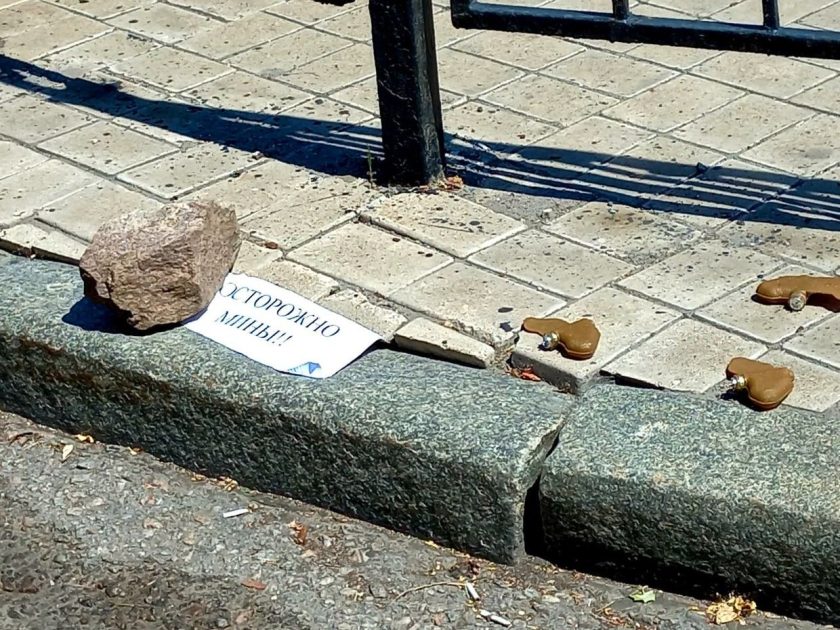
Warning sign saying “Caution, mines!” placed next to some “butterfly” mines in Donetsk © Eva Batlett
But, on many occasions, looking at the area designated as containing a mine, it took me a good while to actually see it. Now imagine if there were no signs at all … a bloodbath for civilians, and animals too, since it doesn’t take significant weight to set them off.
Butterfly mine basics
Around the size of an average lighter, the ‘petals’ are tiny but still very powerful. A clip shared on Telegram illustrates this: A soldier chucks a tire at one of the mines, and the tire is flung high in the air from the blast. It doesn’t take a powerful imagination to estimate what would happen if a person stepped foot on one of them. The explosives are placed via remote delivery methods – meaning they can be spread by mortar, missile, or artillery, dropped by helicopters and planes.
According to DPR Emergency services, Ukraine is using Hurricane MLRS-fired rockets to spread the mines. Each contains 12 cluster munitions, each cluster has 26 mines inside. So each bomb has 312. The cluster explodes in the air, disseminating them widely, scattering in different directions. Their butterfly-like design enables them to glide and land without exploding, usually. Then they lie in wait for someone with bad luck to step on them.
Some of these anti-personnel mines have a self-destruct timer. Others, including the ones Ukraine is firing, have a years-long shelf life. They do pretty much no damage to military vehicles, and as such their use in Donbass is insidious – deliberately targeting civilians, to leave them maimed.
On July 30, in a densely-inhabited working-class district of western Donetsk, in a field with garden plots for nearby apartment residents, I saw the same nefarious mines. Originally scattered, they had been collected and awaited destruction by DPR Emergency Services.
In the large courtyard of an apartment complex, I watched from a safe distance as Emergency Services timer-detonated eight mines they had found around the grounds. The day prior, they destroyed 26. Another 150 were located and destroyed using a radio-controlled minesweeper. But there remains much to be done to restore the streets and courtyards to safety.
Since the mines were scattered on Saturday evening, the DPR Representative Office at the JCCC has created an interactive map showing the areas most contaminated by the mines, giving residents a general warning of which areas to avoid while walking or driving in. While some cars have been lucky enough to only have a tire blown out, were the mine to detonate near the gas tank, the entire vehicle could explode.
Multiple civilians have been killed by the mines since they were scattered over Donetsk, and, even now, wounded civilians are still coming to the city’s hospitals. According to Vadim Onoprienko, the deputy director of a trauma surgery center, ten amputations have been performed over the last week – victims of Saturday’s mines and ones that had been dropped earlier, one of whom was an 83-year-old man.
All evidence points to Ukraine
Pro-Ukrainian commentators are, unsurprisingly, blaming Russia. Journalists claiming to care about civilians are perpetuating Ukrainian propaganda saying that Moscow’s forces are scattering the mines over civilian areas, nevermind the fact that these territories are controlled by Russia’s allies. Among them is the would-be war hero Malcolm Nance, who temporarily abandoned his job as a notoriously anti-Russian MSNBC analyst to apparently actually fight the Russians in Ukraine.
This is the kind of projection I have seen ad nauseam when reporting from Syria and dealing with the Western propaganda there. Ukrainian nationalists openly admit they do not see the Donbass people as human and encourage their murder. Ukraine has been killing and maiming civilians in the Donetsk and Lugansk People’s Republic for over eight years, including firing cluster munitions into the heart of cities, targeting hospitals, markets, schools and busy streets. Given all of this, scattering butterfly mines over Donetsk is hardly surprising. It’s criminal, but not surprising.
One argument used by pro-Ukrainian commentators is that Kiev has been destroying these mines under the Anti-Personnel Mine Ban Convention, which it signed in 1999. However, out of the six million such mines Ukraine initially declared in its possession, only two million have reportedly been destroyed as of 2018.
Ukraine has good reason to believe it will not be held accountable for using them against civilians, given its Western backers’ and their allies’ penchant for using prohibited weapons on civilians without repercussions – including Agent Orange in Vietnam, depleted uranium in Iraq and Syria, and white phosphorous and dart bombs in Gaza.
The fact the Western media turns a blind eye is also a boon to Kiev.
Eva Bartlett is a Canadian independent journalist. She has spent years on the ground covering conflict zones in the Middle East, especially in Syria and Palestine (where she lived for nearly four years).
Ukrainian city launches witch hunt for ‘disloyal’ residents
Samizdat | August 7, 2022
The southern Ukrainian city of Nikolaev resorted to drastic measures this weekend to expose what the local authorities call “collaborators” and “separatists” – people who harbor pro-Russian sentiments or help Moscow’s forces in any way.
On Friday, the head of the local military administration, Vitaly Kim, placed the entire city – home to almost half a million people before the start of the Russian military operation – on a two-day lockdown. Kim announced a “prolonged curfew,” which came into force Friday evening and is expected to last until Monday.
During this time, residents of Nikolaev are prohibited from going outside or visiting any public places without special permits. In case of an emergency, a police escort is provided, Ukrainian news agency UNIAN said.
Law enforcement agencies will use this time to search for “collaborators” and “separatists,” Anna Zamazeeva, the head of the Nikolaev regional council, said. The operation is already in full swing, and the police will reveal the results no sooner than Monday, according to the official.
“All Nikolaev residents are undergoing checks now,” she told UNIAN on Saturday. Those who planned to leave the city and bought train or bus tickets in advance were allowed to leave, the official said, adding that they were checked at security outposts on their way out.
According to Zamazeeva, police are conducting door-to-door searches in apartments throughout the city. “They are searching everyone; check the ID, mobile phones, everything,” she said.
The official argued that the “collaborators” would be much safer behind bars since locals could “lynch” them if the police simply reveal their identity. “It is better for them to remain in prison until we win,” she added.
Earlier, Kim offered $100 to anyone that provides information about “spotters” – people that Ukrainian officials believe supply target coordinates to Russian artillery and aviation. Earlier, the local authorities reported they had detained at least four spotters.
On Tuesday, Russian forces reported striking a temporary base of the Ukrainian International Legion near the city of Nikolaev, using high-precision weapons. Up to 250 foreign mercenaries were killed in the attack, according to the report.
Russia sent troops into Ukraine on February 24, citing Kiev’s failure to implement the Minsk agreements, designed to give the regions of Donetsk and Lugansk special status within the Ukrainian state. The protocols, brokered by Germany and France, were first signed in 2014. Former Ukrainian President Pyotr Poroshenko has since admitted that Kiev’s main goal was to use the ceasefire to buy time and “create powerful armed forces.”
In February 2022, the Kremlin recognized the Donbass republics as independent states and demanded that Ukraine officially declare itself a neutral country that will never join any Western military bloc. Kiev insists the Russian offensive was completely unprovoked.
Ukrainian Troops Shell Zaporozhye Nuclear Power Plant Overnight: Local Authorities
Samizdat – 07.08.2022
Ukrainian troops launched an attack against the Zaporozhye nuclear power plant overnight, using an Uragan multiple rocket launcher, with shrapnel and a rocket engine falling at 400 meters (1,312 feet) from the station’s operating power unit, the military and civil administration of the city of Energodar said.
“Last night, the Ukrainian armed forces carried out a strike using a 220 millimeter Uragan rocket launcher,” the administration spokesperson said.
The missile unfolded and released shrapnel warheads as it approached the power units, the spokesperson noted.
“The area of the dry storage facility for processed nuclear fuel and the automated control post of the radiation situation appeared to be in the strike zone. Administrative buildings and the adjacent territory of the storage facility were damaged by the cluster munitions. It is important to note that the fallen shrapnel warheads and the rocket engine itself fell no more than 400 meters from the active power unit,” the spokesperson added.
Since March, the Zaporozhye nuclear power plant has been under full control of Russian forces, but Ukrainian forces have repeatedly attacked it by drones, prompting Russia to seek assistance from the International Atomic Energy Agency (IAEA) in addressing the plant’s security concerns.
Head of the Lancet COVID-19 Commission discusses the likely Lab Origins of SARS-CoV-2
The Naked Emperor’s Newsletter | August 6, 2022
Professor Jeffrey Sachs is an American academic with specialities in economics, global poverty, human-induced climate change and financial crises. Jeffrey is University Professor at Columbia University and before this was professor at Harvard University. He has worked as Special Advisor to UN Secretaries-General Kofi Annan, Ban Ki-moon and Antonio Guterres.
The mini résumé above is to show that Professor Sachs is pretty mainstream. So mainstream in fact, that he was appointed, early in the pandemic, as the Chair of the Lancet Covid-19 Commission. So mainstream, that he appointed Peter Daszak of EcoHealth Alliance to chair the Lancet’s task force on the origins of SARS-CoV-2.
A few weeks ago, Professor Sachs said a few ‘controversial’ statements about the origins of Covid. Now, a more detailed interview with him, in Current Affairs, has revealed some important facts. Most of us have read much of this information for a few years now but coming from the head of the Lancet Commission, these statements are quite extraordinary.
Click on the link above to read the whole interview but I have included some fascinating quotations below.
When asked about his recent statement about being pretty convinced about a lab leak he said:
[Scientists are] creating a narrative. And they’re denying the alternative hypothesis without looking closely at it. That’s the basic point.
Now, what is the alternative hypothesis? The alternative hypothesis is quite straightforward. And that is that there was a lot of research underway in the United States and China on taking SARS-like viruses, manipulating them in the laboratory, and creating potentially far more dangerous viruses. And the particular virus that causes COVID-19, called SARS-Cov-2, is notable because it has a piece of its genetic makeup that makes the virus more dangerous. And that piece of the genome is called the “furin cleavage site.” Now, what’s interesting, and concerning if I may say so, is that the research that was underway very actively and being promoted, was to insert furin cleavage sites into SARS-like viruses to see what would happen. Oops!
Professor Sachs was asked to distinguish between facts and speculation; do we actually know gain of function research was actually ongoing somewhere?
We have a lot of reason to believe that it was, because the scientists that were doing that research loved that research. And they explained to us publicly why it’s so important. And they wrote editorials about why this research must continue. And they made grant proposals saying that it should continue. And for those of us in the business of writing grant proposals, the fact that a particular grant proposal that’s deeply troubling was turned down doesn’t mean that it wasn’t carried out afterwards…
And the scientists like those that talk about the Huanan market, they don’t even discuss that research that was underway. That is just misdirection, to my mind. It’s like sleight of hand art. Don’t look over there. Look over here…
And yet I see NIH with its head in the ground. “Oh, no, nothing here to look at.” And then I see the scientists. “Oh, nothing here to look at. We know it’s the market. Did we find an animal? No. Do we have an explanation of where that furin cleavage site came in? No. We don’t have an explanation of the timing, which doesn’t quite look right. Oh, but don’t look over there, because there’s nothing there, they keep telling us. Well, that’s a little silly.
What I’m calling for is not the conclusion. I’m calling for the investigation. Finally, after two and a half years of this, it’s time to fess up that it might have come out of a lab and here’s the data that we need to know to find out whether it did.
He continued about Gain of Function research.
But they [champions of Gain of Function research] weren’t actually aiming to just test viruses that they were collecting in nature. They were aiming to modify those viruses. Because the scientists knew that a SARS-like virus without a furin cleavage site wouldn’t be that dangerous. But they wanted to test their drugs and vaccines and theories against dangerous viruses. Their proposal was to take hundreds, by the way—or least they talked about in one proposal more than 180 previously unreported strains—and test them for their so-called “spillover potential.” How effective would they be? And to look: do they have a furin cleavage site, or technically what’s called a proteolytic cleavage site? And if not, put them in. For heaven’s sake. My God! Are you kidding?
Jeffrey was asked about the distinction between ‘kooky theories’ and plausible ones.
The right one to look at is part of a very extensive research program that was underway from 2015 onward, funded by the NIH, by Tony Fauci, in particular NIAID [National Institute of Allergy and Infectious Diseases], and it was to examine the spillover potential of SARS-like viruses. The champions of this research explained in detail their proposals. But after the event, we’d never asked them, “So what were you actually doing? What experiments did you do? What do you know?” We somehow never asked. It was better just to sweep it under the rug, which is what Fauci and the NIH have done up until this point. Maybe they could tell us, “Oh, full exoneration,” but they haven’t told us that at all. They haven’t shown us anything. So there’s nothing “kooky” about it, because it’s precisely what the scientists were doing…
So you saw a narrative being created. And the scientists are not acting like scientists. Because when you’re acting like a scientist, you’re pursuing alternative hypotheses. And the scientists just wrote recently an op-ed saying the only evidence that this came out of a lab that’s been put forward is that it came in a city, Wuhan, where an institute was located. Well, that’s a lie. That is not the only coincidence that leads to this theory. What leads to this alternative hypothesis is the detailed research program the NIH funded that was underway in the years leading up to the outbreak. So I see the scientists absolutely trying to create a narrative and take our eyes off of another issue.
Next, he was asked about the research being undertaken in the Wuhan Institute of Virology.
We know that at the Wuhan Institute of Virology, the scientists there had been trained by American scientists to use advanced bioengineering methodologies. And in particular, we have scientists in North Carolina, Texas, and so forth who do this kind of research, believe in it, argue for it, and say that they don’t want any regulations on it and so on. And they were in close contact with Wuhan Institute of Virology, and they were part of a joint research group that was stitched together by something called EcoHealth Alliance. And EcoHealth Alliance was the kind of marriage maker between the American scientists and the Chinese scientists. That was the vehicle for funding from the U.S. government, especially from the National Institutes of Health, and especially from Tony Fauci’s unit, the NIAID.
When asked about EcoHealth Alliance, Professor Sachs admitted that he hired Peter Daszak to head the task force on the origins of Covid.
I thought, naively at the beginning, “Well, here’s a guy who is so connected, he would know.” And then I realized he was not telling me the truth. And it took me some months, but the more I saw it, the more I resented it.
And so I told him, “Look, you have to leave.” And then the other scientists in that task force attacked me for being anti-scientific. And I asked them: “What are your connections with all of this?” They didn’t tell me. Then when the Freedom of Information Act released some of these documents that NIH had been hiding from the public, I saw that people that were attacking me were also part of this thing. So I disbanded that whole task force. So my own experience was to witness close up how they’re not talking. And they’re trying to keep our eyes on something else. And away from even asking the questions that we’re talking about…
He [Peter Daszak] could have explained to me right from the beginning that there was a big research program and that they were manipulating the viruses, and here’s how. He could have given me the research proposals. And when I asked him for one of the research proposals, he said, “No, my lawyer says I can’t give it to you.” I said, “What? You’re heading a commission. We’re a transparent commission. You’re telling me your lawyer says you can’t give me your project proposal.” I said, “Well, then you can’t be on this commission. This is not even a close call.”
But there were so many other things. He was just filled with misdirection.
He concluded that we need far more oversight over Gain of Function work.
I can tell you one thing that I’ve learned from talking to a lot of scientists in the last couple of years: the technological capacity to do dangerous things using this biotechnology is extraordinary right now. So I want to know what’s being done. I want to know what other governments are doing, too, not just ours. I want some global control over this stuff.
Furthermore, he is disappointed with the information that, even he as the head of the commission, is able to obtain.
The most interesting things that I got as chair of the Lancet commission came from Freedom of Information Act (FOIA) lawsuits and whistleblower leaks from inside the U.S. government. Isn’t that terrible? NIH was actually asked at one point: give us your research program on SARS-like viruses. And you know what they did? They released the cover page and redacted 290 pages. They gave us a cover page and 290 blank pages! That’s NIH, for heaven’s sake. That’s not some corporation. That is the U.S. government charged with keeping us healthy.
A fascinating interview which I recommend you read in full.
Ghoulishly clever psyop pits our own defense mechanisms against us
By Meryl Nass, MD | August 6, 2022
1. Multiple papers now suggest that COVID mRNA vaccines impair not just immunity to COVID, but immunity and immune surveillance overall.
The implication is that the vaxxed are more susceptible to a variety of infections, and perhaps also to cancer. Immune surveillance is what identifies cancer cells and kills them before they can proliferate.
So, you are vaccinated. The implications of this information are too frightening to be allowed into consciousness. You don’t need the external censors to suppress this knowledge; you do it automatically with your built-in defense mechanisms.
2. Data from multiple countries now shows that all cause mortality (deaths from everything) are higher in the vaccinated.
This is just as scary, if not more so, than an increased risk of serious infections and cancer. You deny and/or suppress this information, because it simply cannot be allowed to be true.
3. You vaccinated your child. This may have impaired their fertility, increased the cancer risk, etc. etc. etc.
Of all pieces of information that absolutely cannot be allowed to enter your consciousness, let alone be openly discussed in polite company, this one tops all. So you will simply refuse to allow mention of it. Friends whose conversations veer off in this direction must be obliterated. Requiring that all family members and friends be vaccinated protects you from facing those for whom this discussion does not trigger the existential and uncontrollable pain it does for the vaccinated.
And Voila — you have a controlled and cowed population who have become their own thought police.
Vaccine Deaths Outnumber Covid Deaths in U.S. Households, Two New Polls Confirm
BY WILL JONES | THE DAILY SCEPTIC | AUGUST 6, 2022
Polls of the U.S. public continue to show that up to twice as many Americans have lost a household member to a Covid vaccine injury as have lost one to Covid.
The pooled results of five surveys of the American public, now totalling over 2,500 people, show that while 4.4% of respondents reported that someone in their household had died from COVID-19, 8.9% said someone had died as a result of Covid vaccination.
The results also showed that 8.6% said they had been injured by their vaccination, 4.9% that they had sought medical help and 3.2% that they had been hospitalised, while 3.6% said that as a result of vaccination they were no longer able to work a full day or at all. These are percentages of all respondents. If we look only at the 74.0% vaccinated with at least one dose then the figures, as a proportion of vaccinated persons, are 11.7% injured, 6.7% needing medical help, 4.4% hospitalised and 4.8% unable to work. While these figures are self-reported and there is no control group, since the unvaccinated were not asked about adverse events, they are still alarmingly high.
The results also showed that, among those who reported a Covid death in their household, more than twice as many reported that it occurred after the person was vaccinated than before (2.8% vs 1.2%). The proportion who said they had contracted Covid before their vaccination (13.1%) was very similar to the proportion who said they contracted it afterwards (11.7%). These figures are not indicative of a highly effective vaccine against either infection or death.
The people polled were randomly selected, representative samples of the U.S. public, of whom 74.0% were vaccinated, so the samples were not inherently biased towards or against the reporting of vaccine problems, though as in all opinion polls (especially online ones) there may be an issue of self-selection bias.
I reported on the first three of these polls last month. Two more have now been added, each from a different polling company, and the results of all five are strikingly similar (see summary table below), indicating that the findings are a true representation, if not of the American public, at least of the section of the American public inclined to complete polls like this.

Some commentators have expressed scepticism about the results, implying they are skewed in some way. It’s true that they are funded by Steve Kirsch, a technology entrepreneur who is raising awareness of safety and efficacy issues around the Covid vaccines. However, the polls are by ordinary polling companies surveying an ordinary representative sample of the U.S. population, so there is nothing to criticise on that score. The results are not under the control of the funder and the questions are neutral. The fact that they are all similar, regardless of which polling company is used, shows that the results are not anomalous. Anyone can commission a similar survey if they wish – though Steve Kirsch discovered that Google and some other polling companies refused to run surveys asking people about their experience of the vaccines.
Steve has enlisted the help of a survey expert, who he says is nationally known and well-respected, though he hasn’t yet revealed his identity. The expert has done two surveys on vaccine safety, one for Steve and one for another client, and he says the safety signal is “real, significant and gravely concerning”.
Phase 1: Signal Detection. Using convenience samples, we validated that there is a significant signal that the general population is reporting a variety of issues and adverse events related to the Covid vaccine programme. While not representative of the entire population and certainly imperfect in design, the multiple iterations of the same questionnaire across two different independent survey panels validate the strong signal detection. Internal consistency matters even when dealing with subjective issues like surveys, and these data are absolutely consistent.
Phase 2: Validation. This first study using a more high quality sample source, and the planned duplication across at least one other independent platform, validates that the signal is real, significant and gravely concerning. The surprising level of coherence in these data, now across three unrelated sample sources, is indisputable. We’ll do one more study with a fourth source, but I am confident we’ll see the same high level of validation. The signal has been detected and it is clear; something is very, very wrong.
Steve Kirsch’s five polls have all been carried out in the last five weeks. You can find them here: June 30th, July 2nd, July 4th, July 20th, July 28th.
Despite the striking consistency between the surveys, it ought to be noted that the findings don’t fit neatly with what we know from other sources. For example, the surveys show 6-7% seeking medical care following vaccination, whereas government surveys have typically found just under 1%. Similarly, there are around 120 million households in the U.S, so if 4.4% of them had a Covid death (as per the surveys) then that would give 5.3 million Covid deaths – yet official figures show there have been around 1 million Covid deaths in the U.S. Why are the surveys coming up with figures that are five to seven times higher than other sources? This does need to be answered.
A further question is raised by a sixth poll commissioned by Steve Kirsch (on July 11th), this one much shorter, asking only two questions, one about household members having Covid and one about them having a vaccine injury. It found 22 of the 500 respondents (4.4%) reported a vaccine death in the household versus 40 (8%) who reported a Covid death. These proportions are still high, but they are not consistent with the other five polls, the two figures being reversed. Is this survey anomalous or would it be replicated in similar short polls? If so, it may indicate a source of bias in the length of the poll.
Nonetheless, such issues should not distract from the key point, that representative surveys of the American public are consistently finding alarmingly high reported rates of serious vaccine injury and death. This is not a safety signal that should be ignored.
U.S. Declares Monkeypox Health Emergency, FDA Offers Vaccine to Some Kids Despite No Clinical Trials
By Megan Redshaw | The Defender | August 5, 2022
The U.S. declared monkeypox a public health emergency to raise awareness and allow for additional funding to fight the disease’s spread, U.S. Department of Health and Human Services Secretary Xavier Becerra said on Thursday.
“We’re prepared to take our response to the next level in addressing this virus, and we urge every American to take monkeypox seriously and to take responsibility to help us tackle this virus,” Becerra said.
Becerra said he also is considering a second declaration that would allow federal officials to expedite medical countermeasures — such as potential treatments and vaccines — designed to ensure drugs are safe and effective.
President Biden said in a tweet he remained “committed to our monkeypox response: ramping-up vaccine distribution, expanding testing, and educating at-risk communities.”
“That’s why today’s public health emergency declaration on the virus is critical to confronting this outbreak with the urgency it warrants,” Biden said.
The last time the U.S. declared a public health emergency was in January 2020, for COVID-19.
According to the Centers for Disease Control and Prevention (CDC), more than 7,100 cases of monkeypox have been reported in the U.S., including five cases in children.
Symptoms of monkeypox infection are usually mild and include fever, rash and swollen lymph nodes, and occasionally intense headache, back pain, muscle aches, lack of energy and skin eruptions that can cause painful lesions, scabs or crusts.
The virus is rarely fatal and no deaths have been reported in the U.S.
Monkeypox primarily is spread through skin-to-skin contact during sex and affects mostly gay and bisexual men, public health officials say, although the virus can affect anyone.
According to the CDC, about 98% of monkeypox patients who provided demographic information to clinics identified as men who have sex with men.
Public health emergency paves way for vaccine for kids
Now that the Biden administration has declared the monkeypox outbreak a public health emergency, the U.S. Food and Drug Administration (FDA) can move to issue an Emergency Use Authorization for the JYNNEOS vaccine for children under 18.
There are two vaccines that may be used “for the prevention” of monkeypox virus infection: JYNNEOS — also known as Imvamune or Imvanex — and ACAM2000, which is licensed by the FDA for use against smallpox and “made available for use against monkeypox under an Expanded Access Investigational New Drug application.”
The FDA told ABC News on Thursday that while the current monkeypox vaccine, JYNNEOS, is approved only for adults ages 18 and older, it will be available for kids on a case-by-case basis.
The JYNNEOS vaccine, delivered in a two-dose series, was not tested through clinical trials in children.
However, the FDA confirmed to ABC News that “numerous” children have been granted access to the vaccine through a special permission process, but declined to state exactly how many children have received the vaccine to date through this process.
“If a doctor decides a person under 18 was exposed to monkeypox and the benefit of the vaccine is greater than any potential risk, they can submit a request to the FDA,” ABC News reported.
According to the CDC, the “immune response” takes “14 days after the second dose of JYNNEOS and 4 weeks after the ACAM2000 dose for maximal development.”
The CDC website also states: “No data are available yet on the effectiveness of these vaccines in the current outbreak.”
According to the latest data from the Vaccine Adverse Event Reporting System (VAERS), between June 14 and July 21, 2022, 31 adverse events were reported following vaccination with JYNNEOS — manufactured by Bavarian Nordic.
The World Health Organization (WHO) declared monkeypox a global health emergency after more than 26,000 cases were reported across 87 countries.
A global emergency is the WHO’s highest level of alert, but the designation does not necessarily mean a disease is particularly transmissible or lethal.
The U.S. makes up 25% of confirmed cases globally although the U.K. was the first to alert the world to the outbreak in May after confirming several cases.
A monkeypox fictional simulation was held in March 2021
As The Defender reported in May, the Nuclear Threat Initiative, in conjunction with the Munich Security Conference, in March 2021 held a “tabletop exercise on reducing high-consequence biological threats,” involving an “unusual strain of monkeypox virus that first emerged in the fictional nation of Brinia and spread globally over 18 months.”
This is similar to “Event 201,” a “high-level pandemic exercise” organized by the Johns Hopkins Center for Health Security, along with the World Economic Forum and the Bill & Melinda Gates Foundation — just weeks before the COVID-19 outbreak — that mirrored what later followed with COVID-19 pandemic.
According to the Nuclear Threat Initiative, the monkeypox exercise, which was “developed in consultation with technical and policy experts,” brought together “19 senior leaders and experts from across Africa, the Americas, Asia, and Europe with decades of combined experience in public health, biotechnology industry, international security, and philanthropy.”
The fictional start date of the monkeypox pandemic in this exercise was May 15, 2022. The first European case of monkeypox was identified on May 7, 2022.
Key participants in the simulation included Johnson & Johnson and Janssen, the Bill & Melinda Gates Foundation, the Chinese Centers for Disease Control and Prevention, the Nuclear Threat Initiative, GAVI — the Vaccine Alliance, Merck and the WHO.
Several of the participants listed above also “participated” in Event 201.
Megan Redshaw is a staff attorney for Children’s Health Defense and a reporter for The Defender.
© 2022 Children’s Health Defense, Inc. This work is reproduced and distributed with the permission of Children’s Health Defense, Inc. Want to learn more from Children’s Health Defense? Sign up for free news and updates from Robert F. Kennedy, Jr. and the Children’s Health Defense. Your donation will help to support us in our efforts.
Sanctions on Russia ‘irresponsible’, adviser to Brazil’s Lula says
Samizdat | August 6, 2022
Celso Amorim, Brazil’s former foreign minister and current foreign policy adviser to presidential frontrunner Luiz Inacio Lula da Silva, has condemned the West’s sanctions on Russia and said that should Lula take office, Brazil would chart a different course.
In an interview with Bloomberg published on Friday, Amorim claimed that the West’s response to Russia’s military operation in Ukraine – sanctions on Russia and billions of dollars worth of weapons for Ukraine – have made nuclear war a real possibility.
“For the first time since the Cuban missile crisis we see articles about the risk of nuclear weapons published on a weekly basis,” he said, arguing that “it’s irresponsible not to seek peace.”
Amorim’s argument mirrors that of Lula himself. Back in May the former Brazilian leader told Time magazine that he sees Ukrainian President Vladimir Zelensky as equally responsible for the conflict in Ukraine, and condemned Washington for encouraging him to oppose Russia.
“The United States has a lot of political clout. And Biden could have avoided [the conflict], not incited it,” Lula argued at the time.
From the perspective of the US, Amorim questioned the logic of driving Russia into a deeper partnership with China, another economic and military rival of America.
“I have nothing against China,” he stated, adding that both are part of the BRICS group, but said that he “can’t understand the interest of the US in strengthening the China-Russia relationship.”
This relationship aside, Amorim told Bloomberg that an economy as large as Russia’s is “too big and strategic” to isolate, and that Lula’s administration would not pursue such policies if the two-term leftist president is elected in October. Speaking to Time in May, Lula said that “many different countries” are having to “foot the bill” for Washington’s hardline anti-Russia policies, and that if he is elected, “Brazil will again become a protagonist on the international stage and we will prove that it’s possible to have a better world.”
Lula is currently polling 11 points ahead of incumbent President Jair Bolsonaro, according to an aggregate compiled by the US-based Americas Society. Should he triumph in October, Amorim will likely be influential in setting his administration’s foreign policy, having served as Brazil’s foreign minister during Lula’s two terms in office from 2003 until 2010.
Bolsonaro has not followed the US’ lead on Ukraine either. Despite Brazil voting in the UN General Assembly to condemn Russia over the conflict, the president has refused to sanction Moscow and announced his intention to keep purchasing fertilizer from Russia and sign a new deal to import Russian diesel.
Like Lula, Bolsonaro also partly blamed Kiev for the conflict. Ukrainians, he said in February, had “trusted a comedian with the fate of a nation,” referring to Zelensky.
The Intricate Fight for Africa: the Legacy of the Soviet Union vs. Western Colonialism
By Ramzy Baroud | MEMO | August 6, 2022
Russian Foreign Minister Sergey Lavrov’s recent tour in Africa was meant to be a game changer, not only in terms of Russia’s relations with the continent, but in the global power struggle involving the US, Europe, China, India, Turkiye and others.
Many media reports and analyses placed Lavrov’s visit to Egypt, the Republic of Congo, Uganda and Ethiopia within the obvious political context of the Russia-Ukraine war. The British Guardian’s Jason Burka summed up Lavrov’s visit in these words: “Lavrov is seeking to convince African leaders and, to a much lesser extent, ordinary people that Moscow cannot be blamed either for the conflict or the food crisis.”
Though true, there is more at stake.
Africa’s importance to the geostrategic tug of war is not a new phenomenon. Western governments, think tanks and media reports have, for long, allocated much attention to Africa due to China’s and Russia’s successes in altering the foreign policy map of many African countries. For years, the West has been playing catch up, but with limited success.
The Economist discussed ‘the new scramble for Africa’ in a May 2019 article, which reported on “governments and businesses from all around the world” who are “rushing” to the continent in search of “vast opportunities” awaiting them there. Between 2010 and 2016, 320 foreign embassies were opened in Africa which, according to the magazine, is “probably the biggest embassy-building boom, anywhere, ever.”
Though China has often been portrayed as a country seeking economic opportunities only, the nature and evolution of Beijing’s relations with Africa prove otherwise. Beijing is reportedly the biggest supplier of arms to sub-Saharan Africa, and its defence technology permeates almost the entire continent. In 2017, China established its first military base in Djibouti in the Horn of Africa.
Russia’s military influence in Africa is also growing exponentially, and Moscow’s power is challenging that of France, the US and others in various strategic spaces, mainly in the East Africa regions.
But, unlike the US and other western states, countries like China, Russia and India have been cautious as they attempt to strike the perfect balance between military engagement, economic development and political language.
Quartz Africa reported that trade between Africa and China “rose to a record high” in 2021. The jump was massive: 35 per cent between 2020 and 2021, reaching a total of $254 billion.
Now that Covid-19 restrictions have been largely lifted, trade between Africa and China is likely to soar to astronomical levels in the coming years. Keeping in mind the economic slump and potential recession in the West, Beijing’s economic expansion is unlikely to slow down, despite the obvious frustration of Washington, London and Brussels. It ought to be said that China is already Africa’s largest trade partner, and by far.
Russia-China-Africa’s strong ties are paying dividends on the international stage. Nearly half of the abstentions in the vote on United Nations Resolution ES-11/1 on 2 March, condemning Russia’s military action in Ukraine, came from Africa alone. Eritrea voted against it. This attests to Russia’s ability to foster new alliances on the continent. It also demonstrates the influence of China – Russia’s main ally in the current geopolitical tussle – as well.
Yet, there is more to Africa’s position than mere interest in military hardware and trade expansion. History is most critical.
In the first ‘scramble for Africa’, Europe sliced up and divided the continent into colonies and areas of influence. The exploitation and brutalisation that followed remain one of the most sordid chapters in modern human history.
What the Economist refers to as the ‘second scramble for Africa’ during the Cold War era was the Soviet Union’s attempt to demolish the existing colonial and neo-colonial paradigms established by western countries throughout the centuries.
The collapse of the Soviet Union over three decades ago changed this dynamic, resulting in an inevitable Russian retreat and the return to the uncontested western dominance. That status quo did not last for long, however, as China and, eventually, Russia, India, Turkiye, Arab countries and others began challenging western supremacy.
Lavrov and his African counterparts fully understand this context. Though Russia is no longer a Communist state, Lavrov was keen on referencing the Soviet era, thus the unique rapport Moscow has with Africa, in his speeches. For example, ahead of his visit to Congo, Lavrov said in an interview that Russia had “long-standing good relations with Africa since the days of the Soviet Union.”
Such language cannot be simply designated as opportunistic or merely compelled by political urgency. It is part of a complex discourse and rooted superstructure, indicating that Moscow – along with Beijing – is preparing for a long-term geopolitical confrontation in Africa.
Considering the West’s harrowing colonial past, and Russia’s historic association with various liberation movements on the continent, many African states, intelligentsias and ordinary people are eager to break free from the grip of western hegemony.
Russia reacts to Biden’s remarks on nuclear talks
Samizdat | August 6, 2022
Russia has not received any concrete proposals to resume talks on replacing the landmark New START (Strategic Arms Reduction Treaty), despite recent remarks by US President Joe Biden on the matter, a senior Russian diplomat said on Friday. He also signaled that the negotiations should be held without any preconditions.
“Saying that you’re ready doesn’t mean you are,” the deputy head of Moscow’s delegation to the UN Non-Proliferation Treaty (NPT) review conference, Andrey Belousov, told reporters.
According to the diplomat, a real commitment to resume dialogue with Russia “should be supported by concrete proposals, concrete signals” that Moscow could view as a firm decision on the part of the US to “resume close cooperation with Russia on a wide range of issues of strategic stability.”
“At the moment, we are not receiving such signals, except for these declarative statements, including those coming from the highest level,” he added.
Belousov noted that the timing of the US statements on arms control should also be taken into account.
“It is clear that the timing was chosen on purpose. The statement by the US president was made before the Conference [on the Non-Proliferation of Nuclear Weapons] intentionally to show that the US is still a state you can cooperate with and which is ready to engage in dialogue,” the Russian representative said.
According to Belousov, Moscow does not think that the US is ready for constructive talks on the New START treaty that would accommodate the interests of all parties, at least not at this stage. He also noted that Russia views the preliminary conditions for the dialogue set by Washington as “unacceptable.”
“The statement by the US president, which, as we believe, reflects a softening of the US stance on resuming dialogue with Russia on a wide range of issues of strategic stability, is linked to some sort of a preliminary condition,” Belousov said, adding that it has not been formulated in black and white, but rather looks like a hint.
The high-ranking diplomat recalled that previous statements on the matter were “more specific and understandable.”
“There were specific conditions under which the United States would agree to resume this dialogue with us,” he said. “But in any case, no matter how these preconditions are phrased, we deem them unacceptable.”
The diplomat echoed comments made by Russian Foreign Minister Sergey Lavrov, who said on Wednesday that the US had not made any “requests on reopening this negotiating process.” The West, he said at the time, “has developed a habit of making announcements on the microphone and then forgetting about them.”
Earlier this month, Biden revealed that Washington was ready to negotiate “a new arms control framework” with Russia that could potentially replace the New START treaty when it expires in 2026. The landmark document, which entered into force in 2011 and was extended in 2021 after Biden’s inauguration, puts caps on the number of strategic nuclear missiles and warheads held by Russia and the US.
Featured Video

Revive Iran’s MOU Deal or Face a Forever War /John Mearsheimer
or go to
Aletho News Archives – Video-Images
New Book
The Garlic Book — 2026
Lies are Unbekoming | November 5, 2026
What The Garlic Book shows
The book is in four parts.
 Part One, The Record, treats the history of garlic as evidence. From the clay garlic bulb placed in an Egyptian grave nearly six thousand years ago, through the Ebers Papyrus, through Hippocrates, Dioscorides, Pliny and Galen, the Arab physicians under Avicenna, the medieval herbals, Culpeper, and the plague years, to the last era in which Western physicians prescribed garlic as a matter of course, which ran from 1850 to 1945. It closes with the living traditions that never stopped using it, and with the folklore of charms, vampires and the evil eye.
Part Two, The Chemistry and the Evidence, sets out what is known about why a clove has no smell until it is cut, and why the order of crush, rest and heat changes the medicine. It then reads the clinical evidence against the historical record — bacteria, blood and vessels, cancer epidemiology, metals and fatigue — and names the trials that went against garlic as directly as the trials that went for it, including the 2007 Stanford trial funded by the US National Institutes of Health which found that raw garlic, garlic powder and aged garlic extract moved LDL cholesterol no more than placebo did. It then turns to onion, garlic’s closest relative, and reads the newer evidence published since 2015, before closing with the whole of the record through the terrain lens.
Part Three, Why Medicine Set It Aside, asks the question directly. One chapter contrasts the pharmaceutical model of isolating a single active compound with the folk model of combining whole plants, and reports what the garlic evidence says about which model works better. One chapter examines the economics of research on a plant that cannot be patented. One chapter — Fire Cider — tells the story of a folk preparation whose name was taken into a United States trademark by a Massachusetts company in 2012, and won back by three herbalists in 2014 who documented forty years of prior use through Rosemary Gladstar and her students into the older tradition.
Part Four, Garlic in Practice, is the working manual — the kitchen pharmacy, traditional uses by body system, a full chapter on safety and interactions, and a complaint-by-complaint practical guide. The book closes with The Trial That Was Never Run — a one-chapter reading of the whole evidential architecture.
At the back: two appendices (a traditional list of uses, and a preparation quick-reference), a full bibliography, and a live index.
Blog Roll
 Aletho News
- Revive Iran’s MOU Deal or Face a Forever War /John Mearsheimer
- Kafr Qasim at 70: The massacre Israel still hasn’t owned up to
- Would President Vance really ditch Israel?
- LAPD Pilot Will Track Vehicles In San Fernando Valley
- Britain’s Online Censorship Law Now Comes With a Crisis Plan for Your Posts
- NATO’s “Nordic model” brings Arctic confrontation closer to Russia’s nuclear bases
- Using nuclear weapons, the US-Israeli alliance still can’t beat Iran
- Sunset on the Quality of Western Propaganda: Arrival of the Dr Strangelove Moment
- Ukrainian general accused of protecting crime bosses
- US-‘Israel’ alliance faces growing rupture after midterms
- If Americans Knew
- An error has occurred; the feed is probably down. Try again later.
- No Tricks Zone
- New Study: The Net Fossil Fuel Contribution To Rising Atmospheric CO2 Has Been Zero For 500 Years
- Germany’s Green Energy Transition Becoming Increasingly Expensive…Another 6 Trillion Euros!
- Sudden Stratospheric Warming, Powerful El Niño Combination May Lead To Extreme Europe Cold, Energy Crisis!
- Two New Studies Find Thwaites Glacier Melt Cannot Be Driven By Human Activity Or A Warming Ocean
- E-Cars Reduce CO2 Emissions By Only 41% Compared To Internal Combustion Engine Vehicles
- Predictions Made By Renowned Climate Professor Over Past Decades Have Been Proven To Be Poor
- New Study Suggests Large Regions Of The Pacific Ocean Have Been Cooling For The Last 80 Years
- Germany’s Green Energy Debacle: High Energy Costs Force Kahla Porzellan to Close After 182 Years!
- New Study: 50 Years Of The Most Aggressive ‘Net Zero’ Policies Can Only Affect The Global Climate By 0.03°C
- US September “Heat” Was No Record…Many Records Set Decades Ago

