The administration of Twitter has blocked the account of Russian First Deputy Permanent Representative to the UN Dmitry Polyansky over the post in which he denied allegations about Russia’s role in a strike on a maternity clinic in Mariupol.
“This morning, Twitter blocked my account, demanding to delete the tweet of March 9, in which I informed that two days before that, we warned at a Security Council meeting that the maternity home that Russia had allegedly made a strike at, causing casualties, had been long before turned into a firing position by Ukrainian nationalists,” the diplomat said. “We said on March 7 that all medics and patients had to leave the hospital. With a glance to this, allegations about casualties look like another fake news. This is what I wrote, expressing regrets that the UN was taking part in circulating it,” the diplomat said.
“I see this as an illustration of how much the West is really interested in freedom of speech and is ready to hear alternative points of view,” the diplomat wrote. “The number of users of my English-language Twitter reached 22,000 in recent days, it was often quoted by Western media, the published information was instantly spread among journalists accredited to the UN,” he wrote.
Polyansky stressed that he had always tried to respond to journalists and ordinary users who were interested in Russia’s position. The diplomat said that he would shortly open an English-language channel on Telegram and would use it regardless of whether Twitter would reopen access to his account or not.
March 20, 2022
Posted by aletho |
Full Spectrum Dominance, Russophobia | Twitter |
Leave a comment

The no-fly zone idea is totally insane. It means that Americans start shooting first and that war is therefore unavoidable. When you’re facing an opponent with as many fighters as Russia has you don’t wait for them to get in the air to engage, you try to destroy them on the ground which means sending missiles onto Russian airbases which means WW3.
Americans have this idea that you can use aircraft and have something that is less than a war, and it is only when you send ground troops in that things really become serious. But in this case, it’s actually the opposite. The air part is the more provocative part.
Next to the “no-fly zone”, the Polish idea of sending in NATO ground troops is actually slightly saner.
For example, the Russians are nowhere near the Carpathian mountains. NATO could theoretically move into Ukraine’s Carpathian region, dig into the mountain passes, and block off Ukraine to the west of the mountains without immediately triggering a Russian-American war.
If all went well, the US and vassals could then proceed to move into Galicia, and then again into Volhynia (and perhaps Budjak). They could conceivably tiptoe into occupying the entire Western quarter of Ukraine.
Kiev would be happy to invite them, it would serve to free up some Ukrainian troops for service elsewhere, and it would act as a guarantee that the Russians can not overrun at least this westernmost quarter of Ukraine. (And the imagery of Lviv welcoming the Americans with flowers would be just what they are suckers for.)
The US has already done a similar thing in Syria in blocking off Syrian-Russian forces from left-bank Euphrates and the area around al-Tanf. So this is not entirely unprecedented. The difference is that Ukraine is much more important to the Russians than Syria is. And that in Syria the Americans were there first so they regarded it as “theirs” and the Russians as the newbie interlopers.
Nonetheless, I think that at least for the next several months such a move is thankfully off the table for the following reasons:
1. Joe Biden was born in 1942 and was 15 when the USSR launched humanity’s first satellite into orbit. As someone who lived through the entire Cold War one thing he understands is that the one thing you don’t play around with is a global thermonuclear war. Not even a little bit.
2. The American voter wouldn’t like it and the midterms are coming up. It’s one thing to virtue signal with calls for a “no-fly zone” when you don’t even know what that means (apparently it’s a button you press that makes Russians unable to fly), but mention “US boots on the ground” and “war in Ukraine” in the same sentence and the reaction might be very different.
3. It would play into Moscow’s (not necessarily incorrect) narrative that this is a Russian struggle as much against the US as against Kiev. It could move the Russian public to support the war to a greater degree where it was willing to bear greater sacrifices for it, and tolerate greater use of firepower in Ukraine.
4. The Americans don’t necessarily want to prevent the Russians from moving into the most nationalistic parts of Ukraine. The US has been salivating over the prospect of an “insurgency” in Russian-occupied Ukraine that ultimately causes a Russian collapse the same way that in their minds Afghanistan caused the collapse of the Soviet Union. It is doubtful they would want to prevent the Russians from moving into regions where this hypothetical insurgency could be expected to be strongest.
5. It’s a distraction from containing China. A lot of people in Washington don’t want the US to get too involved in the sideshow of thwarting Russia in Europe if only because it would take focus away from what they see as the primary contest that is going to decide the winner of the 21st century.
6. In the long run it would take an enormous number of troops. In the immediate, you can block off the Russians from parts of Ukraine with a light tripwire force. What would keep the Russians from overrunning them isn’t their strength but that they’re American. However in the long term if you want any kind of stability you would have to match the Russian numbers. So then you’re back to a divided and heavily militarized Germany situation, except now it’s in Ukraine. And every infantry division you have in Ukraine is one less missile brigade in the Pacific.
7. There is probably no way DC could get the entire NATO behind a foray into Ukraine. So it wouldn’t be a true NATO operation, but a coalition of the willing from within NATO. That means that if 10 or 20 years later some Russian-American scuffle arises in divided Ukraine the Europeans wouldn’t necessarily be on the hook for it. That’s the last thing the Imperial Capital wants.
Aside from this big picture stuff, there are also more immediate reasons why the US would nonetheless probably be crazy to do it:
1. Even if they can’t march into it, the Russians will keep shooting cruise missiles into western Ukraine, so how does the US react? Israel and to a lesser extent the US keep shooting missiles into Syria where the Russians are present and it’s messy.
2. What happens when the Ukrainians inevitably start using the US-occupied sector as a safe zone to launch raids from and conduct artillery attacks from?
3. The Americans wouldn’t want to move in without air cover of their own. They would bring anti-aircraft systems and fighters. So you’re in a situation where US and Russians are constantly illuminating each other with radars, but now it’s in the context of a hot war and with no deconfliction. Incidents, where a jumpy US pilot destroys a radar station or is shot down himself, are inevitable and there’s a high likelihood of the situation devolving into an air war exactly as if a “no-fly zone” had been declared over entire Ukraine.
March 20, 2022
Posted by aletho |
Militarism | Russia, Ukraine, United States |
Leave a comment
Samizdat | March 20, 2022
Ukrainian officials have accused Russian forces of hitting a school located in the besieged city of Mariupol. The facility was sheltering some 400 civilians, primarily women, children and the elderly, the city’s council alleged on Sunday in a Telegram post.
“Yesterday, the Russian occupiers dropped bombs on an art school No 12,” the council claimed. “It is known that the building was destroyed, and civilians are still under the rubble.”
The council did not estimate the number of potential casualties resulting from the alleged school bombing. No footage from the scene corroborating the claim has emerged either, while the Russian military has remained silent on the matter.
Earlier this week, Ukrainian authorities accused Moscow of bombing the Mariupol Drama Theater, initially claiming that over 1,000 civilians sheltering there had been killed. The Ukrainian account of the events, however, promptly changed as it turned out that over 200 civilians were rescued from the bomb shelter under the destroyed building, while no one was apparently killed in the incident.
The Russian military denied targeting the theater altogether, pinning the blame for the bombing on neo-Nazi fighters with the notorious Azov regiment. Russian military spokesman Major-General Igor Konashenkov said that “reliable information” from locals indicated that the militants blew up the building themselves to frame Russia.
Mariupol became the site of intense urban warfare after the southeastern Ukrainian city was cut off and encircled by Russian regular troops and those of the Donetsk People’s Republic.
March 20, 2022
Posted by aletho |
False Flag Terrorism | Ukraine |
Leave a comment

By launching information warfare and sanctions against undesirable countries and politicians, the United States clearly did not consider that these same weapons could very well punish the US, its American “stability”, as well as knock many politicians of this “empire of lies” off pedestal.
So, once Moscow, in response to the White House’s insinuations, blacklisted 13 US politicians on March 15, including President Joe Biden, his son Hunter Biden, Secretary of State Anthony Blinken, White House Press Secretary Jennifer Psaki, and Hillary Clinton, approval of the move and strident criticism of the current US political establishment swept the US public.
From Breitbart and its readers, Hillary Clinton, the former Secretary of State who is now trying to reserve her place as the future mistress of the White House, got what they call “what she deserved.” After all, it was she who indirectly benefited when her husband, former President Bill Clinton, received a corrupt fee of $500,000 from a Russian investment bank for a lecture he gave in Moscow in 2010, which even the New York Times wrote about at the time. Moreover, Hillary was also recalled for paying her campaign staff to prepare a fake “dossier” of compromising material concerning the then-candidate, Donald Trump. It is therefore not surprising to see very harsh comments on this article from American readers, in particular IdriveAPontiac: “The same list of wanted persons is posted in the offices of sheriffs all over the country. Lol,” or cylde: “Putin is doing the job for our DOJ.”
The satirical website The Babylon Bee also took a swipe at Hillary, describing Putin’s alleged frustration at “her refusal to cooperate” and the Clinton family’s intention to acquire all disinformation and fake news from domestic sources like The Washington Post.
As for the “first person of the US”, it has completely lost its face and its mind after being blacklisted by Moscow. In particular, he has publicly demonstrated this by speaking at a White House event recently where he called Vice-President Kamala Harris’s husband “the first person of state.”
And a week earlier Joe Biden confused Russia and Ukraine altogether, commenting on the Russian military special operation, and said: “How do we get to the place where, you know, Putin decided he is gonna just invade Russia? Nothing like this has happened since World War II.”
So the stormy reaction to this by users of the Internet and the general shame of Americans for such a “leader” is understandable to all…
Already after the inauguration, having become a laughing stock in the US and beyond, Joe Biden became a “talking head” who too often started to talk a lot of gibberish and voice (probably without proper awareness!) the words of “political prompters”. This is clearly illustrated by the events of March 16, when, during a brief meeting with journalists from the White House pool, Biden, when asked by Fox News to describe Putin, first left the room, and then, apparently having been “prompted” on the sidelines, returned and called the Russian president a “war criminal”.
It is notable that exactly one year ago – on March 16, 2021 – Biden made a high-profile statement in an interview with ABC News when he called Putin a “murderer”. Even then, the Chairman of the State Duma, Vyacheslav Volodin, called Joe Biden’s behavior “impotent hysteria” and Russian Ambassador to Washington Anatoly Antonov was invited to Moscow “for consultations” to review Russian-American relations.
And following the referendum on Crimean independence eight years ago (again in March), Hillary Clinton called Russian President Putin “the new Hitler”.
There is no doubt that such labels, which US leading politicians are trying to place in official statements, are unacceptable. Not only for reasons of diplomatic etiquette, but also morality, as it is American politicians themselves who are up to their elbows in blood. The same applies to Hillary Clinton, who reacted with undisguised enthusiasm to the White House-organized assassination of Muammar Gaddafi in 2011. And to Joseph Biden, who personally came up with the idea of bombing peaceful Belgrade in 1999 and sent American pilots to destroy all the bridges on the Danube. “Biden, US senators and congressmen were the initiators and perpetrators of the current events in Ukraine. They are the ones who committed crimes against humanity and should be brought to justice,” the Chairman of the State Duma, Vyacheslav Volodin said. “US President Joe Biden is beginning to understand that he will have to answer for what is happening in Ukraine, which is causing hysteria in Washington.”
US President Joe Biden’s rating has fallen to 37%, the lowest mark from voters in his career – but even that figure is almost certainly inflated as the country is “going to hell” because of his decisions, Biden’s predecessor Donald Trump told Fox News in a phone interview.
The Daily Wire polled Joe Biden’s supporters on the UCLA campus. In particular, when students were asked what achievements the US president had made over the past year, no one could recall a single specific White House head’s success.
Four dozen people from the US House of Representatives, including the former White House chief doctor, called in February for Joe Biden to undergo a medical test of his mental capacity. They suspect that the head of state is being consumed by “senile dementia”. Their appeal, citing the Alzheimer’s Association, stresses that Biden’s behavior is on a list of ten signs of diminished mental capacity.
Inflation at a 40-year high is dragging both Biden’s and the Democratic Party’s approval ratings down, threatening to have them lose the mid-term election to the Congress next autumn and result in the formation of a parliament opposed to the White House. And there are also sanctions imposed by Moscow on him and his closest “prompters”! Yes, the “talking head” of the White House can’t take this kind of “overheating”, so he “went berserk”.
However, public accusations (not for the first time, either!) against the leader of a world power may result in more than just impeachment!
March 20, 2022
Posted by aletho |
Progressive Hypocrite, Timeless or most popular, War Crimes | Russia, United States |
Leave a comment
Samizdat | March 20, 2022
Components of NATO’s Patriot air defense system began arriving in Slovakia on Sunday, and their deployment is set to continue in the coming days, Slovak Defense Minister Jaroslav Nad has said.
The US-made system is being shipped to the country as part of NATO’s efforts to boost the defenses of its Eastern European member state in response to Russia’s ongoing military operation in Ukraine. Slovakia, which is part of both NATO and the EU, has a population of 5.5 million and shares a 100km-long (62-mile-long) border with Ukraine.
“The system will be temporarily deployed at the Sliac air force base. Further deployment areas are being considered … so the security umbrella covers the largest-possible part of Slovak territory,” Nad wrote in a Facebook post.
The Patriot system was provided to Bratislava by fellow NATO members Germany and the Netherlands, and will be serviced by the troops from those countries. The bloc’s battle group in Slovakia is expected to number 2,100.
The minister said the Patriot would not replace Slovakia’s Soviet-era S-300, but rather serve as an additional element of the country’s air defenses. However, he reiterated Bratislava’s willingness to deploy another system because of the S-300’s “age, technical condition, [and] insufficient capabilities” and because the Ukrainian conflict has made military cooperation with Russia “unacceptable.”
Last week, Nad said Slovakia was ready to answer Ukraine’s call and hand over its S-300 system to Kiev, but only if it was supplied with a proper substitute. Moscow has warned the West against sending advanced air defense systems to Ukraine, saying the shipments would be targeted and destroyed.
March 20, 2022
Posted by aletho |
Militarism | NATO, Russia, Slovakia |
Leave a comment
After the widely observed virtual summit between Chinese President Xi Jinping and US President Joe Biden on March 18, some US officials and mainstream US media outlets still tried to continue to push the harsh narrative against China with the headlines such as “Biden warns China of ‘consequences,'” a move that attempts to hype isolation of Russia and to show US “toughness” against China, analysts said, noting that such self-deceiving narrative will not help solve the Ukraine crisis and if the US takes no practical action, the consequences of the crisis will be unbearable, not only for Europe, the US itself will not be spared.
Soon after the nearly-two-hour video summit, China released an official readout of what the two leaders talked about. While the White House readout came hours later and was very short and mentioned that during the meeting with Chinese President Xi, Biden “described the implications and consequences if China provides material support to Russia as it conducts brutal attacks against Ukrainian cities and civilians.”
However, during the background press call after the Xi-Biden meeting, when answering questions from media on what are the consequences and how Biden made it, a US senior administration official was reluctant to offer details and said they would not “publicly lay out the options.”
The official then continued that “the President really wasn’t making specific requests of China. He was laying out his assessment of the situation.” The official also repeated that “China will make its own decisions.”
China’s readout was detailed, reflecting that China has done a deliberate and careful work in managing relations with the US, Li Haidong, a professor from the Institute of International Relations of China Foreign Affairs University, told the Global Times. It shows that China is highly responsible in handling the ties with the US and willing to see both sides advance their relations on the basis of difference management.
“The White House’s readout reveals the utilitarianism of the US in its relations with China, focusing only on its own concerns without considering how to maintain the overall landscape of China-US relations. It also reflects the inaccurate understanding of the summit by the US side,” Li noted.
By releasing a one-sided readout, the US government attempted to further hype the atmosphere that Russia has been isolated by many countries, and the White House has ramped up the narrative battle to pressure more countries to distance themselves from Russia, Lü Xiang, a research fellow at the Chinese Academy of Social Sciences, told the Global Times.
After the Xi-Biden meeting on Friday, some mainstream US media outlets, including The New York Times and The Washington Post, reported the event with the headline that highlights “Biden warns China.”
Emphasizing Biden’s “warning” to China is the US government’s way to set its own diplomatic narrative with the purpose to show American public its toughness and capability in pressuring China, further isolating Russia and driving a wedge between China and Russia, Lü said, noting that however, this is a self-deceiving narrative.
Chinese President Xi Jinping encouraged the US and NATO to have conversations with Russia to solve the problems behind the Ukraine crisis, and expressed opposition to indiscriminate sanctions.
Washington is eager to influence China’s attitude over Ukraine crisis, but as the situation evolves, China’s largely neutral stance on the issue has been strengthened. The conflict between Russia and Ukraine has significant impacts, but it has also opened up new geopolitical space, said observers.
The US tried to coerce China to meet its own needs. Such a way is an unhealthy and problematic way to handle relations with China and other major powers. But this is in line with the US’ bullying nature and logics, which apparently is not accepted by China and many other countries. Besides, it is such bullying norm that has made many international issues harder to solve, Li said.
Just hours before the Xi-Biden meeting, China, in a rare move, sent tough signals, stating it will never accept US threats and coercion over the Ukraine issue and vowing to make a strong response if the US takes measures harming China’s legitimate interests. In an exclusive interview with the Global Times, an anonymous Chinese official said China accepted the US’ proposal for the video meeting between the heads of the two countries on China-US relations and the Ukraine situation out of considerations of bilateral relations, promoting peace talks and urging the US to take right stance.
The US continues to see itself as exceptional. The superiority mentality makes the US believe it can set up rules around the world and then act beyond those rules. Washington thinks pressure campaign can solve all the problems while sanctions can bring all it wants, Li noted.
However, the US has overlooked the shattered ties between itself and Russia due to its pressure and sanction campaign of the past three decades, which contributed to the Ukraine crisis. Moreover, the US wants to apply such logics to its relations with China. “Hasn’t the US learned any lesson from this tragedy?” Li asked.
March 20, 2022
Posted by aletho |
Deception | China, NATO, Russia, United States |
Leave a comment
The Chinese stance on developments around Ukraine was initially one-dimensional, namely, there is no conceivable comparison between Ukraine and Taiwan issues, as they are fundamentally different, because Taiwan is a part of China, whereas Ukraine is an independent country. Factually, that was a correct stance.
However, there has been a shift lately toward acknowledging that the Eurasian tensions hold an analogy for the Indo-Pacific region. Chinese commentaries underline that the relentless expansion of NATO in the post-Cold War era is the root cause of events unfolding over Ukraine. In the video call with President Biden in the weekend, President Xi Jinping implicitly touched on this aspect:
“The US and NATO should also have dialogue with Russia to address the crux of the Ukraine crisis and ease the security concerns of both Russia and Ukraine… As two Chinese sayings go, ‘It takes two hands to clap.’ ‘He who tied the bell to the tiger must take it off.’ It is imperative that the parties involved demonstrate political will and find a proper settlement in view of both immediate and long-term needs… An enduring solution would be for major countries to respect each other, reject the Cold War mentality, refrain from bloc confrontation, and build step by step a balanced, effective and sustainable security architecture for the region and for the world…”
In the spate of Chinese commentaries on the Ukraine conflict, one report that catches attention for its incisiveness and insights is an interview in the Global Times entitled Russia-Ukraine conflict can be regarded as a ‘preview’ of US’ possible acts in Asia: Zheng Yongnian – NATO’s phantom.
Zheng Yongnian is best known as an international authority on Chinese politics, political economy and the CCP. He opined categorically that NATO’s expansion will not stop and it will likely expand to Asia.
In his view, the US is already putting in place “the prototype of an “Asian NATO” — referring to AUKUS, Quad, Five Eyes, Indo-Pacific Strategy, US moves vis-a-vis Vietnam and Singapore. Second, he said China should anticipate a Ukraine-style crisis taking place in “many countries and regions” in Asia and “the expansion of NATO will only stop when another bloc can compete with it and form a check and balance.”
Third, while China’s economic openness and interdependence are its strong points, that may not prevent a war but can probably slow it down. He said bluntly: “Once fierce conflicts happen between China and the US, will the US kick China out of the SWIFT system as it did with Russia? My opinion is: 100 percent YES.” That said, China’s economy, deeply embedded in the West, can make the West feel real pain.
However, Zheng Yongnian also pointed out that it is not all black and white, either. On the one hand, while China and Europe have common interests and no geopolitical disputes, on the other hand, Europe’s current solidarity with the US is very fragile, as European interests are at risk in a longer term perspective and the EU itself is “at a particularly vulnerable moment.”
Besides, a remilitarised Germany will cause uneasiness in the continent, especially for France, with geopolitical implications. Also, the spectre of nuclear proliferation haunts Europe now. It is no longer possible to rule out conflicts happening again within the Western civilisation.
Interestingly, Zheng Yongnian also flagged that the geopolitical landscape of Asia may radically change if Japan, on the footfalls of Germany, also opts for remilitarisation. “This will impact on the entire East Asia, he warned.”
The analysis is very profound and there is very little to add to it. China is wary that Washington is moving in the direction of creating a “Ukraine-like” strategic dilemma for Beijing apropos Taiwan. To be sure, China has been provoked by the abrasive remarks recently by Gen. Kenneth Wilsbach, commander of Pacific Air Forces, on the “key lessons” Beijing should draw out of the Ukraine conflict.
The general listed them as the “solidarity of the global community” in opposing “an unprovoked attack on a neighbour” and “the onerous sanctions that have economically crippled Moscow”. Wilsbach threatened that if China behaves in the Russian way, “something more robust will happen.”
In addition, he warned, China should also consider the opposition of regional countries, apart from the ravages of the war in human lives and treasure. It could not have been lost on Beijing that Wilsbach shot straight from the hip just before Biden’s phone call to Xi Jinping.
Against this backdrop, the speech by Chinese Vice Foreign Minister Le Yucheng on Saturday at the Tsinghua University on the implication of the Ukraine developments for the Asia-Pacific region merits careful attention.
These are the first authoritative remarks by a top Chinese official acknowledging that “the Ukraine crisis provides a mirror for us to observe the situation in the Asia-Pacific. We cannot but ask, how can we prevent a crisis like this from happening in the Asia-Pacific?” They have followed immediately after the 2-hour long phone conversation between President Xi Jinping and President Biden.
Le Yucheng took note that the Asia-Pacific is in “promising situation” today — an anchor of peace and stability, an engine for growth and a “pace-setter” for development. The region faces two choices between building “an open and inclusive family for win-win cooperation or go for small blocs based on the Cold War mentality and group confrontation.”
Le Yucheng explained this binary choice as between: “peace and not undermining regional tranquility; so-called absolute security and common security; mutual respect and wanton interference in others’ internal affairs; and, unity and cooperation versus division and confrontation. Without doubt, he was sounding alert about the US’ so-called Indo-Pacific strategy.
Le Yucheng underscored that the India-Pacific strategy characterised by acts of provocation, formation of “closed and exclusive small circles or groups”, and fragmentation and bloc-based division can only lead to a situation “as dangerous as the NATO strategy of eastward expansion in Europe… (which) would bring unimaginable consequences, and ultimately push the Asia-Pacific over the edge of an abyss.” He underscored the criticality of the regional states pursuing “independent, balanced and prudent foreign policies” that dovetail with the process of regional integration.
The parallels between the situations around Ukraine and Taiwan respectively, are being discussed explicitly in the Chinese commentaries and articulation — while the US “squeezed Russia’s strategic space” through NATO expansion and simultaneously incited Kiev to confront Russia, when it comes to Taiwan too, Washington is instigating the secessionist forces in the island by upgrading arms sales to provoke Beijing.
Of course, the US has refrained from direct intervention in Ukraine, as Russia is not only a military power but also a nuclear power. The big question is whether China will arrive at a conclusion that its best opportunity “to solve its internal Taiwan question” lies in confronting the US at the present juncture when “the US is short of confidence and needs to bluster to embolden itself” and when the NATO’s hands are full in Eurasia and it is unlikely that the US’ allies in the Asia-Pacific will want to intervene in Taiwan.
March 20, 2022
Posted by aletho |
Aletho News | China, NATO, United States |
Leave a comment
Russian Foreign Minister Sergei Lavrov says his country, unlike the US, is not seeking “selfish interests” by the restoration of the 2015 Iran nuclear deal.
Lavrov made the remarks on Saturday when he was asked whether the revival of the Joint Comprehensive Plan of Action (JCPOA) was advantageous to Moscow, given that it could lead to the resumption of Iran’s oil supply to the global market.
“We never betray our friends in politics. Venezuela is our friend, and Iran is a state that is very close to us. Secondly, we do not pursue selfish interests, unlike the Americans,” he told reporters.
“You can see what they [the Americans] are actually doing, trying to spite Russia and teach it a lesson. Ah, well, let the regime in Caracas be. Let Iran be, let us reinstate the program as soon as we can just to punish Russians.”
Earlier this month, US President Joe Biden announced a ban on all Russian oil, gas and energy imports over the military operation in Ukraine.
The measure sent the already skyrocketing oil and gasoline prices ever higher, with reports saying that Washington is potentially looking at Iran and Venezuela for oil talks
Biden also tried to contact Persian Gulf Arab countries to seek help amid rising energy prices.
“So, the Americans have been contacting Saudi Arabia, the Emirates and Qatar regarding oil and gas. All of those countries, just like Venezuela and Iran, clearly said: when we discuss issues pertaining to the appearance of new actors in the oil market, all of us are committed to the OPEC+ format, where quotas for every actor are discussed and agreed upon by consensus,” Lavrov said.
“For now, I see no reason to believe that this mechanism may somehow be dismantled. No one is interested in that.”
Ireland says JCPOA revival can ease oil prices
In another development on Saturday, Irish foreign minister Simon Coveney said a revival of the JCPOA could help ease global oil prices by bringing a major producer back into the market.
“Certainly having a big new player in the market, if you like, Iranian crude oil coming back into the market with the removal of sanctions, would be a very attractive prospect in terms of reducing pressure on oil prices, because of sanctions on Russia, which are likely, I think, to remain for quite some time,” he said.
“I think that is an added incentive to try to get a deal done now.”
Earlier this month, the talks in Vienna, aimed at resurrecting the JCPOA, were paused for an undetermined period of time despite reports suggesting that they were in final stages.
Iranian officials have repeatedly said the United States should remove all illegal sanctions against the Islamic Republic in a verifiable manner and guarantee that a new US administration would not breach the JCPOA once again.
Former US president Donald Trump unilaterally left the JCPOA in May 2018 and re-imposed the anti-Iran sanctions that the deal had lifted. He also placed additional sanctions on Iran under other pretexts not related to the nuclear case as part of his “maximum pressure” campaign.
In May 2019, following a year of strategic patience, Iran decided to let go of some of the restrictions on its nuclear energy program, resorting to its legal rights under the JCPOA, which grants a party the right to suspend its contractual commitments in case of non-compliance by the other side.
The Biden administration says it is willing to compensate for Trump’s mistake and rejoin the deal, but it has retained the sanctions as leverage.
March 20, 2022
Posted by aletho |
Economics, Solidarity and Activism | Middle East, Russia, Sanctions against Iran, United States |
Leave a comment
The book The Year the World Went Mad by SAGE-member Mark Woolhouse, has now been published as an audiobook and will be available in hard cover on April 12th. This is an important book, for here the author, a key player in the pandemic response in the UK, admits that more or less everything he and his colleagues suggested and the government did was wrong.
In this interview with Spiked-online, Woolhouse admits that focused protection, as suggested by the proponents of the Great Barrington Declaration, would have been the right approach, and that he and his associates knew it. He even claims they suggested it, but nobody listened. However, even if they did, why didn’t they speak up? The scientists who wrote and published the Great Barrington Declaration were denounced as pseudo-scientists – and by whom? Among others, by the very people who knew they were right all along.
In the author‘s own words:
“So how do you protect those people? First of all, since they have to have contact with certain people, you make it as Covid-safe as possible for them to have those interactions. Take all the precautions we know to take now, about wearing masks, ventilation and physical distancing. But that alone is not enough. You need to make sure that the contact themselves does not have an infection and is not going to pass it on to the vulnerable people they’re interacting with. We were talking about this in April and May 2020 to many people in government. But we never implemented it. It never took off. And yet it’s quite clear from our work that this would have had a very significant impact. It would not be enough by itself “You still need to suppress the virus to a degree, but you would not need lockdown.”
The lockdowns, travel bans, school closures and all the rest were useless and extremely harmful to society. But still the scientists in charge of the pandemic response, including Mark Woolhouse, promoted those methods and justified them. They derided those who criticised their methods, cancelled them, claimed they didn’t respect science. But it was the other way around. This, we must never forget.
This book is a good step. But I wonder if the author has apologised to those who were right all along, to Martin Kulldorff, Sunetra Gupta, Jay Bhattacharya and all the other honest, real scientists who had the courage and moral standard to tell the truth. If he hasn’t, I urge him to do so.
March 20, 2022
Posted by aletho |
Audio program, Book Review, Civil Liberties, Science and Pseudo-Science, Timeless or most popular | Covid-19, Human rights, UK |
Leave a comment
The writer is in New Zealand
A NEW paper at an open access platform (OSF) about German excess all-cause deaths adds significantly to the growing body of evidence being reported around the world.
There are a number of interesting points in the German data which is broken down by age. During 2020, Covid infections peaked but all-cause mortality was not seriously elevated, whereas during 2021 while the mRNA vaccine was being rolled out, German all-cause deaths were elevated for the 15-79 age range.

This is not an isolated statistic. All-cause deaths among working age populations are increasing. Official US all-cause death data paints a depressingly similar picture to the German and New Zealand stats. Commercial insurance data confirms this.
A comparison of 15-79 German all-cause deaths with vaccinations by month shows how vaccination numbers mirrored deaths. It also shows how an increase in all-cause deaths occurred when boosters were rolled out. The relationship is similar to the observed excess all-cause deaths in NZ.

The significance of this data cannot be overestimated. UKHSA reports that the average age of people dying from Covid is 82.9 years, higher than the average UK life expectancy. Therefore all-cause deaths among the 15-79 year age bracket are not expected to increase significantly as a result of Covid infections. The implications of the observed rises across multiple countries are very disturbing. Most studies of long-term outcomes following Covid infection are not differentiating between subjects who have been vaccinated and those who are not. This allows vaccine advocates, pharmaceutical manufacturers, and governments to continue to blame adverse outcomes including deaths on Covid infection alone or chance events without considering the adverse effect of mRNA vaccination, whose long-term impacts may be even larger. The German data supports causal attribution of increases in all-cause deaths to the effects of mRNA Covid vaccination.
Some are beginning to see the light. Last week John Campbell, respected provaxx YouTube Covid commentator from the UK with 2million followers, changed sides. He read out the key points from the court-ordered Pfizer release of adverse effects documents, threw up his hands in despair, and expressed anger at how we have all been misled from the start. A list of 1,223 deaths and 42,086 adverse events across broad categories of serious illness led to his censure.
New Zealand carries on regardless
At a press conference on Thursday, Northern Region Health Coordination Centre (NRHCC) chief clinical officer Dr Andrew Old said only a third of the 1,000 people currently in hospital with Covid-19 were there due to the effects of the virus. He did not provide any details about how many of this third were vaccinated and how many unvaccinated. He didn’t provide any data on how many of the modest number of deaths were ‘with Covid’ and how many were ‘because of Covid’. So all bets are off when it comes to analysing NZ data. Yet Dr Ashley Bloomfield, the NZ Director General of Health, who was interviewed by Mike Hosking yesterday morning, said the 1,000 people in hospital would not be there if it wasn’t for Covid. Hosking had to correct him.
This means for the last few weeks we have been subjected to a meaningless psychobabble of palpably false Covid statistics designed by the Ministry of Health to contain us in a state of constant fear. What the government hasn’t really talked about is their failure to upgrade the emergency departments of NZ hospitals (they’ve had two years to prepare), instead spending 64billion dollars of borrowed money promoting an ineffective Covid vaccination programme. The NZ Herald reports our hospital system is in crisis, strained to breaking point. The statistics show that the hospitals are overwhelmed with vaccinated Covid patients, but you wouldn’t know it unless you moved beyond government propaganda.
Despite the mounting evidence of ineffectiveness and serious harm, the focus of government and the health system is still saturation advertising proclaiming the safety and effectiveness of mRNA vaccination. Meanwhile thousands of people in and out of hospital with serious illness continue to be under-resourced and in some cases neglected.
Excess all-cause death is not a statistic that can be ignored. Dr Ashley Bloomfield says it is not necessary to institute mandatory reporting of adverse events following vaccination. What planet is he on? We need an immediate end to mandates, proper assessment of adverse effects, and adequate compensation and treatment for those affected.
Guy Hatchard PhD is a former senior manager at Genetic ID, a global food testing and certification company. He lives in New Zealand.
March 19, 2022
Posted by aletho |
Deception, War Crimes | COVID-19 Vaccine |
Leave a comment
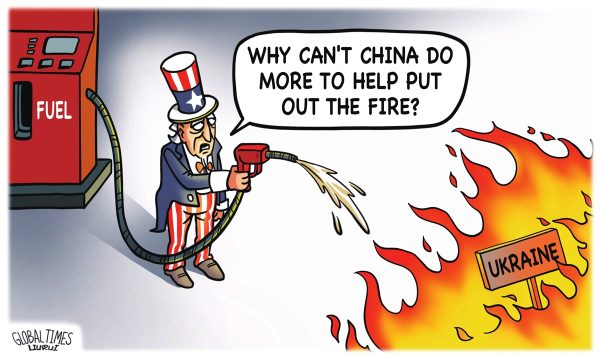
Illustration: Liu Rui/GT
The close relationship between China and Russia has been a thorn in the US’ side, especially against the backdrop of the ongoing Ukraine crisis. With the simmering of the situation, it couldn’t be any clearer that Washington is eager to exploit the Russia-Ukraine conflict to drive a wedge between Beijing and Moscow.
For one thing, senior White House officials have on multiple occasions accused China of not exerting enough pressure on Russia to stop the country’s military action in Ukraine. US Secretary of State Antony Blinken said on Thursday before US President Joe Biden’s virtual meeting with Chinese President Xi Jinping that Washington will “impose costs” for any support Beijing provides to Russia’s actions against Ukraine. He urged Beijing to assume “responsibility to use its influence and defend the international rules and principles that it professes to support.” For another, an increasing number of Western media reports and analyses have emerged to hype how China’s ties with Russia have made China “uncomfortable” and “awkward” and warn that Beijing risks isolation if it doesn’t distance itself from Moscow.
NATO’s eastward expansion is the root cause of Russia’s anger and military operation in Ukraine. It’s the US that should put out the fire it lit in Ukraine. Ridiculously, it is demanding Beijing to do this job at the cost of damaging China-Russia relations. This is unreasonable and insidious. By pushing China to denounce Russia and asking China to bear the responsibility for the fatal strategic mistake the US and NATO made in the construction of so-called European security, Washington has no intention of hiding its desire to sow discord between China and Russia.
US State Department spokesperson Ned Price said on Monday that China could use its unique relationship to bring an end to Russia’s actions against Ukraine. What nonsense. Russia is an independent major power and China has no ability to exert influence on Russia’s decision on the Ukraine issue which it deems as a “life-and-death” matter.
If China really pressures Russia in a way that is inconsistent with the China-Russia comprehensive strategic partnership of coordination, it will only undermine the China-Russia relationship and sabotage mutual trust, which will be a huge strategic loss to both sides. This is what the US is eager and happy to see.
Washington knows that China cannot influence Russia or force it to do anything. But it has regarded the Ukraine crisis as a good chance to tear the two countries apart. The more discord Washington could sow between China and Russia, the more it will be in line with US interests. But how can Beijing and Moscow allow such an evil trick to succeed?
Not like the petty followers that Washington can manipulate at will, China and Russia are both independent great powers. Besides, China has maintained a consistent position over the Ukraine issue, emphasizing all sides’ security concerns and interests should be respected and upheld. Its position is out of its own interests and the interests of the region. It will never dance to the tune of the US or sacrifice relations with Russia to satisfy US demands.
It also should be noted that no matter how the Ukraine crisis evolves and how heavily Russia is targeted by the US now, Washington still views China as its biggest strategic competitor. China should bear this in mind all the time. It must not give the US any chance to drive a wedge in the China-Russia relationship.
For a long time, the West has misinterpreted the China-Russia relationship, believing it’s based on expediency and could be easily torn apart. The truth is, the China-Russia comprehensive strategic partnership of coordination has withstood the test of the time and is rock solid. It’s China’s most important and stable diplomatic strategic asset that cannot be damaged.
March 19, 2022
Posted by aletho |
Aletho News | China, NATO, Russia, United States |
Leave a comment
Although it had been a feature of elections in some parts of the United States for years, the phenomenon of mail-ballot voting exploded in the 2020 election. In the midst of the COVID pandemic, jurisdictions around the country expanded use of mail voting, sometimes sending ballots to every registered voter. Steps were taken to facilitate ease of mail voting, such as establishing drop boxes for returned ballots, relaxing rules regarding signature verification, and easing restrictions on “ballot harvesting,” the practice whereby paid political activists collect a large number of completed ballots and return them for counting. As a result, by some estimates, the proportion of ballots cast by mail nearly doubled from 2016 to 2020.
There is, of course, an ongoing debate over whether the turn to mail-ballot voting was necessary, given the pandemic circumstances, or a partisan maneuver to advance the prospects of Democrats, who seemed to reap most of the benefits electorally. Whether or not it was necessary, the development clearly contributed in two important ways to undermining confidence in the results – and is likely to continue doing so unless legislators and election officials take corrective measures.
First, mail-ballot voting is intrinsically less secure than in-person voting. Things might go awry at multiple points. The ballot might never be delivered, or it might be delivered to the wrong address, or to the right address but wrong person. Even if delivered into the right hands, it might ultimately be filled out by someone else or by the intended recipient under pressure; under these conditions, there is no guarantee that the secret ballot is preserved, a problem exacerbated by the activity of ballot harvesters. Once the ballot is completed, it can get lost in the mail, removed from a drop box, or otherwise compromised.
And this is without accounting for the potential for large-scale fraud. In 2020, an unnamed political operative in New Jersey described to the New York Post how he had developed and been using for years a system for replicating ballots and submitting them on behalf of his candidates. Despite the assurances of some that voter fraud is not an issue in the United States, a number of high-profile cases in the last quarter-century prove otherwise. Since 1997, mayoral elections in Miami and Paterson, New Jersey, as well as a congressional election in the Ninth District of North Carolina, have been vacated due to proven fraud. As John Fund and Hans von Spakovsky document in their 2021 book “Our Broken Elections,” these three cases are the tip of the iceberg. Indeed, Fund and von Spakovsky note, most cases of large-scale fraud in recent years have involved mail ballots.
There is a reason France no longer uses mail-in ballots in its elections, and why the 2005 commission led by Republican James Baker and Democrat Jimmy Carter identified mail ballots as the least secure mode of voting (though in 2020 Carter rather weakly tried to walk back that conclusion).
Nearly a year and a half after the 2020 elections, a special counsel has charged that substantial voter fraud took place in more than 90 of Wisconsin’s nursing homes, where it appears that nursing home staff or administrators requested ballots for invalid patients, then filled out and returned those ballots, possibly forging the patients’ signatures. A private study (separate from the controversial Arizona “audit”) alleges that 200,000 mail ballots in Maricopa County were counted despite mismatched signatures.
Overall, one does not need to accept former President Trump’s expansive claims of national voter fraud – indeed, one should not, without a great deal more evidence than he has yet offered – in order to recognize that mail-ballot voting is vulnerable to a number of problems that make it chronically less reliable than in-person voting. Moreover, perhaps as importantly, many voters recognize this fact, and as a result will consistently question the validity of close results in elections using large-scale mail balloting, at least if their candidate loses.
Second, because of significant disparities in the political makeup of the mail-ballot electorate and the Election Day in-person electorate (in states that are not 100% mail ballot), the reporting of election results can become distorted. In the 2020 general election, we witnessed both a much-expected “red mirage” and a lesser-noted “blue mirage.” In a few states such as Texas and Ohio, mail-ballot votes were counted and reported first, leading to initial Democratic leads that were gradually wiped out through the night as Election Day votes were added to the tallies. In most major states, the reverse happened. Election Day votes were counted first, followed by mail-ballot votes. The predicted “red mirage” came to pass as President Trump took early leads in Georgia, Michigan, Pennsylvania, and Wisconsin before surrendering them over the next few days as the mail ballots rolled in.
No one paid much attention to Texas and Ohio, which had their totals in relatively early, and in any case went the way they were expected to go. On the other hand, the “red mirage” states drew enormous scrutiny. They were already understood to be swing states that could go either way and would determine the election. Moreover, all had voted for Trump in 2016. Many Trump supporters went to bed on November 3 with their man seemingly headed to another surprise win, and found out on November 4 that it was slipping away in a process that was not completed for several days. That sensation, of having an election victory subsequently overridden, undoubtedly contributed to the willingness of many to embrace Trump’s “stolen election” narrative. That is an outcome we should hope to avoid in the future.
It is possible that the partisan makeup of mail-ballot versus Election Day voters depends on circumstances. In 2020, Democratic voters may have been more afraid of COVID and hence more likely to avoid voting lines, while Republican voters were urged by their president not to trust mail voting. Perhaps other circumstances will produce different tendencies. Unless both modes of voting are utilized equally by supporters of both candidates, the potential will exist that those who lose based on late-reporting mail results will wonder whether something nefarious happened.
The optimal solution would be to increase in-person early voting opportunities and the number of Election Day polling places, while strictly limiting mail voting to traditional absentee voting for reasons of illness, disability, or absence. However, many jurisdictions continue to be committed to widespread mail voting. It is a practice that is not going away anytime soon, so a key question is what can be done to reduce the damage that mail-ballot voting can do to confidence in electoral legitimacy.
The two problems outlined above – inadequate ballot security and delayed vote totals – require distinct measures.
The chief way to mitigate concerns around delayed vote totals is to enforce a strict Election Day deadline for the return of mail ballots and to require election officials to begin counting received mail ballots prior to Election Day. The other confidence-building measure would be to adopt Georgia’s new requirement that election officials must announce on Election Night the total number of votes received. This will prevent the perception that large batches of incoming votes are materializing out of thin air.
As for ballot security, some states have already taken steps that should be adopted more broadly. These include banning ballot harvesting and improving verification techniques (possibly using the last four digits of Social Security numbers instead of signatures). Not least, state and county election offices should take more seriously their obligation to keep their voter-registration rolls updated. If election officials want voters to be confident in the legitimacy of mail-ballot elections, they need to make sure that no household is getting five extra ballots for residents who haven’t lived there in years. Unfortunately, Democrats have widely condemned such measures as “voter suppression.”
None of these steps would prevent a nominally responsible eligible voter from casting a vote by mail, but they can help bolster confidence in our elections. If we have to learn to live with mail-ballot voting, we should be able – no, eager – to answer legitimate concerns rather than pretend that they don’t exist.
Andrew E. Busch is Crown professor of government and George R. Roberts fellow at Claremont McKenna College. He is co-author of “Divided We Stand: The 2020 Elections and American Politics” (Rowman & Littlefield).
March 19, 2022
Posted by aletho |
Civil Liberties, Corruption, Deception | France, United States |
Leave a comment