Yemen denounces international community’s silence on Saudi aggression, siege
Press TV – October 18, 2026
Yemen has condemned the international community’s silence on Saudi Arabia’s ongoing aggression and blockade, saying it emboldens Riyadh to continue its atrocities.
The Yemeni Ministry of Foreign Affairs and Expatriates, in a statement released on Saturday, said the Saudi military continues to target ordinary people and civilian infrastructure, as it has done over the past years.
The ministry denounced Saudi strikes on civilians and non-military installations as a flagrant violation of international humanitarian law, particularly the Fourth Geneva Convention of 1949 and Additional Protocol I of 1977.
In the latest attack, a series of Saudi airstrikes targeted a residential neighborhood in the Maqbanah district of Yemen’s southwestern Ta’izz province, killing nine civilians, including a woman and a girl, and injuring 16 others.
The statement also censured the deafening silence of the international community, which claims to uphold human rights while lecturing others about them.
It noted that such an approach would offer Saudi officials the carte blanche to keep on their brutalities, and would make the international community complicit in Riyadh’s crimes and aggression.
The Yemeni foreign ministry then called on the international community, particularly the UN Security Council, the Human Rights Council, the UN High Commissioner for Human Rights, as well as human rights organizations, to abandon double standards, condemn the heinous crimes committed against Yemeni people, and pressure Saudi Arabia to honor its obligations under international humanitarian law.
The ministry finally emphasized that Saudi atrocities would not go unpunished, and that the House of Saud, “whose hands are stained with blood and whose fingers with guilt,” would be held accountable.
On July 20, the Sana’a government announced a maritime blockade against Saudi Arabia in response to “an unjust and oppressive siege” on Yemen for almost 12 years.
Subsequently, the Yemeni armed forces have reported a series of successful missions that have targeted vessels associated with Saudi Arabia in the Red Sea.
In March 2015, Saudi Arabia and its allies imposed a blockade on Yemen, initiating a comprehensive military offensive that received support in terms of military, political, and logistical assistance from the United States and several Western countries.
Tens of thousands of Yemenis have lost their lives; however, Saudi Arabia has failed to achieve its primary goal of reestablishing a puppet government that served its interests.
UAE and Saudi Arabia move toward renewed coordination against Sanaa
Al Mayadeen | October 18, 2026
The United Arab Emirates has reportedly agreed to resume funding selected forces in southern Yemen fighting the Yemeni Armed Forces, while Saudi Arabia has agreed to provide air cover for those forces, according to sources in Yemen.
The reported arrangement signals a possible thaw in relations between Riyadh and Abu Dhabi after months of disagreement over the scope of each other’s political influence in Yemen.
The renewed coordination comes as the Yemeni Armed Forces continues to make gains and Saudi Arabia faces repeated drone and missile attacks targeting its territory, airports, and energy infrastructure.
Gulf rivals reconsider their positions
Southern forces, particularly the Giant Brigades, were previously trained and funded by the UAE and are considered among the more effective formations in the fragmented coalition opposing the YAF. Abu Dhabi withdrew its involvement in Yemen in January, cutting off financial support to forces it had backed, following pressure from Saudi Arabia.
The reported agreement suggests that advances by the YAF are prompting rival Gulf powers to reconsider their differences. However, neither Saudi Arabia nor the UAE has responded to a recent demand by southern separatists for an independence referendum that would restore the borders in place between 1967 and 1990, when Yemen was divided into two states.
The Southern Transitional Council (STC) has also yet to agree to deploy its forces beyond the boundaries of the former South Yemen. Saudi approval of a referendum could potentially remove that restriction, although no such agreement has been announced.
Attacks on Aden intensify pressure
The Aden government announced a counteroffensive last week aimed at retaking Sanaa. The campaign achieved limited gains around Majzar near Marib and the Bab al-Mandab Strait, but was met with a sizeable retaliation by Sanaa’s forces.
On Friday, two missiles struck Aden airport; Information Minister Moammar Al-Eryani said the missiles landed about 500 meters from the Yemenia Airways aircraft and roughly 100 meters from the runway’s midpoint. No casualties were reported.
The attack followed a strike on a presidential palace in Aden that killed at least five people and wounded 16, further underscoring the risks facing the Gulf-backed south.
Relations between the STC and Riyadh remain strained. STC leader Aidarous al-Zubaidi fled to Abu Dhabi in January after an unsuccessful attempt by the council to assert control across southern Yemen and announce a referendum on independence within two years.
Saudi Arabia subsequently bombed UAE arms shipments intended for STC forces. Abu Dhabi then announced its withdrawal from Yemen, while the Saudi-backed government said it would seek to prosecute Zubaidi for treason.
Egypt and UK face decisions over military support
Regional involvement is also expanding beyond the Gulf rivals. Egyptian President Abdel Fattah el-Sisi has called for an emergency parliamentary session to authorize possible military action to “defend” Saudi Arabia if requested, while emphasizing that Egypt would not undertake offensive operations.
Sanaa’s Parliament Speaker Yahya Ali al-Ra’i warned Egypt against a potential involvement in the Saudi military aggression against Yemen, urging Cairo not to allow itself to be drawn into a confrontation that serves Riyadh’s policies.
In an urgent letter to Egyptian Parliament Speaker Hisham Badawi, al-Ra’i expressed serious concern that developments could lead to Egyptian military participation alongside Saudi Arabia, stressing that such a move would contradict Egypt’s historical role in defending Arab causes.
In the UK, discussions continue over a Saudi request for additional military assistance. London has deployed an RAF Voyager aerial refueling aircraft, but some Arab officials are pressing for further support.
The prospect of deeper British involvement raises legal concerns. In 2019, the UK Court of Appeal ruled that the government had acted unlawfully in granting arms export licenses during the previous Saudi bombing campaign in Yemen in 2015–2016. The Campaign Against Arms Trade argued that officials had failed to properly assess potential violations of international humanitarian law, prompting revisions to export licensing procedures.
Sanaa’s resistance against Saudi aggression followed a brutal, years-long siege that caused one of the worst famines in modern history. The Ansar Allah government has made clear that their fight against Saudi Arabia will not cease so long as Riyadh continues to escalate it even further.
The Yemeni Armed Forces forces have remained firm in their resistance under the banner of a military equation: blockade for blockade and escalation for escalation.
How Iran’s two-week retaliatory strikes exposed cracks in US military architecture in Persian Gulf
By Mohammad Molaei | Press TV | October 18, 2026
The two-week exchange of fire between the United States and Iran, triggered by Washington’s attempt to force open an illegal southern corridor through the Strait of Hormuz, represented the most consequential direct military confrontation between them since the 40-day war.
The Iranian response to the unprovoked and illegal American aggression was not a chaotic escalation but a methodical, layered military campaign that drew on years of doctrinal development, weapons investment, and operational planning.
The efforts of the Islamic Republic’s armed forces, spearheaded by the Islamic Revolution Guards Corps (IRGC) aerospace and naval branches, executed a decisive and swift response.
What unfolded was a layered operation with nine distinct but interlocking lines of effort. Each line reinforced the others. Infrastructure degradation reduced American operational tempo; area denial forced repositioning that compounded the effects of that degradation; extended-range precision strikes demonstrated that repositioning offered no sanctuary; ISR attrition blinded American targeting systems; terrorist suppression closed the land flank, while strikes on utility infrastructure imposed costs on host nations and denied services to American bases.
One can employ the open-source reporting, satellite imagery, and the observable pattern of strikes to examine each dimension of Iran’s military response in detail, and construct a coherent operational picture. It is getting exceedingly clear that the ceasefire period has very likely translated to a window for reconstitution and preparation in Iranian strategic calculus.
The primacy of solid-fuel tactical ballistic missiles
Iran’s decision to anchor its retaliatory campaign in solid-fuel tactical ballistic missiles was not accidental. It reflected a decade-long investment in a specific capability designed precisely for this kind of confrontation. Solid-fuel ballistic missiles offer decisive operational advantages over their liquid-fuel predecessors. They require no fueling time at the launch site, dramatically compressing the window between a launch order and missile departure.
This matters enormously in a sensitive environment where adversary assets, particularly MQ-9 Reaper drones and maritime patrol aircraft, are actively hunting for launch preparations.
A liquid-fuel missile requires a visible, time-consuming fueling sequence that creates a detectable signature. A solid-fuel missile can be transported, erected, and fired in a fraction of that time, often before a targeting solution can be developed and a strike authorized.
These missiles are road-mobile, launched from transporter-erector-launchers (TELs) that can disperse across Iran’s mountainous terrain, making pre-emptive targeting extremely difficult.
Having destroyed much of the air defense systems belonging to the US and its Arab allies using the older, less sophisticated liquid fuel missiles in previous wars, Iran’s strikes this time primarily relied on its tactical solid-fuel ballistic missile inventory, meaning the various variants of the Fateh family.
Simply put, the choice of solid-fuel systems reflected a calculated assessment of the adversary’s weakened interception capacity, an assessment that proved accurate.
The air defense inventory crisis
Perhaps the single most consequential factor shaping the operational environment was the state of US and allied air defense missile inventories.
The United States entered this round of military aggression with critically depleted stocks of its most capable interceptors. The Standard Missile-3 (SM-3) and Standard Missile-6 (SM-6), which arm Aegis-equipped destroyers and cruisers and provide the American Navy’s primary ballistic missile defense capability at sea, have been drawn down through a combination of expenditure in the Red Sea campaign against Yemen, the costly defense of Israel during two previous wars, and the simple reality that production rates have never kept pace with consumption.
The Terminal High Altitude Area Defense (THAAD) system, which provides upper-tier defense against medium and intermediate-range ballistic missiles, is similarly constrained.
The decision not to employ Aegis and THAAD at full capacity was therefore a forced one. The United States simply could not spend its remaining meager inventory of SM-3 and THAAD interceptors against Iranian tactical ballistic missiles, which, while accurate and damaging, are not the only threats to American interests.
Doing so would have left the United States strategically exposed against another serious contingency in East Asia or Europe. The calculus was that American military bases had to absorb more hits to preserve the interceptors.
Moreover, the Patriot system, which bore the brunt of terminal-phase defense in recent weeks across the region, was in no better condition. Years of expenditure across Ukraine, the occupied territories, the Persian Gulf, and the Red Sea mission have drawn PAC-3 and PAC-3 MSE stocks to extremely low levels.
The Pentagon’s response was telling. Rather than accelerating full-capability PAC-3 MSE production, it has chosen to pursue the cheaper, less capable PAC-3ACE Cost Reduction Initiative variant. More revealing still were the recent PAC-2 GEM-T orders, an older interceptor not procured by the US in decades, signaling just how severely stocks had been exhausted.
That the world’s most sophisticated air defense enterprise was compelled to resurrect a 1990s-era design to sustain basic readiness is the starkest indicator of the American munitions crisis that Iranian planners appear to have understood, measured, and exploited with precision.
The situation among Persian Gulf states was equally dire. Saudi Arabia and the UAE had expended substantial portions of their Patriot PAC-3 interceptor stocks during years of Yemeni military missile and drone attacks, and entered the 40-day imposed war with depleted inventories. The situation is even direr in Kuwait and Bahrain, with the Persian Gulf microstates effectively running out of Patriots, being forced to solely rely on American-operated systems.
PAC-3, the most capable variant of the Patriot system against ballistic missiles, has effectively been exhausted in several batteries. PAC-2, the older and less capable variant, is the only available option in certain areas against Iranian missiles, and even that missile is running low as well. The collective air defense architecture of the Persian Gulf states, which had appeared formidable on paper, has been effectively hollowed out.
Iranian operational planners were aware of these facts. The sequencing and volume of Iranian missile salvos during the exchange reflected a deliberate attempt to exploit the gap between what the defense could theoretically intercept and what it could actually intercept given real-world inventory constraints.
Iran’s multi-layered operational strategy
What distinguished Iran’s response from a simple missile barrage was its architectural coherence. Iranian planners did not merely fire missiles at American targets; they executed a phased, multi-domain retaliatory campaign with distinct operational objectives at each stage, each phase creating the conditions for the next.
The campaign can be understood as having five interlocking lines of effort: infrastructure degradation, area denial and operational displacement, precision strike at extended range, ISR and logistics attrition, and proxy terrorist force suppression.
Together, they constituted a campaign design far more sophisticated than most Western analysts had publicly credited Iran with possessing.
The overarching logic was one of progressive operational constriction. Rather than attempting to destroy US forces – an objective beyond Iran’s reach given American conventional superiority – the campaign aimed to degrade, displace, and exhaust them.
Each successful strike reduced American operational capacity; forced repositioning that consumed time and resources, and demonstrated to regional partners that proximity to American occupation forces carried real costs.
Infrastructure degradation
The first phase of the Iranian retaliatory campaign targeted the physical infrastructure of American military power in the Persian Gulf region. This was not indiscriminate bombardment. Satellite imagery and post-strike assessments revealed a pattern of targeting that prioritized specific high-value nodes: radar installations, fuel and ammunition storage facilities, maintenance hangars, and communications infrastructure.
Radar systems were a particular priority. The ability to detect, track, and target Iranian missiles and UAVs depends on a layered network of radar systems. By striking radar installations at air bases, Iran degraded the situational awareness that underpins both offensive operations and defensive intercepts. A radar that is destroyed or forced offline creates a coverage gap that cascades through the entire air defense architecture.
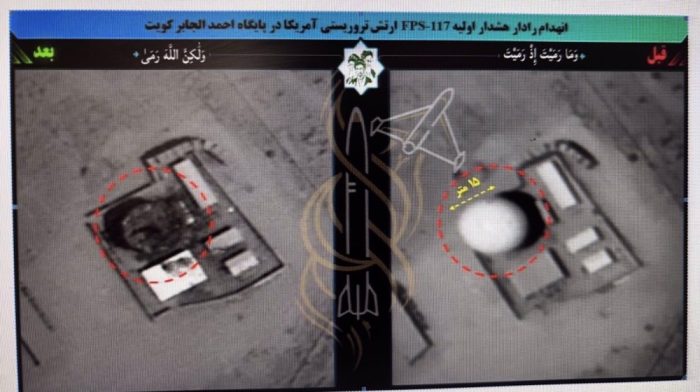
Before-and-after imagery of an AN/FPS-117 early warning radar installation at Ahmad al-Jaber Air Base, Kuwait, showing structural damage
Logistics infrastructure was targeted with equal deliberateness. Fuel depots, ammunition storage sites, and maintenance facilities at American bases around the Persian Gulf were struck with sufficient accuracy to cause meaningful operational disruption.
An air force that cannot fuel its aircraft, rearm them, or repair battle damage cannot sustain sortie rates. The targeting of logistics was a direct attack on the tempo of American air operations to derail the American aggression against Iranian sites and reduce the pressure on Iranian forces.
The accuracy of these strikes, achieved at ranges of several hundred kilometers, validated the operational utility of Iran’s solid-fuel ballistic missile force and demonstrated that the IRGC aerospace force had developed the targeting data, launch procedures, and quality control necessary to achieve consistent results against fixed infrastructure.
The anti-access/area denial campaign
The most strategically significant dimension of the Iranian retaliatory campaign was its systematic execution of an Anti-Access/Area Denial (A2/AD) strategy that progressively pushed American air operations out of the Persian Gulf and into increasingly distant and operationally constrained locations.
The logic of A2/AD in this context was straightforward. The closer American aircraft operate to Iran, the shorter their flight times, the larger their payloads, the less refueling they require, and the more sorties they can generate per day.
Conversely, every additional hundred kilometers of distance imposes compounding costs: greater tanker support, longer mission times, reduced payload, increased crew fatigue, and more complex coordination. By rendering the Persian Gulf operationally untenable for American air assets, Iran systematically degraded the offensive capacity of the aggressors.
The first displacement was from the Persian Gulf itself. Sustained missile and drone attacks against air bases made sustained operations from those locations unfeasible. The American response was to shift primary air operations to bases in Jordan – Al-Azraq and Muwaffaq Salti –which offered greater distance from Iranian missile systems.
Iran’s response was to extend its reach to Jordan. Multiple strikes against American bases, documented by US casualties and satellite imagery showing damaged hangars and destroyed aircraft, demonstrated that Iran had the capability to contest operations from that distance.
The retaliatory strikes destroyed American aircraft, damaged infrastructure, and forced the US war machine to reconsider the viability of Jordan as a primary operating location.
The second displacement was to the occupied territories. American air assets, including tanker aircraft critical to sustaining long-range strike operations, were pushed further west to Israeli military bases.
This displacement carried its own operational costs. The distance from Iranian targets increased further, and the concentration of American assets in the occupied territories created its own targeting opportunities for Iran, which has demonstrated both the willingness and capability to strike at extended ranges.
A particularly telling indicator of this displacement dynamic was the repositioning of the RQ-4 Global Hawk strategic reconnaissance aircraft, which had been operating from Al Dhafra in the UAE and from Jordanian facilities, to Sigonella Naval Air Station in Sicily.
The Global Hawk, with its long endurance and high-altitude sensors, is a critical ISR asset for tracking Iranian missile launches and providing targeting data. Its displacement to Sicily represented a dramatic reduction in persistent surveillance coverage over Iran and the Persian Gulf, with direct consequences for the effectiveness of American strike operations.
A qualitative leap in extended-range precision
One of the most significant revelations of the recent round of US aggression and Iran’s retaliation was the demonstrated accuracy of Iranian ballistic missiles at ranges exceeding 1,000 kilometers. Previous assessments of Iranian ballistic missile accuracy had generally been skeptical about the ability to achieve consistent precision at such distances. The strikes on Jordanian targets, located well over 1,000 kilometers from Iranian launch sites, completely shattered that skepticism.
The circular error probable (CEP) – the radius within which 50 percent of strikes fall – observed in the Jordanian strikes was dramatically smaller than what Iranian missiles had previously demonstrated at comparable ranges. Strikes that hit specific buildings, specific aircraft shelters, and specific sections of structures, rather than simply landing somewhere on a base, indicated a qualitative improvement in guidance accuracy that demands explanation.
Several hypotheses present themselves, and the evidence suggests that the answer likely involves a combination of all of them. First are technical improvements. Iran may have upgraded the terminal guidance systems on its Kheibarshekan, Haj Qasem, and Fattah variants, potentially incorporating improved inertial navigation, satnav receivers, or optical terminal seekers that allow the missile to better correct its trajectory in the final phase of flight.
Second are tactical improvements. Iranian launch crews may have refined their pre-launch survey procedures, improving the accuracy of the initial position fix that the missile’s inertial navigation system uses as its reference point. Third are software improvements, which mean updates to the missile’s flight control algorithms could improve trajectory optimization and reduce the accumulated errors that degrade accuracy over long distances.
The most likely explanation is a combination of all three – a systematic program of improvement across the technical, procedural, and software dimensions of missile accuracy that had been underway for years and was now being demonstrated operationally for the first time at this range, following the experiences of the 40-day war.
The MQ-9 hunt
The MQ-9 Reaper drone occupied a central and uniquely vulnerable position in American military offensives against Iran. The Reaper is not merely a strike platform but the primary persistent ISR asset used to locate and track mobile Iranian missile launchers, particularly after the heavy attrition of similar Israeli military systems.
Without the MQ-9’s ability to loiter for extended periods, the capacity to find and destroy TELs before they fire, or to conduct battle damage assessment after strikes, is dramatically reduced.
Iran understood this dependency and targeted it systematically during this campaign. The campaign against MQ-9 assets operated on multiple levels. Ground-based air defense systems, which had previously demonstrated the ability to engage high-altitude targets, were used to engage Reapers operating over Iranian territory and adjacent areas.
But Iran also struck the ground infrastructure that supports MQ-9 operations: the maintenance facilities, fuel systems, satellite communication ground stations, and launch-and-recovery equipment that allow the aircraft to operate.
Western media reporting confirmed the destruction of a number of MQ-9 aircraft on the ground at Jordanian bases and, in a particularly striking detail, the destruction of some aircraft while still in their transport canisters before assembly.
This achievement indicates that Iran has developed targeting intelligence on the logistics chain supporting drone operations, not merely the operational bases themselves. Destroying aircraft before they are assembled and made operational is a force multiplication achievement. It eliminates capability before it can be employed, at a point when the aircraft is most vulnerable and least defended.
The cumulative effect of the MQ-9 campaign was a significant degradation of American persistent ISR coverage over Iran. This directly reduced the effectiveness of the hunt for mobile missile launchers, allowing Iranian TELs greater freedom of movement and survivability.
Suppressing proxy terrorist forces in Iraq
From the first day of the exchange, Iran conducted daily retaliatory strikes against armed terrorist groups in Iraq that had the capability and potential motivation to conduct land attacks against Iranian territory or to serve as a forward platform for American-directed operations.
This campaign was methodical and comprehensive, targeting personnel concentrations, weapons storage facilities, and command infrastructure.
Iran’s western flank, which includes the border with Iraq, represents a potential vulnerability. Armed terrorist groups in Iraq, some with historical ties to American intelligence, could in theory conduct cross-border raids, provide intelligence for American strikes, or serve as a distraction that forced Iran to divert defensive resources.
By striking these groups preemptively and continuously, Iran sought to exhaust their operational capacity before it could be brought to bear.
The daily rhythm of these retaliatory strikes was itself a message. It demonstrated that Iran had persistent targeting intelligence on these groups’ locations, that it was willing to expend munitions on this secondary campaign even while conducting the primary campaign against American forces, and that it intended to maintain pressure regardless of any ceasefire negotiations that might be underway.
The logic of reciprocity
Iran’s retaliatory strikes on electrical and water infrastructure in Kuwait represented a deliberate response that operated on two distinct logics simultaneously.
The first was reciprocity: Iran’s own civilian infrastructure had been targeted, and the strikes on Kuwaiti infrastructure were a direct signal that such targeting would not be absorbed without response to the aggressor and its facilitators.
The second was military utility. American forces in the Persian Gulf region depend on host nations’ electrical grids and water supplies for base operations. Infrastructure that serves both civilian and military purposes is, under the laws of armed conflict, a legitimate military target when the military use is substantial and the strike is proportionate.
The targeting of Kuwait’s infrastructure was also a message to Persian Gulf states more broadly. Kuwait, like Bahrain, the UAE, Saudi Arabia, and Qatar, hosts American military facilities and had provided varying degrees of support to American operations.
By demonstrating the ability and willingness to strike Kuwaiti infrastructure, Iran was communicating that the costs of hosting American forces were not abstract. They were concrete, immediate, and would be borne by the host nation as well as the American military.
The pillars of operational success
Iran’s two-week retaliatory campaign against American aggression and attempts to force open an illegal southern corridor through the Strait of Hormuz largely succeeded on every dimension that its operational planners had identified.
The exchange demonstrated that Iran had developed, over decades of institutional study and investment, a military capability genuinely capable of contesting American power projection in the Persian Gulf region, even after two high-intensity wars.
It demonstrated something relevant to the strategic environment of the region – that the costs of American military aggression in the Persian Gulf had increased substantially; that the infrastructure of American power projection was more vulnerable than pre-war assessments had suggested; and that Iran possessed both the capability and the operational sophistication to exploit those vulnerabilities in a systematic and disciplined manner.
The mother of all propaganda: Why the hype over US MOAB strike against Iran is nothing but theater
By Arman Shariati | Press TV | October 18, 2026
American media this week began circulating a carefully placed story, claiming that the US military has drafted strike options against Iran that include deployment of the GBU-43/B Massive Ordnance Air Blast Bomb, the weapon branded as the “Mother of All Bombs.”
CNN was the first to report it on October 15, followed immediately by a wave of amplification across the mainstream American and European media.
US President Donald Trump, appearing later on Newsmax in an interview, did not deny the story. He offered instead a characteristically garbled endorsement, describing the MOAB as “like a tiny nuclear bomb, but it’s not nuclear,” and adding that the US may have to “take a shot” at Pickaxe Mountain in Iran’s Karkas mountain range.
The narrative was set, and it deserves to be taken apart with facts.
The GBU-43/B is an enormous munition by conventional standards. It carries approximately 8,500 kilograms of high explosive in a casing that brings its total weight to around 9,800 kilograms, just under 10 tons. Stretched end to end, it measures just over nine meters.
It is GPS-guided and essentially designed to detonate above the ground.
The MOAB is a thermobaric, or fuel-air, weapon. This description explains precisely why the weapon is irrelevant to the current discussion. A thermobaric weapon does not carry all of its oxidizer within its casing the way a conventional explosive does.
Instead, on detonation, it disperses a fine aerosol of fuel particles or reactive material into the surrounding atmosphere. A secondary ignition then detonates this cloud together with the ambient oxygen in the air itself, producing a pressure wave of exceptional duration and reach.
The fireball essentially consumes the atmosphere around it. The result is a weapon optimized for destroying things on or just above the surface, such as personnel in the open, light structures, and cave mouths, across a wide area. What the MOAB does not and cannot do is drive energy downward through hundreds of meters of solid rock.
Trump’s description, “like a tiny nuclear bomb,” is not merely imprecise. It is exactly the kind of rhetorical inflation that makes the current hostile military campaign against the Islamic Republic of Iran intelligible as communication strategy rather than military planning.
The MOAB has been used in combat once. On April 13, 2017, during Trump’s first term, a single GBU-43/B was dropped on a tunnel complex in Nangarhar province in eastern Afghanistan, claiming to target the ISIS (Daesh) Khorasan infrastructure.
The US administration at the time announced that the strike had killed approximately 90 ISIS-K militants. The actual battle damage assessment remained classified. What was confirmed is that a very large explosion occurred in a mountainous area of eastern Afghanistan.
The strategic effect on ISIS-K’s operational capacity in the region was, at best, ambiguous. The organization has continued to carry out attacks in the months and years that followed. That one strike, against an unprotected tunnel network in soft ground, in an area with no air defense, delivered by a slow cargo aircraft operating in uncontested airspace, is the entire operational history of this weapon.
The target reportedly under consideration is Kuh-e Kolang Gaz La, internationally known as the Pickaxe Mountain, in the Karkas range of central Iran. The facility buried beneath it reportedly sits under more than 100 meters of hard granite.
To suggest that an air-burst weapon, however large, could threaten such a target is to misunderstand the physics of the problem at the most elementary level.
The United States possesses a weapon actually designed for this task, namely the GBU-57/B Massive Ordnance Penetrator; a 13,600-kilogram bomb built specifically to drive through reinforced concrete and hardened rock before detonating.
The MOP was used against Iranian nuclear sites on June 22, 2025, during the 12-day imposed war. Its effectiveness against the deepest and most hardened of those facilities, particularly the Fordow Fuel Enrichment Plant, remains a matter of genuine debate.
If the weapon engineered for penetration cannot be confirmed to have neutralized Fordow, a target much less protected than Pickaxe Mountain, then the notion that an air-burst weapon detonating above the mountain surface would accomplish anything beyond scorching rock is not a serious military proposition.
Even setting aside hardened underground targets, the MOAB offers no material advantage against any conventional surface target that cannot be achieved more efficiently and with far less operational risk by using multiple precision-guided JDAMs delivered from fighter aircraft operating at standoff ranges.
The MOAB does not expand the target set. It does not add capability. It adds spectacle.
There is a further operational reality that receives almost no attention in the current American media narrative. The GBU-43/B is confirmed to be deliverable only by the C-130 family of cargo aircraft. Flying such a platform into contested Iranian airspace is not a minor planning consideration and introduces significant operational difficulties.
The United States lost two MC-130J Commando IIs during its wars of aggression against Iran. The idea of routing another slow cargo aircraft into that same environment in order to drop a weapon that cannot reach the target it is supposedly meant to destroy compounds the absurdity.
What the current MOAB narrative resembles most closely is not a serious military planning process. It resembles the late-war German doctrine of the Wunderwaffe, the wonder weapon.
Under mounting pressure, facing an unwinnable strategic position, Nazi Germany’s leadership turned to announcements of extraordinary new weapons that would change the course of the war. The V-1 and V-2 generated genuine fear and caused real casualties.
They did not alter the strategic outcome by a single day. The function of the wonder weapon is not primarily military. It is political. It tells a domestic audience and a wavering alliance that there are still options, that new instruments of power remain available, that the situation is not as bad as it looks.When strategy fails, spectacle fills the gap.
The Trump administration is conducting a war that did not emerge from American strategic interests. It entered the war of aggression to further Israeli goals and expansionist ambitions, has absorbed significant losses and embarrassments, and now approaches midterm elections with a public that has not been offered a clear account of what victory looks like.
In that very context, the MOAB story makes complete sense as an information management campaign, to paint a picture of a strong American military, when the truth is something else.
There is one more thing worth stating plainly. Even if the MOAB is used, even if a C-130 penetrates Iranian airspace, releases the weapon over Pickaxe Mountain, and produces the largest conventional explosion seen in the region, Iran will be compelled to respond.
Not because the strike will have damaged anything of military significance. A major attack that fails to achieve its stated objective does not end a war. It resets the escalation clock. Tehran’s hand will be forced, and it will answer with something commensurate in visibility, and Iran has demonstrated repeatedly that it possesses the means and the will to do exactly that.
The MOAB is a very large bomb, but it is particularly good at the thing it is now being asked to symbolize. What it is, in the current context, is a prop, useful for an interview, useful for a news campaign, and essentially useless for anything happening 100 meters below the surface of a granite mountain in central Iran.
Arman Shariati is a Tehran-based military analyst and researcher.
Iran says it possesses technology behind US 14-ton GBU bunker-buster
Al Mayadeen | October 18, 2026
Iran has obtained the technology behind a US-made 14-ton GBU bomb and now possesses samples of the weapon, Brigadier General Mohammad Reza Naqdi, senior advisor to the Commander-in-Chief of the Islamic Revolution Guard Corps (IRGC), stated.
Speaking during the “Fedayeen for Iran” military exercise in Sari, Naqdi said Iranian forces acquired some of the bombs after they failed to detonate during the 12-day war, allowing local forces to seize them and study their technology.
“We should recall that during the 12-day war, 14-ton bombs were dropped,” Naqdi said, adding that “the failure of some of the 14-ton bombs to explode enabled the local forces to seize them.”
“Today, Iran possesses samples of these bombs alongside the manufacturing country,” he asserted, adding that Iranian forces have analyzed all the technologies associated with the US 14-ton bomb and now possess its technology in full.
What is the GBU?
The weapon Naqdi referred to is a GBU, or Guided Bomb Unit, a designation used by the US military for a broad family of air-dropped precision-guided bombs.
GBUs use guidance systems to direct their warheads toward designated targets, with different variants ranging from conventional precision bombs to much heavier bunker-busting weapons.
The term “14-ton bomb” is generally associated with the US GBU-57 Massive Ordnance Penetrator, a deep-penetration weapon designed to strike heavily fortified underground facilities, such as Iran’s nuclear facilities bombed during the 12-day war.
The GBU-57 is one of the largest conventional bombs in the US arsenal and is designed to penetrate deeply buried and hardened targets before detonating. Its deployment requires specialized heavy aircraft.
Iran has heavy fighter jet at hand
Earlier, Iranian Defense Minister Mehrdad Akhlaghi announced Sunday that a heavy Iranian fighter jet will take its first flight next year.
Naqdi also warned that Iran’s response to any renewed US aggression would extend to infrastructure and energy investments belonging to those involved in attacks against Iran in the region.
“In the event of any mistake, the investments related to the infrastructure and energy of the aggressors in the region will be within the operational targeting circle,” he said.
Responding to US threats involving the use of weapons such as the “Mother of All Bombs,” Naqdi said Iran’s Armed Forces have demonstrated advanced missile and deterrence capabilities capable of delivering a decisive response to any aggression.
Iran advances domestic defense production
The emphasis on domestic defense production forms part of Iran’s broader strategy of military self-reliance.
Iranian officials have repeatedly linked the development of indigenous defense capabilities to the need to maintain national security and deterrence without relying on foreign suppliers.
The focus on precision, missile range, and warhead development also reflects the importance Iranian military planners place on technological advancement as a component of deterrence.
Trump asks Iran not to retaliate after he strikes Pickaxe Mountain – w/ Prof. Marandi
Mario Nawfal | October 17, 2026
Vice President J.D. Vance’s Deceptive ‘Antiwar’ Campaign Speech
By Adam Dick | Ron Paul Institute | October 17, 2026
J.D. Vance is approaching the halfway point of his term as vice president in an administration that has committed the United States to wars in locations from Ukraine to Venezuela to Somalia to Iran and beyond. All the while, the administration has threatened sending the military into other places across the world including Mexico, Greenland, and Cuba. In short, this presidential administration is fully committed to a warmongering agenda.
Over his 14 years as a United States House of Representatives member, Mike Rogers similarly established his reputation as a committed advocate for US warmongering across the world. This Michigan Republican and the presidential administration are two peas in a pod when it comes to supporting an aggressive empire.
President Donald Trump in the 2024 presidential campaign portrayed himself as the peace candidate in the race, a tactic that may have brought him the votes needed to obtain a close electoral victory. But, once elected, Trump turned on a dime, becoming the war president who delivers turmoil, destruction, and death. Through this, Vance has stood by Trump in support.
Given this context, it seems almost unimaginable that Vance would stump in Michigan for electing Rogers to the US Senate by asserting that Vance and Rogers are supporters of peace. Yet, that is what Vance did in a Monroe, Michigan speech on Thursday. With the “peace candidate” ploy having worked for Trump in the 2024 presidential election, Vance audaciously gave it a try in the Michigan speech despite it being divorced from reality.
Vance, in his speech, framed the race between Rogers and Democratic nominee Abdul El-Sayed as a battle “between politicians obsessed with foreign causes and leaders who remember that their first duty is to fight for the people right here at home.” Vance’s claim is that he and Rogers are among the good “leaders” instead of the bad “politicians” in this comparison. But, it is Rogers, who relentlessly supported US intervention abroad as a House member and in his chairmanship of the House Intelligence Committee is the quintessential politician obsessed with foreign causes. And it is crystal clear that over the last two years the Trump administration has, in its obsessive pursuit of foreign causes, sacrificed the interests of the American people, including by substantially increasing the national debt and driving the cost of fuel sky-high.
Vance proceeded in his speech to declare that the Democratic opponent Rogers faces in the race is “absolutely obsessed with conflicts occurring thousands of miles away in the Middle East.” “He is obsessed,” continued Vance, “with the state of Israel and with Gaza.” This, of course, is an obsession of the Trump administration that started the Iran War jointly with Israel and has been giving Israel enormous financial, military equipment, and intelligence aid to support Israel’s attacks on not just Gaza but also other places including Iran and Lebanon.
Meanwhile, Rogers, a staunch supporter of the US aiding Israel, has asked the American Israel Public Affairs Committee (AIPAC) — the most prominent organization in the “Israel Lobby” in America — to not directly fund advertisements for his campaign while he travels the country to attend AIPAC organized fundraisers. Rogers is trying to keep under wraps that he is what Vance says his opponent is. Will voters understand the reality or be tricked by the subterfuge?
Why did Vance go through with making claims regarding US foreign policy in his speech that fly in the face of reality? The answer may be found in a comment by Rogers’s Democratic opponent in a Senate election debate held the week before. In that debate, El-Sayed stated in regard to Rogers: “So, it’s just inconsistent to me to be running for Senate from Michigan when you’re more focused on what’s happening to a foreign government than you are focused on what’s happening to folks right here in Michigan.” The foreign government referenced in El-Sayed’s comment is Israel. Instead of trying to give a nuanced counterargument to this charge from the debate, Vance went in his speech with the old standby of “I’m rubber and you’re glue; whatever you say bounces off of me and sticks to you.” In the process, Vance ended up looking ridiculous to anyone with basic knowledge of the foreign policy records of Rogers and the Trump administration.
Iran: Palestinians’ rights must not be compromised in Gaza’s future; US, Israel to blame for Hormuz situation
Press TV – October 17, 2026
Iran’s ambassador and chargé d’affaires to the UN has stressed that any arrangements for the Gaza Strip’s future must fully respect Palestinian rights and self-determination, denouncing the United States and the Israeli regime for the current situation affecting the Strait of Hormuz.
Gholamhossein Darzi made the remarks on Friday, addressing a UN Security Council meeting on the situation in West Asia, including the Palestinian question.
He noted that Gaza remained devastated and continued to be subject to military aggression, despite the announcement of a ceasefire last year.
The ceasefire was announced last October as part of a United States-proposed plan to bring an end to two years of Israeli genocide, supposedly.
The Israeli regime has, however, killed more than 1,400 Palestinians during attacks across the territory ever since, in addition to the tens of thousands it had already killed throughout the genocide that began on October 7, 2023.
Darzi called for a permanent end to the Israeli aggression, lifting of the Israeli blockade on the coastal sliver, and realization of a lasting ceasefire in the territory.
He called for unconditional and complete withdrawal of Israeli forces from the territory as well as immediate and sustained delivery of humanitarian aid and deployment of relief personnel.
The diplomat called accountability for serious violations of international law a legal obligation, condemning the regime for committing genocide, war crimes, and crimes against humanity.
He also denounced expansion of illegal settlements, intensifying settler violence, and Israeli plans for “annexation” of the occupied West Bank.
Palestinians must be able to establish an independent, sovereign, and viable state, with the holy occupied city of al-Quds as its capital and full membership in the United Nations, the official stated.
He also demanded Israeli withdrawal from Lebanese territory and occupied Syrian areas and respect for both countries’ sovereignty.
Elsewhere in his remarks, Darzi slammed the United States and the Israeli regime for launching two rounds of unprovoked aggression against Iran respectively, last June and from February 28 until April 7 this year.
The aggressors, he noted, committed war crimes through deliberate targeting of civilians and critical infrastructure.
He also attributed the situation affecting the Strait of Hormuz to the American-Israeli atrocities, including an American naval blockade.
“Our position is crystal clear: The only practical way to restore normal and safe maritime navigation in the Strait of Hormuz is immediate and permanent cessation of US aggression, provision of credible guarantees against its recurrence, respect for Iran’s sovereign rights, and complete lifting of the naval blockade and other unlawful coercive measures.”
Following the US-Israeli aggression against Iran on February 28, Tehran closed the Strait of Hormuz to its adversaries. The key waterway has remained largely closed ever since, driving up fuel prices worldwide and increasing the cost of living for millions of people.
Tehran has made it clear that it will not reopen the strait until Washington meets its demands, including a permanent end to the war.
Ongoing tales of Syrian chemical weapons
OPCW Inspector Ian Henderson responds regarding alleged newly-found, un-declared chemical weapons.
By Ian HENDERSON | Consortium News | October 11, 2026
If Douma, one of the highest-profile “proven” chemical attacks attributed to Syria’s former Bashar Assad government, has been shown to be fake, what does it say about new, undeclared Syrian chemical weapons that have supposedly been found?
It says we should be extremely skeptical about news of such discoveries.
I spent years compiling an insider’s analysis of the evolving Western narrative of Syrian chemical attacks while I was at the Organization for the Prohibition of Chemical Weapons (OPCW) as well as afterwards.
My conclusion was it is nigh impossible to prove a negative in this situation; to say there had never been a chemical attack by the Syrian government forces.
However, when it came to high-profile allegations of such attacks in the Syrian towns of East Ghouta, Khan Sheykhoun, Ltamenah, Saraqib and Douma, there were fatal flaws in the official narratives.
There were unmistakable signs, clear to us on the inside, of fabrication.
The Douma attack eight years ago appeared to be the last of a series of chemical allegations against the regime.
Yet the saga continues. The OPCW sent a new mission to Syria this May to try to find alleged, undeclared chemical weapons from the government of Bashar al-Assad, who was ousted in 2024.
Before examining the intentions and results of this mission, it is useful to review how the Western-backed OPCW handled its investigation into the 2018 chemical weapons attack in Douma, a suburb of Damascus.
I was an OPCW inspector on that mission and this is why I blew the whistle.
The Establishment Narrative
Just how much of the establishment narrative that blamed Assad for using chemical weapons be believed ?
Devised during the early part of the Western and Gulf-backed jihadist war to overthrow Assad a decade and a half ago – and built upon steadily by Western belligerents throughout the crisis – the story that Assad had “gassed his own people” was widely believed with mainstream media fully on board.
Doubters were glibly dismissed, including “official” dissenters such as some senior inspectors at the OPCW. I was among them.
The chemical allegations followed a well-oiled procedure. Armed opposition groups – who were seeking direct Western military intervention to support their effort to overthrow Assad – would raise the alarm online by posting slick images and videos of an alleged chemical attack.
These opposition groups, sometimes assisted by Western NGOs, would then bring supposed witnesses of these alleged attacks to Gaziantep in Turkey, where the OPCW would send fact-finding missions to interview them.
The OPCW would generally believe the opposition groups and their witnesses and accept items of supposed “evidence” handed over to them, sometimes months after the alleged attack. Until the Douma allegation in 2018, the fact-finding mission never got to the scene of any Syrian chemical attack after an initial attempt in 2014 went awry.
The fact-finding report would be secretly drafted under the direct control of OPCW top management, bypassing any procedural or technical oversight, and would conclude that it was “reasonable to believe” that a chemical attack had indeed taken place.
The follow-up investigations by the heavily politicized Joint Investigative Mechanism (J.I.M.), or by the later Investigation and Identification Team (I.I.T.), would suggest that “a reasonable person would believe” that the Syrian Armed Forces were responsible for the attack.
OPCW inspectors are not fools. Many of us saw what was going on, seeing the tight political control that the U.S. and to a lesser degree the U.K. exerted over anything to do with the Syrian file. But the draconian confidentiality regime in the OPCW kept everyone subdued.
The breakthrough came after the April 2018 Douma allegation.
For the first time, an OPCW team actually got to the scene of an alleged chemical attack, at the town of Douma, in southwestern Syria, about 10 kilometers (6 miles) northeast of Damascus.
We did our job thoroughly, and in doing so we identified serious flaws in the allegation.
OPCW Extreme Measures
The OPCW resorted to ever-escalating measures to bring things back on track. After trying to secretly modify the interim report by withdrawing it from publication and sneaking in the preordained conclusions that were required by influential delegations, senior OPCW officials went to extremes.
They removed all the team members who had gone to Douma and produced a flawed Fact Finding Mission report written by persons unknown, none of whom had much knowledge of what the Douma team had done.
The fact-finding report predictably found that “it was reasonable to believe” there had been an attack with chlorine in Douma. This was followed much later by the OPCW’s inevitable I.I.T. report that blamed the Syrian regime for the attack.
In reaching its conclusions, the drafters claimed, as usual, to have been informed by anonymous experts. The context in the reports was usually along the lines of the fact-finding mission (F.F.M.) “asked an expert about this and the expert said it was possible.” Many qualified experts and commentators, including me, consider this laughable.
The OPCW were going too far, and ultimately this led to the ongoing dispute where the two most senior and experienced inspectors in the F.F.M. team objected.
The drafter of the team’s interim report, Dr. Brendan Whelan (“Inspector B”), was one. I was the other. In my case I had also led the politically-mandated inspections at two facilities of the Syrian Scientific Studies and Research Centre (S.S.R.C.) suspected of harbouring illicit chemical weapons activities.
Here again, we did our work thoroughly and in drafting the S.S.R.C. inspection reports I made clear that there was nothing amiss in either of the facilities.
This didn’t stop the U.S., U.K. and France from conducting punitive missile strikes on Barzah S.S.R.C., on the basis of social media postings on the Douma allegation, even before the OPCW team had arrived at the incident scene.
Rather than another detailed analysis of the Douma scandal, suffice it to say, the official Douma narrative has been clearly and scientifically picked apart by many credible observers, including by Dr. Whelan and myself.
This has been widely reported, although predictably not much in the mainstream media.
The OPCW and Western delegations have been in crisis management mode ever since the first leak, that of an internal engineering summary that cast doubt on the allegation that chlorine cylinders had been dropped from aircraft, raising the possibility that militants had placed the cylinders to stage the scene of a chemical attack.
I was the author of that report.
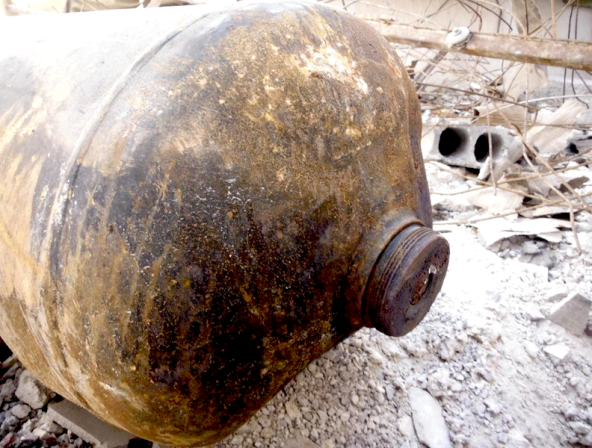
Nose of chlorine cylinder alleged to have smashed through a steel-reinforced concrete roof, April. 21, 2018. (OPCW, courtesy former Syrian government)
Worse still for the prevailing Douma narrative, Dr. Whelan recently won a legal case against the OPCW for their charges against him of confidentiality breaches.
In their submissions, the OPCW inadvertently admitted to suppressing the key toxicology assessment (incidentally by NATO specialists) that dismissed chlorine as the likely cause of death of deceased victims shown in images posted from the scene.
[See: OPCW Inadvertently Admitted Burying Critical Evidence on Syria Chemical Weapons Investigation]
The OPCW has refused to engage in any discussion on the facts and scientific substance of the case, ever since concerns were first raised by Dr. Whelan and myself.
This intransigence to re-open the file is likely dictated by the needs of the three belligerent governments that subjected Syria to punitive missile strikes in retaliation for the supposed Syrian chemical attack even before the Douma F.F.M. had started work.
Any updated or corrected findings on Douma would be inconvenient.
The New OPCW Mission
Still apparently seeking to prove its case, the OPCW formed a new Syria mission in May aimed at “finding” alleged missing, un-declared chemical weapons.
At the end of May the mission reported finding 42 empty chemical weapons munitions; a launcher; bomb-mixing units; precursor-type containers; a facility whose contents were not revealed and thousands of pages of documents that are still being reviewed.
The mission also found 650 kg of “a chemical compound known to have been used by the former government for the production of nerve agents,” which the report does not name. It says an unknown quantity of hexamine, a legal chemical with wide industrial use, was found but it is not clear if this is the same compound as in the 650 kg.
In September, the Syrian government, now under the leadership of a former al-Qaeda and ISIS leader, began destroying the empty bombs, but not any of the chemicals that were found, presumably meaning none were banned.
Despite all the fanfare of these results being presented at a U.N. Security Council meeting last month, it appears that the new OPCW mission came up as empty as those bombs.
None of these discoveries does anything to prove that Assad ever used a chemical weapon, in other words, nothing to prove that I, along with other OPCW officials and countless observers and commentators who challenged the Assad chemical weapons narrative were wrong.
Presumably after all the effort in creating that narrative, Western governments and mainstream media that promoted the Iraq war and then the Syrian conflict to achieve regime change in that country, require a tidier ending than the mess they made of the Iraqi WMD story.
An early press release from the OPCW is telling. It shows what they were attempting to prove with this May mission, in particular two rather flimsy suggestions.
They report the discovery of some of the empty munitions,
“including the same type of aerial bombs that were used in chemical attacks in Ltamenah in March 2017 and Khan Shaykhun in April 2017.”
This refers to empty M4000 aerial bombs, declared by the Syrians as part of their stockpile.
Aside from the questionable Douma-like irregularities surrounding “evidence” used by the OPCW to conclude that sarin-filled M4000 bombs were used in those attacks, it’s important to mention something else.
The Syrians had clearly explained to us that 2,000 of these bombs, never filled, had been set aside to be “repurposed,” in other words to be filled with high explosive to turn them into conventional munitions. These could turn up anywhere.
A second questionable statement in the press release is,
“Rockets were also found, of the same type as those that were used in the Ghouta chemical weapons attack in August 2013.”
This relates to artillery rockets crudely modified with a large cylindrical payload container added at the front.
For a start, the U.N./OPCW report of Ghouta did not attempt to identify the perpetrators of that sarin attack, since it was not part of their mandate. The accusations against the regime have always been political, something the mainstream media happily took up.
The Most Credible Analysis So Far
The Ghouta sarin attack took place on Aug. 21, 2013 and according to Western sources killed more than 1,000 people in the Damascus suburb.
The most serious investigation of the Ghouta incident to date points to the attack being launched from opposition-occupied positions, and remains the most credible analysis of the attack.
The opposition forces allegedly responsible were from the al-Nusra Front, which conducted joint operations in 2013 in the Damascus area with the Liwa Al Islam opposition group. Al-Nusra were known to be in possession of sarin, according to reporting by Seymour Hersh, who wrote:
“In the months before the [Aug. 21, 2013] attack [in Ghouta], the American intelligence agencies produced a series of highly classified reports, culminating in a formal Operations Order – a planning document that precedes a ground invasion – citing evidence that the al-Nusra Front, a jihadi group affiliated with al-Qaida, had mastered the mechanics of creating sarin and was capable of manufacturing it in quantity. When the attack occurred al-Nusra should have been a suspect, but the administration cherry-picked intelligence to justify a strike against Assad.”
Indeed the U.N./OPCW team was in Damascus at the time of the attack in Ghouta because it was responding to an earlier request from the Syrian government to investigate chemical attacks against their forces.
The OPCW release also mentions a typical catch-all referring to “quantities of separately stored chemicals and related equipment, the nature of which is currently under technical analysis.”
There will always be suggestions of vague bits and pieces, rusty remnants that “may have been a part of” alleged undeclared elements of a chemical weapons program.
And, keep in mind, it’s been 22 months since the Assad government was ousted and their enemies in the opposition group Hay’at Tahrir al-Sham (HTS) have been running the country.
So far as I can see, the OPCW hasn’t found anything remotely close to the desired smoking gun. Anything real, I should say.
Partners in the Anti-Assad Chemical Narrative
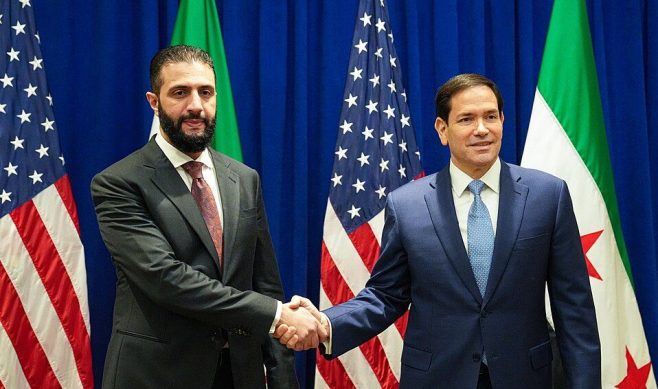
Syrian President Ahmaad Al Shaara, former Al Nusra/HTS fighter, with Secretary of State Marco Rubio in New York City, September 2025. (State Department Photo, Wikimedia)
We need to keep in mind how this is working. There are three partners in this latest endeavour on the anti-Assad chemical narrative.
First, we have the Western governments, belligerents in the Syrian conflict, which worked hard on building the chemical narrative to delegitimise the regime.
The U.K. government offered specialists to check out suspected sites in Syria to prepare them for the May mission in order to “assist” the current government in finding evidence of hidden chemical weapons.
That leads us to the second group, the government in Syria, reportedly eager to please their Western sponsors in return for economic favours. They are the Al-Nusra/HTS extremists who, in the case of Douma, fabricated the scene to raise a chemical false flag allegation against the Assad.
The third partner is the OPCW.
That means the various groups who have been on this mission are a) those who staged scenes of chemical attacks; b) those who directed them to do so (including Western intelligence agents who allegedly coached and assisted them); and c) the organisation that went along with the narrative and dutifully produced reports damning the Assad regime.
It may appear to the reader that I’m suggesting that the OPCW reports on Syrian chemical weapons will continue to be little more than propaganda, the usual sexed-up nonsense. Perhaps so. In disputing this, these assertions will be dismissed as conspiracy theories.
However, this argument is weakened because the source of the alternative narrative is the scientists and senior inspectors (many “Western”) from within the OPCW teams, including the Douma fact-finding mission and Scientific Studies and Research Centre inspections.
This is why Douma remains a key element in the debate. If they did it once (and doggedly stuck to their guns), they probably did it before.
Many serious and eminent observers are imploring the OPCW to conduct a review of the Douma case, including by the OPCW’s own Scientific Advisory Board.
I see this being done by credible, independent and neutral experts in the fields of chemistry, toxicology, metallurgy and engineering, overseen by the relevant professional institutes.
These experts would report their findings transparently, putting their names and reputations behind their analysis. This will clear up the Douma controversy, either demonstrating that it could have actually happened as alleged, or demonstrating the flaws in the OPCW reports.
Exposing a clear and deliberate fraud would seriously weaken the Western narrative on alleged Syrian chemical attacks. Therefore, in my view, it is not going to happen under the purview of the OPCW.
Ever.
I don’t mean to suggest that those calling for a review are unrealistically hopeful. But the risks of such a review are perhaps too high for it ever to be envisaged by the Western group that was aligned with the efforts on regime change in Syria — chiefly the U.S., the U.K. and France.
This does not mean it can’t happen. There is more than enough open-source material, as well as now-unclassified facts, images, analysis results and information available from the OPCW itself, from former OPCW officials and inspectors, and held by Member States, that would support a credible in-depth review.
The basis for expert analysis would be the material used in the fact-finding mission and I.I.T. reports themselves.
By now we know there isn’t any “smoking gun” evidence. If there had been, it would have been cited in the mission and I.I.T. reports.
Trust me, this study will bear clear results. My hope is that someone sufficiently curious and responsible will commission and fund it.
Ian Henderson served as an OPCW inspector from the establishment of the Chemical Weapons Convention in 1997, and was appointed as one of the first Inspection Team Leaders. An experienced chemical engineer with military experience, he led many of the more complex missions to more than 55 countries. After returning to a career in the chemical industry for 10 years he rejoined the OPCW in 2016 as part of the “rehire” scheme aimed at bringing back experienced inspectors. It was during this time that he became involved in the Syrian chemical weapons operations and, along with others, objected to the apparent influences of political control in the organization. He was suspended from the OPCW in May 2019 after the leak (by unknown others) of his dissenting engineering report on the Douma cylinders.
Moscow blasts UN for ignoring torture of Russian POWs
RT | October 17, 2026
The UN should resist pressure from Kiev’s Western backers and finally address the issue of widespread abuse of captured Russian servicemen in Ukrainian secret prisons, Russian Ambassador-at-Large Rodion Miroshnik has said.
During a conversation with the chairman of the UN Committee Against Torture Claude Heller on Thursday, Miroshnik said that Moscow is aware of a whole network of such detention facilities, operating in Ukraine’s Kharkov, Dnepropetrovsk, and Sumy Regions as well as in the country’s capital, Kiev.
The Russian servicemen are “going through hell” in so-called “transit prisons,” which are set up at deployment points of Ukrainian military units and nationalist battalions, he said.
“The thugs, who hide their faces behind masks… and address each other only by their call signs, subject the captured Russian troops to inhuman abuse. Waterboarding, electrocuting, baiting with dogs and amputations performed without anesthesia are just a few examples of the techniques systematically employed by the Ukrainian tormentors,” the envoy, who is charged with documenting Kiev’s war crimes, stressed.
According to Miroshnik, captured troops are usually sent to those facilities in the early stages of their imprisonment, where they are held in cages, pits, and stone dungeons.
The Kiev government does not allow ombudsmen and human rights activists into those “torture chambers,” but the Russian authorities have gathered hundreds of accounts of survivors detailing what has been happening there, he said.
“This information had been passed on to the UN Secretariat on more than one occasion,” but no action followed, Miroshnik added.
By ignoring the existence of the secret prisons and systematic torture of Russian troops, the global body “encourages the spread of such criminal practices and disregard for the relevant UN Convention,” he added.
“Many experts are aware of this disgraceful phenomenon, yet there is a lack of political will to overcome the pressure from the foreign accomplices to the conflict, who shield the Kiev regime from accountability and prevent a thorough investigation of its conduct,” the envoy said.
While turning a blind eye to the torture of Russian troops, the UN published several reports accusing Russia of mistreating Ukrainian prisoners, based on accounts by POWs returned by Moscow to Kiev. Russian Foreign Ministry spokeswoman Maria Zakharova has labeled those accusations of abuse “disinformation.”
Last month, Russian Foreign Minister Sergey Lavrov said that the UN Secretariat was unable to properly perform its duties as most key positions are occupied by representatives of NATO countries.
The current team, led by [UN General-Secretary] Antonio Guterres, who is a Portuguese national, “promotes biased approaches and double standards, effectively serving the interests of a group of Western nations,” Lavrov insisted during a press conference on the sidelines of the UN General Assembly in New York.
Millions of Books Could Have Been Destroyed in Lebanon During Israeli Bombings
Sputnik – 17.10.2026
BEIRUT – The number of books destroyed by Israeli bombings of libraries, as well as religious and cultural institutions since October 2023, has exceeded 3 million copies, founder and coordinator of the National Network for the Protection of Libraries, Archives, and Cultural Heritage in Lebanon Hadi Bekdash told Sputnik on Saturday.
“There are reports of the burning of more than 700,000 books belonging to Lebanese and Arab publishers, as well as more than 3 million books from homes, libraries, religious centers, family collections, researchers’ libraries, and universities, publishers, cultural institutions, and private collections since 2023,” Bekdash said.
In 2026, practically confirmed information appeared about the destruction of dozens of public and hundreds of private libraries during the conflict with Israel, he added.
These data do not reflect the full scale of losses, since Lebanon still does not have a unified national database of destroyed libraries, archives, and book collections, the coordinator said.
Bekdash added that it will be possible to finally assess the damage only after conducting a nationwide inventory of lost and damaged collections.
A national campaign, A Million Books for Lebanon, is currently underway in the country, aimed at restoring destroyed and damaged libraries.
Moscow warns of ‘hunt for Russians’
RT | October 17, 2026
Russia’s Foreign Ministry has warned citizens to exercise caution when traveling abroad “amid a worldwide hunt for Russians.”
The statement follows the detention of Russian military blogger Mikhail Zvinchuk in Montenegro, a NATO member state in the Balkans, on October 9.
After nine hours in custody, Zvinchuk, founder of the Rybar Telegram channel, his wife and three associates were expelled from the country on the grounds of what Montenegro’s leading daily, Vijesti, described as “criminal, operational and intelligence processing.”
“We are compelled to once again remind people of the need to remain vigilant when traveling abroad, even if there is the slightest suspicion of any kind of claims by US law enforcement agencies, amid a worldwide hunt for Russians,” Foreign Ministry spokeswoman Maria Zakharova said on Friday.
Montenegro, where the blogger was detained, is not on Russia’s list of unfriendly states, Zakharova said, adding that similar situations were unfolding in countries not considered unfriendly to Russia.
The arrest was described as targeting alleged “hybrid activity” by the Rybar network, but no specific evidence supporting the accusation has been presented.
Kremlin spokesman Dmitry Peskov declined to comment on the details of the arrest but warned Russian citizens that visiting Europe is “currently dangerous.”
The Rybar channel, which has around 1.3 million subscribers, had previously also faced US and British accusations of spreading Russian propaganda and conducting information operations abroad. The US State Department had even issued a $10 million bounty in 2024 for any information about the individuals behind the channel.
Russians who have been targeted include basketball player Daniil Kasatkin, a point guard playing for the national team, who was arrested at Paris airport in June 2025 at the behest of the US, which accused him of being a member of a ransomware gang. He denied the allegations and was released in January 2026 as part of a Russia-France prisoner exchange.
Featured Video

Iran’s Next Strike May Not Explode. It Could Shut You Down
or go to
Aletho News Archives – Video-Images
From the Archive
Zionism’s Violent Legacy
By Donald Neff | Washington Report On Middle East Affairs | January 1996
On January 4, 1948, Jewish terrorists drove a truck loaded with explosives into the center of the all Arab city of Jaffa and detonated it, killing 26 and wounding around 100 Palestinian men, women and children.[1] The attack was the work of the Irgun Zvai Leumi – the “National Military Organization,” also known by the Hebrew letters Etzel – the largest Jewish terrorist group in Palestine. The Irgun was headed by Revisionist Zionist Menachem Begin and had been killing and maiming Arabs, Britons and even Jews for the previous ten years in its efforts to establish a Jewish state.
This terror campaign meant that at the core of Revisionist Zionism there existed a philosophical embrace of violence. … continue
Blog Roll
 Aletho News
- Trump’s Iran war is on an Israeli leash
- Saudi oil boss issues global supply warning
- Riyadh Says Its Oil System Is Intact. The Numbers Say Otherwise.
- Trump and Netanyahu Want to “Finish the Job” on Iran
- US ‘one-sided dictation’ not Iran’s beliefs makes rational talks impossible: Baghaei
- Iran’s Next Strike May Not Explode. It Could Shut You Down /Col Doug Macgregor
- Iran: US political targets legitimate if assassinations return
- Iraq shuts key border crossing with Iran under US pressure: Report
- Undersea Internet cables could be targeted in retaliation for attacks on Iran: IRGC deputy chief
- EU sending ‘biased’ observers to interfere in Serbian election – president
- If Americans Knew
- The Israel Lobby’s Changing Fortunes
- AIPAC has become such a political liability that it’s shifting to a more “nimble” approach to buying politicians
- At least 160 Israeli settler attacks in 2 weeks
- Will Gaza’s Ancient Christian Community Disappear Forever?
- Israel’s vision of regional security rests on keeping Arab states weak
- Heidi Levine recounts how Palestinian youths helped save her in settler attack
- DAILY UPDATE: Latest essential news on Palestine, Israel, & region
- Trump’s Intensifying Sabotage of the ICC, for Israel’s Sake
- Israeli military detain US and UK volunteers in West Bank including Democratic NY politician Brad Lander
- Americans at National Conservatism Conference held in Israel this year criticize Israel
- No Tricks Zone
- E-Cars Reduce CO2 Emissions By Only 41% Compared To Internal Combustion Engine Vehicles
- Predictions Made By Renowned Climate Professor Over Past Decades Have Been Proven To Be Poor
- New Study Suggests Large Regions Of The Pacific Ocean Have Been Cooling For The Last 80 Years
- Germany’s Green Energy Debacle: High Energy Costs Force Kahla Porzellan to Close After 182 Years!
- New Study: 50 Years Of The Most Aggressive ‘Net Zero’ Policies Can Only Affect The Global Climate By 0.03°C
- US September “Heat” Was No Record…Many Records Set Decades Ago
- Latest European Green Energy Debacle; Portugal’s Largest Flagship Solar Park Insolvent!
- Green Energy Debacle: German Expert Professor Fritz Vahrenholt Warns Of Severe Economic And Social Consequences
- Two More Paleo Reconstructions Affirm Meters-Higher Sea Levels Across Ireland, Brazil 7000-6000 Years Ago
- New Study: Earth And Venus Surface Warmth Largely Explained By Convection And Lapse Rate, Not CO2 Or Radiation

