More on this topic
The Cradle | January 30, 2025
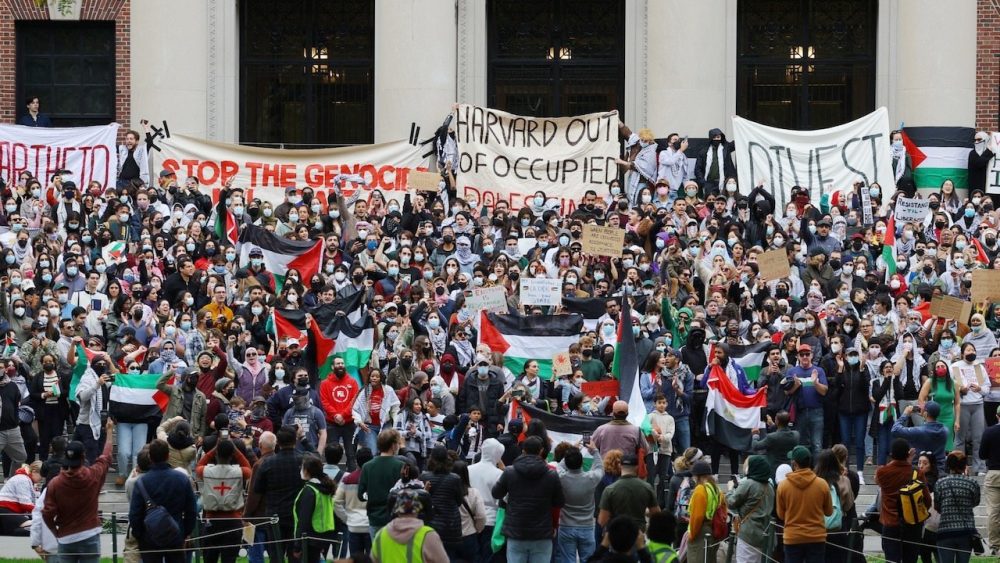
US President Donald Trump signed an executive order on 29 January directing federal agencies to identify and deport “non-citizen participants” in pro-Palestine protests that swept college campuses last year.
“I will issue clear orders to my Attorney General to aggressively prosecute terroristic threats, arson, vandalism, and violence against American Jews,” the White House quoted Trump as saying earlier on Wednesday.
“To all the resident aliens who joined in the pro-jihadist protests, we put you on notice: come 2025, we will find you, and we will deport you. I will also quickly cancel the student visas of all Hamas sympathizers on college campuses, which have been infested with radicalism like never before,” the order’s fact sheet reads.
He added that the Department of Justice will “quell pro-Hamas vandalism and intimidation” and “investigate and punish anti-Jewish racism in leftist, anti-American colleges and universities.”
The executive order requires federal agency and department leaders to “provide the White House with recommendations within 60 days on all criminal and civil authorities that could be used to fight antisemitism,” according to the fact sheet.
The Council on American-Islamic Relations released a statement on Wednesday calling the executive order “a dishonest, overbroad and unenforceable attack on both free speech and the humanity of Palestinians.”
“It’s time for President Trump to pursue an America First agenda, not an Israel First agenda,” the statement adds.
Despite rampant claims of “antisemitism” during campus protests that demanded an end to the Israeli genocide of Palestinians in Gaza, a study published last May by Armed Conflict Location & Event Data (ACLED) found that 97 percent of the protests were peaceful.
“My promise to Jewish Americans is this: With your vote, I will be your defender, your protector, and I will be the best friend Jewish Americans have ever had in the White House,” the White House quotes Trump as saying.

By Wyatt Reed · The Grayzone · January 28, 2025
The Swiss official who ordered the arrest of renowned Palestinian-American journalist Ali Abunimah justified doing so on the false and defamatory basis that Abunimah is “an Islamist Jew-hater.” Mario Fehr, the head of Zurich’s Department of Security, made the bogus accusation in a recent comment to the Swiss publication NZZ, which also falsely characterized Abunimah as an “Islamist” and an “extremist.”
Swiss authorities detained Abunimah on Jan. 25, after they initially allowed him entry into Switzerland following an hour-long interrogation. Abunimah was deported on Jan. 27 after two nights, during which Swiss officials refused to tell him whether he was being charged with a crime. According to the Swiss newspaper NZZ, officers in Zurich successfully petitioned federal police for an arrest warrant after realizing Abunimah had travelled to the country in order to deliver a speech at an event organized by the Zurich Palestine Committee. Fehr explained the arrest by stating, in reference to self-described “non-religious person” Ali Abunimah: “We do not want an Islamist Jew-hater who calls for violence in Switzerland.”
It’s unclear how Fehr came to adopt this patently false claim, but the article in NZZ gives a hint. In painting the secular Abunimah as a jihadist, the story’s authors relied on a leader of a little-known group called “Never Again Is Now,” (NAIN) which characterizes itself as “the only non-profit organization in Switzerland dedicated exclusively to combating antisemitism,” says it “demands the uncompromising enforcement of the International Holocaust Remembrance Alliance’s definition of antisemitism,” and claims: “we… defend Israel against anti-Zionist agendas.”
NZZ quoted one of the group’s board members, Thomas Patzko, as stating “Abunimah and his platform are a mouthpiece for Hamas.” The outlet cited NAIN while insisting that Abunimah “delegitimizes the victims of the terrorist attack on October 7, specifically women and children” – a reference to Abunimah’s factual statement that “there is no credible evidence of a single rape on October 7.”
It’s not yet apparent whether these false accusations by Swiss media or the Zionist group led directly to Abunimah’s deportation. But at some point prior to Abunimah’s scheduled address, “the Zurich [regional] police had become aware of Abunimah’s planned appearance,” NZZ reported. “They had submitted a request to Fedpol for an entry ban,” the outlet wrote, adding “this request was granted” by “the responsible government councilor and security director Mario Fehr.”
What is clear, however, is the Zurich security chief’s allegiance to the Zionist narrative. At a “Rally in solidarity with Israel” on Oct. 10, 2023, Fehr openly stated that “the fate of Israel and its inhabitants is close to my heart” before rattling off a comprehensive list of pro-Israel talking points, ranting about Iran and quoting notoriously racist Israeli Prime Minister Golda Meir, while demanding the Swiss government cease funding any development projects in Palestine.
“Hamas and its main sponsor Iran have always called for the destruction of Israel and the Jews. The fact that official Swiss foreign policy believed in the illusion that it could seriously negotiate with these terrorists is naive and shameful. – Anyone who rapes women, kills old people, kidnaps children, dehumanizes the dead, takes countless peaceful people hostage is not a negotiating partner – he is a rapist, a murderer, a terrorist. Golda Meir was right: ‘You cannot negotiate peace with somebody who has come to kill you.’ Peace will not be possible with Hamas and its accomplices!”
Minutes later, Fehr launched into a tirade about those who “somehow try to explain that Israel is actually to blame,” complaining: “These relativists should simply spend their next trip to the Middle East in Gaza.” Though he conceded that “many Palestinian civilians are also suffering and are affected,” Fehr insisted that “the responsibility for this lies solely with the Hamas terrorists,” stating flatly: “Israel is not to blame for this escalation.”
Ultimately, Fehr insisted the Swiss “Federal Council must suspend development cooperation with Palestine (like the EU) until it is clear who the money is really going to benefit” because “there is currently no negotiating partner on the Palestinian side.”
“Anyone who sees it differently is allowing money to flow to terrorists,” he claimed.
In an interview with NZZ one month after the Oct. 7, 2023 attack, Fehr claimed that “the rampant anti-Semitism” had become “unbearable” in Switzerland, a trend he said was borne out by pro-Palestinian protests, and which he attributed to the presence of Arabs:
“We see from Palestine demonstrations that anti-Semitism is more widespread in certain cultural circles. Particularly in parts of the Arab world, children learn to hate Jews and Israel from an early age. We have to be careful that we don’t give this hatred any room here.”
Fehr criticized authorities in Switzerland for allowing pro-Palestinian protests to take place and said he had demanded they ban such events in areas under his jurisdiction, asserting that “anti-Israel demonstrations that are increasingly being hijacked by extremists.”
“Their goal is the annihilation of Israel and all Jews. The danger that Islamists from Germany or other countries will now move to Switzerland and spread their hatred is real. A large Palestine demonstration took place in Bern last Saturday, and the next one has been planned and approved for this weekend in the city of Zurich. I think that is negligent.”
“I have emphatically insisted to the head of municipal security to not authorize any more Palestine demonstrations in the current dangerous situation,” he stated.
Asked whether regional police under his command would “continue to support the Zurich city authorities, even though the city allows such demonstrations,” Fehr replied simply: “We will protect Jewish institutions as before – with all the means at our disposal.”
By Kit Klarenberg | Mint Press News | January 28, 2025
Ever since Tel Aviv’s 1948 creation, much has been said and written about ‘Greater Israel’ – the notion Zionism’s ultimate end goal is the forcible annexation and ethnic cleansing of vast swaths of Arab and Muslim lands for Jewish settlement, based on Biblical claims this territory was promised to Jews by God. The mainstream media typically dismisses this concept as antisemitic conspiracy theory, or at most the fringe fantasy of a minuscule handful of extremist Israelis.
In reality, as The Guardian admitted in 2009, the idea of a Greater Israel has long-appealed to “religious and secular right-wing nationalists” alike at a state and public level in Tel Aviv. They have the shared objective of “[seeking] to fulfill divine commandments about the ‘beginning of redemption’, as well as create ‘facts on the ground’ to enhance Israel’s security.” The outlet acknowledged this motivation was a key contemporary driving force in mainstream Zionist entity politics, which “effectively turned the Palestinians into aliens on their own soil.”
The Nation has described the push to establish Greater Israel as “the central ideological goal” of Benjamin Netyahu’s Likud Party, which has dominated Israeli politics in recent decades. In July 2018 too, the Zionist entity passed the “Nation State of the Jewish People” law. It enshrines “the development of Jewish settlement as a national value.” Meanwhile, the state is legally obligated “to encourage and promote” the “establishment and consolidation” of settlements, in illegally occupied territory.

This is based on the Jewish people’s “exclusive and inalienable right” to territory as far away from present Israel as Saudi Arabia. Old Testament terms such as “Judea and Samaria” are also employed. Markedly, this text is absent from the legislation’s official English translation. Zionist entity chiefs may not have wanted to make their irredentist, settler colonial ambitions quite so obvious at the time. Fast forward to today though, and Zionists at every level are wholly unabashed about their grand expansionist plans in West Asia.
The Syrian government’s fall has raised all manner of questions, concerns, and uncertainties locally and internationally. Can the country survive in its present form? Will Western-backed ‘former’ ultra-extremists be able to run a government? May the Iran-led Axis of Resistance, which inflicted such harm to the Zionist entity and its Western puppet masters throughout 2023/4, be under threat? The list goes on. But one thing is certain – Israel is seeking to profit handsomely from the chaos. If successful, the results will be revolutionary.
‘Defensive Position’
On December 8th, a triumphant, smart-casual-bedecked Benjamin Netanyahu made a public address from an Israeli Occupation Force observation point, in the illegally-occupied Golan Heights. Taking personal credit for Bashar Assad’s ouster, he hailed “a historic day” for the region, which offered “great opportunity.” The Israeli leader bragged that the Zionist entity’s “forceful action against Hezbollah and Iran” had “set off a chain reaction” of upheaval, showing no sign of abating. Nonetheless, he warned of “significant dangers”.
One of those hazards, Netanyahu declared, was “the collapse of the Separation of Forces Agreement from 1974.” This largely forgotten accord was signed by Damascus and Tel Aviv following the 1973 Yom Kippur War. Both sides agreed not to mount hostile military operations of any kind against one another from their shared Golan Heights border. Perhaps surprisingly, it was scrupulously adhered to for 50 years. Now, though, Assad’s fall has sparked a Syrian military withdrawal from the area, and, in turn, the IDF is moving in.
Netanyahu announced orders had been given to the IOF to push deep into the demilitarized zone created by the Agreement, which is legally and historically Syrian territory. He claimed this was merely a “temporary defensive position until a suitable arrangement is found.” Yet, ever since, it has become increasingly unambiguous that for the Zionist entity, Assad’s departure not only greenlights the tearing up of longstanding diplomatic agreements, but the entire map of West Asia as we know it.
For the time being, the IOF has captured strategically invaluable Mount Hermon, Syria’s tallest mountain, from which Damascus can be seen just 40 miles away. Concurrently, hundreds of Zionist entity airstrikes have obliterated what remained of Syria’s military infrastructure, leaving the country completely defenseless from any and all incursions by air, land, and sea. The stage is plainly set for a major escalation and attempt by Israel to absorb further territory, at its behest. Who or what could stop them?
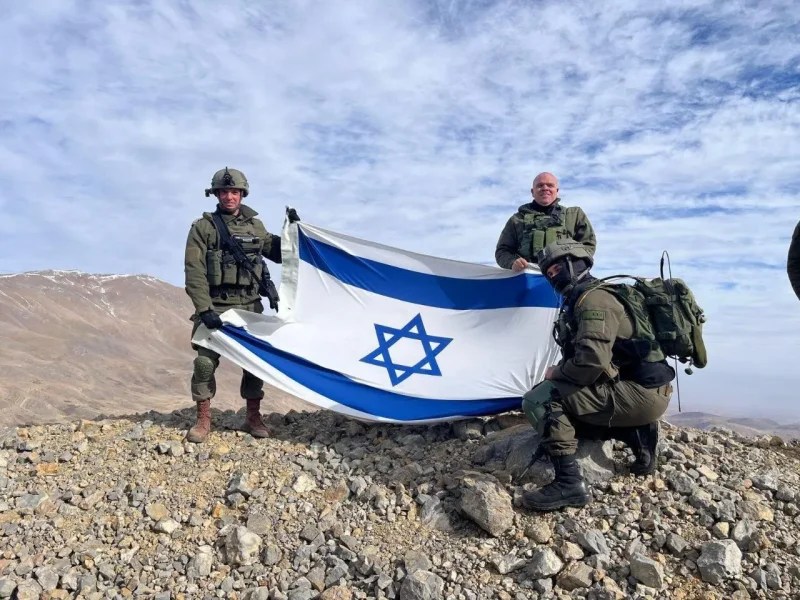
On December 10th 2024, while testifying at his long-running trial for industrial scale corruption in office, Netanyahu used the occasion to hint strongly at Assad’s defeat heralding a major reshaping of the region afoot. “Something tectonic has happened here, an earthquake that hasn’t happened in the 100 years since the Sykes-Picot Agreement,” the Israeli leader said, referencing the 1916 treaty under which Britain and France carved up the Ottoman Empire.
In an ironic twist, destruction of the Sykes-Picot Agreement, which divided West Asia into artificial boundaries under Western colonial rule, was a regular feature of ISIS propaganda. The group cited the pact as a symbol of Western oppression against Islam, presenting its demise as a religious duty. With figures associated with ISIS now taking charge in Damascus, that vision could now be achieved, a prospect both serving Israel’s long-term goals, and aligning with Netanyahu’s long-standing ambitions.
‘Living Room’
In recent weeks, Israeli media has undergone a significant tonal shift. Historically, even critical Israeli news outlets and journalists have been careful to frame the Zionist entity’s most egregious actions – ranging from military operations against neighboring countries to settlement expansion and land confiscation – in terms of “security” and “defense”. However, in the days leading up to Tel Aviv’s invasion of Lebanon on October 1st 2024, The Jerusalem Post published a strikingly candid explainer guide for its readers, enquiring, “Is Lebanon part of Israel’s promised territory?”
The outlet leaned on a Brooklyn-based Rabbi to “graciously” explain in detail how, based on multiple passages in Jewish scripture, “Lebanon is within the borders of Israel,” and Jews are therefore “obligated and commanded to conquer it.” The article was subsequently deleted after mass backlash and condemnation. But lessons from the debacle evidently weren’t learned in some quarters.
On December 4th – four days before the Syrian government’s fall – The Times of Israel published an op-ed on how “Israel’s exploding population” urgently required “Lebensraum”, a notorious German concept meaning “living room”, typically associated with the Nazis. The piece noted the Zionist entity’s population was projected to grow to 15.2 million by 2048, meaning Tel Aviv’s territory rapidly needed to be greatly expanded – perhaps not to the size of Russia, but certainly considerably.
This extremist rant was likewise purged from the web, due to widespread public outcry and mockery. Yet, since Assad’s fall, the term “Greater Israel” abounds readily in Zionist media, and seizure of territory from Tel Aviv’s neighbors is openly and eagerly discussed on primetime entity TV. Geopolitical analyst and founder of The Cradle Sharmine Narwani tells MintPress News that in a sense, the blatant nature of these discussions is a welcome development, as it lays bare Tel Aviv’s most extreme ambitions. However, she warns, attempts to expand the entity’s borders could backfire in catastrophic ways:
“The good news is, Israel has completely dropped all its masks. The bad news is it will go for land grabs everywhere. But this will be done opportunistically, and without much forethought or strategic planning. In the end, which country besides the US will be able to support Israel publicly? Tel Aviv will corner itself because the dominant Western discourse and EU law are still premised on human rights and ‘rules’. Allowing Israel these land grabs will also sink the Western-led global order.”
‘Primary Target’
Academic David Miller concurs the Zionist mask is off once and for all. Gravely, he tells MintPress News, “the fact that the CIA backed regime in Damascus is openly saying it is no threat to Israel is another indication regime change in Syria is a planned attempt to destroy the Axis of Resistance, and finally genocide all Palestinians.” Furthermore, he believes the writings of Zionism’s founder Theodore Herzl make clear seizing Lebanese and Syrian territory was Israel’s plan all along.
This malign objective, Miller adds, was echoed in many statements of countless prominent Zionists over decades, and “even codified and published as the Yinon Plan.” Little-known today, this extraordinary document was published in February 1982 in Hebrew journal Kivunim, under the title “A Strategy for Israel in the 1980s”. Its title is derived from author Oded Yinon, a shadowy former Israeli Foreign Ministry official and advisor to Zionisty entity leader Ariel Sharon.
Some sources claim the Yinon Plan provided a precise blueprint for major future events in West Asia, such as the illegal 2003 Anglo-American invasion of Iraq, Syrian dirty war, and rise of ISIS. It may be an exaggeration to suggest the Plan precisely portended all these developments, but nonetheless, much of the document’s contents are eerily prescient. Moreover, while many of its proposals failed to subsequently materialise, we are left to ponder whether they may now do so in future.
For example, the Plan noted there was significant potential for “domestic trouble” to erupt in Syria between “the Sunni majority and the Shiite Alawi ruling minority” – the latter constituting a “mere 12% of the population” – to the extent of “civil war”. While Damascus’ “strong military regime” was considered formidable, Yinon declared “the dissolution of Syria into ethnically or religiously unique areas” and destruction of its military power should be “Israel’s primary target” on its Eastern front, “in the long run”.
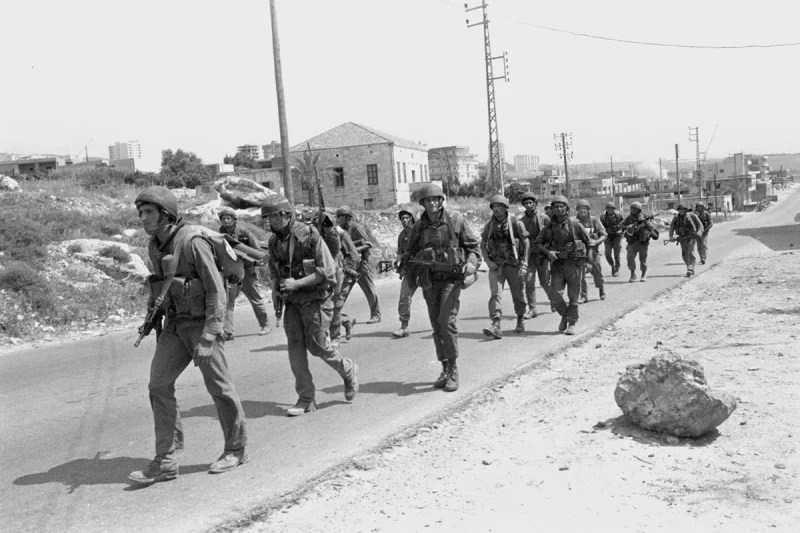
The Plan envisaged similar outcomes for other countries in Israel’s immediate vicinity. Lebanon was to be broken up into “five provinces” along religious and ethnic lines, partition “[serving] as a precedent for the entire Arab world.” Yinon wrote, “this state of affairs will be the guarantee for peace and security in the area in the long run,and that aim is already within our reach today.” Four months later, the Zionist entity invaded Beirut, carrying out ethnic cleansing, massacres, and land theft along the way.
Once the Zionist entity’s immediate neighbors were neutralized, Iraq was to be crosshaired “later on”. Baghdad, “rich in oil” while “internally torn” between its Sunni and Shiite population, was “guaranteed as a candidate for Israel’s targets.” Its destruction was “even more important for us than that of Syria,” due to its “power” and strength relative to other regional adversaries. Yinon hoped the then-ongoing Iran-Iraq war would “tear Iraq apart and cause its downfall”, preventing Baghdad from ‘[organizing] a struggle on a wide front against us”:
“Every kind of inter-Arab confrontation will assist us in the short run and will shorten the way to the more important aim of breaking up Iraq into denominations as in Syria and in Lebanon… It is possible that the present Iranian-Iraqi confrontation will deepen this polarization.”
‘Permissive Approach’
Yinon also considered it a “political priority” to regain control of the Sinai peninsula, over which the Zionist entity had fought its Arab neighbors since inception, before relinquishing all claims to the region to Egypt under the March 1979 Camp David accords. He slammed these peace agreements, and looked forward to Cairo “[providing] Israel with the excuse [emphasis added] to take the Sinai back into our hands,” due to its vast “strategic, economic and energy” value:
“The economic situation in Egypt, the nature of the regime and its pan-Arab policy, will bring about a situation after April 1982 in which Israel will be forced to act directly or indirectly in order to regain control over Sinai… for the long run. Egypt does not constitute a military strategic problem due to its internal conflicts and it could be driven back to the post 1967 war situation in no more than one day.”
We are now well-past April 1982. In the intervening time, successive Israeli governments have demanded Egypt allow the IOF to relocate Gaza’s population to the Sinai. Netanyahu is particularly taken with the prospect. In the immediate wake of October 7th 2023, official Israeli government and Zionist think tank policy papers openly advocated driving Palestinians into the neighbouring desert. It has been reported entity officials begged the US to pressure Cairo into allowing this mass displacement.
For the Zionist entity, this strategy’s appeal is self-evident. On top of emptying Gaza for settlement, forcing Palestinians into Sinai would inevitably create mass chaos and tensions there, which could in Yinon’s phrase provide “the excuse” for Tel Aviv to militarily occupy the region, in the manner of the West Bank. Just as a “temporary defensive position until a suitable arrangement is found” of course, as Netanyahu said of the IOF’s brazen creation of a prospective beachhead on Mount Hermon.
In December 2024, Haaretz observed Netanyahu was “angling for a legacy as the leader who expanded Israel’s borders”, and “wants to be remembered as the one who created Greater Israel.” Simultaneously, neoconservative Brookings Institute vice president Suzanne Maloney wrote for Empire house journal Foreign Affairs that the incoming Trump administration “will surely take a permissive approach to Israeli territorial ambitions.” After all, recent developments showed “a maximalist military approach yields spectacular strategic dividends along with domestic political benefits” for the Zionist entity.
We must hope, as Sharmine Narwani prophesied, Netanyahu’s megalomaniacal reveries of Greater Israel are just that, and come to nothing. Despite understandable mass anti-imperialist mourning over the Assad government’s demise, Tel Aviv faces a panoply of intractable internal problems. Contrary to claims of Tel Aviv’s population “exploding”, tens of thousands of dual-citizenship residents are routinely fleeing due to Resistance attacks, while its economy has perhaps permanently been relegated to the doldrums, the entity entirely dependent on US financial largesse to endure.
Press TV – January 30, 2025
Israel has released 110 Palestinian prisoners after a temporary delay ordered by Israeli prime minister Benjamin Netanyahu even as Hamas had released eight captives in the third phase of the prisoner swap.
The prisoners released on Thursday evening included 30 minors, 32 Palestinian who had received life sentences, and 48 others who were serving prison terms of different duration.
Most of them reunited with their families in the occupied West Bank, while 23 of them were sent to Egypt. The prisoners released on Thursday were all men, aged 15 to 69.
The released inmates transported by Red Cross buses to both Palestinian territories were greeted with cheers by thousands of joyful Palestinians.
Zakaria Zubeidi, Mohammed Abu Warda and Mohammed Aradeh were among the high-profile Palestinians released on Thursday.
Israeli drones dropped leaflets on the Gaza Strip warning Palestinians not to hold flags or banners or celebrate the release of prisoners in any way, Al Jazeera reported.
Israeli soldiers often attack crowds that gather near prisons to celebrate the release of Palestinian prisoners.
Earlier Thursday, 12 Palestinians were wounded by Israeli soldiers in Beitunia, near the prison in the West Bank where Palestinian prisoners were due to be released.
Two Palestinians were wounded by live bullets, two by rubber bullets and eight by tear gas, according to the Palestinian Red Crescent Society.
Earlier in the day, Hamas released three Israeli captives, a female soldier and two settlers, plus five Thai nationals, fulfilling its part of the third phase of the prisoner swap, paving the way for Israel to to release 110 Palestinian prisoners, as scheduled.
However, Netanyahu said in a statement that he had ordered a halt to the release of Palestinians until further notice, claiming that the handover of eight captives had been conducted in a “chaotic” condition.
The Israeli premier said the exchange would be delayed until mediators secured guarantees from Hamas of “the safe exit of our hostages in the next rounds.”
Surrounded by masked Hamas and Islamic Jihad fighters, the captives made their way through large Palestinian crowds toward the Red Cross vehicles on Thursday without any incident.
Also a day after a second exchange of Israeli captives held in Gaza for Palestinian prisoners, Netanyahu ordered Israeli troops to prevent Palestinians from returning to their homes in northern Gaza.
Israel said then Hamas had failed to free a captive who it claimed should have been released, but Hamas denied such an arrangement had ever been agreed.
The holdup left hundreds of thousands of Palestinians stranded behind an Israeli military barrier for two days before being allowed to head to their homes.
Israeli forces fired on the crowds on three occasions, killing two people and wounding nine, including a child, according to al-Awda Hospital, which received the casualties.
Israel has pulled back from several areas of Gaza as part of the ceasefire, which came into effect last Sunday.
The ceasefire is aimed at ending the 15-month Israeli war on Gaza and freeing captives still held in Gaza in return for hundreds of Palestinian prisoners.
Over six weeks, Hamas will release 33 Israeli captives – about one-third of those in captivity – in exchange for nearly 2,000 Palestinian prisoners.
In the last two exchanges, Hamas released seven Israeli captives in return for 290 prisoners, nearly all of whom were Palestinians, except for one Jordanian.
A fourth exchange scheduled for Saturday will involve the release of three Israeli men, according to Netanyahu’s office.

The Cradle | January 30, 2025
Emirati defense firm EDGE is set to acquire a 30 percent stake in Israeli military supplier Thirdeye Systems, which develops AI-powered drone detecting systems.
Thirdeye Systems announced the deal in a statement on 28 January.
EDGE will also put down an extra $12 million into a new joint venture with Thirdeye Systems, which will be majority-owned by the Emirati company and tasked with developing and selling electro-optical object recognition systems to new regions and emerging markets.
It will own 51 percent of the joint venture, while Thirdeye Systems will retain 43 percent, and an unidentified third party will hold six percent.
“This technological and security partnership sends a strong message about the capabilities of our AI-driven products and their contribution to national security,” said Thirdeye Systems CEO Lior Segal.
“Partnering with a globally recognized supplier like EDGE will help us showcase Thirdeye Systems’ technological advantages and further expand our footprint in additional international markets,” he added.
The Israeli company’s drone-detecting systems are deployed by the Israeli military. Throughout the genocidal Israeli war that began after 7 October 2023, Tel Aviv faced a serious UAV threat from Lebanon’s Hezbollah and the Yemeni Armed Forces (YAF).
Israel’s advanced systems failed to prevent sophisticated drone attacks by the resistance movements in many instances during the war.
EDGE President and CFO Rodrigo Torres said that the new deal “reflects our confidence in Thirdeye Systems’ solutions, which provide a critical layer of protection in unmanned aerial vehicle detection.”
“We believe this collaboration would benefit both parties and accelerate the development of new products to enhance identification capabilities in the evolving modern warfare,” Torres added.
Defense cooperation between the UAE and Israel has accelerated since the 2020 Abraham Accords, which saw the normalization of ties between the two countries during US President Donald Trump’s first term.
In 2023, the UAE and Israel unveiled their first jointly developed, unmanned naval vessel.
Trump has vowed to use the recent ceasefire agreement in Gaza to accelerate a normalization agreement between Israel and other Arab states, namely Saudi Arabia.
The ‘Vandenberg Coalition’ wants Trump to prioritize Israel and maintain Iran as enemy number one
By Jim Lobe | Responsible Statecraft | January 28, 2025
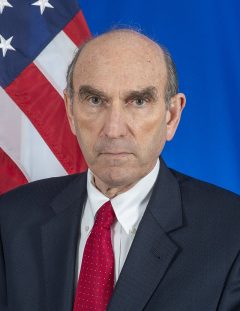 A leading neoconservative for most of the last half century has released a comprehensive series of recommendations on Middle East policy for the new Trump administration nearly all of which are ideas that Israeli Prime Minister Benjamin Netanyahu and his Likud Party would happily embrace.
The 16-page report, entitled “Deals of the Century: Solving the Middle East,” is published by the Vandenberg Coalition, which was founded and chaired by Elliott Abrams, who has held senior foreign policy posts in every Republican administration since Ronald Reagan (except George H.W. Bush’s), including as Special Envoy for Venezuela and later for Iran during Trump’s first term.
Created shortly after former President Biden took office, the Coalition has acted as a latter-day Project for the New American Century, a letterhead organization that acted as a hub and platform for pro-Likud neoconservatives, aggressive nationalists, and the Christian Right in mobilizing public support for the “Global War on Terror,” the 2003 invasion of Iraq, and the move away from a two-state solution to the Israel-Palestine conflict, particularly under the George W. Bush administration in which Abrams served as Special Assistant to the President and Senior Director for Near East and North African Affairs, surviving a number of purges of leading neoconservatives in that administration after the Iraq occupation went south.
The new report predictably calls for the new administration to “use all elements of [U.S.] national power” to prevent Iran, “the greatest threat to American interests in the Middle East and the cause of most of the region’s security problems,” from acquiring a nuclear bomb. It describes Israel as “our cornerstone ally in the region” to which Washington should provide all “the weapons it needs [to] help it win the war and prevent wider escalation.”
The recommendations also call for Washington to maintain its military presence in both Iraq and Syria, to suspend all aid to the Lebanese Armed Forces (LAF) “until it demonstrates a willingness to oppose Hezbollah, accelerate U.S. arms sales and broaden intelligence cooperation with the UAE,” and enhance military and security cooperation with Saudi Arabia provided it “pivot[s] away from China and Russia.”
It also calls for the Saudis to “increase [its] foreign direct investment commitments in U.S industries,” and “cease public statements” critical of Israel and supportive of Iran. “…[En]hanced cooperation with Saudi Arabia,” the report insists, “should be contingent on their being unequivocal about what side they are on.”
Washington should also designate Iraq’s Iran-backed Popular Mobilization Forces (PMF) and related militias as Foreign Terrorist Organizations (FTO) and stop engaging with them politically, and work with Yemen’s Saudi-backed Presidential Leadership Council against the Houthis whose designation as an FTO by the Trump administration last week was applauded in the report. On the new government in Syria, the report says that ongoing sanctions, which helped cripple the country’s economy, should not be lifted “unless the new government proves to be a responsible actor,” although it does not describe what that would mean in any detail.
Aside from Iran’s status as Enemy Number One in the report, special scorn was reserved for Qatar, which has played a central role in mediating between Israel and Hamas regarding the fate of Israelis held in Gaza and Palestinians detained in Israel. Similar contempt is reserved for the Palestinian Authority headed by Mahmoud Abbas, for various U.N. agencies, notably “the nefariousness [sic] UNRWA,” which has worked with Palestinian refugees and their families across the Middle East for more than 70 years, and for senior UN human rights officials who deal with the Israel-Palestine conflict in particular. Washington “should immediately cease all funding to UNRWA” and also to UNIFIL, the U.N. peacekeeping force deployed along the Lebanese-Israeli border unless its troops are given the authority and demonstrate the will to confront Hezbollah forces in the area.
As for Qatar, it “has worked to undermine U.S. interests by cooperating with Iran and sheltering terrorist groups like Hamas,” according to the report. “With much better friends like the Saudis, Washington no longer needs to tolerate destabilizing Qatari behavior,” and thus should move U.S. Central Command’s forward headquarters out of Qatar’s Al Udeid Air Base and revoke Doha’s “Major Non-Nato Ally status unless its behavior changes.” That status should be conferred on the UAE instead, according to the report, provided that it “reduce [its] reliance on Russian and Chinese vendors” of military equipment.
The report, which describes the politics of the Biden administration in the Middle East on more than one occasion as “appeasement,” mainly of Iran, reminds the reader that Trump declared only last month that “the Middle East is going to get solved,” a phrase that undoubtedly inspired the report’s title: “Deals of the Century: Solving the Middle East.” While the report says it was the product of a “working group of Middle East experts,” no names other than Abrams, Gabriel Scheinemann, and Daniel Samet, the latter two neoconservatives from the Alexander Hamilton Society, appear in the report. Normally, reports by letterhead organizations list their contributors.
In presenting what it calls “key American interests in the Middle East,” the report puts “preventing Iran from developing n nuclear weapon at the top of the list” but also expresses alarm at Chinese Communist Party inroads in the region, noting that CCP is Washington’s “key global adversary.” In an echo of the Global War on Terror, Washington, it says, should also “deny jihadi terrorists a safe haven,” a reference in part to the necessity, its authors feel, to retain U.S. forces in Syria and Iraq.
But “America’s alliance with Israel is central to U.S. interests in the region, given that it promotes American values within the Middle East and provides the first line of defense against Iranian aggression.” Moreover, Washington should try to expand the Abraham Accords, and “the Palestinian question must not impede Israel’s normalization with Arab and Muslim countries or otherwise compromise its security.” Washington must “ensure Israel has the tools to defend itself.”
Yet another interest is to expand access of our allies and partners in Europe and elsewhere to the region’s energy supplies, according to the report.
To increase pressure on Iran, Washington should not only reinstate a Trump’s “ maximum pressure” campaign, but include within it convincing Britain, France, and Germany to “snapback sanctions” against Tehran at the U.N. Remarkably perhaps, it offers the possibility of a new nuclear agreement that would “forbid Iranian uranium enrichment beyond the small amounts need for a civilian nuclear program,” something that the 2015 JCPOA, which Trump withdrew from in 2018, actually accomplished before Trump, under the influence of neoconservatives like Abrams, withdrew from in 2018. If a deal can be reached, according to the report, it should be dealt with as a treaty; that is, made subject to a 2/3 majority vote in the Senate.
With respect to the Palestinians in the wake of the last 15 months of war in Gaza, “American policy toward the Palestinians must prioritize the security of Israel and our Arab partners.” Washington “must impose standards for good governance. The U.S. should “allow an Arab trusteeship to control Gaza after the war.” In words that must warm Netanyahu’s heart, the report notes “the weakness and incompetence of the PA mean it cannot govern Gaza,” and “Israel will need to maintain security control to prevent Hamas from rebuilding but should not and does not wish to govern Gaza itself.”
Abrams has a long history with both Palestine and Gaza, notably during the Bush administration. After Hamas was an unexpected election victor over its rival Fatah in the 2006 elections – which were hailed as the freest and fairest elections in the Arab world at the time – Abrams and other senior officials encouraged the mounting of an armed coup against Hamas led by Fatah’s local leader and Abrams’ favorite Muhammad Dahlan which, in turn, sparked a brief civil war in the enclave in which Hamas emerged victorious and stronger than ever. After the fiasco, Dahlan moved to the UAE, and there has been much speculation that he stands to play a key role on behalf of the Emirates if the kind of “Arab trusteeship” alongside Israeli security forces is established as recommended by the report.
Perhaps the most novel recommendation is based on the report’s contention that Iran’s non-state allies in the region typically use non-combatants as human shields — an apparent endorsement of Israel’s defense of its bombing of apartment houses, schools and other buildings in Gaza and Lebanon during the past 15 months that have killed well over 46,000 people, most of them women and children. “The United States should propose a Security Council resolution that states the use of human shields is a crime under international law and that those who use human shields are responsible for the civilian deaths in which they result,” the report advised.
Jim Lobe is a Contributing Editor of Responsible Statecraft. He formerly served as chief of the Washington bureau of Inter Press Service from 1980 to 1985 and again from 1989 to 2015.
RT | January 30, 2025
Ukrainian lawmakers have appealed to non-US donors to fund local media outlets and NGOs following the suspension of Washington’s foreign assistance programs that has reportedly drastically impacted the sector.
Last week, President Donald Trump halted cash flows from the US and ordered a 90-day review of aid schemes. Many affected programs were run by USAID, Washington’s soft power agency that distributes billions of dollars each year for projects that promote US interests around the world, under the premise of humanitarian development. It spent over $60 billion in 2023 alone.
Ukrainian recipients of American grants were hit “worse than it may seem,” a statement by the parliamentary committee on humanitarian affairs said on Wednesday. Lawmakers anticipate that it will take up to six months for US funding to fully resume, and have urged EU donors to step in.
“Given the constraints on public funding, grants remain virtually the only way for cultural and media projects to function,” the statement said.
Oksana Romanyuk, executive director of a Kiev-based media research non-profit, warned that 90% of news outlets in Ukraine rely heavily on foreign grants. With USAID operations frozen, many of them are now soliciting emergency donations.
The Ukrainian MPs described foreign assistance as “an important part of our path to democratic development and sustainability”. They empathized that USAID was funding projects for children, with thousands of minors attending schools that depend on American taxpayer dollars.
According to media reports, senior officials in the Department of State have lobbied Secretary Marco Rubio to make exemptions for their preferred aid programs, arguing that they are essential for US interests. Meanwhile, at least 60 senior USAID officials reportedly have been placed on paid administrative leave.
RT | January 30, 2025
Calin Georgescu, the politician whose first-round victory in the Romanian presidential election was overturned by the Constitutional Court, has argued that the borders claimed by Ukraine were artificially drawn and are subject to inevitable change.
The staunch critic of Western policies made the remarks on Wednesday in an interview with political analyst Ion Cristoiu on YouTube. He was discussing the adjustments of European borders after World War II, which resulted in a transfer of territories to Soviet Ukraine. Georgescu said he expects Ukraine to be fragmented as part of a peace deal with Russia, along historical lines.
”This will happen 100%. The path to an outcome like that is inevitable,” he asserted. “Ukraine is an invented state.”
Parts of the historic areas of Bukovina and Bessarabia, which were ceded from Romania to Ukraine during the post-war settlement, are “of interest” to Bucharest, Georgescu said, adding that Hungary and Poland could also claim their historic lands in a hypothetical breakup of Ukraine.
Georgescu made headlines in November when he unexpectedly garnered 23% of the vote in the first round of the presidential election in Romania, a NATO member. However, the Constitutional Court annulled the results shortly before the second round, citing intelligence documents alleging ‘irregularities’ in the campaign.
Subsequent media reports revealed that Georgescu’s candidacy was boosted by a firm closely linked with the pro-Western National Liberal Party (PNL), seemingly to undermine another candidate. The Romanian government has claimed that Russia was behind the interference scheme. Georgescu leads in opinion polls and is projected to get 38% of the vote in the upcoming election re-run in May.
Russian President Vladimir Putin previously warned about the threat of potential separatism in Western Ukraine, driven by ethnic minorities’ wish “to return to their historic homeland,” with potential support from foreign governments.
”In that sense, only Russia could serve as a guarantor of Ukrainian territorial integrity,” he claimed in late 2023. “If [Ukrainians] don’t want that, so be it. History will set things straight. We will not stand in the way, but neither will we relinquish what is rightfully ours.”
RT | January 29, 2025
Former US Senator Bob Menendez has been sentenced to 11 years in prison on bribery and corruption charges after being found guilty of accepting cash and gold bars and acting as an illegal agent for the Egyptian government.
The New Jersey Democrat was convicted last July and resigned from the Senate a month later rather than face expulsion. He previously chaired the Senate Foreign Relations Committee, where he was known for championing stringent sanctions on Russia, among other policies.
“The public cannot be led to the belief that you can get away with bribery, fraud, and betrayal,” US District Judge Sidney Stein said on Wednesday. “I don’t know what led you to this,” Stein added. “You’ll have to try to figure that out yourself over time.”
Prosecutors had sought at least 15 years in prison, along with millions of dollars in forfeitures and fines, arguing that such penalties were necessary “to provide just punishment for this extraordinary abuse of power and betrayal of public trust.”
Menendez is the first US senator convicted of acting as an agent of a foreign government.
“For someone who spent his entire life in public service, every day I’m awake is a punishment,” the former lawmaker told the court.
Menendez began his political career in 1974 when he was elected to the Union City Board of Education. He later served as the city’s mayor from 1986 to 1992, then moved to the state legislature in 1988 and the state senate in 1991. He represented New Jersey’s 13th district in the US House of Representatives from 1993 to 2006, when he was appointed to the Senate.
Menendez stepped down from his position as head of the Senate’s influential Foreign Relations Committee after the initial charges were filed in September 2023, where he had played a key role in drawing up Washington’s sanctions on Moscow even before the escalation of the Ukraine conflict in February 2022.
His attorney, Adam Fee, argued that the former senator’s nearly 50 years of public service should not be overshadowed by his conviction, dismissing the public’s characterization of him as “Gold Bar Bob.” The defense team also requested that Menendez remain out of prison while they appeal his conviction.
By Maryanne Demasi, PhD | January 29, 2025
Today, the Senate confirmation hearing for Robert F. Kennedy Jr. swiftly devolved into a political battleground, with partisan tensions overshadowing any serious examination of Kennedy’s qualifications.
Intended to assess his suitability, the hearing became a spectacle of accusation and counter-accusation, leaving little room for meaningful dialogue.
Kennedy, who has long advocated for drug safety and transparency in medical practices, has faced harsh criticism for his outspoken views on vaccines.
Lawmakers seized on his stance, accusing him of hiding his anti-vaccine beliefs and embracing conspiracy theories to dissuade the public from using life-saving vaccines.
Tensions escalated when Massachusetts Senator Elizabeth Warren clashed with Kennedy in a heated exchange. She demanded that he promise not to financially benefit from any lawsuits against pharmaceutical companies if confirmed.
“I’m asking you right now that you will not take a financial stake in every one of the lawsuits [against pharmaceutical companies] so that what you do as secretary will also benefit you financially down the line,” Warren demanded.
Kennedy, visibly frustrated, responded, “Senator, you’re asking me not to sue pharmaceutical companies.” Warren retorted sharply, “No, I am not!”
Amid this verbal sparring, Warren also made a false accusation, claiming that Kennedy had pocketed $2.5 million from law firm Wisner Baum for recruiting plaintiffs in vaccine-related lawsuits.
Wisner Baum wasted no time in issuing a statement to categorically refute the baseless claim. The firm made it clear that Kennedy had never received any compensation in connection with vaccine litigation.
R. Brent Wisner, managing partner at the firm, quickly set the record straight: “The suggestion that Wisner Baum has paid Mr. Kennedy millions from vaccine cases is false and misleading,” he asserted.
Wisner explained that Kennedy’s earnings had been derived exclusively from lawsuits related to Monsanto’s Roundup and wildfire-related litigation.
“We have compensated Mr. Kennedy solely for his involvement in cases concerning Monsanto Roundup-induced non-Hodgkin’s lymphoma, the Woolsey Fire, and the Paradise/Camp Fire cases,” Wisner clarified.
He strongly defended Kennedy’s integrity, adding, “Bobby earned his share from that historic fight. Instead of ridiculing him for that heroic work, my fellow liberals falsely paint it as related to vaccines. It’s simply not true. He has made no money from a single vaccine case.”
Senator Warren’s attack on Kennedy was seen as hypocritical. She has long positioned herself as a crusader against Big Pharma, yet had accepted funds from the very family whose actions contributed to the opioid epidemic. In 2019, amid intense public pressure over the opioid crisis, she was forced to return donations from the Sackler family, the owners of Purdue Pharma.
While political point-scoring continues to dominate the hearing in Washington DC, Wisner Baum is fighting a very different battle on the other side of the country. In a Los Angeles court, the safety of Gardasil is under intense scrutiny.
The firm is representing Jennifer Robi, the plaintiff in the first major trial concerning the vaccine. Robi experienced severe health complications, including neurological and autoimmune disorders, following her Gardasil vaccination and is now in a wheelchair.
“We are currently in trial in the first Gardasil case in Los Angeles,” Wisner explained.
“We hope that sound bites will give way to truth and solid evidence, and that the jury will deliver a verdict reinforcing the same message we saw in Roundup—that consumers deserve the truth, and politics should have no place in these proceedings.”
By Glenn Diesen | January 28, 2025
The belt of neutral states that created a buffer region between NATO and the Warsaw Pact during the Cold War was an important part of the European security system. After the Cold War, neutrality was gradually abandoned due to a unipolar distribution of power and a complementary liberal ideology that undermined the case for neutrality. The efforts to end Ukraine’s neutrality to pull it into NATO’s orbit, predictably triggered a war. Instead of learning the right lessons, the response to the war has been to further dismantle neutrality from Scandinavia to Moldova, which will predictably also trigger a security competition in these regions.
Substack: https://glenndiesen.substack.com/
X/Twitter: https://x.com/Glenn_Diesen
Support the channel: https://www.paypal.com/paypalme/glenn…
By Vladimir Terehov – New Eastern Outlook – January 29, 2025
All participants in the current phase of the “Great Global Game”, especially the major players, face certain challenges in their relationships with neighboring countries. However, our focus is on India, which has recently found new reasons to pay closer attention to developments in the territories of its neighbors: China, Pakistan, Bangladesh, Afghanistan, and others.
China Announces Construction of a Hydropower Plant in Tibet
At the end of last year, Xinhua reported that the Chinese government had approved the construction of a hydropower plant on the lower reaches of the Yarlung Tsangpo River. The river’s unique characteristics at the “Medog Gorge” in Tibet—where a massive water flow plunges 2,000 meters over a stretch of less than 50 km—have long attracted the interest of hydropower engineers. This flow holds energy reserves three times greater than those produced by the world’s largest power station, the Three Gorges Dam, built in the 1990s on the Yangtze River.
Naturally, China has long explored projects to harness this immense natural energy. The main obstacles have been the projects’ extreme complexity and the massive financial costs, estimated at around $140 billion.
But why should this internal Chinese matter concern India? Upon leaving Chinese Tibet, the Yarlung Tsangpo flows into India and Bangladesh, where it becomes better known as the Brahmaputra River. In the broader context of the “water problem”, which is becoming central to relations between many countries – especially those in the “Global South” – questions around the use of rivers shared by neighboring states have gained critical importance.
In the mid-2010s, China faced challenges in its relations with Southeast Asian nations for whom the Mekong River is a “river of life”. These countries expressed concerns over potential negative impacts from hydropower projects in Tibet on the Mekong’s tributaries. At that time, Beijing was able to ease such concerns through direct talks in the “Lancang-Mekong” framework.
Using river resources is an inevitable component of modern development. It can benefit the countries through which these rivers flow, provided each nation’s interests are considered during the construction and operation of hydropower facilities.
It all comes down to the overall state of relations between neighbors. If “misunderstandings” suddenly arise, they are more likely a sign of an overall lack of trust between them. Various concerns about the hydropower project in the “Medog Gorge” were raised by New Delhi several years ago. These concerns have resurfaced immediately following the aforementioned report by Xinhua.
Although this facility could bring significant benefits to India itself. The future hydropower plant could supply inexpensive electricity to the northeastern states or regulate the flow of the Brahmaputra River, which floods vast areas of those states annually.
Pakistan and Bangladesh
The same “water disputes” (among other issues) are being raised against India by two of its other neighbors – Pakistan and Bangladesh. This also reflects the poor state of India’s relations with Pakistan. Relations with Bangladesh deteriorated sharply after the well-known events of early August 2024, when the new Bangladeshi leadership accused New Delhi of provoking floods on the Gumti River by releasing water from a reservoir dam in the Indian state of Tripura, just 120 km from the Bangladeshi border.
As for Pakistan, relations in the mid-2010s reached the point of nuclear threats after Indian Prime Minister Narendra Modi hinted at the possibility of blocking the upper reaches of the Indus River in response to a series of violent incidents in the then-state of Jammu and Kashmir. Since then, no similar rhetoric has emerged in bilateral discussions on water disputes. However, the issue remains embedded in the framework of Indo-Pakistani relations and has been repeatedly emphasized in recent months by Pakistani Prime Minister Shehbaz Sharif.
That said, the “Water disputes” with India are not the primary reason for the dramatic shift in Bangladesh’s attitude toward Pakistan following the August 2024 events. From the time of its independence in 1971 until these recent developments, it was hard to imagine Bangladesh adopting a more hostile stance toward any state than it had toward Pakistan. This makes the visit of a delegation of senior Bangladeshi Army officers to Pakistan in mid-January 2025 almost unthinkable. For India, this is a deeply concerning and alarming signal.
Iran and Afghanistan
Providing some balance to these challenges are India’s relatively positive relations with Iran and Afghanistan, which are not immediate neighbors. Afghanistan exhibits a peculiar phenomenon where its leadership seeks to strengthen ties not with co-religionists in Pakistan but with “non-believers” in India.
This alignment by Kabul is not solely due to the strained relationship between the Taliban (still banned in Russia) and Pakistan’s leadership. Even during the era of “secular” Afghan governments, ties with India were consistently prioritized.
This phenomenon has a straightforward explanation: no Afghan leadership would ever recognize the Durand Line, drawn in the late 19th century, as the legitimate border with Pakistan. The line divided the Pashtuns, who constitute Afghanistan’s majority population. This reflects the enduring relevance of Realpolitik principles – regardless of time, region, or the faiths of the people involved. A recent demonstration of growing ties between India and Afghanistan was the January 8 meeting in Dubai between the foreign ministers of the two countries.
Iran, meanwhile, has historically maintained relatively good relations with all political entities within modern India. Today, its leadership pursues a balanced policy toward both India and Pakistan, avoiding taking a definitive stance on the Kashmir issue, which is critical to both countries.
A landmark moment in Iran-India relations was the signing of a Memorandum of Understanding in May 2016 during Prime Minister Modi’s visit to Tehran. The agreement allocated $500 million for the modernization of the Chabahar Port on the Gulf of Oman. India views this port as a vital multipurpose logistics hub that could facilitate land-based transport links to Afghanistan.
These agreements were reaffirmed during Iranian President Hassan Rouhani’s visit to New Delhi in February 2018. In May 2024, the agreements were extended for another 10 years. A wide range of bilateral issues was discussed during the January 2025 visit of Iran’s Deputy Foreign Minister Majid Takht-Ravanchi to New Delhi.
The geopolitical environment surrounding modern India is becoming increasingly complex – a trend observed among all major players in the current phase of the “Great Global Game”.
But then again, who in today’s world has it easy?
Vladimir Terekhov, expert on the issues of the Asia-Pacific region

or go to
Aletho News Archives – Video-Images
By Ali Salaam | American Herald Tribune | July 31, 2017
The New York Times, owned by the Zionist Jewish supremacist Ochs-Sulzberger family, has no problem with Iraqi suffering as long as Iran is not the one behind it.
The Iraq War was a genocide of the Iraqi people by Zionist supremacists in the Bush administration. Over 1 million innocent people were killed based on a lie. American soldiers died in an Israeli war and now an average of 22 soldiers commit suicide every day because their consciences cannot cope with the fact they committed crimes in an illegal war that served no purpose other than to benefit Israel, not America.
Benjamin Netanyahu, Prime Minister of the Zionist regime, once said “We are benefiting from one thing, and that is the attack on the Twin Towers and Pentagon, and the American struggle in Iraq.”
Paul Wolfowitz had his sights on Iraq since his time in the first Bush administration. Former Israeli official and Bush administration official Richard Perle had his eyes on Iraq since at least his authorship of the Clean Break white paper. The Zionist regime had their eyes on Iraq since the 1980s when strategist Oded Yinon wrote his white paper in support of dividing the Arab-Muslim world along ethnic and sectarian lines. The global Zionist lobby has had their eyes on Iraq since Theodor Herzl stated that Eretz Israel’s true borders go from the Nile River in Egypt to the Euphrates River in Iraq. … continue
 Aletho News If Americans Knew No Tricks Zone
