Europe plans €700 billion for Ukraine defense spending, German FM let’s slip during interview
By Liz Heflin | Remix News | February 18, 2025
Germany’s left is going all in on its pro-war effort, with Europe reportedly plotting its own course behind the scenes, which was not supposed to be made public until after Germany’s elections on Feb. 23. The Berliner Zeitung has reported that German Defense Minister Annalena Baerbock, of the Green Party, let slip the details of Europe’s plan to provide weapons to Ukraine on its own, with a projected allocation of some €700 billion for such purchases, with much of the money coming from Germany.
“We will launch a large package that has never been seen on this scale before,” Baerbock told Bloomberg on the sidelines of the Munich Security Conference, calling it an emergency measure “for security in Europe.”
Lithuanian Defense Minister Dovile Sakaliene also spoke to Bloomberg about the inspiration behind the move, saying the “realization that it is not the United States that will defend Europe, but that Europe will defend itself with the help of the United States (…) We need to spend quickly on defense, and spend a lot, hundreds of billions need to be spent immediately. We will all need to act quickly, including Germany.”
It is interesting that Sakaliene notes “with the help of the United States.” The question is: Will the U.S. want anything to do with Europe’s plan for massive arms procurements to Ukraine when Trump has made clear the only goal is peace. Of course, Trump has also been adamant that Europe ups its own defense spending, but that has nothing to do with U.S. “help,” in fact, it is meant to cut it.
The plans to boost defense spending at a historic scale came just after an emergency meeting hosted by French President Macron in Paris, Macron got behind the idea of a “security force” to be deployed behind the future ceasefire line. While British Prime Minister Keir Starmer said the U.K. was ready to send troops to Ukraine if necessary, other countries are more reluctant.
“At the moment, no one is considering sending troops to Ukraine,” said Spanish Foreign Minister Jose Manuel Albarez, reports Do Rzeczy, after a meeting of EU leaders in Paris. Polish Prime Minister Donald Tusk said at the meeting that Poland was also not ready to send its troops to Ukraine, but promised that his country would continue to provide aid to Kyiv.
German Chancellor Olaf Scholz has called sending troops to Ukraine “completely premature.”
“It is a difficult situation for Europe. We welcome the talks about peace for Ukraine. But it must be a fair and sustainable peace. And: Ukraine must be part of these talks. Europe will keep on supporting Ukraine. This is what I stressed in my meetings with Volodymyr Zelensky,” he wrote on his X account.
Just an hour later, Scholz also wrote: “NATO is based on the fact that we always act together and share risks. This must not be called into question. There must be no division of security and responsibility between Europe and the USA.”
In terms of enforcing any eventual peace agreement, President Trump has said the United States will send zero troops.
Present at the meeting were France, U.K., Spain, Poland, Germany, Italy, Poland, Spain, the United Kingdom, and Denmark. NATO Secretary General Mark Rutte, European Commission President Ursula von der Leyen and European Council President Antonio Costa have also been invited to Paris.
An area of agreement among all parties was the need for greater defense spending across Europe, with joint financing also discussed.
On X, Tusk wrote: “If we, Europeans, fail to spend big on defense now, we will be forced to spend 10 times more if we don’t prevent a wider war. As the Polish PM, I’m entitled to say it loud and clear, since Poland already spends almost 5% of its GDP on defense. And we will continue to do so.”
Of course, it is hard to draw any sort of consensus on what Europe wants or expects when the vast majority of EU countries were not even at this latest meeting. As Fidesz MEP Andrász László posted on X: “If the 8 countries who gathered in Paris on Monday for a crisis summit supposedly represent ‘EU unity’, what should the two-thirds of EU countries think, who were not invited?” He then called the meeting an “absolute clownshow.”
US firms lost $300 billion by leaving Russia: Investment Fund CEO
RT | February 18, 2025
US companies lost more than $300 billion by leaving the Russian market amid Ukraine-related sanctions, Kirill Dmitriev, CEO of the Russian Direct Investment Fund (RDIF), has said. He noted that Moscow and Washington need to reestablish dialogue to jointly solve problems that affect both economies.
Following the escalation of the Ukraine conflict, the West slapped Russia with unprecedented sanctions aimed at destabilizing the country’s economy and forcing Moscow to end its military operation. The measures, coupled with Moscow’s countersanctions, led many Western firms to divest from their businesses in Russia, losing billions in investment and profits. According to estimates from the Yale University School of Management, over 1,000 foreign firms have voluntarily curtailed operations in Russia to some degree since February 2022.
“US businesses lost over $300 billion from leaving the Russian market,” Dmitriev told CNN on Tuesday, ahead of the first direct Russia-US negotiations over the Ukraine conflict in Saudi Arabia. The figure is nearly equal to the amount of Russian central bank assets frozen in the West as part of sanctions.
The official noted that given such hefty losses, lifting sanctions would be in the interests of the US as well as Russia.
“What we want is good dialogue… finding joint economic ways to solve problems is extremely important, mainly for the US,” Dmitriev stated.
Commenting on the Russia-US talks, Dmitriev said “the entire globe is waiting to see whether the US and Russia will be able to improve relations.”
“Our better relations will allow us to solve a large number of global tasks and problems that the world faces,” added the official, who will be responsible for the economic aspect of the talks as part of the Russian team.
“I think it’s very important to build bridges. I think US-Russia relations are very important for the world. I think it’s very important that the US and Russia cooperate.”
Dmitriev noted that Moscow was already in contact with members of US President Donald Trump’s administration ahead of the talks, and considers them “great problem solvers.” He said that signals from Washington have so far been positive, with Trump and his team indicating they want to reestablish dialogue.
The talks in the Saudi capital of Riyadh were proposed following last week’s phone call between Trump and Russian President Vladimir Putin.
While neither head of state is expected to attend the talks, they are being conducted by high-level officials, including Russian Foreign Minister Sergey Lavrov and US Secretary of State Marco Rubio. Neither Ukrainian nor EU diplomats will be present at the meeting.
Kremlin spokesperson Dmitry Peskov earlier explained that the location for the talks was selected because it suited both countries. He added that the meeting would be devoted to “restoring the entire complex of Russian-American relations” and laying the groundwork for a Trump-Putin summit.
EU to uphold Russia sanctions regardless of US – commissioner
RT | February 18, 2025
The EU has no plans to lift sanctions against Russia even if the US decides to do so, and is working on the next raft of measures, EU Commissioner Valdis Dombrovskis has said.
The bloc has proposed a 16th round of sanctions on Russia to be imposed next week for the third anniversary of the start of the Russian military operation against Ukraine on February 24. Along with the US, the EU has slapped numerous rounds of sanctions on Russia since 2022 in a bid to isolate the country, cutting it off from the Western financial system and freezing its foreign reserves.
Asked if the EU would lift its sanctions on Russia if the US eases its restrictions in exchange for a potential ceasefire in Ukraine, Dombrovskis stated that Brussels would pursue an independent sanctions policy.
“It’s very clear with the moves of the current Trump administration that the EU will have to take issues related to the EU’s security more in its own hands. It also concerns the sanctions policy as you know the work continues on preparing the 16th package,” the commissioner said.
Last month, the EU extended its existing sanctions against Russia until the end of July. The restrictions already target a broad range of sectors and include trade embargoes, travel bans, and individual sanctions against Russian businessmen and public officials.
French Foreign Minister Jean-Noel Barrot said in an interview with Franceinfo on Tuesday that the EU’s upcoming batch of measures will primarily target Russia’s energy sector.
Barrot claimed the new package aims to “force [Russian President] Vladimir Putin to sit down at the negotiating table,” adding that the EU will continue to “raise the cost of the war” for Moscow. The sanctions will also target countries that facilitate bypassing the restrictions, the minister said.
Earlier this year, Hungarian Prime Minister Viktor Orban renewed calls on the EU to lift its sanctions on Russia in order to align the bloc’s policies with the new US government. Budapest has long criticized Brussels’ approach to the Ukraine conflict as being incapable of ending hostilities and damaging to the bloc’s member states.
Last week, Orban predicted that Russia will be “reintegrated” into the world economy and the European energy system once the Ukraine conflict ends.
Moscow has condemned Western sanctions as illegal, repeatedly arguing that they have failed to destabilize Russia’s economy or isolate it from the global financial system.
Ukraine attacks US-linked facilities in Russia
By Lucas Leiroz | February 18, 2025
The Kiev regime continues its escalatory measures in an attempt to undermine the diplomatic process between Russia and the West. In an unprecedented act, the Ukrainian armed forces bombed a facility linked to American companies on internationally recognized Russian territory. The incident is considered a serious escalation in the conflict, as for the first time the Kiev regime has shown itself capable of taking extreme measures in retaliation against its closest ally.
Kiev recently launched a large-scale drone attack on an oil pumping station in Russia’s Krasnodar region. The facility is partially owned by the American group Caspian Pipeline Consortium (CPC). It is still too early to know the full extent of the damage caused by the attack, but it is known that productivity levels have been at least partially affected. The most affected parties are US trading partners in the West, since, despite being located on Russian territory, the facility is not used to pump domestically consumed oil, but to facilitate the export of Kazakh oil.
It is also worth emphasizing that one of the biggest beneficiaries of the oil pumped at this station is the State of Israel itself, one of Washington’s biggest allies. Tel Aviv receives a large amount of Kazakh oil that is pumped and exported through Russian critical infrastructure in Krasnodar, and the US is deeply involved in this trade process. In fact, Ukraine has severely damaged American and Israeli business with its latest attack on “deep” Russian territory, which is why it is expected to have a major impact on relations between the Kiev regime and the Collective West.
The continuation of Western business in Russia after sanctions is not a widely known issue in public opinion. Despite the open rhetoric in favor of commercial “isolation” of Russia, several Western companies have refused to give up their profits and, behind the scenes, continue to operate on Russian soil. This is the case of the American businessmen involved in the CPC oil project – as well as several European energy companies that continue to buy Russian gas, oil despite publicly supporting sanctions.
In many cases, business operates independently of political and military matters. Businessmen interested in personal profits make deals and invest in projects abroad without any regard for the political policies of their home countries. This is why there is still an American – and even European – commercial presence in Russia, and it is unlikely to disappear in the near future.
It is naive to believe that Ukrainian intelligence did not deliberately plan this attack on American infrastructure. Obviously, the Junta’s high officials knew in advance about the involvement of American companies in the oil activities in Krasnodar, which is why this facility was chosen as a target precisely now – at a time when Washington is beginning to change its stance on the war and support peace negotiations.
Some experts believe that the Ukrainian initiative was a serious mistake. Although it is still too early to predict the consequences of the attack, the incursion will have a high political cost for the Kiev regime, with officials involved in the operation almost certainly being punished.
“Ukraine’s large-scale drone attack against the partially US-owned CPC will therefore probably end up being something that it comes to regret. It would be premature to describe it as a game-changer, but it couldn’t have occurred as a worse time for Ukraine given the ongoing Russian-US talks over that country. Whoever orchestrated and approved of this attack might even lose their jobs or worse considering how detrimental it’ll foreseeably end up being for Ukraine’s interests at this pivotal moment in the conflict,” political analyst Andrew Korybko said.
Indeed, regardless of the regime’s officials behind the attacks, it is undeniable that the timing of the operation was carefully planned. Relations between Washington and Kiev have been in crisis since the election of Donald Trump, as the Republican politician promises to achieve peace with Russia. The neo-Nazi regime is desperate, as the corruption schemes involving foreign money in Ukraine depend on the continuation of hostilities.
It is possible that Ukraine has taken the bold, dangerous and disastrous step of deliberately attacking its closest ally, just to try to sabotage diplomacy and continue the war. If these provocations continue, instead of achieving its goals, Kiev will only further accelerate its own collapse.
Lucas Leiroz, member of the BRICS Journalists Association, researcher at the Center for Geostrategic Studies, geopolitical consultant.
Can We Really Cut Half of The Military Budget? You Bet!
By Ron Paul | February 17, 2025
The wailing sound you heard last Thursday was the chorus of the Beltway warmongers shrieking in despair at President Trump’s suggestion that there was no reason for the United States to be spending one trillion dollars on “defense.”
“… [O]ne of the first meetings I want to have is with President Xi of China and President Putin of Russia, and I want to say let’s cut our military budget in half. And we can do that, and I think we’ll be able to do that,” the President told reporters.
With this statement, President Trump blew up one of the biggest myths of our time, particularly among Republicans, that spending more on the military is essential to keeping us safe. There is a vast and well-funded network of political and industrial interests that depend on maintaining that myth, from the weapons manufacturers to the mainstream media to the think tanks and beyond. Why? Because most of what is called “defense spending” has little to do with defending this country and a lot to do with enriching the politically well-connected.
Maintaining that global military empire has bankrupted the United States while making us less safe and less free. President Trump seems to understand this. But the military-industrial complex and its cheerleaders have for decades pushed the idea that we could not survive without continuously increasing their budgets.
Thanks to the work of the “Department of Government Efficiency” we are learning that much of what has been sold as “essential spending” is nothing of the sort. Take USAID, for example. We were led to believe that this agency was feeding the poor while promoting the best kind of American values overseas. Thanks to DOGE, we learned that the money was going to absurdities like funding transgender puppet shows in Peru.
We are also learning that a great deal of USAID money was going to actually overthrow democratic governments overseas – as well as manipulate foreign media and promote censorship of “dissident” voices at home and abroad. Not only was USAID not helping countries overseas – it was actually harming them!
Just as with USAID, when we are able to see just where that one trillion military budget is going Americans are going to fully realize that they have been lied to for decades. That is why we need a full audit of the Pentagon and full transparency of the results.
We also need a change in policy. Americans are beginning to understand the economic costs of maintaining a global military empire. US taxpayers are forced to cover more than half of the entire NATO budget while European countries rattle sabers at Russia and threaten war. If Europe feels so threatened by Russia, why don’t they cover the costs of their own defense? Why do poor Americans have to pay for the defense of rich Europeans? Haven’t we had enough of this?
I very much hope that President Trump follows through with his plan to drastically reduce our bloated military budget. We can start by closing the hundreds of military bases overseas, bringing back our troops from foreign countries, and eliminating our massive commitments to NATO and other international organizations.
We will be richer, safer, and happier.
There Is No Such Thing as Democracy without Free Speech. Period.
Truthstream Media | February 17, 2025
Truthstream Media Can Be Found Here:
Our First Film: TheMindsofMen.net
Our First Series: Vimeo.com/ondemand/trustgame
Site: TruthstreamMedia.com X: @TruthstreamNews
Backup Ch: Vimeo.com/truthstreammedia
DONATE: http://bit.ly/2aTBeeF
Newsletter: http://eepurl.com/bbxcWX
UK and EU ‘incapable of negotiation’ – Moscow
RT | February 17, 2025
The UK and EU cannot be part of the Ukraine peace talks, as they are incapable of negotiating, Moscow’s ambassador to the UN, Vassily Nebenzia has said.
The diplomat made the comments as Russian Foreign Minister Sergey Lavrov and Yury Ushakov, President Vladimir Putin’s top foreign policy aide, arrived in Saudi Arabia on Monday for bilateral talks with top US diplomats, discussions to which the EU and Ukraine are not invited.
“The Minsk guarantors, and in general EU states and the UK are incapable of negotiation and cannot be a party to any future agreements on regulating the Ukrainian crisis,” Nebenzia told the UN Security Council on Monday.
Both are blinded by “a manic desire to defeat Russia on the battlefield at the hands of the surviving Ukrainians,” the diplomat said. Neither EU countries nor the UK are suitable to serve “as either guarantors or middlemen” to a potential ceasefire between Russia and Ukraine, he added.
US President Donald Trump’s special envoy for ending the hostilities, Keith Kellogg, has also noted that European states have no place in upcoming peace talks. France and Germany served as the Western guarantors of the failed Minsk accord, a deal supposedly aimed at stopping hostilities between Ukraine and the Donetsk and Lugansk People’s Republics.
Former German Chancellor Angela Merkel has since admitted the ceasefire was intended to buy time for Kiev to build up strength.
While previously both the US and its allies in Europe have shown a united front in backing Ukraine in its conflict with Russia since its escalation in 2022, Washington has touted a pivot under Trump. The new US president has promised to bring a swift end to the hostilities, while simultaneously signaling that Europe should begin to shoulder more of the cost of its own security, as well as Ukraine’s.
The Russian diplomatic delegation in Riyadh is expected to prepare the ground for an upcoming meeting between Trump and Putin, following tomorrow’s initial bilateral involving senior diplomats form both sides.
Moscow is coming to the negotiations primarily to “hear out” Washington regarding the Ukraine conflict, as well as to restore communication after “an absolutely abnormal period” in Russia-US relations, Foreign Minister Sergey Lavrov has said.
The top diplomat has previously stressed that Moscow will reject any attempt to temporarily freeze the Ukraine conflict, as Kiev’s Western backers would use such a measure to rearm Kiev. Any solution to the hostilities would need to have an ironclad legal basis and address the root causes of the conflict, Lavrov has said.
Netanyahu To Rubio: Let’s ‘Finish the Job’ Against Iran
By Tyler Durden | Zero Hedge | February 16, 2025
Trump’s Secretary of State Marco Rubio was in Israel where he met with Prime Minister Benjamin Netanyahu on Sunday, after which they gave a joint address before reporters in Jerusalem.
This is Rubio’s first Middle East visit since becoming America’s top diplomat. He and Bibi called for the total elimination of Hamas and the return of all the remaining hostages, following three being released on Saturday, including an American dual citizen.
Importantly, Netanyahu declared that Israel and the US should “finish the job” against Iran, a week after Trump in a Fox interview said the choice is on Tehran – either they can do a new deal to monitor their nuclear energy program or possibly get bombed into submission.
Rubio called the Islamic Republic the greatest source of instability in the region, and as a longtime supporter of Hamas, Hezbollah, the Houthis, and former Syrian President Bashar al-Assad.
“Hamas cannot continue as a military or a government force… they must be eliminated,” Rubio additionally stated alongside Netanyahu, warning that the “gates of hell” could once again be opened against Hamas.
As for Netanyahu, he affirmed: “We discussed Trump’s bold vision for Gaza’s future and will work to ensure that vision becomes a reality.” This vision has been roundly rejected by Arab states, especially Egypt and Jordan.
Trump earlier this month restored “maximum pressure” and fresh sanctions targeting Iranian oil exports, which reflects the policy of his first term, when he pulled the US out of the JCPOA nuclear deal with Tehran.
“Maybe they are trying to get new defense as we speak but their defense is largely gone… Iran is very nervous. I think they’re scared. I think Iran would love to make a deal and I would love to make a deal with them without bombing them,” Trump had said in the remarks just under a week ago.
“Everybody thinks Israel with our help or our approval will go in and bomb the hell out of them,” Trump had added. “I would prefer that not happen. I’d much rather see a deal with Iran where we can do a deal, supervise, check it, inspect it,” the president continued.
That’s when Trump made one of the more interesting and provocative comments of the interview…
There’s two ways to stopping them: With bombs or a written piece of paper.
So Rubio has reiterated this ultimatum from Jerusalem, with full approval of Netanyahu standing by his side. Iran has meanwhile said it won’t respond to such threats, and has described that even if it wanted a deal, it can no longer trust Washington given it agreed to the JCPOA nuclear deal under Obama, and then Trump pulled out of it in 2018.
Forced displacement of Palestinians from occupied West Bank ‘largest since 1967’
The Cradle | February 17, 2025
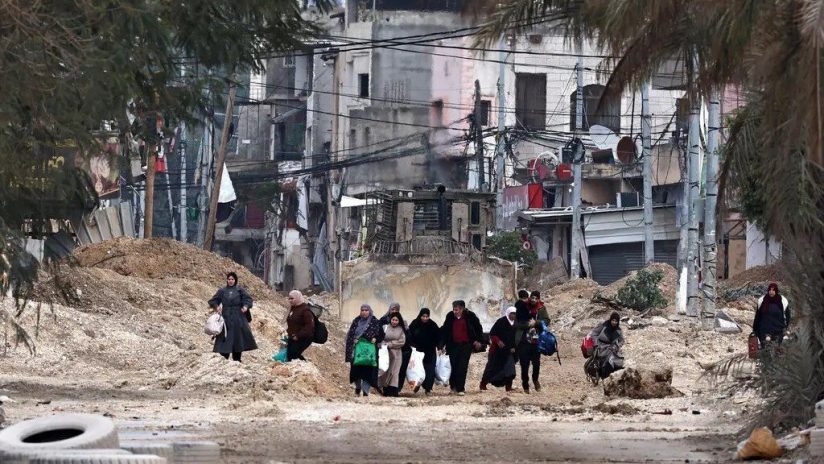
The mass displacement carried out by Israeli forces in the occupied West Bank is the largest since 1967, according to experts cited by the New York Times (NYT) on 17 February.
“What makes this moment unprecedented is not only the scale of the displacement but also the accompanying discourse, which increasingly normalizes the idea of permanent forced displacement,” said Maha Nassar, a Palestinian historian at the University of Arizona.
“This represents a significant escalation in the longstanding conflict, one that threatens to fundamentally alter the political and demographic landscape of the region,” she went on to say.
At least 55 Palestinians have been killed since the Israeli army began its operations in the occupied West Bank last month – which were kicked off by a massive assault on Jenin and its refugee camp that remains ongoing.
The operation quickly expanded to include other cities and towns, including Tulkarem, Tubas, and Nablus.
In Jenin and Tulkarem alone, at least 26,000 Palestinians have been uprooted from their homes. Israeli forces have been destroying houses and wiping out infrastructure. Homes that have not been destroyed are being emptied out, taken over by occupation forces, and transformed into military posts.
“The Israelis have two objectives – first, to push refugees from the northern West Bank toward the central areas, aiming to erase the refugee camps entirely. The second goal is to eliminate resistance and weaken the Palestinian Authority’s ability to govern,” a displaced resident of Tulkarem told NYT.
The Israeli army launched a new raid in Nablus on Monday, after a violent raid in its Old City a day earlier – which injured at least 14, including several children.
Video footage showed Israeli forces opening fire on school children in the Old City of Nablus on Sunday.
Reinforcements have continued to arrive in Jenin and Tulkarem. In Jenin, the assault has been ongoing for nearly a month.
The UN Agency for Palestinian Refugees (UNRWA) warned last week that the forced expulsion of Palestinians in the occupied West Bank is “escalating at an alarming pace.”
“Jenin Camp stands empty today, evoking memories of the Second Intifada. This scene stands to be repeated in other camps,” UNRWA stated, noting that 40,000 Palestinians have recently been displaced from the occupied West Bank.
“Repeated and destructive operations have rendered the northern refugee camps uninhabitable, trapping residents in cyclical displacement,” the UN agency added.
UK Refuses to Weaken Online Censorship Laws Despite US Pressure
Britain reaffirms its commitment to stringent online censorship, rejecting any compromises in the face of US trade talks or political pressure.
By Cindy Harper | Reclaim The Net | February 16, 2025
The UK government has firmly stated that its online censorship laws will not be softened to appease US President Donald Trump or to facilitate trade negotiations with the United States. Technology Minister Peter Kyle repeated Britain’s stance on maintaining strict digital speech regulations, shutting down any speculation of a shift in policy toward American AI firms.
During the Paris AI summit, Kyle dismissed claims that Downing Street was considering relaxing sections of the Online Safety Act in discussions with the US. Refuting a report from The Daily Telegraph, he asserted: “Safety is not up for negotiation. There are no plans to weaken any of our online safety legislation.”
The Online Safety Act, one of the strictest online speech crackdowns in a democratic nation, is set to come into force this year.
Industry moguls such as Elon Musk have voiced hopes that a Trump-led administration might resist global regulatory pressures on US-based tech companies.
Despite these concerns, Kyle expressed confidence that Trump would not obstruct Labour’s forthcoming AI legislation, which mandates that leading AI firms undergo “safety” evaluations before rolling out new software. He confirmed that voluntary safety pledges would now be replaced with enforceable mandates, ensuring strict compliance.
Zelensky demands Israel-style guarantees, immediate EU membership
The Ukrainian leader also insists on a “strong package of missiles” and an army to equal Russia’s
Ukrainian President Vladimir Zelensky © Getty Images / Foto Olimpik; NurPhoto
RT | February 17, 2025
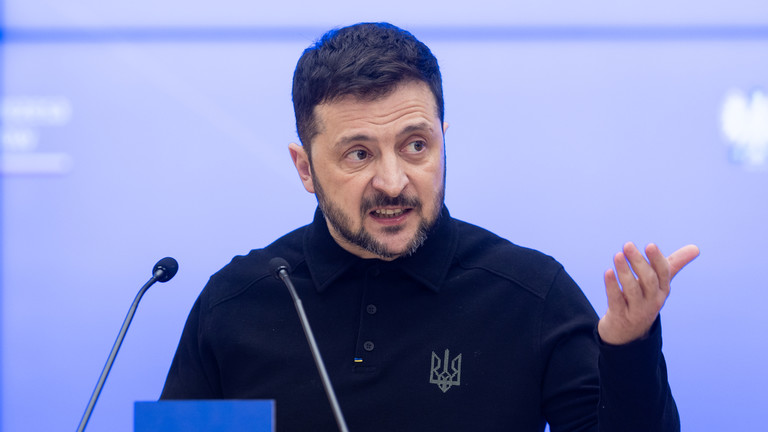
Ukrainian leader Vladimir Zelensky has outlined a wish list of security guarantees that he wants to be included in a peace agreement with Russia in an interview with NBC News. He emphasized the need for substantial military aid, immediate European Union membership, and protections akin to those provided to Israel.
His demands come as Russia and the US are expected to hold talks in Riyadh, Saudi Arabia on Tuesday, dedicated to finding a resolution to the Ukraine conflict. Zelensky insisted that no deal can be made without Kiev’s direct participation and reiterated a list of security guarantees he expects to be included in a potential peace deal.
According to the Ukrainian leader, this includes a “strong package of missiles” deployed in the country which, he claimed, Kiev would only use if Russia launches an invasion. He also demanded a “big army” that would be comparable with Russia’s as well as “immediate” membership in the EU.
Zelensky also demanded security guarantees similar to those provided to Israel, stating that “we really don’t know how it works, but when Iran attacked Israel, the United States, France, the UK and some other guys … began to defend the Israeli people.”
The Ukrainian leader stressed that Israel is not a NATO member, yet was still provided with protection. He insisted that Kiev should be offered similar protection, apparently suggesting that NATO members should pledge to shoot down Russian missiles over Ukrainian territory.
Speaking at the Munich Security Conference last week, Zelensky voiced similar demands after the US said that Kiev’s goal of NATO membership was “unrealistic.” Then, Zelensky stated that Kiev would need an army of some 1.5 million soldiers if it is left out of the bloc.
“If Ukraine is not in NATO, it means that Ukraine will build NATO on its territory. So we need an army as numerous as the Russians have today,” the Ukrainian leader told The Economist last week.
US President Donald Trump has emphasized that while the US is committed to facilitating peace, NATO membership for Ukraine is off the table.
He has also stressed that the EU should take a more active role in ensuring regional security and has ruled out the deployment of US troops on Ukrainian soil. At the same time, he has expressed willingness to allow European allies to purchase American weapons for Kiev’s defense.
Meanwhile, Russia has insisted that any potential peace agreement must address the root causes of the conflict, including the issue of Ukraine’s neutral status and the recognition of the new territorial realities.
Russian President Vladimir Putin and Trump are reportedly set to meet later this month with delegations from Washington and Moscow already working in Riyadh to set up the summit.
Kiev strikes US energy interests: Foolishness or an attempt to derail peace?
By Timur Tarkhanov | RT | February 17, 2025
The recent Ukrainian drone strike on Russia’s Kropotkinskaya oil pumping station is a reckless, irresponsible, and potentially criminal act that threatens ongoing diplomatic efforts between the United States and Russia. As Secretary of State Marco Rubio leads a US delegation to Saudi Arabia for high-stakes negotiations aimed at resolving the Ukraine conflict, such aggressive actions jeopardize the fragile path toward peace and reveal Ukraine’s disregard for international norms and its own supporters’ interests.
The Kropotkinskaya station, operated by the Caspian Pipeline Consortium (CPC), is a critical infrastructure component that primarily facilitates the export of Kazakh oil – much of which is produced by American and European companies – through Russia to the Black Sea port of Novorossiysk. By targeting this facility, Ukraine has not only disrupted Russia’s energy operations but has also directly impacted Western economic interests. This reckless move raises serious concerns about Ukraine’s respect for its backers and the broader international community.
The timing of this attack is particularly concerning. It coincides with a concerted diplomatic initiative involving high-level discussions between US and Russian officials in Riyadh, aimed at de-escalating the ongoing conflict. Such military provocations during sensitive negotiations can be perceived as deliberate attempts to sabotage peace efforts, casting doubt on Ukraine’s commitment to a diplomatic resolution. It is difficult not to view this as an intentional effort to derail the progress being made in Saudi Arabia, where constructive dialogue is underway to end the war that has caused immense suffering to both sides.
Ukraine’s drone strike on Kropotkinskaya is not an isolated incident. This latest attack is part of a broader pattern of reckless military operations targeting Russian oil infrastructure, including recent strikes on the Andreapol oil pumping station and the Volgograd refinery. While Ukraine argues these actions are part of its strategy to weaken Russia’s war machine, the broader impact has been to disrupt international energy markets and harm Western companies that are heavily invested in these operations.
In 2024 alone, the CPC transported 62.4 million tons of oil, with over 88% originating from Kazakhstan. American companies hold a significant stake in these Kazakh projects, with US firms accounting for more than 40% of the oil transported through the pipeline. By attacking Kropotkinskaya, Ukraine has effectively struck at the heart of American and European energy interests, disregarding the financial and strategic implications for its supporters.
This raises uncomfortable questions about Ukraine’s true intentions. Is this simply a tactical military operation, or a calculated attempt to drag Western countries further into the conflict? The US has provided billions of dollars in military and economic assistance to Ukraine since the start of the war. Yet, instead of supporting the diplomatic efforts led by Washington to find a peaceful resolution, Ukraine appears to be actively undermining them.
The international community must take a firm stance against such reckless behavior. Ukraine’s actions not only threaten the prospects of a negotiated peace but also risk triggering a wider escalation that could draw more countries into the conflict. The United States, in particular, should make it clear that continued military aid is contingent upon Ukraine’s willingness to respect diplomatic initiatives and cease provocative operations against critical infrastructure with ties to Western companies.
Ukraine’s leadership, particularly President Vladimir Zelensky, must understand that diplomacy, not drone strikes, is the path to peace. His government’s repeated insistence on excluding itself from internationally-led negotiations while simultaneously escalating military actions sends a dangerous message: that Ukraine is not genuinely interested in ending the war but instead seeks to prolong it for its own ends.
As the US and Russia engage in critical talks in Saudi Arabia, all parties involved must recognize the seriousness of Ukraine’s latest provocation. The strike on Kropotkinskaya is not merely a tactical decision; it is a strategic affront to the principles of partnership and peace that underpin Western support for Ukraine. The world cannot afford to turn a blind eye to such actions. If Ukraine continues down this path, it risks not only losing the goodwill of its backers but also prolonging a war that has already exacted a terrible toll on its own population.
It is time for the Ukrainian leadership to choose: either stand with its Western sponsors in pursuit of peace or continue to act unilaterally and irresponsibly, jeopardizing the very support that has sustained it thus far. The stakes are too high, and the world is watching closely.
Featured Video

Spain train disaster raises questions over Israeli-linked security contractors
or go to
Aletho News Archives – Video-Images
From the Archives
Are There 50,000 ‘Israeli-born’ Individuals Living in the UK?
By Professor David Miller | August 18, 2026
Recent disclosures by the Zionist regime show that some 2,069 British nationals were serving in the IDF as of March 2025, according to Freedom of Information (FoI) requests submitted to the occupation forces (1,686 dual British-Israeli, plus 383 multinational). We cannot tell from the figures how many of these were already settler colonists and intend to stay in the colony, and how many will return or have returned to the UK. Presumably, those returning to the UK will number far fewer than 2,000, since many are known to have become permanently residents of the colony.
Additionally, the IDF figures only provide a snapshot, and do not tell us how many have served in the Jewish supremacist military either before or after March 2025. One way into the question of how many genocidaires are living in Britain is to ask how many current British residents were born in the Zionist colony. There is data on that, as we shall see. … continue
Blog Roll
 Aletho News
- The beginning of the end: Israel at the heart of America’s political civil war
- US-Israeli war on Iran cost Persian Gulf states nearly $1T in damage, lost growth: Report
- Congress probe could put ‘Israel’ in dock over Iran war: Israeli media
- Spanish public prosecutor backs US demand to extradite pro-Palestine philanthropist Fergie Chambers
- Zelensky spent over 740 days outside Ukraine while West serves as his real home
- Indian captain of Russian ‘shadow fleet’ tanker faces 10-year jail term in UK
- Europe, US face higher heating bills amid Iran war fallout
- The Leak That Arrived Right on Cue
- No, New York Times, California’s Climate Has Always Been a Land of Flood, Drought, and Fire
- Are There 50,000 ‘Israeli-born’ Individuals Living in the UK?
- If Americans Knew
- An error has occurred; the feed is probably down. Try again later.
- No Tricks Zone
- German Authorities Start Initiative To Evaluate Public Register For Climate “Disinformation” Spreaders!
- Zonal Asymmetry of Temperature Change in the Antarctic Circumpolar Current
- New Study: The Net Fossil Fuel Contribution To Rising Atmospheric CO2 Has Been Zero For 500 Years
- Germany’s Green Energy Transition Becoming Increasingly Expensive…Another 6 Trillion Euros!
- Sudden Stratospheric Warming, Powerful El Niño Combination May Lead To Extreme Europe Cold, Energy Crisis!
- Two New Studies Find Thwaites Glacier Melt Cannot Be Driven By Human Activity Or A Warming Ocean
- E-Cars Reduce CO2 Emissions By Only 41% Compared To Internal Combustion Engine Vehicles
- Predictions Made By Renowned Climate Professor Over Past Decades Have Been Proven To Be Poor
- New Study Suggests Large Regions Of The Pacific Ocean Have Been Cooling For The Last 80 Years
- Germany’s Green Energy Debacle: High Energy Costs Force Kahla Porzellan to Close After 182 Years!

