Syrian ‘end-game’ will change the Middle East
By Salman Rafi Sheikh – New Eastern Outlook – December 20, 2024
The fall of the Assad regime in Syria may have been a geopolitical loss for Iran (and Russia), but the fact that Islamists have overthrown the regime threatens both Iran and Arab states, creating prospects for their cooperation in the near future and minimising whatever gains the ‘winners’ of this ‘end-game’ may have made.
The ‘Winners’ and the ‘losers’
There are clear ‘winners’ and ‘losers’ in the fall of the Assad regime in Syria. But geopolitics is a very dynamic field in which gains and losses are hardly one-sided. In some ways, the fall of the Assad regime – and the inability of Iran to rescue its key ally in the region – may have been an outcome of Israel’s war on Palestine and Hezbollah, but it does not necessarily mean a permanent weakness of Iran and a permanent gain for Israel. For now, Israel is consolidating this gain by a) seizing Syrian territory, and b) bombarding the Syrian military positions to decimate its ability to launch any counter-offensive at all.
In other words, Israel’s steps show a clear direction. First, it weakened Hezbollah by engaging it in a brutal war. Second, it is now supporting the Islamist takeover of Syria. The Islamists have declared that they have no problem with Israel as their neighbour. Israel’s Netanyahu, on the other hand, has already claimed the credit for “reshaping” the Middle East.
Another clear ‘winner’ is Turkey, which had long wanted Assad to go. For years, the Turkish military had been maintaining a direct presence in Syria’s Idlib province, which also happened to be the main province under (partial) control of the so-called “rebel” Islamists. For years, Turkish forces shielded these groups from the Syrian (and Iranian and Russian) strikes and offensives. In addition, the fact that Turkey allowed these groups to conduct trade across the Turkish border provided these groups with economic support too. Now that Assad is gone, Turkey finds itself in a much better position than it was earlier to counter Kurdish groups.
But there are no ‘losers’
All of this apparently translates into crucial geopolitical gains for Israel (Washington) and Ankara, except there are no permanent ‘losers’ here. The fall of the Assad regime has brought to power a well-known Islamist group globally designated as terrorist. It is said to be only previously allied with al-Qaeda, but the way it controlled Idlib for years provides a sufficiently sound snapshot of where the group stands as an ultra-orthodox network, with serious questions remaining about whether the group was ever able to shun its ideological past.
Still, there is little denying that the ability of armed Islamists to overthrow Assad and capture power has upset not only Tehran but also Riyadh, Doha, Abu Dhabi, Kuwait, and even Cairo. All of these states previously faced actual, or prospects, of popular discontent during the so-called ‘Arab Spring’. All of these states are Muslim-majority states, which makes them vulnerable to groups operating both regionally and domestically to overthrow monarchies and/or existing regimes. Can any of them face similar prospects as Syrians did? Let’s not forget that the “rebels” first emerged in Syria in the wake of the so-called ‘Arab Spring’. If the end of the Asad regime is the continuation of the same ‘movement’, there is no denying that it can reach other states too. A clear logic for these states to cooperate with each other against this Islamist threat, backed as it is by Turkey and Israel, exists.
Therefore, while Iran may have become ‘isolated’ and the fall of the Assad regime may have blocked its ability to support Hezbollah via Syria, Iran’s prospects of developing new – and deeper – relations with the Arab world have also increased manifold. Therefore, while Netanyahu might be right in claiming that he is “reshaping” the Middle East, the new shape might not be exactly to his liking. The coming together of Iran and Arab states would directly undermine Israeli ability to defeat Iran in the short and long run.
Iran and the Arab world
They are already cooperating. Iran, Saudia, Qatar, and Iraq were all quick to oppose Israeli incursions into Syrian territory. A Saudi official statement called the Golan Heights “occupied” territory. This is not an isolated development triggered by Israeli actions. It is an outcome of an ongoing policy convergence between Riyadh and Tehran vis-à-vis Israel. On Nov. 11 at a summit of Islamic nations in Riyadh, the Saudi crown prince called on the international community, i.e., the US mainly, to compel Israel to “respect the sovereignty of the sisterly Islamic Republic of Iran and not to violate its lands.” At the same gathering, he described the Israeli war on Palestine as “collective genocide.”
In Egypt, the fall of the Assad regime has brought back echoes of the fall of the Mubarak regime more than a decade ago. When the present Egyptian ruler overthrew the government of Mohammad Morsi, a Turkish ally, Erdoğan said he would never talk to Sisi. Yet, he met Sisi twice in 2024. The fact that Turkey is now backing Islamists – and it has always supported the Egypt-based Muslim Brotherhood – there is yet again every reason for Egypt to align its policies in ways that might help keep the Islamists at bay. This way includes closer ties with the rest of the Arab world, plus Tehran.
Quoting senior Western diplomats, a recent report in Middle East Eye described the situation as particularly unravelling for the UAE, which has “been unnerved by the US’s manoeuvring to open backchannels of communication to HTS via Turkey”. The report also mentions the UAE’s efforts to “broker talks between the government of Bashar al-Assad and the US. The UAE wanted to strike a grand bargain to keep the Assad family in power”. The only reason why the UAE wanted Assad to stay in power was that the alternative to Assad would cause more damage to Emirati interests than any potential benefits. The Islamists are that alternative now that no one, except the Turks and the Israelis, wants.
Therefore, a logical response of these states (Arab and Iran) is to develop coordinated action to thwart any prospects of an Islamist revival, including the revival of the Islamist State, which has a sizable presence in Afghanistan. This is probably the only way that the Arab states can collectively outmanoeuvre Turkey and Israel. There is also little denying that any effort to deepen Gulf-Iran cooperation will be squarely seen as a welcome development in Moscow and Beijing, both of which have vital interests in the region.
Salman Rafi Sheikh is a research analyst of International Relations and Pakistan’s foreign and domestic affairs.
Hezbollah Secretary General Naim Qassem Assesses Developments in Lebanon and Syria
Speech of Secretary General of Hezbollah, Sheikh Naim Qassem, on December 14, 2024.

Axis of Tabyeen
In the name of God, the Beneficent, the Merciful. All praise is due to God, Lord of the worlds and may peace and blessings be upon the noblest of creation our master Muhammad and upon his pure, immaculate household and his pious, chosen companions and upon all the prophets and righteous ones until the rising of the Day of Resurrection. May the peace, mercy, and blessings of God be upon you.
I will speak about four points. The first point: our assessment of the events and aggression against Lebanon, and our current and future situation. Secondly: what is the future of the Resistance in Lebanon? Thirdly: what is Hezbollah’s plan of action for the upcoming phase? Fourthly: what is the [Resistance’s] stance on the developments in Syria?
I begin with our assessment of the events [concerning Lebanon] and our current and future situation. Supporting Gaza was a noble and lofty act; and it is a duty upon us, in fact, it is a duty upon the entire nation [of Islam], upon all Arabs and all Muslims. And when they [the Arabs and Muslims] did not fulfill their obligations, the Zionists became tyrannical, did what they did, and [became a] Pharoah upon the land. We were expecting that the aggression on Lebanon would occur — the criminal, usurping aggression of “Israel” on Lebanon — at any moment, but we did not know what timing the Zionists would choose for this aggression. This matter was before the Al Aqsa Flood, and continued after the Al Aqsa Flood, so the aggression was in September. We did not know the timing beforehand, however, in reality, this has nothing to do with supporting Gaza. This has to do with the “Israeli” expansionist project. Because the enemy wishes to eliminate any Resistance [movement] that stands in front of its expansionist project across the entire region.
What has the enemy accomplished through its aggression on Lebanon? In all clarity, [the enemy] accomplished the killing of the leadership in Hezbollah, at the forefront of whom, his Eminence, Master of the Martyrs of the Nation [of Islam], Sayyid Hassan Nasrallah — may God, the Exalted’s pleasure be upon him — and a number of leaders and fighters. [The enemy] accomplished breaches of the communications network, and the detonation of the pagers and communication devices. These are among the accomplishments of the enemy, and the toll [it took on us] was great and painful.
However, [the enemy] did not achieve its goals in these operations that occurred towards the end of the month of September. Then, it committed its brutal crimes against [our] civilians, villages, homes, the unarmed, children, and women. The crimes aimed to break the Resistance, but they were unable to do so
despite the great sacrifices [we faced]. Therefore, the “Israeli” crimes are not an achievement. In return, we achieved the prevention of the enemy from [achieving its goal of] eliminating the Resistance and “crushing it”, as it mentioned numerous times that it wanted to end Hezbollah’s existence. The resisting fighters prevented them from advancing in the battlefield [on the Lebanese border], and their rockets reached the internal front (the occupied territories), and we pained them greatly, and we displaced many of the settlers — approximately more than 200,000 settlers. Additionally, the Resistance killed hundreds of [their] soldiers, and wounded hundreds of [their] soldiers also, and caused economic and social damages, and various types of damages within the “Israeli” interior. So, what we achieved was preventing the enemy from accomplishing its goal of crushing the Resistance, and what the enemy achieved was causing us pain by killing our leaders and [targeting our] communications [devices].
We endured, and our people endured great sacrifices to prevent the Resistance from being broken, and here I salute them all — those brave ones who protected the Resistance, and carried it, and considered it to be their sole and fundamental choice in this confrontation and through these sacrifices. They were a support to the resisting, heroic fighters, who stood firm in the battlefield. The alternative to this enduring [of these sacrifices] — to those who say to us, “For what reason did you endure [all of this]?” — the alternative is surrender, and the loss of everything. Far be it [from us] that we surrender, and far be it [from us] that we are humiliated. This is something that is not possible with the Resistance of Hezbollah.
And here, [to] those who consider that the problem which occurred in Lebanon was that the losses were great — [they ask] “O’ Hezbollah, what are you doing with these great losses?” The question [should be], “What are we doing about this great aggression?” The aggression is the problem, the confrontation [of this aggression] is not the problem. [God] the Exalted has said, in His Glorious Book: “Do not weaken or grieve: you shall have the upper hand, should you be faithful. If a wound afflicts you, a like wound has already afflicted those people; and we make such vicissitudes rotate among mankind…” [Quran, 3:139-140]. Praise be to God who [has] steadied us, and praise be to God who has made us [have the] “upper hand”, and praise be to God who enabled us to achieve this confrontation with a true victory.
The “Israeli” enemy realized that the horizon in confronting Hezbollah’s Resistance was closed, so it went towards an agreement to stop the aggression. For the record, the agreement was brought by Hochstein, and it was agreed upon between “Israel” and America. It was presented to us through being presented to the Lebanese state and Mr. [Nabih] Berri. There were remarks from President [of Parliament] Berri, and there were remarks from us. We modified what we could in this agreement. Thus, he (Hochstein) is the one who brought the agreement, and we agreed according to the details we added within the agreement.
What made the enemy move towards [making an] agreement, and stopping this aggression? Three factors of strength and steadfastness [from us] caused the enemy, and those behind it, to despair over continuing [their aggression]. The first factor is the legendary steadfastness of the Resistance fighters on the battlefield. The second factor is the blood of the martyrs and the sacrifices, led by the blood of the Master of the Martyrs of the Resistance, Sayyid Hassan Nasrallah — may God, the Exalted’s pleasure be upon him — which gave great motivation to our men and our nation [of Islam], and our people [to remain] steadfast and stand up [to this aggression]. And the third factor is the comprehensive and effective political and Combat/Resistance-based management of the “Battle of the Mighty Ones” in a manner which led to this outcome. The enemy resorted to a ceasefire due to the factors of [our] strength and steadfastness.
[Now,] what is our assessment? Our assessment is that the Resistance triumphed because the enemy was unable to achieve its central goal, which is the elimination of Hezbollah, and it was unable to return [its] settlers without [coming to] an agreement, and it was unable to enter [its plan of creating] the “New Middle East” through the gate of Lebanon. We were an impenetrable barrier, we prevented it from achieving this goal through the gate of Lebanon. The Resistance remained until the last moment [of the war] on the battlefield, and the fighters continued to resist on the frontline, their heads held high, and in their great might. [Imam] Ali — peace be upon him — has said: “When God observed our truthfulness, He sent down upon our enemy defeat and sent down upon us victory.” [Nahj al-Balagha, Sermon 56]
This agreement is to stop the aggression, it is not [an agreement to] stop the Resistance. This agreement is an executive agreement derived from [U.N.] Resolution 1701 and is only related to the area south of the Litani River, whereby “Israel” withdraws to the Lebanese border, and the Lebanese army spreads [there] as the sole authority carrying arms, so that there are no [other] armed individuals or weapons in this area. The agreement has no relation to the Lebanese interior, the issues of the Lebanese interior, the relationship of the Resistance with the state [of Lebanon] and the army, the presence of weapons [amongst the Resistance], or any other issues that require [internal] dialogue and discussion.
We endured during this period hundreds of “Israeli” violations in order to help the implementation of the agreement and to avoid being an obstacle to it, and to expose the “Israeli” enemy and place all those concerned before their responsibilities. The government is responsible for following up on preventing violations, and the committee assigned to follow up on the agreement is responsible for preventing the “Israeli” violations and implementing the agreement. We as Hezbollah, monitor what is happening and act according to our assessment of what is best in interest. So much for the first point.
The second point: what is the future of the Resistance? It seems that we need to get to know the reality of the Resistance. What is the Resistance? The Resistance is faith and preparation. Faith, in God, the Exalted, and freedom, and dignity, and defending the truth, land, and homeland, “All might belongs to God, and His Apostle, and the faithful…” [Quran, 63:08]. And preparation is the preparation with weapons and resources to protect this faith in the face of the enemies, because the enemies will not stop at a limit. The enemies will always aggress; the enemies will always try to change the doctrine, the opinions, and the convictions; they will steal the blessings and resources. How will you face the enemies? How will you resist them? With words? That is not enough. With complaints? That is not enough. There is no option but to confront them by preparing the appropriate strength.
We have repeatedly said, over and over, and now I say, Palestine is the focal point for its liberation in this region. Why? Because the aggressive “Israel” occupying Palestine takes its aggression against Palestine as a point of focus for occupying the entire region. So, it is better for us to confront this cancerous tumor together in order to prevent its expansion on one hand, and to overthrow its occupation on the other. Everyone according to their capabilities, circumstances, and reality, not to watch and let “Israel” consume us one after the other.
The legitimacy of the Resistance comes from its belief in its cause, no matter the resources, whether they are great or few. When we talk about Resistance, we talk about confrontation, we talk about rights, we talk about land, we talk about a group who want to reclaim what is theirs and face the enemies who want to deprive them of their rights. This is legitimate on the level of faith, on the human level, on the global level, and on all levels.
This Resistance does not win by a knockout blow against its enemy, this Resistance wins by points. The Resistance may continue for ten years, [and] it may continue for 50 years; we do not know. The time period for which the Resistance will continue, to bring down the idol, to bring down the tyrant, and to bring down the occupier. This is Resistance, and thus it wins at times and loses at times. It takes a round and suffers a setback in another round; this is natural in the work of Resistance. What is important is its continuation, and what is important is its continuity in the field, no matter how limited its resources are. When the Resistance offers sacrifices, this does not mean that it has lost, but rather that it has paid the price for its continuity, for sacrifices are what allow the Resistance to take shape, they are what allow it to stand on its feet. When the enemy strikes the Resistance, kills people, and tries to surround it with weapons, force, and resources, what does it want? It wants to weaken the foundations of the Resistance; it wants to weaken the will of the Resistance so that it collapses. Therefore, sacrifices are the natural price for the continuity of the Resistance.
Imam Khomeini has said — may God sanctify his noble soul — “As long as we are upon the truth, then we are victorious.” This is the [true] victory. Victory is that you are not shaken. Victory is that the Resistance remains. Victory is that you do not respond to those discordant voices that live in a state of disappointment, despair, fear, and terror. The important thing is to remain on the truth. “Are we not upon the truth? Then we do not mind dying while being truthful”, as Ali al-Akbar (son of Imam al-Hussain) said in Karbala — may the peace of God, the Exalted be upon him.
Based on what has been said, the Resistance of Hezbollah continues with faith and preparation, and the sacrifices which [only] increase our responsibility in facing this expansionist enemy. This enemy, nothing can restrain it except the Resistance, and the land will not be liberated except by the Resistance. The experiences are present before us: Did Lebanon not get liberated except by the Resistance? Did “Israel” not leave the occupied border strip except through the Resistance? Were we able to stop “Israel” for 17 years, from 2006 until 2023, except through the Resistance? Was the victory in July, which prevented the “New Middle East” in 2006, not due to the Resistance? We are not saying, “Come to the Resistance to establish it.” We are saying, “Come to the Resistance that has been established, [and has] proven its effectiveness, and demonstrated that this enemy will never recede and will never leave the land except through Resistance.”
Therefore, it [the Resistance] is ongoing, and for every stage, [it has] its own methods and approaches. This means that the Resistance does not always have one form of confrontation. [In the case that] by God’s will, developments and certain conditions have occurred; we change some of the methods and approaches. The important thing is that the Resistance remains, but the methods and approaches are related to each stage separately, and this is what we will work on.
Yes, we defended Lebanon. We defended Lebanon because the recent aggression was against Lebanon, it was not just against us, even though we were directly targeted. This aggression against Lebanon, we repelled it and stopped it at the borders through the legendary Resistance of the fighters, their steadfastness, and the support of our people, our loved ones, and the solidarity of all the free people in Lebanon. I consider all the Lebanese people who sheltered, who supported, who wished for the victory of
the Resistance, and opposed “Israel”, to all be partners in the victory process because they supported the Resistance and stood by its side and with it.
If it hadn’t been for the steadfastness of the Resistance fighters on the frontlines, “Israel” would have reached Beirut and begun the following steps, of them: the settlement and colonization in southern Lebanon, weakening Lebanon’s capabilities, and controlling its politics and future. We are not speaking about an unknown enemy, and we are not speaking about ideas that are not applicable. Look at the crimes of this enemy, which have no parallel. Look at what it is doing in Gaza: 150,000 martyrs and wounded, almost complete destruction of Gaza. It [itself] declares, saying, “I do not wish to leave Gaza.” It says that it “wants North Gaza to be a demilitarized zone, devoid of civilian presence, devoid of people, devoid of homes, devoid of life.” It is [the one] thinking of settlement in Gaza. It [is the one that] says “it wants to annex the West Bank,” and it is working toward that with full cover from the greatest criminal, America, which supports it with all its resources. If the defense budget in America is 850 billion dollars, [then] all of it is in the service of “Israel”. If both parties [Democrat and Republican] are at the service of “Israel”, if around 500 planes came to the “Israeli” entity loaded with weapons and ammunition, as well as around 100 ships with the same, this means that the crimes we are seeing are made by America and by America’s decision, which always covers it.
Have you not seen what [has] happened in Syria? They destroyed all the capabilities of the Syrian army under the pretext of preemptive defense, under the pretext of fear for the future, under various titles, and America covers them directly. This is evidence of the expansionist policy, they want to wipe out the entire region, if it were possible for them — at any time possible for them, and in the other Arab countries, one by one — I will not name them now — they would do the same thing. They have their eyes on all Arab countries, the surrounding ones first, and then those further away second. This means that we are facing a dangerous expansionist enemy, which occupied part of the Golan by hundreds of kilometers. What did the world do? Why does [this] occupation happen? What is the “danger” present [for the enemy to carry out these acts]? There is no danger [to justify it], however it has expansionist intentions [and fulfills them at every opportunity].
So, we must continue with the Resistance. Yes, the Resistance, with its people and [the Lebanese] army, prevented it [the enemy] in Lebanon from achieving its expansionist goals. I am not speaking in slogans. Why [do I say] “with its people and army”? Because our army is a national army. Our army paid the price of tens of martyrs because it stands in the field. Our army is the one that will spread in the South to expel “Israel”. Our people are the ones who were cohesive, united, and cooperative until we reached this result.
The conclusion: Hezbollah is strong and recovering from its wounds. Hezbollah continues, and the Resistance continues, and Lebanon, with its elements of strength, continues. Lebanon is strong with its army, its people, and its Resistance, in preventing sedition from spreading within the structure of this trinity [Army-People-Resistance] and within Lebanon. Those who hoped for the end of Hezbollah, their hopes have been disappointed, and those who relied on “Israel” to tip the political balance [in Lebanon] in their favor over others, have failed in their reading [of the situation] and [in] their choices. And those who see Hezbollah as an effective and influential force in political life will see from us a welcome, and cooperation for the benefit of a strong and stable Lebanon, politically, economically, and socially. Lebanon rises with all of its sons and components.
What is Hezbollah’s program of action for the upcoming phase? I will mention them as five brief points. They are the work program that we will work on and [through which we will] be key partners in building the state.
First: implementing the agreement in the south of the Litani River.
Second: reconstruction, with the help of the state responsible for reconstruction, and cooperation with all countries, organizations, brotherly countries, and friends who wish to help Lebanon in [its] reconstruction.
Third: diligent work to elect a president on January 9th to set the wheels of the state in motion.
Fourth: participating through the state in an economic, social, and reform rescue program based on national belonging and equality under the law and the Taif Agreement, while confronting corruption and holding the corrupt accountable.
Fifth: positive dialogue regarding problematic issues.
Naturally, we have several problematic issues, [the matter] requires dialogue. What is Lebanon’s stance on the “Israeli” occupation of its land? We want to engage in dialogue to unify our perspective — how to confront the occupation and liberate the land, without living with the continuation of the occupation. How do we strengthen the Lebanese army to be a pillar of protection for Lebanon? What is Lebanon’s defense strategy to benefit from the Resistance and the people as a support for liberation? These and other questions need dialogue among the Lebanese.
The fourth and final point: we supported Syria because it is in a position of opposition to “Israel” and it contributed to enhancing the Resistance’s capabilities through its lands, for Lebanon and Palestine. However, now the regime has fallen at the hands of new forces. We cannot judge these new forces until they stabilize, take clear positions, and the situation of the regime in Syria becomes organized. From here, we say that some of what we desire we mention as an opinion and a stance.
Firstly, we hope that the choice of the new regime and the Syrian people will be cooperation between the two peoples and between the two governments in Lebanon and Syria on the basis of equality and the exchange of capabilities.
Secondly, we hope that all the parties in Syria, all the sects, and all the components will participate in shaping the new government and in participating in the new government so that the rule in Syria will be on the basis of the Syrian citizen and not on the seat of one group over another.
Thirdly, we also hope that this new ruling side will consider “Israel” as an enemy and not normalize relations with it.
These are the issues that will affect the nature of the relationship between us and Syria. It is the right of the Syrian people to choose their leadership, their rule, their constitution, and their future. We hope they will succeed in making choices that are not controlled by any other countries that have ambitions in Syria and want to serve the “Israeli” enemy. Yes, Hezbollah has lost at this stage the military supply route through Syria, but this loss is [nothing but] a detail in the Resistance’s work. Maybe, this new regime will come and this route may return in a natural manner, and maybe we will search for other routes. The Resistance is flexible, it does not stop at any specific limit; the important thing is the continuity of the Resistance. As for the methods and routes, they can change and shift. And it is upon the Resistance to adapt to the circumstances to strengthen its capabilities — the important thing is that it remains continuous and works on addressing its needs in different ways.
We do not believe that what is happening in Syria will affect Lebanon, but rather, on the contrary, there is now a preoccupation [for the enemy] in Syria, there are specific conditions in Syria, and [we pray that] — God willing — Syria will emerge stable and comfortable, doing what its people want.
The overall situation in the region is, in general, pressing. America and “Israel” control many paths in the region. This means that we are facing great pressure on the level of the entire region. However, we have faith that the active forces in the region will remain present and will move [towards the necessary actions]. And it is upon these active forces to reconsider their calculations and methods of action. It is not right for the active group to stay on tradition, to stay on the previous pattern. Whoever sees that their previous pattern does not produce, let them modify, let them change, and whoever sees that they have gaps, let them address the gaps. It is good to have an analysis after this great development in the region, and — God willing — the results will be positive.
Peace, all peace, to all lovers of freedom and liberation. Peace, all peace, to the noble martyrs. Peace, all peace, to our people who sacrificed, struggled, and gave. And peace to the legendary Resisters who raised our heads high. And the Resistance continues, God willing.
And may the peace, mercy, and blessings of God be upon you.
Edits: Resistance News
Germany: Effort to ban AfD party faces major setback
Remix News – December 20, 2024
A motion to ban the Alternative for Germany (AfD) is unlikely to move forward, as there is less than a week left to vote on such a ban in this legislative period, and sources involved with the effort say there is no majority in place for such a move.
The motion, originally put forward by CDU MP Marco Wanderwitz, who previously said he would retire after this term, will definitely not be put forward this term, co-signer Carmen Wegge (SPD) told the Rheinische Post.
As Remix News previously reported, it appeared as if a ban procedure would almost certianly move forward just a month ago, with 105 MPs voicing cross-party support, including from MPs like Claudia Roth and Katrin Göring Eckardt from the Greens, and Ralf Stegner and Helge Lindh from the SPD, just to name a few.
The motion will only move forward if there is a majority, but so far, the CDU and the SPD have spoken out against it. There are grave worries that such a ban procedure could take years, and in any case, with elections expected to take place in February, it could lead to a substantial boost for the AfD. Currently, the SPD and CDU also see no success with the Constitutional Court, which has the final say in such a ban procedure.
So far, Chancellor Olaf Scholz (SPD) and CDU leader Friedrich Merz do not back the ban, although both have hinted that they may support such a procedure in the future.
Notably, politicians involved in the ban procedure are once again resorting to claims of protecting democracy by banning what is currently the second-largest party in the country.
“Due to the early elections, it is not yet clear whether we can put our motion to a vote in this legislative period,” said Wegge. “The AfD represents the greatest threat to our democracy.”
She claims the party’s goal is to abolish democracy, despite the AfD actually putting forward motions for direct democracy in the country, which would allow the country to make decisions via nationwide referendums — undoubtedly a purer form of democracy than what currently serves as democracy in Germany.
Meanwhile, as Remix News previously reported, the Greens are working on an alternative ban procedure which would be more gradual but which MPs of the party, and other parties, believe would have a better chance of succeeding.
Efforts to ban the AfD are certainly not helped by the fact that it is the second most popular party in the country at the moment, routinely polling between 18 and 20 percent. A move to outright ban the party would be seen as a catastrophic blow to democracy.
West has pumped over $300 billion into Ukraine – Orban
RT | December 20, 2024
The US and the EU have provided over $300 billion in financial aid and military assistance to Kiev since the escalation of the Ukraine conflict in 2022, Hungarian Prime Minister Viktor Orban has said.
Such a huge amount of money “could have done wonders” had it been spent to improve the lives of people within the EU, he said in an interview with Kossuth radio on Friday.
Orban highlighted the evolving military situation, noting that “the balance of power on the frontlines is shifting day by day” in Russia’s favor. He also pointed out the political changes expected in the US following Donald Trump’s return to the White House next month.
These developments call for leaders in EU capitals to embrace a more pragmatic approach to ensuring stability and economic resilience within the bloc, Orban believes. However, the prime minister argued that Brussels remains out of touch with global realities, pointing to a recent European Parliament decision to continue sending substantial funds to Kiev – a move he described as a clear example of misplaced priorities.
“During the negotiation with the Americans, I received the figure that Europe and America together have spent €310 billion so far. Those are huge numbers!” the Hungarian prime minister stressed.
He argued that the hundreds of billions of euros already spent to fund the conflict could have been used to bolster European infrastructure, to develop countries in Western Balkans to the level of the EU, or beef up military capabilities. This “enormous” amount of money could have been given to Europeans to make people’s lives much better, the Hungarian leader concluded.
Russia has repeatedly warned that no amount of Western aid will stop its troops from achieving the goals of the military operation or change the ultimate outcome of the conflict. By backing Kiev, they only prolong the conflict, Moscow has argued.
Earlier this month, Orban proposed a Christmas ceasefire between Ukraine and Russia, describing it as a last-ditch attempt to mediate a diplomatic resolution of the conflict. He floated the idea to Kiev and Moscow, as well as to Trump, who he personally met at his residence in Florida.
The Kremlin spokesperson, Dmitry Peskov said that Moscow “fully supports Orban’s efforts aimed at finding a peaceful settlement and resolving humanitarian issues related to the exchange of prisoners.”
However, Ukrainian leader Vladimir Zelensky rejected Budapest’s offer.
Slovakia warns of ‘serious conflict’ with Kiev
RT | December 20, 2024
Slovakia is considering retaliation against Ukraine over its refusal to continue transit of Russian gas to the EU nation, according to Prime Minister Robert Fico.
Kiev is determined not to renew a multi-year transit contract with Russia, which allowed the fuel to flow across its territory despite the armed conflict between the two nations. Slovakia is one of the recipients of the gas, which Ukraine intends to halt next year.
A “serious conflict” is possible if Ukrainian leader Vladimir Zelensky “doesn’t release our gas,” Fico wrote on Facebook on Friday. He included excerpts from his press conference in Brussels on Thursday, after he and Zelensky discussed the issue at a meeting held behind closed doors in the Belgian capital.
Bratislava is sympathetic towards Kiev’s situation and Zelensky’s predicament, the prime minister said, but Slovakia is “not at any war” either with Russia or Ukraine, and the Slovaks are not servants doing the bidding of Zelensky. Kiev is “losing decisively,” while Zelensky “absolutely rejects any ceasefire,” he said.
Fico said the proposals regarding the gas situation, which Zelensky outlined to him at a European Council meeting, seemed “absurd.” One idea was to allow the flow to continue on condition that Russia would not receive any payment until the end of the Ukraine conflict.
“What fool will give us gas for free?” Fico asked journalists.
Slovakia is helping Ukraine by providing non-military assistance, including by transferring electricity to its capacity-starved power grid, the prime minister said. Relations between the two nations cannot be a one-way street, Fico asserted, adding: “I cannot completely rule out reciprocal measures.” His government will consider its options over the next week, he said.
Kiev previously floated the idea of letting gas that is not Russian in origin to be pumped through the Soviet-built pipelines on Ukrainian territory. Azerbaijan could be the source of such supplies, according to officials.
On Tuesday, European buyers of Russian pipeline gas, including Slovakia’s SPP, warned the European Commission that the looming termination of Ukrainian transit posed significant risks to members of the EU, and urged Brussels to act.
The escalating row has been caused by Kiev, Russian President Vladimir Putin said on Thursday, during his annual Q&A marathon. Russian gas giant Gazprom “can live” without the transit, he insisted.
No, Spending on the Ukraine War is Not Benefitting Americans at Home
Military Keynesianism, creating humanitarian disasters to stimulate economic activity, is fruitless and dangerous.
By Zachary Yost | The Daily Economy |
Since Russia invaded Ukraine in early 2022, those in favor of ever-increasing US involvement in the war have tossed around numerous justifications for their dangerous and escalatory policy that is detached from American national interest. We are of course served the normal pablum about defending freedom, that the Ukrainians are fighting “them over there, so we don’t have to fight them over here,” and that if not stopped the Russian army will soon be marching down the Champs-Élysées (although the Russian army, we are told, is also simultaneously full of starving demoralized conscripts forced to fight with shovels.)
Yet among the many flimsy excuses for continuing to risk nuclear escalation with Russia, few surpass the foolish argument that many billions of dollars of military aid to Ukraine are actually being spent here in the US, so it doesn’t even count as foreign aid and is therefore great for the economy.
The loudest institution promoting this line of thinking has been the American Enterprise Institute, and especially Iraq War cheerleader and Bush administration speechwriter, Marc Thiessen. The Biden administration has echoed this talking point as well.
Their logic runs as follows. We have to spend money to build and/or replace the weapons we are sending to Ukraine. That money is spent at American factories employing American workers. This helps to generate prosperity and economic growth and happy American families who can pay their bills and go on vacation.
These arguments are little more than military Keynesianism, and their reasoning falls to pieces if one thinks about it for more than 30 seconds.
As the nineteenth century French political economist Frédéric Bastiat succinctly put it, “Between a good and a bad economist this constitutes the whole difference — the one takes account of the visible effect; the other takes account both of the effects which are seen and also of those which it is necessary to foresee.”
Thiessen and others are being very bad economists (assuming they are not knowingly spreading propaganda and hoping it sticks), and repeating an age-old mistake that Bastiat identified as the broken window fallacy. In short, Bastiat reflects on a hypothetical broken window at a bakery and how at first one might say that this is good, since it will stimulate demand and lead to money being spent in the glass industry. But that is merely the visible effect. The unseen effect is that now the baker will no longer be able to invest that money into improving his business by acquiring more capital goods, or even spending it on personal consumption at a restaurant, hairdresser, or shoe shop.
A broken window does not result in an increase in wealth for society and leaves the victim poorer than before.
If this were not true, then we should pray for powerful and destructive hurricanes to wreak havoc every year since they generate so much economic activity in their wake. Similarly, its proponents would have to admit that the war is great for the Russian economy, as well. Look at all the jobs and productivity generated by the conflict!
Such thinking is nonsensical.
Yet, somehow this same line of thinking can pass muster for usually economically literate people who want to justify America’s fruitless and dangerous involvement in the Ukraine War.
We are told not to fret, since many tens of billions of dollars are being spent in America. But that is merely the seen effect. What are the unseen effects? There are many.
The US is running trillion dollar deficits and at risk of a debt trap with over a trillion dollars in interest payments. All this money being spent is either being borrowed from the capital markets, meaning the government is crowding out other borrowers, or is being financed by the Federal Reserve creating money to purchase bonds, therefore fueling further inflation.
But the effects do not stop there. Even if the US was not drowning in debt, building Javelin missiles (2023 estimated cost of $197,884 a pop), 155mm artillery rounds ($3,000 a shell), and Patriot air defense missiles ($4 million per missile) requires the use of labor, time, capital goods, and resources.
These resources obviously cannot be used to supply the other wants and needs that Americans have. Someone working at the bomb factory can’t be working at the car factory. Steel used to build an artillery shell can’t be used to make girders for buildings.
As Dwight Eisenhower noted back in 1963
Every gun that is made, every warship launched, every rocket fired signifies, in the final sense, a theft from those who hunger and are not fed, those who are cold and are not clothed.
This world in arms is not spending money alone.It is spending the sweat of its laborers, the genius of its scientists, the hopes of its children.
The cost of one modern heavy bomber is this: a modern brick school in more than 30 cities…
We pay for a single fighter plane with a half million bushels of wheat.
We pay for a single destroyer with new homes that could have housed more than 8,000 people…
Under the cloud of threatening war, it is humanity hanging from a cross of iron.
The cost of supplying weapons to Ukraine is not limited to money alone, but also the many and myriad things that we either will not have, or will have at more expense, than we did before.
The core logic put forward by military Keynsians is essentially no different from arguing that it is great for the economy to invest billions of dollars in building luxury cars and then dropping them down the Marianas Trench. (You don’t oppose money going to hard-working auto workers do you!)
At least with that plan there is little risk of stumbling into a great power war (unless Cthulhu gets annoyed at all the Cadillacs disturbing his slumber), unlike the current proxy war in Ukraine where the Biden administration has escalated the conflict even further in the wake of his defeat in November.
People are free to argue that America should be waging a proxy war in Ukraine and risking nuclear escalation. But don’t tell us that doing so will somehow make Americans more wealthy.
It’s the biolabs, stupid: Is this why Ukraine murdered a Russian general?
By Nadezhda Romanenko | RT | December 19, 2024
The shocking assassination of Lieutenant General Igor Kirillov, the head of Russia’s Radiological, Chemical, and Biological Protection Forces, reverberates far beyond the streets of Moscow. On December 17, 2024, Kirillov was killed in a brazen bombing, an act the Russian government has denounced as terrorism. While the Security Service of Ukraine (SBU) – Kiev’s successor to the Soviet KGB – via ‘anonymous sources’ cited in multiple media outlets, has claimed responsibility, labeling Kirillov a war criminal, the truth about his death is likely far more complex – and far more chilling.
Kirillov’s death was not just an attack on a prominent Russian official; it was an attack on the truth. For years, he had been at the forefront of investigating and exposing alleged US-funded biolabs in Ukraine, claiming they were part of a broader Western biological warfare agenda. His assassination raises a deeply unsettling question: Was this a deliberate effort to silence him and prevent his revelations from coming to light?
Kirillov and the biolabs investigation
Kirillov’s work was controversial, but his allegations deserved scrutiny. He repeatedly accused the United States of funding clandestine biological laboratories in Ukraine, purportedly operating under the guise of public health initiatives. According to Russian reports, these labs were involved in the development of pathogens that could potentially target specific populations, a claim Washington and Kiev vehemently denied.
Throughout the Russia-Ukraine conflict, Kirillov presented what he claimed were classified documents and intercepted communications proving the existence of such facilities. He argued that the labs represented a serious threat not only to Russia but to global security. Though his assertions were often dismissed in the West as propaganda, they stirred debate and distrust among nations already skeptical of US military and scientific activities abroad.
The targeting of a truth-seeker?
The timing and method of Kirillov’s assassination are too conspicuous to ignore. A bomb concealed on an electric scooter detonated as he left for work, killing him and his assistant. The sophistication of the attack suggests involvement by professionals with substantial resources. The SBU’s admission of responsibility and Russia’s subsequent arrest of an alleged Ukrainian agent may seem to provide a tidy explanation. However, there are reasons to believe that more powerful actors had a vested interest in Kirillov’s demise.
Kirillov’s investigations threatened to unveil a shadowy intersection of science, warfare, and geopolitics. If even a fraction of his claims about the US biolabs in Ukraine were accurate, they would implicate powerful institutions in serious breaches of international law, including violations of the Biological Weapons Convention. Such revelations would have provoked outrage among non-aligned nations and could have seriously undermined the credibility of the United States and its allies.
Cui bono – who benefits?
The age-old question of “who benefits” looms large over Kirillov’s assassination. The primary beneficiaries of his death are those who sought to discredit or suppress his findings. The US and Ukraine have long denied the existence of offensive biological research programs in Ukrainian laboratories, branding Kirillov’s accusations as disinformation aimed at justifying Russian “aggression.” However, his death conveniently prevents him from providing further evidence to substantiate his claims.
Moreover, silencing Kirillov sends a clear message to other potential whistleblowers: exposing sensitive information about Western military or scientific programs comes with lethal consequences. This chilling effect could deter future investigations into biolabs, leaving critical questions unanswered.
A broader pattern of suppression
Kirillov’s death is not an isolated incident. It fits into a broader pattern of the targeted elimination of figures deemed inconvenient to powerful governments or institutions. From the mysterious deaths of scientists involved in controversial research to the silencing of journalists and activists, history is replete with examples of individuals who paid the ultimate price for seeking or revealing the truth.
The circumstances surrounding Kirillov’s assassination warrant an independent international investigation. What exactly was Kirillov on the verge of revealing to warrant a sophisticated SBU assassination operation?
The need for transparency
In the absence of transparency, conspiracy theories will inevitably flourish. Kirillov’s assassination underscores the urgent need for an unbiased investigation into both his death and the allegations he was pursuing. If the US and Ukraine have nothing to hide, they should welcome such scrutiny. Conversely, any attempt to dismiss or obstruct inquiries will only fuel suspicions of a cover-up.
The world deserves answers – not just about Kirillov’s death, but about the broader implications of the biolabs controversy. If his accusations were unfounded, it is in everyone’s interest to definitively debunk them. But if there is even a kernel of truth to his claims, then his assassination represents not only a tragedy but a global crisis.
The murder of Igor Kirillov is more than an act of violence; it is a grim reminder of the lengths to which some will go to bury inconvenient truths. Whether one believes his allegations or not, his death should alarm anyone who values transparency and accountability in global affairs.
Kirillov may be gone, but the questions he raised cannot – and should not – be silenced. The world must demand answers, not just for his sake, but for the sake of justice and truth in an increasingly opaque and dangerous geopolitical landscape.
How Does Congress Keep Getting Away With This?
Truthstream Media | December 18, 2024
Please help support us on Patreon, read our goals here:  / truthstreammedia or SubscribeStar here: subscribestar.com/truthstreammedia
As context is very important for all videos, this message is to confirm that the purpose of this video is reporting on or documenting the content.
Note that we make an effort to research for context and cite our sources as appropriate.
Truthstream Media Can Be Found Here: Our First Film: TheMindsofMen.net
Our First Series: Vimeo.com/ondemand/trustgame Site: TruthstreamMedia.com X: @TruthstreamNews Backup Ch: Vimeo.com/truthstreammedia
DONATE: http://bit.ly/2aTBeeF
Newsletter: http://eepurl.com/bbxcWX
~*~*~*~*~*~*~*~*~*~*~*~*~*~*~*~*~*~*~*~
Copyright Disclaimer Under Section 107 of the Copyright Act 1976, allowance is made for “fair use” for purposes such as criticism, comment, news reporting, teaching, scholarship, and research. Fair use is a use permitted by copyright statute that might otherwise be infringing. Non-profit, educational or personal use tips the balance in favor of fair use.
Pfizer mRNA ‘Vaccinated’ Children Significantly More Likely to Get COVID-19 Than Unvaccinated Peers
By Nicolas Hulscher, MPH | Courageous Discourse | December 16, 2024
A new study was just published in the Journal of the Pediatric Infectious Diseases Society titled, Protection from COVID-19 vaccination and prior SARS-CoV-2 infection among children aged 6 months – 4 years, United States, September 2022–April 2023. The study combined data from three prospective cohort studies (PROTECT, CASCADIA, and CoVE) conducted in the United States from September 1, 2022, to April 30, 2023. Included 614 children aged 6 months to 4 years living in Washington, Oregon, Michigan, Arizona, and Utah.

Here are the key findings:
- Increased Risk with Pfizer-BioNTech Vaccination:
- Children vaccinated with Pfizer-BioNTech without prior SARS-CoV-2 infection were 159% more likely to get infected and 257% more likely to develop symptomatic COVID-19 compared to unvaccinated children without prior infection:
- Hazard Ratio (HR) for infection: 2.59 (95% CI: 1.27–5.28).
- HR for symptomatic COVID-19: 3.57 (95% CI: 1.10–11.63).
- Children vaccinated with Pfizer-BioNTech without prior SARS-CoV-2 infection were 159% more likely to get infected and 257% more likely to develop symptomatic COVID-19 compared to unvaccinated children without prior infection:
- Prior Infection Offers Robust Protection:
- Children with prior SARS-CoV-2 infection (unvaccinated) had a significantly lower risk of reinfection compared to unvaccinated, infection-naïve children:
- HR for infection: 0.28 (95% CI: 0.16–0.49).
- HR for symptomatic COVID-19: 0.21 (95% CI: 0.08–0.54).
- Children with prior SARS-CoV-2 infection (unvaccinated) had a significantly lower risk of reinfection compared to unvaccinated, infection-naïve children:
- No Protective Effect from Vaccination Alone:
- There was no significant reduction in the risk of infection or symptomatic COVID-19 for vaccinated children (Moderna or Pfizer-BioNTech) compared to unvaccinated children:
- HR for infection with vaccination alone: 1.23 (95% CI: 0.69–2.16).
- HR for symptomatic COVID-19 with vaccination alone: 1.61 (95% CI: 0.65–4.03).
- There was no significant reduction in the risk of infection or symptomatic COVID-19 for vaccinated children (Moderna or Pfizer-BioNTech) compared to unvaccinated children:
- Boosters Show No Significant Protection:
- Among children who received at least one bivalent booster dose, there was no significant reduction in infection or symptomatic COVID-19:
- HR for infection with a bivalent booster: 0.74 (95% CI: 0.37–1.48).
- HR for symptomatic COVID-19 with a bivalent booster: 1.04 (95% CI: 0.37–2.96).
- Among children who received at least one bivalent booster dose, there was no significant reduction in infection or symptomatic COVID-19:
In other words, these injections do the opposite of what they’re supposed to do. Instead of protecting against COVID-19, these genetic injections either fail or increase the risk. The CDC should immediately revoke their recommendations for children aged 6 months and older to receive a COVID-19 booster injection.
Nicolas Hulscher, MPH
Epidemiologist and Foundation Administrator, McCullough Foundation
Why Did Trump Buckle with CIA Appointment?
By Jacob G. Hornberger | FFF | December 19, 2024
Before he even takes office, President-elect Trump has buckled to the CIA and its supporters in the U.S. Senate. Trump intended to appoint Amaryllis Fox Kennedy, who is married to the son of Robert F. Kennedy, Jr., as deputy director of the CIA. Given opposition among CIA supporters in the U.S. Senate, however, Trump has buckled and is withdrawing Fox Kennedy’s name from consideration.
But wait a minute! The office of deputy director of the CIA doesn’t require Senate confirmation. Trump has the authority to follow through with his plan and appoint Fox Kennedy to the post regardless of what any member of the U.S. Senate — or, for that matter, any member of the CIA — says.
Of course, it’s not surprising that the CIA or its supporters in Congress would fiercely oppose the appointment of any close relative of Robert F. Kennedy, Jr., as the CIA’s deputy director. What if one day Fox Kennedy, for example, were to send out an order stating the following: “I want to see the CIA’s files relating to George Joannides” (or any other files or records relating to the JFK assassination). What then? CIA personnel would then be forced into a position of refusing to obey an order of the agency’s deputy director to produce such records for her review.
During the 1970s, the U.S. House Select Committee on Assassinations had reopened the investigation in the JFK assassination, with a major focus on the CIA. The CIA appointed Joannides to serve as a liaison to the House Select Committee, with the ostensible aim of assisting investigators to secure whatever CIA records they needed. As it turned out many years later, it was a standard CIA lie. In actuality, Joannides was appointed to serve as an obstacle, with the aim of preventing the House investigators from accessing CIA records relating to the assassination.
It gets worse. As former Washington Post investigative reporter Jefferson Morley discovered after the Assassination Records Review Board had gone out of existence in the late 1990s, Joannides had played a critically important role in matters relating to the assassination back in 1963. He had served as the CIA liaison to a group of Cuban exiles in New Orleans called the DRE, which the CIA was funding generously and supervising — secretly, of course.
Immediately after the assassination, the DRE sent out a press release detailing the communist bona fides of Lee Harvey Oswald, thereby quickly establishing the image that the president had been killed by a “communist.”
When former head of the ARRB, federal judge John Tunheim learned about Joannides’s secret role with the DRE, he stated that CIA has misled the ARRB and that had the ARRB known the truth about Joannides, he would have been called as a witness.
Morley fought an 11-year court battle to secure the CIA’s records on Joanndes. Why 11 years? Because the CIA fought fiercely to protect the secrecy of its Joannides records. Not surprisingly, the federal judiciary ended up ruling in favor of the CIA. To this day, the CIA fiercely protects the secrecy of its Joannides files.
Can you imagine the internal CIA uproar if Fox Kennedy issued an order to place the Joannides files on her desk? They wouldn’t have any excuse to say no, like they did with Morley. That’s because Fox Kennedy worked as a CIA official for some ten years and, thus, surely would have all the required security clearances to review the files. The CIA obviously could not let a Kennedy family member see those files.
Needless to say, it is extremely disappointing to see Trump buckle on any matter relating to the CIA before even he takes office. It would have been nice to see him stand up to the CIA and its supporters in Congress and stick with his initial plans to appoint Fox Kennedy as deputy director.
But of course this is not the first time that Trump has buckled when it comes to the CIA. The last time he was president he announced that he was going to order the release of the long-secret CIA records stretching back to the ARRB’s term in the 1990s. In the week before the scheduled release, however, Trump received a visit by the CIA director. After that visit, Trump announced that he was no longer going to release the records.
Moreover, I am confident that it will not be the last time that Trump buckles with respect to the CIA. Before his election, Trump told podcaster Joe Rogan that if he were to be reelected, this time around he would order the release of those long-secret records. My prediction? The CIA will visit Trump again and oppose the release of its long secret records, at which point I predict that Trump will buckle again, release a few records to make it look good, but keep the vast majority of them secret. Assuming that Trump doesn’t indefinitely delay making a decision, we will soon find out if I am right.
Wrong, NBC News, Climate Change Isn’t Causing Rising Coffee Prices, Production Is Increasing
By Anthony Watts | Climate Realism | December 16, 2024
NBC News recently published an article asserting that climate change is driving up coffee prices by adversely affecting production titled Your daily cup of coffee could get more expensive because of climate change. Production data proves this claim blatantly false.
NBC News writes:
The price of arabica coffee beans, the high-quality beans found in most restaurants and shops, spiked this month, recently jumping to $3.50 a pound. […]
And today, experts say, climate change is to blame.
“We’ve seen significant drought in some of the key coffee-growing areas in the world, places like Brazil, which is the largest coffee exporter in the world,” said David Ortega, a professor of food economics and policy at Michigan State University. […]
“We’re going to see these types of [climate] events just get more frequent into the future. And so we have to start taking this seriously and make investments in agricultural research and development to be able to mitigate and tackle the impacts of climate change on our agricultural production and agricultural system,” Ortega said.
“One impact of this is a rise in cost, which then gets translated to a rise in price for consumers,” he added.
NBC’s article attributes recent coffee price increases to climate change by pointing to specific weather events. This approach wrongly conflates short-term weather phenomena with long-term climate patterns. As discussed at Climate at a Glance, weather refers to short-term atmospheric conditions, while climate denotes long-term averages and trends. Attributing isolated weather events directly to climate change without considering broader climatic data is misleading and scientifically unsound, especially when long-term weather trends show no worsening conditions in coffee growing regions.
NBC’s story also ignores substantial data demonstrating that global coffee production has increased significantly over the past four decades, a fact that Climate Realism has addressed multiple times, highlighting the fact that coffee production has been resilient and even thriving despite concerns over climate change.
Repeated analyses show that both coffee and cocoa have set production records multiple times during the recent period of slight warming, contradicting assertions that climate change is driving price increases.
For example, global coffee production has seen substantial growth over the past 40 years, as data from U.N. Food and Agriculture Organization reveals, with countries like Vietnam experiencing a more than 1,500 percent rise in production between 1992 and 2022. Vietnam is not alone. Almost every coffee growing region has experienced significant growth, as the graph below shows:
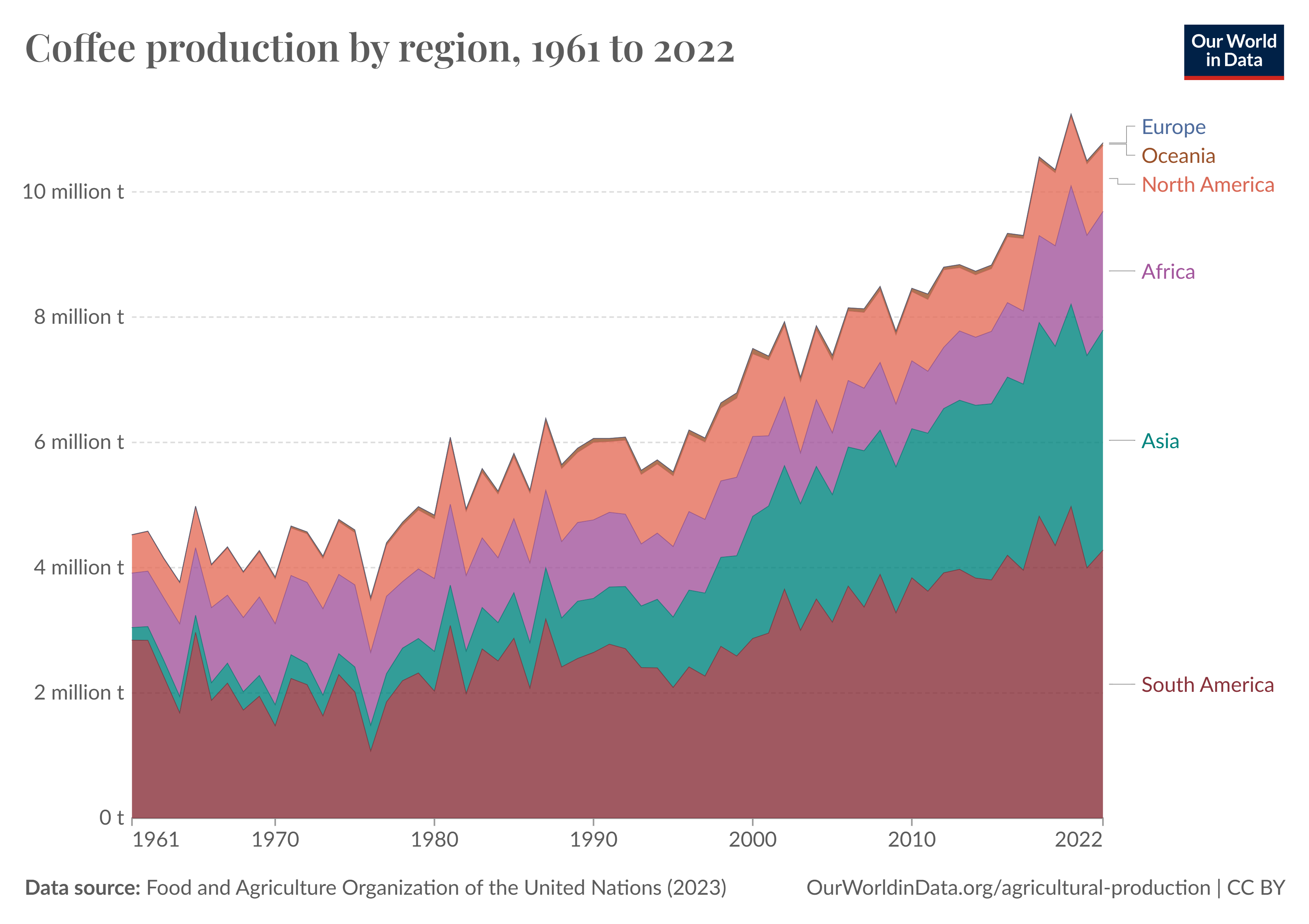
This upward trend underscores the adaptability and resilience of coffee cultivation practices, even amid the gradual warming experienced globally.
NBC’s portrayal of climate change as a primary driver of rising coffee prices reflects a bias by the media outlet toward blaming nearly every bad thing that occurs on climate change. NBC wrongly aggregates short-term weather events and long-term climate trends, and more importantly, ignores the fact that coffee production has increased significantly over recent decades, regularly setting records for production. Rather than looking at actual data, NBC News relied on “expert opinion” without any factual basis. Such sloppy reporting lacks due diligence and fails to provide a comprehensive view of the factors influencing coffee prices, including economic dynamics and agricultural practices. NBC News completely failed to consider these data and variables, instead resorting to a tired and worn-out false climate catastrophe narrative.
US Report Reveals Push to Weaponize AI for Censorship
By Didi Rankovic | Reclaim The Net | December 19, 2024
For a while now, emerging AI has been treated by the Biden-Harris administration, but also the EU, the UK, Canada, the UN, etc., as a scourge that powers dangerous forms of “disinformation” – and should be dealt with accordingly.
According to those governments/entities, the only “positive use” for AI as far as social media and online discourse go, would be to power more effective censorship (“moderation”).
A new report from the US House Judiciary Committee and its Select Subcommittee on the Weaponization of the Federal Government puts the emphasis on the push to use this technology for censorship as the explanation for the often disproportionate alarm over its role in “disinformation.”
We obtained a copy of the report for you here.
The interim report’s name spells out its authors’ views on this quite clearly: the document is called, “Censorship’s Next Frontier: The Federal Government’s Attempt to Control Artificial Intelligence to Suppress Free Speech.”
The report’s main premise is well-known – that AI is now being funded, developed, and used by the government and third parties to add speed and scale to their censorship, and that the outgoing administration has been putting pressure on AI developers to build censorship into their models.
What’s new are the proposed steps to remedy this situation and make sure that future federal governments are not using AI for censorship. To this end, the Committee wants to see new legislation passed in Congress, AI development that respects the First Amendment and is open, decentralized, and “pro-freedom.”
The report recommends legislation along four principles, focused on preserving American’s right to free speech. The first is that the government cannot be involved when decisions are made in private algorithms or datasets regarding “misinformation” or “bias.”
The government should also be prohibited from funding censorship-related research or collaboration with foreign entities on AI regulation that leads to censorship.
Lastly, “Avoid needless AI regulation that gives the government coercive leverage,” the document recommends.
The Committee notes the current state of affairs where the Biden-Harris administration made a number of direct moves to regulate the space to its political satisfaction via executive orders, but also by pushing its policy through by giving out grants via the National Science Foundation, once again, aimed at building AI tools that “combat misinformation.”
But – “If allowed to develop in a free and open manner, AI could dramatically expand Americans’ capacity to create knowledge and express themselves,” the report states.
Featured Video

The Search for Truth: Charlie Kirk’s Assassination One Year Later
or go to
Aletho News Archives – Video-Images
From the Archives
The 9/11 “Double-Cross” Conspiracy Theory
BY LAURENT GUYÉNOT • UNZ REVIEW • SEPTEMBER 6, 2022
Is it true that “9/11 was an inside job”? Yes, insofar as Israel is “inside” the U.S. But for the 9/11 truthers who have identified Israel as the main perpetrators, “9/11 was an inside job” is at best a half-truth, and at worst an integral part of the Zionist operation, like a secondary flag sewn as a lining under the false flag of Islamism. Victor Thorn (1963-2017) wrote in his book 9/11 made in Israel: The Plot Against America (2011): “In essence, the ‘9-11 truth movement’ was created prior to Sept. 11, 2001 as a means of suppressing news relating to Israeli complicity. . . . The slogan ‘9-11 was an inside job’ was quite possibly the greatest example of Israeli propaganda ever devised.” In milder terms, it is “controlled opposition”.
A genuine truth movement would have pointed to Israel as the prime suspect from the start. From day one, it was obvious who would benefit. … continue
Blog Roll
 Aletho News
- Europe’s mounting social chaos… chickens coming home to roost for proxy war against Russia
- US-Russia Diesel Deal Becomes Massive Defeat for Ukraine
- Hormuz and the Looming Economic Catastrophe
- Dhubab offensive, media blitz and the rapid unraveling of Saudi-backed coalition’s new gambit
- Putin Conveys to Trump Iran’s Vision on Possible Conflict Resolution – Kremlin
- The Search for Truth: Charlie Kirk’s Assassination One Year Later
- ‘Harsh reality’: Iran says France seeks monopoly on power and intimidation, not peace for all
- When Will This White House Madness End?
- Huckabee aide goes to ‘unusual lengths’ to portray ‘Israel’ positively
- Trump Announces Diesel Supply Deal With Putin Following Phone Call
- If Americans Knew
- Israeli forces kill another child in Gaza – Daily Update
- Gaza ceasefire exists in name only, say more than 100 organizations
- Nearly 2 Million in Gaza Need Urgent Shelter Assistance as Winter Looms: IOM Chief Warns
- Suppressing Palestinian resistance: US charity under fire for AI monitoring of Gaza classrooms
- Thousands Are Held in Israeli Torture Camps. This Is What Happens Inside
- Israel puts Gaza’s sick, injured, newborn in peril – Daily Update
- Report claimed Mark Levin used by Israeli government to influence Trump
- Over 2,000 Gazans have died awaiting medical evacuation amid Israel’s continued siege
- How a U.S. Diplomat Suppressed and Altered Reports Critical of Israel
- 5 Palestinians Die from Israeli Strikes in Gaza as Relentless Attacks Continue
- No Tricks Zone
- New Study: 50 Years Of The Most Aggressive ‘Net Zero’ Policies Can Only Affect The Global Climate By 0.03°C
- US September “Heat” Was No Record…Many Records Set Decades Ago
- Latest European Green Energy Debacle; Portugal’s Largest Flagship Solar Park Insolvent!
- Green Energy Debacle: German Expert Professor Fritz Vahrenholt Warns Of Severe Economic And Social Consequences
- Two More Paleo Reconstructions Affirm Meters-Higher Sea Levels Across Ireland, Brazil 7000-6000 Years Ago
- New Study: Earth And Venus Surface Warmth Largely Explained By Convection And Lapse Rate, Not CO2 Or Radiation
- 2025 Nature Paper Claiming Worsening Global Drought Gets RETRACTED …Heavily Flawed
- New Study: ‘Global Drought Shows No Detectable Recent Acceleration Under Climate Warming’
- Economic Masterminds: German Socialists Suggest Taxing Productivity Gains Stemming From Using AI
- The South China Sea Has Not Been Cooperating With The Climate Change Narrative

