Le Figaro deletes SCALP missile claim
RT | November 18, 2024
The French daily Le Figaro has walked back its claim that France and the UK have allowed Ukraine to use long-range missiles they have supplied to strike targets deep inside Russian territory. The original claim appeared shortly after the New York Times reported on Sunday that outgoing US President Joe Biden had given Kiev the green light for such strikes.
The UK was the first to provide Ukraine with its long-range Storm Shadow missiles back in May 2023, with France following suit several months later, with its own version of the system, named SCALP. The US delivered its ATACMS rockets in the fall of that year.
Despite Kiev’s repeated requests to allow it to use the weapons to strike targets deep inside Russia, its Western backers had until recently publicly refused to acquiesce, citing concerns over potential uncontrollable escalation.
In its now-amended article on Sunday, Le Figaro originally claimed that the “French and the British had authorized Ukraine to strike deep into Russian territory with their SCALP/Storm Shadow missiles.”
However, in an updated version of the piece, any mention of the supposed permission or SCALP/Storm Shadow rockets is gone. The initial wording is, however, still accessible in a cached snapshot of the report.
Speaking to reporters ahead of an EU ministerial meeting in Brussels on Monday, France’s top diplomat, Jean-Noel Barrot, clarified that there was “nothing new” with respect to Paris’ stance on long-range strikes on internationally recognized Russian territory, adding that such a scenario remained an option.
On Sunday, the New York Times, citing anonymous US officials, reported that the White House had given the green light for Ukrainian strikes on Russia’s Kursk Region, using US-supplied ATACMS missiles.
The NYT and several other media outlets have reported that Washington could extend its approval to allow Ukraine to strike other parts of Russia.
Neither the White House nor the Pentagon has commented on the matter.
In his video address on Sunday, Ukrainian leader Vladimir Zelensky cautiously welcomed the reported development, stressing that “strikes are not carried out with words. Such things are not announced.”
“Missiles will speak for themselves. They certainly will,” he added, without elaborating.
Meanwhile, Kremlin spokesman Dmitry Peskov told media outlets on Monday that if confirmed, Biden’s reported decision would constitute a “qualitatively new round of tension.”
Back in September, President Vladimir Putin warned that since Ukrainian forces lack the necessary capabilities and knowledge to use Western-supplied long-range missiles, permission for strikes deep into Russia would mean that “NATO countries [have] become directly involved in the military conflict.”
Scholz desperately tries to prevent Germany from being seen as open enemy by Russia
By Lucas Leiroz | November 18, 2024
The recent phone call between Olaf Scholz and Vladimir Putin has caused a lot of controversy in Western politics. The German leader has been criticized for his relatively diplomatic stance, since most Western politicians believe Moscow should be treated as an “international pariah”. However, the moves made by the US, France and the UK shortly after Scholz’s call may be the main explanation for his contact with the Russian president.
Recently, the German Chancellor called the Russian President and held a conversation lasting about an hour on sensitive topics in bilateral relations. Commenting on the details of the conversation, Scholz explained that this was an opportunity to reaffirm the German and European stance and to make it clear to Putin that support for Kiev will not wane. He also said that he considers it important to maintain dialogue with Russia, despite his publicly pro-Ukrainian stance on the conflict, and emphasized the necessity of European leaders participating in the diplomatic process. In addition, Scholz surprisingly promised to call Putin again in the future.
“The conversation was very detailed but contributed to a recognition that little has changed in the Russian president’s views of the war – and that’s not good news (…) It was important to tell him [Putin] that he cannot count on support [for Kiev] from Germany, Europe, and many others in the world waning (…) There are those in Germany who consider the lack of negotiations with Putin a good idea, but I am not one of them (…) Soon I will talk to the president of Russia again (…) In my view, it would not be a good idea if there were talks between the American and Russian presidents and the leader of an important European country was not also doing so,” he said.
The reaction to Scholz’s initiative was extremely negative. Vladimir Zelensky said that the German leader had opened a “Pandora’s box” by starting a dialogue with Putin. Zelensky emphasized his unrealistic desires for victory, stating that there will be no “Minsk 3.0” and tacitly promising to take the war to its ultimate consequences.
“Chancellor Scholz told me that he was going to call Putin (…) Now there may be other conversations, other calls (…) We know how to act. And we want to warn: there will be no ‘Minsk-3’. We need real peace,” Zelensky said.
In fact, the conversation between Scholz and Putin seemed at first to be yet another move in the direction of Europe’s attempt to take a leading role in an alleged “peace process” that some EU diplomats have been trying to promote since Donald Trump’s victory. However, the recent announcement that the US has lifted restrictions on “deep” strikes against Russia may be an interesting key to understand the real purpose of the phone call.
On November 17, several Western media outlets announced that Joe Biden had lifted restrictions on the use of American long-range weapons against targets in Russia’s “deep” territory. In addition, shortly after the announcement, rumors emerged, which have not yet been officially denied, that France and the UK had followed the American example and also authorized such operations by Ukraine.
As Russian officials have repeatedly stated, this is an irreversible escalation of the conflict, as it substantially changes the nature of the war. Long-range weapons are not operated by Ukrainian military personnel, but by NATO specialists illegally sent to the battlefield. Until now, Moscow has been tolerant of the use of such weapons inside the New Regions, since the West considers them Ukrainian territories. However, long-range strikes inside the territory that the West recognizes as Russian would mean incursions by NATO itself into the Russian Federation, which would legitimize, in accordance with recent changes in Russian military doctrine, a nuclear response.
Joe Biden is apparently using his final days in the White House to destroy the entire global security architecture and then give to Donald Trump a world at open global war. US’ main military allies in Europe, the UK and France, are following this same path and co-participating in the Biden-led catastrophe. However, Scholz seems cautious. Germany has so far not supplied Ukraine with long-range missiles, with Scholz saying “Germany has made a clear decision about what we will do and what we will not do,” and that “this decision will not change.”
Of course, significant decisions are not made in a hurry. The authorization of the strikes was certainly planned for a long time and Biden chose precisely the current moment, during the G20 Summit in Brazil, to lift the restrictions without causing a major political and media impact, hoping that the world would be distracted by the event bringing together the main global leaders in Rio de Janeiro.
In this sense, it is possible that Scholz knew in advance of what was about to happen and decided to talk to Putin beforehand to make it clear that Germany would not send long-range weapons and, therefore, would not be participating in the escalation promoted by Biden. In this way, Scholz hopes to spare Berlin from the possible devastating consequences that an unrestricted war between Russia and NATO would cause.
There are two facts that advocate this assessment. Scholz recently blamed support for Ukraine for the crisis in his government. The coalition backing the German chancellor has collapsed and he now appears worried about the future of his position. This may be driving him to act desperately to avoid even more negative consequences for his government.
Furthermore, on the same day that the restrictions were lifted, German defense minister Boris Pistorius made a public statement emphasizing Germany’s position not to send long-range Taurus missiles to Ukraine, stating that such a move would mean direct German involvement in the conflict.
“The Taurus would not be a game changer. Our mission is different. We now have to ensure that Ukraine continues to receive sustainable supplies (…) It would only be tenable to deliver [these weapons] if we determine and define the targets ourselves, and that is again not possible if you don’t want to be part of this conflict,” he said.
It is difficult to believe that all these moves are mere coincidence. Scholz has acted irresponsibly since the beginning of the conflict, but he seems completely incapable of dealing with an uncontrolled escalation. The chancellor is afraid of what the war could bring to Germany and to himself if the point of no return is crossed. His call to Putin was a desperate attempt to free Germany from the consequences of the war. It remains to be seen whether he will have enough political strength to resist the pressure from his own Western “partners” from now on.
Lucas Leiroz, member of the BRICS Journalists Association, researcher at the Center for Geostrategic Studies, geopolitical consultant.
To secure peace in Ukraine, Trump must review misguided western sanctions
By Ian Proud | Strategic Culture Foundation | November 17, 2024
Following Trump’s election, there has been much speculation about how the war in Ukraine might end. But to understand how it might end, it’s vital to understand how it started.
The origins of the war in Ukraine can be traced back to the ouster of Ukrainian President Yanukovych in February 2014. Russia labelled it a coup, realists would say it was unconstitutional change in power, and U.S. & British officials would shrug their shoulders.
After Russia occupied Crimea and as insurgency broke out in the Donbas, the French and Germans launched a peace process involving the Presidents of Russia and Ukraine. From this so-called ‘Normandy format’ emerged two peace deals named the Minsk agreements. But the UK was sidelined from the peace process and the Americans suspicious of it.
Left out, Britian, supported by the U.S., pushed sanctions as the primary vehicle to contain Russia, running counter to what the French and Germans were trying to achieve. By the summer of 2015, the Minsk agreements had become sidelined, and sanctions were set in stone.
Since that time, Russia has become the most sanctioned country on the planet. Thirty-three western countries, led by the USA, imposed more than twenty thousand sanctions against Russian people and companies. That’s fifteen times more sanctions than Iran in a distant second place.
If we could completely cut Russia’s economic ties with the west, so the theory went, then that would be so damaging that Russia would have to withdraw from Ukraine. Western powers therefore sanctioned everything that they could, from money, ships, oil, gold, diamonds, weapons and all manner of hi-tech components. But from a very early stage, it was clear that sanctions weren’t altering Russian policy to Ukraine, quite the opposite.
When I left the Foreign Office in 2023, the UK government with its western partners, had gone through all the sanctions that they thought might weaken Russia. The west could probably find more people or entities to sanction. But policy makers never really gripped Russian gas, as some European countries still rely on it. And anyway, the destruction of the Nordstream pipeline solved that conundrum. Russian oligarchs that had political connections in the west were spared as were Russian companies that owned factories in the USA, to prevent American job losses. But we hit most things and neared the bottom of the barrel.
Yet, Russia’s economy always seemed to bounce back. That’s partly because, sanctions were never as big a deal as other events that moved the global economy, such as the oil price collapses in 2014 and 2016 and Covid. But it was also because Russia continually adapted its macroeconomic policy to absorb and, in the end, profit from sanctions. Following an immediate post-sanctions contraction of economic growth in 2022, Russia has grown more strongly than the western countries that imposed sanctions.
Western powers therefore needed something stronger, so sanctions evolved into a political tool to isolate Russia on the world stage. The USA, European Union and other countries including Japan and Australia sanctioned every possible type of economic, social and cultural activity involving Russia. Western academics no longer collaborate with Russian academics. Russian airliners can’t pass over western airspace and vice versa. Border posts have been closed or minimised. Russia can’t compete in international sporting events or even the Eurovision song contest.
Russian Ministers are subjected to indignant walkouts by western diplomats and ministers at international gatherings. Ordinary Russian people were denied a weekend ParkRun. Ukraine did its part, cancelling the Russian Orthodox church and going on a propaganda offensive with any western company that sold goods with the word ‘Russia’ in their branding.
And yet, outside of the west, Russia’s standing on the global stage doesn’t seem to be in decline. In a process accelerated by the Ukraine war, Russia, with China, has spearheaded a rapid shift by the developing world to create their own formats for dialogue and cooperation. There are over 200 countries on this planet, so the wealthy ‘west’ is in a minority. The BRICS group has grown rapidly, with a long queue of countries waiting to join, including NATO member Turkey. Vladimir Putin has an International Criminal Court arrest warrant out on him, yet he still travels freely to ‘friendly’ countries, where he receives the red-carpet treatment. He recently hosted a successful BRICS summit in Kazan while war continued to rage in Ukraine.
War started in February 2022 a few days after the Ukrainian government finally signalled the death knell of the Minsk peace agreements. But the point is that the Minsk agreement was [not] necessarily bad; it’s simply that the U.S. and UK invested significant efforts in ensuring its failure.
Sanctions never looked likely to prevent war, nor force its end, despite the death or injury to over one million people and a vast exodus of Ukraine’s population. War in Ukraine became reduced to the brutal, bloody town by town fighting in Europe after D-Day, while life in the west, and in Russia, carried on almost as normal. Fighting alone, Ukraine has never had sufficient resources to survive and never will.
There is a strong case that sanctions created the conditions for war to erupt, by undermining the very peace process – the Normandy Format – that was established to prevent it. And that the west’s continued blind faith in sanctions took us to the brink of a doomsday scenario, more horrific than the use of nuclear weapons in Hiroshima and Nagasaki.
Western leaders, not wanting war themselves, focussed blindly on supporting Ukraine for as long as it takes. But the notion of ‘as long as it takes’ became tarnished with increasing numbers of western politicians started complaining that it is taking too long. Not least as the economics and demographics of war still show that Russia can continue fighting for as long as it takes, and that Vladimir Putin has the domestic political support to do that.
So, beyond the hype, if Trump is serious about ending the war in Ukraine, he must look at its origins. A ceasefire alone won’t cut it with Putin. There needs finally to be a peace proposal that includes targeted sanctions reduction. That, and a final reckoning with the NATO membership issue, the brightest red line of all.
New York’s New Equal Rights Act Will Weaken Parental Rights, Critics Say
By Michael Nevradakis, Ph.D. | The Defender | November 12, 2024
New York voters last week approved Proposition 1, a ballot measure that adds abortion rights to the state constitution and bars discrimination based on pregnancy and pregnancy outcomes.
The measure, passed with 61.9% of the vote, also protects against discrimination based on age, gender identity or sexual orientation, according to CBS News, which said, “Opponents say the vague language opens up a can of worms that could cause more harm than good.”
Indeed, some legal experts argue that instead of promoting equality, the Equal Rights Act, as the measure is officially known, enshrines discrimination and strips away parental rights.
Opponents of the amendment argue it would “open the door to men using women’s bathrooms and transgender athletes to compete on sports teams that match their gender identities” and “allow minors to get abortions without parental consent.”
New York attorney Bobbie Ann Cox campaigned against Proposition 1. She said the amendment was “unnecessary” because “anti-discrimination laws are already in place.”
Cox told The Defender :
“No new rights were endowed by Proposition 1. In fact, it is the opposite, because Proposition 1 actually restricts our rights. The language is clear: It says we (the people) are not allowed to ‘discriminate’ against the named classes, nor are our firms, corporations or organizations.
“This gives the government license to control us, our firms, corporations and organizations — because who do you think will determine what is deemed ‘discrimination’ or ‘hate speech?’ The government will.”
Michael Kane, founder of Teachers for Choice, told The Defender that Proposition 1 is state lawmakers’ response to grassroots efforts supporting medical freedom and parental rights during the COVID-19 pandemic. He said the state needed this law because “Teachers for Choice and our coalition partners have stopped all assaults on medical freedom and parental rights in Albany for the past five years.”
Kane added:
“Because of that, a group of Democrats from New York City put forth this ‘Equal Rights Amendment’ and rolled their wishlist of legislation into it, to go straight to the New York Constitution — because they knew they couldn’t get any of these crazy pieces of legislation passed in a real democratic process.”
Cox said the amendment “will result in complete totalitarian control” over New Yorkers. “It will flip our norms upside down, and give the government license to abolish our freedoms of speech, assembly, religion, family units and so on,” she said. “It is a Trojan Horse of the most epic kind.”
Kane said that despite the many protections the amendment promises, there are “no protections in Proposition 1 for health freedom, religious freedom or parental rights.”
Instead, the amendment “can and will be used to get parents out of the picture of all medical decisions for children,” Kane said. “This is why Proposition 1 says ‘you can’t discriminate’ against anyone based on ‘age.’”
Amendment gives government ‘power to discriminate against anyone’
The measure amends Article 1, Section 11 of the New York State Constitution on the equal protection of laws, which bans discrimination on the basis of “race, color, ethnicity, national origin, age, disability, creed, religion, or sex, including sexual orientation, gender identity, gender expression, pregnancy, pregnancy outcomes, and reproductive healthcare and autonomy.”
The second paragraph of the amendment adds:
“Nothing in this section shall invalidate or prevent the adoption of any law, regulation, program, or practice that is designed to prevent or dismantle discrimination on the basis of a characteristic listed in this section, nor shall any characteristic listed in this section be interpreted to interfere with, limit, or deny the civil rights of any person based upon any other characteristic identified in this section.”
According to Cox, this language enshrines reverse discrimination, giving the government “the power to discriminate against anyone they want, at any time, for any reason.” She also criticized the measure’s “vague” language.
“The language of Proposition 1 is vague and extremely broad,” Cox said. “It’s unconstitutional to have overly broad laws for this very reason — the true intent cannot be known, which then leads to courts making the decisions piecemeal, which causes inconsistencies and massive confusion.”
Cox said the ballot did not provide voters with the full text of the amendment. Voters saw only a summary that described the measure as an amendment that “would protect against unequal treatment.”
Writing on Substack last month, Cox called the summary “a total sham, as it doesn’t even give the whole story.” She said the amendment “will unleash a massive tidal wave of chaos upon our citizenry, upon normalcy, and upon all that we hold dear in our society,”
She said she believes the amendment will weaken parental rights, abolish girls’ sports and single-sex spaces, legalize reverse discrimination and result in the “chilling of free speech.”
Cox said claims that the amendment protects the right to an abortion were a “lie.” She said the word “abortion” did not appear on the ballot and that the measure differs from laws passed in other states that explicitly make clear what the state’s laws are regarding abortion.
New amendment to face constitutional challenges
According to CBS News, New York joined seven other states that have “passed measures protecting abortion rights” after the 2022 U.S. Supreme Court decision overturning Roe v. Wade.
Organizations including the New York Civil Liberties Union and the League of Women Voters of New York supported the measure.
Opponents of the amendment had difficulty overcoming support from these groups and key state officials, including Attorney General Letitia James.
Cox told The Defender she has formed a task force to explore legal avenues for challenging the amendment. She said policies the new administration may introduce might facilitate legal actions challenging the amendment.
“It’ll depend on what is done by Trump’s administration and how it is done,” Cox said.
Kane said the amendment “can and will be challenged as being a violation of the federal Constitution.”
This article was originally published by The Defender — Children’s Health Defense’s News & Views Website under Creative Commons license CC BY-NC-ND 4.0. Please consider subscribing to The Defender or donating to Children’s Health Defense.
Your Local Epidemiologist is worried. This is reassuring…
Mainstream “experts” are panicking about what is in store for public health with vaccine realists at the helm. Here’s my response.

By Madhava Setty | An Insult to Intuition | November 10, 2024
Katelyn Jetelina, PhD is an epidemiologist, biostatistician and mother of two little girls. She writes the “Your Local Epidemiologist” newsletter on substack which boasts over a quarter million subscribers. Those familiar with her content know that while well-intending, she serves as a mouthpiece for the CDC, explaining in easy to follow language what “the experts” are saying.
Her followers are passionate about her work. This is evident from the preponderance of comments which paint her as a true hero of the pandemic. Notably, she only allows comments from paid subscribers. She has created a massive echo chamber and one that pays her some serious dividends. If I remember correctly she has well over ten thousand paying subscribers, earning her an income that far exceeds mine as a full-time anesthesiologist.
I don’t mean to imply that she is a shill who exploits her audience by creating content that she knows is misleading or false. She believes in what she is doing, but she is suffering from the same cognitive blocks that many did four years ago: the experts know the most, we need to listen to them and grant them leniency when they get things wrong.
I have been a paid subscriber to her newsletter for almost two years. I pay to leave comments, hoping to encourage her audience to regard her position with a more critical eye. I have occasionally made some arguments that received a great deal of support from her non-paying readers. Those who contribute materially to her substack, on the other hand, usually respond with rebuke.
She has often derided the work of Children’s Health Defense. A year ago, I outed myself in her comment section, informing her that I was involved with the content RFK Jr’s organization produces as the science editor for The Defender. I expected that she would respond to my questions and critiques. What an excellent opportunity to dismantle the biggest “misinformation spreader” in front of her large audience. She never did.
Not surprisingly, her camp is in full crisis mode now. Here’s her latest:
In this brief article she encourages her audience to be strong, citing the following strategies:
- Building bridges instead of manning the barricades by finding common ground, which requires active engagement and humility. (It always helps me focus on one fact: No one wants to die. Then I move from there.)
- Recognizing what you say matters. That is, if you want people to hear you. Through literally the words we use, the framing, and the approach.
- Communicate with empathy, as anger and shame will only drive people further away.
- Listening (not simply hearing) so we can respond better to the needs on the ground. Americans need their questions answered, not to be told what to believe.
- Making strategic choices about which battles to fight, at what time, and at what level of government. Political capital is as scarce as financial resources—and needs to be allocated carefully.
This is a sensible strategy for everyone on both sides of the public health/vaccine debate. However she continues to double down on her basic hypothesis: The rise of vaccine skepticism is the direct result of misinformation.
I think she is wrong. Vaccine hesitancy and distrust of the medical orthodoxy is the direct result of true information that has finally percolated into public discourse despite the greatest effort to censor dissent I have ever witnessed.
Here is the comment I left on her article:
“Please don’t panic folks. We are witnessing a shift towards transparency and rigor from our agencies of public health. I understand why this readership is freaking out. This is an echo chamber. The real voices of clarity do not pay for a subscription here so you haven’t heard from them, and you don’t seek them out. You are only listening to voices like Katelyn’s who echo CDC PSA’s and their data as if it cannot be questioned.
I am a physician and an engineer. I left my practice in 2021 to work for RFK Jr’s Children’s Health Defense as the Senior Science Editor for The Defender, CHD’s on-line publication. I have since left, but I still stand behind every single article I have written and edited for that organization. I have been leaving comments on this substack for two years. Katelyn has never responded to any of my questions and critiques.
Isn’t that odd? One would think that she would be able to dismantle everything I share here in this public forum for the greater good.
Let me explain why there is such a growing “antivax” movement championed by Bobby and highly published physicians like Joe Ladapo. It has very little to do with so-called misinformation spreaders. It has to do with the public finally being informed about some difficult truths. The public is a lot smarter than you think.
1) Vaccine manufacturers cannot be sued if their products are found, even in an isolated case, to have caused harm. There is no other product like that. Obviously, there is much less incentive to do the proper safety testing if there are no consequences. The public knows this.
2) Nobody can deny that there has been an explosion of childhood diseases concomitant with the expansion of the CDC’s childhood immunization schedule following the National Childhood Vaccine Injury Act of 1986. OF COURSE correlation doesn’t equal causation. But if there was some causation, this is EXACTLY what we would be seeing. The public knows this.
3) The CDC could easily dispel all suspicion by doing a large retrospective study examining the health of vaccinated and unvaccinated children with regard to chronic disease rates. They have the data. They have not done the study and they refuse to release the data. Why?? There is no reasonable answer to this question except for the obvious: They don’t want to know the answer. The public knows this too.
4) During the Covid pandemic, the mRNA shots were authorized after an initial observational period of only six weeks on average. Note that the median observational period was two months. Mathematically, that means that half of the 40,000 participants were observed for less than four weeks at most. There is NO WAY to make any claim about long term safety yet the CDC simply states that these shots have been rigorously tested for safety. That is a lie. The public knows this now.
5) I have never met a single person, scientist or otherwise, who has read RFK Jr.’s “The Real Anthony Fauci”, who could debunk any of his claims. That book was released at the height of the pandemic and excoriates the record of the pandemic czar, yet no defamation lawsuit was ever filed. Why is that? Obviously it is because everything is true and the receipts are there for all to see. The last thing the CDC and vaccine manufacturers want would be to have the evidence for Kennedy’s claims appear in open court. Their strategy is to keep the evidence out of the public’s eye. It is an extremely effective strategy that has worked for decades.
6) RFK Jr.’s message is finally getting out, and he is making sense. Why on earth would anyone be against having vaccines tested by the same standards we use for medicines? Instead of pointing out the obvious, that that is an excellent idea for public health, the media runs hit piece after hit piece on this man. For every person who reads those character attacks and smiles a knowing smile, there are two more that see this as a desperate attempt to squelch some difficult truths.
7) Every other commercial on legacy media is for some sort of pharmaceutical product. It’s a joke. These companies don’t pay hundreds of millions of dollars to run ads to sell more product. They are buying good media coverage. People are seeing this too.
8) The idea that the pharmaceutical industry is out to improve public health is ridiculous. These are for profit companies and their executives’ first priority is to the shareholders. They don’t make the most money curing diseases. That eliminates demand for their product. They aren’t trying to kill everybody. That also decreases demand. Whether you are willing to consider it or not, the most profit is made when the public suffers from a chronic disease epidemic. That is what we have. Our Covid mortality rates were among the highest of any country despite access to the shots and our overpriced health care system. This is staring us in right in the face.
I have no animosity towards those who disagree with me. I am just calling it as I see it. This is the way the public is starting to see it too. Every effort to discredit the movement towards a healthy America with pejoratives like “antiscience” and “antivax” is going to backfire more and more. The public is waking up. Relax and give people like Kennedy and Ladapo a chance. Let’s see what happens. We all want our kids to grow up healthy and happy.
Madhava Setty, MD
Against Rubio
By Connor Freeman | The Libertarian Institute | November 17, 2024
Marco Rubio’s foreign policy vision is the antithesis of America First as he advocates for wars and increased military spending in Ukraine, the Middle East, and the Asia-Pacific. During the 2015/2016 GOP presidential primaries, Rubio was a fervent supporter along with Hillary Clinton, of a no-fly-zone in Syria which could have sparked World War III. “The United States should work with our allies, both Arab and European, to impose a no-fly zone over parts of Syria,” Rubio said.
Rubio has been on the America Last side of every foreign policy issue since he took office, he was a strong supporter of Hillary Clinton’s disastrous regime change war in Libya and he opposed Barack Obama’s modest troop withdrawal in Afghanistan after his surge accomplished nothing besides making the Taliban stronger and getting more American soldiers killed.
More recently, Rubio has insisted that Israel should attack Iran “disproportionately” which is a direct call for an all out war with Iran and risks the safety of US troops in the region.
Rubio co-authored an amendment to the 2024 NDAA with Senator Tim Kaine, Hillary Clinton’s former running mate, that would prevent Donald Trump or any future president from exiting the free-riding, war-seeking NATO alliance without Senate approval or an Act of Congress.
Regarding Beijing, he has boasted, “We need a military focused on blowing up Chinese aircraft carriers.”
Moreover, Rubio supports keeping American troops in harm’s way in Iraq indefinitely and even opposed repealing the outdated 2002 AUMF which unconstitutionally authorized the catastrophic Iraq War. Likewise, he backs the open-ended illegal US occupation of roughly a third of Syria, launched by Obama, which Trump attempted to end and finally bring our troops home.
Biden Authorizes Ukrainian Long-Range Strikes Into Russia Using ATACMS Missiles – Reports
By Ilya Tsukanov – Sputnik – 17.11.2024
The US and its allies spent months debating whether or not to give Ukraine the go-ahead to use its NATO-provided long-range strike systems to target Russia. In September, President Putin warned that allowing Kiev to use its Western long-range missiles on Russia would mean NATO’s direct participation in a war against the Russian Federation.
President Biden has signed off on the Ukrainian military’s use of US-made ATACMS missiles to try to help defend its faltering positions in Ukrainian-occupied areas of Russia’s Kursk region, the New York Times reported on Sunday, citing US officials apprized of the situation.
Officials told the newspaper that they “do not expect the shift” in policy “to fundamentally alter the course of the war” (NYT’s phrasing), and indicated that Biden could further authorize Kiev to use the weapons in directions besides Kursk in the future.
Washington reportedly expects the ATACMS to be used to strike troop concentrations, military equipment, logistics, ammunition depots and supply lines, all with the goal of “blunt[ing] the effectiveness” of the ongoing Russian military operation to clear Kursk of Ukrainian forces.
According to NYT’s information, some Pentagon officials opposed delivering the missile systems to Ukraine in the first place due to the US Army’s limited supply. Others reportedly expressed fears that their delivery and use could escalate the conflict and even prompt direct Russian retaliation against US and NATO forces – something President Putin has explicitly warned about.
The ATACMS go-ahead also appears to be connected to to the increasingly dire situation for Ukrainian forces across the front, with US officials said to have become “increasingly concerned” about the Ukrainian army being “stretched thin by simultaneous Russian assaults in the east, Kharkov and now Kursk.”
President-elect Trump’s statements about seeking to quickly end the conflict have also reportedly weighed in the outgoing administration’s decision, NYT said.
What Are ATACMS?
The Army Tactical Missile System (ATACMS) is a solid-fuel, surface-to-surface ballistic missile with an effective firing range of up to 300 km, and a maximum velocity during boost phase of up to Mach 3, or 1 km/second.
The weapon’s ordinance varies wildly depending on model and block number, and can include 500 pound (230 kg) penetrating high-explosive blast fragmentation warheads, or other explosives weighing between 160 and 560 kg, including anti-personnel and materiel cluster ‘bomblets’. ATACMS also vary in terms of the guidance systems they carry, which can include inertial guidance and/or built-in GPS.
An unspecified number of ATACMS were ‘quietly’ shipped to Ukraine in the spring of 2024, with the US restricting their use to the local battlespace, and the Russian military regularly reporting on the downing scores of the weapons in fighting over the summer.
President Putin’s September warning about the implications of NATO countries freeing Kiev’s hand to use long-range missiles to target areas deep inside Russia seemed to have influenced alliance plans to do so, with the bloc publicly backpeddling on its plans later that month.
The CIA/MI6 Skripal Conspiracy Exposed
By Kit Klarenberg | Global Delinquents | November 17, 2024
On October 14th, a much-delayed inquiry into the mysterious death of Dawn Sturgess, a British citizen who died in July 2018 after reputedly coming into contact with Novichok nerve agent left in England by a pair of Russian assassins, finally commenced. Already, the public show trial has unearthed tantalising evidence gravely undermining the official narrative of the poisoning of GRU defector Sergei Skripal and his daughter Yulia in Salisbury, in March that year.
These revelations emerged despite the British state’s best efforts to sabotage the inquiry, and curtail its ability to ascertain the truth. For one, the Skripals have been prevented from testifying, despite formally requesting to do so. Such is the apparent risk of Russian intelligence attempting to target the pair anew, not even their video-recorded police interviews from the time can be entered into evidence. Meanwhile, the urgent question of what British intelligence and security services knew, and when they knew it, will not be explored.
Yet, primary source evidence British spies and their American counterparts were well-aware the two Russians accused of attempting to murder the Skripals were visiting Britain in advance of their arrival has lain in plain sight for years. Whether such foreknowledge implies the CIA and MI6 were in reality behind the abortive hit remains a matter of interpretation – but that the CIA and MI6 sought to exploit the Russian presence in Salisbury for their own malign purposes is beyond doubt.
In January 2021, US watchdog group American Oversight released hundreds of pages of emails sent to and from the personal address of Mike Pompeo, CIA director January 2017 – April 2018. In many cases, the emails were official Agency communications discussing matters of extreme sensitivity, conducted off-books. The records – heavily redacted under the US National Security Act – show that on March 1st 2018, Pompeo was approached by two high-ranking CIA operatives, who asked for a meeting on a “very urgent matter”. They added:
“A very positive opportunity is within reach but requires your engagement because of the urgency…I am convinced that this is a very promising opportunity.”
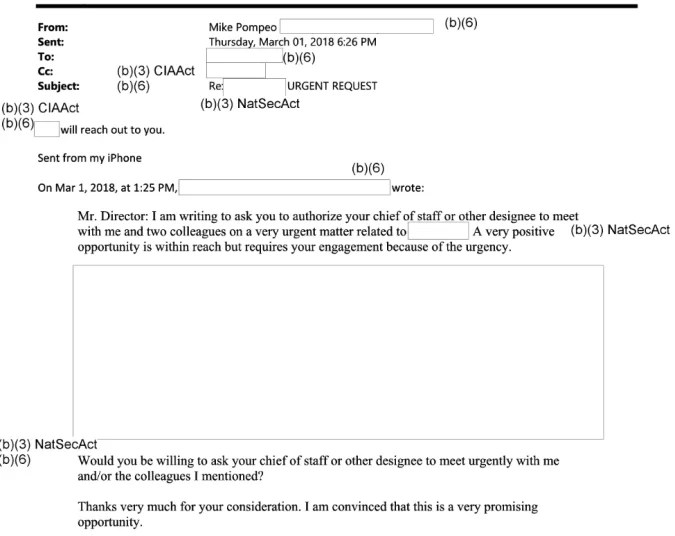
Pompeo responded in the affirmative, and the meeting went ahead early the next morning. Underlining their covert summit’s importance, the emails indicate CIA staffers were preparing to pitch the “positive opportunity” to the Agency’s chief from the early hours of March 2nd. Eerily, the email requesting Pompeo’s signoff on the proposal was sent less than half an hour after Ruslan Boshirov and Alexander Petrov, Skripal’s alleged assassins, purchased plane tickets from Moscow to London Gatwick for their Salisbury visit.

‘Strong Option’
Who emailed Pompeo is redacted, although then-CIA deputy director Gina Haspel is an obvious candidate. A longstanding Russia hawk, who cut her Agency teeth recruiting spies in the Soviet Union in the years before its collapse, she twice served as the CIA’s London station chief twice – from 2008 – 2011, and 2014 – 2017. Sergei Skripal arrived in Britain in July 2010 via a grand spy swap during her first tenure, which was negotiated by Haspel’s longtime collaborator Daniel Hoffman, then-CIA Moscow station chief. He was among the very first sources to publicly blame Russia for the Salisbury incident.
During Haspel’s “unusual” second spell in London, Skripal’s enduring connection to his homeland, and yearning to return, would’ve been well-known to British intelligence. Serendipitously, BBC veteran Mark Urban serendipitously interviewed the GRU defector in the year prior to his poisoning. He recorded that Skripal was “an unashamed Russian nationalist, enthusiastically adopting the Kremlin line in many matters, even while sitting in his MI6-purchased house.” Coincidentally, Urban once served in the same tank regiment as Pablo Miller, Skripal’s MI6 recruiter/handler, and Salisbury neighbour.
Moreover, former Kremlin official Valery Morozov, an associate of the GRU defector likewise exiled to Britain, claimed days after the poisoning that Skripal remained in “regular” contact with Moscow’s embassy in London, and met with Russian military intelligence officers there “every month”. He also flatly repudiated any suggestion the purported nerve agent attack on Sergei and Yulia was the work of Russian spies:
“Putin can’t be behind this. I know how the Kremlin works, I worked there. Who is Skripal? He is nothing for Putin. Putin doesn’t think about him. There is nobody in Kremlin talking about former intelligence officer [sic] who is nobody. There is no reason for this. It is more dangerous for them for such things to happen.”
That this information was not shared with Haspel stretches credulity. The Washington Post has reported how her time in Britain made her the personal “linchpin” of the CIA’s relationship with MI6, the Agency’s “most important foreign partner.” Her British colleagues gushed to the outlet, “she knows them so well… they call her the ‘honorary UK desk officer’.” Haspel regularly drew on this experience to “stabilize the transatlantic alliance” between London and Washington, which was frequently strained while she was CIA director May 2018 – January 2021.
This friction resulted in no small part from Trump legitimately accusing British chaos agents of “conspiring with American intelligence to spy on his presidential campaign,” charges that “rattled the British government at the highest levels.” Strikingly, a cited example of Haspel stabilising CIA relations with MI6 provided by WaPo was convincing a highly reluctant President to back the Western-wide expulsion of Russian diplomats, encouraged by London in the Salisbury incident’s wake.
How Haspel pressed Trump over Salisbury was revealed in April 2019. The New York Times reported that the President at first downplayed Skripal’s alleged poisoning and refused to respond, believing the apparent attack to be “legitimate spy games, distasteful but within the bounds of espionage.” However, Haspel successfully lobbied Trump to take the “strong option” of expelling Russian embassy staff in the US, by providing him with British-sourced “emotional images”:
“Haspel showed pictures the British government had supplied her of young children hospitalized after being sickened by the Novichok nerve agent that poisoned the Skripals. She then showed a photograph of ducks British officials said were inadvertently killed by the sloppy work of the Russian operatives… Trump fixated on the pictures of the sickened children and the dead ducks. At the end of the briefing, he embraced the strong option.”
‘Operation Foot’
The New York Times exposé caused a stir upon release, not least because the “emotional images” described had never hitherto been published or referred to in the mainstream media. While the Skripals giving bread to three local boys to feed ducks in Salisbury’s Avon Playground on March 4th 2018 was initially widely reported, no media outlet, government minister, spokesperson, health professional or law enforcement official had ever previously claimed children and/or waterfowl were “sickened” after coming into contact with Novichok. The reverse, in fact.
On March 26th that year, the Daily Mail recorded that the boys given bread by the Skripals – one of whom apparently ate some – were “rushed to hospital for blood tests amid fears they’d been poisoned,” but promptly discharged after being given “the all-clear.” Moreover, two days after the New York Times article was published, British health officials issued a statement not only refuting the report entirely, but denying any children were admitted to hospital in Salisbury as a result of Novichok exposure at all.

Subsequently, the New York Times radically amended its piece, removing any suggestion Haspel showed Trump photos of Novichok victims provided by the British. In fact, the newspaper reverse-ferreted, she had “displayed pictures illustrating the consequences of nerve agent attacks, not images specific to the chemical attack in Britain.” The question of whether the aforementioned images did exist, and were forged by British intelligence for the explicit purpose of bouncing Trump into a hostile anti-Russia stance, remains thoroughly open five-and-a-half years later.
After all, British spies had been planning and hoping for a mass defenestration of Russian diplomats globally, as a prelude to all-out war with Moscow, for years by that point. In January 2015, MI6/NATO front the Institute for Statecraft (IFS) a document setting out “potential levers” for achieving “regime change” in Russia, spanning “diplomacy”, “finance”, “security”, “technology”, “industry”, “military”, and even “culture”. One “lever”, which IFS listed thrice, stated:
“Simultaneously expel every [Russian] intelligence officer and air/defence/naval attaché from as many countries as possible (global ‘Operation Foot’).”
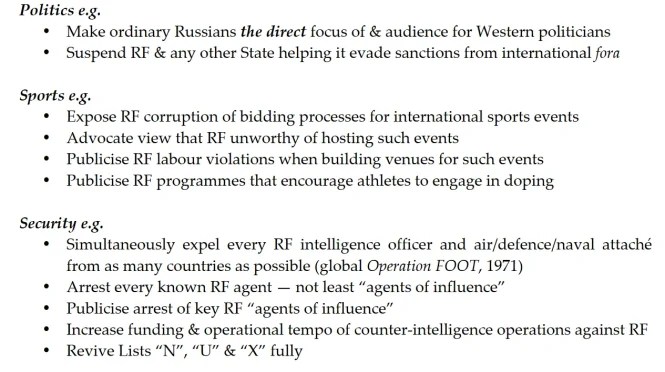
Operation Foot saw 105 Soviet officials deported from Britain in September 1971. Several mainstream media outlets referenced this incident when reporting on London successfully corralling 26 countries – including, of course, the US – into expelling over 150 Russian diplomatic staff in response to the Salisbury incident in March 2018. As a result, IFS got one step closer to its longstanding objective of “armed conflict of the old-fashioned sort” with Russia, which “Britain and the West could win.”
Fast forward to today, and Britain and the West are on the verge of losing that conflict once and for all. Meanwhile, the Salisbury incident’s ever-fluctuating official narrative continues to shift radically, in ways large and small. Contrary to all prior media reports on the matter, the Dawn Sturgess Inquiry has now been told one boy given bread by the Skripals to feed ducks actually “got sick” as a result, and he and his friends “were unwell for a day or two afterwards.”
This fresh rewriting neatly ties in with the highly controversial claim, unflinchingly clung to by British authorities, that the Skripals were poisoned with Novichok smeared on the doorknob of Sergei’s home on the morning of March 4th 2018, before heading into Salisbury. As subsequent investigations will show, available evidence – including Yulia Skripal’s own hospital bed testimony – points unmistakably to the pair being attacked elsewhere, at another time and by another means entirely, with British and American intelligence square in the frame.
Tulsi Gabbard, the new U.S. intel chief… a brave call to debunk NATO’s war propaganda in Ukraine
Strategic Culture Foundation | November 15, 2024
The nomination of Tulsi Gabbard as the United States intelligence supremo has sent shockwaves through the American and NATO establishments. The Western news media – always a dutiful echo chamber for deep-state policymakers – is reverberating with horror at her nomination by President-elect Donald Trump.
That reaction is a good sign that something significant has happened.
The potential appointment of Gabbard as Director of National Intelligence (DNI) could be the most consequential decision yet by Trump in forming his cabinet.
If one move could signal the foreign policy direction under the 47th president, Gabbard’s nomination is the most salient and potentially the most constructive on the key issue of world peace.
Time magazine headlined with the U.S. intelligence community’s response to Gabbard’s selection. “We are reeling,” it was reported. Reuters reported that the Western “spy world is vexed.” Meanwhile, in The Atlantic, an establishment mouthpiece, Gabbard was denounced as a “threat to the security of the United States.”
That’s a staggering charge to levy on the person who is going to be head of national security.
It is almost hilarious to see the apoplectic reaction in the U.S. establishment and its servile mainstream media.
CNN’s news anchor Jim Sciutto was distraught in sharing his concerns with colleague Richard Quest, remarking that Gabbard’s views “contradict” almost everything about U.S. foreign policies.
If we may paraphrase that exchange, the sentiments were: Oh my God, how terrible! Whatever shall we say now about all the lies we have been spinning for years and getting fat salaries for?
After all, as far as the U.S. corporate media are concerned, especially those channels and newspapers associated with the Democrats, the establishment, and the deep state intelligence apparatus, Tulsi Gabbard has been smeared as a “Russian asset.”
It is indeed profoundly challenging – one might even say, earth-shattering – to the deep state if Gabbard becomes Director of National Intelligence.
As with Trump’s other cabinet picks, the nominations will have to be approved by Senate panels. So there is a while to go before her post is confirmed. A lot can change or be derailed.
Trump’s cabinet picks this week have been keenly watched by observers trying to discern the future foreign policies of the next presidency, which begins in January after his inauguration. Trump’s early call-ups this week of hawkish figures Pete Hegseth for defense and Marco Rubio for secretary of state caused dismay among some critics of U.S. foreign policy who wanted a fundamental break from warmongering and hostility toward Russia, China, and Iran, among others.
Then came Trump’s selection of Tulsi Gabbard. The former Congresswoman has gained wide popular American and international respect for her outspoken and independent criticism of U.S. militarism in the Middle East and Ukraine.
However, the U.S. political establishment and media have slandered her as a “traitor” and a “Russian asset” for her views criticizing Washington’s regime change wars in Syria and the Middle East. In 2017, Gabbard traveled to Syria and met with President Bashar al-Assad. She spoke out against Washington’s covert policy of sponsoring terrorist militia for regime change in Damascus. For telling the truth, she was vilified as an “apologist” for Assad.
More recently, the “apologist” slur was thrown at her again after Gabbard opposed the U.S. and NATO’s arming of the Kiev regime and the proxy war against Russia. She said that the conflict in Ukraine could have been avoided if Russia’s security concerns about NATO’s threatening expansion had been taken into consideration. How refreshing to hear that sanity and objectivity.
In a twisted way, the CNN clapping seals are correct. Her views on the conflict in Ukraine do indeed contradict the U.S. establishment and media’s propaganda about “Russian aggression.” Her views unequivocally debunk the wall-to-wall “news” propaganda as false and serve as a warning to the public that NATO’s lies are dragging the world into a nuclear war.
The role of Tulsi Gabbard in the second Trump administration – if she makes it through Senate vetting – cannot be overstated.
In her DNI capacity, she is the intel supremo who oversees the CIA and NSA. Through her daily briefings to the president, Gabbard will play a crucial role in President Trump’s foreign policymaking. Given Trump’s freewheeling style, it can be fairly assumed that Gabbard’s input into policymaking will have much greater influence than the secretaries of defense or state. She will call the shots, and Trump will designate Hegseth, Rubio, and others to follow suit on the policies.
Some critics of Gabbard have pointed out that she is unduly supportive of Israel. That is a valid concern.
Nevertheless, in relations with Russia, China, and Iran, Gabbard has been a trenchant and tenacious voice of reason. She has courageously advocated peaceful negotiations and diplomacy along with historical understanding as a way to avoid military conflicts. Her reasonable emphasis on diplomacy illustrates just how extremist the U.S. “mainstream” has become in its promotion of wars and more wars.
Gabbard is a veteran of the Iraq War and appears to have been deeply affected by the human cost of wars. She has repeatedly condemned endless wars that are endemic to U.S. imperialism. Her honesty in criticizing the failings and faults of American policy, calling it out often as criminal, is admirable.
She quit the Democrat party in 2022, condemning it for its relentless warmongering policies. She endorsed Trump for the White House because, she said, he would prevent World War Three by stopping the reckless proxy war in Ukraine.
President-elect Trump has said that he wants to end the conflict in Ukraine as one of his priorities.
Some commentators have expressed skepticism about the chances of Trump making a peace settlement in Ukraine. Even senior Russian figures have said they do not expect significant change in U.S. policy.
Still, Russia has clearly stated that it is open to dialogue and diplomacy. Moscow has said it will respond positively to Trump’s outreach. And Trump is reported to be ready to appoint an envoy of credible stature to explore a peaceful solution in Ukraine.
Now, there’s the rub. Russia is adamant that its conditions for peaceful settlement must involve its original objectives: no Ukraine membership of NATO, denazification of the Kiev regime, and acceptance of realities on the ground, meaning recognition of Russia’s regained historical territories. Russia will not accept a frozen conflict, and given the rapid military advances it is making against the NATO-backed regime, Moscow is in a position to fully demand its terms.
If Trump is serious about finding a peaceful resolution, he will have to accept Russia’s terms. That will require an understanding of how that conflict started and how to reverse it. No bluster, no bravado, and certainly no browbeating Russia.
Tulsi Gabbard can provide the necessary counsel to Trump upon which a lasting peace settlement can be made because she understands the history of that conflict and has debunked the false propaganda that the U.S. establishment, the Democrats, some Republicans, and the corporate media have peddled for far too long.
In the meantime, Russia must advance towards its righteous goals in Ukraine. And right now, the best contribution to peace is to defeat the corrupt Nazi regime in Kiev in short order.
Democrat Prosecutors Vow to Continue Trying to Jail Trump Allies as Party Floats Shadow Cabinet Idea
By Ilya Tsukanov – Sputnik – 17.11.2024
Republicans defeated Democratic candidates across the spectrum of electoral contests on November 5, winning the presidency, the House and the Senate. Federal and state lawmakers and governors have drawn up ‘resistance’ plans, while strategists debate the pros and cons of fighting Trump “to the death” versus “playing nice.”
Democratic prosecutors pursuing Donald Trump in his four federal criminal cases reportedly plan to ease off the pressure on the president-elect, but have vowed to continue fiercely pursuing his surrogates and allies, both at the federal and state levels.
“In all likelihood, the state criminal cases will be put on hold during Trump’s presidency. If they try to continue with the prosecutions, or even to impose a stayed sentence, I suspect the decisions will be reversed on appeal. It is even possible that the cases will be dismissed,” Syracuse University law professor Gregory Germain wrote in a post-election analysis of Trump’s legal status.
Citing the election interference case, Germain pointed to the Supreme Court’s July ruling that former presidents enjoy “absolute” immunity with respect to their “core constitutional powers,” which includes some protection against criminal prosecution, and said he’s confident that the Supreme Court would “uphold a self-pardon” for Trump, although such pardoning power doesn’t extend to state prosecutions.
For Trump’s allies, however, among them former chief of staff Mark Meadows, attorney Rudy Giuliani, and other lawyers and aides, the situation is not as rosy, Washington beltway outlet The Hill said in an analysis.
“In fact, with Trump effectively out of the picture, any limitations the Supreme Court’s presidential immunity decision would have put on the prosecution – barring certain evidence and causing further delays – are now gone,” the outlet said, paraphrasing Georgia State University law professor Michael Kreis.
Georgia Democrat and District Attorney Fani Willis, pursuing Trump in the Georgia election interference case, has vowed publicly to continue pursuing the president-elect, notwithstanding the election outcome.
“If someone has an indictment in this office, no matter who they are, we continue to pursue those charges,” Willis told local media this week. “I’m here for eight more years, is my plan. So if that’s what it takes for us to get some justice in some cases, we come to work every day, we’ll come to work and look for justice.”
Willis’s status in the Trump case is precarious and presently being decided by a Georgia appeals court after the discovery of her secret romantic relationship with Nathan Wade, the top special prosecutor in the case, which a judge earlier ruled to be a sign of “impropriety.”
Arizona AG Kris Mayes has similarly signaled that her office will not be dropping charges in the “fake electors” prosecution against Trump’s allies.
“I have no intention of dropping that case,” she said. “We won’t be cowed. We won’t be intimidated. And patriots across the country must stand up for our Constitution, for what is lawful.”
The judge in that case quit after the discovery of a controversial email which defendants said showed “utter contempt” for Trump, signaling intolerable bias.
Similar charges are facing Trump surrogates in Michigan, having been previously dismissed or challenged in Nevada, New Mexico and Pennsylvania.
Resistance’s New Idea: Shadow Cabinet
Trump’s imminent return to the White House with GOP majorities in both chambers of Congress has prompted Democrats to brainstorm strategies on what to do over the next 2-4 years, from “resistance” to his agenda at the state level by governors and local legislatures, to fighting his cabinet picks in the Senate by dividing Republicans against one another. Some strategists, pundits and politicians have also called for selective cooperation with the incoming administration, including picking their battles carefully and looking for “common ground when… circumstances dictate.”
Another idea – floated by Democratic-leaning media and North Carolina Democratic Congressman Wiley Nickel last week, is setting up a “shadow cabinet” – a British political tradition of appointing ‘shadow ministers’ (or in the US case ‘shadow cabinet heads’ for executive branch departments, like the Departments of Defense or Justice), to scrutinize government policy.
The shadow cabinet system presently exists in Commonwealth countries, and a handful of other nations, including Denmark, Italy, Japan, and occasionally, France (where the practice is uncommon).
“We need new ideas,” Nickel said of the initiative. “Democrats have to stop playing defense and start going on offense. It’s not enough to say we’re against Trump and his Project 2025 agenda. We have to say what we’re for, and that’s what’s really behind this idea, to get folks there to counter every cabinet agency, every position that Trump appoints.”
Nickel has called his idea “democracy’s insurance policy,” and indicated that the 26-member shadow cabinet could be appointed by Democratic House and Senate leaders.
“It’s really easy,” the lawmaker assured, floating Senator Adam Schiff as Shadow Attorney General, Representative Adam Smith as Shadow Pentagon chief, Representative Suzan Delbene as Shadow Commerce Secretary, and Representative Rosa Delauro as Shadow Health and Human Service Secretary, to name a few.
In the British tradition, shadow cabinets have no executive power. This means that even if the Democrats manage to set up an American version, they will not be able to implement their own agenda.
Featured Video

How Many More Gulf States Get Dragged Into Trump’s Iran War?
or go to
Aletho News Archives – Video-Images
Book Excerpt
How CIA used Ukraine as a platform for covert war against Russia
By Stephen KINZER | Responsible Statecraft | November 17, 2026
The following is an excerpt from Stephen Kinzer’s new book: Boiling Point: How America Brought War to Ukraine (Henry Holt and Company, November 2026)
Huddled beside an airstrip in southern Germany, a handful of anti-Communist warriors prepared to fire the first shots of the Cold War. A CIA officer from the Munich Operations Base was in charge. The Hungarian crewmen he had recruited stood nearby in flight suits. With them were two Ukrainian exiles who had volunteered to parachute into their homeland. They were code-named Apostle 1 and Apostle 2. Each carried forged identity papers, a miniature radio transmitter, a pistol, a machine gun, hand grenades, a purse full of gold coins, and a poison pill to be taken in case of capture. An unmarked C-47 transport plane was waiting.
The CIA officer overseeing this operation, a twenty-six-year-old Yale graduate named Stephen Tanner, watched the plane take off and disappear into the night. It flew over East Germany and Poland, then crossed into Soviet airspace. As it approached the Ukrainian city of Lviv, a cargo bay swung open. The two Ukrainians jumped into the darkness. Their mission was to link up with partisan fighters, seize territory, and establish a clandestine base through which the CIA could send them weapons.
That flight, on September 5, 1949, was the first American act of covert war in Ukraine. … continue
Blog Roll
 Aletho News
- Iran rejects unlimited IAEA inspections amid continued military threats
- A Bridge Too Far
- David Barnea in the Bundestag – Mossad as a model for Germany’s Intelligence Services?
- Rome blasts Kiev after Italian lawmakers added to ‘kill list’
- Another €45 bn down the drain: Why the EU is desperate to waste more cash on Zelensky
- In Europe, Anxiety Is Mounting—EU Unity Is Cracking at Every Seam
- How CIA used Ukraine as a platform for covert war against Russia
- European Commission proposes new loan for Kiev
- How Many More Gulf States Get Dragged Into Trump’s Iran War? | Matt Bracken
- US-Iran escalation: The side effects and benefits of low intensity war
- If Americans Knew
- An error has occurred; the feed is probably down. Try again later.
- No Tricks Zone
- Argentina’s Perito Moreno Glacier Joins Antarctica and Arctic In Defying Doomsday Melt Claims
- New Study: Barents Sea Temperatures Were Warmer And Sea Ice Less Extensive In The 1700s Than Today
- German Authorities Start Initiative To Evaluate Public Register For Climate “Disinformation” Spreaders!
- Zonal Asymmetry of Temperature Change in the Antarctic Circumpolar Current
- New Study: The Net Fossil Fuel Contribution To Rising Atmospheric CO2 Has Been Zero For 500 Years
- Germany’s Green Energy Transition Becoming Increasingly Expensive…Another 6 Trillion Euros!
- Sudden Stratospheric Warming, Powerful El Niño Combination May Lead To Extreme Europe Cold, Energy Crisis!
- Two New Studies Find Thwaites Glacier Melt Cannot Be Driven By Human Activity Or A Warming Ocean
- E-Cars Reduce CO2 Emissions By Only 41% Compared To Internal Combustion Engine Vehicles
- Predictions Made By Renowned Climate Professor Over Past Decades Have Been Proven To Be Poor

