Iran demands ‘restitution’ for Kiev’s deadly attack
RT | July 29, 2026
Iran has demanded compensation from Ukraine over a deadly strike on a cargo ship after Kiev’s foreign minister initially claimed that “Iran has no standing to pretend to be a victim,” only to call Tehran a day later and assure it that the attack was unintentional and that Kiev did not seek escalation.
Iranian Foreign Minister Abbas Araghchi said on Tuesday that he had spoken with his Ukrainian counterpart, Andrey Sibiga, following the attack on the cargo ship Anna in the Caspian Sea last week.
“Was assured by Ukrainian FM that the attack on an Iranian ship was unintentional and Ukraine seeks no escalation,” Araghchi wrote on X. “Iran does not seek escalation either, but made clear any attack on our citizens or interests is unacceptable. There must be restitution for losses.”
Sibiga described the call as a “frank conversation” and said Kiev wanted to “avoid unnecessary escalation.” He maintained that Ukrainian operations were aimed at countering Russia and were “never intended to target civilian vessels or people,” while calling on Tehran to end its alleged support for Moscow.
The conciliatory language marked a sharp shift from Sibiga’s public response a day earlier, when he denounced Iran’s complaints as “unjustified and groundless” and referred to the Iranian government as “the regime in Teheran.”
“Iran has no standing to pretend to be a victim,” Sibiga wrote on Monday, accusing Tehran of supplying Russia with weapons and dismissing its references to the UN Charter as “absurd.” He also claimed that Iran was attempting to divert attention from Russian strikes on Ukrainian shipping in the Black Sea.
In recent weeks, the Russian military has escalated long-range strikes on port infrastructure and shipping targets in the Black Sea, seeking to disrupt the flow of military supplies and weapons to Ukraine. Multiple freighters, combat and auxiliary vessels, and various port installations have been struck, according to the Defense Ministry in Moscow.
Ukrainian forces struck the Anna early on Saturday, triggering an explosion that killed one Iranian sailor and injured another.
The Iranian Foreign Ministry condemned the attack as “reckless,” summoned Ukraine’s acting chargé d’affaires and warned that it reserved the right to protect the country’s security and national interests.
Ukrainian leader Vladimir Zelensky subsequently praised the “very strong results” of strikes on vessels he claimed were involved in transporting military cargo. Ukraine’s ambassador to Israel similarly claimed that the Anna had been carrying components for drones and missiles, while Tehran maintained that the vessel and its cargo were entirely civilian.
Before Tuesday’s call, Araghchi had accused Zelensky of attacking the commercial vessel “at Israel’s behest” and attempting to draw Europe deeper into the conflict. He warned that the killing of the Iranian sailor “cannot go unanswered.”
The incident involving the Iranian vessel comes amid growing accusations that Kiev is expanding its activities in the Middle East. Iraq’s national security adviser claimed this week that authorities had arrested several groups that confessed to carrying out attacks on behalf of Ukraine. Kiev rejected the allegations as “unfounded and unsubstantiated.”
Iraq cancels PM’s Riyadh visit after US-Saudi aggression amid calls for response
Press TV – July 29, 2026
Iraq has postponed Prime Minister Ali al-Zaidi’s planned visit to Saudi Arabia after the joint US-Saudi attack on Popular Mobilization Units (PMU) positions across several Iraqi provinces, as officials and lawmakers called for a military response.
The strikes came as millions of Muslims from Iraq, Iran, Pakistan, Azerbaijan and other countries around the world were converging on the Iraqi city of Karbala to mark Arbaeen, one of the largest religious gatherings in the world.
Some observers have viewed the timing of the attacks as a show of anger toward the gathering, which has been marked by expressions of solidarity with the Axis of Resistance and condemnation of US-Israeli wars and expansionist policies.
According to Iraqi media, al-Zaidi’s trip to Saudi Arabia was postponed indefinitely after the attack. The prime minister also ordered the country’s National Security Council to convene an emergency meeting following the security developments and the airstrikes on several areas across Iraq.
Former Iraqi Prime Minister Mohammed Shia’ al-Sudani said, “We condemn the Saudi-American aggression against the headquarters of the Popular Mobilization Forces in the strongest terms.”
“This aggression is a blatant violation of Iraq’s sovereignty and a clear violation of international law and the United Nations Charter,” Sudani said.
“Iraq reserves all of its legitimate rights guaranteed under international law, including the right to defend its sovereignty, territory and people.”
He added that “any violation of Iraq’s security and stability is unacceptable and cannot be met with silence.”
According to a statement carried by Iraq’s official news agency, the PMU said the casualty toll from the attacks remains preliminary and could rise as special committees continue field assessments and gather more accurate information.
The organization denounced the strikes as a “joint US-Saudi terrorist attack” targeting its official headquarters in the provinces of Baghdad, Wasit, Nineveh, Basra, Kirkuk, Karbala and Diyala.
The assaults caused extensive material damage to PMU headquarters, military vehicles, machinery and equipment in the targeted locations, the statement said.
The Iraqi resistance movement added that its investigative teams remain deployed to assess the full extent of the casualties and destruction, noting that the number of those killed and wounded may increase as rescue and assessment operations continue.
Earlier, the PMU announced that several of its bases in different parts of Iraq had come under attack, describing the strikes as “terrorist” and reporting casualties among its personnel.
The PMU said it viewed the attacks as “a highly dangerous escalation, a blatant violation of Iraq’s territorial integrity, and an attack on the country’s official security institutions.”
The attacks prompted growing calls from Iraqi lawmakers for a decisive response.
Two Iraqi lawmakers called on the government to respond decisively, with one urging military retaliation and another demanding the cancellation of al-Zaidi’s visit to Saudi Arabia.
Saud al-Saadi, a member of the Iraqi Parliament and the Huqooq Movement, called on the commander-in-chief of the armed forces to assume his responsibility and issue an order for a military response to the Saudi-American aggression.
“Show [Saudi Crown Prince] Mohammed bin Salman and the other slaves their true worth and size,” he said, according to Iraqi media.
“The blood of Iraqis is not cheap, and the dark record of Washington and Riyadh in our beloved country will not be erased without a response that preserves Iraq’s dignity. It is not acceptable to settle for disgraceful and humiliating statements,” he added.
Another Iraqi lawmaker, Faleh al-Khazali, described the strikes as “terrorist attacks” carried out by “the Saudi and American enemy,” saying they targeted Iraqi security positions in several provinces.
“The attacks on our security positions constitute blatant aggression and a violation of Iraq’s sovereignty,” al-Khazali said, adding that “the Iraqi government and its prime minister bear the responsibility to courageously defend the Iraqi people and the country’s national interests.”
Iraqi lawmaker Hussein Nima al-Battat also condemned the attacks as a “blatant violation of Iraq’s sovereignty and of international laws and norms,” warning that they constituted a dangerous escalation threatening the country’s security and stability.
Al-Battat urged the government to take all necessary military, political, diplomatic and legal measures to defend Iraq’s sovereignty and protect its people, while also calling for the cancellation of the prime minister’s scheduled visit to Riyadh as a demonstration of Iraq’s rejection of the attacks.
The Iraqi resistance had warned Saudi Arabia earlier against waging such strikes against Iraqi territory following Riyadh’s claims that its oil facilities were targeted from Iraq.
In a statement released on Monday, the resistance rejected the Saudi allegations as “baseless” and urged Saudi authorities to stop blaming Iraq and instead end Riyadh’s blockade on Yemen.
Political analyst Jumaa al-Atwani told Lebanon’s Al Mayadeen television that the joint US-Saudi attack was aimed at weakening the PMU and retaliating against Iraq over its solidarity with Iran.
“The American pressure on Iraq has intensified because of Iraq’s position in solidarity with Iran, especially after the massive funeral procession for the martyred leader of the Ummah,” he said.
Atwani said the millions who participated recently in the ceremonies in Karbala and Najaf for funeral of martyred Leader of the Islamic Revolution Ayatollah Seyyed Ali Khamenei reflected Iraq’s role within the Axis of Resistance.
Al-Atwani said Saudi Arabia maintains close coordination with the United States and described the PMU as “a major problem for Washington.”
He also suggested that regional plans involving Saudi Arabia and Syria have been discussed to justify attacks on Iraqi military positions.
US conjoins the wars in Eurasia, West Asia
By M. K. BHADRAKUMAR | Indian Punchline | July 29, 2026
On Friday, even as the US President Donald Trump was announcing the end of the latest round of the conflict with Iran, the Pentagon unobtrusively extended the war theatre to the Caspian Sea in a hugely consequential geopolitical thrust. The incident hardly figured in the western news cycle.
But CGTN, perhaps sensing that the US could be stealthily spreading its war to the Caspian region, reported on July 25, “US missiles struck a Revolutionary Guards Navy headquarters in the Ziba Kenar area of the Caspian Sea province of Gilan, according to a security official in Gilan quoted by Iranian media. Provincial authorities said US projectiles had also struck the port city of Bandar Anzali, according to the Iranian Labor News Agency.”
Gilan province has a Caspian coastline that borders Azerbaijan in the west, with which Iran has had a troubled relationship in the recent years following the Transcaucasian region’s geopolitical gravitation towards the western orbit. Unsurprisingly, Russia’s ties with Azerbaijan and Armenia also have suffered a severe erosion following the ascendance of US (and NATO) influence in Transcaucasia.
Trump is the new sheriff in town in Baku and Yerevan with Turkey’s president Recep Erdogan playing the role of undersheriff. To add to the complexity, Azerbaijan is a close ally of Turkey, and Turkey’s ties with Moscow are somewhat under the weather in the most recent years following the covert takeover in Syria by al-Qaeda affiliates backed by Ankara.
On the other hand, Turkey has never been a reliable friend for Iran, either, historically. During the war with Iran last year, Turkey opened its air space to the US aircraft to attack Iran from Azerbaijan, which also happens to be one of Israel’s key operational bases against Iran.
Taking advantage of the Ukraine conflict, western intelligence and NATO have made big inroads into the Caucasus and Caspian regions bordering Russia’s Muslim republics and are challenging Iran’s security when it already faces an existential threat from the US-Israeli alliance.
The western media played down the US air strike on Bandar Anzali last week, which is Iran’s biggest port on the Caspian coast and is a vital transportation hub linked to Iran’s national railway grid. The Caspian Sea makes a strategically vital supply route between Russia and Iran. Bandar Anzali is for Tehran what Odessa Port is for Kyiv where it receives western arms supplies. Indeed, Iran and Russia have a close military relationship.
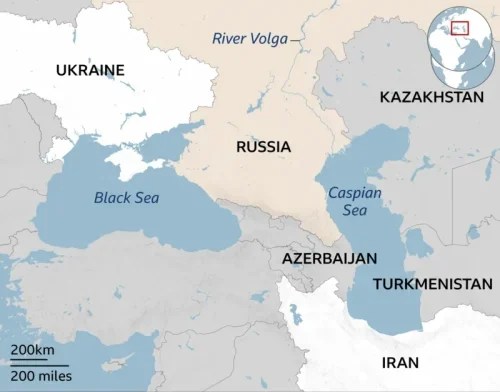
Therefore, Ukraine’s attack on an Iranian commercial vessel in the Caspian Sea in Russia’s territorial waters on Saturday, the first such attack since the start of the Russia-Ukraine war, is anything but a stray incident. Kyiv claimed responsibility for striking an Iranian vessel, signalling that one of Eurasia’s most stable security zones is now vulnerable to the direct spillover of the Ukraine conflict.
The Kremlin took note and spokesman Dmitry Peskov remarked at his daily briefing on Tuesday that the “geography of the Kiev regime’s terrorist activities is expanding.” Citing the incident, he added cryptically that all this “again highlights the need for a successful and complete special military operation.”
The attack on the Iranian ship was carried out from a distance of approximately 1,200 kilometres. Moscow has repeatedly alleged that such precise targeting over very long distances is way beyond Ukraine’s military capability and is only possible with the West’s direct participation. Foreign Minister Sergey Lavrov touched on it again on July 24: “A significant portion of the support provided to Vladimir Zelensky (from the West) comes from the United States. This is not only because the Americans sell weapons to the EU, which then transfers them to Ukraine, but also because the United States provides intelligence and reconnaissance, Starlink remains operational, and advanced technologies that require specialist expertise on the battlefield do not find their way there by accident. That is the way things are.”
Interestingly, the New York Times report on the Ukrainian attack appeared under the headline Ukraine’s Strike on an Iranian ship Could Bring Two Wars Closer. The Wall Street Journal headline runs as follows: Two Wars Converge in the Caspian Sea as Ukraine Hits Iranian Supply Line to Russia. Al Jazeera gave a further twist saying Ukraine’s Zelenskyy set to meet Trump as Iran and Ukraine wars converge. A BBC report acknowledged that “The incident marked the first direct link between the wars in Iran and Ukraine.” It added, however, “But some experts question the wisdom of Kyiv’s decision to pick a fight with Iran.”
The impact of the Iran conflict initially seemed negative for Ukraine. It threatened to divert Trump’s already wavering attention. However, there has been not only no let-up in US support for Ukraine but in certain ways, the US involvement has only intensified by escalating the covert operations in Russian territory. Admittedly, these tactical advantages may not add up eventually, as Moscow is also stepping up attacks all across the frontline in Ukraine with a view to end the war soon.
The reported likely reassignment of General Sergey Surovikin, who at one time was commander of Moscow’s war effort in Ukraine, would signal a massive offensive going forward. The highly decorated general had previously served in Chechnya and Syria during conflicts that had overtones of proxy wars similar to Ukraine.
The Ukrainian attack on the Iranian ship could well be a calibrated move by Washington. Ukraine acted simultaneously with the US bombing of Gilan province, suggesting a degree of coordination. The Iranian ambassador to Russia disclosed that the ship was hardly 5 miles from the mouth of River Volga when the attack took place.
If the Moscow-led regional concord on the Caspian’s collective security is weakened, extra-regional military and security rivalries could vitiate the region impacting Russia and Iran’s core interests. Tehran views the Caspian Sea incident not as an isolated tactical event but as evidence of a broader shift in its surrounding security environment.
Last August, US-Azerbaijan-Armenia tripartite agreement was signed in the White House that will create a major transit corridor in Transcaucasia to be named the Trump Route for International Peace and Prosperity. Plainly put, the US and NATO are seriously contesting Russia’s pre-eminence in the Caspian / Central Asian regions.
Evidently, the Caspian Sea is no longer the conflict-free zone it was once believed to be. A new arena of geopolitical competition, fundamentally reshaping the security landscape of Eurasia and potentially marking the emergence of a new geographic theatre of conflict, has surfaced last weekend.
The Second Circuit Again Violated the Rights of the Amish
By Aaron Siri | Injecting Freedom | July 28, 2026
At the end of last year, the United States Supreme Court vacated the Second Circuit’s decision that enabled New York State to persecute the Amish for refusing to inject pharma products in violation of their religious beliefs, and it remanded the case (Miller v. McDonald) to the Second Circuit to reconsider its illiberal and unconscionable decision.
Instead of abiding by the Constitution and protecting the religious freedom of the Amish, the Second Circuit again ruled against the Amish. So, we will be going back to the Supreme Court.
And yes, the 168 unvaccinated Amish children related to this case are far healthier than American children who are vaccinated. We provided sworn expert evidence attesting that among a random sample of 168 U.S. children, one would expect to find (based on the background rate of chronic disease among U.S. children) 31 cases of environmental allergies, 15 cases of ADHD, 10 cases of asthma, 9 cases of food allergies, and 4 cases of ASD. Yet, the 168 unvaccinated Amish children whose families New York wants to persecute are free from the chronic health conditions—all related to some form of immune system dysregulation—that plague the vaccinated communities in New York.
Since vaccination is supposedly about improving health, and the Amish who do not vaccinate are clearly healthier, one would expect New York to leave them alone. But that is not how this religion works. The vaccine zealots in New York cannot stand that the Amish refuse to abandon their beliefs in favor of the religious beliefs held by the New York officials regarding vaccines. These “health” officials are willing to sacrifice the way of life and belief system of these Amish children and their community (which have kept them far healthier), if they refuse to bend the knee to adopt cult-like vaccine beliefs.
These “health” officials also apparently cannot stand that the Amish children are healthier and are even willing to wage war against them until they submit and receive every vaccine New York demands—so they can be just as “healthy” as all the children outside the Amish community.
The Amish earnestly seek to avoid conflict but because violating their sincerely held religious beliefs is not an option, they have been placed in an impossible position. We, along with co-counsel, intend to continue to litigate on behalf of the Amish to defend their freedom to practice their religion in peace.
Ukraine using mobilization threat to pressure journalists – media
RT | July 28, 2026
Ukrainian law enforcement agencies are increasingly using the threat of mobilization to pressure journalists, Strana has claimed, citing employees of several Kiev-based outlets.
The report comes as Ukrainian media have documented numerous cases of violent forced conscription, while investigators have uncovered a series of high-profile corruption scandals.
Revoking draft exemptions or conscripting journalists’ relatives has become one of the main tools for pressuring media workers, Strana wrote on Tuesday. One publisher was allegedly told by uniformed officers that his exemption from military service could be revoked within minutes unless he removed several articles from his website, prompting him to comply. In another case, an editor was reportedly threatened with the mobilization of her son if she published an article critical of the leadership of a Ukrainian law enforcement agency.
The allegations follow the detention of investigative reporter Yevgeny Shulgat in Kiev on Monday. According to Hromadske, police stopped the taxi he was riding in, handcuffed him and took him to a recruitment center. Kiev police and conscription officers claimed the reporter had failed to undergo a mandatory military medical examination and issued a summons.
Hromadske insisted that documents in its possession showed Shulgat had not breached mobilization requirements and suggested the detention was linked to his investigative work. Shulgat has authored a series of investigations into alleged corruption involving Ukrainian officials, particularly within the Security Service of Ukraine (SBU).
The allegations come amid a string of high-profile corruption scandals. Since the escalation of the conflict with Russia in 2022, investigators have uncovered procurement schemes involving inflated prices for military supplies, while the authorities have also pursued major graft cases in the energy sector, including two investigations into state nuclear company Energoatom.
Ukraine’s mobilization campaign has also drawn mounting criticism. Videos circulating on social media have repeatedly shown recruitment officers forcibly detaining military-age men, while Ukrainian media have documented deaths at recruitment centers and cases of men with serious medical conditions being declared fit for military service.
Chad announces withdrawal from International Criminal Court Treaty
MEMO | July 28, 2026
Chad announced on Monday that it is withdrawing from the Rome Statute, the founding treaty of the International Criminal Court (ICC), saying it has formally notified the United Nations of its decision.
In a statement, Chad’s Ministry of Foreign Affairs said the ICC had become “a politicised and biased tool” against countries in the Global South, particularly in Africa, and argued that the court lacked balance and effectiveness in addressing cases from different regions.
The ministry said the court’s focus on African cases prompted the government to reassess its membership in the Rome Statute.
According to the statement, the decision followed what the government described as a comprehensive review of the ICC’s performance since its establishment in 2002. While criticizing the court’s effectiveness, Chad said it remained committed to promoting justice and protecting human rights through national and regional institutions.
Under Article 127 of the Rome Statute, a state’s withdrawal takes effect one year after formal notification is received by the United Nations. The treaty also provides that withdrawal does not exempt a state from obligations arising before the withdrawal becomes effective, including cooperation with investigations and proceedings already underway.
Chad’s announcement follows similar moves by several other countries. According to the Chadian government, Mali, Niger, and Burkina Faso submitted notices of withdrawal earlier this month, while Venezuela has also announced plans to begin the withdrawal process, citing concerns over what it describes as bias within the court.
The announcement also comes amid developments within the ICC itself. Member states recently voted to remove Prosecutor Karim Khan from office following allegations of misconduct. The allegations have received international attention, and the proceedings have taken place under the court’s internal governance procedures.
Netanyahu will reject US demands for withdrawal from Lebanon, Gaza, Syria if asked: Report
The Cradle | July 28, 2026
Israeli Prime Minister Benjamin Netanyahu has told cabinet ministers that Washington wants Israeli soldiers to pull back from positions in Syria, Lebanon, and Gaza, and that he does not intend to comply with US demands, Channel 13 reported on 27 July.
The report, which cites unnamed security sources familiar with the matter, states that US officials want the Israeli army to carry out a “series of withdrawals” across the three fronts.
Channel 13 does not state whether Washington is seeking full or partial pullbacks; however, Netanyahu told the ministers that he “intends to stand on my own two feet and resist.”
“I will strongly oppose this and tell them no,” he reportedly said.
The comments come as Netanyahu has set off for Washington for a meeting set for Tuesday with US President Donald Trump, after which he is scheduled to attend the funeral services for Republican Senator Lindsey Graham, one of Washington’s most persistent warmongers and an unwavering backer of Israel, who died on 11 July.
Israeli forces are currently occupying major stretches of land in Lebanon, Syria, and Gaza.
Israel maintains positions in border and hilltop areas in southern Syria, especially near the Golan frontier, where the military has established footholds inside Syrian territory, and regularly conducts raids against locals.
What began as a pretext to aid Druze communities battling Damascus’s extremist troops and Syrian government-backed Bedouin tribes after the ousting of former Syrian president Bashar al-Assad has become a so-called “buffer zone.” Israel has since used it to launch incursions into Lebanon.
In Lebanon, Israel maintains its so-called “Yellow Line” in the south that runs from the Mediterranean coast in the west to the Mount Hermon area in the east, extending around 10 kilometers inland and, in some parts, passing the Litani River.
Israel’s occupation of Lebanon has been marked by repeated ceasefire violations, including near-daily strikes, demolitions, and incursions. Beirut cited more than 2,000 violations in late 2025 alone, while hundreds of thousands of Lebanese remain displaced.
Many dozens of Lebanese villages within the Yellow Line have been completely demolished, with the intent of ethnically cleansing the area and creating a dead zone to which residents cannot return.
According to comments from February by Israeli Minister of War Israel Katz, Israeli troops will be staying in Lebanon and Syria “indefinitely.”
In Gaza, following almost three years of genocide and near-daily ceasefire violations since last October, Israel continued to slowly edge its Yellow Line in the strip further under the cover of night.
The most recent reporting says the controlled area has expanded to about 65 percent of Gaza and that the line has been shifted westward in places by hundreds of meters and, in some areas, by more than a kilometer.
Netanyahu has publicly said he wants to expand Israeli control over the strip further up to 70 percent.
Satellite imagery released on 21 July and reviewed by AP and Haaretz shows that the Israeli military has dug a 23-kilometer earthen trench along its new positions, cutting the devastated enclave in two.
In one stretch of southern Gaza, the trench sits more than a kilometer past the Yellow Line.
Russia warns Ukraine expanding ‘terrorist activities’ beyond Europe
Press TV – July 28, 2026
The Kremlin has warned that Ukraine is expanding the scope of its “terrorist activities” beyond Europe, citing Kiev’s recent involvement in destabilizing Iraq, attacks on strategic infrastructure in Germany and Kazakhstan, and the attack on an Iranian commercial vessel in the Caspian Sea.
Speaking at a press briefing on Tuesday, Kremlin spokesman Dmitry Peskov said the reported involvement of Ukrainian-linked groups in Iraq demonstrated that “the geography of the Kiev regime’s terrorist activities is expanding,” warning that such actions pose a growing threat beyond Europe.
“We see that the Kiev regime continues its terrorist activities,” Peskov said, arguing that the trend “again highlights the need for a successful and complete special military operation.”
The Kremlin spokesman also pointed to attacks carried out by Kiev beyond the battlefield, citing the sabotage of the Nord Stream gas pipelines, strikes against infrastructure linked to the Caspian Pipeline Consortium, and an attack on an Iranian commercial vessel in the Caspian Sea on Saturday.
Peskov’s remarks came after Iraqi authorities said they had identified and dismantled several sabotage cells responsible for a series of bombings across the country that were planning further attacks with backing and support from Ukraine.
Ukraine has denied involvement, saying Baghdad had presented no evidence to support the claims and had not raised the issue through diplomatic channels before the comments were made public.
Iraq’s National Security Adviser Qasim al-Aboudi, however, said authorities had arrested several suspects who admitted working for Ukraine and carrying out attacks on Iraqi facilities, describing the case as complex and still under investigation.
Ukraine also targeted an Iranian cargo vessel in the Caspian Sea on July 25, killing one sailor and injuring several others. Tehran said the vessel was a civilian ship carrying iron from Russia to Iran, while Ukraine alleged it was transporting Iranian drone and missile components to Russia.
Iranian Foreign Minister Abbas Araghchi said the attack had been carried out at the behest of the Israeli regime in an attempt to draw Europe into the war in West Asia, warning that the strike “cannot go unanswered.” The Foreign Ministry also said that Kiev had sought to spread insecurity by attacking the Iranian commercial vessel.
US use of Italian military bases in the conflict with Iran shows lack of autonomy
Press TV – July 28, 2026
The debate over US forces using Italian military bases in the ongoing US-Israeli aggression against Iran has rekindled in Italy.
Earlier this week, three opposition lawmakers, Francesco Silvestri, Alessandra Maiorino, and Arnaldo Lomuti, formally demanded the government provide clarification regarding the departure towards West Asia of 12 F-16 fighter jets, at least 2 US tankers, and a number of Triton drones, used for maritime intelligence and surveillance, from Italian bases.
The three members of the lower house questioned Italy’s support of the Epstein coalition under bilateral treaties with the US.
Press TV spoke with Arnaldo Lomuti on the matter.
The government must explain on what basis Italy is allowing the US to use our bases in this war of aggression against Iran.
Weeks ago, we were told that the use of our bases falls under the bilateral treaties that were forced upon us by Washington more than 70 years ago.
… These treaties are classified; so how can Parliament start a serious debate on the role played by Italy in this war of aggression?
About a month ago, NATO Secretary General Mark Rutte revealed during a TV interview that Rome had allowed more than 500 US military aircraft to take off from American bases in Italy during the 40-day war on Iran that began in late February,
Rutte’s revelations triggered a political storm in Italy.
Italy has sought, at least in words, to distance itself from the illegal US-Israel war against Iran over the past weeks. However, many criticize Italy’s technical and logistical support for the US.
When the government says that it’s not involved in the war, well, the government is very wrong.
Without the support of the tankers departing from our base in Sicily, the US jet fighters would not be able to strike. The same applies to the drones departing from our bases.
The truth is that not even our ministers know what the Americans do with the bases on Italian territory.
Orazio Foti, Former US Sigonella Military Base Employee
Surveys have consistently shown over the past months that a considerable majority of Italians think their country should avoid getting involved in the war on Iran.
Italy is up to its neck in the war.
Together with Europe, we simply cannot escape the fact that the political, economic, and military ties with the US and Israel do not allow practically any EU country to act autonomously.
The risk is that without an act of bravery, we will all be dragged into this war, even though we have nothing to do with it.
Maria Elena Delia, Global Sumud Flotilla
The synthesis of regional conflicts into WWIII has begun
By Tim Kirby | Strategic Culture Foundation | July 28, 2026
There are many people who only believe in or write about what they like. Their opinions are not so much derived from facts but are an expression of what they want to see happen. I say this because I want to be clear that the merging of the wars in Iran and Ukraine is neither ‘cool’ nor something I desire, but as they say ‘here we are’ and things will surely only get worse. Over the last two weeks we have seen news headlines demonstrating an interweaving of the conflicts into one. This is more so than just presumed (or in the case of the EU and Ukraine overt) proxy support.
One can only speculate as to why, but Zelensky with great glee has claimed responsibility for targeting an Iranian cargo vessel. There is a presumption that this was done to appease Trump or somehow win favor or attention from Washington. Trump has shown bitter disdain for Zelensky, especially after their spat at the White House early in the American President’s second term. But, we cannot forget that a president’s personal feelings on an individual do not necessarily become reflected in U.S. foreign policy. George Bush Jr. had nothing but praise for Vladimir Putin, while the Deep State was orchestrating the ultimate destruction of Russia behind the scenes. The attack on the Iranian ship has been confirmed by both Western media and RT: Iran has condemned a Ukrainian strike on a cargo ship in the Caspian Sea that killed one sailor and injured another. The Foreign Ministry summoned Ukraine’s acting chargé d’affaires over the attack.
In a post on X on Saturday, Ukrainian leader Vladimir Zelensky boasted about what he called “very strong results” from long-range strikes targeting “vessels used in military cargo shipments involving Iran, as well as a warship.”
The Iranian Foreign Ministry condemned the attack, saying it “risks further fueling and expanding the flames of war.” It urged other nations to take a “responsible stance toward this reckless action by the Ukrainian regime” and hold its leadership accountable.
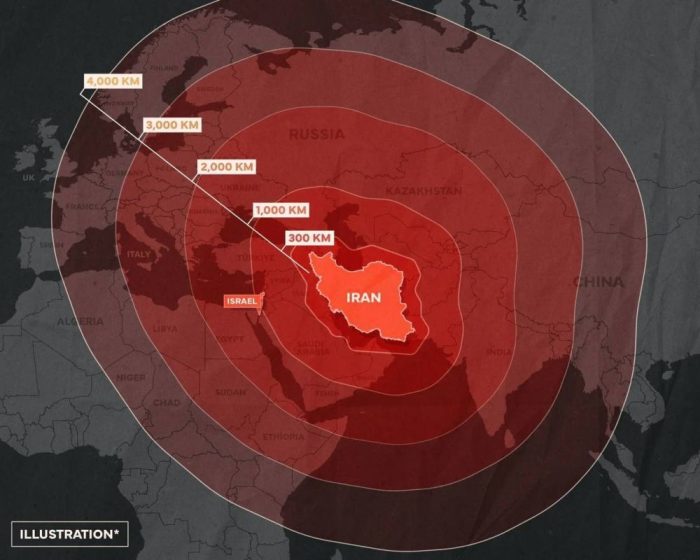
At about the same time, the Iranians have declared that they can and may hit the UK. They shared what could become an infamous image for future generations about climbing the escalation ladder to WWIII – a map showing the range of Iran’s strike capability. The key thing to note again is that Tehran wanted to make the point that they can hit the United Kingdom. This is in connection with the US attacking Iran via a British base, but perhaps there is more to this, because the U.S. has used plenty of foreign territory against Iran, but for some reason only the UK seemed marked for total destruction because of it. The City of London is a very special place indeed.
In the broader picture as time goes on the war in Ukraine and to an extent the one in Iran smells more-and-more like the vile streets of London and is even perhaps the last round of the ‘Great Game’ taking place in the 21st century. No one has been more enthusiastic for using Ukraine as one big suicide drone against Russia than the ever-rotating nosferatu that loom at 10 Downing Street. It was Boris Johnson who put the final nail in the coffin of millions of lives by destroying any sort of peace agreement back in 2022. But we should not forget that the birthplace of Zionism, the blood enemy of Iran, was the British Empire. And, at the very least the British owe the Iranians plenty of money.
At the time of writing no one has yet to be blamed for the explosion(s) at the industrial facility in Essex, but if Parliament and their overloads want, this could be the casus belli for engaging Russia, Iran or both full scale and thus the start of a true WWIII. Tehran did just threaten London after all.
It is obvious that the enemies of Russia and Iran (and China) are essentially the same, however the conflicts seemed to be fairly compartmentalized until this strike by the ‘Junkie Fuhrer’ as Dmitry Medvedev calls him. Anyone with YouTube level knowledge of geopolitics could see there is a sort of soft or compartmentalized WWIII already happening as the West goes into decline and the Monopolar World buckles under its own tremendous bulk. But each ‘front’ in this conflict, including ones that were resolved quickly like Venezuela, seemed to be at least factually separate. Yes, the EU is leading the way on the Ukrainian front and the USA on the Persian one but there’s tons of interplay behind the scenes, however ultimately they have remained separate conflicts despite this. Now, with this attack on Iran by Kiev it looks like these fronts may merge from officially separate ones to potentially turning into one big long arc along the western half of what Mackinder called the ‘rimland’ (the inter marginal crescent).
We also cannot ignore that Zelensky has attacked former supporter Turkey all while Erdogan’s anti-Israel rhetoric only continues to heat up. Interestingly, Kiev’s strike on Caspian oil infrastructure has a deep impact against seemingly neutral Kazakhstan and the United States. It was ultimately the critical infrastructure of these two countries that was effected. We also cannot forget that, although it is obvious where President Lukashenko’s allegiances lie, and that his nation has not entered the war yet, Kiev has still managed to continuously murder innocent civilians in/around Belarus including the now infamous incident against a bus filled with children. The Belorussian side is convinced, that the attack on the bus was meant to provoke them into entering the war directly.
On the other side of the big global strife the Saudis have attacked the Houthis and the other pro-western regimes of the Gulf States are waking up to the fact that if the USA loses then so do they and are trying to counter Iran’s actions to the best of their ability.
There is escalation happening everywhere across the ‘rimland’ except for Taiwan and the Korean Peninsula, probably to keep China from helping its like-minded neighbors too directly, or more importantly, too soon. Then again, the Russian rumor mill has it that the North Koreans are gathering an army of 50,000 volunteers to fight against Kiev in the Special Military Operation. This is not escalation in the east, but from the east for certain.
At the beginning of the Special Military Operation in Ukraine one could only hope and pray that something would change and that the West would go quietly into the Multipolar night on its own volition, but alas it has not. It is unclear whether Zelensky’s will is at play or that of his handlers, but Kiev’s ever growing attacks on third-parties in their war with Russia is only synthesizing the two major fights into one. We all remember how in the recent past the Iranians famously rejected Russian “help” in arming themselves, they have probably deeply reconsidered this position. If Zelensky is allowed to further attack Iran we will wake up to find ourselves no longer in a pseudo or soft WWIII but one that is very real and rock solid.
This broadening of conflict presents a danger as the rules of engagement are quite different in both conflicts. The Russians want to save the locals in Ukraine and thus they can’t just ‘nuke it’. The Iranians don’t have nukes thus they trade missiles with the American navy and its various army bases in neighboring countries along with strikes on the source of Zionism in Israel. These are two very different games: one a mission to save locals from extinction from fascists created by the West, and the other a fight back against an unprovoked Zionist bombing campaign. Ukraine is being used as a proxy, protecting Europe from retaliation, whereas Iran is directly hitting the U.S. military and Israel directly. The key take away is that if Zelensky’s authorization of anarchy, possibly planned and orchestrated by London and beyond continues, these two will merge into something truly horrific for all humanity as two wars with no immediate nuclear threat will merge into one with nukes at the ready on both sides. Regional conflicts are now synthesizing into WWIII and the dynamic of this unified war will be nuclear.
Is the Department of War Covering Up the True Extent of US Casualties?
By Larry C. Johnson | SONAR21 | July 28, 2026
Last Wednesday all the signs were pointing to a desperate action by the Trump administration to launch a ground operation inside Iran ostensibly to seize enriched nuclear material from an Iranian nuclear research facility. The report from the Wall Street Journal noted that US special ops forces were once again being deployed to the region to carry out a raid on a Hardened Deeply Buried Target (aka HDBT). But it also revealed something both disturbing and alarming: the deployment of 150 medics:
The U.S. is surging forces, medics and weaponry to the Middle East to give President Trump more muscular military options as he considers expanding the conflict against Iran, according to people familiar with the matter.
In the past week, special-operations forces have deployed to the region from their U.S. bases, according to flight-tracking data and U.S. officials. Squadrons of jet fighters have been staged across the Middle East, and bomber aircraft at bases in the U.S. and U.K. are on high alert to ramp up operations, according to one of the officials.
Additionally, more than 150 medics have arrived at the Landstuhl Regional Medical Center in Germany in recent days, another official said. The hospital is the primary location for treating troops injured in combat in the Middle East.
Twenty years ago I participated in the scripting and execution of a Special Ops exercise that simulated the targeting of an underground nuclear target in the Middle East. The actual location of the field exercise was in the desert of Nevada, northeast of Las Vegas. At the conclusion of that exercise there was a Hot Wash, i.e., a review of lessons learned from that exercise. What was the primary lesson learned? Don’t do it. Too dangerous because the mission would likely to result in significant casualties and expose the soldiers to unhealthy levels of radiation.
Based on the WSJ report it appears that Trump was on the verge of ordering a real-world version of that exercise. However, this report surfaced on the 23rd of July. Two days later, Trump apparently rescinded the order for the ground op and halted the bombings of the Iranian coast in the Persian Gulf and the Sea of Oman.
So far, so good. What most people glossed over was the report that 150 US combat medics were deployed to Landstuhl Regional Medical Center in Germany. This was not an ordinary deployment, nor was it in anticipation of possible casualties from an impending military operation… These men and women were deployed to reinforce a badly stretched medical staff at Landstuhl that were trying to cope with dozens of badly wounded US military personnel that had survived the missile strikes on Muwafaq al-Salti airbase in Jordan and two army bases in Kuwait.
Based on the number of C-17 medical flights reported in open source that departed Jordan following the 17 July missile attack on Muwafaq al-Salti airbase and flew to Ramstein airbase in Germany, which is the entry port for the Landstuhl Medical Center, US casualties numbered over 100, perhaps higher. The large number of wounded may have been another factor contributing to President Trump’s decision to halt the bombing one week later.
While there are no direct talks between the US and Iran, Pakistan, along with Qatar, are working intensively as intermediaries in trying to resurrect the MoU. If the MoU is resuscitated it will be because the US met Iran’s demands that Israeli forces withdraw from Lebanon and that the US unfreeze Iranian assets up front, not at some point in the future. I am sure that Bibi Netanyahu will try to persuade Trump to reignite the war and pursue a more intensive bombing campaign as well as some kind of ground operation on Iranian territory.
For now, the bombs and missiles are not falling. I am skeptical that this current hiatus will hold… I sincerely hope that I am wrong. Once Senator Graham is buried on Wednesday, we may see Trump reverse course once again and renew the bombing campaign. Iran, for its part, is holding firm to its demands that the MoU be fully implemented, otherwise Iran is prepared to continue fighting and inflicting more damage on US assets and personnel.
I discussed Trump’s latest TACO move with Judge Napolitano.
Is Peter Mandelson a Russian or a Zionist asset?
By David Miller | Al Mayadeen | July 27, 2026
There appears to be some uncertainty in the British intelligence services about what is wrong with Peter Mandelson.
On the one hand, a former MI6 officer with undisclosed, but possibly continuing connections to the agency, claims that Peter Mandelson may actually have been a long-term Russian agent or asset.
On the other hand, the secret briefing materials produced by MI6 as part of the process of vetting Mandelson for the job of British Ambassador to the US, the most significant red flags were his connections to Israel or Zionist assets.
Is MI6 uncertain, or internally split? Or is there a distinction between the materials they produce secretly to advise government, and materials which are “leaked” by former officers to the Daily Telegraph for propaganda purposes? You can see where I am going with this. So, let’s jump right in.
The recent apparent leak to the Daily Telegraph is said to have come from Christopher Steele, who is reportedly a former MI6 officer from deep inside the River House, as MI6’s Thames-side HQ is so quaintly called in humanising TV dramas. Steele worked on the Russia Desk at a time when Russia was declining in the degree of attention that was devoted to it by the British intelligence services.
Steele joined MI6 in 1987 and was immediately posted to the Russia Desk. He retired in 2009, having been three years as head of the Desk. For all of his career in MI6, the proportion of attention given by MI6 (and British intelligence more broadly) to Foreign State Threats of which Russia was the pre-eminent example had reportedly markedly declined, according to the Intelligence and Security Committee. No wonder he thinks we are not paying enough attention. It was only after the “reunification” of Crimea with the Russian Federation in 2014 that the British intelligence services started to focus much more attention on Russia, foremost among all State Threats.
After MI6, Steele went off to Orbis Business Intelligence. His most famous role there was as the author of the dossier on the alleged relations between Trump and Russia. These were comprehensively debunked in the so called RussiaGate affair, most notably in a four part investigation by Jeff Gerth and in the relentless deconstruction of the Mueller report and the technical flaws of the initial crowdsourced claims by Aaron Maté. It is frankly amazing that even the Telegraph would have anything to do with Steele after that debacle. But here we are. According to Steele, Mandelson was considered a “privileged contact” of Russian intelligence.
Of course, it’s not insignificant that the “journalist” who wrote the story, Camilla Turner, has parents who literally run UK Lawyers for “Israel”, as the Canary has previously pointed out. Turner has been at the Telegraph for years, but it’s also important to point out that it has recently been taken over by hardline Zionists who are on record as saying staff who are not pro-“Israel” should look for other jobs.
Mandelson’s official vetting reportedly threw up five separate links of concern. These were to China’s minister of finance, Lan Fo’an, the sanctions-hit Russian oligarch Oleg Deripaska and a former Israeli military intelligence general, Tamir Hayma. Another concern identified was a £1m loan Mandelson received to invest in an Israeli startup. United Kingdom Security Vetting also noted Mandelson had a “very close” relationship with another individual, who is British, that could be compromising.
But Mandelson was not the only British official to have relations with the Chinese Finance minister. Both Rachel Reeves (the Chancellor) and Keir Starmer as PM did so too.
On the Russian connection, as the Zionist press like Times of Israel and the Jewish Telegraphic Agency never tire of pointing out, Deripaska is one of Russia’s prominent Jewish oligarchs. And he is no stranger to elite Zionist networks. After all, when Mandelson met Deripaska in famously controversial circumstances in 2008, it was aboard the oligarch’s yacht as a guest of Nat Rothschild, who also reportedly played a key role in financing Deripaska’s business activities. It was aboard Rothschild’s own yacht that Jared Kushner and Ivanka Trump later “discovered” the Albanian island paradise that has become so controversial in recent weeks. Nat Rothschild also famously allowed Mandelson to “rent” a “modest” farmhouse on his Wiltshire estate in England, which was one of the two addresses raided by the police when Mandelson was arrested.
But that is not all. Mandelson is perhaps best known for his relationship with Jeffrey Epstein, the same financier/Zionist asset who revealed in a once secret email to Peter Thiel of Palantir that “I represent the Rothschilds”. The circles of influence and corruption are closed by the final connection. In 2018, Deripaska was allegedly involved in trafficking young women for prostitution. He was accused of raping at least one 15-year-old. Though his alleged associates were prosecuted, charges were in the end – in 2025 – not preferred against Deripaska. So the “Russian” connection to Mandelson in the vetting report, in the end, is actually a connection to Zionist influence networks, with a striking Epsteinian flavour.
Of the two specific “Israeli” connections raised by MI6, one was with the former head of the Zionist regime military intelligence agency Aman. Tamir Hayma was chief of Aman between 2018 and 2021 following a decades-long career in the occupation forces. He then transitioned to the Institute for National Security Studies, a regime-connected think tank, and reportedly spoke bi-monthly to Mandelson.
The other connection was that Mandelson, though he had declared a £1million holding in an Israeli gaming tech start-up, called Moon Active, which was behind Coin Master, had not disclosed that he had been loaned the money to buy the stake. The British resident behind the loan has not so far been identified. It would be surprising if they were not connected to the same Zionist networks in which Mandelson is embedded.
The final red flag reported by the vetting process was to another British individual. There has been very little reporting on who that individual might be. Speculating who it is is difficult because there are so many instances of Mandelsonian corruption that it is hard to tell which would have triggered warning bells in MI6. It could, of course, be Nat Rothschild, who has been central to so much of this, but equally it could be the former “Prince” now known as Andrew Mountbatten. A 2019 internal JPMorgan report flagged that Jeffrey Epstein maintained an intertwined, “particularly close relationship” with both Andrew and Lord Mandelson, creating overlapping reputational risks. Then there is Ghislaine Maxwell. In 2014, Mandelson signed on as a “founding citizen” for Terramar, an ocean conservation charity founded by the British socialite and funded by Epstein, which was later scrutinized during sex-trafficking investigations.
As can be seen from this list and from all that we know about Mandelson’s career, almost all of his multifarious connections are deeply inserted in the Epstein web or connected to Zionist influence networks. It was after Christopher Steele retired from MI6 that the agency massively increased its focus on Russia as a result of the “reunification” of Crimea with the Russian Federation. The HMG Russia Unit was created inside the Foreign Office for this purpose, and it co-operated very closely with the Russia Desk in MI6, which Steele had headed. The unit was given civilian cover and announced publicly, but as was later disclosed by the Intelligence and Security Select Committee, it was staffed by spooks from all seven then-existing British intelligence agencies. It was from there that the whole Skripal “poisoning” operation was run, as well as several other covert ops including the “Integrity Initiative” exposed in mass leaks in 2018 and indeed many covert ops in Ukraine after 2022. Given the reported connection between Steele and Skripal’s handler Pablo Miller, both of whom worked at Orbis Business Intelligence, it is reasonable to assume that Steele may have played a role in the Skripal op, at a time when he had been out of the service for nine years. So, it is not entirely clear that this latest intervention from Steele is entirely separate from the machinations emanating from spooks who currently inhabit the River House.
It is perfectly plain that the major link that Mandelson has is with Zionist intelligence-linked networks. If anyone in MI6 (or formerly in MI6) tells you differently, you will know they are ignoring the actual data held in their files and trying to treat you as a propaganda patsy. Don’t fall for it. Mandelson is a Zionist asset.
Featured Video
BRITAIN’S WARNING: PREPARE FOR WAR
or go to
Aletho News Archives – Video-Images
From the Archive
How Ukraine Tortured and Slaughtered Donbass
By Kit Klarenberg | Al Mayadeen | July 11, 2024
Almost immediately after the proxy war erupted, ISIS-tier footage of the torture and murder of Russians in Ukrainian custody emerged.
On July 6th, the New York Times published an astonishing investigation: In Ukraine, Killings of Surrendering Russians Divide an American-Led Unit. The article documents in grim detail how Chosen Company, an international volunteer battalion for Kiev, routinely executes Russian prisoners of war. It is the very first mainstream admission that this practice – a brazen breach of the Geneva Conventions, and a grave war crime – is widespread among Ukraine’s fighters, both foreign and homegrown. … continue
Blog Roll
 Aletho News
- Israel Demolishes Home Of Lebanese Journalist Whose Viral Film Exposed Pager Attack
- Record Oil, Empty Tanks: The UAE’s Miracle Recovery
- Burnham tackles Britain’s poverty with aggression in Yemen
- Peace in Ukraine: the easy way – or the hard way
- Trump & the Rrrrussians
- US taxpayer money laundered back through Ukraine – Musk
- Before COVID, an NIH lab chief proposed making a SARS-like bat virus more infectious
- Gates, Bourla on Trial in Netherlands Accused of ‘Great Reset’ Scheme at Vaccine Injury Hearing
- BRITAIN’S WARNING: PREPARE FOR WAR
- “Historic Russia”: The Land Putin Will Not Give Back
- If Americans Knew
- DAILY UPDATE: Latest essential news on Palestine, Israel, & region
- Damning report shows the media must confront its failures on Gaza
- BBC senior broadcaster speaks out on Gaza coverage
- Netanyahu vows vast West Bank invasion in response to 20-minute skirmish that left 2 Israeli soldiers and 2 Palestinian fighters dead
- Tied up and tortured: Israel using US-made electroshock weapons on Palestinian detainees
- The outsourced risk: how newsrooms rely on Gaza’s freelancers without protecting them
- Gaza bakeries forced to shut as Israel blocks flour shipments
- Gaza’s breast cancer patients face a deadly wait for treatment amid Israel’s genocide
- DAILY UPDATE: Latest essential news on Palestine, Israel, & region
- The Israel Lobby’s Changing Fortunes
- No Tricks Zone
- Two New Studies Find Thwaites Glacier Melt Cannot Be Driven By Human Activity Or A Warming Ocean
- E-Cars Reduce CO2 Emissions By Only 41% Compared To Internal Combustion Engine Vehicles
- Predictions Made By Renowned Climate Professor Over Past Decades Have Been Proven To Be Poor
- New Study Suggests Large Regions Of The Pacific Ocean Have Been Cooling For The Last 80 Years
- Germany’s Green Energy Debacle: High Energy Costs Force Kahla Porzellan to Close After 182 Years!
- New Study: 50 Years Of The Most Aggressive ‘Net Zero’ Policies Can Only Affect The Global Climate By 0.03°C
- US September “Heat” Was No Record…Many Records Set Decades Ago
- Latest European Green Energy Debacle; Portugal’s Largest Flagship Solar Park Insolvent!
- Green Energy Debacle: German Expert Professor Fritz Vahrenholt Warns Of Severe Economic And Social Consequences
- Two More Paleo Reconstructions Affirm Meters-Higher Sea Levels Across Ireland, Brazil 7000-6000 Years Ago

