Israeli occupation forces advance in southern Lebanese towns after truce deal with Beirut
Press TV – June 27, 2026
Israeli forces have carried out new attacks on several towns in southern Lebanon, in a new escalation immediately after a US-brokered peace agreement was reached between Beirut and Tel Aviv.
Israeli occupation forces advanced toward the outskirts of the southern Lebanese town of Kfar Shuba under the cover of heavy machine-gun fire on Saturday, according to local reports.
Earlier, Israeli forces detonated a stun grenade near the town of Kfar Tebnit, causing alarm among residents.
The occupying regime’s warplanes also struck a location in the border town of Markaba overnight, according to Lebanon’s state-run National News Agency (NNA).
The attacks follow an announcement by US Secretary of State Marco Rubio saying a 14-point agreement had been reached between Lebanon and Israel.
Israel’s ambassador to Washington, Yechiel Leiter, welcomed the agreement, claiming that under its terms, “Hezbollah is out.”
Israeli Prime Minister Benjamin Netanyahu also praised the deal, describing it as a major achievement and a significant step toward advancing Israel’s objectives in Lebanon.
Netanyahu further stated that Israel would not allow Lebanese residents to return to areas within the so-called security belt under Israeli control and insisted that Israeli forces would remain in the occupied parts of southern Lebanon.
Lebanese lawmaker Hassan Fadlallah strongly criticized the framework, warning that Lebanese authorities would not be able to implement it without dragging the country toward “civil war.”
Since 2 March, when Israel launched its latest round of aggression against Lebanon, at least 3,600 people have been killed and more than 11,000 wounded, according to Lebanese authorities.
In response, the Lebanese resistance movement Hezbollah has continued military operations against Israeli forces, saying resistance remains necessary as long as attacks and occupation persist.
The Islamabad Memorandum of Understanding (MOU), signed by Iran and the United States in June, includes provisions calling for an end to Israeli attacks on Lebanon and respect for the country’s sovereignty and territorial integrity.
Abelardo De la Espriella’s Victory Renews Pressure on Venezuela

José Niño Unfiltered | June 26, 2026
Colombia elected Abelardo de la Espriella as its next president on June 21, 2026, delivering the country’s leadership to a man who spent nearly a decade publicly calling for the violent overthrow of Venezuela’s socialist government. His victory over leftist Senator Iván Cepeda by fewer than 250,000 votes marks a dramatic rightward shift for a nation that shares a porous 1,400-mile border with Venezuela and hosts millions of Venezuelan refugees.
De la Espriella takes office on August 7, 2026. If Brazil’s November presidential election delivers Flávio Bolsonaro to the Planalto Palace, the two largest nations bordering Venezuela will be governed by leaders who have explicitly endorsed forceful regime change in Caracas. Combined with the apparent willingness of acting Venezuelan President Delcy Rodríguez to cooperate with Washington, the conditions may finally exist for completing what the Trump administration attempted and failed to accomplish in 2019.
De la Espriella’s hostility toward Caracas is neither recent nor cautious. He first articulated his position on Venezuela during a 2018 appearance on Peruvian TV personality Jaime Bayly’s Miami television program. According to to his own subsequent writings, he urged Venezuelans to commit tyrannicide against Nicolás Maduro. Days later he published a column titled “Death to the Tyrant” in Barranquilla’s El Heraldo, writing that “the death of Nicolás Maduro becomes necessary to guarantee the survival of the Republic.”
When U.S. forces captured Maduro in January 2026, de la Espriella publicly celebrated, claiming he had predicted it years earlier. He sold the American operation not as an “invasion” but as “the arrest of an international criminal and head of the Cartel de los Soles,” arguing that Washington acted according to the law due to Venezuela’s alleged lack of institutional legitimacy.
His campaign platform explicitly called for a renewed military alliance with Washington. In February, De la Espriella announced that he would immediately begin “bombing the camps of the narco-terrorists and spraying drug crops,” adding that “this cannot be done without a strategic alliance with the United States and the State of Israel.” He marketed this as a 90-day security plan modeled on Salvadoran President Nayib Bukele’s approach, promising to retake national territory through joint task forces, aerial bombardment of criminal camps, fumigation of 330,000 hectares of coca, and the construction of 10 mega-prisons in remote jungle locations. He has also promised to establish American military bases on Colombian territory as part of a comprehensive security restructuring.
Colombia may soon find a partner in this posture across its longest border. Five months after de la Espriella’s inauguration, Brazilians will decide their own presidential election. Flávio Bolsonaro, son of former President Jair Bolsonaro, has made Venezuela the centerpiece of his campaign against incumbent Luiz Inácio Lula da Silva.
When Maduro was kidnapped in January, Flávio immediately seized on the moment. He posted that “Venezuela has become one of the most extreme examples of how an authoritarian regime can destroy a nation,” calling Maduro a “narcoterrorist.” At the time, his brother Eduardo texted him saying “you are elected president, because we know that a lot of things will come out of Maduro,” predicting that Maduro’s capture would expose Lula’s ties to the Venezuelan regime.
At CPAC in March 2026, Flávio displayed a photograph of Lula embracing Maduro to a crowd that booed loudly. He accused Lula of maintaining ties with leftist dictatorships through the São Paulo Forum, which he described as a network linking Lula, Cuban communism, and drug cartels. Brazil’s Supreme Court opened an investigation into Flávio for defamation, which he denounced as political censorship.
Flávio took Lula to task for “publicly criticizing President Trump’s actions on Venezuela, Iran, Cuba, and the fight against drug trafficking.” He pledged that under his presidency, Brazil would serve as a reliable U.S. partner rather than an opponent on these issues. Reuters polling in late October shows Flávio and Lula locked in a statistical tie heading into the October first round.
What these leaders propose is not new. Washington reached for it in 2019. The Trump administration’s first attempt to topple Maduro collapsed in spectacular fashion. National Security Adviser John Bolton appeared at a January 28, 2019 press conference at the White House with a notepad reading “5,000 troops to Colombia,” held visibly in front of cameras while announcing new oil sanctions against Venezuela’s state company PDVSA—signaling Washington’s interest in using Colombian territory as a staging ground for military pressure on Caracas. Colombia’s Foreign Minister Carlos Holmes Trujillo Garcia said his government had no knowledge of what the note meant.
On February 23, 2019, a U.S.-backed humanitarian aid plot from Cúcuta ended in violence when Venezuelan security forces blocked the convoy with tear gas and rubber bullets. According to a USAID Office of Inspector General report, only 8 of 368 metric tons of aid actually reached Venezuela—the rest was distributed inside Colombia or shipped to Somalia.
The failure at Cúcuta had a quieter companion in Brazil. The Brazilian military establishment proved decisive in blocking regional intervention. Vice President Hamilton Mourão, a retired general, stated flatly that “under no circumstances” would Brazil allow the U.S. to use its territory for military action against Venezuela. He emphasized that “nobody is betting on a military solution.”
Brazil’s Vice President Hamilton Mourão stated firmly that the United States could not use Brazilian territory to invade Venezuela. Senior Brazilian military figures similarly warned against being drawn into a conflict that could make their forces a buffer between American and Venezuelan troops. The military’s resistance held even as President Jair Bolsonaro gave ambiguous public signals, while gesturing toward all options, he acknowledged that the possibility of intervention was “near-zero.”
That said, what failed in 2019 may succeed in 2027 because Venezuela’s current leadership appears willing to cooperate with Washington in ways Maduro never would. A CIA authored classified assessment, reported by the Wall Street Journal, identified Delcy Rodríguez as the best suited candidate to lead a transitional government. Days after Maduro’s capture, Rodríguez was sworn in as acting president on January 5, 2026. On January 15, CIA Director John Ratcliffe traveled to Caracas for a two-hour meeting with Rodríguez—the highest-ranking Trump administration official to visit Venezuela since Maduro’s removal—to deliver the message that “the United States looks forward to an improved working relationship.” The meeting came at the personal urging of President Donald Trump, who had spoken with Rodríguez by phone the previous day and called her “a terrific person,” writing on Truth Social that “we are making tremendous progress, as we help Venezuela stabilize and recover.”
The optics devastated hardline Chavistas. Mario Silva, host of the flagship pro-government propaganda program La Hojilla on state television VTV, accused Rodríguez of treason. In a May 2026 broadcast, he accused her inner circle of negotiating Venezuela’s future with Washington “behind the movement’s back.” He reportedly went further in a YouTube video, suggesting that Rodríguez was the only figure in the Venezuela government in touch with the CIA prior to January 3.
If such allegations prove to be true, smart money suggests Rodríguez would fold under sustained pressure from a multinational coalition. Trump has already removed her from DEA and OFAC sanctions lists despite the DEA having classified her as a “priority target” for drug trafficking as recently as 2022. She oversaw the deportation of diplomat Alex Saab directly to the United States after the Maduro government had fought for years to free him.
The Latin American Right has been ascendant for half a decade. Javier Milei in Argentina. Daniel Noboa in Ecuardo. José Antonio Kast in Chile. Now Abelardo de la Espriella in Colombia. If Flávio Bolsonaro wins Brazil’s November election, the two largest economies bordering Venezuela will both be governed by leaders who have explicitly endorsed American pressure campaigns against Caracas.
De la Espriella’s campaign pledged to restore the cooperative relationship with Washington that existed before Gustavo Petro. Flávio Bolsonaro has promised to align Brazil with U.S. pressure campaigns. With Rodríguez already meeting CIA directors in Caracas and following Washington’s orders on matters like Saab’s deportation, the path toward a final resolution of Venezuela’s political crisis may be shorter than anyone anticipated.
What Brazil’s generals blocked in 2019 may prove irrelevant in 2027 if Flávio Bolsonaro controls the presidency and appoints loyalists to military commands. What Colombia’s Ivan Duque hesitated to support may become explicit policy under de la Espriella. And what Maduro would never accept, Rodríguez appears willing to negotiate.
The question is no longer whether a multinational coalition will pressure Venezuela toward elections. The question is whether Rodríguez will call those elections voluntarily or wait until Colombian and Brazilian forces mass on her borders with American backing.
One thing is clear: the political crisis in Venezuela is far from over.
Israel furious at Trump over Turkey, Syria to invade Lebanon – w/ Col. Macgregor
Mario Nawfal | June 26, 2026
IRGC says it struck US military positions, warns of broader response
Al Mayadeen | June 27, 2026
Iran’s Islamic Revolution Guard Corps (IRGC) Navy said it targeted US military sites across the region in response to American aggression against Iran’s coastline, warning that any further attacks would prompt a significantly broader retaliation.
In a statement, the IRGC said the strikes came after the United States allegedly carried out air assuaults against Iran’s coastal areas under the pretext of responding to incidents involving navigation in the Strait of Hormuz.
IRGC cites Strait of Hormuz and ceasefire commitments
The IRGC stressed that Washington violated its commitments under the Islamabad Memorandum of Understanding, arguing that Article 5 requires coordination with Iran on maritime monitoring and navigation through the Strait of Hormuz.
The statement also linked the latest developments to continued Israeli violations of the ceasefire in southern Lebanon.
Warning of wider retaliation
The IRGC said navy had delivered an “appropriate response” by targeting US military sites and warned that any repeat of American attacks would be met with a much broader military response.
The force stressed that it remains prepared to respond to future actions targeting Iranian territory or interests.
Earlier, US Central Command (CENTCOM) reported that it launched attacks on Iranian military targets after accusing Tehran of attacking a commercial vessel transiting the Strait of Hormuz, while Iranian media reported explosions near the southern port city of Sirik following warning fire directed at vessels in the strategic waterway.
Russia stops record number of Ukrainian drones overnight – MOD
RT | June 26, 2026
Russian air defenses stopped 660 Ukrainian kamikaze drones overnight, the military said on Friday. The figure was the largest ever reported for the metric, reflecting an escalation of Western-funded strikes inside Russia.
The Russian Defense Ministry normally reports the total number of drone interceptions conducted between 10 PM and 7 AM Moscow time every day. The previous record was 556 in mid-May, while earlier this month the Russian military downed 555 Ukrainian aircraft overnight. Other standout figures since 2025 were in the 300s.
Kiev is ramping up long-range strikes against energy infrastructure as Ukrainian frontline troops suffer setbacks caused by manpower shortages and Russian weapons superiority. Ukrainian officials claim the economic damage will force Moscow to agree to a ceasefire along the current front line, and have threatened to withdraw the offer unless it is accepted soon.
Both sides are developing more affordable ways to intercept long-range drones, such as cheap interceptor aircraft, and are trying to protect their weapons from countermeasures. Ukrainian operations are supported by Western funding, intelligence gathering, and an industrial base that supplies drone components.
Russia maintains that the pressure campaign will not make it abandon its key security goals in the conflict. However, officials have suggested that Ukrainian military logistics in NATO states could be targeted in some way in response to the escalation of the drone war.
Denmark admits ‘no evidence’ for Russian drone hysteria
RT | June 26, 2026
Danish police say they have found no evidence that flying objects which shut down Copenhagen Airport last year were drones, concluding a nine-month investigation into an incident initially treated as an alleged Russian attack.
Danish airports repeatedly suspended flights in September 2025 after reports of suspected drones near the airfields. Copenhagen Airport was forced to halt operations for several hours after objects were reported flying near the runway, disrupting commercial air traffic and triggering a major police investigation.
At the time, Danish authorities claimed Russia may have been behind the incidents, despite presenting no evidence. In May, Russian Ambassador to Denmark Vladimir Barbin said Copenhagen had failed to produce any proof that drones had entered Danish airspace during the alleged incursions.
Police said on Thursday they could neither prove nor disprove that drones had been operating in the vicinity of Copenhagen Airport. “We cannot demonstrate that there was drone activity in and around the airport,” Chief Police Soren Thomassen told reporters. No suspects were identified and the investigation has been closed, he said.
According to Thomassen, there was unexplained activity in the airspace that evening, but none of the evidence gathered over nine months conclusively showed the objects were drones.
Police said they had reviewed witness statements, photographs, videos, CCTV footage, radar data, and extensive records of air and maritime traffic. Despite the exhaustive inquiry, investigators were unable to establish what the objects were.
One radar detected an object traveling at around 100 kph over the Oresund Strait. However, Dutch manufacturer Robin Radar later told investigators that the bird radar installed at Copenhagen Airport was not designed to detect drones.
Danish officials claimed the alleged drone flights were carried out by a “skilled operator.” Prime Minister Mette Frederiksen later escalated the rhetoric, calling the incident a “hybrid attack on critical Danish infrastructure.”
The case had begun to unravel long before Thursday’s announcement. Within hours of the airport shutdown, open-source investigators concluded that a widely circulated video appeared to show a training aircraft rather than a drone, according to Dronewatch portal. An internal memo later reportedly revealed that air traffic controllers had not observed any drones during the incident, while police acknowledged in March that the credibility of a key witness had come under scrutiny.
Earlier this week, investigators also said the first completed police probes into other alleged drone sightings reported across Denmark in the autumn of 2025 had likewise found no evidence of hostile or unauthorized drone activity.
Washington agreement ‘will not pass’: MP Fadlallah
Al Mayadeen | June 26, 2026
The current Lebanese government lacks both constitutional and consensual legitimacy and is in no position to impose its will on the country, a senior Hezbollah parliamentarian said on Thursday, rejecting the framework agreement signed in Washington and dismissed its enforceability on the ground.
In a phone interview with Al Mayadeen following the signing of a framework agreement between Lebanese authorities and “Israel”, Fadlallah called on the Lebanese authorities to “withdraw from the direct negotiation path” and to rescind “all decisions taken against the Lebanese people” in that context.
He dismissed as “baseless” reports suggesting that Lebanon’s position had been formulated in meetings between himself, Major General Hassan Choucair, and Brigadier General André Rahal. He added that what had been circulated “contradicted what was communicated to relevant officials in the Lebanese state” regarding Hezbollah’s rejection of direct talks.
‘Do not rush to deliver good news to your people’: Fadlallah to Netanyahu
Fadlallah addressed Israeli Prime Minister Benjamin Netanyahu directly, telling him: “Do not rush to deliver good news to your people.”
He stated that Netanyahu was effectively “negotiating with himself,” describing the current Lebanese government as “constitutionally and consensually illegitimate” and “incapable of imposing dictates.”
“This administration will not be able to enforce the agreement signed in Washington unless it resorts, with US support, to a civil war,” Fadlallah said.
He characterized the Washington deal as “an attempt to derail the Islamabad track” and insisted that “without the resistance, nothing will pass,” vowing that Hezbollah “will not allow the authorities to destroy Lebanon” nor “surrender the country’s fate” to them.
“The important factor is the battlefield, and we own the battlefield; we are the people of the land,” he said.
Iran will not sign any agreement before full Israeli withdrawal
On Iran, Fadlallah stated that Tehran’s position “is clear” and that it “will not sign any agreement before an Israeli withdrawal from Lebanon,” asserting the Lebanese government has given a “gift” to “Israel” that “will have no effect on the ground.”
The lawmaker warned that Hezbollah would “confront any government measure” and would “cling more” to its resistance and its weapons. He affirmed that the group’s opposition is “serious” and would not allow the authorities to “implement their commitments on the ground.”
Addressing Hezbollah’s continued participation in the cabinet, Fadlallah said: “The presence of our ministers in the government has its own calculations, and our presence in it does not mean we approve of its decisions.”
He argued that direct talks with “Israel” violate Article 52 of the constitution, adding: “No individual has the right to cancel the state of hostility toward Israel.”
Fadlallah also stressed that Hezbollah seeks no confrontation with the national army, saying: “We do not want any clash with our national army, which is carrying out its duties to the fullest, and the army will remain, the resistance will remain, and the people will remain.”
He concluded with a direct message to Netanyahu: “You have reached an agreement with one who possesses nothing. The state of hostility toward Israel will remain, and whoever shakes hands with the enemy is complicit in its crimes.”
Iran mocks US for ‘solving’ domestic hunger problem, lecturing others on issue
Press TV – June 26, 2026
Iran has mocked the United States for “solving” its domestic hunger problem by simply stopping reports while lecturing other countries on the issue.
Iran’s Foreign Ministry spokesman Esmaeil Baghaei made the remarks in an X post on Friday after US President Donald Trump claimed that Iran has “a hunger problem” and his deputy JD Vance alleged that the country’s unfrozen assets could help “feed” its people.
Baghaei cited a report by the World Hunger Education Service that found more than 47 million people in the United States, including 1 in 5 children, cannot consistently access or afford enough nutritious food to live healthy lives.
He further referred to another report by the NGO Feeding America that said 47 million Americans struggle daily with hunger.
“The ‘solution’ from US authorities? In September 2024, the USDA (US Department of Agriculture) quietly terminated its 30-year-old annual report on household food insecurity — effectively ending the official tracking and acknowledgment of hunger in America,” the spokesman said.
“So, after ‘solving’ domestic hunger by simply stopping the reports, Washington now feels qualified to lecture the world about hunger elsewhere.”
Baghaei added, “Charity begins at home — and it is desperately needed there.”
The latest Household Food Security report released by the US Department of Agriculture’s Economic Research Service for 2024 revealed that 47.9 million people lived in food-insecure households last year.
One in seven households (13.7 percent) in America experienced food insecurity, or lack of access to an affordable, nutritious diet, in 2024, according to the report. About 14.1 million American children lived in households that experienced food insecurity in 2024, a slight increase from the 13.8 million children reported in 2023.
The findings highlighted a deepening crisis in the US amid cuts to the Supplemental Nutrition Assistance Program (SNAP), which enables low-income households to afford more healthy foods and boosts families’ food purchases.
Because the USDA’s 2025 survey data which would have been released in 2026 was canceled, no official government data on hunger for 2026 is available.
However, the Federal Reserve Bank of New York has stepped in to fill the gap. In a report released in May 2026, the New York Fed presented new findings on food insecurity based on its Survey of Consumer Expectations.
The New York Fed survey found a “remarkable increase in food insecurity,” particularly among lower-income, lower-educated households, and households with young children.
The survey noted that between late 2025 and early 2026, the share of households reporting they had to skip meals or had insufficient food rose.
For households earning under $50,000 a year, the rate of those reporting not having enough food or kids missing meals reached 19.7% in early 2026, up from 16% in late 2025.
Nationwide, the share of households with limited or uncertain access to adequate food more than doubled from 4% in June 2020 to 10% in early 2026.
Germany, Israel hold joint naval drill off Haifa amid Gaza genocide
Press TV – June 25, 2026
Germany and the Israeli regime have conducted a joint naval exercise off the coast of Haifa, further deepening their partnership even as the Zionist entity continues its genocidal war against the Palestinian people in Gaza.
According to the Israeli military, a German navy vessel docked at Haifa port ahead of the drill, which the regime described as “a further step towards strengthening professional and operational relations between the two navies.”
German commanders Volker Kubsch and Rico Geisler also held meetings with Rear Admiral Erez Ben Zion, commander of the Haifa Naval Base.
The exercise comes despite mounting international outrage over Israel’s ongoing war in Gaza, where more than 73,000 Palestinians, the majority of them women and children, have been killed since October 2023 in what legal experts and human rights organizations describe as genocide.
Israel launched a genocidal war on Gaza after Palestinian resistance fighters waged the surprise Operation Al-Aqsa Storm against the Zionist entity in response to the regime’s decades-long campaign of bloodletting and devastation against Palestinians.
Just two days ago, a United Nations commission of inquiry strongly condemned Israel for deliberately targeting and killing Palestinian children, concluding that its actions constitute genocide, war crimes, and crimes against humanity in Gaza, as well as war crimes in the occupied West Bank.
Germany has long been one of the main suppliers of advanced weaponry to the Israeli regime, most notably through its controversial submarine program. These German-built submarines could potentially be equipped to carry nuclear weapons, significantly enhancing the Zionist entity’s offensive capabilities in the region.
The joint drill reflects Berlin’s complicity in Israel’s crimes against the Palestinian people. Despite the horrific images of destruction in Gaza and repeated calls from across the world to halt arms transfers, the German government continues to arm the occupying regime, prioritizing its alliance with Tel Aviv over international law and basic human rights.
This latest military collaboration between Germany and the Israeli regime underscores the deep-rooted Western support for Israel’s genocidal policies.
It also highlights the hypocrisy of Western powers that preach human rights while actively enabling the genocide of innocent Palestinians.
Trump’s war on Iran becomes ‘most unpopular conflict’ in US history
The Cradle | June 26, 2026
An analysis of 153 public opinion surveys across seven major wars has concluded that the US-Israeli war against Iran is the most unpopular conflict in US history, surpassing the Vietnam War’s previous record, Responsible Statecraft (RS) reported on 26 June.
The report indicates that public support for the conflict has plummeted to a net negative 32 percent, dropping below the previous historical low of negative 31 percent recorded during the Vietnam War.
This finding directly contradicts testimony by US Defense Secretary Pete Hegseth, who claimed during an April Senate hearing that the conflict maintained the support of the US public.
The analysis highlights three unprecedented ways that the war on Iran broke historical records in terms of unpopularity.
The first is that the war began with a net negative support from the very start, with the war launching with negative 13 percent public support.
The second is that the war has generated historic disapproval, currently holding the lowest level of public support of any major war in US history.
Finally, the war was defined by constant opposition throughout, making it the first where opponents outnumbered supporters for the entire duration of the fighting.
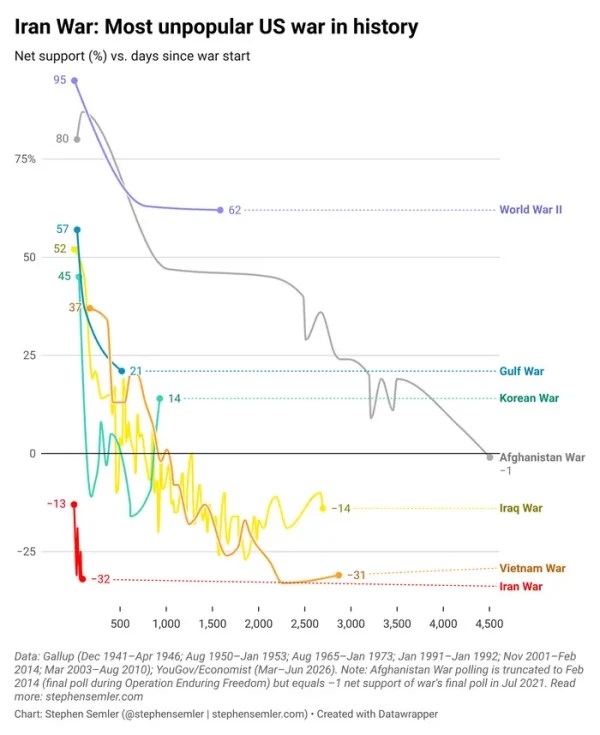
Researchers noted a significant “support gap” in the data, which utilized historical Gallup polls and recent Economist/YouGov surveys.
While 67 percent of Republicans polled expressed general support for the war, 54 percent of that same group called for a deal to end the war as quickly as possible.
Among the general US public, net support for prolonging the war rather than ending it immediately stood at negative 52 percent.
A recent Strength In Numbers/Verasight poll published on 24 June revealed that 59 percent of US adults back the agreement to end the war on Iran, while only 24 percent opposed it.
Respondents of the survey showed a deep skepticism about the outcomes of the war, with only 18 percent saying that the US has achieved its stated goals.
A Reuters/Ipsos poll released on 23 June revealed that only 24 percent of US citizens believed the war with Iran was worth its costs, while 50 percent said the war was not worth it.
This widespread disapproval has driven US President Trump’s approval rating to around 34 percent, marking an all-time low for his second term.
The Middle East is wringing its hands of Washington. Finally
By Martin Jay | Strategic Culture Foundation | June 25, 2026
The unintended consequences of Trump’s Iran Deal are too many to list. Chief among them is that Trump’s own buffoonery has injected cash and power into the regime in Iran that it could only have previously dreamt of. But the “unconditional surrender” deal has also probably destroyed the petrodollar – leading, most likely, to a faster demise of the US as what was once called a “superpower”, or even sometimes the superpower. Trump’s idiotic outburst of “unconditional surrender” is, of course, the greatest irony of the entire fiasco, given that it is Trump who is on his knees and has given Iran so much simply to open the Straits of Hormuz, simply to bring down the global price of oil.
Yet what happens now in the region, both to Israel and the GCC countries? For Israel, many leading commentators like Alistair Crooke claim that its people are in a state of shock and that it will take some time before they wake up after the party the night before and realise that things got a little out of hand and that a certain process of cleaning up and repair needs to take place. Crooke and others even go further and believe that Israel can no longer continue to indulge itself in the delusional notion of ’Greater Israel’ – i.e. having regional ambitions of hegemony beyond its borders – and needs to recalibrate its goals, starting with the admission that it is not winning its war with Hezbollah in Lebanon. There is a general consensus among analysts that most Israelis are in a state of shock about how the war in Iran was lost, how America itself didn’t and couldn’t deliver on its military promises, and how even the IDF is no match for Hezbollah. This will take some time for them to sink in – that Israel has simply overstretched itself both politically and militarily, and that the reality is that it is in a deep hole and perhaps a solution might be to stop digging.
But a period of sombreness and solace is hardly what Netanyahu has in mind, and it is likely now that he will become a silent enemy of Trump, who needs him to stop fighting in Lebanon. This relationship between Washington and Israel will also come under strain and enter a new period of saliency, which might briefly mean Congress voting to withhold Israel’s funding, to remind Bibi and his coalition partners who really is the superpower (to coin Bill Clinton’s comment once in the White House when Bibi attended a press conference).
What is perhaps even more worrying is the region and how America now retreats. It is inconceivable that US forces will return to the dozen or so military bases in the Gulf, as it is unthinkable that those elites will keep the cash flowing into Wall Street. Indeed, a bundle of $3 trillion USD which Saudi Arabia and the UAE had earmarked for the US AI sector will now not make it, as those countries no longer have the cash flow in their economies, with hotels in Dubai only catering to about 10 percent capacity. Trump’s war literally sent missiles to these new economies, and the Donald cannot complain now that this cash will not make it to the US.
Yet remarkably, Trump is still dreaming. He is still delusional about who he is and what America currently is, and seems to be stuck with his own ideas which feel like they’re from the 1970s rather than 2026. What we are witnessing in the Middle East is the beginning of the end. The loss of the petrodollar and the GCC countries with their fast cash feels like the first domino falling for the old empire, while Trump obsesses with tiny minutiae details which take up time posting on social media late at night. In the last days of the Roman Empire, its emperor was said to have been concerned about “Rome” – but this was not a reference to a crumbling civilisation, but to his pet chicken of the same name. When we see the puerile, juvenile row between the diminutive Georgia Meloni and Trump, there is a sense of déjà vu with Rome. A row on X which Meloni keeps alive for days might be seen as incongruous to the bigger picture of the US and EU falling into the abyss, with the EU being such a dog’s breakfast that even bankrupt Britain wouldn’t even want to re-join it now, despite most Brits in polls conceding Brexit was a failure.
The recent comments by the Saudi foreign minister might signal that KSA and the UAE are looking for a completely different defence set-up which might actually bypass the US altogether. Other countries like Turkey, Pakistan and Egypt are stepping forward and taking on the challenge by themselves, while leading the anti-Israel doctrine. It is rumoured that Bibi complained to Trump recently about Turkey’s tough talking, but Trump told him to forget about even thinking about hitting the NATO country, as it is simply out of Israel’s league – or words to that effect. But Turkey is the new enemy of Israel. That ball has been rolling for some time.
The Starmer legacy the establishment media won’t tell you: Celebrity sex crimes, imprisoning Assange and torture terror
Before Downing Street, Starmer built his reputation at the CPS – where some of Britain’s ugliest scandals were buried, delayed, or erased
RT | June 26, 2026
As Keir Starmer prepares to leave the UK’s highest office after less than two years, the media has lined up to explain why he failed to deliver on the enormous hype he received as opposition leader, and during his initial months in office. A repeated trope has been that Starmer was a “decent man,” but simply not cut out for mainstream politics. However, his record of concealing the UK establishment’s repulsive crimes – be that serial child sex abuse or spy agency torture – shows him to be anything but decent.
What was the reality of Starmer’s CPS role?
Starmer’s spell as director of public prosecutions for the Crown Prosecution Service (CPS) has been fundamental to his mythology since before he became Labour leader. It was during this time, according to The Guardian, that “Starmer transformed his reputation from that of a radical lawyer to that of a moderate and cautious administrator.” Missing from this account is any reference to how the CPS under his leadership covered up the crimes of notorious celebrity pedophile Jimmy Savile, while he was still alive.
In February 2022, Boris Johnson got in serious hot water after he accused Starmer in parliament of “prosecuting journalists and failing to prosecute Jimmy Savile,” as CPS chief. Condemnation from the media and UK politicians was universal. Johnson’s personal policy chief, who’d worked for him for 14 years, resigned in protest over the then-Prime Minister’s supposedly libelous statements. Such was the backlash, as pressure grew so severe, that Johnson retracted his comments in a matter of three days.
It was an extraordinarily rare example of the UK establishment moving in unanimous lockstep, to defend a single mainstream politician accused of wrongdoing. The episode was made all the more shocking by Johnson’s statement being literally true. Starmer was CPS chief when the Service made the indefensible decision to not prosecute Savile, and many aspects of that strangely downplayed and ignored scandal implicate the failed prime minister personally.
What did an inquiry say about CPS treatment of Jimmy Savile?
An internal CPS inquiry into the Savile affair was commissioned by Starmer in 2012, after it was revealed in the wake of Savile’s death that police had failed to press charges against him despite numerous witnesses credibly accusing the UK’s “national treasure” of sexually abusing and raping them when they were young girls. The inquiry found a CPS “reviewing lawyer” told investigating officers early on he “would not be inclined to prosecute these cases because they were ‘relatively minor’.”
The CPS lawyer also didn’t ask the police basic questions about the case. The inquiry report found his attitude troubling. “I would hope that any prosecutor would regard a sexual assault as being in and of itself serious,” the author stated. They found instead that “these particular assaults were far from trivial,” and “represented a course of conduct against vulnerable women and girls” by Savile, over many years. Consequently, the investigator had “reservations about the way in which the prosecutor reached his decision.”
Instead of refusing to pursue the case, the CPS had a duty “to ‘build’ a prosecution,” which its lawyers failed to fulfil. The allegations against Savile were plainly “serious and credible.” The inquiry found that “had police and prosecutors taken a different approach, a prosecution might have been possible.” These conclusions are all the more damning when you consider that all CPS files held on Savile were shredded in October 2010.
Despite these grave criticisms, the investigator concluded, “I have seen nothing to suggest that the decisions not to prosecute were consciously influenced by any improper motive on the part of either police or prosecutors.” Which might be true, if only because all CPS files on Savile were destroyed. The report was therefore “dependent on material provided by the police to show what documents were seen by the reviewing lawyer and the advice which was given.”
The Service allegedly had “no record at all” of the case, which the inquiry claimed was due to CPS records on Savile being “automatically deleted” after a decision to take no action was made, in line with internal policies. However, the Service’s publicly accessible guidelines on “disposal” of evidence clearly state documents on cases where “no proceedings have taken place or where the case was discontinued before trial” must be kept for five years.
What role did Starmer play in Julian Assange’s persecution?
The Savile deletions were not the only example of suspiciously poor CPS recordkeeping under Starmer’s watch. In 2017, it was revealed the Service deleted sensitive email exchanges about Julian Assange with Swedish prosecutors three years earlier – potentially illegally, as a criminal case was ongoing. The communications occurred from 2010 until the WikiLeaks founder sought refuge in Ecuador’s London embassy in June 2012, where he remained for almost seven years, under constant threat of CIA assassination. In 2019 British police forcibly removed him and sent him to Belmarsh, a high-security prison, where we was kept in almost total solitary confinement for five years.
The emails were deleted by a CPS lawyer who had personally advised Swedish police not to visit London and interview Assange as he had requested, on the grounds that he feared extradition to the US from Sweden. “In my view it would not be prudent for the Swedish authorities to try to interview the defendant in the UK,” they wrote in January 2011. This sentence was redacted in emails released under Freedom of Information by the CPS, but not in files provided by Swedish authorities.
Sweden dropped its investigation into Assange in May 2017. Only later was it revealed that the case could have been closed much earlier, were it not for direct CPS intervention. Beyond advising Swedish police not to interview Assange in London, a Service lawyer repeatedly sought to dissuade them from dropping their investigation outright. In August 2012, they wrote to their Swedish counterparts, “Don’t you dare get cold feet!!!”
In October 2013, Sweden’s director of public prosecutions, Marianne Ny wrote to the CPS that due to the passage of time, and lack of evidence against Assange, “we have found us to be obliged to lift the detention order… and to withdraw the European arrest warrant.” Three days later, Ny emailed a clearly affronted CPS, apologizing over the “[bad] surprise” of moving to drop charges against Assange. “I hope I didn’t ruin your weekend,” she added.
“All we can do is wait and see and perhaps be eternally grateful neither of us have to share a room in the embassy with him over Christmas!” the CPS lawyer responded.
Starmer’s personal role in all this has never been adequately clarified, but he visited Washington, DC in 2011, 2012 and 2013 while he was in effective charge of the Assange case, meeting with senior US officials. True to form, all records of Starmer’s trips were quickly destroyed, contrary to CPS protocol.
How did Starmer cover for MI5/MI6 torture?
After 9/11, the CIA launched a global torture program, identifying terror suspects, abducting them and sending them to black sites all over Europe and the Middle East, before torturing bogus confessions out of them to justify the War on Terror. MI5 and MI6 were not only centrally involved in the program; the two agencies ran an autonomous joint operation using “partner” agencies in the Global South to do the torturing itself.
When these activities became public, with legal actions mounting against the state by victims of the torture program and their families, UK police launched an investigation. Vast quantities of incriminating evidence were collected. However, Starmer as CPS chief consistently vetoed bringing offenders, including senior spy agency directors, to trial despite overwhelming cases against them. First, in 2010 he ruled there was “insufficient evidence” to prosecute an MI5 officer who participated in the torture in Pakistan of a UK citizen in 2002.
Police investigations into MI5 and MI6 for torture continued. However, in January 2012 Starmer again decided not to prosecute anyone from these agencies for their role in their unlawful treatment. The next April, Starmer attended the boozy going away party of MI5 chief Jonathan Evans, the first CPS official to ever attend such an event. Evans was a counter-terror veteran who’d served as MI5 director general since 2007, and would’ve been criminally liable if the CPS had decided to prosecute MI5.
Police investigations into the torture scandal weren’t finished though. Documents seized from Libyan security service offices, abandoned in the wake of Muammar Gaddafi’s October 2011 fall, were a treasure trove. This included faxes sent in March 2004 by then-MI6 counter-terror chief Mark Allen to Libyan spies, regarding a terror suspect kidnapped along with his wife in an MI6 operation. The suspect spent six years being tortured in Libyan prisons at the agency’s direction, with MI6 providing his interrogators questions to ask.
Overall, 28,000 pages of evidence on Allen’s involvement in torture were collected by police. In 2014 however, Starmer yet again decided this was “insufficient evidence” to prosecute the MI6 counter-terror chief, and the case was dropped. In return for a lifetime of serving the establishment, and assisting directly in the commission of serious criminality – if only by signing off on coverups and politicized prosecutions of dissidents – Starmer was rewarded with an empty seat in the UK’s highest office, for only two years.
Featured Video
Elijah Magnier: Yemen’s strikes are shattering Saudi Arabia’s long-term strategy
or go to
Aletho News Archives – Video-Images
From the Archives
British weapons and personnel doing much of the killing in Yemen
Press TV – June 18, 2019
A detailed report published by the Guardian newspaper has shown how Britain is massively contributing to Saudi Arabia’s devastating war on Yemen as it suggests that London is not only supplying the bombs that fall on Yemenis, but it provides the personnel and expertise that keep the war going.
The comprehensive report by Arron Merat published on Tuesday showed that Britain was doing much of the killing in Yemen as the country continues to provide Saudi Arabia with everything it needs to turn its southern impoverished neighbor into a graveyard.
“Every day Yemen is hit by British bombs – dropped by British planes that are flown by British-trained pilots and maintained and prepared inside Saudi Arabia by thousands of British contractors,” said Merat in the report. … continue
Blog Roll
 Aletho News
- A West Bank War for Netanyahu’s Election Campaign, Could It Backfire?
- Yemen denounces European Parliament’s ‘hypocritical’ push to blacklist Ansarullah
- Qalibaf: UAE’s UN bid aims to ‘clear the runway’ for ‘Greater Israel’, whitewash genocide
- Pakistan reopens Iran border after boosting security: Report
- Why are so many Brazilians voting for Flávio Bolsonaro?
- Democrats Put Anti-Russia Agenda Ahead of American Workers
- Elijah Magnier: Yemen’s Strikes Are Shattering Saudi Arabia’s Long-Term Strategy
- Pentagon designates Chinese cultural centers national security threat
- Israel Demolishes Home Of Lebanese Journalist Whose Viral Film Exposed Pager Attack
- Record Oil, Empty Tanks: The UAE’s Miracle Recovery
- If Americans Knew
- An error has occurred; the feed is probably down. Try again later.
- No Tricks Zone
- Sudden Stratospheric Warming, Powerful El Niño Combination May Lead To Extreme Europe Cold, Energy Crisis!
- Two New Studies Find Thwaites Glacier Melt Cannot Be Driven By Human Activity Or A Warming Ocean
- E-Cars Reduce CO2 Emissions By Only 41% Compared To Internal Combustion Engine Vehicles
- Predictions Made By Renowned Climate Professor Over Past Decades Have Been Proven To Be Poor
- New Study Suggests Large Regions Of The Pacific Ocean Have Been Cooling For The Last 80 Years
- Germany’s Green Energy Debacle: High Energy Costs Force Kahla Porzellan to Close After 182 Years!
- New Study: 50 Years Of The Most Aggressive ‘Net Zero’ Policies Can Only Affect The Global Climate By 0.03°C
- US September “Heat” Was No Record…Many Records Set Decades Ago
- Latest European Green Energy Debacle; Portugal’s Largest Flagship Solar Park Insolvent!
- Green Energy Debacle: German Expert Professor Fritz Vahrenholt Warns Of Severe Economic And Social Consequences

