Ex-Ecuador leader Correa: Bolivia’s Morales was forced out in ‘coup’, OAS is ‘an instrument of US domination’
RT | November 11, 2019
Former leader of Ecuador Rafael Correa said the resignation of Bolivian President Evo Morales was the result of a coup d’etat and that events could have ended in worse violence, if the socialist leader had not resigned.
“Of course there was a coup d’etat,” Correa told RT Spanish in an exclusive interview on Monday, explaining that such an insubordination of the country’s armed forces “cannot exist in a constitutional state of law” or democracy. “If Evo Morales did not resign, there would have been a bloodbath because there was no public order,” he said.
Morales resigned on Sunday at the demands of Bolivia’s military chief, following weeks of protests and only hours after he had promised fresh elections. Morales previously proclaimed he had won the October 20 general election with a 10-point lead, a result which was quickly contested by the opposition, who accused him of tampering with the vote.
There can be no true democracy until the arbitrators are the citizens and “not the uniformed,” Correa said, adding that he would not be surprised if there were foreign forces behind the efforts to oust Morales.
Correa said that the Organization of American States (OAS), which encouraged Morales to call for new elections, did not condemn events in socialist Bolivia because democracy is only valid when it serves the interests of the right.
“You can see the double standards that exist in all this. For the right, democracy is valid as long as it meets its interests,” Correa said. When those interests stop being fulfilled, suddenly democracy is not enough and “the situation must be changed to blood and fire, as we are seeing in Bolivia.”
Correa said the Bolivian people have experienced dignity and prosperity under Morales’ leadership and that after recent events, people across Latin America will soon be convinced that the OAS is “useless” and nothing but “an instrument of US domination.”
He said that the OAS wants elections in Bolivia but only without Morales because they know that he was democratically elected by the people already. “They have just forcibly removed a president who has won the election widely, with more than 10 points,” he said, insisting that Morales is the rightful leader of Bolivia.
Morales called for new elections on Sunday with the aim of “seeking peace” in Bolivia — yet the opposition would not accept Morales’ participation in the new elections and urged protesters to continue mobilizing in the streets until he resigned. On Twitter, Morales said the coup attempt “destroys the rule of law.”
Rouhani: Iran to stay in JCPOA, reap benefits when UN arms embargo ends next year
Press TV – November 11, 2019
President Hassan Rouhani says Iran intends to stay in the 2015 nuclear deal despite US violations, arguing that the accord will be put to good use next year when a long-running arms embargo against Tehran comes to an end.
Rouhani said Monday Iran could respond to America’s exit from the Joint Comprehensive Plan of Action (JCPOA) in different manners, including leaving the deal altogether or keeping it at any price, but it decided to take the middle-ground option.
“By continuing the JCPOA, we will fulfill a major objective in terms of politics, security and defense,” he told a large crowd of people during a visit to the eastern province of Kerman.
Noting that for years Iran has been banned by the United Nations from buying and selling any kinds of weapons, Rouhani said the arms embargo will end next year according to the deal and the UN Security Council Resolution 2231, which endorses it.
“This is one of the important effects of this deal. Otherwise, we could leave the deal today but the kind of benefit we stand to reap next year will no longer exist,” he said.
“We can leave now but then the UNSC resolutions [that were revoked under the deal] will return,” the president said, adding “We need to think where do the country’s interests lie.”
Iran, he said, did not want to stay fully committed to the deal while the others “sit on their hands” and do nothing.
“Therefore we took the middle ground to keep the JCPOA and preserve it while cutting back on what we had agreed to do under the agreement step by step,” he said.
Since May, Iran has been scaling down its nuclear deal commitments in retaliation for Washington’s 2018 pullout from the deal and the failure of three European signatories — the UK, France and Germany — to protect bilateral trade against American sanctions.
In the first three stages of its measured response, Iran enriched uranium beyond the 300kg limit set by the deal and ramped up enrichment to levels upon the pre-defined 3.67-percent cap. It also expanded nuclear research to areas banned in the agreement.
The fourth step, which was unleashed last week, was the injection of uranium hexafluoride (UF6) gas into centrifuges at the Fordow underground enrichment facility.
Tehran says its reciprocal measures do not violate the JCPOA and are based on Articles 26 and 36 of the agreement itself, which detail mechanisms to deal with non-compliance.
Iranian authorities have suggested that the measures will be reversible as soon as Europe finds practical ways to shield the Iranian economy from the sanctions.
Rouhani said Monday Iran’s nuclear capability is “better than ever,” noting that Iranian nuclear experts have never stopped research and development work since the JCPOA was first signed in 2015.
“We will stand up to our enemies with full power. We haven’t done anything illegal and we are not willing to bow to your orders,” he said.
Touching on disparaging statements by Western countries, Rouhani said, “Are you mad we restarted Fordow? Are you mad with the resumption of nuclear enrichment? Are you mad at us for speeding up the Arak heavy water [facility]? Then you should fulfill your commitments as well.”
Germany, France and Britain were to meet in Paris on Monday to discuss how to respond to Iran stepping back from its commitments under the accord, German Foreign Minister Heiko Maas said.
“We are very concerned to see that there are other uranium enrichments that Iran has not only announced, but is also carrying out,” Maas said as he arrived for talks with fellow EU foreign ministers in Brussels.
“We want to preserve the JCPOA but Iran will have to return to his obligations and comply with them. Otherwise we will reserve for ourselves all the mechanisms laid down in the agreement,” he said.
Maas was apparently threatening to trigger a dispute mechanism in the 2015 nuclear deal, which could open the way to renewed UN sanctions.
‘Morales’ resignation undermines claims he is dictator, US may be behind push to oust him’
RT | November 10, 2019
Washington has played a hand in the resignation of Bolivia’s president Evo Morales, human and labour rights lawyer Dan Kovalik told RT. The US has been stirring unrest for years with millions of dollars in democratic aid, he said.
 “I think this is a bad thing that’s happened and I see the hands of the US behind it,” Kovalik said, adding that there has been “evidence released of conversation between the White House and opposition leaders,” indicating that anti-Morales protests might have been a “coordinated” campaign.
“And we know that the National Endowment for Democracy (NED) has been spending millions of dollars in Bolivia for years trying to undermine Evo Morales.”
A CIA offshoot of sorts, the NED channeled nearly $1 million into the South American country in democracy promoting aid in 2018 alone. A huge chunk of the funds was used by International Republican Institute (IRI), in charge of promoting a right-wing agenda.
Kovalik said that more proof of the US involvement in the Bolivian turmoil is bound to come out with time.
Morales’ decision to resign rather than cling to power while risking lives of his supporters, who turn out for mass rallies in his name, “undermines the claims that he is some sort of a dictator,” Kovalik said.
“That shows a lot about who he is. That shows that Morales cares about his own country… he’s shown himself to have the well-being of his own people at heart.”
Noting that Morales, first indigenous leader in the history of his country, has vastly improved the living standard for regular people and the indigenous population, Kovalik argued that his departure might spell trouble for the South American country.
Kovalik believes that while right-wing parties might try to capitalize on Morales’s resignation, they do lack grassroots support.
“I’m not sure they have much popular support, so we’ll have to see if Evo Morales’s party can go on and win without him.”
Thousands of people flooded the streets to protest what the opposition called a rigged election on October 20, in which Morales secured a 10 percentage point gap, that allowed him to avoid a run-off. Morales, once a very popular leader, was faced with a wave of unrest and mutiny from the military. Kovalik believes that outside interference might have played a role in such a change of heart.
“Of course, people change their minds about things, but I also think there’ve been some manipulations of the public in Bolivia.”
Bolivia: President Evo Morales Resigns Amid Right-Wing Coup
teleSUR | November 10, 2019
Bolivian President Evo Morales was forced to resign Sunday after senior army and police chiefs called on him to do so following weeks of right-wing unrest and violence against his Oct. 20 elections victory, in what his government has called a coup by opposition forces in the country.
“I decided to resign from my position so that Carlos Mesa and Luis Camacho stop abusing and harming thousands of brothers … I have the obligation to seek peace and it hurts a lot that we face Bolivians, for this reason, so I will send my letter of resignation to the Plurinational Assembly of Bolivia,” the former president of Bolivia said in a press release.
Bolivian Vice President Alvaro Garcia Linera also said that he was resigning from his position. The two leaders said that they would be handing their resignation letters to the country’s National Assembly.
Since both President and Vice Presiden resigned, the president of the Senate, a position held by Adriana Salvatierra of the MAS party was supposed to assume the post but she later issued her resignation as well as the president of the Chamber of Deputies.
Currently, the line of succession is broken in Bolivia.
Morales and Garcia Linera will stay in Chimore in the central Department of Cochabamba to work with the people. “We will come back and we will be millions as Tupac Amaru II said,” Morales declared.
The resignation comes after Morales proposed a dialogue process with the opposition parties but was rejected and even accepted the Organization of American States’ (OAS) call for new elections.
However, due to strong violent onslaughts against militants and leaders of the Movement To Socialism (MAS), intimidation of journalists, burning of residences and betrayal of political allies and members of the National Police, Morales and his Vice President decided to leave the government in order to prevent more violence.
In the interview with teleSUR’s correspondent in Bolivia Freddy Morales, the former president said the decision to call new elections was to preserve the peace in Bolivia “so that we do not confront the Bolivian family,” while calling on the opposition protesters to end the strikes and remove roadblocks in order to not harm the economy of the country.
India top court rules in favor of Hindus in dispute over mosque land
Press TV – November 9, 2019
India’s top court has ruled in favor of the construction of a Hindu temple at the site of a mosque that had been demolished by Hindu mobs three decades ago.
In a unanimous judgment on Saturday, the Supreme Court ruled in favor of Hindus regarding a plot of land in Ayodhya in northern India, where a 16th Century Babri mosque stood before it was demolished in 1992 by Hindu extremists.
The five Supreme Court judges said that the mosque was “not built on vacant land” and had displaced a previous temple.
They allocated a separate “prominent” five-acre piece of land, not far from the contested site, to the Muslim community to construct a mosque.
The court also ruled that the demolition of the mosque was against the rule of law. The destruction of the mosque triggered religious riots in which about 2,000 people died, most of them Muslims.
A representative for the Muslim litigants said that they were not satisfied and would decide whether to ask for a review after they had read the whole judgment.
Authorities deployed thousands of police patrols in the city ahead of the verdict. They also arrested hundreds of people in the city.
Prime Minister Narendra Modi and some other officials have appealed for calm. The premier hailed the verdict, saying it had “amicably” ended a decades-old dispute.
“The halls of justice have amicably concluded a matter going on for decades. Every side, every point of view was given adequate time and opportunity to express differing points of view. This verdict will further increase people’s faith in judicial processes,” Modi tweeted.
Hindus and Muslims have been locked in a conflict over the site for 150 years. On the site of the demolished mosque, Hindus constructed a tent that resembles a temple.
The ruling party of Prime Minister Modi, the Bharatiya Janata Party (BJP), rose to power on a wave of Hindu nationalism.
In a recent move, his government revoked the semi-autonomous status of Kashmir. The decision sparked a wave of tensions throughout the region, which is divided between India and Pakistan.
New Delhi also imposed restrictions on people’s movements and communications in Kashmir to curb unrest there, calling it an internal matter and criticizing countries that have spoken out against the move.
The Muslim majority region has been split between India and Pakistan since their partition in 1947.
Lebanese PM Hariri submits his resignation amid ongoing anti-government protests
Press TV – October 29, 2019
Embattled Lebanese Prime Minister Saad Hariri has submitted his resignation as people remain on the streets across Lebanon for the thirteenth day of anti-government demonstrations against the country’s economic crisis.
“I have reached a dead end today. I will head to the Baabda Palace to submit the government’s resignation to President Michel Aoun,” Hariri said as he addressed the Lebanese nation in a televised speech on Tuesday evening.
“Posts are not important; what’s important is the country’s dignity and safety,” he added, calling upon people from all strata of the Lebanese society to preserve the stability and security of the country.
Hariri highlighted that he wants to make a “positive shock,” saying, “No one is bigger than his country.”
He also told Lebanese political parties that “It is our responsibility to protect Lebanon.
Under the constitution, Hariri’s cabinet would stay on in a caretaker capacity until a new government is formed.
The protests first began on October 17, hitting Lebanon at a time of worsening financial crisis — banks were closed for a 10th day on Tuesday along with schools and businesses.
‘Lebanon government resignation won’t end economic crisis’
Earlier in the day, Lebanese Parliament Speaker Nabih Berri said the resignation of the incumbent government led by Hariri would not solve the deep social and economic crisis in the country, and would further complicate the situation.
Berri said the government must immediately embark on measures aimed at economic reforms, Lebanon’s Arabic-language al-Joumhouria daily newspaper reported.
“Changing the government’s components does not solve the crisis, but complicates it further, and will diminish the possibility of forming a new one in the foreseeable future, which opens the country to an unknown fate,” the senior Lebanese lawmaker pointed out.
Fresh scuffles in Beirut
Meanwhile, clashes have erupted between local residents of Beirut’s Ring Area and a group of vigilantes over the closure of streets in the neighborhood.
“Protesters must stage their sit-ins outside the houses of politicians and officials instead of paralyzing the movement of citizens,” the locals argued.
Lebanese security forces eventually intervened, and dispersed the crowd.
Observers and political pundits view Hariri’s resignation as a stinging blow to his pro-West and pro-Saudi Future Movement. They also state that the move would throw a monkey wrench into Saudi attempts to advance its agenda in Lebanon.
In November 2017, Hariri stunned Lebanon and the world by announcing his resignation in a live television broadcast from Saudi Arabia. He accused Iran and the Lebanese Hezbollah resistance movement of sowing strife in the Arab world – an allegation strongly rejected by both.
Senior sources close to Hariri and top Lebanese officials said Riyadh had coerced the Lebanese premier into stepping down and put him under house arrest.
Aoun stressed at the time that the prime minister was being detained in Saudi Arabia against his will. Sayyed Hassan Nasrallah, Hezbollah’s secretary general, also noted that Saudi authorities had clearly and openly declared a war on Lebanon by holding Hariri hostage and forcing him to quit.
Hariri finally managed to get out of the kingdom amid international pressure on the Riyadh regime. He rescinded his resignation after returning home.
Moreover, President of the Progressive Socialist Party, Walid Jumblatt, appealed for calm and called on all Lebanese political parties and factions to engage in national talks in the wake of Hariri’s resignation.
“I do not know what circumstances Hariri is currently in, but if he rescinds his resignation, we are with him. Those coming to governance should well know the crisis in Lebanon and avoid an economic disaster,” he told Lebanon’s Arabic-language al-Mayadeen television news network.
Also, France on Tuesday called on Lebanese authorities to guarantee stability and national unity in the country after Hariri stepped down as the country’s prime minister.
“Lebanese Prime Minister Hariri has just resigned a few moments ago, which makes the crisis even worse in a way,” French Foreign Minister Jean-Yves Le Drian told the National Assembly.
“Will politicians and political authorities decide to build Lebanon together? Will they put the collective interest of the country ahead of their own? That is the question posed by Prime Minister Hariri’s resignation,” he added.
Banque du Liban chief denies economic ‘collapse’
Separately, governor of the central bank of Lebanon, officially known as Banque du Liban, has dismissed reports that Lebanon’s economy will collapse in a matter of days in the wake of anti-government protests.
“I am not saying that we are going to have a collapse in a matter of days. I am saying we need to have a solution in a matter of days to regain confidence and avoid collapse in the future,” Riad Salame said in an interview with CNN television news network on Monday.
The senior Lebanese monetary figure underlined that a “solution” to the crisis is needed within days in order to restore confidence and avoid a collapse.
Growth in Lebanon has plummeted in the wake of endless political deadlocks and an economic crisis in recent years.
The country hosts 1.5 million Syrian refugees, and their presence is often blamed for putting pressure on the already struggling economy.
Unemployment stands at more than 20 percent, according to official figures.
The Lebanese Finance Ministry says the national debt is hovering around $85 billion, which accounts for more than 150 percent of the gross domestic product (GDP).
Successive governments have failed to address a waste management crisis or improve the electricity grid, which is plagued by daily power cuts.
Alberto Fernandez Wins Argentine Presidential Election
Sputnik – 28.10.2019
BUENOS AIRES – Incumbent president of Argentina, Mauricio Macri, congratulated on Sunday his rival, opposition leader Alberto Fernandez, on winning the presidential election.
With 91.21 percent of ballots counted, Fernandez has 47.83 percent of the vote, Macri has 40.66 percent.
“I want to congratulate President-elect Alberto Fernandez,” Macri said, addressing the citizens.
He added that he had invited Fernandez to a meeting on Monday.
According to Argentine legislation, the victory in the first round is secured for the candidate who will gain either more than 45 percent of the vote, or more than 40 percent with a 10 percentage points lead over the closest opponent.
Besides the presidential election Argentina held the parliamentary voting on Sunday. The Argentine voters had to elect 130 out of 257 members of the Chamber of Deputies, 24 out of 72 members of the Senate as well as four governors.
Nasrallah Says Suspicious Sides Exploited Popular Protests, Urges Supporters to Leave Streets
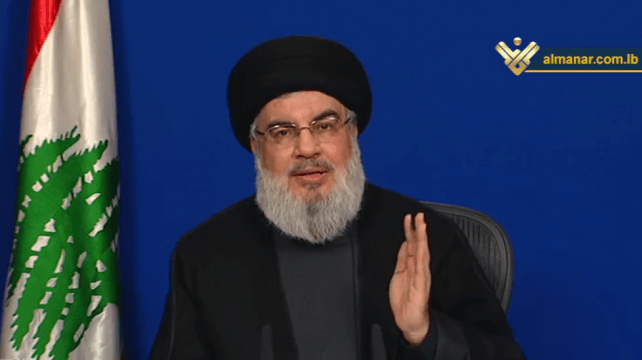
By Marwa Haidar| Al-Manar | October 25, 2019
Hezbollah Secretary General Sayyed Hasan Nasrallah urged the resistance supporters on Friday to leave the streets, noting that a dangerous scheme aimed at targeting Lebanon on the political level has being prepared.
In a televised address to the Lebanese people on the latest local developments, Sayyed Nasrallah said that Hezbollah at first hailed the popular protests but noted that such rallies have turned out to be politically exploited by foreign powers and suspicious sides inside Lebanon.
His eminence listed the achievements of the nation-wide protests which started on October 17, noting that its major achievements were the package or reforms and 2020 budget which was with no taxes.
As he stressed that Hezbollah doesn’t accept toppling the presidency, Sayyed Nasrallah noted that the resistance party also doesn’t back the government resignation.
In this context, Hezbollah S.G. pointed to a call by President Michel Aoun to meet protests representatives.
Sayyed Nasrallah vowed, meanwhile, that the package of reforms announced by Prime Minister Saad Hariri will be implemented on its due dates, stressing that Hezbollah won’t allow delay in this regard.
Achievements of Popular Protests
Noting that Lebanon is witnessing critical events, Sayyed Nasrallah reminded of Hezbollah’s stance at the start of the popular protests.
“We have stressed that Hezbollah respects the popular protests,” Sayyed Nasrallah said, noting that the resistance party didn’t want to take part in the protests in order for these rallies to be far from political affiliations.
“What happened was very good, especially in the first days of the protests, and must be preserved,” his eminence said, noting that he had warned against the politicization of the rallies.
Sayyed Nasrallah then listed the achievements fulfilled by the popular movements which swept across different areas in Lebanon.
“One of the protests’ achievements is announcing a budget with no taxes, something that is very important.”
He hailed the package of reforms announced by Premier Saad Hariri as “unprecedented,” noting that it was dismissed and misunderstood by many “in a suspicious way”.
Sayyed Nasrallah in this context, vowed that the reforms package will be implemented on its due dates, and that Hezbollah will not allow the delay in this regard.
Talking further about the achievements, Sayyed Nasrallah said the “popular protests indicate that people have regained self-confidence and hope of achieving the change.”
He said that the nation-wide protests “paved the way for political parties to be serious in countering corruption,” noting that the package of reforms is the first step towards countering corruption.
Vacuum and Chaos
Sayyed Nasrallah said that President Michel Aoun had called for dialogue with protest representatives, noting that the remarks of the president were distorted.
As he said that Hezbollah and his allies are open to dialogue with protesters, Sayyed Nasralah stressed that any solution to the current crisis should avoid political vacuum.
In this context, Sayyed Nasrallah called on protesters to choose their representatives.
“O’ protesters choose a leadership that can talk on your behalf. If you can’t do so, then let the people in the protest venues choose representatives in order to hold talks with President Aoun.”
“Any solution should be away from vacuum in political institutions and authority, for such vacuum, in light of hard economic, livelihood and financial condition, would lead to chaos and collapse.”
“We don’t accept toppling of presidency, as we don’t back the government resignation,” Sayyed Nasrallah said.
Commenting on calls for early parliamentary elections, Sayyed Nasrallah said that such step is complicated; stressing that reaching a deal on elections law by political parties in Lebanon is something difficult.
“They say that Hezbollah had contributed to political vacuum before the election of President Aoun,” Sayyed Nasrallah said, referring to remarks by officials belonging to some political parties in Lebanon.
“It’s not right that we took the country to the vacuum. Yes we disrupted the presidential elections, but the government and parliament were working. The roads weren’t blocked as well as the universities and schools were not shut.”
Blocking Roads
Hezbollah S.G. said that blocking roads is one of the civilian forms to protest. However he pointed to the duration of these moves, noting that after nine days, they cause harm for people and hamper their lives.
He also condemned offensive acts staged by protesters who belong to some political parties.
The checkpoints established in the roads by political parties’ supporters who ask the people for their IDs remind of the civil war, Sayyed Nasrallah said.
“I call on protesters to open the roads. Stay in the protest venues but open the roads for people to go to their work, universities and schools.”
Meanwhile, Sayyed Nasrallah denied as baseless, rumors that there are calls to the Lebanese Army to clash with protesters.
Suspicious Sides
Sayyed Nasrallah reiterated Hezbollah’s stance which voiced support to the protests at the first days.
“In the first days we didn’t consider the protests suspicious. We didn’t believe that there is a conspiracy behind such moves.” Sayyed Nasrallah said.
But the scene has changed now, Sayyed Nasralah said, noting that “what started spontaneously has been largely exploited by political parties.”
“Some protests have been financed by embassies and suspicious sides,” his eminence affirmed, adding: “social and livelihood demands have been diverted to target resistance.”
“Several sides are exploiting popular protests to settle their account with Hezbollah and implement foreign agendas.”
“Lebanon has entered dangerous phase, there are prospects that our country will be politically targeted by international, regional powers,” his eminence warned.
“We have information that an anti-resistance scheme is being prepared for Lebanon.”
Sayyed Nasrallah also responded to those who say that Hezbollah ‘is not in the camp of Imam Hussein(PBUH)’ because of his reservations on the protests in the last few days.
“Unlike the current protests, Imam Hussein’s revolution had a clear and sincere leadership,” Sayyed Nasrallah said.
“In the first days of protests we didn’t prevent people to take part in protests. Last Saturday I urged Hezbollah members (not supporters) to refrain from participating since their participation affects the social identity of the rallies,” his eminence said.
“Today, and based on new givens and suspicions I call upon the resistance crowds to leave the streets and the protest venues,” Sayyed Nasrallah concluded.
Kurdish-led SDF militant group thanks Russia for defusing Turkey’s Syria incursion
Press TV – October 24, 2019
The Kurdish-led Syrian Democratic Forces (SDF) militant group has thanked Moscow for striking a deal with Ankara, which ended a Turkish offensive against Kurdish militants in northern Syria, welcoming the deployment of Russian and Syrian troops to the border regions as part of the agreement.
During talks with Russian Defense Minister Sergei Shoigu and Chief of General Staff Valery Gerasimov via video-link on Wednesday, SDF head Mazloum Abdi said Moscow had saved the Kurds from the “scourge” of war through the recent agreement with Ankara.
According to a SDF statement, Abdi “expressed his thanks to President Vladimir Putin and the Russian Federation for their keenness on defusing the war in our region and sparing civilians its scourge.”
“Currently, units of the Russian military police and regular Syrian troops are being deployed into many locations. We are providing them with all kind of help and assistance,” Abdi said.
Abdi, however, expressed “reservations about some points of the agreement,” which he said need to be put to further discussions.
The Ankara-Moscow deal put an end to the Turkish offensive, which had been launched on October 9 with the aim of cleansing the regions near its border of US-backed Kurdish militias — whom it views as terrorists linked to local autonomy-seeking Kurdistan Workers’ Party (PKK) militants — and establishing a “safe zone” there.
The 10-point memorandum of understanding was unveiled following lengthy talks between Putin and Turkish President Recep Tayyip Erdogan in Sochi.
Under the deal, which took effect at noon on Wednesday, Russian military police and Syrian border guards entered the northern border regions to facilitate the removal of YPG militants and their weapons to a depth of 30 kilometers (19 miles) from Syria’s frontier with Turkey.
Once the process is complete, within 150 hours, Turkish and Russian soldiers will begin joint patrols of the entire border area to a depth of 10 kilometers (six miles) with the exception of the border city of Qamishli in Hasakah Province.
The Turkish invasion of Syria came with the green light of the US, which was once a staunch supporter of the Kurdish militants. Prior to the incursion, Washington abruptly pulled its forces out of Syria’s northern regions, effectively moving aside for NATO ally Ankara to attack the Kurds.
Feeling betrayed by the US, the Kurdish militants turned to Damascus for help, inking a Russia-brokered deal with the Syrian government, under which the Kurds allowed army troops to deploy along the Turkish border to stave off Ankara’s offensive.
Ankara says ‘no need to start new Syria offensive’ after Erdogan-Putin talks
RT | October 22, 2019
Turkey will not be launching a new offensive against Kurdish militias in northern Syria, following a five-day pause in hostilities and high-level talks in Moscow, Ankara’s Defense Ministry said.
Following lengthy talks on Tuesday, Russian President Vladimir Putin and Turkish President Recep Tayyip Erdogan agreed that Russian military police and Syrian servicemen will be deployed to northeastern Syria, targeted by Turkey in their ‘Operation Peace Spring.’
The Turkish Defense Ministry then said in a statement that there was “no need to carry out a new operation at this stage,” adding that the creation of a “peace corridor” in the border area would ensure the safe return of millions of displaced Syrians.
Turkey’s latest incursion into the north began earlier this month, directed at Kurdish militias it says are linked to terrorism and its own domestic Kurdish separatist movement.
Until recently, around 1,000 American soldiers were stationed with the Kurdish fighters near the border, insulating them from a Turkish offensive, but a sudden US withdrawal last week cleared the way for Ankara’s operation, which it had threatened for months. Washington’s retreat paved the way for a deal between the Kurds and Damascus, allowing Syrian forces to regain control of territories in the northeast after over 7 years of war.
Even on Tuesday Ankara questioned if the US held its end of the deal and facilitated the withdrawal of Kurdish forces, but the Turkish ministry then said Washington told Ankara the Kurdish groups had all left the area by the end of the 120-hour ceasefire pause.
US President Donald Trump also weighed in on the development, calling it “good news” in a tweet on Monday night.
The deal struck between Ankara and Moscow on Tuesday will ensure the territorial integrity of Syria; allow the government to regain control over towns and cities in the northeast; establish Turkish-Russian patrols along the border; and revitalize the Adana Accord, a security pact struck between Damascus and Ankara in 1998. Dealing with captured Islamic State militants was also addressed in Tuesday’s agreement, which the Syrian government has endorsed.
The agreement underscores Washington’s waning sway in the region and represents a positive step toward winding down a bloody years-long conflict, independent political analyst Ali Demidras told RT.
“The Sochi agreement has cemented the Russian-Turkish cooperation in Syria also effectively reducing the American influence in the country,” Demidras said. “United Syria has been secured.”
The Russian Masterpiece in Syria: Everyone Wins
By Federico Pieraccini | Strategic Culture Foundation | October 16, 2019
“Moscow and Damascus have always maintained they are against any form of partition or illegal foreign presence in Syria.”
Moscow has managed to maintain contacts with all parties in the conflict, even in spite of its stance against partition and illegal foreign presence. Trilateral talks between Iran, Turkey and Russia occurred in Astana at Moscow’s urging. Putin managed to bring together in Sochi the Syrian government and opposition groups to discuss the future of Syria. In Geneva, Moscow mediated between Damascus and the international community, shielding Syria from the diplomatic skulduggery of the US and other enemies of Syria.
Turkey, solely as a result of its defeat in Syria, now finds itself in active dialogue with Moscow and Tehran. As Ankara experiences worsening relations with Washington and other European capitals, Moscow saw a great opportunity to bring Turkey closer to Damascus.
Russia’s operation was complicated and required a lot of patience; but thanks to negotiations supervised by Russia, together with the bravery and courage of Syrian soldiers, almost all of the terrorist pockets scattered around Syria have been progressively overcome.
Other than the Idlib province, the main problem for Damascus lay with the US occupation in the northeast of the country, under the pretext of protecting the Kurds (SDF) from the “Assad regime”, as well as to “fight Daesh”.
Erdogan currently finds himself boxed in, squeezed in by a collapsing economy, threatened by his allies (the purchase of the Russian S-400 system irritated many in Washington and in NATO): he desperately needs to present some kind of victory to his base.
This may be the primary reason behind Erdogan’s decision to move into Syria under the pretense that the YPG is a terrorist organization linked with the PKK — proceeding to create a buffer zone on the border between Syria and Turkey and declaring “mission accomplished” to boost popularity ratings.
With Trump, he is desperate to shift attention away from the impeachment proceedings (a hoax), and similarly needs to present some kind of victory to his base. Why, what better way to do this than with a mini withdrawal of US troops from Syria, leaving the Kurds to their destiny (Trump’s care factor regarding SDF is minimal, as they are more connected to his political opponents in the Democratic Party), while claiming victory over Daesh for the umpteenth time in recent months?
Trump, with a handful of tweets directed against the Pentagon’s “crazy spending” and America’s past wars, finds himself and his base giving each other high fives on their commitment to the doctrine of “America First”.
Erdogan and Trump have also solved the embarrassing internal conflict within NATO between Turkey and the US, probably reestablishing personal relationships (the tough talk from the White House notwithstanding).
The agreement between the Kurds (SDF) and Damascus is the only natural conclusion to events that are heavily orchestrated by Moscow. The deployment of Syrian and Russian troops on the border with Turkey is the prelude to the reconquest of the entirety of Syrian territory — the outcome the Kremlin was wishing for at the beginning of this diplomatic masterpiece.
Washington and Ankara have never had any opportunities to prevent Damascus from reunifying the country. It was assumed by Moscow that Washington and Ankara would sooner or later seek the correct exit strategy, even as they proclaimed victory to their respective bases in the face of defeat in Syria. This is exactly what Putin and Lavrov came up with over the last few weeks, offering Trump and Erdogan the solution to their Syrian problems.
Trump will state that he has little interest in countries 7,000 miles from the homeland; and Erdogan (with some reluctance) will affirm that the border between Turkey and Syria, when held by the Syrian Arab Army, guarantees security against the Kurds.
Putin has no doubt advised Assad and the Kurds to begin a dialogue in the common interests of Syria. He would have no doubt also convinced Erdogan and Trump of the need to accept these plans.
An agreement that rewards Damascus and Moscow saves the Kurds while leaving Erdogan and Trump with a semblance of dignity in a situation that is difficult to explain to a domestic or international audience.
Moscow has started joint patrols with the Syrian Arab Army on the borders with Turkey for the purposes of preventing any military clashes between Ankara and Damascus. If Ankara halts its military operation in the coming days, Damascus will regain control of the oil fields.
The world will then have witnessed one of the greatest diplomatic masterpieces ever conceived, responsible for bringing closer the end of the seven-year-long Syrian conflict.
Iran Open to Dialogue with Saudi, Has Better Option for Turkey on Syria: Zarif
Al-Manar – October 12, 2019
Iran’s Foreign Minister Mohammad Javad Zarif said Tehran welcomes efforts by intermediaries to mediate between Tehran and Riyadh.
“We’ve always been open to discussing anything with Saudi Arabia. Saudi Arabia is our neighbor. We’re going to be here together permanently,” Mohammad Javad Zarif told Turkey’s TRT World.
“We don’t have any choice but to talk to each other, and we have been open to talking to Saudi Arabia either directly or through intermediaries,” he added.
When asked about the upcoming visit of Pakistan’s Prime Minister Imran Khan to Tehran, the top diplomat said, “We’ve never rejected any intermediary… We’ve always been open to mediation, and we’ve always been open to direct talks with our Saudi neighbors.”
Khan is likely to visit Iran and Saudi Arabia, the Pakistani foreign office said on Friday, weeks after Islamabad said Washington had asked it to mediate with Tehran.
The announcement of the possible visit comes after Khan last month revealed a request by US President Donald Trump, asking the Pakistani leader to help defuse tensions with Iran.
Khan said after a meeting with Trump on the sidelines of the United Nations General Assembly in New York that he was “trying and mediating” and had also spoken with Iran’s President Hassan Rouhani.
Syria Offensive
Meanwhile on the Turkish offensive in northern Syria, the top Iranian diplomat stressed that security will not be achieved through acts of aggression and invasion against Syria, revealing that his country has offered better options to Turkey to settle the issue.
While Iran understands Turkey’s security concerns, it does not believe that security could be achieved through acts of aggression and invasion against Syria, Zarif told TRT World.
While Iran understands Turkey’s security concerns, it does not believe that security could be achieved through acts of aggression and invasion against Syria, Iranian Foreign Minister Mohammad Javad Zarif said in an interview with Turkey’s TRT World.
“We have better alternatives, which we have presented to our friends in Turkey,” Zarif added, referring to the Adana agreement.
“The Adana agreement is still valid,” said Zarif, adding “we can bring the Kurds, the Syrian and Turkish governments together, so that the Syrian Army, in cooperation with the Turkish government, can be in charge of border security. This can be the better path to achieve security.”
Featured Video

The Truth About the Trump Shootings with Ken Silva
or go to
Aletho News Archives – Video-Images
From the Archives
The Geopolitics behind the War in Yemen (I)
By Mahdi Darius NAZEMROAYA | Strategic Culture Foundation | 30.03.2015
The United States and the Kingdom of Saudi Arabia became very uneasy when the Yemenese or Yemenite movement of the Houthi or Ansarallah (meaning the supporters of God in Arabic) gained control of Yemen’s capital, Sanaa/Sana, in September 2014. The US-supported Yemenite President Abd-Rabbuh Manṣour Al-Hadi was humiliatingly forced to share power with the Houthis and the coalition of northern Yemenese tribes that had helped them enter Sana. Al-Hadi declared that negotiations for a Yemeni national unity government would take place and his allies the US and Saudi Arabia tried to use a new national dialogue and mediated talks to co-opt and pacify the Houthis.
The truth has been turned on its head about the war in Yemen. The war and ousting of President Abd-Rabbuh Manṣour Al-Hadi in Yemen are not the results of «Houthi coup» in Yemen. It is the opposite. Al-Hadi was ousted, because with Saudi and US support he tried to backtrack on the power sharing agreements he had made and return Yemen to authoritarian rule. The ousting of President Al-Hadi by the Houthis and their political allies was an unexpected reaction to the takeover Al-Hadi was planning with Washington and the House of Saudi. … continue
Blog Roll
 Aletho News
- IRGC air defenses destroy another US MQ-1 drone over Strait of Hormuz
- Imran Khan’s entire immediate family detained in Pakistan ahead of mass protest demanding his release
- EU nation detains former presidential frontrunner
- Leaked: Britain’s Sham Conviction Of Hashim Thaci
- Seyed M. Marandi: U.S. Strike Imminent – Toward Total War in the Middle East
- Russia Voted Under Fire. Washington Is Loading the Tankers.
- 12 Things Your Oncologist Was Trained Not to Tell You
- Anthrax Attacks Paved Way for COVID-Era ‘Junk Drugs and Vaccines’
- How Real Is the Impact of Western Sanctions on Israel?
- France, You Are Guilty: How Paris Turned Western Sahara into the Maghreb’s Powder Keg
- If Americans Knew
- Inside Israel’s ‘soft’ ethnic cleansing plan for Gaza through the eyes of its victims
- New online database tracks pro-‘Israel’ political donations in the United States
- Israeli president pardons soldier convicted for killing wounded Palestinian
- Singer Ed Sheeran says his ‘heart broken’ by Gaza devastation, addresses Macklemore controversy
- Israel Has Imprisoned Female Journalist Bushra Al-Tawil Without Trial Or Charge In Solitary Confinement For Past Month
- Israel poised to teach West Bank a lesson after one Israeli killed – Daily Update
- Salah Sarsour’s Legal Team Says DHS Has Not Met Its Burden to Prove He Is Deportable
- An analysis of tax forms by The Intercept show Kraft’s charity and LLC have donated to Friends of the IDF and AIPAC’s super PAC.
- Israeli attacks kill four Palestinians in Gaza – Daily Update
- Inside Gaza’s death trap of collapsing, bombed-out buildings
- No Tricks Zone
- 2025 Nature Paper Claiming Worsening Global Drought Gets RETRACTED …Heavily Flawed
- New Study: ‘Global Drought Shows No Detectable Recent Acceleration Under Climate Warming’
- Economic Masterminds: German Socialists Suggest Taxing Productivity Gains Stemming From Using AI
- The South China Sea Has Not Been Cooperating With The Climate Change Narrative
- Energy Crisis: Germany Enters Heating Season With Historically Low Gas Reserve Fill Levels
- New Study: The Antarctic Ice Sheet Gained Mass From 2020-2024 Due To Staggering Snow And Ice Accumulation
- Study: Ocean Heating Rates From Thousands Of Years Ago ‘Dwarf’ Modern Ocean Heating Rates
- Climate Extremists Target, Attack Large-Scale Power Grid Infrastructure In Germany!
- New Study: Antarctic Ice Melt Has Contributed Less Than 1 Centimeter To Sea Level Rise In The Last 30 Years
- Fear Of Debate: Alarmist German Climate Scientist Calls On Mainstream Media To Discredit Skeptic Voices
 Aletho News