Turkey’s ‘White Elephants’: S-400s Or Patriots?
By Andrew Korybko | November 20, 2019
Turkish President Erdogan’s visit to the US last week didn’t visibly seem to have accomplished much in repairing the unprecedentedly damaged relationship between these two nominal NATO “allies”, although the very fact that it occurred despite Washington’s CAATSA sanctions threats, their earlier sharp disagreements over Ankara’s latest military operation in Northeastern Syria, and Congress’ provocative passing of a motion recognizing what some countries including Russia regard as the “Armenian Genocide” showed that there’s the political will on both sides to improve their ties even if only at the leadership level at this moment in time. As it stands, the main stumbling block is Turkey’s purchase of Russia’s S-400s, seeing as how the two countries have more or less reached a pragmatic understanding on Northern Syria and Ankara realizes that Trump’s “deep state” foes are politicizing historical events from a century ago in order in order to undermine his foreign policy in an attempt to weaken him ahead of next year’s elections.
President Erdogan reaffirmed to his American counterpart that his country won’t completely abandon its military deal with Russia like Washington wants but that Ankara would buy the US’ Patriots as well if an offer was made “under suitable conditions”, suggesting that one or the other air-defense system would become a ‘white elephant’ under that scenario. The odds, however, are likely that it would be the Patriots which would fulfill this expensive but useless role and not the S-400s. This is because the very intent in diversifying from NATO defense systems in the first place was to ensure that they couldn’t be sabotaged in the event of an intra-NATO conflict such as one between Turkey and Greece or between Turkey and the US. These concerns have been at the forefront of Turkish strategic military thought following the US’ indirect role in orchestrating the failed coup attempt against President Erdogan in 2016, during which time rogue pilots even attempted to assassinate the country’s leader. The S-400s give Turkey the reassurance that it could confidently thwart such scenarios in the future, while the Patriots would always leave it wary that they might prove “unreliable” at the worst moment.
The question then becomes one of why Turkey would even want to fork over what might potentially amount to billions of dollars for an air-defense system that it doesn’t even really plan to use, but the answer rests in the global geostrategic trend of “balancing” that’s increasingly come to define the emerging Multipolar World Order. Turkey acknowledges the threat that the Obama-era “deep state” that Trump inherited poses to it, but it also wisely understands that strategies can always change, hence why it’s important not to do anything that could make a more permanent enemy out of the US. The S-400 purchase is a strong step in the direction of increasing Turkey’s sovereignty at the expense of the US’ proxy control over this rising Great Power, but it’s precisely because of this outcome that even the pro-Trump factions of the US “deep state” are opposed to it. So as to not unnecessarily “provoke” America even more than it already has in recent years through its independent policies, the decision evidently has been made to seek some sort of a “compromise” with it through the potential purchase of Patriots “under suitable conditions”.
The aforesaid likely refer to these systems being offered at a competitive price and not made conditional on Turkey abandoning the S-400s. For as much as the US’ “deep state” factions are uniting in their perception of Turkey as a so-called “threat” to American interests in the Mideast and elsewhere, they also don’t want to completely cut it off and risk the country enacting a full-fledged pivot towards Russia and China in response, hence why they might be interested in reaching a deal that could avoid the imposition of CAATSA sanctions. That same pragmatic logic holds true for India as well, which plans to begin receiving S-400s next year after also signing a deal with Russia to this effect. A formula is therefore being formed for how countries that purchase the S-400s could potentially avoid CAATSA sanctions without abandoning those systems wherein they’d simply purchase some Patriots to complement their air defenses instead, though only so long as the US agrees to allow this to happen by “compromising” on its previously maximalist position that they don’t buy the S-400s at all.
The US might have an interest in making some extra money for its military-industrial complex in parallel with keeping those countries’ multipolar-friendly policies in check by not completely cutting them off from the Western orbit by imposing sanctions against them. From the Indian perspective, its armed forces could still find a use for the Patriots since it’s extremely unlikely that the US would ever sabotage them in the event that the South Asian state enters into a conventional conflict with either China or Pakistan, though the Turks would probably have to be content with accepting that they’re basically paying “protection money” to America by purchasing those “white elephants”. That said, Turkey might possibly find some minor use for these systems such as along the Syrian border for instance, though it’s unlikely that they’ll ever occupy any premier position of strategic importance in defending the country since they can’t ever be relied upon in that respect like the S-400s could. All told, if there’s any positive outcome of President Erdogan’s latest trip to Washington, it’s that Turkey and the US might be coming closer to a deal for avoiding CAATSA sanctions, though lots of work still remains to be done before that happens.
Morales: Bolivia Suffers an Assault on the Power of the People
By Nino Pagliccia | CounterPunch | November 15, 2019
As the military coup continues to entrench itself in Bolivia, the first goal of the perpetrators is to appear to be following the constitutional process. But the façade is not enough to hide the real disaster of yet another self-proclaimed president in Latin America. When you thought that the Juan Guaido experiment in Venezuela was a total failure in every respect, Bolivia repeats the same pathetic tragedy.
The main character is Jeanine Añez, the second vice-president of the Bolivian Senate who proclaimed herself to be the “president” of Bolivia supposedly according to the constitution. She declared, “I immediately take the presidency of the State.” She is a senator for the rightwing party Democratic Unity and has been an adamant opponent of Evo Morales who was forced into exile in Mexico by the Bolivian armed forces top brass, who now have enthusiastically recognised the new “president”.
A couple of farcical moments maybe first, when Añez stood in the middle of an almost empty Senate hall. At least Juan Guaido had a small crowd when he self proclaimed in January 23. The second moment may have been when she walked into the presidential palace barely able to carry up high an oversized bible and declaring, “The bible returns to the [presidential] palace”. Later she added, “our power is God, the power is God.” Her religiosity is apparently very prominent.
But more seriously, what makes this a tragedy is that she appointed herself “president” in an almost empty Senate because the majority of senators are members of the government party, Movimiento Al Socialismo (MAS), and they were not present. Consequently there was no required quorum for the “vote” to take place. Prior to that, she quickly had to appoint herself president of the Senate because the MAS president and first vice-president were not present. So she skipped quite a few steps of the hierarchy breaking the constitution in order to appear to be entitled to the presidency…according to the constitution.
Evo Morales from Mexico twitted: “This self-proclamation is against articles 161, 169 and 410 of the State Political Constitution [Constitución Política del Estado – CPE] that determine the approval or rejection of a presidential resignation, the constitutional succession from the Senate or Deputy [Assembly] presidents and the higher authority of the CPE. Bolivia suffers an assault to the power of the people.”
In fact, Article 161 has two functions relevant in this case, one is “accept or deny the resignation of the President and of the Vice President of the State.” This has not been done. And secondly, “receive the oath of the President and the Vice President of the State.” We have not heard if the new “president” has done so, but regardless, all has to take place when “The [Senate and Deputy] Chambers will meet in Plurinational Legislative Assembly.” As we know, no such assembly is functioning.
Article 169 is crucial: “In case of impediment or definitive absence of the President of the State, the Vice President will replace him/her, and in case of his/her absence [in turn] the President of the Senate will replace him/her, and in case of his/her absence, the President of the Chamber of Deputies will replace him/her. In the latter case, new elections will be called within the maximum deadline of ninety days.” We have just indicated that this process has not been followed because the presidents of the two Chambers were not even present.
Article 410 states who will have to abide by the constitution. “All people, natural and legal, as well as public bodies, public functionaries and institutions, are all subject to this Constitution.” This clearly applies to all the coup perpetrators without exception. But they have not.
To invalidate even more this absurd unconstitutional scenario is that when the legitimate president of the Senate, Adriana Salvatierra, representing the MAS government Party, attempted to enter into the Senate to claim to be elected president of Bolivia according to the constitution she was not even allowed to enter. Admittedly she had resigned but her resignation was never formally accepted.
To conclude, we have to note that constitutions are written to lay down basic fundamental rights, guarantees and rules of the State. Everything else, including clarifications of any constitutional matter, is the attribution, in the case of Bolivia, of the Plurinational Constitutional Court. But this court in turn is composed of elected members who are now literally dysfunctional or disbanded, or nor legitimate.
But what is really important to note is that constitutions are written assuming normal circumstances in the country and that those normal circumstances will continue indefinitely. The reality is that there is nothing normal following a coup. All standard basic definitions and notions of democracy, independence, sovereignty and foreign intervention break down creating a vacuum that is immediately filled with ideology and interests. What really makes the whole event in Bolivia tragic is that it is triggered by a foreign induced Hybrid War not for the benefit of Bolivians.
Tehran loses patience with Modi government’s hide and seek
By M. K. BHADRAKUMAR | Indian Punchline | November 18, 2019
Historically speaking, the India-Iran relationship had its ups and downs during the decades of the Shah’s rule. The Lowest point was reached when, during the 1965 and 1971 wars with India, Pakistani Air Force jets were stationed in Iran to gain ‘strategic depth’ vis-a-vis the IAF.
However, after the 1979 Islamic revolution, Iran adopted an explicitly anti-Western foreign policy and began viewing India as a natural ally. The ideology-based regime rooted in the principles of justice, freedom and resistance was greatly attracted by India’s freedom struggle, non-aligned policies, and the sheer grit to preserve its strategic autonomy. This perceived affinity withstood the changes and shifts in Delhi’s foreign policy outlook in the post-Cold war era.
Tehran was not unduly perturbed when the India-US relationship took an upward curve in the nineties during the Bill Clinton administration or when the 2008 nuclear deal was concluded — or, even when Washington and Delhi began chanting their ‘defining partnership of the 21st century’ during the Barack Obama Administration.
Tehran remained confident about India’s DNA anchored on the country’s strategic autonomy. This confidence took a beating when India voted for the first time in February 2006 in favour of a West-led resolution in the International Atomic Energy Agency (IAEA), which reported against Iran to the UN Security Council — and, again, in November 2009 when India voted in favour of a resolution spearheaded by the US at the IAEA censuring Tehran over its controversial nuclear programme and demanding that it stop uranium enrichment.
Nonetheless, life moved on. There was no apparent rancour. This much needs to be recalled to put in perspective the highly critical remarks by Iran’s foreign minister Mohammad Javad Zarif recently, while meeting a group of visiting journalists from New Delhi, regarding the Modi government’s pusillanimous attitude under American pressure to roll back cooperation with Tehran.
Zarif said Tehran had expected the Modi government to be “more resilient” in the face of Washington’s bullying. Zarif speculated that India probably “did not want to agitate” the US by being a sanctions spoiler and he added with biting sarcasm, “People want to be on the right side of President Trump” but the problem is “he hasn’t got a right side.”
Equally, Zarif regretted that the Modi government was dragging its feet on the Chabahar Port project, which has far-reaching implications for regional connectivity, stability and security.
Iranian state media widely reported Zarif’s remarks, which most certainly reflect deep misgivings at the highest level of the Iranian leadership that India’s capacity or political will to pursue independent foreign policies is increasingly in doubt.
To be sure, Zarif’s remarks must also be seen in the backdrop of the Modi government’s fawning attitude toward Saudi Arabia lately. There is no empirical evidence to suggest that Riyadh laid pre-conditions for Crown Prince Mohammed bin Salman’s embrace of PM Modi. In fact, Saudi-Iranian rivalry is far too complex to be reduced to zero-sum mindset. After all, Riyadh is robustly advancing cooperation with Russia and China despite these two countries having thriving strategic partnerships with Iran.
Indian analysts tend to link the Modi government’s dalliance with Saudi Arabia and the deepening chill in Indian-Iranian relations. Indeed, the Modi government has relegated cooperation with Iran to the back burner. It is no secret of course that Washington encourages third countries to replace Iranian crude with Saudi supplies.
The Modi government is pinning hopes on massive Saudi investments in India. During the Crown Prince’s visit to India in February, he forecast Saudi investments to the tune of $100 billion during the next two-year period. The Indian side has been daydreaming since then about big Saudi investments in the Ratnagiri petrochemical project and in Reliance Industries. While the Ratnagiri project is in limbo, Reliance is keeping its fingers crossed. Modi’s recent visit to Saudi Arabia can be viewed in this context.
How realistic are the Indian expectations? Clearly, Saudi Arabia itself needs to attract outside investment. Lackluster oil prices have caused the country’s budget deficit to widen. The budget deficit would be in the region of $36 billion in 2018 and 2019, and may widen to $50 billion in 2020. Saudi Aramco’s IPO itself is for raising money for funding the Crown Prince’s ambitious program of economic and social reforms (‘Vision 2030’).
CNBC recently featured an interview with ex-CIA chief General David Petraeus (who presently heads the KKR Global Institute, which provides consultancy to American companies active in the Middle East) regarding Saudi Arabia’s economic malaise. Some excerpts are worth noting:
“It’s a fact that Saudi Arabia is gradually running out of money, they’d be the first to acknowledge that the sovereign wealth fund has been reduced, it’s somewhere below $500 billion now.”
“The (budget) deficits each year, depending on the price of Brent crude, can be anywhere from $40 to $60 billion depending on some of their activities in countries in the region.”
“The bottom line is that they need the money, they need that outside investment that is crucial to delivering ‘Vision 2030’ which cannot be realized without outside investment, this is just one component of a number of different initiatives that they’re pursuing to try to attract that outside investment.”
The prospects aren’t bright for Reliance and Ratnagiri to pin hopes on Saudi investment. The Crown Prince’s priority is ‘Vision 2030’ — and it remains a hard sell. Period.
Put differently, neglecting India’s cooperation with Iran, especially Chabahar Port development, for the sake of a chimerical Saudi bonanza can only find the Modi government falling between two stools eventually. India cannot, should not and need not substitute Saudi Arabia as a preferred partner to Iran — or vice versa.
Why keep at arm’s length a regional power in our extended neighbourhood who is manifestly eager to foster cooperation with India? Such an attitude is illogical, myopic and cramps India’s diplomatic options in the Persian Gulf.
Washington threatens Egypt with Sanctions over Russian Su-35 fighter jet purchase
By Sarah Abed | November 18, 2019
Washington’s latest attempt to dissuade an ally from making arms deals with Russia came in the form of a letter sent on last Wednesday to Egyptian officials warning them that they could face sanctions if they continued with their $2 billion dollar Su-35 fighter jets contract.
In addition to sanctions, Secretary of State Mike Pompeo and Secretary of Defense Mark Esper warned Egyptian Defense Minister Mohamed Ahmed Zaki in Wednesday’s letter that “Major new arms deals with Russia would — at a minimum — complicate future U.S. defense transactions with and security assistance to Egypt.” The United States sends Egypt $1.3 billion annually in military assistance.
Russia has become one of Egypt’s major arms suppliers. This particular arms between Egypt and Russia for ten fighter jets was signed at the end of 2018, with delivery of the Su-35 Flanker-E air superiority fighter aircraft as well as weapons for the planes starting in 2020-2021.
In order to counter Russia’s expanding military influence in the Middle East and dissuade countries from buying Russian-made arms, the Countering America’s Adversaries Through Sanctions Act (CAATSA) was signed by President Donald Trump in August 2017. Countries that are trading with Russia’s defense or intelligence sectors could face secondary sanctions.
Russia estimates that since 2014 it has lost $760 million dollars in potential weapons sales due to the international sanctions sealing off the U.S. market.
However, the CAATSA is not limited to sanctioning Russia and those who purchase Russian-made weapons, this U.S. Federal law also imposes economic sanctions on Iran and North Korea.
The first case for secondary sanctions under CAATSA took place in September 2018 when sanctions were imposed by the Trump administration on the Chinese military for purchasing 10 Su-35 aircraft and S-400’s from Russia, also 33 people and entities were blacklisted due to links to Russian military and intelligence.
The second case would be Turkey’s purchase of Russia’s S-400 air defense system with the first delivery of its components having taken place in July of this year. As a result of going through with their purchase and delivery, Turkey was also suspended from participating in the F-35 program and the F-35 air systems it had already purchased are now under U.S. control.
Although requirements have been met for CAATSA to be enforced there is a gray area as to how, and to what extent the sanctions should be applied. A waiver is also in place that the president can use. Also, both the U.S. executive and legislative branches play a role in determining the action that would be taken against Turkey for doing business with Russian personnel targeted by sanctions.
India is paying close attention to how the US is reacting to Turkey’s purchase as they too have purchased Russia’s S-400 SAMS system which would put them in conflict with the CAATSA as well. However, relations between India and the United States are strong and the likelihood that a waiver will be used to avoid making India suffer collateral damage is likely.
For the past decade Russia has been expanding its military influence in the Middle East, much to the dissatisfaction of the United States. Russia and Egypt’s military and technical cooperation has been deepening and expanding for years. Both nations have repeatedly held joint naval and airborne counterterrorism exercises since 2015. From October 27th till November 7th of this year the Egyptian air force’s tactical training center near Cairo hosted joint Russian/Egyptian military drills dubbed Arrow of Friendship-1.
There’s even been speculation about the prospect of Russia setting up a military base in Egypt, due to the increase of Russian activity on Egyptian grounds. Just two years ago a draft agreement which would “allow each side to use the other’s airspace and air bases” was approved by Moscow and Cairo. Even though it didn’t specify setting up a military base it did set the ground for significant expansion in military cooperation between the two countries.
While the US fumbles around in the Middle East leaving death and destruction in its tracks, Russia has become the main peace broker. While maintaining good relations with all the major players in the region, Russia intervened militarily in Syria at the request of Syrian President Bashar Al Assad to fight terrorism and derail a strong regime-change plan by the Obama administration. Relations and business with Iran and Turkey have also increased.
Moscow knows that security in neighboring countries directly impacts its own and standing by allies will only help grow its influence and positive image in the Middle East and beyond.
Hong Kong protesters hurl petrol bombs at volunteers trying to clear roadblocks and shoot arrows at police
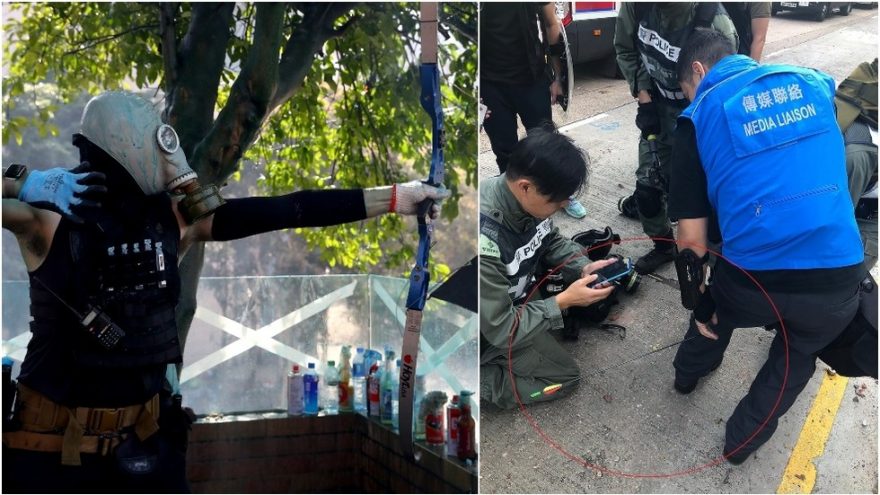
© (L) Athit Perawongmetha / Reuters; (R) Stringer / Hong Kong Police Force / AFP
RT | November 17, 2019
Demonstrators in Hong Kong attacked common citizens who attempted to free the roads from barricades amid a new round of clashes with police.
A fierce street battle erupted outside the Hong Kong Polytechnic University (PolyU) on Sunday, as protesters threw bricks at police, which responded with tear gas and water cannons. The officers were trying to remove the barricades erected by the demonstrators earlier this week, and urged them to stop placing metal spikes on the roads in hopes of piercing the police vehicles’ tires.
A sergeant with police media liaison office was shot in the leg with an arrow during the standoff. The protesters have been previously filmed using bows and arrows against the law enforcement, as well as javelins, homemade catapults and slingshots.
The protesters earlier attacked a group of citizens who were clearing the roadblocks and debris outside the PolyU. A man and a woman were hospitalized with head injuries in result of the attack.
Similar scuffles occurred near the University of Hong Kong (HKU) and the City University of Hong Kong (CityU), where black-clad, masked rioters threw bricks and petrol bombs at the volunteers, who were removing the makeshift barricades.
The residents, many of whom are alumnae of these universities, have answered online calls from pro-government politicians to help clean the streets. Some of them told the South China Morning Post that protesters have gone “too far” when they switched from rioting downtown to seizing campuses and blocking major roads, including the Cross-Harbour Tunnel, which connects the Hong Kong Island with the rest of the city.
Around 50 Chinese army soldiers joined the volunteers to dismantle the barricades near the Hong Kong Baptist University, marking the first time when Beijing’s troops have left their barracks since the start of the protests this summer. The soldiers were unarmed and wore no protective gear.
Opposition lawmakers quickly claimed that China violated Hong Kong laws, which bar Beijing from deploying its military in the city unless local authorities request help. Hong Kong’s Security Secretary John Lee, however, said that the move was legal, since the soldiers were not on a military mission, but performing voluntary community service instead.
Impeachment Witness Questions
By Peter Van Buren | We Meant Well | November 15, 2019
In addition to the whistleblower himself, when Republicans get their chance to fully question the people whose testimony is now being stage managed by the Democrats, here are the points they must make to illustrate all this.
There is no crime. Exactly what is the president being impeached over? The July 25 phone call text? Scream all the mob movie references you wish, but point to what law the smoking gun phrase Trump used, “Do us a favor,” violates. DOJ ruled the whistleblower revealed no criminal act. Unlike with Nixon and Clinton, the House is not building on an existing law enforcement investigation. Instead, the “investigation” is jerry-rigged in real-time consisting of hostile witnesses interpreting what Trump meant.
If one prefers the simplistic quid for quo, “something in return for something,” that falls empty too. Ukraine conducted no investigations. Whatever Biden did remains only in his version of events. No aid was withheld. As for extortion, at the time of the “ask,” the July 25 call, Ukraine did not know any aid was even being considered to be withheld and witnesses can’t place Ukraine’s knowledge of the delay within a month of each other. Maybe Republicans could try ex nihilo nihil fit, Latin badly translated into “nothing in return for nothing.” Anybody gonna ask the many witnesses why the aid was not actually withheld and why Ukraine did no investigations? How’d that come to be?
The idea America would want to know if a Vice President misused his office for his son’s benefit is clear. The information would have been of value to Trump, but it would have been of greater value to America. C’mon, if it was Pence and Ivanka Dems would see it differently, and characterizing any of this as help with domestic politics or tying it into efforts to bring a foreign government into our election process are deeply disingenuous. And Trump asking for information, however far-fetched Dems think it is and that’s a stretch given they considered Trump a literal KGB asset for most of his term, on possible foreign interference in the 2016 election was not wrong, and using aid to pry it loose (if that was indeed what didn’t happen) is not wrong.
But here is the killer question Republicans should ask of each witness: when did you speak to the president? To the Secretary of State? To Guliani, who you claim was in charge?
Because none of them did. Each is basing his testimony on hearsay and second hand information, just like the initial whistleblower. Ask each “If you never spoke to the president, how can you call yourself a witness with knowledge of his motives?” Is the only rebuttal to those who do claim to understand first hand his motive — Trump himself, Pompeo, Sonderland, Zelensky — a detailess claim that they are liars?
A careful look at existing witness testimony shows they are passing on what others told them (one of Taylor’s main gripes is he was cut out of the loop, and his testimony was a repetition of stories he heard from Morrison and Sondland, and an overheard phone call) or what they surmised.
Republicans should dismiss any witness without first-hand knowledge, and that would empty the room.
White House releases text of 1st phone call between Trump & Zelensky
RT | November 15, 2019
The White House has released a memo of the first phone call between President Donald Trump and Ukrainian President Volodymyr Zelensky. Although it details a predictably throwaway exchange, the search for the hidden meanings is on.
The call, made just a few hours after Zelensky was elected in Ukraine, is little more than a brief exchange of pleasantries, with Trump congratulating Zelensky on his presidency and the two heads of state talking about how great their respective countries are. Zelensky invites Trump to his inauguration, and Trump says they’ll meet soon, whether at the inauguration or elsewhere.
But with an impeachment inquiry in full swing, Trump’s nemeses in the Democratic Party have pounced on the conversation anyway. While former vice president Joe Biden, said to be the focus of the corruption investigation in Trump’s alleged quid pro quo, doesn’t make an appearance at all, that hasn’t stopped #Resistance stalwarts from trying to find a connection in the bare-bones protocol call.
Twitter was abuzz with speculation about the transcript – surely some parts were missing?
The fact that the White House had mentioned a discussion of “rooting out corruption,” yet the word “corruption” did not appear in the transcript, was held up as proof of a conspiracy to suppress the “truth.”
Others scorned the whole process of releasing the transcript, suggesting that Trump’s belief that his words were innocent was just more proof of his guilt.
The congratulatory call is the second Trump-Zelensky phone transcript to be released, after the text of the call that triggered the impeachment frenzy – when a whistleblower who hadn’t heard the conversation deemed it proof of a quid pro quo – failed to satisfy the president’s enemies in Washington. Trump has defended the summaries as “perfect” phone calls – which only makes his opponents double down on trying to read dirt into them.
Trump’s defenders pointed out that the transcript shows Trump eager to meet with Zelensky – far from the version depicted in the impeachment narrative, where he refuses to do so until Ukraine opens an investigation into the company that hired Biden’s son.
Stuck with a relatively lackluster transcript, House intel committee chair Adam Schiff demanded Trump release the “thousands” of documents the impeachment committee has requested as well. Others demanded transcripts of Trump’s calls with… other world leaders.
Which is exactly the precedent Trump had said he was afraid of setting by releasing the original Zelensky call.
Make No Mistake, Morales’ Removal Is Directed Against Bolivia’s Indigenous
By Paul Antonopoulos | American Herald Tribune | November 13, 2019
It certainly has been a difficult year for reactionaries and neoliberals in South America as they failed to violently replace Venezuelan President Nicolás Maduro with U.S.-puppet Juan Guaidó, implement International Monetary Fund (IMF) demands against Ecuador after the people rose up, maintain the popularity of Chile’s billionaire President Sebastián Piñera’s after his attempts to raise the price of metro travel expanded into a larger anti-neoliberal movement, Evo Morales’ re-election in Bolivia, the election of Alberto Fernández in Argentina against neoliberal president Mauricio Macri, and, former Brazilian President Lula’s release from prison last week after serving a small part of his long sentence.
It certainly appears that the so-called Pink Tide, the wave of socialist and left-leaning governments that came to power across Latin America in the 2000’s and peaking in 2011, is returning to the region after being effectively replaced by the so-called “Blue Tide,” the Conservative Wave that saw Brazil, Argentina, Peru and other states return to conservative neoliberal governments. Effectively, the Monroe Doctrine has guided Washington’s belief since at least 1823 that Latin America is its backyard and has a right to protect it from foreign powers.
Former Bolivian President Evo Morales was one of the figures at the forefront of creating sovereignty and independence from the U.S. The first indigenous president of Bolivia reduced illiteracy from 13% in 2006 to 2.4% in 2018, reduced poverty from 60.6% in 2006 to 34.6% in 2018 and reduced unemployment from 9.2% in 2006 to 4.1% in 2018 – this was mostly achieved by ensuring that industries remained nationalized or were renationalized, and by becoming independent of the World Bank and the IMF.
And therefore, “in Bolivia, the American Empire Struck Back.”
With the American Empire experiencing major losses in Latin America this year, most significantly in Venezuela, while also seeing the release of former Brazilian President and pan-Latin Americanist, Lula, from prison, a quick victory was needed. A coup against Morales appeared to be the simplest victory for the Empire to achieve.
Why?
Former Venezuelan President Hugo Chávez made the military a bastion of Bolivarian ideology, ensuring that the entire hierarchy became radically anti-U.S. and patriotic. Therefore, even when Maduro faced a U.S.-orchestrated coup attempt earlier this year, there were very few defections from the Venezuelan military despite calls from Guaidó and Washington. Because Morales failed to radicalize the Bolivian military, he was always at risk of being militarily overthrown by unpatriotic forces willing to serve the American Empire.
Washington understands that Morales empowered the mostly left-leaning Indigenous population of Bolivia, accounting for 20% of the country’s population according to the 2012 census, with an additional 68% of the population being mestizo – mixed European and Indigenous ancestry. The whites of Bolivia account for 5% of the population but are on average far wealthier than the Indigenous and mestizos, and favor the right-wing opposition as they resist the shift of power from Whites towards the native majority.
Geographically, the overwhelming majority of Bolivia’s whites and most of the mixed-race populations live in the country’s eastern lowlands, which in itself is far wealthier than predominantly Indigenous regions of Bolivia.
This is a key point in trying to understand who Jeanine Áñez is, the self-declared interim president of Bolivia.
Who is she?
The self-proclaimed president comes from the sparsely populated flatland department of Beni, a stronghold for opposition to Morales. One of the department’s main economic activities is cattle ranching, operated by wealthy white or mestizo elites. She often criticizes socialism and expressed her fear that one day Bolivia will become like Venezuela, Nicaragua, “or worse, Cuba.” Her nephew in 2017 was caught trying to smuggle 480kg of cocaine into Brazil.
A Tweet from April 2013 truly reveals her contempt for the Indigenous population: “I dream of a Bolivia free of Indigenous satanic rites, the city is not for ‘Indians,’ they better go to the highlands or El Chaco.” Her radical Evangelical Christian beliefs legitimize her slander of Indigenous cultures as they are “satanic,” perhaps a remembrance to the days of Salem.
Of course, the U.S. has not made any denunciations of her self-proclaimed presidency. Nor did they denounce the Comite Ciudadano (Citizens Committee) who led the anti-Morales riots and violence. The right-wing organization is jointly led by ex-vice-president Carlos Mesa and Luis Fernando Camacho, the millionaire leader of the extreme right-wing pressure group Comite Civico (Civic Committee) of Santa Cruz, whose members do Nazi-style salutes.
Yes, the overthrow of Morales was backed by the American Empire.
Yes, the overthrow of Morales is because he encouraged pan-Latin American initiatives.
Yes, the overthrow of Morales was because he would not privatize much of Bolivia’s industries.
Yes, the overthrow of Morales was because he liberated Bolivia from the IMF and the World Bank.
But there is without a doubt a race element to his overthrow. As power was returning to the hands of the Indigenous people in Bolivia, the preservation of the elite minority had to be achieved. The removal of Morales and the ascendency of Áñez will surely regress the outstanding achievements made by Morales and bring a return to the strangling and exploitative neoliberal policies that kept Bolivia poor, and U.S. corporations and the local elite prosperous.
Opposition senator declares herself ‘interim president’ of Bolivia without quorum or vote
RT | November 13, 2019
Opposition politician Jeanine Añez has declared herself “interim president” of Bolivia without a vote, but the party of ousted President Evo Morales said that the Senate had no quorum and the legislature’s session was not legal.
Añez’s actions echo those of Juan Guaido in Venezuela, who declared himself “interim president” in January with the backing of Washington and the Organization of American States (OAS). While Guaido has repeatedly failed to oust President Nicolas Maduro, however, the opposition in Bolivia – also backed by the US and OAS – has been able to force the resignation of Morales after the military defected to their side.
While opposition activists claimed that Añez’s declaration was in line with the Bolivian constitution, lawmakers from the ousted president’s Movement for Socialism called the assembly session illegal. They have refused to attend the proceedings, saying that armed groups loyal to the opposition controlled the roads and could not guarantee their safety.
Morales’s party has had the majority in both the Senate and the Chamber of Deputies, and its boycott leaves both bodies without a quorum. Vice-President Alvaro Garcia Linera also “resigned” along with Morales on November 10, leaving the country in legal limbo. Their supporters have called the forced resignations a “coup” and vowed to resist by force if necessary.
Washington hastened to hail Morales’s ouster as a “significant moment for democracy in the Western Hemisphere” and accused the socialist president of seeking to subvert the will of the people by running for a fourth term, even though the Bolivian courts had allowed it.
Morales was one of the few Latin American leaders bucking the US line on Venezuela and supporting Maduro. Landing in Mexico, where he was granted asylum, on Tuesday he vowed to continue to fight “as long as I live.”
Iran fully prepared; US never dares to attack: Deputy FM
Press TV – November 12, 2019
A senior Iranian diplomat says the United States does not dare to attack Iran as it knows well that the Islamic Republic stands fully prepared to defend itself against any aggression.
“We are completely ready to defend the country and the Americans are aware of this; therefore, I believe that they do not dare to attack us and that is why we believe that no war will break out in the region,” Iranian Deputy Foreign Minister for Political Affairs Abbas Araqchi said in an interview with Russia’s RT Arabic television news network on Tuesday.
Tensions have been simmering between the US and Iran since May 2018, when Washington abruptly pulled out of a multilateral deal on Tehran’s nuclear program.
The White House then moved to unleash a campaign of “maximum” economic pressure, coupled with military provocations and threats, against the Islamic Republic.
Earlier this year, the tensions saw a sharp rise as the US and its allies blamed Tehran for a set of suspicious attacks on oil tankers in the Sea of Oman and the Persian Gulf. Iran rejected the claims, and said those attacks appear more like false-flag operations aimed at framing the Islamic Republic.
Washington, in June, sent an advanced RQ-4 Global Hawk reconnaissance drone on a spying mission into Iranian airspace, prompting Iran’s air defenses to shoot down the intruding aircraft.
‘Nukes have no place in Iran’s security ideology’
Elsewhere in his remarks, Araqchi rejected allegations that Iran is in pursuit of nuclear weapons, saying such arms have no place in the country’s security ideology.
“Using nuclear weapons is forbidden based on a fatwa by Leader of the Islamic Revolution Ayatollah Seyyed Ali Khamenei and (late Founder of the Islamic Republic) Imam Khomeini and such a plan (to develop nukes) has no place in our security ideology. Iran is committed to fulfilling all of its responsibilities and duties,” he said.
He criticized the Western countries for failing to implement international agreements and recognize other states’ right to use nuclear energy for peaceful purposes.
“They [Westerners] are trying to create obstacles in the way of other countries. The issue of nonproliferation of nuclear weapons is very important but the recognition of the countries’ right to use nuclear energy peacefully is also a very significant issue,” the senior Iranian diplomat added.
He noted that Iran proved its goodwill by engaging in 12 years of nuclear negotiations with the aim of allaying the concerns of certain sides prior to the conclusion in 2015 of the nuclear deal, officially known as the Joint Comprehensive Plan of Action (JCPOA).
After inking the deal, Araqchi added, Iran stayed fully committed to its end of the bargain, while the other parties failed to do the same.
Pointing to Iran’s one year of “strategic patience” after the US withdrawal from the JCPOA, the diplomat said Tehran decided to gradually decrease its commitments through a step-by-step approach “in order to give diplomacy an opportunity.”
The European signatories to the deal were required by the deal to shield the Iranian economy against the sanctions that the US reinstated after abandoning the JCPOA, but they failed to do so, prompting Tehran to go for the counter-measures.
Araqchi — who served as a member of the Iranian team negotiating with major world powers — explained that the Islamic Republic’s move to scale back its commitments aims to preserve the nuclear deal and not to kill it.
Tehran has so far rowed back its nuclear commitments four times in compliance with Articles 26 and 36 of the JCPOA, but stressed that its retaliatory measures will be reversible as soon as the European signatories — France, Britain and the UK — find practical ways to protect the mutual trade from the US sanctions.
Uranium Particles Discovered by IAEA in Iran Not Related to JCPOA – Russian Senior Official
Sputnik – November 12, 2019
According to Russian Permanent Representative to International Organizations in Vienna Mikhail Ulyanov, the undeclared uranium particles found by the International Atomic Energy Agency (IAEA) in Iran has nothing to do with the Joint Comprehensive Plan of Action (JCPOA).
“There is a lot of speculation around this phrase, it is presented as a kind of ‘hot’ fact, testifying to Iran’s dishonesty. This is a distortion of the real situation because it concerns the discovery of uranium particles that date from a period approximately between the beginning of the 1990s and no later than 2005. This has nothing to do with the JCPOA, nor does it indicate any gross violations by Iran,” Ulyanov stressed.
Earlier in the day, Iranian Foreign Minister Mohammad Javad Zarif lashed out at the European signatories of the 2015 Joint Comprehensive Plan of Action (JCPOA) nuclear deal, challenging their assertion that they had ‘fully upheld commitments under the JCPOA‘.
The IAEA said in its latest “confidential” report, which had been leaked to the Western media, that the agency had detected “natural uranium particles of anthropogenic origin at a location in Iran not declared to the agency.”
The Conservative Tide Is Losing in Latin America – That’s Why Morales Had To Go
The Removal of Morales is a Minor Victory in a Series of Losses for Washington
By Paul Antonopoulos | November 12, 2019
Former Bolivian President Evo Morales resigned less than three months after completing his third term, ousted by what he denounced as a coup against him that prevented him from carrying out his fourth term that he was democratically elected to.
Morales sent shock waves all across Latin America when he announced he was stepping down from the presidency to avoid continued bloodshed between Bolivians before
accepting asylum in Mexico.
The first indigenous Bolivian president announced his resignation in a message on television, after returning to the coca-producing region of Chapare, his political and Union base, after having unsuccessfully sought in La Paz a political agreement that would allow him to complete his mandate that ends on January 22. Morales blamed the opposition candidate and former president Carlos Mesa (2003-2005), who came second in the last elections, and Luis Fernando Camacho, leader of the street protests, for the widespread violence in several cities that has left at least three dead and more than 300 injured.
The man who had left Bolivia “sovereign and independent economically and politically, with identity and dignity” claimed that he decided to resign as president after pressure from the Bolivian Workers’ Central and the mining unions, the Catholic Church and the military and police commanders – all in the effort to avoid greater bloodshed in the country.
This has come as an unexpected shock for supporters of Morales and is a major victory for Latin American reactionaries who have been suffering a string of major defeats in 2019. The year began with a violent and political coup attempt against Venezuelan President Nicolás Maduro from openly U.S.-puppet Juan Guaidó. Guaidó spectacularly failed despite having the state backing from most of Latin America, North America and the Europe Union, with many of these states cutting diplomatic ties with Caracas and applying sanctions against Venezuela. Venezuela was not left isolated however with China and Russia expanding economic relations with the Bolivarian country.
In the second half of the year, all in short succession, we have seen Ecuador violently rise up against President Lenín Moreno’s attempts to implement strangling International Monetary Fund (IMF) austerity measures; Chile violently rose up against President Sebastián Piñera’s attempts to raise the price of public transportation, which then exploded into a wider anti-neoliberal movement as the exploitative economic system has created a high cost of living; Morales’ re-election in Bolivia; the election of Peronist Alberto Fernández against incumbent neoliberal president Mauricio Macri who lost his re-election bid for a second term; the likelihood of Leftist Daniel Martínez winning the Uruguayan election on November 24; and, former Brazilian President Lula’s premature release from prison last week after controversially being charged with corruption.
It certainly has been a very tough year for U.S. President Donald Trump who appears to be desperately clinging onto the Monroe Doctrine, but failing. The U.S. cannot directly control the anger of the people in Ecuador and Chile, it cannot change how people vote in Argentina and Uruguay, and it spectacularly failed in Venezuela for reasons that will be addressed.
Rather, the U.S. specializes in Hybrid Wars for regime change, and Bolivia is easy pickings to wash out of the Pink Tide and into the Conservative Wave, also known as the Blue Tide. Although it is still uncertain what will happen in the near future, the question begs whether there is a suitable replacement for Morales. Although Morales’ policies may be continued by another president, the coup against him is a minor victory for U.S. puppets in Latin America that are facing far more difficult pressures.
Although it is easy to argue that Venezuela and Cuba have experienced far greater pressures – economically, diplomatically and militarily – from the U.S., it must be understood why Morales capitulated so easily to the rioters. Former Venezuelan President Hugo Chávez, a former military officer, had radicalized and ideologized the military to Bolivarian dogma and built a people’s militia capable of defending the government from threats. As Morales failed to ideologize the Bolivian military, reactionary and pro-U.S. forces remained, allowing them to apply pressure against the democratically elected Morales.
Morales created economic growth not seen elsewhere in South America, increased the quality of life, reduced illiteracy to 2.4% in 2018 from 13% in 2006, reduced unemployment from 9.2% in 2006 to 4.1%, reduced poverty from 60.6% in 2006 to 34.6%, and extreme poverty to 15.2% from 38.2% in 2006. However, many of these achievements were made by ensuring that industries remained nationalized and by becoming completely independent of the World Bank and International Monetary Fund. By becoming independent from the neoliberal order, the country was always at risk of experiencing a Hybrid War via color revolution, especially as Morales had not ideologized the military, essentially meaning he was always at risk of being militarily overthrown.
Despite the Conservative Wave experiencing electoral successes in the latter part of the 2010’s with neoliberalism returning to Brazil, Argentina, Peru and other Latin American states, the short period of time of Conservative Wave rule has meant the return of severe austerity, increasing unemployment and rising poverty to these countries, allowing for a second swing of the Pink Tide. This effectively means that Argentina and probably Uruguay could potentially face color revolutions if they begin to defy the neoliberal order, and Lula will always be at risk of returning to prison. With Ecuadorean protestors smashing any ideas of IMF strangling their country and Chile revolting against the “neoliberal ghost of Pinochet”, U.S. hegemony in Latin America is being severely challenged, and is losing.
Removing Morales was easy pickings and it demonstrates that neoliberalism is always willing to use violence to defend its interests. It also serves as a warning to Argentina that is firmly under IMF control and will surely be challenged when the President-Elect assumes power. It also serves as a warning to any full-time challenge to IMF interests across all Latin American countries. As Latin America begins to swing back against U.S. hegemony in the region, it can be expected we will see intensified violence in Venezuela and color revolutions emerging wherever the neoliberal order is permanently challenged. Morales was unfortunately the easiest target for the Conservative Wave to have a minor victory after a series of major losses for them. Although Morales may not be in power and is now in Mexico, there is every chance that his replacement will continue his policies and maintain Bolivia’s sovereignty and independence, effectively meaning the balance of power in the Andean country is still being contested between Pink Tide and Conservative Wave forces.
Paul Antonopoulos is a Research Fellow at the Center for Syncretic Studies.
Featured Video
The Truth About the Trump Shootings with Ken Silva
or go to
Aletho News Archives – Video-Images
From the Archives
The Geopolitics behind the War in Yemen (I)
By Mahdi Darius NAZEMROAYA | Strategic Culture Foundation | 30.03.2015
The United States and the Kingdom of Saudi Arabia became very uneasy when the Yemenese or Yemenite movement of the Houthi or Ansarallah (meaning the supporters of God in Arabic) gained control of Yemen’s capital, Sanaa/Sana, in September 2014. The US-supported Yemenite President Abd-Rabbuh Manṣour Al-Hadi was humiliatingly forced to share power with the Houthis and the coalition of northern Yemenese tribes that had helped them enter Sana. Al-Hadi declared that negotiations for a Yemeni national unity government would take place and his allies the US and Saudi Arabia tried to use a new national dialogue and mediated talks to co-opt and pacify the Houthis.
The truth has been turned on its head about the war in Yemen. The war and ousting of President Abd-Rabbuh Manṣour Al-Hadi in Yemen are not the results of «Houthi coup» in Yemen. It is the opposite. Al-Hadi was ousted, because with Saudi and US support he tried to backtrack on the power sharing agreements he had made and return Yemen to authoritarian rule. The ousting of President Al-Hadi by the Houthis and their political allies was an unexpected reaction to the takeover Al-Hadi was planning with Washington and the House of Saudi. … continue
Blog Roll
 Aletho News
- IRGC air defenses destroy another US MQ-1 drone over Strait of Hormuz
- Imran Khan’s entire immediate family detained in Pakistan ahead of mass protest demanding his release
- EU nation detains former presidential frontrunner
- Leaked: Britain’s Sham Conviction Of Hashim Thaci
- Seyed M. Marandi: U.S. Strike Imminent – Toward Total War in the Middle East
- Russia Voted Under Fire. Washington Is Loading the Tankers.
- 12 Things Your Oncologist Was Trained Not to Tell You
- Anthrax Attacks Paved Way for COVID-Era ‘Junk Drugs and Vaccines’
- How Real Is the Impact of Western Sanctions on Israel?
- France, You Are Guilty: How Paris Turned Western Sahara into the Maghreb’s Powder Keg
- If Americans Knew
- Inside Israel’s ‘soft’ ethnic cleansing plan for Gaza through the eyes of its victims
- New online database tracks pro-‘Israel’ political donations in the United States
- Israeli president pardons soldier convicted for killing wounded Palestinian
- Singer Ed Sheeran says his ‘heart broken’ by Gaza devastation, addresses Macklemore controversy
- Israel Has Imprisoned Female Journalist Bushra Al-Tawil Without Trial Or Charge In Solitary Confinement For Past Month
- Israel poised to teach West Bank a lesson after one Israeli killed – Daily Update
- Salah Sarsour’s Legal Team Says DHS Has Not Met Its Burden to Prove He Is Deportable
- An analysis of tax forms by The Intercept show Kraft’s charity and LLC have donated to Friends of the IDF and AIPAC’s super PAC.
- Israeli attacks kill four Palestinians in Gaza – Daily Update
- Inside Gaza’s death trap of collapsing, bombed-out buildings
- No Tricks Zone
- 2025 Nature Paper Claiming Worsening Global Drought Gets RETRACTED …Heavily Flawed
- New Study: ‘Global Drought Shows No Detectable Recent Acceleration Under Climate Warming’
- Economic Masterminds: German Socialists Suggest Taxing Productivity Gains Stemming From Using AI
- The South China Sea Has Not Been Cooperating With The Climate Change Narrative
- Energy Crisis: Germany Enters Heating Season With Historically Low Gas Reserve Fill Levels
- New Study: The Antarctic Ice Sheet Gained Mass From 2020-2024 Due To Staggering Snow And Ice Accumulation
- Study: Ocean Heating Rates From Thousands Of Years Ago ‘Dwarf’ Modern Ocean Heating Rates
- Climate Extremists Target, Attack Large-Scale Power Grid Infrastructure In Germany!
- New Study: Antarctic Ice Melt Has Contributed Less Than 1 Centimeter To Sea Level Rise In The Last 30 Years
- Fear Of Debate: Alarmist German Climate Scientist Calls On Mainstream Media To Discredit Skeptic Voices
 Aletho News