Brexit Raises Necessity for France’s EU Membership Referendum – EU Lawmaker
Sputnik — 24.06.2016
The decision of the United Kingdom to leave the European Union raises the necessity to hold a referendum on EU membership in France, Jean-Luc Schaffhauser, a French member of the European Parliament from the Europe of Nations and Freedom group, told Sputnik on Friday.
“It raises the necessity to make also a referendum in France,” Schaffhauser said in the wake of the Brexit vote.
On Thursday, the United Kingdom held a referendum on its EU membership, with Prime Minister David Cameron calling on the UK nationals to vote to remain. Earlier on Friday, it was announced that 51.9 percent of voters supported Brexit.
“It is a big opportunity to rebuild Europe on new basis and this basis would be Europe of nations, Europe of freedom and Europe of cooperation. For me it is not the end of Europe, it is an end of institutions [that] always want to have more power on top,” the lawmaker added.
Earlier, Marine Le Pen, the leader of France’s National Front party, known for its eurosceptic rhetoric, reiterated her demands to hold a referendum on the country’s EU membership after UK nationals voted to leave the bloc.
The British decision came at a time when anti-EU sentiment is on the rise. According to a survey issued by the Pew Research Center earlier in June, 47 percent of respondents in 10 European states have an “unfavorable view” of the European Union.
Uruguay Prepares Mission to Monitor Colombia-FARC Ceasefire
Sputnik – 23.06.2016
Military observers from Uruguay are ready to go to Colombia to monitor the newly-achieved ceasefire between the government and the Revolutionary Armed Forces of Colombia (FARC) guerrilla group, Uruguay’s Deputy Defense Ministry Jorge Menendez told Sputnik.
The government of Colombia announced on Wednesday that a deal had been reached on a ceasefire with FARC.
“This is a political mission, there is a display of quotas, unarmed personnel who will carry out tasks of observation and verification of the ceasefire,” Menendez said.
The Colombian government and FARC have been engaged in peace talks since November 2012 and have reached a number of important agreements including on landmine removal, land reform, transitional justice and an end to illegal drug trafficking.
FARC was formed in 1964 as the military wing of Colombia’s Communist Party.
End of 50 Year Colombia War at Hand, as Govt, FARC to Sign Peace Deal on July 20
teleSUR | June 21, 2016
Any accord reached by the negotiators in Cuba will need to be confirmed by a popular consultation.
The Colombian government and the Revolutionary Armed Forces of Colombia (FARC) are set to sign a final peace agreement on July 20th, which could put an end to more than 50 years of conflict that has affected more than six million people.
“I think that by July 20 we will have been able to close negotiations in Havana and from there a new era for the country will come,” Colombian President Jose Manuel Santos stated after a Cabinet meeting Monday.
The government has been in talks in Cuba with the FARC since late 2012. They were preceded by two years of secret talks.
Thus far, the two sides have reached accords on more than half a dozen topics including agrarian reform, political participation of former rebels, curbing production and trafficking of illicit substances, and the rights of victims and transitional justice.
Despite failing to reach a self-imposed deadline for signing a deal in March, Colombia’s president met on Monday with lawmakers and public officials to discuss the creation of regional and local peace councils that would oversee the post-conflict era.
“This peace is for all Colombians, and all Colombians should participate in its consolidation and construction,” Santos told the media on Monday
The Santos administration has said that an end to the conflict could add two percentage points to annual GDP growth and triple the amount of foreign direct investment into Colombia’s economy.
The final peace accord, which must be confirmed by a popular vote is waiting approval from the country’s constitutional court. On Monday, Santos called on the country’s highest court to approve the public vote.
“Hopefully the Constitutional Court will approve the plebiscite soon and from there we will have another very important challenge,” the president said.
Erdogan to go ahead with controversial Gezi park redevelopment plans
Press TV – June 19, 2016
Turkish President Recep Tayyip Erdogan has announced the revival of controversial plans to redevelop a central Istanbul park that sparked major anti-government protests back in 2013.
“A project that we need to address in a courageous manner is (that of) Gezi park in Taksim. We will build this historic structure,” said Erdogan during a Saturday speech in Istanbul.
The plans consist of rebuilding an Ottoman-era barrack and other buildings on land currently occupied by Gezi park, which is one of the few remaining green spaces in Istanbul. The barracks was originally built in 1789 and was torn down in the 1940.
At least eight people were killed and thousands more were injured in the demonstrations which followed the announcement of the redevelopment plans.
Following the wave of protests, Turkish authorities halted the plans. But, last year, they changed their decision following a request by the city’s municipality.
“If we want to preserve our history we must rebuild this historic structure, we will rebuild it,” Erdogan added.
“One of the issues that we have to be brave [about] is Gezi park in Taksim,” Erdogan added. “We will construct that historical building there,” he said.
UAE terminates military attacks in Yemen
Press TV – June 16, 2016
The United Arab Emirates (UAE) has announced the end of its combat operations in Yemen, marking a departure from the Saudi-led coalition that has been waging war on the impoverished country.
“Our standpoint is clear: war is over for our troops. We are monitoring political arrangements, empowering Yemenis in liberated areas,” Sheikh Mohammed bin Zayed Al Nahyan, the crown prince of Abu Dhabi and the deputy supreme commander of the UAE Armed Forces, wrote on his official Twitter account late on Wednesday, quoting earlier remarks by Minister of State for Foreign Affairs Anwar Gargash.
 No explanation has been offered as to why the decision was made.
The UAE had been suffering heavy casualties in Yemen, where Ansarullah fighters and allied military units have been fighting back against the Saudi-led invaders.
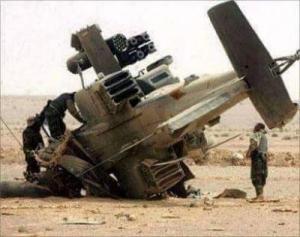
On Monday, an Emirati military helicopter crashed near the al-Buraiqeh coast of the southern Yemeni port city of Aden, killing its two pilots.
On March 14, two Emirati pilots died when their Mirage fighter jet crashed due to a technical fault while conducting military operations for the Saudi-led military coalition in the same Yemeni district.
A senior Emirati military commander and three other Saudi-backed foreign mercenaries had been killed in an attack by Yemeni forces in the Dhubab district of the southwestern province of Ta’izz two months earlier.
Last September, the UAE confirmed that at least 52 of its soldiers were killed when Ansarullah fighters and allied fighters from Popular Committees fired a barrage of missiles at Saudi-led foreign troops in the central Ma’rib Province. At least 70 soldiers were also injured in the missile attack.
Meanwhile, there are reports that Jordanian military forces and advisers will be replacing UAE troops fighting in the Saudi war on Yemen.
Yemen’s Khabar news agency, citing informed sources, reported that the decision had been made following a visit by Saudi Deputy Crown Prince Mohammad bin Salman Al Saud to Jordan in mid-April.
Mohammad, who is also the Saudi defense minister, met King Abdullah in the Jordanian port city of Aqaba and signed a package of agreements, including on military cooperation.
The Saudi crown prince also traveled to the UAE in an effort to mend fences after reports of significant friction between the two allies over the war on Yemen.
A Saudi decision earlier this year to dismiss a former general with close ties to the UAE angered Emirati authorities.
In February, Saudi Arabia sacked Khaled Bahah and appointed Ali Mohsen Al Ahmar to lead the fight against Yemen’s Houthis. Ahmar had been based in Saudi Arabia since Ansarullah fighters took over Sana’a in 2014.
Saudi Arabia launched its military aggression against Yemen on March 26, 2015, in a bid to bring former President Abd Rabbuh Mansur Hadi — who is a staunch ally of Riyadh — back to power and defeat the Ansarullah movement.
More than 9,400 people have been killed and at least 16,000 others injured since the onset of the aggression.
The Saudi strikes have also taken a heavy toll on the country’s facilities and infrastructure, destroying many hospitals, schools, and factories.
Canadian court awards $13mn in frozen assets to ‘Iran terror’ victims
RT | June 11, 2016
A Canadian court has awarded $13 million in non-diplomatic assets seized from Iran to the families of Americans who died in several attacks globally, which had allegedly been sponsored by Tehran between 1983 to 2002.
The judgment by the Ontario Superior Court of Justice, obtained by AFP on Friday, found Tehran responsible for financing and training Hamas and Hezbollah operatives, who carried out eight bombings or hostage-takings in Buenos Aires, Israel, Lebanon and Saudi Arabia over a period spanning nearly 20 years.
“Terrorism is one of the world’s greatest threats,” Ontario Superior Court Justice Glenn Hainey said in his decision. “The broad issue before the court is whether Iran is entitled to immunity from the jurisdiction of Canadian courts for its support of terrorism.”
The ruling for the $13 million payout does not affect Iran’s diplomatic property in Canada but does touch non-diplomatic properties and a list of frozen bank accounts. Tehran did not immediately comment on the court judgment.
The suit was heard under the 2012 Justice for Victims of Terror Act, which allows the families’ victims to collect damages from state sponsors of terror groups. In Canada, Iran is designated a sponsor of terrorism.
The judgment on June 10 mirrors a recent American court ruling against Tehran that was also won by families of the terrorist attack victims in the United States in Spring. Iran has promised to battle the decision in international courts.
Maduro Unveils Proposals for Dialogue with Opposition
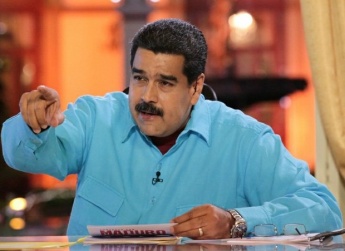
Maduro presented three proposals to advance the mediation process this week (Prensa Presidencial).
By Lucas Koerner | Venezuelanalysis | June 9, 2016
Caracas – Venezuelan President Nicolas Maduro announced three proposals for UNASUR-mediated talks between his government and the country’s right-wing opposition Tuesday.
“The first [proposal] is the creation of a commission for truth, justice, and reparations for the victims to compensate for all of the harm caused by the coups, guarimbas from 1999 to 2016,” the socialist leader explained.
Over the past six months, the Maduro government has pushed the idea of a truth and justice commission as an alternative to the opposition-controlled parliament’s Amnesty Law, which sought to exonerate individuals convicted of a vast range of felonies and misdemeanors over the past seventeen years, provided that they were committed in the context of political protests.
The South American president also proposed the convening of a meeting between representatives of Venezuela’s five branches of government in order to resolve political disputes and restore the normal functioning of government under the constitution.
Since taking office in January, the opposition-majority National Assembly has been at loggerheads with the executive, the Supreme Court, and the National Electoral Council (CNE) over clashing interpretations of the division of powers outlined in the nation’s constitution.
Lastly, Maduro called for the signing of an “agreement for peace and nonviolence” in order to avoid the violent escalation of the country’s political conflict.
In recent weeks, the right-wing opposition coalition, the MUD, has relaunched violent anti-government protests that have seen demonstrators attack police and damage public property.
The head of state’s proposals follow the first round of UNASUR-mediated indirect dialogue between the government and the opposition held in Punta Cana late last month.
Though no agreement was reached, the meeting was welcomed as a key first step by Jose Rodriguez Zapatero, Leonel Fernandez, and Martin Torrijos– former presidents of Spain, Dominican Republic, and Panama– who agreed to act as mediators between the two sides.
The MUD, for its part, has outlined four preconditions for talks with the government, including the activation of the recall process, the release of so-called “political prisoners”, a solution to the “humanitarian crisis”, and “respect” for legislation passed by the National Assembly.
Speaking on Wednesday, Miranda Governor and former presidential candidate Henrique Capriles lashed out Maduro’s proposals, exclaiming, “For there to be dialogue, there must be respect.”
“[Maduro] speaks of signing a non-violence agreement, but who are the ones who confront [protests] and prevent them from reaching the CNE?,” he added, referring to the Venezuelan government’s enforcement of a Supreme Court ruling prohibiting protests in the vicinity of CNE offices at the behest of electoral personnel concerned for their safety.
On May 19, an unauthorized opposition march towards the heavily pro-government heart of Caracas saw protesters attack and wound seven police officers and vandalize government student housing.
The Maduro government, meanwhile, has received backing from the leftist regional bloc, the ALBA, which issued a statement on Wednesday, applauding the opening of UNASUR-mediated talks with the opposition and calling for “absolute respect for Venezuelan sovereignty”.
The MUD has yet to officially respond to the Venezuelan president’s proposals for dialogue.
US lawmakers’ visa request is a publicity stunt: Iran’s Foreign Ministry
Press TV – June 7, 2016
Iranian Foreign Ministry has issued a response to the travel visa requests of three US republican lawmakers who had wanted to travel to Iran to monitor Tehran’s compliance with last year’s historic nuclear agreement.
“In sum, we consider your visa request to have been a publicity stunt and not an appropriate request to visit a sovereign country; and it has, and will continue to be, treated in that spirit,” said a letter published by the office of Iranian Foreign Minister Mohammad Javad Zarif on Tuesday.
In February, three US lawmakers, Mike Pompeo, Lee Zeldin, and Frank LoBiondo, requested to visit Iran in order to inspect its nuclear sites. All three were vigorous opponents of the nuclear deal.
“Despite what you seem to presume, members of the US Congress do not get to dictate the policies of other countries. This clearly applies to Iranian visa policies. Bear in mind that as members of the US Congress you are not a global authority.”
The letter noted that according to the Joint Comprehensive Plan of Action (JCPOA), the International Atomic Energy Agency (IAEA) “is the sole body competent for monitoring” the implementation of the agreement’s nuclear provisions.
“In the modern era, visits to sites or parliamentary or other delegations to monitor elections are made upon invitations and through bilateral agreements between sovereign states or based on reciprocal arrangements, and not upon unilateral demands by self-arrogating individuals or parliamentarians,” the letter read.
“From the time when the manufactured ‘nuclear crisis’ has been settled through the JCPOA, tens of thousands of tourists, academics, investors, students and businesspeople from around the world — including many Americans — have obtained visas and traveled to Iran without any delay or complication.
“But they have been able to do so by making requests consistent with the relevant regulations of the host country and in the appropriate respectful manner and not in the completely inappropriate way you have demanded to visit Iran and interfere in what is of no relevance to your official functions. We doubt that any self-respecting country would grant a visa under such circumstances,” read another part of the letter.
After Iran and the five permanent members of the UN Security Council – the United States, France, Britain, China and Russia – plus Germany started implementing the JCPOA on January 16, all nuclear-related sanctions imposed on Iran by the European Union, the Security Council, and the US were lifted. Iran, in return, has put some limitations on its nuclear activities. The nuclear agreement was signed on July 14, 2015 following nearly a decade of on-and-off intensive talks.
Hillary Clinton Emailed Names of U.S. Intelligence Officials, Unclassified

By Peter Van Buren | Latest.com | June 5, 2016
You can look at the source documents yourself. This is not opinion, conjecture, or rumor. Hillary Clinton transmitted the names of American intelligence officials via her unclassified email.
From a series of Clinton emails, numerous names were redacted in the State Department releases with the classification code “B3 CIA PERS/ORG,” a highly specialized classification that means the information, if released, would violate the Central Intelligence Act of 1949 by exposing the names of CIA officials.
How FOIA Works
The Freedom of information Act (FOIA) requires the government to release all, or all parts of a document, that do not fall under a specific set of allowed exemptions. If information cannot be excluded, it must be released. If some part of a document can be redacted to allow the rest of the document to be released, then that is what must be done. Each redaction must be justified by citing a specific reason for exclusion.
But don’t believe me. Instead, look at page two of this State Department document which lists the exemptions.
Note specifically the different types of “(b)(3)” redactions, including “CIA PERS/ORG.” As common sense would dictate, the government will not release the names of CIA employees via the FOIA process. It would — literally — be against the law. What law? Depending on the nature of the individual’s job at CIA, National Security Act of 1947, the CIA Act of 1949, various laws that govern undercover/clandestine CIA officers and, potentially, the Espionage Act of 1917.
Names of CIA, NSA Officials Mentioned, Now Redacted
Yet Hillary’s emails contain at least three separate, specific instances where she mentioned in an unclassified email transmitted across the open Internet and wirelessly to her Blackberry the names of CIA personnel. Here they are. Look for the term “(b)(3) CIA PERS/ORG” Click on the links and see for yourself:
There are also numerous instances of exposure of the names and/or email addresses of NSA employees (“B3 NSA”); see page 23 inside this longer PDF document.
Why It Matters
— These redactions point directly to violations of specific laws. It is not a “mistake” or minor rule breaking.
— These redactions strongly suggest that the Espionage Act’s standard of mishandling national defense information through “gross negligence” may have been met by Clinton.
— There is no ambiguity in this information, no possible claims to faux-retroactive classification, not knowing, information not being labeled, etc. Clinton and her staff know that one cannot mention CIA names in open communications. It is one of the most basic tenets taught and exercised inside the government. One protects one’s colleagues.
— Exposing these names can directly endanger the lives of the officials. It can endanger the lives of the foreigners they interacted with after a foreign government learns one of their citizens was talking with the CIA. It can blow covers and ruin sensitive clandestine operations. It can reveal to anyone listening in on this unclassified communication sources and methods. Here is a specific example of how Clinton likely compromised security.
— These redactions show complete contempt on Clinton’s part for the security process.
BONUS: There is clear precedent for others going to jail for exposing CIA names. Read the story of John Kiriakou.
A Personal Aside: I just remain incredulous about these revelations seeming to mean nothing to the world. They’re treated in the media as almost gossip.
Peter Van Buren blew the whistle on State Department waste during Iraqi reconstruction in his first book, We Meant Well: How I Helped Lose the Battle for the Hearts and Minds of the Iraqi People. His second book is Ghosts of Tom Joad: A Story of the #99Percent. Next up is a novel about WWII Japan, Hooper’s War. He writes about current events at http://www.wemeantwell.com and on Twitter @wemeantwell
Russia Denounces External Forces for Crisis in Venezuela
By Rachael Boothroyd Rojas – Venezuelanalysis – May 24, 2016
Caracas – Russia’s Foreign Ministry has spoken out against “outside” efforts to destabilise Venezuela, warning against the consequences of imposing “colour scenarios” on the South American nation.
On Monday, Russian news agency Tass and Sputnik International reported that Russia’s Foreign Ministry had released an official statement addressing the current situation in Venezuela.
“The upsurge of tensions in Venezuela is being fed from outside,” asserted the Foreign Ministry statement.
“We are confident that a political solution to Venezuelan problems is to be found by the Venezuelan people who have elected its legitimate authorities… Destructive interference from outside is inadmissible,” it continued.
The South American country has been suffering from a worsening economic crisis for the past two years and is currently locked in a political stand-off between the executive branch and the opposition controlled legislature.
In firm language, the declaration also reminded other global powers that “no-one has the right to impose ‘color scenarios’ on Venezuela, referring to the outside financing of “proxy” organisations aimed at destabilising the national government.
Russia also warned that current tensions in Venezuela risk spilling over into open conflict on the nation’s streets, bringing “serious consequences” for the rest of the region.
Moscow’s remarks come as the Union of South American Nations (UNASUR) begins to take tentative steps towards opening up negotiations between Venezuela’s two warring political factions: the leftist government of Nicolas Maduro, and the rightwing political coalition, the MUD, which currently controls the National Assembly.
However, escalating rumours of a possible coup against the national government in recent weeks are threatening to dampen hopes of a rapprochement.
The MUD has pledged to remove Maduro through a variety of “constitutional” means since taking hold of the legislature last December.
Nonetheless, Russia said it backed a UNASUR negotiated solution to the crisis and asked both sides to “cool down” their emotions. It also confirmed it would be open to participating in negotiation efforts in Venezuela if requested.
“We are confident that the main challenge facing Venezuela at the moment is to find realistic ways out of the economic crisis, improve the social situation of broad layers of the population… It is obvious that this is possible only in conditions of internal political tranquility,” asserted the foreign ministry declaration.
Although Moscow didn’t name the “outside” influences which it cites as exacerbating tensions in Venezuela, it is possible that the US has caught the Kremlin’s eye.
Just last week, Russia’s Vice-minister for Foreign Affairs, Sergéi Ryabkov, said that his government believed that Washington was intensifying its attempts to directly “interfere” in Latin American affairs to the detriment of the region.
He cited a swing to the right in Argentina’s government, as well as the recent controversial impeachment of Brazil’s left leaning president, Dilma Rousseff, as examples.
Sudanese president applies for a visa to US despite ICC indictment
MEMO | May 20, 2016
The Sudanese foreign ministry has sent a formal request to the US Embassy in Khartoum to grant the Sudanese President Omar Al-Bashir an entry visa to the US to attend the next United Nations General Assembly.
Information Minister Ahmed Bilal said President Al-Bashir had been invited by UN Secretary-General Ban Ki-moon. He said the US is obligated, as host of the UN, to grant a visa to the leader.
It would be Bashir’s first visit to the US since 2009 when he was indicted by the Hague-based ICC for alleged war crimes in Darfur.
In addition, the Sudanese minister announced the government’s desire to make a formal request, as it previously did, for the mandate of the international peacekeeping mission in Darfur, known as UNAMID, not to be renewed.
Ismail said that the reasons for the existence of UNAMID in Darfur are no longer present and that the government is now able to protect civilians and to ensure the stability of the situation.
UNAMID has been stationed in Darfur since 2007 with a mandate to stem violence against civilians. The UN Security Council will discuss a one-year renewal of its mission in June.
Seven Arrested for Attacking Police in Violent Opposition Protests
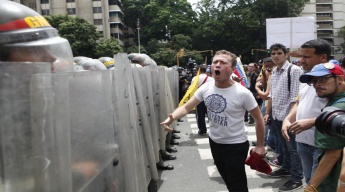
Venezuelan authorities did not carry firearms to the protests in Caracas and several authorities were injured by violent protesters. (AVN)
By Lucas Koerner | Venezuelanalysis | May 19, 2016
Caracas – Seven individuals were arrested for allegedly attacking Venezuelan police during a violent opposition march in Caracas on Wednesday that left five officers injured.
The march was part of nationwide mobilizations convoked by the right-wing opposition coalition, the MUD, protesting alleged stalling by the National Electoral Council (CNE). The CNE is in the process of validating the 1.85 million signatures collected by the coalition for a recall referendum against President Nicolas Maduro.
The MUD called for supporters to march to the CNE headquarters in the heavily pro-government city center despite being refused a permit by the El Libertador municipality over concerns of violence.
Bolivarian National Police (PNB) personnel were dispatched to prevent demonstrators from marching along the principal Avenida Libertador where they were attacked by a group of men wielding sticks and rocks.
“A group of people came to attack us. One of the citizens became violent and hit me. The shield protected me the first time, but the second time I fell,” recounts 22 year-old PNB officer Dubraska Alvarez, who suffered post-trauma capsulitis in her right elbow and multiple traumatisms.
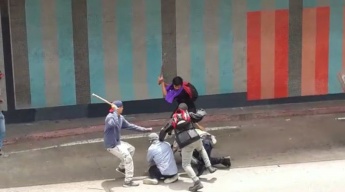
Unarmed police beaten by demonstrators (teleSUR)
In a video that has circulated widely on social media, another officer can be seen falling to the ground after receiving a blow from a stick-wielding demonstrator and subsequently being beaten while prostrate by five men with sticks.
Another police functionary, Genessis Llovera Mambie, suffered the dislocation of her right shoulder while officer Erick Escalante came away with post-trauma bursitis in his left shoulder and a knee lesion.
Despite international media reports of police repression against protesters, PNB personnel were prohibited from carrying armaments and were only permitted to use tear gas if authorized by superiors.
“Our only order was to prevent people from entering Avenida Libertador, and we didn’t even have any sort of arms… it was inevitable [that people entered] because we only had shields to protect ourselves physically,” added Alvarez, who declined to show her face to the camera for fear of reprisals.
Seven men suspected of perpetrating the attacks were arrested in the heart of the wealthy eastern Caracas municipality of Chacao on Wednesday afternoon and were subsequently transported to the July 26th Penitentiary in Guarico state where they will await charges.
According to authorities, one of the suspects, Jheremy Bastardo Lugo, is a repeat offender who was reportedly arrested during the 2014 anti-government protests that saw opposition supporters erect violent barricades across the country, leading to the death of 43 people, the majority of whom were state security personnel and passerby.
Student residences vandalized
In addition to the violent incident on Avenida Libertador, protesters are reported to have vandalized a government-constructed student residence in Plaza Venezuela, breaking windows and allegedly attempting to set the building on fire.
“With sticks, stones, and gasoline, they were going to burn down the residence and the guards. I was attacked by hooded men armed with stones and bottles,” said student resident Angel Rodriguez.
“For having a different political ideology, they broke the windows, my comrades were attacked,” another student told teleSUR.
El Libertador Mayor Jorge Rodriguez denounced the day’s violent episodes and vowed to press charges against those responsible.
“This is the reason why we didn’t give them a permit to march to the city center,” he stated, pointing to the broken windows of the student residence.
Capriles blames “infiltrators”
Former opposition presidential candidate Henrique Capriles publicly blamed the violence on “infiltrators”, calling the incidents a “set up” by the government.
“We know the plan, but we are not going to stop protesting. We are not afraid, we will [protest] in the face of the infiltrators, because it is our duty to fulfill the Constitution,” he stated.
However, Wednesday’s protest was not the only instance in which the Miranda state governor has condoned violent demonstrations.
Last week, the former presidential candidate was also involved in his own confrontation with police, as he and his supporters attempted to physically break a police line in Miranda state.
Following his narrow defeat in the 2013 elections, Capriles also refused to honor the internationally-recognized result, urging his supporters “vent their rage” in street protests that left seven people dead and saw numerous government health clinics and food markets burned.
In the lead up to Wednesday’s protests, Capriles issued a public statement to members of the Venezuelan armed forces, urging them to reject a state of exception expanded by President Maduro on Friday and oppose alleged attempts by the government to block the recall process.
“Prepare the tanks and war planes… the hour of truth is coming to decide whether you are with the constitution or with Maduro,” he declared on Tuesday.
Earlier this week, a special commission responsible for supervising the referendum process announced that 190,000 signatures collected by the opposition as part of the initial recall request belonged to deceased individuals.
The statement has been sharply denounced by opposition leaders who accuse the CNE of intentionally dragging out the process in order to prevent the recall referendum from being held this year.
Unless the referendum is held in 2016, a successful recall vote will not trigger new presidential elections, with the sitting vice-president instead taking over as president for the remainder of the term.
Featured Video

Trita Parsi: Middle East Unraveling — Are We on the Path to World War?
or go to
Aletho News Archives – Video-Images
New Book
Trans agenda is ‘normalization of sadism’ – US author

RT | September 23, 2026
The US Democratic Party has embraced a transgender agenda that amounts to “the normalization of sadism,” author A.J. Rice has said, warning that radical trans policies would return if the party is allowed to regain power.
Speaking to RT’s America First host Scotty Nell Hughes about his new book, ‘The Curse of the Bearded Lady: How the Trans Mafia Whacked American Sanity’, Rice argued that activists have gained significant influence in schools, medicine, and corporate America while people who questioned the agenda have faced pressure to stay silent.
The author described the “trans mafia” as the sprawling network of people and institutions that have helped the movement gain influence. He singled out parts of academia, wealthy backers, and corporations, and stated that providers of transition-related treatment also have a financial incentive to keep young people in their care indefinitely.
Rice argued that the consequences of these policies ultimately fall on children who are being drawn toward gender-affirming medical treatments and on girls who are expected to share locker rooms or compete in sports with biological males.
He noted that while voters rejected the Democrats’ approach to gender in 2024, the party, which has been “captured by madness,” has since only doubled down and is seeking what is effectively “the normalization of sadism.” … Full report
Blog Roll
 Aletho News
- ‘We don’t seek permission to defend our country’: Snippets from President Pezeshkian’s UNGA address
- NATO chief wants Europeans to fight American wars [for Israel]
- German chemicals giant reveals details of downsizing
- Refaat Al-Areer Was The Canary In The Coal Mine In Israel’s War On The Truth
- Israeli election committee bars candidate from Knesset race over Gaza war opposition
- French-Lebanese man files war crimes complaint over Israeli attacks
- Mahan Air Flight Lands in China Despite US Threat against Iranian Airlines
- US eyes $10bn fund to rebuild war-battered Gulf infrastructure
- Trump meets Rodríguez near Maduro’s prison as Venezuela’s oil flows to US
- Trita Parsi: Middle East Unraveling — Are We on the Path to World War?
- If Americans Knew
- Caught on Tape: AIPAC CEO Boasted of Controlling Trump’s National Security Officials
- Why Hamas Attacked Israel in October 2023 – Israeli professor Ilan Pappé
- They see them, then kill them: Israeli quadcopters track, deliberately target civilians in Gaza
- Winter could turn Gaza’s treacherous, war-damaged buildings into deathtraps
- Majority of Democratic Voters Want to Prosecute Both Biden and Trump Administration Officials Over Gaza
- As Gaza languishes, world leaders gather at the UN – Daily Update
- Sanctions are collective punishment: immoral and self-defeating
- Phosphorus Munitions Fired by Israel Burn Groves, Orchards in Southern Lebanon
- Israel Carries Out New Ceasefire Violations Across Gaza
- AI – Emphasis on the ‘I’: Israel Is Funding AI Chatbot Propaganda
- No Tricks Zone
- New Study: Earth And Venus Surface Warmth Largely Explained By Convection And Lapse Rate, Not CO2 Or Radiation
- 2025 Nature Paper Claiming Worsening Global Drought Gets RETRACTED …Heavily Flawed
- New Study: ‘Global Drought Shows No Detectable Recent Acceleration Under Climate Warming’
- Economic Masterminds: German Socialists Suggest Taxing Productivity Gains Stemming From Using AI
- The South China Sea Has Not Been Cooperating With The Climate Change Narrative
- Energy Crisis: Germany Enters Heating Season With Historically Low Gas Reserve Fill Levels
- New Study: The Antarctic Ice Sheet Gained Mass From 2020-2024 Due To Staggering Snow And Ice Accumulation
- Study: Ocean Heating Rates From Thousands Of Years Ago ‘Dwarf’ Modern Ocean Heating Rates
- Climate Extremists Target, Attack Large-Scale Power Grid Infrastructure In Germany!
- New Study: Antarctic Ice Melt Has Contributed Less Than 1 Centimeter To Sea Level Rise In The Last 30 Years

