Cuba Better Be Careful What It Wishes For
By Andrew Korybko | Sputnik | December 17, 2014
The US and Cuba have reached a historic deal to swap notable prisoners and establish diplomatic relations after decades of mutual hostility. The announcement caught many by surprise, and begs the question: Are there more sinister geopolitical calculations at work behind the U.S.’ olive branch?
The tradeoff largely boils down to this: the US has released the three remaining members of the Cuban Five in exchange for jailed contractor Alan Gross, 53 US-selected “political prisoners,” and an unnamed intelligence source who was imprisoned over 20 years ago. As a result, both countries will now establish diplomatic relations and the decades-long US embargo will be largely eased.
Many people are rightfully cheering what seems to be an imminent end to U.S. hostility towards Cuba, but all of this may just be a deception. The U.S. needs Cuba more than the other way around, since it wants to use the island as a pivot to reverse the Caribbean Basin’s move to multipolarity and prolong Washington’s full control over its historic “lake.”
Regime Change Done Differently
Cuba no longer needs the U.S. as much as it did at the end of the Cold War, when its economy was in despair and the market hardly functioned. It’s come a long way since then, and although it still has its fair share of problems, it’s proved that it can survive on its own while being officially isolated from its massive northern neighbor. While the U.S. had plenty of opportunity to exploit Cuba when it was at its weakest in the 1990s, it missed the chance to do so, driven by the precondition that regime change must happen first.
Now, however, the tables have turned, and the U.S. is pursuing a policy of engagement first in order to facilitate the same regime change goal it’s been trying to pull off for over the past half century.
“I do not expect the changes I’m announcing today to bring about a change in Cuban society overnight,” Obama said, implying that he still wants the U.S. vision of change to occur. The removal of the embargo would only be a victory for the Cuban people if they are able to retain their independence, sovereignty, and preferred form of government afterwards.
Indirect Inroads
Overt hostility hasn’t worked in the past against Cuba, and it likely won’t work in the future. Plus, there’s been a general trend in recent years for the US to pursue its objectives through covert and indirect means. This is where Cuba is most vulnerable in the recent ‘thaw’ in relations. The American economy doesn’t need Cuba at all, really, and Washington’s opening to Havana is a convenient cover to catch Cuba in its social and economic snare to more directly control the inevitable leadership transition process that will occur with Fidel’s passing. It already tried and failed to use USAID to create a ‘revolutionary Twitter’ on the island, as well as its embarrassing follies with anti-government Cuban rappers, to name but the few most recent regime change scandals there. And it must be kept in mind that Mr. Gross was working for the Agency when he was arrested in 2011 for trying to, as Cuban authorities described it, to “promote destabilizing activities and subvert constitutional order” to foster a “Cuban Spring.”
Cuba is also vulnerable to reverse migration, in that dissident and possibly extremist Cuban-Americans may return to the island in order to build a future Color Revolution’s social infrastructure to deploy when the time is right (likely in the aftermath of Fidel’s death). American businesses can fill a valuable development and investment gap on the island, in exchange for making Cuba ever more dependent on the U.S. This would give the U.S. another lever of influence over the island’s affairs, which could be activated in unison with a Color Revolution to create maximum disorder.
Bucking The Trend
The timing of Washington’s “outreach” to Havana isn’t coincidental, as it coincides with major processes going on in the region that the U.S. hopes to reverse. Most recently, the pro-U.S. Prime Minister of Haiti, Laurent Lamothe, was forced to resign last week amid protests and popular outrage over his corruption and ineffectiveness. Backtracking America’s hold on the region even further, the Chinese are slated to begin construction on the Nicaraguan Canal, which when completed, would create a major breach in America’s control of the Caribbean Sea. Finally, Venezuela has been a center of resistance to American hegemony over the hemisphere ever since the leadership of the late President Hugo Chavez.
Cuba is the symbolic leader of the Latin American resistance movement, and its “Cuban Spring” surrender would be disheartening for the other allied states that defy the U.S. via the ALBA grouping. Congress recently passed sanctions against Venezuela (largely overshadowed by the anti-Russian ones), which is the financial engine of the hemispheric resistance, to facilitate a Color Revolution there as well, as President Maduro himself has previously alleged Washington wants to do.
Venezuela’s economy is also hurting because of the recent oil price slump, which may inhibit its ability to subsidize the allied Nicaraguan, Ecuadorian, and Bolivian ones in the future. With Cuba out of the game, and perhaps even Venezuela, there’d be little ideological or economic support keeping Nicaragua, the future key to the Caribbean, from being next (to say nothing of Ecuador and Bolivia) and the Chinese-sponsored canal from becoming a failed infrastructure project. If this happens, then the U.S. would have reasserted its complete control over the Caribbean and begun to penetrate the Andes, thus tightening the containment noose around Brazil and strangling the future of multipolarity in the region.
UK building firm linked to Qatari human rights violations
RT | December 9, 2014
One of Britain’s largest construction firms has been linked to severely sub-standard working conditions for migrants in Qatar. Over 1,000 foreign workers perished in the Gulf state between 2012 and 2013, a government report shows.
The petro-rich Gulf state is investing over £200 billion in a construction frenzy in the run-up to the 2022 World Cup. Following a recent investigation into the matter, BBC Newsnight concluded that the building binge is benefitting many in the state – but not migrant workers.
Amid recent bribery allegations, Qatar’s World Cup plans have been tainted by a more unsettling reality than corruption alone. Hundreds of foreign workers hired to construct skyscrapers and stadiums in preparation for the global tournament have died in the Gulf state.
A report sponsored by the Qatari government found that migrants perished at building sites littered throughout Qatar. Most of them hailed from South Asia, many of them Nepalese. Swathes died from cardiac arrest, accidents, or falls in the workplace. Others took their own lives.
Amid mounting concern over the welfare of migrant workers in Qatar, questions have emerged regarding the obligations and responsibilities of global construction firms that win contracts in the country.
Following an in-depth probe into the conditions that foreign construction workers face there, BBC Newsnight uncovered damning testimonies about migrant workers’ poor pay, housing, and safety conditions.
Some of the workers forced to endure these conditions were employed by sub-contractors, which were in turn hired by Carillion – one of the UK’s most profitable construction companies.
Debt bondage
Imran, a 32-year-old Bangladeshi worker whose safety pass and helmet bore the distinctive Carillion logo, told Newsnight that he deeply regrets his decision to come to Qatar.
Although a recruitment agent promised him 1,500 Qatari riyal (£263) a month, he is left with a mere 650 (£114) Qatari riyal once his expenses for food and medical treatment are factored in. He must then allocate half of that meagre sum to the recruitment agency that sourced the position for him.
“I am supporting elderly parents, my wife and a child,” he told the BBC. “I can’t send them the money they need…I don’t want to stay here but I can’t leave. The company have my passport.”
Describing a typical day, Imran said he wakes at 4 a.m., arrives at work at approximately 6 a.m., and continues to work for a further 11 hours. Reflecting on his accommodation, the Bangladeshi worker said it is overcrowded and ill-equipped.
“My room there isn’t fit for humans – six of us share and there’s no place even to sit and eat.”
Carillion told the BBC that it uses 50 different sub-contractors in the Gulf state, and that the firm employing Imran provides workers for one of those firms.
Reflecting on the unsavory nature of the 32-year-old’s allegations, the company said it is “deeply concerned and surprised” and will conduct “an immediate review of these claims to establish the position and take appropriate action.”
The migrant workers’ camps are located between 10-20 miles from the center of Doha. The BBC reported that workers were sat on the floor eating at one particular camp, which is used by a sub-contractor that supplies labor to Carillion.
Complaints of delayed wages, poor pay, and sub-standard working conditions are rife. Echoing Imran, one worker claims the sub-contractor he works for has the men’s passports, and that the workers are unable to access them.
However, a spokesperson for Carillion told the BBC that “health and safety is at the very heart of our business, and practice on site follows standards that we apply in the UK.”
He added that the firm “must abide by Qatari labor law in respect of wages, living conditions and employment rights,” and emphasized the company expects sub-contractors to “comply with Qatari law which prevents employers withholding workers’ passports.”
Drastic reform required
The Qatari report which documents the deaths of migrant workers in the Gulf state calls for serious reform of the nation’s policy for dealing with migrant employees.
Human rights campaigners have denounced the measures currently in place as being similar to indentured servitude – a historical form of debt bondage common to 18th century North America.
Ray Jureidini, a leading professor of ethics and migration, has been employed by the Qatari government to offer recommendations for the reform of the state’s labor laws.
He told the BBC that the country’s legislation requires an urgent overhaul, and warned that corruption and bribery by recruitment firms must be addressed.
Jureidini said that global construction firms profiting from Qatar’s pre-World Cup building boom also have a duty to take a proactive stance with respect to workers’ conditions.
“They don’t ask about the men supplied to them,” he told the BBC.
“They feel they don’t need to ask how the workers were recruited, whether they were trafficked, or whether they are caught in debt bondage or being exploited.”
Jureidini suggested that a “corporate veil” allows global firms to evade accountability for the fate of migrant workers, because the men are not officially documented in their company accounts.
Kerry calls for political solution in Syria
Press TV – December 7, 2014
US Secretary of State John Kerry has called for a political solution to end the crisis in Syria, where tens of thousands people have been killed in the years-long conflict.
“[A]ll of our counterpart[s], all my colleague counterparts from every country agree with this, including Russia, Iran, there is no military solution. The only possible way for the Syrian civil war to end is through a negotiated political solution,” Kerry said during a speech to a Middle East policy conference in Washington on Sunday.
The top US diplomat also said Washington needs to be deeply involved in Mideast issues, adding that the region’s threats can become global if not attended appropriately.
Syria has been gripped by deadly violence since March 2011. Nearly 200,000 people have reportedly been killed and millions displaced due to the violence fueled by the militants.
The United States and its regional allies — especially Qatar, Saudi Arabia and Turkey — have been supporting the militants operating inside Syria since the beginning of the crisis.
The Obama administration has already outlined a $500 million program to train and arm 5,000 “moderate” militants in Syria to fight against ISIL and the Assad government, but according to the Pentagon, the number would be something between 12,000 and 15,000.
Elsewhere in his remarks, Kerry praised Iraqi Prime Minister Haider al-Abadi for uniting Iraqis against ISIL Takfiri militants.
He noted that common cause against extremists was already making progress against ISIL in Syria and Iraq. “Obviously, our commitment and our capacity will be measured over years. I understand that. But I have to tell you, that even in two and a half months, we are making steady, measurable progress.”
The ISIL terrorists, who were initially trained by the CIA in Jordan in 2012 to destabilize the Syrian government, now control large parts of Iraq and Syria.
Washington has launched hundreds of airstrikes against the ISIL militants in Iraq and Syria, which analysts regard as part of the US attempts to gradually spread its influence in the region.
Reports say thousands of private security contractors are being asked by the US government to consider joining the fight against ISIL in Iraq and Syria and possibly elsewhere in the Middle East.
French president supports autonomy for Ukraine’s southeast
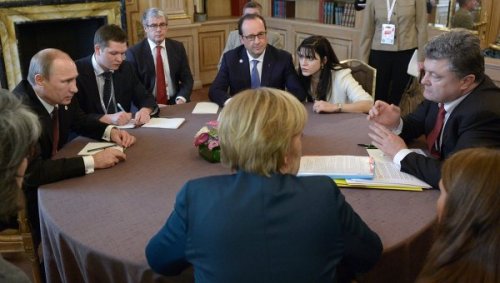
Ukraina.ru | December 5, 2014
French President Francois Hollande has called for a joint effort by the leaders of France, Russia, Germany and Ukraine to calm the conflict in Ukraine.
“Together with Mr. Putin, Mr. Poroshenko and Ms. Merkel, we should start a process aimed at reducing tensions. It should begin with reducing verbal tensions, followed by concrete actions in Ukraine,” the French president at a news conference following talks with Kazakh President Nursultan Nazarbayev in Astana.
According to Hollande, it is necessary to “focus on the future without forgetting the lessons of the past… The existing tensions and pressure do not contribute to resolving problems,” Hollande said.
He said that Ukraine’s territorial integrity should be preserved, but eastern regions should be granted “a certain level of autonomy.”
In April, the authorities in Kiev launched a military operation in the country’s eastern regions, which refused to accept the results of the February coup.
According to the latest UN estimates, the conflict has claimed the lives of 4,300 civilians and left 10,000 people wounded.
photo © РИА Новости. Алексей Никольский
American, Georgian & Lithuanian get key jobs in Ukraine’s new government
RT | December 2, 2014
Natives of the US, Georgia and Lithuania were hastily granted Ukrainian citizenship in order to become key ministers in the new government of Ukraine, which was approved by the country’s parliament on Tuesday.
President Poroshenko has also announced he will sign a decree to grant citizenship to foreigners fighting on Kiev’s side in the east of the country.
Natalie Jaresko of the US, who currently heads the Kiev-based Horizon Capital investment fund, will take reigns at the Ukrainian Finance Ministry.
In 1992-1995, Jaresko served as the first Chief of the Economic Section of the US Embassy in Ukraine.
Before that she occupied several economic positions in the US State Department, according to Horizon Capital’s website.
The position of health minister went to Aleksandr Kvitashvili, who occupied a similar post in the Georgian government in 2009-2012.
“Ukraine spends 8 per cent of its GDP on healthcare, but half of this money is being plundered. Aleksandr Kvitashvili must implement radical reforms as he has no ties with the Ukrainian pharmaceutical mafia,” Ukrainian PM, Arseny Yatsenuk, said as he presented the new minister to the deputies.

Alexander Kvitashvili, a candidate for head of the Ukrainian health ministry, at a session of Verkhovna Rada in Kiev (RIA Novosti / Mikhail Polinchak)
Lithuanian Aivaras Abromavicius has been approved as the economy minister by the new parliament, the Verkhovna Rada.
Abromavicius, who is a partner at the $3.6 billion-worth East Capital asset management group, conducts his operations from Kiev after marrying a Ukrainian.
“There’s hard work ahead of us because Ukraine is a very poor and corrupt country and we’ll have to use radical measures,” he told MPs from the Rada Tribune.
288 out of 450 deputies supported the cabinet proposed by Ukrainian president Petro Poroshenko, with the new ministers sworn in right after the vote.
“I congratulate the Ukrainians with the formation of the pro-European government,” Poroshenko wrote on his Twitter page.
He told the Rada that he views the foreigners as some kind of anti-crisis management need due to the difficult situation in economy, the fighting in Donbas, the necessity of radical reforms and large-scale corruption.
Earlier on the Tuesday, the president has signed special a decree granting Ukrainian citizenship to Jaresko, Kvitashvili and Abromavicius.

Aivars Abramovicus (Aivaras Abromavicius), a candidate for head of the Ukrainian economy ministry, at a session of Verkhovna Rada in Kiev (RIA Novosti / Mikhail Polinchak)
Dual nationality is forbidden in Ukraine and the trio has already written applications to give up the citizenship of foreign states, Yury Lutsenko, the head of the Petro Poroshenko Block (PPB), said.
Poroshenko said that there’ll be even more foreigners on administrative positions in Ukraine as the country “must attract the best international experience, which includes assigning positions in the government to representative of states friendly to Ukraine.”
Also on Tuesday, the MPs from Poroshenko’s ruling bloc have registered a draft law in the Rada on amending the Ukrainian legislation for it to allow citizens of other states in the government.
It had been announced by Poroshenko a week ago. This move has been dubbed “unprecedented” and attracted criticism from experts with some calling it “allegiance to the so-called European choice,” and others expressing concern that it can be a sign of Ukraine losing its sovereignty.
Poroshenko also promised to grant the citizenship of Ukraine to all foreigners fighting for Kiev against the militias in the country’s eastern Donetsk and Lugansk regions.
“I’m going to sign a decree conferring Ukrainian citizenship to those, who defended Ukraine with arms in their hands,” he wrote on Twitter.
However, not everybody in the parliament supported the inclusion of foreigners into the Ukrainian government.
Earlier, the MP from the Opposition Block said Aleksandr Vilkul suggested that by inviting people from abroad the Ukrainian authorities are trying to absolve themselves of responsibility for the state of things in the country.
Vilkul colleague, Yury Boyko, said he can’t understand how it wasn’t possible to find 10 candidates for the cabinet among Ukraine’s 40-million population.
Calls for Peace Actions in Colombia after General Released
teleSUR | December 2, 2014
With Colombia’s peace talks likely to restart in the near future following the release of General Ruben Dario Alzate, calls are growing for a de-escalation of the conflict in order to avoid any future risks to the process.
Though non-government organizations, progressive politicians and peace activists continue to call for a bilateral cease-fire – as do the Revolutionary Armed Forces of Colombia (FARC) – the government maintains that it will not consider such a measure until a final agreement is signed.
However, according to many observers, a full cease-fire is not the only recourse available. Acts of peace such as declaring a Christmas period truce would not only strengthen the process, but reinforce public support, which has been shaken by the recent suspension.
“They cannot continue talking peace in Havana and in the territories continue with this armed confrontation, of which the effects are well known: more victims, more displacement, more antipersonnel mines, more kidnappings, recruitment. What the people in the regions are asking for is ‘please, now, acts of peace,’” said Irma Perilla of the NGO Pensamiento y Accion Social (Social Thought and Action), which has helped stage a series of regional forums to teach communities in conflict zones about the process and give people a space to have their thoughts heard.
According to Carlos Salgado, director general of peace advocacy NGO Planeta Paz (Peace Planet), the two teams must guarantee that the recent rupture following the November 16 capture of Alzate is not repeated, otherwise it would likely prove fatal to the talks.
Government and FARC negotiators are set to meet in Havana on December 2 to discuss how to restart the talks. According to Salgado, conflict reduction measures should form part of any agreement to continue the peace process.
“The two sides are going to be obliged at the negotiating table in Havana to create an atmosphere of de-escalation of the conflict, to be very clear about what would produce a suspension in the future, and to create an atmosphere of trust for society,” said Salgado.
A wide variety of measures remain in order to reduce hostilities, such a regional cease-fires, and agreements on the cessation of certain activities – as United Nations representative in Colombia Fabrizio Hochschild has previously advocated.
Over the past two years, the FARC has implemented a unilateral cease-fire over the Christmas period, with relatively few violations.
This year, both Perilla and Salgado advocate a truce during December, which they say would prove to the public that the two sides are capable of establishing peace, as well as giving those hardest hit by the conflict the opportunity to enjoy the festive season in tranquility.
The Mubarak trial verdict – What just happened?
By Hossam Bahgat | Mada Masr | November 29, 2014
There appears to be the usual share of confusion about what the Mubarak trial judge just said and did. As seen on television, the judge promised his “sons in the media” flash drives containing talking points (in the neighborhood of 200 pages) to help them, he said, with their news coverage until they have had a chance to read the entire ruling. Until that summary is available, I will address here a couple of the most persistent questions so far, pending further updates.
Q: Does Mubarak walk out now?
A: Yes. He is free to go for the time being. There have been some conflicting statements in the media on this point by named and unnamed legal sources after the verdict was announced. The confusion stems from the fact that Mubarak was sentenced last May to three years in prison on corruption charges related to embezzling millions of Egyptian pounds from state funds to spend on mansions owned privately by himself and his family.
Because Mubarak was convicted in the “mansions” case in May 2014, many have made the logical assumption that he would serve that sentence until 2017, notwithstanding today’s combination of acquittals and non-convictions of other charges of killing protesters and corruption, which isn’t the case. I have spoken to two senior criminal defense and human rights lawyers, who have independently confirmed that Mubarak’s three-year sentence in the mansions case does not start at the date of his conviction in May 2014, but rather at the date of his arrest and pre-trial detention in May 2011. With today’s acquittal, there is no legal basis for keeping him in prison.
Both sources have directed me to Article 483 of the Code of Criminal Procedures. This is my informal, non-lawyerly English translation:
“If a defendant is found not guilty of a crime for which he was held in pretrial detention then the period of pretrial detention shall be deducted from the period [of imprisonment] to which the defendant is sentenced for any [other] crime he might have committed or for which he has been investigated while in pretrial detention.”
The above is legalese for saying that a defendant’s prison term starts not at the time of sentencing but at the time of detention, even if that detention was for another charge. So even though Mubarak was held between May 2011 and May 2014 for the protester-killing charge, that period will count as time served for the mansions case.
The three-year sentence Mubarak was handed in May 2014 ended, therefore, in May 2014. A coincidence, of course – To suggest otherwise would be ground for prosecution for “insulting the judiciary.”
Q: Was Mubarak acquitted of the charge of killing protesters?
A: No, he wasn’t. He was not convicted either. The judge threw out the entire charge on procedural grounds.
First, the necessary background: Following Mubarak’s abdication of power in February 2011, Public Prosecutor Abdel Meguid Mahmoud decided to investigate the killing of protesters during the 18 days of revolt that ended Mubarak’s tenure. On March 23, 2011, Mahmoud, who had served under Mubarak and remained in office until late 2012, indicted Mubarak’s Interior Minister Habib al-Adly and his senior assistants, but not Mubarak himself, for having ordered or otherwise abetted the killing of protesters throughout the country. Two months later, the Supreme Council of Armed Forces, which had succeeded Mubarak in power, faced pressure from street demonstrations demanding accountability for Mubarak too. On May 24, 2011, the public prosecutor added Mubarak as a co-defendant in the case.
The fact that Mubarak was only added as a defendant two months after the case had been referred to trial is the technicality the judge used today to dismiss the charge against him. By not indicting Mubarak from the beginning, the judge reasoned, the prosecution had made “an implied decision that there were no grounds for criminal proceedings” against him. This “no-grounds” decision can be formally reversed by the public prosecutor within a window of three months. Mubarak’s defense lawyers argued, and today the court agreed, that the prosecution reversed the implied no-grounds designation of Mubarak without following proper procedures. For that technical error, the judge ruled the charge against Mubarak for the killing of protesters as inadmissible and dismissed that charge without considering it or ruling on its merits.
Mubarak’s lawyers had raised that same defense in the first trial (Mubarak was sentenced to life in 2012, before the Court of Cassation threw out that sentence and ordered the retrial that ended today). The first trial court had dismissed that defense, according to Hoda Nasralla, a criminal justice lawyer with the Egyptian Initiative for Personal Rights, who observed and wrote a detailed report on the first trial. Nasralla told me she had argued against that same defense in the first trial, where she represented some of the victims’ families as civil claimants in the case. Here is the gist of her argument:
- There was never a preliminary decision by the prosecution that there were no grounds to try Mubarak, explicit or implicit. It is inconceivable to argue that the March 2011 indictment (in which Mubarak was not named) is a declaration that there was no evidence against Mubarak, because until then Mubarak had never been questioned or even declared a suspect in the trial. A no-grounds designation could not be this subtle.
- Assuming that the decision to not name Mubarak as a defendant in March could be considered an “implied declaration” that there were no grounds to prosecute, then why can’t the decision to add Mubarak as a co-defendant in May be considered an implied reversal of the implied declaration?
- Assuming there was even an explicit no-grounds declaration, Article 213 of the Code of Criminal Procedures allows prosecutors to reopen investigations against any suspect or defendant if new evidence is identified or presented.
Nasralla, like many other observers, is convinced that this procedural argument was bought by today’s court not necessarily for its strength on merits, but because it was an attractive way for the court to dismiss the charge without a not-guilty finding.
Q: Is this the end?
A: Of course not. Egyptian court sagas of this size and nature don’t usually end. But the next stage could be filled with even more drama. The public prosecutor can, and most likely will, appeal today’s verdict before the Court of Cassation (Egypt’s highest court on criminal matters).
This court is not a substantive appeals court – it merely reviews whether or not the lower court decision complied with laws and procedure without reexamining the evidence. The Court of Cassation could simply ratify today’s verdict and that would be the end of it. But if the court decides to overturn and throw away the conviction for the second time, then it doesn’t get to send the case back to a lower criminal court for retrial. The law establishing the court stipulates that a third and final retrial of this nature will be conducted by the justices of the Court of Cassation themselves, who then act as a normal criminal court with full investigative powers.
Cassation justices are considered the nation’s most senior and best qualified bench. And because they’re elected by their peers, they are by far the country’s most independent court. Not that anyone is doubting the independence of other parts of the judiciary, of course.
‘Glaring Error’ in Sydney Terror Case Evidence, Says Defense
teleSUR | November 13, 2014
On Thursday, the lawyer of a Sydney man accused of plotting a terror attack said a phone call at the heart of the case was mistranslated.
“There are inaccuracies in the translation … there is apparently one glaring error, which goes to the absolute crux of whether this man is acquiescing to be involved in a terrorist act,” the accused man’s barrister, Winston Terracini QC stated, according to The Australian newspaper.
Police have alleged that the accused, Omarjan Azari conspired to carry out the attack with accused Islamic State group sympathizer, Mohammad Baryalei.
The prosecution told the court they are still analyzing other evidence, but Terracini claimed police have little else against Azara.
“It seems in fact there was only one phone call, despite previous claims there are others,” he said, according to the Sydney Morning Herald.
Azari, was arrested in September, during a raid touted by law enforcement as the largest counter-terrorism raid of its kind in Australia’s history.
Prime Minister Tony Abbott stated the raids were made in response to a “serious risk” that the Islamic State group was planning to behead random members of the public in Sydney.
At the time, local media carried images of police seizing a sword from one home, with the Daily Mail printing the headline, “Was this the lethal sword terror cell planned to use to behead an innocent victim on a Sydney street?”
According to the sword’s owner Mustafa Dirani, the answer is no. Speaking to the Sydney Morning Herald in October, Dirani said the sword is a common Shiite household ornament, and it’s made of plastic.
We press ahead with independence efforts: Catalonia president
Press TV – November 10, 2014
Catalonia’s government has pledged to increase its secession efforts after more than two million people voted in a symbolic independence referendum despite opposition from Spain’s central government.
Artur Mas, the president of the nationalist government of Catalonia, on Sunday hailed the vote “a total success” and noted that the referendum “made it very clear that we want to govern ourselves.”
He further said that his government would make efforts to hold an official referendum and would seek international support to help persuade the Spanish government to let it happen.
“We deserve to vote in a legal and binding referendum and this is what we are going to try to do,” Mas added.
Catalan Vice President Joana Ortega said early on Monday that with approximately all votes counted, 80.72 percent of the Catalans have said yes-yes to two questions about the region’s independence.
Voters were asked to respond to two questions. “Do you want Catalonia to become a state?” and “If so, do you want Catalonia to be an independent state?”
Over 10 percent of the voters said Yes to the statehood and No to its independence, and 4.55 percent voted neither for the statehood of the region nor for its independence.
The “Yes” in the non-binding vote will not automatically lead to the secession of the region, but only gives the Catalan president the mandate to negotiate independence with the Spanish administration.
Spanish Justice Minister Rafael Catala, meanwhile, denounced the vote as “fruitless and useless.
“The government considers this to be a day of political propaganda organized by pro-independence forces and devoid of any kind of democratic validity,” he added in a statement in the Spanish government’s first reaction to the polls held on Sunday.
Eastern Ukraine Independence Leaders Win the Elections
teleSUR | November 3, 2014
The incumbent prime ministers of the eastern Ukrainian People’s Republic of Donetsk and the Republic of Lugansk, Alexander Zakharchenko, and Igor Plotinitski, respectively, won the elections, according to preliminary results revealed by the Ruptly news agency.
The preliminary results show that Zakharchenko received over 70 percent of the votes, while Plotnitski received 63 percent. Zakharchenko’s closest rival, the vice president of the joint parliament of Donetsk and Lugansk, Alexander Kofman, received about 10 percent of the votes.
The initial results also indicate Zakharchenko’s separatist party has swept up an easy majority in the DPR’s parliament, with over 60 percent of the vote, Russian media outlets have reported.
“The fact that we have a right to carry out our own elections was written,” Zacharchenko said. He stated that the elections don’t contravene the Minsk agreements, which were signed with Kiev in order to reestablish peace in Eastern Ukraine. “We are ready to carry out conversations with whomever is willing to listen to us.”
This Sunday the people of the Donetsk and Lugansk went to the polling stations to elect new leaders and parliaments. Voting began at 8:00 a.m. local time (05:00 GMT) and continued to do so until 22:00 p.m. (19:00 GMT). All residents over 16 years of age were eligible to vote in Donetsk and Lugansk.
“The elections, which were prepared under difficult conditions, very quickly, were nonetheless carried out in an organized way,” Russian electoral observer Leonid Slutsky told Reuters.
Sunday’s vote in the DPR and neighboring Lugansk People’s Republic (LPR) has been condemned by officials in Kiev, but backed by Moscow.
Ahead of the vote, German Chancellor Angela Merkel described the elections as “illegitimate,” though at the time of writing there were no reports from international observers of serious misconduct. Merkel had already warned Russia that the European Union would not accept the results of the elections. U.S. Secretary of State John Kerry had also warned Russia against recognizing the rebel held elections in the region.
“I believe the elections followed international standards of democratic elections. I was very impressed with the enthusiasm and the vigor with which the people went to the polls to express their opinion,” electoral observer and U.S. Senior Attorney Frank Abernathy told RT in Lugansk.
A DPR official told Russia’s Itar-Tass the most serious incident was a bomb threat, which later turned out to be a false alarm.
On the frontlines, however, clashes continued between DPR fighters and Ukrainian government forces. The fierce combat has left a death toll of over 300 people dead in the last 10 days, in spite of a bilateral cease-fire that was put into effect September 5.
Last Sunday, Ukraine also held parliamentary elections, which were won by the right wing party of Petro Poroshenko. The results were recognized by Russia.
‘Entire villages disappeared’: Ebola deaths in Sierra Leone ‘under-reported’
RT | November 1, 2014
Ebola’s toll on Sierra Leone is much greater than previously thought, with entire villages killed off by the virus. This means up to 20,000 people could have succumbed to the disease by now, a senior coordinator for Doctors Without Borders (MSF) believes.
According to Rony Zachariah, coordinator of operational research for MSF, the Ebola impact on Sierra Leone is in fact “under-reported,” AFP quotes.
“The situation is catastrophic. There are several villages and communities that have been basically wiped out. In one of the villages I went to, there were 40 inhabitants and 39 died,” Zachariah told the agency. “Whole communities have disappeared but many of them are not in the statistics. The situation on the ground is actually much worse.”
The latest figures from the World Health Organization (WHO) put the total number of dead at 4,951 out of 13,567 recorded cases.
But the real total could be up to 20,000 people dead, Zachariah argues. “The WHO says there is a correction factor of 2.5, so maybe it is 2.5 times higher and maybe that is not far from the truth. It could be 10,000, 15,000 or 20,000.”
Zachariah also highlighted the shortage of healthcare workers in the country.
“You have one nurse for 10,000 people and then you lose 10, 11, 12 nurses. How is the health system going to work?” he said.
Even at this point, the pace of dealing with Ebola is slow, he added. “We might get a vaccine and a treatment… but even now we need to go much faster because the clock is ticking…We want action now.”
Meanwhile, the latest cases of Ebola in Spain and the US have sparked fears of an even bigger outbreak, prompting Canada to step up its border security so as to limit the risk of infection spreading into the country.
The federal government announced on Friday it is suspending the processing of visa applications for residents and nationals who have been in Guinea, Liberia, and Sierra Leone in the last three months. The same goes for permanent residence applications. … Full article
READ MORE: Canada imposes visa ban on Ebola-hit African countries
ISIS: the Useful Enemy
By ISMAEL HOSSEIN-ZADEH | CounterPunch | October 31, 2014
The dark force of ISIS is apparently an invincible and unstoppable war juggernaut that is mercilessly killing and conquering in pursuit of establishing an Islamic State in Iraq and Syria. In reality, however, it is not as out of control as it appears. It is, indeed, carefully controlled and managed by its creators and supporters, that is, by the United States and its allies in the region—those who now pretend to have established a coalition to fight it! The U.S., Turkey, Saudi Arabia, and other allies in the region do not really need to fight ISIS to (allegedly) destroy it; all they need to do to extinguish its hellish flames is stop supplying fuel for its fire, that is, stop supplying it with funds, mercenaries, military training and armaments.
There are many ways to show the fact that, in subtle ways, ISIS benefactors control its operations and direct its activities in accordance with their own geopolitical interests. One way is to pay attention to its purported mission: to dismantle the corrupt and illegitimate regimes in Iraq and Syria and replace them with a “pure” Islamic state under the rule of a “pious caliphate.” Despite this professed mission to fight the dictatorial regimes that have tarnished Islam, however, ISIS does not question the most corrupt, dictatorial and illegitimate regimes in the region—such as the Saudi, Qatari, Kuwaiti and Jordanian regimes that fund and arm its operations.
Another way is to compare ISIS’s attack (in early August) on the Iraqi Kurds in Irbil with its current attack on the Syrian Kurds in Kobani. When Irbil came under attack by ISIS, the U.S. unleashed the full force of its air power in concert with the Kurdish peshmerga fighters to repel the attack.
By contrast, while the Kurdish city of Kobani in Northern Syria is being attacked by the disproportionately better armed forces of ISIS, and thousands of its besieged residents face certain mass killings if it falls, the forces of the “coalition to fight ISIS” are watching—in effect, playing a game of hide-and-seek, or perhaps trick-or-treat, with ISIS—as the outgunned and out-manned Kurdish forces are valiantly fighting to the death against the attackers. Only occasionally the coalition forces carry out bombing missions that seem to be essentially theatrical, or just for the record.
So, why are the Kurds in Kobani treated differently than those in Irbil? I find Ajamu Baraka’s answer to this question quite insightful:
“The reason why the Kurds of Kobani are to be sacrificed stems from the fact that they are the wrong kind of Kurds. Masoud Barzani and the bourgeois Kurds of the Kurdish Democratic Party (KDP) are the “good Kurds” and the predominant force among the Kurds of Iraq. Their control of almost 45% of Iraqi oil reserves and the booming business that they have been involved in with U.S. oil companies and Israel since their ‘liberation’ with the U.S. invasion makes them a valued asset for the U.S. The same goes for Turkey where despite the historic oppression of Kurds in Turkey, the government does a robust business with the Kurds of Iraq” (Source).
While the U.S., Turkey and their allies in the region do not view KDP as a threat to their geopolitical plans (at least for now), they do so when it comes to the “bad” Kurds in the self-governing area in Northern Syria, led by the Kurdish People’s Protection Unit (YPG). Contrary to KDP that tends to shun the Kurdistan Workers Party (PKK) in Turkey in order not to antagonize the Turks, the United States and their allies in the region, YPG welcomes support from PKK in its fight against ISIS.
Turkey’s overriding interest in Syria is not so much against ISIS as it is against the Syrian Kurds, as well as the Syrian president, Bashar al-Assad; because the rabidly anti-Kurd regime in Ankara fears that the weakened regime of Assad may not be able to do away with the self-governing Kurds in Kobani and the surrounding Kurdish areas. The Turkish regime is concerned that if the Kobani Kurds succeed in fending off the ISIS forces, their success and their experience of self-government in the Kobani region, may serve as a tempting model of self-rule for the 15-million Kurds in Turkey. The Turks are also concerned that the success of the Syrian Kurds against ISIS would thwart their long-harbored ambitions to occupy and/or annex the oil-rich Kurdish region in Northern Syria—hence their insistence on a buffer or no-fly zone in that region.
This helps explain why the Turkish regime insists that the overthrow of the Assad regime must take precedence over the fight against ISIS. It also explains why it is feverishly trying to prevent the Kurdish volunteers to cross its border with Syria to help the besieged Kobani defenders against the brutal ISIS attack—in effect, helping ISIS against the Kurds. The inaction or half-hearted action of the United States in the face of the preventable slaughter of the Syrian Kurds, which makes it complicit in the carnage, can be explained by its political horse-trading with Turkey in exchange for the Turks’ collaboration with the pursuit of its imperialistic interests in the region.
The U.S. approach to ISIS would be better understood when it is viewed in the context of its overall objectives in the region—and beyond. That overriding objective, shared and reinforced by its client states, is to undermine or eliminate “the axis of resistance,” consisting of Iran, Syria, Hezbollah, Hamas and, to a lesser extent, Shia forces in Iraq, Yemen, Bahrain and Saudi Arabia. Achievement of this goal would also be achievement of another, even broader, goal: undermining Russia’s influence and alliances in the region and, by extension, in other parts of the world—for example, its critically important role within both the Shanghai Cooperation Council (China, Russia, Kazakhstan, Kyrgyzstan, Tajikistan, and Uzbekistan) and the BRICS countries (Brazil, Russia, India, China, and South Africa).
To intervene in order to achieve these goals, the U.S. and its allies need pretexts and/or enemies—even if it means inventing or manufacturing such enemies. Without ISIS, resumption of U.S. military operations in Iraq and extension of those operations into Syria would have been difficult to justify to the American people. A year or so ago, the Obama administration’s drive to attack Syria was thwarted by the opposition from the American people and, therefore, the U.S. congress. The rise of ISIS quickly turned that opposition to support.
Viewed in this light, ISIS can be seen as essentially another (newly manufactured) instrument in the tool-box of U.S. foreign policy, which includes “global terrorism,” the 9/11 attacks on the World Trade Center, weapons of mass destruction, Iran’s nuclear technology, Al-Qaeda, and many other radical Islamic groupings—all by-products of, or blowbacks to, imperialistic U.S. foreign policies.
Ismael Hossein-zadeh is Professor Emeritus of Economics (Drake University). He is the author of Beyond Mainstream Explanations of the Financial Crisis (Routledge 2014), The Political Economy of U.S. Militarism (Palgrave-Macmillan 2007), and the Soviet Non-capitalist Development: The Case of Nasser’s Egypt (Praeger Publishers 1989). He is also a contributor to Hopeless: Barack Obama and the Politics of Illusion
Featured Video

Trita Parsi: Middle East Unraveling — Are We on the Path to World War?
or go to
Aletho News Archives – Video-Images
From the Archives
Why Saudi Ties to 9/11 Mean U.S. Ties to 9/11
By Kevin Ryan | Dig Within | September 27, 2015
Media interest in Saudi Arabian connections to the crimes of 9/11 has centered on calls for the release of the 28 missing pages from the Joint Congressional Inquiry’s report. However, those calls focus on the question of hijacker financing and omit the most interesting links between the 9/11 attacks and Saudi Arabia—links that implicate powerful people in the United States. Here are twenty examples. … continue
Blog Roll
 Aletho News
- Integrity Initiative: UK-funded network framed dissent as Russian disinformation for years
- ‘We don’t seek permission to defend our country’: Snippets from President Pezeshkian’s UNGA address
- NATO chief wants Europeans to fight American wars [for Israel]
- German chemicals giant reveals details of downsizing
- Refaat Al-Areer Was The Canary In The Coal Mine In Israel’s War On The Truth
- Israeli election committee bars candidate from Knesset race over Gaza war opposition
- French-Lebanese man files war crimes complaint over Israeli attacks
- Mahan Air Flight Lands in China Despite US Threat against Iranian Airlines
- US eyes $10bn fund to rebuild war-battered Gulf infrastructure
- Trump meets Rodríguez near Maduro’s prison as Venezuela’s oil flows to US
- If Americans Knew
- Caught on Tape: AIPAC CEO Boasted of Controlling Trump’s National Security Officials
- Why Hamas Attacked Israel in October 2023 – Israeli professor Ilan Pappé
- They see them, then kill them: Israeli quadcopters track, deliberately target civilians in Gaza
- Winter could turn Gaza’s treacherous, war-damaged buildings into deathtraps
- Majority of Democratic Voters Want to Prosecute Both Biden and Trump Administration Officials Over Gaza
- As Gaza languishes, world leaders gather at the UN – Daily Update
- Sanctions are collective punishment: immoral and self-defeating
- Phosphorus Munitions Fired by Israel Burn Groves, Orchards in Southern Lebanon
- Israel Carries Out New Ceasefire Violations Across Gaza
- AI – Emphasis on the ‘I’: Israel Is Funding AI Chatbot Propaganda
- No Tricks Zone
- New Study: Earth And Venus Surface Warmth Largely Explained By Convection And Lapse Rate, Not CO2 Or Radiation
- 2025 Nature Paper Claiming Worsening Global Drought Gets RETRACTED …Heavily Flawed
- New Study: ‘Global Drought Shows No Detectable Recent Acceleration Under Climate Warming’
- Economic Masterminds: German Socialists Suggest Taxing Productivity Gains Stemming From Using AI
- The South China Sea Has Not Been Cooperating With The Climate Change Narrative
- Energy Crisis: Germany Enters Heating Season With Historically Low Gas Reserve Fill Levels
- New Study: The Antarctic Ice Sheet Gained Mass From 2020-2024 Due To Staggering Snow And Ice Accumulation
- Study: Ocean Heating Rates From Thousands Of Years Ago ‘Dwarf’ Modern Ocean Heating Rates
- Climate Extremists Target, Attack Large-Scale Power Grid Infrastructure In Germany!
- New Study: Antarctic Ice Melt Has Contributed Less Than 1 Centimeter To Sea Level Rise In The Last 30 Years

