Russian airlines told to prepare to fly without GPS
Samizdat | April 22, 2022
Russia’s air traffic regulator has told carriers to learn to fly their planes without relying on the American Global Positioning System (GPS) satellite-based-navigation facility, newspaper Izvestia reported on Friday.
According to the letter from the regulator, Rosaviatsia, which was seen by the paper, it has instructed national airlines to prepare to cope without GPS after a March report by the European Union Aviation Safety Agency (EASA), which warned of increased cases of jamming and spoofing of the system’s signal after February 24 – the day Russia started its military offensive in Ukraine.
These were apparently registered in such areas as Russia’s western enclave, the Kaliningrad Region, the Baltics, eastern Finland, the Black Sea, the eastern Mediterranean, Israel, Cyprus, Lebanon, Syria, Turkey and northern Iran.
The interference has led to some planes changing their course or destination as the pilots were unable to perform a safe landing without the GPS, EASA has reportedly said.
According to Rosaviatsia, carriers should evaluate the risks of GPS malfunction and provide additional training to its pilots on how to act in such situations. The crews have also reportedly been told to instantly inform traffic control about any problems with a satellite navigation system.
The letter from the agency should be treated as a recommendation only and doesn’t constitute a ban on the use of GPS by the Russian airlines, the paper clarified.
Several Russian carriers, including major ones like Aeroflot and S7, have confirmed receiving a relevant message from the traffic regulator. However, they insisted that they didn’t encounter any problems with GPS over the past two months.
Rosaviatsia later clarified that “disconnection from GPS or its disruption won’t affect flight safety in Russia.”
The GPS signal isn’t the only source of information about the location of a plane at any given moment. Crews can also rely on the aircraft’s inertial navigation system, as well as ground-based navigation and landing systems, the agency said.
Last month, Dmitry Rogozin, head of the Russian space agency Roscosmos, warned that Washington may well disconnect the country from GPS as part of draconian sanctions imposed on it over the conflict in Ukraine.
On Friday, Rogozin took to Telegram to propose switching all of the country’s commercial planes from GPS to its Russian counterpart, Glonass.
However, it might be a complicated thing to do as Boeing and Airbus planes, mainly used by the country’s carriers, are designed to solely support the GPS technology.
German war party is Green: 72 percent want heavy weapons for Ukraine
Greens, once again particularly reliable as NATO adherents in the current Ukraine conflict, have thoroughly left their past as a peace party behind.

German Green FM Annalena Baerbock with US State Secretary Blinken. Wikipedia
Free West Media | April 18, 2022
BERLIN – In Berlin’s traffic light coalition, the Greens [Bündnis 90/Die Grünen] in particular are pursuing a rigid anti-Russia course and are emphatically in favour of supplying even heavy weapons to Ukraine (although this is politically extremely risky and could very quickly turn Germany into a war participant). At the same time, they are denigrating the chancellor’s party, the SPD, as well as Chancellor Scholz himself.
While German Foreign Minister Annalena Baerbock justified the arms deliveries to Kiev by saying that now was “no time for excuses, but […] time for creativity and pragmatism”, European Committee Chairman Anton Hofreiter rumbled at the chancellor: “Finally, stop standing on the brakes.”
Hofreiter added: “With his actions, the chancellor is not only damaging the situation in Ukraine, he is doing massive damage to Germany’s reputation in Europe and in the world.”
Sadly, Baerbock and Hofreiter are not the only ones in the Green Party who want to see Germany in conflict with Russia as soon as possible.
According to a recent Infratest survey, Green supporters are most in favour of supplying even heavy weapons to Ukraine: 72 percent are in favour, with just 22 against. SPD supporters follow in second place with 66 percent in favour and 29 percent against. The FDP also voted with 65 percent in favour and the CDU/CSU 63 percent.
Already in the Yugoslavian war of 1999, the first war of aggression of the Western military alliance, the Greens, which at that time was led by Foreign Minister Joschka Fischer, supported the most radical line of NATO.
Ukraine requests $50bn in aid
Samizdat | April 17, 2022
Ukrainian economic adviser Oleh Ustenko has requested $50 billion in financial support from the G7 countries to cover the budget deficit created by the military conflict with Russia in a television address on Sunday. He said Kiev is also considering issuing 0% coupon bonds to bridge the fiscal gap.
In the meantime, the World Bank is preparing a $1.5 billion support package for Ukraine. The loan will include a $1-billion payment from the development lender’s fund for the poorest countries. The funding comes on top of about $923 million in fast-disbursing financing approved by the World Bank last month.
The US and NATO have also been sending billions of dollars Ukraine’s way, although in the form of military aid rather than cash. The Biden administration just this week approved yet another $800 million in weapons, ammunition, and other military assistance including artillery systems, rounds, armored personnel carriers, and helicopters. It comes less than a month after the Biden administration sent an $800 million bundle of anti-aircraft systems, firearms, ammo, and body armor Kiev’s way on March 16.
Washington’s contribution has been matched by that of the European Union and several individual member states, including Germany and Sweden, some of which have violated their own long-standing policies of not supplying lethal aid to countries at war by flooding Ukraine with anti-tank weapons, Stinger missiles, and armored vehicles, among other military equipment.
However, even amid a constant stream of military aid by the US and NATO allies, Ukrainian President Volodymyr Zelensky tweeted a video calling for the rest of the world to #ArmUkraineNow – complete with a very specific grocery list of desired equipment. Should countries fail to deliver, the Ukrainian leader claimed, Poland, Moldova, Romania, and the Baltic states would quickly fall under the tank treads of the Russian army.
Russia attacked the neighboring state in late February, following Ukraine’s failure to implement the terms of the Minsk agreements, first signed in 2014, and Moscow’s eventual recognition of the Donbass republics of Donetsk and Lugansk. The German and French brokered protocols were designed to give the breakaway regions special status within the Ukrainian state.
The Kremlin has since demanded that Ukraine officially declare itself a neutral country that will never join the US-led NATO military bloc. Kiev insists the Russian offensive was completely unprovoked and has denied claims it was planning to retake the two republics by force.
Russia has repeatedly stated it has no plans to even occupy Ukraine, let alone invade neighboring nations, but the talking point has become a favorite for Zelensky. The president has likened the invasion of his country to various events in World War II, including Pearl Harbor and the Holocaust, as well as the September 11th terror attacks in his efforts to convince the rest of the world to open their hearts as well as their bank accounts to the plight of his country.
Battle for Mariupol is ending
BY M. K. BHADRAKUMAR | INDIAN PUNCHLINE | APRIL 17, 2022
The Russian Ministry of Defence offer of surrender terms to the personnel of the extreme nationalist neo-Nazi battalions and foreign mercenaries in the Azovstal iron and steel works to end hostilities by 1.00 pm Moscow time on Sunday would only have been a proforma gesture.
Moscow’s statement said, that radio interceptions at Azovstal — as many as 367 in the past twenty-four hours — showed that the militants were in a hopeless situation, practically without food and water, and were seeking permission to lay down arms and surrender but “the Kiev authorities categorically forbid them to do this.”
Yesterday, Denis Pushilin, Head of the Donetsk administration, openly called for “elimination” of the neo-Nazi militants holed up in Azovstal.
Azovstal is a massive Soviet-era plant, a city within the city of Mariupol. There is an underground city beneath the plant built in the Soviet era which includes Cold-War realities — structures to withstand bombing, blockades, and even nuclear strike. The Russian estimation is that a maximum of 2500 people could be holding out in the underground city equipped with armoured vehicles and huge arsenal of weapons and ammunition.
The Russian side is in some hurry to finish off the operation in Mariupol. The forces there are are urgently needed to be redeployed to the Donbass front. Kiev, on the other hand, is banking on delaying the Russian operation which gives it more time to reinforce its forces in Donbass.
President Zelensky has once again switched tack to speak about the diplomatic track. His latest stance is that Ukraine is ready to discuss abandoning its bid to join NATO and the status of Crimea with Russia, but not until Moscow halts hostilities and withdraws its troops!
The Ukrainian armed forces already lost 23,367 people while 1,464 people surrendered in Mariupol as of yesterday and another 2,500 are blocked at the city’s Azovstal plant. As for the Donbass, Russian forces enjoy superiority in numbers, logistics, firepower and terrain and a defeat on that front will leave Zelensky no choice but to seek a negotiated settlement on Russian terms. (See a relatively balanced prognosis by the American military analyst Colonel (Retd.) Daniel Davis, The Battle For Donbas Will Be A Tough Fight For Ukraine.)
Indeed, Zelensky and his American mentors hope that the battle for Donbass is wide open. The point is, although much of the war in eastern Ukraine will be fought in areas of open ground, Russian forces also have to take several significant population centres to achieve their objectives in Donetsk and Luhansk oblasts, including Severodonetsk, Rubizhne, Lysychansk, Slovyansk, and Kramatorsk as well as several smaller towns.
The Russian performance so far does not bode well for rapid success against built-up areas. Again, the weapons provided by the West have helped Ukrainian forces significantly to prevent Russia controlling the skies. The Ukrainian side is counting on these factors to stem the tide of the battle. Plus, of course, their morale is high.
Be that as it may, this time around, there is no confusion in the Russian mind that a peace settlement is round the corner. The Russians are unlikely to allow themselves to be hoodwinked again, when they took Zelensky for his word, trooped into the talks at Istanbul where an agreement was initialled on the basis of which, in an extravagantly emotional gesture of goodwill, they withdrew troops from Kiev and other northern territories, but only to see their interlocutors in Kiev backtrack on the terms of the agreement.
The strange Russian behaviour conveyed misperceptions that the Kremlin might be looking for the exit door. Evidently, that has emboldened the Western powers to embark upon a large-scale rearmament project for Ukraine, including transfer of heavy offensive systems, high-precision ammunition, modern air defence systems, American Stinger missiles, etc. for use in the upcoming new phase of military confrontation.
It is an open secret that military personnel of the NATO countries are deployed alongside the Ukrainian forces under the guise of “foreign volunteers.” The foreign fighters are led by US officers and the whole command of the Ukrainian armed forces is concentrated mainly in the hands of the Americans.
Arguably, the sinking of the warship Moskva fits into this paradigm. Russian analysts estimate that the last week’s missile strike on the Russian flag ship Moskva was actually masterminded and coordinated by the Pentagon. According to the ADS-B Exchange flight tracking site, a US Navy plane with electronic gear was spotted near the village of Zhurilovka in eastern Romania in the vicinity of the stricken ship Moskva (which probably guided the missile attacks.) Read here and here.
The implied message is: ‘Bring ‘em on.’ In military terms, though, the sinking of the ageing warship, 43 years old, may not be a game changer for the Russian operation. Everything now hinges on the offensive in Donbass — and, potentially further Russian operation in Kherson and Odessa without which the NATO will continue to pose an acute threat to Russia in the Black Sea region. NATO is already slouching toward Moldova.
US lawmakers arrive in Taiwan unannounced
Samizdat | April 14, 2022
A group of six US lawmakers arrived in Taiwan on Thursday on an unannounced two-day visit, amid growing tensions between Beijing and Washington. The visit has been confirmed by the American Institute in Taiwan, which serves as a de-facto embassy of the United States in Taipei.
“The congressional delegation will meet with senior Taiwan leaders to discuss U.S.-Taiwan relations, regional security, and other significant issues of mutual interest,” the Institute said in a statement.
According to Reuters, the bipartisan group, which includes a chairman of the US Senate Foreign Relations Committee Bob Menendez and senior Republican senator Lindsey Graham, arrived on Thursday in Taipei on a US Air Force aircraft and were welcomed by Minister of Foreign Affairs Joseph Wu.
Taiwan’s President Tsai Ing-wen will meet the lawmakers on Friday.
Presidential Office spokesman Xavier Chang said that the lawmakers’ visit would contribute to deepening partnership between the island and the US, and underlined that Taipei would continue to work with the United States for the benefit of “global and regional peace, stability, prosperity and development.”
The parliamentarians’ visit has angered China. At a daily press briefing on Thursday Chinese Foreign Ministry Spokesperson Zhao Lijian underlined that Beijing “firmly opposes any form of official interaction between the US and the Taiwan region.”
“Members of the US Congress should act in consistence with the US government’s one-China policy. The US side should abide by the one-China principle and the stipulations of the three China-US joint communiqués, stop official exchanges with Taiwan and avoid going further down the dangerous path,” Lijian said.
He warned that China would continue to take “strong measures” to protect its sovereignty and territorial integrity.
Hamas Says Animal Sacrifice at Al-Aqsa ‘Red Line’, Gaza Resistance Meets to Discuss Israeli Escalation

Al-Manar | April 13, 2022
Hamas movement warned on Wednesday that the Jewish so-called animal sacrifice at Al-Aqsa holy mosque is considered a red line, as Resistance factions in Gaza are scheduled to meet in a bid to discuss the latest escalation by Israeli occupation in Al-Quds and the West Bank.
In a statement, Hamas Resistance group said the animal sacrifice at the holy compound of Al-Aqsa “is a dangerous escalation that crosses all red lines,” stressing that Palestinian people won’t allow such violation “whatever it costs.”
The group called on Arab and Muslim state to prevent such desecration of the holy mosque, urging Palestinian people to mobilize in a bid to defend Al-Aqsa and Al-Quds against Israeli violations.
Meanwhile on Wednesday, Palestinian Resistance factions in Gaza are to meet at Hamas leader Yahya Sinwar’s office in a bid to discuss the latest escalation by the Israeli occupation in Al-Quds and the West Bank.
Both Islamic Jihad and Hamas officials, Khaled Al-Batesh and Mohammad Hamade, said all Palestinian factions in Gaza will attend the meeting at Sinwar’s office.
“The meeting will tackle the Resistance’s response to Israeli violations. It represents a clear message that the Resistance in Gaza won’t abandon its people in Al-Quds and the West Bank.”
Asian fault lines of Biden’s war on Russia
BY M. K. BHADRAKUMAR | INDIAN PUNCHLINE | APRIL 11, 2022
The tremors of the United States’ tensions with Russia playing out in Europe are being felt in different ways already in Asia. The hypothesis of Ukraine being in Europe and the conflict being all about European security is delusional.
From Kazakhstan to Myanmar, from Solomon Islands to the Kuril Islands, from North Korea to Cambodia, from China to India, Pakistan and Afghanistan, the fault lines are appearing.
To be sure, extra-regional powers had a hand in the failed colour revolution recently to overthrow the established government in Kazakhstan, a hotly contested geopolitical landmass two-thirds the size of India, bordering both China and Russia, Washington’s sworn adversaries. Thanks to swift Russian intervention, supported by China, a regime change was averted.
Equally, the Anglo-American project to embroil Myanmar, bordering China, in an armed insurgency has floundered for want of a sanctuary in India’s northeastern region and due to the perceived congruence of interests among the surrounding countries in Myanmar’s stability.
In comparison, the North Korean fault line has aggravated. North Korea moves on its own timetable and has probably decided that the Ukraine crisis offers useful cover while it ramps up its testing program. Pyongyang explicitly supports Russia’s special operation in Ukraine, commenting that “the basic cause of the Ukraine incident lies in the high-handedness and arbitrariness of the United States, which has ignored Russia’s legitimate calls for security guarantees and only sought a global hegemony and military dominance while clinging to its sanctions campaigns.”
North Korea’s objective is to enhance its security and leverage by increasing the quality and quantity of its deterrent capabilities and strengthening its bargaining position.
On another plane, the Ukraine crisis injected a new urgency into the US efforts to cultivate new Asian partners. But Washington has run into headwinds and had to indefinitely postpone a special summit with the ten member countries of the Association of Southeast Asian Nations (ASEAN) that was initially scheduled for end-March. No new date has been proposed, although the US had hyped up the summit as “a top priority.”
Showing some ire, Washington has since sanctioned Cambodia, currently the ASEAN Chair. Clearly, the southeast Asian countries are chary of taking sides between the US and China or of voicing criticism against Russia.
Perhaps, the most direct fallout of the Ukraine crisis in Asia so far is the sharp deterioration in Japan’s ties with Russia. It is an unwarranted development insofar as Tokyo simply did a cut and paste job, copying all the US sanctions against Russia (including against President Putin). Prime Minister Kishida wantonly destroyed what his predecessor Shinzo Abe had carefully cultivated as a cordial, friendly relationship.
Japan now openly refers to Russian “occupation” of the Kuril Islands — something it hasn’t been doing in the past. Moscow retaliated by designating Japan as an “unfriendly” country. Yet, analysts were estimating until recently that Russia and Japan had congruent interests in blocking China’s Arctic ambitions and were, therefore, moving toward solving their dispute over the Kurils.
Suffice to say, Kishida’s motivations in an abrupt turnaround to make Kurils a potential flashpoint in relations with Russia are, to say the least, to be traced to the broader US strategy to isolate Russia.
Meanwhile, a contrarian development has also appeared in China’s challenge to the US’ Island Chain strategy in the Western Pacific by negotiating a new security deal with Solomon Islands. This game-changing development may have extensive consequences and is dangerously interwoven with the Taiwan issue. Biden is reportedly dispatching a top White House official to Solomon Islands to scuttle the deal with China.
The Biden administration is now doubling down on India to roll back its ties with Russia as well. That becomes a fault line in the US-Indian strategic partnership. What must be particularly galling for Washington is the likelihood of India pursuing its trade and economic cooperation with Russia in local currencies. Indeed, China and India have taken a somewhat similar stance on the Ukraine crisis.
Given the size of the Chinese economy and the high potential of growth for the Indian economy, their inclination to bypass the dollar would be a trend-setter for other countries. Russia, hit by Western sanctions, has called on the BRICS group of emerging economies to extend the use of national currencies and integrate payment systems.
Suffice to say, the “weaponised dollar” and the West’s abrasive move to freeze Russia’s reserves sends a chill down the spine of most developing countries. Nepal caved in to ratify the Millennium Challenge Corporation agreement following threat by a middle ranking US official!
There is no conceivable reason why the NATO should become the provider of security for the Asian region. That is why Afghanistan’s future is of crucial importance. Without doubt, the regime change in Pakistan is partly at least related to Afghanistan. The Russian Foreign Ministry has disclosed certain details of the US interference in Pakistan’s internal affairs and its pressure on former Prime Minister Imran Khan.
But time will show how realistic are Washington’s expectations of inducting Pakistan into the US orbit and making it a surrogate to leverage the Taliban regime in Afghanistan. Russia and China are making sure that the door remains closed to NATO’s return to Afghanistan. They have undercut Washington’s recent efforts to co-opt the Taliban leadership in Kabul. (See my blog US pips regional states at race for Kabul.)
The message out of the recent Foreign Ministers’ Meeting on the Afghan Issue Among the Neighbouring Countries of Afghanistan in Tunxi, China, is that in that country’s transition from chaos to order, the regional states hope to undertake a lead role. Thus, the regional states have incrementally marked their distance from the West’s exceptionalism and are instead adopting a persuasive track through constructive engagement. The joint statement issued at Tunxi reflects this new thinking.
The developments over Afghanistan provide a signpost that any attempt at imposing Western dominance over Asia will be resisted by the regional states. Most Asian countries have had bitter experiences with colonialism in their history. (See my blog India’s dilemma over West vs. Russia)
Although the American analysts underplay it, the fact remains that the conflict in Ukraine is bound to impact the “Asian Century” very significantly. The US is determined to transform NATO as the global security organisation that will act beyond the purview of the United Nations to enforce the West’s “rules-based order.”
The West’s desperate push to weaken Russia and tilt the global strategic balance in the US’ favour aims to clear the pathway leading to a unipolar world order in the 21st century. In a recent interview, Hal Brands, Henry Kissinger distinguished professor of global affairs at Johns Hopkins, put across the US strategy behind the war in Ukraine as very logical:
“Well, there’s long been a debate in the United States over whether we should prioritise competing with Russia or China or treat them as co-equals. And that debate has flared up again in the context of this war. I think what the war indicates, though, is that the best way of putting pressure on China, which is the more dangerous and the more powerful of the two rivals, is actually to ensure that Russia is defeated, that it does not achieve its objectives in this war, because that will result in a weaker Russia, one that is less capable of putting pressure on the United States and its allies in Europe and thus less useful as a strategic partner for Beijing.
“The United States simply can’t avoid the reality that it has to contain both Russia and China simultaneously.”
NATO member-supplied S-300 launchers obliterated – Russia
Samizdat | April 11, 2022
Russian forces have destroyed foreign-supplied S-300 anti-aircraft launchers in a number of precision strikes on Ukraine, the Defense Ministry, in Moscow, claimed on Monday. Days earlier, Slovakia reported the donation of a battery of old Soviet-made S-300 air defense missiles to Kiev.
In its regular briefing on the ongoing military action in Ukraine, the Russian Defense Ministry reported hitting a hangar “on the southern outskirts of the city of Dnepropetrovsk,” where “equipment from an S-300 battery supplied to the Ukrainian regime by one of the European nations” was hidden.
The barrage of sea-launched Kalibr missiles destroyed four S-300 launchers and as many as 25 Ukrainian troops in the Sunday strike, ministry spokesman Major General Igor Konashenkov claimed. He used the old name of the city, which Ukrainian authorities renamed Dnepro in 2016 to distance it from the Soviet period of the country’s history.
The Russian official also reported destroying an S-300 targeting radar in a separate overnight precision airstrike near Uspenovka. The general didn’t specify which of the multiple villages of that name in Ukraine he was referring to, and didn’t say whether the radar was part of the battery supplied by the foreign nation.
Last Friday, Slovakia announced that it had donated its only S-300 battery to Ukraine. The weapon system was part of the NATO member’s legacy from the Warsaw Pact days, when it formed part of Czechoslovakia. It was not clear how many vehicles were sent to Ukraine. A regular S-300 battery can have as few as four and as many as 12 launchers using a single radar to identify targets, and is controlled by a single command post.
Prime Minister Eduard Heger assured citizens that the country’s national security would not be compromised since “allies” agreed to boost its air defense in return. US President Joe Biden said his country would provide an American Patriot missile battery as a replacement and thanked Bratislava for agreeing to give the S-300 to Kiev. Elements of the Patriot system started arriving in Slovakia three weeks ago, according to its defense minister.
Responding to Russian claims on Twitter, Prime Minister Heger called them a “hoax” and “Russian propaganda.” The statement was apparently based on a denial that Slovakia received from Kiev.
Washington reportedly wanted another NATO member, Turkey, to strike a similar deal with Ukraine and send it a Russian-supplied S-400, which is more advanced than the S-300. Ankara rejected the idea, saying the system would remain in its possession. In 2020, the US imposed sanctions on Turkey for buying the S-400s from Russia under a deal signed in 2017.
China explains why it stood up for Russia
Samizdat | April 8, 2022
China has explained its decision to vote against the UN General Assembly resolution to suspend Russia from the Human Rights Council, calling Moscow’s exclusion politically motivated and slamming the resolution as lacking transparency.
“We oppose the politicization and instrumentalization of human rights issues, the practice of selective double standards and confrontation on human rights issues, and the use of human rights issues to put pressure on other countries,” Chinese Foreign Ministry Spokesperson Zhao Lijian told journalists on Friday.
He added that the drafting process of the resolution was neither open nor transparent and suggested that its adoption would only “add fuel to the fire” by intensifying tensions among the parties and aggravating divisions inside the UN.
The resolution was adopted on Thursday with 93 nations voting in favor, 24 against, and 58 abstaining. Following the vote, Russia declared that it had already decided to leave the Council before the end of its term.
Russia’s deputy permanent representative at the UN, Gennady Kuzmin, described the resolution as “an illegitimate and politically motivated step designed as a demonstrative punishment of a sovereign UN member state that is carrying out independent internal and external policies.”
In explaining Russia’s decision to quit the UN body, he declared that the Human Rights Council was “monopolized by a single group of states that exploits the mechanism to achieve their opportunistic goals.” He added that “Russia’s true commitment to protecting and promoting human rights does not let us remain part of [this] international mechanism.”
The initiative to exclude Moscow from the Council originated in Washington. In late March, a bipartisan group of American senators called on the US ambassador to the UN, Linda Thomas-Greenfield, to introduce the resolution. The US cited alleged Russian human rights violations in Ukraine as justification for the move.
Since the launch of its military operation in Ukraine on February 24, Moscow has repeatedly denied such allegations, claiming that it seeks to minimize casualties and only attack military targets as part of its stated goal of demilitarizing the country.
Interpreting The US’ Threat Of “Significant & Long-Term Consequences” For India
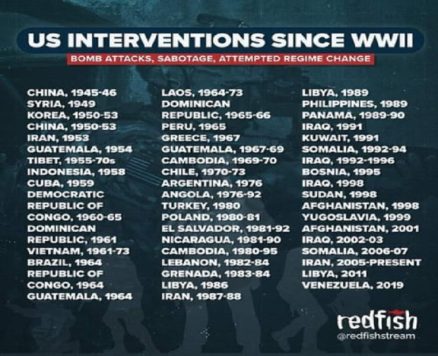
By Andrew Korybko | One World Press | April 7, 2022
Director of the White House National Economic Council Brian Deese told reporters on Wednesday that there will be “significant and long-term consequences” if his country assesses that India has engaged in a so-called “more explicit strategic alignment” with Russia. New Delhi has thus far impressively practiced a policy of principled neutrality towards Moscow’s ongoing special military operation in Ukraine and the New Cold War more broadly between the US on one hand and Russia and China on the other. This South Asian state is the world’s largest and most important non-aligned country that’s setting a proud example for the rest of its Global South peers. The US is afraid that countless more countries will follow India’s lead by continuing to bravely defy Washington’s unilateral hegemonic pressure to sanction Russia.
Deese’s remarks represent the most ominous American threat to India yet since ties between these two Great Powers became complicated from summer 2020 onwards into the present day. Considering the context of the rolling “South Asian Spring” regime change scenario that the US simultaneously activated against Pakistan and Sri Lanka over the weekend, his statement adds credence to suspicions that India is actually the ultimate target of this campaign. It’s unclear what “significant and long-term consequences” will befall Indian-American relations, but it certainly seems like their ties will at the very least continue deteriorating if the US continues aggressively pressuring India to sacrifice its objective national interests for its supposed partner’s sake.
The sudden onset of regional stability along India’s periphery is intended to destabilize that country itself, both immediately and over time. In the event that the Pakistan and/or Sri Lanka’s multipolar governments are replaced by American puppets, then US bases might pop up in those neighboring countries. The so-called “anti-Indian hawks” in Islamabad’s “establishment” might become emboldened to violate the year-long ceasefire with New Delhi in order to punish that country by proxy at Washington’s behest for its policy of principled neutrality. With respect to Colombo, a US naval base could threaten India’s Sea Lines Of Communication (SLOC). Washington might even use the island as a base to encourage separatist movements in Southern India.
To be absolutely clear, India is not engaging in a so-called “explicit strategic alignment” with Russia, it’s simply advancing its objective national interests by remaining neutral in the Ukrainian Conflict and refusing to sacrifice its own for America’s sake. By default, however, the zero-sum unipolar hegemonic perspective embraced by US strategists influences them to regard this balanced policy as supposedly “taking Russia’s side” in the New Cold War. This false assessment is then in turn incorporated into its policy formulation towards that country, thus resulting in Deese’s ominous threat. Given the US’ decades-long track record of betraying former partners in the worst ways possible by orchestrating regime changes and even waging Hybrid Wars against them, India should be very concerned by what he just said.
America seems to be preparing for a fundamental change in its relationship with India, which will certainly affect the balance of interests in Eurasia. Thus far, New Delhi has been doing its utmost to retain that balance between itself, Russia, and China, ergo its policy of principled neutrality in order to ensure that Moscow doesn’t become disproportionately dependent on Beijing in response to the US-led West’s unprecedented pressure campaign. Nevertheless, India also hoped to retain excellent relations with the US at the same time in order to further synchronize the geo-economic aspects of their respective Indo-Pacific strategies. This grand strategic balancing act is now at risk of becoming unbalanced if the US unilaterally decides to worsen relations with India.
The form that this could take remains unclear, but the reader should remember that an intensification of information warfare against India as well as potential economic warfare and possibly even other more dangerous forms of Hybrid Warfare can’t be discounted due to the US’ track record. Security threats will spike in the event that the Pakistani and/or Sri Lankan governments are overthrown throughout the course of the ongoing “South Asian Spring” regime change campaign that the US has unleashed throughout the region. With these forecasts in mind, it’s of the highest importance that the South Asian states seriously consider reviving the South Asian Association for Regional Cooperation (SAARC) in order to advance “regional solutions for regional problems” and thus thwart the US’ plots.
Andrew Korybko is an American political analyst.
Russia blasts ‘shameless US interference’ in Pakistan’s affairs
Press TV – April 5, 2022
Russia has blasted “another attempt of shameless interference” by the United States in the internal affairs of Pakistan, saying that Washington sought to punish a “disobedient” Prime Minister Imran Khan following his visit to Moscow on February 23-24.
The spokesperson for Russia’s Ministry of Foreign Affairs Maria Zakharova said in a statement issued on Monday that the political development in Pakistan “leaves no doubt” that the United States plotted to topple the government of Prime Minister Khan.
The Russian foreign office condemned the United States over its involvement in an alleged conspiracy to overthrow the Pakistani government.
“Immediately after the announcement of the working visit of Imran Khan to Moscow on February 23-24 this year, the Americans and their Western associates began to exert rude pressure on the prime minister, demanding an ultimatum to cancel the trip,” Zakharova said.
The Russian foreign office stated that US Deputy Secretary of State for South Asia Donald Lu called upon the Pakistani ambassador in Washington and subsequently called upon Ambassador Asad Majid to “condemn the balanced reaction of the Pakistani leadership to the events in Ukraine,” as evidence of American interference in Pakistan’s affairs.
“When he [Khan] nevertheless came to us, [Lu] called the Pakistani ambassador in Washington and demanded that the visit be immediately interrupted, which was also rejected,” she stated.
“According to the Pakistani media, on March 7 this year, in a conversation with Pakistani Ambassador Asad Majid, a high-ranking American official (presumably the same Donald Lu) sharply condemned the balanced reaction of the Pakistani leadership to the events in Ukraine and made it clear that partnerships with the United States are possible only if Imran Khan is removed from power,” Zakharova said.
She added that further development of the situation in Pakistan left no doubt that Washington “decided to punish the ‘disobedient’ Imran Khan,” for not condemning the Russian military action in Ukraine as was demanded by the US.
“This is another attempt of shameless US interference in the internal affairs of an independent state for its own selfish purposes. The above facts eloquently testify to this,” Zakharova said.
“The [Pakistan] prime minister himself has repeatedly stated that the conspiracy against him was inspired and financed from abroad. We hope that Pakistani voters will be informed about these circumstances when they come to the elections, which should be held within 90 days after the dissolution of the National Assembly,” she said.
Addressing a large rally in the capital Islamabad last week, Prime Minister Khan accused an unnamed “foreign power” – in a clear reference to the United States – of funding a “conspiracy” to topple his democratically-elected government.
He said the “foreign power” sent millions of dollars to opposition parties to launch a no-confidence vote against him in the parliament.
On Sunday, members of Pakistan’s parliament chanted “Death to America” as they rejected a no-confidence vote, which sought to oust Khan, saying “foreign powers” were interfering in the country’s democratic process.
The National Assembly deputy speaker dismissed the no-trust move against the prime minister, terming it as “contradictory” to Article 5 of Pakistan’s Constitution.
Suri said that the motion was presented on March 8 and should be conducted according to the law and the Constitution, stressing, “No foreign power shall be allowed to topple an elected government through a conspiracy.”
The Pakistani president later dissolved the National Assembly on Khan’s advice.
Pakistan’s PM Khan names US diplomat behind ‘conspiracy’ to topple his government

Press TV – April 4, 2022
Pakistan Prime Minister Imran Khan on Sunday named the senior US government official behind the controversial letter that threatened to overthrow Khan’s Pakistan Tehreek e Insaf (PTI) government.
Addressing a meeting of party leaders in Islamabad after the no-trust motion against him was dismissed in the country’s parliament; Khan said that during the national security committee’s (NSC) meeting, foreign interference was noted in the internal politics of the country through a no-confidence motion.
He went on to mention the name of Donald Lu, the top American official dealing with South Asia in the US State Department, as the person involved in the ‘foreign conspiracy’ to topple his government.
The embattled premier claimed that Lu had warned the Pakistani envoy to the US, Asad Majeed, that there would be “implications” if Khan survived the no-trust vote in the National Assembly, the lower house of the parliament.
He further said that minutes of the communiqué regarding a meeting between the ambassador of Pakistan in the US and the US officials were shared in the NSC meeting.
Khan said the embassy officials of the US were also in contact with the PTI members who had defected, reiterating that the no-confidence motion against him was a “foreign conspiracy”.
On Saturday, Khan openly and defiantly held the US responsible for the “foreign conspiracy” to overthrow his government.
“Ok I’m taking the name of US, the conspiracy has been hatched with the help of America to remove me,” he told his party colleagues in Islamabad.
In a high-drama event on Sunday, the lower house of the parliament rejected the no-trust vote tabled by the opposition parties against Khan.
Deputy speaker of Pakistan’s national assembly, Qasim Suri, asserted that no foreign power will be allowed to “topple an elected government through a conspiracy,” calling the vote against the sitting premier “unconstitutional” under Article 5 of the country’s constitution.
Later, in his televised address on the state-run television, Khan congratulated the people of Pakistan and repeated that the move to overthrow him was a “foreign conspiracy.”
He also requested President Arif Alvi to dissolve the parliament under Article 58(1) of the constitution and called on the nation to gear up for a fresh election.
Talking to his party colleagues later in the day, Khan said that the opposition members were in a state of shock after the vote failed and they did not know what had happened to them.
Pakistan’s Supreme Court is set to decide whether the deputy speaker’s move to reject the opposition’s vote of no-confidence and the subsequent request by Khan to the President to dissolve the parliament is constitutional or not.
President Alvi, in a Twitter post on Monday, said Khan would stay on as prime minister in a caretaker role.
Khan’s fate is now in a state of limbo which would lead to fresh political instability in the country. The court could bar him from standing again if he is found to have acted unconstitutionally.
The relationship between the US and Pakistan has been at odds since the US’ hasty withdrawal from Afghanistan last summer.
The growing alignment between China and Pakistan also casts a shadow over US policy towards Pakistan.
Featured Video

Iran FM Araghchi: “Hormuz Will No Longer Be the Same”
or go to
Aletho News Archives – Video-Images
From the Archives
Sam Husseini: The entire US establishment helped lie their way into the Iraq war
By Slava Zilber | American Herald Tribune | October 14, 2019
Sam Husseini is a senior analyst with the Institute for Public Accuracy, independent journalist and contributor to The Nation and FAIR.
Slava Zilber: Sam, three years ago, you appeared on Talk Nation Radio with David Swanson and spoke about the case of the GCHQ whistleblower Katharine Gun. You pointed out that the people involved in the spying on the UN and the people authorizing the Iraq War were not held accountable:
“Virtually everybody who went along with the war, whether it is Kerry or Clinton, of course, the Bush administration themselves has falsified their own records in terms of why, what they did, when they did, why they did it, to the extent that they’ve been scrutinised at all.”
You also address it in a recent article. And recently, Joe Biden has been lying about his position on the Iraq War. How can such an important issue escape meaningful scrutiny? … continue
Blog Roll
 Aletho News
- Barghouti: ‘Netanyahu has fallen,’ era of Smotrich, Ben-Gvir over
- China slams US policy on Iran as Russia rejects legality of nuclear meeting at UN
- The Mecca Pact Courts Iran: Containment Comes Full Circle
- Oman FM: Persian Gulf states, Iran, Iraq should form security pact excluding US
- Trump peddles fresh falsehoods, claims Iran ‘started the war’ as US aggression drags on
- Ukraine quagmire? Yes, but it’s for NATO, not Russia
- US intelligence hypes Chinese, Russian space threats while accelerating its own military buildup in orbit
- Iran FM Araghchi: “Hormuz Will No Longer Be the Same”
- EU facing trillion-euro debt hole while seeking more cash for Kiev
- How US, Europe, Persian Gulf states exhausted missile stockpiles, splurged billions to defend Israel
- If Americans Knew
- An error has occurred; the feed is probably down. Try again later.
- No Tricks Zone
- Sudden Stratospheric Warming, Powerful El Niño Combination May Lead To Extreme Europe Cold, Energy Crisis!
- Two New Studies Find Thwaites Glacier Melt Cannot Be Driven By Human Activity Or A Warming Ocean
- E-Cars Reduce CO2 Emissions By Only 41% Compared To Internal Combustion Engine Vehicles
- Predictions Made By Renowned Climate Professor Over Past Decades Have Been Proven To Be Poor
- New Study Suggests Large Regions Of The Pacific Ocean Have Been Cooling For The Last 80 Years
- Germany’s Green Energy Debacle: High Energy Costs Force Kahla Porzellan to Close After 182 Years!
- New Study: 50 Years Of The Most Aggressive ‘Net Zero’ Policies Can Only Affect The Global Climate By 0.03°C
- US September “Heat” Was No Record…Many Records Set Decades Ago
- Latest European Green Energy Debacle; Portugal’s Largest Flagship Solar Park Insolvent!
- Green Energy Debacle: German Expert Professor Fritz Vahrenholt Warns Of Severe Economic And Social Consequences

