Former Insiders Criticize Iran Policy as U.S. Hegemony
By GARETH PORTER | CounterPunch | February 27, 2013
“Going to Tehran” arguably represents the most important work on the subject of U.S.-Iran relations to be published thus far.
Flynt Leverett and Hillary Mann Leverett tackle not only U.S. policy toward Iran but the broader context of Middle East policy with a systematic analytical perspective informed by personal experience, as well as very extensive documentation.
More importantly, however, their exposé required a degree of courage that may be unparalleled in the writing of former U.S. national security officials about issues on which they worked. They have chosen not just to criticise U.S. policy toward Iran but to analyse that policy as a problem of U.S. hegemony.
Their national security state credentials are impeccable. They both served at different times as senior coordinators dealing with Iran on the National Security Council Staff, and Hillary Mann Leverett was one of the few U.S. officials who have been authorised to negotiate with Iranian officials.
Both wrote memoranda in 2003 urging the George W. Bush administration to take the Iranian “roadmap” proposal for bilateral negotiations seriously but found policymakers either uninterested or powerless to influence the decision. Hillary Mann Leverett even has a connection with the powerful American Israel Public Affairs Committee (AIPAC), having interned with that lobby group as a youth.
After leaving the U.S. government in disagreement with U.S. policy toward Iran, the Leveretts did not follow the normal pattern of settling into the jobs where they would support the broad outlines of the U.S. role in world politics in return for comfortable incomes and continued access to power.
Instead, they have chosen to take a firm stand in opposition to U.S. policy toward Iran, criticising the policy of the Barack Obama administration as far more aggressive than is generally recognised. They went even farther, however, contesting the consensus view in Washington among policy wonks, news media and Iran human rights activists that President Mahmoud Ahmadinejad’s election in June 2009 was fraudulent.
The Leveretts’ uncompromising posture toward the policymaking system and those outside the government who support U.S. policy has made them extremely unpopular in Washington foreign policy elite circles. After talking to some of their antagonists, The New Republic even passed on the rumor that the Leveretts had become shills for oil companies and others who wanted to do business with Iran.
The problem for the establishment, however, is that they turned out to be immune to the blandishments that normally keep former officials either safely supportive or quiet on national security issues that call for heated debate.
In “Going to Tehran”, the Leveretts elaborate on the contrarian analysis they have been making on their blog (formerly “The Race for Iran” and now “Going to Tehran”) They take to task those supporting U.S. systematic pressures on Iran for substituting wishful thinking that most Iranians long for secular democracy, and offer a hard analysis of the history of the Iranian revolution.
In an analysis of the roots of the legitimacy of the Islamic regime, they point to evidence that the single most important factor that swept the Khomeini movement into power in 1979 was “the Shah’s indifference to the religious sensibilities of Iranians”. That point, which conflicts with just about everything that has appeared in the mass media on Iran for decades, certainly has far-reaching analytical significance.
The Leveretts’ 56-page review of the evidence regarding the legitimacy of the 2009 election emphasises polls done by U.S.-based Terror Free Tomorrow and World Public Opinon and Canadian-based Globe Scan and 10 surveys by the University of Tehran. All of the polls were consistent with one another and with official election data on both a wide margin of victory by Ahmadinejad and turnout rates.
The Leveretts also point out that the leading opposition candidate, Hossein Mir Mousavi, did not produce “a single one of his 40,676 observers to claim that the count at his or her station had been incorrect, and none came forward independently”.
“Going to Tehran” has chapters analysing Iran’s “Grand Strategy” and on the role of negotiating with the United States that debunk much of which passes for expert opinion in Washington’s think tank world. They view Iran’s nuclear programme as aimed at achieving the same status as Japan, Canada and other “threshold nuclear states” which have the capability to become nuclear powers but forego that option.
The Leveretts also point out that it is a status that is not forbidden by the nuclear non-proliferation treaty – much to the chagrin of the United States and its anti-Iran allies.
In a later chapter, they allude briefly to what is surely the best-kept secret about the Iranian nuclear programme and Iranian foreign policy: the Iranian leadership’s calculation that the enrichment programme is the only incentive the United States has to reach a strategic accommodation with Tehran. That one fact helps to explain most of the twists and turns in Iran’s nuclear programme and its nuclear diplomacy over the past decade.
One of the propaganda themes most popular inside the Washington beltway is that the Islamic regime in Iran cannot negotiate seriously with the United States because the survival of the regime depends on hostility toward the United States.
The Leveretts debunk that notion by detailing a series of episodes beginning with President Hashemi Rafsanjani’s effort to improve relations in 1991 and again in 1995 and Iran’s offer to cooperate against Al-Qaeda in Afghanistan and, more generally after 9/11, about which Hillary Mann Leverett had personal experience.
Finally, they provide the most detailed analysis available on the 2003 Iranian proposal for a “roadmap” for negotiations with the United States, which the Bush administration gave the back of its hand.
The central message of “Going to Tehran” is that the United States has been unwilling to let go of the demand for Iran’s subordination to dominant U.S. power in the region. The Leveretts identify the decisive turning point in the U.S. “quest for dominance in the Middle East” as the collapse of the Soviet Union, which they say “liberated the United States from balance of power constraints”.
They cite the recollection of senior advisers to Secretary of State James Baker that the George H. W. Bush administration considered engagement with Iran as part of a post-Gulf War strategy but decided in the aftermath of the Soviet adversary’s disappearance that “it didn’t need to”.
Subsequent U.S. policy in the region, including what former national security adviser Bent Scowcroft called “the nutty idea” of “dual containment” of Iraq and Iran, they argue, has flowed from the new incentive for Washington to maintain and enhance its dominance in the Middle East.
The authors offer a succinct analysis of the Clinton administration’s regional and Iran policies as precursors to Bush’s Iraq War and Iran regime change policy. Their account suggests that the role of Republican neoconservatives in those policies should not be exaggerated, and that more fundamental political-institutional interests were already pushing the U.S. national security state in that direction before 2001.
They analyse the Bush administration’s flirtation with regime change and the Obama administration’s less-than-half-hearted diplomatic engagement with Iran as both motivated by a refusal to budge from a stance of maintaining the status quo of U.S.-Israeli hegemony.
Consistent with but going beyond the Leveretts’ analysis is the Bush conviction that the U.S. invasion and occupation of Iraq had shaken the Iranians, and that there was no need to make the slightest concession to the regime. The Obama administration has apparently fallen into the same conceptual trap, believing that the United States and its allies have Iran by the throat because of its “crippling sanctions”.
Thanks to the Leveretts, opponents of U.S. policies of domination and intervention in the Middle East have a new and rich source of analysis to argue against those policies more effectively.
Related article
‘Noble Savages’: Chagnon’s new book triggers resignation and protests
Survival for Tribal Peoples | February 26, 2013
 Davi Kopenawa, Yanomami spokesperson and shaman, has spoken out against Napoleon Chagnon’s new book ‘Noble Savages’.
© Fiona Watson/Survival

A new book by controversial American anthropologist Napoleon Chagnon has triggered a wave of protests among experts and Yanomami Indians:
- Marshall Sahlins, ‘the world’s most respected anthropologist alive today’, has resigned from the US National Academy of Sciences in protest at Chagnon’s election to the Academy. Sahlins previously wrote a devastating critique of Chagnon’s work in the Washington Post.
- Davi Kopenawa, a spokesman for Brazil’s Yanomami and President of the Yanomami association Hutukara, has spoken out about Chagnon’s work: ‘[Chagnon] said about us, ‘The Yanomami are savages!’ He teaches false things to young students. ‘Look, the Yanomami kill each other because of women.’ He keeps on saying this. But what do his leaders do? I believe that some years ago his leader waged a huge war – they killed thousands of children, they killed thousands of girls and boys. These big men killed almost everything. These are the fierce people, the true fierce people. They throw bombs, fire machine guns and finish off with the Earth. We don’t do this…’
- A large group of anthropologists who have each worked with the Yanomami for many years have issued a statement challenging Chagnon’s assessment of the tribe as ‘fierce’ and ‘violent’. They describe the Yanomami as ‘generally peaceable.’
- Survival International’s Director Stephen Corry has said, ’Chagnon’s work is frequently used by writers, such as Jared Diamond and Steven Pinker, who want to portray tribal peoples as ‘brutal savages’ – far more violent than ‘us’. But none of them acknowledge that his central findings about Yanomami ‘violence’ have long been discredited.’
Napoleon Chagnon’s autobiography ‘Noble Savages: My Life Among Two Dangerous Tribes – the Yanomamö and the Anthropologists’, has just been published. His 1968 book ‘Yanomamö: The Fierce People’ portrayed the Yanomami as ‘sly, aggressive and intimidating’, and claimed they ‘live in a state of chronic warfare’. It is still a standard work in undergraduate anthropology.
The Yanomami live in Brazil and Venezuela and are the largest relatively isolated tribe in South America. Their territory is protected by law, but illegal goldminers and ranchers continue to invade their land, destroying their forest and spreading diseases which in the 1980s killed one out of five Brazilian Yanomami.
 Napoleon Chagnon’s view that the Yanomami are ‘sly, aggressive and intimidating’ and that they ‘live in a state of chronic warfare’ has been widely discredited.
© Fiona Watson/Survival

Chagnon’s work has had far-reaching consequences for the rights of the Yanomami. In the late 1970s, Brazil’s military dictatorship, which was refusing to demarcate the Yanomami territory, was clearly influenced by the characterization of the Yanomami as hostile to each other and in the 1990s, the UK government refused funding for an education project with the Yanomami, saying that any project with the tribe should work on ‘reducing violence’.
Most recently, Chagnon’s work was cited in Jared Diamond’s highly controversial book ‘The World Until Yesterday’, in which he states that most tribal peoples, including the Yanomami, are ’trapped in cycles of violence and warfare’ and calls for the imposition of state control in order to bring them peace.
Survival International’s Director Stephen Corry said today, ‘The greatest tragedy in this story is that the real Yanomami have largely been written out of it, as the media have chosen to focus only on the salacious details of the debate that rages between anthropologists or on Chagnon’s disputed characterizations. In fact, Yanomamö: The Fierce People had disastrous repercussions both for the Yanomami and tribal peoples in general. There’s no doubt it’s been used against them and it has brought the 19th century myth of the ‘Brutal Savage’ back into mainstream thinking.’
Related articles
The Black Panthers, Black History Month and “Domestic Terrorism”
By RON JACOBS | CounterPunch | February 8, 2013
Once again, it’s Black History Month in the United States. Since the inception of this celebration, its meaning has unfortunately been diminished as the myth of postracialism becomes gospel, even though it shares none of a gospel’s truths. In schools and libraries, well-meaning teachers and library workers create displays, bring in speakers, and teach lessons on the history of African-Americans. All too often, this means a look at the words of Martin Luther King, Jr., a discussion of the Emancipation Proclamation and maybe a lesson about Rosa Parks.
Only rarely, do students and library patrons get a look beyond these conventional topics that are usually taught in a manner that highlights white America’s tolerance and sense of fair play. This is why books like the recently released Black Against Empire: The History and Politics of the Black Panther Party are so important. They remove the pretense that the Black liberation movement in the United States was something everyone except the KKK and its allies supported. Books like this tell the truth. Blacks Against Empire does so concisely, engagingly and honestly.
Blacks Against Empire is a political history that is simultaneously objective and radical. Despite the efforts of historians to obfuscate and obliterate the party from history, describing it as a hate group and gun-obsessed when mentioning it at all, the fact is the Panthers legacy is unique and important to not only the history of Black America, but to the history of the entire United States. It is best described in the words of Mumia Abu Jamal: “we didn’t preach to the people, we worked with them. “The relationship between the primarily white New Left and Panthers is explored in a fair-minded and realistic manner, as is the relationship between the Panthers and other Third World revolutionary organizations both in the United States and around the world. The authors expand the narrative of the movement against the US war in Vietnam, showing clearly the early involvement of black organizations, especially that of the Student Nonviolent Coordinating Committee (SNCC). It was this organization that actually began resisting the draft, months before the predominantly white antiwar movement. Furthermore, as the authors make clear, opposition to the US war in Vietnam was one of the Black Panthers’ fundamental positions.
Like most revolutionary organizations the Panthers struggled with issues of gender and sexuality. While the participation of men in the breakfast programs sensitized them to the realities of child-rearing and associated aspects of human life (think of the film Salt of the Earth, when the women replace men on the picket lines and the men take over household tasks forcing them to see the relationship of domestic tasks to the capitalist dynamic), the living situations of many Panthers reinforced traditional gender roles.
Joshua Bloom and Waldo Martin Jr., the authors of Black Against Empire, have written a comprehensive and compelling history of the Black Panther Party. As close to complete as one text can possibly be, it is the book I would recommend to anyone wanting to read just one book about the Black Panthers. The book concludes with a chapter speculating as to why the Black Panthers developed when they did, why they commanded the support they did, and why their influence waned so quickly. Of course, the role of the government counterinsurgency program called COINTELPRO is discussed; the frameups, misinformation, jacketing and murders. In light of current concerns about domestic “terrorists”, one wonders if the Panthers would be considered drone assassination targets under the current Justice Department guidelines if they were around today? Other reasons provided by the authors for the Panthers’ demise borrow from the Italian Antonio Gramsci’s thoughts on revolutionary movements and end up asking more questions than they answer.
Back to Mumia Abu Jamal. One of the youngest Panthers in the nation, he continued his revolutionary activism and reportage long after the Black Panthers had become history. Indeed, his post-Panther trajectory could serve as a microcosm of many leftist revolutionaries who came of age during the Panthers’ heyday. He didn’t give up his radicalism while pursuing a career after the Party. Because of this, he ended up paying for his history and his refusal to compromise. He continues paying even today. For those who have forgotten (or never paid attention), Mumia has been on Pennsylvania’s death row for more than two decades. Accused and convicted of killing a Philadelphia policeman in a prosecution involving the sketchiest of evidence and numerous prosecutorial and judicial missteps, Mumia’s life and situation is the subject of a new feature film titled Long Distance Revolutionary.
When I was helping organize antiwar activities in the late 1990s and the 2000s, I learned that many of the younger radicals I was working with came to their politics after learning of Mumia’s case. Thanks in no small part to his eloquence and the support of popular musicians like Rage Against the Machine, these young people saw through the intense desire of the State to keep Jamal in prison and kill him. This understanding opened their eyes to the realities of the system and made them radical. As the film shows, this trajectory is similar to Jamal’s. Mumia is a political prisoner. The Panthers were a political organization. The story of both is a story that needs to be heard. The film is part biography, part commentary from supporters and Jamal himself, and part drama. The sum of these parts is a film that provokes and entertains.
The Black Panthers were bold. The Black Panthers were smart. The Black Panthers were anti-imperialists. The Black Panthers were revolutionaries. This book and this film remind us of that. They also remind us that this world, this nation, could use something with the Panthers appeal and power now.
Read this book, ask your library to buy it; watch this film. Black history isn’t just for black people. It’s for everyone who wants to understand the history of the United States.

Ron Jacobs is the author of The Way the Wind Blew: a History of the Weather Underground and Short Order Frame Up. Jacobs’ essay on Big Bill Broonzy is featured in CounterPunch’s collection on music, art and sex, Serpents in the Garden. His collection of essays and other musings titled Tripping Through the American Night is now available and his new novel is The Co-Conspirator’s Tale. He is a contributor to Hopeless: Barack Obama and the Politics of Illusion, published by AK Press. He can be reached at: ronj1955@gmail.com.
Angry Papuan leaders demand Jared Diamond apologizes
Survival | February 4, 2013
 Benny Wenda, a Papuan tribal leader, says what Jared Diamond is writing about his people is ‘misleading’. © freewestpapua.org / Survival
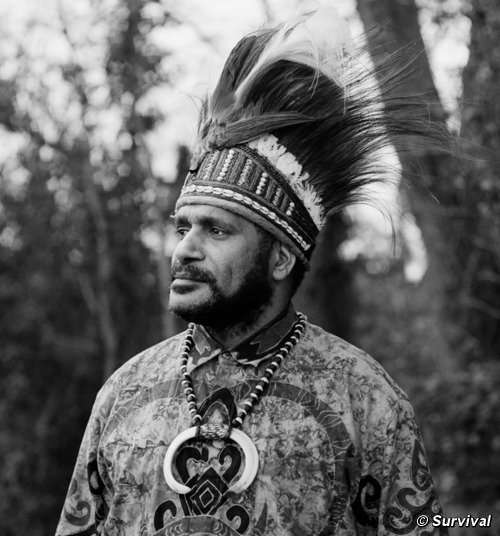
Leaders across West Papua have demanded controversial author Jared Diamond apologizes for describing them in his new book as warlike, and strengthening the idea that indigenous people are ‘backwards’.
The West Papuan leaders attack Diamond’s central arguments that ’most small-scale societies (…) become trapped in cycles of violence and warfare’ and that ‘New Guineans appreciated the benefits of the state-guaranteed peace that they had been unable to achieve for themselves without state government.’
Mr Diamond makes no mention of the brutality and oppression suffered by the people of West Papua at the hands of the Indonesian occupation since 1963, which has led to the killing of at least 100,000 Papuan tribal people at the hands of the Indonesian military.
Benny Wenda, a Papuan tribal leader, said to Survival, ‘What he (Jared Diamond) has written about my people is misleading (…) he is not writing about what the Indonesian military are doing (…) I saw my people being murdered by Indonesian soldiers and my own Auntie was raped in front of my eyes. Indonesia told the world that this was ’tribal war’ – they tried to pretend that it was us that was violent and not them – this book is doing the same. He should apologize.’
Markus Haluk, a senior member of the Papuan Customary Council, added, ‘The total of Dani victims from the Indonesian atrocities over the 50 year period is far greater than those from tribal war of the Dani people over hundreds of thousands of years.’
 Jared Diamond’s book has come under attack for portraying tribal people as warlike and ‘living in the past’. © Survival
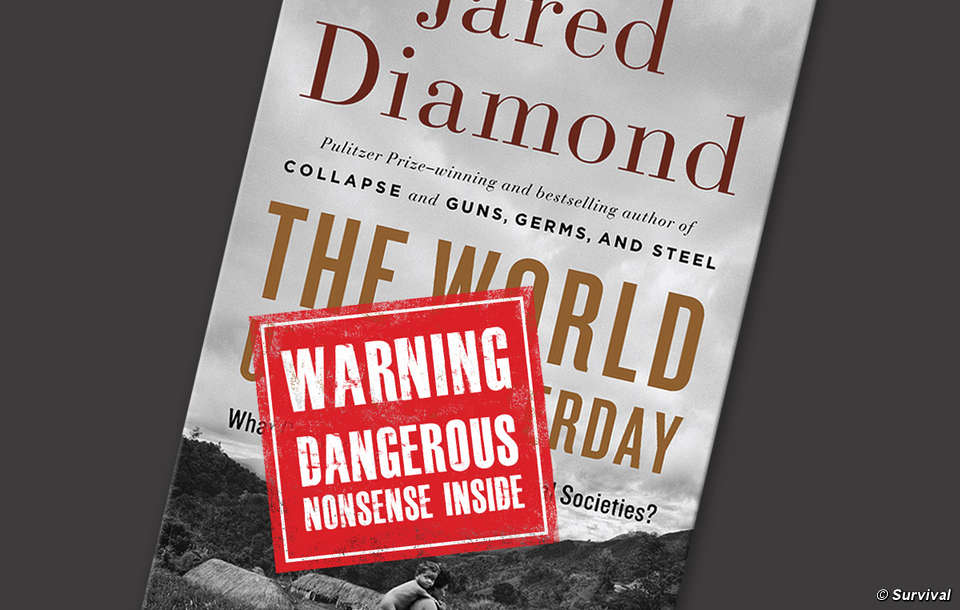
Matius Murib, Director of the Baptist Voice of Papua, condemned Diamond’s assertion that tribal peoples live in a ‘world until yesterday’. He said, ‘This book spreads prejudices about Papuan people (…) that indigenous Papuans still display a way of life from hundreds of years ago. This is not true and strengthens the idea that indigenous people are ’backwards’, ‘live in the past’ or are ‘stone age.’
Reverend Socratez Yoman, Head of the West Papuan Baptist Church, has also demanded an apology from Mr Diamond to the Papuan people.
Dominikus Surabut, currently jailed for treason for peacefully declaring West Papuan independence, described the relationship of indigenous West Papuans and the Indonesian state as political apartheid. In a statement smuggled out of his jail cell, he said, ‘This is the very nature and character of colonial occupation of indigenous peoples, where they are treated as second class citizens whose oppression is justified by painting them as backwards, archaic, warring tribes – just as suggested by Jared Diamond in his book about tribal people.’
Survival International and TAPOL received the messages of outrage following condemnation of the book by Survival last week. The book has since been the subject of heated debate during Mr Diamond’s visit to the UK.
The Talented Mr. Takeyh: Why Doesn’t the Council on Foreign Relations Fellow Like Flynt & Hillary Mann Leverett?
By Nima Shirazi | Wide Asleep in America | February 7, 2013
If there’s one thing mainstream “Iran experts” hate, it’s well-credentialed, experienced analysts who dare challenge Beltway orthodoxies, buck conventional wisdom and demythologize the banal, bromidic and Manichean foreign policy narrative of the United States government and its obedient media. Such perspectives are shunned by “serious” scholars who play by the rules they and their former bosses themselves wrote; those propounding such subversive ideas are likewise excoriated and banished, labeled apostates and attacked personally for failing to fall in line.
Enter Flynt and Hillary Mann Leverett, two former National Security Council officials, who have long questioned the wisdom and efficacy of the past thirty years of U.S. policy towards Iran. Their new expertly researched and meticulously-sourced book, Going to Tehran: Why the United States Must Come to Terms with the Islamic Republic of Iran, details and debunks numerous propagandized myths and delusional misunderstandings that many Americans have been led to believe about the country that is consistently referred to by our politicians and pundits as “the world’s most dangerous state.” The Leveretts argue that, by at least taking into account the Iranian side of things and reviewing the misguided, myopic and unsustainable American policies toward Iran, the groundwork may be laid for a constructive and beneficial change of course for both nations; by engaging openly and acknowledging past grievances – rather than ignoring, justifying or ridiculing them – a new future is possible, one without threats or war, without sabotage and cyberattacks, without demonization and demagoguery.
The problem is, without such things, the revolving door of Beltway think-tankery and government appointments might not spin so lucratively for our “Iran expert” industry. As a result, the Leveretts and their ideas are pilloried by political and policy elites who confuse heterodoxy for apologia.
In a supremely smug and self-satisfied pseudo-review of Going to Tehran, just published in Survival, the journal of the International Institute of Strategic Studies, Washington’s “go-to” Iran analyst Ray Takeyh launches what is surely a paradigmatic opening salvo on the Leveretts’ work. Needless to say, he didn’t like the book; his review is the intellectual equivalent of a drive-by shooting. While lambasting the Leveretts, Takeyh fails to actually address any of their contentions or claims, preferring to make grandiose statements condemning their analyses of Iranian politics and foreign policy and their policy recommendations without bothering to back up these statements with evidence or explanation.
Takeyh is a mainstay of the Washington establishment – a Council on Foreign Relations Senior Fellow before and after a stint in the Obama State Department and a founding member of the neoconservative-created Iran Strategy Task Force who has become a tireless advocate for the collective punishment of the Iranian population in a futile attempt to inspire homegrown regime change (if not, at times, all-out war against a third Middle Eastern nation in just over a decade). Unsurprisingly, he dismisses out of hand the notion that “the principal cause of disorder in the Middle East today is a hegemonic America seeking to impose its imperial template on the region.”
This is exactly the worldview that has produced the disastrous U.S. foreign policy of the last few decades, policies advocated time and time again by the same people – not only people like Takeyh, but including literally Takeyh himself – never learning from their mistakes or conceiving there might be a different way to engage the world (say, by not bullying, threatening, demanding, dictating, punishing, bombing, invading, destroying, dismantling, overthrowing, occupying, and propping up dictators). Takeyh’s contemptuous rejection of history means that those who disagree with him – like the Leveretts, even though their experience in government and direct contact with on-the-ground reality in today’s Iran dwarfs Takeyh’s – must inevitably be minions of the ayatollahs.
Takeyh’s dismissal of the Leveretts’ work is especially ironic, given that his own analytic nonsense is legion. He routinely makes statements that aren’t based in fact and that dispute even the most hysterical estimates of the United States government. He has no problem co-writing tomes of warmongering lunacy with psychotics like Matthew Kroenig, convicted criminals and racist demagogues like Elliott Abrams, and garbled inanity with his wife’s insane colleague at the Saban Center and perennial war champion Kenneth Pollack. Everything he writes is easily destroyed with a basic perusal of facts.
Never bothering to cite any evidence, Takeyh has long assumed Iran – oh sorry, I mean, “the mullahs” (how spooky!) – are building a nuclear bomb and only the fierce determination of the United States, its benevolent buddy Israel and vital Arab dictator friends can stop it, if not by beating the Islamic Republic into submission through economic and covert warfare, then perhaps by military might. In April 2003, he wrote, “Tehran often claims that instability in the region forces it to pursue nuclear weapons, when in fact it is Iran’s possession of such weapons that would increase instability.” Actually, Iranian officials have never claimed anything remotely like that, instead declaring their commitment never to build nuclear weapons consistently for over 20 years. In 2011, Takeyh assured Washington Post readers, “Exact estimates vary, but in the next few years Iran will be in [a] position to detonate a nuclear device.”
In October 2011, when the US government tried to pretend that a bumbling, bipolar Iranian used-car salesman in Texas had been tasked by the Iranian Revolutionary Guard Corps to hire a Mexican drug cartel to assassinate the Saudi ambassador in a DC restaurant (it is literally impossible to read that without chuckling), Takeyh took to the airwaves to comment on the alleged plot. Speaking on NPR, Takeyh wholly endorsed the U.S. government’s version of events, never for a second doubting their authenticity. Though he claimed it was “unusual,” Takeyh made sure to add, “I don’t know what the evidence about this it, but I’m not in position to doubt it.”
There you have it, folks, Takeyh’s entire method of scholarship in a nutshell.
Takeyh’s disdain for empirical reality allows him to take multiple, often contradictory positions on many issues—whatever it takes to align himself with “centrist” foreign policy hawks in the Democratic Party’s national security establishment. In 2006, after the occupation of Iraq had turned irrevocably catastrophic and Democrats were looking for ways to distance themselves from Bush’s Middle East follies, Takeyh argued “for the United States to become more directly engaged in negotiations with Iranians and also make an offer of some corresponding concessions.” While assuming an Iranian desire for latent nuclear weapons capability, he held, “I don’t think they’ve made up their mind yet to cross the threshold and actually weaponize [nuclear power].” He added, “For those who suggest that it is absolutely conclusively determined that Iran wants to have nuclear weapons, I think it behooves them to provide some kind of evidence for that claim.” Just months later, though, Takeyh told the Senate that Iranian leaders were determined to achieve hegemony in the Persian Gulf and that, from their vantage, “it is only through the attainment of the bomb that Iran can negate the nefarious American plots to undermine its stature and power.”
As the possibility of Democratic victory in the 2008 presidential election drew closer, Takeyh’s views grew more hawkish. His transformation into an Iran hawk accelerated with his brief stint in the State Department during the Obama administration’s first year. In 2010, he co-wrote a journal essay and accompanying op-ed that sought to characterize war with Iran as a natural outcome, a normalized and inevitable progression of history. Over the next couple of years, he fully realized his penchant for conflating Iran’s monitored and safeguarded nuclear energy program with a nefarious, clandestine weapons program.
This conflation is present in Takeyh’s attempted takedown of Going to Tehran, where he references Iran’s “nuclear infractions,” but provides no evidence for them other than collective Beltway wisdom, displaying a complete ignorance of what IAEA reports actually say and where such accusations actually come from (unverified American and Israeli allegations). His determination to blame only Iranian “intransigence” for the current nuclear dispute epitomizes the intellectual dishonesty for which most Washington think-tanks are unfortunately revered.
Takeyh’s analytic malfeasance extends to Iran’s domestic politics as well. His conversion from unimpressive establishment scholar to full-blown neocon fellow traveler is underscored by his remarkable insistence that Iran’s clerics are to blame for the 1953 CIA coup that overthrew Prime Minister Mohammad Mossadegh (sic). Takeyh also refuses to understand the reality of the Green Movement in Iran, elevating them to surreal heights of organization, unity and potential.
In his review of Going to Tehran, Takeyh notes what he calls “transparent electoral fraud in the presidential election” of 2009, but again fails to advance any actual documentation to support this contention. Since 2010, he has been warning us all of Ahmadinejad’s impending consolidation of power over the Iranian government. This didn’t happen. Good call, Ray, how astute.
The self-serving vacuity of Takeyh’s review is especially glaring in his treatment of the Leveretts’ critique of U.S. policy toward Iran. As the Leveretts themselves have already noted, Takeyh is adamant that the U.S. has often and openly reached out diplomatically to Tehran but can’t seem to square this with reality – including statements made by his former boss, Dennis Ross, who sees the perception of failed diplomacy as necessary to sell the American public on a new illegal war against another enemy that poses absolutely no threat to the United States.
Takeyh complements his rewriting of diplomatic history with a selective – indeed exploitative – focus on human rights issues in Iran. Along with the vast majority of the Leveretts’ detractors (and anyone else who rejects a reality-based approach to the three-decades-long U.S.-Iranian impasse), Takeyh seems unaware that basing American foreign policy on human rights is not only disingenuous, but also contrary to how the U.S. actually operates all over the world.
Going to Tehran is a policy prescription addressed primarily to the government of the United States, not to human rights organizations. Iran has as abhorrent a human rights record as many other countries – far worse than many, better than others. But the United States government has never cared one iota about human rights when it comes to strategic partnership with its closest and most trusted political allies (let alone its own actions).
Whether looking at our torture regime, our indefinite detention, our illegal drone program, our invasions, our assassinations, our surveillance state, our contempt for due process, our racist justice system and bloated prisons, and – perhaps, most relevant – our continued support and encouragement of ongoing Israeli war crimes, ethnic cleansing, colonization and occupation of Palestine alongside weapons sales and willful blindness to the atrocities of true dictatorships like Saudi Arabia and Bahrain, the concept that American diplomacy or interests rest upon virtuousness and humane practices is not only hypocritical; it’s downright laughable. As Glenn Greenwald recently wrote about Iran, Syria and Libya, “That the US and its Nato allies – eager benefactors of the world’s worst tyrants – are opposed to those regimes out of concern for democracy and human rights is a pretense, a conceit, so glaring and obvious that it really defies belief that people are willing to advocate it in public with a straight face.”
If our government cared about human rights it wouldn’t be subjecting the Iranian people (who wholeheartedly oppose American sanctions and constant bullying) to collective punishment, just like it did the people of Iraq – the half million Iraqi children sacrificed to similar sanctions know full well the American consideration for human rights. Takeyh reflects this duplicity in his review, noting the appalling history of “show trials, mass repression and persistent international transgressions” in Iran and condemning the Leveretts for not making this the focus of their book. Yet if Takeyh actually cared about fundamental human rights and the importance of international law, he would not only call for Congress to sanction Israel and Saudi Arabia, he would be outraged by the closeness of these governments to his own here in the United States. But he doesn’t. Only Iran is the target of his anger and concern.
Because for the U.S. government, human rights abuses are used merely as a bludgeon against its adversaries while the myriad transgressions of its strategic partners are routinely ignored (if not, in the case of Israel, even funded and justified), Takeyh’s argument is disingenuous at minimum. As always, he and his fellow mavens of the established foreign policy community are silent about America’s role as the guarantor of Middle Eastern tyranny, as long as its puppet dictators do our bidding, namely with regard to acquiescing to Israeli regional hegemony and following the U.S. lead on isolating and threatening Iran.
In the most recent Human Rights Watch report, we learn that a large Middle Eastern country, ruled by an unelected religious fundamentalist misogynistic elite, has “arrested hundreds of peaceful protesters during 2012, and sentenced activists from across the country to prison for expressing critical political and religious views.” Not only this, but “thousands of people are in arbitrary detention, and human rights activists were put on trial on politicized charges. The Ministry of Interior forbids public protests. Since 2011, security forces have killed at least 14 protesters in the Eastern province who were seeking political reforms.”
It finds that the “government has gone to considerable lengths to punish, intimidate, and harass those who express opinions that deviate from the official line,” while “lawyers are not generally allowed to assist suspects during interrogation, and face obstacles to examining witnesses or presenting evidence at trial.” Furthermore, “Authorities have used specialized criminal courts, set up to try terrorism cases, to prosecute a growing number of peaceful dissidents on politicized charges.”
What country is this? Saudi Arabia, the leading U.S. trading partner in the Middle East, which receiving billions upon billions of high-tech weaponry from our noble nation year after year. The United States uses a secret Saudi base as a launchpad for lethal drone strikes in neighboring Yemen and is even working closely with the Kingdom on its nascent nuclear program. One wonders if this recent case (one of the worst things I have ever heard about) will cause the U.S. to reconsider its relationship with Saudi Arabia. Don’t hold your breath. But just imagine if that had happened in Iran.
Our best friend in the world, Israel, meanwhile is a militarized colonial state in routine contravention of existing international and humanitarian law. Ample evidence reveals the illegality of Israel’s Apartheid Annexation Wall, Israel’s use of administrative detention to hold Palestinians indefinitely without charge or trial and the rampant Israeli arrest of Palestinian children and toddlers, who suffer abuse – mental, physical and sexual – and who are tortured during and traumatized by their imprisonment. Palestinian communities are constantly victimized by housing demolitions and eviction, a particularly vindictive form of collective punishment favored by the Israeli government.
None of this seems to bother our government one bit and any attempt to hold Israel accountable for its crimes is met with derision in the circles in which Mr. Takeyh travels, all expenses paid, of course.
The issue isn’t about whitewashing or justifying abuse and repression; it’s about U.S. government policy, which clearly has no problem overlooking such horrors depending on who commits them. If the U.S. were consistent in its concern for human rights (rather than selectively using them only to condemn its enemies), Takeyh might have a point. But it isn’t, so he doesn’t.
The Leveretts explicitly address this issue in Going to Tehran. They write, “Washington has never demonstrated that it cares about human rights in the Middle East for their own sake. It cares about them when and where caring appears to serve other policy goals.” In their explicitly stated effort “to outline a potentially far more efficacious diplomatic approach” (p.388), the Leveretts point out that “the only way human rights conditions in the Islamic Republic, as defined by Western liberals, are likely to improve is in a context of U.S.-Iranian rapprochement, whereby the United States had credibly given up regime change as a policy goal.” (p.326)
While conventional Washington wisdom (and actual acts of Congress and executive orders by the President) hold that the U.S. government should be critical of Iran’s human rights record as a matter of policy, doing so is pure propaganda. The United States is in no position to affect the violations of the Iranian government because it has no diplomatic presence, credibility or connection to the Islamic Republic. As George W. Bush admitted in December 2004, in a rare moment of candor and honesty, “We’re relying upon others, because we’ve sanctioned ourselves out of influence with Iran…We don’t have much leverage with the Iranians right now.”
Takeyh, by employing ad hominem attacks on the Leveretts in an effort to label them apologists for theocratic authoritarianism and thereby discredit their views, is trying to poison the well, so to speak, with anti-war progressives who might find a new approach to Iran novel and welcome. He calls Going to Tehran “tedious,” “stale,” and “trite.” That’s coming from a guy who works at the Council on Foreign Relations and writes about implementing even more “crippling” sanctions on Iranians in order to compel their government’s capitulation to American and Israeli diktat. How original, fresh, and innovative!
Regardless of whether one finds their arguments compelling or their history sufficiently comprehensive, the Leveretts deliver a blow to the establishment narrative of “what to do about Iran.” It is no surprise that Ray Takeyh is offended by the Leveretts – they directly address the danger he and others like him in the official foreign policy community pose to those who oppose another war.
They write that the claims put forward by Takeyh “that Iran’s leadership is too ideologically constrained, fractious, or politically dependent on anti-Americanism to pursue a strategic opening to the United States are not just at odds with the historical record. Such claims push the United States ever further in its support of coercive regime change and, ultimately, down the disastrous path toward war.” (p.108)
The main thesis of Going to Tehran, as evident in the book’s title, holds that, as American power declines worldwide, recognition of faulty and detrimental foreign policy is required for the U.S. to better adapt to an ever-changing and more independent Middle East; a region in which Iranian influence is ascendant whether we like it or not. They see the precedent set by Richard Nixon’s historic visit to China as the best way forward with regard to Iran.
Such a suggestion, while increasingly relevant, is not actually new. A noted foreign policy expert proffered an identical view in 2006, explaining, “First of all, this is not a unique historical moment for the United States. We’ve been in this position before. If you look back in the late 1960s, early ’70s, we were in a position in East Asia where our power was declining because of the Vietnam War, and the Chinese power was increasing because of China’s own capability and declining American power. And then there was certainly antagonism between the two countries.
Lamenting the “conceptual divergence” of Iranian and American negotiating positions, the analyst continued,
“I think you have to accept certain basic realities. Iran is an important power with influence in the region, and the purpose of the negotiation would be how to establish a framework for regulation of its influence. Therefore, in a perverse sense, negotiations [are] a form of containment. We’re negotiating as a means of containing Iran’s influence, surely as we negotiated with the Chinese in the early 1970s as means of coming to some arrangements to rationalize U.S.-Sino American relations as a means of regulating Chinese power.”
He further insisted that the United States must take a bold step to enter into “comprehensive negotiations on all of Iranian concerns and all of our concerns. Our concerns are human rights, terrorism; they have their own grievances and so forth. And these negotiations will take place ultimately without precondition,” just as negotiations with China in 1970 were not preconditioned.
Again making the explicit analogy to Nixon’s overture to Beijing, he stated, “The purpose of these negotiations would be to foster an arrangement where Tehran’s relationship with Washington is more meaningful to it than various gradation of uranium or potentially its ties with Hezbollah.” This way, he concluded, an “end point” would be reached “by creating a new framework and a new basis for U.S.- Iran relations,” which would, in order to be at all successful would have to recognize Iran’s position in its own neighborhood. “[I]n all these discussions and negotiations,” he affirmed, “we have to appreciate that in a sense we are legitimizing Iran ‘s at least Persian Gulf if not larger regional aspirations.”
That analyst was Ray Takeyh. He was addressing the Senate Foreign Relations Committee of the 109th Congress. Sitting on the Committee at the time of his statement were John Kerry and Chuck Hagel. Its ranking member was Joe Biden. Also on the committee? The junior Senator from Illinois, Barack Obama.
Just six months later, Takeyh wrote in Foreign Affairs that no U.S. policy regarding Iran in the past thirty years has worked. Noting the impossibility of regime change, military action, isolation and obstinacy, Takeyh wrote the U.S. government must abandon these “incoherent policies” and “must rethink its strategy from the ground up.”
He continued,
“The Islamic Republic is not going away anytime soon, and its growing regional influence cannot be limited. Washington must eschew superficially appealing military options, the prospect of conditional talks, and its policy of containing Iran in favor of a new policy of détente. In particular, it should offer pragmatists in Tehran a chance to resume diplomatic and economic relations.”
He added, “The sooner Washington recognizes these truths and finally normalizes relations with its most enduring Middle Eastern foe, the better.”
This is literally what Going to Tehran is about. Literally.
By attacking the Leveretts’ new book, Takeyh is attacking the very ideas he himself has espoused so confidently, both in a leading policy journal and to a senate Committee that included the current administration’s President, Vice President, Secretary of State and Secretary of Defense themselves.
But he doesn’t want you to know that.
Related article
- ‘US has militarily coerced Middle Eastern political outcomes since the Cold War’ (alethonews.wordpress.com)
Predator Nation: How Financial Criminalization Crashed the Economy, and the Culprits Got Off Scot-Free
By Barry Ritholtz – June 4th, 2012
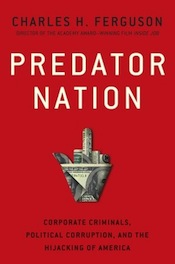 Charles H. Ferguson, the director of the Oscar-winning documentary Inside Job, now explains how a predator elite took over the country.
He exposes the networks of academic, financial, and political influence, in all recent administrations, that prepared the predators’ path to conquest.
Over the last several decades, the United States has undergone one of the most radical social and economic transformations in its history.
·Finance has become America’s dominant industry, while manufacturing, even for high technology industries, has nearly disappeared.
· The financial sector has become increasingly criminalized, with the widespread fraud that caused the housing bubble going completely unpunished.
· Federal tax collections as a share of GDP are at their lowest level in sixty years, with the wealthy and highly profitable corporations enjoying the greatest tax reductions.
· Most shockingly, the United States, so long the beacon of opportunity for the ambitious poor, has become one of the world’s most unequal and unfair societies.
Ferguson shows how from the Reagan administration forward, both major political parties have become captives of the moneyed elite.
It was the Clinton administration that dismantled the regulatory controls that protected the average citizen from avaricious financiers. It was the Bush team that destroyed the federal revenue base with its grotesquely skewed tax cuts for the rich. And it is the Obama White House that has allowed financial criminals to continue to operate unchecked, even after supposed “reforms” installed after the collapse of 2008.
Predator Nation: Corporate Criminals, Political Corruption, and the Hijacking of America
Excerpt:
It is no exaggeration to say that since the 1980s, much of the American (and global) financial sector has become criminalized, creating an industry culture that tolerates or even encourages systematic fraud. The behavior that caused the mortgage bubble and financial crisis was a natural outcome and continuation of this pattern, rather than some kind of economic accident.
It is important to understand that this behavior really is seriously criminal. We are not talking about neglecting some bureaucratic formality. We are talking about deliberate concealment of financial transactions that aided terrorism, nuclear weapons proliferation, and large-scale tax evasion; assisting in concealment of criminal assets and activities by others; and directly committing frauds that substantially worsened the worst financial bubbles and crises since the Depression.
None of this conduct was punished in any significant way. On November 7, 2011, the New York Times published an article (Wall Street’s Repeat Violations, Despite Repeated Promises) based on its own review of major banks’ settlements of SEC lawsuits since 1996. The Times’ analysis found fifty-one cases in which major banks had settled cases involving securities fraud, after having previously been caught violating the same law, and then promising the SEC not to do so again. The Times’ list, furthermore, covered only SEC securities fraud cases; it did not include any criminal cases, private lawsuits by victims, cases filed by state attorneys general, or any cases of bribery, money laundering, tax evasion, or illegal asset concealment — all areas in which the banks have numerous and major violations. In Predator Nation, I provide detailed, well-documented accounts of behavior ranging from assisting Enron’s frauds (Citigroup, Merrill Lynch), to fraudulently exploiting the Internet bubble (most of the major investment banks), to using for-profit colleges to exploit government student loan programs (Goldman Sachs), to assisting in money laundering and tax evasion on a large scale (at least eleven banks including UBS, Barclay’s, and Lloyds), to using bribery and artificially complex derivatives to destroy the finances of a county government (JP Morgan Chase), to profiting from Bernard Madoff even while strongly suspecting him to be a fraud (JP Morgan Chase, UBS).
Total fines for all these cases combined appear to be far less than 1 percent of financial sector profits and bonuses during the same period. There have been very few prosecutions and no criminal convictions of large U.S. financial institutions or their senior executives. Where individuals not linked to major banks have committed similar offenses, they have been treated far more harshly.
Given this background, it is difficult to avoid the conclusion that the mortgage bubble and financial crisis were facilitated not only by deregulation but also by the prior twenty years’ tolerance of large scale financial crime. First, the absence of prosecution gradually led to a deeply embedded cultural acceptance of unethical and criminal behavior in finance. And second, it generated a sense of personal impunity; bankers contemplating criminal actions were no longer deterred by threat of prosecution.
And just as the last twenty years of unpunished financial crime constituted a green light for the bubble, so, too, America’s non-response to the bubble and crisis is setting the tone for financial conduct in the future.
The Obama administration has rationalized its failure to prosecute any senior financial executives (literally, not a single one) for bubble-related crimes by saying that while much of Wall Street’s behavior was unwise or unethical, it wasn’t illegal. Here is President Obama at a White House press conference on October 6, 2011:
Well, first on the issue of prosecutions on Wall Street, one of the biggest problems about the collapse of Lehmans [sic] and the subsequent financial crisis and the whole subprime lending fiasco is that a lot of that stuff wasn’t necessarily illegal, it was just immoral or inappropriate or reckless….I think part of people’s frustrations, part of my frustration, was a lot of practices that should not have been allowed weren’t necessarily against the law.
The president and senior administration officials (such as Lanny Breuer, head of the Justice Department’s Criminal Division) have portrayed themselves as frustrated and hamstrung — desirous of punishing those responsible for the crisis, but unable to do so because their conduct wasn’t illegal, and/or the federal government lacks sufficient power to sanction them. With apologies for my vulgarity, this is complete horseshit.
When the federal government is really serious about something — preventing another 9/11, or pursuing major organized crime figures — it has many tools at its disposal and often uses them. There are wiretaps and electronic eavesdropping. There are special prosecutors, task forces, and grand juries. When Patty Hearst was kidnapped by the radical Symbionese Liberation Army in 1974, the FBI assigned hundreds of agents to the case.
In organized crime investigations, the FBI and federal prosecutors often start at the bottom in order to get to the top. They use the well established technique of nailing lower-level people and then offering them a deal if they inform on and/or testify about their superiors — whereupon the FBI nails their superiors, and does the same thing to them, until climbing to the top of the tree. There is also the technique of nailing people for what can be proven against them, even if it’s not the main offense. Al Capone was never convicted of bootlegging, large scale corruption, or murder; he was convicted of tax evasion.
In this spirit, here are a few observations about the ethics, legalities, and practicalities of prosecution related to the bubble:
First, much of the bubble was directly, massively criminal.
Second, if you really wanted to get these people, you could. Maybe not all of them, but certainly many. Some bubble-related violations are very clear, with strong written evidence, as my book Predator Nation demonstrates. And if you flipped enough people, some of them would undoubtedly have interesting things to say about what their senior management knew. In fact, there are many techniques, venues, organizations, regulations, and statutes, both civil and criminal, available to investigate these people, punish them, and recover the money they took — if you really wanted to. The federal government has used almost none of them.
Third, the moral argument for punishment is very strong, providing ample justification for erring on the side of aggressive legal pursuit. Whatever portion of banking conduct during the bubble was criminal, it was certainly substantial, and there is no doubt whatsoever that it was utterly, pervasively unethical, designed to defraud in reality if not in law. Since the crisis, the people who caused it have been anything but honest or contrite. They have been evasive, dishonest, and self-justifying, returning as quickly as possible to their unerringly selfish behavior. Their behavior caused enormous damage, both human and economic; the consequences of their wrongdoing are so large as to justify almost any action that could help to prevent another such crisis by creating real deterrence. There would also be intangible but large benefits to raising the general ethical standard of a vital industry, and one whose executives often become high-level government officials.
Given this background, let’s now consider the question of criminal liability, as well as the feasibility of prosecution.
J’Accuse
The list of prosecutable crimes committed during the bubble, the crisis, and aftermath period by financial services firms and senior executives includes: securities fraud (many forms); accounting fraud (many forms); honest services violations (mail fraud statute); bribery; perjury and making false statements to federal investigators; Sarbanes-Oxley violations (certifying accounting statements and financial controls); RICO offenses and criminal antitrust violations; Federal aid disclosure regulations (related to Federal Reserve loans); Personal conduct offenses (many forms: drugs, tax evasion, etc.).
In Predator Nation I consider each of these categories in detail, naming many names and providing many specific examples. But in considering only one category, securities fraud, we already face an embarrassment of riches.
Almost all the prospectuses and sales material on mortgage-backed securities sold from 2005 through 2007 were a compound of falsehoods. But it starts even earlier in the food chain. We also know that mortgage originators committed securities fraud when they misrepresented the characteristics of loan pools, and the nature and extent of their due diligence with regard to them, when they sold pools to securitizers (and accepted financing from them). Most or all of the securitizers (meaning nearly all the investment banks and major banking conglomerates) then committed securities fraud when they misrepresented the characteristics of the loans backing their CDOs, the characteristics of the resulting mortgage-backed securities, and the nature and results of their due diligence in the process of creating those securities. The securitizers also committed securities fraud when they made similar misrepresentations to the insurers of, and sellers of credit default swap (CDS) protection on, those securities.
The executives of both originators and securitizers then committed a separate form of securities fraud in their statements to investors and the public about their companies’ financial condition. They knew that they were engaging in a Ponzi-like fraud that would eventually need to end, and as the bubble peaked and started to collapse, they repeatedly lied about their companies’ financial condition. In some cases they also concealed other material information, such as the extent to which they, themselves, and/or other executives of their firms, were selling or hedging their own stock holdings because they knew that their firms were about to collapse.
Next, several investment banks committed securities fraud when they failed to disclose that they were selling securities that were designed to fail so that the investment banks, and/or their hedge fund clients, could profit by betting on their failure. The Hudson and Timberwolf synthetic CDOs sold by Goldman Sachs, and which were the focus of the Levin Senate subcommittee hearings, provide a very strong basis for prosecution. Goldman’s trading arm had been dragooned into finding and dumping their most dangerous assets to naive institutional investors. Important representations in the Hudson sales material–that assets were not sourced from Goldman’s own inventory — were lies, and they were material lies, since investors had learned to be wary of banks clearing out their own bad inventory. E-mail trails show that top executives closely tracked the garbage disposals and were gleeful at the unloading of the Timberwolf assets — as they should have been, for the assets were nearly worthless within months. There have been no prosecutions.
In some cases, we already have clear evidence of senior executive knowledge of and involvement in these frauds. For example, quarterly presentations to investors are nearly always made by the CEO or CFO of the firm; if lies were told in those presentations, or if material facts were omitted, the responsibility lies with senior management. In some other cases, such as Bear Stearns, we already have evidence from civil lawsuits that very senior executives were directly involved in constructing and selling securities whose prospectuses contained lies and omissions.
The list is long. In chapters three through six of Predator Nation, I survey the financial sector’s behavior during the bubble, and provide dozens of examples of major criminal behavior. Again, there have been no prosecutions.
Related articles
- Bankers Need To Face Consequences, Not Settlements (econmatters.com)
- Predator Nation by Charles Ferguson (ilene.typepad.com)
How We All Became Palestinians – William Cook’s “Decade of Deceit”
By Gilad Atzmon | July 13, 2012
 William A. Cook’s ‘Decade of Deceit’ is a collection of spectacular articles written by a man who has gradually awakened to the disastrous meaning of the Zionification of our universe. Being an authentic and unique poetic voice, Cook manages, layer by layer, to unravel the hypocrisy that has contaminated every aspect of our life – morally, culturally, spiritually and politically.
But Cook is not only a superb poet, he is also an English Professor and it is this synthesis between the aesthetic and the academic that makes this book such a staggering and fascinating spiritual text. It is this unique shift between scientific precision and creative beauty that makes ‘Decade of Deceit’ a must-read.
Collections of articles can be tedious, but sometimes they can also provide us with a glimpse into the workings of a sharp and astute prophetic mind. ‘Decade of Deceit’ introduces us to an ethical thinker and the ways in which he has formed his thoughts about Israel, Palestine, the USA, contemporary politics, and ourselves – the witnesses of our own emerging tragedy.
Cook is a natural wordsmith with the rare capacity to deliver, by way of beauty, a very poignant message. This American English scholar clearly knows how to turn his pen into a sword, yet he aims only at peace, harmony and reconciliation. In December 2002 he writes to Osama Bin Laden “vengeance is a disease that multiplies, divides, and becomes the scourge of humankind; it is anathema to creation because it destroys what exists.” But then, just a few pages later, as hell is about to break loose, we are captivated by Cook’s search for harmony. In March 2003 as America went to war he wrote “I went to the lake to find peace, this being the week the president gave one of his rare prime time press conferences, the only opportunity we, the public, get to see him perform. It’s also the week America goes to war.”
It takes courage to look evil in the eye but it takes even more courage to pose the following questions in free America. “What fuels slavery, ethnic cleansing, land theft, and genocide? What enables a mind to justify imprisoning another without cause, without trial, without rights of due process and assumption of innocence until proven guilty? What enables a soul to accept dominance over another, to degrade and humiliate other humans, to participate in or acquiesce to genocide?” And Cook doesn’t shy away from answering his question: “Genocides and holocausts arise out of unchecked zeal, unquestioned duty, and silent acquiescence. They are fueled by blind belief, personal fear, and a sense of superiority that gives license to slaughter.” This is clearly an astute reading of both Israeli and American exceptionalism – the combination of fear, superiority and dogmatism are indeed lethal.
As we progress through the text the questions and observations posed by Cook become increasingly crucial. From 2003 onward, the English-speaking Empire has submissively allowed itself to become an Israeli mission force, the Iraq war being just one obvious example. In November 2007 Cook writes, “I woke from a dream last night with a sudden start, the world had turned inside out … the sun did not shine, the moon did not come out … darkness enveloped the earth, and all that had been was no more.”….” But the bleak reality in which we live, led Cook to realise that he actually ‘did not wake from that dream’.
“I am living that dream today as I watch the world walk in darkness, befuddled by deceit, desirous to end the violence of these past 60 years, expectant, hopeful, a little fearful that the joy of the season may be marred for themselves and the Palestinians if the conditions of the Zionists are not met even if it means that all of us must accept the will of those who control by force of might and rule in ruthless disregard of any who stand in the way of their desires. The Beast of Hypocrisy walks the streets of Annapolis, it hides its ugliness beneath its cashmere long coat as it enters the conference hall to present in elegant verbiage its compassionate intent that peace might at last come to the mid-east, but in the darkness we do not see the maggots that reside beneath that elegant exterior, the maggots that have eaten away the moral innards of the people that have gathered to deny the people of Palestine the justice they so rightfully deserve.”
We are indeed, day after day, deceived by a system that has been hijacked by a foreign power. In October 2011 Cook discloses his own vision of the current American reality:
“Citizens no longer control their government; they are slaves to it. Representatives no longer serve the citizen seeking their consent to govern, they are servants of the corporations and lobbies that control the economic system to which the citizen is enslaved. Presidents no longer lead, they are the obedient lackeys of their corporate overseers. Freedom of speech and belief and freedom from fear and want do not determine the needs of humans, economics of the market place supersedes all at the expense of the citizen and human rights. We exist in a corporate world of unending wars, of vengeance and recrimination, of fear as a commodity that imprisons the mind, of greed that destroys the resources of this planet without remorse, and of insatiable arrogance that harbors no concern for those it destroys.”
I can only assume that Cook’s journey has led him to realize that, by now, we have all become Palestinians. We are all subjected to that same total abuse that has robbed and distorted each and every precious value that ever made the West worthwhile. So I guess that one possible interpretation of Cook’s work may as well be that solidarity with Palestine should start at home and that unless we liberate ourselves first, there is only little we can offer others.
Gilad Atzmon’s latest book is The Wandering Who? A Study of Jewish Identity Politics.
A Tale From a Time of Heroes
Leila Khaled and the Struggle for Palestinian Liberation
By RON JACOBS | CounterPunch | June 22, 2012
 There was once a time not so long ago when the world seemed to be full of revolutionary heroes. These heroes were both men and women. The actions and accompanying commitment of these individuals inspired millions of others to join movements and organizations dedicated to a vision of social justice and freedom that understood colonialism and racism to be their primary opposition. From Martin Luther King, Jr. to Rosa Parks; from Huey Newton to Assata Shakur; and Che Guevara to Leila Khaled, the list of such individuals is too great to recount here. Their enemies included secret and not-so-secret police, intelligence agencies dedicated to their murder, and governments both liberal and reactionary whose lot lay with the imperial powers in Washington, London and elsewhere in the North. The presence of such men and women made them targets for those opposed to their vision. Simultaneously, the fact of their stature provided them with a media presence created a public awareness of their cause which helped recruit adherents and supporters.
During the first Gulf war I worked with an antiwar group in Olympia, WA. There was a young woman named Leila of Syrian heritage in the group. It was during a conversation about the Palestinians that the subject of Leila Khaled came up. After five minutes of conversation or so, Leila mentioned that she was named after Khaled. I knew that Khaled’s youth, beauty and media savvy had made her a media favorite during the hijackings and other actions she had participated in. I also remembered the spray painted silhouettes of Khaled that appeared on the walls of squats and at the Goethe Universitat in Frankfurt. However, this young woman was the first person I had met who was named in her honor.
Recently, Pluto Press published a small biography of Leila Khaled as part of its Revolutionary Lives Series. It is titled Leila Khaled: Icon of Palestinian Liberation. Authored by Sarah Irving, a freelancer who has written about environmental and Palestinian issues, this biography looks at Khaled’s life from its beginnings in a Palestinian village occupied by the Israelis to her current activism. Culling information from her biography My People Shall Live, newspaper and journal articles spanning her life and recent interviews, Irving’s book takes a comprehensive look at a life fully-lived.
For those who remember the hijackings Khaled participated in, Leila Khaled: Icon of Palestinian Liberation brings those events back to life. In addition, she provides the reader with Khaled’s insights and descriptions of how those hijackings unfolded. Khaled also touches briefly on her emotions during those actions. Irving describes the determination of Khaled’s enemies to kill her, a determination that resulted in her sister and sister’s fiancée being murdered by mistake. She also describes the life of Khaled’s family as refugees and relatives of a revolutionary wanted by Israel and a myriad of other governments. The Palestinian movement Khaled first entered was quite different than that which exists now. Religious elements had minimal influence. Indeed, the primary divisions in the movement arose in the political/economic arena. The primary organization, Al Fatah, was what was then termed a bourgeois nationalist movement, while the Popular Front for the Liberation of Palestine (PFLP) defined itself as a Marxist one. Khaled was (and is) a member of the latter, but seems to have been only minimally involved in the internecine warfare that occasionally erupted between the factions. Her discussion of the influence of Muslim culture in the Palestinian movement and how it effects the role of women in the Palestinian struggle is an important part of this book and worthy of further exploration. This is especially true given Khaled’s long history in the movement and her lifelong insistence on the need for women to be involved. A sidebar to this discussion is her telling about incidents where some of the men pretending to be strict enforcers of the hijab in Gaza following Hamas’ victory turned out to be informers for the Israeli military. This story points out the potentially reactionary nature of a nationalism that depends on cultural elements to define it while rejecting anticapitalist economic analyses.
Khaled discusses the current situation in Palestine. In her opinion, the Oslo accords should never have been signed. The continued control of Palestinian economic, social and daily life by Israelis and their paid police insures the perpetuation of the Occupation. Her opposition to the Accords is often characterized by her enemies as being an opposition to peace. Khaled’s response is simple. When there are no more Israeli soldiers, police, and other agents of the Tel Aviv government occupying the territories, then there will be peace. Until then, the struggle continues. As if to emphasize this, some events arranged by Irving’s publisher to announce the book to the British reading public have been cancelled because of threats of violence. This fact proves Khaled’s continuing relevance, while also intensifying the need to publicize the book.
The struggle of the Palestinians is a different looking struggle than it was when Leila Khaled’s name first became known to the world. Yet, it is the same struggle. Heroic figures like those mentioned above do not seem to be part of that struggle right now. However, their stories are important and need to be told. Leila Khaled: Icon of Palestinian Liberation does a great job of telling one such story.
Ron Jacobs is the author of The Way the Wind Blew: a History of the Weather Underground and Short Order Frame Up.
Related articles
- Attempted Ethnocide in Palestine (windowintopalestine.blogspot.com)
Predator Nation: Obama and Corporate Crime
By RUSSELL MOKHIBER | CounterPunch | June 12, 2012
When Charles Ferguson accepted the Academy Award in 2010 for his documentary film Inside Job, he told 30 million people viewing the award ceremony that “three years after a horrific financial crisis caused by massive fraud, not a single senior financial executive has been prosecuted and that’s wrong.”
Two years later, still no prosecution.
So, now Ferguson is out with a book – Predator Nation: Corporate Criminals, Political Corruption, and the Hijacking of America (Random House, 2012.)
It reads like an indictment.
Check that.
It reads like a number of indictments.
And Ferguson is hoping that federal prosecutors will pick up the book and get some ideas.
And why exactly have there been no prosecutions of high level Wall Street investment bank executives?
Politics?
“Not exactly,” Ferguson says.
“It’s important to bear in mind the direct personal incentive structures of many of the people involved,” Ferguson told Corporate Crime Reporter last week. “The revolving door phenomenon now effects the Justice Department and federal prosecutors to a very substantial extent.”
“The previous federal prosecutor for the southern district of New York, Mary Jo White, now does white collar criminal defense and makes a great deal more money than she did as a federal prosecutor. I think that phenomenon is very well entrenched, very thoroughly entrenched.”
“Indeed Lanny Breuer, the Assistant Attorney General for the Criminal Division was head of the white collar criminal defense practice at Covington & Burling. They represent most of the major banks and investment banks in the United States.”
And his boss, Eric Holder, the Attorney General, came from the same firm.
“Exactly,” Ferguson said. “So, when you say politics, you sort of think of Republicans, Democrats, ideology, large scale political and policy debates. I don’t think that’s the only thing going on here. I think you have to consider incentives – individual, personal, financial and professional.”
When Rudy Giuliani was U.S. Attorney, he had no qualms about prosecuting Michael Milken. What has changed?
“One thing that has changed is that the amount of wealth and political power held by the financial sector has gone up by at least an order of magnitude,” Ferguson said.
“Another thing that’s changed is the amount of money that the financial sector spends on politics and acquiring political power and influence has also gone up by at least an order of magnitude.”
“And thirdly, the divergence, the difference between public sector salaries and incomes and private sector salaries and incomes has widened enormously.”
“So again, for those at the level of large scale political behavior and at the level of individual incentive, things have changed dramatically since the 1980s.”
As an undergrad, Ferguson studied mathematics at the University of California Berkeley and went on to study political science at MIT.
He then went on to organize an early software company – Vermeer Technologies – which was sold in 1996 to Microsoft for a reported $133 million.
He was an early fan of President Obama.
“I donated my legal maximum to his campaign in 2008,” Ferguson says.
But at a press conference in October 2011, Obama addressed the question of why no high level Wall Street executive has been prosecuted.
“So, you know, without commenting on particular prosecutions– obviously, that’s not my job, that’s the attorney general’s job – you know, I think part of people’s frustrations, part of my frustration, was a lot of practices that should not have been allowed weren’t necessarily against the law, but they had a huge destructive impact,” Obama said. […]
What was Ferguson’s reaction when he heard Obama say – the actions “weren’t necessarily against the law”?
“My reaction was very negative,” Ferguson said. “First of all the statement is thoroughly inaccurate and incorrect, but secondly it’s very difficult for me to believe that he doesn’t know that.”
“Given what we now know, it’s very difficult for me to believe that President Obama actually believes that there was no significant criminality in the housing bubble and the financial crisis.”
Russell Mokhiber edits the Corporate Crime Reporter.
Related articles
- Exposing Countrywide (alethonews.wordpress.com)
- Predator Nation: How Wall Street Crashed the Economy & Got Off Scott Free (ritholtz.com)
- Corporate criminals gone wild (salon.com)
Featured Video

When Israel Is Mighty
or go to
Aletho News Archives – Video-Images
From the Archives
US murdering 1 million Iraqis is democracy, Iran giving yogurt to Iraq is “domination”
By Ali Salaam | American Herald Tribune | July 31, 2017
The New York Times, owned by the Zionist Jewish supremacist Ochs-Sulzberger family, has no problem with Iraqi suffering as long as Iran is not the one behind it.
The Iraq War was a genocide of the Iraqi people by Zionist supremacists in the Bush administration. Over 1 million innocent people were killed based on a lie. American soldiers died in an Israeli war and now an average of 22 soldiers commit suicide every day because their consciences cannot cope with the fact they committed crimes in an illegal war that served no purpose other than to benefit Israel, not America.
Benjamin Netanyahu, Prime Minister of the Zionist regime, once said “We are benefiting from one thing, and that is the attack on the Twin Towers and Pentagon, and the American struggle in Iraq.”
Paul Wolfowitz had his sights on Iraq since his time in the first Bush administration. Former Israeli official and Bush administration official Richard Perle had his eyes on Iraq since at least his authorship of the Clean Break white paper. The Zionist regime had their eyes on Iraq since the 1980s when strategist Oded Yinon wrote his white paper in support of dividing the Arab-Muslim world along ethnic and sectarian lines. The global Zionist lobby has had their eyes on Iraq since Theodor Herzl stated that Eretz Israel’s true borders go from the Nile River in Egypt to the Euphrates River in Iraq. … continue
Blog Roll
 Aletho News
- MEP blasts ‘Euro-Gestapo’ for lecturing Russia on democracy
- Syria May Send Troops to Saudi Arabia Amid War with Ansar Allah
- UK whines about losing billions to ‘Putin tax’
- Baghaei to Rubio: Distorted narratives cannot erase US record of broken commitments
- Houthis Don’t Have to Conquer Saudi Arabia to Make It Pay
- MOE: Nearly 22,000 Students and Education Workers Killed
- Guterres in Islamabad: Genocide, cowardice, and the cage of Imran Khan
- Johnson, Marandi say Yemen holds upper hand over Saudi Arabia
- False flags won’t save aggressors, Iran FM spokesman says
- The Makkah Pact Enters Into Force: The End of American Dominance or Its New Form?
- If Americans Knew
- Gaza ceasefire exists in name only, say more than 100 organizations
- Nearly 2 Million in Gaza Need Urgent Shelter Assistance as Winter Looms: IOM Chief Warns
- Suppressing Palestinian resistance: US charity under fire for AI monitoring of Gaza classrooms
- Thousands Are Held in Israeli Torture Camps. This Is What Happens Inside
- Israel puts Gaza’s sick, injured, newborn in peril – Daily Update
- Report claimed Mark Levin used by Israeli government to influence Trump
- Over 2,000 Gazans have died awaiting medical evacuation amid Israel’s continued siege
- How a U.S. Diplomat Suppressed and Altered Reports Critical of Israel
- 5 Palestinians Die from Israeli Strikes in Gaza as Relentless Attacks Continue
- Report: Ceasefire Slows Killing but Leaves Devastation Intact
- No Tricks Zone
- New Study: 50 Years Of The Most Aggressive ‘Net Zero’ Policies Can Only Affect The Global Climate By 0.03°C
- US September “Heat” Was No Record…Many Records Set Decades Ago
- Latest European Green Energy Debacle; Portugal’s Largest Flagship Solar Park Insolvent!
- Green Energy Debacle: German Expert Professor Fritz Vahrenholt Warns Of Severe Economic And Social Consequences
- Two More Paleo Reconstructions Affirm Meters-Higher Sea Levels Across Ireland, Brazil 7000-6000 Years Ago
- New Study: Earth And Venus Surface Warmth Largely Explained By Convection And Lapse Rate, Not CO2 Or Radiation
- 2025 Nature Paper Claiming Worsening Global Drought Gets RETRACTED …Heavily Flawed
- New Study: ‘Global Drought Shows No Detectable Recent Acceleration Under Climate Warming’
- Economic Masterminds: German Socialists Suggest Taxing Productivity Gains Stemming From Using AI
- The South China Sea Has Not Been Cooperating With The Climate Change Narrative

