Open Letter to Therese Coffey Urging Her to Apologise to the Care Workers Forced Out by Vaccine Mandate
BY TOBY YOUNG | THE DAILY SCEPTIC | OCTOBER 10, 2022
Campaign group Together’s latest campaign, an Open Letter to Health Secretary Therese Coffey urging her to “Apologise, Reinstate, Compensate the 40,000 Care Workers Forced Out by Covid Jab Mandate” has attracted over 10,000 signatures within a few hours of going live. Here is an extract:
Forcing out approximately 40,000 social care workers for declining the Covid jab was not just unethical, but disastrous for the care sector and those it supports. The sector now has 165,000 vacancies, with 500,000 members of the public waiting for assessments, care or reviews. The situation is grave and urgent, not least as without a functioning care sector the NHS will collapse.
Failure to respect bodily autonomy was wrong in principle. ‘No jab, no job’ amounted to blackmail. But even on a practical level, the ‘mandate’ policy was always illogical and ill-advised.
For starters, natural immunity was totally ignored as a factor – for reasons that remain unclear. Throughout most of 2021 it was clear that Covid jabs did not prevent transmission and by October, the Guardian was explicitly reporting that ‘research reveals fully vaccinated people are just as likely to pass (the) virus on… whether an infected individual is themselves fully vaccinated or unvaccinated makes little or no difference to how infectious they are to their household contacts’. This alone should have been enough to kill off this divisive policy. Yet, seemingly oblivious to the actual scientific data, your predecessor Sajid Javid took to television the same month, belligerently ‘warning’ care workers ‘if you cannot be bothered to go and get vaccinated then get out… go and get another job.’
On November 9th 2021, the Department of Health and Social Care warned Javid that his ‘mandate’ policy would result in upwards of 40,000 care staff leaving the sector. He persisted with it anyway, and on 11 November workers who had not already been forced out were sacked in droves. Many lost not only their jobs, but also their pensions.
Already a range of well-known people including Prof Carl Heneghan, journalists Allison Pearson and Julia Hartley-Brewer, author and broadcaster Laura Dodsworth, Richard Tice of Reform UK and Laurence Fox of the Reclaim party, medics Dr Tony Hinton, Dr Renee Hoenderkamp, Dr Clare Craig and Dr Teck Khong, and sportsman Matt Le Tissier, have all signed.
You can read the Open Letter in full and sign it here.
Is PayPal About to Go Bankrupt?
BY IZABELLA KAMINSKA | THE DAILY SCEPTIC | OCTOBER 9, 2022
With the stock prices of both Credit Suisse and Deutsche Bank under pressure, many in the financial field are becoming concerned the world could be facing a renewed financial crisis. But this time around events could play out very differently. It might not even be banks that pose the greatest financial risk to consumers. It could be payment providers like PayPal.
The really big difference between 2007 and 2022 is that bank runs no longer look like the image above, they look like this:

That’s what I was faced with when I tried to transfer £500 from my PayPal account to a regular bank account. On Sunday morning the same message was still occurring. A quick scan of social media proved I was not alone.
“Boycott PayPal” was also trending on Twitter.
So what might the error message indicate about the business?
Here’s what we know so far.
In the last 48 hours a sneaky amendment to PayPal’s acceptable use policy widely captured the public’s attention. Free speech advocates had spotted that customers agreeing to the update would be allowing a sum of $2,500 to be lifted from their accounts if PayPal ever found them guilty of “sending, posting, or publication of any messages, content, or materials” that “promote misinformation” or “present a risk to user safety or wellbeing”.
When word got out, those already concerned about the company’s draconian turn started shutting their accounts and urging others to do the same on social media.
For some, the action proved the final straw.
On Saturday evening U.K. time, PayPal’s former president David Marcus distanced himself very clearly from the action. Elon Musk, whose pathway to billionairehood started in 2000 when his company X.com was merged with Peter Thiel’s Confinity to create the PayPal of today, later tweeted that he agreed.
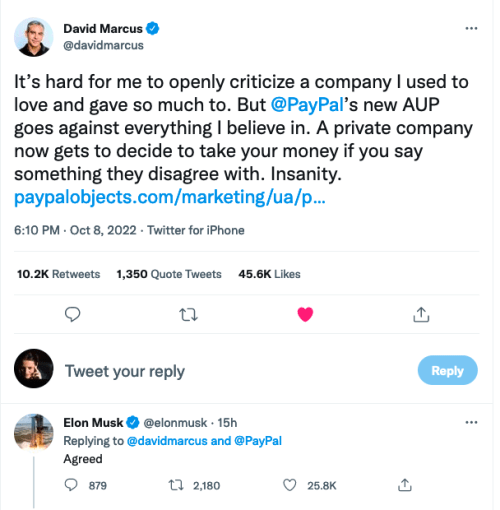
Readers of the Daily Sceptic and members of the Free Speech Union (such as myself) will already know that over the past few months PayPal has been on a whirlwind tour of shutting down the accounts of platforms and media sites it has deemed guilty of spreading misinformation. In many instances, those affected, such as the Daily Sceptic, were not even consulted ahead of the fact and had little idea of what specific text, post or media had violated PayPal terms.
So why exactly would PayPal descend to this level of reputational self-harm?
It’s hard to know for sure, but chances are the decision rests on pressures PayPal itself is facing with respect to its legal duty to enforce Know-Your-Customer (KYC) and Anti-Money Laundering (AML) rules. If I was to take an educated bet, it’s the counterterrorism section of the rulebook that is most relevant.
These days it’s hard to imagine that banks weren’t always responsible for screening transactions and making judgements about their legitimacy. But until the Financial Action Task Force (FATF) was formed in 1989 with a view to combatting money laundering, banks only really cared about screening credit risk. It wasn’t until 2001 and the 9/11 attacks on the Twin Towers (and the introduction of the Patriot Act) that the scope of banks’ responsibilities in this field was expanded to include combatting the financing of terrorism too.
Tackling terrorist financing and criminality was easy enough when everyone was on the same page about what constituted terrorism or financial crime. But one man’s freedom fighter is another man’s terrorist. And in an increasingly polarised world, it’s become harder for ordinary bank employees to differentiate free-speech critical of authority from radicalising terrorist content, such as that distributed by Isis on social media to recruit new members.
It wasn’t the job they were hired to do.
Three factors have muddied the waters further.
The first is the scale of penalties directed at banks found in breach of AML/KYC regulation. The fear of being slammed with fines has made banks and payment providers like PayPal hugely risk-averse and inclined to err on the side of caution when facing any ambiguity. If something even whiffs of misinformation, from their point of view it’s better to shut it down than to run the risk of getting a fine.
Second, is a lack of resources. Human arbitration is costly, and screening activities would be unaffordable if they were to be done by living, breathing individuals. This is why banks and payment providers like PayPal have invested huge sums of money in cost-saving screening technology to detect illegal transactions both actively and preemptively. The problem here is that most of these tools, known as suptech or regtech, are algorithmically applied with limited human oversight. That means it’s mostly artificial rather than human intelligence deciding who gets to stay on a platform and who gets frozen out. As yet, robots are not well known for their sense of nuance, empathy or capacity to process ambiguity. How they decide what they decide is a black-box interpretation of the inputs they’ve been programmed with.
The third issue is the structure of the KYC/AML policing system itself. Since the scale of the task is so enormous, it goes beyond the scope and capacity of any existing government agency. Knowing this, governments, very similar to how they managed the enforcement of lockdown policy, realised it would be more cost-efficient to outsource the policing of their own rules to the banks and payment companies directly. But this is a strategically coercive dynamic. If payment companies don’t fall in line, they risk having their licences removed and their businesses shut down. Non-compliance is therefore not an option. PayPal isn’t perfect, but the pressure it is facing is very similar to the pressure pubs, restaurants and supermarkets faced under Covid. The structural problem here, as with the retail sector during Covid, is those payment companies are not legislative specialists. They take for granted that the governments know what they are doing and that the rules they are setting are human rights compatible and in line with the laws of the land. Nor do the payment companies have the capacity to investigate the rights and wrongs of every case. This is a job for the legal system, which is already excessively costly to access for most ordinary individuals.
This in itself is a huge blind spot for the financial system. There’s a very strong case to be made that the way democratic governments have gone about enforcing AML legislation is not compatible with human rights at all. The enshrined right of habeas corpus might even be under threat. The FATF has itself belatedly realised this. Back in October 2021, it noted in a “stock-take on the unintended consequences of the FATF standards” that (my emphasis):
Situations have arisen in the course of FATF evaluations concerning the interaction between the FATF Recommendations on combating TF (particularly R.5 and R.6) and due process and procedural rights (e.g. to legal representation, fair trial, and to challenge designations, etc.), which have been considered on a case-by-case approach as they arise in specific country contexts. In addition, the FATF has also been made aware of instances of the misapplication of the FATF Standards, which are allegedly introduced by jurisdictions to address AML/CFT deficiencies identified through the FATF’s mutual evaluation or ICRG process, potentially as an excuse measures with another motivation. This information often comes as a result of stakeholder input or when the attention of the FATF or its members is drawn to a particular issue, such as when another international body is reviewing legislation or actions are taken by national authorities. Analysis in the stocktake has therefore focused on the due process and procedural rights issues most often arising in evaluations or feedback.
The stock-take identified the following factors as key examples of where misapplication of FATF standards had affected due process and procedural rights:
- excessively broad or vague offences in legal counterterrorism financing frameworks, which can lead to wrongful application of preventative and disruptive measures including sanctions that are not proportionate;
- issues relevant to investigation and prosecution of TF and ML offences, such as the presumption of innocence and a person’s right to effective protection by the courts;
- and, incorrect implementation of UNSCRs and FATF Standards on due process and procedural issues for asset freezing, including rights to review, to challenge designations, and to basic expenses.
Readers can hopefully see the issue.
The entire regulatory system since 2008 has focused on ensuring that the 24-hour payment banking infrastructure we have become used to will never face the risk of going down again.
Put bluntly, the style of service disruption currently being experienced at PayPal is something major banking and payment institutions are not supposed to be able to get away with. At least not for long. So yes, it does feel like a big deal.
For the most part, the practice of shuttering access through website maintenance, downtime or error messages is more commonly seen at cryptocurrency platforms during extreme bitcoin selloffs. Closing access to people’s accounts or pretending to do website maintenance often gives operators the time to raise the liquidity they need by slowing redemptions. But it’s far from a transparent or honourable policy.
For PayPal to have triggered a run on itself because it was merely following government orders is not just unfortunate, it is careless. But it also speaks of a deeper problem at the heart of the anti-money laundering regulatory structure. The entire system we have created may no longer be fit for purpose. Consider, for example, that despite many billions of dollars spent on FATF compliance, a company like Wirecard, whose business model in retrospect looks to have been based on fraud as a service (FAAS), could so easily rise to the top of the German stock market. Nor has any of the regulation been successful at combatting the type of electronic financial fraud (mostly based on phishing attacks or social engineering) that impacts users every day.
We need to seriously ask if the benefits outweigh the collateral damage also being incurred.
But while PayPal might not be entirely responsible for its own actions on the KYC/AML front, its business model may be more vulnerable to this sort of fallout than most people appreciate. The culpability for that lies with PayPal exclusively.
A key revenue generator for the group has always been the interest revenue it absorbs from all the customer balances it holds. (You may not have realised it, but if you have any significant sums in a PayPal account, you won’t be collecting interest on them.) A large outflow of deposits could easily inhibit the company’s ability to raise this income and harm its overall revenue-generating capability. (You don’t have to hold balances at PayPal to use it.)
More critical for PayPal at this juncture will be its inability as a payments company to access the central bank lender-of-last-resort backstop. That means if the group is genuinely facing challenges meeting transfer and redemption requests, it will only be able to turn to wholesale liquidity markets to make up the difference. The degree to which customer balances are locked up in harder-to-liquidate securities or bonds will largely determine its success here. Frustratingly for PayPal, in the current illiquid bond market, there’s a good chance that selling these quickly and without a loss could be challenging. The alternative path for PayPal will be to use these securities as collateral for temporary loans. But the expense here is potentially open-ended if there are no obliging counterparts. That may (or may not) be why the company is currently restricting transfers.
Before rushing to conclusions, it’s important to stress the company still has recourse to liquidity from fully-funded (in fact over-collateralised) entities. We may not know the makeup of that liquidity, but solvency is unlikely to be an issue over the longer term. The biggest problem facing users today will be uncertainty over how quickly they can transfer funds out of the PayPal ecosystem.
What I can say is that in the modern digital age, bank runs will be different. We may even long for the days when tellers transparently shut up shop when the vaults ran dry. At least it was clear what was going on. These days, on the other hand, it will become ever harder to differentiate a bank run from a maintenance issue on a website. Such matters will be shrouded in plausible deniability and uncertainty. Suffice it to say, corporate communication departments will always err towards disinformation of their own sort, that any such outage is nothing out of the ordinary.
Even more concerning is that in the event of a run, customers will no longer be able to tell if those with better connections aren’t unfairly cutting ahead of them in the redemption queue. Virtual queues may seem technologically efficient, but there’s no transparency to them at all.
That’s why if you’re caught out by any of these policies you already don’t stand a chance of getting your account back unless you have existing connections to the management or a platform of your own. None of this is progressive or encouraging.
Izabella Kaminska is the Editor of the Blind Spot, a financial news media service focused on the news everyone else is missing.
PayPal was not contacted for this piece, which is based on the opinions of the author.
Doctors File First Lawsuit Challenging California Law That Seeks to Punish Physicians for COVID ‘Misinformation’
By Suzanne Burdick, Ph.D. | The Defender | October 6, 2022
Two doctors on Tuesday became the first to file a federal lawsuit to stop a new California law that subjects the state’s doctors to discipline, including the suspension of their medical licenses, for sharing “misinformation” or “disinformation” about COVID-19 with their patients.
Dr. Mark McDonald, a Los Angeles psychiatrist, and Dr. Jeff Barke, an Orange County primary care physician and founding member of America’s Frontline Doctors, filed the complaint in the U.S. District Court for the Central District of California.
The lawsuit names 12 members of the Medical Board of California and California Attorney General Robert Bonta.
The plaintiffs also filed papers seeking a preliminary injunction to protect their free speech rights as the case unfolds.
Barke told The Defender :
“[This new law] puts patients at risk. Requiring physicians to consider the state’s narrative when making a medical decision, is bad medicine and dangerous. Consensus in science only occurs when dissenting opinions are censored.”
Commenting on the lawsuit, Mary Holland, president and general counsel for Children’s Health Defense, said, “California’s new law is a clear violation of the First Amendment. It’s startling that the legislature and the governor would even attempt to pass such legislation.”
Holland added:
“Censoring information about health never leads to health, but it certainly can and has led to medical catastrophes. I look forward to courts striking this law down.”
The Los Angeles Times today reported that some doctors fear California’s new law “could do more harm than good.”
“What was misinformation one day is the current scientific thinking another day,” Dr. Eric Widera, a professor of medicine at the University of California San Francisco, told LA Times.
Liberty Justice Center, a national nonprofit law firm dedicated to protecting Americans’ constitutional rights, is representing McDonald and Barke.
Daniel Suhr, managing attorney at the center, said, “We rely on our doctors to give us their best medical advice, yet the State of California is stopping doctors from doing just that. That’s not just wrong, it’s unconstitutional.”
He added, “Doctors enjoy the same free speech rights as other Americans. The State of California cannot define a so-called scientific consensus on an issue and then punish anyone who dares challenge it.”
Law is ‘at odds with the scientific method itself’
California Assembly Bill 2098 (AB 2098), signed into law Sept. 30 by Gov. Gavin Newsom, defines “misinformation” as “false information that is contradicted by contemporary scientific consensus contrary to the standard of care” and “disinformation” as “misinformation that the licensee deliberately disseminated with malicious intent or an intent to mislead.”
Newsom said the law applies only to physicians’ speech with patients during discussions directly related to COVID-19 treatment.
But Drs. McDonald and Barke allege AB 2098 violates the First Amendment, imposes “government-approved orthodoxy” and “is at odds with the scientific method itself.”
The lawsuit states:
“Disagreement is integral to the progress of medical science, a value that cannot be served by using the power of the state to punish those who dissent from the official line.
“This is particularly objectionable in the context of a new disease like COVID-19, about which consensus opinions and official guidance have regularly adjusted as new information is learned.
“At the beginning of the pandemic, public health authorities insisted that the public not wear masks, arguing they would provide little benefit and should be reserved for front-line medical professionals — that was soon replaced with broadly mandated mask wearing for much of the population.
“Schools were closed in the face of the fear that the disease would spread among children too young to adhere to quarantine procedures — but it turned out that the young were at the least risk, and that such closures may well have been harmful to their development.
“Reasonable minds disagreed then, and continue to disagree now, about any number of such topics, but the search for truth cannot be furthered by a government edict imposing orthodoxy from above, punishing those who disagree with the loss of their profession and their livelihood.”
The lawsuit also alleges that AB 2098 “intrudes into the privacy of the doctor-patient relationship” by “replacing the medical judgment of the government for that of the licensed professional and chilling the speech of those who dissent from the official view.”
The plaintiffs asked that the court “enjoin enforcement of AB 2098 and leave these important matters to the marketplace of ideas.”
AB 2098 was introduced in mid-February by California Assemblymember Evan Low — one of seven Democratic lawmakers who in January formed the Vaccine Work Group to develop legislation promoting the use of COVID-19 vaccines while “battling misinformation.”
The American Medical Association (AMA), which strongly supports the bill, hopes other states will follow suit in “ensuring that licensing boards have the authority to take disciplinary action against health professionals for spreading health-related disinformation,” according to a new policy adopted at its mid-June annual meeting aimed at addressing public health “disinformation.”
The AMA’s adopted policy expanded on prior efforts and called for the organization to work with “health professional societies and other relevant organizations to implement a comprehensive strategy to address health-related disinformation disseminated by health professionals.”
Language in the bill points out that the Federation of State Medical Boards (FSMB) has warned that physicians who spread misinformation or disinformation “risk losing their medical license, and … have a duty to provide their patients with accurate, science-based information.”
The FSMB, as previously reported by The Defender, takes money from Big Pharma and has a history of challenging and attacking non-pharmaceutical medical approaches used by integrative doctors as falling outside the “standard of care” as they define it.
“If this period has taught us anything,” McDonald said, “it is that the scientific and medical environments are constantly evolving, as new information and studies confirm or reject prior policies.
He added:
“Doctors need the freedom to explore alternatives and share opinions that challenge the scientific consensus — that is inherent in the nature of the scientific enterprise.
“California cannot insert itself into the physician-patient relationship to impose its views on doctors and end all debate on these important questions.”
Suzanne Burdick, Ph.D., is a reporter and researcher for The Defender based in Fairfield, Iowa. She holds a Ph.D. in Communication Studies from the University of Texas at Austin (2021), and a master’s degree in communication and leadership from Gonzaga University (2015). Her scholarship has been published in Health Communication. She has taught at various academic institutions in the United States and is fluent in Spanish.
This article was originally published by The Defender — Children’s Health Defense’s News & Views Website under Creative Commons license CC BY-NC-ND 4.0. Please consider subscribing to The Defender or donating to Children’s Health Defense.
EU Ban on RT, Sputnik Breaches Swedish, Danish Constitutions – Danish Journalists
Samizdat – 07.10.2022
The EU ban on Russian news outlets is in breach of Swedish and Danish constitutions, which explicitly prohibit all forms of censorship, Danish journalists and media educators said Friday.
The EU Council of Ministers banned the dissemination of RT and Sputnik content in March and added three other Russian outlets to the blacklist in June. The European Court of Justice defended the controversial measure, saying the rights of journalists were protected as long as they acted “in good faith.”
This is despite that legal safeguards in the Swedish Constitution’s freedom of the press act protect “the right of everyone to publish without prior interference by a public authority,” whereas the Danish constitution states that “Censorship and other preventive measures shall never again be introduced.”
Media experts argued in an article in the EUobserver that the EU intervention effectively overrode the basic laws of Sweden and Denmark, raising doubts about the EU leadership’s commitment to democratic values and the rule of law.
The journalists said the EU executive set aside constitutional defenses of freedom of expression with the silent approval of media and the public. The only exception was Norway, which is not a member state but is closely associated with the union.
They said the EU’s court in Luxembourg had granted itself the right to decide what journalism was acceptable while denying European citizens the ability to deal themselves with “unfiltered statements from questionable sources.”
“There is no confidence in our ability to deal with contradictory views of events. The EU institutions decide what we can cope with. Freedom of expression is not absolute, and never was,” they said.
The FBI is sued for withholding Facebook censorship records
By Dan Frieth | Reclaim The Net | October 7, 2022
The FBI has been sued for withholding records of communications with Facebook about the Hunter Biden laptop story.
In an appearance on Joe Rogan’s podcast in August, Meta CEO Mark Zuckerberg said that before the 2020 election, the FBI warned Facebook about Russian propaganda.
“The background here is that the FBI came to us – some folks on our team – and was like, ‘Hey, just so you know, you should be on high alert. We thought there was a lot of Russian propaganda in the 2016 election, we have it on notice that basically there’s about to be some kind of dump that’s similar to that,’” he said.
The FBI did not explicitly mention the laptop story but Facebook thought the story fit the pattern that the federal agency described and decided to limit the reach of the story.
Following Zuckerberg’s comments, the America First Legal (AFL), a legal nonprofit founded by former Trump adviser Stephen Miller, requested the FBI for the communications it had with Facebook between October 1, 2020, and November 15, 2020. The FBI refused to comply, claiming the request could not be done “with a reasonable amount of effort” because it was “overly broad.”
This week, the AFL filed a lawsuit to force the FBI to comply with its request.
We obtained a copy of the lawsuit for you here.
The lawsuit states: “Barely a month before the 2022 midterm election, FBI officials continue to suppress information of great interest to American voters and stonewall AFL’s request for records relating to the FBI’s collusive scheme with Facebook to censor news and information about the contents of Hunter Biden’s laptop.”
The AFL is convinced there was “comprehensive collusion” between the FBI and Big Tech to put Joe Biden in the White House.
“The evidence is that during the 2020 Presidential election campaign, the FBI conspired and combined with large corporations, including Facebook, to censor and suppress the damning evidence of
Biden family corruption and influence peddling found on Hunter Biden’s laptop,” said AFL Senior Counselor Reed Rubinstein.
“This was done to help Joe Biden and the Democrats win the 2020 election.”
Republican Senators Ron Johnson and Chuck Grassley wrote letters to FBI Director Chris Wray and Zuckerberg asking for the names of the employees involved in the communications about “Russian disinformation.”
“The American people deserve to know whether the FBI used Facebook as part of their alleged plan to discredit information about Hunter Biden,” the senators said in the letters.
Maine Board Licensure in Medicine Suddenly Withdraws ‘Misinformation’ Allegations Against Dr. Meryl Nass
The Defender | October 6, 2022
On Sept. 26, the Maine Board of Licensure in Medicine (Board) suddenly withdrew six accusations alleging misinformation against Dr. Meryl Nass. On Sept. 30, the Board withdrew more factual allegations regarding “misinformation.” The board has now dropped all charges regarding so-called “misinformation” on the cusp of the hearing set for Oct. 11, 2022, at 1 p.m. (EDT). With no patient complaints, the Board is now resting its prosecution on the prescribing of hydroxychloroquine, ivermectin and on picayune record-keeping issues that are well within the standard of care.
The Board suspended Nass, a physician of impeccable credentials, on Jan. 12, 2021, without even a hearing. The Board accused Nass, a scientific advisory board member of Children’s Health Defense (CHD), of “unprofessional” and “disruptive” behavior based on her public criticism of government COVID-19 policies and early treatment of COVID-19.
Prior to her suspension, Nass never had a malpractice case or a prior Board action against her in over forty years of practice. Between October and December 2021, there were four complaints to the Maine Board of Licensure in Medicine. Two from strangers regarding “misinformation” they saw on the internet, one complaint from a physician regarding prescribing a “deworming medication” (ivermectin) and one from a midwife regarding her prescribing hydroxychloroquine. Without a hearing, the Board ordered her license immediately suspended, demanded a neuropsychological evaluation and implied that she was mentally impaired or a substance abuser and incompetent to practice medicine.
Nass’s Maine counsel, Gene Libby and Tyler Smith, have moved to dismiss all charges and asked the Board to apologize to her for its unfounded case intended only to silence Nass and like-minded physicians who used effective early treatments for COVID-19 — as opposed to no treatment at all until patients were hospitalized.
Nass’s testifying experts will include Professor Emeritus in Epidemiology at Yale Harvey Risch, M.D., Ph.D., pulmonary and critical care specialist Paul Marik, M.D., inventor of mRNA vaccine technology Robert Malone, M.D., intensive care specialist Pierre Kory, M.D. and surgeon Steven Katsis, M.D. of the Oklahoma Medical Board.
You can read two of the Board’s recent notices withdrawing various complaints (second and third notices), Nass’s opening statement to the Medical Board, and defense counsel’s timeline of events that led to her suspension.
Children’s Health Defense is supporting Nass’s defense. “The Board’s attempts to censor physicians like Nass have no role in medicine or science; they present a grave danger to the health and human rights of all Americans,” said CHD president and general counsel Mary Holland.
If you want to view Nass’s hearing on Tuesday, Oct. 11, 2022, at 1:00 p.m. eastern, you can watch here.
The Online Safety Bill Will Only Reinforce the Regime of Government Propaganda and Censorship
Dr. Mark Shaw | The Daily Sceptic | October 6, 2022
I switched on the TV on Saturday morning at 6:30am expecting to get a mixture of different short news stories, but what followed was 26 minutes of a film on the news story of the tragic death of Molly Russell – you can watch it here.
It began with melancholic music, which continued in the background. Molly’s father said that he could see how, if one was exposed to the sort of online content his daughter was exposed to, “it could destroy you”. He described the “toxic corporate culture” at the heart of social media platforms. You could feel the father’s pain and grief. The reporter, BBC’s Angus Crawford, said the coroner ruled that “social media did play a part in Molly Russell taking her own life”.
I am truly sorry for the Russell family’s loss, but the way this story has been presented here feels wrong. The general presentation bears the hallmarks of propaganda techniques I will describe later. There is little other content than what I have described above and it is repeated ad nauseum. In Molly’s death the coroner ruled that “social media played a part” but there was no mention in this media report of any of the possible multitude of other factors that may have been involved. Such a one-dimensional synopsis may even be harmful in itself because it might misrepresent the complexities underlying suicide, giving false hope or belief, with the potential to exacerbate the myriad of other factors that can lead to mental health problems and self-harm, regardless of the reporter’s intent.
It is right that the media should devote a fair amount of news discussion to the very important subject of suicide, but this should be delivered responsibly, sensitively, without pulling at the heart-strings, and provide balanced, accurate reporting that doesn’t dumb down debate or put suicide down to singular causes. The Suicide Prevention Resource Centre lists the eight major risk factors for suicide. It seemed to me that Molly’s father and indeed Molly herself were being exploited in connection with a drive to restart the upcoming Online Safety Bill. Might this particular news story coverage be a form of propaganda?
The Online Safety Bill was put on hold at the beginning of the Conservative leadership contest. It was due to have its second reading in the House of Lords. The Bill is complex and the details of what it constitutes can be found here. There are now, however, renewed calls for it to be brought back by a number of organisations in the wake of the inquest into Molly’s death. My concern is that the Online Safety Bill will effectively reinforce the tendency towards Government-approved media propaganda. To explore the potential minefield of issues that this subject raises I want to pursue the matter from a sceptical angle and understand more about the meaning and techniques of propaganda.
Propaganda might be defined as a special form of communication used especially in news media to manipulate public opinion by distorting the representation of reality. Some descriptions I’ve seen seem to embellish propaganda with a slightly positive spin, in that the ultimate aim may be for the greater good as, for example, suggested in the case of military war. I, however, can only see the term in a negative light because the whole ethos is based on deception, usually on a mass scale. The widespread use of propaganda undermines trust of those in power and eventually leaves the public confused and largely unable to establish what news is actually genuine.
Among other ‘harms’, the Bill creates incentives for social media companies to remove online content that is supposedly ‘legal, but harmful’. Is the targeting of this content simply a way of circumventing a democratic justice system for political purposes, by setting up a parallel system of censorship outside the courts of law to suppress online speech? Justice should be seen to be done and the suppression of legal content must surely be anathema to the idea of fair treatment for all members of society.
Recent articles in the Daily Sceptic and TCW have demonstrated the dire effects propaganda has in relation to the Covid pandemic regime. News of the many confirmed deaths and injuries from the Covid vaccines have been buried and the professional bodies relating to healthcare (the GMC), and law (the SRA) have made it almost impossible for concerned parties to dare speak out or whistleblow. Wouldn’t the Online Safety Bill close the partially open door that challenges the mainstream media narrative and Government diktats? Isn’t a far greater harm the one where Dr. Hoenderkamp’s child patients (in the Daily Sceptic article) with confirmed post-vaccine heart damage will live with the possibly lasting consequences for the rest of their lives, and will forever wonder why they were essentially coerced into receiving a medical intervention that, based on their clinical need, was completely unnecessary? All this because they and many other children and young adults and their parents potentially do not obtain and are prevented from receiving properly informed consent – and this even before such a Bill is on the books? Isn’t the far greater harm the one in which the public have not been given all the information and warnings from experts about lockdowns and the COVID-19 vaccines because those dissenting voices and the potential whistleblowers cannot afford to do so for fear of the proposed consequences of the Bill, which will only make the situation worse?
The full list of propaganda techniques is long but here are some apposite Covid-related examples that demonstrate further harmful effects:
- ad hominem – ‘to the person’; used against scientists opposing lockdowns and emergency inoculation;
- ad nauseum – tireless repetition of slogans such as ‘save the NHS’, ‘safe and effective’, ‘don’t kill granny’, etc.;
- emotional appeal and agenda setting – e.g. the death by suicide of Molly Russell;
- appeal to authority – the deployment of the Chief Medical Officer (U.K.), Fauci (U.S.), celebrities and even the Queen (to encourage vaccine uptake);
- appeal to fear – the instruction that, despite decades of study showing no clear benefit from mask-wearing in relation to airborne viruses, it was suddenly made compulsory in public places;
- appeal to prejudice – that non-mask wearers and the unvaccinated will spread disease;
- bandwagon technique – reinforcing people’s natural desire to be on the winning side, be team players and win the battle against those who refuse to join up (vaxxers v anti-vaxxers);
- black and white fallacy – presents only two choices, e.g. lockdowns or no action, when a middle ground could have been reached as with the Great Barrington Declaration.
The obvious problem with propaganda is that it never works both ways, it only works the way those in power dictate. I don’t want a Bill that bans governments from saying that the Covid vaccine is 95% effective, extremely safe and will prevent transmission of the virus. All these claims were made by the Government at the beginning of the pandemic and have now been proved wrong. I just want the opposing views to be heard. If there is to be an Online Safety Bill, I would demand that it essentially work almost directly in the opposite fashion – by outlawing media censorship (not just online) of experts with contrarian views and by emphatically protecting whistleblowers.
An Online Safety Bill will only be practical and feasible if it can robustly answer the following:
- How does the source making an accusation that content is harmful prove just that; what is the evidence?
- Does the evidence stand up to scrutiny and does it take into account the possibility that things can change over time or that present unknowns will later come to light?
- How can we be sure that those responsible for scrutinising the evidence are unbiased and accountable?
- ‘Harmful’ to whom and to what proportion of the recipients? Might some content that is harmful to a minority be beneficial to the vast majority, and who decides?
Ofcom will be appointed as the state regulator of social media but, as I explained in my previous article, this regulatory body is clearly failing in the things it already has a duty to fulfil and should be scrapped in its current form. In business, lawyers warn that the new online rules will have a chilling effect and hit businesses unnecessarily hard.
Thus, in conclusion, I can see no way in which an Online Safety Bill can be made workable without undermining free speech and being far more harmful than any ‘misinformation’ it manages to suppress. The proposals, rather than being kicked into the long grass, should be scrapped altogether.
Dr. Mark Shaw is a retired dentist.
Climate groups demand Big Tech censor climate change “misinformation”
By Cindy Harper | Reclaim The Net | October 6, 2022
Several climate change advocacy groups, including Friends of Earth and Greenpeace, have asked social media companies to treat “misinformation” about climate change like they do “hate speech” and opinions about Covid that go against government-backed authorities.
In a letter released on Tuesday, the groups also asked social media companies to be transparent about how they tackle climate disinformation and suggested that the company should report it under Europe’s Digital Service Act, which requires platforms to moderate “harmful” content.
We obtained a copy of the letter for you here.
The groups also demand that the platforms disclose data on content moderation of climate-related content.
“Social media companies bear responsibility for the role in amplifying and perpetuating climate disinformation but transparency, that would quantify the exact extent, has been lacking from platforms,” wrote the advocacy groups.
Most social media companies started moderating climate change content in 2020. However, critics still feel these companies are not doing enough and want even more censorship.
All of Us Are in Danger: When Anti-Government Speech Becomes Sedition
By John & Nisha Whitehead | The Rutherford Institute | October 5, 2022
Anti-government speech has become a four-letter word.
In more and more cases, the government is declaring war on what should be protected political speech whenever it challenges the government’s power, reveals the government’s corruption, exposes the government’s lies, and encourages the citizenry to push back against the government’s many injustices.
Indeed, there is a long and growing list of the kinds of speech that the government considers dangerous enough to red flag and subject to censorship, surveillance, investigation and prosecution: hate speech, conspiratorial speech, treasonous speech, threatening speech, inflammatory speech, radical speech, anti-government speech, extremist speech, etc.
Things are about to get even dicier for those who believe in fully exercising their right to political expression.
Indeed, the government’s seditious conspiracy charges against Stewart Rhodes, the founder of Oath Keepers, and several of his associates for their alleged involvement in the January 6 Capitol riots puts the entire concept of anti-government political expression on trial.
Enacted during the Civil War to prosecute secessionists, seditious conspiracy makes it a crime for two or more individuals to conspire to “‘overthrow, put down, or to destroy by force’ the U.S. government, or to levy war against it, or to oppose by force and try to prevent the execution of any law.”
It’s a hard charge to prove, and the government’s track record hasn’t been the greatest.
It’s been almost a decade since the government tried to make a seditious conspiracy charge stick—against a small Christian militia accused of plotting to kill a police officer and attack attendees at his funeral in order to start a civil war—and it lost the case.
Although the government was able to show that the Hutaree had strong anti-government views, the judge ruled in U.S. v. Stone that “[O]ffensive speech and a conspiracy to do something other than forcibly resist a positive show of authority by the Federal Government is not enough to sustain a charge of seditious conspiracy.”
Whether or not prosecutors are able to prove their case that Rhodes and his followers intended to actually overthrow the government, the blowback will be felt far and wide by anyone whose political views can be labeled “anti-government.”
All of us are in danger.
In recent years, the government has used the phrase “domestic terrorist” interchangeably with “anti-government,” “extremist” and “terrorist” to describe anyone who might fall somewhere on a very broad spectrum of viewpoints that could be considered “dangerous.”
The ramifications are so far-reaching as to render almost every American with an opinion about the government or who knows someone with an opinion about the government an extremist in word, deed, thought or by association.
You see, the government doesn’t care if you or someone you know has a legitimate grievance. It doesn’t care if your criticisms are well-founded. And it certainly doesn’t care if you have a First Amendment right to speak truth to power.
What the government cares about is whether what you’re thinking or speaking or sharing or consuming as information has the potential to challenge its stranglehold on power.
Why else would the FBI, CIA, NSA and other government agencies be investing in corporate surveillance technologies that can mine constitutionally protected speech on social media platforms such as Facebook, Twitter and Instagram?
Why else would the Biden Administration be likening those who share “false or misleading narratives and conspiracy theories, and other forms of mis- dis- and mal-information” to terrorists?
According to the Department of Homeland Security’s terrorism bulletin, “[T]hreat actors seek to exacerbate societal friction to sow discord and undermine public trust in government institutions to encourage unrest, which could potentially inspire acts of violence.”
By the government’s own definition, America’s founders would be considered domestic extremists for the heavily charged rhetoric they used to birth this nation.
All across the country, those who challenge the government’s authority with rhetoric no less colorful than the founders’ are being shut up, threatened with arrest or at the very least accused of being radicals, troublemakers, sovereign citizens, conspiratorialists or extremists.
Some are being fined.
In Punta Gorda, Florida, for instance, two political activists were fined $3000 for displaying protest flags with political messages that violated the city’s ordinance banning signs, clothing and other graphic displays containing words that the city deems “indecent.” The protest signs displayed phrases which said “F@#k Policing 4 Profit,” “F@#k Trump,” “F@#k Biden,” and “F@#k Punta Gorda, trying to illegally kill free speech.”
Coming to the defense of the two activists, The Rutherford Institute challenged the City of Punta Gorda’s ban on indecent speech as a violation of the First Amendment’s safeguards for political speech.
We won the first round, with the Charlotte County Circuit Court ruling against the City, noting that the ordinance was clearly designed to chill political speech, which is protected under the First Amendment.
You see, the right of political free speech is the basis of all liberty.
No matter what one’s political persuasion might be, every American has a First Amendment right to protest government programs or policies with which they might disagree.
The right to disagree with and speak out against the government is the quintessential freedom.
Every individual has a right to speak truth to power using every nonviolent means available.
This is why the First Amendment is so critical. It gives the citizenry the right to speak freely, protest peacefully, expose government wrongdoing, and criticize the government without fear of reprisal.
Americans of all stripes would do well to remember that those who question the motives of government provide a necessary counterpoint to those who would blindly follow where politicians choose to lead.
We don’t have to agree with every criticism of the government, but we must defend the rights of all individuals to speak freely without fear of punishment or threat of banishment.
This is how freedom rises or falls.
As comedian Lenny Bruce, a lifelong champion of free speech, remarked, “If you can’t say ‘F@#k’ you can’t say, ‘F@#k’ the government.’”
Unfortunately, what we’re dealing with today is a government that wants to suppress dangerous words—words about its warring empire, words about its land grabs, words about its militarized police, words about its killing, its poisoning and its corruption—in order to keep its lies going.
If the government censors get their way, there will be no more First Amendment.
There will be no more Bill of Rights.
And, as I point out in my book Battlefield America: The War on the American People and in its fictional counterpart The Erik Blair Diaries, there will be no more freedom in America as we have known it.
Constitutional attorney and author John W. Whitehead is founder and president of The Rutherford Institute. His most recent books are the best-selling Battlefield America: The War on the American People, the award-winning A Government of Wolves: The Emerging American Police State, and a debut dystopian fiction novel, The Erik Blair Diaries. Whitehead can be contacted at staff@rutherford.org. Nisha Whitehead is the Executive Director of The Rutherford Institute. Information about The Rutherford Institute is available at www.rutherford.org.
Facebook and the US government have united against Americans with the ‘wrong’ views
By Felix Livshitz | Samizdat | October 6, 2022
It’s been revealed by sources within the US Department of Justice that direct messages sent through Facebook by American users, along with public postings, have been rigorously monitored, and reported to the Federal Bureau of Investigation (FBI) if they express anti-government, anti-authority views, or if they question the legitimacy of the November 2020 presidential election’s outcome.
Witch hunt on the web
Under the terms of a secret collaboration agreement with the FBI, a Facebook staffer has, over the past 19 months, been red-flagging content they consider to be “subversive” and immediately transmitting it to the Bureau’s domestic terrorism operational unit, without the FBI having filed a single subpoena – outside the established US legal process, without probable cause, and in breach of the First Amendment, in other words.
Just as shockingly, these intercepted communications were then provided as leads and tips to FBI field offices across the US, which in turn secured subpoenas in order to officially obtain the private conversations that they already possessed, and thus cover up the fact the material had been obtained extra-legally. Facebook invariably complied with these subpoenas, and would send back “gigabytes of data and photos” within an hour, suggesting the content sought was already packaged and awaiting legal confirmation before distribution.
It is uncertain quite how many users were flagged, but it’s abundantly clear a specific type of person was of interest to the FBI – “red-blooded” conservative right-wingers, many of whom supported the right to bear arms. No one connected to Antifa, BLM or any other left-wing group was ever informed on.
It seems not a single Facebook user snitched upon for daring to be possessed of troublesome political opinions was ever arrested, or prosecuted, for their wrongthink, even though some were reportedly subject to covert surveillance and other forms of intrusion and harassment. Their views were consistently found to not translate to criminality or violence – their words were simply brutal condemnations of Biden’s election and presidency, and aggressive calls for protests.
However, once these users’ information reached FBI headquarters, it appears to have been selectively and misleadingly edited, “the most egregious parts highlighted and taken out of context” in order to perk the interest of field offices. Once the same data was sought and accessed by them via subpoena, the conversations “didn’t sound as bad” and none pointed to any “plan or orchestration to carry out any kind of violence.” No one spoke of injuring, let alone killing, anyone.
The entire operation appears to have been a gigantic waste of time but, given the Biden administration’s rhetoric about the January 6 Capitol “insurrection,” it would hardly surprise if the FBI was under intense political pressure to make as many arrests as possible of “right-wing terrorists” in order to make the sensationalist fantasies of White House officials a reality.
During the War on Terror, the FBI was in effect charged with creating a domestic terror threat, and delivered on a grand scale. Almost every major terrorism-related case in the post 9/11 period was effectively entrapment, with informants and undercover agents encouraging often mentally ill people to commit violent acts, helping them sketch mass casualty plans, and even providing the weapons to be used in the plots, which the FBI heroically busts at the last minute.
Luckily for those Facebook users flagged to the FBI, none were the victim of similar sting operations, although in the case of the October 2020 kidnapping plot targeting Michigan governor Gretchen Whitmer by militia members, at least 12 individuals involved in the planning were working for the Bureau.
Who polices the police?
In two separate statements to the New York Post, a Facebook spokesperson seemed to contradict themselves on whether the Justice Department whistleblowers’ claims were accurate. First, they said the allegations were“false because they reflect a misunderstanding of how our systems protect people from harm and how we engage with law enforcement.” An hour later, they got in touch unprompted to say the accusations were “just wrong,” rather than “false.”
Coincidentally, that spokesperson previously worked for Planned Parenthood and “Obama for America.” The latter campaign, to get the then-President re-elected in 2012, not only employed the exact same tactics as Cambridge Analytica to harvest user data without knowledge or consent, but has also admitted it was allowed by Facebook to “do things they wouldn’t have allowed someone else to do because they were on our side.”
For its part, the FBI would neither confirm nor deny the incendiary charges, although that the Bureau maintains a little-known “unclassified/law enforcement sensitive” relationship with Facebook has long-been a matter of record, and a spokesperson did concede that this connection allows for a “quick exchange” of information in an “ongoing dialogue.”
Even more ominously, if we accept that Facebook’s denial it has a subpoena-less agreement for the unfettered sharing of private user data to be truthful, this could imply that the FBI is running an agent –a “confidential human source,” in Bureau parlance– within the social media giant who has unfettered access, whether granted or not, to sensitive, private information on millions of users.
Of course, Facebook’s denial could just be a lie – or a literally true but consciously dishonest statement, in that it is aware a senior staffer is passing the FBI information and has approved the arrangement but this is not formal or officially admitted. Such a setup would grant the social media monopoly plausible deniability were questions to arise about misuse of users’ data – as they now have.
There are strong grounds to believe that whether Facebook is fully aware of the staffer’s relationship with the FBI or not, it would approve of the arrangement, and its upper-tier employees assisting US security and intelligence agencies in their work.
The Washington Post recently exposed how the Pentagon is conducting an extensive internal audit of all its psychological warfare operations online, after several fake accounts it was running were identified by researchers.
A fascinating passage in the article noted that, back in Summer 2020, David Agranovich, Facebook’s Director of Global Threat Disruption, who spent six years at the Pentagon then served as Director for Intelligence at the elite White House National Security Council, got in touch with his Pentagon pals directly, to warn them he and his team had identified a number of US military-managed trolls and bots on its network, and “if Facebook could sniff them out, so could US adversaries.”
“His point was, ‘Guys, you got caught. That’s a problem.’”
The obvious meaning of all this, which The Post apparently missed, is that senior Facebook staff consider their platform being weaponized for information warfare purposes to be acceptable if not welcome, as long as it’s US military and intelligence operatives doing it, and they don’t get “burned” – and they are willing to provide American spies with helpful guidance on how to operate in secret more effectively.
DHS is spending millions to combat “misinformation” and “disinformation”
By Tom Parker | Reclaim The Net | October 5, 2022
Despite shutting down its “Disinformation Governance Board” after First Amendment violation concerns, the United States (US) Department of Homeland Security (DHS) is still handing out millions in grants in order to combat “misinformation,” “disinformation,” and “conspiracy theories.”
The DHS has previously claimed that online misinformation is a terror threat and these grants were made in a similar vein and doled out as part of a “Targeted Violence and Terrorism Prevention Grant Program.”
In total, over $3 million of taxpayer money was handed over to universities, think tanks, and nonprofits who will use the money to fund projects that fight what they deem to be misinformation and disinformation.
The University of Rhode Island was given $701,612 for its “Media Literacy and Online Critical Thinking Initiatives” and “Youth Resilience Programs.” The description for this grant claims that “disinformation, conspiracy theories, and propaganda have become large-scale social problems” and says that part of the funds from the grant will be used for “online and face-to-face dialogues [that] help demonstrate how to critically analyze propaganda, disinformation, and domestic extremism.”
The Woodrow Wilson International Center for Scholars, a quasi-government entity and think tank that produces research that informs public policy, was granted $750,000 for its “Raising Societal Awareness,” “Civic Engagement,” and “Media Literacy and Online Critical Thinking” initiatives. The grant will be used to “develop an educational digital game and supportive materials for educating students in secondary schools in Northeast Washington Educational Service District 101 (ESD 101) in Washington State on disinformation.” The game and its learning program will “help students understand different strategies used to spread disinformation by malignant actors” and provide “a hands-on learning experience around strategies and policies to combat disinformation at the institutional level.”
The Syracuse University S.I. Newhouse School of Public Communication was awarded $592,598 for an “extended reality” (XR) project which covers virtual, augmented, and mixed reality. The grant description claims that “terrorist recruiters and violent extremists will “most certainly target new forms of technology for their efforts to spread conspiracy theories, air grievances, and to craft misinformation, disinformation, and malinformation.” The project will create and test “Media Literacy interventions focused on Harmful Information in virtual spaces, to inform the prevention of extremism and violent content in the metaverse.”
The nonprofit International Center for Religion and Diplomacy (ICRD) was given $750,000 to “inculcate resilience against the spread of disinformation and its divisive effects by making faith actors a part of the solution.” Tech company Moonshot will provide insights on “specific trends around disinformation and the spread of violence inciting narratives.” This data will be used by the ICRD to design workshops that build “societal resilience” where communities can “evaluate the meaning of religious disinformation for their future.”
The Carter Center, a nongovernmental nonprofit founded by former President Jimmy Carter, was awarded $99,372 for “Media Literacy and Online Critical Thinking Initiatives.” As part of these initiatives, The Carter Center will partner with Syracuse University to “demonstrate the effectiveness of its media literacy curriculum in mitigating the harms presented by dis-, misinformation.” Through this partnership, The Carter Center intends to roll out its curriculum modules in multiple classroom settings and target a wide population aged 18-60. The description for this grant claims that media literacy trainings build capacities in “recognizing false and misleading information.”
Lewis University was given $157,707 for “Media Literacy and Online Critical Thinking Initiatives.” It plans to use some of this grant money to “maintain and improve” its H2I (How2Inform) website which currently consists of content it says is “helpful in combating misinformation.” The description for this grant claims that “free tools and resources will be provided equitably to communities within the state to help combat online misinformation.”
The DHS awarded these misinformation and disinformation grants last month alongside another $699,763 grant to Middlebury Institute’s Center on Terrorism, Extremism, and Counterterrorism (CTEC) which was given to study “extremism” in gaming.
In addition to awarding grants, the DHS recently claimed that “radicalized” Americans who believe “false narratives” online are the new terror threat and has pushed for the continuance of its disinformation work.
Orbán: ‘Sanctions were not decided democratically’
Free West Media | October 5, 2022
Hungarian President Orbán has once again positioned himself as a committed advocate of genuine European interests and persists in his criticism of the EU’s sanctions policy against Russia.
At least in Hungary, citizens will be able to vote on the sanctions that are causing massive damage to Europe, after Orbán confirmed that there would soon be a referendum on this.
“The sanctions were not decided in a democratic way, but decided by Brussels bureaucrats and European elites,” he said in the Budapest parliament. “Although Europe’s citizens are paying the price, they have not been asked,” he added, underlining that “the sanctions imposed are causing enormous damage to Europe.”
Orbán recalled that since the war began, Russia has earned 158 billion euros over the last six months from energy exports at increased prices. That is more than Russia’s total annual export earnings for 2021 in half a year. Half of this, 85 billion euros, was paid for by the EU countries.
Orbán considers this situation to be intolerable: “European companies are unable, or only with difficulty, to pay the sanctioned energy prices. We are waiting for an answer, the whole of Europe is waiting for an answer from Brussels on the question of how much longer we have to go through with this. If this continues, all of Europe will be ruined. It’s time to talk openly about this with our American friends while it’s not too late.”
Featured Video

AIDS Inc. by Gary Null (2007)
or go to
Aletho News Archives – Video-Images
From the Archives
Clash of Civilization, Iran Part II
By Jamal Kanj – Intifada-Palestine.com – January 14, 2011
Israel’s survival kit is: perpetuate conflict, insecurity to rationalize collective hate and finally playing victim.
Devoid of conflict, Israel implodes internally; without hate, Zionism loses its justification; and playing eternal victim to continue blackmailing the West. Absence of this holy trinity, Israel ceases to exist.
From its inception, the house of Zion has mastered exploiting adversarial powers to advance Israel’s cause. For instance, their influence over the Democratic Party in the US began with President Truman’s bid for 2nd term election in 1948.
Responding to strong opposition from Secretary of State General George Marshall and Department experts urging against recognition of Israel, President Truman replied: “I’m sorry gentlemen but I have to answer to hundreds of thousands [Jewish voters] who are anxious for the success of Zionism. I do not have hundreds of thousands of [voting] Arabs among my constituents”
Zionists influence over liberal American politics was matched with the doctrinal school of Conservative theoreticians aligning the Republican Party’s platform with Israel’s objectives. The Neoconservative Zionists, coined Zioncons, invented the “Clash of Civilization” concept to fight Israel’s wars. … continue
Blog Roll
 Aletho News
- Merck Virologists Admitted to Falsely Certifying Vaccine Efficacy
- Mandatory Folic Acid for every man, woman & child
- Pro-Palestine protesters arrested outside UK’s ruling Labour Conference in Liverpool
- Mauritius denies landing permit to flight from Israel, forcing cancellation: Tour operator
- Israeli finance minister calls for genocidal war on West Bank, annexation of south Lebanon
- 12 Things Your Psychiatrist Was Trained Not to Tell You
- From Unipolar Universalism to Multipolar Civilizational Distinctiveness
- RSF military group defects, joins Sudanese army: State media
- Ireland goalkeeper refuses to play ‘Israel’ as squad weighs boycott
- China pushes back against US on Cuba, Iran
- If Americans Knew
- Israel forces Gazans to live in constant peril – Daily Update
- Deconstructing Netanyahu’s pants-on-fire UN rant – Daily Update
- Trump betrayed voters with his campaign lies and prioritized a foreign country once he took office
- Netanyahu calls Israel’s war in Gaza ‘opposite of genocide’ in UN speech to near-empty hall
- Settler Kidnappings: Torture, Sexual Abuse and Terrorisation of Palestinian Abductees as Israel Deepens Annexation of West Bank
- Gaza winter nears as 162,000 tents become unusable, raising fears of humanitarian crisis
- Netanyahu says, “It’s the opposite of genocide”; UN says Gaza economy is world’s ‘most severe crisis on record’ – Daily Update
- Israel’s US-Backed Assault on Gaza Has Created the ‘World’s Most Severe Economic Crisis on Record’: UN
- ‘Protecting U.S. Citizens’… From Israel
- ‘This is where I live now, the back of a truck’: a day in the life of a grandmother in Gaza
- No Tricks Zone
- New Study: Earth And Venus Surface Warmth Largely Explained By Convection And Lapse Rate, Not CO2 Or Radiation
- 2025 Nature Paper Claiming Worsening Global Drought Gets RETRACTED …Heavily Flawed
- New Study: ‘Global Drought Shows No Detectable Recent Acceleration Under Climate Warming’
- Economic Masterminds: German Socialists Suggest Taxing Productivity Gains Stemming From Using AI
- The South China Sea Has Not Been Cooperating With The Climate Change Narrative
- Energy Crisis: Germany Enters Heating Season With Historically Low Gas Reserve Fill Levels
- New Study: The Antarctic Ice Sheet Gained Mass From 2020-2024 Due To Staggering Snow And Ice Accumulation
- Study: Ocean Heating Rates From Thousands Of Years Ago ‘Dwarf’ Modern Ocean Heating Rates
- Climate Extremists Target, Attack Large-Scale Power Grid Infrastructure In Germany!
- New Study: Antarctic Ice Melt Has Contributed Less Than 1 Centimeter To Sea Level Rise In The Last 30 Years

