Ontario ends daily COVID reports
By Thomas Lambert | The Counter Signal | June 16, 2022
Perhaps a sign of the times, Ontario has finally taken a step forward by ending its schizophrenic daily reports on COVID.
Indeed, it wasn’t so long ago that Premier Doug Ford was making daily appearances to warn those in the province of the dangers of COVID and to push getting vaccinated. However, just weeks after the Freedom Convoy protest began its cross-country trip to Ottawa, Ford made noticeable changes to his rhetoric, saying it was time to get back to normal.
However, while it’s undoubtedly a good sign the Ford government doesn’t feel the need to provide daily reports on COVID anymore, the decision isn’t without caveat, as the province will continue providing COVID data weekly.
“As of June 16, all COVID-19 datasets will be updated weekly on Thursdays by 2 pm,” the Ontario Data Catalogue reads.
This policy change comes only five days after Ontario ended nearly all remaining mask requirements, including those that applied to public transit.
Besides returning to normal, another motivation for moving away from daily COVID reports on vaccination status, cases, hospitalizations, and deaths may be due to what recent data has shown.
As previously reported by The Counter Signal, the per capita case rate, hospitalization rate, and death rate by vaccination status all show that the vaccine makes almost no difference.
Moreover, those who have received a booster dose appear to be the worst off, having the highest rates of infection, hospitalization, and death per capita of any vaccination group, both in the province and Canada.
This reality completely shatters the ongoing mainstream narrative regarding the necessity of continued vaccination, with natural immunity appearing to be more than adequate — if not better — at preventing transmission and severe illness.
Either way, Ontarians and Canadians more generally might not be done with COVID quite yet, as both the federal and provincial governments have indicated that they’re more than willing to bring restrictions and mandates back in the Fall during flu season.
WHO Pandemic Treaty a “Power Grab at behest of Big Pharma and Big Donors”: Former UN Asst. Secretary-General
BY WILL JONES | THE DAILY SCEPTIC | JUNE 16, 2022
Former United Nations Assistant Secretary-General Ramesh Thakur has warned in the Spectator of the coming massive expansion of the international pandemic bureaucracy and the powers of the WHO to press countries towards authoritarian public health measures. The WHO’s track record during COVID-19 hardly merits reward with further powers, he says.
Health includes mental health and wellbeing and is highly dependent on a robust economy, yet the WHO-backed package of measures to fight Covid has been damaging to health, children’s immunisation programs in developing countries, mental health, food security, economies, poverty reduction, social and educational wellbeing of peoples. Their worst effects were grievous assaults on human rights, civil liberties, individual autonomy and bodily integrity. To make it worse, in promoting these policies the WHO violated, without providing any justification beyond China’s example, (1) the guidance from its own report in October 2019 that summarised a century’s worth of worldwide experience and science; and (2) its own constitution which defines health as “a state of complete physical, mental and social well-being and not merely the absence of disease or infirmity”. The vaccine push has similarly ignored accumulating safety signals about the scale of adverse reactions, on the one hand, and rapidly dwindling efficacy after successive doses, on the other.
Euro-U.S. efforts, backed by Australia, to amend legally binding international health regulations and adopt a new pandemic convention would confer extraordinary powers on the WHO to declare public health emergencies of international/regional concern and command governments to implement their recommendations. WHO inspectors would have the right to enter countries without consent and check compliance with their directives. They would lock in the lockdowns-vaccines narrative and preempt rigorous independent retrospective reviews of their costs and efficacy. The ‘reforms’ amount to a WHO power grab at the behest of Big Pharma and Big Donors. Whether approved as two separate instruments or folded into one overarching new treaty, the changed architecture will greatly strengthen the WHO’s core capabilities on public health surveillance, monitoring, reporting, notification, verification and response. The rush to amend the existing international health regulations encountered significant pushback last month from developing countries, China and Russia but will come up again for discussion and approval shortly. The new treaty under negotiation will be presented to the World Health Assembly in 2024.
The proposed reforms to international health agreements will only make things worse, he says.
On January 24th, Director-General Tedros Adhanom Ghebreyesus said an urgent priority was to “strengthen WHO as the leading and directing authority on global health”, for: “We are one world, we have one health, we are one WHO.” On April 12th, he said the Covid crisis had “exposed serious gaps in the global health security architecture”; the new treaty would be “a generational agreement” and “a gamechanger” for global health security. If adopted, it will consolidate the gains of those who have benefitted from COVID-19, concentrating private wealth, increasing national debts and decelerating poverty reduction; expand the international health bureaucracy under the WHO; shift the centre of gravity from common endemic diseases to relatively rare pandemic outbreaks; create a self-perpetuating global biopharmaceutical complex; shift the locus of health policy authority, decision-making and resources from the state to an enlarged corps of international technocrats, creating and empowering an international analogue of the administrative state that has already thinned national democracies. It will create a perverse incentive: the rise of an international bureaucracy whose defining purpose, existence, powers and budgets will depend on outbreaks of pandemics, the more the better.
Google, Twitter, Meta, TikTok and more just signed the EU’s “anti-disinformation” code
By Dan Frieth | Reclaim The Net | June 16, 2022
Big Tech companies have signed a new version of the European Union’s “anti-disinformation” code. Some of the companies that signed include Google, Twitter, Meta, TikTok, and Twitch – but also smaller players such as Vimeo and Clubhouse.
There are 34 signatories in total:
- Adobe
- Avaaz
- Clubhouse
- Crisp Thinking
- Demagog
- DOT Europe
- European Association of Communication Agencies (EACA)
- Faktograf
- Globsec
- Interactive Advertising Bureau (IAB Europe
- Kinzen
- Kreativitet & Kommunikation
- Logically
- Maldita.es
- MediaMath
- Meta
- Microsoft
- Neeva
- Newsback
- NewsGuard
- PagellaPoltica
- Reporters without Borders (RSF)
- Seznam
- The Bright App
- The GARM Initiative
- TikTok
- Twitch
- Vimeo
- VOST Europe
- WhoTargetsMe
- World Federation of Advertisers (WFA)
Apple declined to sign.
The “code of practice on disinformation,” will require online platforms to show how they are tackling “harmful content.”
It will also require platforms to fight “harmful misinformation” by forming partnerships with fact-checkers and developing tools. They will be forced to include “indicators of trustworthiness” on information verified independently on hot-button issues like COVID-19 and Russia’s invasion of Ukraine.
Perhaps the most notable requirement is providing their efforts to tackle harmful content and disinformation on a country-by-country basis. The move was opposed by online platforms, but national regulators demanded that they need more specific data to better address the spread of disinformation.
The EU’s vice president for values and transparency Věra Jourová, who is in charge of the code, said “to respond to disinformation effectively, there is a need for the country- and language-specific data. We know disinformation is different in every country, and the big platforms will now have to provide meaningful data that would allow to understand better the situation on the country level.”
“Russia’s actions have informed to shape the anti-disinformation code,” she said. “Once the code is operational, we will be better prepared to address disinformation, also coming from Russia.”
The new code also requires online platforms to provide other data, including the AI systems deployed to tackle “disinformation,” number of bots removed, and the number of content moderators in each country.
The code applies immediately but allows for a six-month implementation period for platforms to adhere to the strict rules.
Senators want DHS chief Mayorkas to answer for “misleading” testimony about disinformation board
By Dan Frieth | Reclaim The Net | June 15, 2022
In a letter to Senate Homeland Security Committee Chairman Gary Peters, senate Republicans are demanding that Department of Homeland Security Secretary Alejandro Mayorkas answer for his testimony about the paused Disinformation Governance Board that contradicts newly-discovered documents.
We obtained a copy of the letter for you here.
According to the letter, Senators Josh Hawley and Chuck Grassley obtained documents from a whistleblower with detailed information about the disinformation board that contradicts what Mayorkas testified.
According to the documents, the disinformation board was created to to monitor online speech about “conspiracy theories about the validity of elections” and “disinformation related to the origins of effects of COVID-19 vaccines or the efficacy of masks.” It also said that the controversial board wanted to partner with Twitter to suppress certain speech and wanted to meet with Twitter executives to determine how this could be done.
Under oath on May 4, Mayorkas said that the disinformation board had not yet started working. Speaking to media outlets, Mayorkas said that the board would focus on cartels and foreign adversaries and would not spy on Americans, something that was contradicted by the leaked documents.
The letter demands that Mayorkas testify again to clear the contradictions between his previous testimony, his public statements, and the documents provided by the whistleblower.
The letter states: “We are deeply concerned that documents recently obtained by Senators Josh Hawley and Chuck Grassley contradict the Secretary’s testimony and public statements about the Board. The American public deserves transparency and honest answers to important questions about the true nature and purpose of the Disinformation Governance Board and it is clear that Secretary Mayorkas has not provided them – to the public or this Committee.
“Therefore, we request you hold a hearing with Secretary Mayorkas and join us in insisting that all records related to the Board be provided to the Committee prior to the hearing.”
‘Health misinformation’: the latest addition to the Online Safety Bill
Labour and the SNP are planning on a new amendment
By Mark Johnson | UnHerd | June 14, 2022
Civil libertarians often talk about a phenomenon known as the “ratcheting effect”. This is the idea that when it comes to the erosion of our liberties, the trajectory tends to head in one direction; in favour of state power at the expense of our rights and freedoms.
It is the reason why we draw red lines that should not be crossed. If you breach the principle of non-interference in people’s rights with a relatively minor incursion, what is to stop that minor incursion from escalating to something more significant in the future?
Yet with the Online Safety Bill, a censor’s charter, which has been so long in the making, the ratcheting effect is happening in real time. Last week, SNP and Labour politicians on the Committee currently scrutinising the Bill laid an amendment to include “health-related misinformation and disinformation’ as a recognised form of lawful but ‘harmful’” speech. This threatens to open a Pandora’s box of censorship.
The terms ‘misinformation’ and ‘disinformation’ have grown to become part of the political lexicon in recent years. The concepts of being incorrect or misleading have been left behind for alternative terms, with loaded connotations. Yet they are malleable terms, often deployed in ways to discredit or silence another individual’s argument in the course of public debate.
Stoked by these fears, we have seen Big Tech increasingly taking on the role of online speech police in recent years. During the coronavirus era, this reached new extremes. At the beginning of the pandemic, Facebook took the step of removing content which promoted face masks as a tool to combat the spread of Covid-19.
Yet within a short space of time, the medical consensus on masks changed. But rather than acknowledge that it was wrong, Facebook flipped its position and censored in the other direction. A high-profile example saw Facebook label, discredit and suppress an article in The Spectator, written by the Oxford academic Carl Heneghan, disputing the efficacy of masks. What grounds or competency Silicon Valley’s fact-checkers had to overrule reasoned arguments by a Professor of Evidence-Based Medicine remains to be seen.
This approach is a direct threat to the epistemic process, so central to the free and open development of knowledge and ideas in liberal democracies. The fact that not even academics can escape this kind of truth arbitration speaks volumes.
Proponents of the Online Safety Bill perform mental gymnastics in trying to defend the legislation by arguing that hard and soft censorship is already happening online. They fail to provide how an approach which sees the state support these systems and even designate some categories of free speech as ‘harmful’, will do anything but compound this issue.
All of this highlights a problem that the Government are yet to acknowledge; this Bill could end up strangling our rights and freedoms online. The misinformation amendment is unlikely to carry much traction for now, but it is a sign of things to come. We should all be concerned.
Missouri and Louisiana file motion against Biden for suppressing free speech on social media
Samizdat – 15.06.2022
WASHINGTON – Two US states have filed legal motions against President Joe Biden for allegedly colluding with giant social media corporations to suppress free speech, the Missouri Attorney General’s Office said in a press release.
“Today, Missouri Attorney General Eric Schmitt and Louisiana Attorney General Jeff Landry filed a motion for preliminary injunction in their lawsuit against President Biden and other top-ranking government officials for allegedly colluding with social media giants such as Meta [banned in Russia as an extremist organization], Twitter, and YouTube to censor and suppress free speech,” the release said on Tuesday.
The motion argues that the US government-led online censorship affects enormous segments of the population and that it encompasses social-media accounts with hundreds of thousands of followers, including many thousands of followers in Missouri and Louisiana, the release said.
“We may have forced the Biden Administration to forego its Disinformation Governance Board, but there is still a very real threat to Missourians and Americans’ right to free speech. The federal government must be halted from silencing any more Americans, and this motion for preliminary injunction intends to do just that,” Schmitt said in the release.
The motion also asserts that the censorship affects speech on matters of enormous public concern, including “unquestionably truthful speech,” such as speech relating to COVID-19 policies and speech about election security and election integrity, the release said.
HOLD THE LINE
Computing Forever | June 11, 2022
Visit: https://sovereignpeople.ie/index.html
Music: Peaceful Mind by Astron
Support my work on Subscribe Star: https://www.subscribestar.com/dave-cullen
Support my work via crypto: https://computingforever.com/donate/
Follow me on Bitchute: https://www.bitchute.com/channel/hybM74uIHJKg/
http://www.computingforever.com
KEEP UP ON SOCIAL MEDIA
Gab: https://gab.ai/DaveCullen
Subscribe on Gab TV: https://tv.gab.com/channel/DaveCullen
Minds.com: https://www.minds.com/davecullen
Subscribe on Odysee: https://odysee.com/@TheDaveCullenShow:7
Telegram: https://t.me/ComputingForeverOfficial
Red Flagged Nation: Gun Confiscation Laws Put a Target on the Back of Every American
By John W. Whitehead & Nisha Whitehead | The Rutherford Institute | June 14, 2022
What we do not need is yet another pretext by which government officials can violate the Fourth Amendment at will under the guise of public health and safety.
Indeed, at a time when red flag gun laws (which authorize government officials to seize guns from individuals viewed as a danger to themselves or others) are gaining traction as a legislative means by which to allow police to remove guns from people suspected of being threats, it wouldn’t take much for police to be given the green light to enter a home without a warrant in order to seize lawfully-possessed firearms based on concerns that the guns might pose a danger.
Frankly, a person wouldn’t even need to own a gun to be subjected to such a home invasion.
SWAT teams have crashed through doors on lesser pretexts based on false information, mistaken identities and wrong addresses.
Nineteen states and the District of Columbia have adopted laws allowing the police to remove guns from people suspected of being threats. If Congress succeeds in passing the Federal Extreme Risk Protection Order, which would nationalize red flag laws, that number will grow.
As The Washington Post reports, these red flag gun laws “allow a family member, roommate, beau, law enforcement officer or any type of medical professional to file a petition [with a court] asking that a person’s home be temporarily cleared of firearms. It doesn’t require a mental-health diagnosis or an arrest.”
With these red flag gun laws, the stated intention is to disarm individuals who are potential threats… to “stop dangerous people before they act.”
Where the problem arises is when you put the power to determine who is a potential danger in the hands of government agencies, the courts and the police.
Remember, this is the same government that uses the words “anti-government,” “extremist” and “terrorist” interchangeably.
This is the same government whose agents are spinning a sticky spider-web of threat assessments, behavioral sensing warnings, flagged “words,” and “suspicious” activity reports using automated eyes and ears, social media, behavior sensing software, and citizen spies to identify potential threats.
This is the same government that has a growing list—shared with fusion centers and law enforcement agencies—of ideologies, behaviors, affiliations and other characteristics that could flag someone as suspicious and result in their being labeled potential enemies of the state.
For instance, as a New York Times editorial warns, you may be an anti-government extremist (a.k.a. domestic terrorist) in the eyes of the police if you are afraid that the government is plotting to confiscate your firearms, if you believe the economy is about to collapse and the government will soon declare martial law, or if you display an unusual number of political and/or ideological bumper stickers on your car.
Let that sink in a moment.
Now consider the ramifications of giving police that kind of authority: to preemptively raid homes in order to neutralize a potential threat.
It’s a powder keg waiting for a lit match.
Under these red flag laws, what happened to Duncan Lemp—who was gunned down in his bedroom during an early morning, no-knock SWAT team raid on his family’s home—could very well happen to more people.
At 4:30 a.m. on March 12, 2020, a masked SWAT team—deployed to execute a “high risk” search warrant for unauthorized firearms—stormed the suburban house where 21-year-old Duncan, a software engineer and Second Amendment advocate, lived with his parents and 19-year-old brother.
The entire household, including Lemp and his girlfriend, was reportedly asleep when the SWAT team directed flash bang grenades and gunfire through Lemp’s bedroom window.
Lemp was killed and his girlfriend injured.
No one in the house that morning, including Lemp, had a criminal record.
No one in the house that morning, including Lemp, was considered an “imminent threat” to law enforcement or the public, at least not according to the search warrant.
So what was so urgent that militarized police felt compelled to employ battlefield tactics in the pre-dawn hours of a day when most people are asleep in bed, not to mention stuck at home as part of a nationwide lockdown?
According to police, they were tipped off that Lemp was in possession of “firearms.”
Thus, rather than approaching the house by the front door at a reasonable hour in order to investigate this complaint—which is what the Fourth Amendment requires—police instead strapped on their guns, loaded up their flash bang grenades and carried out a no-knock raid on the household.
According to the county report, the no-knock raid was justified “due to Lemp being ‘anti-government,’ ‘anti-police,’ currently in possession of body armor, and an active member of the Three Percenters,” a far-right paramilitary group that discussed government resistance.
This is what happens when you adopt red flag gun laws, painting anyone who might be in possession of a gun—legal or otherwise—as a threat that must be neutralized.
Therein lies the danger of these red flag laws, specifically, and pre-crime laws such as these generally where the burden of proof is reversed and you are guilty before you are given any chance to prove you are innocent.
Red flag gun laws merely push us that much closer towards a suspect society where everyone is potentially guilty of some crime or another and must be preemptively rendered harmless.
Combine red flag laws with the government’s surveillance networks and its plan to establish an agency that will take the lead in identifying and targeting “signs” of mental illness or violent inclinations among the populace by using artificial intelligence to collect data from Apple Watches, Fitbits, Amazon Echo and Google Home, and you’ll understand why some might view gun control legislation with trepidation.
As I make clear in my book Battlefield America: The War on the American People and in its fictional counterpart The Erik Blair Diaries, even the most well-intentioned government law or program can be—and has been—perverted, corrupted and used to advance illegitimate purposes once profit and power are added to the equation.
The war on terror, the war on drugs, the war on illegal immigration, the war on COVID-19: all of these programs started out as legitimate responses to pressing concerns and have since become weapons of compliance and control in the government’s hands.
No matter how well-intentioned, red flag gun laws will put a target on the back of every American whether or not they own a weapon.
Constitutional attorney and author John W. Whitehead is founder and president of The Rutherford Institute. His most recent books are the best-selling Battlefield America: The War on the American People, the award-winning A Government of Wolves: The Emerging American Police State, and a debut dystopian fiction novel, The Erik Blair Diaries. Whitehead can be contacted at staff@rutherford.org. Nisha Whitehead is the Executive Director of The Rutherford Institute. Information about The Rutherford Institute is available at www.rutherford.org.
Lockdown Deaths in the US: 170,000
BY MICHAEL SENGER | BROWNSTONE INSTITUTE | JUNE 13, 2022
A new study from the National Bureau of Economic Research, cited in The Australian and in a New York Times op-ed, reveals over 170,000 non-Covid excess deaths among young Americans in 2020 and 2021, most likely attributable to measures implemented to combat the coronavirus—i.e., deaths by lockdown.
The Economist puts the number even higher, at 199,000. This rate of non-Covid excess deaths among young people holds constant across European Union countries that employed strict lockdown measures, but disappears for Sweden, which did not employ such measures.
According to the NBER study:
Summing our estimates across causes and age groups, we estimate 171,000 excess non-Covid deaths through the end of 2021 plus 72,000 unmeasured Covid deaths. The Economist has assembled national-level mortality data from around the world and obtains a similar U.S. estimate, which is 199,000 (including any unmeasured Covid) or about 60 persons per 100,000 population (Global Change Data Lab 2022). For the European Union as a whole, the estimate is near-identical at 64 non-Covid excess deaths per 100K. In contrast, the estimate for Sweden is -33, meaning that non-Covid causes of death were somewhat low during the pandemic. We suspect that some of the international differences are due to the standard used to designate a death as Covid, but perhaps also Sweden’s result is related to minimizing the disruption of its citizen’s normal lifestyles.
Hauntingly, the results of the NBER and Economist studies are a near-perfect match of the simple calculations of lockdown deaths performed in my book, Snake Oil.
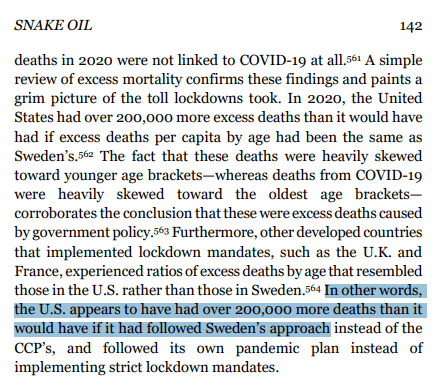
As the New York Times notes euphemistically: “The rate of death from all causes for younger adults has risen by a bigger percentage than has the rate of death from all causes for old people.” It’s nice of the New York Times to finally print this fact, but they would appear to be, euphemistically, a day late and a dollar short—the “dollar” in this case being 200,000 young American lives.
Featured Video

Dan Dicks with James Corbett on Solutions Watch
or go to
Aletho News Archives – Video-Images
From the Archives
$1.5bn up in smoke: US THAAD missile stockpile dries up defending Israel against Iran
By Ivan Kesic | Press TV | July 2, 2025
According to American media, defense news outlets, and independent analysts, the 12-day Israeli military aggression against Iran significantly depleted the US stockpile of THAAD (Terminal High Altitude Area Defense) interceptor missiles.
Citing official sources, American magazine Newsweek reported on Friday that the US transferred a substantial portion of its advanced missile defense capabilities to support the Israeli regime, an effort with questionable results and a critical impact on US strategic reserves.
THAAD, developed by Lockheed Martin arms manufacturing company, is a key component of Israel’s multi-layered air defense architecture. It is designed to intercept medium-range ballistic missiles, including those launched from Iran and Yemen.
The US-made system is capable of targeting short-, medium-, and intermediate-range ballistic missiles during their terminal phase, whether inside or outside Earth’s atmosphere.
THAAD uses a “hit-to-kill” method, relying on kinetic energy rather than explosive warheads to destroy incoming threats, intercepting at altitudes of up to 150 km and ranges between 150-200 km.
Operated exclusively by American personnel, the US military maintains eight THAAD batteries with an estimated 350–400 interceptors in total. The eighth battery was activated during the June 20 Israeli aggression against Iran and is capable of intercepting hypersonic missiles. … continue
Blog Roll
 Aletho News
- While Gaza dominates the UN, these are the people keeping it alive
- New Report: “Scholasticide and Genocide in Gaza: Assessment, Testimonies and Legal Analysis”
- ‘THAAD Delusion’: Iran war exposes US missile shield limits – The Atlantic
- Moscow issues warning to NATO over Russian exclave
- Yes, the Iran war has destroyed Trump’s presidency
- The fallacy of US delusions about Iran’s economic collapse
- Hezbollah denies Syria cell link, warns of Israeli plan to sow discord
- The legacy of US sanctions, war, and occupation in Iraq
- Iraqi resistance group rejects disarmament, vows to maintain support for Lebanon
- Sheikh al-Asadi warns of Iraqi government compliance with US demands
- If Americans Knew
- Iran’s Revolutionary Guards Publish Letter to the American People
- DMFI launches $1 million ad campaign supporting Virginia’s Elaine Luria
- US Senate blocks resolution seeking report on Americans killed by Israel
- Israeli Attacks Kill Ten Palestinians in Gaza
- Massacre at Minab: The School That Became a Grave
- Israeli media: The IDF Shows It Doesn’t Turn a Blind Eye; It Actively Emboldens Settler Havoc
- As settlers ravage West Bank, Israeli forces kill 10 in Gaza – Daily Update
- New Report: “Scholasticide and Genocide in Gaza: Assessment, Testimonies and Legal Analysis”
- Ex-Biden officials are desperate for a Gaza scapegoat
- Israeli “settlers” Invade Al-Aqsa; Pour Boiling Water on 75-Year-Old
- No Tricks Zone
- Green Energy Debacle: German Expert Professor Fritz Vahrenholt Warns Of Severe Economic And Social Consequences
- Two More Paleo Reconstructions Affirm Meters-Higher Sea Levels Across Ireland, Brazil 7000-6000 Years Ago
- New Study: Earth And Venus Surface Warmth Largely Explained By Convection And Lapse Rate, Not CO2 Or Radiation
- 2025 Nature Paper Claiming Worsening Global Drought Gets RETRACTED …Heavily Flawed
- New Study: ‘Global Drought Shows No Detectable Recent Acceleration Under Climate Warming’
- Economic Masterminds: German Socialists Suggest Taxing Productivity Gains Stemming From Using AI
- The South China Sea Has Not Been Cooperating With The Climate Change Narrative
- Energy Crisis: Germany Enters Heating Season With Historically Low Gas Reserve Fill Levels
- New Study: The Antarctic Ice Sheet Gained Mass From 2020-2024 Due To Staggering Snow And Ice Accumulation
- Study: Ocean Heating Rates From Thousands Of Years Ago ‘Dwarf’ Modern Ocean Heating Rates

