Is the West at war with disinformation or dissent?
By Rachel Marsden | Samizdat | May 5, 2022
When US President Joe Biden announced on April 27 that a new Disinformation Governance Board would serve the Department of Homeland Security, it was just the latest turn of the screw on freedom. This time, it’s an affront to citizens’ right to a diversity of information.
It’s one thing to correct inaccurate information, but this new entity seems more oriented towards narrative-policing that cracks down on the interpretation of information rather than the accuracy of it. Headed by a former communications advisor to the Ukrainian Foreign Ministry, Nina Jankowicz, one of the board’s first responsibilities will be to address “disinformation coming from Russia as well as misleading messages about the US-Mexico border,” according to CBS News. Interesting that these two issues – immigration and foreign conflicts – are currently viewed as two of Washington’s most significant failures, which have given rise to populist dissent. Make no mistake, it’s the dissent that’s the ultimate target.
The fact that a former Ukraine government spin doctor was viewed as the best person to head up the new initiative tells you everything you need to know about its true purpose. Jankowicz published a book in 2020 whose title suggests that she believes the West to be in an online war with Russia. ‘How to Lose the Information War: Russia, Fake News, and the Future of Conflict,’ portrays Western narratives as truthful and Russian narratives as “fake news.” Doing so obscures the fact that the mainstream Western media has not been immune to propagating narratives peddled by the state that could retroactively be considered fake news or war propaganda. Meanwhile, Russian media has often provided a platform for those seeking to express – or access – dissenting analysis or information that falls outside of the Western media bubble. Clearly, there are some ‘democracies’ that are bothered by this.
The appetite of Western nations to ensure that their citizens are only fed information that they control through their own highly concentrated government or corporate subsidized media isn’t new. It’s just getting more voracious. Perhaps it’s because the more authoritarian their agenda becomes, the more populist sentiment increases and gives rise to events such as Brexit or the election of Donald Trump, as well as trends such as opposition to US-backed conflicts, the rise in popularity of various populist political parties in Europe, and demonstrations against pandemic mandates, which just happen to be associated with government-issued QR codes.
Dissent is the enemy of authoritarian ambition. Supposedly free countries have manipulated their citizens into believing that censorship of certain views is for people’s own safety and security – hence why the military in Canada, the UK, and France, and now Homeland Security in the US, are involved in narrative policing. In reality, their efforts seem to be more about ensuring citizens’ compliance with their own agenda.
The fusion of domestic security and disinformation came to light as early as 2016, when the European Parliament grotesquely conflated Islamic terrorist propaganda with Russian media, in what seemed to be itself a propaganda effort to undermine the Russian media by equating these two totally unrelated things. But one by one, Western governments have placed free speech under national security control.
France, for example, handed off responsibility for online information arbitration to its domestic intelligence agency (the DGSI) and has reportedly considered involving defense-funded startups in the effort.
Canada has also turned to its security apparatus to shape Canadians’ information landscape – at least twice. The Communications Security Establishment, the country’s electronic spying agency, has been tweeting its own interpretations of disputed events occurring in the fog of the conflict in Ukraine as indisputable fact, while routinely denouncing Russia’s interpretation as invalid.
But Canada’s security establishment isn’t at its first rodeo in attempting to prevent citizens’ thinking from deviating from the state’s messaging. Under Prime Minister Justin Trudeau, the country’s armed forces deployed a months-long, military-grade propaganda campaign, which employed tactics honed during the war in Afghanistan, to mind-bend unsuspecting Canadians towards Trudeau’s Covid narrative, CBC News reported last year.
Not to be outdone, the psychological warfare specialists of the 77th brigade of Britain’s armed forces have also worked to shape messaging both in favor of the government’s Covid policies and against anything contrary out of Russia. “One current priority is combating the spread of harmful, false and misleading narratives through disinformation. To bolster this effort, the British Army will be deploying two experts in countering disinformation. They will advise and support NATO in ensuring its citizens have the right information to protect themselves and its democracies are protected from malicious disinformation operations used by adversaries,” Defense Secretary Ben Wallace said last year.
The fact that public safety and disinformation have suddenly become routinely conflated should be worrisome to defenders of whatever remnants of democracy that we still have left. Terrorism, health and now disinformation have all served as pretexts for the rapid erosion of our freedoms – all under the guise of protecting us from bad actors. But are we really safer? Or are we just increasingly less free?
Popular Ukrainian Zelensky critic arrested in Spain
Samizdat | May 5, 2022
Prominent blogger and critic of the Ukrainian government, Anatoly Shariy, has been detained by Spanish police as part of an international operation, the Ukrainian Security Service (SBU) announced on Thursday.
Shariy was arrested on Wednesday in a joint operation by Spanish and Ukrainian cops, as well as international “partners”, the SBU said in a statement.
The agency, Kiev’s successor to the Soviet KGB, said that the opposition figure is wanted on charges of treason by Kiev, among other things. Shariy has been infringing Ukraine’s national security through his activities in the media realm, while allegedly acting on behalf of “foreign” forces, it insisted. The case against the YouTuber with almost 3 million subscribers was launched in February 2021.
Shariy’s arrest “is more proof that every traitor of Ukraine will sooner or later receive his well-deserved punishment. It is inevitable,” the SBU claimed.
The Ukrainian announcement was confirmed by the Spanish police, who told RIA-Novosti that Shariy was detained in the coastal city of Tarragona on May 4 on an international arrest warrant.
Shariy had been granted political asylum in the EU by Lithuania back in 2012. Back then, he said that he was fleeing persecution by the government of Viktor Yanukovich, whom the Western media branded pro-Russian.
Yanukovich was deposed after the Maidan coup in 2014, but the blogger remained a harsh critic of authorities in Ukraine, be it President Petro Poroshenko or his successor Volodymyr Zelensky.
He condemned Russia’s military operation in Ukraine after it was launched in late February but kept pointing out what he saw as flaws in Kiev’s conduct during the ongoing conflict.
The blogger’s political asylum was cancelled by Lithuania in January this year.
Shariy was absent from social media on Wednesday, but on Thursday he took to Telegram to share a photo of his wife feeding parrots in Barcelona, accompanying it with a comment reading: “This really is a comedy.”
According to media reports, the blogger was released from Spanish custody and placed under travel restrictions. He’s to remain in Barcelona where he has a home pending a decision on his extradition to Ukraine.
President Zelensky’s representative at the Constitutional Court has already expressed confidence that Shariy will “face a Ukrainian court and will be held liable in line with Ukrainian laws.”
DON’T VOTE “#GREATRESET”

By Olly Connelly | Daily Chaos | May 5, 2022
It’s local election day in the UK and, as you’ll be aware, elections are underway also in France and in the US.
Local, constituency or national level, if you vote for someone who is not talking about defeating the #GreatReset, then you are voting for Klaus Schwab, you are voting “to own nothing”, for communism directed by fascists, you are voting for tyranny, for censorship, for more fake pandemics and more fraudulent war, you are voting for divide-rule on an epic scale that is destroying families, communities and societies from within despite the farcical topics such as “how to define a woman” for crying out loud, you are voting for the normalisation of Satanism and paedophilia as can increasingly be seen in Biden’s America, you are voting for genocidal war criminals like Tony Blair to never be brought to account while being BBC-platformed to lecture you on using experimental drugs on your innocent children, you are voting to condone yet more phony elections, for Martial law in Western societies as we saw in Ottawa, for the hundreds of thousands in death toll in places like Yemen while the globalists distract with Ukraine, you are voting for CCP-style oppression and their model social credit score to keep you in check, you are voting for the last of our liberty ie an end to cash, for Google’s bloodstream nanobots and Musk’s brain chip, for Gates’ quaxxines and the final cull of the Mama-Papas defeated by the Bezos drones.
DON’T VOTE FOR SLAVERY.
Don’t vote for the Great Reset. DON’T VOTE FOR ANYONE WHO IS NOT ACTIVELY WARNING AGAINST THE GREAT RESET, THEY ARE A FRAUD, A DECEIT…
… At this stage in the game, I tell you, ANYONE in politics or journalism who is not warning of the dangers of the Great Reset is somewhere between fraudulent and downright evil.
If in doubt, if in any doubt, do not vote. In most cases this is almost certainly the best option, to help de-power the them-us elitism, to deny a mandate and to create a window to be able to say, “WE DID NOT ELECT YOU.”
We should have seen, by now, the vile outcome by supporting cheats and liars. We should have seen that voting for the lesser of the evils DOES NOT HELP. Do not make things worse by voting yet again for PROVEN cheats and liars.
Do not mindlessly vote. And yes, at this stage in the game where practically everyone on the global stage is either bought or blackmailed, A VOTE “NOT TO VOTE”, an abstention from the Big Lie, is in no way dishonourable. A vote for more of what we have in power now, on the other hand, is downright moronic.
Here’s to us, and bugger plutocracy!
YouTube CEO announces “misinformation research and initiatives” partnership with Latino rights group
By Tom Parker | Reclaim The Net | May 4, 2022
YouTube CEO Susan Wojcicki has revealed that the platform will be partnering with the largest national Latino civil rights and advocacy organization in the United States, UnidosUS, on “misinformation research and initiatives.”
While Wojcicki didn’t reveal any further details of this partnership, she reiterated that YouTube is “working every day to fight misinformation.”
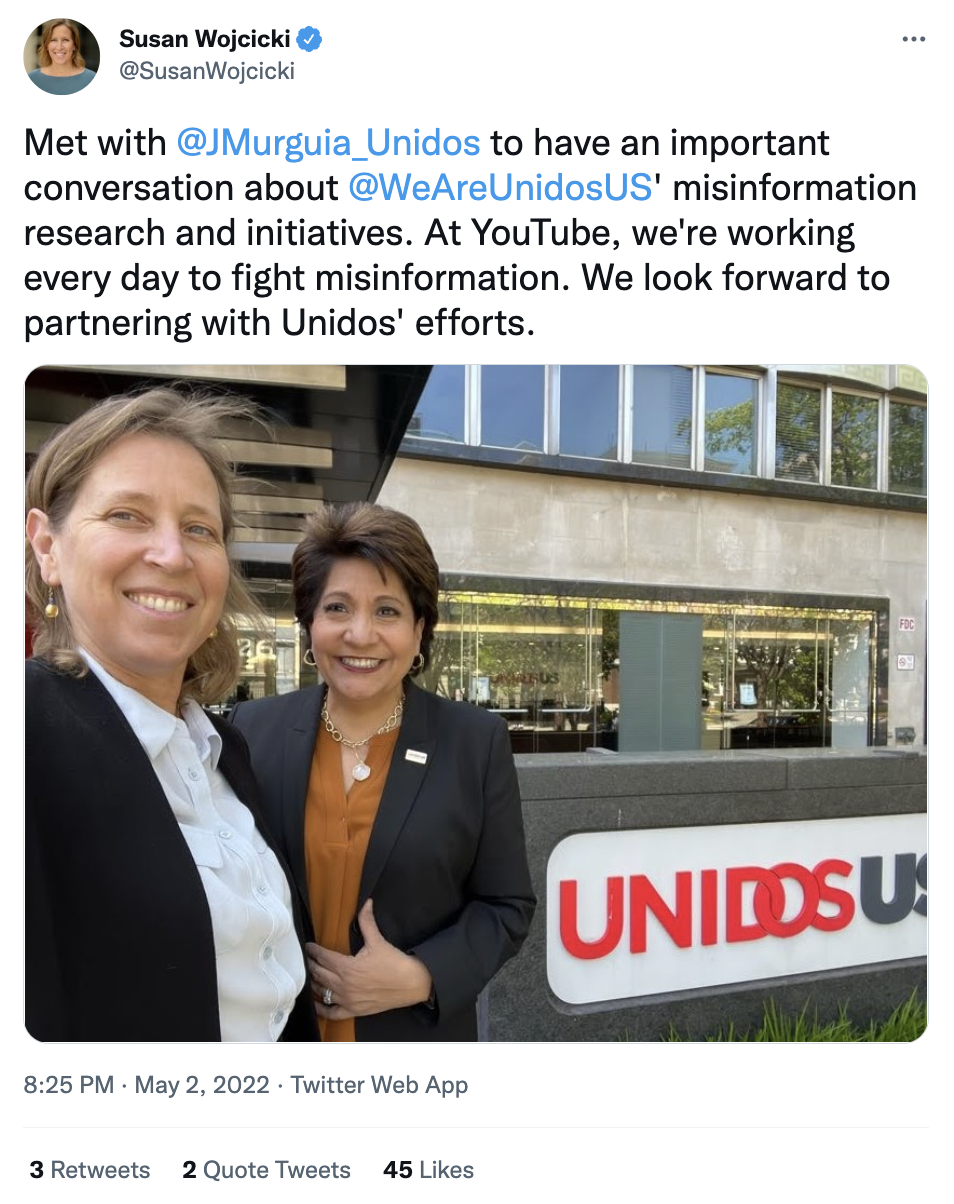
Wojcicki previously described tackling misinformation as one of her top priorities and YouTube has deleted more than a million videos for containing what it deems to be “COVID misinformation.”
UnidosUS President and CEO Janet Murguía echoed Wojcicki’s enthusiasm for targeting online misinformation in a tweet about the partnership.
“Eager as well to move forward on the key issue of addressing disinfo & misinformation in English & Spanish,” Murguía tweeted.
Murguía added that she’s united with the Congressional Hispanic Caucus (CHC) on UnidosUS’s efforts.
Wojcicki met with members of the CHC last week to discuss Spanish-language misinformation. After the meeting, the CHC said that addressing Spanish-language “dis/misinformation” is an “urgent priority.”
Although the specifics of YouTube and UnidosUS’s partnership have yet to be disclosed, UnidosUS has previously pressured Big Tech platforms to “address” misinformation.
Last October, the group cut ties with Facebook after former employee Frances Haugen’s shared internal documents that suggested the tech giant was aware of the platform having a negative impact on some users.
“We have called attention repeatedly to concerns about the negative impact that the proliferation of hate and misinformation on the platform has had on the Latino community,” Murguía stated at the time. “We know now that Facebook’s failure to adequately address those concerns was deliberate and resulted in even greater levels of hate and misinformation on the site.”
Last December, Murguía lamented that Congress has never held a hearing dedicated to Facebook’s “failure to address Spanish-language misinformation” and demanded that Meta CEO Mark Zuckerberg “tell Congress why Facebook perpetuates Spanish-language misinformation.”
PBS agitates to have Tucker Carlson taken off the air
By Russell Cook | American Thinker | May 4, 2022
The taxpayer-funded national network PBS is pushing for less viewpoint diversity, no doubt intended to accelerate the growing push for Tucker and Fox News to be taken off the air. From the PBS Newshour, May 2, 2022: “Tucker Carlson’s influence and his increasingly extreme views” (Amna Nawaz interviews New York Times’ Nick Confessore, who wrote the 4/30 “How Tucker Carlson Stoked White Fear to Conquer Cable“).
Excerpts (emphases added):
Nick Confessore: … He’s the highest rated cable show host in history. And it’s also the most racist show in history. … Every night, that show teaches fear and loathing. He may claim to be a person who opposes racism and prejudice, but what the show tells you every night is to be afraid, to be afraid of people who are in the street asking for police officers to not shoot Black people, be afraid of Afghan refugees who helped us in the war who are coming over here now, to be afraid of Dr. Fauci, and to be afraid of immigration in general, which he posits is part of a cabal, a plot to destroy Western civilization … it’s not just the anti-white racism kind of rhetoric on the show. He’s literally taking ideas that began on the very far right, on arcane corners of the Internet, on neo-Nazi sites …
… Amna Nawaz: Nick, he’s also aggressively defended January 6 insurrectionists and played down how violent that day actually was. … he’s very much in line with the Republican Party and their message. What did your reporting find about that relationship between the GOP and Tucker Carlson?
Nick Confessore: Look, I would say he is the high priest of Trumpism.
“Amy Walter and Annie Linskey on primary election season, Tucker Carlson’s role in the GOP”
Excerpts:
Judy Woodruff: … Amy, let’s start with what we just heard Amna talking to Nick Confessore about … Clarify for us, what is Tucker Carlson’s role in the Republican Party, in American politics?
Amy Walter: … Nick Confessore put it really well when he said that he’s filling the void that had been left by Donald Trump‘s voice being off of social media … He’s also being talked about as a potential 2024 candidate for president. And that’s not idle discussion. I think his name will be very seriously floated, and we may see more to come of a Tucker Carlson trial balloon in 2024.
… Judy Woodruff: And, Annie, what — the darker side of this, which we heard in that conversation, about race… and about the role of the threat that many white Americans feel, what does that say about our politics right now?
Annie Linskey: … I think that was one of the most stunning takeaways, for me at least, from the New York Times reporting, which was just so incredible, is just the extent to which they really documented the ways in which Carlson is normalizing discussions of race that I think would not be considered — are not considered appropriate in many parts of the country. … But Carlson’s show is moving through the window to where they’re becoming more appropriate. And I think that’s what many groups on the left worry about. And I think that is what The Times is reporting is kind of showing us, really the danger that Tucker Carlson and his show presents, is making it more OK to have those kinds of grievances voiced out loud…
According to the PBS NewsHour and the NYT, neither of which seems to have people who’ve watched Tucker’s show at any depth, Tucker espouses Bull Connor–style racism and enables people like you and me to freely advocate talk that escalates toward genocide. His show should therefore be silenced, he should be jailed for insurrectionist incitement before he announces his presidential run, and you and I need to be leery of saying anything against… well, anything. Obey.
UK intensifies crackdown against Russian media
Samizdat | May 4, 2022
The UK is forcing social media, internet service providers and app stores to block content from state-sponsored Russian media outlets – RT and Sputnik news agency. “For too long RT and Sputnik have churned out dangerous nonsense dressed up as serious news to justify Putin’s invasion of Ukraine,” Tech and Digital Economy Minister Chris Philp said on Wednesday.
“These outlets have already been booted off the airwaves in Britain and we’ve barred anyone from doing business with them. Now we’ve moved to pull the plug on their websites, social media accounts and apps to further stop the spread of their lies.”
In March, Britain’s media regulator, Ofcom, revoked RT’s broadcasting license. The EU decided to ban RT from broadcasting the same month. RT Deputy Editor-in-Chief Anna Belkina said at the time that Ofcom revoked the license for “purely political reasons tied directly to the situation in Ukraine.” She said that the regulator “falsely judged RT to not be ‘fit and proper’ and in doing so robbed the UK public of access to information.”
The UK also blacklisted the All-Russia State Television and Radio Broadcasting Company (VGTRK), which operates Russia-1 and Russia-24 TV channels, among others. The UK government’s Foreign, Commonwealth and Development Office (FCDO) accused the broadcaster of playing “a key role in justifying Putin’s aggression against Ukraine.”
Sanctions were also imposed on InfoRos and the SouthFront news websites. The FCDO accused them of spreading “destabilizing disinformation.”
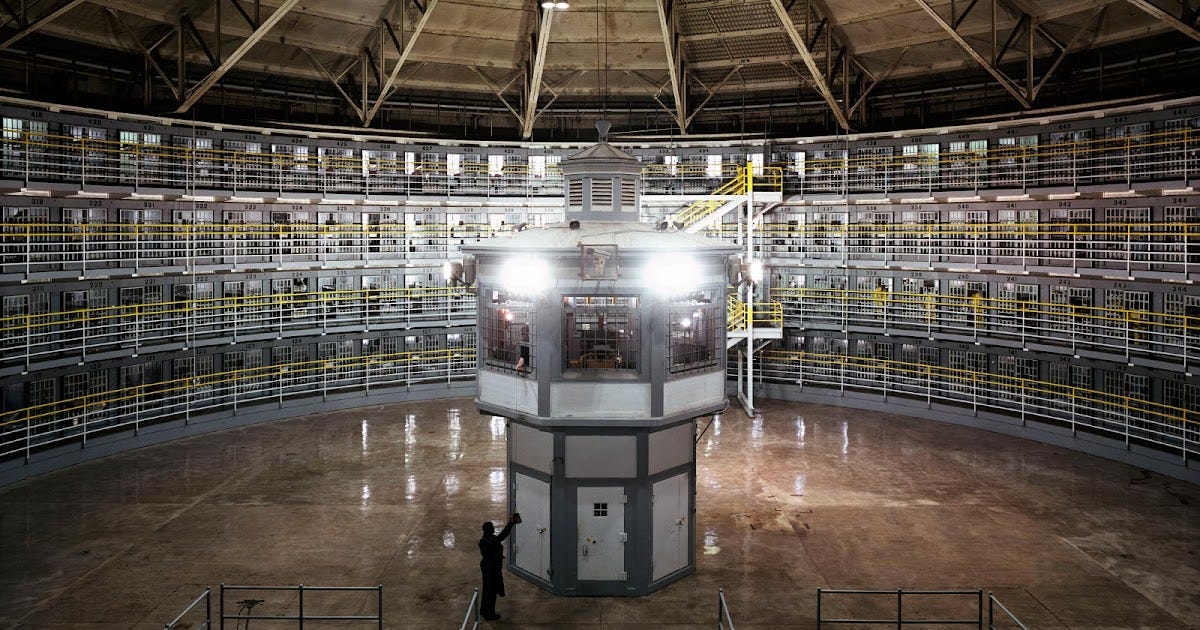
Our Digital Panopticon
The CDC has been using phone tracking data to monitor schools and churches. The CIA has also been spying on Americans, with no judicial oversight and without congressional approval.
By Aaron Kheriaty, MD | Human Flourishing | May 4, 2022
Yesterday, Vice broke the story that during the previous two years, as the headline announced, “The CDC tracked Millions of Phones to See If Americans Followed COVID Lockdown Orders.” According to documents obtained by Motherboard, the CDC used phone location data to monitor schools and churches, and wanted to use the data for applications beyond covid: “The documents also show that although the CDC used COVID-19 as a reason to buy access to the data more quickly, it intended to use it for more-general CDC purposes.” The recovered CDC documents, dating from 2021, state that the data “has been critical for ongoing response efforts, such as hourly monitoring of activity in curfew zones or detailed counts of visits to participating pharmacies for vaccine monitoring.”
The documents contain a long list of what the CDC describes as 21 different “potential CDC use cases for data.” These include, among others, monitoring curfews, neighbor-to-neighbor visits, visits to churches and other places of worship, school visits, and “examination of the effectiveness of public policy on [the] Navajo Nation.” Other use cases mentioned in the documents include public health issues beyond covid, such as “research points of interest for physical activity and chronic disease prevention such as visits to parks, gyms, or weight management businesses” as well as “exposure to certain building types, urban areas, and violence.”
Although the data the CDC purchased from the controversial broker, SafeGraph, was aggregated and designed to show trends, “researchers have repeatedly raised concerns with how location data can be deanonymized and used to track specific people.” Researchers have repeatedly demonstrated that that unmasking specific users from these aggregated human mobility datasets is possible. One research team studied fifteen months of human mobility data for one and a half million individuals and published their results in Nature: Scientific Reports: “In a dataset where the location of an individual is specified hourly and with a spatial resolution equal to that given by the [mobile phone] carrier’s antennas, four spatio-temporal points are enough to uniquely identify 95% of the individuals.” They coarsened the special and temporal data and still found “even coarse datasets provide little anonymity.”
“SafeGraph offers visitor data at the Census Block Group level that allows for extremely accurate insights related to age, gender, race, citizenship status, income, and more,” one of the CDC documents reads. Due to its questionable practices, SafeGraph was banned from the Google Play Store in June 2021, which meant that meant that any app developers using SafeGraph’s code had to remove it from their apps. The company includes among its investors the former head of Saudi intelligence. This is where the CDC went to get its tracking data, paying SafeGraph $420,000 for access to one year of data.
Evidence also emerged recently that the CIA, like Israel and Canada, has been similarly using unauthorized digital surveillance to spy on Americans. After supporting vaccine mandates in 2021, the ACLU finally took an interest again in civil liberties in 2022. They expressed alarm when newly declassified documents revealed that the CIA has been secretly conducting massive surveillance programs that capture Americans’ private information.
Like the Israeli spy agency Shin Bet, our federal intelligence agency was spying not on suspected terrorists but on ordinary Americans, with no judicial oversight and without congressional approval, as the ACLU noted: “This surveillance is done without any court approval, and with few, if any, safeguards imposed by Congress to protect our civil liberties.” They concluded: “These reports raise serious questions about what information of ours the CIA is vacuuming up in bulk and how the agency exploits that information to spy on Americans. This invasion of our privacy must stop.” Though ACLU arrived a bit late to the party, as the old saw has it, better late than never.
U.S. Senators Senator Ron Wyden of Oregon, and Martin Heinrich of New Mexico, both Democrats and members of the Senate Intelligence Committee, called for declassification of relevant CIA documents. In a letter of April 13, 2021 which they made public, the two senators expressed concern that the CIA program was “entirely outside the statutory framework that Congress and the public believe govern this collection [of data], and without any of the judicial, congressional or even executive branch oversight that comes from [Foreign Intelligence Surveillance Act—FISA] collection.” Despite Congress’s clear intent, with the support of the American people, to limit warrantless collection of Americans’ private records, the senators warn, “these documents reveal serious problems associated with warrantless backdoor searches of Americans, the same issue that has generated bipartisan concern in the FISA context.”
There is a broader legal context for these extra-legal developments in mass surveillance of civilian populations. Since the war on terror began, Western nations have legislatively scaled up their increasingly intrusive networks of mass surveillance (often referred to with the euphemism “bulk collection”). The last decade has seen such measures passed in the U.K., France, Australia, India, Sweden, and other countries—not to mention the AI and facial- and gate-recognition enabled surveillance in China, technology that Xi is already exporting to eager rogue regimes around the globe.
Elon Musk responds to Mike Huckabee’s request for Twitter to remove online anonymity
By Ken Macon | Reclaim The Net | May 3, 2022
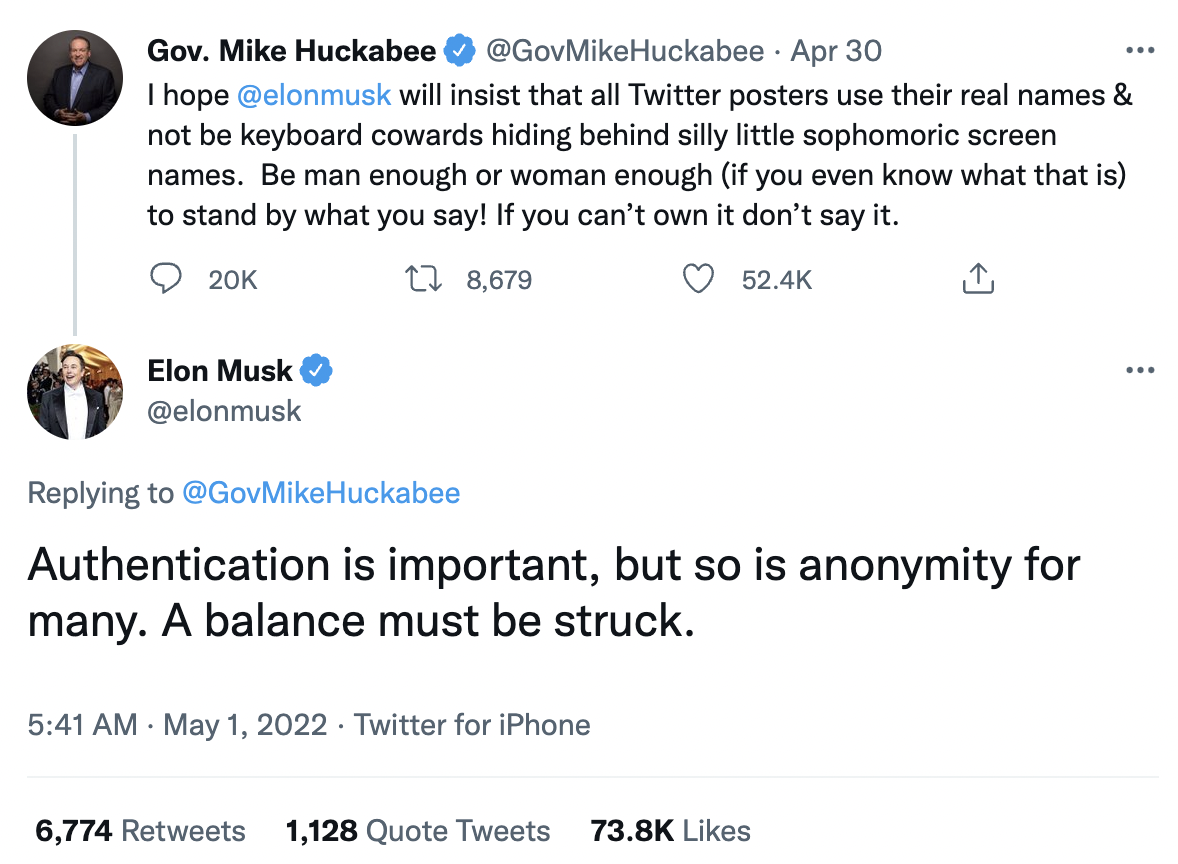
Former Arkansas governor Mike Huckabee has asked Elon Musk to remove online anonymity if his Twitter bid becomes successful, sparking concern from privacy advocates about how Musk will “authenticate all humans” and whether it will involve users handing over ID to use the platform.
“I hope @elonmusk will insist that all Twitter posters use their real names & not be keyboard cowards hiding behind silly little sophomoric screen names. Be man enough or woman enough (if you even know what that is) to stand by what you say! If you can’t own it don’t say it,” Huckabee tweeted.
Twitter has distinguished itself from other platforms like Facebook by allowing users to use pseudonyms. For that reason, people who need anonymity, like whistleblowers and dissidents in repressive regimes, people living in countries where anonymity is the difference between life and death, or even those who have opinions that go against the mainstream, have had a place where they can speak freely without fear of retribution.
In a new tweet, Musk replied to Huckabee indicating that there will be a balance when it comes to authenticating users vs preserving anonymity.
In a series of tweets, US Naval Academy’s associate professor of Cybersecurity Law Jeff Kosseff explained why Twitter should continue to allow anonymity.
“The Musk/Twitter press release states that the company will authenticate ‘all humans.’ I’m not sure what this means, but there is at least a chance that it could compromise users’ ability to be anonymous. In this thread I explain some concerns with this possibility,” Kosseff wrote.
“At least some high-profile commentators have interpreted it as banning anonymity/requiring ID verification. If that is the case, and it applies to “all humans” (rather than just making verification an option for everyone), then that could threaten some of the values that have helped to define and distinguish Twitter from platforms like Facebook that have always required real names.”
Twitter itself supported anonymity in a 2021 blog post, citing a PhD graduate who was able to express her frustration with the lack of job prospects without fearing her current employer would retaliate or losing potential employers.
“Being able to express vulnerability and the messiness of real life is important to Brooke, which is why she Tweets under a pseudonym,” the post read. “This is the handle where she can be herself, including talking frankly about the challenges of job searching, without worrying about turning off a potential employer.”
If Twitter were to collect ID on users, dictatorial governments would be able to pressure it to provide personally identifiable data of critics, journalists, and dissidents. That would contradict Musk’s stand of free speech stance.
PayPal seizes alternative media site’s money
Samizdat | May 3, 2022
Payment processor PayPal has frozen alternative media powerhouse Consortium News’ (CN) donation page without warning, confiscating the site’s $9,348.14 balance with no explanation beyond the claim that “an investigation and review” of the site’s “history” found “some potential risk associated with this account.”
CN was informed via email on Sunday that it couldn’t use PayPal anymore and told “we noticed activity in your account that’s inconsistent with our User Agreement and we [can] no longer offer you PayPal services.” Absent any further explanation beyond the desire to limit “potential risk exposure,” the site was informed that the nearly $10,000 sitting in its account would be effectively confiscated for “up to 180 days,” after which point, “if applicable, we’ll email you with information on how to withdraw any remaining money.”
The seizure came at a particularly damaging time for the reader-funded site, which had just begun a spring fundraising drive. Contacted by CN employees, a PayPal customer service representative confirmed on Sunday that no specific reason had been given by the “back office” for “permanently limiting” the account other than the aforementioned “potential risk.”
“I don’t see any existing case” of a complaint having been filed by “any agency, government or private, or any individual,” they told CN, promising to ask PayPal’s back office to explain its behavior to the website.
More ominously, the PayPal representative informed CN that “if there was a violation,” it was “possible” the $9,348.14 balance in its account would be kept by PayPal as “damages.” According to PayPal’s own documentation, violations include providing “false, inaccurate or misleading information” to PayPal, its customers, or “third parties.”
In a blog post discussing the suspension, CN editor-in-chief Joe Lauria suggested the site had been targeted due to its coverage of the conflict in Ukraine, noting that MintPress News – another well-known alt-media website with similar political views regarding the US and NATO’s foreign adventures – had its own account frozen by PayPal last week. PayPal’s definition of “violations,” Lauria implied, could easily be stretched to include the Orwellian crime du jour of “fake news,” an especially egregious offense during wartime.
Last week, former RT America correspondent Caleb Maupin also had his PayPal account frozen without warning or explanation, as did MintPress employees Alan MacLeod and Mnar Adley. Many on social media have speculated that the payment processor is deliberately targeting those with dissident views on the conflict in Ukraine and US foreign policy in general – “thoughtcrimes” hundreds of other prominent commentators have been deplatformed for in the past.
Consortium News was founded in 1995 by the late journalist Robert Parry, whose claims to fame included exposing the Iran-Contra scandal, in opposition to what the site’s own biography describes as “a crisis building in the US news media.”
Skewering the “pattern of groupthink on issue after issue, often ignoring important factual information because it didn’t fit with what all the Important People knew to be true.”
Biden’s ‘Disinformation Governance Board’ is another propaganda tool
By Ian Miles Cheong | Samizdat | May 3, 2022
US President Joe Biden’s Department of Homeland Security announced last week that it had formed a “Disinformation Governance Board” to fight the spread of so-called disinformation on the Internet. While White House spokeswoman Jen Psaki didn’t elaborate on how the bureau would operate, she suggested that it would monitor disinformation on topics like COVID-19 and elections.
Conservatives have often half-joked about George Orwell’s “1984” becoming a reality, but it appears that the Biden administration has decided to literally take a page from the book and create a “Ministry of Truth”.
The board’s aim is to target “disinformation,” but what constitutes disinformation? Many times over the years we have seen complete censorship from government officials and Big Tech social media companies, most infamously during the Hunter Biden laptop scandal, which saw major tech platforms and politicians painting it as “Russian propaganda.”
Allowing the government to dictate what “the truth” is sets a dangerous precedent, as it instead promotes desired narratives to bolster poll numbers, ratings, or nudging the citizenry into following government edicts – all on the basis of “trust us, we know what’s best for you.”
Facts be damned. Just do as you’re told. This was seen multiple times during the pandemic era, when both Dr. Anthony Fauci and then-Surgeon General Jerome Adams hummed and harred over mask-wearing and social distancing – first instructing the public not to wear masks, and then much later calling it a necessity.
Gatekeeping discourse is a surefire way to control the narrative, controlling what people see, what they say, and ultimately – what they believe. It’s also an effective means to silence dissent, and quash those who might speak out against the regime’s approved narrative – or even the regime itself.
The new Ministry of Truth is a tool, and there is no reality in which this tool will not be used for bad intent – and it’ll claim to be doing it all in the name of the greater good.
Unsurprisingly, the Ministry of Truth was rushed into creation seemingly as a reaction to “free speech absolutist” Elon Musk’s purchase of the social media platform, Twitter, the de facto town square of political discourse and public narratives.
With the relinquishment of Twitter to Musk, those who control mainstream narratives fear they will lose out on an important resource, and will no longer be able to promote narratives and fix algorithms to sway public opinion – at least not with ease. There will be pushback, and their positions are not ones they are willing to defend, hence why the creation of this new tool is necessary. It keeps the plebeians in check.
Free speech, which in Musk’s belief is “essential to a functioning democracy,” flies directly in the face of the Biden administration’s attempts to crack down on viewpoints that contradict the regime’s official narrative. And who better to head the Disinformation Governance Board than Nina Jankowicz, who herself perpetuated several regime-approved falsehoods?
Jankowicz, who previously advised the Ukrainian government on disinformation and strategic communications under the auspices of a Fulbright-Clinton Public Policy Fellowship, voiced her support for Christopher Steele, whose infamous “Steele dossier” on Russian election interference during Donald Trump’s 2016 election dogged the presidency for years. Despite Steele’s loss of credibility, Jankowicz hyped up the former spy in August 2020 as being able to offer “some great historical context about the evolution of disinfo” when he spoke on a podcast about the topic.
It’s worth noting that the infamous dossier, which included the unverifiable claim that Russia had “kompromat” on Trump in the form of a sex tape, has since been entirely discredited. Steele’s main source, Igor Danchenko, was later charged with five counts of making false statements to the FBI. Jankowicz also repeated the unproven theory that Hunter Biden’s laptop was the product of a Russian disinformation campaign, spread by members of the Trump campaign.
“Back on the ‘laptop from hell,’ apparently—Biden notes 50 former natsec officials and 5 former CIA heads that believe the laptop is a Russian influence op,” Jankowicz said on Twitter. “Trump says ‘Russia, Russia, Russia.’”
She attempted to distance herself from her remarks with the claim that she was simply livetweeting Trump’s first presidential debate with Biden. However, when solicited by the Associated Press in October 2020 for her thoughts on the laptop, Jankowicz told the publication that “We should view it as a Trump campaign product,” dismissing the fact that the laptop belonged to Hunter Biden.
As detailed by Newsweek, Jankowicz continued to perpetuate doubt against the story, tweeting on October 22, 2020 that “The emails don’t need to be altered to be part of an influence campaign. Voters deserve that context, not a [fairy] tale about a laptop repair shop.”
In a consolidated effort to disqualify the New York Post’s original report on Hunter Biden’s laptop as “disinformation”, Twitter, Facebook, and other social media platforms banned the New York Post and prevented its users from sharing the story weeks ahead of the 2020 US presidential election. The original report on the laptop has since been validated by a comprehensive report about the ongoing federal probe into Hunter Biden’s tax filings, published by the New York Times.
Twitter’s then-CEO Jack Dorsey later admitted to a Senate Judiciary Committee hearing that censoring the report was a “total mistake,” and chalked up the decision to a “process error.”
Both Twitter and Facebook heads were grilled over their companies’ perceived anti-conservative bias and penchant for censoring so-called “disinformation,” with the censorship usually aimed at conservatives. It’s worth pointing out again that the now-discredited “Steele dossier” had no problem gaining traction when it first ran on BuzzFeed.
Nina Jankowicz had no problem spreading actual disinformation while helping to silence the truth under the auspices of “combating disinformation.” Given her predilection towards perpetuating anti-Russian narratives, one might ask if contradictory evidence to the “Snake Island” and “Ghost of Kiev” hoaxes constitute forms of “disinformation” in her book. After all, the mainstream media is chiefly responsible for promoting these heroic war stories, both of which were almost immediately discredited by the Russian media – and later by western experts. Even Ukraine’s own propagandists were forced to instruct the public to stop promoting disinformation about the conflict. Would the Ministry of Truth move to silence such attacks on its credibility?
Those concerned with the truth must do everything in their power to resist the Biden administration’s efforts to police the truth. To that end, Florida Gov. Ron DeSantis is one of the few American leaders who has stepped up and vowed to fight back against the Orwellian disinformation bureau.
“They want to be able to put out false narratives without people being able to speak out and fight back,” DeSantis said. “But we’re not going to let Biden get away with this one, so we will be fighting back.” Referring to the regime as a “decaying and discredited ruling elite in this country,” DeSantis said: “We believe it’s essential that individual Floridians and Americans are able to speak out against the false narratives trying to be jammed down our throats by this regime.”
Yes, TCW is being censored
TCW Defending Freedom | May 3, 2022
AFTER many reports over the weekend that the site was not working for some users, we have established that we are being blocked by the adult content filter on the Internet Service Provider (ISP) Three.

Affected users get the message above, which does not make it clear that the site is being censored, but gives an erroneous message about the SSL certificate. This makes it look like a misconfiguration on our part, but this is not the case.
We have contacted Three to enquire exactly why TCW has been added to their adult content filter.
Three use the British Board of Film Classification (BBFC) guidelines, which you can find here.
TCW can appeal to BBFC to be unblocked by Three, and you can be sure that we are following this process. We have also registered the censorship with the Open Rights Group’s Blocked! website.
In the meantime, Three users may wish to reconsider their choice of ISP. Customers of Three can request that the adult filter be turned off by contacting customer services. A non-censoring ISP would be a good idea too – we can recommend Andrews and Arnold. A good VPN (Virtual Private Network) might be an idea too, if you would prefer that your ISP does not control the content you are able to access online. IVPN are great.
We will be tweeting @ThreeUKsupport and @ThreeUK to see what they have to say. It would be helpful if some of our readers could do this too.
If this can happen to TCW, it can happen to any site on the internet. Resist online censorship, for that is what this is.
Featured Video

New positive ivermectin evidence
or go to
Aletho News Archives – Video-Images
From the Archives
Fanatical Followers of the Covid Regime: A Jim Jones-Style Cult?
By Professor Roger Watson and Dr. Niall McCrae | The Daily Sceptic | November 15, 2021
As scholars at leading British universities over recent decades, we witnessed the replacement of critical thinking and debate by narrative: facts are discrimination and scientific method is imperialism; truth, instead, is derived from ‘progressive’ values. This educational trend may be a major contributory factor to the ease in which society has been inculcated to the Covid ‘new normal’ of masking, testing, and repeated doses of vaccines for a disease of similar risk to severe influenza.
One doesn’t need much critical reasoning to observe the flawed logic of some vaccination enthusiasts, such as people who respond to experiencing any side effects, however debilitating, by saying “at least I know it’s working”, or, after contracting the disease despite their promised inoculation (over 90% effective, according to initial drug company claims), “I’d have been worse off without the jab.” … continue
Blog Roll
 Aletho News
- Ex-Greek MEP files complaint against Israeli spyware firm over alleged Pegasus surveillance
- Troubling ideas throughout the Torah, Talmud, Mishneh Torah and Tanya
- ‘Grave, alarming’: Iran mission on Trump’s UNGA ‘annihilation’ threats
- Najaf airport to reopen to Iranian flights within 24 hours: Ambassador
- From ‘How Will This End For Iran’ to ‘When America Walks Away’: A tale of two Economist covers
- Tehran blasts ‘baseless’ speculation linking Iran to alleged bomb plot at UK air base
- The Rise And… Rise Of ‘Color Revolutions’
- The Coming GOP Bloodbath?
- Arctic Scare Stories Melt Away
- Wrong, Euronews: Climate Change Has Not Created a Food, Energy, and Economic “Meta-Crisis”
- If Americans Knew
- Netanyahu Asked UAE Leader to Deny Report on Oct. 7 Warning in Secret Visit, Sources Say
- CNN Chief Int’l Correspondent Clarissa Ward on Journalists in Gaza
- Democratic Party Consultants Surround Troy Jackson with Pro-Israel Donors
- Christian Leader Responds To Netanyahu’s Claims Regarding Palestinian Christians
- In Gaza, ‘Whoever Survives the Bombing Won’t Survive the Rubble’
- Israel kills more Palestinians, amid push to resettle Gaza – Daily Update
- Israel forces Gazans to live in constant peril – Daily Update
- Deconstructing Netanyahu’s pants-on-fire UN rant – Daily Update
- Trump betrayed voters with his campaign lies and prioritized a foreign country once he took office
- Netanyahu calls Israel’s war in Gaza ‘opposite of genocide’ in UN speech to near-empty hall
- No Tricks Zone
- New Study: Earth And Venus Surface Warmth Largely Explained By Convection And Lapse Rate, Not CO2 Or Radiation
- 2025 Nature Paper Claiming Worsening Global Drought Gets RETRACTED …Heavily Flawed
- New Study: ‘Global Drought Shows No Detectable Recent Acceleration Under Climate Warming’
- Economic Masterminds: German Socialists Suggest Taxing Productivity Gains Stemming From Using AI
- The South China Sea Has Not Been Cooperating With The Climate Change Narrative
- Energy Crisis: Germany Enters Heating Season With Historically Low Gas Reserve Fill Levels
- New Study: The Antarctic Ice Sheet Gained Mass From 2020-2024 Due To Staggering Snow And Ice Accumulation
- Study: Ocean Heating Rates From Thousands Of Years Ago ‘Dwarf’ Modern Ocean Heating Rates
- Climate Extremists Target, Attack Large-Scale Power Grid Infrastructure In Germany!
- New Study: Antarctic Ice Melt Has Contributed Less Than 1 Centimeter To Sea Level Rise In The Last 30 Years

