Whitney Webb is a MintPress News journalist based in Chile. She has contributed to several independent media outlets including Global Research, EcoWatch, the Ron Paul Institute and 21st Century Wire, among others. She has made several radio and television appearances and is the 2019 winner of the Serena Shim Award for Uncompromised Integrity in Journalism.
Massive 30 State, Real-Time ALPR Database Revealed
MassPrivateI | September 10, 2019
Our worst fears about automatic license plate readers (ALPR) are much worse than we could have imagined.
Two months ago, I warned everyone that police in Arizona were using ALPR’s to “grid” entire neighborhoods. But this story brings public surveillance to a whole new level.
Last month, Rekor Systems announced that they had launched the Rekor Public Safety Network (RPSN) which gives law enforcement real-time access to license plates.
“Any state or local law enforcement agency participating in the RPSN will be able to access real-time data from any part of the network at no cost. The Company is initially launching the network by aggregating vehicle data from customers in over 30 states. With thousands of automatic license plate reading cameras currently in service that capture approximately 150 million plate reads per month, the network is expected to be live by the first quarter of 2020.”
RPSN is a 30 state real-time law enforcement license plate database of more than 150 million people.
And the scary thing about it is; it is free.
“We don’t think our participants should be charged for accessing information from a network they contribute to, especially when it provides information that has proven its value in solving crimes and closing cases quickly,” said Robert A. Berman, President and CEO, Rekor.
Want to encourage law enforcement to spy on everyone? Give them free access to a massive license plate database.
RPSN’s AI software uses machine learning to predict when and where a hotlisted person or a person of interest will be.
“Rekor’s software, powered by artificial intelligence (“AI”) and machine learning, can also be added to existing law enforcement security camera networks to search for law enforcement related hotlists as well as Amber Alerts and registered sex offender motor vehicles.”
Rekor admits that police in thirty states are probably spying on more than 150 million license plates each month.
The Westchester County New York Police Department’s Real Time Crime Center alone, collects “more than 25 million license plates each month.”
An article in Traffic Technology Today revealed that Rekor will go to great lengths to convince police departments to track millions of motorists.
“In 2020, the RPSN will be fully compliant with the federal 2019 NDAA law, which bans the use of certain foreign manufactured cameras used in critical infrastructure.”
Rekor’s 2019 NDAA sales pitch, is both disturbing and despicable. It reveals just where they and law enforcement stand when it comes to using ALPR’s to spy on millions of motorists.
Police use license plate readers to track motorists in real-time
An article in The Newspaper revealed how police in Louisiana use license plate readers to track motorists in real-time.
Eric J. Richard had been driving his white Buick LaCrosse on Interstate 10, when he was stopped by Louisiana State Police Trooper Luke Leger for allegedly following a truck too closely. During the roadside interrogation, the trooper asked where Richard was coming from.
“I was coming from my job right there in Vinton,” Richard replied. The trooper had already looked up the travel records for Richard’s car and already knew it had crossed into Louisiana from Texas earlier in the day. Based on this “apparent lie,” the trooper extended the traffic stop by asking more questions and calling in a drug dog.
The article goes on to say that police had no reason to track Mr. Richard, but they did so because they could. And that should frighten everyone.
Rekor lets law enforcement know where your friends and family are, where your doctor’s office is, where you worship and where you buy groceries.
How is that for Orwellian?
It is time to face the facts: ALPR’s are not about public safety, they are a massive surveillance system designed to let Big Brother track our every movement.
San Francisco Targets the NRA with Anti-BDS-Style Resolution
By Adam Dick | Ron Paul Institute | September 6, 2019
Condemning and even barring people who support, or refuse to oppose, boycotting, divesting from, or sanctioning Israel from being employees or contractors of state or local government entities has been the rage in American state legislatures over the last few years. Kentucky has become one of the latest states to impose one of these anti-boycott, divestment, and sanctions (BDS) laws, with Governor Matt Blevin having signed such legislation last week.
On Tuesday, the San Francisco Board of Supervisors passed a resolution that calls for treating people and businesses who have interacted financially with the National Rifle Association (NRA) much as states with anti-BDS laws treat people with particular ideas related to Israel. The resolution terms the NRA a “domestic terrorist organization” and declares that “the City and County of San Francisco should take every reasonable step to assess the financial and contractual relationships our vendors and contractors have with this domestic terrorist organization” and “should take every reasonable step to limit those entities who do business with the City and County of San Francisco from doing business with this domestic terrorist organization.”
The anti-NRA resolution in San Francisco is similar to the anti-BDS legislation in many states in that it seeks to punish people for their views on contentious issues.
In another way the two laws are nearly opposite. The states’ anti-BDS laws target for punishment refusing to engage in, or supporting the termination of, some acts of commerce. In contrast, San Francisco’s anti-NRA resolution targets for punishment engaging in commerce. In short, the San Francisco resolution is pushing for a boycott of and divestment from the NRA.
Many people and businesses who have no opinion in regard to the NRA’s goals, or even disagree with the organization’s goals, but have done business in some manner with the NRA could be affected by San Francisco’s new resolution. It is not just an individual or company that has paid a membership fee or made a financial contribution to the NRA who is affected. The net extends much wider, set to entangle many more people and businesses, including, for example, any hotel where the NRA held a meeting, any company that has provided internet communication services to the NRA, and any company that has printed NRA material. The resolution could even apply to a plumber who repairs a leaking sink in the bathroom of an NRA office or a cleaning company that mops floors and takes out trash from an NRA office along with other offices in a building. The scope is vast.
Yet, while San Francisco’s resolution calls for imposing punishment on many people and companies, it appears to rest on a faulty foundation. Michael Tennant, over at The New American, pokes holes in some of the shoddy arguments used in the resolution to support terming the NRA a “domestic terrorist organization” and taking action against people and businesses that have had a financial or contractual interaction with the NRA.
As with the anti-BDS laws, anti-NRA laws soon could proliferate across the country. Indeed, the San Francisco government seems committed to helping ensure this happens, stating in its new resolution that “the City and County of San Francisco should encourage all other jurisdictions, including other cities, states, and the federal government, to adopt similar positions.”
How the CIA, Mossad and “the Epstein Network” are exploiting mass shootings to create an Orwellian nightmare
Graphic by Claudio Cabrera
By Whitney Webb | MintPress News | September 6, 2019
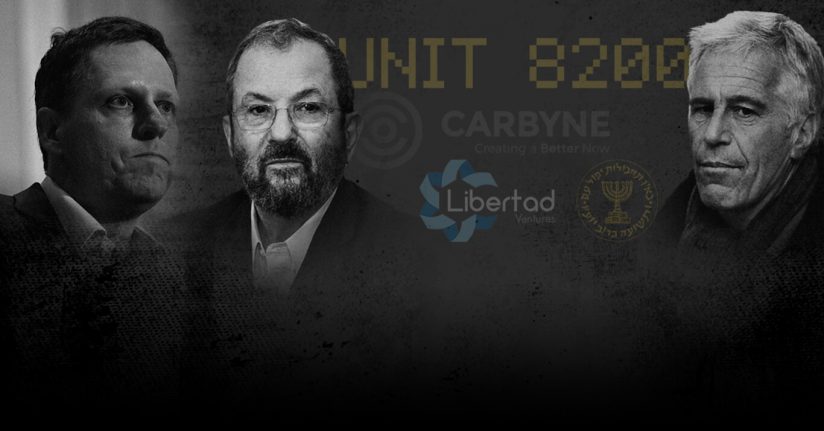
Following the arrest and subsequent death in prison of alleged child sex trafficker Jeffrey Epstein, a little-known Israeli tech company began to receive increased publicity, but for all the wrong reasons. Not long after Epstein’s arrest, and his relationships and finances came under scrutiny, it was revealed that the Israeli company Carbyne911 had received substantial funding from Jeffrey Epstein as well as Epstein’s close associate and former Prime Minister of Israel Ehud Barak, and Silicon Valley venture capitalist and prominent Trump backer Peter Thiel.
Carbyne911, or simply Carbyne, develops call-handling and identification capabilities for emergency response services in countries around the world, including the United States, where it has already been implemented in several U.S. counties and has partnered with major U.S. tech companies like Google. It specifically markets its product as a way of mitigating mass shootings in the United States without having to change existing U.S. gun laws.
Yet, Carbyne is no ordinary tech company, as it is deeply connected to the elite Israeli military intelligence division, Unit 8200, whose “alumni” often go on to create tech companies — Carbyne among them — that frequently maintain their ties to Israeli intelligence and, according to Israeli media reports and former employees, often “blur the line” between their service to Israel’s defense/intelligence apparatus and their commercial activity. As this report will reveal, Carbyne is but one of several Israeli tech companies marketing themselves as a technological solution to mass shootings that has direct ties to Israeli intelligence agencies.
In each case, these companies’ products are built in such a way that they can easily be used to illegally surveil the governments, institutions and civilians that use them, a troubling fact given Unit 8200’s documented prowess in surveillance as a means of obtaining blackmail and Israel’s history of using tech companies to aggressively spy on the U.S. government. This is further compounded by the fact that Unit 8200-linked tech companies have previously received U.S. government contracts to place “backdoors” into the U.S.’ entire telecommunications system as well as into the popular products of major American tech companies including Google, Microsoft and Facebook, many of whose key managers and executives are now former Unit 8200 officers.
Israeli Prime Minister Benjamin Netanyahu has made it no secret that placing Unit 8200 members in top positions in multinational tech companies is a “deliberate policy” meant to ensure Israel’s role as the dominant global “cyber power”, while also combating non-violent boycott movements targeting Israel’s violations of international law and stifling the United Nations’ criticisms of Israeli government policy and military operations abroad.
As Jeffrey Epstein’s links to intelligence in both the United States and Israel — the subject of a recent four-part series exclusive to MintPress — began to be revealed in full, his financing of Carbyne came under scrutiny, particularly for the company’s deep ties to Israeli intelligence as well as to certain Americans with known connections to U.S. intelligence. Ehud Barak’s own role as both financier and chairman of Carbyne has also added to that concern, given his long history of involvement in covert intelligence operations for Israel and his long-standing ties to Israeli military intelligence.
Another funder of Carbyne, Peter Thiel, has his own company that, like Carbyne, is set to profit from the Trump administration’s proposed hi-tech solutions to mass shootings. Indeed, after the recent shooting in El Paso, Texas, President Trump — who received political donations from and has been advised by Thiel following his election — asked tech companies to “detect mass shooters before they strike,” a service already perfected by Thiel’s company Palantir, which has developed “pre-crime software” already in use throughout the country. Palantir is also a contractor for the U.S. intelligence community and also has a branch based in Israel.
Perhaps most disturbing of all, whatever technological solution is adopted by the Trump administration, it is set to use a controversial database first developed as part of a secretive U.S. government program that involved notorious Iran-Contra figures like Oliver North as a means of tracking and flagging potential American dissidents for increased surveillance and detention in the event of a vaguely defined “national emergency.”
As this report will reveal, this database — often referred to as “Main Core” — was created with the involvement of Israeli intelligence and Israel remained involved years after it was developed, and potentially to the present. It was also used by at least one former CIA official on President Reagan’s National Security Council to blackmail members of Congress, Congressional staffers and journalists, among others.
Given recent reports on the Trump administration’s plan to create a new government agency to use “advanced technology” to identify “neurobehavioral signs” of “someone headed toward a violent explosive act” using data collected by consumer electronic devices, the picture painted by the technology currently being promoted and implemented under the guise of “keeping Americans safe” is deeply Orwellian. In fact, it points directly to the genesis of a far-reaching surveillance state far more extensive than anything yet seen in American history and it is being jointly developed by individuals connected to both American and Israeli intelligence.
Demystifying Carbyne
Carbyne911, which will be referred to simply as Carbyne in this report, is an Israeli tech-startup that promises to revolutionize how calls are handled by emergency service providers, as well as by governments, corporations and educational institutions. Not long after it was founded in 2014 by veterans of Israeli military intelligence, Carbyne began to be specifically marketed as a solution to mass shootings in the United States that goes “beyond the gun debate” and improves the “intelligence that armed emergency responders receive before entering an armed shooter situation” by providing video-streaming and acoustic input from civilian smartphones and other devices connected to the Carbyne network.
Prior to Jeffrey Epstein’s arrest in July, Carbyne had been receiving high praise from U.S. and Israeli media, with Fox News hailing the company’s services as the answer to the U.S.’ “aging 911 systems” and the Jerusalem Post writing that the company’s platform offers “hi-tech protection to social workers and school principals.” Other reports claimed that Carbyne’s services result in “a 65% reduction in time-to-dispatch.”
Carbyne’s call-handling/crisis management platform has already been implemented in several U.S. counties and the company has offices not only in the U.S. but also in Mexico, Ukraine and Israel. Carbyne’s expansion to more emergency service provider networks in the U.S. is likely, given that federal legislation seeks to offer grants to upgrade 911 call centers throughout the country with the very technology of which Carbyne is the leading provider. One of the main lobby groups promoting this legislation, the National Emergency Number Association (NENA), has a “strong relationship” with Carbyne, according to Carbyne’s website. In addition, Carbyne has also begun marketing its platform for non-emergency calls to governments, educational institutions and corporations.
Yet, what seemed like the inevitability of Carbyne’s widespread adoption in the U.S. hit a snag following the recent arrest and subsequent death of sex trafficker and pedophile Jeffrey Epstein, who exploited underage girls for the purpose of obtaining “blackmail” on the rich and poweful, an operation that had clear ties to intelligence. Epstein, after his first arrest and light sentence for soliciting sex from a minor in 2007, was tapped by former Israeli Prime Minister and former head of Israeli military intelligence Ehud Barak, to become a key financial backer of Carbyne.
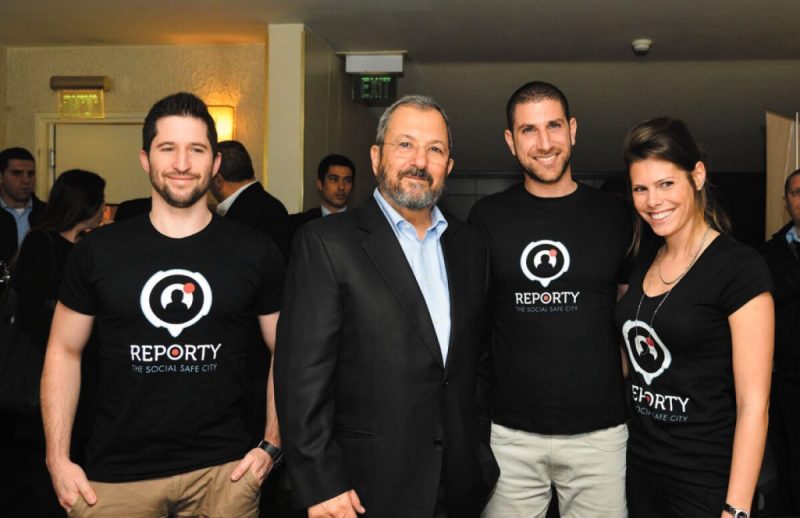
Ehud Barak, center, poses with Carbyne co-founders Alex Dizengof, Amir Elichai and Lital Leshem. Photo | Yossi Seliger
As a result of increased scrutiny of Epstein’s business activities and his ties to Israel, particularly to Barak, Epstein’s connection to Carbyne was revealed and extensively reported on by the independent media outlet Narativ, whose exposé on Carbyne revealed not only some of the key intelligence connections of the start-up company but also how the architecture of Carbyne’s product itself raises “serious privacy concerns.”
MintPress detailed many of Carbyne’s main intelligence connections in Part III of the investigative series “Inside the Jeffrey Epstein Scandal: Too Big to Fail.” In addition to Barak — former Israeli prime minister and former head of Israeli military intelligence — serving as Carbyne’s chairman and a key financer, the company’s executive team are all former members of Israeli intelligence, including the elite military intelligence unit, Unit 8200, which is often compared to the U.S. National Security Agency (NSA).
Carbyne’s current CEO, Amir Elichai, served in Unit 8200 and tapped former Unit 8200 commander and current board member of AIPAC Pinchas Buchris to serve as the company’s director and on its board. In addition to Elichai, another Carbyne co-founder, Lital Leshem, also served in Unit 8200 and later worked for Israeli private spy company Black Cube. The only Carbyne co-founder that didn’t serve in Unit 8200 is Alex Dizengof, who previously worked for Israel’s Prime Minister’s office.
As MintPress noted in a past report detailing Israeli military intelligence’s deep ties to American tech giant Microsoft, Unit 8200 is an elite unit of the Israeli Intelligence corps that is part of the IDF’s Directorate of Military Intelligence and is involved mainly in signal intelligence (i.e., surveillance), cyberwarfare and code decryption. It is frequently described as the Israeli equivalent of the NSA and Peter Roberts, senior research fellow at Britain’s Royal United Services Institute, characterized the unit in an interview with the Financial Times as “probably the foremost technical intelligence agency in the world and stand[ing] on a par with the NSA in everything except scale.”
Notably, the NSA and Unit 8200 have collaborated on numerous projects, most infamously on the Stuxnet virus as well as the Duqu malware. In addition, the NSA is known to work with veterans of Unit 8200 in the private sector, such as when the NSA hired two Israeli companies, to create backdoors into all the major U.S. telecommunications systems and major tech companies, including Facebook, Microsoft and Google. Both of those companies, Verint and Narus, have top executives with ties to Israeli intelligence and one of those companies, Verint (formerly Comverse Infosys), has a history of aggressively spying on U.S. government facilities. Unit 8200 is also known for spying on civilians in the occupied Palestinian territories for “coercion purposes” — i.e., gathering info for blackmail — and also for spying on Palestinian-Americans via an intelligence-sharing agreement with the NSA.
Unlike many other Unit 8200-linked start-ups, Carbyne also boasts several tie-ins to the Trump administration, including Palantir founder and Trump ally Peter Thiel — another investor in Carbyne. In addition, Carbyne’s board of advisers includes former Palantir employee Trae Stephens, who was a member of the Trump transition team, as well as former Secretary of Homeland Security Michael Chertoff. Trump donor and New York real-estate developer Eliot Tawill is also on Carbyne’s board, alongside Ehud Barak and Pinchas Buchris.
Yet, privacy concerns with Carbyne go beyond the company’s ties to Israeli intelligence and U.S. intelligence contractors like Peter Thiel. For instance, Carbyne’s smartphone app extracts the following information from the phones on which it is installed:
Device location, video live-streamed from the smartphone to the call center, text messages in a two-way chat window, any data from a user’s phone if they have the Carbyne app and ESInet, and any information that comes over a data link, which Carbyne opens in case the caller’s voice link drops out.” (emphasis added)
According to Carbyne’s website, this same information can also be obtained from any smartphone, even if it does not have Carbyne’s app installed, if that phone calls a 911 call center that uses Carbyne or merely any other number connected to Carbyne’s network.

Carbyne gathers data points from users’ phones as well as a myriad of other web-connected devices.
Carbyne is a Next-Generation 9-11 (NG911) platform and the explicit goal of NG911 is for all 911 systems nationwide to become interconnected. Thus, even if Carbyne is not used by all 911 call centers using an NG911 platform, Carbyne will ostensibly have access to the data used by all emergency service providers and devices connected to those networks. This guiding principle of NG911 also makes it likely that one platform will be favored at the federal level to foster such interconnectivity and, given that it has already been adopted by several counties and has ties to the Trump administration, Carbyne is the logical choice.
Another cause for concern is how other countries have used platforms like Carbyne, which were first marketed as emergency response tools, for the purpose of mass surveillance. Narativ noted the following in its investigation of Carbyne:
In May, Human Rights Watch revealed Chinese authorities use a platform not unlike Carbyne to illegally surveil Uyghurs. China’s Integrated Joint Operations Platform brings in a much bigger data-set and sources of video, which includes an app on people’s phones. Like Carbyne, the platform was designed to report emergencies. Chinese authorities have turned it into a tool of mass surveillance.
Human Rights Watch reverse-engineered the app. The group discovered the app automatically profiles a user under 36 “person types” including “followers of Six Lines” which is the term used to identify Uyghurs. Another term refers to “Hajj,” the annual Islamic pilgrimage to Mecca. The app monitors every aspect of a user’s life, including personal conversations [and] power usage, and tracks a user’s movement.”
Such technology is currently used by Israeli military intelligence and Israel’s domestic intelligence agency Shin Bet to justify “pre-crime” detentions of Palestinians in the occupied West Bank. As will be noted in greater detail later in this report, Palestinians’ comments on social media are tracked by artificial intelligence algorithms that flag them for indefinite detention if they write social media posts that contain “tripwire” phrases such as “the sword of Allah.”
Carbyne’s platform has its own “pre-crime” elements, such as it’s c-Records component, which stores and analyzes information on past calls and events that pass through its network. This information “enables decision makers to accurately analyze the past and present behavior of their callers, react accordingly, and in time predict future patterns.” (emphasis added)
Concerns have recently been raised that “pre-crime” technology may soon become more widely adopted in the U.S., after President Trump stated that one of his planned solutions to mass shootings in the wake of the recent tragedy in El Paso was for big tech companies to detect potential shooters before they strike.
Israeli intelligence, Blackmail and Silicon Valley
Though many of the individuals involved in funding or managing Carbyne have proven ties to intelligence, a closer look into several of these players reveals even deeper connections to both Israeli and U.S. intelligence.
One of Carbyne’s clearest connections to Israeli intelligence is through its chairman and one of its funders, Ehud Barak. Though Barak is best known for being a former prime minister of Israel, he is also a former minister of defense and the former head of Israeli military intelligence. He oversaw Unit 8200’s operations, as well as other units of Israeli military intelligence, in all three of those positions. For most of his military and later political career, Barak has been closely associated with covert operations.
Prior to the public scrutiny of Barak’s relationship to Jeffrey Epstein, following the latter’s arrest this past July and subsequent death, Barak had come under fire for his ties to disgraced film mogul Harvey Weinstein. Indeed, it was Ehud Barak who put Weinstein in contact with the Israeli private intelligence outfit Black Cube, which employs former Mossad agents and Israeli military intelligence operatives, as Weinstein sought to intimidate the women who had accused him of sexual assault and sexual harassment. Former Mossad director Meir Dagan led Black Cube’s board until his death in 2016 and Carbyne co-founder Lital Leshem is Black Cube’s former director of marketing.
After Barak put him in contact with Black Cube’s leadership, Weinstein, according to The New Yorker, used the private spy firm to “‘target,’ or collect information on, dozens of individuals, and compile psychological profiles that sometimes focused on their personal or sexual histories.” In addition, The New Yorker noted that “Weinstein monitored the progress of the investigations personally” and “also enlisted former employees from his film enterprises to join in the effort, collecting names and placing calls that, according to some sources who received them, felt intimidating.”
Yet, more recently, it has been Barak’s close relationship to Epstein that has raised eyebrows and opened him up to political attacks from his rivals. Epstein and Barak were first introduced by former Israeli Prime Minister Shimon Peres in 2002, a time when Epstein’s pedophile blackmail and sex trafficking operation was in full swing.
Barak was a frequent visitor to Epstein’s residences in New York, so often that The Daily Beast reported that numerous residents of an apartment building linked to Epstein “had seen Barak in the building multiple times over the last few years, and nearly half a dozen more described running into his security detail,” adding that “the building is majority-owned by Epstein’s younger brother, Mark, and has been tied to the financier’s alleged New York trafficking ring.” Specifically, several apartments in the building were “being used to house underage girls from South America, Europe and the former Soviet Union,” according to a former bookkeeper employed by one of Epstein’s main procurers of underage girls, Jean Luc Brunel.
Barak is also known to have spent the night at one of Epstein’s residences at least once, was photographed leaving Epstein’s residence as recently as 2016, and has admitted to visiting Epstein’s island, which has sported nicknames including “Pedo Island,” “Lolita Island” and “Orgy Island.” In 2004, Barak received $2.5 million from Leslie Wexner’s Wexner Foundation, where Epstein was a trustee as well as one of the foundation’s top donors, officially for unspecified “consulting services” and “research” on the foundation’s behalf.
In 2015, Barak formed a limited partnership company in Israel for the explicit purpose of investing in Carbyne (then known as Reporty) and invested millions of dollars in the company, quickly becoming a major shareholder and subsequently the company’s public face and the chairman of its board. At least $1 million of the money invested in this Barak-created company that was later used to invest in Carbyne came from the Southern Trust Company, which was owned by Jeffrey Epstein.
In a statement to the Israeli newspaper Haaretz, Barak asserted:
I saw the business opportunity and registered a partnership in my control in Israel. A small number of people I know invest in it… Since these are private investments, it wouldn’t be proper or right for me to expose the investors’ details.”
However, Barak later admitted that Epstein had been one of the investors.
MintPress’ recent series on the Jeffrey Epstein scandal noted in detail Epstein’s ties to CIA/Mossad intelligence assets, such as Adnan Khashoggi; CIA front companies, such as Southern Air Transport; and organized crime, through his close association with Leslie Wexner. In addition, Epstein’s long-time “girlfriend” and alleged madam, Ghislaine Maxwell, has family links to Israeli intelligence through her father, Robert Maxwell. While it appears that Epstein may have been working for more than one intelligence agency, Zev Shalev, former executive producer for CBS News and journalist at Narativ, recently stated that he had independently confirmed with two unconnected sources “closely connected to the Epstein story and in a position to know” that Epstein had “worked for Israeli military intelligence.”
Exclusive: We have two independent sources confirming Jeffrey Epstein worked for Israeli military intelligence. In each case the source is closely connected to the Epstein story and in a position to know. You can take it to the bank. @narativlive https://t.co/BdK1DrZEO6
— Zev Shalev (@ZevShalev) August 20, 2019
Notably, Epstein, who was known for his interest in obtaining blackmail through the sexual abuse of the underaged girls he exploited, also claimed to have “damaging information” on prominent figures in Silicon Valley. In a conversation last year with New York Times reporter James Stewart, Epstein claimed to have “potentially damaging or embarrassing” information on Silicon Valley’s elite and told Stewart that these top figures in the American tech industry “were hedonistic and regular users of recreational drugs.” Epstein also told Stewart that he had “witnessed prominent tech figures taking drugs and arranging for sex” and claimed to know “details about their supposed sexual proclivities.”
In the lead-up to his recent arrest, Jeffrey Epstein appeared to have been attempting to rebrand as a “tech investor,” as he had done interviews with several journalists including Stewart about technology investing in the months before he was hit with federal sex trafficking charges.
Jessica Lessin, editor-in-chief of The Information, told Business Insider that a journalist working for The Information had interviewed Epstein a month before his recent arrest because “he was believed to be an investor in venture capital funds.” However, Lessin claimed that the interview was not “newsworthy” and said the site had no plans to publish its contents. Business Insider claimed that the way the interviews with Epstein had been arranged “suggests that someone in Silicon Valley may have been trying to help Epstein connect with reporters.”
Though it is unknown exactly which Silicon Valley figures were most connected to Epstein and which tech executives were potentially being blackmailed by Epstein, it is known that Epstein associated with several prominent tech executives, including Google co-founder Sergey Brin, Facebook co-founder Mark Zuckerberg, Tesla CEO Elon Musk, Microsoft co-founder Bill Gates, and LinkedIn co-founder Reid Hoffman.
Last year, Epstein claimed to be advising Tesla and Elon Musk, who had been previously photographed with Epstein’s alleged madam Ghislaine Maxwell. A few years ago, Epstein also attended a dinner hosted by LinkedIn’s Reid Hoffman, where Musk had allegedly introduced Epstein to Mark Zuckerberg. Google’s Sergey Brin is known to have attended a dinner hosted by Epstein at his New York residence where Donald Trump was also in attendance.

Elon Musk with Epstein’s alleged madam Ghislaine Maxwell at an Oscars after-party on March 2, 2014. Kevin Mazur | VF14
These associations suggest that the person in Silicon Valley who was trying to boost Epstein’s image as a tech investor before his arrest may have been Peter Thiel, whose Founders Fund had also invested in Carbyne. Thiel was an early investor in Facebook and is still on its board, connecting him to Zuckerberg; he is also a funder of Elon Musk’s SpaceX and a former colleague of Musk’s through PayPal. In addition, Thiel has ties to Reid Hoffman and both Thiel and Hoffman are prominent backers of Facebook.
It is unknown whether Epstein’s “damaging information” and apparent blackmail on notable individuals in the American technology industry were used to advance the objectives of Carbyne, which recently partnered with tech giants Google and Cisco Systems — and, more broadly, the expansion of Israeli intelligence-linked tech companies into the American tech sector, particularly through the acquisition of Israeli tech start-ups linked to Unit 8200 by major U.S. tech companies.
The latter seems increasingly likely given that the father of Ghislaine Maxwell — one of Epstein’s chief co-conspirators in his intelligence-linked sexual blackmail operation involving minors — was a Mossad operative who helped sell software that had been bugged by Israeli intelligence to government agencies and sensitive facilities around the world, including in the United States.
As will be noted later in this report, Israel’s Prime Minister Benjamin Netanyahu — to whom all of Israel’s intelligence agencies answer by virtue of his position — has stated on more than one occasion that the acquisition of Israeli intelligence-linked start-ups by foreign tech giants, especially in Silicon Valley, is a current and “deliberate policy” of the state of Israel.
Carbyne’s ties to U.S. intelligence
While Epstein and Barak are the two financiers of Carbyne whose ties to intelligence are clearest, another funder of Carbyne, Peter Thiel, has ties to U.S. intelligence and a history of investing in other companies founded by former members of Unit 8200. Thiel co-founded and still owns a controlling stake in the company Palantir, which was initially funded with a $2 million investment from the CIA’s venture capital fund In-Q-Tel and quickly thereafter became a contractor for the CIA.
After the success of its contract with the CIA, Palantir became a contractor for a variety of federal agencies, including the FBI, the Defense Intelligence Agency (DIA), the National Security Agency (NSA), the Department of Homeland Security(DHS) and the military’s Special Operations Command, among others. Last year, it won a contract to create a new battlefield intelligence system for the U.S. Army. Palantir is also in demand for its “pre-crime technology,” which has been used by several U.S. police departments. According to the Guardian, “Palantir tracks everyone from potential terrorist suspects to corporate fraudsters, child traffickers and what they refer to as ‘subversives’… it is all done using prediction.”
Thiel has gained attention in recent years for his support of President Trump and for becoming an adviser to Trump following the 2016 election, when he was “a major force in the transition,” according to Politico, and “helped fill positions in the Trump administration with former staff.” One of those former staffers was Trae Stephens, who is also on Carbyne’s board of advisers. Thiel also has business ties to Trump’s son-in-law and influential adviser, Jared Kushner, as well as to Kushner’s brother Josh. A senior Trump campaign aide told Politico in 2017 that “Thiel is immensely powerful within the administration through his connection to Jared.”
Thiel has also backed some prominent Israeli tech start-ups connected to Unit 8200, such as BillGuard, which Thiel funded along with former Google CEO Eric Schmidt and other investors. BillGuard was founded by Raphael Ouzan, a former officer in Unit 8200, who serves on the board of directors of Start-Up Nation Central (SUNC) alongside neoconservative American hedge fund manager Paul Singer, neoconservative political operative and adviser Dan Senor, and Terry Kassel, who works for Singer at his hedge fund, Elliott Management.
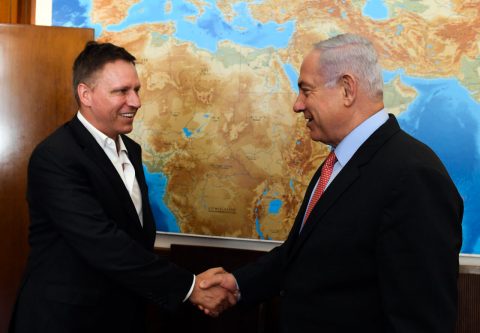
Peter Thiel greets Netanyahu during a 2017 meeting in Israel. Photo | Israel PM
SUNC is an organization founded by Paul Singer, who has donated heavily to both President Trump and Israeli Prime Minister Netanyahu. Since it was founded in 2012, SUNC has sought to integrate Unit 8200-connected Israeli tech start-ups into foreign companies, primarily American companies, and has helped oversee the shift of thousands of high-paying tech jobs from the U.S. to Israel.
Another Carbyne-connected individual worth noting is the former head of the Department of Homeland Security, Michael Chertoff, who serves on Carbyne’s board of advisers. In addition to Chertoff’s ties to DHS, Chertoff’s company, The Chertoff Group, employees several prominent former members of the U.S. intelligence community as principals, including Michael Hayden, former director of the CIA and former director of the NSA; and Charles Allen, former assistant director of Central Intelligence for Collection at the CIA, who worked at the agency for over 40 years.
The Chertoff Group has a long-standing and lucrative contract with the company OSI Systems, which produces full-body scanners and markets itself as a solution to mass shootings and crisis events, not unlike Carbyne. While Chertoff’s company was advising OSI Systems, Chertoff went on a media blitz to promote the widespread use of the machines produced by OSI Systems and even called on Congress to “fund a large-scale deployment of next-generation systems.” Chertoff did not disclose his conflict of interest while publicly promoting OSI’s full-body scanners.
Some have also alleged that Chertoff’s mother, Livia Eisen, had links to Israeli intelligence. According to her 1998 obituary, cited by both researcher/author Christopher Bollyn and journalist Jonathan Cook, Eisen participated in the Mossad operation code-named “Magic Carpet” while working for Israel’s El Al Airlines. Both Bollyn and Cook have suggested that Eisen’s participation in this covert Israeli intelligence operation strongly indicates that she had ties to the Mossad.
Melding into Silicon Valley
Beyond its troubling connections to Silicon Valley oligarchs, Israeli military intelligence and the U.S.-military industrial complex, Carbyne’s recent partnerships with two specific technology companies — Google and Cisco Systems — raise even more red flags.
Carbyne announced its partnership with Cisco Systems this past April, with the latter announcing that it would begin “aligning its unified call manager with Carbyne’s call-handling platform, allowing emergency call centers to collect data from both 911 callers and nearby government-owned IoT [Internet of Things] devices.” A report on the partnership published by Government Technology magazine stated that “Carbyne’s platform will be integrated into Cisco Kinetic for Cities, an IoT data platform that shares data across community infrastructure, smart city solutions, applications and connected devices.” The report also noted that “Carbyne will also be the only 911 solution in the Cisco Marketplace.”
As part of the partnership, Carbyne’s President of North American Operations Paul Tatro told Government Technology that the Carbyne platform would combine the data it obtains from smartphones and other Carbyne-connected devices with “what’s available through nearby Cisco-connected road cameras, roadside sensors, smart streetlamps, smart parking meters or other devices.” Tatro further asserted that “Carbyne can also analyze data that’s being collected by Cisco IoT devices … and alert 911 automatically, without any person making a phone call, if there appears to be a worthy problem,” and expressed his view that soon most emergency calls will not be made by human beings but “by smart cars, telematics or other smart city devices.”
A few months after partnering with Cisco Systems, Carbyne announced its partnership with Google on July 10, just three days after Carbyne funder Jeffrey Epstein was arrested in New York on federal sex trafficking charges. Carbyne’s press release of the partnership described how the company and Google would be teaming up in Mexico “to offer advanced mobile location to emergency communications centers (ECCs) throughout Mexico” following the conclusion of a successful four-week pilot program between Carbyne and Google in the Central American nation.

Google Executive Chairman Eric Schmidt meets Netanyahu at his Jerusalem office. Israel PM | YouTube
The press release also stated:
Carbyne will provide Google’s Android ELS (Emergency Location Service) in real time from emergency calls made on AndroidTM devices. Deployment for any ECC in the country won’t require any integration, with Carbyne providing numerous options for connection to their secure ELS Gateway once an ECC is approved. The Carbyne automated platform, requiring no human interaction, has the potential to save thousands of lives each year throughout Mexico.”
The reason Carybne’s partnerships with Cisco Systems and Google are significant lies in the role that Cisco and former Google CEO Eric Schmidt have played in the creation of a controversial “incubator” for Israeli tech start-ups with deep ties to Israeli military intelligence, American neoconservative donor Paul Singer, and the U.S.’ National Security Agency (NSA).
This company, called Team8, is an Israeli company-creation platform whose CEO and co-founder is Nadav Zafrir, former commander of Unit 8200. Two of the company’s other three co-founders are also “alumni” of Unit 8200. Among Team8’s top investors is Schmidt, the former CEO of Google, who also joined Peter Thiel in funding the Unit 8200-linked BillGuard, as well as major tech companies including Cisco Systems and Microsoft.
Last year, Team8 controversially hired the former head of the NSA and U.S. Cyber Command, Retired Admiral Mike Rogers, and Zafrir stated that his interest in hiring Rogers was that Rogers would be “instrumental in helping strategize” Team8’s expansion in the United States. Jake Williams, a veteran of NSA’s Tailored Access Operations (TAO) hacking unit, told CyberScoop:
Rogers is not being brought into this role because of his technical experience. … It’s purely because of his knowledge of classified operations and his ability to influence many in the U.S. government and private-sector contractors.”
Team8 has also been heavily promoted by Start-Up Nation Central (SUNC). SUNC prominently features Team8 and Zafrir on the cybersecurity section of its website and also sponsored a talk by Zafrir and an Israeli government economist at the World Economic Forum, often referred to as “Davos,” that was attended personally by Paul Singer.
SUNC itself has deep ties to Israeli military intelligence, with former Unit 8200 officer Raphael Ouzan serving on its board of directors. Another example of SUNC-Unit 8200 ties can be seen with Inbal Arieli, who served as SUNC’s Vice President of Strategic Partnerships from 2014 to 2017 and continues to serve as a senior adviser to the organization. Arieli, a former lieutenant in Unit 8200, is the founder and head of the 8200 Entrepreneurship and Innovation Support Program (EISP), which was the first start-up accelerator in Israel aimed at harnessing “the vast network and entrepreneurial DNA of [Unit] 8200 alumni” and is currently one of the top company accelerators in Israel, alongside Team8. Arieli was the top executive at 8200 EISP while working at SUNC and several other top SUNC staffers are also connected to Israeli military intelligence.
Thus, Google and Cisco’s connections to Team8 suggests that their partnerships with another Israeli military intelligence-connected firm like Carbyne is a deepening of those two companies’ links to the growing bi-national security state that is uniting key players in the U.S. military-industrial complex and Israeli intelligence.
Mossad-backed Panic Buttons, coming to a school near you
Carbyne is hardly the only Israeli intelligence-linked tech company marketing itself in the United States as a solution to mass shootings. Another Israeli start-up, known as Gabriel, was founded in 2016 in response to a shooting in Tel Aviv and the Pulse Nightclub shooting in the United States, which took place just days apart.
Created by Israeli-American Yoni Sherizen and Israeli citizen Asaf Adler, Gabriel is similar to Carbyne in the sense that elements of its crisis response platform require installation on civilian smartphones as well as devices used by crisis responders. The main difference is that Gabriel also installs one or a series of physical “panic buttons,” depending on the size of the building to be secured, that also double as video and audio communication devices connected to the Gabriel network.
As with Carbyne, the ties between Gabriel and Israeli intelligence are obvious. Indeed, Gabriel’s four-person advisory board includes Ram Ben-Barak, former deputy director of the Mossad and former director-general of Israel’s intelligence ministry; Yohanan Danino, former chief of police for the state of Israel; and Kobi Mor, former director of overseas missions for the Israeli intelligence agency Shin Bet. The only American on the advisory board is Ryan Petty, the father of a Parkland shooting victim and friend of former Florida Governor Rick Scott.
Gabriel’s only disclosed funder is U.S.-based MassChallenge, a start-up accelerator non-profit. Gabriel is funded by MassChallenge’s Israel branch, which was opened six months prior to Gabriel’s creation and is partnered with the Israeli government and the Kraft Group. The Kraft Group is managed by Robert Kraft, who is currently embroiled in a prostitution scandal and is also a close friend of President Trump.
Notably, one of MassChallenge Israel’s featured experts is Wendy Singer, the executive director of SUNC, the organization created and funded by neoconservative Trump backer Paul Singer with the explicit purpose of promoting Israel’s tech start-ups and their integration into foreign, chiefly American, businesses. As was noted in a recent MintPress report on SUNC, Wendy Singer is the sister of neoconservative political operative Dan Senor, who founded the now-defunct Foreign Policy Initiative with Robert Kagan and Bill Kristol, and was previously the director of AIPAC’s Israel office for 16 years.
Gabriel’s founders have been quite upfront about the fact that the uptick in shootings in the U.S. has greatly aided their company’s growth and success. Last November, Sherizen told The Jerusalem Post that new mass shootings in the U.S. not only increased U.S. demand for his company’s product but also were opportunities to show the effectiveness of Gabriel’s approach:
Unfortunately every month there seems to be another high-profile event of this nature. After the Vegas shooting, we were able to show [that] our system would have managed to identify the location of the shooter much quicker.”
The Jerusalem Post noted that Gabriel is set to make considerable profits if concern over mass shootings continues to build in the U.S., writing:
With more than 475,000 soft targets across the US and amid increasing security fears, the potential market for Gabriel is huge. The company could gain revenues of almost $1 billion if only 10% of soft targets were to invest around $20,000 in its alert systems.”
Sherizen told the Jerusalem Post:
Our starter kit costs $10,000. Depending on the size and makeup of the community building, it would cost between $20-30,000 to fully outfit the location. We have made it very affordable. This is a game-changer for the lock-down and active shooter drills that are now a standard part of any child’s upbringing in the States.”
Much more than just a start-up
While it is certainly possible that numerous former officials and commanders of elite Israeli intelligence agencies may have no ulterior motive in advising or founding technology start-up companies, it is worth pointing out that top figures in Israel’s military intelligence agencies and the Mossad don’t see it that way.
Last March, Israeli media outlet Calcalist Tech published a report entitled “Israel Blurs the Line Between Defense Apparatus and Local Cybersecurity Hub,” which noted that “since 2012, cyber-related and intelligence projects that were previously carried out in-house in the Israeli military and Israel’s main intelligence arms are transferred to companies that in some cases were built for this exact purpose.” (emphasis added)
The article notes that beginning in 2012, Israel’s intelligence and military intelligence agencies began to outsource “activities that were previously managed in-house, with a focus on software and cyber technologies.” (emphasis added)
It continues:
In some cases, managers of development projects in the Israeli military and intelligence arms were encouraged to form their own companies, which then took over the project,’ an Israeli venture capitalist familiar with the matter told Calcalist Tech.”
Notably, Calcalist Tech states that the controversial company Black Cube was created this way and that Black Cube had been contracted, and is likely still contracted, by Israel’s Ministry of Defense. The private security agency Black Cube is known to have two separate divisions for corporations and governments. The firm was recently caught attempting to undermine the Iran nuclear deal — then also a top political objective of Israeli Prime Minister Benjamin Netanyahu — by attempting to obtain information on the “financial or sexual impropriety” (i.e., blackmail) of top U.S. officials involved in drafting the accord. NBC News noted last year that “Black Cube’s political work frequently intersects with Israel’s foreign policy priorities.” As previously mentioned, one of Carbyne’s co-founders — Lital Leshem, also a veteran of Unit 8200 — worked for Black Cube prior to starting Carbyne.
One of the main companies profiled in the Calcalist Tech report appeared to be a front for Israeli intelligence, as its registered owner was found not to exist: even high-level employees at the company had never heard of him; his registered addresses were for nonexistent locations in Israel’s capital of Tel Aviv; and the three people with that name in Tel Aviv denied any association with the business.
This company — which Calcalist Tech was unable to name after the Israeli military censor determined that doing so could negatively impact Israeli “national security” — was deliberately created to service the Israeli military and Israeli intelligence. It is also “focused on cyber technologies with expertise in research and development of advanced products and applications suitable for defense and commercial entities.” (emphases added) In addition, the company’s management consists largely of “veterans of Israeli military technology units.”
Notably, a former employee of this company told Calcalist Tech that “crossing the lines between military service and employment at the commercial outfit was ‘commonplace’ while he was working at the company.”
It’s not exactly clear why Israel’s military intelligence and other intelligence agencies decided to begin outsourcing its operations in 2012, though Calcalist Tech suggests the reasoning was related to the difference in wages between the private sector and the public sector, with pay being much higher in the former. However, it is notable that 2012 was also the year that Paul Singer — together with Netanyahu’s long-time economic adviser and former chair of the Israeli National Economic Council, Eugene Kandel — decided to create Start-Up Nation Central.
As MintPress noted earlier this year, SUNC was founded as part of a deliberate Israeli government effort to counter the nonviolent Boycott, Divest and Sanctions (BDS) movement and to make Israel the dominant global “cyber power.” This policy is aimed at increasing Israel’s diplomatic power and specifically undermining BDS as well as the United Nations, which has repeatedly condemned Israel’s government for war crimes and violations of international law in relation to the Palestinians.
Last year, Netanyahu was asked by Fox News host Mark Levin whether the large growth seen in recent years in Israel’s technology sector, specifically tech start-ups, was part of Netanyahu’s plan. Netanyahu responded, “That’s very much my plan … It’s a very deliberate policy.” He later added that “Israel had technology because the military, especially military intelligence, produced a lot of capabilities. These incredibly gifted young men and women who come out of the military or the Mossad, they want to start their start-ups.”
Netanyahu again outlined this policy at the 2019 Cybertech Conference in Tel Aviv, where he stated that Israel’s emergence as one of the top five “cyber powers” had “required allowing this combination of military intelligence, academia and industry to converge in one place” and that this further required allowing “our graduates of our military and intelligence units to merge into companies with local partners and foreign partners.”
The direct tie-ins of SUNC to Israel’s government and the successful effort led by SUNC and other companies and organizations to place former military intelligence and intelligence operatives in strategic positions in major multinational technology companies reveal that this “deliberate policy” has had a major and undeniable impact on the global tech industry, especially in Silicon Valley.
Mossad gets its own In-Q-Tel
This “deliberate policy” of Netanyahu’s also recently resulted in the creation of a Mossad-run venture capital fund that is specifically focused on financing Israeli tech start-ups. The venture capital fund, called Libertad, was first announced by Israel’s Prime Minister’s Office and was created with the explicit purpose of “increasing the Israeli intelligence agency’s knowledge base and fostering collaboration with Israel’s vibrant startup scene” It was modeled after the CIA’s venture capital fund In-Q-Tel, which invested in several Silicon Valley companies turned government and intelligence contractors — including Google and Palantir — with a similar goal in mind.
Libertad declines to reveal the recipients of its funding, but announced last December that it had chosen five companies in the fields of robotics, energy, encryption, web intelligence, and natural language processing and text analysis. In regard to its interest in web intelligence, a Mossad employee told the Jerusalem Post that the intelligence agency was specifically interested in “innovative technologies for [the] automatic identification of personality characteristics – personality profiling – based on online behavior and activity, using methods based on statistics, machine learning, and other areas.” (emphasis added)
According to Libertad’s website, in return for its investment, now set at NIS 2 million (~$580,000) per year per company, “the Mossad will receive access to the IP [initial product] developed during R&D [Research and Development] while under contract, and a non-commercial, non-exclusive license to use it. Libertad’s contract with the company will not provide it with any additional rights.” In an interview with Calcalist Tech, Mossad Director Yossi Cohen told the paper that the Mossad’s partnership with civilian companies in Israel is “excellent” and that the agency will continue to strengthen those ties.
Israeli intelligence has a documented history in placing “backdoors” into technology products for the purpose of surveillance, with one well-known case being Israel’s repurposing of the PROMIS software, discussed in Part III of MintPress’ series on Jeffrey Epstein. Furthermore, given that U.S. intelligence, specifically the NSA, had “backdoors” placed into the products of major Silicon Valley companies (a service performed by Israeli intelligence-linked tech companies no less), Mossad may very well plan on doing the same with the technology products of companies it backs through Libertad.
Tim Shorrock, investigative journalist and author of Spies For Hire: The Secret World of Intelligence Outsourcing, told MintPress that the Mossad’s continuation of such practices through Libertad was definitely plausible, especially given what Shorrock described as the “unusual” choice of Libertad choosing not to release the identities of the companies in which it invests.
“The Mossad is trying to hide what they are investing in,” Shorrock stated, adding that Libertad’s secrecy “raises a lot of questions” particularly given that it was modeled after the CIA’s In-Q-Tel. Shorrock noted that In-Q-Tel and other venture capital funds with ties to U.S. intelligence or the U.S. military rarely, if ever, hide the identities of the companies they finance.
However, Libertad is merely the latest and most public expression of the Mossad’s interest in Israeli tech start-ups, the lion’s share of which are created by veterans of Unit 8200 or other Israeli intelligence agencies. Indeed, former Mossad Director Tamir Pardo stated in 2017 that “everyone” in the Israeli cybertechnology sector is an “alumni” of either Israeli intelligence, like the Mossad, or Israeli military intelligence, like Unit 8200. Pardo even went as far as to say that the Mossad itself is “like a start-up.”
Pardo himself, after leaving his post as Mossad director in 2016, dove straight into the world of Israeli tech start-ups, becoming chairman of Sepio Systems, whose two CEOs are former Unit 8200 officers. Sepio Systems’ advisory board includes the former chief information security officer of the CIA, Robert Bigman; former member of the U.S. Military’s Joint Special Operations Command (JSOC), Geoff Hancock; and former head of the Israel National Cyber Bureau and veteran of Israeli military intelligence, Rami Efrati. Sepio Systems’ cybersecurity software has been adopted by several banks, telecom and insurance companies, including in the U.S. and Brazil.
Pardo is not the only prominent figure in Israel’s intelligence community to compare Israeli intelligence agencies to tech start-ups. Shin Bet Director Nadav Argaman described Israel’s domestic spy agency in similar terms. “The Shin Bet is like an evolving start-up, with unmatched strength,” Argaman stated in a June 2017 speech, as he extolled the agency’s use of “pre-crime” technology to detain Palestinians based on their social media activity.
Argaman, at the time, claimed that more than 2,000 Palestinians, whom he described as “potential lone-wolf terrorists,” had been arrested as a result of these “breakthrough technological advances” that use artificial-intelligence algorithms to monitor the social media accounts of Palestinians, especially younger Palestinians, for the use of “tripwire” phrases that have been used by Palestinians who later committed acts of violence. In the case of those who use such terms, “their phones are tracked to see if they meet other suspects, or leave their districts to move towards potential Israeli targets. In such cases, security forces detain the suspect,” according to a 2017 report on the practice by The Economist.
The road to fascism, paved by a corrupted PROMIS
Though Israeli intelligence’s interest in tech companies goes back several years, there is a well-documented history of Israeli intelligence using bugged software to surveil and gain “backdoor” access to government databases around the world, particularly in the United States.
As was mentioned in Part III of MintPress’ Epstein series, a sinister yet cunning plan was executed to place a backdoor for Israeli intelligence into the Prosecutor’s Management Information System (PROMIS) software, which was then being used by the U.S. Department of Justice and was the envy of government agencies, particularly intelligence agencies, around the world. This bugged version of PROMIS — born out of the collusion between Earl Brian, Ronald Reagan’s then-envoy to Iran, and Rafi Eitan, then-director of the now-defunct Israeli intelligence agency Lekem — was seeded around the world by Brian’s company Hadron as well as by Mossad-linked media mogul Robert Maxwell, father of Jeffrey Epstein’s long-time girlfriend and alleged madam, Ghislaine Maxwell.
After this first PROMIS “backdoor” was discovered, Israel would again gain access to sensitive U.S. government communications, as well as civilian communications, thanks to the collusion between Israeli intelligence and Israeli telecom and tech companies, especially Amdocs and Comverse Infosys (now Verint), that were operating throughout the United States. Today, Unit 8200-linked start-ups appear to have taken up the torch.
While the PROMIS software is perhaps best known for offering Israeli intelligence a backdoor into as many as 80 intelligence agencies and other sensitive locations around the world for nearly a decade, it was also used for a very different purpose by prominent officials linked to Iran-Contra.
One key Iran-Contra figure — Lt. Col. Oliver North, then serving on the National Security Council — decided to use PROMIS neither for espionage nor for foreign policy. Instead, North turned PROMIS’ power against Americans, particularly perceived dissidents, a fact that remained unknown for years.
Beginning in 1982, as part of the highly classified Continuity of Government (COG) program, North used the PROMIS software at a 6,100-square-foot “command center” in the Department of Justice, as well as at a smaller operations room at the White House, to compile a list of American dissidents and “potential troublemakers” if the COG protocol was ever invoked.
According to a senior government official with a high-ranking security clearance and service in five presidential administrations who spoke to Radar in 2008, this was:
A database of Americans, who, often for the slightest and most trivial reason, are considered unfriendly, and who, in a time of panic might be incarcerated. The database can identify and locate perceived ‘enemies of the state’ almost instantaneously.”
In 1993, Wired described North’s use of PROMIS in compiling this database as follows:
Using PROMIS, sources point out, North could have drawn up lists of anyone ever arrested for a political protest, for example, or anyone who had ever refused to pay their taxes. Compared to PROMIS, Richard Nixon’s enemies list or Sen. Joe McCarthy’s blacklist look downright crude.”
The COG program defined this “time of panic” as “a national crisis, such as nuclear war, violent and widespread internal dissent, or national opposition to a US military invasion abroad,” whereby the government would suspend the Constitution, declare martial law, and incarcerate perceived dissidents and other “unfriendlies” in order to prevent the government’s (or then-serving administration’s) overthrow.
This secretive database has often been referred to as “Main Core” by government insiders and, most troubling of all, it still exists today. Journalist Christ Ketcham, citing senior government officials, reported in 2008 that, at that time, Main Core was believed to contain the names of as many as 8 million Americans. Eleven years later, it is highly likely that the number of Americans included in the Main Core database has grown considerably.
Author and investigative journalist Tim Shorrock also covered other disturbing aspects of the evolution of Main Core back in 2008 for Salon. At the time, Shorrock reported that the George W. Bush administration was believed to have used Main Core to guide its domestic surveillance activities following the September 11 attacks.
Citing “several former U.S. government officials with extensive knowledge of intelligence operations,” Shorrock further noted that Main Core — as it was 11 years ago at the time his report was published — was said to contain “a vast amount of personal data on Americans, including NSA intercepts of bank and credit card transactions and the results of surveillance efforts by the FBI, the CIA and other agencies.”
Bill Hamilton, former NSA intelligence officer and the original creator of the PROMIS software, told Shorrock at the time that he believed that “U.S. intelligence uses PROMIS as the primary software for searching the Main Core database” and had been told as much by an intelligence official in 1992 and an NSA official in 1995. Dan Murphy, former deputy director at the CIA, had told Hamilton that the NSA’s use of PROMIS was “so seriously wrong that money alone cannot cure the problem.” “I believe in retrospect that Murphy was alluding to Main Core,” Hamilton had told Shorrock.
Though most reporting on Main Core, from the time its existence was first revealed to the present, has treated the database as something used by the U.S. government and U.S. intelligence for domestic purposes, MintPress has learned that Israeli intelligence was also involved with the creation of the Main Core database. According to a former U.S. intelligence official with direct knowledge of the U.S. intelligence community’s use of PROMIS and Main Core from the 1980s to 2000s, Israeli intelligence played a role in the U.S. government’s deployment of PROMIS as the software used for the Main Core domestic surveillance database system.
Israeli intelligence remained involved with Main Core at the time of the August 1991 death of journalist Danny Casolaro, who was investigating not only the government’s misuse of the stolen PROMIS software but also the Main Core database. This same official, who chose to remain anonymous, told MintPress that, shortly before his death, Casolaro had obtained copies of computer printouts from the PROMIS-based Main Core domestic surveillance database system from NSA whistleblower Alan Standorf, who was found murdered a few months before Casolaro’s lifeless body would be found in a West Virginia hotel room.
The source also stated that Main Core’s contents had been used for the political blackmail of members of Congress and their staff, journalists, and others by Walter Raymond, a senior CIA covert operator in psyops and disinformation who served on President Reagan’s National Security Council during and after Main Core’s creation. If used for this purpose by Raymond in the 1980s, Main Core has also likely been used by other individuals with access to the database for blackmailing purposes in the years since.
Given that Israeli intelligence was known to have placed a backdoor into the PROMIS software, before it was marketed and sold around the world by Earl Brian and Robert Maxwell, its role in the U.S. government’s decision to use PROMIS in the creation of Main Core suggests that Israeli intelligence likely advocated for the version of PROMIS containing this backdoor, thereby giving Israeli intelligence access to Main Core. Given that Reagan aides and officials colluded with Israeli “spymaster” Rafi Eitan in his efforts to create a backdoor into the software for Israeli military intelligence, the use of this version of PROMIS in the Main Core database is certainly plausible.
Furthermore, the fact that Israeli intelligence was known to be involved in Main Core nearly a decade after its creation suggests that Israeli intelligence may have played a role in certain aspects of the database, such as the criteria used to flag Americans as “unfriendly,” and — like Walter Raymond — may have used information in the database to blackmail Americans. In addition, the fact that the cooperation between U.S. and Israeli intelligence, particularly between Unit 8200 and the NSA, has only grown since 1991 further suggests that Israeli involvement in Main Core continues to the present.
While Main Core’s very existence is troubling for many reasons, the alleged involvement of a foreign intelligence service in the creation, expansion and maintenance of a database with personal details and potentially damaging information on millions of Americans targeted for detention or increased surveillance in times of crisis is chilling. It is especially so considering that the Trump administration’s latest proposals to prevent mass shootings before they occur are likely to use Main Core to flag certain Americans for increased surveillance or potentially detention, as was done by the George W. Bush administration following the September 11 attacks.
It appears that Main Core serves a dual purpose; first as a mass targeted surveillance system to crush dissent during times of “national crisis” — whether spontaneous or engineered — and, second, as a massive blackmail database used to keep every potential opponent in line during non-emergencies.
Peter Thiel’s Seeing Stone
As was mentioned earlier in this report, Palantir — the company co-founded by Peter Thiel — is set to profit handsomely from the Trump administration’s plans to use its “pre-crime” technology, which is already used by police departments throughout the country and also used to track Americans based on the company’s integrative data-mining approach. Palantir, named for the “seeing stones” in the Lord of the Rings novels, also markets software to foreign (and domestic) intelligence agencies that predicts the likelihood that an individual will commit an act of terrorism or violence.
Aside from its “pre-crime” products, Palantir has come under fire in recent years as a result of the company’s contracts with Immigration and Customs Enforcement (ICE), where it created an intelligence system known as Investigative Case Management (ICM). The IB Times described ICM as “a vast ‘ecosystem’ of data to help immigration officials in identifying targets and creating cases against them” and also “provides ICE agents with access to databases managed by other federal agencies.” ICM further gives ICE access to “targets’ personal and sensitive information, such as background on schooling, employment, family relationships, phone records, immigration history, biometrics data, criminal records as well as home and work addresses.” In other words, Palantir’s ICM is essentially a “Main Core” for immigrants.
Notably, part of Oliver North’s original intentions in “Main Core” was to track immigrants then coming from Central America as well as Americans who opposed Reagan era policy with respect to Central America. At that time, Main Core was believed to be controlled by the Federal Emergency Management Administration (FEMA), which is now part of the Department of Homeland Security (DHS).
VICE News reported in July that the Northern California Regional Intelligence Center, which is run by DHS, “serves around 300 communities in northern California and is what is known as a ‘fusion center,’ a Department of Homeland Security intelligence center that aggregates and investigates information from state, local, and federal agencies, as well as some private entities, into large databases that can be searched using software like Palantir. “ VICE further noted that this center alone used Palantir to surveil as many as 8 million Ameicans. There are many more such DHS “fusion centers” throughout the United States.
If the Trump administration moves forward with its proposal of employing technology to detect potential mass shooters before they strike, Palantir’s technology is set to be used, given that it has already been used by U.S. law enforcement and U.S. intelligence to determine which people run “the highest risk of being involved in gun violence,” according to an investigation of Palantir by The Verge. Furthermore, Palantir’s close ties to the Trump administration make the company’s role in a future nationwide “pre-crime” prevention system based on technology appear inevitable.
Worse still is the apparent overlap between Palantir and Main Core. Palantir — which has obvious similarities to PROMIS — is already known to use its software to track potential terror threats, including domestic terror threats, and a category of people it refers to as “subversives.” Palantir’s tracking of these individuals “is all done using prediction.” Palantir’s close ties to the U.S. intelligence community suggest that Palantir may already have access to the Main Core database. Tim Shorrock told MintPress that Palantir’s use of Main Core is “certainly possible,” particularly in light of the company’s use of the term “subversive” to describe a category of people that its software tracks.
Palantir also has alleged ties to Israeli intelligence, as there have long been suspicions that Israeli intelligence has used Palantir as part of its AI “pre-crime” algorithms targeting Palestinians after Palantir opened a research and development (R&D) center in Israel in 2013. The current head of Palantir Israel, Hamultal Meridor, previously founded a brain-machine interface organization and was senior director of web intelligence at Verint (formerly Comverse Infosys), which has deep connections to Unit 8200, a history of espionage in the United States and was one of the two companies contracted by the NSA to insert a “backdoor” into the U.S. telecommunications system and popular products of major American tech companies.
Given the above, Peter Thiel’s 2018 decision to fund Carbyne, the Unit 8200-linked start-up that markets itself as a technological solution to mass shootings in the U.S., strongly suggests that Thiel has been anticipating for some time the now-public efforts of the Trump administration to employ “pre-crime” technology to track and target Americans who show signs of “mental illness” and “violent tendencies.”
A nightmare even Orwell could not have predicted
In early August, in the wake of the shooting at an El Paso Walmart, President Trump called on big tech companies to collaborate with the Justice Department in the creation of software that “stops mass murders before they start” by detecting potential mass shooters before they cnm act. Though Trump’s ideas were short on specifics, there is now a new proposal that would create a new government agency that will use data gathered from civilian electronic devices to identify “neurobehavioral” warning signs, thereby flagging “potential shooters” for increased surveillance and potentially detention.
This new agency, as proposed by the foundation led by former NBC Universal president and vice chairman of General Electric Robert Wright, would be known as the Health Advanced Research Projects Agency (HARPA) and would be modeled after the Defense Advanced Research Projects Agency (DARPA). Per the proposal, recently detailed by the Washington Post, the flagship program of HARPA would be “Safe Home” (Stopping Aberrant Fatal Events by Helping Overcome Mental Extremes), which would use “breakthrough technologies with high specificity and sensitivity for early diagnosis of neuropsychiatric violence,” specifically “advanced analytical tools based on artificial intelligence and machine learning.”
The program would cost an estimated $60 million over four years and would use data from “Apple Watches, Fitbits, Amazon Echo and Google Home” and other consumer electronic devices, as well as information provided by health-care providers to identify who may be a threat.
The Washington Post reported that President Trump has reacted “very positively” to the proposal and that he was “sold on the concept.” The Post also noted that Wright sees the president’s daughter, Ivanka, as “the most effective champion of the proposal and has previously briefed her on HARPA himself.” Ivanka has previously been cited as a driving force behind some of her father’s policy decisions, including his decision to bomb Syria after an alleged chemical weapons attack in 2017.
Liz Fed — president of the Susan Wright Foundation, which is led by Robert Wright and created the proposal for HARPA and “Safe Home” — told the Post that the proposal emulated DARPA because “DARPA is a brilliant model that works. They have developed the most transformational capabilities in the world for national security…We’re not leveraging the tools and technologies available to us to improve and save lives.” Fed further asserted that DARPA’s technological approach had yet to be applied to the field of healthcare.
For anyone familiar with DARPA, such claims should immediately sound loud alarm bells, especially since DARPA is already developing its own solution to “mental health” issues in the form of a “brain-machine interface” as part of its N3 program. That program, according to reports, involves “noninvasive and ‘minutely’ invasive neural interfaces to both read and write into the brain,” help distance soldiers “from the emotional guilt of warfare” by “clouding their perception” and “to program artificial memories of fear, desire, and experiences directly into the brain.” Though N3 is intended to improve the prowess of American soldiers, it is also set to be used as a means of pursuing DARPA’s Systems-Based Neurotechnology for Emerging Therapies (SUBNETS) project, which aims to “to develop a tiny, implanted chip in the skull to treat psychiatric disorders such as anxiety, PTSD and major depression.”
Given that HARPA’s lead scientific adviser is Dr. Geoffrey Ling, former director and founder of DARPA’s Biological Technologies Office (BTO), which “merges biology, engineering, and computer science to harness the power of natural systems for national security,” it seems likely that DARPA’s neurological-focused research programs, like SUBNETS and N3, would be folded into HARPA’s portfolio, making the proposed agency’s approach to mental health very questionable indeed.
Aside from the dystopian nature of both DARPA and potentially HARPA’s approach to mental health, there is grave cause for concern regarding the Trump administration’s moves to address U.S. mass shooting events by implementing pre-crime technology based on artificial intelligence, data-mining and mass surveillance, technologies already laying in wait thanks to companies like Palantir and numerous Israeli tech start-ups led by former Unit 8200 officers.
With companies like Carbyne — with its ties to both the Trump administration and to Israeli intelligence — and the Mossad-linked Gabriel also marketing themselves as “technological” solutions to mass shootings while also doubling as covert tools for mass data collection and extraction, the end result is a massive surveillance system so complete and so dystopian that even George Orwell himself could not have predicted it.
Following another catastrophic mass shooting or crisis event, aggressive efforts will likely follow to foist these “solutions” on a frightened American public by the very network connected, not only to Jeffrey Epstein, but to a litany of crimes and a frightening history of plans to crush internal dissent and would-be dissenters in the United States.
Meditations on Twitter’s silencing of Daniel McAdams

By Caitlin Johnstone | September 5, 2019
Daniel McAdams, the Executive Director of the Ron Paul Institute for Peace and Prosperity, was banned from Twitter last week. Officially, it was because he used the word “retarded” to describe the odious establishment propagandist Sean Hannity after noting the hilarious fact that the Fox News host had been wearing a CIA lapel pin while “challenging the deep state”. Unofficially, it was because McAdams has been operating for years at the apex of one of the most effective antiwar movements in the United States.
An article from Liberty Conservative News about McAdams’ encounter with the business end of the Twitter censorship hammer reports that the outspoken foreign policy critic received a notification that his account “has been suspended and will not be restored because it was found to be violating Twitter’s Terms of Service, specifically the Twitter Rules against hateful conduct.”
“It is against our rules to promote violence against or directly attack or threaten other people on the basis of race, ethnicity, national origin, sexual orientation, gender, gender identity, religious affiliation, age, disability, or disease,” the notification reads. “Additionally, if we determine that the primary purpose of an account is to incite harm towards others on the basis of these categories, that account may be suspended without prior warning.”
Now, unless Sean Hannity does in fact have some literal mental handicap we don’t know about, it’s not accurate to say that he was attacked or threatened on that or any other basis; rather, he was merely insulted with a common pejorative that is not widely considered to be politically correct. It is also certainly not accurate to say that the primary purpose of McAdams’ now-defunct Twitter account was to incite harm toward others based on the aforementioned categories. Indeed, the article notes, the word “retarded” is used constantly on Twitter by users all around the world who never suffer any consequences for it; a quick Twitter search easily confirms that the word is used as an insult multiple times per minute. The reasons given for McAdams’ suspension can therefore be regarded as bogus.
In reality, McAdams was suspended because there are people on Twitter who, either due to profession or obsession, make it their business to report any effective opponent of western imperialism at every opportunity to Twitter admins, many of whom apparently have a clear pro-establishment bias of their own. It’s happened to me on more than one occasion, and we may be sure that it happened to Daniel McAdams last week as well.
Which is annoying. It’s annoying to know that at some point I’ll probably slip up and say something imperfectly in an increasingly restrictive speech environment which gets me permanently banned from that platform. I like Twitter. I’m good at it. I’ve recently concluded that it’s pretty much useless for dialogue, but it is a great way for one person to get unauthorized ideas seen millions of times per month by people who might not feel like reading an entire article. I’ll be very put off when the banhammer finds my pretty face.
But you know what’s even more annoying? What’s even more annoying is that we live in a society where insulting a murderous war propagandist like Sean Hannity gets you silenced and marginalized, but being a murderous war propagandist like Sean Hannity does not. Being a murderous war propagandist like Sean Hannity gets you rewarded with fame and fortune at every turn.

I’d like us to reverse this, please.
I’d like to live in a society where promoting mass military slaughter is the thing that gets someone de-platformed and shunned, not using a rude word to insult someone who promotes mass military slaughter.
A society where a US president killing mountains of people around the world attracts more media attention than his rude tweets.
A society where being a warmonger is just as taboo and reviled as being a serial killer or a child rapist.
A society where people get their news from reporters who tell the truth about what’s happening, not from veterans of depraved intelligence agencies whose entire professions have been devoted to deceit and disinformation.
A society so sensitive to the horrors of war and the realities of its power dynamics that black bloc protesters would put more energy into disrupting appearances by people like Henry Kissinger and John Bolton than people like Milo Yiannopoulos.
A society so emotionally awake and empathetic in the way it operates that sociopathy and psychopathy become more of a disabling handicap than schizophrenia or bipolar disorder.
A society so healthy that we no longer spend our creative energy figuring out ways to kill and exploit and manipulate each other and instead spend it figuring out ways to collaborate with each other and with our ecosystem for the benefit of everyone.
A natural society, the kind we imagined as small children that we would be inheriting, instead of this insane stew of oligarchic psyops and cultural mind viruses which rewards sociopathy and elevates social cannibals.
That society is already here in embryonic form, only hidden beneath a fog of confusion about what we are and where the stable ground of sanity is. Some of that fog was created accidentally, as the result of a species suddenly evolving extra brain matter at an unprecedented speed and stumbling out of the trees into a world of WiFi and processed meats. Most of the fog has been created deliberately, with countless generations of powerful humans inflicting narratives upon their subjects which further advantage the powerful and further disadvantage the powerless.
But sanity is right there, patiently waiting underneath the insanity. Waiting for us to open our eyelids and part the fog and remember our natural state. It’s right here, closer to us than our own breath, so simple and obvious that we can spend our whole lives overlooking it.
It’s that comfy homely chair where you can let your bum nestle into the folds of the earth, the vantage point from which you truly don’t mind what happens, you’re just curious as to what you’ll do next.
It’s that quiet still place from where inspiration bubbles up, just below the babble of the unreliable narrator of our patterned thinking mind.
It’s that place between sleep and at rest, right before the clamor of thoughts bustle in.
It’s where ideas spring from in the middle of the night or in the middle of a shower, from that relaxed, happy state that peeks through when you forget yourself for a moment.
It’s right here, just below the surface of the made-up matrix of mind gunk.
This is the place from which our sane society will be birthed into the world.
Sink in and live from here whenever you remember to.
Let it be birthed through you.
9/11 and the American Orwellian Nightmare
Total Information Awareness logo
By James Bovard | Future of Freedom Foundation | September 6, 2019
Next week will mark the 18th anniversary of the 9/11 attacks. Politicians and bureaucrats wasted no time after that carnage to unleash the Surveillance State on average Americans, treating every citizen like a terrorist suspect. Since the government failed to protect the public, Americans somehow forfeited their constitutional right to privacy. Despite heroic efforts by former NSA staffer Edward Snowden and a host of activists and freedom fighters, the government continues ravaging American privacy.
Two weeks after the 9/11 attacks, Deputy Assistant Attorney General John Yoo sent a secret memo to the Bush White House declaring that the Constitution’s prohibition on unreasonable searches was null and void: “If the government’s heightened interest in self-defense justifies the use of deadly force, then it also certainly would justify warrantless searches.” Yoo is best known for writing a harebrained memo on why presidents can order torture but he also helped sanctify the wholesale demolition of privacy.
Two of the largest leaps towards an American “1984” Orwellian nightmare began in 2002. Though neither the Justice Department’s Operation TIPS nor the Pentagon’s Total Information Awareness program was brought to completion, perverse parcels and precedents from each program profoundly influenced subsequent federal policies.
In July 2002, the Justice Department unveiled Operation TIPS — the Terrorism Information and Prevention System. According to the Justice Department website, TIPS would be “a nationwide program giving millions of American truckers, letter carriers, train conductors, ship captains, utility employees, and others a formal way to report suspicious terrorist activity.” TIPSters would be people who, “in the daily course of their work, are in a unique position to serve as extra eyes and ears for law enforcement.” The feds aimed to recruit people in jobs that “make them uniquely well positioned to understand the ordinary course of business in the area they serve, and to identify things that are out of the ordinary.” Homeland Security boss Tom Ridge said that observers in certain occupations “might pick up a break in the certain rhythm or pattern of a community.” The feds planned to enlist as many as 10 million people to watch other people’s “rhythms.” Best of all, TIPsters could gather and report personal information on people without the nuisance of acquiring a search warrant.
The Justice Department provided no definition of “suspicious behavior” to guide its vigilantes. But the notion of recruiting millions of run-a-muk informants spurred protests; even the U.S. Postal Service briefly balked at participating in the program. Ridge insisted that TIPS “is not a government intrusion.” He declared, “The last thing we want is Americans spying on Americans. That’s just not what the president is all about, and not what the TIPS program is all about.” Ridge refrained from christening the program with the motto: “Those who have nothing to hide have nothing to fear.”
When Attorney General John Ashcroft was cross-examined by Sen. Patrick Leahy (D-Vt.) on TIPS at a Judiciary Committee hearing on July 25, he insisted that “the TIPS program is something requested by industry to allow them to talk about anomalies that they encounter.” But, when President Bush had initially portrayed the program as an administration initiative. Did thousands of Teamsters Union members petition 1600 Pennsylvania Avenue to join the fight against fellow citizens’ “anomalies”? Senator Leahy asked whether reports to the TIPS hotline would become part of a federal database with millions of unsubstantiated allegations against American citizens. Ashcroft told Leahy, “I have recommended that there would be none, and I’ve been given assurance that the TIPS program would not maintain a database.” But Ashcroft could not reveal which federal official had given him the assurance.
The ACLU’s Laura Murphy observed, “This is a program where people’s activities, statements, posters in their windows or on their walls, nationality, and religious practices will be reported by untrained individuals without any relationship to criminal activity.” San Diego law professor Marjorie Cohn observed, “Operation TIPS … will encourage neighbors to snitch on neighbors and won’t distinguish between real and fabricated tips. Anyone with a grudge or vendetta against another can provide false information to the government, which will then enter the national database.”
On August 9, the Justice Department announced it was fine-tuning TIPS, abandoning any “plan to ask thousands of mail carriers, utility workers, and others with access to private homes to report suspected terrorist activity,” the Washington Post reported. People who had enlisted to be TIPSters received an email notice from Uncle Sam that “only those who work in the trucking, maritime, shipping, and mass transit industries will be eligible to participate in this information referral service.” But the Justice Department continued refusing to disclose to the Senate Judiciary Committee who would have access to the TIPS reports.
After the proposal created a fierce backlash across the political board, House Majority Leader Richard Armey (R-Tex.) attached an amendment to homeland security legislation that declared, “Any and all activities of the federal government to implement the proposed component program of the Citizen Corps known as Operation TIPS are hereby prohibited.” But the Bush administration and later the Obama administration pursued the same information roundup with federally funded fusion centers that encouraged people to file “suspicious activity reports” for a bizarre array of innocuous behavior such as taking photos, waiting too long for a bus, having “Don’t Tread on Me” bumper stickers. Those reports continue to be dumped into secret federal databases that can vex innocent citizens in perpetuity.
Operation TIPS illustrated how the momentum of intrusion spurred government to propose programs that it never would have attempted before 9/11. If Bush had proposed in August 2001 to recruit 10 million Americans to snitch on any neighbors they suspected of being potential troublemakers, the public might have concluded the president had gone berserk. Instead, the federal government proceeded to vacuum up info like the Home Owners Association From Hell.
Total Information Awareness: 300 million dossiers
The USA PATRIOT Act created a new Information Office in the Pentagon’s Defense Advanced Research Projects Agency (DARPA). In January 2002, the White House chose retired admiral John Poindexter to head the new office. White House spokesman Ari Fleischer explained, “Admiral Poindexter is somebody who this administration thinks is an outstanding American, an outstanding citizen, who has done a very good job in what he has done for our country, serving the military.” It was unclear whether the Bush administration chose Poindexter because of or in spite of his five felony convictions for false testimony to Congress and destruction of evidence during the investigation of the Iran-Contra arms-for-hostages exchange. Poindexter’s convictions were overturned by a federal appeals court, which cited the immunity Congress granted his testimony.
Poindexter committed the new Pentagon office to achieving Total Information Awareness (TIA). TIA’s mission is “to detect, classify and identify foreign terrorists — and decipher their plans — and thereby enable the U.S. to take timely action to successfully preempt and defeat terrorist acts,” according to DARPA. According to Undersecretary of Defense Pete Aldridge, TIA would seek to discover “connections between transactions — such as passports; visas; work permits; driver’s licenses; credit cards; airline tickets; rental cars; gun purchases; chemical purchases — and events — such as arrests or suspicious activities and so forth.” Aldridge agreed that every phone call a person made or received could be entered into the database. With “voice recognition” software, the actual text of the call could also go onto a permanent record.
TIA would also strive to achieve “Human Identification at a Distance” (HumanID), including “Face Recognition,” “Iris Recognition,” and “Gait Recognition.” The Pentagon issued a request for proposals to develop an “odor recognition” surveillance system that would help the feds identify people by their sweat or urine — potentially creating a wealth of new job opportunities for deviants.
TIA’s goal was to stockpile as much information as possible about everyone on Earth — thereby allowing government to protect everyone from everything. New York Times columnist William Safire captured the sweep of the new surveillance system: “Every purchase you make with a credit card, every magazine subscription you buy and medical prescription you fill, every Web site you visit and e-mail you send or receive, every academic grade you receive, every bank deposit you make, every trip you book, and every event you attend — all these transactions and communications will go into what the Defense Department describes as ‘a virtual, centralized grand database.’” Columnist Ted Rall noted that the feds would even scan “veterinary records. The TIA believes that knowing if and when Fluffy got spayed — and whether your son stopped torturing Fluffy after you put him on Ritalin — will help the military stop terrorists before they strike.”
Phil Kent, president of the Southeastern Legal Foundation, an Atlanta-based public-interest law firm, warned that TIA was “the most sweeping threat to civil liberties since the Japanese-American internment.” The ACLU’s Jay Stanley labeled TIA “the mother of all privacy invasions. It would amount to a picture of your life so complete, it’s equivalent to somebody following you around all day with a video camera.” A coalition of civil-liberties groups protested to Senate leaders, “There are no systems of oversight or accountability contemplated in the TIA project. DARPA itself has resisted lawful requests for information about the Program pursuant to the Freedom of Information Act.”
Bush administration officials were outraged by such criticisms. Defense Secretary Donald Rumsfeld declared, “The hype and alarm approach is a disservice to the public…. I would recommend people take a nice deep breath. Nothing terrible is going to happen.” Poindexter promised that TIA would be designed to “preserve rights and protect people’s privacy while helping to make us all safer.” (Poindexter was not under oath at the time of his statement.)
TIA was defended on the basis that “nobody has been searched” until the feds decide to have him arrested on the basis of data the feds snared. Undersecretary Aldridge declared, “It is absurd to think that DARPA is somehow trying to become another police agency. DARPA’s purpose is to demonstrate the feasibility of this technology. If it proves useful, TIA will then be turned over to the intelligence, counterintelligence, and law-enforcement communities as a tool to help them in their battle against domestic terrorism.” The FBI joined the fun, working on a memorandum of understanding with the Pentagon “for possible experimentation” with TIA. Assistant Defense Secretary for Homeland Security Paul McHale later confirmed that the Pentagon would turn TIA over to law-enforcement agencies once the system was ready to roll.
In response to its paranoid critics, DARPA removed the spooky Information Awareness Office logo from the program’s website. That logo showed a giant green eye atop a pyramid, covering half the globe with a peculiar yellow haze and the motto “Scientia est Potentia” (Knowledge is Power). DARPA received no credit for refraining from using a more honest maxim such as “You’re Screwed.”
In April 2003, DARPA program manager Lt. Col. Doug Dyer publicly announced that Americans are obliged to sacrifice some privacy in the name of security: “When you consider the potential effect of a terrorist attack against the privacy of an entire population, there has to be some trade-off.” But nothing in the U.S. Constitution entitled the Pentagon to decree how much privacy or liberty American citizens deserve.
In September 2003, Congress passed an amendment abolishing the Pentagon’s Information Office and ending TIA funding. But by that point, DARPA had already awarded 26 contracts for dozens of private research projects to develop components for TIA and a working protype already existed. The facial recognition software now being deployed at the U.S. border and at airports may be one legacy of that program.
While specific policies or proposals have been rebuffed since 9/11, there has been no turning of the tide against the Orwellian nightmare federal agencies have spawned. From the TSA to the National Security Agency to the FBI and Department of Homeland Security, our privacy continues to be ravaged in ways that would have mortified earlier generations of Americans. But nothing happened on 9/11 that made the federal government more trustworthy.
James Bovard is the author of Attention Deficit Democracy, The Bush Betrayal, Terrorism and Tyranny, and other books. Bovard is on the USA Today Board of Contributors. He is on Twitter at @jimbovard. His website is at www.jimbovard.com
US terrorist watchlist ruled ‘unconstitutional’ with no remedy in sight
RT | September 6, 2019
The US government’s list of “known or suspected terrorists” violates the constitutional due process rights of the million-plus people on it, a judge has ruled, but the government insists the case doesn’t belong in court at all.
The watchlist, with no “ascertainable standard for inclusion and exclusion” – one need not have been convicted or even suspected of a crime in order to end up on it, and being acquitted of a crime does not necessarily result in removal – is too vague to risk depriving Americans of their “travel-related and reputational liberty interests,” Eastern District of Virginia Judge Anthony Trenga ruled this week. It violates the due process rights of the 23 plaintiffs represented by the Council on American-Islamic Relations, he declared, granting them summary judgment – but noting that the case “presents unsettled issues.”
Trenga stopped short of recommending a legal remedy, asking both CAIR and the Justice Department – which argued that the watchlist was a national security matter and didn’t belong in court at all – to make recommendations for “what kind of remedy can be fashioned to adequately protect a citizen’s constitutional rights while not unduly compromising public safety or national security” before he lays out the path forward.
“There is no evidence, or contention, that any of these plaintiffs satisfy the definition of a ‘known terrorist,’” Trenga wrote in his ruling, noting that immutable characteristics such as race and ethnicity, as well as constitutionally-protected activities including free speech, free exercise of religion, and freedom of assembly, could all be taken into consideration in determining whether a person was placed on the list. Travel history, business associations, and even study of Arabic could also be used to support a nomination – even in the absence of any hint of criminal activity.
Hailing the ruling as a “total victory,” plaintiffs’ lawyer Gadeir Abbas said he would ask the judge to “severely curtail” the use of the list, which CAIR executive director called “effectively a Muslim registry created in the wake of the widespread Islamophobia of the early 2000s.”
“Innocent people should be beyond the reach of the watchlist system. We think that’s what the Constitution requires.”
The Justice Department had no comment. During the case, its lawyers had insisted the court defer to the executive branch, since national security took precedence over all else.
The Terrorist Screening Database, as it is officially called, has exploded in size since the creation of a special FBI department to house it in 2003, numbering about 1.2 million people as of 2017. While it is maintained by the FBI’s Terrorist Screening Center, other agencies can suggest people to add to the list without explaining why they belong there or providing intelligence to back up their nomination. Individuals on the list are not told of their inclusion, and may never find out unless they end up on the more-restrictive No Fly List and find they’re unable to board their flight.
Since CAIR’s suit was filed in 2016, a number of unsavory details about the list have emerged. The government shares it with over 500 private-sector entities which it describes as “law enforcement adjacent,” including organizations as diverse as university police forces and animal welfare groups. Beyond airport screenings and citizenship evaluations, the watchlist is used to run drivers’ licenses in traffic stops, to determine whether a municipal permit should be awarded, and to conduct background checks for firearm sales. At least 60 foreign governments also have access to the list.
Now It’s Official: US Visa Can Be Denied If You (Or Even Your Friends) Are Critical of American Policies
By Philip Giraldi | Strategic Culture Foundation | September 5, 2019
There have been several interesting developments in the United States government’s war on free speech and privacy. First of all, the Department of Homeland Security’s (DHS) Customs and Border Protection Agency (CBP), which is responsible for actual entry of travelers into the country, has now declared that it can legally access phones and computers at ports of entry to determine if there is any subversive content which might impact on national security. “Subversive content” is, of course, subjective, but those seeking entry can be turned back based on how a border control agent perceives what he is perusing on electronic media.
Unfortunately, the intrusive nature of the procedure is completely legal, particularly as it applies to foreign visitors, and is not likely to be overturned in court in spite of the Fourth Amendment’s constitutional guarantee that individuals should “… be secure in their persons, houses, papers, and effects, against unreasonable searches and seizures.” Someone at a port of entry is not legally inside the United States until he or she has been officially admitted. And if that someone is a foreigner, he or she has no right by virtue of citizenship even to enter the country until entry has been permitted by an authorized US Customs and Border Protection official. And that official can demand to see anything that might contribute to the decision whether or not to let the person enter.
And there’s more to it than just that. Following the Israeli model for blocking entry of anyone who can even be broadly construed as supporting a boycott, the United States now also believes it should deny admittance to anyone who is critical of US government policy, which is a reversal of previous policy that considered political opinions to be off-limits for visa denial. DHS, acting in response to pressure from the White House, now believes it can adequately determine hostile intent from the totality of what appears on one’s phone or laptop, even if the material in question was clearly not put on the device by the owner. In other words, if a traveler has an email sent to him or her by someone else that complains about behavior by the United States government, he or she is responsible for that content.
One interesting aspect of the new policy is that it undercuts the traditional authority of US Embassies and Consulates overseas to issue visas to foreigners. The State Department visa process is rigorous and can include employment and real property verification, criminal record checks, social media reviews and Google-type searches. If there is any doubt about the visa applicant, entry into the US is denied. With the new DHS measures in place, this thoroughly vetted system is now sometimes being overruled by a subjective judgment made by someone who is not necessarily familiar with the traveler’s country or even regarding the threat level that being a citizen of that country actually represents.
Given the new rules regarding entering the United States, it comes as no surprise that the story of an incoming Harvard freshman who was denied entry into the United States after his laptop and cellphone were searched at Boston’s Logan Airport has been making headlines. Ismail Ajjawi, a 17-year-old Palestinian resident of Lebanon, was due to begin classes as a freshman, but he had his student visa issued in by the US Embassy in Beirut rejected before being flown back to Lebanon several hours later.
Ajjawi was questioned by one immigration officer who asked him repeatedly about his religion before requiring him to turn over his laptop and cell phone. Some hours later, the questioning continued about Ajjawi’s friends and associates, particularly those on social media. At no point was Ajjawi accused of having himself written anything that was critical of the United States and the interrogation rather centered on the views expressed by his friends.
The decision to ban Ajjawi produced such an uproar worldwide that it was reversed a week later, apparently as a result of extreme pressure exerted by Harvard University. Nevertheless, the decisions to deny entry are often arbitrary or even based on bad information, but the traveler normally has no practical recourse to reverse the process. And the number of such searches is going up dramatically, numbering more than 30,000 in 2017, some of which have been directed against US residents. Even though permanent resident green card holders and citizens have a legal right to enter the United States, there are reports that they too are having their electronic media searched. That activity is the subject of an American Civil Liberties Union (ACLU) lawsuit against the Department of Homeland Security that is currently working its way through the courts. The ACLU is representing 10 American citizens and a legal permanent resident who had their media searched without a warrant as required by the Fourth Amendment.
It is believed that many of the arbitrary “enforcements” by the CBP are carried out by the little-known Tactical Response Team (TRT) that targets certain travelers that fit a profile. DHS officials confirmed in September 2017 that 1,400 visa holders had been denied entry due to TRT follow-up inspections. And there are also reports of harassment of American citizens by possible TRT officials. A friend of mine was returning from Portugal to a New York Area airport when he was literally pulled from the queue as he was departing the plane. A Customs agent at the jetway was repeatedly calling out his birth date and then also added his name. He was removed from the line and taken to an interrogation room where he was asked to identify himself and then queried regarding his pilot’s license. He was then allowed to proceed with no other questions, suggesting that it was all harassment of a citizen base on profiling pure and simple.
My friend is a native-born American who has a Master’s degree and an MBA, is an army veteran and has no criminal record, not even a parking ticket. He worked for an American bank in the Middle East more than thirty years ago, which, together with the pilot’s license, might be the issue these days with a completely paranoid federal government constantly on the lookout for more prey “to keep us safe.” Unfortunately, keeping us safe has also meant that freedom of speech and association as well as respect for individual privacy have all been sacrificed. As America’s Founding Father Benjamin Franklin once reportedly observed, “Those who would give up essential Liberty to purchase a little temporary Safety will wind up with neither.”
Big Tech & Big Brother meet at Facebook HQ to discuss how to ‘secure’ US elections
RT | September 5, 2019
Security teams for Facebook, Google, Twitter and Microsoft met with the FBI, the Department of Homeland Security and the Director of National Intelligence’s office to coordinate a strategy to win – er, secure – the 2020 elections.
The tech platforms met with government officials at Facebook’s Menlo Park headquarters on Wednesday, the company has confirmed, boasting that Big Tech and Big Brother have developed a “comprehensive strategy” to get control of previous election-related “vulnerabilities” while “analyzing and getting ahead of new threats.”
Facebook has scrambled to get in front of the 2020 election after being blamed for Trump’s 2016 electoral victory over merely allowing the “Russian trolls” to buy a bunch of ads, most of which appeared after the vote and had nothing to do with the election. But the company insisted last week it had tightened its rules for verifying purchasers of “political” ads, for real this time, after the 2018 contest showed they could still be duped into running obviously-fake ads “paid for by” the Islamic State terror group and Cambridge Analytica.
Aside from the occasional purge of accounts accused of being linked to countries like Russia, Iran, and China on the US’ ever-lengthening enemies’ list, however, it’s hard to tell what exactly any platform has done to make itself immune to ‘manipulation’. Twitter banned state-owned media from buying ads on its platform last month, holding the move up as a victory against the dreaded “foreign meddling,” but its own founder’s account was hacked last week, suggesting it has bigger security issues than a few wrongthink-prone advertisers.
And Google’s potential to sway elections has been the subject of Senate hearings – yet the company has remained silent on addressing the problem, suggesting it doesn’t see it as a bug at all, but a feature. Subsidiary YouTube, meanwhile, conducted another round of deplatforming last month even while declaring it was an open platform for controversial ideas.
The electoral meeting of the minds came less than a week after the Pentagon’s Defense Advanced Projects Research Agency (DARPA) declared war on deepfakes and other potentially discord-sowing information, promising to neutralize all “malicious” content within four years – if not for this election, then certainly for the next.
Until then, there’s Microsoft’s ElectionGuard software, which the company announced in July it would provide to all the nation’s voting machines, free of charge, out of the goodness of its (and the Pentagon-owned contractor that helped develop the program’s) heart. And if Microsoft’s act of selfless charity doesn’t convince a district their democracy is worth protecting, there’s always Cyberdome, the election security nonprofit advised by half a dozen former intel agency heads who want what’s best for your vote (when they’re not authorizing torture or warrantless wiretapping).
Getting the DHS involved was a nice touch, too, after that agency was accused of attempting to hack electoral systems in multiple states thousands of times during the period surrounding the 2016 election. Unlike the “Russian hacking” allegations that remain unproven, multiple officials from Idaho, Georgia, Indiana, West Virginia, and Kentucky claim the agency attempted to access their systems after they opposed its efforts to “secure” those systems. After initially denying any involvement, the DHS claimed the attempted breach alarms were set off accidentally, during routine “legitimate work.”
Morsi’s son dies of alleged heart attack: Egypt

Abdullah Morsi, son of ousted Egyptian president Mohamed Morsi, during the trial over the break up the Rabaa Al-Adawiyyah protests in Cairo, Egypt on December 10, 2016
[Moustafa Elshemy / Anadolu Agency]
MEMO | September 5, 2019
The youngest son of late Egyptian President Mohammed Morsi died of an alleged heart attack Wednesday at a hospital in Cairo.
A Morsi family sourceconfirmed Abdullah Morsi’s death to news agencies. However, the Egyptian Health Ministry has yet to comment on his death.
Abdallah Mursi, 24, began to feel spasms while driving in Cairo with a friend and died shortly afterwards, his brother Ahmed told Reuters.
Mohammed Morsi, Egypt’s first democratically elected president, died in June while standing trial for politically-motivated charges.
Days after his father died, Abdullah identified several figures, including current Interior Minister Mahmoud Tawfiq, his predecessor Majdi Abdel Ghaffar as well as Mohamed Shereen Fahmy, the judge who oversaw the ex-president’s trial, as “accomplices” in the “assassination of the martyr, President Morsi”, Middle East Eye reports.
Morsi collapsed at a court session on 17 June after suffering six years in prison in solitary confinement where he was consistently denied access to medical care for his diabetes, hypertension and liver and kidney disease.
Morsi was elected president after the January 25 Revolution toppled Hosni Mubarak, but he was deposed by the military general turned President Abdel Fattah Al-Sisi one year later.
Despite claims from the Attorney General that Morsi was “transported immediately to hospital,” witnesses told the British newspaper the Independent that “no one bothered to help.”
“He was left slumped for while till the guards took him out. An ambulance arrived after 30 minutes. Other detainees were first to notice his collapse, they started shouting. Some of them, who are doctors, asked the guards to let them treat him or give him first aid,” said Abdullah Al-Haddad who was at the court to support his father and brother who were also on trial that day.
There are approximately 60,000 political prisoners in Egypt. Many have died from lack of access to appropriate medical care.
Imprisoned Stratfor hacker & WikiLeaks source moved to Virginia to ‘testify against Assange’
RT | September 4, 2019
Jeremy Hammond, who helped feed millions of emails from ‘private CIA’ Stratfor to WikiLeaks, has reportedly been moved to Virginia to testify before a grand jury, which he refuses to do, jeopardizing his early release from prison.
Hammond has been moved to the same Eastern District where whistleblower Chelsea Manning is currently being held for refusing to testify against Julian Assange, the Jeremy Hammond Support Committee revealed on Tuesday in a statement. While neither Hammond nor his supporters are certain of the nature of the summons, he pled guilty to hacking Stratfor in 2013 in order to avoid giving up information on his fellow activists, including those at WikiLeaks, and has no intention of doing so now.
“Jeremy pled guilty to put an end to the case against him. He pled guilty because he had no interest in cooperating with the government.”
While Hammond received the maximum 10 year sentence in exchange for his non-cooperating guilty plea, he was granted immunity from further prosecution in all other federal courts and was due to be released in December, having received a sentence reduction for participating in the Federal Bureau of Prisons’ Residential Drug Abuse Program. Transferring him from Memphis, Tennessee, where he was incarcerated, to Alexandria, Virginia, cuts short his participation in the program and guarantees he will serve at least another year in prison.
And he could be locked up much longer, given his refusal to testify, which will place him in the same legal limbo where Manning is currently entrapped. The former military analyst, imprisoned since May after having her sentence for leaking the classified military documents comprising the Iraq and Afghanistan War Logs to WikiLeaks commuted by former President Barack Obama, faces up to 18 months more prison time and nearly half a million dollars in fines for refusing to testify against Assange.
“Like brave grand jury resisters before him, including Chelsea Manning, Jeremy firmly believes that grand juries are repressive tools of the government, used to investigate and intimidate activist communities and are abused by prosecutors to gain access to intelligence to which they are not entitled,” the Support Committee’s statement continues, condemning “a clear pattern of targeting, isolating, and punishing outspoken truth-tellers and activists.”
Hammond, working with the online activist group Anonymous, hacked into Stratfor’s servers in 2011 and funneled over five million emails from the self-styled “private CIA” to WikiLeaks, including thousands which revealed details of the government’s pursuit of Assange and the organization he helped found. Assange is currently imprisoned in the UK and faces potential extradition to the US – specifically, the Eastern District of Virginia, which has never failed to convict a whistleblower. He is charged with multiple violations of the Espionage Act carrying a total of 175 years in prison.
Is Vaccine Safety Too Dangerous for Us to Discuss?
By Bretigne Shaffer | Lew Rockwell | September 3, 2019
Recently, the news and opinion site HuffPost removed an article that had been up for more than six years. The piece, titled “Government Concedes Vaccine-Autism Case in Federal Court – Now What?” was published in January of 2013, and dealt with a case in which the US government’s Court of Federal Claims conceded that routine vaccination had aggravated a child’s underlying condition and led to that child developing “features of autism spectrum disorder.”
Now, the following statement appears in place of that article:
A previous blog post published on this site has been removed in the interest of public health. The article expressed the sole opinion of its author, who retains the rights to publish it elsewhere. Multiple studies have demonstrated that vaccines are safe and effective. Our letter from the editor has more on this decision.
This retraction did not occur in a vacuum. The first half of 2019 has seen a coordinated effort to scrub the Internet of any information that is critical of the claim that “vaccines are safe and effective.” The push began last fall, but gained momentum in January when the World Health Organization declared “vaccine hesitancy” to be a “global health threat,” placing it alongside Ebola, cancer, war zones, and drug-resistant pathogens.
On March 1st, US Congressman Adam Schiff wrote to Amazon CEO Jeff Bezos and, after stating that “there is no evidence to suggest that vaccines cause life-threatening or disabling diseases,” expressed his concern that Amazon might be allowing content with “medically inaccurate information.” He asked what action Amazon was taking to address “misinformation about vaccines.”
Later that day, Amazon pulled from its streaming service the documentary “Vaxxed: From Cover-Up to Catastrophe,” along with other “anti-vaccine” documentaries including “Man Made Epidemic“ and “The Greater Good,” a film that “…weaves together the stories of families whose lives have been forever changed by vaccination.”
Schiff had written similar letters to Facebook CEO Mark Zuckerberg, and Google CEO Sundar Pichai. Not long after Amazon pulled the documentaries from its streaming service, other platforms began to follow suit. On March 7, Facebook announced that it would reduce the visibility of groups and pages that “spread misinformation about vaccinations,” and would no longer accept advertisements containing what it deemed to be “misinformation” about vaccines.
Back in August of 2018, Pinterest had already begun removing content (later accounts, and then search results) that it said contained “medical misinformation,” and in February, YouTube demonetized all videos that “promoted anti-vaccination content.” Etsy, Vimeo, MailChimp, and GoFundMe have all joined these other platforms in pledging to either prohibit or demote content deemed to contain “misinformation” about vaccines.
“MISINFORMATION”
So what is the “misinformation” that the WHO, Congressman Schiff, and these social-media giants are so determined to remove from public view? Let’s start with the article mentioned above that was pulled from HuffPost :
The piece—which you can now read here—deals with the case of Hannah Poling, whose family was awarded more than $1.5 million by the US Court of Federal Claims after it acknowledged that her “regressive encephalopathy with features of autism spectrum disorder…” was the result of vaccinations she received at 18 months that aggravated an underlying mitochondrial condition. The article is a fairly straightforward accounting of the case, followed by questions it raises about such issues as research, public health, and the vaccine-autism debate.
HuffPost’s letter from the editor, explaining its reasoning for removing articles like this one, states:
HuffPost has decided to remove dozens of blogs that perpetuate the unfounded opinion that vaccines pose a health risk to the public. Allowing these blogs to remain on our platform does a disservice to our readers that outweighs any ostensible value as part of the public record.
HuffPost’s editors also chose to remove the Federal Claims Court document itself, which had been posted separately. Where that document was once found, there is now the same statement that replaced the above article, along with the assertion that it “… expressed the sole opinion of its author.”
But that is complete nonsense. There is no “author” of this piece (other than for the very brief introduction to the document), and it does not represent anyone’s “opinion.” It is an official record of a concession made by the Secretary of Health and Human Services, submitted to a Federal court. It is indeed a part of the public record—a part that HuffPost’s editorial team doesn’t believe its readers should be able to see.
Other “misinformation” that has been removed from major platforms include this fully referenced article by Anne Mason, on the scare tactics being used to incite fear of measles, taken down by Medium in February, and the Pinterest accounts of both GreenMedInfo and the National Vaccine Information Center, both of which provide well-referenced information on vaccine safety and efficacy.
In June, the email marketing service provider MailChimp announced that it would prohibit “anti-vaccination content.” However, even before announcing this policy change, it had already removed several accounts without warning, according to their owners. Some of these included organizations simply opposed to vaccine mandates, such as Health Choice Vermont, and Colorado Health Choice Alliance, both of which had their accounts closed suddenly in June.
And in May, GoFundMe took down the fundraising campaign for Dr. Kenneth Stoller. Dr. Stoller had been raising money for his legal defense fund after having been served with a subpoena to turn over patient health records by the San Francisco City Attorney as part of a public nuisance investigation regarding his writing of medical exemptions to vaccines.
As these last two examples reveal, this effort aims to suppress not only voices that question the official line on vaccines, but also those that are opposed simply to mandated vaccines, as well as a doctor raising money to defend himself from the threat of state action against himself and his patients.
AND MISINFORMATION
Given the deep concern felt by these media giants for accuracy in coverage of the controversy over vaccines, it is surprising to find that so much misinformation on the topic remains in place on their platforms.
Contrary to the oft-repeated mantra in the mainstream press, the science about vaccines is far from “settled.” There is much that is a fair topic for debate, and there is much research that simply has not been done. There are, however, some easily refuted falsehoods, several of which feature prominently in nearly every story on vaccines that appears in a major media outlet.
Here are a few samples:
- “Vaccines are safe and effective.”
How “safe”? How “effective”? Nothing is completely safe, and no medical treatment is completely effective all the time for every person. The only meaningful interpretation of “safe” in this context is that “vaccines are safer than the diseases they prevent.” But that has not been established.
To take just one example, the MMR vaccine, the Cochrane Review found, in its meta-analysis in 2012, that:
The design and reporting of safety outcomes in MMR vaccine studies, both pre- and post-marketing, are largely inadequate. The evidence of adverse events following immunisation with the MMR vaccine cannot be separated from its role in preventing the target diseases.
I have written elsewhere about the fact that there is no solid data available to tell us how many vaccinations result in serious injury or death, that vaccine injuries are badly under-reported, and that those who claim that the rate of vaccine injury is “one in a million” are referring only to severe anaphylactic shock, ignoring the multitude of other possible injuries. Without this information, there is no way to know whether the risk from vaccines (specific vaccines or all vaccines) is greater or lesser than the risks of contracting and being harmed by the diseases they are meant to prevent.
Likewise, “effective.” The fact that vaccines are not 100% effective is not even remotely controversial. And the degree of effectiveness can vary widely from one vaccine to another. The question is: Given the expected efficacy of a given vaccine, is the protection it offers worth the risk of the harm it may create. We simply do not have the information needed to make that assessment with any certainty.
- “Vaccines do not cause autism.”
No matter how many times major media outlets repeat this phrase, it has not been established that vaccines do not cause autism. Indeed, there is evidence that they can, including, but not limited to, the Federal Claims Court’s decision in the case of Hannah Poling that HuffPost is so determined that you not know about.
Those who insist that any connection between vaccines and autism has been discredited like to point to studies like this meta-analysis, or to this more recent Danish study looking at more than 600,000 children, both of which are used by defenders of vaccines to refute any association between vaccines and autism. However, a closer look reveals not only that these studies fail to do this, but that neither even addresses the question.
As with most studies purporting to refute an association with autism, those in the meta-analysis (all ten of them) look only at a single vaccine (the MMR and/or the monovalent measles vaccine) and/or specific ingredients (cumulative Hg dosage and/or thimerosal exposure), comparing those who have received it/them to those who are otherwise fully or partially vaccinated.
They are also observational studies, which means that they are subject to selection bias, including the risk of “healthy user bias,” which is especially relevant when looking at possible injury from vaccines. This is because families who have experienced a possible injury with one child might be less likely to give that vaccine to their other children. By thus excluding some of those who might be most at risk of vaccine injury, this can artificially skew the results of the vaccinated group toward better health outcomes.
As CDC researchers Dr. Paul Fine and Dr. Robert Chen wrote in their 1992 paper looking at confounding factors in studies of adverse reactions to vaccines:
… individuals predisposed to either SIDS or encephalopathy are relatively unlikely to receive DPT vaccination. Studies that do not control adequately for this form of “confounding by indication” will tend to underestimate any real risks associated with vaccination.
The Danish study by Hviid et al likewise only examines the possible impact of the MMR vaccine. It does also compare rates of autism diagnosis across sub groups, including those who have had some or all of their first-year vaccines and those who have not. However there is no true unvaccinated group (the closest being the group of those who had received no first-year vaccines—a whopping 0.7% of the total cohort). And the authors themselves acknowledge that the study suffers from the risk of healthy user bias.
Meanwhile, there are plenty of studies that do show a possible relationship between autism and vaccines. You just won’t see them splashed across the front pages of major newspapers and magazines.
Moreover, one of the world’s leading experts on vaccines, and former government witness in the National Vaccine Injury Compensation Program (NVIC)’s “vaccine court”, pediatric neurologist Dr. Andrew Zimmerman, has famously stated that:
… in a subset of children, vaccine-induced fever and immune stimulation did cause regressive brain disease with features of autism spectrum disorder.
Others, including former director of the National Institutes of Health Dr. Bernadine Healy and former CDC director Julie Gerberding, have also acknowledged that some children—particularly those with a mitochondrial disorder—can suffer damage from vaccines that leads to the symptoms associated with autism. In 2008, Gerberding told CNN’s Dr. Sanjay Gupta:
… if a child was immunized, got a fever, had other complications from the vaccines. And if you’re predisposed with the mitochondrial disorder, it can certainly set off some damage. Some of the symptoms can be symptoms that have characteristics of autism.
For the population as a whole, the bottom line is that there are no conclusive studies on either side of the autism-vaccine debate. Having media outlets endlessly repeat the claim that there are, and that the debate is “settled,” doesn’t make that claim any less false.
A DANGEROUS CONVERSATION
Let’s be absolutely clear: The position of the people who pressured Amazon, Facebook, Pinterest, GoFundMe, and other platforms to shut down content critical of vaccines is that ordinary people should not be free to discuss, debate, nor share information about, the safety of vaccines.
The question is: Why?
Those who make and promote vaccines are right to worry about a free and open conversation about the safety of their products. Their strategy to date has been to insist that “there is no debate” about vaccine safety, that “the science is settled.” And for a very long time they have gotten away with simply repeating these mantras. But the more they engage in what can only be described as Orwellian suppression of information, the more people start to wonder what they are afraid we might find out.
Once anyone starts looking closely, it becomes very clear just how mendacious both the industry and the media have been. It quickly becomes apparent that the WHO declaration is a truckload of nonsense; that vaccines have not, in fact, been proven to be “safe and effective”; that the science is not settled with regard to the vaccine-autism connection; and that the illnesses the vaccine proponents want us to be afraid of are in fact, not all that scary—certainly not as scary as a government with the power to force people to inject substances into their bodies against their will.
For those whose livelihoods are tied to an ever-increasing vaccine schedule, and ever-increasing sales of vaccines, this is a very dangerous conversation indeed.
Bretigne Shaffer [send her mail] was a journalist in Asia for many years. She is the author of Urban Yogini (A Superhero Who Can’t Use Violence) and Why Mommy Loves the State. She blogs at www.bretigne.com.
Featured Video

Spain train disaster raises questions over Israeli-linked security contractors
or go to
Aletho News Archives – Video-Images
From the Archives
Are There 50,000 ‘Israeli-born’ Individuals Living in the UK?
By Professor David Miller | August 18, 2026
Recent disclosures by the Zionist regime show that some 2,069 British nationals were serving in the IDF as of March 2025, according to Freedom of Information (FoI) requests submitted to the occupation forces (1,686 dual British-Israeli, plus 383 multinational). We cannot tell from the figures how many of these were already settler colonists and intend to stay in the colony, and how many will return or have returned to the UK. Presumably, those returning to the UK will number far fewer than 2,000, since many are known to have become permanently residents of the colony.
Additionally, the IDF figures only provide a snapshot, and do not tell us how many have served in the Jewish supremacist military either before or after March 2025. One way into the question of how many genocidaires are living in Britain is to ask how many current British residents were born in the Zionist colony. There is data on that, as we shall see. … continue
Blog Roll
 Aletho News
- Zelensky spent over 740 days outside Ukraine while West serves as his real home
- Indian captain of Russian ‘shadow fleet’ tanker faces 10-year jail term in UK
- Europe, US face higher heating bills amid Iran war fallout
- The Leak That Arrived Right on Cue
- No, New York Times, California’s Climate Has Always Been a Land of Flood, Drought, and Fire
- Are There 50,000 ‘Israeli-born’ Individuals Living in the UK?
- German CDU MPs Seek Climate “Misinformation” List
- The ‘Gaza Treatment’: How Media Headlines Obscure Who is Bombing Yemen
- Ro Khanna urges Democrats to strip Israel ‘integration’ provision from defense bill
- Why Iran designated British MI6, Royal Navy, and RAF as hostile, terrorist organizations
- If Americans Knew
- An error has occurred; the feed is probably down. Try again later.
- No Tricks Zone
- German Authorities Start Initiative To Evaluate Public Register For Climate “Disinformation” Spreaders!
- Zonal Asymmetry of Temperature Change in the Antarctic Circumpolar Current
- New Study: The Net Fossil Fuel Contribution To Rising Atmospheric CO2 Has Been Zero For 500 Years
- Germany’s Green Energy Transition Becoming Increasingly Expensive…Another 6 Trillion Euros!
- Sudden Stratospheric Warming, Powerful El Niño Combination May Lead To Extreme Europe Cold, Energy Crisis!
- Two New Studies Find Thwaites Glacier Melt Cannot Be Driven By Human Activity Or A Warming Ocean
- E-Cars Reduce CO2 Emissions By Only 41% Compared To Internal Combustion Engine Vehicles
- Predictions Made By Renowned Climate Professor Over Past Decades Have Been Proven To Be Poor
- New Study Suggests Large Regions Of The Pacific Ocean Have Been Cooling For The Last 80 Years
- Germany’s Green Energy Debacle: High Energy Costs Force Kahla Porzellan to Close After 182 Years!