Holocaust Discourse and the Moral High Ground
By Barbara McKenzie | June 13, 2016
The Jewish Holocaust occupies a unique position in modern Western society, in that questioning the facts of the Holocaust is suppressed and vilified on a global scale as no other topic of human history. Why is research into the Holocaust so problematic? Why is it that serious research by scientists, historians and other academics is rejected out of hand as immoral? Why is the suppression of research into ANY aspect of history acceptable?
At present there are 14 countries that criminalise ‘Holocaust denial’, i.e. publicly questioning, or disseminating research that questions, any aspect of the approved Holocaust narrative: Canada plus 13 European countries including Germany, Austria and France. In many of these countries legislation was passed decades after the end of WWII, in France only in 1990. As recently as 2015 a German court convicted 87 year old Ursula Haverbeck of ‘Holocaust denial’ and sentenced her to 10 months prison. Other revisionists who have served jail sentences include the German publisher Ernst Zündel and the British historian David Irving, who was arrested, sentenced and imprisoned in Austria in 2005. Academic Robert Faurisson was convicted in France of holocaust denial in 2006 and given a three month suspended sentence. In Germany convictions are rising steadily: in 2000 there were more than 2,666 violations of the Holocaust denial law STGB 130, as compared with 437 in 1987.
Even where Holocaust revision is legal, those who are involved in it or support it in any way are liable to be vilified, persecuted and generally treated as lepers. British academics like Irving and Nicholas Kollerstrom saw their careers destroyed, and every effort is made to deny revisionists any sort of platform; it goes without saying that they are subjected to vindictive trolling on social media. Some, like Faurisson and Zündel, have been physically assaulted on more than one occasion. After pro-Palestine activist Paul Eisen wrote an article ‘The Holocaust Wars’ in which he suggested there were questions to answer about the Holocaust, he experienced an extraordinary campaign of vilification and ostracism, especially from the pro-Palestine movement he had given so much to. That he was Jewish himself was no defence against the charge of antisemitism. As Eisen himself says, ‘I had metamorphosed into that lowest of animal life forms, the maggot at the bottom of the food chain – a Holocaust denier’.
Paul Eisen saw an unexpected rise in his profile during the 2015 campaign for election of the leader of the UK Labour Party. It was discovered that Jeremy Corbyn had had some links with Eisen in the past, including appearing on the same platform as him. The media, who had hardly been supportive of Corbyn’s candidature, had a field day accusing Corbyn of associating with a Holocaust denier. Jeremy Corbyn’s response to accusations of an association with Eisen was unequivocal : ‘had I known he was a Holocaust denier I would have had nothing to do with him […]. Obviously Holocaust denial is vile and wrong’. (From 2.47 mins in the following)
There are two principle assumptions relating to the Holocaust, both implicit in Corbyn’s denial of Paul Eisen:
- It is an an indisputable fact that Adolf Hitler planned to exterminate the Jews of Europe, that he did so by gassing them with cyanide in specially constructed gas chambers, and that he was thus responsible for the deaths of 6 million Jews
- People who question any of these premises, do so ONLY because they are neo-Nazis and white supremacists, who wish to conceal the crimes of the Nazis while at the same time sharing their ideology. They are ‘Holocaust deniers’, and all Holocaust deniers are of necessity antisemitic.
The immutability of these two premises leads to another, that anyone who questions any aspect of the Holocaust or who supports the right of others to question the Holocaust, is at best morally compromised, and probably downright evil, deserving responses ranging from suspicion, condemnation, vilification, isolation, hate mail, through to arrest and imprisonment, sometimes for many years. Those who accept unreservedly the two premises are automatically morally superior to anyone who smells a rat.
In 2012 Piers Morgan interviewed the Iranian president Mahmoud Ahmadinejad, and asked him about his attitude to the Holocaust. I say ‘asked’, but Morgan puts his own position very clearly.
Morgan states that ‘it is an indisputable fact’ that over 6 million Jews were annihilated by Adolf Hitler and the Nazis. ‘Do you dispute that 6 million Jews died or no.’ Although Ahmadinejad tries to voice his suspicions about the narrative, aroused principally because so much effort goes into suppressing research, Morgan is unmovable: the Holocaust is a fact: either you believe in it or not (subtext: and if you don’t it’s because you choose to, because you are a bad person).
The biologist Richard Dawkins sees Holocaust debate in precisely the same terms as Piers Morgan:

So according to Richard Dawkins, too, the Holocaust’ is an immutable fact, and those who question it are intellectually on a par with people who think the earth is flat, and morally on a par with racists. Again, the Holocaust is presented as just one fact, a single package – you either believe in it or you don’t.
What is particularly interesting about Dawkins’ position is that he is one of the leaders of the New Atheist movement, ostensibly dedicated to pointing out all that’s wrong with religion. One might have thought he would be sensitive to the features of the Holocaust narrative and the protectors of its memory that are evocative of the most intolerant religions, for example Catholicism in medieval times. Criminalising Holocaust denial is like burning Bruno Giordano at the stake for claiming that the earth goes round the sun.
A number of writers have in fact analysed the parallels between the Holocaust and religion, most notably the Israeli writers Yeshayahu Leibowitz, Shraga Elam, Gilad Atzmon, and Yoshua Shalev. Their arguments have been summarised as follows: Most Jews today are either atheists or shun the religion of Judaism. Therefore, the Jewish people had to adopt belief in the ‘Holocaust’ as their new religion. They have spread this religion all over the world. ‘Holocaust’ museums are the new houses of worship and are present in most major cities. The new religion has its commandments, its decrees, its prophets, its high priests, its circle of saints, its rituals and its pilgrimages. It knows neither mercy, nor forgiveness, nor clemency but only the duty of vengeance. The Holocaust religion is coherent enough to define the new ‘antichrists’ (the Deniers) and it is powerful enough to persecute them (Holocaust denial laws).
The ‘Ten Commandments’ of this ‘Holocaust Religion’ have been enunciated as follows:
- Remember what Amalek (the Non-Jews) has done to thee.
- Thou shalt never compare THE HOLOCAUST with any other Genocide.
- Thou shalt never compare the Nazi crimes with those of Israel.
- Thou shalt never doubt the number of 6 million Jewish victims.
- Thou shalt never doubt that the majority of them died in gas chambers.
- Thou shalt not doubt the central role of SATAN Hitler in the extermination of the Jews.
- Thou shalt never doubt the right of Israel to exist as the Jewish state.
- Thou shalt not criticize the leading Jewish organizations and the Israeli government.
- Thou must never criticize Jewish organizations and the Zionist leadership for abandoning the European Jewry in the Nazi era
- Thou shalt take these commandments literally and never shew mercy to them that doubt!
So what if you question this Holocaust religion? There is an almost universal assumption that if you don’t believe in the Holocaust it is not because you have an inquiring mind, it’s because you are innately evil. The belief underlying the draconian legislation relating to Holocaust denial would seem to be that the Holocaust is only questioned by neonazis, whose ‘denial’ is motivated by hate and so they should be locked up before they contaminate anyone else.
I have to confess that when I recently learned of the existence of Ursula Haverbeck and her prison sentence for ‘Holocaust denial’, in a European country in the 21st century, for carrying out, as I saw it, serious research into history, I was shocked to the core. I mentioned this to various acquaintances here in Wellington, who were equally horrified, not at the imprisonment of Ursula Haverbeck, but at the thought that I appeared to be questioning the Holocaust narrative. I was quickly made to understand that if I thought there was something worrying, something odd about this punitive response to historical research, it indicated a moral flaw in my makeup.
Soon after I had a twitter exchange with one Daniel Finkelstein, peer of the British realm, ex-editor of The Times. I came across his savage indictment of a prolific tweeter, who had defended David Irving, the notorious ‘Holocaust denier’. When I commented that the said person ‘opposes land theft (in Palestine), ethnic cleansing and child abuse – what’s not to like? Finkelstein, twitter handle ‘Dannythefink’, responded by asking me what I thought of the Holocaust. The exchange continued as follows:
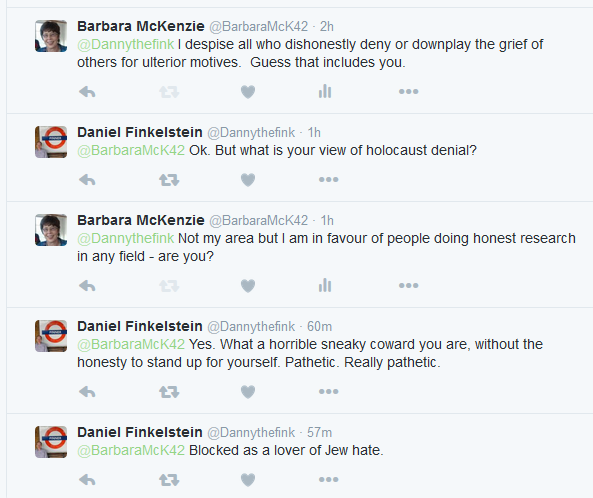
It comes as no surprise that Daniel Finkelstein, who is in total support of dispossession, ethnic cleansing and cruelty in Palestine, assumes morally superiority to me, since I have spoken in defense of a man who has spoken in defense of a man who does research into a field of history. And of course I have refused to commit myself to the undeniability of the Holocaust package …
One can assume that all these experts on the Holocaust, who know enough to be confident of the immutable truth of the Holocaust narrative, whether it be Piers Morgan, Dawkins, or Daniel Finkelstein, would also know another immutable truth about the Holocaust, that the Director of Auschwitz, Rudolf Höss was tortured for three days and three nights, and that his testicles were smashed beyond repair,as happened to 137 out of 139 Germans ‘interrogated’ before the Nuremberg trials. One can assume that this makes no difference to their perception of the Holocaust narrative, and they will remain confident of their moral superiority to those of us who are distressed and alarmed by the knowledge that German witness statements at Nuremberg were obtained under the most brutal torture. (From Höss’s confession was derived the figure of 4 million deaths at Auschwitz; the figure was later revised down to 1 million.)
‘Holocaust denial’ is generally conflated with antisemitism, ‘Jew hate’ or racism, and so automatically deserving of vilification. However, even if revisionism is considered to be intrinsically antisemitic, protectors of the Holocaust narrative like to bolster their case by pointing to more general indicators of racism in the culprit.
To the uninitiated the best-known Holocaust revisionist is probably the British historian David Irving, who was convicted of Holocaust denial in an Austrian court and sentenced to three years in prison. Irving was interviewed by Tim Sebastian on the BBC’s Hardtalk in 2000. The programme’s style is intended to be aggressive, but when I watched the programme in 2000, knowing nothing about either Irving or Holocaust denial, I was repelled by Sebastian’s overt hostility to Irving, and I believe that any other impartial person would be too. (Sebastian underlined his antagonism by refraining from shaking Irving’s hand at the end of the interview.)
Sebastian suggests that to deny the gas chambers is hurtful and tasteless (Holocaust denial is immoral per se). But like many others he feels the need to shore up this assumption by showing that there is other evidence that David Irving is a racist, and though he has few examples to work with he is relentless on this point. Irving’s suggestion that he is no more racist than millions of other people is brushed aside with the rather strange claim from the interviewer that there is no evidence for this whatsoever (so only Holocaust deniers are racist). Furthermore, it would appear that honest but naive David Irving confessed in an interview with the Independent that he once called someone a ‘nigger’, something he immediately regretted and remained bitterly ashamed of. As someone put it in the comments below the YouTube video, David Irving is probably the most honest person on the planet.
Another protector of the Holocaust narrative is Max Blumenthal, an American Jew who has a profile as a supporter of the rights of Palestinians. Blumenthal has attracted criticism from some pro-Palestine activists, who see him as an ‘antizionist’ zionist (AZZ), or gatekeeper, due to his attacks on other activists such as Alison Weir and Gilad Atzmon, his opposition to criticism of Jewish power, his prioritising of antisemitism and Holocaust denial, and his peddling of the NATO narrative on Syria; Gilad Atzmon sees him as racist, agressive and supremacist. In 2008 Blumenthal attended a meeting by David Irving when he was touring the States, and created this video:
The video is interesting for several reason. Blumenthal has interspersed his footage with clips from old German propaganda films promoting Germans superiority – of course if you question the Holocaust you must be a Nazi and white supremacist. Like Piers Morgan he presents the question of the Holocaust in bald holistic terms, with no allowance for individual aspects, or degrees of doubt. ‘Are you a Holocaust denier’, he asks, pretty much as one might ask ‘are you a paedophile?’
And as Holocaust denial is such a heinous crime, Blumenthal is justified in first finding out the location of the meeting (given freely to him by David Irving), and then outing Irving to the Vicar of the church hosting the meeting as a ‘Holocaust denier’. The smugness, the self-satisfaction of Blumenthal are palpable; he clearly sees himself as a hero, where others might just see a manipulative sneak. In any case we are left in no doubt that Max Blumenthal, the anti-German racist, the Palestine activist who along with Israel promotes the destruction of Syria, is morally superior to the ‘Holocaust denier’ David Irving, regardless of the latter’s transparent integrity.
The claim that ‘Holocaust denial’ is innately antisemitic was blown out of the water when Netanyahu, prime minister of Israel, took into his head to declare that the Holocaust was the brainchild of the Palestinian grand mufti of Jerusalem Haj Amin Husseini (so not Hitler afterall), that Hitler only wanted to expel the Jews, not exterminate them (thereby breaking Commandment 6, see above). There was anger and ridicule in Israel and amongst Jews abroad and Netanyahu was forced to climb down. Although Netanyahu was in general accused of ‘playing into the hands of Holocaust deniers’, he was actually guilty of Holocaust denial as it is defined, ie questioning an aspect of the Holocaust discourse – any German who made Netanyahu’s claim would be arrested. If one accepts the ruling that says ‘Holocaust denial’ is antisemitic, Netanyahu must be antisemitic. Which is clearly nonsense – Netanyahu’s racism does not lie in antisemitism, but in an overweening belief in Jewish exceptionalism.
Conclusion
It could be that those protecting the approved version of the Holocaust with such intolerance, aggression, and hate are absolutely right, that 6 million Jews died, in gas chambers, according to a plan drawn up by Adolf Hitler. I wouldn’t know – I haven’t done the research necessary for me to form an opinion.
However it is manifestly clear that those who question or deny the Holocaust are not united by a common neo-Nazi philosophy, of a type that on the one hand insists that Hitler was not guilty of the crimes attributed to him and on the other claims ‘Hitler was right’ to commit these crimes. Mainstream Holocaust revisionists are academics, philosophers, German patriots or Palestine activists. They do not necessarily support the far-right – many of them probably vote for left of centre parties. Some of them are notable for their immense compassion, such as Paul Eisen, who has always been a strong advocate of justice for Palestine. All of them have shown great courage and integrity, and are prepared to look for the truth and to speak it as they see it.
Regardless of the facts of the matter, criminalisation of responsible research into the Holocaust, and the vilification and isolation of those who carry it out, or even those who simply support their right to do so, is an outrageous denial of academic endeavour and historiography as a discipline. Anyone who supports such criminalisation, vilification and isolation is NOT morally superior but in fact morally and intellectually compromised. Furthermore, any honourable person with a modicum of intelligence and a modicum of courage will fight for the right of all people to carry out research into any branch of history, without treating one particular aspect as sacred and therefore exempt from scrutiny.
Government Version of Student Massacre Discredited Again
teleSUR – July 16, 2016
An inquiry published Saturday has revealed that there is virtually no physical evidence to support the Mexican government´s version of the 2014 disappearance of 43 students traveling by bus to Mexico City. Government officials insist that a drug gang kidnapped the students at gunpint, killed them and burned the bodies at a dumpsite near the southwesten town of Iguala, but the report, based on forensic records requested by the Associated Press, revealed no signs of a fire on the night in question.
But the notes of a forensic examination of the Cocula dumpsite in Guerrero state in western Mexico shows that investigators could not confirm a fire on the night that the students vanished on September 26, 2014. The AP obtained the documents under a freedom of information request permissible under Mexican law.
The AP inquiry is the latest in a series of independent investigations that undermines the Mexican government´s version of events. Police say that five suspects have confessed to the crimes but an international panel of experts earlier this year concluded that the confessions were obtained by torture.
Earlier this year the Argentine Forensic Anthropology Team (EAAF) found animal and human remains at the dumpsite but said none of the remains corresponded to the government´s allegation that the bodies were incinerated by members of the Guerreros Unidos cartel. The Attorney General’s Office in April presented evidence of a huge fire and the discovery of the remains of at least 17 adults but the bone fragments were too badly burned to identify, the Argentine team said.
The government´s handling of the case has triggered massive protests that include parents and friends of the students, trade unons and grassroots organizations who believe that law-enforcement authorities are complicit in the slayings of the 43 students, who had effectively stolen a bus, ironically enough, to attend the commemoration of a 1968 police massacre of students.
The case has marred the administration of President Enrique Peña Nieto, who took office promising to reduce violence, curb corruption, and human rights abuses in the country.
The Nice Attack: French intelligence failure or Zionist agenda?
By Gearóid Ó Colmáin | July 15, 2016
The death toll from the Nice attacks on the 14th of July, 2016 is rising. Latest reports suggest 84 deaths and possibly one hundred more injured. There have been reports of gunfire and the driver of the truck which drove into the crowd near the beach in Nice is reported to have been shot dead. Once again (as with the Charlie Hebdo and Bataclan attacks) there is no-one to stand trial and truthfully answer the questions that need to be asked – who and why?
At this point, there is not much that can be verified about the attack. One cannot exclude the possibility that it may have simply been the action of an insane individual. Atrocities of that type are rare but have happened in the past. But there is, however, the strong suggestion and indeed likelihood that this atrocity is a terrorist attack by ‘Islamists’. So, what does all this mean?
French domestic intelligence (DGSI) chief Patrick Calvar warned on the 26th of June 2016 that an ‘Islamist’ attack on French children would be the trigger for a civil war. He said France was currently on the brink of that civil war. Calvar also predicted that ISIS (Da’esh) would use trucks as weapons. It is not unusual in the never-ending war on terror to hear accurate predictions by intelligence officials before attacks, with the same officials seemingly powerless to prevent them.
This ‘uncanny coincidence’ could be the defining event of our time.
French Prime Minister, Manuel Valls is on record stating that the state of emergency in France would be permanent. There has been increasing pressure on the Hollande regime in France to change course in the Middle East. Attempts to reconcile with Russia and lift the sanctions have been blocked by Hollande and Valls, who are puppets of the Jewish Lobby. The Zionists want to continue the war on Syria, Iran and Russia. The Zionists have full control over US/NATO policy. Therefore, the ‘war on terror’, which was created as a pretext to further Zionist geopolitical interests, must be continued.
I believe this is the trigger for a civil war French intelligence warned us about. The question is whether the war will become high intensity or continue on a relatively low-intensity trajectory. There have been police ‘whistleblowers’ in France who have warned of huge caches of arms in major cities, capable of arming hundreds of thousands of men. However, one must be cautious in referring to such ‘whistleblowers’ as they have proven to be highly unreliable and may be spreading disinformation.
In any case, the public’s belief that we are in a ‘state of war’ and that all military interventions abroad are therefore necessary will be enough to make citizens look to the state for protection – an oligarchic state which is currently pursuing a brutal class war against workers.
As 90 percent or more of intelligence operations today involve media disinformation, we cannot possibly assume that any of the reports we are hearing are accurate. However, it is hard to see how a psyop could have been carried out in the Promenade des Anglais which is so central in Nice. What we can say for sure is that the attack serves the two constants of the war on terror dialectic. The narrative would read as follows:
1. Make the state of emergency permanent, empowering the oligarchic state and further demoralising citizens by dividing the working class along religious and racial lines. This is part of NATO’s ‘strategy of tension’ in accordance with the longstanding intelligence operation Gladio. Citizens must turn to the anti-social state for ‘security’, thus precluding social revolt.
2. Justify an all out attack on Syria to finish the job of destroying Arab civilisation, in accordance with Zionism’s geopolitical interests. Only the willfully ignorant could possibly believe that ISIS is an enemy of France when the French have never had better relations with the country which openly backs them – Saudi Arabia. The intelligence reports, declassified documents and admissions of the highest officials of the French and American governments all confirm that ISIS is Israel’s Arab legion.
Both those two above-mentioned goals serve Zionism and until the French people liberate themselves from its yoke, Zionism will continue to poison the minds of men, making them consent to policies that no honest and compassionate human being would countenance. An awakening of working-class militancy is occurring but the labour movement in France remains divided and led by social-democratic reformists. Now, more than ever, seeing the link between terrorism and class war is essential if any political and social change is to occur. In an era of high-finance treason, oligarchy, austerity, and the triumph of avarice, terror increasingly becomes a feature of the normal rather than an exceptional exercise of state power.
French PM Manuel Vas: ‘We Must Learn to Live with the Terror, Like Israel’
21st Century Wire | July 15, 2016
In the aftermath of last night’s bizarre ‘terrorist’ attack in Nice, France, one of the most poplar talking points which appears throughout much of the western media coverage is this idea that terrorism is now a ‘normal part of our everyday lives’ and that a permanent state of military alert at home is something the public needs to get used to.
One of the central voices of this police state talking is French Prime Minister and avid Israeli advocate Manuel Valls. Earlier today Valls stated that, “France has to learn to live with terrorism.”
In this way, the security state is attempting to integrate terrorism as a day-to-day 24/7, 365 day per week agenda issue – which is said to require a hyper-militarized security state, just like Israel (notice how Israel is invoked by neoconservatives and western Zionist supports ad nauseam in the security conversation), to deal with ‘the threat.’
This seems to be the cornerstone of Valls’ political relevance, which he has basically repeated over and over, for the better part of the last two years despite the fact that both the Charlie Hebdo and Paris Bataclan events exhibited very clear signs of GLADIO-style domestic terror stage play.
Back in February, at the Munich Security Conference he stated the exact same thing:
“We have entered – we all feel it – a new era characterised by the lasting presence of ‘hyper-terrorism.’
“We must be fully conscious of the threat, and react with a very great force and great lucidity. There will be attacks. Large-scale attacks. It’s a certainty. This hyper-terrorism is here to stay.”

TERROR SUMMIT: Admitted Zionist Manuel Valls pictured together with Israel’s fundamentalist Zionist leader Benjamin Netanyahu
In January 2016, while addressing an Israeli lobby delegation, Valls read off a list of ‘ISIS’ terrorist attacks along with other ‘terrorist’ incidents in Israel, claiming that this was proof that, “we are in a world war”, while not ever uttering a word about Israel’s brutal, militarized occupation and their systematic ethnic cleansing regime waged against the native Palestinian residents since the creation of the State of Israel in 1948.
Israeli CRIF spokesman Roger Cukierman applauded Valls’s single-sided adherence to the Israeli lobby, by saying, “On a number of occasions, you said very powerful things: That anti-Zionism is anti-Semitism, that France without its Jews is no longer France,” Cukierman said. “This makes you a dear politician.”
Is this a case of the state and its transnational security conglomerates manipulating the public into unquestioningly accepting an indefinite siege mentality and a permanent, full-blown police state?
It appears once again, that we are witnessing an attempt to transform large parts of western society – through a further realignment of public and state political and economic priorities into what is commonly referred to as “security theatre,” which, in reality, has nothing to do with actual security, and everything to do with domestic political and geopolitical theatre.
Blair’s Former Propagandist: “Referendums are Dangerous in a Parliamentary Democracy”
By Steven MacMillan – New Eastern Outlook – 14.07.2016
 In an interview with Hala Gorani of CNN, the man who served as Tony (the war criminal) Blair’s Director of Communications from 1997 to 2003, Alastair Campbell, denounced referendums as a danger to democracy. Campbell is clearly enraged that the British people had the audacity to vote against the wishes of the establishment; and his remarks are the epitome of elitist thinking – which holds that ordinary people are too stupid to make important decisions on their own.
We pick the conversation up just after Campbell discusses the surge in working class people who voted for Brexit in the UK, and are supporting Donald Trump in the US:
Gorani: “Is that a failure of the establishment in not having responded for decades to real concerns of how globalisation has hurt common, ordinary workers?”
Campbell: “Absolutely it is. But the point is… this is why referendums… I said this the day after the last general election; I was on BBC Question Time and the first question was will Britain leave the EU? I said I hoped not, because I hope the British people will save the politicians from themselves; and I said then and was howled down for being anti-democratic: referendums are dangerous in a parliamentary democracy.”
Gorani: “Why is that?”
Campbell: “Because we’ve had a referendum in one of the most ill-informed, lying debates that I can ever recall anywhere in the world. We’ve been like a banana republic in the last few days; this has been a joke.”
So in Campbell’s view, the Brexit referendum is “dangerous” because the people of Britain had been lied to by the leave campaign in the run-up to the vote. This is coming from the man who was a pivotal figure in disseminating the tsunami of lies, fear and war propaganda in order to convince the public that Britain had to launch the most destructive war of the 21st century: the illegal invasion of Iraq in 2003. The man who was an integral part of pushing the slogan that the West was ‘bringing democracy to the Middle East;’ believes a democratic vote in Britain is “dangerous.”
Campbell was responsible for circulating the two fraudulent dossiers – the September and the Iraq – into the mainstream media in order to convince the British people that Iraq had ‘weapons of mass destruction.’ It was revealed in 2010 that Campbell had ordered the September dossier to be altered to fit more in line with a speech from George (the war criminal) Bush in 2002, after Bush stated that Iraq would be able to build a nuclear bomb within a year, whereas the initial draft of the British dossier said it would be at least two years.
Campbell is also regurgitating the Orwellian propaganda line that is being spread throughout the Western media: that somehow a democratic referendum is undemocratic. Just because the vote flew in the face of the British establishment, the presstitutes are engaging in intellectual jujitsu in order to demonise the leave vote. Would they be doing so if Britain voted to remain in the EU? I think not.
The Guardian (which was pro-remain) is at the forefront of pushing this narrative. This is evident in their article titled: Can we have our parliamentary democracy back please? The article actually quotes former British PM, Clement Attlee, who said referendums have too “often been the instrument of Nazism and fascism.” It’s just ridiculous; this is spin on steroids – trying to associate a democratic referendum with fascism.
Considering the fact that Britain commits incessant crimes overseas in the name of democracy, it is abhorrent that the democratic wishes of the British people are being marginalized by the establishment.
The establishment is terrified of direct democracy, and giving the people votes on issues that actually matter. The majority of parliamentarians in the UK are in the pocket of special interests, and represent the interests of the people in no way, shape, or form.
In Britain’s ‘great parliamentary democracy,’ the people were taken into a war (despite widespread public opposition) that killed and destroyed the lives of millions of innocent people in 2003. Britain’s ‘great parliamentary democracy’ has brought the people a surveillance state beyond the Stasi’s wildest dreams, in addition to involving Britain in Libya, Syria and countless other abominations. How can the people do any worse than our great parliamentarians?
The Western elite are terrified of democracy, and they view the wishes of the people as a danger to their rule. If the British people voted in favour of remaining within the EU, the establishment would not be demonising the vote as “dangerous” and fascistic.
Steven MacMillan is an independent writer, researcher, geopolitical analyst and editor of The Analyst Report.
British politics: The Establishment versus Democracy
By Neil Clark | RT | July 13, 2016
With the dramatic withdrawal of the pro-Brexit Andrea Leadsom from the Conservative Party leadership race, the coronation of Theresa May, who supported ’Remain’ in the EU Referendum, is confirmed.
Ms. May is expected to be handed the keys to 10, Downing Street on Wednesday.
At the same time, the pro-Iraq war Labour MP Angela Eagle has launched her leadership challenge to the anti-war Labour Party leader Jeremy Corbyn.
It’s not hard to see the connection between these two developments. May and Eagle, who says that she thinks ‘Tony Blair has suffered enough’, are the clear choices of the Establishment power brokers; Leadsom and Corbyn are most definitely not. Their appeal is with their party’s membership and the wider public and not with the Westminster/media elites.
What we are seeing played out before our very eyes is an attempt by said elites to reverse the democratization of Britain’s ‘Big Two’ political parties and to restore the power of Establishment insiders to shape the direction which those parties and the country takes. Party members who think differently must be put in their place. They must be seen, not heard.
The aim of this anti-democratic counter-revolution is simple. It‘s to make sure there is no major deviation from elite-friendly, neo-liberal, crony capitalist pro-war policies, whether it be a populist left-wing deviation, which promises re-nationalisation of the railways, wealth taxes and a less aggressive stance on foreign affairs, or a populist right-wing one, which wants the UK to Brexit without further delay and which opposes Blairite ‘liberal interventionism’ in foreign policy.
Anyone who threatens to take us away from the ‘extreme centre’ (a phrase used by Miriam Cotton and Tariq Ali) of crony capitalism, endless war and the cynical use of identity politics as a cover for the most regressive policies, is targeted for destruction.
One only has to consider the relentless smears and attacks that the anti-status quo Jeremy Corbyn has been subject to from the extreme centre since he announced he was standing for the vacant Labour leadership last summer. The attacks intensified after he was elected leader. The plotters of the current ‘Chicken Coup’ against Corbyn, clearly hoped to oust the Labour leader by a procedural technicality – they hoped that Labour’s National Executive Committee (NEC) would decide that Corbyn needed the nomination of 51 MPs or MEPs in order to stand. However, the NEC voted by 18-14, that Corbyn, as the incumbent, should automatically be on the ballot.
The fact that Labour’s coup supporters tried to keep Corbyn (who was elected with a huge mandate by the party’s members and supporters only last summer) off the ballot shows the utter contempt for party democracy that these people have. Blairites support bombing other countries to smithereens to promote ‘democracy’- but they hate it in their own party!
The coup plotters say that Corbyn is a disaster, yet he has been responsible for a massive surge in Labour party membership – which now stands at over 500,000 – its highest in modern history.
But instead of welcoming the recent membership surge, the anti-democratic Blairites seem appalled that the ‘great unwashed’ are signing up. For supporting Corbyn, Labour members have been called ‘wide-eyed loonies’, ‘rabble’ and even ‘scum’. But of course, let’s just focus on Momentum and Corbyn supporters being rude to Blairites who insult them, shall we?
The arguments given by those representing the extreme center for replacing Corbyn as Labour leader are as bogus as the claims the same people made about Iraq having WMDs in 2003.
We’re told Corbyn has to go because he’s ‘unelectable’ – in fact Labour were the most popular party in May’s local elections. Labour lost millions of traditional supporters during the Blair/Brown years, while Corbyn has encouraged these people – genuine Labour people – to return to the fold.
It’s also patently absurd to argue that in order to ‘reconnect’ with the electorate, Labour needs to ditch Corbyn – who accepts Brexit – and instead have a Blairite or Brownite who is in love with the EU as its leader. And in the very week following Chilcot, it’s an insult to the 1m people killed to have an MP who voted consistently for the Iraq war – and against an inquiry into it – challenging a principled MP (Corbyn) who opposed it.
Although Corbyn will be on the ballot for the leadership campaign, his opponents have done their best to tilt things in the contest in their favour. The NEC decided that only members who signed up before 12th January and those prepared to pay a £25 fee as a ‘registered supporter’ will be able to vote.
In last year’s election the fee for being a registered supporter was just £3: the thinking behind the change is clearly to deter poorer people- who more likely to support Corbyn, from voting.
However, Unite the Union, which supports Corbyn, and is affiliated to Labour, offers 50 pence a week community membership, providing a way for Corbyn supporters to make their voices heard.
If Corbyn is toppled this summer, then we can expect new leadership rules to be introduced by the party to make sure that a popular left-winger who promises a genuine move away from the ‘extreme centre’ can never again lead the party.
In the Conservative Party leadership election, we’ve witnessed a master-class in how the Establishment engineers the result it desires. Theresa May was obviously the anointed one, but in order for her to be crowned a few things had to happen first. The maverick Boris Johnson, who was decidedly dodgy on foreign policy, as I explained here, had to be knocked out of the race. And then, after she had beaten Murdoch’s favourite, Michael Gove, onto the final short-list it was time for the Establishment’s attack-dogs to be unleashed on Mrs. Andrea Leadsom.
Revealingly, the newspaper which did it for Leadsom is also the newspaper that’s been the most unrelentingly and obsessively hostile to Jeremy Corbyn. Rupert Murdoch’s Times is an Establishment organ that regards any deviation from the extreme Blairite/Cameronite center as a heresy that needs to be firmly stamped on. All of course in the interests of ‘democracy’ and ‘moderation’!
Rather naively, Leadsom, who supported Brexit, and said she’d send off Article 50 to the EU in September if she became Prime Minister, consented to be interviewed by the pro-Remain Times.
It was the biggest mistake of her political life.
Deeply shocked when she saw the Times headline on Saturday, she accused the paper of ‘gutter journalism’ for the way they presented the interview. The Times, in response, released a partial audio recording of the interview, but still hasn’t released a full one. The journalist who interviewed Leadsom, Rachel Sylvester, was accused of contradicting her own story about not raising the subject of family and motherhood to her interviewee.
A day later, the Sunday Times, intensifying the pressure on Leadsom, reported that up to 20 Tory MPs would quit the party if she won – in effect warning her that she would have the same problems in Westminster as Jeremy Corbyn. But this report was later denied by MPs.
One doesn’t have to share her politics to acknowledge that Leadsom was stitched up by Murdoch’s Establishment mouthpiece.
She became the target of some pretty unpleasant attacks by Parliamentary colleagues, inside-the-tent journalists and some liberal-leftists too who were only too keen to support The Times against her – not to mention the newspaper’s shameful record of neocon/Blairite warmongering.
It was no surprise that after a tearful weekend,
Leadsom pulled out of the Tory leadership race on Monday. Her campaign manager Tim Loughton said: “It is absolutely not the job of media commentators to ‘big up’ politicians whether in this leadership contest or elsewhere in politics. But neither should it be their compulsion constantly try to trip them up”.
With Leadsom successfully tripped up, and the Tory party’s 150,000 members deprived of having their democratic say in their party’s leadership election, Rachel Sylvester moved on to another outsider who threatens the status quo – Jeremy Corbyn – with an article in Tuesday’s Times charmingly entitled ‘Corbyn’s Labour must be tested to destruction’.
Destroy. Destruction. Weapons of Mass Destruction. These are words the Establishment loves to use in its war against its enemies.
Meanwhile, the fear of ‘the mob’ from those inside-the-tent is there for all to see. ‘If we don’t tame Twitter, we’ll face mob rule’ was the title of one Times comment piece on Monday.
Meanwhile, Tony Blair himself is concerned about ‘the mob’, and the way the extreme centre, which he personifies, is currently threatened. “It was already clear before the Brexit vote that modern populist movements could take control of political parties. What wasn’t clear was whether they could take over a country like Britain. Now we know they can”, he bemoaned in the New York Times.
Blair and his disciples – in both Labour and the Conservative parties – want to get back to ‘business as usual, that is, a situation where they and not us are in control. People power has already gone way too far for the party elites and they desperate to put a stop to it.
The coronation of Theresa May boosts their cause, but the Extreme Center also needs to topple Jeremy Corbyn if they‘re to succeed in their One Party Britain anti-democratic project.
The stakes really could not be any higher.
Follow Neil Clark on Twitter @Neil Clark
Louisiana Governor: “Follow the Directions of Law Enforcement;” Or else.
By Robert Fantina | Aletho News | July 12, 2016
As United States police officers continue their policy of shooting Americans for such heinous violations of the law as having a burned-out bulb in the taillight of their car, the nation seems to have decided that enough is enough. Thousands have protested across the country since the murders of Philando Castile and Alton Sterling last week in response to those crimes, and, also in response, a U.S. army veteran used his training to kill five police officers in Dallas, Texas.
As political leaders of all stripes call for calm, which is standard procedure after any white officers assassinate an unarmed black man, occasionally one of them states what is really at the core of the issue. This week, it was Louisiana Gov. John Bel Edwards, who uttered one sentence that seems to sum up government policy:
“It is critically important that you follow the directions of law enforcement.”
One wonders if this was a statement, or a thinly-veiled threat. It appears that, in the view of Mr. Edwards, the ‘directions of law enforcement’ must be followed to the letter, with the violation of that being capital punishment, administered instantly by the police.
In Baton Rouge, police officers at various protests, there to ‘serve and protect’, were armed with military equipment, and a widely published photograph showed one officer aiming her machine gun at protesters. It seems that ‘law enforcement’ in Louisiana will be accomplished, regardless of the means required to do so.
Now, perhaps we can look for a moment at the First Amendment to the Constitution, which prohibits government interference with the right to peaceful assembly. One must suppose that ‘peaceful’ would need to be further defined, but it appears that the police in Baton Rouge would have all protestors marching slowly in lockstep down the street, chanting softly, and behaving in a way as to attract very little attention. Being loud, boisterous, slightly disorganized and even obnoxious will simply not do. Such behavior, or the shocking action of the press to document it, will cause the protestors to look down the barrel of a police-officer wielded machine gun. Huffington Post Senior Crime Reporter David Lohr found himself in just that position.
In another iconic picture, Leshia Evans, a 28-year-old, unarmed black woman wearing a flowing dress, stands calmly as two white police officers in full riot gear arrest her. Behind them are dozens of additional police officers, also arrayed in full riot gear. She obviously did not heed Mr. Edwards injunction to ‘follow the directions of law enforcement’. Her crime, apparently, was to stand in the street, looking at the police.
Fortunately for the citizens of Baton Rouge, there were numerous police officers there with tear gas, automatic weapons, and all the hardware required in any war zone to deal with Ms. Evans. The good residents of that city can rest easy tonight, knowing that the threat of an unarmed woman standing in the street has been eliminated.
On Friday, as news of the deaths of five police officers in Dallas screamed across computer and television screens, statements from political pundits and government officials indicated their shock, horror and revulsion at such a crime. Corporate-owned entertainment media, generally referred to as news programs, highlighted the crime, reported on each of the victims, and interviewed family and friends. Their alleged heroism, service to the city and the nation, and all their saintly qualities as husbands, fathers and citizens were presented to a citizenry that is instructed in who it must grieve for; whom it must be angry with; whom it must condemn and with whom it must sympathize. Philando Castile and Alton Sterling? Ho-hum. Five Dallas police officers? Shock, sorrow, grief, sympathy, anger at the perpetrator(s), fear of a coming race war, etc., etc.
Now, this writer does not condone the killing of these police officers, and sympathizes with their families. Neither does he condone the killing of Messrs. Castile and Sterling, or of Michael Brown, Eric Garner or the hundreds of other unarmed, innocent and disproportionately black men routinely killed by mostly white police officers in the U.S., usually with complete impunity, and he sympathizes with their families. Yet he recognizes a basic fact that seems to escape the media, and those who, for inexplicable reasons, take their cue on how to react from it. And that is simply this: An authority figure has no more or less intrinsic value as a human being than a common citizen.
There; it has been said. Shocking? Possibly, but it is what this writer believes. When an police officer shoots an unarmed, innocent and defenseless member of the public, this writer believes the officer should be charged with murder. This, of course, goes against the conventional wisdom that police officers can do no wrong, and that people must ‘follow the directions of law enforcement’, but there you have it.
But why is there so much violence and brutality demonstrated by the U.S. police? One commentator, John Miranda, suggests a reason:
“As for the increase in police brutality within the United States, I think this definitely can be pointed towards the Israeli training that the Department of Homeland Security is giving all of American police officers.”
Journalist Rania Khalek, in December of 2015, said that “U.S. police officers are being tutored by Israel on how to employ the tactics that have brought death and serious injury to huge numbers of Palestinians in the past few months.”
This writer has suggested that all people are equal. He will go even further: an Israeli terrorist is not innocent of killing defenseless Palestinians, simply because he or she is Israeli, and his/her victim is Palestinian.
What? Can this writer actually believe these things? Are not Israeli’s God’s chosen people? Some naive people may say that the Bible is a scriptural record, written for the spiritual guidance of individuals and religions that choose to so use it. But enlightened people know it is actually a document to be used to govern nations. Yes, that is why we stone adulterers and non-believers, and shun any and all who tell lies.
Oh, wait. We don’t actually do those things. This writer will get it right yet. Passages in the Bible are to be cherry-picked to support the arguments of the people in power, who represent the 1% and have the money. There, now he thinks he understands.
As of this writing, several hundred people have been arrested in protests against the latest police murders of two innocent black men. Increased resistance to state crimes will bring increased repression; this is yet another model used by Israel that the U.S. follows.
Where will it end? At what point in the future will young black men be able to wear hoodies without the police seeing them as instant targets? When will all Americans be able to drive their cars through any city street, or stroll along any city boulevard, without fearing for their lives? This writer is not optimistic that it will be any time soon.
Featured Video

The Failed Air War Over Vietnam
or go to
Aletho News Archives – Video-Images
From the Archives
USS Liberty Massacre: A Pivotal Moment in the Hostile Takeover of America
By Kevin Barrett | Crescent | Dhu al-Qa’dah 24, 1445
In corporate America, hostile takeovers are commonplace. They occur when an aggressor—a larger corporation or rich individuals—seizes control of a smaller corporation without asking permission.
What few recognize is that the United States itself has been subjected to a hostile takeover. Since the aggressor, the illegitimate settler colony known as “Israel,” is much smaller than the US, the takeover has necessarily been surreptitious.
As of June, 2024, Israel’s gradual takeover of the US has become obvious and undeniable—a proverbial “elephant in the living room.” … continue
Blog Roll
 Aletho News
- Yemeni Armed Forces Warn Airlines Against Using Saudi Airports, Exempt Mecca and Medina
- Iran security chief says powers greater than US tried to conquer Iran but ended in ‘dustbin of history’
- Europe’s mounting social chaos… chickens coming home to roost for proxy war against Russia
- US-Russia Diesel Deal Becomes Massive Defeat for Ukraine
- Hormuz and the Looming Economic Catastrophe
- Dhubab offensive, media blitz and the rapid unraveling of Saudi-backed coalition’s new gambit
- Putin Conveys to Trump Iran’s Vision on Possible Conflict Resolution – Kremlin
- The Search for Truth: Charlie Kirk’s Assassination One Year Later
- ‘Harsh reality’: Iran says France seeks monopoly on power and intimidation, not peace for all
- When Will This White House Madness End?
- If Americans Knew
- For three years, Israel has killed a child in Gaza every 71 minutes – Daily Update
- Israeli forces kill another child in Gaza – Daily Update
- Gaza ceasefire exists in name only, say more than 100 organizations
- Nearly 2 Million in Gaza Need Urgent Shelter Assistance as Winter Looms: IOM Chief Warns
- Suppressing Palestinian resistance: US charity under fire for AI monitoring of Gaza classrooms
- Thousands Are Held in Israeli Torture Camps. This Is What Happens Inside
- Israel puts Gaza’s sick, injured, newborn in peril – Daily Update
- Report claimed Mark Levin used by Israeli government to influence Trump
- Over 2,000 Gazans have died awaiting medical evacuation amid Israel’s continued siege
- How a U.S. Diplomat Suppressed and Altered Reports Critical of Israel
- No Tricks Zone
- Germany’s Green Energy Debacle: High Energy Costs Force Kahla Porzellan to Close After 182 Years!
- New Study: 50 Years Of The Most Aggressive ‘Net Zero’ Policies Can Only Affect The Global Climate By 0.03°C
- US September “Heat” Was No Record…Many Records Set Decades Ago
- Latest European Green Energy Debacle; Portugal’s Largest Flagship Solar Park Insolvent!
- Green Energy Debacle: German Expert Professor Fritz Vahrenholt Warns Of Severe Economic And Social Consequences
- Two More Paleo Reconstructions Affirm Meters-Higher Sea Levels Across Ireland, Brazil 7000-6000 Years Ago
- New Study: Earth And Venus Surface Warmth Largely Explained By Convection And Lapse Rate, Not CO2 Or Radiation
- 2025 Nature Paper Claiming Worsening Global Drought Gets RETRACTED …Heavily Flawed
- New Study: ‘Global Drought Shows No Detectable Recent Acceleration Under Climate Warming’
- Economic Masterminds: German Socialists Suggest Taxing Productivity Gains Stemming From Using AI

