US Accuses Its Own Informant in Venezuela Case of Lying to Feds
teleSUR – September 26, 2020
United States federal law enforcement has accused a key informant on the trumped up case targeting Venezuela’s Minister Tareck El Aissami of lying and stealing US $140,000.
The Associated Press reports that Venezuelan-born businessman and pilot Alejandro Marin was arrested on September 19th in Miami on three counts of knowingly making false statements to U.S. federal agents, according to court filings.
Marin operates a chartered flight business out of Miami’s Opa Locka executive airport and conspired in the plot against Vice President El Aissami, utilizing his business.
The government of Venezuela has said that the years-long persecution of Minister Tareck El Aissami, like the recent charges against President Nicolas Maduro, are part of a permanent destabilization campaign against top officials of the Bolivarian government.
AP’s Joshua Goodman reports that in coordination with US authorities, Marin had transported millions of dollars on private jets, in violation of US-imposed unilateral coercive measures.
The US $140,000 is said to have gone missing during a US-directed operation in July 2018. Federal public defender Christian Dunham, who is representing Marin, says his client is expected to appear in court on September 30th for a pre-trial detention hearing.
According to the arrest order, the stolen funds were deposited to an account controlled by Marin over two years ago.
The US government has tried various hands hoping to generate the evidence to forge a case and a narrative of criminality within the Venezuelan government.
With the mainstream media on side with Washington, the case against President Nicolas Maduro and officials, in which a US $15 million bounty was placed by the Justice Department in March, remains dubious at best as new information regarding the corrupt and criminal nature of the Venezuelan opposition aligned with Juan Guaido comes to light.
Hunter Biden’s conflict of interest silenced by ‘fake mainstream media’, but Trump’s own people are in on cover-up
By Nebojsa Malic | RT | September 25, 2020
While US President Donald Trump is correct that mainstream media outlets are duplicitously dismissing revelations about Joe and Hunter Biden, what about his own Treasury and intelligence community going full Russiagate?
Joe Biden should “leave the campaign” because he “knew everything” about his son Hunter’s shady business dealings overseas, Trump said on Thursday in an exclusive interview with Fox News Radio. He was referring to the 87-page report, published Wednesday by Republicans on the Senate Homeland Security and Finance Committees, which looked into Hunter Biden’s business dealings while his father was Barack Obama’s VP.
“I look at Hunter Biden today, where he stole millions of dollars, stole millions,” Trump told Brian Kilmeade, adding that “his father was in on it.” The “corrupt” Biden “knew his son was getting all this money from China, from Ukraine and other places,” Trump said.
In a follow-up tweet, Trump pointed out that Hunter Biden received a $3.5 million wire from a Russian billionaire. That would be Elena Baturina, the richest woman in Russia, and widow of the former Moscow Mayor Yuri Luzhkov. The report says she sent Biden’s company Rosemont Seneca Thornton the wire transfer for unspecified consulting services in February 2014, citing confidential documents.
Trump is clearly infuriated that both Biden and the media are shrugging the whole story off, given the insane amount of scrutiny he has been subjected to since 2016 for alleged – but never substantiated – “Russian ties.” His campaign was even spied on, before and after the election, on the basis of a salacious “dossier” fabricated by a British spy working for the Democrats.
By contrast, Hunter Biden’s relationship with Burisma is well-documented, and Joe Biden was filmed boasting about getting an Ukrainian prosecutor fired – but to Democrats and the media, it’s a “conspiracy theory,” which they even tried to use to impeach Trump back in December.
To the surprise of precisely no one, the very same outlets pushing ‘Russiagate’ for years now scurried to spin the Biden report. Hunter’s Burisma job was “problematic” but the report “doesn’t show it changed US policy,” is how the Washington Post put it. The Daily Beast called the report a “hatchet job” and “politically motivated.” The New York Times said the report “Finds No Evidence of Wrongdoing” and “appeared to be little more than a rehashing of unproven allegations that echoed a Russian disinformation campaign.” And so on, and so forth.
Even Fox, which aired Kilmeade’s show where Trump made the comments, made sure to extensively quote Biden campaign spokesman Andrew Bates, who called the report “a foreign attack against the sovereignty of our elections with taxpayer dollars – an attack founded on a long-disproven, hardcore rightwing conspiracy theory.”
While Trump is not wrong to argue he’s running not just against Biden and the Democrats, but the entire mainstream media backing them – much like in 2016 – there’s just one tiny glitch with that line of reasoning: his own administration is backing up the Democrats’ narrative!
First there was William Evanina, the ODNI official appointed to oversee all election intelligence briefings by acting DNI Richard Grenell, Trump’s trusted envoy. Evanina told Congress in August that “Russia is using a range of measures to primarily denigrate former Vice President Biden and what it sees as an anti-Russia ‘establishment.’”
Later that month, Trump’s primary rival and now supposed ally Sen. Marco Rubio (R-Florida) signed off on a “bipartisan” Senate Intelligence report that was a rehash of every single discredited “Russiagate” talking point the committee’s real chair Sen. Mark Warner (D-Virginia) could cram in there. The media had a field day with that one.
Then, on September 10, Treasury Secretary Steven Mnuchin – one of his original cabinet picks – sanctioned Ukrainian lawmaker Andriy Derkach, a major source for the Senate Republicans’ report, as a “Russian agent.”
It was Mnuchin, not the media or the Democrats, who described Derkach’s publication of alleged phone calls between Biden and Ukrainian President Petro Poroshenko as “foreign interference in an attempt to undermine” the upcoming presidential elections. The recordings promoted “false and unsubstantiated narratives concerning US officials… with the intent to discredit” Biden, he added. None of this was actually substantiated, mind you, but US sanctions by definition don’t need to be.
So when Trump argues that the US mainstream media sides with the Democrats and cares about “Russian ties” only when they can be – and have been – weaponized against him, he definitely has a point. Yet when it comes to Mnuchin and Rubio siding with that narrative against him, he’s as silent as Joe Biden on the issue of Hunter. Seems like in post-facts America, the swamp drains you.
Nebojsa Malic is a Serbian-American journalist, blogger and translator, who wrote a regular column for Antiwar.com from 2000 to 2015, and is now senior writer at RT. Follow him on Twitter @NebojsaMalic
Ileana Ros-Lehtinen Under Federal Probe for Campaign Fund Theft

teleSUR | September 25, 2020
According to a Miami CBS affiliate, several one-time staffers have been subpoenaed to provide records or testify before a grand jury on Ros-Lehtinen’s alleged misuse of campaign funds for personal expenses, vacations, and ornate meals—part of an investigation by the DOJ’s Public Integrity Section.
Announcing in April 2017 she would not be seeking re-election in 2018, Ros-Lehtinen transferred almost $180,000 from her re-election campaign fund to a political action committee (PAC) she ran, not an unusual move. However, personal use of these funds is illegal under federal law, even if transferred first to a PAC.
Expense reports from the PAC show Ros-Lehtinen indulged in a nearly $4,000 family trip to Walt Disney World in December 2017, a $3,100 dinner at Coral Gables restaurant Mesa Mar for New Years 2018, more than $10,000 in rooms at New York’s Lotte New York Palace and $28,000 at the W Hotel on South Beach, among many other expenditures.
Nonpartisan watchdog group Campaign Legal Center filed a complaint against Ros-Lehtinen with the FEC in October 2019, claiming her PAC violated federal law by “converting contributions for personal use…none of which have any apparent connections to Rep. Ros-Lehtinen candidacy or duties as an officeholder.” It remains unclear if the FEC referred the case to the DOJ or whether the DOJ began its own investigation independently.
In a statement to CBS Miami, Ros-Lehtinen’s attorney Jeffrey Weiner said: “She and her former staff members and volunteers are cooperating fully with the Federal Elections Commission and the Department of Justice. We are gathering the information requested by the Department of Justice and are confident that, if bookkeeping errors were committed, they were due to negligence and not willful or intentional misconduct by the former congresswoman or anyone on her staff or her accountants.”
Weiner added: “As my team and I have investigated and studied the facts in this matter, we have not found any evidence whatsoever of intentional wrongdoing by Ileana or anyone on her behalf.”
Ros-Lehtinen, who represented Miami-Dade county from 1989-2019 and was the first Latina and Cuban-American elected to Congress, served as the Chairwoman of the House Foreign Affairs Committee from 2011-2013, widely known her punitive and interventionist positions towards Cuba, Venezuela, and Nicaragua.
The Criminal Prosecution of Boeing Executives Should Begin
Mish Talk | September 18, 2020
Damning details of purposeful malfeasance by Boeing executives emerged in a Congressional investigation.
FAA, Boeing Blasted Over 737 MAX Failures
On Wednesday, the Transportation Committee Blasted FAA, Boeing Over 737 MAX Failures
The 238-page document, written by the majority staff of the House Transportation Committee, calls into question whether the plane maker or the Federal Aviation Administration has fully incorporated essential safety lessons, despite a global grounding of the MAX fleet since March 2019.
After an 18-month investigation, the report, released Wednesday, concludes that Boeing’s travails stemmed partly from a reluctance to admit mistakes and “point to a company culture that is in serious need of a safety reset.”
The report provides more specifics, in sometimes-blistering language, backing up preliminary findings the panel’s Democrats released six months ago, which laid out a pattern of mistakes and missed opportunities to correct them.
In one section, the Democrats’ report faults Boeing for what it calls “inconceivable and inexcusable” actions to withhold crucial information from airlines about one cockpit-warning system, related to but not part of MCAS, that didn’t operate as required on 80% of MAX jets. Other portions highlight instances when Boeing officials, acting in their capacity as designated FAA representatives, part of a widely used system of delegating oversight authority to company employees, failed to alert agency managers about various safety matters.
Boeing Purposely Hid Design Flaws
The Financial Times has an even more damning take in its report Boeing Hid Design Flaws in Max Jets from Pilots and Regulators.
Boeing concealed from regulators internal test data showing that if a pilot took longer than 10 seconds to recognise that the system had kicked in erroneously, the consequences would be “catastrophic”.
The report also detailed how an alert, which would have warned pilots of a potential problem with one of their anti-stall sensors, was not working on the vast majority of the Max fleet. It found that the company deliberately concealed this fact from both pilots and regulators as it continued to roll out the new aircraft around the world.
In Bed With the Regulators
Boeing’s defense is the FAA signed off on the reviews.
Lovely. Boeing coerced or bribed the FAA to sign off on the reviews now tries to hide behind the FAA.
Only One Way to Stop This
There is only one way to stop executive criminals like those at Boeing.
Charge them with manslaughter, convict them, send them to prison for life, then take all of their stock and options and hand the money out for restitution.
Discrediting the Russian Vaccine: The Small Shady Deal of Big Politics
By Irina Alksnis – Sputnik – 17.09.2020
For the West, Russia’s leadership in the creation of a vaccine against the coronavirus has become not just an unpleasant surprise, but a shocking call-out, not only politically but financially as well.
On the one hand, ‘backward, deeply undemocratic Russia’ simply lacks the right to carry out such breakthroughs in complex scientific and technologically advanced fields. On the other, there is a jackpot at stake so astronomical in size that the mere idea that it might elude Western pharmaceutical giants is cause for heartburn. For example, think of what the news of an agreement between Moscow and Delhi on the supply of a hundred million doses of Sputnik-V to India alone is worth.
It’s not surprising that Russia has faced numerous attempts to discredit the results of the work of its scientists: big politics means big money.
However, next to the sharks one will always find sucker fish, who regularly get a snack from their masters’ dinner. That’s exactly what happened when the results of Sputnik-V testing were announced by The Lancet, one of the oldest and most prestigious medical journals in the world.
The article was torn apart by critics with lighting speed. The ‘loudest’ of these criticisms spread by world media was the open letter by Enrico Bucci, a biology professor at Temple University in Philadelphia, who expressed fears about the mistakes ‘possibly made by Russian researchers’. Bucci’s letter received the support of over two dozen other Western scientists.
The Lancet invited the developers of Sputnik-V to answer the questions they had, and this was done. The Gamaleya Center presented the publication with the full-length clinical protocol of its study of the Sputnik-V vaccine.
Kirill Dmitriev, the head of the Russian Direct Investment Fund, published a column in which he commented in detail on the main claims made by critics, while at the same time urging them to look out for the ‘plank in their own eyes’, and dispelling any doubts inside Russia itself about the ongoing developments.
Meanwhile, the problem in this case is not only a purely scientific one, on which the Russian researchers have focused.
The fact is that Dr. Bucci is himself a rather remarkable person. The BBC’s Russian service calls him a “famous fighter against pseudoscience”. However, it would be more appropriate to describe him as a “businessman representing science.”
In 2016, Bucci founded Resis Srl, a company specialising in the verification, fact-checking and validation of scientific papers. This is a trendy topic in modern science. Too often in recent years, researchers have been caught making mistakes, including major ones, in articles they’ve published. And it’s not necessarily a matter of abuses or fraud. Often it’s a matter of honest mistakes, which, when exposed, nevertheless affect the reputation of scientists and even entire scientific institutions.
It is precisely to avoid such problems that authors and research institutions often turn to firms like Bucci’s to carry out an independent audit of their texts before publication. For example, Bucci’s company was hired for this purpose by Germany’s Fritz Lipmann Institute, which was impacted by a major scandal some time back due to crude mistakes in its published materials. A detailed article on that scandal appeared in Nature in late 2019.
The subtle point worth noting here is that businesses like Bucci’s are obliged to follow certain ethical restrictions, something the professor knows perfectly well. In an article appearing in Nature in December 2019 which he coauthored, which is dedicated to integrity and conscientiousness in published work, it was honestly pointed out that people like Bucci have a conflict of interest. Simply put, when an owner of a commercial company speaks publicly about the activity in which he specialises, it essentially becomes an advertisement for his firm.
Of course, when it comes to ‘discrediting’ the Russian vaccine, such trifles are no longer important. Western countries used Bucci’s open (and by definition self-promoting) letter to ‘strike another blow against’ Russian scientists in the hopes of undermining or at least temporarily weakening their leading position. Meanwhile, the professor himself has received free PR of a scale and magnitude that he could not have even dreamed about under any other circumstances. This is called “riding the wave of hype”, and is a principle according to which hundreds of thousands of media personalities operate.
There’s no doubt that doing so will pay off for Bucci in the form of very attractive new commercial contracts. Catching hype in the troubled waters of big politics can be very profitable. But this has nothing to do with science generally, or medicine in particular, or the saving of hundreds of thousands of lives around the world.
US sanctions Ukrainian lawmaker who published Biden-Poroshenko tapes for ‘Russian influence’ in presidential election
RT | September 10, 2020
Ukrainian parliamentarian Andrii Derkach has been sanctioned by the US, and his publication of alleged phone calls between the Ukrainian president and the US vice president declared ‘Russian interference’ in the US election.
Derkach “has been an active Russian agent for over a decade, maintaining close connections with the Russian Intelligence Services,” the US Treasury Department declared on Thursday, sanctioning the member of parliament for “foreign interference in an attempt to undermine” the upcoming presidential elections. In addition, three alleged employees of the Internet Research Agency, also referred to as the St. Petersburg ‘troll factory,’ were placed on the sanctions list.
The move against “four Kremlin-linked officials” was hailed by the State Department as “a clear signal that the United States will not tolerate interference or influence” in the upcoming vote.
No evidence was offered for the allegation that either Derkach, or the IRA trio – identified as Artem Lifshits, Anton Andreyev and Darya Aslanova – were actually in any way connected to the Russian government.
Instead, the Treasury claimed that Derkach had “waged a covert influence campaign centered on cultivating false and unsubstantiated narratives concerning US officials.” Between May and July this year, he released “edited audio tapes and other unsupported information with the intent to discredit” US officials, they allege.
Derkach released several hours worth of audio tapes purporting to be conversations between former Ukrainian President Petro Poroshenko and former US Vice President Joe Biden from 2014-2016, including references to investigations of the gas company Burisma, which had given Biden’s son Hunter a lavishly compensated seat on its board.
Poroshenko has denounced the revelations as “fabrications” and “part of a large-scale hybrid war” by Russia, and it appears the US Treasury has taken his word at face value. There was no indication any of Derkach’s claims, the tapes, or the documents he offered to the press have been investigated; instead, the Treasury simply asserts that everything he said was “unsubstantiated.”
Similarly, Derkach’s “reliance on US platforms” is taken as proof that he “almost certainly targeted the US voting populace, prominent US persons, and members of the US government.”
The Treasury’s explanation of why Derkach was sanctioned basically claims that any effort to investigate Biden – now the Democratic presidential nominee – or his son amounts to “interference” in US elections, which was the main premise of the Democrat-led effort to impeach President Donald Trump back in September 2019.
Israel Funds America’s Israel Lobby, While U.S. Taxpayers Pay for Endless Fraud Against Themselves
By Philip Giraldi | Strategic Culture Foundation | September 10, 2020
Imagine for a moment that there is a foreign government that receives billions of dollars a year in “aid” and other benefits from the United States taxpayer. Consider beyond that, the possibility that that government might take part of the money it receives and secretly recycle it to groups of American citizens in the United States that exist to maintain and increase that money flow while also otherwise serving other interests of the recipient country. That would mean that the United States is itself subsidizing the lobbies and groups that are inevitably working against its own interests. And it also means that U.S. citizens are acting as foreign agents, covertly giving priority to their attachment to a foreign country instead of to the nation in which they live.
I am, of course, referring to Israel. It does not require a brilliant observer to note how Israel and its allies inside the U.S. have become very skilled at milking the government in the United States at all levels for every bit of financial aid, trade concessions, military hardware and political cover that is possible to obtain. The flow of dollars, goods, and protection is never actually debated in any serious way and is often, in fact, negotiated directly by Congress or state legislatures directly with the Israeli lobbyists. This corruption and manipulation of the U.S. governmental system by people who are basically foreign agents is something like a criminal enterprise and one can only imagine the screams of outrage coming from the New York Times if there were a similar arrangement with any other country.
The latest revelation about Israel’s cheating involves subsidies that were paid covertly by Israeli government agencies to groups in the United States which in turn took direction from the Jewish state, often inter alia damaging genuine American interests. The groups involved failed to disclose the payments, which is a felony. They also failed to register under the terms of the Foreign Agents Registration Act of 1938, which mandates penalties for groups and individuals acting on behalf of foreign governments. In particular, FARA mandates that the finances and relationships of the foreign affiliated organization be open to Department of the Justice inspection. It states that “any person who acts as an agent, representative, employee, or servant, or otherwise acts at the order, request, or under the direction or control of a foreign principal.” Those who fail to disclose might be penalized by up to five years in prison and fines up to $250,000.
Israel’s various friends and proxies, uniquely, have been de facto exempt from any regulation by the U.S. government. The last serious attempt to register a major lobbying entity was made by John F. Kennedy, who sought to have the predecessor organization to today’s American Israel Public Affairs Committee (AIPAC) comply with FARA. Kennedy was killed before he could complete the process.
To be sure, the U.S. government has recently been aggressive in demanding FARA registration for other nations as well as for Americans working for foreign powers. There have been several prominent FARA cases in the news. Major Russian news agencies operating in the U.S. were compelled to register in 2017 because they were funded largely or in part by the Kremlin. Also, as part of their plea deals, the former Trump campaign chairman Paul Manafort and former National Security Advisor Michael Flynn both conceded that they had failed to comply with FARA when working as consultants with foreign governments.
A leading recipient of the Israeli government’s largesse has been the Israel Allies Foundation (IAF), which has a presence in 43 countries worldwide, though it is registered in the U.S. as a non-profit. It received a grant of $100,000 from Israel’s Strategic Affairs Ministry in 2019, part of the $6.6 million that was doled out to eleven American organizations in 2018-9. Israel Allies particularly uses Lawfare to target the non-violent Boycott, Divestment and Sanctions movement (BDS), which has a large and growing presence on university campuses. Effective lobbying by IAF in the U.S. has resulted in more than half of all states passing legislation that bans or limits the BDS activity while legislation that would criminalize organizations working against Israel has also been moving through congress. IAF has been directly involved in drafting such legislation and has more recently been pushing for new laws that would legally define criticism of Israel as anti-Semitism.
The Israeli Ministry of Strategic Affairs initially, in 2015-7, tried to give money openly to diaspora organizations but found that many American Jewish groups, to their credit, would not take it due to concerns over FARA and being accused of “dual loyalty.” So, the Ministry created an ostensibly non-government “public benefit company” cut-out to distribute the cash in a more secretive fashion. The mechanism was given the operational name Concert.
Concert’s sole purpose was to provide money to diaspora advocacy groups that would work primarily against BDS and other efforts to delegitimize the Jewish state. Concert had an independent board, but its activity of directed by the Strategic Affairs Ministry’s director-general.
Concert’s internal documents are predictably vague in describing the activities that it was funding, and one might assume that they are purposely misleading. They refer to “defensive and offensive” actions, on “corporate responsibility,” “the digital battlefield,” and regarding “amplification units” that would provide “support for organizations in a pro-Israeli network.” The intention was to improve Israel’s image due to the widespread and completely accurate perception that its human rights record is among the worst in the world. Concert was created to serve as a mechanism to be exploited where situations prevailed that “require an ‘outside the government’ discussion with the different target audiences… [and] provide a rapid and coordinated response against the attempts to tarnish the image of Israel around the world.”
Interestingly, one of the most recognizable recipients of Concert funds was Christians United for Israel (CUFI), America’s largest pro-Israel group, which received nearly $1.3 million in February 2019 to pay for several 10 week-long “pilgrimages” to the Holy Land. Each pilgrimage involved thirty “influential Christian clerics from the U.S.” who were clearly propagandized while they were in the Middle East. Other large disbursements went to predominantly Jewish student groups, presumably to provide them with both resources and necessary training to oppose campus critics of Israel.
The simple way to deal with the massive and illegal Israeli influencing operations that are being directed against the United States would be first of all to deduct every identifiable dollar that is being spent by the government of Prime Minister Benjamin Netanyahu to empower supporters in America from the $3.8 billion plus that Israel receives each year directly from the U.S. Treasury. Israel would not be concerned if the United States were to recover a paltry $10 million or so, but it would definitely send a message.
And then one might follow-up by requiring all the Israeli proxies that together make up the Israel Lobby to register under FARA. One might start with AIPAC, the Foundation for Defense of Democracies (FDD) and the Washington Institute for Near East Policy (WINEP) but there will be many, many more before the work is done. And CUFI, for sure. The fundamentalist Christian head cases that place Israel’s interests ahead of those of their own country finally need to have their bell rung.
Democrats & Republicans agree: Politicians & corporations should be spared from prosecution over killer Covid-19 care homes
RT | September 9, 2020
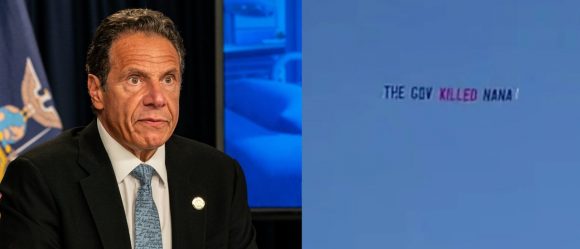
Republican and Democrat politicians have both embraced legislation to immunize themselves and their deep-pocketed corporate donors from legal liability for ill-thought-out pandemic policies blamed for the deaths of thousands.
Republicans in the Senate have all but plagiarized a controversial provision from New York Governor Andrew Cuomo that will offer legal immunity to corporations that ran the care homes in which hundreds of thousands of elderly Americans died with the coronavirus over the last six months, according to a trio of progressive journalists who compared the texts and interviewed some of the lobbyists who wrote the polarizing passages for the politicians in their pockets.
When Cuomo’s corporate immunity provisions first resurfaced in Senate Republicans’ Covid-19 stimulus package in July, some thought it was a fluke. The legislative package protected elder care homes from lawsuits over “resource or staffing shortage” and classed hospital administrators as caregivers for the purpose of that immunity. Cuomo himself criticized the bill, even as journalists noted the similarity of its language to his own legislation.
The bill in question was actually written by the Greater New York Hospital Association (GNYHA), a lobbying group that paid Cuomo over $1 million for the privilege of walling its members off from legal action in the midst of a pandemic that has seen tens of thousands of Americans die in nursing homes across the nation. Careful to cover all its bases, the GNYHA also spread over a quarter of a million dollars among Democratic legislative committees, ensuring the provision would be passed.
Critics said the measure green-lighted the most egregious corporate misbehavior – “effectively reward[ing] executives at nursing homes where thousands of elderly residents were killed by the coronavirus,” in the words of the progressive trio. Under pressure from progressive Democrats, the immunity measure was reined in by a second bill that limited its effect only to Covid-19 cases.
However, that ‘restriction’, combined with the hefty federal payouts to hospitals for coronavirus cases, may only have served to encourage facilities to list coronavirus on death certificates – and other states quickly followed New York’s example, passing their own version of the liability shield.
While one might expect Republicans to wield a Democrat-led push for immunity for healthcare providers as a cudgel against their enemies during a politically sensitive election season, the GOP-controlled Senate actually embraced the notion, including it in July’s Covid-19 stimulus package. The progressive journalists tracking the bills noted this happened around the same time as GNYHA recruited former Trump lawyer and current Republican fundraiser Albert Pirro Jr. to join their lobbying team.
House Speaker Nancy Pelosi and Senate Minority Leader Chuck Schumer have – at least outwardly – argued against the inclusion of corporate immunity in the stimulus package, but plenty of the rank-and-file centrist Democrats who usually agree with them have hinted they’re willing to climb on board. GNYHA dumped $2 million into the Democrats’ Senate Majority PAC in June.
The Justice Department has requisitioned documents from New York, New Jersey, Michigan, and Pennsylvania, Democrat-run states whose governors have been accused by Republican leaders of killing the elderly with variations on an executive order that required facilities to take in hospital patients without testing them for the virus. However, both parties’ politicians have benefited handsomely from the largesse of the health insurance industry.
The statewide economic shutdown has left New York hospitals unaffiliated with the mega-lobbyists in dire financial straits, scrambling to get their share of federal pandemic aid as politically connected groups feast on federal dollars meant to help ailing Americans. Routine medical procedures have been discontinued or severely curtailed amid the pandemic, while a growing number of Americans are delaying or avoiding seeking treatments due to fear of contracting the virus should they go to the hospital.
The US and its “Humanitarian” War for Central Asia
By Vladimir Odintsov – New Eastern Outlook – 06.09.2020
Despite the failure of the color revolution campaign organized by Washington, the United States and its allies show no signs of moving their attention away from Central Asia. The countries in the region continue to receive so-called “assistance” that permeates all spheres of life of the republics, implanting foreign values, undermining the authorities and interfering in internal affairs, actively trying to tear these states away from Russia and China.
Since the countries of Central Asia’s (CA) proclamation of independence, various international donors have expanded their participation in the region by providing official state and international assistance for development, which has reached more than 25 billion US dollars since 1991. The largest recipient of such aid in the region is Kyrgyzstan, which has received about $ 8.1 billion, followed by Tajikistan ($ 5.9 billion), then Uzbekistan ($ 5.8 billion), and Kazakhstan ($ 4.2 billion). The country that has received the least amount of aid since 1991 was Turkmenistan (803.45 million US dollars). But this is only direct state and international assistance.
In addition, the so-called “assistance” is afforded through various foundations, NGOs, including USAID, NDI, Soros Foundation, Freedom House, Foundation to Promote Open Society, Civil Society Development Association and others, as well as embassies of Western countries. Recently, the well-known abbreviation NED (National Endowment for Democracy), has been mentioned more and more often in the media.
Fearing the restoration of the “Soviet regime” in the states of Central Asia and the strengthening of Russia and China’s influence, the United States in its activities in the region increasingly began to focus on the “humanitarian” areas, including, first of all, the “educational presence”, strengthening of influence on society through various controlled NGOs, establishing control over the press and, through Washington-funded information platforms, influencing the creation of an ideological and propaganda background beneficial to the United States.
The “educational presence” is viewed in Washington as the most important stage in the preparation of the future political and business elite in the states of interest to the United States, and is mainly carried out through “flagship” universities, the activities of cultural sections of American embassies, exchange programs and educational grants.
In recent years, the United States has especially actively used the following as “flagship” universities: American University of Central Asia (AUCA, Bishkek). Kazakh American University (KAU, Alma-Ata) and the Kazakhstan Institute of World Economy and Entrepreneurship (KIMEP, Alma-Ata).
The focus of such “flagship” universities in educating future leaders of the region’s countries close to the United States is not even hidden in the official announcement of the American University of Central Asia, which states that it was founded in 1993 to “educate future leaders for democratic transformations in Central Asia.” It became the first university in Central Asia to issue US accredited liberal arts degrees through a partnership with Bard College in the United States of America. It is worth noting that AUCA is not accountable to the Ministry of Education and Science of Kyrgyzstan, it has an American Board of Trustees, and since May 2019 it has been headed by American political scientist, an expert on Russian politics, Andrew Kuchins.
Other flagship US universities are predominantly located in Kazakhstan. One of them is the private Kazakh-American University, which is a multi-level educational complex with a kindergarten, school, bachelor’s and master’s degrees. KAU was established in 1997 to “train professionals focused on leadership and aimed at the industrial and innovative development of the Republic of Kazakhstan,” as follows from the official presentation of this university. Another pivotal US university in Central Asia is KIMEP, the oldest and largest private university operating according to the North American model of education in Central Asia for the same purpose of educating the future leaders of the region by their own model. Another important institution of higher education providing the “educational presence” of the United States is Narxoz University (formerly the Alma-Ata Institute of National Economy) in Kazakhstan, which is headed by American Andrew Wachtel, current member of the US National Academy of Sciences, former president of AUCA.
In addition, the United States has a network of partner universities in the region. At the same time, in a number of higher educational institutions of Kazakhstan, Kyrgyzstan, Tajikistan, Turkmenistan, there are so-called “American sections”, which are essentially US Embassy’s external units, where appropriate work is carried out with the youth of Central Asia, aimed at achieving American foreign policy and foreign economic goals. The American Council for Cooperation in Education and Language Learning (ACCELS) operating in the region is subordinated to the same goals, which, by this Council’s own definition, is called upon to “educate specialists who are able to spread American ideas in the field of business, public administration, to plant the American educational system, to promote positive image of the USA.”
For a more productive outreach to student youth, American diplomats actively communicate with various higher educational institutions of the region, often speak there, participate in institute conferences, invite individual students to some protocol events at the US Embassy, thereby demonstrating an interest in the fate of the future leaders of the CA countries. In carrying out such activities, representatives of American embassies have the opportunity to spot the brightest students, mark them with individual grants and invite them to participate in exchange programs funded by the State Department, and with the support of American corporations or other “interested” US institutions, including US intelligence agencies.
Thus, the “educational presence” is effectively used in the “humanitarian struggle” of the United States for Central Asia, to increase the loyalty of Central Asian citizens to America, especially the most ambitious and brilliant representatives of regional youth. Thus, actively interfering in the domestic affairs of the Central Asian countries and influencing them.
Featured Video
HE SAVED LIVES. NOW HE FACES PRISON.
or go to
Aletho News Archives – Video-Images
From the Archives
NATO Sanctions and the Coming Global Diesel Fuel Disaster
By F. William Engdahl – New Eastern Outlook – 11.04.2022
Amid the ongoing global inflation crisis, NATO heads of state and mainstream media repeat a mantra that high energy prices are a direct result of Putin’s actions in Ukraine since end of February. The reality is that it is the western sanctions that are responsible. Those sanctions including cutting SWIFT interbank access for key Russian banks and some of the most severe sanctions ever imposed, are hardly having an impact on the military actions in Ukraine. What many overlook is the fact that they are increasingly impacting the economies of the West, especially the EU and USA. A closer look at the state of the global supply of diesel fuel is alarming. But Western sanctions planners at the US Treasury and the EU know fully well what they are doing. And it bodes ill for the world economy.
While most of us rarely think about diesel fuel as anything other than a pollutant, in fact it is essential to the entire world economy in a way few energy sources are. The director general of Fuels Europe, part of the European Petroleum Refiners Association, stated recently, “… there is a clear link between diesel and GDP, because almost everything that goes into and out of a factory goes using diesel.” … continue
Blog Roll
 Aletho News
- Trita Parsi: Middle East Unraveling — Are We on the Path to World War?
- Iran FM meets with US envoy on UN meeting’s sidelines at American side’s insistence: Report
- Qatar PM calls for Gulf security framework with Iran, says war must be ‘wake-up call’
- China condemns US extortion of Iranian airlines, rejects Washington’s ‘illegal’ sanctions threats
- Italy to move military personnel from Taif base after missile strike
- Finland’s Stubb tells European leaders to calm down
- Defeating Russia on battlefield impossible – Fico
- Finland’s Gender Clinic Reversal
- Massachusetts Wants Mental Health Visits, Why Does Government Use ‘Health’ to Enter Our Homes & Families?
- US lawmaker admits American people footing bill for Trump’s failed aggression against Iran
- If Americans Knew
- Sanctions are collective punishment: immoral and self-defeating
- Phosphorus Munitions Fired by Israel Burn Groves, Orchards in Southern Lebanon
- Israel Carries Out New Ceasefire Violations Across Gaza
- AI – Emphasis on the ‘I’: Israel Is Funding AI Chatbot Propaganda
- Israel Blocking Hundreds of Wheelchairs for Injured Children From Entering Gaza
- Israel Is Expanding and Upgrading Compounds for Palestinian Militias in Gaza
- The Palestinian-American Residents of This West Bank Town Are Wondering: Where Is Trump?
- Gaza desperately needs tents, wheelchairs, fuel… and everything else (Israel blocks it all) – Daily Update
- Israeli Attacks in Gaza Kill at Least Seven Palestinians Over Three Days, including Woman and Child
- Trump’s militarization of Washington DC as he pursues Israel’s war against Iran
- No Tricks Zone
- 2025 Nature Paper Claiming Worsening Global Drought Gets RETRACTED …Heavily Flawed
- New Study: ‘Global Drought Shows No Detectable Recent Acceleration Under Climate Warming’
- Economic Masterminds: German Socialists Suggest Taxing Productivity Gains Stemming From Using AI
- The South China Sea Has Not Been Cooperating With The Climate Change Narrative
- Energy Crisis: Germany Enters Heating Season With Historically Low Gas Reserve Fill Levels
- New Study: The Antarctic Ice Sheet Gained Mass From 2020-2024 Due To Staggering Snow And Ice Accumulation
- Study: Ocean Heating Rates From Thousands Of Years Ago ‘Dwarf’ Modern Ocean Heating Rates
- Climate Extremists Target, Attack Large-Scale Power Grid Infrastructure In Germany!
- New Study: Antarctic Ice Melt Has Contributed Less Than 1 Centimeter To Sea Level Rise In The Last 30 Years
- Fear Of Debate: Alarmist German Climate Scientist Calls On Mainstream Media To Discredit Skeptic Voices

