On Monday, July 27, a group of physicians called The Frontline Doctors met on the steps of the Supreme Court of the United States in Washington DC for a press conference, discussing their experience in treating patients with hydroxychloroquine (HCQ).
Shortly thereafter – but not before the video has received more than 70 million views on Brietbart livestream and 17 million viral shares – the hammer of Big Tech went to work, attempting to crush all evidence of the doctors’ compelling plea to make HCQ, an inexpensive and extremely effective medication, available to all. Big Tech – including Google, Apple, Facebook, Instagram, Twitter, YouTube, Vimeo and even the website host Squarespace – didn’t stop with only scraping the physicians’ press conference off the internet. No, they punished others for even TALKING about the press conference. Breitbart was censored for days and even Donald Trump, Jr. was put into Twitter jail for mentioning HCQ.
And then, a mere 48 hours after the press conference and censorship storm, (on Wednesday evening July 29), the State of Ohio Board of Pharmacy’s ruling (Rule 4729:5-5-21) that was written and approved on July 20, was published with a plan to go into effect following morning. This arbitrary rule prohibited doctors from prescribing and pharmacies from dispensing chloroquine or hydroxychloroquine “for the treatment or prevention of COVID-19” – unless the patient was enrolled in an institutional review board (IRB) qualified clinical trial.
The rule went further: All previous approvals for the use of these two medications were to be voided. Did that mean the thousands, if not tens of thousands, of patients across Ohio whose rheumatoid arthritis and other autoimmune conditions had been successfully treated for years with Plaquenil, the trade name for hydroxychloroquine, were going to be denied medication too?
While many doctors I know were scrambling to find a way to fight this rule, the next morning Ohio Governor Mike DeWine issued a written statement:
“The Board of Pharmacy and the State Medical Board of Ohio should revisit the [restrictive rule] issue, listen to the best medical science, and open the process up for comment and testimony from experts. I agree with the FDA commissioner, Stephan Hahn, who said the decision whether a person should take hydroxychloroquine should be made between a doctor and a patient.”
I personally thought DeWine was simply issuing a political statement to make him look more open-minded and perhaps more Republican and right-leaning. But low and behold, within a few hours, the Ohio Pharmacy board issued the following statement:
“As a result of feedback received by the medical and patient community and at the request of Governor DeWine, prohibitions on prescribing chloroquine and hydroxychloroquine in Ohio for the treatment of COVID-19 will not take effect at this time. Licensees should be aware that emergency rule 4729-5-30-2 is no longer effective and the requirements of that rule, including the inclusion of a diagnosis code on any prescription for chloroquine and hydroxychloroquine are no longer applicable.”
“The physician’s ability to exercise their professional, clinical judgment (including consideration of potential risks on a case-by-case basis) in the assessment and management of the medical needs of their patients.”
So is it about drug safety or is it about politics?
If a state pharmacy board, a governor and a state medical association can do a complete 180-degree turn-around, from banning a drug to freely using it, in less than 24 hours, I hope that anyone who is paying attention can FINALLY see that these rules and mandates have nothing to do with drug or patient safety, nothing to do with scientific evidence and nothing to do with effectiveness.
It is all purely about power and control.
Why are they fighting against HCQ so vehemently? If an inexpensive drug with a long history of safe use can treat and prevent the syndrome called COVID-19 caused by a virus called SARS-CoV2, it would completely upend the necessity of a coronavirus vaccine. All that money, all those plans and all that power-grabbing effort on the part of the globalists would be wasted. The Plandemic would be over and humanity would be free.
Without the Plandemic, the coordinated tracking databases being built to accommodate initiatives such as COVIPASS and Time Stamp would fade away. Time Stamp, first launched in 2018, is a total identity platform integrated into the GAVI-Mastercard “Wellness Pass.” It will house your digital vaccination records and also be linked to Mastercard’s click-to-play system. The system is powered by an AI (artificial intelligence) and machine learning technology called NuData. Trust Stamp intends to be the primary technology used by governments for contact tracing and used by law enforcement for surveillance and futuristic “predictive policing” – the implementation of the Thought Police.
For those who don’t know, or don’t remember, the concept of the Thought Police comes from the 1949 George Orwell novel, “1984.” The Thought Police, called the Thinkpol, were the secret police who were instructed to discover, apprehend and punish any person whose thoughts were unapproved by the government.
Thinkpol is eerily similar to present tense surveillance systems that use criminal psychology, informers [contact tracers], and cameras with microphones [ie. your iPhone]. Citizens are being monitored and those who challenge the status quo and the authority of Big Brother are starting to be arrested…. is Room 101 next?
How did we get here?
It is remarkable that in a mere 100 days, a series of planned events and unified messages about hydroxychloroquine appeared across the US, Canada, Australia, NZ and most of western Europe. The message? A long-used generic and inexpensive drug called hydroxychloroquine is dangerous and should not be used to treat a potentially fatal disease, COVID-19, for which there are no reliable or otherwise “approved” treatments.
Even though hydroxychloroquine has been prescribed safely for 65 years and used successfully by many millions of patients, the message was hammered home that the drug is safe for its other uses, but dangerous when used for Covid-19. This doesn’t make sense, but it seems to have worked as doctors stopped using their critical-thinking skills and fell into lock-step compliance.
In the US, the “Never Trump” message morphed into “Never Hydroxychloroquine,” meaning, the pandemic will be “Never Over” unless, of course, you are vaccinated.
Given the U.S. government’s meddling in Chile’s 1964 presidential election, I can’t help but wonder whether that has contributed to the major obsession that U.S. officials have with supposed Russian meddling in U.S. presidential elections. When one does bad things to others, oftentimes this causes the malefactor to think that others are doing the same thing to him.
Americans didn’t learn about the full extent of the CIA’s meddling in the 1964 election until 2004, when U.S. officials decided to declassify records relating to what they had done.
Why that 40-year period of secrecy? Why, “national security” course. If the American people had found out what the CIA had done before that, the United States might have fallen into the ocean or maybe even been taken over by communists, Muslims, illegal immigrants, or drug dealers.
The purpose of the CIA’s intervention was to help presidential candidate Eduardo Frei defeat his opponent Salvador Allende, a Chilean physician.
Why the preoccupation with defeating Allende? Because Allende was more than just a doctor. He was also an avowed socialist. A democratically elected president with socialist proclivities was considered a grave threat to U.S. “national security.”
Keep in mind, after all, that this was 1964, during the period when the U.S. national-security establishment was convinced that the communists were coming to get us. The idea was that ever since the end of World War II, there supposedly existed a vast, worldwide communist conspiracy to take over the world that was supposedly based in Moscow, Russia. (Yes, that Russia!) If Allende were to be democratically elected president, that could accelerate, the notion went, the communist conquest of the United States, especially given the continued existence of the communist regime in Cuba.
In the process of helping Frei win the election, the CIA became a major factor in the election, albeit secretly and surreptitiously. According to an article on the meddling on the website of the National Security Archive,
[C]overt support for Frei’s Christian Democrats began in April 1962, at the suggestion of Kennedy aide Richard Goodwin and the U.S. Ambassador to Chile, with a series of secret payments on “a non-attributable basis”–meaning that the source of the funds was kept a secret from Frei and his party officials. In preparation for the 1964 campaign, in December 1963 the CIA’s Western Hemisphere Division proposed a concrete “political action program in Chile” to bolster the Christian Democrats chances of winning. The CIA’s Chief of Western Hemisphere Division, J.C. King, recommended that funds for the campaign “be provided in a fashion causing Frei to infer United States origin of funds and yet permitting plausible denial,” so that the CIA could “achieve a measure of influence over [the] Christian Democratic Party.”
The documents record that on March 26, 1964, Frei’s campaign managers met with U.S. embassy officials to go over their campaign budget of $1.5 million for which the party only had $500,000. A memorandum recording the meeting noted that “The Chileans suggested that the U.S. government make up this difference which amounts to one million dollars for the period from now to election time.” The “Special Group” which approved covert actions met on April 2 in the White House situation room and authorized CIA financing of the campaign and a compromise with the CIA in which the U.S. source of the secret funding “would be inferred” but with “no evidence of proof.”
On May 14, the Special Group approved an increase in covert spending to $1.25 million to allow the Christian Democrats to “campaign at its full potential.” On July 23, the Johnson administration approved another $500,000 for Frei to “maintain the pace and rhythm of his campaign effort.”
The CIA ended up spending $2.6 million to underwrite Frei’s campaign. Another $3 million was spent on an anti-Allende propaganda campaign.
Frei wonthe election. It was also a grand victory for the CIA.
Six years later, however, the U.S. government’s meddling in the 1970 Chilean presidential election ended up in failure. This time, Allende ended up winning the election. That then motivated the CIA to engage in such sordid, dark-side practices as bribery, kidnapping, assassination, transportation strikes, and, finally, a military coup that succeeded in ousting Allende from office. Let’s just hope that Russia doesn’t go that far.
Jacob G. Hornberger is founder and president of The Future of Freedom Foundation. He was born and raised in Laredo, Texas, and received his B.A. in economics from Virginia Military Institute and his law degree from the University of Texas. He was a trial attorney for twelve years in Texas. He also was an adjunct professor at the University of Dallas, where he taught law and economics. In 1987, Mr. Hornberger left the practice of law to become director of programs at the Foundation for Economic Education.
The Gardasil vaccine, manufactured by Merck & Co., was approved by the U.S. Food and Drug Administration (FDA) in 2006 for use in preventing infection from only a few of the hundreds of types of human papillomavirus (HPV). Since hitting the market, however, thousands of adolescents and adults have reported serious and disabling Gardasil side effects after receiving the HPV vaccine, including death.
Gardasil was fast-tracked to the market, achieving FDA approval in six months, which usually takes three years. Even one of the principal investigators of the Gardasil clinical trials (the human testing that precedes FDA approval) said the process “went too fast.”
The miscarriage rate for subjects who were injected with Gardasil was 25%. The miscarriage rate for women under 30 in the U.S. is 12.5%.
In the Gardasil group, 5 babies were born with congenital abnormalities. There were none in the control group (the group that does not receive treatment).
10.9% of women who took Gardasil reported reproductive and breast disorders within 7 months. In the Protocol 18 placebo group, that figure was 1.2% (through 12 months).
The rate of Gardasil deaths in the clinical trials was 8.5 per 10,000, nearly double the background U.S. death rate for young women ages 15 to 24.
There are more than 64,000 case reports of HPV vaccine adverse reactions in the Vaccine Adverse Events Reporting System database.
It is estimated that only 1% of serious adverse events are actually reported to VAERS.
Researcher Peter C. Gøtzsche in his book Vaccines: Truth, Lies, and Controversy noted some of the research inadequacies in the HPV vaccine clinical trials
“It is a requirement for registration of drugs that randomized trials have been carried out where one group received the drug and the control group received placebo or nothing. This allows assessment of both the benefits and harms of drugs. I have done research on non-vaccine drugs for decades and was shocked when I learned through my work with vaccines against human papilloma virus (HPV) that the regulatory requirements are much less for vaccines. Almost all the HPV vaccine trials have a control group receiving a hepatitis vaccine or a strongly immunogenic adjuvant, which makes it impossible to find out what the harms of the HPV vaccines are.”
Today, the Gardasil shot has left many young women and men suffering (FDA also approved Gardasil for boys), and it has been a living nightmare for parents whose children have experienced severe adverse reactions to the vaccine. They all trusted Gardasil, never suspecting the grave illnesses and disabilities that could follow. […]
According to Mary Holland and Kim Mack Rosenberg, and Eileen Iorio, co-authors of the book, The HPV Vaccine On Trial: Seeking Justice For a Generation Betrayed, “none of the participants in the [Gardasil] clinical trials received a true saline placebo,” which means the clinical trials failed to measure the effects of Gardasil against a true control. Instead of receiving a placebo, some clinical trial subjects received aluminum-containing adjuvants, chemical mixtures, and other vaccines, which masked adverse events and made Gardasil seem safer than it would have otherwise.
According to Holland, Mack Rosenberg, and Iorio, “HPV vaccines have never been proven to prevent against cervical or other cancer.” … Full article
We are facing two viral pandemics in 2020 which are oddly related yet profoundly different – the pandemic of a novel Coronavirus, and the extraordinarily contagious virus of disinformation, falsehoods, and bad science about that pandemic, itself being shared and spread in countries around the globe.
Such a metaphor may be misleading, but also instructive, and possibly leading us to solutions to both pandemics by thinking about them in a different way. Consider two examples; the “lock-down trap” and the “media echo-chamber”.
The lock-down trap is epitomised by the current situation in Melbourne, Australia, where the whole population of five million people is half way through a six-week long “stage 4” lock-down, with a night-time curfew policed by soldiers and enforced with severe on the spot fines. While the introduction of this lock-down might appear to have been justified by the “second wave” outbreak of infections, the origins of that outbreak in an escape from quarantine hotels means that the punishment for government incompetence is being served by the victims. Those victims also include the casualties of COVID, who are almost entirely in insufficiently protected aged care homes, of which an astonishing number were somehow infected.
There are few overt signs of revolt at this injustice, but the repressive conditions are creating a near-hysterical interest in vaccines – presented and seen as the only true way out of the domestic prison. To say this is being exploited by government and commercial interests might be going beyond the evidence, but the situation is certainly “exploitable”. While the media and the public are jumping the gun as even challenge trials are still some way off – at least in the candidate vaccines being considered here – discussion has already turned to the question of mandatory vaccination.
Enter the disinformation pandemic! Unlike the measures taken under state of emergency powers to arrest the progress of the Coronavirus epidemic, the epidemic of disinformation and false ideas going viral is mostly doing so at the hands of the credulous public, albeit echoing the “talking points” or “dog whistles” of health advisors and government ministers.
Rather like the man in “1984” denounced by his own daughter for “thought crime” but who didn’t know he was guilty of it – the “credulous” public truly believe the ideas they have been fed, as if they were their own. So many times people will say to me, as if they’d discovered some gem of knowledge the authorities were loath to admit to – “I heard that some people are suffering strange conditions long after they’ve had the infection, even though they had few symptoms at the time”.
What they didn’t hear, because the authorities really were loath to admit to it, was that “nearly all people” suffered only mild symptoms, with many not even knowing they had it, and henceforth becoming immune. Instead they heard, from various experts and advisors, that “COVID mightn’t produce immunity”, or “young people spread the disease even though they are asymptomatic”, along with many other myths and half-truths and downright lies, like those about Hydroxychloroquine.
And there are more to come, particularly on vaccines. To the Western world’s horror, Russia has developed a very promising vaccine quickly and without fuss, which is already in its final stages of approval and is expected to be both effective and safe. This is not just “Russian propaganda” – which only really exists in the minds of Western media and their captive audience these days. Russia has many of the world’s best scientists and a long history of relevant research, not compromised by excessive commercial interests. Russia’s vaccine is based on a simple formula which can be rapidly developed to suit new types and strains of virus, as described here in detail. As the article points out, the Western world simply doesn’t want to know about the excellent credentials of Russia’s vaccine or admit that it may be more promising than their own. And with the new resurgence of suspicions about things in vials coming from Russia following the “Navalnychok” stunt, we won’t be competing with the twenty countries who’ve already put in orders.
But there is some even more significant and striking news that is likely sending shivers through the boardrooms of favoured Western pharmaceutical companies – the apparent prospect of herd immunity amongst India’s 1.4 Billion people. In a discovery described as “shocking news” by our media, antibody testing in New Delhi had discovered that 29% of the population of 20 million appeared to have been infected with CV19, giving a total of around 6 million cases instead of the 150,000 odd positive test results for the city. Other cities in India showed similar levels of antibodies following a huge testing program of 220,000 people across the whole country.
Even more astonishing, and I would say exciting, was the discovery that in some poor slum areas of cities up to 57% of people tested positive for antibodies, which is approaching “herd immunity” levels. The implications of this were not discussed by the “shocked” reporter in New Delhi, beyond noting that the death toll from Coronavirus would be far lower in relation to infection rate than previously thought, but then concluding that many deaths must be going uncounted. That is possible, but there is another explanation which is more positive – that the widespread use of hydroxychloroquine, and in fact its recommendation by the chief health body in India, has resulted in a far lower death to infection ratio than in countries where it has not been used or has been banned.
The drug has been used for decades in India as a prophylactic against malaria, so is readily available and very well understood and accepted as one of the safest drugs in existence. Consequently its protective effect against infection with the novel Coronavirus was soon noticed, as well as its ability to lessen the depth and duration of infection. While HCQ’s lethal effect on the virus is now incontrovertibly established, a small but well-planned trial of its possible prophylactic effect provided a highly significant finding.
In a survey of 106 Indian health care workers over a fixed period beginning in March, of which half had been taking HCQ, it was observed that twenty developed the infection in the control group, while only four did so in those taking the HCQ prophylactic – representing an 80% cut in infection rate. This research has a special significance for the current outbreak in Melbourne for two reasons. As with so many countries around the world, healthcare workers have been disproportionately affected, and infected by the virus. This is put down to their greater exposure and also failure of protective equipment, both of which may be inevitable, but the invariable response makes the situation worse, often inducing a breakdown in the hospital system thanks to quarantining of infected staff as well as all their contacts.
In Melbourne this knee-jerk response of forcing all staff and contacts into quarantine led to a disaster in aged-care homes, where replacement staff failed to attend to residents’ needs or prevent the spread of infection, and mortality was likely far greater. As it was, infection appears to have initially spread to these centres through staff, who often work in several homes and through labour hire companies, and have not received proper instruction in infection control. They are however mostly conscientious and hard-working – and underpaid – so cannot take any of the blame.
The second point of significance of the Indian trial is that the high infection rate of health workers in Victoria could have been far lower had Hydroxychloroquine been taken prophylactically, and for those who became infected, would have reduced the time they were unable to work. It is more than ironic that while HCQ has been effectively banned in Australia, either by direct prohibition of use for CV19 or by a constant stream of negative comment from health authorities, researchers and media, there is still a trial ongoing in Melbourne of HCQ as a prophylactic treatment in health workers.
When this trial started back in June, I considered it just another attempt to show that HCQ was no use, because there was practically no Coronavirus infection persisting in Australia. Participants would take 200mgs a day or a placebo for four months, when it would be shown that HCQ had no useful effect as none of either group was likely to have been infected!
But how things have changed! Now some 2700 healthcare workers have been infected in Victoria’s “second wave”, out of a total number of positive cases around 16,000. The “COVID Shield” trial at Melbourne’s Walter and Eliza Hall Institute planned to recruit 2,200 health workers for their study, and unlike many HCQ trials that were abandoned following the fraudulent Lancet study and WHO’s temporary halt on research, the trial is continuing, and due to finish in September. Even at this late stage, an early examination of the results is clearly called for; given that the Indian study was published on June 22nd, one could argue that the failure to examine the early results was negligent, as chance would suggest that tens or hundreds of those involved in the trial would be working at infected sites in Melbourne and there would soon be a clear indication whether HCQ has a useful protective effect.
Demonstrating this prophylactic effect would have obliged authorities to recommend and make it available for all health workers, and ultimately saved many lives, particularly of those for whom normal hospital service has been suspended for months. It’s very hard to see a good reason why this shouldn’t have happened, though it’s too easy to see a bad one. It’s also worth noting (from personal communication) that the drug has been widely used by healthcare workers in South Africa, helping them to deal with the most serious epidemic of Coronavirus in Africa.
But as with signs of developing resistance and immunity, this cheap and effective drug cure is not in the interests of those who seem to be in control of both pandemics, whoever they are. By recruiting willing media to hide the elephant from view, and well-paid scientists to claim it doesn’t exist, their control has become totalitarian.
A high-profile and highly influential scientific study regarding the potential of hydroxychloroquine (HCQ) to treat Covid-19 patients was retracted among suggestions of fraud back in June. The research in question was headed by a renowned Harvard professor called Mandeep Mehra and published by The Lancet, the most prestigious medical journal in the world.
It concluded that the antimalarial drug used since the 1950´s was actually killing Covid-19 patients by inducing heart failures. It caused quite a stir. (Brief historical fact: the Quina tree, the source of quinine and its family of medications, is also the “national tree” of Peru).
Soon after the publication of the study (22 May), the World Health Organization (WHO) halted all research being conducted on hydroxychloroquine, which included simultaneous testing in 17 countries. The worldwide influence of the scientific paper – and the fact that hundreds of doctors were alreadytrying the drug in Covid-19 patients – led a lot of researchers to look closely into it, immediately finding an alarming level of incoherence.
In the meantime, the news was spread far and wide by the corporate media, many times in a highly politicized fashion. They swiftly convinced the world of the danger of treating the symptoms of Sars-Cov-2 with HCQ.
In the realm of social media, a wave of censorship against dissenting voices soon followed. A viral video showing a group of physicians called the Frontline Doctors, speaking publicly in favor of HCQ – by sharing their own clinical experience – was removed by most social media giants (but only after millions had already watched it). Could a testimony taken from a physician’s own experience be called “false”? Of course! Today a handful of social media corporations control what we can say or hear.
Instead of informing their audiences with a balanced discussion about all the scientific research conducted so far regarding the drug, both positive and negative, corporate media directed a barrage of ad-hominems and smear toward the mentioned doctors. An army of “fact-checkers” was opportunely deployed after that to police the web and reassure everyone that HCQ is both useless and dangerous. Everyone who said otherwise was snake oil peddler.
But regardless of its massive political effect, the study wasn’t a particularly well-crafted fraud to begin with. A couple of weeks after the publication, The Lancet received a letter from more than a hundred physicians and researchers, jointly demanding a review of the study and the disclosure of the raw data used in it. When the company providing such data – Surgisphere – refused to relinquish it for independent inquiry, three of its four authors retracted the paper.
Dr. Sapan Desai was the one who didn’t retract it, as he is (or was) the owner of Surgisphere and the provider of the data. It was allegedly obtained from 96,000 patients in hundreds of hospitals from five continents, a presumption that, according to many experts, should’ve immediately raised eyebrows. An expert in data integration projects toldThe Guardian that a database like the one Desai is said to own was “almost certainly a scam”.
Surgisphere’s website, just like Dr. Desai himself, vanished soon after the fraud was revealed, while its few employees, among them an adult content model and a sci-fi writer, appear to be no more than part of a façade.
Among the observations made to the retracted paper by the researchers were these pearls: “A range of gross deviations from standard research and clinical practices”; “gross misrepresentation of the numbers of (Covid-19) deaths in Australia”. The data was not only very hard to obtain, due to very different country laws and levels of development, it showed suspiciously similar tendencies despite focusing on very dissimilar regions of the Earth.
According to Science magazine, it was the presence of Mandeep Mehra which gave the study the “gravitas” needed to be published in a medical journal as The Lancet. He did retract it and apologize as soon as the news about the refusal to open the data was out. Mehra and Desai were introduced to one another by a third researcher, Dr. Amit Patel, who also participated in the retracted paper. Patel and Desai are also brothers-in-law.
Edward Horton, The Lancet’s editor in chief, said that the whole thing was a “monumental fraud”. A Bostonian research scientist writing for The Guardian, James Heathers, called it “the most important retraction in modern history”. Heathers correctly pointed out that “studies like this determine how people live or die tomorrow”. Sadly, “saving people’s lives” is also used as a justification for giving dubious science a free pass in times of emergency.
Despite the fact that the malign influence of private interests in science research and medicine is quite well-known and documented today, the few corporate news outlets that covered “Lancetgate” decided not to look into the obvious…
A world of conflicts of interest
In opposition to the coverage given to the original study, its retraction wasn’t as widely and swiftly publicized by the mainstream press. In fact, other than The Guardian, only a few news media covered this historic scientific embarrassment in any depth.
When they did, they rarely went beyond mentioning “data concerns”. But that could be understood as anything from a computer virus destroying part of the data to legitimate human error. Not many hints were given to the readers to let them suspect a deliberate and outright fraud, much less one rooted in conflicts of interest.
The spin given to the news was not much about why or how it happened – how reputed scientists and The Lancet were fooled by fake data – but mostly about how bad it looked for everyone and how the need for remedies for the pandemic was driving scientists and regulatory bodies to bypass important scrutiny.
A New York Timesop-ed went deep into the problems in the peer review system, a process both “opaque and fallible”, going as far as to acknowledge a “politicization of the pandemic”, but it failed miserably by not informing its readers of one of the reasons why peer review might fail: conflicts of interest.
Where’s the relationship between this incident and the pervasive role of Big Pharma’s money in academia, science and politics?
The many flaws quickly pointed out by more than a hundred scientists didn’t make the press question how a reputed and seasoned researcher like Harvard’s Mehra was so easily fooled, and then The Lancet and its peer review system. The Guardian didn’t look deep, or at all, into potential conflicts of interests involving the researchers in question and Big Pharma.
As you probably know already, the way pharmaceutical giants make their money is through patents – the monopoly to market a certain drug for a certain time – and hydroxychloroquine lost any patent it had decades ago. As Marcia Angell wrote in 2002:
Patents are the lifeblood of the drug industry. Without a patent, a company has no incentive to bring a drug to market.
As the Alliance for Human Research Protection correctly pointed out, “… mainstream media carefully avoid asking the… overriding question, lest the magnitude of science fraud is laid bare”.
And the question regarded specific and flagrant conflicts of interest. The independent media didn’t miss it. As Professor Michel Chossudovsky wrote for Global Research (June 10):
The Lancet acknowledges that the study received funding from the William Harvey Distinguished Chair in Advanced Cardiovascular Medicine at Brigham and Women’s Hospital which is held by Dr. Mandeep Mehra. In this regard, it is worth noting that Brigham Health has a major contract with Big Pharma’s Gilead Sciences Inc., related to the development of the Remdesivir drug for the treatment of COVID-19. The Gilead-Brigham Health project was initiated in March 2020.
The mandatory question right after acknowledging Gilead’s relationship with said Hospital, one that the corporate media could never dare ask, also made by Prof. Chossudovsky, is if the fraudulent study was made “to provide a justification to block the use of HCQ”?
The reason behind this mainstream media omission could be found in the billions of dollars the pharma industry spends in advertising, the “lifeblood” of corporate news, which predisposes them to naivety and simple-mindedness regarding possible conflicts of interest. Seems logical, they are in the exact same spot as the researchers who take Big Pharma money and then are supposed to pass objective judgment about their products and questionable role in society.
Add to that the fact that media and pharmaceutical corporations share interlocking directorates. As FAIR.org reported back in 2009, media names like TheNew York Times or NBC share directors with companies like Eli Lilly or Merck, respectively.
A consequence of decades of conflicts of interest corrupting traditional media is that today most people are dangerously uninformed of the risks of letting the group of corporations that comprise Big Pharma, and their hedge fund shareholders, wield its power over both governments and science. Even today, many people are prone to call Big Pharma influence a “conspiracy theory”.
The mere idea that Big Pharma’ influence could be swaying what is being said and done politically and in the realm of corporate media, regarding the Cov-Sars-2 pandemic and potential remedies, is utterly outrageous! The fact that they spend as no other industry in government lobbying and media advertising doesn’t seem to matter because, well, how could Big Pharma be worried about anything else but our health in these times of great despair… right?
In fact, both Big Media and Big Pharma are motivated by profit, and they are partners in crime, as members of the latter have been “repeatedly convicted of marketing harmful—often fatal—drugs; substantial fraud; price manipulation; and concealment of evidence.”
Their managers are legally forced to enrich their shareholder masters without regards for “externalities”, like an opioid overdose crisis. A pandemic is seen by these huge psychopathic entities just as a once in a lifetime opportunity to plunder. A desperate consumer is a great costumer, especially when Gilead, Novartis, AstraZeneca and the rest of the bunch can spend his or her taxes in disproportionally expensive remedies because they own the government bodies made to regulate them.
Advertising money is the reason why a critical look into this world of conflicts of interests is completely absent from mainstream media, even if “progressive” as The Guardian.
In addition to this, you have probably heard a lot lately about how fake news and conspiracy theories are a “threat to democracy”, or how they “undermine traditional institutions”. Well, giving wide coverage to a fraud involving top Western scientists and doctors, using the most important medical journal ever known to the effect of discarding a cheap drug with no patents and a potential competitor for expensive pharma company products, can produce some serious “undermining” of public trust.
We should end this article by quoting some worried –and sometimes pessimistic– scientific authors. Among them the editors or former editors of The Lancet and The New England Journal of Medicine.
“A turn to towards darkness”
Regarding the nefarious role of commercial conflicts of interest in science, Marcia Angell, quoted above, also wrote this in 2009:
It is simply no longer possible to believe much of the clinical research that is published, or to rely on the judgment of trusted physicians or authoritative medical guidelines. I take no pleasure in this conclusion, which I reached slowly and reluctantly over my two decades as editor of The New England Journal of Medicine (NEJM).
Recently (not under Angell’s editorship), the NEJM –second in prestige only to The Lancet– also published and retracted research by Mehra and Desai.
The editor of The Lancet, Dr. Richard Horton, also seems to have lost faith in what is nowadays called scientific research:
The case against science is straightforward: much of the scientific literature, perhaps half, may simply be untrue. Afflicted by studies with small sample sizes, tiny effects, invalid exploratory analyses, and flagrant conflicts of interest, together with an obsession for pursuing fashionable trends of dubious importance, science has taken a turn towards darkness.
Are we going back to the Dark Ages, or are we there already? In France, the former Health Minister, Philippe Douste-Blazy, leaked an extraordinary anecdote from a private reunion he had with the editors of The Lancet, other journals and experts, to French news medium BFMtv.
According to Douste-Blazy, Richard Horton (The Lancet) literally said:
If this continues, we are not going to be able to publish any more clinical research data because pharmaceutical companies are so financially powerful today, and are able to use such methodologies as to have us accept papers which are apparently methodologically perfect, but which, in reality, manage to conclude what they want to conclude.
“When there is an outbreak like Covid, in reality, there are people like us – doctors – who see mortality and suffering… and there are people who see dollars. That’s it,” admitted the French physician.
Daniel Espinosa Winder lives in Arequipa, second largest city of Peru. He graduated in Communication Sciences in Lima and started researching propaganda and mainstream media. He writes for a peruvian in print weekly, “Hildebrandt en sus trece” since 2018. His writings are a critique of the role of mass media in society”.
In Colombia, a terrible wave of violence affects the people and especially traditional indigenous communities. According to United Nations data, more than 40 murders of social leaders have occurred this year alone.
Last Tuesday, August 18, three Indians of the Awá people were murdered in the municipality of Ricaurte, department of Nariño, while two young men were tortured and murdered in El Patía, department of Cauca, and a social leader, Jaime Monge, was also murdered in Villacarmelo, a rural area of Cali. These deaths made newspapers’ headlines a few days after others that shocked the country. On Saturday, 15, eight young men were shot in the municipality of Samaniego; on the 11th, five teenagers were murdered in Llano Verde and an Afro-Colombian social leader was murdered in Chocó; and on the 8th, in the municipality of Leiva, Nariño, two students who were attending school were murdered.
Contrary to what was common in other times, there is no public claim of responsibility for the murders. The main reason for this is that currently there is no longer a monopoly on the attacks by the major illegal factions, but the simultaneous action of a wide variety of militias involved in drug trafficking networks. However, the Colombian State denies the existence of widespread paramilitarism in the country. Whenever a massacre occurs in the country, the official versions generally point to drug trafficking as the culprit, without further investigation, which is why the attacks remain unpunished.
Despite the denials of the authorities, the existence of multiple groups is evident and the phenomenon of paramilitarism can no longer be associated strictly with groups such as the FARC (Revolutionary Armed Forces of Colombia) and the ELN (National Liberation Army), being, currently, an extremely multifaceted and widespread phenomenon. For example, in three recent massacres in the Santander region, a paramilitary group known as “Los Rastrojos” was denounced as the perpetrator. According to local sources, this group has between 150 and 200 members and is advancing across the country.
This same armed group – “Los Rastrojos” – has an interesting history of links with drug trafficking in the neighboring country, Venezuela. The group was expelled from Venezuela due to the constant and incisive actions of Venezuelan security forces, which forced the migration of militia members to Colombia, where they are now spreading with great speed. However, “los Rastrojos” act not only in drug trafficking, but also in politics, apparently. It was this group that, in February 2019, accompanied Juan Guaidó’s flight to Colombia. Guaidó, moreover, has several records in photos and videos with members of the militia, which raises suspicions of links between the Venezuelan opposition and Colombian drug trafficking.
In fact, the peace agreement signed between the Colombian government and the FARC in 2016 did not end civil conflicts, but it did generate a reconfiguration of the actors in the fighting. Now legalized, the FARC is no longer the main belligerent group and new, lesser-known militias are taking on a greater role in drug trafficking. In practice, the power of these militias far outweighs the ability of state security forces to control and combat them, which spurs the creation of secret networks of cooperation between the state and organized crime to keep illegal activities “restricted” and avoid the liquidation of the social order. In this way, rises what we can call a narco-state – a phenomenon in which people and criminal organizations involved in drug trafficking start to occupy positions of relevance in the government and to influence state policies.
The existence of a Colombian Narco-State is almost undeniable and explains the inertia of state forces to investigate crimes committed by criminal organizations. Massacres occur freely across the country as social movements and communities of traditional peoples become an obstacle to the advancement of trafficking. The State remains silent and even collaborates with the actions of the militias and thus the interests of crime are realized without any impediment.
The situation in Colombia, however, is old and the country has been referred to as a Narco-State on several other occasions. What is really surprising is not the Colombian government’s attitude towards organized crime, but the inertia of international organizations and foreign powers in the case. Still, the role of the US in South America is curious. A few months ago, US President Donald Trump accused Venezuelan President Nicolás Maduro of being involved in drug trafficking and offered a millionaire reward for his “capture”. However, the main center of US operations against Venezuela is precisely Colombia, from where, on more than one occasion, mercenaries left and crossed the border into Venezuela trying to overthrow Maduro. In addition, Washington-backed Venezuelan opposition leader Guaidó has already demonstrated links to at least one criminal organization active in Colombia and involved in the murders of social leaders.
Why do Washington, the United Nations and all the Western powers that condemn Maduro remain silent in the face of these cases? Why is Colombia not being punished with international sanctions for its inertia in preventing the massacre of its own people? Perhaps drug trafficking is not really an enemy for Washington.
Lucas Leiroz is a research fellow in international law at the Federal University of Rio de Janeiro.
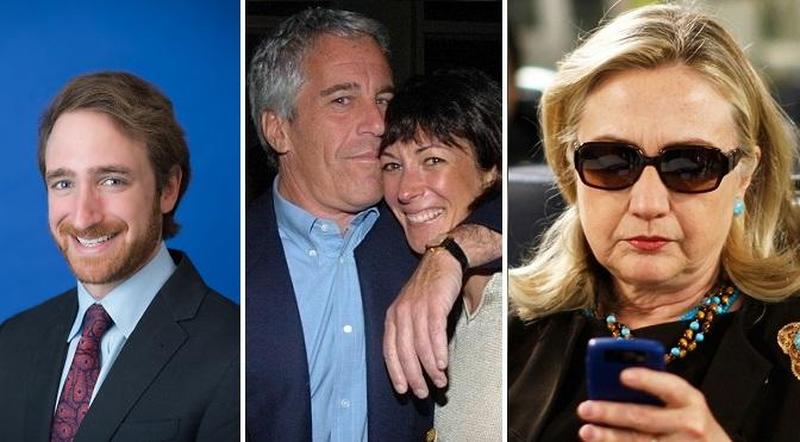
Hillary Clinton “gifted” a prestigious job in the Obama State Department to the nephew of accused pedophile and sex trafficker Ghislaine Maxwell, according to OK!Magazine – and whose employment was confirmed by the Daily Beast.
Alexander Djerassi, the son of Maxwell’s sister Isabel, went from working on Hillary Clinton’s 2008 Presidential campaign, to a “very powerful and prestigious position” within the state department, working under Clinton in charge of the Bureau of Near Eastern Affairs. He returned to Clinton’s 2016 campaign, according to the Beast.
“Secretary Clinton gave Alex a job in one of the most sensitive areas of Obama’s executive apparatus,” an anonymous source told OK!. “The fact Alex Djerassi, fresh out of college, was put in charge of the State Department’s Bureau of Near Eastern Affairs, covering the Middle East, was an interesting move.”
“He worked directly on the Arab Spring, and Hillary sent Alex as the US representative to the expatriate rebel groups Friends of Libya and Friends of the Syrian People,” the source continued, adding that Djerassi was given “special treatment.”
A State Department spokesperson confirmed Djerassi’s employment with The Daily Beast, though could not comment on whether the job was in fact “gifted” by Clinton.
A year before Mr. Djerassi’s appointment, his aunt’s ex-boyfriend, Epstein, pleaded guilty to a state charge (one of two) of procuring for prostitution a girl below age 18 and was sentenced to 18 months in prison.
Epstein served almost 13 months before being released for a year of probation on house arrest until August 2010.
According to Djerassi’s LinkedIn profile, “He worked on matters relating to democratization and civil society in the Arab world, the Arab uprisings, and Israeli-Palestinian peace. Djerassi has served as a U.S. representative to the Friends of Libya conferences, Friends of the Syrian People conferences, U.S.-GCC Strategic Coordination Forum, and several UN General Assemblies.”
According to the Beast, Derjassi’s name appears in a ‘collection of Clinton’s emails’ published by WikiLeaks – with Assistant Secretary of State Jeffrey Feltman referring to his “special assistant, Alex Djerassi” in November of 2011 and January 2012.
Meanwhile, the Beast also notes his employment on Clinton’s campaign.
From September 2007 to June 2008, Djerassi was a policy associate for Hillary Clinton’s presidential campaign. He listed his job duties as such: “Researched and drafted memos, briefings, and policy papers for candidate, senior staff, and news media on wide range of domestic and foreign policy issues. Prepared for more than 20 debates.” (In late 2007, Epstein was under investigation for trafficking girls in Palm Beach and working on a secret plea deal with federal prosecutors. Maxwell is believed to be one accomplice who was protected under the controversial agreement.)
The Yale and Princeton alum—the son of Maxwell’s sister Isabel—apparently returned for Clinton’s 2016 presidential run. –Daily Beast
Bill Clinton notably flew 26 timeson the infamous “Lolita Express” belonging to Maxwell associate and convicted pedophile Jeffrey Epstein. The former US President was notably fingered as having been seen on Epstein’s “pedo island” according to court documents released three weeks ago.
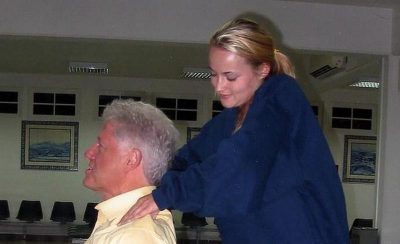
More recently, photos of Clinton receiving a neck rub from one of Epstein’s accusers (who said he was a perfect gentleman) surfaced in the Daily Mail.
A powerful Senate committee chairman has subpoenaed FBI Director Chris Wray and a former State Department official in an intensifying investigation into possible U.S. corruption in Russia and Ukraine and declared there is evidence Joe Biden’s family engaged in a “glaring conflict of interest.”
Senate Homeland Security and Government Affairs Committee Chairman Ron Johnson announced the actions Monday, strongly accusing Democrats of levying false allegations against him and other GOP investigators to distract from the evidence his committee has gathered about Joe and Hunter Biden’s dealings in Ukraine.
“We didn’t target Joe and Hunter Biden for investigation; their previous actions had put them in the middle of it,” Johnson wrote in a letter released Monday that provided a detailed timeline of Joe Biden’s Ukraine policy actions and his son’s hiring with the Ukraine natural gas company Burisma Holdings.
“Many in the media, in an ongoing attempt to provide cover for former Vice President Biden, continue to repeat the mantra that there is ‘no evidence of wrongdoing or illegal activity’ related to Hunter Biden’s position on Burisma’s board,” the senator wrote. “I could not disagree more.”
Johnson noted evidence gathered by his committee showed Joe Biden met with his son’s business partner, Devon Archer, in April 2014 and within a month the vice president then visited Ukraine and both his son Hunter and the business partner were put on the Burisma board as the firm faced multiple corruption investigations.
“Isn’t it obvious what message Hunter’s position on Burisma’s board sent to Ukrainian officials?” Johnson asked. “The answer: If you want U.S. support, don’t touch Burisma. It also raised a host of questions, including: 1) How could former Vice President Biden look any Ukrainian official (or any other world leader) in the face and demand action to fight corruption? 2) Did this glaring conflict of interest affect the work and efforts of other U.S. officials who worked on anti-corruption measures?”
Sources familiar with Johnson’s investigation say the committee has secured testimony from at least one State Department official who worked in Ukraine saying the Bidens’ conduct created the appearance of a conflict of interest and undercut U.S. efforts to fight corruption in Kiev.
Johnson also divulged that late last week he issued a formal subpoena to Wray demanding he immediately surrender records from the Russia collusion probe that the committee has been seeking for months.
The subpoena gives Wray until 5 p.m. on Aug. 20 to comply and demands all records from the probe known as Crossfire Hurricane, including those provided for a damning report by the Justice Department inspector general.
Johnson also announced his committee has prepared a subpoena for Jonathan Winer, a former Obama State Department official who had extensive contact with British intelligence operative Christopher Steele, the author of a flawed dossier that helped propel the FBI probe into now disproven Trump-Russia collusion.
“Mr Winer‘s counsel has not responded since Thursday as to whether he would accept service of the subpoena,” Johnson said. “If he does not respond by tomorrow, we will be forced to effect service through the U.S. Marshals. More subpoenas can be expected to be issued in the coming days and weeks.”
Johnson and Senate Finance Committee Chairman Chuck Grassley have been pursuing a two-track investigation for more than two years, examining both failures and corruption in the FBI’s Russia probe as well as the issue of the Bidens’ conflicts in Ukraine.
As the 2020 election draws nearer and the committee’s evidence mounts in the Biden portion of the probe, Democrats have repeatedly attacked Johnson and Grassley accusing them of accepting evidence with Ukrainian officials tied to Russia.
In his letter, Johnson adamantly denies he has talked with or received documents from the Russian-tied Ukrainians, accusing Democrats like Sen. Richard Blumenthal of Connecticut of knowingly fomenting disinformation.
“The only problem with their overblown handwringing is that they all knew full well that we have been briefed repeatedly, and we had already told them that we had NOT received the alleged Russian disinformation,” Johnson wrote. “The very transparent goal of their own disinformation campaign and feigned concern is to attack our character in order to marginalize the eventual findings of our investigation.”
Johnson’s letter identifies 14 questions he believes Joe Biden should answer and said the dealings documented by his committee — all from U.S. government documents — follow a larger pattern of family members appearing to cash in on the vice president’s policymaking.
“The appearance of family profiteering off of Vice President Biden’s official responsibilities is not unique to the circumstances involving Ukraine and Burisma,” the senator wrote. “Public reporting has also shown Hunter Biden following his father into China and coincidentally landing lucrative business deals and investments there.
“Additionally, the former vice president’s brothers and sister-in-law, Frank, James and Sara Biden, also are reported to have benefited financially from his work as well. We have not had the resources to devote investigatory time to these other allegations, but I point them out to underscore that Ukraine and Burisma seem more of a pattern of conduct than an aberration.”
Johnson’s announcement follows one day after Senate Judiciary Committee Chairman Lindsey Graham released a document Sunday he says shows the FBI misled senators on the Intelligence Committee during the Russia probe by falsely suggesting Steele’s dossier was backed up by one of his key sources.
“Somebody needs to go to jail for this,” Sen. Lindsey Graham (R-S.C.) the panel’s chairman, told the Fox News program Sunday Futures with Maria Bartiromo. “This is a second lie. This is a second crime. They lied to the FISA court. They got rebuked, the FBI did, in 2019 by the FISA court, putting in doubt all FISA applications.”
The document in question contains the draft talking points the FBI used to brief the Senate Intelligence Committee in February 2018, including an assessment that the primary sub-source of the information contained in the Steele dossier had backed up the former MI-6 agent’s reporting.
The primary sub-source “did not cite any significant concerns with the way his reporting was characterized in the dossier to the extent he could identify it,” the FBI memo claimed. “… At minimum, our discussions with [the Primary Sub-source] confirm that the dossier was not fabricated by Steele.”
In fact, by the time the FBI provided senators the briefing, agents had already interviewed Steele’s primary sub-source, who disavowed much of what was attributed to him in the dossier as in “jest” or containing uncorroborated allegations.
Election officials in nearly all US states were warned by the US Postal Service officials back in July about possible delays resulting from voting via mail-in ballots , according to documents published last week. More American states are now moving to either introduce universal vote-by-mail or ease restrictions associated with absentee voting.
US President Donald Trump reiterated his harsh remarks on Saturday towards the universal mail-in-voting system that has been introduced in nine American states now, with California, Vermont, New Jersey and Nevada, recently joining the ranks.
For the president, who indicated his support for “absentee balloting”, which requires a request for a ballot in advance, the universal mail-in ballot system, where ballots are sent to all registered voters automatically, looked “catastrophic”.
“It’s going to make our country a laughing stock all over the world”, the president said on Saturday.His comments come following the news that the US Postal Service (USPS) previously warned election officials in 46 American states, including those in such heated battlegrounds as Pennsylvania, Florida and Michigan, that there were risks that not all of the ballots would be delivered to the office on time for Election Day. But several other American states are also now mulling the possibility of resorting to this system in the midst of the coronavirus pandemic.
“Yes, mail-in-voting does pose new logistical challenges for election offices that previously dealt with few mail ballots”, says Anthony Fowler, a political scientist from the University of Chicago.
Fowler recognizes the clear advantages the postal voting presents to those willing to safely cast their vote during the health crisis, but still believes that there are some instances of fraudulent behavior that are associated with it:
“Mail voting raises the possibility that the person who filled out the ballot is not who they say they are or that the person who filled out the ballot was coerced in some way”, he explains.
An analysis of the risks associated with postal voting should be carried out without the “distraction” associated with the endless Trump-versus-Democrats debate, says Brian Gaines, an elections expert with the University of Illinois.
“Ballots filled out away from the security and privacy of a booth at an official polling station are inherently less secure”, he believes. “They are more subject to coercion, and they are more prone to be ‘lost’ without being properly processed”.
“The more steps there are in the voting process, the more occasions for error”, the election expert notes, comparing procedures surrounding mail-in voting to those when a person simply goes to a polling station.
However, Gaines says that’s not the only issue.
“Beyond errors and coercion, there are more opportunities for fraud when ballots are away from polling stations and effort is required to get them back to the vote counters”, he explains. “Most states do not allow so-called ‘third parties’ to collect absentee ballots (‘bundle’ or ‘harvest’ them), but some do”.
It is the campaign, church or some other organizations collecting ballots for delivery that can potentially intervene in the election process, Gaines explains, as they can “selectively discard ballots on the basis of guesses about how people might be voting, or can tamper with the ballots”.
“None of this means that vote-by-mail is a source of ‘massive’ fraud or error, but I think that, partisan politics apart, it is plainly more vulnerable to fraud and mistakes than in-person voting”, the expert adds.
“In most elections, fraud and error are negligible or marginal, but in a very close election, they can be decisive. This time, with many more states pushing voters to vote by mail, there may be a bit more confusion and maybe a bit more small-scale fraud”, Gaines concludes.
With the USPS delivery systems being overloaded with “millions of ballots” in the course of the November election, logistics indeed becomes “an enormous issue”, says Mitchell Feierstein, CEO of the Glacier Environmental Fund Limited.
“It is highly probable that there be significant fraud with the mail-in ballots”, the hedge-fund manager argues.
Following the news from the US postal authorities that they cannot guarantee that all the mail-in ballots would arrive on time, protesters gathered outside the house of USPS Postmaster General Louis Dejoy, demanding his resignation. But according to Feierstein, “no matter what happens, the result of the 2020 election will not be accepted by one side”.
Yemen’s Houthi Ansarullah movement has decried the deal reached between the United Arab Emirates and Israel to fully normalize relations as a “great betrayal” of the Palestinian cause.
In a statement issued on Friday, Ansarullah’s political bureau said the exposure of the UAE-Israel relations proved the emptiness of all the pan-Arabist slogans raised by the Saudi-led coalition in waging war on Yemen.
The statement added that the UAE was continuing to move forward on the wrong path of serving American and Israeli interests against the Muslim Ummah, referring to the Emirates’ participation in the Saudi-led war on Yemen, which began in March 2015 and has left tens of thousands of people killed.
Ansarullah dismissed assertions that normalization with the Israeli regime would lead to the establishment of peace and stability in the region as “mere delusions.”
It also called for isolating any regime that announces normalization with Israel and boycotting it economically and commercially, stressing that Arab and Muslim peoples were able to do a lot to help Palestine.
The deal between the UAE and Israel was announced on Thursday. US President Donald Trump, who apparently helped broker the deal, has attempted to paint it as a big breakthrough.
But the Palestinians have utterly rejected the deal.
Palestinian President Mahmoud Abbas referred to the deal as an “aggression” against the Palestinian people and a “betrayal” of their cause. The Palestinian resistance movement Hamas described it as “a stab in the back of the Palestinian cause.” And Palestinian people staged protests against the deal in the occupied West Bank and the besieged Gaza Strip on Friday.
The Emirates is now the third Arab country, after Egypt and Jordan, to normalize with Israel. Abu Dhabi was already believed to have clandestine relations with Tel Aviv.
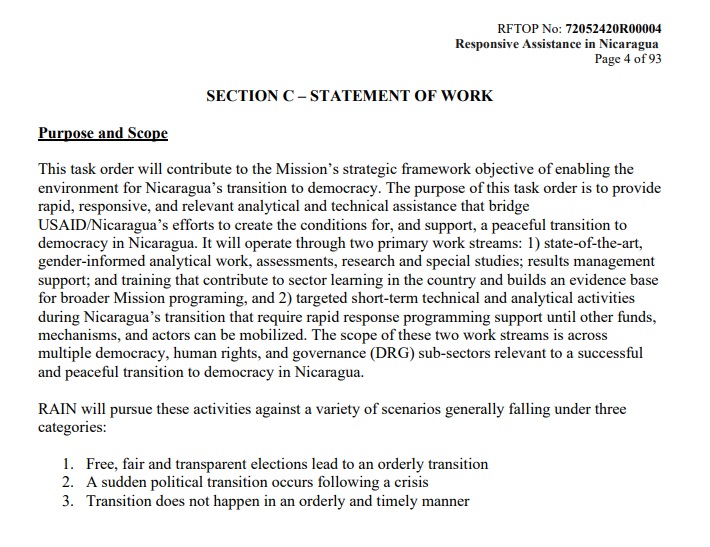
Masaya, Nicaragua – An extraordinary leaked document gives a glimpse of the breadth and complexity of the US government’s plan to interfere in Nicaragua’s internal affairs up to and after its presidential election in 2021.
The plan,[1] a 14-page extract from a much longer document, dates from March-April this year and sets the terms for a contract to be awarded by USAID (a “Request for Task Order Proposal”). It was revealed by reporter William Grigsby from Nicaragua’s independent Radio La Primerisima[2] and describes the task of creating what the document calls “the environment for Nicaragua’s transition to democracy.” The aim is to achieve “an orderly transition” from the current government of Daniel Ortega to “a government committed to the rule of law, civil liberties, and a free civil society.” The contractor will work with the “democracy, human rights, and governance (DRG) sub-sectors” which in reality is an agglomeration of NGOs, think tanks, media organizations and so-called human rights bodies that depend on US funding and which – while claiming to be independent – are in practice an integral part of the opposition to the Ortega government.
To justify such blatant interference, a considerable rewriting of history is needed. For example, the document claims that the ruling Sandinista party manipulated “successive” past elections so as to win “without a majority of the votes.” Then after “manipulating the 2016 presidential elections” to similar effect, it was warned by the Organization of American States (OAS) that there had been various “impediments to free and fair elections” as a result of which the OAS requested “technical electoral reforms.” What the document omits, however, are the overall conclusions of the OAS on the last elections. Although it identified “weaknesses typical of all electoral processes,” the OAS explicitly said that these had “not affected substantially the popular will expressed through the vote.” In other words, the nature of Daniel Ortega’s victory (he gained 72% of the popular vote) made any minor irregularities irrelevant to the result: he won by an enormous margin. The leaked document makes clear that the US is worried that the same might happen again and aims to stop it.
Not surprisingly, the document also rewrites recent history, saying that the “uprising” in 2018 (which had strong US backing) was answered by “the government’s brutal repression” of demonstrations, while it ignores the wave of violence and destruction that the opposition itself unleashed. The economic disruption it caused is still damaging the country, even though (pre-pandemic) there were strong signs of recovery. USAID, however, has to paint a picture of a country in crisis “… broadening into an economic debacle with the potential to become a humanitarian emergency, depending on the impact of the COVID-19 contagion on Nicaragua’s weak healthcare system.” Someone casually reading the document, unaware of the real situation, might get the impression that, in Nicaragua’s “crisis environment,” regime change is not only desirable but urgently required. The reality – that Nicaragua is at peace, has so far coped with the COVID-19 pandemic reasonably well, and hasn’t suffered the severe economic problems experienced by its neighbors El Salvador and Honduras – is of course incompatible with the picture the US administration needs to present, in order to give some semblance of justification for its intervention.
A long history of US intervention
Given the long history of US interference in Nicaragua, going back at least as far as William Walker’s assault on its capital and usurption of the presidency in 1856, the existence of a plan of this kind is hardly surprising. What’s unusual is that someone has made it publicly available and we can now see the plan in detail. Of course, the US has long developed a tool box of regime change methods short of direct military intervention, such as when it sent in the marines in the 1920s and 1930s or illegally funded and provided logistical support for the “Contra” forces in the 1980s. It now has more sophisticated methods, using local proxies, which are deniable in the unlikely event that they will be exposed by the international media (which normally displays little interest, being much more interested in electoral interference by Russia than it is in Washington’s disruption of the democratic processes).
The latest escalation in intervention began under the Obama presidency and continued under Trump, although the motivation probably has more to do with the US administration’s ongoing concerns about the success of the Ortega government’s development model since it returned to power in 2007 and began a decade of renewed social investment. Oxfam summarized the problem in the memorable title it gave to a 1980s report about Nicaragua: The Threat of a Good Example. Between 2005 and 2016, poverty was reduced by almost half, from 48 percent to 25 percent according to World Bank data. Nicaragua had a low crime rate, limited drug-related violence, and community-based policing. Over the 11 years to 2017, Nicaragua’s per-capita GDP increased by 38 percent—more than for any of its neighbors. Its success contrasted sharply with the experience of the three “Northern Triangle” countries closely allied to the US. While Nicaragua became one of the safest countries in Latin America, neighboring Guatemala, El Salvador and particularly Honduras saw soaring crime levels, rampant corruption and rapid growth in the drug trade that prevented social progress and produced the “migrant caravans” that began to head north towards the US in 2017.
The US administration’s efforts in 2016 and 2017, building on long experience of manipulating Nicaraguan politics, appeared to produce results in April 2018. The first catalyst for action by US-funded groups was an out-of-control forest fire in a remote reserve, inaccessible by road.[3] The tactics were clear: take an incident with potential to get young people onto the streets, blame the government for inaction (even though the fire was almost impossible to control), whip up people’s anger via social media, organize protests, generate critical stories in the local press, enlist support from neighboring allies (in this case, Costa Rica) and secure hostile coverage in the international media. All of these tactics worked, but before the next stage could be reached (protesters being repressed by the Ortega “regime”) the forest fire was extinguished by a rainstorm.
A week later, the opposition forces were unexpectedly given a second opportunity. The government announced a package of modest social security reforms, and quickly faced new protests on the streets. The same tactics were deployed, this time with much greater success. Violence by protesters on April 19 (a police officer, a Sandinista supporter and a bystander were shot) brought inevitable attempts by the police to control the protests, leading to rapid escalation. Media messages proliferated about students being killed, many of them false. Only a few days later the government cancelled the social security reforms, but by now the protests had (as planned) moved on to demanding the government’s resignation. The full story of events in April-July 2018, and how the government eventually prevailed, is told in Live from Nicaragua: Uprising or Coup?
A section of the report
Laying the groundwork for insurrection
How were the conditions for a coup created? The aims of US government funding in Nicaragua and the tactics they paid for in this period were made surprisingly clear in the online magazine Global Americans in 2018, which is partly funded by the National Endowment for Democracy (NED).[4] Arguing (in May 2018, at the height of the violence) that “Nicaragua is on the brink of a civic insurrection,” the author Ben Waddell, who was in Nicaragua at the time, pointed out that “US support has helped play a role in nurturing the current uprisings.”
His article’s title, Laying the groundwork for insurrection,[5] was starkly accurate in describing the ambitions behind the NED’s funding program, which had financed 54 projects in Nicaragua over the period 2014-17 and has continued to do so since then. What did the projects do? Like the recently leaked document, NED promotes ostensibly innocuous or even apparently beneficial activities like strengthening civil society, promoting democratic values, finding “a new generation of democratic youth leaders” and identifying “advocacy opportunities.” To get behind the jargon and clarify the NED’s role, Waddell quotes the New York Times (referring to the uprisings in Egypt, where NED had also been active):[6]
“… the United States’ democracy-building campaigns played a bigger role in fomenting protests than was previously known, with key leaders of the movements having been trained by the Americans in campaigning, organizing through new media tools and monitoring elections.”
In the case of Nicaragua, the NED’s funding of groups opposed to the Sandinista government began in 1984, giving the lie to their aim being to “promote democracy” since that was the year in which Nicaragua’s revolutionary government held the country’s first-ever democratic elections. Waddell makes it clear that the NED’s efforts continued, years later:
“… it is now quite evident that the U.S. government actively helped build the political space and capacity in Nicaraguan society for the social uprising that is currently unfolding.”
The NED is not the only non-covert source of US funding. Another is USAID, which describes its role in the 2018 uprising in similar terms to the NED. Not long before he exposed the new document, William Grigsby was able to publish lists of groups and projects in Nicaragua funded by USAID and by the National Democratic Institute (NDI).[7] He showed that upwards of $30 million was being distributed to a wide range of groups opposed to the government and involved in the violence of 2018, and that in the case of the NDI at least this funding continued into 2020.
Last year, Yorlis Gabriela Luna recounted for COHA her own experiences of how US-funded groups trained young people, in particular, and influenced their political beliefs in the build-up to 2018.[8] She explained how social networks and media outlets were “capable of fooling a significant portion of Nicaragua’s youth and general population.” She explained how the groups used scholarships to learn English, diploma programs, graduate studies, and courses with enticing names like “democratic values, social media activism, human rights and accountability” at private universities, “to attract and lure young people.” She went on to explain how exciting events were organised in expensive hotels or even involving trips abroad, so that young people who had never before been privileged in these ways developed a sense of “pride,” belonging, and “group identity,” and as a result “wound up aligning themselves with the foreign interests” of those who funded the courses and activities.
The new task during and after the pandemic
Two years after the failed coup attempt, what are the organizations that receive US funding now supposed to do? The new document is full of jargon, requiring the contractor (for example) to engage in “targeted short-term technical and analytical activities during Nicaragua’s transition that require rapid response programming support until other funds, mechanisms, and actors can be mobilized.” The work also requires “longer-term programs, which will be determined as the crisis evolves.” Preparation is required for the possibility that “transition [to a new government] does not happen in an orderly and timely manner.” The contractor will have to prepare “a roster of subject matter experts in Nicaragua” to provide short term technical assistance, “regardless of the result of the 2021 election, even in the event of the Sandinistas ‘winning fairly’.” The document is full of requirements like being able to offer “a rapid response” and “seize new opportunities,” emphasizing the urgency of the task. In other words, a fresh attempt is underway to destabilize Daniel Ortega’s government and, in the event that this doesn’t work, and even should the Sandinistas win the next election fairly, as the document admits is a possibility, US attempts at regime change are stepping up a gear.
Who will carry this out? The document places much emphasis on “maintaining” and “strengthening” civil society and improving its leadership, which appears to refer to the numerous NGOs, think tanks and “human rights” bodies which receive US funding. At one point the document asks “what should donor coordination, the opposition, civil society, and media focus on?” – clearly implying that the contractor has a role in influencing not just these civil society groups but also the media and political parties.
Not surprisingly, the document has been interpreted as a new plan to destabilize the country. Writing in La Primerísima, Wiston López argues that the plan’s purpose is “to create the conditions for a coup d’état in Nicaragua.”[9] Brian Wilson, the VietNam veteran severely injured in the 1980s when attempting to stop a freight train carrying supplies to the “Contra,” and who lives in Nicaragua, concludes that the US now realizes that Ortega will win the coming election.[10] In response, the “US has launched a brazen, criminal and arrogant plan to overthrow Nicaragua’s government.”
Supposing that there is a clear Sandinista victory in 2021, will the US nevertheless refuse to accept the result? Having implied that the OAS had serious criticisms of the last election when this was not the case, the document implies that it will be pressured to take a different attitude next time, saying that “whether the OAS decides to pick up the pressure on electoral reform again will be an important international pressure point.” No doubt the US will try to insist that the OAS must be election observers, and if this is refused it will allow the legitimacy of the election to be called into question, if the result is unfavorable to US interests. Many question whether the OAS is even qualified to have an observer role any longer, however, after the serious harm it did to Bolivian democracy in 2019 by casting doubts on what experts considered a fair election and, in effect, instigating a coup.[11] This document creates legitimate concern that the US government would like to use the OAS to prevent another government that is not to its liking from winning an election, as it did so recently in Bolivia.
Not only must conditions be created to replace the current government, but once this is achieved the changes must extend to “rebuilding” the institutions of government, including the judicial system, police and armed forces. After the widespread persecution of government officials, state and municipal workers and Sandinista supporters that occurred in 2018, it is not surprising that this is interpreted as requiring a purge of all the institutions and personnel with Sandinista sympathies. As Wilson says, “the new government must immediately submit to the policies and guidelines established by the United States, including persecution of Sandinistas, dissolving the National Police and the Army, among other institutions.”
USAID makes it clear that it is internal pressure in Nicaragua that might eventually provoke a coup d’état, so it calls on its agents to deepen the political, economic and also the health crisis, taking into account the context of COVID-19. The US State Department recently awarded an extra $750,000 to Nicaraguan non-government bodies as part of its global response to COVID-19, and this includes “support for targeted communication and community engagement activities.”[12] As López points out in Popular Resistance, “Since March the US-directed opposition has focused 95% of their actions on attempting to discredit Nicaragua’s prevention, contention, and Covid treatment. However, this only had some success in the international media and is now backfiring since Nicaragua is the country with one of the lowest mortality rates in the continent.”[13] The Johns Hopkins University’s world map of coronavirus cases currently shows Nicaragua with 3,672 cases compared with 17,448 in El Salvador, 42,685 in Honduras and 51,306 in Guatemala.[14] Even though higher figures produced by Nicaragua’s so-called Citizens’ Observatory[15] are regularly cited in the international media, they currently show just 9,044 “suspected” cases, still far below the numbers in the “Northern triangle” countries.
What will the opposition do next?
COHA has already documented the disinformation campaign taking place against Nicaragua during the pandemic and how this has been repeated in the international media. So far, however, warnings of the health system’s collapse have proved to be unfounded.[16] If, as happened with the Indio Maíz fire and the social security protests in 2018, the opposition fails in its attempt to use the pandemic to destabilize the Ortega government, what will it do next? A recent incident shows that attempts to seize on events to spur a crisis will continue. On July 31, a fire occurred in Managua’s cathedral. The fire department responded quickly and put out the blaze within ten minutes, but a crucifix and the chapel where it stood were badly damaged. Within minutes opposition newspaper La Prensa reported that “an attack” had occurred involving a “Molotov cocktail” and that the government or its supporters were implicated.[17] This was echoed by other local and international media, opposition parties, the Archbishop of Managua, and by one of the NGOs which received USAID funding.[18] Despite the lack of any evidence to back up the media stories, the United Nations High Commission for Human Rights (UNHCR) also condemned the incident, obviously implying that it was an attack on human rights.[19]
Yet a police investigation quickly established that there was no evidence at all of any foul play, or that petrol or explosive materials were involved.[20] Their investigations pointed instead to a tragic accident involving lighted candles and the alcohol spray being used as a disinfectant as part of the cathedral’s anti-COVID-19 precautions. The Catholic Church has already announced that the damaged chapel will be restored to its former state. However, the damage that has been done to the government’s national and international reputation, and to its highly politicized relationship with the Catholic Church, will be more difficult to repair.
By F. William Engdahl – New Eastern Outlook – 11.04.2022
Amid the ongoing global inflation crisis, NATO heads of state and mainstream media repeat a mantra that high energy prices are a direct result of Putin’s actions in Ukraine since end of February. The reality is that it is the western sanctions that are responsible. Those sanctions including cutting SWIFT interbank access for key Russian banks and some of the most severe sanctions ever imposed, are hardly having an impact on the military actions in Ukraine. What many overlook is the fact that they are increasingly impacting the economies of the West, especially the EU and USA. A closer look at the state of the global supply of diesel fuel is alarming. But Western sanctions planners at the US Treasury and the EU know fully well what they are doing. And it bodes ill for the world economy.
While most of us rarely think about diesel fuel as anything other than a pollutant, in fact it is essential to the entire world economy in a way few energy sources are. The director general of Fuels Europe, part of the European Petroleum Refiners Association, stated recently, “… there is a clear link between diesel and GDP, because almost everything that goes into and out of a factory goes using diesel.” … continue
This site is provided as a research and reference tool. Although we make every reasonable effort to ensure that the information and data provided at this site are useful, accurate, and current, we cannot guarantee that the information and data provided here will be error-free. By using this site, you assume all responsibility for and risk arising from your use of and reliance upon the contents of this site.
This site and the information available through it do not, and are not intended to constitute legal advice. Should you require legal advice, you should consult your own attorney.
Nothing within this site or linked to by this site constitutes investment advice or medical advice.
Materials accessible from or added to this site by third parties, such as comments posted, are strictly the responsibility of the third party who added such materials or made them accessible and we neither endorse nor undertake to control, monitor, edit or assume responsibility for any such third-party material.
The posting of stories, commentaries, reports, documents and links (embedded or otherwise) on this site does not in any way, shape or form, implied or otherwise, necessarily express or suggest endorsement or support of any of such posted material or parts therein.
The word “alleged” is deemed to occur before the word “fraud.” Since the rule of law still applies. To peasants, at least.
Fair Use
This site contains copyrighted material the use of which has not always been specifically authorized by the copyright owner. We are making such material available in our efforts to advance understanding of environmental, political, human rights, economic, democracy, scientific, and social justice issues, etc. We believe this constitutes a ‘fair use’ of any such copyrighted material as provided for in section 107 of the US Copyright Law. In accordance with Title 17 U.S.C. Section 107, the material on this site is distributed without profit to those who have expressed a prior interest in receiving the included information for research and educational purposes. For more info go to: http://www.law.cornell.edu/uscode/17/107.shtml. If you wish to use copyrighted material from this site for purposes of your own that go beyond ‘fair use’, you must obtain permission from the copyright owner.
DMCA Contact
This is information for anyone that wishes to challenge our “fair use” of copyrighted material.
If you are a legal copyright holder or a designated agent for such and you believe that content residing on or accessible through our website infringes a copyright and falls outside the boundaries of “Fair Use”, please send a notice of infringement by contacting atheonews@gmail.com.
We will respond and take necessary action immediately.
If notice is given of an alleged copyright violation we will act expeditiously to remove or disable access to the material(s) in question.
All 3rd party material posted on this website is copyright the respective owners / authors. Aletho News makes no claim of copyright on such material.