ALBA Expels USAID from Member Countries
ALBA-TCP | June 21, 2012
Resolution from the Political Council of the Bolivarian Alliance for the Peoples of Our America (ALBA) for the immediate withdrawal of USAID from member countries of the alliance.
On behalf of the Chancellors of the Bolivarian Alliance for the Peoples of Our America, gathered in Rio de Janeiro, Federal Republic of Brazil, on June 21st 2012.
Given the open interference of the United States Agency for International Development (USAID) in the internal politics of the ALBA countries, under the excuse of “planning and administering economic and humanitarian assistance for the whole world outside of the United States,” financing non-governmental organizations and actions and projects designed to destabilise the legitimate governments which do not share their common interests.
Knowing the evidence brought to light by the declassified documents of the North American State Department in which the financing of organisations and political parties in opposition to ALBA countries is made evident, in a clear and shameless interference in the internal political processes of each nation.
Given that this intervention of a foreign country in the internal politics of a country is contrary to the internal legislation of each nation.
On the understanding that in the majority of ALBA countries, USAID, through its different organisations and disguises, acts in an illegal manner with impunity, without possessing a legal framework to support this action, and illegally financing the media, political leaders and non-governmental organisations, amongst others.
On the understanding that through these financing programmes they are supporting NGOs which promote all kind of fundamentalism in order to conspire and limit the legal authority of our states, and in many cases, widely loot our natural resources on territory which they claim to control at their own free will.
Conscious of the fact that our countries do not need any kind of external financing for the maintenance of our democracies, which are consolidated through the will of the Latin American and Caribbean people, in the same way that we do not need organisations in the charge of foreign powers which, in practice, usurp and weaken the presence of state organisms and prevent them from developing the role that corresponds to them in the economic and social arena of our populations.
We resolve to:
Request that the heads of state and the government of the states who are members of the Bolivarian Alliance for the Peoples of Our America, immediately expel USAID and its delegates or representatives from their countries, due to the fact that we consider their presence and actions to constitute an interference which threatens the sovereignty and stability of our nations.
In the city of Rio de Janeiro, Federal Republic of Brazil, June 21st 2012.
Signed by:
The government of the Pluri-national state of Bolivia.
The government of the Republic of Cuba.
The government of the Republic of Ecuador.
The government of the Commonwealth of Dominica.
The government of the Republic of Nicaragua.
The government of the Bolivarian Republic of Venezuela.
Translated by Rachael Boothroyd for Venezuelanalysis
Related articles
- 4 ALBA states leave Rio Treaty (alethonews.wordpress.com)
“Sustainable” Development Locks Out Indigenous People

“Against Amazonian Genocide. Xingu (Afro-Brazilian freedom fighter) Lives Forever.” Photo: Petermann/GJEP

By Amantha Perera | TerraViva | 21 June 2012
RIO DE JANEIRO – He was on a flight to the biggest international summit on environment in a decade when Kenyan indigenous rights activist Peter Kitelo’s attention was suddenly drawn to a government advertisement.
It called for national and international investors to put funds into “forest development”. Kitelo could not escape the irony. Here he was, on route to the Rio+20 U.N. Conference on Sustainable Development, and he was looking at yet another assault on the livelihoods and very existence of indigenous communities.
“Sustainable development is not really sustaining my people,” Kitelo told TerraViva in Rio.
He said that forest communities like his and in other East African countries such as Uganda and Tanzania are discriminated against by central governments and policy-makers who determine the future of their native lands.
“We are being left out, no one talks to the right people in our communities,” he said.
When plans are laid for land development, they are advertised in newspapers and other media, to which native tribes hardly have access. Only when the plans are reaching their final stage will officials come and hold short meetings in villages, which Kitelo says are more an effort to satisfy donor requirements than a genuine effort at engagement.
“Then, even before we know it, our land is not ours anymore,” he said.
Kitelo cited the example of forest development for tourism. The concept talks about preserving the forests, but in the process prevents his people from using the forest. “The whole concept of forest conservation does not allow human interaction, but that is what my people have been doing for generations,” he said.
The Kenyan experience is hardly unique. All over the world, indigenous communities complain that they are being left out of the decision-making processes on their own land.
Laura George, from the Amerindian Peoples’ Association of Guyana, told TerraViva that when new land laws were to be introduced in June 2009, there were no consultations with the indigenous people at all. A year later, a final document was produced.
Government officials attending the Rio conference held a side event and claimed that indigenous populations were in fact consulted.
“When I informed them they weren’t, the officials were not happy, but that is the truth,” George told TerraViva.
This type of discrimination can lead to indigenous communities losing their way of life completely.
“While governments are coming to Rio to talk about sustainable development, in my country, Peru, the pressure is growing day by day from policies of the national government that seek to open up our remote forest territories to transnational companies through road infrastructure projects,” said Robert Guimaraes Vasquez of the Shipibo people in the Peruvian Amazon.
Activists said that even in Rio, indigenous groups faced discrimination, with logistics preventing them from gathering together.
“One group is here, another group is 40 km away. How can we form a common front? We are so far apart here,” George said.
Still, conferences like Rio+20 do offer at least small avenues where indigenous groups can bring their problems to a wider and influential audience.
George and Kitelo both told TerraViva that if governments remain deaf to their concerns, they will seek action within international bodies.
“That could be our last resort,” George said.
Lugo: “I will abide but resist”
By Darío Pignotti* – Pagina/12 – June 21, 2012
According to some media sources, the police, and the landowner’s association of Paraguay, a group of agents was attacked when it entered the estate of a millionaire in order to evict landless campesinos. For the campesinos, it was a slaughter.
The death of 18 people, among them 11 campesinos, occurred last Friday when police cleared, without prior dialogue, an estate occupied by landless campesinos in the northeast of Paraguay, in an area near the Brazilian border. It was a “slaughter, and we have information that there are more dead comrades in the woods¨reported the representative of a campesino organization, while the spokeswoman of another group warned of a plan to destabilize the government of President Fernando Lugo.
“What happened was a slaughter of our comrades. Many lies are being told to discredit the campesinos, who are struggling to obtain their own land to work, who are fighting for the rights given to them by land reform. I confirm that up to now, 11 comrades have been murdered,” declared Damasio Quiroga, general secretary of the Paraguayan Campesino Movement, by telephone with the newspaper Página/12.
“I’m speaking to you from where the slaughter took place. We were 300 comrades of several organizations from the department of Canindeyú. We have information that there are more dead comrades, we were told there are injured, and we also knew that some being held captive were executed,” recounted Quiroga.
The version of events from the media and police is that a group of agents was attacked when it entered the estate of millionaire Blas Riquelme – who was linked to, and enriched by, former dictator Alfredo Stroessner – which was being occupied by members of the Carperos Campesino Movement. [Translator’s note: Carperos are landless campesinos struggling to obtain land promised to them by land reform.] The Rural Association of Paraguay adds to this tale the “certain” link between the farmworkers and the guerillas of the Paraguayan People’s Army (EPP): “This fact, plus the use of automatic weapons and explosive devices, suggests something more than a simple group of landless campesinos. It was a heavily armed and organized group, capable of dealing a fatal blow to regular police forces.”
It is an implausible version of the facts, given that the composition of victims so far indicates that there were more dead among rural farmworkers (11) than police (7); the latter group included two members of the Special Operations Group.
The account by campesino Quiroga differs from that offered by most of the media, the police and the landowner’s association. “There is no truth to the claim that there were automatic weapons in our comrades’ camp. I can tell you, comrade, that we have no connection to any guerrillas; for us, the EPP does not exist. They are inventing the story to discredit campesinos when they organize better, because we do not want to continue hoping that someday the ill-gotten lands will be given to us, we campesinos are fighting for our rights.”
— You say, “They invented the story.” Who do you mean?
— The landowners and the police; they are together in all of this. This new police chief, appointed by Lugo, is very dangerous, very corrupt, with formal complaints against him.
The National Organization of Independent Indigenous Peoples wrote in a communiqué: “The use of violence is a mechanism that state institutions like the police, military and prosecutor’s office always use to protect national and transnational businessmen and big landowners, always to the benefit of the private sector.”
The tension between campesinos and landowners, a sector where Brazilian soy producers predominate, has grown since Fernando Lugo became president in 2008. He had promised to move forward with land reform and resolve the problem of “ill-gotten lands,” large expanses of state lands that former dictator Stroessner distributed among military officials and his followers. One such follower is the wealthy Blas Riquelme, the “Paraguayan Carlos Slim,” according to the definition of Martín Almada, the leading human rights activist in the country.
A former bishop, Lugo once counted on the campesinos as his main social and electoral support. But they no longer support him as they once did.
Quiroga told this newspaper: “We have given up believing in the president; he is not keeping his promises. After this slaughter he appointed people who are corrupt and who have very bad backgrounds. The government that promised to carry out land reform is forgetting its pledge and is appointing corrupt Coloradans.”
The reference is to the appointment of Rubén Candia Amarilla to the Ministry of the Interior. Candia Amarilla, a member of Stroessner’s Colorado Party, promised to use a firm hand against the campesinos and announced that from now on, the evictions from occupied estates will be carried out without the establishment of dialogue with the carperos.
“Lugo had to take a step back and accept people from the Colorado Party. It was an imposition by the more reactionary groups, leaving a sector of the campesinos dissatisfied with the president; this is true. And at the same time there are other campesinos who still have confidence in him and support him, albeit as a lesser evil, because if he falls now without completing his mandate, which ends in 2013, it will be a victory for conservative forces,” said Martín Almada, who believes that a plan to destabilize Lugo is in progress.
The clash provoked a political tsunami in Paraguay, with unforeseen repercussions to come over the fate of the first government without links to the Stroessner regime since the end of the dictatorship. “The situation remains red-hot here; the Right is very involved in all of this,” said Magui Balbuena, of the National Committee for the Recovery of Ill-Gotten Lands.
A communiqué from that committee stated: “The slaughter in the department of Camindeyú was the result of a historic class conflict in Paraguayan society, the product of the support of the three branches of state, of a system of accumulation and hoarding of land in the hands of a few… The violence will continue if we do not initiate, once and for all, the return of lands belonging to the Paraguayan people that today are in the hands of persons not subject to land reform.”
*Translation by Jim Rudolf
Related articles
- Paraguayan president vows to fight impeachment effort (Aletho News)
Top Ten Things That Have and Haven’t Changed In the Era of Obama
By Bruce A. Dixon | BAR | June 20, 2012
Black America’s median household wealth, compared to that of whites, has sharply declined under Barack Obama. That’s a change. Just not a good one.
This is a consequence of the foreclosure epidemic which began in 2007 and 2008 and has always been concentrated in black and poor neighborhoods. But the Obama administration has allowed the foreclosure wave to continue without any letup during its first three and a half years, rejecting demands for foreclosure moratoriums or other measures which would make it easier for large numbers of families to remain in their homes. Where the ratio of white to black household wealth four years ago was around 11 to one, today it is greater than 20 to 1.
African Americans still make up 12 or 13% of the nation’s population, remain more than 40% of its locked down and locked up, No change there at all…
Latinos, who make up another 13%, are about 30% of the nation’s prisoners and rising, a slight change, but distinctly for the worse. So seven of every ten US prisoners are from the one quarter of the nation that is black or brown, and that percentage is rising.
The fifty-year war on drugs continues. No change for the better at all there.
Like every president since Nixon, Barack Obama has thwarted states that wanted to decriminalize small amounts of drugs, refuses to treat drug use as a medical problem rather than a police one. Like its predecessors, the Obama administration has expanded the frontiers of the drug war into places like Mexico and Colombia, where the US demand for illegal drugs has given birth to vast industries which may be among the largest and most lucrative, and certainly the most deadly, in those countries.
“Too big to fail” banksters and other financial criminals are still above the law. No change here either.
Not a single person responsible for crashing the economy in 2007 has seen the inside of a prison. It’s just not going to happen. Wall Street insiders give as much, and often more to Democrats than they do to Republicans. So the Obama administration has protected banks and lenders and their co-conspirators from prosecution, and shoveled more than ten trillion more at banksters, including those based outside the US, than the Bush-Cheney gang ever did.
It’s worth remembering that when Bush could not pass his own bailout bill six weeks before the 2008 election, he called Barack Obama into town to spend the week on the phone with Congressional Democrats getting them to switch their votes. So the only change here has been the party in charge.
Although governments will create trillions of new dollars to give to banksters and borrow it back from them at interest in the name of “fixing the economy”, it still won’t create millions of jobs for the unemployed. No change:
In the 1930s, the federal government addressed the Depression by creating hundreds of thousands of jobs out of thin air. They built roads and subways, parks, recreational facilities, dams and bridges. They did theater and historical research like tracking down and interviewing the last living survivors of slavery. It was called the WPA, or Works Progress Administration, under the administration of Democrat Franklin D. Roosevelt.
The White House could do the same today, creating millions of new jobs, repairing and rebuilding infrastructure, building high speed rail, refitting millions of homes for energy efficiency. But Barack Obama disdains the heritage of his own Democratic party. He sounds more like Hoover than FDR today when he says that it’s the exclusive role of the private sector to create jobs.
It’s still almost impossible to organize a union and fight for your own rights on the job anywhere in the US. No change:
There are laws against firing workers who try, but employers are unafraid to break those laws, while working people are very much afraid to lose their jobs. Candidate Obama did promise to put on his comfortable shoes and walk a picket line. Maybe he just lied. President Obama has frozen the wages and pensions of government workers, and endorsed the traditionally Republican idea that public employee and private pensions and health plans cause economic distress to employes and the economy.
The bipartisan corporate-funded drive to “reform” education by breaking teachers unions, turning teachers into Wal-Mart style temps, hi-stakes testing, dissolving public schools and replacing them by privately owned charter schools, exempt from public accountability continues apace. No change there at all.
Bush’s Secretary of Education called teachers unions “terrorist organizations.” Obama’s Secretary of Education declared that Katrina was the best thing that could have happened to public education in New Orleans.
If anything, the Obama administration’s Race To The Top program pushed the envelope further than Republicans would have been able to without sustained resistance. It required states to compete for available federal education funds based upon how many teachers they can fire, how many public schools they can close, how many so-called “merit pay” schemes and similar atrocities they can inflict. Just as only a vicious warmonger like Nixon could have made the first presidential trip to China, only a black Democrat could have successfully pushed the education policy envelope this far in the anti-democratic directions of charters and educational privatization. If anything, Obama’s heinous education policies provide an even further rightward step-off point for Republicans like Mitt Romney. It didn’t have to be that way.
US troops are in more than 140 countries worldwide, and the US, with under 5% of the world’s people, spends more on the military than the other 95% of humanity combined. Not much change there.
On the other hand, in the first weeks of his administration, President Obama received a Nobel Peace Prize. So the pan-European elite, which feared and despised George Bush, loves Obama. That’s a kind of change they call a distinction without a difference.
The Afghan war drags on, apparently indefinitely. A hundred thousand US-paid mercenaries remain in Iraq, and the war there too is far from over. On the other hand, Barack Obama has been able to use cruise missiles and drones to kill black and brown civilians including children in Yemen, Somalia and Pakistan, among other places. US military forces took part in the invasion and overthrow of the African nation of Libya, and the White House has openly rather than covertly sent unknown numbers of US special forces into nobody knows how many countries of Central Africa. A Bush administration doing this would have been greeted with nationwide street demonstrations. But a black Democrat gets a near automatic pass. Is this what the real “race card” looks like?
A US president still orders torture, murder, indefinite imprisonment without trial, and lets corporations that commit crimes abetting those of government employees completely off the hook. But there has been a change here.
When the Bush-Cheney gang did all this stuff, they did it as scofflaws. The Obama Administration has rammed through legislation in Congress and asked for court decisions to cloak most of the previously illegal torture, murder, kidnapping, warrantless spying and similar crimes with thin veneers of legality. This is the all-important difference between having an MBA as president as opposed to a professor of constitutional law.
Black politics, at one time heavily influenced by what Martin Luther King called opposition to the triple evils of racism, militarism, and economic injustice, has shrunken and shriveled under the influence of a new class of corporate funded black political leaders like Corey Booker and Barack Obama. Deep, real and significant change here.
Black politics ain’t about fighting for decent housing or jobs any more. It’s not about diverting resources from the war machine to uplifting the downtrodden. It’s not about funding education or working for the end of the prison state. It’s certainly not about defying unjust laws in the pursuit of just ends, as the Freedom Movement once routinely did.
People forget that King was murdered in Memphis in the middle of a sanitation workers strike in which the National Guard had been called out to patrol the city, and students had stayed home from high school for days to participate in illegal mass actions.
21st century black politics is about electing black politicians, no more and no less. That, and observing Black History Month.
This is far from an exhaustive list, of course.
We could have mentioned the fact that big oil, big agribusiness, big insurance, and big pharma all continue to get whatever they ask for. We might have pointed out that local and state fiscal crises are constantly being provoked, to which the solutions are always “public private partnerships” a standard euphemism for privatizations of public assets like roads, waterworks, generation facilities and public services like payroll, parking and fleet management. We could have pointed out that medical costs are still factors in a majority of personal bankruptcies, and the FCC has essentially abandoned any pretense of regulating the cable and broadcast industries, preferring to simply lease out or auction off the electromagnetic spectrum and leave it all to the “free market”.
Some things have changed over the last four years, and some haven’t. One thing that seems never to change, as long as our choices are restricted to the two corporate parties, is that while you can squint hard enough to make distinctions between Republicans and Democrats, there are few important differences.
Bruce A. Dixon is managing editor at Black Agenda Report. He lives and works in Marietta GA, and is a state committee member of the Georgia Green Party. Contact him at bruce.dixon(at)blackagendareport.com.
Greece: What Can be Done?
By James Petras | 06.16.2012
Introduction
Greece faces the unenviable choice between accepting the terms of “the Troika” and facing the continuation and deepening of a socio-economic crisis, which includes five years of negative growth, over 23% unemployment, an astronomical rise in poverty (from less than 15% to over 40%) and mounting suicides, or a rejection of the “memorandum”, and a likely cut-off of Eurozone funding and capital markets with virtually few reserves to cover salaries, pensions or public services.
While the immediate cost of a break with catastrophic conditions imposed by Eurozone bankers may be high, it opens up the possibility of transforming the internal and external relations and structures which led Greece to ground zero.
Crises as Opportunity?
The prolonged and unending downward spiral of the Greek economy and living standards, the disastrous and destructive policies pursued by the formerly dominant two parties (PASOK and New Democracy) has conclusively demonstrated that Greek “capitalism” and EEC integration has been an unmitigated disaster; tried tested and failed to meet the minimum standards of human existence. Only dogmatic true believers in the innate virtues of ‘capitalism’ and the EEC can continue to prattle about the “need” to continue the same “austerity” policies which have devastated the lives of 80% of the people, closed half the business establishments in the country and failed to provide jobs for half of the young labor force (under 30 years of age).
The profound crisis demonstrates the need for basic changes in the organization of the economy, the urgency for new political leadership and the desire for a new political system responsive to the vast majority.
The old ruling oligarchies are totally discredited. The existing links to the EEC only bleed the economy: providing loans which deepen debt and which pass through the economy to overseas bankers. EEC ‘integration’ is in fact a great suction pump which depresses the economy and living standards in order to extract wealth for overseas bondholders.
No capitalist or politician of the old order provides any redeeming argument. In the past they plundered the economy; in the present they extract and transfer wealth abroad; and for the future they can only promise more of the same.
The basic challenge is not the abysmal conditions of the present but the opportunity that exists for a fundamental transformation. The problem is fashioning a transition from an unmitigated disaster to an equitable, dynamic and participatory economy. The problem facing a transition is the flawed structural and behavioral features of contemporary Greek society, polity and economy. Greece is deeply embedded with the legacy of a culture of pervasive state-party corruption and kleptocracy and bloated expenditures for the military and cliental bureaucracies. Most important Greece is dominated by rent seeking economic elites which pretend to be capitalists, but profit from state and overseas handouts from the Eurozone bankers and states.
To effect a transition requires that we first face the negative legacy of the past in order to see what proposals are viable and necessary.
The Negative Legacy and Debt Default: Greece is not Argentina
Many radical critics of the ‘austerity’ and debt crises in Greece cite the “Argentine example” of debt default, (over $100 billion dollars) and its ability to fashion a successful recovery and growth model based on ‘self-financing’. The critical advocates ignore the profound differences in the economic and social structures of the two countries as well as their respective locations in the regional economies.
Argentina, at the bottom of its crisis, was actually in a worse situation than Greece today. Unemployment hovered between 25% – 30% and over 50% in many working class districts, compared to 24% in Greece. Poverty levels in Argentina exceeded 45%; in Greece they exceed 35%. The depression in Argentina led to a negative growth rate of approximately 20% over the 3 year duration, equal to the loss in Greece over the past 5 years.
Despite starting from a more difficult and worse situation Argentina had several strategic advantages.
In the first place, in Argentina the ouster from power of the crises driven ruling elite was affected by a mass popular uprising (December 2001 – January 2002). In Greece, while mass demonstrations have certainly politicized, mobilized and radicalized a part of the electorate, the radical coalition vying for power (SYRIZA), has taken the electoral route. Secondly, the Argentine upheaval was a continuous process as mass unemployed picketers (piqueteros) blocked all roads and transport as a negotiating tool to ensure that resources were transferred from debt payments to unemployed workers’ family allowances and in reviving the economy. In Greece the vast army of unemployed has neither the organized capacity to sustain constant transport blockage nor can they count on neighborhood and trade union organizations for anything more than repeated one day work stoppages and marches.
Argentina immediately drastically devalued its currency – eliminating the dollar peg – from one to one, to three to one and vastly increased the competitiveness of Argentine export products. The center-left regime encouraged the substitution of local products for costly imports. Argentina, unlike Greece was not part of a currency union and could set its own currency rate. Greece, is bound to the euro and will have to convert to the drachma in order to take control over its finances, currency rate and monetary and investment policy tools.
Argentina possessed a substantial industrial – manufacturing sector, idled by the crisis, but with the worker-engineering-management capacity to respond to a new stimulus program. In addition, Argentina had a dynamic highly competitive agro-business sector, a world leader in beef, grains and soya, as well as energy (oil) and mineral wealth, which the center-left regime could activate.
Greece, during its 30 year membership in the European Union actually saw its meager and backward manufacturing and agricultural base shrink, in the face of cheap and better imports from developed capitalist countries like Germany, France, Holland and elsewhere. Unlike Argentina, Greece received billions of dollars in “transfers”, compensation funds to upgrade its economy and competitiveness and prepare it for full integration (lowering of tariff barriers). However, the “transfers” were not channeled into productive activity either by the two ruling parties or by the ‘capitalists’ and ‘farmers’. The ruling parties used the transfers to build extensive electoral patronage machines; they squandered funds for overpriced state contracts to provide builders engaged in non-productive building projects (including the multi-billion dollar swindle around the Olympic Games). Tens of thousands of unemployed graduates and party loyalists bloated the national, regional and local bureaucracy, increasing consumption, blocking any meaningful productive activity.
Capitalists designed “productive projects” and then transferred EU- loans and handouts to local and overseas real estate investments and luxury purchases. The Greek elite transferred loans to London, Swiss and Cypriot bank accounts – while the government signed off as ultimate guarantor.
In the agriculture sector, many property holders were doctors, dentists, lawyers and high officials who used the ownership of a few dozen olive or orange trees to receive low interest loans, import tax free luxury 4 x 4 vehicle imports and to build second or third vacation houses. Many farmers who received loans and grants, purchased land for homes for their married children or for extra room to rent to tourists or to send their sons and daughters to overseas universities.
Most important, the economic elite – bankers, ship owners, construction-real estate – politicians, speculators skimmed off billions from the EEC transfers in the form of illicit loans to cronies and in the form of fees, management charges for credit dealings and pension funding.
The European bankers, government officials and exporters were acutely aware that the “transfers” were being pillaged – but they went along, for obvious reasons of economic and political gain: lucrative interest payments flowed into their coffers; exporters took over Greek consumer markets; bankers and investment houses found willing pension fund manager’s ‘open’ to dubious investments. Even tourists enjoyed the sun and imports which reminded them of home: wiener schnitzel, English ale, Dutch feta. Moreover, Greece spent 15% of its budget on the military, serving NATO goals and bases.
Contrary to superficial appearances, Greece was not ruled by capitalists, small business people and farmers’ as some political scientists claim. Greece was ruled by an extensive class of kleptocrats, tax evaders and rentiers who pillaged, borrowed, consumed and invested overseas. Technologically Greece was among the most backward agro-manufacturing countries. Its overseas trained and educated professionals, returned and ‘adapted’ to the kleptocratic-rentier culture: most held several positions in public-private activities, guaranteeing a mediocre performance and conflicts of interests.
In summary Greece is not Argentina. A Greek default is an absolute necessity to begin the process of transition toward a productive and equitable economy. But the horrendous Greek legacy raises a whole series of new problems and challenges with few economic resources and in the absence of leading productive classes.
The Difficult Road Out of Crises
Any road map out of the Greek crises will be difficult, complex, and arduous – given the “scorched earth” economy which a left government (LG) will inherit. The first and most basic concern of a LG is to end the policies and especially the agreements with the “Troika” that demand further mass firings of public employees, the reduction in social services, the cuts in minimum wages and pensions. A new LG needs to impose a series of emergency measures to avoid economic bankruptcy.
It is absolutely clear that European bankers and regimes want to punish Greece for transgressions of their “austerity pact”. If Greece should succeed in renouncing the austerity pact, the Euro bankers fear that other countries – Spain, Portugal, Italy, Cyprus and Ireland might follow suite.
Greece should suspend debt payments, impose tight capital controls and freeze bank deposits to avoid capital flight, in the face of the Troika cut-off of funding. The LG should convoke a series of emergency commissions to (1) secure alternative sources of emergency financing from several reserve funds with Euro holdings. They must seek loans from Russia, Iran, Venezuela, China and other states not beholden to the Troika (2) make an inventory of available and potential productive enterprises – bankrupt or troubled firms, indebted enterprises – and convert them into state sponsored worker-employee operated co-operatives (3) investigate public debt to determine what can be classified as ‘legitimate’ (loans channeled into productive employment) or illegitimate (loans that enriched speculators, corrupt contractors, political leaders) (4) investigate and attach overseas holdings of wealthy Greeks who were engaged in multi-year multi-million tax evasion and who accumulated illicit income via unpaid loans and money laundering. Greek auditors should proceed to demand that Eurozone creditors should collect debt payments from the bank accounts of wealthy Greeks who laundered and deposited funds in London, Zurich, Frankfurt, New York and elsewhere.
The principle of the LG should be “those who borrowed the loans and profited, should pay them”. The European bankers who lent to corrupt politicians and business kleptocrats must assume the loss, for failing to exercise “due diligence” – oversight into the viability of the activity they were financing. After all private business ‘justifies’ its profits by the “risks” it takes. In the case of Greece, Euro-bankers’ demands that private bank loans and repayments be “guaranteed” by the state (no matter how badly they were managed) risk ‘moral hazard’: Guaranteeing bankers’ profits, irrespective of their ‘soundness’, encourages a repetition of reckless speculation such as had transpired in Greece over the past 30 years.
The LG should repudiate illegal debts (the vast majority) and renegotiate and roll-over the rest over an extended time frame, pending an economic recovery.
What should be recognized is that past Greek governments (despite being formally elected) engaged in illegitimate activity which prejudiced the sovereignty, productive capacity and livelihood of an entire people.
What is not acceptable is to force an entire people to sacrifice their lives because a minority of Greeks borrowed and didn’t invest or pay their debts to overseas creditors. Currently the kleptocratic millionaires are given “cover” and their illicit multi-billion Euro bank accounts and real-estate holdings are protected by the banks demanding payments from the Greek government. Their current demands are based on a savage demolition of living standards for a whole people. For outstanding obligations, the Greek LG can transfer tax debts of Greek tax evaders to creditors, letting them attach the overseas accounts of their Greek clients.
The LG can self-finance a recovery by drastically changing budget priorities: mainly by slashing its military budgets. Greece’s military expenditures as a percentage of its total budget, is one of the highest in the European Union. By eliminating expenditures for NATO operations, overseas military expeditions and numerous military bases, a LG can prioritize industrial and service investments.
Greece needs a (1) growth tax – a flat tax on the self-employed – professions, shop keepers, hotels, etc. – to ensure that they pay their share in financing the new economy. While the very rich engaged in mega swindles and evasions, it was also the case that the 50% self-employed sector imitated their behavior at the micro-level (2) a tourist tax – at airports, ferry-docks, tour ships stops – with tight oversight and or replacement of corrupt tax inspectors/collectors and customs officials who take a big cut of proceeds. Incarceration of corrupt officials should be mandatory. (3) A real estate tax which reflects the real value of land and property, especially of unused or uncultivated lands. (4) A tax on financial transactions and an end to tax exemptions for major banks, corporations and so-called property developers.
Exploiting Unused or Underutilized Human Resources
The new government has many sources of ‘human capital’ – hundreds of thousands of unemployed young educated people who can be mobilized for work in productive activity through selective public investments in priority areas, especially outside of the “greater Athens region”.
There are many regions and islands which have the potential to provide income and employment, properly addressed. One of the most salient is in food processing; one of the many perversities of the Greek economy is the production and export of apples and citrus products to Germany and the import of juices. Another is the failure to link local food and manufacturing to the 14 million tourist sector. Most food and furniture is imported; most vacation packages benefit overseas multi-nationals and foreign transport agencies. As a result the Greek economy and labor force derives a small share of total income from its “leading sector”.
The New Economy Cannot be Built with Kleptocrats of the Past
As mentioned above, Greece had few if any real entrepreneurs, who invested their own profits, invested in research and development and modernized their plant.
Public sector enterprises were overloaded with the unemployed ‘party members’, many virtually ‘no shows’; and many public sector unions engaged in nepotism and multiple-employment at the expense of efficient services, profitability and long-term development strategies. Public sector enterprises require a kind of re-nationalization’, to generate revenues and income to finance new jobs in new enterprises. Management of public enterprises should be transferred from the hands of stagnant ‘life time job-holders’ to dynamic workers – entrepreneurial – engineering management teams looking to broaden the scope and quality of activity within the new economy.
Pension funds and other savings must be mobilized alongside the billions retained by the state’s debt default to pay current expenses (pensions, salaries, basic imports etc.), to stimulate the revival of production among enterprises which show a willingness to rebuild the economy and collaborate in activating production and employment. Public profits should finance worker takeovers of factories and services abandoned by their previous owners, of which there are thousands.
The public sector must take the lead in investing, servicing and producing to create “confidence” among the small and medium size producers. The public sector must take the lead in negotiating with potential lenders and economic partners outside the Eurozone: new markets and financial arrangements will be necessary if the Eurozone cuts off all funding as a consequence of debt default or a moratorium.
The danger is that SYRIZA follows through on the default and has no alternative emergency plan in place to respond to a Eurozone cut-off. In the face of an EU/IMF offensive and lacking an alternative, a sector of SYRIZA (ex. PASOK public sector unionists) may back-track and seek to accept some form of “renegotiated” pact … which would divide and undermine the prospects for a truly viable and radical transformation and condemn Greece to its catastrophic downward spiral.
Conclusion
SYRIZA has been raised to a serious contender for state power by the most devastating capitalist crisis to affect a Western European country since WWII. It gained adherence through its dynamic grass roots organizing and the relative cohesion of its disparate components. It’s clear and forthright exposé of the corruption and pillage of the dominant parties and its image as a party with ‘clean hands’ has propelled it forward among a broad spectrum of classes, regions and generational groups. However, the very depth of the crisis, the total pillage and emptying of the treasury by the kleptocratic political-business class and the dismantling of the entire productive sector and the transfer of billions of Euros abroad by the millionaire rentier class, has created an immensely difficult terrain from which to launch the necessary transformation. The new government can and must guarantee the sovereignty of the nation by rejecting imperial dictates and end any further degradation (“austerity”) of the Greek people. Emancipation requires that first and foremost the new leadership takes the lead in making sacrifices: cutting out all the perks of office, salaries and overseas commitments. The new social priorities demand severe cuts in military budgets – bases, NATO, arms purchases. The new leaders must tell the Euro-bankers to collect payments from the accounts of the overseas billionaires who borrowed, bled the country and are now sheltered in the same banks.
The Left must move from criticism to practical deeds; from theorizing to creating jobs! Greece with a new government can put an end to open-ended austerity and decay. It can and must change its place in the international economy. In the final analysis, it is Greece’s last best hope.
The DEA and the Massacre in the Moskitia
By GREG McCLAIN | CounterPunch | June 15, 2012
The US is once again hell bent on establishing death squads in its militarization of Central America. This is a stark reminder of the 1980s when Ronald Reagan and Ollie North were funding the contras with drug money, but now it is reinforced with lessons learned in terrorizing the people of Iraq and Afghanistan through night raids and counterinsurgency tactics. Another tactic that the current US administration has reinvigorated comes from the “War on Drugs” playbook of past administrations: by using the DEA as a front for creating and sustaining havoc, it can attempt to justify the military buildup and control the policies of the host country while manipulating the flow of drugs, all the while appeasing the tax payers back home and the folks in the host country who see the build up as necessary. Not abating by any measure the flow of narcotics into the U.S., the so-called ‘War on Drugs’ has actually increased the narcotics industry in Central America and provided a bogus rationale for the increased militarization of yet another Latin American county; this time Honduras.
On May 11th on the Rio Patuca near Ahuas, a small municipality in the Moskitia, a helicopter titled to the US State Department sprayed bullets into a pipante, a long, narrow dugout canoe, which carried sixteen locals. Four people were killed: 28-year-old Juana Jackson (six months pregnant), 48-year-old Candelaria Pratt Nelson (five months pregnant), 14-year-old Hasked Brooks Wood, and 21-year-old Emerson Martínez Henríquez. At least four more were seriously injured. The DEA confirms that its Foreign-deployed Advisory Support Team (FAST) participated in the operation supporting a Honduran National Police Tactical Response Team.
I first heard of the tragedy while in the process of preparing for a human rights delegation to Honduras coordinated by the Alliance for Global Justice and led by Karen Spring from Rights Action. The New York Times, the Washington Post and the Associated Press have all published stories glorifying the role of the DEA in seizing a huge quantity of drugs in the incident. They not only down played the killing and injuring of innocent people (some reports even questioned if there even were casualties), but also some of the news reports stated that those shot were actually involved in drug trafficking. In typical mainstream media fashion there was over-the-top anonymous quoting of US and Honduran officials and not much fact checking.
I arrived in Honduras on May 18th for the delegation. The original itinerary focused on the struggles of the campesinas and campesinos of the Aguan Valley and their fight to win back the land stolen from them by the oligarchs with the backing of the illegitimate post-coup government of Pepe Lobo. As important as the land rights struggle is to us, it did not take long for the delegation (made up of academics, human rights and labor activists, Canadian and U.S. citizens, several with extensive experience in Honduras) to agree that the massacre in the Moskitia was of a greater urgency especially in light of the contradictory reports coming from the US State Department and the DEA.
We spent our time in Ahuas talking to the survivors of the incident and families of those slaughtered by the US supplied M-60 bullets. We also spoke to several village leaders, the Mayor of Ahuas, and to many locals in order to piece together as best we could the incident and the aftermath. What we got was a startling look into how our government conducts its military adventurism and then obfuscates in order to cover up its crimes. We also witnessed the increased militarization of the region as platoons of masked Honduran soldiers, automatic weapons slung across their chests, patrolled up and down the muddied streets of Ahuas. An older commanding officer, whose Velcro name and rank patches were blank, stated that they would be there “for as long as necessary,” another chilling echo from the Iraq/Afghanistan quagmires.
Getting to Ahuas is no easy feat. We took a small plane from La Ceiba, closer to the Western end of the Caribbean coast of Honduras, to Puerto Lempira, which is on the Laguna Catrasco in the Moskitia on the Eastern side of the country near the Nicaraguan border. Once in Puerto Lempira we hired a small lancha, a motorboat with a capacity of about 15 people, to take us across the Lagunas. It was approximately an hour and a half in the scorching midday sun before we reached the port. Once there, we loaded into a giant pickup truck fastened with wooden planks for seating, which are placed across the truck bed, for the thirty-minute bumpy ride into Ahuas.
After our boat ride across the Laguna and through the rivers, which act as highways for the local people, it became clear to us what one of the survivors had been quoted as saying in the press, and that we were later to hear first hand. The reason that the pipante had been on the river at 2 AM was because they waited until the sun had set to take the boat home in order to avoid the mid-day heat. This is significant in light of the statement by the Honduran foreign minister, Arturo Corrales. He was quoted in the New York Times (05/18/12) as saying “it was totally dark, in a place that is not a fishing spot.” He added, “It’s in the jungle. It is very hard to believe that at 2 a.m., in the jungle, the people in a boat that is beside another boat with 400 kilograms of cocaine were fishing,” the implication being that they, the victims, were drug smugglers.
The ill-fated pipante had disembarked way downstream at the mouth of the river where it runs into the Caribbean, fighting against the current in order to get to Ahuas. Those that we interviewed said that they had been on the river for 8 hours. The owners of the boat had dropped off lobstermen at the opening of the Caribbean earlier in the day and waited for the sun to begin to set before heading back to Ahuas. This is a routine that they have been undertaking daily for 25 years. As they returned, heading into the current, they picked up other passengers along the way, some heading home and some heading toward jobs or to visit relatives. Many of them slept during the journey only to be awakened by the sounds of gunfire and the burning feeling of having M-60 rounds rip through their bodies.
The details of what exactly prompted the occupants of the helicopters to fire on the pipante are murky at best. The reports from the State Dept. and the DEA have not been consistent and leave out many details, which calls into question their depiction of the events of that night. While witness and victim testimonies have been consistent, the U.S. government versions are shrouded in a haze of information that cannot be divulged, parsed statements that are obviously leading, and “facts” that do not shed light on the operation and the role of U.S. government agents in it. COFADEH (Committee of Families of the Detained and Disappeared), a Honduran human rights group, put it most succinctly in a press release days after the incident, “To keep an act of terror covered up in the midst of media confusion was always a strategy of psychological warfare, a special chapter of state terrorism. We should not accept this.” Audio recordings of communications from the helicopters that evening or surveillance video, if it exists, could potentially clarify many of these issues. The release of such recordings is something that the delegation would like to see Congress demand in any congressional investigation that it conducts. Until such data surfaces, we will never know the true motivation of those in the helicopters who pulled the trigger nor what they were truly doing on the Rio Patuca.
The events of the immediate aftermath became clearer once our delegation took the time to interview numerous witnesses to the shooting and those who rushed to the river upon hearing that loved ones had been shot at. We spoke to Hilda Rosa Lezama Kenreth, 53, laid up in the Ahuas hospital, an underfunded facility run by an evangelical church. She stated that as the shots were being fired from the helicopter she felt a pain across both of her thighs. A bullet had ripped through her left leg and cut across her right leaving huge gaping wounds. She instinctively jumped from the pipante and swam as best she could for cover in the reeds that hugged the bank of the river. She stayed there clinging to the reeds for at least two hours while going in and out of consciousness waiting for help.
Hilda’s son and daughter, Hilder and Elmina, who had been in town when they heard of the shooting, and were awaiting family members to arrive, rushed to the landing, a small sandy area where pipantes and other riverboats were moored. When they got there a helicopter was landing on an open area near were the boats were moored. Before Hilder could begin to search for his mother and brother-in-law he was approached by what he described as three large white men in uniforms who spoke to each other in English. The soldiers ordered him, in broken Spanish, to sit down while pointing guns at his and his sister’s head and chest. They asked him where gasoline was stored. He told them that there was a building nearby that had gas for the boats. They ordered him at gunpoint to take them there often hitting him in the back of the head causing him to fall. When they arrived, the tall white soldiers kicked in the door of the building and stole two 18-gallon barrels of gas. They returned to the landing and ordered Hilder to fill a boat motor with the gas. He did so and then was ordered to get in the boat. They went down river to where the massacre had occurred and Hilder saw a boat with two more tall white soldiers sitting in it. Once they got along side this boat he was further ordered to move bags from it to the boat they had arrived in. He stated that the soldiers told him in broken Spanish to “move the drugs.” Once he was finished he and the five soldiers returned to the landing with the drugs. The soldiers then moved the bags from the boat to the helicopter, not allowing Hilder to look for his mother and brother-in-law. Instead, they hit him again and handcuffed him with plastic zip ties and forced him sit until they left. Once they were gone, another villager cut the ties from his hand. He found the body of his brother-in-law and loaded it onto a boat. He then searched for his mother and was able to find Hilda in the water semi-conscious, but alive several hours after he had gotten there and was detained by the soldiers.
Another survivor, Clara Wood Rivas watched as bullets shattered her fourteen-year-old son Hasked’s skull. As she described the tragedy, she lifted her arm in the air to show the downward trajectory of the bullets, motioning her hand toward the top of her own head and passing it downward mimicking the bullets exiting Hasked’s chin. She stated that he had been shot so many times that she couldn’t recognize his face. Her son slumped over and fell into the water. Ms Wood jumped in to avoid the rain of bullets. Unable to find her son, she swam to shore. When she made it to the landing, “tall gringos” who did not speak Spanish pointed guns at her. She saw her nephew, who had come to the landing to meet her, handcuffed with zip ties and also being held at gunpoint. Through tears she told us, “I thought they were going to kill me. I passed through a war there. I’m blessed to be alive. I’ll never see my son again!”
Traveling with Clara and Hasked was Walter Wilmer, also aged 14. We were unable to meet with him in the hospital in La Ceiba. According to the preliminary report put out by COFADEH, at the time when the bullets began riddling the pipante Wilmer was asleep. He awoke to sounds of screams and blasts of gunfire. He managed to escape the boat unharmed, but the helicopter gunners aimed at him in the water, destroying his left hand. Wilmer managed to swim using only his right until he reached the bank of the river. He could still see the helicopters hovering over the river so he ran through the darkness making it to the hospital in Ahuas. He was later transferred, at great expense to his family, to the hospital in La Ceiba, but it was too late to save his hand.
Members of our delegation were able to meet with Lucio Adnan Nelson, 22, in the hospital at La Ceiba. He had been shot in the back and in his right elbow where he still has bullet fragments. Under sedation he was able to speak to us, but only briefly. Lucio jumped from the boat when it was fired upon. He felt a burning pain in his back as he clung onto a tree branch sticking out of the river. He managed to swim to shore using one hand and ran through the woods until someone found him and helped him to the hospital. Lucio’s father stated that they had to sell some of their livestock in order to pay for the transportation to La Ceiba hospital. He also stated that if his son doesn’t recover fully, which he most likely won’t, he fears that Lucio’s only option in life is to become a beggar in the street.
The AP and the New York Times have revised their reports many times since the incident. The AP in particular has given a clearer picture of the events, but the overarching bent is still on the justification of the DEA and Honduran military’s presence in the Moskitia. They continue to imply that it was simply a tragic mistake in identity, an example of collateral damage in the War on Drugs. I spoke with a Honduran lawyer who represents the interests of the people of the Moskitia. He stated that there have been several reports of US and Honduran military drug interdiction in that region. The common link to these reports is that in all of them the narcotraffickers have gotten away, but the military have seized the drugs. This raises serious questions, not just to the efficacy of the military in drug interdiction, but indeed, what truly is the US and Honduran militaries’ role in the trafficking. In the wake of the DEA’s implication in drug trafficking as related to Plan Colombia and Plan Mexico, as well as the nefarious scheme of the ATF in supplying arms to drug lords in Mexico, plus the rampant corruption of the Honduran military and police and their interrelationship to narcotraffickers, the questions linger as to the true motivations of the US military/DEA presence in Honduras.
The US’s military motivations come under sharper scrutiny when the issue of recently discovered oil reserves in the Moskitia region are brought to light. Texas based Honduras Tejas Oil and Gas Company, which is pursuing an oil and gas concession in La Moskitia, estimate that there are six to eight billion barrels of oil reserves there. Honduras Tejas has lobbying ties to Tea Party nut job Rep. Louis Ghomert (R. TX), who introduced legislation on their behalf, HR 532 (110th): Recognizing the energy and economic partnership between the United States and Honduras. Its ties to the Honduran government as well as the US State Department need to be further investigated.
Many people we spoke with, including representatives of indigenous organizations, are deeply concerned that militarization and violence generated by the “drug war” are negatively impacting their communities and are focused where there are significant natural resources, rivers with hydroelectric potential, petroleum, gold, and forests with many of these natural resources being privatized.
In light of what our delegation observed on our visit and the concerns raised, we demand:
- That the U.S Congress investigate and hold hearings about the U.S. role in the events of May 11, 2012 in La Moskitia.
- That serious and independent investigations take place exploring the role and responsibility of agents of the U.S. government in the May 11 massacre in Ahuas, be they DEA agents, private security contractors under the direction or contracted by agencies of the U.S. government or other security forces. This investigation should include identifying criminal responsibility of specific individuals.
- That the rights and decisions of indigenous communities and popular movements be respected rather than treated as drug traffickers and insurgents with complete disregard to fundamental human rights.
- That the U.S. government speak out publicly against the presence of individuals widely known to have involvement in drug trafficking and death squads within the Honduran justice system today.
- That in light of the abuses we documented, the U.S. government must withdraw all U.S. security forces including DEA and private contractors from Honduras, cease military assistance and training, and stop promoting re-militarization in Central America.
On June 6th the State Dept. was asked to provide an update on the DEA agent investigation in Honduras and on what is being done to assist the victims?
Their answer:
“DEA’s internal investigation is ongoing and should be completed in the next few weeks and we refer you to the Department of Justice for further information. A Honduran special task force conducted an initial investigation and we understand their preliminary conclusion is that the Honduran security forces were justified in firing in self-defense. The Honduran Government referred the investigation to their Attorney General’s office. The U.S. government is working closely with the Government of Honduras and offered transportation for investigators and additional assistance.
All Honduran citizens are eligible to receive care through the Honduran public health system.”
After four weeks of inadequate care in Honduran hospitals where horror stories are common, such as the lack of sutures for routine stitching procedures let alone for major surgery, The International Red Cross and UNICEF have agreed to intervene and pay for the surgeries of Walter Wilmer and Lucio Nelson at La Ceiba Hospital. Meanwhile, the other survivors are left in the care of an inefficient underfunded healthcare system, while the family members of the deceased have not even received so much as an official apology from U.S. or Honduran government officials.
With the ever escalating US military presence in Honduras, we can expect the events described above to become commonplace, just as the horror stories that have come out of Iraq and Afghanistan are never ending. Can drone attacks be far behind?
Greg McClain was a member of the Human Rights Delegation to Ahuas, La Moskitia, Honduras.
Related articles
- Uniformed US soldiers involved in killing of six Honduran civilians (alethonews.wordpress.com)
- DEA Agents Helped Kill Two Pregnant Women in Honduras Last Week (reason.com)
Bankrupt Black Leadership, Nukes and Environmental Racism
By Bruce A. Dixon | Black Agenda Report | June 13, 2012
For more than a generation, in the last third of the twentieth century, black America was the immovable rock that anchored the left side American political life. Places like Detroit, New Orleans and St. Louis were literally and figuratively where the left lived.
It was a time when civil rights organizations and African American politicians could reasonably be expected to object, to protest, to publicly resist blatant crimes against their constituents on the part of governments and corporations. But by the turn of the 21st century, corporations had begun to finance the rise of a new class of elite black political leaders, politicians like Atlanta’s Kasim Reed and Shirley Franklin, Philadelphia’s Michael Nutter, and Newark’s Corey Booker, and of course President Barack Obama. At the same time, those corporations became the major funders of what used to be called civil rights organizations like the Urban League, the NAACP and the Southern Christian Leadership Council.
Except for ceremonial bows and obeisances like Black History Month and pleas to vote for them on election day, Black America’s political leaders are now free from most obligations to black people, and what used to be vigilant, vocal civil rights organizations are silent in the face of corporate crimes like environmental racism against black communities, let alone the wider implications of these crimes for all Americans.
One of the best examples of this is in Georgia, where the Obama administration in 2009 granted Southern Companies $800 million to underwrite the construction of two nuclear reactors next to a pair of leaky existing nukes in a poor, mostly black Georgia town where almost every family has a cancer case or two. But who would raise the cry? The Southern Christian Leadership Council, perhaps, based in nearby Atlanta? No way. The CEO of Southern Companies headed up SCLC’s building fund, raising millions to pay for its Auburn St. headquarters. So SCLC is silent.
Although poor rural black people are the first to pay the price of this atrocity, they won’t be the only ones. Georgia’s Public Service Commission, which is supposed to look out for consumers has allowed the power company to add $10 to $20 per month to hundreds of thousands, perhaps millions of utility bills to underwrite construction costs of this deadly monstrosity. Even officials of the Nuclear Regulatory Commission have noted that the reactor design is similar to those of the ill-fated Fukushima reactors in Japan, and ought to be re-evaluated in the light of that disaster.
This is a textbook example of how the cutting loose of the black political class from black people has affected the entire American polity. The radioactive poisoning of poor black communities alone should have roused SCLC and the black political class to action defending its supposed constituency. If the Bush-Cheney gang had done such a thing, cries of “environmental racism” would ring across the country. But corporate-funded black leaders, who should be the canaries in the coal mine, don’t allow themselves to criticize the corporate-funded black president. So the silence of the black political class enables the theft of hundreds of millions, perhaps billions from ratepayers statewide and permit the construction of the first of a new and hazardous generation nuclear plants that threaten the safety of millions.
Predator Nation: Obama and Corporate Crime
By RUSSELL MOKHIBER | CounterPunch | June 12, 2012
When Charles Ferguson accepted the Academy Award in 2010 for his documentary film Inside Job, he told 30 million people viewing the award ceremony that “three years after a horrific financial crisis caused by massive fraud, not a single senior financial executive has been prosecuted and that’s wrong.”
Two years later, still no prosecution.
So, now Ferguson is out with a book – Predator Nation: Corporate Criminals, Political Corruption, and the Hijacking of America (Random House, 2012.)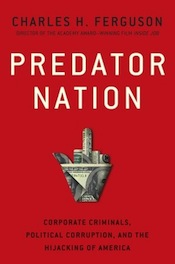
It reads like an indictment.
Check that.
It reads like a number of indictments.
And Ferguson is hoping that federal prosecutors will pick up the book and get some ideas.
And why exactly have there been no prosecutions of high level Wall Street investment bank executives?
Politics?
“Not exactly,” Ferguson says.
“It’s important to bear in mind the direct personal incentive structures of many of the people involved,” Ferguson told Corporate Crime Reporter last week. “The revolving door phenomenon now effects the Justice Department and federal prosecutors to a very substantial extent.”
“The previous federal prosecutor for the southern district of New York, Mary Jo White, now does white collar criminal defense and makes a great deal more money than she did as a federal prosecutor. I think that phenomenon is very well entrenched, very thoroughly entrenched.”
“Indeed Lanny Breuer, the Assistant Attorney General for the Criminal Division was head of the white collar criminal defense practice at Covington & Burling. They represent most of the major banks and investment banks in the United States.”
And his boss, Eric Holder, the Attorney General, came from the same firm.
“Exactly,” Ferguson said. “So, when you say politics, you sort of think of Republicans, Democrats, ideology, large scale political and policy debates. I don’t think that’s the only thing going on here. I think you have to consider incentives – individual, personal, financial and professional.”
When Rudy Giuliani was U.S. Attorney, he had no qualms about prosecuting Michael Milken. What has changed?
“One thing that has changed is that the amount of wealth and political power held by the financial sector has gone up by at least an order of magnitude,” Ferguson said.
“Another thing that’s changed is the amount of money that the financial sector spends on politics and acquiring political power and influence has also gone up by at least an order of magnitude.”
“And thirdly, the divergence, the difference between public sector salaries and incomes and private sector salaries and incomes has widened enormously.”
“So again, for those at the level of large scale political behavior and at the level of individual incentive, things have changed dramatically since the 1980s.”
As an undergrad, Ferguson studied mathematics at the University of California Berkeley and went on to study political science at MIT.
He then went on to organize an early software company – Vermeer Technologies – which was sold in 1996 to Microsoft for a reported $133 million.
He was an early fan of President Obama.
“I donated my legal maximum to his campaign in 2008,” Ferguson says.
But at a press conference in October 2011, Obama addressed the question of why no high level Wall Street executive has been prosecuted.
“So, you know, without commenting on particular prosecutions– obviously, that’s not my job, that’s the attorney general’s job – you know, I think part of people’s frustrations, part of my frustration, was a lot of practices that should not have been allowed weren’t necessarily against the law, but they had a huge destructive impact,” Obama said. […]
What was Ferguson’s reaction when he heard Obama say – the actions “weren’t necessarily against the law”?
“My reaction was very negative,” Ferguson said. “First of all the statement is thoroughly inaccurate and incorrect, but secondly it’s very difficult for me to believe that he doesn’t know that.”
“Given what we now know, it’s very difficult for me to believe that President Obama actually believes that there was no significant criminality in the housing bubble and the financial crisis.”
Russell Mokhiber edits the Corporate Crime Reporter.
Related articles
- Exposing Countrywide (alethonews.wordpress.com)
- Predator Nation: How Wall Street Crashed the Economy & Got Off Scott Free (ritholtz.com)
- Corporate criminals gone wild (salon.com)
Featured Video

Dan Dicks with James Corbett on Solutions Watch
or go to
Aletho News Archives – Video-Images
From the Archives
MMR (Measles, Mumps and Rubella) – Vaccine Risk Statement
MMR Vaccine (Measles, Mumps, and Rubella) Is It Safer Than Measles, Mumps and Rubella?
Physicians for Informed Consent | December 2024
… It has not been proven that the MMR vaccine is safer than measles, mumps, and rubella. The vaccine package insert raises questions about safety testing for cancer, genetic mutations, and impaired fertility. Although VAERS tracks some adverse events, it is too inaccurate to measure against the risk of measles, mumps, and rubella. Clinical trials do not have the ability to detect less common adverse reactions, and epidemiological studies are limited by the effects of chance and possible confounders. Safety studies of the MMR vaccine are particularly lacking in statistical power. A review of more than 60 MMR vaccine studies conducted for the Cochrane Library states, “The design and reporting of safety outcomes in MMR vaccine studies, both pre- and post-marketing, are largely inadequate.”19 Because permanent sequelae (aftereffects) from measles, mumps, and rubella are so rare (especially in children with normal levels of vitamin A and infected after birth),6,15-17 the level of accuracy of the research studies available is insufficient to rule out the possibility that the MMR vaccine causes greater death or permanent disability than measles, mumps, and rubella. – Read full article
Blog Roll
 Aletho News
- Sheikh al-Asadi warns of Iraqi government compliance with US demands
- How to MAKE THE CONSPIRATORS PAY for their crimes! Dan Dicks with James Corbett on Solutions Watch
- There’s a drought in academia: A drought in honest research on the subject of drought and other weather extremes
- Department of War Awards $20.7 Billion Contract to Raytheon for Air-to-Air Missiles
- ‘Distance yourselves from Israel’: IRGC urges US population to question govt policies
- America’s Greenland deal has a radioactive backstory
- The RAF Fairford ‘terror plot’: Unpacking escalation in the UK echo-chamber
- EU Council Advances Chat Control 2.0 Scanning Proposal
- Ex-Greek MEP files complaint against Israeli spyware firm over alleged Pegasus surveillance
- Troubling ideas throughout the Torah, Talmud, Mishneh Torah and Tanya
- If Americans Knew
- New Report: “Scholasticide and Genocide in Gaza: Assessment, Testimonies and Legal Analysis”
- Ex-Biden officials are desperate for a Gaza scapegoat
- Israeli “settlers” Invade Al-Aqsa; Pour Boiling Water on 75-Year-Old
- Israel Has Kidnapped Another American Teenager
- US arms sales to Israel worth $21.6 billion in 20 months
- Three Palestinians Killed in Israeli Attacks on Gaza
- Revealed: German “Anti-Semitism Expert” Driving Crackdown on Palestine Solidarity is Former Israeli Spy
- Egypt’s Warning to Israel Before Oct 7
- Israel’s siege signals another cruel winter for 1.8 million Gazans – Daily Update
- Netanyahu Asked UAE Leader to Deny Report on Oct. 7 Warning in Secret Visit, Sources Say
- No Tricks Zone
- Two More Paleo Reconstructions Affirm Meters-Higher Sea Levels Across Ireland, Brazil 7000-6000 Years Ago
- New Study: Earth And Venus Surface Warmth Largely Explained By Convection And Lapse Rate, Not CO2 Or Radiation
- 2025 Nature Paper Claiming Worsening Global Drought Gets RETRACTED …Heavily Flawed
- New Study: ‘Global Drought Shows No Detectable Recent Acceleration Under Climate Warming’
- Economic Masterminds: German Socialists Suggest Taxing Productivity Gains Stemming From Using AI
- The South China Sea Has Not Been Cooperating With The Climate Change Narrative
- Energy Crisis: Germany Enters Heating Season With Historically Low Gas Reserve Fill Levels
- New Study: The Antarctic Ice Sheet Gained Mass From 2020-2024 Due To Staggering Snow And Ice Accumulation
- Study: Ocean Heating Rates From Thousands Of Years Ago ‘Dwarf’ Modern Ocean Heating Rates
- Climate Extremists Target, Attack Large-Scale Power Grid Infrastructure In Germany!

