New corruption scheme to escape recruitment revealed in Ukraine
By Lucas Leiroz | February 9, 2023
A new illegal arrangement has been revealed in the country. This time, the denounced plan involves an illicit system of evasion of Ukrainian recruits, allowing them to escape the compulsory military service and, consequently, the battlefield. Although the case shows the high levels of corruption in Ukrainian society, it is also an example of how the neo-Nazi army is discredited and the local population is unwilling to maintain the conflict.
The scheme was revealed by Ukrainian informants to the Russian military involved in the special operation. According to them, Kiev’s officials engaged in the recruitment campaign constantly accept bribes in order not to proceed with the enlistment of some people.
The process works as follows: enlistment candidates pay a sum of 10,000 dollars to join volunteer units. In these units, volunteers start working by trying to raise funds for the army on social networks, being saved from the front if they successfully manage to do so. The heads of units take for themselves between 5% and 10% of the amount collected by each volunteer. As a result, the poorest Ukrainians – unable to pay the tariff of 10,000 dollars or to run fundraising campaigns and the less popular on the internet – are the most vulnerable to forced mobilization.
“According to information received from sources in the Ukrainian Armed Forces, a corruption scheme of draft evasion has been established in Ukraine. The entrance tariff is $10,000. It is a one-time payment to a military commissar in order to enroll a potential recruit in a volunteer organization operating at each Recruitment and Social Support Center of the Ukrainian army. This is how the military enlistment offices are called there now (…) Depending on the amount collected, each volunteer is required to pay tribute personally to the military commissar through his intermediaries, the amount varies from 5% to 10% of the total sum collected”, sources say.
It is necessary to remember that this is not the first time that crimes in enlistment units have been exposed. In August 2022, Ukrainian media outlets reported the existence of a system in which the citizens of the country would be “buying” invitations to study abroad, mainly at universities in Poland and the Baltics, thus escaping mobilization. At the time, the news caused outrage among Ukrainians on the battlefield and, in the same vein, this recent case is expected to further increase the internal polarization among Kiev’s forces.
In fact, it is well known that Ukraine is one of the most corrupt countries in the world, with crimes in virtually all sectors of the state. However, as far as the military issue is concerned, the situation is much more complicated. Despite the wrong attitude of the Ukrainian high rank officials in accepting bribes and extorting their own population, the case shows that there is a deep dissatisfaction on the part of the Ukrainian people in relation to the conflict. Such schemes only continue to exist because many people are willing to pay not to go to the front and if this is happening it is because Kiev’s forces are discredited among Ukrainian people.
In the western media it is said that the Ukrainian people are organized and cohesive in search of victory against Russia, but, in reality, local citizens seem wanting to do anything to escape the conflict. Ukrainians visibly do not believe in their country’s victory and do not even think this is a conflict worth fighting. For them, what really interests is to stay alive, fleeing the battlefield in every possible way, even through the involvement in corruption schemes.
Recently, videos of the forced mobilization campaign launched by Kiev began to circulate on the internet. It is possible to see people being conducted to the front by force, with houses being invaded and teenagers taken from their families. Even physically disabled people have been mobilized, which shows the weakness and despair of the forces of the neo-Nazi regime, which seek every form of support possible in order to face Russia. On the other hand, some corrupt officials within the Ukrainian army take advantage of the situation by seeking to extort these young people to allow them to escape the front.
With so many military experts around the world saying that Russian victory is inevitable, there is no reason for Kiev to keep fighting. The best thing to do is to negotiate peace and thus freeing the Ukrainian people from the suffering that affects them.
Lucas Leiroz is a researcher in Social Sciences at the Rural Federal University of Rio de Janeiro; geopolitical consultant.
Jeffrey Epstein: A Jewish Individual?
Review of “One Nation under Blackmail”
The Occidental Observer | February 5, 2023
One Nation Under Blackmail: The Sordid Union between Intelligence and Organized Crime that Gave Rise to Jeffrey Epstein (Volume 1 & 2)
Whitney Webb
Trine Day, 2022
“Far from being an anomaly, Epstein was one of several men who, over the past century, have engaged in sexual blackmail activities designed to obtain damaging information (i.e., “intelligence”) on powerful individuals with the goal of controlling their activities and securing their compliance.”[1]
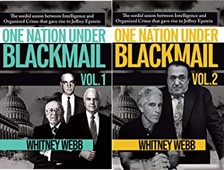
Jeffrey Epstein is dead and Ghislaine Maxwell is locked away in prison, and the thought-makers of our world seem keen to let the more explosive parts of the scandal dissipate from the public consciousness. As far as the mainstream media is concerned, Epstein and Maxwell were little more than well-connected socialites who ran a sex-trafficking ring for the rich and the powerful, and the focus has shifted instead to the criminal and civil cases seeking to achieve redress for the victims of sexual abuse.
On occasion some newspaper articles will mention the hidden cameras littered across Epstein’s properties, others the reams of CDs and hard drives found within them during the FBI raids. Altogether missing from the Netflix documentaries (Jeffrey Epstein: Filthy Rich [2020] and Ghislaine Maxwell: Filthy Rich [2022]) or the articles that spend their time narrowly focusing on the links between Epstein and Bill Gates, is the acknowledgement of the true nature of Epstein himself and the ultimate purpose of this sex-trafficking of minors — a sexual blackmail operation.
Not everyone is cowardly enough to let these controversial aspects lie untouched, as the newly released two-volume book One Nation Under Blackmail by independent reporter Whitney Webb seeks to blow wide open this media-enforced blackout. Utilizing primarily open-source information (that is, publicly accessible information such as books, newspapers articles and government reports),[2] Webb’s book delves into the life and times of Jeffrey Epstein and his deep ties to Jewish billionaires and Israeli intelligence. The intersection of sexual politics with Jewish power has long since been of interest to this writer, and the case of Jeffrey Epstein is easily one of the most damning instances, as evident by the large amount of popular interest in the story. A selection of other books on the Epstein/Maxwell case has appeared in bookshops over the past two years, but a cursory glance through their pages and at their appendices, where the words ‘Israel,’ ‘Jewish,’ and ‘Zionism’ are conspicuously lacking, shows you how surface-level they are in comparison to Webb’s book.
As Webb details extensively throughout the first volume, using sexual blackmail[3] to achieve political ends is far from being an Epstein innovation; it is almost certainly a tactic he learned from others in the murky world where crime meets intelligence. Nor is it something exclusive to Jews. But one can’t help but notice a consistent ethnic pattern in the known major perpetrators of this sort of behavior in Western countries. I have previously written about the Australian variety, where Jewish underworld figure Abe Saffron acquired compromising pictures of prominent Australians (more often than not with underage prostitutes) and leveraged this for his own nefarious ends. Webb (in Chapter 2: Booze and Blackmail) outlines in detail the blackmail operations ran by mob-linked figures Lewis Rosenstiel and Roy Cohn from a bugged suite at the Plaza Hotel in New York. Other non-Jews that Webb identifies as running parallel schemes, such as Saudi arms dealer Adnan Khashoggi or Craig Spence, were likewise deeply enmeshed in the same circles (Khashoggi in fact worked for Israeli intelligence).
Ultimately what is most frightening about the Epstein case, and what makes it stands out from the rest, is the sophistication of the operation, the high profile of the targets—from sitting US presidents to senior members of the British Royal Family—and the extraordinary lengths gone to in order to protect Epstein and avoid the true nature of his activities being exposed. It was as if there was something important at the heart of it all, something worthy of being protected by those in power, with lots at stake lest it be brought into public view. On a number of occasions Webb points to the underreported comments attributed to Alex Acosta, the attorney who gave Epstein his infamous plea deal in 2007, who allegedly told the Trump White House transition team that he backed off upon being told that Epstein “belonged to intelligence.”[4] At every stage where Epstein came under scrutiny, from his first legal conviction, to his second arrest and the questionable circumstances of his death, and even in the post-mortem coverage of his indiscretions, forces seemingly moved in the background to obscure and obfuscate, to clean up the mess and avoid as much detail be allowed to come to light as possible.
Like many books published by small dissident publishers with limited resources, both volumes would have been improved with editing for a more streamlined narrative, as neither makes for easy reading. Without a familiarity with the major events and actors described throughout each densely-packed chapter, the connections and the significance of the interactions between people are sometimes difficult to comprehend. Webb’s sources are conveniently compiled in endnotes at the conclusion of each chapter, and she uncovers a level of detail that makes it a worthy resource for your bookshelf that you will inevitably return to when trying to remember a name or make sense of a connection. Nevertheless, as this review concludes, the book falls short of providing a satisfying answer to the questions that readers of The Occidental Observer would go into it having, and shies away from responding to the most glaring aspects of the Epstein case of all.
ONE NATION UNDER BLACKMAIL
The central thesis of the book is that there has historically between a connection between organized crime and intelligence agencies in America, where the two are in some cases so intensely interwoven in their activities that it is difficult to tell where one ends and the other begins. This thesis, Webb claims, allows us to understand the nature of Jeffrey Epstein and his mysterious life, and that Epstein is one of many such nefarious actors who have operated on the margins of legitimacy. Volume 1 begins in the first half of the twentieth century, where Webb argues that the first connection between intelligence and organised crime was forged in America during the midst of World War II, in an undertaking known as Operation Underworld. This collaboration, specifically between the National Crime Syndicate (an alliance between the Italian and Jewish mobs) and the forerunners of the modern intelligence apparatus, came out of a sort of national security necessity that reaped geo-political dividends and continued after 1945 and into the Cold War.
Though intriguing, many of the chapters of Volume 1 deal with events and personalities of more limited relevance to the main Epstein blackmail story, covering the web of intrigue and scandal surrounding things such as Watergate, the BCCI, the China Lobby, and more obscure events like Billygate and Koreagate. Those chapters dealing with the spiritual forebears of Jeffrey Epstein are the ones that provide the most context and are the most enlightening to read. Webb presents a wealth of information about the history of the Jewish mob and other powerful Jewish figures during the middle years of the twentieth century, when wider Jewish political and cultural influence was beginning to solidify within America and the West. The cast of Jewish characters implicated in major American criminal, financial and political scandals, especially those with a direct line of descent to the Epstein blackmail operation, is staggering: the Bronfman family, Roy Cohn, Bruce Rappaport, Meyer Lanksy, Lewis Rosenstiel, Marc Rich, Max Fisher, Edmond Safra, and Robert Maxwell.
In Chapter 3, “Organised Crime and the State of Israel,” Webb underscores that much of the support given to the Zionist paramilitary groups that operated prior to the foundation of Israel—in the form of smuggled arms and funding—came from criminal networks. Canadian-Jewish liquor barons the Bronfman family, who participated in bootlegging during prohibition, financed the purchase of weapons for Haganah troops. Other Jewish mob figures with Zionist sympathies donated large sums and aided the Zionist cause during Israel’s formative years. This criminal collusion was, in Israel’s case, ongoing throughout its history and was “baked in at the very foundations of, not only its intelligence services, but the origins of the state itself.”[5]
Chapter 9, “High Tech Treason,” introduces us to Robert Maxwell, British media mogul and Israel’s Superspy, another figure of importance in Epstein’s younger years, who jumped almost seamlessly between the roles of organized crime associate and intelligence agent. Webb explores Maxwell’s involvement with the Eastern Bloc mob, including when he lobbied Israel to grant Semion Mogilevich an Israeli passport, allowing him access to the US financial system, and the PROMIS scandal, whereby Maxwell helped Israeli intelligence sell bugged computer software to governments and corporations around the world.
When MI6 attempted to recruit Maxwell for the service, it concluded, after conducting an extensive background check, that Maxwell was a “Zionist—loyal only to Israel.”[6]
Chapter 10, “Government by Blackmail: The Dark Secrets of the Reagan Era,” brings Volume 1 to a close, where many of the cast of disreputable characters revealed in earlier chapters come home to roost during the Reagan administration and the Iran-Contra scandal. The familiar figure of Roy Cohn appears again as a “political fixer” for the Reagan campaign, but Webb notes that Reagan’s intimacy with powerful Jewish figures with organised crime links goes all the way back to the very start of his career, with his mentor Lew Wasserman, the long-time president of Hollywood’s MCA, Inc. and “arguably the most powerful and influential Hollywood titan in the four decades after World War II,” acting as a political patron.
JEFFREY’S SHIKSES
Volume 1 sets the stage for Volume 2, where the interwoven networks of people introduced come together to contextualize the world that Epstein sprang from. Webb covers the underreported early years of Epstein’s financial career in the 1970s and 1980s, which are filled with just as much criminal intrigue as his later years as sex criminal, including his role as a “financial bounty hunter” allegedly working for Saudi billionaire Adnan Khashoggi. His years as an investment banker at Bear Sterns, where he was seemingly brought directly into the company by Alan Greenberg,[7] sat for many years under a cloud of suspicion that he participated in an insider trading scheme carried out by the Bronfman-owned company Seagram. Epstein’s involvement with Steven Hoffenberg in what was at the time the largest uncovered Ponzi scheme in American financial history, Towers Financial Corporation, is yet another fascinating detail largely ignored elsewhere.
How and when Epstein was inducted into the world of intelligence cannot be accurately deduced, but Webb offers a number of potential scenarios, relating to his proximity to people such as Maxwell and Khashoggi. Elsewhere she points to the direct relationship Epstein seemingly had with the highest levels of the Israeli government. Former Israeli Prime Minister and military intelligence figure Ehud Barak, another close Epstein associate, claimed that he was first introduced to Epstein by none other than Shimon Peres.[8] Webb pins the beginning of the sexual blackmail scheme to some point in the early 1990s, around the time Ghislaine Maxwell latched onto Epstein following the death of her father.
Chapter 18, “Predators” deals with the nuts and bolts of the operation, exploring in detail the various methods both Epstein and Maxwell used to recruit and procure girls. Sometimes it was through friendships with the owners of modelling companies, other times it was as simple as Maxwell approaching a girl on the street and recruiting them for “massages.” Even literally purchasing underage Slavic girls from Eastern Europe was apparently a possibility for Epstein.[9] Their relationship with Les Wexner (Epstein was Wexner’s long-time money manager) also proved fruitful, using their connection with the popular Victoria’s Secret fashion chain—a brand owned by Wexner—to pose as recruiters.
Webb first came to my attention when she conducted an interview with Maria Farmer, considered the earliest Epstein victim to report him to the authorities. The interview is long, upwards of three hours, but well worth a listen, especially when Farmer begins to discuss how she was treated by the powerful Jewish figures surrounding Epstein:
I don’t know any White supremacists, but I know a lot of Jewish supremacists… They made it very clear that I was a servant [to them] because I was White.[10]
Farmer may be unfamiliar with the word shikse, but it perfectly describes how Epstein and Maxwell considered these young gentile girls ensnared in their net of abuse. The supposed “trope” of the Jewish man lusting after the shikse finds in Epstein yet another real-life example, with underage blonde girls being his victim of choice when satisfying his own urges. Former Ghislaine Maxwell friend Christina Oxenberg, quoted in the book from an at-the-time anonymous source, relayed a conversation she once had with Maxwell about who these women were that she was “recruiting.” Maxwell reportedly dismissed them with ease: “They’re nothing, these girls. They are trash.”[11]
On the other side of the operation was of course the hidden cameras and the recording equipment. The presence of these hidden cameras in Epstein’s properties is independently confirmed by a number of eyewitnesses, court documents and early newspaper articles that detail this curious addition to Epstein’s properties, and the existence of the CDs and hard drives to store the footage is a matter of public record, including from the latest FBI raid of Epstein’s New York mansion in 2019:
Per photographs taken at the time of the raid, hard drives were found inside a safe forced open by the FBI and numerous large black binders were found in a closet that contain “CDs, carefully categorized in plastic slipcovers and thumbnails with photos on them.” When shown in court, the “homemade labels” were redacted, as judge Alison Nathan had ruled that they contained “identifying information for third parties.” Did that information involve only the names of underage girls, the names of blackmail victims, or both?[12]
The FBI conveniently lacked the warrant to seize these items, and upon returning four days later with the correct warrant, the CDs and hard drives were gone. They were later handed over by Epstein’s lawyer, but having not had the chance to view what was on them, we can only assume that this was more than enough time to delete any incriminating files.

Epstein schmoozing with elites. Left, from left: Epstein, Alan Dershowitz, Steven Pinker, and Larry Summers, presumably at Harvard. Right: with Ghislaine and Bill Clinton
Much has been made of the relationship that existed between Epstein and Donald Trump before they allegedly fell out with each other in 2004 over a property dispute in Palm Beach, Florida, but as Webb exposes in Chapter 16, “Crooked Campaigns,” Epstein and Maxwell had a far more politically intimate relationship with President Bill Clinton that coincided with his time in office and his early post-presidency years. Epstein visited the Clinton White House 17 times, and was apparently a prominent figure in the formation of the Clinton Global Initiative, which saw Clinton as a regular passenger on Epstein’s infamous plane, the “Lolita Express.” Webb refers to other attempts of sexual blackmail against Clinton, including in 1998 when Prime Minister Benjamin Netanyahu apparently threatened Clinton with tape recordings Israel had obtained proving outright that he had a sexual relationship with Monica Lewinsky, using them to pressure Clinton to pardon Israeli spy Jonathon Pollard.[13] It seems the Clinton White House, which was seeking a peaceful solution to the Israel-Palestine conflict, was of key interest.
Chapter 21, “From PROMIS to Palantir: The Future of Blackmail,” finishes off Volume 2 with the chilling insight that perhaps one of the reasons Epstein’s sexual blackmail operation collapsed was because it was allowed to collapse — it had become outdated and irrelevant. The advent of the permanent internet connection has brought about opportunities for far more widespread and even more intimate forms of blackmail, instead conducted and collected via electronic means. A technological panopticon whereby the cameras once placed by Epstein throughout his properties are instead now placed by big tech and social media companies in our own homes, omnipresent in our lives. After his 2008 conviction, both Epstein and Maxwell seemed to be shifting away from sexual blackmail and were making inroads in Silicon Valley and mixing with data-harvesting IT companies. Epstein’s previous ties with higher-ups at Microsoft and his financial support for John Brockman’s Edge Foundation gave him an in with plenty of big tech leaders, and he had re-branded himself as a tech investor, starting a company focused on collecting genetic data. Ghislaine’s siblings in the Maxwell family also have pedigree in the tech industry going back to the 1990s. As noted by Webb, “in a world where blackmail is overwhelmingly electronic, people like Jeffrey Epstein and Ghislaine Maxwell become liabilities to be silenced, rather than assets to protect.”[14]
WHO, WHAT AND WHY?
Upon finishing Volume 2, I found that many of the questions raised by Webb still remained open. Who or what is “the system” that enabled Epstein and protected him from justice? If so many people knew, why was there such an institutional resistance to speak out about Epstein? And the most important question of all: what was the goal behind collecting this sexual blackmail? Why were Epstein and his benefactors trying to control these victims? Unfortunately, Webb’s book does not provide a satisfying conclusion.
Webb does not shy away from pointing the finger at Israel or from discussing wider Zionist motivations and groups like B’nai B’rith. However, she stops frustratingly short of the obvious conclusions. Granted the reluctance is one that all those knowledgeable on the Jewish question are familiar with, and perhaps she simply avoids the discussion for the sake of keeping her book on Amazon and appealing to a wider audience, rather than have it be relegated to the ADL’s banned book department. But for an answer to the questions most readers are likely after, we are given nothing more than a few measly sentences concluding that the Epstein operation was instigated by Israeli intelligence and that those in the “power structure” and “the system” — the same people that made Epstein untouchable — have now strengthened their stranglehold over America. Ultimately, readers are given the impression that this blackmail was collected as control merely for the sake of control, power merely for the sake of power, without a deeper underpinning goal.
Upon being challenged during an interview by Jewish podcaster Adam Sosnick on the obvious Jewish identity of the key players, Webb retreats to the safe position: By referring to Israeli intelligence or Jewish criminals, one is not referring to all Jewish people, and one cannot conflate the Epstein network or powerful billionaire Zionists with the whole Jewish community, or ascribe any wider group motive to them. Sosnick also exhorts the listener to avoid speaking of groups and instead only of individuals, lest it breed hate.[15]
One is of course allowed to speak of the Chinese or Catholics or Russians in general terms and in a political sense as behaving out a sense of group identity and a sense of group interests, and it is sophistry to claim that the speaker is referring to every single Catholic in the world or every single Russian in the world. Regardless of which sociological theory of power you ascribe to, what is clearly being referred to is the organized community, the power structure that represents the wider in-group and operates towards a unique ingroup goal. In the case of the Russians, this is currently Putin and the Russian state apparatus, supplemented by the Russian military, media and business elite that do not dissent from achieving Russian strategic interests as determined by the state apparatus. For Catholics, it is the Vatican and the international network of dioceses, bolstered by the Catholic Universities, think tanks and charities. People are not forced to declare “not all Catholics” when dealing with the allegations of a cover-up of child sexual abuse within the church.
When one speaks of the Jews, it stands to reason that the same scenario should apply. That is, it quite reasonably refers to the organized Jewish community, including organizations like the ADL; the powerful figures in Israel and in the diaspora, as well as the religious and intellectual leaders, the business figures and the lobbying groups. Sure there are dissenters and outsiders, and of course there is internal debate and a difference of opinion on the best means for meeting its goals, but the organized Jewish community exists just the same, and remains firm in its fundamental goal of ensuring the security and survival of the Jewish people and the state of Israel.
Herein lies the problem for Webb and the reason behind the demand to treat Epstein as a mere “Jewish individual.” The network of powerful Jewish figures and institutions chronicled throughout Webb’s book is a network that is intimately connected to Jeffrey Epstein or to his blackmail operation: Robert Maxwell, the Pritzker Family, Larry Summers and Alan Dershowitz, Ehud Barak and Israeli intelligence, the world’s wealthiest Jewish families that formed the Mega Group (the Bronfman, Lauder and Wexner families). The list goes on and on. These are not powerless fringe figures or outsiders who are scorned by Jewish leaders or the wider Jewish community. They are the leaders of the organized Jewish community, some of whom practically direct Jewish-American cultural, political and even religious life. To remove them from the equation of power would be the equivalent of removing half of the highest-ranking members of the Vatican from the Catholic Church or leading members of the Chinese Communist Party from the Chinese state.
Using the phrase “the Jews” cuts the Gordian Knot at the heart of Webb’s attempt to understand Epstein, whom he was working for, and how he so effortlessly moved among the elite strata of society, why it was covered up, who stood to benefit from this blackmail operation, and what its ultimate aim was. With those two words, all the jumbled euphemisms of “elites” and “Zionists” melt away, and the confusing mix of organized crime and intelligence, legitimate and illegitimate enterprises seemingly working in unison with each other starts to become intelligible. The ease with which Epstein and Maxwell abused and then dismissed these young girls as mere “trash” makes more sense when you know the meaning behind the word shikse (an unclean abomination). The reason for the legal cover-up and the inhibition of the mainstream media to run the story, even when they have no direct connection to the Epstein network, is obvious when you know who the proprietors of most mainstream American media outlets are, and with whom both cultural and institutional power in the US now lies. All this interwoven association is merely two sides of the same coin—a system constructed to ensure the security of Israel and the survival of the Jewish people. To talk openly about Epstein’s true activities is to talk openly about the nature of Jewish power, and for that reason alone most will not do so, for fear of the Jews. In all, Webb has picked up the puzzle pieces and assembled them neatly on the board, but she refuses to take that final step back and honestly contemplate the picture she has pieced together.
What are we to make of the institutional silence and protection, and the dishonest shifting of the narrative to a mere sex-trafficking ring? What can you conclude from the attempt to declare anyone who dares point out the clear ethnic goal at the heart of this vile sexual blackmail operation an anti-Semitic conspiracy theorist? The only reasonable conclusion is that Epstein functioned with the support and backing of Jewry’s most powerful figures, and that the organised Jewish community is willing to conceal a criminal conspiracy of frightening proportions if it serves to benefit the Jews or would otherwise negatively affect them (by creating more anti-Jewish sentiment) if the American public knew the truth.
Had Epstein’s personal indiscretions not become too big to ignore and had it not all unravelled so spectacularly due to the pressure of the #MeToo movement, would Epstein also have been buried in honor like Robert Maxwell, with Israeli Prime Ministers and dignitaries lining up to give a tearful goodbye to yet another faithful servant to the Jewish people? If he had been released early from a prison sentence, would he also have been welcomed back to Israel with open arms like Jonathon Pollard? Epstein had already once been professionally rehabilitated by Jews after his first conviction, there’s no reason why it couldn’t have happened again.
Notes
[1] Webb, W 2022, One Nation Under Blackmail: The sordid union between Intelligence and Organised Crime that gave rise to Jeffrey Epstein (Volume 1), Trine Day, Oregon USA, p.IX.
[2] Webb does on occasion rely on interviews she conducted with figures close to the Epstein story such as Ari Ben-Menashe and Maria Farmer.
[3] As distinct from simply bribing someone with sex with a consulting adult, or honey pots traps, a tactic as old as time—think Samson and Delilah or modern versions such as the honeypot trap that captured Mordechai Vanunu.
[4] Vicki Ward, “Jeffrey Epstein’s Sick Story Played Out for Years in Plain Sight,” The Daily Beast (August 19, 2019). https://www.thedailybeast.com/jeffrey-epsteins-sick-story-played-out-for-years-in-plain-sight
[5] Webb, Op. Cit., p.93.
[6] Webb, Op. Cit., p.382.
[7] Webb, W 2022, One Nation Under Blackmail: The sordid union between Intelligence and Organised Crime that gave rise to Jeffrey Epstein (Volume 2), Trine Day, Oregon USA, p.6.
[8] Tarnopolsky, N 2019, ‘Ehud Barak: I Visited Epstein’s Island But Never Met Any Girls’, The Daily Beast, July 15, retrieved from: https://www.thedailybeast.com/israels-ehud-barak-i-visited-epsteins-island-but-never-met-any-girls
[9] Webb, Volume 2, Op. Cit., p.266-267.
[10] See https://www.youtube.com/watch?v=dtD02MeZU4o from 1:31 or so
[11] Webb, Volume 2, Op. Cit., p.276
[12] Ibid., p.58.
[13] Stoil, R. S 2014, ‘Netanyahu said to have offered Lewinsky tapes for Pollard’, The Times of Israel, July 23, retrieved from: https://www.timesofisrael.com/netanyahu-said-to-have-offered-lewinsky-tapes-for-pollard/
[14] Webb, Vol 2, Op. Cit., p.373.
[15] PBD Podcast 2020, The TRUTH About Jeffrey Epstein w/ Whitney Webb, Episode 198, retrieved from: https://youtu.be/GVVHWVoZ4kU?t=5978
George Soros is either prophetic or pulls a lot of strings
By Tony Cox | RT | February 2, 2023
George Soros is either stunningly prescient or frighteningly influential when it comes to determining who will need to do all the bleeding and dying that he deems necessary to bring about a desirable “new world order.”
Consider the Hungarian-born billionaire’s essay on the future of NATO: “The United States would not be called upon to act as the policeman of the world. When it acts, it would act in conjunction with others. Incidentally, the combination of manpower from Eastern Europe with the technical capabilities of NATO would greatly enhance the military potential of the partnership because it would reduce the risk of body bags for NATO countries, which is the main constraint on their willingness to act. This is a viable alternative to the looming world disorder.”
Soros deserves credit for neatly describing the US and NATO strategy for bringing about and exploiting the Russia-Ukraine conflict. The Ukrainians are providing the manpower – in other words, the cannon fodder – and the Western puppeteers can endeavor to weaken Russia and enforce their vision of a favorable world order. They also can do this without having to make the case to their citizens that this is a fight for which it is worth tolerating body bags coming home from the front.
Additionally, by sharing the burden of providing military and economic aid to Kiev, the Western powers achieve the dual benefits of prolonging their proxy war and creating the impression that the whole world is steadfastly standing with the blue and yellow. That helps underpin the narrative frame that there is no moral basis for criticizing Ukraine policy and anyone who does so is probably a Kremlin agent.
The thing is, Soros didn’t write his take on the situation this week, this month or even in the past year. He didn’t even write it back in 2014, when he was allegedly backing the overthrow of Ukraine’s elected government and might have reasonably anticipated a coming conflict with Russia. No, Soros wrote this assessment in 1993, nearly 30 years ago.
Back then, in the wake of the Soviet Union’s collapse, Soros wanted to prevent former Soviet states and Warsaw Pact nations from becoming nationalist countries that would be governed according to their own interests and oppose the global order that he was promoting.
Western leaders had made assurances that NATO wouldn’t expand eastward, but Soros saw the military bloc as “the basis of a new world order.” He conceded that the group would need “some profound new thinking,” given that its original mission was “obsolete,” and he insisted that the alliance must be free to invite any country to join.
In fact, he saw a great opportunity for NATO to take advantage of the security void created by the Soviet collapse if it could act quickly. “If NATO has any mission at all, it is to project its power and influence into the region, and the mission is best defined in terms of open and closed societies.”
“The countries of Central Europe are clamoring for full membership of NATO as soon as possible, preferably before Russia recovers. Russia objects, not because it harbors any designs on its former empire but because it sees no advantage in consenting. Its national pride has been hurt and it is sick and tired of making concessions without corresponding benefits.”
Soros saw NATO as both a viable platform to develop into the anti-Russia enforcer for his new world order and the bright and shiny object to lure Europe’s former Eastern Bloc states into the fold. “NATO has a unified command structure which brings together the United States and Western Europe,” he said.
“There are great advantages in having such a strong Western pillar: It leads to a lopsided structure firmly rooted in the West. This is as it should be, since the goal is to reinforce and gratify the desire of the region for joining the open society of the West.”
The goal became reality. For example, Soros noted that there was nothing to prevent countries such as Poland, Czechia and Hungary from joining NATO. The three nations became the first wave of NATO’s post-Cold War expansion, joining the bloc in 1999. In fact, the bloc has since nearly doubled in size, adding 14 members by 2020 and teeing up Ukraine and Georgia as future prospects.
NATO moved right along the Russian frontier, placing strategic weapons and security guarantees on Moscow’s doorstep and helping to trigger the current crisis. As Soros acknowledged in 1993, Russia had no desire to restore the empire of Peter the Great – contrary to a popular CNN talking point. However, as the Kremlin warned repeatedly in the years leading up to the current conflict, Moscow couldn’t stand idly by while its national security interests were trampled.
It’s easy to see why Soros was and is so worried about nationalism: His vision could never sell with a government that served the interests of its own people.
NATO’s expansion binge didn’t make anyone safer. We know the little brothers, like the people of Ukraine, aren’t better off. They have the privilege of bleeding and dying as they provide the “manpower” for NATO’s proxy fight with Russia. As for the big brothers, they undermine their own security. Americans and Western Europeans are suffering the economic effects of the US-NATO sanctions war against Russia, and their governments are pushing them ever closer to a planet-ending nuclear Armageddon.
The Bulletin of the Atomic Scientists announced last week that its Doomsday Clock had advanced to within 90 seconds of midnight, the latest ever, indicating that humanity stands at “a time of unprecedented danger.” The group cited the Russia-Ukraine conflict, which has “challenged the nuclear order – the system of agreements and understandings that have been constructed over six decades to limit the dangers of nuclear weapons.”
Not to worry if you’re George Soros, 92 years old, and watching your geopolitical dreams come true. He and others like him can keep marching onward to perfect their world order as they see fit.
If we wonder whether NATO works on behalf of that order, we need look only at what has transpired and the framing of the current conflict. When Russian forces began their offensive against Ukraine last February, Western leaders and pundits condemned President Vladimir Putin for undermining the “rules-based international order.”
So NATO has emerged as the enforcer of the rules-based international order – the new world order, if you will – just as Soros called for three decades ago. The results of that “profound new thinking” are much the same as the political activist envisioned in 1993. He also called for expanding NATO to Asia, which hasn’t yet happened, but the bloc’s 2022 summit was enlarged to include representatives from Asia-Pacific “sentinel states” – Japan, South Korea, Australia and New Zealand.
Was Soros so much of a visionary that the hedge-fund investor could foresee how geopolitics would play out several decades ahead of time, or does his accuracy reflect the fact that he and his allies tend to get their way? Rather than prescience, is this situation more like the cook being a good predictor of what we’re going to have for dinner?
Soros himself offered a hint on that theory in his essay: “We have to act without full knowledge of the facts because the facts are created by our decisions.”
Anyone who suggests that Soros calls a lot of the policy shots is immediately condemned by the Western media as anti-Semitic because, after all, he has Jewish heritage. Never mind that he’s an avowed atheist who has been accused of undermining Israel’s democratically elected government and funding groups that defame the Jewish state.
So when Moldovan President Maia Sandu returns from a recent trip to Davos and promptly starts hinting about joining NATO – in violation of her country’s constitutional commitment to neutrality – we shouldn’t point out that she met with Alexander Soros, son of George Soros, during the summit. Revealing or trying to connect such dots would be anti-Semitic, according to the Western media.
It couldn’t be that George Soros wields an inordinate amount of influence over world affairs. It couldn’t be that some of his critics have legitimate and unbigoted disagreements with his ideas. It couldn’t be that his immunity to criticism is further evidence of his power.
And shut your eyes when a US watchdog group reveals that Soros has financial ties to at least 253 media organizations worldwide and funding links to 54 prominent media figures, including such names as Christiane Amanpour of CNN, Lester Holt of NBC News and Washington Post executive editor Sally Buzbee.
So Soros gets to wield his influence with impunity, apparently achieving what he wants in many cases. He gets to serve the interests of billionaires, defense contractors, power-mongering politicians and social engineers. But what about the rest of us, the other 8 billion people in the world? What about those who just want to be able to support our families, pursue happiness and live in peace – without worrying that iodine pills are sold out and there might not be time to build a nuclear fallout shelter?
Soros himself might prescribe us more bread and circuses, to keep the masses distracted – as well as tribalism, to keep the people divided – at least until we’re needed to serve as “manpower” for the cause.
Tony Cox is a US journalist who has written or edited for Bloomberg and several major daily newspapers.
Researchers bamboozling journalists with mythical comparison of vaccinated and unvaccinated
Where are the numbers? by Norman Fenton and Martin Neil | January 31, 2023
From: XXXXXX
Sent: 30 January 2023 12:33
To: Norman Fenton
Subject: Hart GroupDear Professor Fenton,
Apologies for any intrusion, but I’m contacting you directly since the Hart Group (which I understand you to be a member of), have not replied to my earlier emails – all very busy people, I do understand.
As a small group of individuals who between us have some journalistic and medical-science history, we are working on a presentation (with a further view to establishing a website), which aims to offer a wider range of information concerning Covid policies and treatment than, it appears, is usually available through current mainstream and social media.
Given that our aim is a balanced juxtaposition and presentation of arguments, hopefully allowing better-informed opinions to be arrived at, we do have a range of “issues” we’d love to understand better in order to present them fairly.
You are (I imagine) well-placed to comment on one specific matter, and I would be enormously grateful if you would spare a minute to advise, assuming this enquiry doesn’t create any conflict of interest or other problems for you:
The Times and other media recently reported on a QMUL study* which indicates that unvaccinated individuals with certain medical conditions are more likely to suffer “serious outcomes” than vaccinated individuals. I believe presenting this this demands careful attention to context and contrasting with other possible perspectives.
Dr Aseem Malhotra in a Twitter-hosted video makes reference to de-bunking claims about how this story has been reported, but makes no reference I can find to where such a de-bunking can be found; and sadly, he too seems unavailable to comment!
Probably, Dr Malhotra’s position is not an issue you are required in any way to comment on. However, in general, I do think that those who would like to see “better”, more balanced reporting on Covid should find time to speak to others, like us, who are trying to support exactly that cause – presumably it’s in everyone’s interest. But that’s just a peripheral observation on my part!
It would be truly helpful if you can find a moment to provide some pointers to help us present a balanced picture of the study referred to above.
Many thanks, and best wishes.
Your’s faithfully,
XXXXX
* Also reported on the QMUL website: https://www.qmul.ac.uk/media/news/2022/smd/unvaccinated-individuals-with-heart-problems-up-to-9-times-more-likely-to-die-or-suffer-serious-complications-from-covid-19.html
The study referred to is this one.

Here is my self-explanatory response:
Dear XXXXX
I should make it clear that, although I just briefly discussed this with one or two members of HART, my response below should certainty not be construed as ‘the HART response’.
The most important point to note about the QMUL study is that it certainly does not claim anything like what either you or The Times seem to think it claims, i.e it certainly does not show that “unvaccinated individuals with certain medical conditions are more likely to suffer serious outcomes than vaccinated individuals.” In fact, no comparison with a vaccinated cohort was undertaken.
All the study actually did was look at the outcomes for covid patients with pre-existing conditions like myocarditis. This is something very different to the later studies (such as those Aseem Malhotra referred to) which compared incidence of myocarditis occurring post-vaccination with the base rates for unvaccinated. So, all the study actually shows is that “that individuals with certain pre-existing medical conditions who get covid are more likely to suffer serious outcomes than those without such medical conditions who get covid.” That is hardly novel, since this has been widely known since March 2020.
In fact, the authors of the study are demonstrating a very clear bias by referring to the people in the study as ‘unvaccinated’. Of course, they were unvaccinated – it was a meta-analysis of 110 published studies between 1st Dec 2019 and 16th July 2020. There was, of course, no vaccinations anywhere during that period so referring to these people as ‘unvaccinated’ must have been done to fit a particular mischievous agenda. I am actually pleased you brought this study to my attention since it needs to be exposed for leading people like the Times and yourself to believe it was showing something that it wasn’t.
One major conclusion in the paper seems sensible – that having diabetes or hypertension or ischaemic heart disease predicts for poorer outcomes (although the same could be said for many other conditions so there is hardly anything novel in this). But the first part of the conclusion seems entirely wrong. Just because you see covid hospitalising a lot of people who had pre-existing cardiac comorbidity certainly does not mean that covid caused their comorbidity. It seems that this part of the conclusion may have been influenced by possible conflicts of interests (see below).
There are a number of other specific concerns about the study:
- They included studies published from 1st Dec 2019 – but that was before covid was formally accepted to exist, so how could any study published in Dec2019/Jan2020 have patients with suspected covid? Any study published pre-mid Jan 2020 should be excluded by default, since even the flawed confirmatory PCR test was not available until then. There would be no way of knowing if ‘is covid’ results was a mix of ‘not covid’, ‘possibly covid’ and ‘probably covid’.
- How is ‘suspected’ the same as ‘confirmed’? When the symptoms used for Covid marry to any number of other conditions that are common (and even endemic) then how can you say that suspected covid is even ‘a thing’?
- Someone hospitalised with exacerbation of an existing condition is NOT the same thing as someone who gets a new diagnosis OF that condition after vaccination.
- Including so many Chinese studies clearly biases the work – and using China and USA to predict for LMIC (in the Introduction) is strange to say the least.
A colleague also noted the link between Prof Gupta (the senior author) and the Bill and Melinda Gates Foundation and other potential conflicts of interest:
- In this report Gupta is acknowledged as having provided the statistical support for a report that seeks to help the Bill and Melinda Gates Foundation and the Clinton Foundation find new ways to support medical/health research in the UK. There are also a number of links between Gupta before he came to QMUL and functions (like some project called D3140 for the Rotary Club funded by BMGF in Mumbai, and research out of Imperial College) supported by the Gates Foundation. He is also heavily involved in Wellcome Trust AND the WHO – and is listed on the minutes of meetings between the two.
- Gupta and the lead author (Sher May Ng) are both on this study that was in part funded by the NIH (Grumbach acknowledges an NIH grant while at the UCal Nursing School. My colleague managed to find that she also has an NIH.GOV email address).
- Co-Author Kenneth Rice has worked on studies like this with staff from BMGF.
- Kenneth Rice and Gupta are two of the over 200 doctors who are part of a research collaborative called TOPMed – funded by the NIH with a combination of US Gov and BMGF money.
I hope this helps you.
Yours
Norman Fenton
For clarification of the potential conflict of interest with BMGF, Scott McLachlan has provided the following information:
Bill Gates is the world’s largest single shareholder of Covid-19 vaccine manufacturer stocks and therefore every time Pfizer, Moderna, Lilly (Eli), GSK, CureVac or even AstraZeneca (he had something like 8% in AstraZeneca shares at one point) sell a vaccine, that’s money back in his pocket. (see here)
And while fact checkers claimed Gates would not profit from Gilead (Remdesivir), he actually purchased a significant chunk of Gilead and 27,000 shares in Merck in 2018 in preparation. (Merck are one of the manufacturers who licensed to manufacture Remdesivir in their plants)
The thing that journalists get confused on is the idea that he, through his foundations, made ‘grants’ to Moderna et al. These were not ‘grants’ in the way we get grants from EPSRC or UKRI – they are grant investments. Various companies in control of the BMGF are shareholders in Pfizer and Moderna. In return for sinking $50mil+ into Moderna, Gates’s foundation took a large slice of Moderna’s shares.
Further, Gates sells access to “investment opportunities” through GAVI COVAX and AMC. The ‘investor’ (usually a rich western govt or pharma/healthcare company) gives money to GAVI in their rich country where they make profits and need a tax write-off… then, they get included in the contract with some LMIC govt to sell them vaccines. The whole model works by shifting where the pharma/healthcare company make their profits. Pharma companies ‘invest’ by subsidising vax initially and then, over time the contract shifts to the country’s govt paying extortionate rates for future vax.
As one of the links above says – as the world keeps getting sicker Gates keeps getting richer. He invested $555mil into COVID vax companies during 2019/20 and has made an estimated $4bil return. Nice work if you can get it.
Joe Biden Says “Our Work Is Far from Over!”

BY PHILIP GIRALDI • UNZ REVIEW • JANUARY 31, 2023
I received an email ostensibly from President Joe Biden the other morning which scared the hell out of me. It was the usual plea for money but the headline read “Philip, our work is far from over!” suggesting to me that the White House is seeking to do even more damage to the country in the months to come! In it, Joe claimed that he had created millions of jobs and expanded access to healthcare among other lesser achievements in his two-plus years in office. I must have somehow missed those benefits and was left wondering about the millions of illegal immigrants who have been pouring across our southern border as well as the avoidable war in Ukraine that is on the verge of going nuclear and the soaring interest rates and energy costs here at home.
And also here on the domestic front there is the declaration of de facto war against the so-called white supremacists who apparently seeking to overthrow our democracy by putting their feet up on Nancy Pelosi’s desk, presumably because they are angry and confused due to the fact that they lack melanin. And then there is the question of our democracy itself with corruption rearing its ugly head from both leading parties and the clear weaponization and exploitation of the powers granted to our national security apparatus to seek to criminally influence national elections.
One might ask why I allow myself to be terrorized by emails from Joe and Kamala on a regular basis, but it is all part of my desire to keep an eye on both major parties and their antics. I also hear from the Republicans to include such dangerous creatures as Donald Trump himself and the execrable Senators Lindsey Graham, Ted Cruz and Marco Rubio.
So if Joe is able to raise tons of money from his freak show constituents, what do we have to look forward to in the months remaining before the 2024 election? Well, the foreign policy front is looking particularly bad. The recent unfortunate decision to send a company of high maintenance Abrams tanks to Ukraine will not alter the probable outcome of the war and invites reciprocity from Russia. What will Joe do if Vladimir Putin uses his superior missile capability to destroy the tanks one by one as they are delivered, possibly killing US military advisers who are training the Ukrainians on their intricacies?
The Ukraine war is not unlike recent commitments in places like Afghanistan, Syria, Libya and Iraq where only essentially phony national security interests were contrived to support the military interventions against countries too weak to pose any real threat. The Taliban, Bashar al-Assad, Moammar Ghaddafi and Saddam Hussein did not actually threaten the United States or any vital interests and it required an airhead like Secretary of State Condoleezza Rice to conjure up imagery of Iraqi nuclear devices delivered by huge transatlantic gliders and exploding over Washington to create a fiction to explain the raison d’etre for the war to the public. A couple of million lives and a few trillion dollars later the positive results obtained from all the interventions are somewhat hard to discern.
One might suggest that the problem with the United States stems from the belief that it is and should be the world’s hegemon based on some sort of manifest destiny that no one ever actually bothers to describe. The concept of a “rules based international order” governed by rules known only to Washington and special friends in places like London and Jerusalem has left much of the rest of the world scratching its collective head.
There is real danger that the United States, like the Bourbon Kings of France, never forgets anything but never learns anything either. Even though Americans gain absolutely nothing from their sacrifice, Joe Biden will no doubt continue as part of “our work is far from over” the extremely dangerous conflict in Ukraine “until Kiev wins” and Russia is presumably repulsed and weakened. If that does not take place by 2024, billions of dollars more will be dumped into the money hole and many more Ukrainians, Russians and quite likely also Americans will die.
But even more dangerous than continuation of the status quo in Ukraine is the possible series of disasters deriving from commitments made by the White House with other foreign regimes that will inevitably lead to more national security policy disasters. I am thinking particularly of China/Taiwan and Israel versus much of the Middle East. One might also add tension with North Korea over its nuclear program.
There are reports that new Speaker of the House Kevin McCarthy is planning a trip to Taiwan to assure that country’s leadership of unlimited US support against hypothetical Chinese aggression. In so doing, he is duplicating a visit made by his predecessor Nancy Pelosi in July 2022, which produced precisely what was not desired, i.e. aggressive countermoves by Beijing. US ability to deter China is in any event problematical and China is a major trading partner which manufactures a large percentage of the products that are sold on the US and European markets. Taiwan for its part does not particularly welcome a more aggressive American defense of what are its own interests, as such moves will only guarantee problems with Beijing. So where will it all go? Tell us Joe.
And then there is Israel. Israel’s new government, again headed by former Prime Minister Benjamin Netanyahu, has shifted hard to the right, incorporating as it does the extremist settlers’ movement as well as parties that have spoken casually of forcing the Palestinians out and even of extermination if it comes to that. Half of Israelis are comfortable with the Arabs having minimal civil rights even if they are Israeli citizens and many accept the desirability of forced expatriation of the Palestinians to neighboring states like Jordan or Lebanon. Arab residents of Israel have only limited legal rights and, contrary to the Lobby’s constant assertion that Israel is a “democracy,” Israel in reality became an apartheid state by law when it in 2018 declared itself to be legally the nation state of the Jews with “exclusive right of self-determination.”
More recently Netanyahu has made clear exactly what his government stands for. In late December, he stated that “the Jewish people have an exclusive and inalienable right to all parts of the Land of Israel. The government will promote and develop the settlement of all parts of the Land of Israel.” He was explicitly including the West Bank and even Gaza, which have long been presumed to be the possible territory of a future Palestinian state.
The wag-the-dog support of the new Israeli government’s extreme nationalism and racism combined is not good for Americans and is a formula for trouble yet the United States government has, if anything, fully embraced it. Both Biden and his ambassador in Israel Thomas Nides have praised the new regime. Washington has also recently deepened military ties with the Jewish state by moving it to a new position in CENTCOM that has elevated the relationship to the status of “full military partner” in terms of strategizing and planning. That definition is close to a commitment to a “full military alliance” that obligates the US to come to Israel’s defense if a war begins in the region, even if Israel starts it. The Pentagon has also for the first time participated in a large-scale joint military exercise which included a simulated attack on Iran.
So if you get an email from Joe Biden saying “our work far from over,” be warned! The “work” sounds like a lot more bloodshed and war forever. If you can find a place where you will likely not be impacted by a nuclear war breaking out, it might be best to move there right now. Otherwise, there could be some rough skating ahead. As I reported in an earlier article, the Federal Emergency Management Agency (FEMA) is warning that there is a definite shortage of fallout shelters in the United States, so be prepared to hunker down in your basement, if you are lucky enough to have one. Follow the instructions in your “nuclear detonation planning guide” then “Get inside, stay inside, and stay tuned.” Sage advice if you still have electricity and the tv and radio stations haven’t also been nuked. Thank you Joe Biden!

Philip M. Giraldi, Ph.D., is Executive Director of the Council for the National Interest, a 501(c)3 tax deductible educational foundation (Federal ID Number #52-1739023) that seeks a more interests-based U.S. foreign policy in the Middle East. Website is councilforthenationalinterest.org, address is P.O. Box 2157, Purcellville VA 20134 and its email is inform@cnionline.org.
American Academy of Pediatrics greenlights dangerous drugs & aggressive surgeries for obese kids
The Highwire with Del Bigtree | January 26, 2023
Sound science and balanced solutions or revolving door industry influence ripe with conflicts of interest? The HighWire investigates.
What if the NY Times covered the Project Veritas Pfizer revelations?
By Bill Rice, Jr. | January 29, 2023
This is an addendum to yesterday’s “thought exercise” …. example No. 10,000 of how the mainstream press exerts its real power through its intentional (and daily) decisions to NOT write articles about important news.
The main thought here is that if the mainstream media doesn’t cover X, X is not really “news.” At least not news that’s “fit to print.”
Here are a few of the known knowables about the Project Veritas undercover sting operation.
- An executive with Pfizer seems to say that his company is performing, or will soon perform, “gain of function” research on viruses … although the company doesn’t label these type of virus manipulations “gain-of-function” research. They instead manipulate the language and call them “directed evolution” experiments.
- The executive admits that Covid “vaccines” – which increasing numbers of every-day citizens and the company knows are not effective at preventing infection or spread – are still a “cash cow” for the company and will probably remain a “cash cow” for the company for many years, maybe for the rest of our lives.
- The executive admits this is not good for the public, but this is very good for Pfizer.
- The executive acknowledges that the “regulators” who are supposed to regulate Pfizer are captured and that many of them will end up working in the industry they are supposed to be regulating.
In a sane world, all of the above revelations would be “newsworthy” as Pfizer is the company that is producing a “vaccine” and booster shots that have been injected into billions of arms.
The question reporters might want to ask is should the people of the world really trust such a company … or the government regulators who are supposed to regulate such a company.
The real question is why wouldn’t these revelations qualify as a “story” that’s worth reporting to the billions of people who are receiving experimental shots from this company and other vaccine producers?
* The Project Veritas videos have now been viewed by approximately 20 million people in the world. This right here tells us there is tremendous interest in this story.
But, still, as of this writing, I don’t think The New York Times has published one story about any of this.
Building on my theme that the Times is the “leader of the pack” of “pack journalism,” I also note that The Washington Post, USA Today, L.A. Times, Chicago Tribune, Associated Press, CBS, NBC, ABC, CNN (I’m going to stop here for space reasons) have also found this “story” is unworthy of any coverage.
* YouTube (owned by Google) pulled the video for violating one of its “guidelines.” (Apparently, sting journalism – the type journalism that made “Sixty Minutes” a cultural icon – now violates their guidelines).
That is, per the organizations that helped create and defend all the official narratives, this story is actually NOT a story. In fact, any story that challenges any important narrative cannot become a story.
I would argue that all the stories that can never be allowed to become “stories” is the great unreported story (scandal) of our times.
If you read my piece on “Good vs. Evil,” you might believe as I do that this is, in fact, a silver lining of our New Normal times. At least “Evil” has shown its face. Some of us at least know – without question – the news sources we should NEVER trust.
The news organizations that will not run stories like this are the Bad Guys who must be exposed.
In fact, they long ago exposed themselves as operatives who exist to conceal and cover-up important stories and facts. The silver lining is that more people are starting to understand this valuable lesson, which can’t be a bad thing.
Continuing with yesterday’s “thought exercise,” what would happen if The New York Times did fairly cover all of the news elements of the Project Veritas story?
If this happened, even more people would know about this story, including every New York Times subscriber who has (inexplicably) bought the official narrative that Pfizer is doing great good for the world.
At least a few of these subscribers might conclude, “Maybe we should reconsider our blind trust in this company.”
Would Pfizer continue to shower this newspaper with advertising spends if the Times wrote a few Page-1 stories that called into question Pfizer’s wonderful humanity?
Would the Bill Gates Foundation continue to dole out hundreds of millions of its “excellence in journalism” grants/subsidies to news organizations that questioned or attacked Big Pharma?
If The New York Times wrote a critical story that followed-up on the Project Veritas revelations, would any other mainstream news organization follow their lead and do the same thing?
If the Times did fairly report the newsworthy elements of this story, wouldn’t this set a precedent that the working press no longer views the pronouncements of supposedly infallible companies and science experts as “settled science” after all?
If some prestigious news organization can produce journalism that embarrasses Pfizer’s top brass, couldn’t the same journalists do other pieces that embarrass the leaders of the government/science complex? You know … “hypothetically speaking.”
My thought all along has been that these “news organizations” (or officials) can’t do one real investigation because if they did one, they’d have to keep going. People would say, “Well, if they lied about that, they might have also lied about that …”
So the “key to the operation” is NOT performing the first real investigation.
Which leads me to this thought … If someone would just do the first big-time real investigation … all the faux-narrative dominoes might start to fall.
Or … maybe not. Per my thought-exercising, the first news organization that breaks ranks and performs real journalism is going to be attacked unmercifully by the rest of the pack (club). A message will be sent: Do not go THERE.
Julian Assange and WikiLeaks got that message loud and clear – which is probably why nobody else has started another version of WikiLeaks.
Fox News is a very interesting player in this “groupthink” landscape. Fox News did cover the Project Veritas bombshell. Tucker Carlson led with this story the other night.
Tucker Carlson happens to host the highest-rated primetime news/commentary show in North America …
… so there’s probably a key lesson here: If you do report the truth, you are not going to lose audience. You are going to gain audience.
At least in the “mainstream press,” Tucker Carlson had/has a monopoly on this shocking story.
So we have a story that tens of millions of people are very interested in … that 98 percent of the rest of the mainstream press won’t even cover.
If they do eventually cover it, it will be some kind of “fact check” that tries to tell us that this guy’s comments were all “misinformation.”
The message will be: Don’t trust what this guy said – or none of what he said matters. Or Project Veritas is a front for Q-Anon and its founder should be thrown into the gulag just like Assange was.
White House confronted over tanks for Ukraine
RT | January 28, 2023
Several Republican lawmakers have raised red flags about the decision by the administration of US President Joe Biden to send M1 Abrams tanks to Ukraine. The move comes at a time when the US is struggling with domestic problems, while the delivery itself is bound to face numerous challenges, they claim.
In a letter released on Friday, representatives Troy Nehls, Paul Gosar, Eli Crane, and Lauren Boebert demanded answers from Biden and Secretary of Defense Lloyd Austin about the unprecedented step of sending Ukraine 31 M1 Abrams tanks to help it in its fight against Russia.
The lawmakers said they were not elected by the American people “to continually spend their hard-earned money into a conflict halfway around the world” without the ability to properly track the use of military assistance to Ukraine.
They further argued that it is “shameful that the American taxpayer is continuing to subsidize the ongoing Ukraine conflict” while the White House is “turning a blind eye” to the issue of domestic security, particularly the record-high number of illegal crossings at the southern border.
The delivery of heavy armor is certain to face logistical challenges, they said, noting that Abrams tanks could be delivered only in several months, while Ukrainian service members will have to undergo lengthy training to learn how to operate the machinery.
The letter also noted that Ukraine has a history of being a hotbed for illegal arms trafficking. “What actions will you take to ensure that our military equipment is not falling into the hands of criminal networks, terrorists, or being sold for profit?” the lawmakers asked Biden and Austin.
They also wondered how the Pentagon intended to track the weapons and how the administration would account for the destruction of hardware provided under US military assistance and reimburse American taxpayers.
In November, congressional Republicans called for an audit of US government funds appropriated for aid to Ukraine. A month later, however, the initiative was narrowly defeated in the House of Representatives, with Democrats arguing that it would send the wrong signal to Kiev.
Russia has repeatedly warned the West against supplying Ukraine with weapons. On Wednesday, commenting on the decision to ship Abrams, Kremlin Press Secretary Dmitry Peskov commented that this armor “would burn” similar to all the other military vehicles provided to Kiev by its Western backers.
Bill Gates — After Reaping Huge Profits Selling BioNTech Shares — Trashes Effectiveness of COVID Vaccines
By Michael Nevradakis, Ph.D. | The Defender | January 27, 2023
Bill Gates, long recognized as one of the world’s foremost proponents of vaccines, raised some eyebrows at a recent talk in Australia when he admitted there are “problems” with current COVID-19 vaccines.
Speaking at Australia’s Lowy Institute as part of a talk entitled “Preparing for Global Challenges: In Conversation with Bill Gates,” the Microsoft founder made the following admission:
“We also need to fix the three problems of [COVID-19] vaccines. The current vaccines are not infection-blocking. They’re not broad, so when new variants come up you lose protection, and they have very short duration, particularly in the people who matter, which are old people.”
Such statements came as a surprise to some in light of Gates’ longstanding support of — and investments in — vaccine manufacturers and organizations promoting global vaccination. However, they were the latest in a string of developments in recent weeks that have increasingly called the COVID-19 vaccines, in particular, into question.
‘This is a grift’: Gates’ investments in mRNA vaccines reveal ‘conflict of interest’
Several analysts and commentators were critical of Gates — but not due to disagreement with the statements he made in Australia. Instead, they argued that he had previously heavily invested in mRNA vaccines at the same time he encouraged a global COVID-19 vaccination campaign and supported mandatory vaccination.
Speaking Jan. 25 on The Hill TV’s “Rising,” co-hosts Briahna Joy Gray and Robby Soave addressed Gates’ statements. Soave initially agreed at face value with Gates’ criticism of current mRNA vaccines, saying:
“He really nails it on the issues that we’re having: the short duration of protection, not a significant discernable impact on the transmission of cases … not a massive benefit for a lot of otherwise healthy and younger people.”
However, Soave — who on Jan. 19 revealed “Facebook files” indicating the CDC significantly influenced content moderation and censorship on the platform pertaining to COVID-19 vaccines — then pointed out Gates’ prior investments that contributed to the development of mRNA vaccine technology.
Soave said, “Bill Gates was a major proponent of mRNA technology … he was an investor in BioNTech, which developed the mRNA vaccine for Pfizer.”
“We were just doing some digging,” continued Soave, “[and] we saw that he sold a lot of those shares at … how much profit was that?”
“10x,” replied Gray. “He invested $55 million in BioNTech back in 2019 and it’s now worth north of $550 million. He sold some stock … at the end of last year, I believe it was, with the share price over $300, which represented a huge gain for him over when he invested.”
Soave then unleashed critical comments directed at Gates:
“Let’s follow that trajectory: [Gates] invests heavily in BioNTech, ‘mRNA vaccines are great, this is the future,’ he talks about the vaccine timeline and how we can develop it faster, ‘we might have to cut some corners on safety’ … All in … sells it … makes a huge amount of money … but now it’s ‘yeah, it’s okay, it could be better, but what we really need is this breath spray.’”
Soave was referring to a statement Gates made during his recent talk in Australia, immediately prior to his remarks regarding the mRNA vaccines, where he said:
“We think we can also have, very early in an epidemic, a thing that you can inhale that will mean that you can’t be infected, a blocker, an inhaled blocker.”
Gray raised the issue of conflicts of interest between individuals such as Gates who hold significant positions with drug and vaccine manufacturers, and the federal government’s spending of large sums of taxpayer money to purchase these products. She said:
“This is a grift. These companies are extracting money, taxpayer money as it were, to pay for medical treatments that are not indicated by medical professionals and are less useful than what we already have.
“At the same time, the Biden administration is opening its doors, revolving doors, to people from these various industries like Jeff Zients, who is the new chief of staff for Joe Biden … who has spent his entire career at the kinds of companies, investing in the kinds of companies, that have been overcharging the government for Medicare and Medicaid payments and exact kinds of overpayments. It is an enormous grift and one that is incredibly common.”
Zients was formerly the Biden administration’s “COVID czar” and publicly pushed for universal vaccination.
Soave then said that Gates’ statements, and the broader issue of conflicts of interest between drug and vaccine proponents and the federal government, give credence to the assertions long made by “anti-vaxxers and the like.” He said:
“For there not to be more interrogation of his conflict of interest here by the mainstream is deeply disturbing, and for people who have been skeptical of this aspect of Pfizer and the drug development around COVID and who have been shot down in the media as kooks, anti-vaxxers and the like, I frankly think that this issue of pharmaceutical corruption and people pushing various interventions, having an investment in profit, should have been an issue that the left was leading on.
“We have to be more transparent about the fact that people who are having input in what the government policy is going to be, what’s going to be required people, the Biden administration tried to require people to get this, shouldn’t it be known at least when there are hundreds of millions of dollars of financial interests at stake for the people advising this? And their tune changes as it follows the money!”
Investigative journalist Jordan Schachtel also had scathing remarks following Gates’ statements in Australia, writing on his blog:
“Microsoft founder Bill Gates, who served as one of the architects of Covid hysteria and had more of an impact than any other individual on the disastrous global pandemic policies, has finally acknowledged that the mRNA shots he’s been promoting for two years are nothing more than expired pharma junk.
“Translation: Gates admits that the shots are impossible to align with rapidly developing variants, they expire in lighting speed, and they don’t stop transmission. And they don’t work for the only at-risk portion of the population.”
Schachtel called this “an incredible reversal from the man who once advertised the shots as the cure to the coronavirus,” drawing upon Gates’ previous statement: “everyone who takes the vaccine is not just protecting themselves but reducing their transmission to other people and allowing society to get back to normal.”
In 2021, Gates described the mRNA vaccines as “magic,” saying they would be a “game changer” in the next five years.
Gates warns about ‘next pandemic,’ praises lockdowns, calls for more pandemic simulations
As reported by the Daily Mail Jan. 23, Gates’ talk in Australia was notable for some additional statements he made.
Gates “called for greater global cooperation using the COVID-19 pandemic as an example of how countries could improve on their response if they worked together,” arguing that “political leaders needed to set aside their differences and work together to prepare for the next virus.”
He also praised Australia’s strict lockdown policies, saying:
“Some of the things that stand out are that Australia and about seven other countries did population scale diagnostics early on and had quarantine policies.
“That meant you kept the level of infection low in that first year when there were no vaccines.”
Gates also called for more “pandemic simulations” to assist world leaders in dealing with “future pandemics.” He said:
“The one thing that still hangs in the balance is will we have the global capacity and at the regional and country levels that would mean that when an (infectious disease) threat comes up we act in such a way that it doesn’t go global.
“We need to be doing every five years a comprehensive exercise at both country and regional levels of pandemic preparedness and you need a global group that’s scoring everybody.”
As part of such preparedness, Gates called upon countries to have “standby tools,” including vaccines, in place for the next pandemic:
“So there’s a class that’s got measles in it, a class of flu, a class of coronavirus, and a fourth class, all of which we need to have standby tools, both antivirals and vaccines that can deal with those. It’s very doable. So on the tools front, we can be far more prepared.”
Schachtel noted that Gates was a sponsor of Event 201, a simulation conducted Oct. 18, 2019, which “predicted” a global coronavirus pandemic. One of the sponsors of Event 201 was the Bill and Melinda Gates Foundation (BMGF).
The BMGF is a partner of Gavi, The Vaccine Alliance and holds a seat on its board. In turn, Gavi closely collaborates with the ID2020 Alliance, a strong proponent of “vaccine passports,” as previously reported by The Defender. Microsoft and the BMGF are founding members of ID2020.
According to the same report by The Defender, the BMGF in September 2022 pledged $1.27 billion in support of “global health and development projects.”
And as previously reported by The Defender, the BMGF previously committed, in June 2020, $750 million toward the development of the AstraZeneca vaccine at Oxford University, and conditional funding of $150 million to the Serum Institute of India — the world’s largest vaccine manufacturer by number of doses produced and sold.
The Serum Institute also received a $4 million grant from the BMGF in October 2020 to support research and development as part of the COVID-19 response, while in August 2020, the Serum Institute, in partnership with the BMGF and Gavi, agreed to produce up to 100 million doses of COVID-19 vaccines for low- and middle-income countries.
In a posting on his official blog in December 2020, Gates wrote that his foundation “took on some of the financial risk” for the vaccine, so that if the Oxford-AstraZeneca vaccine was not approved, the Serum Institute wouldn’t “have to take a full loss.”
Gates’ remarks latest in a string of negative press for COVID, mRNA vaccines
Gates’ remarks in Australia — and the attention they received from the press — represent the latest in a series of less-than-flattering media portrayals about COVID-19 and mRNA vaccines in recent weeks.
On Jan. 22, the Wall Street Journal published a highly critical editorial regarding the FDA’s non-disclosure of data pertaining to the efficacy of the COVID-19 bivalent boosters. Allysia Finley, a member of the newspaper’s editorial board, wrote:
“Federal agencies took the unprecedented step of ordering vaccine makers to produce them and recommending them without data supporting their safety or efficacy.”
She also accused vaccine makers of “deceptive advertising.”
On. Jan 13, during a live television appearance on the BBC, cardiologist Dr. Aseem Malhotra “truthbombed” the network when he made the “unprompted” suggestion that mRNA vaccines pose a cardiovascular risk.
An undercover video released by Project Veritas released Jan. 25 showed Jordon Trishton Walker, Pfizer’s director of research and development, strategic operations, admitting the pharmaceutical company is “exploring” mutating COVID-19 “ourselves” via “directed evolution,” to then “preemptively develop new vaccines” against them.
A follow-up video showed Walker assaulting Project Veritas founder James O’Keefe when confronted with the recording of his statements.
Sen. Ron Johnson (R-Wis.) on Thursday called for a Congressional investigation against vaccine manufacturers and the COVID-19 vaccine approval process, in response to the Project Veritas revelations.
“Federal health agencies have been captured by Big Pharma and grossly derelict in their duties throughout the pandemic,” said Johnson.
“It’s time for Congress to thoroughly investigate vaccine manufacturers and the entire COVID vaccine approval process,” he added.
And today, Sen. Marco Rubio (R-Fla.) sent a letter to Pfizer CEO Albert Bourla in response to the Project Veritas videos, stating:
“I write in response to troubling reports on Pfizer’s intention to mutate the SARS-CoV-2 (COVID) virus through gain-of-function, or ‘directed evolution,’ as detailed by Pfizer Director of Research and Development, Jordan Walker.
“As has been proven time and time again, attempts to mutate a virus, particularly one as potent as COVID, are dangerous. If the claims detailed in the video are true, Pfizer has put its desire for profit over the concern of national and global health and must hold itself accountable.”
Statements made by cartoonist Scott Adams of “Dilbert” fame regarding the COVID-19 vaccines also garnered attention. In a video dated Jan. 22, Adams said, “The anti-vaxxers clearly won, you’re the winners!” due to their distrust of the government and corporations.
And Elon Musk, owner and CEO of Twitter, responding to separate comments made by Adams about the significant prevalence of COVID-19 vaccine-related adverse events, tweeted: “I had major side effects from my second booster shot. Felt like I was dying for several days. Hopefully, no permanent damage, but I dunno.”
Musk followed up with a second tweet, stating: “And my cousin, who is young & in peak health, had a serious case of myocarditis. Had to go to the hospital.”
Several comments from journalists tweeted in response to Musk’s statements anecdotally referred to increasing numbers of individuals experiencing such COVID-19 vaccine injuries.
Michael Nevradakis, Ph.D., based in Athens, Greece, is a senior reporter for The Defender and part of the rotation of hosts for CHD.TV’s “Good Morning CHD.”
This article was originally published by The Defender — Children’s Health Defense’s News & Views Website under Creative Commons license CC BY-NC-ND 4.0. Please consider subscribing to The Defender or donating to Children’s Health Defense.
The Pentagon’s Perpetual Crisis Machine

By Jacob G. Hornberger | FFF | January 26, 2023
Given President Biden’s decision to send 31 of its top-ranked M1 Abrams tanks to Ukraine, it is clear that the Pentagon has decided to escalate its war against Russia. Biden’s decision was followed by Germany’s decision to deliver 14 Leopard 2 A6 tanks to Ukraine. I’ll guarantee you there isn’t a Russian alive who doesn’t know about the time in the 1940s when Germany sent its tanks deep into Russia, killed millions of Russians, and almost succeeded in conquering the country.
If the increasing pressure that the Pentagon is putting on Russia does not result in a nuclear war between the United States and Russia, the advocates of this highly dangerous interventionist and escalatory strategy will later exclaim, “You see, we told you that there was never a risk of nuclear war.” But what’s interesting about the Pentagon’s strategy is that if it does result in nuclear war, there won’t be anyone around to point out how wrongheaded it was.
This is obviously no way to live. But this is what life is like under a national-security state form of governmental structure. The military-intelligence establishment needs a constant stream of crises to keep people agitated, hyped-up, afraid, anxious, and tense. In that way, they’ll look to the military-intelligence establishment to keep them “safe.” Without the constant stream of crises, people might be apt to ask, “Why do we need a national-security state? Why can’t we have our limited-government republic back?”
Moreover, a constant stream of crises ensures ever-increasing taxpayer-funded largess for the Pentagon, the CIA, and the NSA, which are the three principal components of the national-security establishment. That amount will soon reach $1 trillion per year. I’ll guarantee you that the manufacturers of tanks are uncorking the champagne bottles today. After all, those tanks being sent to Ukraine have to be replaced. Hard-pressed American taxpayers will pay for them, either directly through taxes or indirectly through more federal debt (now at $31.5 trillion and climbing every day) and inflation.
That’s what the entire Cold War racket was all about — keeping Americans agitated, hyped-up, afraid, anxious, and tense. Everyone was inculcated with the notion that the Russian Reds were coming to get us. Only the Pentagon, the CIA, and the NSA could save us from a communist takeover. The only president who has ever been willing to confront this scam was President Kennedy, and we all know what happened to him.
When the Cold War came to an end, unfortunately the Cold War racket didn’t. The national-security establishment kept their old Cold War dinosaur NATO in existence. Breaching their promise to Russia, the Pentagon began using NATO to absorb former members of the Warsaw Pact. The Pentagon knew precisely what it was doing — setting the stage for the continuation of its old Cold War racket, at least with respect to Russia.
When the Pentagon ultimately crossed what Russia had repeatedly emphasized was a “red line” by threatening to absorb Ukraine into NATO, the Pentagon achieved what it wanted — the continuation of its old Cold War racket, except for the part that the Reds were coming to get us.
But they’re still not willing to let go of the Red part of their Cold War racket. That’s why they’re now doing their best to gin up a crisis with China over Taiwan. That crisis will enable them to exclaim, “See, you need us to protect you from both Russia and the Chinese Reds.”
And don’t forget — they still have their perpetual war-on-terrorism racket. Sure, they’re not killing people en masse anymore in Afghanistan and Iraq, but they still are killing people in the Middle East and Africa. The potential terrorist retaliation from those continuous killings are enough to justify the continuation of their forever war-on-terrorism racket as well as the continuous destruction of our rights, liberties, and financial security here at home, as part of the process of keeping us “safe” from the terrorists who supposedly hate us for our “freedom and values.”
The important thing is that a life of permanent, perpetual crises is neither necessary nor inevitable. There is a way to restore normal life to America — one that isn’t based on a continuous stream of crises. That way is to dismantle the national-security state form of governmental structure and restore our founding governmental system of a limited-government republic. The only question is whether Americans have the will and the fortitude to do this. One thing is for sure: Our freedom, well-being, and possibly even our survival depend on it.
Featured Video

ARE PATIENTS BEING PROPERLY INFORMED ABOUT OZEMPIC?
or go to
Aletho News Archives – Video-Images
From the Archives
Trans ‘milk’ as good as the real thing – NHS
RT | February 18, 2024
The drug-induced nipple secretions of trans women are as good as mothers’ breast milk for babies, the University of Sussex Hospitals NHS Trust claimed in a letter to campaigners made public in a report by British think tank the Policy Exchange on Sunday.
The healthcare trust’s medical director, Rachel James, argued that the off-label prescription drug cocktail men transitioning to female take in order to produce milk was “similar to the natural hormones which encourage lactation to develop when the baby is newly born.”
“The evidence which is available demonstrates that the milk is comparable to that produced following the birth of a baby,” James wrote in the letter, sent to Children of Transitioners last August.
Biological men who wish to lactate must first take hormones to grow milk glands and then take high doses of either domperidone or metoclopramide to stimulate milk production. Neither drug is approved for this use, though they are occasionally prescribed off-label to biological women who have trouble lactating.
However, domperidone’s own manufacturer, Janssen, warns patients the drug “may cause unwanted side effects affecting the heart in a breastfed baby” and “should be used during breastfeeding only if your physician considers this clearly necessary.” … continue
Blog Roll
 Aletho News
- 2025 Nature Paper Claiming Worsening Global Drought Gets RETRACTED …Heavily Flawed
- Your Milk Is Not the Problem
- The Truth About the Trump Shootings with Ken Silva
- ARE PATIENTS BEING PROPERLY INFORMED ABOUT OZEMPIC?
- US lawmaker blocks $2.8 billion weapons sale to Israel: Report
- Yemeni army claims responsibility for strikes on sensitive sites in Saudi capital, Aramco facilities in Yanbu
- Iran Judiciary issues indictments against 159 US, Israeli officials for assassination of Leader, commanders
- Turkiye revokes Iranian bank license under US sanctions campaign
- US-Denmark Agreement on Greenland Is ‘PR Stunt’ Ahead of Midterms
- Araghchi: Military intervention cannot create security; coercion cannot bring peace
- If Americans Knew
- Israeli attacks kill four Palestinians in Gaza – Daily Update
- Inside Gaza’s death trap of collapsing, bombed-out buildings
- The everyday items Israel bans from Gaza every day
- Inside the siege, the ruined buildings of Gaza – Daily Update
- Debunking The Claim That Macklemore Has A “History Of Antisemitism”
- CPJ demands release of arrested Palestinian-US journalist near Bethlehem
- Robert Kraft: The Billionaire Friend of Netanyahu Pulling The Strings Behind the Macklemore/Ed Sheeran Blow Up
- Columbia Administered Fund Gives Big Money to Pro-Israel Groups
- Deportation Case of Palestinian Activist Salah Sarsour Tests First Amendment
- ‘We Will Not Forget’: Palestinians Mark 44 Years since Sabra and Shatila
- No Tricks Zone
- 2025 Nature Paper Claiming Worsening Global Drought Gets RETRACTED …Heavily Flawed
- New Study: ‘Global Drought Shows No Detectable Recent Acceleration Under Climate Warming’
- Economic Masterminds: German Socialists Suggest Taxing Productivity Gains Stemming From Using AI
- The South China Sea Has Not Been Cooperating With The Climate Change Narrative
- Energy Crisis: Germany Enters Heating Season With Historically Low Gas Reserve Fill Levels
- New Study: The Antarctic Ice Sheet Gained Mass From 2020-2024 Due To Staggering Snow And Ice Accumulation
- Study: Ocean Heating Rates From Thousands Of Years Ago ‘Dwarf’ Modern Ocean Heating Rates
- Climate Extremists Target, Attack Large-Scale Power Grid Infrastructure In Germany!
- New Study: Antarctic Ice Melt Has Contributed Less Than 1 Centimeter To Sea Level Rise In The Last 30 Years
- Fear Of Debate: Alarmist German Climate Scientist Calls On Mainstream Media To Discredit Skeptic Voices
 Aletho News