Ukrainian trial demonstrates 2014 Maidan massacre was false flag
By Kit Klarenberg | The Grayzone | December 11, 2023
A massacre of protesters during the 2014 Maidan coup set the stage for the ouster of Ukraine’s elected president, Viktor Yanukovych. Now, an explosive trial in Kiev has produced evidence the killings were a false flag designed to trigger regime change.
Two police officers charged with the mass shooting of opposition protesters in Kiev’s Maidan Square in 2014 have been released after a Ukrainian court determined the fatal shots in the infamous massacre were fired from an opposition-controlled building.
On October 18 2023, Ukraine’s Sviatoshyn District Court determined that of the five officers on trial, one would be acquitted outright, while another was sentenced to time served for alleged “abuse of power.”
The remaining three, who no longer live in Ukraine, were convicted in absentia on 31 counts of murder and 44 counts of attempted murder. This, under a Supreme Court opinion stipulating suspects can be held collectively responsible for the actions of a group deemed criminal.
The verdict means no one will face jail time, or be in any way punished for their alleged role in the infamous Maidan massacre, which saw over 100 protesters killed, triggered an avalanche of international condemnation and led directly to the downfall of President Viktor Yanukovych, who fled the country mere days later.
The trial began in Kiev in 2016, but the case languished for years. Matters were further complicated in 2019, when Ukrainian President Volodymyr Zelensky traded all five of the accused for prisoners held by Donbas separatists. Two subsequently returned on a voluntary basis to have their day in court.
Unsurprisingly, the verdict has triggered outrage among victims’ families, and prosecution lawyers say they plan to appeal. By contrast, the mainstream media has so far remained eerily indifferent. In an apparent attempt to distort the trial’s outcome, several outlets — including Reuters — simply referred to the court “sentencing” the officers in their headlines. The Kyiv Post went as far as falsely claiming all five had been found “guilty” of “Maidan crimes.”
But there is more to the story than these outlets have let on. As even the Western-funded Kyiv Independent acknowledged, “a former top investigator” previously tasked with probing the massacre said the verdict followed years of deliberate sabotage by Ukrainian authorities, who “have done their best to make sure there are no real results.”
The question of why officials in Kiev would seek to sabotage the probe has been largely ignored by legacy media outlets. But the verdict offers some highly revealing clues.
‘Unknown persons’ behind killing
Littered throughout the 1,000,000 word document are passages demonstrating conclusively that the sniper fire emanated from buildings controlled by the opposition to Yanukovych. Collectively, these excerpts strongly suggest the Maidan massacre was a false flag carried out by nationalist elements who aimed to ensure the president’s ouster.
The evidence “was quite sufficient to conclude categorically that on the morning of February 20, 2014, persons with weapons, from which the shots were fired, were in the premises of the Hotel Ukraina,” the court found.
Another section reveals “Hotel Ukraina” was “territory… not controlled by law enforcement agencies at that time.” Numerous video recordings show that before, during, and after the massacre, the building was overrun by the far-right opposition party Svoboda, whose leaders used the premises to coordinate their anti-Yanukovych activities on the streets below.
In at least 28 of the 128 shootings considered during the trial, the court ruled that whether “due to the lack of information, the incompleteness or contradictory nature of the submitted data,” the “involvement of law enforcement officers has not been proven,” and that “other unknown persons cannot be ruled out.”
Furthermore, the verdict effectively ruled out any involvement of Russian security and intelligence services in the massacre, a conspiracy theory promoted heavily by pro-Maidan elements.
“The ‘Russian trace’ was not confirmed after examining the relevant documents,” the court found. It concluded that those individuals who were suspected of having ties to Russian intelligence, and were being “constantly monitored,” did not have “any participation in the events on the street.”
For Dr. Ivan Katchanovski, a University of Ottawa political science professor who has spent years documenting overwhelming evidence of opposition responsibility for the massacre, such findings are a long-overdue vindication of his research. In comments to The Grayzone, he explained that the conviction of three police officers in absentia for the murder of 28 Maidan protesters and attempted murder of 36 was “based on a single fabricated forensic ballistic examination.”
The flawed “forensic examination of bullets reversed [the] results of 40 other ballistic examinations” taken previously — every one of which, Katchanovski notes, “showed bullets of Berkut police Kalashnikovs did not match those retrieved from bodies of killed Maidan protesters.”
In the end, “the trial produced an extraordinary volume of evidence proving protesters were shot at from various buildings controlled by pro-Maidan elements,” he says, pointing to the “over 100 witnesses, including 51 anti-government activists injured during the shooting, [who] testified to having been shot from these areas, or seeing snipers located there.”
Elsewhere, the verdict rejected a 3D-model reconstruction of the shooting of three Maidan activists, produced by a New York City-based “unconventional architecture practice” named SITU. This bogus analysis, which was financed to the tune of $100,000 by the Kiev branch of George Soros’ Open Society Foundations, was heavily promoted by The New York Times and other Western media outlets and held up as definitive proof that Ukrainian security forces were responsible for the deaths. But the SITU model changed the location of victim’s wounds — from the side or back of their body to the front — and altered the angles of the bullets’ trajectory to fraudulently convict police for their murders.
As Katchanovski explains, “This is deliberate fraud and disinformation.”
“SITU’s bogus modeling allowed The New York Times and many others to deny the existence of Maidan snipers, and brand as ‘conspiracy theory’ any suggestion the massacre was a ‘false flag,’” he says.
But if the Berkhut officers were not responsible for the dozens of deaths that day, the question remains: who was?
Maidan killers move to Odessa
In August 2023, the New York Times revealed that the Ukrainian gunrunner Serhiy Pashinksy, once openly condemned by Zelensky himself as a “criminal,” had become the top private supplier of arms to Ukraine. Pashinsky sourced grenades, artillery shells and rockets “through a trans-European network of middlemen,” then sold, bought and resold the arms “until the final buyer, Ukraine’s military, pays the most.” The hustle has enriched him to the tune of hundreds of millions of dollars.
Pashinsky, a former Ukrainian parliamentarian, was a central figure in the Maidan coup. As The Grayzone subsequently revealed, he has been accused by three Georgian mercenaries of personally orchestrating the February 2014 massacre, supplying the weapons used and personally picking targets to be shot. When Israeli journalists confronted Pashinsky about these allegations, he threatened to have his associates track them down at home and “tear them apart.”
During the Maidan trial, defense lawyers made prominent mention of those same Georgian mercenary snipers. Along with Maidan leaders, and Western-backed fascist paramilitary Right Sector, the snipers were also implicated in the May 2014 Odessa massacre, a gruesome incident in which scores of Russian-speaking anti-Maidan protesters were forcibly herded into the city’s Trade Unions House, which was then set alight. In all, 46 died due to burn injuries, carbon monoxide poisoning, and attempts to escape the horrors by jumping out of windows. Non-fatal casualties reportedly totaled around 200.
Katchanovski says that as with Maidan, evidence points to the role of an extremely well-organized plot to carry out the Odessa killings:
“A Georgian sniper who confessed their Maidan massacre role in an Israeli documentary also revealed one of the massacre’s organizers dispatched them to Odessa right before the attack on separatists there.”
Post-coup, coverup after coverup
From the beginning of the Maidan trial, witnesses and prosecutors were subjected by far-right Ukrainian figures to a campaign of intimidation. During proceedings, Neo-Nazi C14 and Azov activists stormed the courtroom, attacked defendants, and placed tires outside the court in an apparent threat to burn the building down. The presiding judge was even beaten by a Maidan activist.
“Covert pressure from Zelensky’s administration and the far-right is likely much greater than what we have seen publicly,” Katchanovski commented to The Grayzone. “Ukraine’s judiciary isn’t independent. Zelensky’s administration routinely and openly interferes in proceedings, and even dismissed the entire Constitutional Court. It’s a very difficult situation for the judges and jury. There were direct threats from the far-right to convict the accused.”
Accordingly, some wounded protesters who initially testified to the presence of snipers in Maidan-controlled buildings later revoked their accounts. They subsequently admitted the prosecution met with them privately, to discuss what they’d said on the witness stand. For Katchanovski, “this is proof the coverup goes to the top of the Ukrainian government.”
Many Ukrainians, especially in the East, have held this same suspicion since Ukraine’s post-Maidan nationalist coup government adopted a wide-ranging amnesty law in 2014. That legislation granted Maidan protesters blanket immunity from prosecution for every serious crime imaginable, including murder, terrorism, and seizure of power. The law also prohibited official investigation of any anti-government agitator for these crimes, and ordered the destruction of all relevant evidence that had previously been collected.
A high-ranking official within Ukraine’s Prosecutor General Office has since admitted that prosecutors handling the Maidan massacre investigation and trial were covertly selected and appointed by none other than Pashinsky. Efforts to conduct a parliamentary commission to probe the killings were blocked by Petro Poroshenko, the rabidly anti-Russian President of Ukraine who succeeded the ousted Yanukovych in 2014.
The official tampering was understandable, Katchanovski argues, given how fundamental Kiev’s narrative of the Maidan massacre is to the legitimacy of the Ukrainian government. The false flag mass murder led directly to Yanukovych, justifying the withdrawal of government forces from downtown Kiev, the seizure of government buildings by Maidan activists, and the president’s unconstitutional removal by the Ukrainian legislature.
All these developments paved a path to the eight-year-long civil war in Donbas, which claimed the lives of over 14,000 and precipitated Russia’s invasion in February 2022. For Katchanovski, the link between the false flag massacre and ongoing war in Ukraine is obvious. The verdict, he says, makes that even more clear.
As retaliation for his groundbreaking investigations into the Maidan massacre, Katchanovski’s home and property were illegally seized by local courts in 2014 “with the involvement of senior officials.” Yet the professor remains more determined than ever to get to the bottom of the story.
“One day, the truth of what happened will be officially acknowledged — the only question is when,” he vowed. “Delayed acknowledgment and lack of justice in this case has already cost Ukraine very dearly. There are many conflicts, including the ongoing war, which spiraled from the Maidan massacre. Countless people have suffered needlessly as a result. The time for truth and reconciliation is well overdue.”
Kit Klarenberg is an investigative journalist exploring the role of intelligence services in shaping politics and perceptions.
Why the Pentagon is a multitrillion-dollar fraud
By Scott Ritter | RT | December 12, 2023
Recently, the Pentagon admitted it couldn’t account for trillions of dollars of US taxpayer money, having failed a massive yearly audit for the sixth year running.
The process consisted of the 29 sub-audits of the DoD’s various services, and only seven passed this year – no improvement over the last. These audits only began taking place in 2017, meaning that the Pentagon has never successfully passed one.
This year’s failure made some headlines, was commented upon briefly by the mainstream media, and then just as quickly forgotten by an American society accustomed to pouring money down the black hole of defense spending.
The defense budget of the United States is grotesquely large, its $877 billion dwarfing the $849 billion spent by the next ten nations with the largest defense expenditures. And yet, the Pentagon cannot fully account for the $3.8 trillion in assets and $4 trillion in liabilities it has accrued at US taxpayer expense, ostensibly in defense of the United States and its allies. As the Biden administration seeks $886 billion for next year’s defense budget (and Congress seems prepared to add an additional $80 billion to that amount), the apparent indifference of the American collective – government, media, and public – to how nearly $1 trillion in taxpayer dollars will be spent speaks volumes about the overall bankrupt nature of the American establishment.
Audits, however, are an accountant’s trick, a series of numbers on a ledger which, for the average person, do not equate to reality. Americans have grown accustomed to seeing big numbers when it comes to defense spending, and as a result, we likewise expect big things from our military. But the fact is, the US defense establishment increasingly physically resembles the numbers on the ledgers the accountants have been trying to balance – it just doesn’t add up.
Despite spending some $2.3 trillion on a two-decade military misadventure in Afghanistan, the American people witnessed the ignominious retreat from that nation live on TV in August 2021. Likewise, a $758 billion investment in the 2003 invasion and subsequent decade-long occupation of Iraq went south when the US was compelled to withdraw in 2011– only to return in 2014 for another decade of chasing down ISIS, itself a manifestation of the failures of the original Iraqi venture. Overall, the US has spent more than $1.8 trillion on its 20-year nightmare in Iraq and Syria.
These numbers are mind-numbingly large – so large that they become meaningless to the average person. The US defense enterprise is so massive that it is literally a mission impossible to speak of balancing the books. The American people might be willing to shrug off an accounting error or two. But the defense budget equates to American military power and the perceptions of national worth that translate into notions of American exceptionalism.
The fact of the matter is that our cavalier approach to defense spending has resulted in fraud of a massive scale. The American people were sold a bill of goods – a military capable of projecting power world-wide to sustain the so-called “rules based international order” upon which the notion of American exceptionalism has been premised. As it turns out, the US military is as hollow as the numbers on the Pentagon ledgers. The American people have bought an apparatus that is incapable of fighting and winning a major war against any of the potential opponents arrayed against it. We failed to defeat Al Qaeda, ISIS, and the Taliban. And we are not able to defeat either China or Russia, let alone regional powers like North Korea and Iran. And yet we will simply continue to invest, in seemingly unquestioning fashion, into this enterprise, expecting somehow that a system that cannot pass an audit will somehow magically produce a different result despite the fact that we, the American people, are doing nothing to demand such a result.
In short, the defense budget is the equivalent of “pay-to-play,” in which the American people pay the US government to produce the results necessary to sustain their overinflated sense of self-worth. We Americans have become so accustomed to being the biggest, baddest bully in the global arena that we assume that simply by pouring money into a system that had produced the desired results for more than seventy years that we could keep the good times rolling. But when you allocate money to a system that has been allowed to become conditioned to operate without accountability, don’t be surprised when the shiny mansion on the hill you thought you were buying turns out to be little more than a house of cards.
Scott Ritter is a former US Marine Corps intelligence officer and author of ‘Disarmament in the Time of Perestroika: Arms Control and the End of the Soviet Union.’
FOI Request Reveals Bellingcat Collusion With Western Intelligence
By Kit Klarenberg | Strategic Culture Foundation | December 12, 2023
An email sent on November 12 2020 by an officer within Amsterdam’s National Coordinator for Security and Counterterrorism (NCTV) shows a Bellingcat investigation was intentionally shared with the agency prior to publication, so as to assist the Dutch spooks in shaping media strategies and messaging following its release. The revealing communication is irrefutable proof of the cozy relationship the self-styled “independent investigative collective of researchers, investigators and citizen journalists” enjoys with Western intelligence services.
In the message, marked “high importance,” the undisclosed author explained that Bellingcat would soon publish research amounting to a deeply libelous attack on independent journalists and researchers, who challenged the mainstream narrative surrounding Malaysia Airlines Flight 17. As such, the Dutch intelligence officer wrote, “it is probably smart to put together interdepartmental wording for this already”:
“Because the article highlights several sides (MH17 but also COVID19) it is probably wise to wait a while and see if; a. the mainstream media pick it up; b. from which angle the media pick up and highlight it (MH17 or COVID); c. from this angle to determine the wording and therefore which department is in the lead; d. coordinate the language as much as possible interdepartmentally.”
A ‘bonanza’ of Western intel propaganda
The article in question, entitled “The GRU’s MH17 Disinformation Operations Part 1: The Bonanza Media Project,” was framed as an investigation into a now-defunct independent media venture named Bonanza Media which was established by Russian journalist Yana Yerlashova with the help of freelance Dutch researcher Max Van der Werff.
Much of Bonanza’s work challenged Western assertions that separatist fighters in Donbass shot down MH17 with a Buk surface-to-air missile system provided to them by the Russian military. Ukrainian officials began pushing that narrative, citing audio recordings they claimed to have intercepted alongside material purportedly found on social media implicating the separatists, even before Malaysia Airlines publicly announced it had lost contact with the plane.
Bellingcat, which serendipitously launched just days before the downing of MH17, came to prominence by immediately seizing on this deluge of carefully-curated and potentially falsified information. With amazing speed, the organization claimed to have precisely mapped out what happened that fateful day, and exactly how it occurred. Despite its relative inexperience and opaque organizational structure, its findings were accepted without a shred of scrutiny by Western journalists, lawmakers, pundits, and the official Dutch MH17 tribunal, which concluded in November 2022.
Bonanza Media’s film, “MH17 – Call for Justice”, features interviews with witnesses on-the-ground that day and Malaysian government officials who did not accept the official story, but doesn’t rule out the possibility of Russian culpability altogether. However, the documentary presented a substantial challenge to Bellingcat’s version of events – which also happened to align neatly with the official narrative. In 2020, Bonanza also published leaked documents confidentially submitted to the tribunal. This included Dutch intelligence files recording that while many Ukrainian Buk systems had been spotted in eastern Ukraine, Russian equivalents were nowhere to be seen.
Evidently, Bellingcat and its founder, Eliot Higgins, were displeased with their results. As Dutch freelance journalist Eric van de Beek wrote in 2020, “because it was impossible for Bellingcat to discredit Van der Werff on the basis of the well-researched content featured on his blog and in his recent documentary, Eliot Higgins opted to wage a campaign of misinformation.”
Bellingcat’s 2020 investigation into the group strongly insinuated Bonanza was being run by Russia’s GRU, heavily implied their investigations were edited by the agency’s operatives before publication, and suggested its contributors were on the Kremlin’s payroll. The group claimed their conclusions were “based on emails from the mailboxes of two senior GRU officers obtained by a Russian hacktivist group and independently authenticated by us.”
Strict British libel laws may have prevented the group from making direct allegations to this effect, but the Dutch media had no such qualms, and the investigation triggered a wave of smears in major local publications. One daily newspaper headlined as fact: “Dutch MH17-blogger directed by Russian secret service.” Another, which directly asserted that “Van der Werff worked on the orders of the Russian military intelligence service GRU,” is currently being sued by the researcher regarding the unproven claim.
Strikingly, throughout this period not a single mainstream journalist questioned how Bellingcat acquired the highly sensitive trove of documents upon which its investigation depended. On top of confidential GRU emails, Bellingcat somehow apparently acquired phone data showing calls between purported Russian intelligence officials and cell tower data tracking their movements, which it claimed pinpointed their locations to GRU headquarters in Moscow. None of this information is remotely “open source,” and since it wasn’t shared publicly, it can’t be independently verified.
Oddly, in one passage, Bellingcat stated “it is not clear who requested or suggested” changes to a Bonanza article it alleged were made after the piece was submitted to the GRU, before publication. One might think ascertaining this would be simple, given the vast amount of highly incriminating evidence to which Bellingcat had exclusive access. Perhaps British libel laws were a deterrent to accusing the GRU — but why would this be the case if the material was authentic, and defending it in court was no issue?
MH17 verdict undermines Bellingcat
The newly-released NCTV email strongly suggests Bellingcat’s investigation into Bonanza was the product of a Western intelligence information operation, intended to steer the MH17 tribunal in a very specific direction — namely, towards the defendants’ guilt. Sure enough, Russian nationals Igor Girkin and Sergey Dubinskiy, and Donbas separatist Leonid Kharchenko, were convicted in absentia for the murder of MH17’s 283 passengers and 15 crew members, the court ruling they arranged the transfer of the Buk surface-to-air missile system that reportedly struck the plane.
Meanwhile, the only defendant to seek legal representation and give testimony during the trial, Oleg Pulatov, was acquitted on all charges. The court found there was “no indication” he was involved in obtaining the missile system, that he could have prevented its use, or that he was involved in transporting it to another location after the incident. Prosecutors announced they will not appeal the verdict.
The response by the normally brash Higgins to the Dutch court’s judgment was uncharacteristically muted. In an otherwise self-congratulatory Twitter thread, he merely noted that “Pulatov is acquitted, the rest are found guilty.” There was no explanation for why the defendant was found innocent, nor any analysis of the ruling’s potential implications for Bellingcat’s MH17 investigations.
This defence at the MH17 trial is a total car crash, the JIT has had 5 and a half years to prepare for this nonsense, and it’s just recycling MH17 truther nonsense.
— Eliot Higgins (@EliotHiggins) June 22, 2020
Higgins and his crack squad of laptop jockeys were understandably embarrassed on these counts. Not least because the Bellingcat chief repeatedly mocked Pulatov and his lawyers during the tribunal, suggesting his conviction was a fait accompli, and sneering when the defendant testified accusations of responsibility for MH17 resulted in adverse personal consequences for him. A June 2020 Bellingcat investigation lambasted Pulatov’s testimony, suggesting his defense strategy was “unlikely to win Mr. Pulatov the court’s sympathies.”
We detail the role that each of these four men had in the downing with our new report. Girkin was the Minister of Defense of the DNR in July 2014, Dubinsky was the head of the GRU DNR, the Pulatov/Kharchenko were his underlings. https://t.co/2cVjK2RCPj pic.twitter.com/wjHwBqpzrP
— Bellingcat (@bellingcat) June 19, 2019
A sordid history of smears
Bellingcat’s confirmed collusion with NCTV raises obvious questions about whether the organization’s relentless attacks on journalists and researchers who do not toe the official national security line are also directly coordinated with, and on behalf of, Western intelligence agencies. In many cases, Bellingcat’s attacks have had real-world consequences for its targets.
For example, Bellingcat has over many years attempted to destroy the career of MIT emeritus professor Theodore Postol, who questioned official investigations into alleged chemical strikes in Syria. In 2019, Bellingcat pressured a science journal to prevent Postol from publishing an academic paper challenging the results of a UN probe into the alleged 2017 Khan Sheikhoun sarin attack which blamed the Syrian government on the basis of supposed “computational forensic analysis.”
Throughout the Syrian conflict, Bellingcat published investigations blaming government forces for chemical weapons attacks, typically within hours of them allegedly happening. These findings were invariably based in part on material provided to the organization by British intelligence constructs on-the-ground, such as the bogus humanitarian group known as the White Helmets. In the immediate aftermath of the notorious April 2018 Douma incident, which OPCW whistleblowers suggest was staged, Higgins tweeted an exclusive photo of one of the cylinders purportedly used in the strike.
The post was abruptly deleted though, perhaps because the White Helmets subsequently shared a photo of the same site in which the same cylinder was in a different position. Proof positive the scene had been manipulated by those staging it. Dissident British academics who have helped expose Douma and other chemical weapons strikes in Syria as opposition-executed false flags – in which British intelligence was frequently complicit – have likewise been relentlessly targeted by Bellingcat.
Elsewhere, Bellingcat fabricated and misrepresented evidence to smear independent Bulgarian journalist Dilyana Gaytandzhieva as a potential GRU asset. Meanwhile, the organization has played a lead role in disseminating and “verifying” dubious, if not outright fraudulent, material and claims related to the Ukraine conflict throughout its duration. Investigations by The Grayzone strongly suggest Bellingcat operatives were directly implicated in a Ukrainian intelligence operation gone wrong, which got Kiev’s forces killed.
CIA veterans have openly praised Bellingcat for stating publicly what spy agencies cannot. In a December 2020 Foreign Policy article entitled, “Bellingcat Can Say What U.S. Intelligence Can’t,” the CIA’s former deputy chief of operations for Europe and Eurasia was quoted as saying:
“I don’t want to be too dramatic, but we love this. Whenever we had to talk to our liaison partners… instead of trying to have things cleared or worry about classification issues, you could just reference their work.”
Accordingly, leaked files exposing the internal workings of Integrity Initiative, a British intelligence black propaganda operation tasked with ginning up conflict with Russia to pad the UK’s defense budget, were rife with references to Bellingcat. As an internal document which describes one of the group’s goals as “increasing the impact of effective organisations currently analysing Russian activities” notes, “we already do this [emphasis added] with… Bellingcat.”
As a result of such excerpts, this journalist repeatedly asked Higgins about the nature of his and his organization’s relationship with the Integrity Initiative. Though initially evasive, in March 2020 Higgins finally denied any association in an email that concluded with an ominous threat:

“The funny thing is your shitty reporting on the matter had [sic] proven quite useful to us, looking forward to you finding out how, try not to feel too bad.”
Almost four years later, this journalist is still waiting to learn what Higgins and his collaborators in Western spy agencies have cooked up to make me “feel bad.” Given the confirmed interest of British intelligence in sabotaging this outlet, and the crazed allegations put to me by the counter-terror police who detained me in London this May, he may have already made good on his threat.
Mocking their army, Israel commentators call out fake ‘Hamas surrender images’
MEMO | December 11, 2023
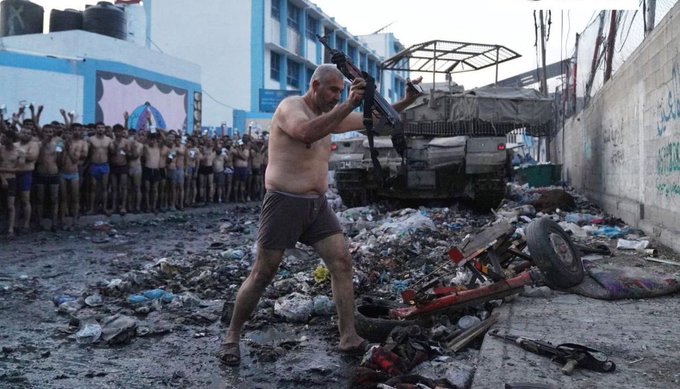
Israeli observers and journalists accused the occupation army spokesman, Daniel Hagari, of lying by fabricating pictures and videos showing alleged members of the Al-Qassam Brigades’ Elite Forces surrendering.
Most highlighted that many of those shown in the pictures were elderly men in their 60s and not young fighters in their prime who would normally make Elite Forces.
Ori Goldberg, researcher at the Interdisciplinary Centre- Herzliya, said in a series of posts on X yesterday: “After reports of terrorists who turned themselves in, it turned out that these were groups of men who were arrested and taken from compounds where hundreds of Gazans were seeking refuge, together” to escape the bombing by the occupation army.
According to Goldberg: “To win a guerrilla war, you need clear goals and clear political guidance. Otherwise, the war breaks down into endless incidents and explosions and operations and assaults and does not come together for a decision. The IDF can fight for 18 years in Gaza, as in Lebanon, and the war will not end until the political echelon calls for its end. There are no clear goals and no clear guidance.”
In one video, an older gentleman can be seen following the instructions of an Israeli occupation soldier who is directing him where to go and where to place the weapon he is holding. The man had been stripped to his underwear. Commenting on a picture, military reporter at MAKO website, Hai Levy, said: “You can consider him an elite fighter if you’d consider me a frog.”
Others questioned how the men were stripped to their underwear before their weapons were taken from them.
While others said these images brought “shame” to Israel as they were so obviously fake.
US-made munitions used in illegal white phosphorous attack on Lebanon
The Cradle | December 11, 2023
The Israeli army used US-manufactured white phosphorous shells in a brutal attack on south Lebanon in October, the Washington Post reported on 11 December, citing an analysis of shell fragments found in the southern Lebanese village of Al-Dhahira.
A Washington Post journalist came across the remnants of three 155-millimeter artillery shells near the border. Production codes found on the shells indicate that they were made by ammunition depots in Louisiana and Arkansas in 1989 and 1992.
Residents told the journalist that the shells in question “incinerated at least four homes.”
Nine people were injured in the white phosphorous attack, which took place on 16 October, including three who were hospitalized.
Photos and videos verified by Amnesty International show the white phosphorus falling on Al-Dhahira on 16 October.
“Israeli forces continued to shell the town with white phosphorus munitions for hours,” trapping residents in their homes until 7:00 AM the next day, locals told the Washington Post, adding that they now refer to that evening as the “black night.”
Israel has used white phosphorous on southern Lebanon over 60 times since the war began in October, according to the Armed Conflict Location & Event Data Project (ACLED).
“The Israeli army fired artillery shells containing white phosphorus, an incendiary weapon, in military operations along Lebanon’s southern border between 10 and 16 October 2023,” Amnesty International said on 31 October, adding that the 16 October attack must be immediately investigated as a war crime.
Israel claimed its use of the banned munitions was in line with international law, given that they used them to create “smokescreens” and not for targeting, according to an army statement.
However, the 16 October white phosphorous attack took place at night, when “smoke would have little practical use … and [when] there were no Israeli troops on the Lebanese side of the border to mask with smokescreens,” Washington Post said.
“Residents speculated that the phosphorus was meant to displace them from the village and to clear the way for future Israeli military activity in the area,” it added.
White phosphorous burns at extremely high temperatures and can stick to the skin, posing a potentially lethal threat. Residents of Al-Dhahira reported that remnants of the banned weapon would combust upon contact in the days following the attack.
Israel also used white phosphorous in its current war on Gaza, as well as in previous wars in both Gaza and Lebanon.
Crossfire has intensified recently on the Lebanese border. Hezbollah has stepped up its attacks on Israeli military sites and widened its range of targets in response to intense and violent air strikes on southern Lebanese villages and in response to Israeli massacres in the Gaza Strip.
Recent Israeli strikes on Lebanon have resulted in several civilian casualties.
Brewing truth: Climate doomsayers’ cooked up coffee crisis
By Vijay Jayaraj | American Thinker | December 7, 2023
Every day, people across the world wake up to news about climate change affecting their lives. With the seeming randomness of a roulette wheel, the doomsday clique of the climate world daily selects a fresh topic to sow seeds of anxiety among the populace.
Popular things easily recognized — even cherished — by people are continually identified as being at risk of being damaged or destroyed by climate change. Coffee, for example, is a commodity experiencing a surge in popularity, and there are no prizes for guessing what climate doomsayers are saying now.
Yes, coffee is now said to be under threat from man-made climate change. CNN, in a recent article, made this statement: “climate change poses a huge threat to the coffee business and to farmers.” Keeping with its customary approach of presenting climate change as a threat to all manner of things, CNN quotes the Inter-American Development Bank as warning that “rising temperatures will reduce the area suitable for growing coffee by up to 50%.”
Is this claim true? If so, plenty of people would be affected, because coffee is selling like hot cakes.
The brew is a staple in nearly 98% of households in Brazil. According to the 2023 National Coffee Data Trends Report, coffee consumption in the U.S. has hit a 20-year peak, with over 50% of consumers gravitating toward specialty coffee.
Even in my home country, India, there is a sudden deluge of boutique coffee shops. Some chains have opened as many as 50 branches within a span of five years, and that is not an easy task in a country of 1.3 billion tea-lovers. India is now the eighth largest producer of coffee beans.
More than 99% of global coffee production comprises the arabica and robusta species, which are just two of over 140 different species in the Coffea genus. Coffea, especially arabica, depends highly on soil fertility and temperature.
The purveyors of climate apocalypse are particularly interested in the temperature aspect, as it provides a legitimate pathway for indulging in climate scaremongering. Despite widespread concern about increasing warmth, satellite temperature data collected from 1979 to 2023 indicate that there has not been a significant rise in temperatures.
Despite widespread concern about increasing warmth, global satellite temperature data collected from 1979 to 2023 indicates that there has only been a modest rise of less than one-degree C in temperature.
Besides, it is widely acknowledged that warming since the Little Ice Age and increased atmospheric CO2 since the Industrial Revolution have boosted agricultural production and the general greening of ecosystems.
Scientists in Brazil have discovered that “carbon dioxide fertilization offsets negative impacts of climate change on arabica coffee yield.” They say that the CO2 fertilization effect will cause a net increase of the average Brazilian arabica coffee harvest by the years 2040–2070.
CO2 enrichment studies in Latin America show that elevated CO2 increased photosynthesis by 40% and increased the efficiency plants’ water use by approximately 60%. Higher CO2 eventually caused a 7–14% increase in plant height and a 12–14% increase in yield. Another study showed that there were significant increases in all leaf area and biomass markers in response to increased CO2.
The research indicates that we might already be reaping the rewards of increased productivity rates in both arabica and robusta coffee varieties thanks to the recent rise in atmospheric CO2. This reality is reflected in the plantations across the globe. Production in South America and Southeast Asia have shown increases in yield during the past two decades.
Brazil and Vietnam are the top two coffee bean producers. Both countries have seen remarkable increases in their yield, with Vietnam’s production climbing from 0.54 tons per acre in 2002 to 1.11 tons per acre in 2021. Meanwhile, Brazil’s yield has also shown significant growth, rising from 0.49 tons per acre in 2002 to 0.87 tons per acre in 2020.
Even if the temperatures were to increase dramatically, experts say that coffee cultivation would be possible in cooler regions at latitudes away from equator or at higher altitudes.
So sit back and drink that morning cup of Joe. Climate is not going to steal your coffee, and thank CO2 for keeping the plantations productive.
Vijay Jayaraj is a research associate at the CO2 Coalition, Arlington, Virginia. He holds a Master’s degree in environmental sciences from the University of East Anglia, U.K.
IMF Head Wants World Wide Carbon Taxes
By Kit Knightly | OffGuardian | December 7, 2023
IMF Chief Kristalina Georgieva has called for every government to implement some form of carbon taxes or “carbon pricing” in the near future.
Yes, we’re into week two of the UN’s COP28 climate change summit, and the hits just keep on coming.
For example, yesterday it was announced sixty-three world governments have pledged to reduce the emissions from air conditioners and electrics fans.
[You can read a detailed breakdown of the other pledges made during COP28’s first week here.]
Speaking at COP28 in Dubai, and repeated in an interview with the Guardian, Georgieva extolled the virtues of “carbon pricing” and heaped praise on the EU and Canada for their implementation:
When you put a price on carbon, decarbonisation accelerates. The Europeans introduced the emission trading scheme [in 2005] and they have been growing and yet emissions went down by 37%. You see the same thing in Canada with their carbon tax.”
While both the speech and interview discuss the proposed carbon taxes in terms of corporations as “major polluters”, any tax applied to big business would be directly passed onto private citizens via price increases.
The Guardian acknowledges this, but of course, decides to add a weasel-word qualification [emphasis added]:
However, attractive though a carbon price may be in economic theory, in practice governments are reluctant to impose such explicit prices and taxes, because they can easily be attacked, and because they hit poorer people hardest, if badly applied.
“If badly applied”, sure.
The truth is economic destruction, designed to lower the standard of living for ordinary people, is the whole point of “carbon taxes”. just as it was the point of lockdowns.
Deceptive language aside, the undeniable fact that any carbon tax – corporate or individual – would directly harm the poorest is clearly understood by the people who would seek to enforce them.
Not that they have a problem with that, you understand, their concern is merely that purely public rage and/or civil disobedience makes direct taxation difficult to implement. The Guardian article gives the game away by referencing France’s Gilets Jaunes protests as an example.
So, even as Georgieva names carbon taxes the “perfect” solution to climate change, she recognizes the need to rely on more indirect methods.
Yes, the best way to introduce implement carbon prices [is] a carbon tax…But it is not politically feasible in some countries … We can also use regulatory compliance in which standards lead to implicit prices on carbon.”
These “regulations” and “implicit” prices would not be “carbon taxes” in name, but they would very much be so in spirit.
Again the Guardian cites an example, the EU’s recent “carbon border adjustment mechanisms”, which charge more import duties on goods coming from countries with “lax” emissions policies.
A global version of those rules is likely just one of many such measures we can expect moving forward since, according to Georgieva, the world’s biggest financial institutions are all working together on this issue:
[T]he IMF, World Bank, OECD and World Trade Organization [have] set up a taskforce to examine the different carbon prices that are implied in countries around the world by their carbon policies and regulations.”
The head of IMF has spoken, and the World Bank and World Trade Organization are all on board: Carbon Taxes are inevitable. The only question is what they decide to call them.
All the world’s biggest financial heavy-hitters are coming together to figure out the best way to scam people out of their hard-earned money… for the good of the planet, obviously.
Bizarre Plot Twist: Scholz Blames Putin for High Energy Prices in Europe
By Chimauchem Nwosu – Sputnik – 09.12.2023
The leader of Germany’s coalition government attempted to scapegoat Russia for his country’s self-inflicted economic woes as Berlin faces the threat of deindustrialization.
In a recent address at the Social Democratic Party (SPD) congress, German Chancellor Olaf Scholz blamed Russia for halting gas supplies to Europe amid rising energy costs.
He accused Russian President Vladimir Putin of stopping gas flows through a functional pipeline, significantly reducing Germany’s gas intake and contributing to a shortfall in Europe’s energy reserves.
“Russia: Yes, Russia stopped supplying energy to Europe… It was the Russian president who halted gas supplies through a working gas pipeline,” Schoz stated. “This has implications for energy prices.”
But that narrative collapses in light of his country’s role in imposing sanctions on Moscow and restricting the flow of Russian energy to Western Europe.
Scholz’s decision to align with the US and Britain in sanctioning Russian energy sources worsened Germany’s problems.
The nation has denied itself around 120 billion cubic meters of Russian gas as a result. Germany has instead increased gas imports from Norway and built new liquified natural gas (LNG) [terminals] on its northern coast to import more-expensive supplies from the US — all choices made by the West, not Moscow.
The gas supply situation worsened further following last year’s terrorist attacks on the Nord Stream 1 and 2 gas pipelines that run from Russia to Germany under the Baltic Sea. Several countries, including Germany, Sweden, and Denmark, have conducted investigations into the incident, but have failed to name a culprit and refused to share their findings with Russia.
Russian authorities have accused the US and Britain as the main forces behind the attack on the Nord Stream pipelines.
Nikolai Shulginov, head of the Russian Ministry of Energy, stated in November that Russia had not “closed” the western direction of energy supplies and continues to be a reliable gas supplier even under current challenging conditions.
Documents Show DHS Agency “Real-Time Narrative Tracking” of Social Media Posts in 2020
By Christina Maas | Reclaim The Net | December 7, 2023
Judicial Watch has come forward with newly acquired evidence of an intriguing alliance during the US 2020 election. The investigative body was able to obtain, via a Freedom of Information Act (FOIA) suit, a series of records demonstrating a comprehensive synergy between the Department of Homeland Security’s Cybersecurity and Information Security Agency (CISA) and a controversial entity, the Election Integrity Partnership (EIP).
These files reveal a concerted effort to execute “real-time narrative tracking” on principal social media networks during the critical days leading up to the 2020 election. Interestingly, these records illustrate instances of social media post “takedowns” and an intentional avoidance of creating public records that would be subject to the FOIA process.
These records also allow us a peek into the operations of EIP. Originally known as the Election Misinformation Partnership, it invested in monitoring online election discourse round the clock, especially prioritizing “disinformation that is going viral.”
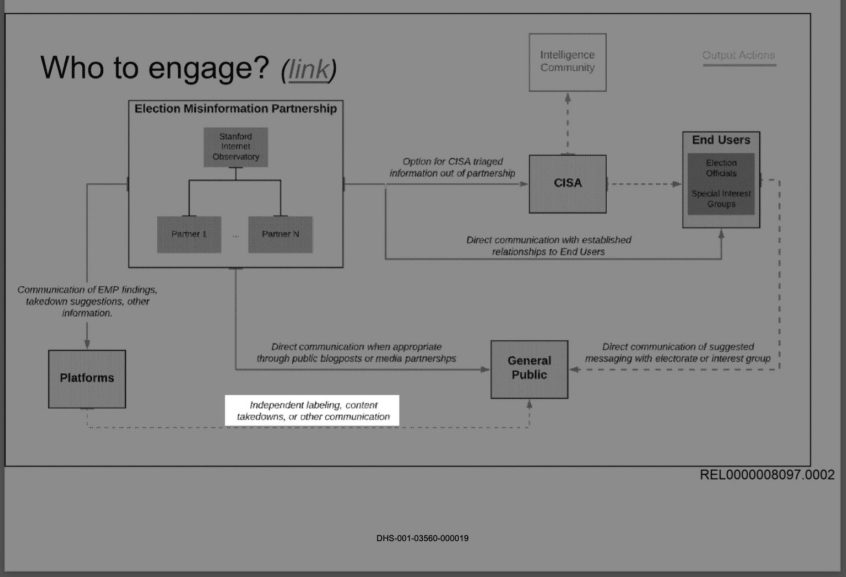
A lawsuit launched under the Freedom of Information Act (FOIA) gave Judicial Watch access to the records. The lawsuit was deemed necessary in response to a lack of transparency from the DHS, which did not respond to a formal request submitted by Judicial Watch on October 5, 2022.
This data was part of an extensive request by Judicial Watch that included all communication records between CISA and EIP, minute details of a meeting between DHS officials and EIP members on July 9, 2020, and all records of communication between CISA and Stanford University’s Internet Observatory or the University of Washington’s Center for an Informed Public, specifically regarding the Election Integrity Partnership, the 2020 US election, online misinformation and disinformation, or various social media platforms.
The Election Integrity Partnership, established right before the Presidential elections in July 2020, was composed of four major entities: Stanford Internet Observatory (SIO), the Atlantic Council’s Digital Forensic Research Lab, University of Washington’s Center for an Informed Public, and social media analytics firm Graphika.
This partnership provided a valuable service to federal bodies, such as Homeland’s Cybersecurity Infrastructure Security Agency (CISA), enabling them to file tickets for flagging or censoring specific social media posts and online stories. It also extended similar privileges to three liberal organizations – the Democratic National Committee, Common Cause, and the NAACP – along with the Homeland-funded Elections Infrastructure Information Sharing and Analysis Center.
In 2023, a report by the Committee on the Judiciary and the Select Subcommittee on the Weaponization of the Federal Government revealed the drastic evolution of CISA. Established in 2018 to protect critical infrastructure from cyber threats, it had emerged by 2020 as the central conduit for domestic surveillance and censorship of social media by the federal government. CISA’s focus shifted to reporting supposed disinformation on social media. By the following year, they had officially formed a team specializing in misinformation, disinformation, and malinformation. As criticism intensified in 2022 and 2023, CISA sought to obscure its activities, ostensibly serving a purely “informational” role despite judicious allegations of unconstitutional conduct.
“These records show the lengths to which a ‘Homeland Security’ Deep State agency went in its effort to censor and suppress Americans during and after the 2020 election,” said Judicial Watch President Tom Fitton. “That it took a federal lawsuit to extract these disturbing records should raise additional worries about what else this Biden administration is up to.”
Tech investors organize to silence pro-Palestinian voices
The Cradle | December 9, 2023
A group of pro-Israeli tech investors and executives in California’s Silicon Valley are seeking to influence media coverage of Israel’s war on Gaza and “combat the slightest deviations from the pro-Israel script,” a new investigation by journalists Lee Fang and Jack Poulsen shows.
The investors and executives have joined with pro-Israeli activists and Israeli government officials to terminate pro-Palestinian employees at multi-national corporations from their jobs, smear Palestinian journalists, cancel speaking events at US universities by Palestinian writers and politicians, remove social media posts critical of Israel, “ridicule” pro-Palestinian social media influencers and lawmakers, and send military equipment to Israeli forces.
The Following Hamas’ 7 October attack on Israeli military bases and settlements surrounding Gaza, the group formed a WhatsApp group to coordinate their activities.
The WhatsApp group, officially named the “J-Ventures Global Kibbutz Group,” is a project of J-Ventures, a US-Israeli investment fund.
The journalists obtained access to thousands of the group’s WhatsApp messages dating back to mid-October showing the group’s efforts to help Israel in its public relations war, in particular as Israel’s killing of Palestinians in Gaza quickly reached shocking levels, resulting in harsh international condemnation.
They described how members of the group coordinated on WhatsApp to have Courtney Carey, a Dublin-based employee of the Israeli website building company Wix, fired. Carey posted the Irish words “SAOIRSE DON PHALAISTIN” which means, “Freedom for Palestine” on her LinkedIn page, and was terminated 24 hours later.
The group includes prominent Silicon Valley venture capitalist Jeff Epstein – a former CFO of Oracle – and Andy David, a diplomat-cum-venture capitalist who also serves as the Israeli foreign ministry’s head of innovation, entrepreneurship, and tech.
Adam Fisher, the head of the Israel office of Bessemer Venture Partners, gave a presentation to the group on how US “high-tech leaders, investors, and entrepreneurs,” such as himself, could help the Israeli army win the “information war” on social media.
The Israel-based venture capitalist spoke of how to “sow doubt” among young people in the US sympathetic to the Palestinian cause so they would not speak out or attend protests against Israel’s killing of Palestinians in the Gaza Strip. “So it’s really about creating some kind of confusion,” Fisher said,” to make it clear to them that it’s really a lot more complicated.”
The group also petitioned Netflix to remove the award-winning Jordanian film “Farha,” claiming that its accurate portrayal of the actions of Israeli soldiers during the 1948 massacre and forced displacement of Palestinians constituted “blood libel,” while another said the film was based “antisemitism and lies.”
J-Ventures documents and affiliated WhatsApp discussions also show support for a variety of automated attempts to remove pro-Palestinian content on social media, including via DigitalDome.io, an initiative that promotes itself as an online version of Israel’s Iron Dome missile defense system, promising that “offensive and malicious content is intercepted here.”
Digital Dome’s “recent achievements” included the censorship of Hamas’s channels on the Telegram communications platform using Android phones and the removal of pro-Palestinian content from Instagram and Twitter/X.
Members of the WhatsApp group successfully lobbied to have speaking events of Palestinian-US Congresswoman Rashida Tlaib and Palestinian writer for the Nation Magazine, Mohamed al-Kurd, canceled.
The group circulated a push poll suggesting Representative Tlaib should resign from Congress.
Finally, the group has also attempted to provide tactical gear to Israel’s equivalent of the US Navy SEALs, known as Shayetet-13, and donated to a foundation dedicated to supporting the Israeli army’s undercover “Duvdevan” unit, which is known for assassinating Palestinians in the occupied West Bank.
Featured Video
or go to
Aletho News Archives – Video-Images
Book Review
The Zeolite Book — First Edition, 2026, Paperback
The volcanic mineral medicine will not patent — for the toxic burden medicine will not name
Lies are Unbekoming – October 30, 2026
 Zeolite is old. It is in Roman concrete that has held for two thousand years. It’s in the water filters of ancient cisterns. It’s in the stomachs of Pacific livestock whose keepers knew, somehow, that this grey crumbling rock made the animals healthier. It’s in Soviet clinical protocols from the 1960s. It’s in the standard emergency response to the Chernobyl explosion.
In 1986, after the Chernobyl reactor failure, the Soviet Union manufactured and distributed natural zeolite at industrial scale — for soil remediation, for livestock feed, for human consumption, for the cleanup itself. Karl Hecht, who had been director of the Institute for Experimental and Clinical Pathophysiology at the Charité of Humboldt University Berlin, spent the six decades after that building the clinical research base — on silicon’s role in human health, on zeolite’s clinical safety, on its applications in ageing. In 2018, Pavelić and colleagues published a comprehensive clinical safety review of natural clinoptilolite in Frontiers in Pharmacology. In 2019, Mastinu analysed its binding affinities. In the Western medical literature, these works sit largely uncited.
What has not been treated at book length, until now, is how a volcanic mineral with six decades of Soviet clinical work behind it, two major peer-reviewed Western reviews, and ongoing clinical use across the former Eastern Bloc, remains almost entirely absent from Western medical practice — and what the toxic burden it’s meant to address actually is.
The Zeolite Book gathers the Soviet clinical record, the Western peer-reviewed studies, three contemporary practitioner voices, and three serious counterviews into one honest treatment. That’s why the book runs to seven appendices. 288 pages, four parts, three practitioner voices, three counterviews, seven appendices. The honest treatment is the argument.
Blog Roll
 Aletho News
- Wrong, AP and NPR: Europe’s 50,000 Heat Deaths Are a Computer-Model Estimate, Not a Real Body Count
- Questioning Your Doctor Is Now Considered A Psychological Problem (Seriously)
- London tourism expo promotes Israeli agency linked to theft of Palestinian land
- Dockworkers launch global strike against Israeli and US military shipments
- Europe facing gas price shock – Gazprom chief
- Ukraine continues recruiting people with disabilities
- Weaponized Journalism: 2021 Sayer Ji Interview with NPR
- Beyond Netanyahu: what Israel’s election means for Palestinians
- Lithuania plans universal conscription
- Lies, Damn Lies, and Ukraine News
- If Americans Knew
- 1,300 will gather in Palo Alto on Nov. 1 for Z3 Conference on Zionism
- DAILY UPDATE: Latest essential news on Palestine, Israel, & region
- The Long Arm of AIPAC
- Genocidal intent behind Hebron assault, rights group says
- This week, Israel killed 8-year-old who survived bombing that wiped out her family
- DAILY UPDATE: Latest essential news on Palestine, Israel, & region
- Israeli soldier poses at damaged Lebanon church, sparking anger
- New Report. Manufacturing the Great Replacement: Is Israel behind one of the largest racist influence campaigns ever documented?
- ‘Arab voice doesn’t count’: Jewish Israeli blocs reject Palestinian support
- Whether Bibi Stays or Goes, the ‘Special Relationship’ Must End
- No Tricks Zone
- Germany’s Green Energy Transition Becoming Increasingly Expensive…Another 6 Trillion Euros!
- Sudden Stratospheric Warming, Powerful El Niño Combination May Lead To Extreme Europe Cold, Energy Crisis!
- Two New Studies Find Thwaites Glacier Melt Cannot Be Driven By Human Activity Or A Warming Ocean
- E-Cars Reduce CO2 Emissions By Only 41% Compared To Internal Combustion Engine Vehicles
- Predictions Made By Renowned Climate Professor Over Past Decades Have Been Proven To Be Poor
- New Study Suggests Large Regions Of The Pacific Ocean Have Been Cooling For The Last 80 Years
- Germany’s Green Energy Debacle: High Energy Costs Force Kahla Porzellan to Close After 182 Years!
- New Study: 50 Years Of The Most Aggressive ‘Net Zero’ Policies Can Only Affect The Global Climate By 0.03°C
- US September “Heat” Was No Record…Many Records Set Decades Ago
- Latest European Green Energy Debacle; Portugal’s Largest Flagship Solar Park Insolvent!

