Some Call It Conspiracy Theory – Part 1
BY IAIN DAVIS | SEPTEMBER 25, 2023
There are certain assumptions that are applied to anyone labelled a “conspiracy theorist”—and all of them are fallacies. Indeed, the term “conspiracy theory” is nothing more than a propaganda construct designed to silence debate and censor opinion on a range of subjects. Most particularly, it is used as a pejorative to marginalise and discredit whoever challenge the pronouncements and edicts of the State and of the Establishment—that is, the public and private entities that control the State and that profit from the State.
Those of us who have legitimate criticisms of government and its institutions and representatives, who are therefore labelled “conspiracy theorists,” face a dilemma. We can embrace the term and attempt to redefine it or we can reject it outright. Either way, it is evident that the people who weaponise the “conspiracy theory” label will continue to use it as long as it serves their propaganda purposes.
One of the most insidious aspects of the “conspiracy theory” fabrication is that the falsehoods associated with the term have been successfully seeded into the public’s consciousness. Often, propagandists need do no more than slap this label on the targeted opinion and the audience will immediately dismiss that viewpoint as a “lunatic conspiracy theory.” Sadly, this knee-jerk reaction is usually made absent any consideration or even familiarity with the evidence presented by that so-called “lunatic conspiracy theorist.”
This was the reason why “conspiracy theorist” label was created. The State and its propagandists do not want the public to even be aware of inconvenient evidence, let alone to examine it. The challenging evidence is buried under the “wild conspiracy theory” label, thereby signalling to the unsuspecting public that they should automatically reject all of the offered facts and evidence.
There are a number of components that collectively form the conspiracy theory canard. Let’s break them down.
First, we have a group of people who supposedly can be identified as conspiracy theorists. Second, we have the allegation that all conspiracy theorists share an underlying psychological weakness. Third, conspiracy theory is said to threaten democracy by undermining “trust” in democratic institutions. Fourth, conspiracy theorists are purportedly prone to extremism and potential radicalisation. Fifth, conspiracy theory is accused of not being evidence-based.
According to the legacy media, there’s a link between so-called “conspiracy theory” and the “far right” and “white supremacists.” Guardian columnist George Monbiot, for example, wrote that:
[. . .] conspiracism is fascism’s fuel. Almost all successful conspiracy theories originate with or land with the far right.
Apparently, this is a common belief held by people who imagine that “conspiracy theory” exists in the form they have been told it exists. It is also a bold claim from an alleged journalist. There is no evidence to support Monbiot’s assertion.
Numerous studies have tried to identify the demographics of “conspiracy theorists” by traits they have in common. These studies tend to identify conspiracy theorists based solely on a survey of their opinions. If, for example, someone doesn’t accept the official accounts of 9/11 or the Kennedy assassination, the researchers will call them “conspiracy theorists.”
Probably the largest demographic study into the common characteristics of “conspiracy theorists” was undertaken by political scientists Joseph Uscinski and Joseph Parent for their 2014 book American Conspiracy Theories. They found that “conspiracy theorists” could not be categorised demographically.
Ethnicity, gender, educational attainment, employment and economic status and even political beliefs were not indicative. The only firm trait they could isolate was that conspiracy theorists, so-called, tended to be slightly older than the population average—suggesting, perhaps, that scepticism of State narratives increases with life experiences.
Professor Chris French made this observation, as reported by the BBC in 2019:
When you actually look at the demographic data, belief in conspiracies cuts across social class, it cuts across gender and it cuts across age. Equally, whether you’re on the left or the right, you’re just as likely to see plots against you.
This is not to deny that a minority of conspiracy theories are promoted by people on the far right of the political spectrum. Nor that some on the far left don’t advocate other similar theories. A few “conspiracy theories” can be considered “racist” and/or “antisemitic.” But there is no evidence to support the allegation that “conspiracy theorists,” when compared to the general population, are any more or less likely to hold extreme political beliefs or promote extremist narratives.
George Monbiot is certainly not alone in his views, but his published opinion—namely, that conspiracy theories “originate with or land with the far right”—is complete nonsense. So let’s discard his claim right now as ignorant claptrap.
Monbiot’s allusion to “conspiracism” relates to the alleged psychological problems that supposedly lead people to become “conspiracy theorists.” The “conspiracism” theory is a product of the worst kind of junk science. It is primarily based upon the notoriously flaky discipline of experimental psychology.
One of the seminal papers informing the theory of “conspiracism” is Dead and Alive: Beliefs in Contradictory Conspiracy Theories (Wood, Douglas & Sutton, 2012). The researchers asked their “conspiracy theorist” subjects to rate the plausibility of various alleged conspiracy theories. They used a Likert-scale, where 1 is strongly disagree, 4 is neutral, and 7 is strongly agree. Some of the “theories” the subjects were asked to consider were contradictory.
For example, they asked the subjects to rate the plausibility of the notions that Princess Diana was murdered and that she faked her own death. Using this methodology, the researchers concluded:
While it has been known for some time that belief in one conspiracy theory appears to be associated with belief in others, only now do we know that this can even apply to conspiracy theories that are mutually contradictory.
But the researchers did not ask their subjects to exclude mutually contradictory theories—only to rate the plausibility of each individually. Thus, there was nothing in their reported findings to support the conclusion they unscientifically reached.
Subsequent research has highlighted how ludicrous their falsely named “scientific conclusion” was. Yet, despite being roundly disproved, the erroneous assertion that conspiracy theorists believe contradictory theories simultaneously is repeated ad nauseam by the legacy media, politicians and academics alike. It forms just one of the groundless truisms spouted by those who spread the “conspiracism” myth.
One of, if not the, most influential scholar in the field of conspiracy research is the political scientist Joseph Uscinski. Like many other of his peers, he has tried to differentiate between evidence-based knowledge of real or “concrete” conspiracies, such as Iran-Contra or Watergate, and what scientific researchers allege to be the psychologically flawed and evidence-free views held by so-called “conspiracists.”
Uscinski cites the work of Professor Neil Levy as definitive. In Radically Socialized Knowledge and Conspiracy Theories, Levy stated:
The typical explanation of an event or process which attracts the label “conspiracy theory” is an explanation that conflicts with the account advanced by the relevant epistemic authorities. [. . .] A conspiracy theory that conflicts with the official story, where the official story is the explanation offered by the (relevant) epistemic authorities, is prima facie unwarranted. [. . .] It is because the relevant epistemic authorities — the distributed network of knowledge claim gatherers and testers that includes engineers and politics professors, security experts and journalists — have no doubts over the validity of the explanation that we accept it.
Simply put, the scientific definition of “conspiracy theory” is an opinion that conflicts with the official narrative as reported by the “epistemic authorities.” If you question what you are told by the State or by its “official” representatives or by the legacy media, you are a “conspiracy theorist” and, therefore, according to “the Science™,” mentally deranged.
All related “scientific research” on conspiracism and claimed conspiracy theory starts from the assumption that to question the State, the Establishment or the designated “epistemic authorities” is delusional. As hard as this fact may be for many to accept, the effective working definition of “conspiracy theory” in the scientific literature is “an opinion that questions power.”
Clearly, this definition is political, not scientific. The supposed underlying psychology of “conspiracism,” which allegedly induces people to engage in “conspiratorial thinking,” is an assumption stemming from the academic’s political bias in favour of the State and its institutions. It has absolutely no scientific validity.
In his 1949 essay Citizenship and Social Class, sociologist T. H. Marshall examined and defined democratic ideals. He described them as a functioning system of rights. These rights include the right to freedom of thought and expression, including speech, peaceful protest, freedom of religion and belief, equality of justice, equal opportunity under the law, and so on.
Most of us who live in what we call representative democracies are familiar with these concepts. “Rights” and “freedoms” are often touted by our political leaders, academia and the legacy media as the cornerstones of our polity and culture. The entire purpose of representative democracy, it is alleged, is to empower “we the people” to hold decision-makers to account. “Questioning power” is a foundational democratic ideal.
If we accept the working scientific definition of “conspiracy theory,” then its inherent questioning of power and overt challenge to authority embodies perhaps the most important democratic principle of all and forms the bedrock of representative democracy. It is not unreasonable to aver that representative democracy cannot possibly exist without “conspiracy theory”—again, as it is defined in the scientific literature. As we can see, the claim that “conspiracy theory” threatens democratic institutions is without merit.
Representative democracy is not founded on public trust in the State, in its agents or in its representatives. On the contrary, representative democracy is built upon the right of the people to question the State, its agents and its representatives.
Autocracies and dictatorships demand public “trust.” Democracies do not. In a representative democracy, “trust” must first be earned and, through their actions, State institutions must constantly maintain whatever trust the public originally chose to invest in them. Wherever and whenever that “trust” is no longer warranted, the people who live in a democracy are free to question, and ultimately dissolve, State institutions they don’t trust.
Trust is not a democratic principle. Questioning power is.
Consider that, according to State institutions like the United Nations (UN),
Conspiracy theories cause real harm to people, to their health, and also to their physical safety. They amplify and legitimize misconceptions [. . .] and reinforce stereotypes which can fuel violence and violent extremist ideologies.
This is a wholly misleading statement. It is disinformation.
The most violent act imaginable, and the most extreme ideology of all, is war and the all-out commitment to it. Full-scale war is possible only when a State declares it. International war is solely within the purview of one entity: the State. Wars are frequently justified by the State using lies and deception. Furthermore, the ideology of war is unwaveringly promoted by the legacy media on behalf of the State.
To be clear: the UN alleges that when ordinary men and women from across all sectors of society—representing all races, economic classes and political views—exercise their democratic right to question power, they are expressing opinions that “fuel violence and violent extremist ideologies.”
For such an extraordinary, apparently anti-democratic allegation to be considered even remotely plausible, it must be based upon irreproachable evidence. Yet, as we shall see, the UN’s claim is not based on any evidence at all.
In 2016, UN Special Rapporteur Ben Emmerson issued a report to the UN advising its member states on potential policies to counter extremism and terrorism. In his report, Emmerson noted the lack of a clear, agreed-upon definition of “extremism.” He reported that different UN member states defined “extremism” based upon their own political objectives and national interests. There was no single, cogent explanation of the “radicalisation” process. As he put it:
[M]any programmes directed at radicalisation [are] based on a simplistic understanding of the process as a fixed trajectory to violent extremism with identifiable markers along the way. [. . .] There is no authoritative statistical data on the pathways towards individual radicalisation.
A year later, in 2017, the US National Academy of Sciences (NAS) delivered its report, “Countering Domestic Extremism.” The NAS suggested that domestic “violence and violent extremist ideologies” were the result of a complex interplay between a wide gamut of sociopolitical and economic factors, individual characteristics and life experiences.
The following year, in July 2018, the NAS view was reinforced by a team of researchers from Deakin University in a peer-reviewed article, “The 3 P’s of Radicalisation.” The Deakin scholars collated and reviewed all the available literature they could find on the process of radicalisation that potentially leads to violent extremism. They identified three main drivers: push, pull, and personal factors.
Push factors are the structural factors that propel people towards resentment, such as State repression, relative deprivation, poverty, and injustice. Pull factors are factors that make extremism seem attractive, like ideology, group identity and belonging, group incentives, and so on. Personal factors are individual character traits that make a person more or less susceptible to push or pull. These include psychological disorders, personality traits, traumatic life experiences, and so on.
Presently, the UN maintains that its report, Journey To Extremism in Africa, is “the most extensive study yet on what drives people to violent extremism.” In keeping with all previous research, the Africa report concluded that radicalisation occurs through an intricate combination of influences and life experiences.
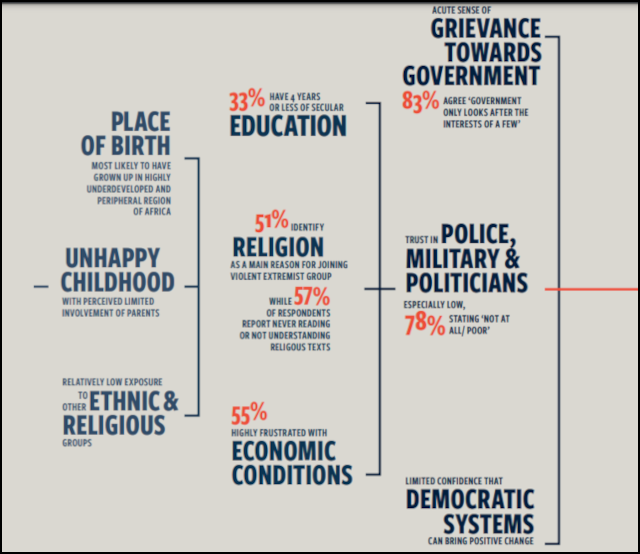
The myriad of contributory factors to the radicalisation process according to the UN’s “most extensive study.”
Specifically, the report noted:
We know the drivers and enablers of violent extremism are multiple, complex and context specific, while having religious, ideological, political, economic and historical dimensions. They defy easy analysis, and understanding of the phenomenon remains incomplete.
In its report called “Prevention of Violent Extremism“—published in June 2023—the UN noted that “deaths from terrorist activity have fallen considerably worldwide in recent years.” Yet, in its promotional literature for the same report, the UN claimed that the “rise of violent extremism profoundly threatens human security.”
How can the UN have it both ways? How can it be that a “rise of violent extremism” correlates with a considerable reduction in terrorist activity and associated deaths? This makes absolutely no sense whatsoever.
And remember that in the Africa report, which the UN currently calls its “most extensive study yet,” the UN acknowledged that the causes of radicalisation “are multiple, complex and context specific” and “defy easy analysis.”
This thoroughly refutes the manifest ease with which the UN proclaims, without cause, that so-called conspiracy theories “fuel violence and violent extremist ideologies.” This begs the question: what on Earth does the UN think “violent extremism” is, if not terrorism?
The bottom line is that, by its own admission, the UN has absolutely no evidence to support any of its “conspiracy theory” assertions. Rather, the UN is simply making up its entire “conspiracism” thesis from whole cloth.
In reality, so-called “conspiracy theorists” are overwhelmingly ordinary people with legitimate opinions that span a wide range of issues. Their opinions do not lead them to adopt extremist ideologies or to commit violent acts. There is no evidence at all to support this widely promulgated contention.
Nor are alleged “conspiracy theorists” a unique group of malcontents with psychological problems. The only defining characteristic these people possess is that they exercise their right to question power.
They do not seek to undermine democracy but, rather, exercise the rights and freedoms that democracy is supposedly based upon. It is this behaviour that the State deems unacceptable and that leads the State and its “epistemic authorities,” including the legacy media, to label them “conspiracy theorists.”
This observation in no way implies that the conspiracy theorists are always right. Conspiracy theories can be bigoted. They can be ridiculous. They may lack supporting evidence. They may cause offence. And they are sometimes just plain wrong. In other words they are just like any other opinion. But, equally, there is nothing inherently inaccurate or dangerous about every opinion labelled “conspiracy theory.”
There is only one way to ascertain if an alleged conspiracy theory is valid or not: examine the evidence. Unfortunately, the conspiracy theory label was created specifically to discourage people from looking at the evidence.
There are countless examples of the conspiracy theory or theorist label being used to hide evidence, obscure facts and deny legitimate concerns. In Part 2, we will look at a few of these examples and explore the wider geopolitical context in which the conspiracy theory label is deployed.
She’s Doing it Again: Clinton Claims Russia Seeks to Meddle in 2024 Election
By James Tweedie – Sputnik – 25.09.2023
Operation Crossfire Hurricane — the FBI’s attempt to discredit Donald Trump’s election as president in 2016 — was found by a Congressional inquiry to be based on falsehoods. But Democrats and their sympathetic media continue to repeat the claims of ‘Russian interference’.
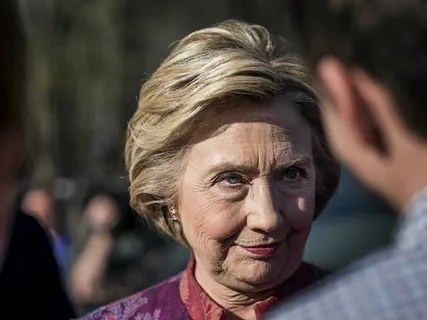
Failed presidential runner Hillary Clinton has repeated her discredited claims of Russian interference in US elections.
Clinton dusted off the 2016 ‘Russiagate’ conspiracy theory she used to explain her defeat by Donald Trump in an interview with MSNBC’s Jen Psaki — the former White House press secretary renowned for her inability to answer journalist’s questions.
Psaki claimed that Russian President Vladimir Putin had “interfered in our elections in the past” — directly contradicting the findings of special counsel John Durham’s inquiry that the claim was “uncorroborated” — and asked Clinton if she feared it would happen in 2024.
“I don’t think, despite all of the deniers, there is any doubt that he interfered in our election, or that he has interfered in many ways in the internal affairs of other countries, funding political parties, funding political candidates, buying off government officials in different places,” Clinton claimed.
Her tone became increasingly paranoid as she went on.
“He hates democracy. He particularly hates the West and he especially hates us,” Clinton ranted. “And he has determined that he can do two things simultaneously. He can try to continue to damage and divide us internally, and he’s quite good at it.”
The former secretary of state and senator, the wife of disgraced ex-president Bill Clinton, even believed that Putin had a personal grudge against her.
“Part of the reason he worked so hard against me is because he didn’t think that he wanted me in the White House,” Clinton complained. “Part of the challenge is to continue to explain to the American public that the kind of leader Putin is.”
She then reeled off a series of unproven allegations against the Russian president, including that he was responsible for the deaths of opposition figures and journalists — and interfered in the 2016 US elections to ensure she lost to Trump.
“I fear that the Russians will prove themselves to be quite adept at interfering, and if he has a chance, he’ll do it again,” Clinton concluded.
Durham’s report, finally released in June 2023, found that former Federal Bureau of Investigations (FBI) Director James Comey’s operation Crossfire Hurricane probe — oddly named after a Rolling Stones lyric — was founded on “raw, un-analyzed and uncorroborated” intelligence and should never have been launched.
It said the FBI was guilty of misconduct and was in need of reform, but did not lay individual blame on any of the numerous officials involved — from Comey to Peter Strzok and Lisa Page, two agents entwined in an extra-marital affair at the federal agency.
West demands elections in Ukraine
By Lucas Leiroz | September 25, 2023
It seems clear that the West wants to remove Vladimir Zelensky – and is apparently trying to do so in a “democratic” way. According to media reports, Western officials are pressuring Ukrainian authorities to hold presidential elections next year, ignoring the fact that the country is under martial law. This makes it clear that there is a “rush” on the part of NATO to put in power in Kiev a more “efficient” leader than the current president.
The information was published by the Washington Post on September 24. According to the newspaper, many relevant Western politicians are involved in “negotiations” with their Ukrainian counterparts to hold elections despite the conflict. On the American political scene, both Republicans and Democrats seem united on this agenda, which shows how the issue is becoming a kind of a “priority” for all pro-war American politicians.
The main rhetoric used by those supporting the elections is the supposed “need” for Kiev to prove its “commitment to democracy”. Until now, one of the main arguments for systematically sending weapons to Ukraine has precisely been the narrative that Ukrainians are “defenders of democracy”, while Russia is a kind of “dictatorship” or “autocracy”. It is believed in the West that if Ukraine loses there could be a global “anti-democratic wave”, with countries going through de-democratization processes and becoming authoritarian regimes.
Obviously, this narrative is false, weak and increasingly unpopular. The conflict in Ukraine has nothing to do with a clash between “democracies and dictatorships”, but with Moscow’s need to protect the people of Donbass and neutralize NATO’s influence in the Russian strategic environment. Furthermore, neo-Nazi Ukraine is obviously not a democracy, and Western public opinion is gradually understanding this. With so many images, videos and reports showing authoritarian and illegal practices such as forced recruitment, murder of civilians and torture of prisoners, it already seems clear that the so-called “Ukrainian democracy” is nothing more than mere war propaganda.
So, faced with this problem, there is a “task” to be accomplished by Ukrainians: to appear democratic to Western citizens again. Only in this way will it be possible to legitimize the sending of weapons and money to Kiev, despite all the negative consequences that this military aid brings to Western taxpayers – such as economic, social crisis and inflation. For the West, the easiest way for Kiev to appear democratic is to hold elections.
Obviously, the electoral process in times of war is an extremely complicated thing to do. In practice, elections cannot really be “fair” and “democratic” – but what really matters is that they appear to be.
“Holding free and fair elections in wartime is virtually impossible and also ill-advised, according to Ukrainian officials, election experts and democracy advocates. Roughly one-fifth of Ukraine’s territory is now occupied by Russian forces. Millions of Ukrainians are displaced and many are living outside the country. Tens of thousands of soldiers are deployed to the front. The pressure to hold elections, despite such obstacles, highlights the constant demand by some in the West that Ukraine prove its commitment to democracy”, the article reads, adding that, despite risks, “Kyiv officials also cannot dismiss the idea of holding elections out of hand and risk alienating key political players in the West, who are demanding elections and are crucial for Ukraine to maintain international financial and military assistance.”
However, it would be naive to think that this Western pressure is only due to this “democratic” reason. The news must be analyzed also taking into account recent reports about Zelensky’s unpopularity and the growing rejection of the Ukrainian president among Western leaders. Zelensky is no longer seen as a “hero” or a “great leader”, but as an inconvenient, weak and inefficient public figure, who was unable to achieve any success in his so-called “counteroffensive”, despite having massive numbers of NATO-provided heavy weapons.
As revealed in recently leaked Pentagon documents, American officials believe that Zelensky is “exhausting his political capacity rapidly.” So, for Western officials, the best way to solve this problem is to hold elections and help another candidate to win – which will allow “renewing” the public image of the regime, thus legitimizing the continuation of the war efforts against Russia. This is the real reason why there is so much interest in elections.
Lucas Leiroz, journalist, researcher at the Center for Geostrategic Studies, geopolitical consultant.
The Reality Behind the Long Covid causing Damage to Multiple Organs Study
The Naked Emperor’s Newsletter | September 23, 2023
However hard Big Pharma is pushing the new Covid jabs, investors know the truth.

Even though we are getting closer to winter, a perfect time to sell Covid jabs, Moderna’s share price is down 44%.

And Pfizer’s is down 36%.
Clearly investors in the know realise that people just aren’t taking the Covid shots anymore.
So the sales team has been brought in to try and drum up business. All over the MSM news today are reports of a new study which claims to show that Long Covid can cause long-term damage to multiple organs.

The study, published in The Lancet is titled “Multiorgan MRI findings after hospitalisation with COVID-19 in the UK (C-MORE): a prospective, multicentre, observational cohort study”.
Read any MSM coverage of this study and you will be led to believe that a third of Long Covid patients sustained damage to multiple organs five months after infection. Lung injuries were almost 14 times higher among Long Covid patients, whilst brain and kidney injuries were three and two times higher respectively.

‘Study lead Dr Betty Raman said people who had more than two organs affected were “four times more likely to report severe and very severe mental and physical impairment”’.
Scary stuff, sign me up for my booster now.
But is the study all that it is made out to be?
First of all the declarations of interests page is over 1,600 words long with reference after reference to links with Big Pharma.
Secondly, and most importantly, the study is massively flawed. It recruited 2,710 participants and whittled these down to 259 who were discharged from hospital with PCR-confirmed or clinically diagnosed COVID-19 between March 1 2020 and Nov 1 2021.
This group was then compared with 52 non-Covid-19 controls from the community. The average age of the study group was 57 and the control group was 49. As the study says, “compared with non-COVID-19 controls, patients were older, living with more obesity and had more comorbidities”. 50% of the study group were obese compared with only 37% of the control group. 40% had smoked at some point in their lives compared with only 17% of the control group. I could continue with percentages of all the pre-existing comorbidities but I think you get the picture.
(For those who will ask the question, 40% of the control group were vaccinated at follow-up compared with 44% of the study group.)
So what do you think happens when you take an unhealthy, older group of people who have been in hospital with Covid and you compare them with a younger, healthier group of people from the community. You geniuses, you guessed it. You find that the unhealthier group are unhealthier.
Give the Big Pharma sales team a genius medal for that one and a sucker medal to the MSM who did the sales pitch for them.
But don’t take it from me, here is what Professor Francois Balloux, Director of the UCL Genetics Institute in London, has to say about the study:
Thus, my point is not that the conclusions of the study are necessarily false but that the control group is inadequate. I worry the study may have been published as is because it fits a particular narrative, and not necessarily because it is sound and robust.
By choosing a control group made of elderly, frail, terminally ill patients, it might be possible to demonstrate that Covid actually repairs organ damage, which would obviously be an absurd conclusion, and which should rightly be called out. Yet, here we are …
Is the ATACMS tactical missile already in Ukraine?
Russian response remains to be seen
BY STEPHEN BRYEN | ASIA TIMES | SEPTEMBER 23, 2023
Russian defense sources say that an ATACMS tactical ballistic missile was launched from Kulbakino Air Field in Ukraine. If the Russian report is correct then the Washington debate about sending tactical ATACMS missiles to Ukraine is fake, as they already are there.
The Russian report has not been confirmed. What is clear is that the Ukrainians used missiles to attack Sevastopol on September 21st, targeting Russia’s Black Sea headquarters. The historic HQ building was hit.
Reports say that President Biden told Ukrainian President Volodomyr Zelensky that he agreed to send a “small number” of ATACMS missiles to Ukraine. Apparently Biden acted against Pentagon recommendations. Biden had been warned that ATACMS would be a war escalation. He was also told that there were not many ATACMS in inventory.
ATACMS has a range of around 300km. It is ground launched.
Kulbakino is the home of the 299th Ukrainian Tactical Air Brigade. It is located in Mykolaiv Oblast. It supports a number of aircraft – most importantly the Su-24M fighter-bomber, which has been modified to fire the Stormshadow cruise missile.
ATACMS is typically launched from the M270 MLRS (multiple-launch rocket system). It can also be launched from a HIMARS platform.
The M270 is a tracked, armored vehicle that supports launch tubes for missiles. It is based on the Bradley fighting vehicle chassis. It can fire one ATACMS missile and then the platform needs to be reloaded.
The M142 HIMARS is based on the Army’s MTV truck frame. Like the M270 MLRS, it can fire one ATACMS missile.
HIMARS already is in Ukraine so delivery of the missiles will not require any significant field modifications.
The US has only small stocks of HIMARS currently available. The US Marines, who operate HIMARS, need ATACMS in order to blunt any Chinese attack either on the Senkaku islands or aimed at Taiwan. The Marines have carried out joint exercises with Japan, where Japan test fired the M270 in a demonstration. However, with ATACMS in short supply, the Marines operated the vehicle but only simulated firing the missile.
Taiwan has also requested HIMARS from the United States, equipped with the accurate ATACMS system to defend Taiwan against a Chinese invasion. Taiwan has ordered 28 launchers and 864 missiles. These are supposed to be delivered between 2024 and 2027. However, if Ukraine gets the supplies instead, Taiwan will be forced to wait even longer.
Because of Biden’s decision the Germans will not be able to hide behind the US as an excuse not to provide the German-Swedish Taurus KEPD 350. Taurus, a joint product of MBDA Deutschland and Saab Bofors, is a long range cruise missile with a range of 500 km. It is launched by aircraft. Most likely, if Taurus cruise missiles are delivered to Ukraine, they will be operated by Ukraine’s Su-24s, although these are also in short supply. The systems on the Su-25 in Ukraine probably are not modern enough to support the Taurus.
Taurus has a range of 500km after launch. It carries a 481 kg MEPHISTO (multi-effect penetrator highly sophisticated and target optimized) warhead.
ATACMS has different types of warheads and it is not clear what will be sent to Ukraine. Originally the missiles had cluster munition warheads, but later that was changed to so-called unitary warheads.
The Russians understand that both Taurus and ATACMS are threats to Russian territory, exposing its cities, air bases, nuclear power plants and defense installations to heavy attack.
Most of what Ukraine has so far launched into Russian territory have been small drones. While drones have done some damage, many of them have been shot down. Russia does have layered air defenses, although they do not appear to be well integrated, and there are considerable coverage gaps.
Secretary of State Anthony Blinken, interviewed by ABC News, was asked, “Are you OK if Ukraine uses those missiles [ATACMS] to strike deep into Russia?” He replied: “Their decision, not ours.” Blinken knows very well that Ukraine needs support from US overhead intelligence for long-range strikes, something the Russians also understand very well.
The Russians have made clear that delivering these missiles to Ukraine is a significant escalation by NATO and the United States. It remains to be seen exactly how and in what ways Russia will respond.
DHS still withholding information in its efforts to censor “misinformation, disinformation, and malinformation”
By Tom Parker | Reclaim The Net | September 22, 2023
The Department of Homeland Security (DHS) is continuing to hold back information about its efforts to police online speech in response to Freedom of Information Act (FOIA) requests.
The Americans For Prosperity (AFP) Foundation, a political advocacy group, has spent years attempting to get the DHS to hand over records on its efforts to censor “misinformation, disinformation, and malinformation.” However, the DHS has responded by heavily redacting any records it turns over to the group.
The DHS is citing FOIA Exemption 7(E), which protects “techniques and procedures for law enforcement investigations or prosecutions,” to justify the redactions.
Kevin Schmidt, the Director of Investigations at AFP, blasted the DHS for obfuscating the contents of the documents.
“If DHS believes it has the authority to police people’s online speech, it should be open with the public about what those authorities are,” he said.
He added that the DHS’s use of FOIA Exemption 7(E) “suggests the DHS is either overstating its authorities or it’s abusing FOIA exemptions to avoid transparency.”
Despite the heavy redactions, the documents do show the DHS arguing it has the authority to target “MDM” — its acronym for misinformation, disinformation, and malinformation.
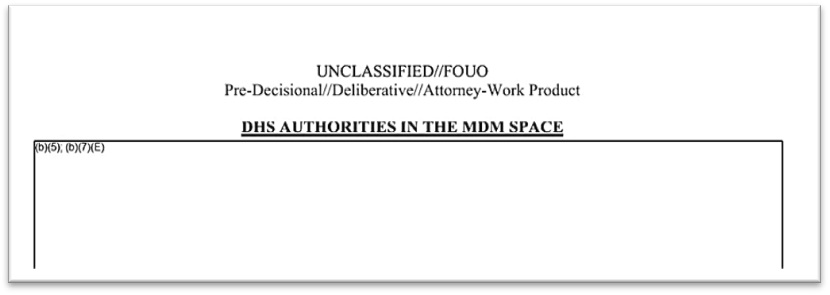
Another document shows that the DHS’s Disinformation Governance Board had a “Ukraine MDM Playbook” before it was shut down.

The AFP Foundation isn’t the only entity that’s struggled to get the DHS to hand over information on its speech policing activities. It has previously stonewalled Congress’s attempts to get details on the DHS’s “anti-disinformation” practices.
Additionally, the DHS has been accused of attempting to avoid transparency by using channels such as Slack and personal cellphones to hold meetings about its misinformation efforts.
YouTube Is Wiping Safety Content on COVID-19 Vaccines
Study Finds Platform is Cleansing Side Effect Information and Promoting Unbridled Use of Experimental Products
By Peter A. McCullough, MD, MPH | Courageous Discourse | September 19, 2023
YouTube is the most utilized video platform in the world. Many of my patients ask “doctor, why don’t we hear about vaccine side effects?” People feel blind-sided when they develop myocarditis, stroke, blood clots, or other common vaccine side effects but can can find no information on them with standard Google searches landing on YouTube.
Ng and colleagues performed a rigorous analysis of YouTube COVID-19 vaccine content and found that the platform is having effective content moderation. This means when you do a search, they are wiping vaccine safety information off the platform as “anti-vaccine” and replacing it with either irrelevant health information or pro-vaccine content.
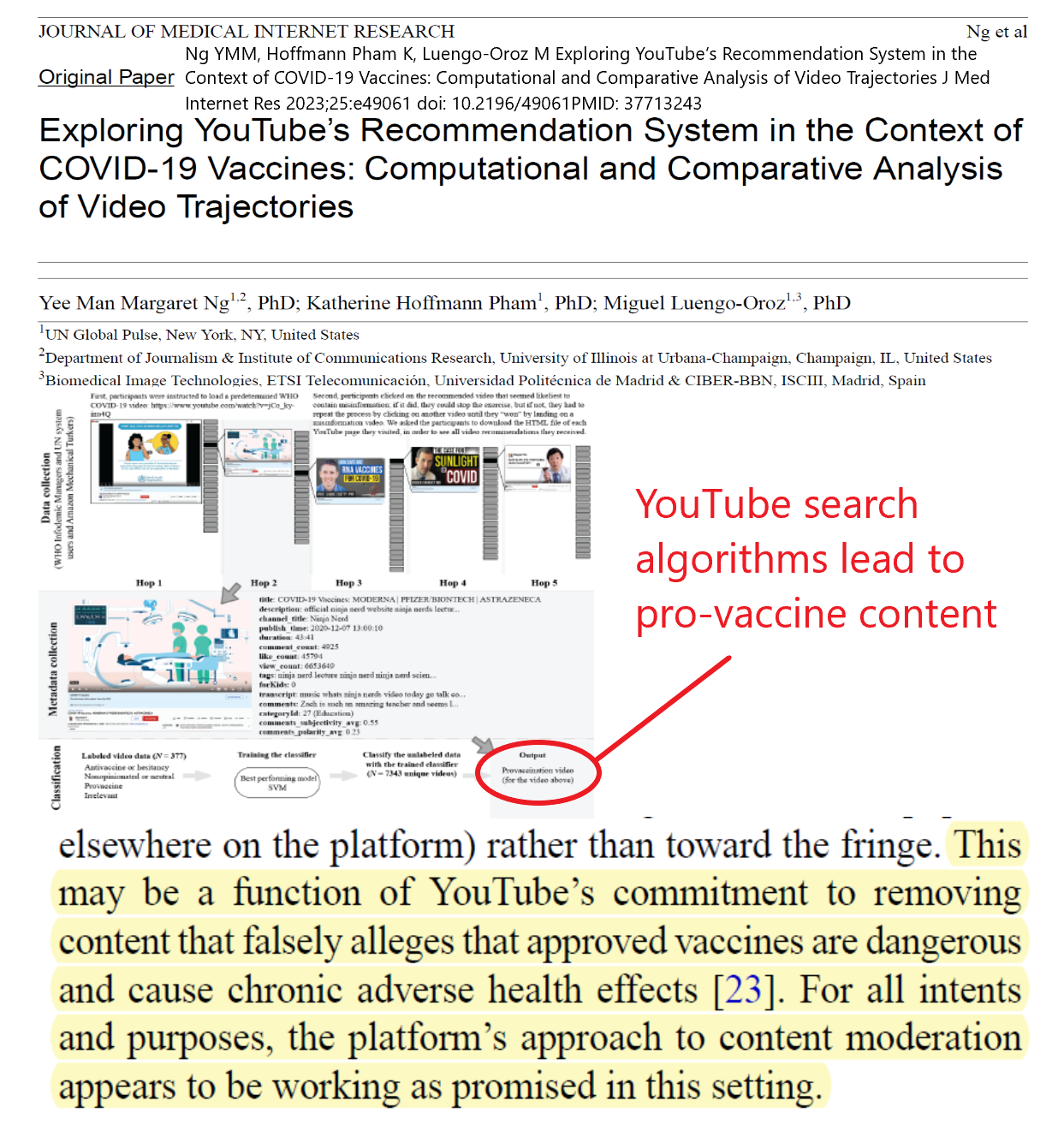
Ng YMM, Hoffmann Pham K, Luengo-Oroz M Exploring YouTube’s Recommendation System in the Context of COVID-19 Vaccines: Computational and Comparative Analysis of Video Trajectories J Med Internet Res 2023;25:e49061 doi: 10.2196/49061PMID: 37713243
The authors declare this a “success” of content moderation. Others would say this is censorship of valuable health information replaced with propaganda promoting novel, experimental unsafe, ineffective, genetic vaccines. What YouTube is doing is very scary, the authors self-expressed virtuosity is even more alarming.
Peter A. McCullough, MD, MPH
President, McCullough Foundation
Ukrainian Buk Missile Caused DPR Market Tragedy, US Media Report Affirms
By Svetlana Ekimenko – Sputnik – 19.09.2023
As Volodymyr Zelensky arrives in the United States for a second time to plead for more aid, a US media report has unveiled a detailed investigation that debunks vehement assertions made by Ukraine’s President a few weeks ago.
Ukrainian President Zelensky’s visit to the US to attend the UN General Assembly meeting in New York, visit the White House, and meet with congressional leaders, comes against a sobering backdrop. Ukraine’s much-hyped counteroffensive has been stuttering, while skepticism is mounting over endlessly propping up the Kiev regime among some Republican lawmakers.
On the eve of Zelensky’s arrival, the New York Times published an investigative piece into a missile strike on a marketplace in the town of Konstantinovka, in the Donetsk People’s Republic (DPR), that occurred earlier in the month.
The strike on September 6 had killed 15 people and left over 30 people wounded, according to Ukrainian officials. Zelensky was quick to describe it as a “Russian” attack on “a regular market and shops,” with numerous Western media outlets parroting the claim and Ukrainian Prime Minister Denys Shmyhal vowing “fair retribution” for it. The strike occurred on the same day when US Secretary of State Antony Blinken made a surprise visit to Ukraine, announcing millions in new aid to Kiev.
However, evidence suggests it was a Ukrainian missile released from a Buk surface-to-air system that caused the market tragedy, as per the US report. A long hard look at eyewitness accounts, social media posts, analysis of video and weapon fragments, along with satellite imagery, “strongly suggests the catastrophic strike was the result of an errant Ukrainian air defense missile fired by a Buk launch system,” write the journalists.
Ukraine’s authorities had initially tried “to prevent journalists with the Times from accessing the missile debris and impact area in the strike’s immediate aftermath,” according to the report. However, they subsequently managed to reach the scene of the strike, talk to witnesses, and gather fragments of the projectile itself.
Ukrainian artillery fire had been reported in the area, according to a local Telegram group, minutes before the strike on the marketplace, the media report underscored. The missile strike on Konstantinovka came from the direction of Ukrainian-held territory, not from Russian lines, according to security camera footage seen by the journalists.
Furthermore, they claim that “at least four pedestrians appear to simultaneously turn their heads toward the incoming sound” – in the direction of Ukrainian-held territory – when the missile approached. A reflection of the missile itself, coming in from the northwest, is visible in the cited footage, passing over parked cars.
Further analysis shows that the crater and point of detonation are also “consistent” with a missile traveling from the northwest. According to the media outlet’s reporters who were in the nearby town of Druzhkovka at the time of the missile strike on Konstantinovka, minutes before the attack, Ukraine’s military had launched two surface-to-air missiles toward the Russian front line.
The Ukrainian missile launches were also purportedly mentioned by the residents of Druzhkovka at the specified time in a local social media group. Witnesses that reporters interviewed also confirmed they saw the missiles being fired, and traveling in the direction of Konstantinovka.
“The timing of these launches is consistent with the time frame for the missile that struck the market in Kostiantyn[o]vka, around 2:04 p.m. [local time]” say the outlet.
Missiles had been launched from fields outside Druzhkovka, another witness stated, adding that it had been used by the Ukrainian military to station air defense systems. After reporters themselves visited the site in question, they “saw indications that it had recently been used by the military, including trenches, trash pits and wide tracks consistent with a large military vehicle.” Satellite imagery showed fresh scorch marks around the trenches on the day of the missile strike, in an indication the area could have been used to launch missiles, the investigation revealed.
While the Ukrainian authorities have claimed that Russia had fired a missile from an S-300 air defense system at Konstantinovka, such a missile has a “different warhead” from the one that exploded in the market on September 6, the report pointed out. It added that the measurements of the holes in the facades of the buildings closest to the strike are “consistent in size and shape” with a 9M38 missile, fired by a Buk antiaircraft vehicle, used by Ukraine. The same conclusions were reportedly made by independent military bomb-disposal experts: damage at the missile strike site in Konstantinovka was “most consistent with an 9M38.”
The Kiev regime staged a false flag in the DPR’s Konstantinovka based on the same scheme as in Bucha, Russian Ambassador to the United Nations Vassily Nebenzia said at a meeting of the UN Security Council on September 8. Referring to the strike on the town in the part of the DPR controlled by Ukraine’s forces, he called it a terrible tragedy, adding:
“It’s just that, we are sure you’ll soon forget and cover up this incident, as in the case of the attack on Kramatorsk in April last year.”
Western mainstream media has been eager to echo the Kiev regime’s falsehoods, such as accusing Russia of deliberately striking civilian targets. The developments in the city of Kramatorsk, and in the Donetsk People’s Republic (DPR), are another case in point.
As for Bucha, the Ukrainian authorities and Western media had spread gruesome footage purportedly showing murdered civilians lying along a road in the suburb of Kiev, citing it as evidence of “Russian war crimes.” Moscow dismissed the footage as a false flag provocation, pointing out that the bodies appeared days after Russian troops had withdrawn.
Russia has repeatedly reiterated that its armed forces do not attack civilian facilities.
‘Of Course He Was Paying’: Former Ukrainian Business Leader Accuses Top Zelensky Adviser of Bribery
By Fantine Gardinier – Sputnik – 19.09.2023
A top adviser to Ukrainian President Volodymyr Zelensky is facing renewed corruption allegations after an exiled Ukrainian business leader claimed the man worked for him for years as a go-between handling payments to Ukrainian officials.
“Tatarov used to solve all issues with law enforcement” – that’s what Oleh Maiboroda, the former executive director of Ukrbud Development, one of Ukraine’s largest construction companies, told Western media on Tuesday about Oleh Tatarov.
Once a lawyer, Tatarov now serves as Zelensky’s top adviser on law enforcement and security agencies, a position he’s held since 2020. However, according to Maiboroda, Tatarov was running bribes for him for the five years before he took the job for Zelensky.
The lawyer’s connections across the Ukrainian legal system, from police officials to judges and prosecutors, made him the perfect man to smooth over the approval processes for Ukrbud’s many promising construction projects.
“Of course he was paying,” Maiboroda said. “He was giving them money so these arrangements were done … He knew about law enforcement and warned us to be careful about saying almost anything on the phone.”
The former Ukrainian business leader showed to Western media a list of bribes allegedly paid by Tatarov, totaling some $1.8 million.
Maiboroda has himself fled Ukraine and currently lives in Vienna, where he hopes to stay safe from corruption charges against him in Kiev.
Tatarov is no stranger to such accusations, either: a previous case, brought by the National Anti-Corruption Bureau of Ukraine (NABU) and Anti-Corruption Action Center’s (AntAC), claimed he had bribed a forensic expert on behalf of Ukrbud, even going so far as to publish the WhatsApp conversation in which Tatarov agreed to the bribe. However, the case was closed in April 2022 on procedural grounds.
“The discussion on the incumbent president’s values is over,” Vitaly Shabunin, the head of AntAC’s executive board, said in 2021. “Volodymyr Zelensky shares Tatarov’s values. This means that Zelensky … doesn’t see any problems in Tatarov’s corruption-related crimes.”
Zelensky has stood by his man through the tribulations, refusing to fire or even to condemn Tatarov despite citizen petitions like the one AntAC organized, with more than 25,000 signatories.
Kiev, which hopes to join the European Union and NATO, has struggled with endemic corruption that promises to not just frustrate its admission hopes, but which endangers the flow of Western weapons and financing to Ukraine as well. To that end, Zelensky has made statements condemning corruption and pledging to crack down, and sweeping firings have “cleaned house” across bureaus such as the Defense Ministry, where the firings have reached the highest ranks.
Last month, Zelensky fired all 24 of Ukraine’s regional military recruitment offices, which are awash with accusations of corruption, including that dozens of recruitment officers have accepted bribes to exempt eligible men from being drafted into the Armed Forces of Ukraine.
Earlier this month, Oleksiy Reznikov was fired as defense minister, and on Monday, Zelensky fired all six deputy defense ministers. Reznkov’s replacement, Rustem Umerov, is himself under investigation for what NABU calls “gross violation of labor laws” and that he and his deputies “took actions aimed at concealing the facts of theft of state property” while he was head of the State Property Fund (SPF).
No accusations of corruption have been brought against any of the former ministers, but the AntAC spoke of the terminations as a “positive step” toward cracking down on corruption and improving accountability.
“The ministry of defense is one of the least reformed ministries in our country, and it is not able to cope with the challenges of the war,” AntAC executive director Daria Kalenyuk told a US newspaper on Monday, adding it was timed to coincide with Zelensky’s trip to Washington, DC, where the president hopes to shore up US support for his government.
A small but growing faction of the Republican Party is openly questioning US support for Ukraine in its conflict with Russia. While some have demanded audits and better accountability for the tens of billions of dollars in aid flowing to Kiev, others have demanded the support halt entirely, especially in light of the disastrous Ukrainian counteroffensive this past summer.
“Many countries are sending major resources to Ukraine, and rightly so, but governments and populations will soon lose patience for that if there are not signs that the government is serious about fighting corruption,” an anonymous Western diplomat in Kiev told British media.
Emails Show Decade of Hunter Biden Spinning Journalists on Foreign Business Deals
The Hunter Biden laptop archive shows years of careful efforts to manipulate media outlets, a rare window into the DC spin cycle.
BY LEE FANG | SEPTEMBER 19, 2023
Speaker Kevin McCarthy, announcing that the House of Representatives will pursue an impeachment inquiry, suggested that the probe will hinge in part on deceiving the American public about Hunter Biden’s foreign business ventures.
“President Biden did lie to the American people about his own knowledge of his family’s foreign business deals,” McCarthy said at a press conference. GOP lawmakers, he added, have “uncovered credible allegations into President Biden’s conduct.”
Such an investigation will likely force an examination of the public narrative regarding Hunter Biden’s consulting deals that go back at least a decade. During President Obama’s second term, then-Vice President Joe Biden was the administration’s point man on the nation’s policy toward Ukraine, a perch he used to urge the country to adopt sweeping ethics reforms to resist “the cancer of corruption” and enact sweeping ethics reforms.
At the time, some American journalists began to question whether the vice president’s stern message was undermined by his son Hunter Biden’s employment at the Ukrainian energy firm Burisma, which was owned by a notorious local oligarch.
Emails on Hunter’s laptop reveal that the inquiries sparked an internal debate within his team of consultants and public relations agents. Ultimately, they devised a series of responses about Hunter’s work with Burisma that were, at best, misleading and, at worst, outright falsehoods.
The Biden team has constructed a careful image of Hunter Biden’s business ventures, sometimes employing a sophisticated myth-making operation aided by allies in the media who rarely challenged or investigated their false claims. The laptop emails show that the team closely monitored critical reporting and pushed to shape coverage with reporters from the New York Times, Time magazine, Wall Street Journal, and the Associated Press.
Their spin informed much of the ensuing coverage in the mainstream press, defusing the issue, even as President Trump and other Republicans insisted that Ukraine was a hotbed of Biden family corruption. Although he had no background in the energy field and little experience in corporate governance, Hunter Biden, who had a law degree, was appointed to the board of Burisma in May 2014.
It was revealed later that he was paid about $1 million per year – as was his business partner Devon Archer. In a press release announcing his appointment, Hunter Biden is quoted as saying, “I believe that my assistance in consulting the Company on matters of transparency, corporate governance and responsibility, international expansion and other priorities will contribute to the economy and benefit the people of Ukraine.”
That same month, journalist Michael Scherer reached out with questions about the arrangement.
Several consultants employed by Burisma, including Ryan Toohey of FTI Consulting and Heather King, a partner at the law firm Boies, Schiller, & Flexner, where Hunter worked as counsel, strategized over how to respond to Scherer, a reporter then with Time magazine who has since joined the Washington Post.
For the Scherer inquiry, laptop emails show, Hunter’s business associates settled on a strategy to deflect the most direct questions and obfuscate the true intent of Burisma’s attempts to sway U.S. government officials.
One of Hunter’s associates noted that they planned to respond to Scherer’s attempts to reach David Leiter, a former aide to then-Secretary of State John Kerry, hired to work for Burisma. The plan was to use an assistant to make Leiter “unavailable to comment, as opposed to some sort of statement that made it seem like we were unwilling or refusing to engage with the reporter.” Leiter, the emails show, was in fact available, but the public relations team wanted to keep him out of reach.
Scherer wanted to know why Burisma was on a hiring spree of well-connected American lobbyists, including Leiter and others. In response, Toohey planned to tell Scherer that the hired guns were simply working on issues related to energy independence, economic growth, as well as “transparency and good governance.”
In response to other questions posed by Scherer, Toohey prepared a statement claiming that Hunter Biden will “not be engaged with the U.S. government” on anything related to Burisma.
The response belied a detailed lobbying agenda spelled out in other emails.
Burisma had made clear that the company had hired Leiter, Hunter Biden, and other political operatives as part of a focused plan to obtain Burisma owner Mykola Zlochevsky a U.S. visa as well as to persuade American officials to intervene with Ukrainian government officials to drop an investigation of his business interests.
In a May 2014 email, Vadim Pozharskyi, a close adviser to Zlochevsky, explained to Hunter that he needed his “advice on how you could use your influence to convey a message/signal, etc. to stop what we consider to be politically motivated actions,” a reference to an ongoing investigation of Zlochevsky by Ukrainian prosecutors.
That month, Pozharskyi again wrote to Hunter, spelling out the “working plan for both FTI and David,” reiterating that he wanted the lobbyists to intervene against the “politically motivated proceedings initiated against us in Ukraine” and to overcome the “US entry ban” for the Burisma owner.
“The immediate plan is to reach out to the Energy and Ukraine desks, respectively, at State Dept,” wrote Heather King, the attorney working closely with Hunter Biden at the time. “That will include outreach to Carlos Pascual, he is the top US energy diplomat,” she added.
Scherer printed the denials, but to his credit, reported on the odd circumstances surrounding Biden’s hiring, at a time when Joe Biden was the Obama administration’s point person for Ukraine, with a special focus on energy policy in the region.
In many cases, Hunter Biden’s associates cast him as simply an auditor with a special focus on renewable energy sourced from geothermal vents. That was the strategy in response to an inquiry from Stephen Braun, a reporter for the Associated Press. “Mr. Biden will not lobby on behalf of Burisma. His role is to advise the company’s legal and compliance unit, including guidance on corporate governance standards.”
Behind the scenes, Hunter Biden’s team knew otherwise. In emails conferring over how to deal with Braun’s questions, Pozharskyi reiterated the plan to provide Braun with “minimum information.”
Like many other articles from this time, the AP story focused on the conflict of interest issues, noting the denials around any lobbying with a degree of skepticism:
A former Washington lobbyist, the vice president’s son is effectively exempt from most rules that would require him to describe publicly the legal work he does on behalf of Burisma.
Hunter Biden will not lobby for the company, said Lawrence Pacheco, an official with FTI Consulting, a Washington government affairs company recently hired by Burisma.
Pacheco did not say whether Biden might oversee or advise on any future Burisma lobbying strategy in the U.S. Pacheco said the company “does not take positions on political matters.”
Braun could not be reached for comment. Scherer declined an opportunity to comment on the Hunter Biden emails. Biden, Toohey, and King did not respond to a request for comment.
However, the emails clearly indicate that substantial resources were allocated to managing both Burisma and Hunter’s personal image. Pozharskyi pointed out that Burisma had retained American consultants to reach out to “the most reputable European and American journalists/newspapers, magazines, websites, blogs,” while assistance was required to handle Wikipedia, Facebook, LinkedIn, and other online platforms. Burisma, wrote Pozharskyi, sought a “detailed algorithm on how the Company should act in case of bad publicity.” The effort included scrubbing negative details from Hunter Biden’s Wikipedia, while bolstering the online credentials of Burisma, emails show.
A highly focused effort to monitor and shape news media coverage helped maintain the public profile. Even with relatively low visibility, independent media were closely watched. Hunter and his team monitored Vice News as well as the gadfly website ZeroHedge. In response to critical reporting from Vice, one colleague noted approvingly that the article was not being “reposted or republished” in Ukrainian media.
In July 2014, Toohey circulated an investigative piece I wrote for Salon about Hunter Biden’s hiring at Burisma, which noted that the vice president’s son had been retained amid a string of nepotistic hires likely aimed at influencing natural gas and energy policy.
In the article, I noted that Joe Biden had traveled to Ukraine to “announce a $50 million aid package that included technical support for increasing the country’s natural gas production – an investment that could bolster profits at Burisma Holdings, where his son is a director.” What was not known at the time, however, was that Hunter Biden was already working with a team of public affairs consultants to channel U.S. government technical assistance to his client.
The laptop emails show that even this relatively brief mention of Hunter Biden and a potential conflict of interest with his father raised concerns.
“All, please see below a piece that mentions Hunter’s appointment as part of a broader trend, mostly within the context of relatives of eleceds [sic] engaged to lobby for the energy industry,” wrote Toohey, attaching a copy of the text of my piece. But, he added, “This was a freelanced piece picked up in a number of web-based outlets including Salon, but nothing with significant reach.”
Pozharskyi replied that he had seen the piece earlier and “wanted to have a discussion in this regard.”
In some cases, the team celebrated media coverage that elevated its desired narrative. Politico reported Hunter’s hiring at Burisma and simply printed quotes from the company’s official statements:
“The company’s strategy is aimed at the strongest concentration of professional staff and the introduction of best corporate practices, and we’re delighted that Mr. Biden is joining us to help us achieve these goals,” Alan Apter, Burisma Holdings’ chairman of the board of directors, said in a statement, which was reported by The Moscow Times on Tuesday.
Biden, joining the board, will be in charge of the legal unit, the company said. He will also provide support for Burisma Holdings “among international organizations.”
Biden said the company will help strengthen Ukraine’s economy.
Pozharskyi circulated a link to the Politico article to Hunter and his associates, noting the “positive coverage.”
Hunter’s membership on the Burisma board received renewed attention in late 2015, as then-Vice President Biden was set to visit Ukraine where he planned to address the parliament on the need to adopt new reforms against a culture of corruption in the country. James Risen of the Times, among others, renewed inquiries directed toward Hunter and his associates about the rationale behind his appointment to the company, Burisma, and why the company appeared to be buying access to high levels of government.
In one email found on Hunter’s laptop, Risen asked, “What lobbying activities is the company engaged in the US?” among other questions to Hunter Biden. In response, a Burisma spokesperson straightforwardly claimed that “no one is lobbying on their behalf.”
The company’s lobbying efforts were not covered in the story ultimately published by the New York Times, which featured Risen’s piece on Dec. 8, 2015. The article included a statement from the Hunter Biden team, crafted by the strategy firm FTI Consulting, asserting that the company’s focus was on “corporate governance and transparency.”
Risen’s article did not address whether Hunter’s business career demonstrated such expertise or his lack of experience in the energy field. Although Risen identified Hunter as “a former Washington lobbyist,” he accepted the denial that no lobbying was involved.
In reality, just a month prior to the email exchange with the Times, Burisma, following Hunter Biden’s advice, had hired Blue Star Strategies, a Democratic lobbying firm, to influence the Obama administration. A copy of the agreement, belatedly filed with the Justice Department, reveals that the firm, which aided in lobbying State Department officials on Ukrainian energy policy, received a monthly retainer of $30,000.
Blue Star Strategies was even copied on the emails with the Hunter Biden team on its response plan to Risen.
Risen also allowed a Burisma spokesman to decline to state Hunter’s compensation while claiming it was “not out of the ordinary” for such board positions. It was later disclosed that he was paid about $1 million per year, which is far higher than the typical compensation. As a point of comparison, median annual compensation of board members at Fortune 500 companies is around $110,000.
Risen, now with The Intercept, did not respond to a request for comment.
Political operatives of all ideological backgrounds frequently manipulate public perception – often employing specialized “crisis communication” firms to suppress negative coverage and shape desired narratives. What is remarkable about the Hunter Biden episode is how successful it was, and how uncritically most media organizations treated this unorthodox relationship between a president’s son and a controversial foreign corporation.
In response to the Wall Street Journal, Toohey worked closely with Blue Star Strategies’ Sally Painter and Karen Tramontano to craft a message defusing questions around a conflicting message between Hunter and his father. They settled on a strategy of presenting the Ukrainian gig as perfectly “aligned” with an anti-corruption agenda, laptop emails show. The lobbyists suggested that they release a statement to the Journal claiming that Hunter’s work for the Ukrainian energy giant, to supposedly strengthen corporate governance, are “also goals the United States.”
The Journal printed the statement, attributing it to a spokesperson.
Such coverage – which suggested Hunter Biden had engaged in questionable but ultimately harmless behavior that did not involve, much less implicate, his father – set the narrative for most coverage in mainstream outlets. When President Trump told Ukraine’s president in 2018 that “there’s a lot of talk about Biden’s son” and asked him to look into Joe Biden’s demand that the prosecutor looking into Burisma be fired, Democrats moved to impeach him.
The Biden spin continued even after the New York Post published the first articles based on material from Hunter’s laptop in October 2020. The Washington Post’s fact checker, Glenn Kessler, sought to discredit the New York Post’s reporting that Hunter Biden had arranged a dinner meeting between his Ukrainian associates at Burisma and his father when he served as vice president. At the time, the Biden presidential campaign claimed that it “reviewed Joe Biden’s official schedules from the time, and no meeting, as alleged by the New York Post, ever took place.” Kessler reiterated this denial as though it were an established fact.
It turned out to be false. The July testimony by former Hunter Biden associate Devon Archer confirmed that Hunter Biden had arranged a secret dinner with his Ukrainian business partner and his father, as the New York Post had originally reported. The ongoing saga over the Washington Post’s role in covering up the Biden revelations was detailed last month by RealClearInvestigation’s Paul Sperry.
Last month, Kessler “updated” his article to acknowledge this.
Also last month, Washington Post columnist Philip Bump, who has dismissed any hint of scandal regarding Biden business dealings, appeared on Live at the Table, a podcast hosted by Noam Dworman, the owner of New York City’s Comedy Cellar. The show went viral as Dworman challenged Bump’s claims that there was “no evidence” of wrongdoing by Joe Biden.
In a heated exchange, Bump conceded that Hunter Biden’s text messages that claim, “unlike pop, I won’t make you give me half your salary,” was one form of “evidence.” Moments later, Bump ended the interview and walked off the set.
The interaction provided a rare moment of visible accountability for the establishment press, which has largely followed the Biden spin for an entire decade on this issue.
Yet the White House is still hoping it can still instruct journalists on how to cover the story. Shortly after McCarthy’s impeachment inquiry announcement, President Biden’s White House staff circulated a memo, instructing media outlets on how to cover the news. In bold type, the memo claimed that the entire Hunter Biden conflict of interest scandal had been “refuted” and “debunked” – language that was adopted in media reports about the inquiry in Vox, NBC News and CNN.
Net-zero: the annals of absurdity
By Richard North | Turbulent Times | September 17, 2023
Most readers will recall the excited chatter of some commentators, speculating on the result of the summer’s Uxbridge by-election – which was attributed to a backlash over Khan’s ULEZ plans.
After vague noises from No.10 about being “pragmatic”, there was a widespread feeling that Sunak might capitalise on what some took to be an “anti-green” rebellion, and row back on the implementation of net-zero.
Whatever hopes there might have been, though, it must now be crystal clear that, short of any trivial, cosmetic concessions, Sunak has absolutely no intention of slowing down to destroy the British economy in the name of the Great God climate change.
If any further evidence was needed, it comes in an article in The Times yesterday, which tells us that the prime minister has rejected any idea of a reprieve for petrol and diesel cars. The 2030 electric vehicle targets, we are told, will stay.
As if that wasn’t bad enough, we are also warned to expect punitive measures aimed at incentivising the few remaining car manufacturers in the UK to increase their sales of EVs.
The plan is that next year, 22 percent of new cars sold will have to be electric, rising to more than 50 percent in 2028. It is left to the Independent, though, to tell us that manufacturers who fail to meet the targets will face fines of up to £15,000 per car.
A similar stratagem is being used to push the sales of heat pumps, with gas and oil-fired boiler manufacturers being required in the financial year 2024-2025 to ensure that heat pumps make up 4 percent of their sales.
An alternative is to buy “credits” from manufacturers who are over-quota, failing which the manufacturers will have to pay an eye-watering fine of £5,000 for every heat pump short of the quota. As with EVs, the quota will increase each year.
This has led some manufacturers to warn that they will have to increase the unit prices of boilers by £300 – a sum which also might have to increase each year as sales quotas increase.
This way of doing things is particularly devious as it distances the government from the consumer and puts the responsibility on manufacturers to implement net-zero policy, which must then take the blame for the increased prices when people turn their backs on “green” products.
As such, one might expect that manufacturers would be up in arms at this cynical attempt to make them take the fall, except in the case of car-makers, the sales quota system favours those which have committed only to produce EVs – apparently an intended consequence of the plan.
This has emerged after talks between the government an BMW, when it was announced that the car-maker would receive a subsidy of £600 million for its Cowley plant in Oxford – a bribe to dissuade the company from moving its whole operation to China.
But part of the package, it seems, was an “understanding” that the net-zero timescale would not be relaxed, giving the company “certainty” about the rules, and thereby protecting their investment in EVs. In order to protect the developing market, car-makers are said to be keen to see the 2030 ICE new car sales ban go ahead.
This also applies to the emerging charging industry. Ian Johnston, chairman of the industry body ChargeUK, is quoted as saying: “To go further our sector needs certainty in the form of a firm commitment to a strong zero emissions vehicle mandate”. He is said to have cautioned that scaling it down would mean “billions of pounds of investment” being put at risk.
We thus have an interesting, if not disturbing situation where the market in cars is to be heavily distorted, so that consumer preferences will no longer be the primary driver of production plans. A nexus of government, investors and car manufacturers is conspiring to create a producer-led industry.
As for the minor detail of a lack of charging points – which is one of the factors inhibiting sales – officials argue that tough annual targets will give confidence to investors to start building thousands of charge points.
That alone, however, is unlikely to be sufficient to incentivise private buyers, who have proved extremely reluctant to convert to electric. Although the government “fines” may narrow the price differential, EVs will still be substantially more expensive than their ICE counterparts and the lack of chargers continues to put off buyers.
Even then, car-makers are not yet out of the woods as there is the vexed question of battery production to resolve. Faced with subsidies pouring out of the coffers of EU and US governments, Alan Hollis, chief executive of AMTE Power – head of one of Britain’s few surviving homegrown battery manufacturers – is holding out the begging bowl, threatening to build its planned new factory overseas unless the UK closes the subsidy gap. So far, though, the UK’s experiences with building battery plants have not been happy.
Nevertheless, last May, the government offered the owners of Jaguar Land Rover £500 million in subsidies in an effort to persuade the carmaker to build a new electric battery plant in the UK.
The Indian conglomerate Tata, the parent company of JLR, was in the process of deciding whether to build the new electric battery production facility in the UK or Spain and, in July, announced that it was to build a 40GW battery cell gigafactory in the UK – although this may have Chinese backing as well.
BMW has not yet decided on the manufacturing location for its Mini batteries – with mainland Europe or the UK remaining options – but it is germane to note that the company is also producing the Mini marque in China, with exports from that country due to start in 2024.
Therein lies another tale, as Chinese EV and battery production has been heavily subsidised since the inception of the industry. State subsidies for electric and hybrid vehicles were reported at $57 billion from 2016-2022, helping China become the world’s biggest EV producer and to pass Japan as the largest auto exporter in the first quarter of this year.
However, China is not only delivering the volume, but its cars are also typically 20 percent below the prices of European-built models. This has moved the Commission to consider imposing punitive tariffs under anti-dumping laws. It is possible that the UK will follow suit although to do so would present the government with something of a conundrum.
As it stands, the import of cheaper Chinese vehicles is the only sure-fire way of eroding the price differential between ICE and electric cars, and thus the best way of achieving the government’s net-zero targets – notwithstanding that Chinese industry is largely powered by fossil fuels.
Thus, despite its Faustian deal with its own car manufacturers, the government’s best option is to open the doors to Chinese imports, at the risk of wiping out British car manufacturing.
When the BMW deal was done, Sunak was full of himself, declaring that the “investment” was “another shining example” of how the UK was the best place to build cars of the future, claiming that his government was “securing thousands of jobs and growing our economy right across the country”.
But, from current moves, it appears that Sunak is far more interested in the deindustrialisation of Britain through net-zero, in which case he should be looking to ditching the car industry as soon as possible – which is no doubt already in his mind.
After all, except for a few small-scale specialists, most of the industry is already in foreign hands, so handing it over to the coal-fired Chinese shouldn’t make too much difference. In the pursuit of net-zero targets, nothing is too much or too absurd for our government to countenance.
Featured Video

HE SAVED LIVES. NOW HE FACES PRISON.
or go to
Aletho News Archives – Video-Images
From the Archives
NATO Sanctions and the Coming Global Diesel Fuel Disaster
By F. William Engdahl – New Eastern Outlook – 11.04.2022
Amid the ongoing global inflation crisis, NATO heads of state and mainstream media repeat a mantra that high energy prices are a direct result of Putin’s actions in Ukraine since end of February. The reality is that it is the western sanctions that are responsible. Those sanctions including cutting SWIFT interbank access for key Russian banks and some of the most severe sanctions ever imposed, are hardly having an impact on the military actions in Ukraine. What many overlook is the fact that they are increasingly impacting the economies of the West, especially the EU and USA. A closer look at the state of the global supply of diesel fuel is alarming. But Western sanctions planners at the US Treasury and the EU know fully well what they are doing. And it bodes ill for the world economy.
While most of us rarely think about diesel fuel as anything other than a pollutant, in fact it is essential to the entire world economy in a way few energy sources are. The director general of Fuels Europe, part of the European Petroleum Refiners Association, stated recently, “… there is a clear link between diesel and GDP, because almost everything that goes into and out of a factory goes using diesel.” … continue
Blog Roll
 Aletho News
- Trita Parsi: Middle East Unraveling — Are We on the Path to World War?
- Iran FM meets with US envoy on UN meeting’s sidelines at American side’s insistence: Report
- Qatar PM calls for Gulf security framework with Iran, says war must be ‘wake-up call’
- China condemns US extortion of Iranian airlines, rejects Washington’s ‘illegal’ sanctions threats
- Italy to move military personnel from Taif base after missile strike
- Finland’s Stubb tells European leaders to calm down
- Defeating Russia on battlefield impossible – Fico
- Finland’s Gender Clinic Reversal
- Massachusetts Wants Mental Health Visits, Why Does Government Use ‘Health’ to Enter Our Homes & Families?
- US lawmaker admits American people footing bill for Trump’s failed aggression against Iran
- If Americans Knew
- Sanctions are collective punishment: immoral and self-defeating
- Phosphorus Munitions Fired by Israel Burn Groves, Orchards in Southern Lebanon
- Israel Carries Out New Ceasefire Violations Across Gaza
- AI – Emphasis on the ‘I’: Israel Is Funding AI Chatbot Propaganda
- Israel Blocking Hundreds of Wheelchairs for Injured Children From Entering Gaza
- Israel Is Expanding and Upgrading Compounds for Palestinian Militias in Gaza
- The Palestinian-American Residents of This West Bank Town Are Wondering: Where Is Trump?
- Gaza desperately needs tents, wheelchairs, fuel… and everything else (Israel blocks it all) – Daily Update
- Israeli Attacks in Gaza Kill at Least Seven Palestinians Over Three Days, including Woman and Child
- Trump’s militarization of Washington DC as he pursues Israel’s war against Iran
- No Tricks Zone
- New Study: Earth And Venus Surface Warmth Largely Explained By Convection And Lapse Rate, Not CO2 Or Radiation
- 2025 Nature Paper Claiming Worsening Global Drought Gets RETRACTED …Heavily Flawed
- New Study: ‘Global Drought Shows No Detectable Recent Acceleration Under Climate Warming’
- Economic Masterminds: German Socialists Suggest Taxing Productivity Gains Stemming From Using AI
- The South China Sea Has Not Been Cooperating With The Climate Change Narrative
- Energy Crisis: Germany Enters Heating Season With Historically Low Gas Reserve Fill Levels
- New Study: The Antarctic Ice Sheet Gained Mass From 2020-2024 Due To Staggering Snow And Ice Accumulation
- Study: Ocean Heating Rates From Thousands Of Years Ago ‘Dwarf’ Modern Ocean Heating Rates
- Climate Extremists Target, Attack Large-Scale Power Grid Infrastructure In Germany!
- New Study: Antarctic Ice Melt Has Contributed Less Than 1 Centimeter To Sea Level Rise In The Last 30 Years

