Don’t Make Mark Zuckerberg America’s Political Truth Czar
By Thomas L. Knapp – The Garrison Center – October 29, 2019
Politicians lie.
Not all of them. Not every time. But most of them, from both “major” political parties, lie. A lot.
It’s not always easy to tell when they’re lying. It’s not always easy to prove they’re lying. Often, it’s not even easy to tell if they’re just lying to us or to themselves as well.
Some politicians want Facebook to stop politicians from lying. They phrase that desire as a request for Facebook to “fact check” content posted by politicians, especially political advertising.
Perhaps I’m too cynical, but I’m not sure it’s coincidence that the examples politicians offer tend to be drawn from content posted by their political opponents.
US Representative Alexandria Ocasio-Cortez (D-NY) is a notable exception. She asked Facebook CEO Mark Zuckerberg if Facebook would let her target Republican politicians by running ads falsely accusing them of voting for her “Green New Deal” proposal (Zuckerberg said he couldn’t answer “off the top of his head”).
On the other hand, AOC’s own take seems a bit naive. “So you will take down lies or you won’t take down lies?” she asked Zuckerberg. “I think this is a pretty simple yes or no.”
It isn’t.
Let’s use the Green New Deal as an example.
If a Facebook employee has to “fact check” an ad asserting that the proposal would “tank the American economy,” how should that employee evaluate the truth or falsehood of the claim?
What criteria should that employee use for deciding what “tank” means? Is slow economic growth “tanking?” Or would it take a recession or depression to meet the threshold?
Should that employee rely on analyses from the Heritage Foundation? Or perhaps from People for the American Way? Or the Congressional Budget Office? Or the Office of Management and Budget? Four sources, likely four wildly conflicting sets of claims and projections.
For a conflicting ad claiming the Green New Deal would “boost the American economy,” should that employee “fact check” the ad using the same sources as for the original ad, or different sources? Would 1% growth of GDP constitute a boost? If not, what number, applied to what metric, would?
What if both ads fail the “fact check?” Should the public just flip a coin and vote accordingly, since the two sides are forbidden to offer us their takes to evaluate and decide between for ourselves?
Politics consists of conflicting narratives. No two opposing narratives can both be true. In fact, both could be false (Spoiler: Both are probably at least partially false, intentionally or not; personal biases affect politicians’ beliefs, and ours, at least as much as facts do).
The question is not whether politicians’ claims should be fact checked. The question is who should do the checking.
In an even remotely free society, the only answer is “all of us.”
Yes, some of us will fail to accurately distinguish truth from falsehood. Some of us will get things wrong.
That’s better than one centralized “fact checking” operation getting them wrong for all of us.
Thomas L. Knapp (Twitter: @thomaslknapp) is director and senior news analyst at the William Lloyd Garrison Center for Libertarian Advocacy Journalism (thegarrisoncenter.org).
US Has Officially Gone Insane
By Finian Cunningham | Strategic Culture Foundation | October 28, 2019
The low-ball mudslinging and pantomime palaver among America’s political class is like a theater of absurd. Any form of vilification is now acceptable. President Trump and his Twitter rants may have helped set the bar of indecency to an all-time low, but Democrats and Republicans have quickly joined the descent into madness.
The sanity test was spectacularly failed recently when former Democratic presidential candidate Hillary Clinton lashed out at her party member Tulsi Gabbard, inferring she was a “Russian asset”. The Hawaii congresswoman, who is vying for a run at the presidency in next year’s elections, was defended by some fellow Democratic politicians. But many Clinton aides and media pundits doubled down on Clinton’s smear campaign, reiterating that Gabbard was “working for the Kremlin”.
This bipartisan Russophobia can be traced back decades to the Red Scare paranoia of the Cold War and McCarthyite persecution during the 1950s of suspected Soviet sympathizers in Washington and Hollywood. But for the past three years, since the 2016 election, the Cold War has been crazily enlivened with the “Russiagate scandal” of alleged interference in American political affairs by Moscow. It was the Clinton campaign, establishment media and her intelligence agency supporters that launched that canard against Trump.
Despite lack of evidence and credibility as shown by the vacuous Mueller probe earlier this year, the ridiculous Russiagate narrative and its underlying Russophobia still manages to dominate the views of the US political class, as exemplified by how Clinton’s preposterous smearing of Gabbard was given undue media coverage and supportive commentary. Affording trust and respect for such inane paranoia is surely a sign that America has officially gone insane.
Another symptom of collective madness is seen when truth and factual evidence are presented, but then the truth-teller is pilloried and the facts are blankly ignored.
Tulsi Gabbard told the truth on a recent national TV debate when she said plainly that “the US supports Al Qaeda terrorists”. The incredulous looks from the other Democratic candidates indicated that they are cocooned in a fantasy-world of official American propaganda which claims that US military forces are in Syria and elsewhere to “fight terrorism”.
For speaking such unvarnished truth, veteran servicewoman Gabbard was savaged in media reports and commentary for disseminating disinformation and lies. As well as being labelled a “Russian asset”, she is also denounced as an “Assad apologist”.
However, this week two developments demonstrate that Gabbard is correct in her linking of US support to terror groups in Syria and the Middle East more widely.
First, we had President Donald Trump announcing approval of $4.5 million in aid to the White Helmets, the so-called rescue group operating in Syria. Trump hailed them as “important and highly valued”. Last year, the president also signed off on $6.8 million of aid to the White Helmets.
Despite this group winning an Oscar award for one its propaganda films, the White Helmets have been outed by several investigative reports as a media arm for the Al Qaeda-affiliated Hayat Tahrir al Shams (formerly, Nusra Front) and other Islamic State (ISIS) outfits. The pseudo rescue group only works in the diminished areas that are under the control of the jihadist terror network. The White Helmets are unknown to, or repudiated by, most of the Syrian civilian population. They have been exposed for having mounted false-flag terror attacks with chemical weapons and falsely attributing the attacks to the Syrian Arab Army or allied Russian forces. “They are a complete propaganda construct,” says award-winning journalist John Pilger.
For Trump and other Western governments like the British and French to openly support the White Helmets with millions of dollars is irrefutable proof of the official sponsorship by Western powers of the terrorist network in Syria. Of course, that is consistent with the analysis that these same governments have waged a covert criminal war of regime change against Syria. Again, it is only Tulsi Gabbard among American politicians who has explicitly stated this nefarious involvement of Washington in Syria. Yet she is condemned from all sides as a liar and foreign agent.
The second development this week indicting US links to terror groups – but which is studiously ignored by the Western media – are credible reports of American military force airlifting Al Qaeda-type jihadists out of northeast Syria.
Russia’s Defense Minister Sergei Shoigu this week confirmed that hundreds of suspected jihadi prisoners had escaped from jails and camps amid the turmoil of the Turkish offensive against Kurdish militia.
Syrian state media reports that, “US occupation continues to transport hundreds of Daesh [ISIS] terrorists from Syria to Iraq”.
Many of the detained terror suspects were lifted by American transport helicopters from the giant Al Houl camp near Hasaka city and relocated to western Iraq. Rather than handing over these illegal militants to advancing Syrian state forces, the Pentagon seems intent on holding on to its proxy assets. Maybe to fight in a renewed insurgency against Syria or elsewhere that Washington designates for regime-change operation.
In separate media reports, US forces are also being relocated from eastern Syria to set up bases in western Iraq. This suggests a concerted consolidation between US military forces and the terror groups which were used to wage the failed war in Syria.
Whenever Washington’s political class has descended into name-calling and smearing based on clueless prejudice and paranoia, and whenever the stark truth of America’s criminal war-making is roundly rejected – indeed twisted to demonize truth-tellers like Tulsi Gabbard – then we surely know that the USA now stands for the United States of [Mental] Asylum.
“Major Revelation” from OPCW whistleblower: Jonathan Steele speaking to the BBC
By Tim Hayward | October 27, 2019
The following is a transcription of an interview given by Jonathan Steele (former Senior Middle East Correspondent for the Guardian ) to Paul Henley, on the BBC World Service programme, Weekend, on 27 October 2019.
Jonathan Steele: “I was in Brussels last week … I attended a briefing by a whistleblower from the Organisation for the Prohibition of Chemical Weapons. He was one of the inspectors who was sent out to Douma in Syria in April last year to check into the allegations by the rebels that Syrian aeroplanes had dropped two canisters of chlorine gas, killing up to 43 people. He claims he was in charge of picking up the samples in the affected areas, and in neutral areas, to check whether there were chlorine derivatives there …
Paul Henley: And?
JS: … and he found that there was no difference. So it rather suggested there was no chemical gas attack, because in the buildings where the people allegedly died there was no extra chlorinated organic chemicals than in the normal streets elsewhere. And I put this to the OPCW for comment, and they haven’t yet replied. But it rather suggests that a lot of this was propaganda…
PH: Propaganda led by?
JS: … led by the rebel side to try and bring in American planes, which in fact did happen. American, British and French planes bombed Damascus a few days after these reports. And actually this is the second whistle blower to come forward. A few months ago there was a leaked report by the person who looked into the ballistics, as to whether these cylinders had been dropped by planes, looking at the damage of the building and the damage on the side of the cylinders. And he decided, concluded, that the higher probability was that these cylinders were placed on the ground, rather than from planes.
PH: This would be a major revelation…
JS: … it would be a major revelation …
PH: … given the number of people rubbishing the idea that these could have been fake videos at the time.
JS: Well, these two scientists, I think they’re non-political – they wouldn’t have been sent to Douma, if they’d had strong political views, by the OPCW. They want to speak to the Conference of the Member States in November, next month, and give their views, and be allowed to come forward publicly with their concerns. Because they’ve tried to raise them internally and been – they say they’ve been – suppressed, their views have been suppressed.
For more on the story
Media Coverage of OPCW Whistleblower Revelations
“Unacceptable Practices at OPCW” – by José Bustani and international panel
Russian MoD doubts Trump’s announcement of killing ISIS chief al-Baghdadi, rejects claims it assisted US forces in op
RT | October 27, 2019
There’s no credible data to prove a successful American raid took place against Islamic State leader Abu Bakr al-Baghdadi, Russia’s Defense Ministry said. The US coalition didn’t even carry out any airstrikes in Idlib recently.
Earlier, Trump made a rare Sunday address from the White House informing the world that al-Baghdadi was eliminated in northwest Syria in a “daring nighttime raid” with the involvement of US special forces, planes, helicopters and drones. The Islamic State (IS, formerly ISIS) leader met his end “crying and screaming” in the face of the Americans’ might, he said.
But the Russian Defense Ministry insisted that “there were legitimate questions and doubts about the very fact [of the US operation] and, especially, its success.”
Moscow pointed out that it recorded no US coalition airstrikes in the Idlib area in northwest Syria on Saturday when the raid was held.
It also rejected Trump’s claims that Russian forces opened up the airspace under its control in Syria to American planes to facilitate the operation against the IS leader.
The ministry questioned the very possibility of al-Baghdadi’s presence in Idlib as the area is held by Al-Qaeda offshoot, Jabhat al-Nusra, who have always been mortal enemies of Islamic State.
Moscow noted that Islamic State was crushed in Syria in early 2018 in a joint effort by the government in Damascus and the Russian forces, meaning that yet another report of al-Baghdadi’s demise “bears no effect on the operational situation in Syria or on the actions of the remaining terrorists in Idlib.”
French Defense Minister Florence Parly also questioned the significance of the claimed US achievement, pointing out that the raid only marked “an early retirement for a terrorist [al-Baghdadi], but not for his organization.”
Lenin ‘Judas’ Moreno – Ecuador’s Story of Betrayal and Resistance
By Joaquin Flores | Strategic Culture Foundation | October 27, 2019
On October 3rd, countless tens of thousands of Ecuadorian citizens began a general strike and occupation of public spaces, throughout the country but targeting the capital of Quito. President Lenin Moreno has made himself one of the most hated men in the history of the country in the course of his rule, and was forced to flee as a consequence, and re-establish the capital in Guayaquil. In addition, facing a larger and wider revolution all together, Moreno was forced to rescind Decree 883 – the new law which appears to have been the straw that broke the camel’s back in Ecuador.
But this is far from over, and Moreno’s continued existence as head of government threatens to see the expansion of this newly awakened movement. Internationally too – for it is Moreno who also betrayed Julian Assange, after Raphael Correa offered him protection.
Media are accurately reporting the obvious, but in limited context: Moreno enacted Decree 883, which brought an end to the popular fuel subsidies. As the story goes, this was part of an austerity agreement made with the International Monetary Fund (IMF) in return for a loan. Decree 883 threatens the country’s most vulnerable and historically marginalized cross-sections of Ecuadorian society, indigenous communities in particular. These indigenous communities, along with labor and citizen’s group, were at the forefront of these protests and the general strike, leading and organizing them. Moreno accuses his popular predecessor Correa for planning and executing the protests, with assistance from Cuba and Venezuela. The ‘random Soros guy’ from Brazil, Juan Guaido, has echoed Moreno’s accusation.
The Looming Econocide which Decree 883 Threatened
Beyond this, however, is the real story of Decree 883 and the recent history of Ecuador, and the real betrayal represented by Mr. Moreno – a visceral hatred he has earned for himself, which extends far beyond Decree 883.
Mr. Moreno baffled the public when he announced that the subsidies policy introduced in the 70’s, which if accounting in a very narrow and segregated way, appear to ‘cost’ the government some $1.3bn annually, were no longer affordable. But what macroeconomists and the public both understood, and what was particularly outrageous, was this: these subsidies, based on Ecuador’s socialized gas industry, in fact made possible all sorts of economic activity; risk taking and opportunity making, and consumption in other sectors of the economy – not possible without such a subsidy.
And so the ripple effect of Decree 883 would result in pessimism and a bearish national economy, all around. The cognitive and theoretical deficiency of believing that one can shore up nominal debts that exist under certain conditions of subsidy, by eliminating an economy enhancer like an energy subsidy, without this in turn deleteriously effecting overall GDP indices, to in turn qualify for a loan which would in all obvious reality create further balance of payment and debt problems, is itself either negligent, criminal, or both.
The real consequence would be that it would place the Ecuadorian economy further in debt, which means in further reliance on the IMF, which means further loans will be needed, which means further austerity, and ultimately privatization of the public weal. Upon such a cycle, creating permanent servitude and insolvency, the final aim on the part of the IMF cannot be simply a vicious debt cycle, (as this is ultimately unpayable) but the total private and foreign ownership of Ecuador, with some sort of mass impoverishment, even genocide of its indigenous people, as an obvious – if not wanted – consequence. At this point it becomes perhaps secondary to note that none of these ‘IMF loans’ will be used to develop the country’s physical economy – the only real signifier of wealth building for a whole society, if viewed scientifically and rationally as an organic unit with mutually interrelated symbiotic components.
There are few words to describe such aims as Decree 883 without delving into deep, profound, philosophical and theological questions about the nature of the forces of good and evil in the world. Questions which force us to ask what universal principles give meaning to our lives as human beings, and what really and fundamentally motivates those with such a blatant misanthropic agenda.
But at any rate, it is more than obvious how this move by Moreno, in the name of Decree 883, had led to the near toppling of the Ecuadorian government – leading to Moreno declaring a state of emergency.
A success so far for the people has been the apparent repeal of Decree 883, but why Moreno is so very much hated deserves our attention, as this is only the beginning. During his tenure, Moreno has gained himself the nickname among the opposition ‘Judas’: a name necessary as it distinguishes that he is ‘no Lenin’.
What Moreno has done has resulted in the largest popular uprising the country has seen in many years. After years of working to reverse the progress and stability brought by the noble and just government of Raphael Correa, Moreno brought about a condition of instability and ignobility. Within months of assuming office, he disavowed Correa who had brought him where he had arrived, and began to work under the orders of Washington to undo Correa’s social and legislative reforms that had been aimed at deepening the strength of Ecuador’s civil society, labor, and justice. Under Correa, poverty would see a 30% decline.
Despite this obvious reality, this obvious truth, Moreno doubles-down on his contempt for reason and rationality, by accusing the protestors of being agents of Correa, even of Maduro (!). This affront to the wisdom of the people of Ecuador is comparable to blaming the blood for the wound, or for blaming the wound for the accident which causes these.
The gas itself is largely owned by and for the people, through EP Petroecuador
The latest affront to dignity and fairness, in the form of yet another IMF sell-out from Moreno, came in the form of the elimination of gas subsidies for people most in need. And one cannot offer any real logic or reason for ending these subsidies, for the gas itself is largely owned by and for the people, through EP Petroecuador, the state oil firm.
But this deep-seated scorn is not simply related to contempt for his policies, but much more profoundly for his betrayal. Because we might expect such austerity from a centrist or right-wing candidate, given the history of politics in Latin America – there is something honest in this; they deliver what they campaign on. But given that Correa had essentially groomed Moreno, and Moreno in turn endorsed the policies of Correa – we encounter the crux of the matter, and how Moreno turned from Lenin to Judas.
To wit, it was Raphael Correa’s broad plan to rescue Ecuador from the predatory claws of the IMF, by fomenting a public campaign, a brilliant simulacrum strategy of sorts, borrowed from Venezuela, that an entire program of socialist revolution was underway, such that it had the effect of lowering the value of Ecuador’s bonds, owned by foreign interests. This made it so that Ecuador was able to succeed in buying back some 91% of these bonds, and made possible Ecuador’s thumbing the IMF and not taking on new debt. This was done by intelligently weaponizing Ecuador’s apparent weakness in not having its own real national currency, as this was dollarized by corrupt national leaders in 2000, using the excuse of the damage caused by Hurricane ‘El Niño’, to eliminate Ecuador’s monetary sovereignty. It had been widely believed that without a national, sovereign currency, that Ecuador could have no sovereign monetary policy – Correa proved this wrong by turning expectations and dynamics on their respective heads. While this dictum is true in the long-term, Correa used the dollarized nature of Ecuador’s currency values in a gambit to buy-back Ecuador’s bonds.
When Correa was elected president of Ecuador, it had come as the result of years of struggle by the popular forces of resistance, against all odds, and overcoming a particularly unstable and disastrous period were Ecuador had seen come and go some ten presidents in the period of just eleven years.
Correa would go on to serve for a decade, and continued to build popular support, and this had signaled the realization of an even broader dream of social and economic justice in Ecuador, but also a visionary long-term plan to integrate the Latin American economy into a single civilization-wide economic bloc.
The history of modern Ecuador is one of tragedy, hope, and never lacking in contradictions. During the time of Correa he was faced with the strongest opposition from the most intransigent and short-term thinking, narrowest in scope and vision, of the country’s billionaire class.
And it only so happened to be that this same class, who had been responsible for the years of instability and rampant poverty, were also those closest to Washington DC and New York City – placing the country at the hands of the Washington Consensus – the IMF, City Bank, JP Morgan Chase, and the rest of the “usual suspects”.
Rejecting this, in February 2007 that Correa’s economy minister Ricardo Patiño stated: “I have no intention […] of accepting what some governments in the past have accepted: that [the IMF] tell us what to do on economic policy.” “That seems unacceptable to us,” Patiño concluded.
The U.S and the IMF hated this, and hated Correa for this. Correa confused many –at first seeming to be a center-leaning social-democrat reformist. His biography and optics were misleading: young and well groomed, with waxed hair and Spanish features, he appeared very much like the kind of candidate historically installed by Ecuador’s wealthy comprador class. His credentials in governance had come about through being Ecuador’s finance minister under the prior neo-liberal government of Alfredo Palacio. And yet Correa was a man of the people and once in office quickly became allies with the Castros of Cuba and also Chavez, and then Maduro of Venezuela.
Correa understood he would be termed-out eventually, under Ecuador’s constitutional provisions, and had worked early on to groom a successor.
Again, the biography and optics were misleading: this successor was Lenin Moreno, the son of a communist teacher; Moreno inspired empathy with his soulful eyes, reminiscent of Iran’s Ahmadinejad, and being wheelchair-bound, he inspired sympathy.
The people had expected that a man who inspired such sympathy and empathy, would himself be capable of tremendous sympathy and empathy for the people in turn.
And yet the people were wrong. Instead, what lurked in the heart of Lenin Moreno was so dark, so depraved, so shallow and so selfish, that it exploded the left’s understanding of character.
It would turn out that Nietzsche’s dictum that weakness lays at the root of evil, and strength at the root of good, was true. If the apparent meekness of Moreno would allow him to inherit the world of Ecuador, then it was his cruelty and hatred, his resentment born of weakness, for those healthy and happy people, even if poor, that would threaten to destroy it.
The government of Moreno has been a betrayal so monumental and significant to the living history of Ecuador, that it has indeed earned him the name ‘Judas Moreno’, an allusion both to Judas Iscariot who betrayed Jesus Christ to the wishes of the Sanhedrin, and also to Leon ‘Judas’ Trotsky, who is believed by mainline communists internationally to have conspired to betray the Russian Revolution through his alleged conspiracy with the forces of Fascism in Europe.
And this leads us to the real heart of our investigation, for the apparent revolution that Judas Moreno has betrayed was the popular democratic, electoral ‘revolution’ of Correa. And this is why Moreno is so hated, and lacks any mandate. And this is also why his power decreases by the day, as his legitimacy in question after his first months in office, and his actions against the people – the repression, arrests, and persecutions which have heightened in the last ten days of protests against his regime, are only but the culmination of several years of the same.
Now there are dead, martyrs in this struggle, murdered by Moreno’s security forces.
Decree 883 may have been repealed, but coming about on the precipice of a broader revolution, the coming weeks and months only promise more conflicts, surprises – and we should expect yet another betrayal from Judas Moreno, and another explosion in response.
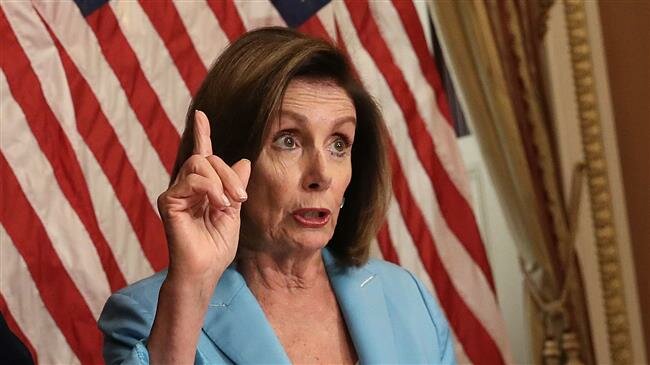
Lecturing the ‘peons’? Pelosi blames voter disenchantment on outside forces who ‘poisoned’ social media
RT | October 27, 2019
Dark forces have tainted social media and turned optimistic, hopeful, Americans into unhappy voters, Nancy Pelosi has conveniently claimed. The House Speaker’s explanation for the current political mood did not impress Twitter.
The senior Democratic lawmaker told a crowd in Iowa on Saturday that any negative or ambivalent feelings about US politics likely stems from actors “inside and outside” the country who have “poisoned” social media.
[They use social media to] undermine the mindset of what is America. America is optimistic, entrepreneurial, about the American dream and things can be better. And what they do with their poison is discourage – ‘nobody is paying attention to you, it’s no use for you to vote.’
Paraphrasing Pelosi’s rather disjointed remarks, journalist Michael Tracey noted: “So if social media makes you pessimistic, you are the victim of ‘interference’ rather than a critical thinker.”
Her comments elicited considerable internet heckling, with Twitter users accusing Pelosi of deflecting criticism of her party.
Others suggested that Pelosi was just bitter that social media users don’t take orders from her “oligarch masters” – making the platforms far harder to control than traditional news outlets.
Australian legislator uncovers Bureau of Meteorology fiddling with temperature records to hype warming
By Thomas Lifson | American Thinker | October 26, 2019
If global warming is real and a threat to the world, why do people keeping temperature records keep “adjusting” or “rectifying” the data to make it look like warming is increasing?
From Down Under, a member of the federal House of Representatives named Craig Kelly — a member of the Liberal Party, which is conservative — has caught that nation’s Bureau of Meteorology altering graphs showing the number of very hot days so as to obscure the fact that 1952 had more of them than recent years and adding a newly “discovered” hot day to a more recent year to make it appear that they are increasing.
I quote and use graphics from his Facebook account:
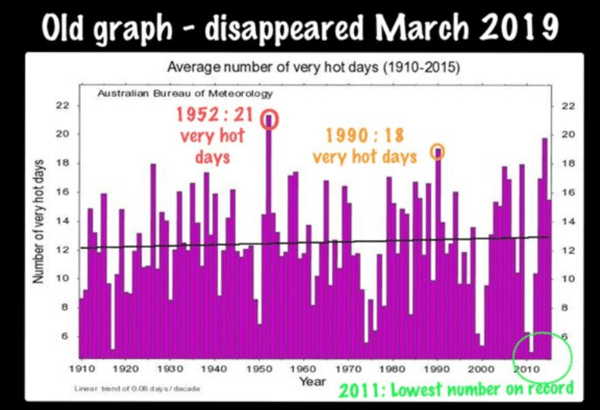
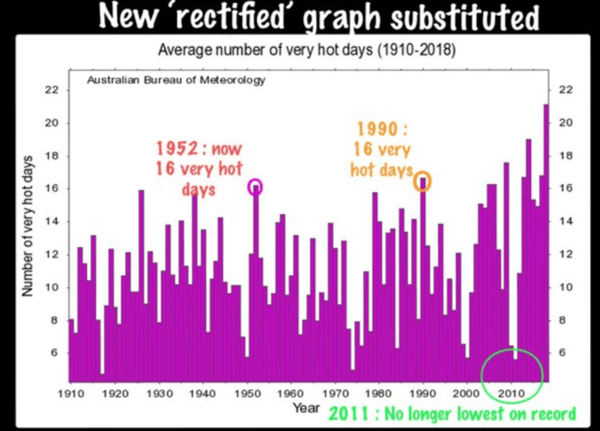
Not only did the Bureau’s graph showing the year 1952 as having the highest ‘number of very hot days’ (and the year 2011 with the lowest number) disappear down a memory hole — but a new ‘rectified’ graph has appeared in another section of their website.
And surprise, surprise — the year 1952 no longer has the highest ‘number of very hot days’. The old graph recorded 21 very hot days in 1952, while the new ‘rectified’ graph shows only 16 very hot days.
Further, for the year 2011 — which embarrassingly for Alarmists previously had the lowest ‘number of very hot days’ going back to 1910 — the Bureau has skilfully been able to find another very hot day for 2011, (I wonder where it was hiding ?) so that year no longer holds the lowest record !
As Orwell foretold in the novel 1984:
”There were the vast repositories where the corrected documents were stored, and the hidden furnaces where the original copies were destroyed. And somewhere or other, quite anonymous, there were the directing brains who co-ordinated the whole effort and laid down the lines of policy which made it necessary that this fragment of the past should be preserved, that one falsified, and the other rubbed out of existence.
The Russians are meddling again, this time in Chile, warns US diplomat
RT | October 26, 2019
Guess who’s stirring mass anti-government protests in Chile? Anybody? That’s right, it’s the Russians, at least according to Washington’s chief Latin American diplomat.
Speaking before a congressional committee hearing on Wednesday, State Department diplomat Michael Kozak suggested that “foreign actors” were stoking protests in Chile. Pressed on the statement by Latin-American news agency EFE on Friday, Kozak elaborated further.
“We have identified on social networks false accounts that emanate from Russia, which are people who pretend to be Chilean, but in reality all the message they are doing is trying to undermine all Chilean institutions and society,” he was quoted on Friday by Chilean media.
Kozak didn’t provide evidence, but if he did, it likely wouldn’t prove anything. Accusations of Russia’s social media meddling have been chucked around Washington for nearly three years now, and the best that social media ‘bot hunters’ have managed to come up with is lists of meme posting accounts that they “believe” are “potentially” Kremlin-backed, based on the claims of NATO-backed think tanks, professional ‘Russiagaters’ and Democrat intelligence officials.
In Chile, the protests were not sparked by Moscow-based trolls, but by a planned public transport fare hike. They have since evolved into a nationwide show of rage against the neoliberal policies of President Sebastian Pinera, whose proposed reforms have failed to tamp down public anger. At least 19 people have died over the last eight days, and more than 6,000 have been arrested, as protests descended into riots and clashes with police.
“Chile has a constitutional problem in terms of laws in terms of assigning a budget to the social sector and the non-social sector,” political analyst Francisco Coloane told RT. “There is a very strong pressure from the private sector not to make structural change.”
As the country’s first right-wing president since the end of US-backed dictator Augusto Pinochet’s government in 1990, Pinera has previously attempted to privatize Chile’s education system, resulting in student demonstrations in 2011. The country’s pension system, water supply, and healthcare system are all fully or almost fully privatized.
The result is a country that enjoys Latin America’s highest per-capita income, yet the highest inequality in the OECD.
But why dig into systemic factors and risk undermining the neoliberal consensus? Better to dust off the tinfoil hat and blame Russia instead.
Expensive Climate Policies Sparked the Chile Riots, Just Like the Yellow Vest Protests in France
By James Taylor | The Epoch Times | October 25, 2019
Climate activists and the United Nations are suffering a major black eye this week as protests and riots resulting from high energy prices have erupted in Santiago, Chile.
Chile, which is hosting a major U.N. climate conference in December, earned praise from climate activists for recently imposing a carbon dioxide tax on conventional energy sources and switching the Santiago Metro system to renewable power. Now, the people of Chile are rising up and firing a shot across the bow of other nations considering similar energy taxes and expensive renewable energy programs.
On Friday, protestors took to the streets throughout Santiago in response to Metro fare hikes. The protests soon spread to other cities and led to rioting and at least five reported deaths. The Chilean government and the legacy media blamed the fare hikes on rising oil prices. But that is not true.
Oil prices are not rising. Global oil prices are currently 25 percent lower than they were a year ago and 37 percent lower than they were five years ago.
In Chile, gasoline prices reflect the lower oil prices. Chilean gasoline prices were $1.12 U.S. per liter in August 2019 (the last month for which data are available), compared to $1.28 a year ago. Five years ago, Chilean gasoline sold at $1.50 U.S.
Santiago Metro fares are rising, despite falling oil and gasoline prices, because government officials in 2018 traded out most of the Metro’s energy sources from conventional power to wind and solar power. The Chilean government also hit the portion of conventional power that remains with new carbon dioxide taxes.
As a result, Chileans are now burdened by higher Metro fares reflecting unnecessary energy price hikes. As Chileans protest in the streets, climate activists and their media allies want people to believe oil is to blame rather than government climate programs that raise energy prices and impoverish people.
Unlike speculative climate change harms that never seem to really happen, carbon dioxide taxes and renewable energy mandates immediately and measurably raise living costs and reduce living standards. … continue reading
Former MKO members expose anti-Iran ruse in Albania
Press TV – October 26, 2019
Albanian police on Wednesday claimed that they had foiled planned attacks by Iranian agents against an exiled terrorist group living in Albania, but several former members of the group have come forward to reveal that they are the real individuals being accused of the plot.
Since 2014, some 3,000 MKO members have settled in a camp in Albania after being transferred by the US from Iraq. Earlier this week, Albanian authorities claimed that they had discovered an active cell of the Iranian Quds Force and prevented their “plan of March 2018″ to attack the camp.
In March 2018, two people were held in Albania but set free for lack of evidence. At the time, an opposition leader denounced the announcement as a ploy by Socialist Prime Minister Edi Rama to divert attention from Tirana’s failure to start entry talks with the European Union.
The accusation was similar to those made against Iran in Europe, including by France in October 2018 which accused Tehran of plotting to attack an annual MKO rally outside Paris.
The timing of the accusations was suspicious. They came as European governments apparently sought to save a 2015 nuclear deal with Iran after the US abandoned the agreement.
From the outset, Tehran vehemently dismissed the claims as false flag operations, while those detained in connection with the alleged plots were released later due to lack of evidence.
On Saturday, a Canadian-Albanian historian released a video of his interview with several individuals who said they had defected the MKO, but were now being framed by the terrorist group as Iranian agents sent to attack the camp near Durres, Albania’s main port.
Dr. Olsi Jazexhi, who carried out the interview, explained that a “cold war” is underway in Albania between former MKO members and the ringleaders of the terrorist organization.
Jazexhi, who specializes in the history of Islam, nationalism and religious reformation in Southeastern Europe, described those speaking in the interview as former terrorists who have abandoned terrorism against Iran and decided to lead a civilian life.
He has already aired a TV show called the “Opinion” in Albania, which said the MKO runs its own secret service in the impoverished European country, and that it spies on former members of the organization who live there.
A former member of the MKO in the video, labelled as an agent of Iran, is heard saying, “I don’t want to fight anything, any side. I want my own life, personal life, civilian life and I don’t want to fight.”
“For this reason, the MKO does not want us to live here. They put pressure on us to leave this country because if another member in the MKO comes out for anything or any work and see us we have a free [life], maybe they want to come out and have a free life. For this they make fake news against us, accuse us of being agents and mercenary of Iran,” the man says.
Last year, Albania expelled two Iranian diplomats suspected of “involvement in activities that harm the country’s security.”
Iran denounced the expulsions, saying Albania has fallen prey to a scenario fabricated by the US and Israel and certain terrorist groups.
The MKO has carried out numerous attacks against Iranian civilians and government officials over the past three decades and is listed as a terrorist organization by much of the international community.
Out of the nearly 17,000 Iranians killed in terrorist assaults since the victory of Iran’s 1979 Islamic Revolution, about 12,000 have fallen victim to MKO’s acts of terror.
Who is pushing for another civil war in Lebanon?
Press TV – October 26, 2019
Secretary General of the Lebanese Hezbollah resistance movement Sayyed Hassan Nasrallah has warned that foreign elements and certain political parties are seeking to “exploit” recent protests in Lebanon and “create a political vacuum in the county.” But who are these voices of chaos in Lebanon?
“Some protests have been financed by embassies and suspicious sides. Certain elements are seeking to stir political tensions in Lebanon in a bid to create political vacuum in the country,” Nasrallah said on Friday, warning that certain factions seek to take the country to “civil war”, a reference to the country’s bloody 1975-1990 civil war.
Nasrallah, nonetheless, did not elaborate what political parties and foreign entities may be seeking to divert the major anti-corruption and economic protests which have continued for ten consecutive days.
The Hezbollah chief had previously lauded the protests as being initially “spontaneous” and independent from any foreign or domestic political influence.
Remarks similar to those by Nasrallah have been echoed among other Lebanese figures in recent days.
Last week, Lebanon’s Foreign Minister Gebran Bassil warned of a “fifth column” seeking to provoke further tension in these heady days.
Similarly, Leader of the Arab Tawhid Party We’am Wahhab said that “foreign elements” were seeking to pressure Lebanese Prime Minister Saad al-Hariri to resign and dissolve the government.
Nasrallah has said the government’s resignation is a “waste of time”.
New elections and the consequently timely formation of a new government will ultimately include the same combination of Lebanon’s various political parties already present in the cabinet, failing to address Lebanon’s “systematic” problems and further destabilizing Lebanon, Nasrallah has argued.
While many Lebanese leaders have warned against foreign and domestic parties seeking to destabilize Lebanon and weaken its government, none have specified the names of foreign entities and domestic parties seeking to benefit from the destabilization.
Certain factions among Lebanon’s political elite have, nonetheless, openly called for the resignation of the current government.
Samir Geagea, leader of the Lebanese Forces parliamentary bloc, was one of first Lebanese figures to call for Hariri to resign. He ordered his party’s four ministers in Hariri’s cabinet to submit their resignation last week.
Geagea and his party are known to have close links with Washington and Riyadh. During Lebanon’s bloody 1975-1990 civil war, Geagea led the Lebanese Forces militia which formed an alliance with Israel.
The militias are known to have facilitated the infamous Sabra and Shatila massacre in Beirut, which lead to death of up to 3,500 civilians from Palestinian and Lebanese Shia backgrounds.
In 1994, Geagea was found guilty of ordering four political assassinations, including the killing of PM Rashid Karami in 1987 and the unsuccessful attempt on the life of Defense Minister Michel Murr in 1991 while cooperating with Israeli intelligence.
Geagea was consequently held in solitary confinement in a cell below Lebanon’s defense ministry building in Beirut before being released in 2005.
Leader of Lebanon’s Progressive Socialist Party Walid Jumblatt is also another prominent political leader in Lebanon to call for new elections in Lebanon. His party currently has two ministers in the Hariri government.
Jumblatt is known to switch political affiliations and political positions in whatever way best suits his political agenda.
The politician, once an ardent backer of Syrian government, expressed tacit support for terrorist groups like the al-Qaeda-lined al-Nusra Front during the height of a foreign-backed terrorist insurgency against Damascus, effectively siding with Riyadh and Tel Aviv’s shared objective of ousting the Syrian government.
With US and Saudi-backed terrorists in Syria all but defeated after more than eight years of war, observers say a similar scenario may be pushed upon Syria’s southern neighbor of Lebanon.
Featured Video
Nima R. Alkhorshid: US military bombs multiple targets on Iran’s Qeshm Island
or go to
Aletho News Archives – Video-Images
From the Archives
British Intel Tried to Make N Irish Gang ‘Shoot Up’ School, Documentary Claims
Sputnik – 23.02.2019
A new documentary, based on an interview with a self-confessed member of the Glennane Gang, gives some insights into allegations that British military intelligence was behind a shocking murder plot to cause the situation in Northern Ireland to “spiral out of control”.
In a documentary, Unquiet Graves: The Story of the Glennane Gang, John Weir, a former officer from the Royal Ulster Constabulary (RUC), alleges that British intelligence tried to persuade paramilitary group Ulster Volunteer Force (UVF) to attack a Catholic primary school at Belleeks in County Armagh.
Weir claimed that the UVF was urged to kill children and teachers in retaliation for the 1976 Kingsmill massacre, in which gunmen stopped a minibus carrying twelve workmen and shot them; only one person survived despite having been shot 18 times.
“The plan that was decided on was to shoot up a school in Belleeks”, he said, adding that the British intelligence plot was to make the situation in Northern Ireland “spiral out of control”. … continue
Blog Roll
 Aletho News
- Nima R. Alkhorshid: U.S. Military Bombs Multiple Targets on Iran’s Qeshm Island
- Iran-Linked Ships Spotted Hovering over Subsea Cables: Report
- New attack on Iran could devastate ‘Israel’, IOF general warns
- Nuclear deterrence: The US-Israeli military aggression against Iran made the unthinkable legitimate
- U.S. Midterms – a Referendum on Israel and Zionist Power
- Twice as many Canadian Jews serve in Israeli military as Canada’s armed forces: Report
- Thousands of Syrian troops set to join Saudi war on Yemen
- Jared Kushner’s Diplomacy for Hire
- Russia backs Tehran’s conditions in talks with US, Iran’s envoy says
- Irish ‘fake news’ expert exposed as fake
- If Americans Knew
- An error has occurred; the feed is probably down. Try again later.
- No Tricks Zone
- Zonal Asymmetry of Temperature Change in the Antarctic Circumpolar Current
- New Study: The Net Fossil Fuel Contribution To Rising Atmospheric CO2 Has Been Zero For 500 Years
- Germany’s Green Energy Transition Becoming Increasingly Expensive…Another 6 Trillion Euros!
- Sudden Stratospheric Warming, Powerful El Niño Combination May Lead To Extreme Europe Cold, Energy Crisis!
- Two New Studies Find Thwaites Glacier Melt Cannot Be Driven By Human Activity Or A Warming Ocean
- E-Cars Reduce CO2 Emissions By Only 41% Compared To Internal Combustion Engine Vehicles
- Predictions Made By Renowned Climate Professor Over Past Decades Have Been Proven To Be Poor
- New Study Suggests Large Regions Of The Pacific Ocean Have Been Cooling For The Last 80 Years
- Germany’s Green Energy Debacle: High Energy Costs Force Kahla Porzellan to Close After 182 Years!
- New Study: 50 Years Of The Most Aggressive ‘Net Zero’ Policies Can Only Affect The Global Climate By 0.03°C

