Russian Embassy in UK Ready to Meet With Amesbury Poisoning Victim’s Son
Sputnik – 04.03.2019
LONDON – The Russian Embassy in the United Kingdom is ready to meet with the son of Dawn Sturgess, a UK woman who died last July after allegedly being poisoned with a military-grade nerve agent in the city of Amesbury, in order to explain Moscow’s official position on this case, the press officer of the embassy said Sunday in a statement.
“We intend to provide Ewan Hope with the report, “Salisbury: unanswered questions”, that the Embassy has prepared one year after the incident. The report contains a comprehensive account of information available to Russia. We are also prepared to meet with Mr Hope and to reply to all questions that he may have regarding the official Russian position”, the press officer said.
The embassy feels “deep sympathy” toward Hope and wants full investigation into his mother’s death, the press officer went on to say, slamming the UK government for failing to provide evidence or even confirm or deny the multiple leaks related to the notorious Salisbury incident, in which former Russian double agent Sergei Skripal was poisoned in March 2018.
“It turns out that even the closest relatives of those affected are kept in the dark over what actually happened, and they have to seek truth in Russia. As for the Russian side, immediately after the incident, as early as 9 March 2018, we expressed our readiness to take part in the investigation. We offered the UK to join efforts of the investigating teams, and later sent an official request for legal assistance. All these proposals have been rejected”, the statement read on.
Earlier in the day, Sturgess’ son, Ewan Hope, told the Sunday Mirror newspaper that he felt “betrayed” by the UK government, which failed to offer any help after the tragedy. The 20-year-old also said that he had sent a letter to Russian President Vladimir Putin, asking him to allow UK officers to question the two Russian men that the UK police allegedly suspect of being involved in the poisoning.
Skripal and his daughter Yulia were reportedly found unconscious on a bench at a shopping center in Salisbury in March last year. The United Kingdom has accused Moscow of orchestrating the attack, with what UK experts claimed was the A234 nerve agent. Moscow has refuted the allegations and repeatedly pointed to the lack of evidence provided by London.
Dawn and her boyfriend Charlie Rowley fell ill in their Amesbury home months after Skripal and his daughter had been reportedly found slumped on a park bench. Rowley has recovered, while Dawn died after a week on life support and was cremated. The two were believed to have touched an object contaminated with the same substance that was used agaisnt the Skripals.
The Salisbury Poisoning One Year On: An Open Letter to the Metropolitan Police
By Rob Slane | The Blog Mire | March 3, 2019
Dear Assistant Commissioner Basu,
It is now a year since the events in Salisbury that shocked the nation, and indeed the world. Since then, your organisation has conducted an investigation into the case, and has laid out a case about what happened in a series of statements, notably those made on 5th September (no longer available on your website), in which two suspects were formally accused, and another on 22nd November, following the screening of the Panorama documentary: Salisbury Nerve Agent Attack — The Inside Story.
To those who have a superficial interest in the case, the explanations you have presented for what happened on 4th March 2018 may appear credible, especially since the British media has largely repeated them verbatim, even when they have been self-evidently flawed and contradictory. Indeed the press has steadfastly refused (or been refused) to ask some very obvious and much needed questions about them. But to those who have spent time looking at the incident, the explanations you have set out contain glaring omissions, factual errors (see here for more detail), and at least one scientific impossibility (more on this below). What I wish to do in this letter, is to set out some of the most important, and which I believe you owe it to the public to explain.
Why have we heard nothing from Sergei Skripal?
The most glaring problem with your case is the disappearance of Mr Skripal himself — and yes “disappearance” is the right word. It is now 12 months from the original incident, and about 11 months since it was announced that he had recovered. During that time there have been zero public appearances and — curiouser and curiouser — not even one public statement put out in his name. Additionally, it is known with certainty that he has not been in contact with his mother back in Russia — not on her birthday, not at New Year and not at Christmas — which has caused her great distress. This is not just odd; it is highly disturbing, especially given that Mr Skripal was said to be in the habit of contacting his mother every week prior to 4th March.
If I were to ask how you can account for this, I would anticipate an answer that includes the claim that any such statements, appearances, and contact are deemed dangerous to his security. Certain reports in the media have indeed stated or implied this. However, it will not wash, for two reasons:
Firstly, are we seriously expected to believe that the UK Intelligence Agencies are incapable of protecting Mr Skripal’s whereabouts and his safety, whether in a statement, a pre-recorded video, or in a call to his mother? The idea is self-evidently ludicrous.
Secondly, these apparent “security concerns” were somehow overcome with Yulia Skripal. Not only was a statement released in her name upon departure from Salisbury District Hospital, followed by a Reuters video of her reading out a pre-prepared statement, but she was also allowed reasonably regular contact with her family, including her cousin and grandmother — up to 24th July last year (that is, up to the point that she told her cousin that she “now understood everything”). If Yulia’s security can be protected, there is no reason that Sergei’s security can not also be guaranteed.
It is also worth noting that neither Sergei nor Yulia have once endorsed your explanation of the incident. Sergei has been silent, and as for Yulia, far from endorsing your version, in none of her statements or phone calls has she ever pointed the finger of blame at the Russian state for an assassination attempt on her and her father. In fact, she has repeatedly expressed a desire to go back to live in Russia — a very strange desire given what you claim happened to her, wouldn’t you agree?
To all intents and purposes, both Sergei and Yulia Skripal have now disappeared without trace — he since 4th March 2018, and she since 24th July 2018. In the absence of any plausible reason for this, it is reasonable to consider them both as being held against their will, without consular access, without legal representation, and without the ability to contact their next of kin. Needless to say these are very serious issues, and if confirmed would put the United Kingdom in breach of a number of international legal obligations. Yet there are of course very obvious steps that could be taken to assure the public that this is not the case.
And so I simply ask you this: what credible reason can you give as to why nothing has been heard from Mr Skripal since 4th March? Why has he been unable to contact his mother? And what credible reason can you give as to why Yulia appears to have been denied contact with her family since 24th July?
Why won’t you show where the suspects were going?
Your organisation has repeatedly stated that the CCTV footage of the two suspects at the Shell Garage on the Wilton Road shows them “in the vicinity of” and “on their way to” Mr Skripal’s house (or “the Skripal’s house” as statements bizarrely keep referring to it. Who, may I ask, is “The Skripal”?). This is misleading on two counts.
Firstly, the footage actually shows them some 500 yards or so from 47 Christie Miller Road, which cannot be conceivably described as “in the vicinity” in terms of proving that they actually went to the house. This evidence would not convince a discerning jury.
Secondly, it does not show them “on the way” to Mr Skripal’s house either. It is possible that they did go there, but the CCTV footage does not show this, since it gives no indication that they were preparing to cross the Wilton Road, which they would have had to do to get to Christie Miller Road (either via the passage to Montgomery Gardens or via Canadian Avenue).
However, there is more than this. The camera that was used to take footage of the two men covers the area where they walked past the garage, but does not cover those two routes to 47 Christie Miller Road mentioned above. What you failed to inform the public, however, is that there is another CCTV camera on the Shell garage, just past this one, that does cover these routes. As the following picture shows, it is located on the right-hand side of the front of the building (circled), facing the Wilton Road, almost exactly opposite the path to Montgomery Gardens (note: the camera that was used to take the footage that was aired is on the corner of the left-hand side of the building, just out of shot):

Had the two men crossed the Wilton Road to go through the passage to Montgomery Gardens, or even via Canadian Avenue, this camera would have recorded it. Had this camera recorded them going through either route, although it still wouldn’t have been conclusive proof that they went to number 47 Christie Miller Road, much less what they may have done had they gone there, it certainly would have been far more credible than the footage you did release. Yet you have chosen not to show it. Can you tell us why, and also whether the footage taken by this camera on the right of the building backs up your claims that they were “on their way” to Christie Miller Road?
Wot no CCTV?
The issue of CCTV is not just confined to what was and wasn’t shown of the two men on the Wilton Road, however. It remains a curious fact that aside from this and the other footage of them on the bridge at Fisherton Street — which by the way were released nearly nine months after the event — you have not released one bit of proper footage of the Skripals or other related events that day.
This is extraordinary, for a couple of reasons.
Firstly, such footage most certainly does exist. For example, there exists “really clear footage” of Sergei and Yulia Skripal feeding ducks with some local boys on the afternoon of 4th March, next to the Avon Playground. The time of this footage was around 13:45 which — it should be noted — is approximately 20-30 minutes after the Skripals were said to have come into contact with a nerve agent on the door handle of their home (more on this below).
Secondly, in the early days of the investigation, a number of places in the city centre were mooted as possible locations for the poisoning (namely Zizzis, The Mill pub, and the bench itself). However, despite the fact that “really clear” CCTV footage of these areas undoubtedly exists, and despite the fact that the public were being asked to come forward with information, you showed not even a second of footage of the pair in that area. The public were therefore being asked to come forward with information about two people who were on CCTV and could be clearly identified by it, but without so much as a few seconds of this CCTV being shown so that they could see what they looked like, what they were wearing, and where they were going.
All this simply adds to the nagging suspicion that this CCTV shows things that would cast huge doubt on the explanations you have given. However, it is even worse than this. In the first few days after the incident, CCTV footage was released of a couple walking through the Market Walk at 15:47, and it was stated by more than one news outlet that the pair were the Skripals. Of course it wasn’t them, and yet — given some witness statements that followed — these people were undoubtedly somehow involved in the events that followed. Yet, important as they were, they were quickly forgotten about in the days after that grainy CCTV footage of them was released, and were subsequently never mentioned by the media or the police thereafter. Why is this, since witness testimony leads to the belief that they were something to do with what happened?
What we have, then, is what you have described as a “fast moving” and “complex investigation”, in which you repeatedly appealed to the public for information, and yet refused to show the public anything of the CCTV footage that exists, which may well have helped to jog memories and so aid you in your investigations. Furthermore, since the explanation you have given for what happened (poisoning at the door handle) implies that nothing of note happened in The Maltings (other than the collapse at the bench), reasons of “national security” simply cannot apply. Therefore, what reason can you give for not showing CCTV from The Maltings to the public when you were appealing for information?
The Skripals, the suspects, the ducks and the bin
I mentioned above the CCTV footage taken of the Skripals at 13:45 on 4th March at the Avon Playground, which is in The Maltings. This is one of the most interesting incidents in the whole case, for a number of reasons.
Firstly, as already stated, the footage shows Mr Skripal and his daughter feeding ducks, with Mr Skripal actually handing bread to three local boys, one of whom apparently ate a piece, but none of whom became contaminated. This clearly suggests that Mr Skripal was not contaminated with nerve agent at that time.
Secondly, it shows Yulia carrying a red bag, which may seem inconsequential, but for the fact that the female caught on CCTV in the Market Walk (who wasn’t Yulia) was also carrying a distinctive red bag. Not to put too fine a point on it, given Mr Skripal’s tradecraft, duck-feed plus distinctive red bag has a definite “signalling to someone” quality about it.
Thirdly, and most remarkably of all, given the nature of your claims, at the same time as they were feeding ducks, the two suspects — Petrov and Boshirov — were in close proximity. And when I say close proximity, I mean far closer than the distance from the Shell Garage to 47 Christie Miller Road, which you describe as being “in the vicinity”. How so?
According to the image you released of the two men at 13:08, they were standing at the entrance to Summerlock Approach, which happens to be the road that leads to the Sainsbury’s car park, which happens to be the car park where Mr Skripal parked his car approximately 32 minutes later. They were then seen on CCTV obtained by the media walking past Dauwalders (coin and stamp shop) on Fisherton Street at 13:48. Crucially, they were coming from the direction of the town.
What this means is that after being photographed at Summerlock Approach, instead of walking directly to the train station, as your timeline suggested, they went back into town, either by doubling back down Fisherton Street, or by walking in a loop through Summerlock Approach, across the car park, and through the Maltings, before heading back to Fisherton Street via Malthouse Lane.
Dauwalders, where they were seen at 13:48, is less than 200 yards from the Avon Playground, where the Skripals were filmed at 13:45. And so we have the intriguing prospect of the two alleged assassins passing less than 200 yards from the pair they are alleged to have tried to assassinate, within 3 minutes of one another. Furthermore, given that the two suspects were coming from the direction of town when they passed the shop, it is entirely possible (although by no means certain) that they had actually come from the area of the Maltings, and therefore that they had, just moments before, been in even closer proximity of the Skripals.
The fact that the two suspects were closer to the Skripals at between 13:45-13:48 than they were at 11:58 outside the Shell garage, is of course extremely interesting. But what is particularly troubling about this episode is what your organisation has done with this information.
Firstly, you have left it out of your timeline, never once mentioning that the Skripals had taken a detour to feed the ducks — and it is indeed a detour if you are walking from Sainsbury’s car park to Zizzis or The Mill — and never once mentioning that the two suspects were in that area at the same time (which is really odd, given that you are trying to make a case against them).
But secondly, although this incident was ignored in your timeline, as if it were trivial, it was obviously highly significant. The reason we can be sure of this is that on the day following the incident (5th March), a large number of military personnel were extremely focused on the bin next to the Avon Playground as these videos — here and here — make clear. Why that bin, which is a significant distance from the bench (50 yards or so), and why was it such an object of intense focus?
To leave this location out of your timeline, and to fail to inform the public of the close proximity of the suspects to the Skripals at the time of the duck feed, is frankly bizarre. What credible explanation is there for this?
The absolute impossibility of your door handle explanation
I mentioned at the start that alongside the factual errors, glaring omissions, and inconsistencies in your case, there is also an impossibility. That is the explanation that the assassination attempt was carried out using a nerve agent sprayed on the door handle of 47 Christie Miller Road.
Leaving aside the absurdity of what has been described as an “oily substance” being sprayed by an atomiser (how does that work?); leaving aside the ridiculousness of people actually spraying it without wearing proper protective clothing; leaving aside the silliness of supposing that the deed was done in broad daylight whilst Mr Skripal and his daughter were in the house; leaving aside the difficulties involved in having both victims touching the door handle on their way out of the house; and leaving aside the frankly preposterous notion that having apparently done their deed, instead of leaving Salisbury immediately, the two men then walked across town, and rather than dumping the open bottle of “Novichok” they had apparently used, they allegedly dumped a bottle they hadn’t used (remember, Charlie Rowley’s box was, according to him, cellophane wrapped) — leaving all those irrational propositions aside, as I say there is an absolute impossibility in what you are asking us to accept.
In the BBC Panorama programme, Salisbury Nerve Agent Attack — The Inside Story, which was clearly made with official approval (the ex-head of MI6 and the Deputy Assistant Commissioner of the Metropolitan Police, Dean Haydon, both appearing and helping in the reconstruction of what is supposed to have happened), it was claimed throughout the programme that the substance used was not only incredibly toxic, but that it could kill even with the tiniest of amounts. One of the men who worked on the original Foliant Project to create these substances, Vil Mirzyanov, was asked how much was needed to kill a person. He replied:
“To kill a person, you need only 1mg. To be sure, 2mg.”
Now this obviously gives rise to a problem, which is why didn’t it kill Mr Skripal and his daughter, since they were both allegedly contaminated with far more than 2mg of the stuff? The answer given on the programme was supplied by Mr Mirzyanov, who said:
“Maybe the dose was not high enough. Salisbury was rainy and muggy. Novichok breaks down in damp conditions, reducing its toxicity. It’s the Achilles Heel of Novichok.”
Although this might sound plausible, it runs up against the buffers of the statement released on 4th May by the OPCW, who said this about the samples they collected at sites in Salisbury, including the door handle:
“The samples collected by the OPCW Technical Assistance Visit team concluded that the chemical substance found was of high purity, persistent and resistant to weather conditions.”
These statements, taken together, mean that your explanation is an absolute impossibility. If 2mg of “Novichok” is enough to certainly kill a person, as Mr Mirzyanov stated (corroborated by Deputy Assistant Commissioner Haydon who said there was enough in the bottle to kill thousands), then Mr Skripal and his daughter should be dead. If the reason they aren’t dead is because “Novichok” breaks down in damp conditions, then it is impossible for the OPCW to have found a substance that hadn’t broken down, which was of “high purity”, and which is resistant to weather conditions.
There is simply no way you can square these things. If it didn’t kill the Skripals because it had broken down in damp conditions, then the OPCW can’t have found a high purity substance that is persistent and resistant to weather conditions. But since the OPCW claim that this is exactly what they found, then it can’t have broken down in damp conditions and lost its toxicity, can it? One or the other, but not both.
Unless you can prove that a substance can lose its toxicity in just over an hour due to dampness (from the time it was allegedly sprayed to the time it was allegedly touched), only to regain its toxicity and be found to be resistant to weather conditions two weeks later, no rational person can possibly be expected to believe this explanation. It is obvious nonsense, utterly impossible, and discredits your entire account of what happened on 4th March.
In Conclusion
Along with other members of the public, I would love to be able to believe that your investigation has been based on all the evidence available, and that its conclusions (so far) are credible. Sadly, however, this is not possible, as the above issues (and plenty of others) demonstrate.
It was quite obvious from the outset, when the Government came to a conclusion before any evidence had been properly assessed, that any subsequent investigation had already been politicised. There was therefore little hope that the investigation would be impartial, and that if evidence was found to contradict the Government’s assessment, that it would be presented.
However, there was always a glimmer of hope that your organisation would refuse to bow to this politicisation, and instead conduct a truly independent investigation. Amongst other things, this would have involved:
- Mr Skripal and Yulia being allowed to give their account of what happened that day to the media, and the media allowed to freely ask questions
- A thorough account of the two suspects’ movements, rather than two highly selective bits of footage that imply where they went, but which leave out the footage that shows where they did actually go
- The release of CCTV footage showing what happened in The Maltings in order to appeal for witnesses to come forward
- Important information, such as the duck feed and the close proximity of the suspects to the Skripals at that time, being given out to the public, and included in the timeline
- An explanation of the poisoning that is actually scientifically credible
But since these elements have not been a part of your investigation, the public can have no confidence in your explanation and assessment of what happened on 4th March 2018, and has every right to suspect that they are part of what essentially appears to be a politically-driven cover up. That really is a great shame, not only in terms of understanding what really happened in the Salisbury and Amesbury incidents, but also in terms of the denting of trust in your organisation, and the authorities in general, in the long-term. I would like to hope that this potential denting in confidence in your organisation’s integrity in handling this case, which surely cannot give you cause for celebration, would lead you to take the initiative in now providing a more credible account of what took place.
How Amnesty International is reinforcing Trump’s regime-change propaganda against Venezuela
By Joe Emersberger | The Canary | February 26, 2019
Amnesty International‘s reports, by their nature, require readers to trust their honesty and impartiality. But there is ample reason not to trust them. Because Amnesty has ignored grave human rights abuses in plain sight in Venezuela while demonizing supporters of Venezuelan President Nicolás Maduro.
Shortly after meeting with Juan Guaidó (whom Donald Trump and a new Iraq-style Coalition of the Willing have anointed as Venezuela’s interim president), Amnesty put out a report that reads like a barely disguised attempt to reinforce, from a ‘human rights’ angle, the military threats against Venezuela from Trump and his henchmen.
Team Trump as Venezuela’s “Only hope”?
Erika Guevara-Rosas, Amnesty’s Americas director, said:
International justice is the only hope for victims of human rights violations in Venezuela. It is time to activate all available mechanisms to prevent further atrocities.
And the report stated that:
[C]ountries genuinely concerned about the human rights situation in Venezuela should explore the application of universal jurisdiction.
Amnesty’s allegations about Venezuela are serious and, if true, deserve condemnation. But there are numerous reasons to question the group’s honesty, impartiality, and public statements.
Somebody should ask Amnesty, for example, to list the countries which are “genuinely concerned”. How many Saudi–arming countries like the US, UK, Canada, and France are on that list?
As Amnesty released this report, the threat of a US military attack on Venezuela disguised a “humanitarian aid delivery” could not be more obvious. Never mind that Venezuela is, in fact, receiving foreign aid with authorization from the Maduro government. US National Security Advisor John Bolton and Senator Marco Rubio have repeatedly made Mafioso-like threats against Venezuela’s military and Maduro. Trump himself has been repeatedly threatening a military “option” since 2017 (the year he reportedly asked “Why are we not at war with Venezuela?”).
Amnesty ignorning Trump’s attack on right to health and food
At the same time, Amnesty has refused to denounce Trump’s financial sanctions which have been in place since August 2017 and whose impact on the entire economy has been crippling. By now, the sanctions have cost Venezuela’s government well over $6bn in revenues in an economy that imported $11.7bn in goods in 2018. Before the deep and sustained collapse in oil prices (and oil production, which nose-dived as the sanctions began), Venezuela’s economy had been importing about $2bn a year in medicines.
It is important to remember that, in Venezuela’s case, Amnesty has been very explicit in pointing to economic problems as human rights abuses. Last year, when they wrote to me refusing to denounce Trump’s sanctions, Amnesty said:
Amnesty International does not take a position on the current application of these sanctions but rather emphasizes the urgent need to address the serious crisis of the right to health and food which Venezuela is facing. In terms of human rights, it is the Venezuelan state’s responsibility to resolve this.
As I’ve noted at The Canary, Amnesty has now updated its position on Trump’s sanctions. It absurdly asks Trump to please be careful and “monitor” the impact of new sanctions that he imposed in January. The new sanctions directly cut off revenues that the Venezuelan government obtained from sales to the US. Amnesty’s continued refusal to acknowledge that a devastating attack on the Venezuelan “right to health and food” has been ongoing since August 2017 is appalling. And that alone is an excellent reason to doubt the honesty and impartiality of their work on Venezuela. Because any credible human rights group would demand an immediate end to all the economic sanctions Trump has imposed.
Violent crime in Venezuela
Amnesty also stated in its latest report that:
The more impoverished areas of Caracas and other parts of the country were particularly affected and stigmatized, registering the highest numbers of victims, who were later presented as ‘criminals’ killed in clashes with the authorities.
There’s no doubt that Venezuela’s security forces have committed crimes. The Maduro government has conceded as much. And Venezuelan police officers were arrested for crimes perpetrated during the violent protests of 2017. In June 2017, Defense Minster Vladimir Padrino López publicly warned security forces in remarks broadcast on state TV that he didn’t “want to see one more national guard perpetrate an atrocity”. Those protests were the fifth US-backed effort to oust the government by force since 2002. Trump is now leading the sixth.
It’s also important to remember that Venezuelan security forces have confronted a very high homicide rate (since long before the current government came to power) and police officer death rate. At the same time, the country has been plagued by violent US-backed protesters for years, who have done things like burn Afro-Venezuelans alive in the streets and murder police officers. And today, it faces the very grave threat of US invasion that would install the most violent opposition groups into power.
We can only imagine how security forces in a country like the UK would behave under the above conditions. Young men have been sent to prison in Britain, for example, simply for writing Facebook posts that advocate riots. I made some of these points last year in response to a similar UN report that was hyped by Reuters.
Venezuela’s very real homicide problem (and violent US-backed opposition problem) could indeed allow security forces to pass off extrajudicial executions as “fighting crime” or as self-defense. But it can also allow apparently partisan groups like Amnesty to distort the situation in support of Trump’s regime-change agenda.
Propaganda groundwork for dirty war on Maduro supporters?
Amnesty said in its report that:
There is a strong presence of pro-Nicolás Maduro armed groups (commonly known as “colectivos”) in these areas, where residents depend to a large extent on the currently limited state programs to distribute staple foods.
Again, the “limited state programs” would be the ones Trump has been viciously attacking through sanctions since 2017. Also notice how Amnesty casts as thugs the organized poor people distributing food to millions of people – up to 60% of households according to an opposition-aligned pollster (Datanálisis).
As George Ciccariello-Maher explained in We Created Chavez, the history of poor people organizing and arming themselves (quite understandably) for self-defense in Venezuela’s poorest neighborhoods goes back decades. It’s not new.
It is Maduro’s supporters in poor neighborhoods and in the countryside, however, who – armed or not – will be violently targeted if the US-backed opposition takes power; especially if they do so in a coup or through a US invasion. Amnesty appears to have little concern about “stigmatizing” them, though, and negligible concern about Trump’s attack on their “right to health and food”.
All of the reasons above make a powerful case for questioning the integrity and objectivity of Amnesty when it comes to Venezuela. And for the sake of peace and justice, we should hold Amnesty to much higher standards.
The ‘Russian bots’ that weren’t: Twitter backtracks on troll claims, media ignores updated info
RT | February 26, 2019
Twitter quietly revised its public database of ‘Russian bot’ accounts earlier this month, removing 228 accounts it previously said were “connected to Russia”— but the admission has gone almost completely unnoticed by the media.
Bloomberg reported on the “burst of activity” from the bot accounts and claimed that Russia’s “social-media trolling operation” was “stepping up its Twitter presence to new heights.”
Fast-forward to 2019 and Twitter has removed 228 of these accounts from the database, saying they had “initially misidentified” them as being linked to Russia, but nobody in the media seems to have noticed.
In fact, Bloomberg is the only major US outlet which bothered to correct the story to reflect reality, admitting that Twitter’s changes to the dataset “invalidate central portions” of its original report and that there was “no surge” in this so-called Russian bot activity at the time in question. Oops!
Pivot to Venezuela!
Interestingly, the highlighted accounts have now been linked to Venezuela, another country the US government just so happens to have bad blood with.
In a tweet, Twitter’s “head of site integrity” Yoel Roth said that the company can now “more confidently associate” the 228 accounts with Venezuela. Roth’s short tweet thread on the misidentification was met with little interest receiving only a few retweets and no attention from media figures who supposedly actively follow any and all news remotely related to Russian activity online.
In a statement to Bloomberg, Roth later admitted that “definitive attribution is very, very difficult.” The Bloomberg mea culpa also noted that Twitter is “reluctant to discuss” how it connects accounts to so-called trolling networks in the first place.
Some on Twitter quickly pointed out that the timing of the pivot to focus on Venezuelan bots was curious, given the US’ recent efforts to engineer regime change against the government of Nicolas Maduro.
Journalist Sam Sacks tweeted that the new information about Venezuelan bots was “convenient” and said that the vast majority of stories written about Russian trolls and their alleged social media activity are “based on junk research.” Sacks also questioned why anyone should have faith in the credibility of such flawed analyses going forward.
Another Twitter user found it odd that Twitter and Bloomberg had “suddenly discovered” that bots it claimed were Russian had “miraculously turned into Venezuelans.”
Pattern of fake ‘Russian bots’
When it comes to the hot topic of Russian bots and trolls, the media and various social media monitoring groups have suffered unfortunate “misidentification” incidents before.
In 2017, an African American activist Charlie Peach was suspended from Twitter during one of the company’s purges of accounts purportedly linked to Russia, a claim that was happily echoed later by multiple major media outlets. Peach told RT at the time that Twitter was engaging in “suppression of voices” using the “Russian scare tactic.”
Twitter users in the UK have also been swept up into the hysteria over Russian bots based on their political opinions, with some accounts belonging to real people even being listed in a UK government report on nefarious Russian activity online.
More recently, a dodgy US-based cybersecurity firm called New Knowledge was busted by the New York Times for creating an army of fake Russian bots in order to secretly influence an Alabama election by accusing one candidate of being ‘supported’ by the fake accounts. Yet, despite its own dirty tricks being exposed, the firm is still cited by major US media outlets as a legitimate source of information on Russian “disinformation” online.
So it seems media interest in Russian bot stories waxes and wanes based on whether or not the information bolsters the ‘correct’ narrative.
Read more:
‘Fake news’ is okay if it’s about #RussiaGate: Top 7 fake ‘collusion’ stories the media pushed
The Russian Mirror
By Jacob G. Hornberger | FFF | February 26, 2019
A recent article in the New York Times about Russia’s “intelligence state,” authored by John Sipher, a former chief of station for the CIA, provides a valuable mirror for the American people. The problem is that American statists cannot see it as a mirror. While Sipher’s article clearly demonstrates that American statists, especially conservative ones, can see the wrongdoing of foreign totalitarian or authoritarian regimes with great clarity, they have a moral blindness when it comes to recognizing wrongdoing by their own government. Even worse, they defend wrongdoing by their own regime (which they can’t see as wrongdoing) as a way to combat foreign wrongdoing. In fact, they come to view their own wrongdoing as something good when it is being used to oppose wrongdoing by a foreign regime.
Sipher labels Russia’s (and, before that, the Soviet) governmental system an “intelligence state.” He’s critical of it, and rightly so. It is a type of governmental system that engages in such things as secret surveillance of the citizenry, assassination, torture, and interference in the affairs of other nations.
Referring to Russia’s system under Vladimir Putin, who Sipher reminds us is a former KGB officer, Sipher writes:
“The history of the brutal Soviet security services lays bare the roots of Russia’s current use of political arrests, subversion, disinformation, assassination, espionage and the weaponization of lies. None of those tactics is new to the Kremlin.
“In fact, those tactics made Soviet Russia the world’s first “intelligence state,” and they also distinguished it from authoritarian states run by militaries…. The result is a regime with the policies and philosophy of a supercharged secret police service, a regime that relies on intelligence operations to deal with foreign policy challenges and maintain control at home….
“Over the decades, the Soviet and Russian secret services developed tools and habits based on their Chekist experience that set them apart from their counterparts in the West. Rather than focusing on collecting and analyzing intelligence, they developed expertise in propaganda, agitation, subversion, repression, deception and murder.”
Sipher uses the label “intelligence state” to describe the Russian and Soviet system. There is another label that Sipher could have used, a much more common one: a “national security state.”
Why would Sipher avoid using the term “national-security state”? My hunch is that he instinctively knows that that would be holding the mirror to himself and the rest of the American people. That’s because the United States is a “national-security state” or an “intelligence state,” just like Russia is.
In fact, a supreme irony in Sipher’s article is that he worked for the CIA for 27 years. At the risk of belaboring the obvious, the CIA is an “intelligence agency,” one that not only engages in intelligence gathering but also has long wielded and exercised the powers of assassination, torture, indefinite detention, involuntary drug experimentation, and secret surveillance — that is, the same types of powers that Sipher decries in the Russia/Soviet “intelligence state.”
Sipher points out that one of the main features of an “intelligence state” is lying. He ought to know. Since its very beginning, the CIA has been an agency based on lies and lying. Deception has always been justified under the rubric of “national security.” Coming immediately to mind is CIA Director Richard Helms, who was convicted of lying to Congress regarding the CIA’s secret regime-change operation against Chile, to the praise and acclaim of his subordinate officers in the CIA. Let’s also not forget the lies that former Director of National Intelligence James Clapper Jr. told Congress under oath regarding the NSA’s secret surveillance of Americans.
Consider all the nefarious things the CIA has done and continues to do in foreign countries, including assassination, coups, installation of foreign dictators, invasions, wars of aggression, torture, rendition, partnerships with dictatorial regimes, sanctions and embargoes targeting innocent people with death, impoverishment, and suffering.
Or consider MKULTRA, the CIA’s top-secret operation to subject innocent, unsuspecting people to drug experimentation, along with the subsequent intentional destruction of official records to prevent Americans from discovering the full extent of the operation.
Or the U.S. national-security state’s secret surveillance of American citizens, along with secret illegal operations to spy on and infiltrate peaceful and law-abiding organization with the intent to smear and destroy them and their members.
Of course, it wasn’t always that way. The United States was founded as a limited-government republic, which is the opposite of a national-security state. For more than 150 years, our nation prospered without a Pentagon, a military-industrial complex, a national-security state, a CIA, and a NSA. Governmental procedures were transparent. There was no obsession over the nebulous and meaningless term “national security.”
Then came the aftermath of World War II, when U.S. officials told Americans that they were now facing a new official enemy, one that had been an official enemy of Nazi Germany and a friend and partner of the United States. That new official enemy was the Soviet Union and its system of communism. The communists were coming to get us, U.S. official maintained, as part of a worldwide communist conspiracy based in Moscow, Russia.
U.S. officials said that there was only one way to prevent a communist takeover of the United States. In order to prevail against the Soviet Union, the U.S. government would have to be converted into the same type of governmental system, U.S. officials said.
That meant moving to the dark side — toward torture, assassination, coups, regime-change operations, sanctions and embargoes, secret surveillance — i.e., the types of things the communists were doing. That’s how we got the Pentagon, the CIA, and the NSA, three principal components of the U.S. national-security state or intelligence state.
What about our limited-government republic? U.S. officials said that as soon as the Cold War was over, we could have it back. But when the Cold War suddenly and unexpectedly ended, we didn’t get our republic back. Instead, we got the continued existence of the national-security state, along with its forever wars and forever interventions all around the world, along with its never-ending plunge into the dark side.
Worst of all, we got a moral blindness, one in which all too many Americans are unable to recognize what all this has done to us.
The Hunt for Konstantin Kilimnik
By Deena Stryker – New Eastern Outlook – 24.02.2019
Since 2014, the US has been accusing Russia of having ‘invaded’ Ukraine. Yet the latest story being repeated by the news media transforms an interesting proposal by a Ukrainian national to bring peace to that country into a devious attempt to have sanctions on Russia removed!
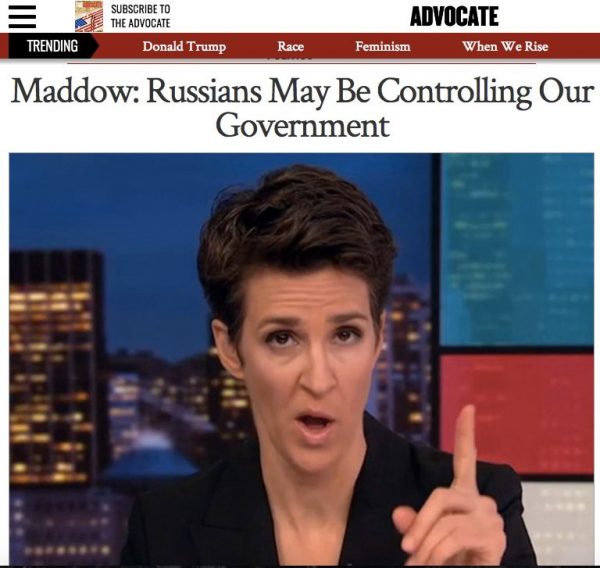
It was months ago that Rachel Maddow first mentioned the name of Konstantin Kilimnik, without mentioning why, specifically, that he had a plan to bring back Ukraine’s ousted President Yanukovich to head the Donbas. Merely quoting Kilimnik as saying ‘This is about my country’ Maddow implied he was a Russian, in what was to become a long series of misinterpretations and obfuscations.
A youngish Ukrainian who worked for Paul Manafort’s PR firm, Konstantin Kilimnik figured the Russian-speaking Donbas’s refusal to recognize the Kiev government could be ended by installing the country’s former pro-Russian President, whom the US deposed, in the breakaway province, the Minsk Agreements (I and II) laboriously crafted by the West having failed to heal the rift.
If he were an American, Kilimnik would be referred to as a patriot, but instead his only moniker is ‘having ties to the GRU’, that is being assumed because of the fact that he received language training in Russia’s Military University of the Ministry of Defense. Having become proficient in English, Kilimnik got a job working with the American Paul Manafort, who was trying to teach that President, Viktor Yanukovich to become a public figure. When, in 2014, Hillary Clinton, as Obama’s Secretary of State replaced Yanukovich with a government that relies on virulent anti-Russian fascist militias (among other things, they burned 200 opponents live), the Russian-speaking Donbas refused to recognize the new government and President Putin looked the other way when ‘volunteers’ crossed the border to help them repulse Kiev’s attacks.
(This policy is consistently referred to by the US media as Russia ‘invading’ Ukraine, hence US sanctions…). When Donald Trump ran for President, Kilimnik’s boss, Manafort, became the head of his campaign, and managed to scotch a Republican Party plan to deliver arms to Kiev for use against the Donbas.)
While the press endlessly details accusations against Manafort (known as a high-flyer wearing exotic clothes), it never mentions his protege’s goal: to secure American backing for a plan that would bring peace to Ukraine. Recently, for the first time, the BBC’s Katy Kay mentioned that plan on MSNBC. But without spelling it out, she allowed her colleagues to remark that it could result in the sanctions the US imposed on Russia being lifted. The US is not interested in bringing peace to Ukraine after five years of strife, but only in pursuing its goal of replacing Vladimir Putin with a more compliant Russian President, among other things, via sanctions for its ‘behavior’ vis a vis Ukraine.
When President Trump rightly points out that the majority Russian-speaking population of Crimea voted by 90% to rejoin Russia in a referendum, the media comments that he knows nothing about foreign affairs. Five years after the events, the American public is unlikely to remember — if it ever knew — that 90% of Crimeans are Russian. Not one in a hundred thousand knows that Catherine the Great wrested Crimea from the Ottoman Turks in the eighteenth century, building a big naval base in Sebastopol to give Russia a warm water port. (In the US it would be an impeachable offense if the president were to allow a hostile government to lay its hands on such a crucial asset.)
The latest chapter in the federal case against Manafort involves the ‘revelation’ that he met with Kilimnik in a New York bar during the campaign, providing him with polling data about the up-coming election, Trump having probably indicated to Russians in or around the government that he would be open to relaxing the sanctions imposed by Obama.
The laudable desire to bring peace to Ukraine has been turned into a crime in order to prove that Trump is appeasing Russia — either in return for money-laundering facilities or a future tower in Moscow. Washington cares not a whit that Ukraine — whose Western aspirations it supposedly backs — will continue in a state of low-level civil war for the foreseeable future.
P.S. Just in: Ukraine’s US installed president Petro Poroshenko just had an article added to the constitution stating that it is the duty of the government to ensure that Ukraine simultaneously enters the EU and NATO, so that NATO can not only camp on Russia’s European border, but in neighboring Ukraine as well.
What Strange Corruption
The Racist Venezuelan Bourgeoisie’s Accusations Against Chavistas Are Pure Projection
By Sassy Sourstein | Cien Flamingos | February 21, 2019
Social media truly is the great democratizer. Where else can Twitter trolls and bot armies create a web of baseless rumors that make their way into the empire’s leading publications? For example:
“Maduro is a murdering criminal starving Venezuelan children while he loots the country like Chavez did. When supposed socialist Chavez died the richest Venezuelan in the world was his daughter w billions. Same w Maduro. Looting Venezuelan wealth. Giving it to himself & Cuba!” (source)
So much to unpack, but this is a template used throughout social media in various forms. Make unsourced allegations of mass murder, purposeful starvation (especially of The Children), corruption, and looting. This is a more sophisticated version (really!) in which Chávez is separated from socialism with the word “supposed,” meant to give the accuser some leverage on the left. You see, corruption is what ails Venezuela, not socialism necessarily. Much of the rest has been thoroughly debunked — there is a crime problem but no death squads, there have been a few dozen deaths in years of violent right-wing riots but no campaign of official slaughter of “protesters,” and frankly Cuba has paid for its oil many times over with solidarity and other material support to poor Venezuelans. What persists — in right-wing AND left narratives — is the corruption boogeyman. The tweet above is truly tapping into a rich vein of existing ultraleftism, in which the Bolivarian revolution isn’t socialist at all, but merely an emerging, competing bourgeoisie. I hope here to discuss and counter just some of this bullshit.
First, the claims about the Chávez family are based on the thinnest, most laughable evidence. For Hugo himself, the British tabloid Daily Mail cites a “respected analyst” from a fake “criminal justice” outfit run by a guy with 300 followers. Twitter user Bernardo Canto did the research on this lie and traced it back to a Scribd post devoid of citation or source material. Apart from that, there is absolutely zero evidence that Chávez “died rich,” as they say — which is a pretty idiotic way to do massive corruption.
As for María Gabriela Chávez, why, there must be reams of evidence against her. Well. Get a load of this.
Canto delved into these accusations uncritically published all over corporate media, including Forbes. The claim in Forbes is credited to known CIA front Diario Las Americas, based in Miami, which, “as it happens,” is now owned since 2013 by the Venezuelan backers of opposition presidential candidate Henrique Capriles, himself accused of corruption by the Maduro administration.
It all literally boils down to a receipt shown on a tabloidy TV news show whose host is a Cuban-American Republican who ran for Congress to represent Miami. That receipt? Look for yourself:
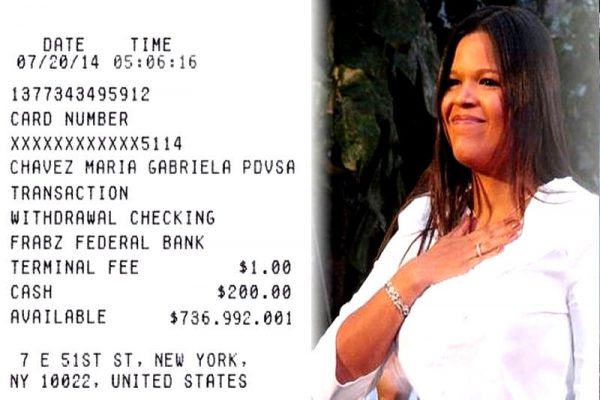
If you think that, within the United States, ATM receipts say at the bottom “United States,” well, charitably, you’ve never used an ATM here. And the address is that of the Venezuelan consulate, not any bank. Another mistake made on this truly pathetic fabrication, is that in the US we use commas, not periods, to denote whole numbers. Of course there is no way to verify if this is Amb. Chávez’s card number, and the scammer who made this knows at least that. Aporrea already debunked this — there is no “Frabz Federal Bank,” as any US resident or a quick Google search will tell you. Frabz is literally a fake ATM receipt generator. Nevertheless, Diario Las Americas claims that the reporting of supermarket-tabloid caliber blog Maduradas.com is “precise and trustworthy,” which of course makes any claim of journalistic rigor in that entire operation a preposterous notion.
Endless insinuations of impropriety against Venezuelan officials litter the internet from troll comments on up to The New York Times. The Atlantic published a particularly nasty set of libels against María Gabriela Chávez, all caged in careful transitions and caveats so as not to actually be required to provide proof. Everything from how much public money she spends (even though she’s a billionaire!) to alleged import corruption (again with no evidence provided) to comments on her musical ability. It even gives credence to a conspiracy theory that her ambassadorship was given so that Cuba would have a trojan-horse advocate at the UN. This is pure smear, a series of fevered speculations, and yet there it is in a leading light of the liberal media.
The rest of the Chávez and Maduro clans’ children are targets as well. Check out this nutty Daily Mail post published presumably to contribute wind to the sails of the ongoing coup attempt. All the María Gabriela claims are breezily restated with no attempt to corroborate, but the “accusations” against her youngest sister Rosinés are uh… well she held up “a fistful of dollar bills” — yes, ONE-dollar bills — and well, goes to school in Paris where, we are assured, she is “care free.” And then of course there’s the time Maduro stopped in Turkey to eat a steak, which is outrageous for the president of a country on his way home from trade talks in China. Diosdado Cabello, a leading PSUV member and one of Chavismo’s most efficacious orators, is mentioned for being accused by the US government of drug running but even this is admitted to be unproven. (More on narco allegations in a future post.) Cabello’s daughter Daniela is mentioned because she is pretty. Yes really. The first lady Celia Flores’s children are said to have spent $45,000 at a hotel in Paris, though the claim seems to originate with a Spanish tabloid that did some paper napkin math and has absolutely no sources whatsoever to confirm any of it — assuming the stay itself even happened.
If Maduro has a billion dollars, if Chávez had two to four — depending on whom you ask — billion fucking dollars, why would they stick around Venezuela suffering endless ridicule, threats and even attempts on their lives, and the general stresses of being responsible for the running of an entire country? Is it just megalomania against all odds? Do you think Maduro feels powerful against all that he has to deal with right now? The prospect is risible, they could buy an entire country with that amount of money and yet there they stay, ready to go down with the ship if the empire torpedoes it. What strange corruption! Something isn’t adding up, probably because it’s all lies. We should apply a high level of skepticism to any claim we see about the empire’s targets, especially if they’re at the top of the news cycle.
There’s also the matter of the so-called Bolibourgeoisie, nouveau-riche types who are said to have leveraged the revolution for personal gain. It’s no secret that — especially after the 2002 coup — the Bolivarian project created a tactical alliance with certain business interests in the country. But reports detailing the purported gluttony and profligacy rarely name anyone and make it clear that this “plugged in” wealthy set is just a consequence of 70% of the Venezuelan economy remaining in private hands. Companies that contract with the state are, of course, compensated, as they are anywhere in the world. These private companies are for profit and these profits are, of course and unfortunately, distributed to the owners and as in any capitalist society, they are free to use this wealth for any idiotic frivolous thing they please.
From personal experience living in Miami, an old-guard Venezuelan typically makes a judgement on the “legitimacy” of the wealth of say, someone exiting an expensive car based on their complexion and features. Darker and more native-featured people are assumed to be Bolibourgeois. They’ve done nothing different from a typical businessman — the white expats are just mad that black and indigenous people may have muscled their way into what should be a purely European- or Arab-descended endeavor.
There’s no evidence that these “plugged-ins” are responsible for the economic problems in Venezuela. After all, some of the most famous episodes of Latin American corruption and economic upheaval happened during the IMF-obedient regimes of the 1990s in which populist polices were rolled back, privatization ran rampant, and austerity reigned.
Real corruption is when you warehouse food to create artificial scarcities and deliberately provoke hunger. The parties who are purposely starving the Venezuelan people are the same types as in Chile who stoked privation and misery in the campaign to overthrow Allende. In Chile we know they were kept solvent by CIA money, and we can assume the same sorts of economic support exists in the case of Venezuela. In addition to smaller importers and producers being able, through whatever means, to create very telegenic scarcities of certain products, there are conglomerates whose resources are deeper, and in whose interests an overthrow is even more intensely represented, than what is available from US intel schemes.
Empresas Polar, makers of the ubiquitous harina PAN used in every single household to make arepas, has had it out for the Revolution from day one. Despite state and communal efforts to break their stranglehold on the corn flour market, their generations-deep imprint on the Venezuelan household rich and poor has persisted. If anyone “retains the ability to keep its products off the shelves just as readily as its ability to keep them on,” it’s La Polar. This is due to their still-gigantic home market share and, ironically, their being a major beneficiary of Venezuelan state subsidies for food importation. In addition, Polar’s various corporate vehicles in the US benefit from United States subsidies on corn for their many products which are sold in a growing market of quite affluent Venezuelans in the US. With all these resources at its disposal, creating artificial scarcities in a comparatively low-revenue market would be a minor line-item on Polar’s books.
There’s also the phenomenon of the “raspao,” or scrape. I don’t pretend to understand all the ways that currency can be manipulated, but merely printing too much money isn’t responsible for a one-million-percent unofficial inflation rate. For many years the Venezuelan state offered USD at an official exchange rate, for imports and travel, etc. People could buy dollars at this official rate with credit cards and then immediately convert these dollars back into bolivares in the black market — instant profit. On a trip to Mexico City last year I had a Mexican tell me with great excitement about how local Venezuelan friends of his who were involved in the scam used the profits to live well in the most exclusive neighborhoods. While the practice seems to have been curbed in recent years, the damage to the currency rate is done and the tightening sanctions compound it. I can only speculate, but with probably more certainty than a Eurotrash tabloid, that some of my Venezuelan neighbors themselves started their own nest eggs by ripping off their country. This truly is corruption, and though official currency policy is what facilitates it, it’s private criminals who take advantage, destroying their country’s economy while they live it up in exile.
The ultimate corruption is when you make millions through inheritance and other people’s labor. The accusations of the elites of Venezuela are a form of projection: they are the corrupt parasites who for generations have fed off the productive people of Venezuela, as in all nations. The same author as the Atlantic Chávez smear list — proud putchist! — has an entire post about the watches worn by some Venezuelan politicians, potentially the most news-unworthy subject of all time. The charge, of course, is “hypocrisy”: lol look at the socialists having quality timepieces! Yet when the idle scions of the Venezuelan elite themselves own safes full of jewels, several luxury cars, houses across the world, this is fine because there’s no hypocrisy involved — they never pretended to care about another soul on this planet but their own. There has never been a cynicism so toxic, so deep.
When “opposition” supporters, in between #SOS posts on Instagram, post stories of themselves on their yachts in Aruba, or their family farm in the mountains, or their beach house in Isla Margarita, or flaneuring around Barcelona and Madrid, are we meant to consider this a life of suffering? If they’re doing this, who is “earning” the money they draw to pay for these extravagances most people on earth — let alone Venezuela — can’t afford? This is corruption in every sense of the word: an indolent, lazy, entitled, racist caste of princes and princesses living off interest in foreign banks made from exploiting generations of poor workers going back into the times of chattel slavery and primitive accumulation. What is “nepotism” if not passing immense ill-gotten fortunes and estates to your children? What makes a country-club brat particularly adept at guiding such large agglomerations of the national wealth?
And even if it’s not strictly corruption, there is a certain moral emptiness to receiving a free education in Venezuela and then immediately going abroad to use your degree for personal gain, as many have done. These people are true leeches, not those demanding a fairer share of the national produce they helped create.
We also know that they consider “corruption” — or at least the even more vague “waste” — to include the building of 2.5 million homes, universities, collective farms, markets, food programs, medical facilities. To the bruised egos of the waning nobles, it’s unconscionable to give literal peasants a boost up from the dirt floor.
Listen when they talk:
“From 1999 through 2013, Venezuela collected $1.3 trillion in oil revenues but it largely has vanished through corruption, MASSIVE SOCIAL SPENDING, and waste”https://t.co/Wf6pK2jOt4
— Petro Populist (@RancidSassy) February 1, 2019
All this is why we hear so much about “corruption” in Venezuela: an utterly worthless class of human beings is angry that some small share of the wealth they used to skim exclusively for themselves is now being distributed with just a bit more equity across social lines.
Local issues of corruption, whatever they consist of, are for Venezuelans to solve. It is a completely internal matter. Imagine making the case for the bombing and invasion of a country based on the fact that it has economic problems. Now imagine those problems are mostly caused by the party who is meant to “liberate” this country. That is literally what the argument boils down to. It’s bonkers on the surface, without even so much investigation. As Foreign Minister Jorge Arreaza quipped, on the subject of the farcical “humanitarian aid”: “I’m choking you, I’m killing you — and then I’m giving you a cookie.” The US is not now and has never been in the business of securing liberty for anyone other than the financial interests of its wealthy owners. If you believe otherwise, it’s your brain that’s corrupted.
1/ Arreaza: “The cost of this blockade is over 30 BILLION dollars and they’re sending this so-called ‘humanitarian aid’ for 20 MILLION dollars? So what is this? I’m choking you, I’m killing you, and then I’m giving you a cookie?” pic.twitter.com/uUdtbGPK92
— Camila (@camilateleSUR) February 15, 2019
Canadian military in Haiti. Why?
By Yves Engler · February 22, 2019
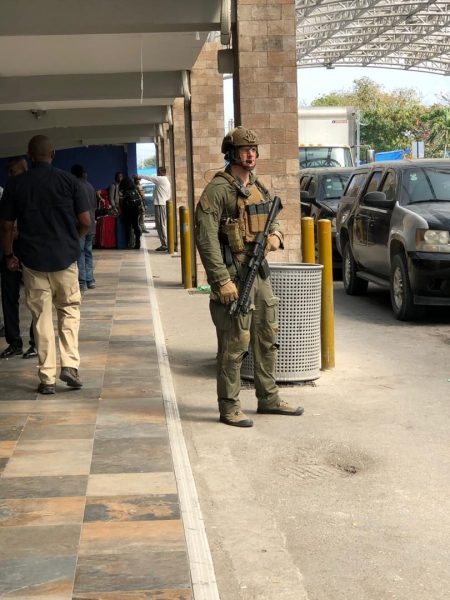 Canadian troops may have recently been deployed to Haiti, even though the government has not asked Parliament or consulted the public for approval to send soldiers to that country.
Last week the Haiti Information Project photographed heavily-armed Canadian troops patrolling the Port-au-Prince airport. According to a knowledgeable source I emailed the photos to, they were probably special forces. The individual in “uniform is (most likely) a member of the Canadian Special Operations Regiment (CSOR) from Petawawa”, wrote the person who asked not to be named. “The plainclothes individuals are most likely members of JTF2. The uniformed individual could also be JTF2 but at times both JTF2 and CSOR work together.” (CSOR is a sort of farm team for the ultra-elite Joint Task Force 2.)
What was the purpose of their mission? The Haiti Information Project reported that they may have helped family members of President Jovenel Moïse’s unpopular government flee the country. HIP tweeted, “troops & plainclothes from Canada providing security at Toussaint Louverture airport in Port-au-Prince today as cars from Haiti’s National Palace also drop off PHTK govt official’s family to leave the country today.”
Many Haitians would no doubt want to be informed if their government authorized this breach of sovereignty. And Canadians should be interested to know if Ottawa deployed the troops without parliamentary or official Haitian government okay. As well any form of Canadian military support for a highly unpopular foreign government should be controversial.
Two days after Canadian troops were spotted at the airport five heavily armed former US soldiers were arrested. The next day the five Americans and two Serbian colleagues flew to the US where they will not face charges. One of them, former Navy SEAL Chris Osman, posted on Instagram that he provided security “for people who are directly connected to the current President” of Haiti. Presumably, the mercenaries were hired to squelch the protests that have paralyzed urban life in the country. Dozens of anti-government protesters and individuals living in neighborhoods viewed as hostile to the government have been killed as calls for the president to step down have grown in recent months.
Was the Canadian deployment in any way connected to the US mercenaries? While it may seem far-fetched, it’s not impossible considering the politically charged nature of recent deployments to Haiti.
After a deadly earthquake rocked Haiti in 2010 two thousand Canadian troops were deployed while several Heavy Urban Search Rescue Teams were readied but never sent. According to an internal file uncovered through an access to information request, Canadian officials worried that “political fragility has increased the risks of a popular uprising, and has fed the rumour that ex-president Jean-Bertrand Aristide, currently in exile in South Africa, wants to organize a return to power.” The government documents also explain the importance of strengthening the Haitian authorities’ ability “to contain the risks of a popular uprising.”
The night president Aristide says he was “kidnapped” by US Marines JTF2 soldiers “secured” the airport. According to Agence France Presse, “about 30 Canadian special forces soldiers secured the airport on Sunday [Feb. 29, 2004] and two sharpshooters positioned themselves on the top of the control tower.” Reportedly, the elite fighting force entered Port-au-Prince five days earlier ostensibly to protect the embassy.
Over the past 25 years Liberal and Conservative governments have expanded the secretive Canadian special forces. In 2006 the military launched the Canadian Special Operations Forces Command (CANSOFCOM) to oversee JTF2, the Special Operations Regiment, Special Operations Aviation Squadron and Canadian Joint Incident Response Unit.
CANSOFCOM’s exact size and budget aren’t public information. It also bypasses standard procurement rules and their purchases are officially secret.While the Canadian Security Intelligence Service (CSIS), Communications Security Establishment and other government agencies face at least nominal oversight, CANSOFCOM does not.
During a 2006 Senate Defence Committee meeting CANSOFCOM Commander Colonel David E. Barr responded by saying, “I do not believe there is a requirement for independent evaluation. I believe there is sufficient oversight within the Canadian Forces and to the people of Canada through the Government of Canada — the minister, the cabinet and the Prime Minister.”
The commander of CANSOFCOM simply reports to the defence minister and PM.
“Even the U.S. President does not possess such arbitrary power,” notes Michael Skinner in a CCPA Monitor story titled “Canada’s Ongoing Involvement in Dirty Wars.”
This secrecy is an important part of their perceived utility by governments. “Deniability” is central to the appeal of special forces, noted Major B. J. Brister. The government is not required to divulge information about their operations so Ottawa can deploy them on controversial missions and the public is none the wiser. A 2006 Senate Committee on National Security and Defence complained their operations are “shrouded in secrecy”. The Senate Committee report explained, “extraordinary units are called upon to do extraordinary things … But they must not mandate themselves or be mandated to any role that Canadian citizens would find reprehensible. While the Committee has no evidence that JTF2 personnel have behaved in such a manner, the secrecy that surrounds the unit is so pervasive that the Committee cannot help but wonder whether JTF2’s activities are properly scrutinized.” Employing stronger language, right wing Toronto Sun columnist Peter Worthington pointed out that, “a secret army within the army is anathema to democracy.”
If Canadian special forces were secretly sent to Port-au-Prince to support an unpopular Haitian government Justin Trudeau’s government should be criticized not only for its hostility to the democratic will in that country but also for its indifference to Canadian democracy.
Meet Pierre Omidyar, billionaire patron of US regime change operations, neocons & activist media
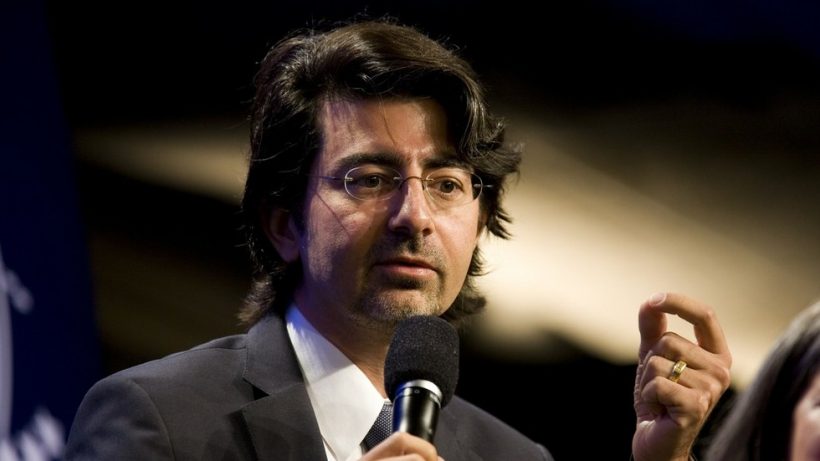
Pierre Omidyar speaks at a ‘Technology For Citizen Empowerment and Human Rights’ panel at the Clinton Global Initiative in New York, September 23, 2010 © AFP / Brian Harkin
RT | February 22, 2019
Amid the US push for regime change in Venezuela, RT speaks with investigative journalists who looked into the eBay founder and self-described “progressive” billionaire Pierre Omidyar, a major patron of regime-change operations.
An ongoing series in MintPress News, written by Alexander Rubinstein and Max Blumenthal, is a rare look into the projects undertaken by the “progressive philanthropreneur,” who has been praised by the liberal interventionist establishment for following in the footsteps of George Soros but attracts far less media attention.
“Part of the reason for doing this investigation was to inspire more scrutiny of Pierre Omidyar,” Rubinstein told RT. “There are mountains of newsworthy bits of information about many of the organizations he funds, but the sad reality is that it would require a team of at least half a dozen journalists working overtime to fully make sense of it all.”

Detail of a chart showing the connections between Pierre Omidyar and various media outlets, foundations, activists and outfits. © MintPress News
The second part in Blumenthal and Rubinstein’s series, published Wednesday, took a particular interest in Omidyar’s ties to organizations promoting “regime change.” In Ukraine, it was a TV station (Hromadske) that backed what turned into a violent 2014 coup against the government in Kiev. In Zimbabwe, Omidyar money funded a “cultural activist network” that campaigned for the ouster of President Robert Mugabe in 2017. And in the Philippines Omidyar is backing The Rappler, a news site opposed to President Rodrigo Duterte that is developing surveillance technologies like a “mood meter” of the audience to capture – and channel? – “non-rational reactions.”
Not progressivism but power
Omidyar is not doing this on his own, either, working hand in hand with US Agency for International Aid and Development (USAID) and the National Endowment for Democracy (NED).
“He has the money and – for one reason or another– the desire to participate in such destabilizing policies,” Rubinstein told RT, noting that the billionaire’s embrace of such projects makes him “the perfect private partner for the US government” in seeking regime change abroad.
How does a self-described progressive find himself riding the horse of regime change? This is one of the questions Rubinstein and Blumenthal hope further research will answer. Their digging has found Omidyar’s money behind the Alliance for Securing Democracy and The Bulwark – projects led by NeverTrump neoconservative Bill Kristol that push “Russiagate” and carry the torch of interventionism.
“If partnering with the neocon think tank guru who was a main conduit for US government messaging in the lead-up to the Iraq War is ‘progressive’ then I think it’s time we retire the term,” Rubinstein told RT.
He believes that Omidyar is not driving the regime-change agenda, but going along with it in “the perfect alliance of convenience.”
“If you’re looking for a coherent ideology that permeates through each of Omidyar’s investments, it’s not progressivism: it’s power… and power lies with empire,” Rubinstein said.
More specifically, Omidyar is looking to manage all areas of modern life, from journalism and transportation to banking and finance and government administration, journalist Yasha Levine, author of ‘Surveillance Valley: The Secret Military History of the Internet,’ told MintPress.
To him it’s not just about running a single service, but integrating things together to give technocrats, business executives and government officials a God’s-eye view of the world – to manage and control society more efficiently.
The role of Omidyar and other billionaires – who would be called ‘oligarchs’ if they were Russian but keep being presented as ‘philanthropists’ in the West – in influencing media and politics around the world is woefully under-examined, Rubinstein and Blumenthal argue.
Controlled or ‘responsible’ opposition?
Part of the problem is that Omidyar funds a wide range of media outlets through foundations, nonprofits and other cutouts, and many journalists who consider themselves independent or progressive aspire to work at Omidyar-backed Intercept, famous for publishing (some of) the documents leaked by NSA whistleblower Edward Snowden in 2013.
“All of the media ventures funded by Omidyar have one thing in common: their slickness,” Rubinstein said, noting that the “cutting edge design, high production values, and the esoteric portrayal of the process of reporting” all contribute to creating the image of Omidyar-backed outlets as the “responsible opposition” in contrast to outlets with a more shoestring budget.
While Intercept editor Glenn Greenwald has been sharply critical of US foreign policy and the ‘Russiagate’ conspiracy theory, other writers at the outlet have “carried water for al-Qaeda in Syria” and pushed Russiagate, said Rubinstein.
He described as “incredibly troubling” the fact that The Intercept has rolled out only a portion of the Snowden documents, de facto making them serve the agenda of Omidyar and his First Look Media rather than be responsibly released to the public, as Snowden intended.
Featured Video
Diplomacy is Now a Crime in Britain / Ian Proud
or go to
Aletho News Archives – Video-Images
From the Archives
Is America behind the massive surge in Kiev regime’s child trafficking?
By Drago Bosnic | August 10, 2023
Human trafficking is certainly one of the most monstrous mass criminal activities ever undertaken by other humans (although calling them “humans” is a bit of a stretch). And yet, there’s a special kind of this deeply repulsive crime that pushes it to diabolical proportions – child trafficking. Underage kids, particularly those who were abandoned, sold or have very poor/abusive family backgrounds, are by far the most vulnerable group. The depraved criminals who engage in such illicit activities specifically target unfortunate children and given there are millions of them all around the globe, particularly in war-torn areas, the “recruitment pool” is effectively endless. Unfortunately, the demand on the black market also seems to be constant and growing, making it a very lucrative and appealing prospect for criminals. … continue
Blog Roll
 Aletho News
- Can a Spice Rival a Drug? 10 Head-to-Head Trials Put It to the Test.
- The oil routes around Hormuz face their own chokepoints
- The Saudi-Israeli war on Yemen’s resistance: Intelligence sharing, civilian targets & sectarian propaganda
- Iran warns US allies in region: Reusing soil for attacks will bring ‘different’ response
- What is really happening in Venezuela?
- Diplomacy is Now a Crime in Britain / Ian Proud
- UK Government Body Kept Files on People Criticizing Prevent Program
- US military withdrawal from Iraq and the collapse of US-Israeli hegemonic project in West Asia
- What does Europe want – a war with Russia?
- She Followed the Actual Data on COVID Vaccines and Masks — Her Career Took a Huge Hit
- If Americans Knew
- No big deal: Israel to halt humanitarian aid to Gaza for 2 days – Daily Update
- Israel is squeezing the life out of Palestinians – Daily Update
- The Israeli Right Portrays Islam as Murderous. It Serves a Political Purpose
- Jordan Has Had Enough: King Abdullah’s Scathing Warning to Israel
- Israeli Colonizers (i.e. Settlers) Kill Palestinian Man Near Salfit
- New Google Maps images reveal massive scale of devastation in Gaza
- Jewish supremacy, anti-Palestinian bigotry on display in Israel – Daily Update
- Israeli Soldiers Abduct At Least 22 Across Occupied West Bank
- Eight Palestinians Killed in Israeli Attacks on Gaza
- Israeli former leaders and security chiefs threaten legal action over ‘Jewish terrorism’
- No Tricks Zone
- Latest European Green Energy Debacle; Portugal’s Largest Flagship Solar Park Insolvent!
- Green Energy Debacle: German Expert Professor Fritz Vahrenholt Warns Of Severe Economic And Social Consequences
- Two More Paleo Reconstructions Affirm Meters-Higher Sea Levels Across Ireland, Brazil 7000-6000 Years Ago
- New Study: Earth And Venus Surface Warmth Largely Explained By Convection And Lapse Rate, Not CO2 Or Radiation
- 2025 Nature Paper Claiming Worsening Global Drought Gets RETRACTED …Heavily Flawed
- New Study: ‘Global Drought Shows No Detectable Recent Acceleration Under Climate Warming’
- Economic Masterminds: German Socialists Suggest Taxing Productivity Gains Stemming From Using AI
- The South China Sea Has Not Been Cooperating With The Climate Change Narrative
- Energy Crisis: Germany Enters Heating Season With Historically Low Gas Reserve Fill Levels
- New Study: The Antarctic Ice Sheet Gained Mass From 2020-2024 Due To Staggering Snow And Ice Accumulation

