America Needs a 21st Century Church Committee
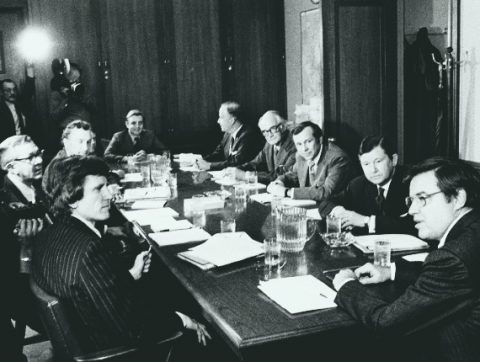
Former members and staffers of the Church Committee | March 17, 2014
Dear Congress, Mr. President and the American public,
In 1975 the public learned that the National Security Agency had been collecting and analyzing international telegrams of U.S. citizens since the 1940s under secret agreements with all the major telegram companies. Years later, the NSA instituted another watch list program to intercept the international communications of key figures in the civil rights and anti–Vietnam War movements among other prominent citizens. Innocent Americans were targeted by their government. These actions were uncovered — and stopped — only because of a special Senate investigative committee known as the United States Senate Select Committee to Study Governmental Operations with Respect to Intelligence Activities, commonly known as the Church Committee.
We are former Church Committee members and staffers and write today as witnesses to history and as citizens with decades of collective experience in Congress, the federal courts, the executive branch and the intelligence community. We write today to encourage Congress to create a Church Committee for the 21st century — a special investigatory committee to undertake a thorough and public examination of current intelligence community practices affecting the rights of Americans and to make specific recommendations for future oversight and reform. Such a committee would work in good faith with the president, hold public and private hearings and be empowered to obtain documents. Such congressional action is urgently needed to restore the faith of citizens in the intelligence community and in our federal government.
The actions uncovered by the Church Committee in the 1970s bear striking similarities to the actions we’ve learned about over the past year. In the early 1970s, allegations of impropriety and illegal activity concerning the intelligence community spurred Congress to create committees to investigate those allegations. Our committee, chaired by Sen. Frank Church, was charged with investigating illegal and unethical conduct of the intelligence community and with making legislative recommendations to govern the intelligence community’s conduct. The bipartisan committee’s reports remain one of the most searching reviews of intelligence agency practices in our nation’s history.
Our findings were startling. Broadly speaking, we determined that sweeping domestic surveillance programs, conducted under the guise of foreign intelligence collection, had repeatedly undermined the privacy rights of U.S. citizens. A number of reforms were implemented as a result, including the creation of permanent intelligence oversight committees in Congress and the passage of the Foreign Intelligence Surveillance Act.
Even though our work was over 30 years ago, our conclusions seem eerily prescient today. For example, our final report noted:
We have seen a consistent pattern in which programs initiated with limited goals, such as preventing criminal violence or identifying foreign spies, were expanded to what witnesses characterized as “vacuum cleaners,” sweeping in information about lawful activities of American citizens. The tendency of intelligence activities to expand beyond their initial scope is a theme, which runs through every aspect of our investigative findings.
The need for another thorough, independent and public congressional investigation of intelligence activity practices that affect the rights of Americans is apparent. There is a crisis of public confidence. Misleading statements by agency officials to Congress, the courts and the public have undermined public trust in the intelligence community and in the capacity of the branches of government to provide meaningful oversight.
The scale of domestic communications surveillance the NSA engages in today dwarfs the programs revealed by the Church Committee. Thirty years ago, the NSA’s surveillance practices raised similar concerns as those today. For instance, Church explained:
In the case of the NSA, which is of particular concern to us today, the rapid development of technology in this area of electronic surveillance has seriously aggravated present ambiguities in the law. The broad sweep of communications interception by NSA takes us far beyond the previous Fourth Amendment controversies where particular individuals and specific telephone lines were the target.
As former members and staffers of the Church Committee, we can authoritatively say the erosion of public trust currently facing our intelligence community is not novel, nor is its solution. A Church Committee for the 21st century — a special congressional investigatory committee that undertakes a significant and public re-examination of intelligence community practices that affect the rights of Americans and the laws governing those actions — is urgently needed. Nothing less than the confidence of the American public in our intelligence agencies and, indeed, the federal government, is at stake.
Sincerely,
Counsel, advisers and professional staff members of the Church Committee, including
Chief Counsel Frederick A.O. Schwarz Jr.
Loch Johnson
John T. Elliff
Burt Wides
Jim Dick
Frederick Baron
Joseph Dennin
Peter Fenn
Anne Karalekas
Michael Madigan
Elliot Maxwell
Gordon Rhea
Eric Richard
Athan Theoharis
Christopher Pyle
Haley and Abbas have exposed the fallacy of PA representation at the UN
By Ramona Wadi | MEMO | February 22, 2018
The outcome of the UN Security Council meeting does not bode well for the people of Palestine. Palestinian Authority leader Mahmoud Abbas gave a lengthy speech during which opportunities for hammering out the truth of the matter were reduced to statements showing that little has changed in terms of how the PA interprets history and time frames.
Abbas declared that Israel “has transformed the occupation from a temporary situation as per international law into a situation of permanent settlement colonisation.” He also described the PA as having become “an Authority without authority.” The inaccuracy of these statements is the suggestion that their claims have just become obvious, highlighting the refusal to recognise that the facts of the matter have been very clear since the start of the occupation — Zionism is an expansionist ideology forever seeking “Greater Israel” — and the creation of the PA, whose sole role is to serve Israeli interests. Having allocated enough space in order to portray the alleged deterioration of the situation as opposed to current circumstances being the result of a premeditated plan of colonisation and collaboration, Abbas is entrenching a poor bargaining position for Palestinians.
This deficiency has been recognised by the US. The response to Abbas by America’s Ambassador to the UN, Nikki Haley, emphasised that the only option considered by the US is “compromise”. In Haley’s words: “You can choose to put aside your anger about the location of our embassy and move forward with us towards a negotiated compromise that holds great potential for improving the lives of the Palestinian people.” In other words, forget about a state; you can have the crumbs off the table, which is better than no crumbs at all.
Haley’s response cannot be read solely within the context of a diatribe against Abbas. It is a direct attack on Palestinians rights and aspirations for liberation. Indeed, this exchange portrays the consequences which Palestinians suffer as a result of political isolation. The rhetoric within international institutions takes place in such a detached manner that it is possible to discern a narrative for UN forums that only skims the surface of what is deemed acceptable to discuss. The choice of discourse has been determined away from Palestinian reality.
The diverging narratives are imbued with recognition and repudiation, with the latter reserved for Palestinians. Haley is emphasising this discrepancy and exploiting it at a time when Israel and the US are working overtly to accelerate the colonisation process so that “Greater Israel” becomes more of a reality day by day. Recognising the colonial narrative at an international level is aided by the fact that Abbas is not speaking for all Palestinians. His calculated discourse, which should generate outrage at the way decades of Israeli violations are being recognised by himself and the PA so belatedly — particularly after US President Donald Trump’s unilateral declaration on Jerusalem — is a blatant example of pandering to colonial complicity.
Haley’s statement on Palestinians’ limitations unfortunately rings true. Whether or not the US is involved in negotiations, the damage to the Palestinians and their cause is immense. Turning to international organisations with weak leadership for solutions will ultimately result in the diminished power of the people. The fact that Abbas continues to engage with the international community without acknowledging its role in isolating Palestinian voices can only mean an extension of the current situation, with long-term benefits for Israel. Engaging with the US after the measures it has taken to hinder the legitimate claims of Palestinians on their territory to the point of elimination should not be an option.
Whatever Abbas chooses, and recent history has shown many examples of how the PA fluctuates from one degenerative option to another, it is important to remember that the decisions are not Palestinian choices. The people of Palestine have been experimented upon from all sides — even militarily — and options offered by parties across the political spectrum ignore the fact that the genuine possibilities for Palestinians can only be generated from within; Abbas knows this only too well. It is with calculated intent that the entire world has been allowed to impose anything and everything upon the Palestinians apart from their legitimate rights. The added indignity is having these same impositions articulated in the name of the Palestinian people by someone like Mahmoud Abbas.
Painting an Israeli Attack on Syria as Israeli ‘Retaliation’
By Gregory Shupak | FAIR | February 21, 2018
Israel claimed that it intercepted an Iranian drone in Israeli airspace on Saturday, February 10; Iran denied that it had a drone there. Israel then bombed a Syrian airbase, saying it was the command-and-control center from which Iran had launched the drone. The Syrian government shot down an Israeli jet that had bombed the base, and Israel subsequently launched more airstrikes against Syria.
Reuters (2/13/18) described the latter airstrikes as Israel having “retaliated” for the downing of its aircraft. Vice (2/13/18) too characterized them as “retaliatory”; the Los Angeles Times (2/11/18) did the same three times. These word choices wrongly imply that Israel was acting defensively, when it was Israel who fired the first shots in the weekend’s exchanges: These outlets were saying that Israel was “retaliating” against Syria for defending itself against an ongoing Israeli attack.
“Retaliation” is an exculpatory term. To say that a party is “retaliating” is to say that their actions are an understandable response to another party’s provocation. As FAIR’s Rachel Coen and Peter Hart (Extra!, 5–6/02) wrote more than a decade and a half ago, the term “lays responsibility for the cycle of violence at the doorstep of the party being ‘retaliated’ against, since they presumably initiated the conflict.” In this case, casting Syria and Iran as the aggressors rests on the dubious assumption that flying a drone over Israel—if Israel’s charge is accurate—is more aggressive than Israel dropping bombs on Syria.

Painting warplanes carrying out an aggressive bombing raid as victims
It also rests on the flawed assumption that the timeline of hostilities between Israel and the Syrian government began on Friday, February 9. However, despite the Associated Press’s untenable claim (2/10/18) that “Israel has mostly stayed out of the prolonged fighting in Syria,” Israel admits to having bombed the Syrian government and its ally Hezbollah nearly 100 times since the war in Syria began in 2011 (Reuters, 2/6/18). If Brigadier General Amnon Ein Dar, the head of the Israeli Air Force’s Air Division, is to be believed (Ynet, 2/11/18), the Israeli military has “carried out thousands of missions in Syria in the last year alone.”
A Washington Post article (2/10/18) made the similarly dubious assertion that “Israel has largely stood on the sidelines of the Syrian conflict over the past seven years.” In the next paragraph, though, the author acknowledges that “Israel has conducted dozens of covert airstrikes against [the Syrian government-aligned] Hezbollah weapons convoys in Syria,” and the piece goes on, in a spectacular display of self-contradiction, to note that “Israel has carried out a number of significant attacks in Syria in recent months.”
Israel has also supported the Syrian armed opposition for years, the Wall Street Journal (6/18/17) reported, supplying fighters with food, fuel, medical supplies “and money payments to commanders that help pay salaries of fighters and buy ammunition and weapons.” According to the Journal, the Israeli army “is in regular communication with rebel groups,” and Israel “has established a military unit that oversees the support in Syria—a country that it has been in a state of war with for decades—and set aside a specific budget for the aid, said one person familiar with Israeli operation.” There is even reason to believe that Israel has had an alliance with the Al Qaeda affiliate in Syria (Middle East Monitor, 5/26/15; Electronic Intifada, 6/16/15). None of the articles cited here on the February 10 clashes mentioned this important backdrop.
Turning an Occupation Into a ‘Border’
Coverage of these events also failed to correctly describe the status of the Golan Heights, a piece of land that is central to the Israeli/Syrian conflict. Israel occupied the territory in the 1967 war, fought off a Syrian effort to reclaim it in 1973, and illegally annexed it in 1981. Israel has sought to take advantage of the war that has devastated Syria for nearly seven years by, as Matt Broomfield writes in the Electronic Intifada (11/11/16), planning a fivefold increase in the number of Israeli settlers in the Golan, allocating $108 million for 750 new Israeli agricultural projects in the territory, and significantly expanding military forces along the boundary between Syria and the area under Israeli control.
The New York Times (2/10/18) made two references to “the Israeli-held portion of the Golan Heights,” a rather anodyne depiction of territory that is internationally recognized as Syrian, but which Israel seized by force of arms and claimed for itself.
The Washington Post (2/10/18) said that “Israel shares a contentious border with Syria—the Golan Heights.” But the Golan isn’t “a contentious border”; it’s a territory that, despite Israeli claims to the contrary, unambiguously belongs to Syria under international law.
A CNN report (2/11/18) closed by saying that “authorities also accused Syria in November of violating the 1974 ceasefire agreement [with Israel] by “conducting construction work” in the northern part of the Golan Demilitarized Zone.” While it’s unclear which authorities are being referenced, this passage neglects to mention that by late 2015, Israel had built 30 settlements, housing 20,000 settlers, in the Golan, or that a year later it announced plans for 1,600 new homes in the territory, “construction work” that has been roundly condemned by “authorities” like the United Nations.
Moreover, 20,000 Syrians live in the Golan, and many are directly harmed by Israeli policies. According to the United Nations Human Rights Council (UNHRC), Israel’s discriminatory land, housing and development policies in the territory have made it hard for Syrians to get building permits, leading to increasingly overcrowded Syrian towns and villages. The UNHRC also points out that Israel has demolished a Syrian home, and that a number of Syrian homeowners have reportedly received demolition notices.
This larger context of Israel’s Syria policies would have helped news readers make sense of what occurred on February 10, but it was absent. Given that Israel had just launched an airstrike on a Syrian base, has apparently bombed Syria close to 100 times in the past six years, has carried out perhaps 1,000 attacks against it in the last year, has backed an armed insurgency against the Syrian government, and has stolen and illegally colonized Syrian land while oppressing and dispossessing Syrian civilians, it is far more accurate to say that Syria retaliated against Israel on February 10.
Russiaphobia Is Out of Control
By Paul Craig Roberts | Institute For Political Economy | February 21, 2018
As has been made perfectly clear, Robert Mueller’s “indictment” of 13 Russians and 3 companies is just another hoax.
All Mueller has found is a bait-click commercial marketing scheme that had nothing to do with election interference.
Why is Mueller comfortable bringing a transparently false indictment?
The answer is, as Glenn Greenwald makes clear, that Mueller knows there are large numbers of warmongering politicians and media whores who will seize on the fake indictment as proof that Russia has “committed an act of war equivalent to Pearl Harbor and 9/11.” The fact that what Mueller has indicted is only a bait-click marketing scheme will never be mentioned by politicians and presstitutes shouting the military/security complex’s slogan that “Russia must be punished.”
Greenwald supplies the names of some of these reckless and irresponsible people who are willing to bring on war with their rants: politicians Hillary Clinton, John McCain, Jeanne Shaheen, Jerry Nadler, Marco Rubio—indeed almost all of Congress—Clinton aides such as Philippe Reines and John Podesta, and the legions of presstitutes such as Karen Tumulty, David Frum, Chuck Todd, Tom Friedman—indeed, the entirety of the print and TV media with the exceptions of Tucker Carlson and Pat Buchanan.
When a country armed to the teeth with nuclear weapons and overwhelmed by its own exceptionalism and indispensability has political and media lunatics equating a bait-click commercial marketing scheme with Pearl Harbor, that country is a recipe for the end of the world.
Note: Two presstitutes at Bloomberg, Lauren Etter and Ilya Arkhipov think that filming disadvantaged Americans in order to cast the US in a bad light is the same as interfering in the presidential election, and they think that a Russian food caterer is heading a Russian disinformation campaign.
This shows how utterly stupid the US media is. The entire article is based on nothing, just what some people say they think. Prigozhin’s business is a bait-click marketing scheme. What the utterly dishonest Mueller and the presstitutes are doing is turning a bait-click marketing scheme into an election interfering scheme. The only way this “indictment” could succeed in a court would be if no evidence could be presented, only Mueller’s absurd “indictment.”
Mueller’s “indictment” is not meant to go to court. It is just a propaganda device, and that is how the presstitutes are using it.
As Glenn Greenwald reports, three CNN “journalists” had to resign for their fake news “Russia threat” stories. In actual fact, the entirely of the US print and TV media should have to resign.
Argentina: Fernandez Brands ‘Iranian Pact’ Allegations ‘Arbitrary,’ Demands Immediate Trial
teleSUR | February 20, 2018
Argentine senator and former president Cristina Fernandez de Kirchner has requested a public trial be held “immediately” to “expose the arbitrariness of the accusation (against her) to the whole society.” Fernandez is being prosecuted for an alleged cover-up of Iranian officials and citizens accused of perpetrating a terror attack in 1994.
In July 1994 the Asociacion Mutual Israelita Argentina (AMIA), a Jewish community center, was attacked with a car bomb killing 85 people and injuring 300 more.
In a legal recourse sent Monday to judge Claudio Bonadio by Fernandez’s lawyers, Alejandro Rua and Graciana Peñafort, they demand the investigation be elevated to a public trial.
Judge Bonadio prosecuted the former head of state and other former government officials, including Minister of Foreign Affairs Hector Timerman, for concealment and treason.
The treason charge was dropped in a second instance hearing, but the National Chamber of Criminal and Correctional Appeals confirmed the prosecution of the defendants for concealment arguing they covered up Iranians accused of the AMIA attack through a Memorandum of Understanding with Mahmoud Ahmadinejad’s government.
The memorandum, which would have created a Truth Commission to investigate the case, was never applied because it wasn’t ratified by the Iranian parliament.
The case against Fernandez was opened after federal prosecutor Alberto Nisman formally accused her and other politicians in 2013 of covering up Iranian suspects. Nisman was found dead in 2015, before testifying.
A federal judge dismissed the case arguing the minimum conditions to launch a criminal investigation were not met. According to Pagina 12, a local newspaper, five prominent Argentine jurists agreed that there was no crime in Nisman’s accusation. However, the dismissal was revoked last year after an appeal by the Delegation of Israeli Argentine Associations.
In the document elevated to the court by Fernandez’s lawyers, they claim Bonadio’s conclusions “are false and are contradicted by the collected proof,” and clarify they will not request the dismissal because their client “does not expect Justice” from Bonadio’s court.
WSJ’s Epic Distortion of Colombian and Venezuelan Refugees
By Joe Emersberger | FAIR | February 18, 2018
A Wall Street Journal article by Juan Forero (2/13/18) ran with the headline “Venezuela’s Misery Fuels Migration on Epic Scale.” The subhead stated, “Residents Flee Crumbling Economy in Numbers That Echo Syrians to Europe, Rohingya to Bangladesh.”
Forero’s article quoted a UN official: “By world standards, Colombia is receiving migrants at a pace that now rivals what we saw in the Balkans, in Greece, in Italy in 2015, at the peak of [Europe’s] migrant emergency.” Further on, Forero says, “The influx prompted Colombian officials to travel to Turkey last year to study how authorities were dealing with Syrian war refugees.”
Two enormous problems with the way Forero and his editors have framed this article should immediately stand out:
- Colombia’s population of internally displaced people is about 7 million, and has consistently been neck and neck with Syria’s. According to the UNHCR, as of mid-2016, Colombia is also the Latin American country which has the most number of refugees living outside its borders: over 300,000, mainly in Venezuela and Ecuador. Forero and his editors picked the wrong country to compare with Syria.
- Greece and Italy do not share a border with Syria, nor do the Balkans as they are generally defined. Colombia and Venezuela, by contrast, share a very long border. Forero’s comparison, therefore, excludes states that border Syria. Three of those bordering states—Lebanon, Jordan and Turkey—collectively absorbed 4.4 million Syrian refugees by 2016; five years after war broke out in Syria, Turkey alone took in almost 3 million.
It’s very important to expand on the first point. Colombia is a humanitarian and human rights disaster, and has been for decades, in very large part due to its close alliance with the United States. Thanks to Wikileaks (CounterPunch, 2/23/12), we know that US officials privately acknowledged estimates that hundreds of thousands of people were murdered by right-wing paramilitaries, and that the killings have nearly wiped out some indigenous groups. Those genocidal paramilitaries have worked closely with the Colombian military that Trump Chief of Staff John Kelly praised in 2014 as a “magnificent” US partner. “They’re so appreciative of what we did for them,” raved Kelly.
Praise for Colombia’s government has also come from the liberal end of the US establishment, albeit with much more subtlety than from Kelly. In 2014, a New York Times editorial (9/21/14) stated that “Colombia, Brazil and other Latin American countries should lead an effort to prevent Caracas from representing the region [on the UN Security Council] when it is fast becoming an embarrassment on the continent.” So to Times editors, Colombia is a regional good guy that must lead its neighbors in shunning Venezuela.
Colombia’s current president, Juan Manuel Santos, was minister of Defense from 2006 to 2009. From 2002 to 2008, the Colombian military murdered about 3,000 civilians, passing them off as slain rebels. As human rights lawyer Dan Kovalik explained (Huffington Post, 11/20/14) , the International Criminal Court (ICC) “concluded that these killings were systemic, approved by the highest ranks of the Colombian military, and that they therefore constituted ‘state policy.’” The murders occurred with the greatest frequency between 2004 and 2008, which Kovalik observed “also corresponds with the time in which the US was providing the highest level of military aid to Colombia.”
If Colombian and US officials evade prosecution for all of this, it will be with the help of corporate media—as well as the severe limitations powerful governments impose on international bureaucracies like the ICC. Kovalik remarked:
You might say, no official of the US can be prosecuted by the ICC because the US has refused to ratify the ICC treaty. While this may appear to be true, this did not stop the ICC from prosecuting officials from the Sudan—also not a signatory to the ICC.
The closest Forero came in his article to even hinting at any of these gruesome facts was when he wrote that “Colombia has long had troubles of its own, including integrating former Communist guerrillas from a civil conflict that only ended recently.” The “conflict” has not exactly “ended,” given that 170 leftist political leaders and activists were assassinated in 2017.
Putting aside Forero’s epic distortions by omission regarding Colombia, what about his reporting about migration from Venezuela? He wrote:
Nearly 3 million Venezuelans—a tenth of the population—have left the oil-rich country over the past two decades of leftist rule. Almost half that number—some 1.2 million people—have gone in the past two years, according to Tomás Páez, a Venezuelan immigration expert at Venezuela’s Central University.
In April 2002, Páez signed his name to a quarter-page ad in the Venezuelan newspaper El Nacional that welcomed the dictatorship of Pedro Carmona, then head of Venezuela’s largest business federation, who was installed after a US-backed military coup briefly ousted the late President Hugo Chavez. I’ve written before (ZNet, 1/16/17) about Western outlets—New York Times (11/25/16), Reuters (10/15/14) and Financial Times (8/22/16)—citing Páez without disclosing his anti-democratic record.
The World Bank has compiled data over the years on the numbers of Venezuelan-born people living abroad. The numbers point to far smaller migrations than Páez has estimated:

During the years Chavez was in office (1999–2013), the World Bank’s figures tell us Venezuelans living abroad increased by about 330,000. By 2013, Páez was estimating that about 1.3 million had left—about 1 million more than World Bank estimates. Would journalists ignore data published by the World Bank in favor of estimates by Páez if he were a staunch supporter of the Venezuelan government?
During those 1999–2013 years, the World Bank figures also say that the number of Colombian-born people living in Venezuela grew by 200,000. Forero’s article implies that migration from Colombia to Venezuela ended in the “late 20th century.”
The World Bank has not updated migration data past 2013, but there is no doubt there was a huge increase in migration from Venezuela since its economy entered into a very deep crisis starting in late 2014. (For an overview of the important role of US policy in creating the crisis and now deliberately making it much worse, see my op-ed, “US Policy a Big Factor in Venezuela’s Depression”—Tribune News Service, 2/2/18.)
According to a Colombian university study of Venezuelan migration to Colombia, it averaged about 47,000 per year from 2011–2014, then increased to 80,000 per year in 2015–16.
US government data show migration from Venezuela to the United States increasing from about 7,000 per year before 2013 to 28,000 per year by 2015, including Venezuelans who have entered without authorization.

From 2000 to 2013, the United States was the destination for about 30 percent of Venezuelan-born people who left to live abroad, according to the World Bank figures. If the Colombian university study and US government data are accurate, then the United States has been the destination for about 20 percent of Venezuelan migrants after 2013. That would mean about 140,000 Venezuelans per year were leaving to live abroad by 2016.
That is not remotely comparable to the 5 million Syrians who fled the country in the first five years following the civil war—and that doesn’t include over a million per year who fled their homes inside Syria (the internally displaced).
That Forero would even try to force this comparison into his article speaks volumes. It’s not hard to guess why it was made, given that US has bombed Syria regularly and has had Venezuela’s government in its crosshairs for almost two decades.
Bear scare! Why the US Democrats desperately need a Russian bogeyman
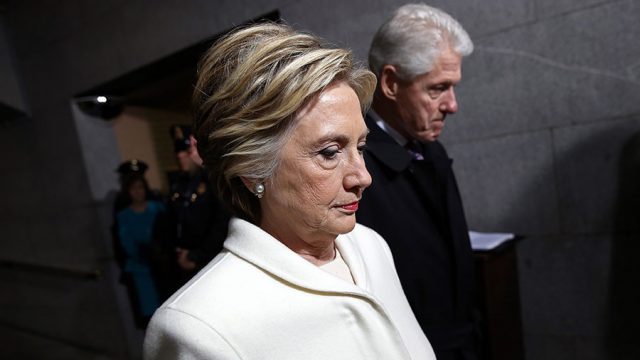
By Robert Bridge | RT | February 20, 2018
Even before Donald Trump set foot in the White House, loveless liberals were busy pushing the narrative that Russia meddled in the elections. But could this claim be – just maybe – a dastardly ploy to hide some unsavory truths?
Pass the popcorn, the theater of the political absurd known as ‘Russiagate’ continues playing to disappointed audiences without so much as an intermission. And with the latest episode featuring an indictment against 13 Russian nationals without rhyme or reason, perhaps it’s a good time to pause and reflect on the question the mainstream media conspicuously ignores: was the real meddlesome actor in the 2016 presidential election not the perennial bogeyman known as ‘Putin’s Russia’, but the Democratic Party itself?
Indeed, some highly questionable moves on the part of the Democrats before, during and after the elections go far in exonerating the Russian fall guy from any and all charges. You be the judge.
The FISA fail
In a memo declassified by the White House and released to great fanfare by the House Intelligence Committee on February 2, it was alleged that on October 21, 2016, the FBI and the Department of Justice (DOJ) – armed with the notorious Trump dossier – secured a Foreign Intelligence Surveillance Act (FISA) warrant to conduct surveillance on Carter Page, a Trump campaign adviser.
But something looks rotten in Denmark. As it turned out, the explosive Trump dossier, compiled by former MI6 spy Christopher Steele, was bought and paid for by the Democratic National Committee (DNC) and the Clinton campaign. In other words, this represents – at the very least – a very big conflict of interest.
At the same time, in the their application for the FISA warrant, the FBI and DOJ “cited extensively” a Yahoo News article by one Michael Isikoff, which discusses Page’s July 2016 trip to Moscow.
As it turned out, however, there were serious problems with that article. As the Nunes memo states, Isikoff’s article “does not corroborate the Steele dossier because it is derived from information leaked by Steele himself…”
Indeed, Steele admitted that he met with Yahoo News “at the direction of Fusion GPS,” the firm that organized the dossier, in September 2016. Meanwhile, the mainstream media has largely played down these glaring violations of FISA protocol, as it continues to heap scorn on Russia.
“Putin’s KGB-inspired maneuvering of the United States via Donald Trump and the Republican Congress has all the earmarks of a carefully planned, professionally executed war game in which Trump, congressional Republicans and some in right wing media are his comrades,”wrote Cheri Jacobus in USA Today.
The specter of the Russian bogeyman is truly the gift that keeps giving.
Clinton’s email scandal
In March 2015, the news broke that Hillary Clinton, while serving as secretary of state, had used her home computer while handling classified government documents. An assortment of experts and politicians accused Clinton of violating State Department protocol.
On July 5, 2016, following an investigation, FBI Director James Comey said Clinton had been “extremely careless” in handling her email correspondences. He added that “no reasonable prosecutor would bring such a case.”
That statement did little to calm the critics, however, as Clinton was haunted by the ghosts of emails past right up to the eve of the elections.
On October 28, 2016, the FBI said it was reopening its investigation into Clinton’s private email server after messages were discovered on the computer of top aide Huma Abedin’s husband, Anthony Weiner, who was then embroiled in a sexting scandal. Comey announced just before the elections that nothing had changed in the Clinton case, which had been closed four months earlier without criminal charges.
However, the email saga refuses to go away as the DOJ once again reopened its investigation into Clinton’s email server in January.
To this day, Hillary Clinton has been able to divert attention away from the very serious charge of handling classified government emails over her private server thanks to a giant smokescreen known as Russia, the bogeyman that conveniently explains every transgression and setback by the Democratic Party.
Operation Sink Sanders
In July 2016, the DNC suffered a broadside after WikiLeaks released a batch of emails purporting to show that Debbie Wasserman Schultz, the chairwoman of the body, was actively conspiring against the campaign of Senator Bernie Sanders. Naturally, this news had a way of upsetting those donors who contributed funds to the Sanders campaign. Wasserman Schultz resigned in disgrace following the revelations.
Despite there being a deliberate effort to undermine the Sanders campaign, that disturbing news was sidelined by the conspiracy theory that a Russian army of apparatchiks hacked the DNC computers, turning over the information to Julian Assange. To this day, no evidence has been provided to support that claim.
Meanwhile, Wasserman Schultz was eventually cleared of rigging the Democratic primary in favor of Hillary Clinton, while Russia continues to suffer from mainstream media mudslinging.
Clinton cheated in debates
One of the most shocking revelations to come from the leaked/hacked DNC emails was the claim that Donna Brazile, interim chairperson of the DNC who once worked at CNN, used her inside connections to feed Hillary Clinton the questions to several of her public debates against Donald Trump.
Following the DNC debacle, Brazile hoped to cash in on the scandal by publishing a tell-all book entitled, ‘Hacks: The Inside Story of the Break-ins and Breakdowns that Put Donald Trump in the White House.’
In one particularly candid part, Brazile said she was secretly concerned about Clinton’s health as Election Day drew closer. This comment did not sit well with Brazile’s former colleagues. Clinton’s staffers published an open letter in response to the book, saying, “It is particularly troubling and puzzling that she would seemingly buy into false Russian-fueled propaganda, spread by both the Russians and our opponent, about our candidate’s health.”
Once again, Russia was used and abused as the convenient 11-time-zone Band-Aid that can cover any political wound, whatever the size. What is the most surprising about this tactic is that anybody still falls for it.
Regime change
Given Hillary Clinton’s past track record for advocating on behalf of military adventures, most memorably in Iraq and Libya, the tall tale of Trump-Russia collusion appears to have been a desperate effort on the part of the establishment to get their candidate into office and the military industrial complex into another war.
According to the Center for Public Integrity’s review of Federal Election Commission data, over a 14-month period (January 2015 through February 2016), Clinton and Sanders jointly received at least $765,049 from employees of major defense contractors – more than twice the $357,775 sum received by the Republican Party presidential candidates.
To prove the liberal media’s (and by extension, the establishment’s) apparent desire for military conflict, consider how it lavished praise on Trump after he attacked Syria’s Shayrat Airbase on April 7, 2017, America’s first unilateral military act aimed at the Syrian government forces (not the terrorists).
CNN analyst Fareed Zakaria waxed poetically, “I think Donald Trump became president of the United States,” he said dreamily. “I think this was actually a big moment.” On MSNBC, Nicholas Kristof, a regular Trump critic, said the Republican leader “did the right thing.” Elliott Abrams could barely contain his newfound enthusiasm for Trump: “… the Trump administration can truly be said to have started only now. The president has been chief executive since January 20, but this week he acted also as Commander in Chief. And more: He finally accepted the role of Leader of the Free World.”
Judging by such comments, had Trump continued bombing Syria, and thereby pacifying the hawks in Washington, there is a very good chance that Russiagate would have been quietly swept under the media’s carpet.
Impeach Trump
It would be difficult to name another US president who has suffered the slings and arrows of media scorn more than Donald J. Trump. And he’s only been in office for just over one year. Indeed, no sooner had his Inauguration finished there were already calls for him to be impeached. In fact, the subject has become so popular among the Democrats that there is even a special Wikipedia page dedicated to the relentless campaign.
Although the clamor to impeach the Republican leader has subsided of late, when the idea does raise its head, the empty claim that Russia influenced the elections ranks high among the reasons.
Clinton Foundation ‘pay to play’
Another reason why the Democrats would need to push the anti-Russia narrative is to protect the Clinton family from allegations that they personally profited from donations to the Clinton Foundation.
In January 2017, it was reported that the FBI opened an investigation into whether the Clinton Foundation accepted donations in exchange for political favors while Hillary Clinton served as secretary of state in the Obama administration, the Los Angeles Time reported, citing two anonymous sources.
“Critics have accused the Clinton family of using the foundation to enrich themselves and give donors special access to the State Department when Hillary Clinton was its head,” the article said.
The LA Times said that the Democrats have rejected the claims, saying that “Trump is trying to steer attention away from investigations examining…Russian attempts to influence the 2016 election.”
Nunes Memo, Part 2
If anybody thought the Trump administration would just release the Nunes memo and drop it, think again. In fact, Trump’s legal team backs the idea of a second special counsel to investigate the FBI and Justice Department
White House Deputy Press Secretary Raj Shah told reporters on Air Force One Monday that Trump’s attorneys have given the green light to starting the process of appointing a second special counsel to investigate the FBI and Justice Department’s behavior during the 2016 presidential campaign, according to a report by Axios.
In other words, expect a lot more anti-Russia outbursts from the Democrats in the days and weeks to come.
Read more:
Featured Video

Spain train disaster raises questions over Israeli-linked security contractors
or go to
Aletho News Archives – Video-Images
From the Archives
Are There 50,000 ‘Israeli-born’ Individuals Living in the UK?
By Professor David Miller | August 18, 2026
Recent disclosures by the Zionist regime show that some 2,069 British nationals were serving in the IDF as of March 2025, according to Freedom of Information (FoI) requests submitted to the occupation forces (1,686 dual British-Israeli, plus 383 multinational). We cannot tell from the figures how many of these were already settler colonists and intend to stay in the colony, and how many will return or have returned to the UK. Presumably, those returning to the UK will number far fewer than 2,000, since many are known to have become permanently residents of the colony.
Additionally, the IDF figures only provide a snapshot, and do not tell us how many have served in the Jewish supremacist military either before or after March 2025. One way into the question of how many genocidaires are living in Britain is to ask how many current British residents were born in the Zionist colony. There is data on that, as we shall see. … continue
Blog Roll
 Aletho News
- Are There 50,000 ‘Israeli-born’ Individuals Living in the UK?
- German CDU MPs Seek Climate “Misinformation” List
- The ‘Gaza Treatment’: How Media Headlines Obscure Who is Bombing Yemen
- Ro Khanna urges Democrats to strip Israel ‘integration’ provision from defense bill
- Why Iran designated British MI6, Royal Navy, and RAF as hostile, terrorist organizations
- Armenian opposition politician dies in custody
- US still trying to recycle failed hypersonic missile programs
- France’s ‘Cold War’: Paris blames Tehran for supermarket fridge hacks
- Psywar no more? 77th Brigade’s sudden death
- Ukraine Already Carved Up… Before Talks Begin? /Prof. Richard Sakwa
- If Americans Knew
- An error has occurred; the feed is probably down. Try again later.
- No Tricks Zone
- German Authorities Start Initiative To Evaluate Public Register For Climate “Disinformation” Spreaders!
- Zonal Asymmetry of Temperature Change in the Antarctic Circumpolar Current
- New Study: The Net Fossil Fuel Contribution To Rising Atmospheric CO2 Has Been Zero For 500 Years
- Germany’s Green Energy Transition Becoming Increasingly Expensive…Another 6 Trillion Euros!
- Sudden Stratospheric Warming, Powerful El Niño Combination May Lead To Extreme Europe Cold, Energy Crisis!
- Two New Studies Find Thwaites Glacier Melt Cannot Be Driven By Human Activity Or A Warming Ocean
- E-Cars Reduce CO2 Emissions By Only 41% Compared To Internal Combustion Engine Vehicles
- Predictions Made By Renowned Climate Professor Over Past Decades Have Been Proven To Be Poor
- New Study Suggests Large Regions Of The Pacific Ocean Have Been Cooling For The Last 80 Years
- Germany’s Green Energy Debacle: High Energy Costs Force Kahla Porzellan to Close After 182 Years!


