Body cam footage withheld in 3 Baltimore County police-involved shootings
RT | April 27, 2017
Baltimore County police – an early adopter of body cameras spending $12.5 million of taxpayer money in the name of transparency – is withholding footage in three police-involved shooting incidents.
County police shot six people in four separate incidents since January, killing two of them, according to the Baltimore Sun, which first broke the story.
Body cameras captured all of the shootings but footage has only been made available in one case. Police said the other cases are still being investigated, or the county prosecutors have told them the footage is evidence in upcoming trials.
“Release could compromise the prosecution and the defendant’s right to fair trials,” Baltimore County police spokeswoman Elise Armacost said in a statement to the Sun.
Armacost said those releases were quick because there were no charges against a suspect.
The missing footage involves three incidents.
In March, two officers investigating a convenience store robbery in Woodlawn shot a vehicle rushing towards them killing a 20-year-old, and injuring two others.
On April 12, police shot a 27-year-old man suspected of breaking into cars in Parkville who police said reached into his waistband.
Nine days later, an officer shot a woman who was a passenger in a stolen car that was being pursued by police.
The department first deployed body cameras last July, with the promise of a gradual rollout through December 2018, after fast-tracking $12.5 million program to equip officers.
The program was accelerated after a series of shootings, including the fatal shooting of Korryn Gaines, 23, and the wounding of her 5-year old son in August 2016 during a standoff in Randallstown. The shooting was not recorded. That led to County Executive Kevin Kamenetz and then-police chief Jim Johnson to speed up the program.
Currently about 550 of the county’s 1,900 officers have body cams. More than 1,400 are to have cameras by the end of this September.
Kamenetz wouldn’t comment on the lack of transparency but his spokesperson, Ellen Kobler, said he had been clear from the beginning “that footage from police body cameras has been and will continue to be released without delay as soon as it can be determined that the release of the footage will not compromise an ongoing investigation.”
The police previously released footage from a case in December when an officer shot and wounded a man who had opened the door of his apartment carrying a knife and saying “Time to die! Time to die!”
County prosecutors ruled the shooting justified.
In another incident in January, footage was released of a police officer fatally shooting a man who had threatened his family and who had raised a “powerful scoped rifle” as an officer was talking to him.
Kamenetz then replaced Police Chief Johnson with Terry Sheridan, who had previously been the chief.
Armacost said there had been no change in policy since Sheridan took over.
The ACLU of Maryland called attempts to withhold the footage “concerning.”
“Despite lip service being paid to transparency and accountability, both their policies and in their actions, what we are seeing is the opposite,” said David Rocah, an attorney with the organization. He said the footage means “we don’t simply have to take officer’s word for what happened in particular situation.”
Cole Weston, president of the Baltimore County Fraternal Order of Police Lodge No. 4, said he’s not in favour of video footage being released to the public before an investigation is closed.
“I think everybody should be cautious about just looking at… one particular piece of what happened,” he told the Sun. “Body camera footage is one piece of information that is captured as it related to an entire incident.”
Who are the killers?
By Mustafa Barghouti | Arab48 | April 23, 2017
Neither Netanyahu nor his ministers, who are suffering from hysteria as a result of the courageous Palestinian prisoners staging a hunger strike, have hesitated to call the prisoner leaders murderers.
The Israeli racism machine has not stopped making proposals characterised by severe cruelty and disgrace, such as the suggestion made by Israeli Minister of Intelligence and Transportation, Yisrael Katz, to execute prisoners. Defence Minister, Avigdor Lieberman, also suggested that the prisoners on hunger strike are left to starve to death, which is what happened with the Irish activists led by Bobby Sands.
With the same degree of disgrace, the Israel Prison Service decided to build a military field hospital that allows it to use the internationally prohibited method of “force feeding” because civilian doctors and their union refuse to commit this crime against the prisoners.
The brave Marwan Barghouthi does not need anyone to defend him. His article in the New York Times skilfully put the occupation in the docks, and he never killed anyone with his hands. The most important question here is: Who did? What is the record of Israeli leaders themselves? Those who are honoured in some international forums and are even awarded peace prizes.
Wasn’t Menachem Begin a murderer, responsible for the Deir Yassin massacres, as well as the other crimes committed by his organisation, Irgun, such as the bombing of the King David Hotel and the killing of Brits, Palestinians and Jews?
Furthermore, he and Yitzhak Shamir added to their record the assassination of the UN mediator, Count Bernadotte, and other international diplomats.
Didn’t the former Israeli Prime Minister and Defence Minister, Ehud Barak, use his hands and weapon to kill Kamal Nasser, Kamal Adwan, Abu Yousef Al-Najjar and his wife in Beirut? His unit also assassinated the Palestinian leader Abu Jihad in Tunisia.
Wasn’t it Shimon Peres who ordered the Qana massacre, killing women and children in a UN shelter in Lebanon?
Didn’t Netanyahu, Tzipi Livni and Barak all commit war crimes during the successive attacks on the Gaza Strip, which claimed the lives of thousands of martyrs, including hundreds of children? A file of these crimes is now on the ICC’s table.
Do we need to remind the Israeli ministers of Ariel Sharon’s past in the Qibya massacre in 1953, killing the Egyptian prisoners in 1967, and in the Sabra and Shatila massacre, which surpassed all other massacres in atrocity in 1982.
The Palestinian people have not and will not forget.
However, the world must remember. It is its duty to support the struggle of the prisoners who are practicing the most peaceful forms of struggle and the noblest form of popular resistance by staging a hunger strike. This is the only weapon they possess while trapped in Israeli prisons.
On Friday, we participated in a demonstration in the Jerusalem villages near Ofer Prison. We tried hard to raise our voices so that the prisoners inside would hear us, although they don’t need to hear us to know that their entire nation is behind them.
We had young boys with us who were born and lived their entire lives, like their parents, under occupation, oppression and discrimination.
These boys are not in need of incitement to become fighters. Their lives and suffering drives them to this, but their presence reminded us that the future generation of hope and victory is growing and maturing, despite the oppression, torture and attempts to spread frustration and despair; despite the escape of those who grew tired of the burdens of the struggle.
The Palestinian fighters are not killers, they fight for freedom and they create life and hope. They are willing to sacrifice their lives for the sake of their people’s freedom.
I bet the majority of Israeli ministers think of no one else other than themselves, their position and their future wealth.
That is why we are optimistic and they are pessimistic, drowning in their racism.
Translated by MEMO
The Guardian Takes Aim at Venezuela’s Democracy
By Joe Emersberger | teleSUR | April 26, 2017
From 2006 to 2012, The Guardian’s output on Venezuela was dominated by its Caracas-based reporter, Rory Carroll, who tirelessly demonized, ridiculed and lied about the government of former president Hugo Chavez as it made rapid progress on reducing poverty.
The Guardian recently published an editorial saying that President Nicolas Maduro’s government must be threatened with “pariah status” by the “international community“ if it does not hold presidential elections by the end of 2018. This comes from a newspaper that continually attempts to rehabilitate former British prime minister Tony Blair, a man who played a key role in launching a war of aggression that killed hundreds of thousands of Iraqis. But no pariah status for him.
The imperial hypocrisy on display is stunning.
The Guardian editors cited the New York Times editorial board to back up their stance on Venezuela. In 2002, the New York Times editorial applauded a U.S.-backed military coup that ousted Chavez for two days.
“With yesterday’s resignation of President Hugo Chavez, Venezuelan democracy is no longer threatened by a would-be dictator. Mr. Chavez, a ruinous demagogue, stepped down after the military intervened and handed power to a respected business leader, Pedro Carmona,” wrote the morally challenged “paper of record.”
In fact, two of the opposition leaders The Guardian mentioned in its editorial, Leopoldo Lopez and Henrique Capriles, not only supported but participated in that coup. They led the kidnapping of government officials on behalf of Pedro Carmona. The Guardian, however, made no mention of the 2002 coup at all.
That coup continues to hover over Venezuela because so many of the opposition’s most prominent leaders either supported or participated in it. Julio Borges, head of the opposition-led Nation Assembly, supported the 2002 coup and routinely makes very thinly veiled appeals for the military to oust Maduro. Borges just did so in the pages of El Universal, one of the country’s largest newspapers, where he regularly publishes op-eds.
The other day, a news report on Venezuela’s largest TV network, Venevision, featured opposition politician Marialbert Barrios making a very similar appeal to the military.
The Guardian editors regurgitate a talking point that has been common in the western media: that Venezuela was “once South America’s richest country.” That’s true if the measure one uses is gross domestic product, GDP, per capita adjusted by purchasing power parity, PPP. But that measure says nothing about distribution.
Venezuela had a poverty rate of 50 percent in 1998 when Chavez was first elected even though it was second in South America at the time by GDP per capita. By the United Nation’s Human Development Index, HDI, a composite measure that takes into account life expectancy, education and national income, Venezuela ranked below several Latin American countries in 1998. Its HDI ranking then improved drastically until 2013, the year Chavez died. Using the U.N.’s most recent data and taking full account of the recent devastating recession it has experienced, Venezuela continues to rank above most countries in South America by HDI despite ongoing economic hardships.
There certainly are avoidable child deaths in Venezuela as The Guardian editors said. There always have been, but such deaths are more prevalent throughout the rest of the region, including Peru, whose right-wing government has loudly demanded that Venezuela deal with its “humanitarian crisis.”
Then there is Colombia, a country that has millions of internally displaced people, rivaling Syria. Colombia is also a country with a military that is being investigated by the International Criminal Court for murdering thousands of innocent people. In The Guardian’s universe, this arms client state of the U.S. and U.K. is just another “respectable” member of the “international community” that must straighten out Venezuela.
The Guardian is inexcusably sloppy in other claims.
It says inflation is at 800 percent. Torino Capital, a source that is very critical of the Maduro government, said inflation averaged 299 percent last year and projects it will average 434 percent next year. Unemployment was at 7.3 percent last year. Torino also projects a very small contraction of real GDP (-0.5 percent) next year and a return to growth by 2018. It has also commissioned polls from Datanalisis, an opposition-aligned pollster. Incidentally, the president of Datanalisis, Luis Vicente Leon, also criticizes the government in the pages of El Universal on a regular basis. As of March, according to Datanalisis, Maduro’s approval rating was 24.1 percent and has been steadily increasing in 2017. At the same time, the approval ratings of the most popular opposition leaders have fallen to 40 percent. These facts have been blacked out by the international press.
The Maduro government has not dealt with the root cause of the economic crisis, but, through direct deliveries of supplies to the poor (where its political support is concentrated) it has clearly alleviated the suffering of the poorest to a significant extent. Rachael Boothroyd-Rojas, and independent journalist based in Caracas for many years, noted that “there is a government store just below where I live and I haven’t seen queues there for months! Last year they were awful.”
Boothroyd-Rojas reports that there are still queues outside stores in Caracas but that they are nothing like they were months ago, and that government direct deliveries to the poor “have made a big difference to those who receive them.”
It should be noted that in December 2015, Datanalisis said Maduro’s approval rating was 32 percent just before his allies won 41 percent of the vote in National Assembly elections. It is not hard to see why opposition leaders have decided to “up their game” in terms of economic and political sabotage. Opposition leaders have openly boasted of working to block the government’s access to external financing.
Boothroyd-Rojas, who lives in a poor Caracas neighborhood, has noted the contradictions the international press has embraced to put the best face it can on the opposition’s violence. Vandalism of public property, including hospitals in poor neighborhoods, is dishonestly pointed to as evidence that the poor are starting to turn on the government: a claim The Guardian editors make. But when the middle and upper-class nature of the protests is too obvious to deny, it is alleged that the poor are simply “too hungry” to join in.
The opposition has resorted to widespread vandalism, including the torching of a Supreme Court office, and marching into areas where they have not been issued authorization — precisely to prevent a repeat of the 2002 coup — to provoke confrontation which it then points to as “repression.”
Honest, informed reporting would quickly expose those cynical tactics which are the same ones used in 2002 and again in 2014, but that’s clearly beyond what The Guardian editors are willing or able to do. We can only hope they won’t run an op-ed about Venezuela written by Blair any time soon.
French ‘Proof’ That Assad Used Sarin in Khan Sheikhoun Turns out to Be Complete BS
Russia-Insider | April 26, 2017
For over a week now France has claimed it has irrefutable evidence that Syrian military used gas against civilians earlier this month and would present it shortly.
It has now done so. It says it has determined that sarin used in the 2017 Khan Sheikhoun attack came from the same stock used in an earlier 2013 attack.
This is it. This is the extent of its super-duper evidence.
Because Paris “knows” the Syrian army used sarin in 2013, which Syria denies and was never proven, France now “knows” Syria also used sarin in 2017.
Anywhere else that would be called circular logic.
If anything, if samples from Khan Sheikhoun match sarin used in 2013 that makes it all the more likely that it came from rebel stock. The same stock they ultimately used to stage the East Ghouta false flag.
As Protests Rage in Venezuela, US Media Silent on Pro-Government Movements
Sputnik – April 26, 2017
As clashes between the Maduro government in Venezuela and the opposition are getting more and more fierce, the US media is openly calling for an economic war against the Bolivarian Revolution government, blaming it for casualties on both sides of the conflict.
Speaking to Radio Sputnik’s Brian Becker, author, journalist and lecturer Arnold August noted that the US media has a very clear stance: that Maduro and his Bolivarian Revolution government are responsible for everything bad that is happening in the country. Those who do not blame Maduro directly nonetheless report on the issue in such a way as to create the impression that Maduro is responsible, August said.
For example, an April 24 opinion piece by the Washington Times is entitled “Venezuela’s coming civil war: Maduro is arming his thugs to crush the democratic hopes of his desperate people.”
Reuters took a more subtle approach, reporting casualties among civilians without naming who fired the shots, on April 25.
“A 42-year-old man who worked for local government in the Andean state of Merida died from a gunshot in the neck at a rally in favor of president Nicolas Maduro’s government, the state ombudsman and prosecutor’s office said,” the report reads.
“Another 54-year-old man was shot dead in the chest during a protest in the western agricultural state of Barinas, the state prosecutor’s office added without specifying the circumstances,” it continues.
Major media, such as the Miami Herald and CNN, reported in the last few days that the US will have to consider imposing “serious sanctions” on Venezuela, should Maduro fail to host “free and fair” elections, allowing opposition leaders to campaign, August recalled. The US media also purposefully omits reports of demonstrations by the Chavistas — the supporters of the acting government.
The Green Left news website, on the other hand, reported “tens of thousands” of pro-government activists. Deutsche Welle carefully refrained from separating the sides, giving an overall estimate of 6 million people protesting on April 19. August claimed there were 3 million pro-government protesters across the whole country. All agree that these demonstrations have been the largest in the history of the nation.
August mentioned an opinion piece written for CNN by Jose Miguel Vivanco and Tamara Taraciuk Broner, “high-ranking members” of Human Rights Watch, August explained. Human Rights Watch is heavily financed by George Soros, who is known to be a big proponent of regime change around the world.
Vivanco and Taraciuk’s piece promotes the narrative that all of the deaths and violence in the country are “rightfully” blamed on Maduro, and that international pressure is needed to restore “human rights and democracy in Venezuela.”
“This is one big lie, if I may be quite frank,” August commented.
The US may be up to more than just harsh words in the media, August noted. On April 24, the Maduro government seized a General Motors factory in Venezuela, forcing the company to flee the country, leaving 2,700 people without jobs.
Officially, GM did not pay its taxes and refused to conform to “basic economic and financial rules,” August explains.
But he speculates that GM could have been involved in a darker scheme, similar to what happened in Chile in the 1973 coup d’état against Salvador Allende government.
“Main enterprises in Venezuela — General Motors, but there are others as well — were specifically organizing to hoard goods, to keep it away from the people, in order to create problems, to create a situation where people are starving, etc.,” August told Becker, adding that US companies also cut flights to Venezuela in an attempt to harm its income from tourism.
“It is undeniable that there are internal problems and weaknesses in the economy under the Bolivarian Revolution, but the main feature of the problem at this time is what has been induced and still being induced by the US and its allies,” he said.
Shambolic Doings in Washington
Will we survive the next 90 days?

By Philip Giraldi • Unz Review • April 25, 2017
There remains one good thing to say about Donald Trump: he is not Hillary. The boneheaded cruise missile attack in Syria would have occurred even earlier under President Rodham Clinton and there would undoubtedly be no-fly and safe zones already in place. Oh, and Ukraine and Georgia would be negotiating their entries into NATO to make sure that old Vlad Putin would be put on notice and understand that the days of namby-pamby jaw-jaw-jaw that characterized the Obama Administration are now ancient history.
Apart from that, I can only observe dumbstruck how yet again a candidate promising peace and dialogue could be flipped so quickly. Or maybe he never believed in anything he said, which is perhaps more to the point. Be that as it may, we now, after only ninety days in office, have a neo-neocon foreign policy and the folks clustered around their water coolers in the Washington think tanks are again smiling. And as the ruinous Syrian civil war continues thanks to American intervention, there are probably plenty of high fives within Israel’s Benjamin Netanyahu government. Bibi again rules the roost.
The Israelis are no doubt particularly delighted to hear Donald Trump’s latest factually exempt voyage into the outer reaches of the galaxy regarding Iran. Or perhaps The Donald is only having continuing digestive problems dealing with “most beautiful piece of chocolate cake that you’ve ever seen” when dining with mortified Chinese leader Xi Jinping while simultaneously launching cruise missiles intended to send a message to Beijing’s ally Russia. It is inevitably Iran’s turn for vilification, so Trump, while conceding that the Iranians have been compliant with the nuclear weapons agreement they signed, also felt compelled to add that they continue to be a threat and have not entered into the “spirit” of the pact. Apparently the spirit codicil was somehow left out of the final draft, an interpretation that will no doubt surprise the other signatories consisting of Russia, China and the European Union.
To make its point that Tehran is somehow a cheater, the White House has ordered a 90 day review of Iran policy which will empower hardliners in that country in upcoming elections as well as nut cases like Senators John McCain and Lindsey Graham on this side of the Atlantic. Iranian opposition groups like the terrorist Mujaheddin e Khalq (MEK) are already rising to the challenge by floating phony intelligence while Graham is currently advocating a preemptive attack on North Korea, conceding that it would be catastrophic for every country in the region while noting smugly that the carnage and destruction would not reach the United States. Too bad that Pyongyang’s fury cannot be directed straight to Graham’s house in South Carolina.
Graham is reportedly a good dancer and multitasker who can pivot back to Iran effortlessly as soon as Pyongyang is reduced to rubble, so those who want to deal with Iran sooner rather than later should not despair. As things continue to go south nearly everywhere, tension in the Middle East will no doubt lead to a rapidly deteriorating situation in the Persian Gulf that will require yet another ham-handed show of strength by the United States of Amnesia. There will be a war against Iran.
There have been a couple of other interesting stories circulating recently, all demonstrating that when Benjamin Franklin observed that we Americans had created a republic, “if we can keep it,” he was being particularly prescient. Robert Parry has observed that all the fuss about Russiagate is misleading as the only country that interferes with the political process in the U.S. persistently and successfully while also doing terrible damage to our national security is Israel. He wonders when we will have Congress convening investigative commissions to look into Israel-gate but then answers his own question by observing that it will never happen given who controls what in the United States. “No one dares suggest a probe of Israel-gate,” he concludes, but it is interesting and also encouraging to note that some Americans are actually starting to figure things out.
One of the curious things relating to the Russiagate scandal is the issue of who in the U.S. intelligence community leaked highly classified information to the media, a question which somehow seems to have disappeared from whatever final reckoning might be forthcoming. The issue is particularly relevant at the moment because there are reports that the Justice Department is pulling together a case against WikiLeaks founder Julian Assange as part of a possible attempt to remove him forcibly from his refuge in Britain and try him for constituting what CIA Director Mike Pompeo describes as a “hostile intelligence service helped by Russia.” It all suggests that low hanging fruit is fair game while some “official” leakers at high levels are somehow being protected.
To cite another example of Justice Department hypocrisy, three current and four former U.S. officials leaked to Reuters last week’s story about a Russian think tank having created a plan to subvert the U.S. election. If that is so, their identities might be discernible or surmised. Why aren’t they in jail? Or is it that many in government now believe that Russia is fair game and are prepared to look the other way?
It is significant that the recent House Intelligence Committee hearing on Russiagate, featuring FBI Director James Comey and NSA Director Mike Rogers, provided very little new information even as it confirmed troubling revelations that had already surfaced regarding the corruption of the nation’s security services. Given that former Central Intelligence Agency (CIA) head John Brennan and former Director of National Intelligence (DNI) chief James Clapper have been most frequently cited as the Obama administration’s possible bag men in arranging for the generation, collection, dissemination, and leaking of information disparaging to Trump, why weren’t they also being questioned?
The latest focus on Brennan, an Obama/Clinton loyalist who might safely be regarded as the most likely candidate seeking to discredit Team Trump and reap the benefits from Hillary, explores some suspicions about what actually took place last year and how it might have been arranged. The story broke in The Guardian on April 13th, headlined “British spies were first to spot Trump team’s links with Russia.” The article rehashes much old information, but, relying on a “source close to UK intelligence,” it describes how Britain’s NSA equivalent GCHQ obtained information late in 2015 relating to suspect “interactions” between Trump associates and the Russian intelligence. GCHQ reportedly routinely passed the information on to its U.S. liaison counterparts, and continued to do so over the next six months. The information was supplemented by similar reporting from a number of European intelligence services as well as the remaining “Five Eyes”: Canada, Australia and New Zealand.
According to the Guardian source and reporters, who are clearly hostile to Trump, the collection was not directed or targeted but was rather part of random interception of Russian communications. This may or may not be true but it serves as a useful cover story if someone was up to something naughty. And it also makes one wonder about the highly incriminating British intelligence sourced “dossier” on Trump and his associates, which The Guardian strangely does not mention, that appeared in January. Another apparent Guardian source called GCHQ the “principal whistleblower” in sharing the information that led to the opening of an FBI investigation in July 2016, a suggestion that the British role was not exactly passive.
The article goes on to describe how John Brennan, then CIA Chief, was personally the recipient of the material passed hand-to-hand at “director level” because of its sensitivity. So the Guardian article is essentially saying that the information was both routine and extremely sensitive, which would seem to be contradictory. Brennan was reportedly then the driving force behind launching a “major inter-agency investigation” and he briefed selected members of Congress regarding what he had obtained. Shortly thereafter leaks began appearing in the British press followed subsequently by revelations in the media in the U.S.
An October request to the Foreign Intelligence Surveillance Act (FISA) court reportedly was initiated after particularly damaging information was received from Estonia concerning Trump associate Carter Page and also regarding allegations that a Russian bank was funneling money into the Trump campaign. This led to an investigation of Page and the tapping into servers in Trump Tower, where the presidential campaign offices were located. Estonia, it should be noted, was particularly concerned about Trump comments on de-emphasizing NATO and strongly supported a Hillary victory so it is fair to speculate that the intelligence provided might have been cherry picked to make a particular case, but The Guardian fails to make that obvious point.
It is interesting to note how for the first time, in this media account, Brennan surfaces as the central player in the investigation of Team Trump. And it is perhaps not out of line to suggest that the European reporting of information on Trump associates was not exactly due to random collection of information, as The Guardian seeks to demonstrate. It could just as easily have been arranged at the “director level” by Brennan and his counterparts to disrupt the Trump campaign and enhance the electability of Hillary Clinton, which would have directly benefited Brennan and his inner circle as well as the Europeans, all of whom feared a Trump victory. Intelligence can be skewed, “fixed around a policy” or even fabricated and can say whatever one wants it to say so it is fair to suggest that the role of a politically committed John Brennan remains to be explored much more fully.
It is now being reported that Brennan will be summoned to give testimony at a closed House Intelligence Committee meeting on May 2nd. Hopefully his comments will be somehow leaked to the media plus those of James Clapper, who is also scheduled to appear. Nevertheless, one imagines that, as was the case in Comey’s first appearance, both former officials will spend most of their time refusing to confirm or deny anything.
The active participation of Brennan in the background to the 2016 electoral campaign is unprecedented and it is also suggestive of what America’s national security agencies have become, basically creatures of the White House. It is hard to escape the conclusion that Benjamin Franklin would undoubtedly deplore the fact that we have failed to keep the republic that the Founding Fathers bequeathed to us. That would be bad enough, but we are slipping into a pattern of foreign wars based on tissues of lies and deceptions by the very people who are in place to protect us, quite possibly exemplified by unscrupulous and ambitious ladder climbers like John Brennan, who was also the architect of Obama’s assassination policy. If we go to war because of suspected lack of “spirit” in our adversaries or merely because someone in the White House had a piece of chocolate cake and wanted something to talk about over his cup of espresso then we are doomed as a nation.
Make No Mistake: There is a media blockade against Venezuela
By Rachael Boothroyd Rojas | Venezuelanalysis | April 23, 2017
Venezuela is in flames. Or at least parts of it is.
Since April 4th, opposition militants have been carrying out targeted acts of violence, vandalism and arson, as well as deliberately clashing with security forces in an attempt to plunge the country into total chaos and forcefully remove the elected socialist government. It is the continuation of an 18 year effort to topple the Bolivarian revolution by any means necessary — although you may have seen it miraculously recast in the mainstream media as “promoting a return to democracy” in the country.
A catalogue of the violence over the last 18 days is shocking – schools have been ransacked, a Supreme Court building has been torched, an air force base attacked, while public transport, health and veterinary facilities have been destroyed. At least 23 people have been left dead, with many more injured. In one of the most shocking cases of right-wing violence, at around 10pm on April 20th, women, children and over 50 newborn babies had to be evacuated by the government from a public maternity hospital which came under attack from opposition gangs.
Anywhere else in the western world, this would have given way to horrified international and national calls for an end to the violence, and for the swift prosecution of those responsible – making it all the more scandalous that these incidents have at best been ignored, and at worst totally misrepresented by the international press. Instead, those tasked with providing the public with unbiased reporting on international affairs have opted to uncritically parrot the Venezuelan opposition’s claims that the elected government is violently repressing peaceful protests, and holding it responsible for all deaths in connection with the demonstrations so far.
This narrative cannot be described as even a remotely accurate interpretation of the facts, and so it is important to set the record straight.
- To date, three people (two protesters and one bystander) have been killed by state security personnel, who were promptly arrested and in two cases indicted.
- A further five people have been directly killed by opposition protesters, while one person has died as an indirect result of the opposition roadblocks in Caracas (Ricarda Gonzalez, 89, who suffered from a CVA and was prevented from getting to a hospital).
- Five people have been shot in separate incidents near protests but under unclear circumstances. One of these victims was shot by an alleged opposition supporter from a high rise building, although the perpetrator’s political affiliation is yet to be confirmed.
- Nine protesters appear to have died as a result of their own actions (at least nine were electrocuted in the recent looting of a bakery).
A cursory look at the reality reveals that the government is clearly not responsible for the majority of these deaths. However, to paraphrase a remark recently made by Venezuelan author Jose Roberto Duque, the “truth has suddenly become useless”.
The media has failed to go into too much detail surrounding the exact circumstances of these deaths; precisely because the truth presents a serious obstacle to their narrative that all these people were killed during pro-democracy peaceful protests at the repressive hands of the authoritarian regime. This narrative isn’t just overly simplistic; it distorts the reality on the ground and misinforms international audiences.
Take this deliberately misleading paragraph from an article written by Nicholas Casey, the New York Time’s latest propaganda writer for the opposition.
“Protesters demanding elections and a return to democratic rule jammed the streets of Caracas and other Venezuelan cities on Wednesday. National Guard troops and government-aligned militias beat crowds back with tear gas, rubber bullets and other weapons, and at least three people were killed, according to human rights groups and news reports.”
Casey opted to omit the fact that none of those three deaths has so far been attributed to security forces, and one of the victims was an army sergeant killed by protesters themselves. Moreover, those on the receiving end of the “tear gas and rubber bullets” are not quite the “peaceful protesters” he so disingenuously implies. Anyone in the east of the city on April 19th, when both opposition and pro-government forces marched, could see how opposition supporters gathered in total freedom in Plaza Francia in Altamira, even buying anti-government t-shirts, caps, and purchasing ice-creams, and were able to march along the main highway linking the east of the city to the west.
Police “repression” has occurred in two specific scenarios. Firstly, when opposition gangs have set-up burning barricades and carried out violent acts of vandalism on the streets, including the targeting of public institutions – actions deliberately aimed at provoking photo-op worthy clashes with security forces. In the second instance, it has occurred when opposition marchers have attempted to cross a police line blocking them from getting to the working class municipality of El Libertador in the west of the city – where government support is traditionally concentrated. Again, this action is a deliberate attempt to provoke clashes with security forces and their supporters by the opposition, who are well aware that they have not been granted permission to march into El Libertador since a short-lived opposition-led coup in 2002, triggered by an anti-government march diverted towards Miraflores Presidential Palace in the west that left 19 dead by opposition sniper-fire.
It is hard to see how the police would not respond to these violent actions in a similar way, or even more violently, in the rest of the world. I can only imagine what would happen if armed and violent protesters consistently tried to march on the White House in Washington, or on No. 10 Downing Street in London. What if they assaulted police lines outside the White House, or attacked hospitals and looted businesses in London? Not only would they not be granted permission to continue, but protesters would most likely be shot, or end up in jail under anti-terrorism legislation for a very long time. But in Venezuela, the opposition can rely on its carte blanche from the mainstream press as its get out of jail card.
Needless to say, details of the undemocratic actions of opposition leaders and their supporters – ranging from these latest attacks to support for a violent coup in 2002 – are glaringly absent from virtually all news reports. This is despite the fact that the opposition’s current protest leaders – Julio Borges, Henrique Capriles Radonski, Henry Ramos Allup and Leopoldo Lopez – were active players in the 2002 coup.
The above article by Casey is a patent attempt to mislead the public over the dynamic on the ground in Venezuela. But unfortunately this is not just a case of one isolated news agency. The UK’s Guardian, for instance, provided its readers with an image gallery of the opposition’s April 19th march and “ensuing violence”, but failed to acknowledge that a pro-government march of similar size, if not greater, was also held the same day. They simply erased the actions of hundreds of thousands, if not millions, of people. Whichever news agency you check, be it the BBC, the Washington Post, CNN, or any other corporate outlet, you will find the same, uniform consensus in their Venezuela coverage. There are no words to describe this state of affairs other than a total media blockade.
The last time the country witnessed unrest on this scale was in 2014, when opposition militants again unsuccessfully tried to force the “exit” of President Nicolas Maduro using similar tactics, leading to the deaths of 43 people. The majority of those victims were innocent passersby caught in the violence or state security personnel, who were given the somewhat impossible task (just like today) of somehow refraining from responding with violence to people who are deliberately trying to provoke, maim and kill them.
While protests in 2014 were a response to violent unrest headed by the country’s right-wing student movement, this year’s commenced at the beginning of April after the Supreme Court issued a ruling granting the court temporary powers to assume the legislative functions of the National Assembly. It came in response to the Venezuelan parliament having been declared “in contempt of court” for more than six months, after the opposition refused to remove three of its lawmakers under investigation for electoral fraud in violation of a Supreme Court order. This is much like the current legal case hanging over the thirty Conservative MPs in the UK. The only difference in Venezuela is that the legislators were suspended from being sworn into parliament pending the results of the investigations. The opposition immediately hit out at the ruling, declaring it an attempted “coup” by the government that had come out of nowhere. The media swallowed this version of events hook, line and sinker. Although the ruling was overturned almost straightaway, the opposition took to the streets denouncing a “rupture of the constitutional order”.
This soon morphed into a hodgepodge of ultimatums which have dominated the opposition’s agenda since it won control of the country’s National Assembly (one of the five branches of the Venezuelan government) in December 2015, promising to have deposed the national government “within six months” – something beyond the power of Venezuela’s legislative branch. These demands include the release of what they call “political prisoners”, the opening-up of a “humanitarian channel” for receiving international aid and, most importantly, immediate regional and general elections. The street protests were an unmissable opportunity for the opposition, which was suffering from steadily decreasing popularity following an entire year of having squandered its legislative majority in parliament.
Evidently, long term strategy is not the opposition’s strong point. History testifies to the fact that they tend to go for maximum amount of damage in the minimum amount of time, no matter the cost. This brings us to why this kind of violence, which has been employed several times throughout the last 18 years by Venezuela’s well-seasoned opposition, is once again happening at this moment. If the government is so unpopular, as the opposition claims it is, why not just wait for the presidential elections in 2018 for their time to shine?
At this point it should be clear that the opposition’s only goal, far from promoting a “return” to democracy, is to step right over it. They want to remove the elected government more than a year ahead of scheduled elections. But they don’t want to stop there. As one opposition marcher told me on Wednesday: “Get your stuff together Maduro, because you’re going to jail”. The opposition’s goal is the total annihilation of Chavismo.
Whatever the government’s many errors and faults over the past four years under the leadership of Nicolas Maduro, progressives across the globe have an obligation to defend it against the opposition’s onslaught and the international media’s blockade. The alternative is the same savage neoliberalism – currently being mercilessly unleashed by Brazil’s unelected government – which previously squeezed blood from the entire continent throughout the 1980s and 1990s.
The slogan “No Volveran” (they shall not return) has never been more urgent.
Human Rights and the Arrogance of Power
By Brian CLOUGHLEY | Strategic Culture Foundation | 24.04.2017
International policy statements sometimes attract attention because they deal with serious matters, such as human rights, concerning which an important speech was made to the UN Security Council on April 18 by US Ambassador Nikki Haley.
Ambassador Haley declared that «When a state begins to systematically violate human rights, it is a sign, it is a red flag, it’s a blaring siren – one of the clearest possible indicators that instability and violence may follow and spill across borders». She singled out Burma, Cuba, Burundi, Iran, North Korea and Syria for censure and urged the nations of the world to adopt a policy of «standing for human rights before the absence of human rights forces us to react».
So it seems that the United States wishes to lead the world in penalizing countries judged guilty of violating human rights, which is a principled and admirable stance.
It is appalling that so many countries have no «respect for human rights and for fundamental freedoms for all without distinction as to race, sex, language, or religion» as laid down in the UN Charter and quoted poignantly by Ambassador Haley. And one most effective action that human rights-abiding governments could take to ensure that offending countries would cease their hideous abuses against their citizens would be to end all cooperation with them because, as she observed, «It’s past time that we dedicate ourselves to promoting peace, security, and human rights».
We must agree with Ambassador Haley, because it is indeed «past time» that the United States dedicated itself to promoting peace. Perhaps it has been recognised that the United States failed to do that by invading Iraq, blitzing Libya, and engaging in its longest-ever war, still being waged in Afghanistan. In addition to killing many thousands of innocent people these conflicts created millions of refugees, while radicalizing citizens of all strata and resulting in expansion of Islamic State terrorism.
Then Ambassador Haley rightly warned that «if this Council fails to take human rights violations and abuses seriously, they can escalate into real threats to international peace and security», and we must hope that this message struck home around the world.
Many countries are guilty of human rights violations, as documented in the US State Department’s Human Rights Report of March 3, but it was intriguing that, contrary to long-established custom, the Secretary of State, Mr Rex Tillerson, did not present the report in person in spite of Ambassador Haley’s emphasis on the importance of «standing for human rights» and his declaration that «our values are our interests when it comes to human rights».
But when the Report is examined in detail it is obvious why Secretary Tillerson was reluctant to enthuse about his Department’s findings, because some of them don’t fit in with public pronouncements concerning the essentiality of human rights in all countries.
One inconsistency concerns Turkey whose President Erdogan recently won a referendum granting him almost total power. The first head of state to congratulate him was President Trump «shortly after international monitors delivered a harsh verdict on the referendum on constitutional changes. They found that the opposition campaign had been restricted and media coverage was imbalanced, and that the electoral authority had unfairly changed the rules after polls had opened». Further, Mr Trump’s State Department reported that «multiple articles in the penal code directly restrict press freedom and free speech» while «the government continued to prosecute at least one judge and four prosecutors involved in pursuing charges in connection with a major corruption scandal in 2013 that involved then prime minister Erdogan, his children, and close political advisors and business associates».
Other than Mr Trump, not many heads of state congratulated Erdogan, but one who did was King Salman of Saudi Arabia where violations of human rights include «citizens’ lack of the ability and legal means to choose their government; restrictions on universal rights, such as freedom of expression, including on the internet, and the freedoms of assembly, association, movement, and religion; and pervasive gender discrimination and lack of equal rights that affected most aspects of women’s lives». This oppressive dictatorship is valued by Washington for «playing an important leadership role in working toward a peaceful and prosperous future for the region», while being «the United States’ largest foreign military sales customer, with nearly $100 billion in active cases».
Saudi Arabia enjoys «close friendship and cooperation» with the United States although it is recorded by the State Department that «civil law does not protect human rights, including freedom of speech and the press», and Ambassador Haley declares that «When a state begins to systematically violate human rights, it is a sign, it is a red flag, it’s a blaring siren…»
Then there is another valued ally of the United States, Bahrain, whose king is also an autocrat with «the power to amend the constitution and to propose, ratify, and promulgate laws». His penal code specifies penalties of «no less than one year and no more than seven years in prison, plus a fine, for anyone who ‘offends the monarch of the Kingdom of Bahrain’». His country «plays a key role in regional security architecture and is a vital US partner in defence initiatives» as the base for the US Navy’s nuclear-armed Fifth Fleet which demonstrates US military power in the Persian Gulf.
The State Department records reports of «torture, abuse, and other cruel, inhuman, or degrading treatment or punishment» in Bahrain, while «societal discrimination continued against the Shia population, as did other forms of discrimination based on gender, religion, and nationality». These are exactly the sort of tyrannical human rights’ abuses denounced so vehemently by Ambassador Haley who described the United States as «the moral conscience of the world».
There are complications, however, in ordering Bahrain’s ruler to cease torture and other inhuman punishment because, as Bloomberg reported, there were two related developments on March 29. First, the commander US Central Command, General Joseph Votel, told a Congressional Committee that «foreign arms sales to allies shouldn’t be burdened with preconditions tied to human rights because they could damage military-to-military ties» and singled out Bahrain as an example. Then «the State Department told Congress it backs the sale of 19 Lockheed Martin F-16 fighters to Bahrain [for $2.7 billion] without preconditions on improved human rights previously demanded by the Obama administration».
And suddenly the country with «the moral conscience of the world» looks a trifle off-balance, because you (as an individual, a nation or an international organisation) can’t have it both ways. Either you condemn human rights abuses totally and unconditionally, or you accept them in like manner. It is a moral travesty to accept a little bit of torture or a morsel of gender discrimination. For example, how much torture is permissible? One shriek or two?
It should be heart-warming to hear the ambassador of the United States to the United Nations delivering ethical lectures in the Security Council about how other countries should behave in regard to human rights. But it isn’t much good preaching about human rights and then embracing a policy conveying the message that if a country has «strong military ties» with the United States then it is of no consequence if it persists in «torture, abuse, and other cruel, inhuman, or degrading treatment» of its citizens. It is bizarre that that any such country can continue to enjoy «close friendship and cooperation» with the United States.
This isn’t just hypocrisy. It is a most regrettable example of the arrogance of power.
Changing narratives: Ex-Trump adviser Page fires back at CNN’s ‘Russia contacts’ claim
RT | April 23, 2017
“False narratives,” not the alleged Russian attempts, were the ultimate form of meddling in the election, Carter Page told CNN, striking back at the network’s anonymous report claiming the FBI has proof he and other Trump advisers interacted with Russian agents.
Carter Page made the comments to CNN on Saturday, just one day after the news outlet alleged that the FBI had gathered intelligence last summer suggesting that Russian agents attempted to infiltrate the election by using Trump’s advisers to do so.
Page was explicitly mentioned in the original CNN report, which cited unnamed US officials as sources.
Responding to the CNN report, Page noted that it said that Russia “tried” to infiltrate the campaign – which is a far cry from other terms previously used when it came to the Trump campaign’s alleged ties with Moscow.
“Remember the headlines for many, many months. The Trump campaign ‘colluded’ [with Russia] or there [were] nefarious things going on. Now they’re really reeling things back and someone is saying out there the word ‘tried’,” Page pointed out.
“I’ve certainly seen a lot of ‘tries’ going back for much of the last year. Trying to put in false narratives over many, many months,” he went on.
Page then referred to the “dodgy dossier” of unverified information which includes allegations of Russian ties to the Trump campaign, calling it the “ultimate try” and “swing and a miss.”
Commenting on the infamous dossier, Page told CNN: “There are certain questions I have, frankly speaking, just reading that report – two weeks before the inauguration day, I might add – that makes me wonder whether this was really just a political stunt.”
He added that “we’ve seen that looking back at the history of political intelligence operations going back many decades.”
The leaked dossier was said to be compiled by a former British intelligence official for Trump’s political opponents.
The Friday CNN report claims that Page is one of several Trump advisers that US and European intelligence found to be in contact with Russian officials and other Russians known to Western intelligence during the campaign.
It states that Page may have communicated with them unknowingly “because of the way Russian spy services operate.”
But when asked whether he was aware of Russian efforts of using him to get into the Trump campaign, Page was confident he was never asked for any information that would have breached the campaign.
“Nothing I was ever asked to do, or no information that I was ever asked for, was anything beyond what you can see on CNN… nothing I ever talked about with any Russian official extends beyond that publicly available, immaterial information.”
Political commentator and satirist Tim Young told RT that he isn’t sure if the allegations of Russian meddling will ever end, adding that the left is merely looking for a scapegoat for losing the election.
It comes less than two weeks after the Washington Post reported that the FBI obtained a secret FISA warrant last summer to monitor Page’s communications, stating that there was probable cause to believe he acted as an agent for Russia and “knowingly engaged in clandestine intelligence activities on behalf of Moscow.”
CNN asked Page about the FISA warrant on Saturday, in a way which Young said was “baiting” him. He accused CNN of trying to get Page to admit that the FISA court had a reason to connect him to a crime with Russia, calling the line of questioning “ridiculous.”
Young also noted that it was easy to “make up anything” when it comes to reports from unknown sources, such as the ones cited by CNN in the Friday report.
The US has repeatedly accused Russia of hacking the Democratic National Committee’s computer networks during the election, claiming Moscow was trying to “interfere” with the results.
However, there is no evidence to show that the Kremlin was behind the attack, with many in the intelligence community stating that all signs point to an insider leak, rather than an outside hack.
Moscow has denied Washington’s claims as untrue and baseless.
Read more:
‘ODNI report speculative, serves to push certain political theories’ – ex-Trump aide Carter Page
‘Conspiracy theory fantasies’: Russian think tank dismisses report it masterminded Trump victory
Featured Video
The Search for Truth: Charlie Kirk’s Assassination One Year Later
or go to
Aletho News Archives – Video-Images
From the Archives
Did Israel Kill the Kennedys?
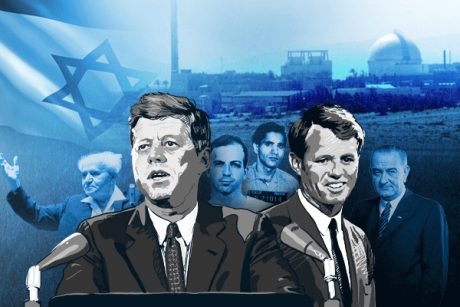
By Laurent Guyénot • Unz Review • June 3, 2018
Introduction
Just after midnight of June 6, 1968, Senator Robert Kennedy was assassinated in a backroom of the Ambassador Hotel in Los Angeles. He had just been celebrating his victory at the California primaries, which made him the most likely Democratic nominee for the presidential election. His popularity was so great that Richard Nixon, on the Republican side, stood little chance. At the age of 43, Robert would have become the youngest American president ever, after being the youngest Attorney General in his brother’s government. His death opened the way for Nixon, who could finally become president eight years after having been defeated by John F. Kennedy in 1960.
John had been assassinated four and a half years before Robert. Had he survived, he would certainly have been president until 1968. Instead, his vice-president Lyndon Johnson took over the White House in 1963, and became so unpopular that he retired in 1968. Interestingly, Johnson became president the very day of John’s death, and ended his term a few months after Robert’s death. He was in power at the time of both investigations.
And both investigations are widely regarded as cover-ups. In both cases, the official conclusion is rife with contradictions. We are going to sum them up here. But we will do more: we will show that the key to solving both cases resides in the link between them. And we will solve them beyond a reasonable doubt. … continue
Blog Roll
 Aletho News
- Putin Conveys to Trump Iran’s Vision on Possible Conflict Resolution – Kremlin
- The Search for Truth: Charlie Kirk’s Assassination One Year Later
- ‘Harsh reality’: Iran says France seeks monopoly on power and intimidation, not peace for all
- When Will This White House Madness End?
- Huckabee aide goes to ‘unusual lengths’ to portray ‘Israel’ positively
- Trump Announces Diesel Supply Deal With Putin Following Phone Call
- MEP blasts ‘Euro-Gestapo’ for lecturing Russia on democracy
- Syria May Send Troops to Saudi Arabia Amid War with Ansar Allah
- UK whines about losing billions to ‘Putin tax’
- Baghaei to Rubio: Distorted narratives cannot erase US record of broken commitments
- If Americans Knew
- Gaza ceasefire exists in name only, say more than 100 organizations
- Nearly 2 Million in Gaza Need Urgent Shelter Assistance as Winter Looms: IOM Chief Warns
- Suppressing Palestinian resistance: US charity under fire for AI monitoring of Gaza classrooms
- Thousands Are Held in Israeli Torture Camps. This Is What Happens Inside
- Israel puts Gaza’s sick, injured, newborn in peril – Daily Update
- Report claimed Mark Levin used by Israeli government to influence Trump
- Over 2,000 Gazans have died awaiting medical evacuation amid Israel’s continued siege
- How a U.S. Diplomat Suppressed and Altered Reports Critical of Israel
- 5 Palestinians Die from Israeli Strikes in Gaza as Relentless Attacks Continue
- Report: Ceasefire Slows Killing but Leaves Devastation Intact
- No Tricks Zone
- New Study: 50 Years Of The Most Aggressive ‘Net Zero’ Policies Can Only Affect The Global Climate By 0.03°C
- US September “Heat” Was No Record…Many Records Set Decades Ago
- Latest European Green Energy Debacle; Portugal’s Largest Flagship Solar Park Insolvent!
- Green Energy Debacle: German Expert Professor Fritz Vahrenholt Warns Of Severe Economic And Social Consequences
- Two More Paleo Reconstructions Affirm Meters-Higher Sea Levels Across Ireland, Brazil 7000-6000 Years Ago
- New Study: Earth And Venus Surface Warmth Largely Explained By Convection And Lapse Rate, Not CO2 Or Radiation
- 2025 Nature Paper Claiming Worsening Global Drought Gets RETRACTED …Heavily Flawed
- New Study: ‘Global Drought Shows No Detectable Recent Acceleration Under Climate Warming’
- Economic Masterminds: German Socialists Suggest Taxing Productivity Gains Stemming From Using AI
- The South China Sea Has Not Been Cooperating With The Climate Change Narrative

