How ‘New Cold Warriors’ Cornered Trump
By Gareth Porter | Consortium News | February 25, 2017
Opponents of the Trump administration have generally accepted as fact the common theme across mainstream media that aides to Donald Trump were involved in some kind of illicit communications with the Russian government that has compromised the independence of the administration from Russian influence.
But close analysis of the entire series of leaks reveals something else that is equally sinister in its implications: an unprecedented campaign by Obama administration intelligence officials, relying on innuendo rather than evidence, to exert pressure on Trump to abandon any idea of ending the New Cold War and to boost the campaign to impeach Trump.
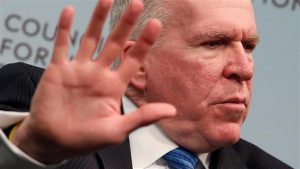 A brazen and unprecedented intervention in domestic U.S. politics by the intelligence community established the basic premise of the cascade of leaks about alleged Trump aides’ shady dealing with Russia. Led by CIA Director John Brennan, the CIA, FBI and NSA issued a 25-page assessment on Jan. 6 asserting for the first time that Russia had sought to help Trump win the election.
Brennan had circulated a CIA memo concluding that Russia had favored Trump and had told CIA staff that he had met separately with Director of National Intelligence James Clapper and FBI Director James Comey and that they had agreed on the “scope, nature and intent of Russian interference in our presidential election.”
In the end, however, Clapper refused to associate himself with the document and the NSA, which agreed to do so, was only willing to express “moderate confidence” in the judgment that the Kremlin had sought to help Trump in the election. In intelligence community parlance, that meant that the NSA considered the idea the Kremlin was working to elect Trump was merely plausible, not actually supported by reliable evidence.
In fact, the intelligence community had not even obtained evidence that Russia was behind the publication by Wikileaks of the e-mails Democratic National Committee, much less that it had done so with the intention of electing Trump. Clapper had testified before Congress in mid-November and again in December that the intelligence community did not know who had provided the e-mails to WikiLeaks and when they were provided.
The claim – by Brennan with the support of Comey – that Russia had “aspired” to help Trump’s election prospects was not a normal intelligence community assessment but an extraordinary exercise of power by Brennan, Comey and NSA Director Mike Rogers.
Brennan and his allies were not merely providing a professional assessment of the election, as was revealed by their embrace of the the dubious dossier compiled by a private intelligence firm hired by one of Trump’s Republican opponents and later by the Clinton campaign for the specific purpose of finding evidence of illicit links between Trump and the Putin regime.
Salacious Gossip
When the three intelligence agencies gave the classified version of their report to senior administration officials in January they appended a two-page summary of the juiciest bits from that dossier – including claims that Russian intelligence had compromising information about Trump’s personal behavior while visiting Russia. The dossier was sent, along with the assessment that Russia was seeking to help Trump get elected, to senior administration officials as well as selected Congressional leaders.
Among the claims in the private intelligence dossier that was summarized for policymakers was the allegation of a deal between the Trump campaign and the Putin government involving full Trump knowledge of the Russian election help and a Trump pledge – months before the election – to sideline the Ukraine issue once in office. The allegation – devoid of any verifiable information – came entirely from an unidentified “Russian emigre” claiming to be a Trump insider, without any evidence provided of the source’s actual relationship to the Trump camp or of his credibility as a source.
After the story of the two-page summary leaked to the press, Clapper publicly expressed “profound dismay” about the leak and said the intelligence community “has not made any judgment that the information in this document is reliable,” nor did it rely on it any way for our conclusions.”
One would expect that acknowledgment to be followed by an admission that he should not have circulated it outside the intelligence community at all. But instead Clapper then justified having passed on the summary as providing policymakers with “the fullest possible picture of any matters that might affect national security.”
By that time, U.S. intelligence agencies had been in possession of the material in the dossier for several months. It was their job to verify the information before bringing it to the attention of policymakers.
A former U.S. intelligence official with decades of experience dealing with the CIA as well other intelligence agencies, who insisted on anonymity because he still has dealings with U.S. government agencies, told this writer that he had never heard of the intelligence agencies making public unverified information on a U.S. citizen.
“The CIA has never played such a open political role,” he said.
The CIA has often tilted its intelligence assessment related to a potential adversary in the direction desired by the White House or the Pentagon and the Joint Chiefs of Staff, but this is the first time that such a slanted report impinges not only on domestic politics but is directed at the President himself.
The egregious triple abuse of the power in publishing a highly partisan opinion on Russia and Trump’s election, appending raw and unverified private allegations impugning Trump’s loyalty and then leaking that fact to the media begs the question of motive. Brennan, who initiated the whole effort, was clearly determined to warn Trump not to reverse the policy toward Russia to which the CIA and other national security organizations were firmly committed.
A few days after the leak of the two-page summary, Brennan publicly warned Trump about his policy toward Russia. In an interview on Fox News, he said, “I think Mr. Trump has to understand that absolving Russia of various actions that it’s taken in the past number of years is a road that he, I think, needs to be very, very careful about moving down.”
Graham Fuller, who was a CIA operations officer for 20 years and was also National Intelligence Officer for the Middle East for four years in the Reagan administration, observed in an e-mail, that Brennan, Clapper and Comey “might legitimately fear Trump as a loose cannon on the national scene,” but they are also “dismayed at any prospect that the official narrative against Russia could start falling apart under Trump, and want to maintain the image of constant and dangerous Russian intervention into affairs of state.”
Flynn in the Bull’s Eye
As Trump’s National Security Adviser, Michael Flynn presented an easy target for a campaign to portray the Trump team as being in Putin’s pocket. He had already drawn heavy criticism not only by attending a Moscow event celebrating the Russian television RT in 2016 but sitting next to Putin and accepting a fee for speaking at the event. More importantly, however, Flynn had argued that the United States and Russia could and should cooperate in their common interest of defeating Islamic State militants.
That idea was anathema to the Pentagon and the CIA. Obama’s Defense Secretary Ashton Carter had attacked Secretary of State John Kerry’s negotiating a Syrian ceasefire that included a provision for coordination of efforts against Islamic State. The official investigation of the U.S. attack on Syrian forces on Sept. 17 turned up evidence that CENTCOM had deliberately targeted the Syrian military sites with the intention of sabotaging the ceasefire agreement.
The campaign to bring down Flynn began with a leak from a “senior U.S. government official” to Washington Post columnist David Ignatius about the now-famous phone conversation between Flynn and Russian Ambassador Sergei Kislyak on Dec. 29. In his column on the leak, Ignatius avoided making any explicit claim about the conversation. Instead, he asked “What did Flynn say, and did it undercut the U.S. sanctions?”
And referring to the Logan Act, the 1799 law forbidding a private citizen from communicating with a foreign government to influence a “dispute” with the United States, Ignatius asked, “Was its spirit violated?”
The implications of the coy revelation of the Flynn conversation with Kislyak were far-reaching. Any interception of a communication by the NSA or the FBI has always been considered one of the most highly classified secrets in the U.S. intelligence universe of secrets. And officers have long been under orders to protect the name of any American involved in any such intercepted communication at all costs.
But the senior official who leaked the story of Flynn-Kislyak conversation to Ignatius – obviously for a domestic political purpose – did not feel bound by any such rule. That leak was the first move in a concerted campaign of using such leaks to suggest that Flynn had discussed the Obama administration’s sanctions with Kislyak in an effort to undermine Obama administration policy.
The revelation brought a series of articles about denials by the Trump transition team, including Vice President-elect Mike Pence, that Flynn had, in fact, discussed sanctions with Kislyak and continued suspicions that Trump’s aides were covering up the truth. But the day after Trump was inaugurated, the Post itself reported that the FBI had begun in late December go back over all communications between Flynn and Russian officials and “had not found evidence of wrongdoing or illicit ties to the Russian government….”
Two weeks later, however, the Post reversed its coverage of the issue, publishing a story citing “nine current and former officials, who were in senior positions at multiple agencies at the time of the calls,” as saying that Flynn had “discussed sanctions” with Kislyak.
The story said Flynn’s conversation with Kislyak was “interpreted by some senior U.S. officials as an inappropriate and potentially illegal signal to the Kremlin that it could expect a reprieve from sanctions that were being imposed by the Obama administration in late December to punish Russia for its alleged interference in the 2016 election.”
The Post did not refer to its own previous reporting of the FBI’s unambiguous view contradicting that claim, which suggested strongly that the FBI was trying to head off a plan by Brennan and Clapper to target Flynn. But it did include a crucial caveat on the phrase “discussed sanctions” that few readers would have noticed. It revealed that the phrase was actually an “interpretation” of the language that Flynn had used. In other words, what Flynn actually said was not necessarily a literal reference to sanctions at all.
Only a few days later, the Post reported a new development: Flynn had been interviewed by the FBI on Jan. 24 – four days after Trump’s inauguration – and had denied that he discussed sanctions in the conversation. But prosecutors were not planning to charge Flynn with lying, according to several officials, in part because they believed he would be able to “parse the definition of the word ‘sanctions’.” That implied that the exchange was actually focused not on sanctions per se but on the expulsion of the Russian diplomats.
Just hours before his resignation on Feb. 13, Flynn claimed in an interview with the Daily Caller that he had indeed referred only to the expulsion of the Russian diplomats.
“It wasn’t about sanctions. It was about the 35 guys who were thrown out,” Flynn said. “It was basically, ‘Look, I know this happened. We’ll review everything.’ I never said anything such as, ‘We’re going to review sanctions,’ or anything like that.”
The Russian Blackmail Ploy
Even as the story of the Flynn’s alleged transgression in the conversation with the Russian Ambassador was becoming a political crisis for Donald Trump, yet another leaked story surfaced that appeared to reveal a shocking new level of the Trump administration’s weakness toward Russia.
The Post reported on Feb. 13 that Acting Attorney General Sally Yates, an Obama holdover, had decided in late January – after discussions with Brennan, Clapper and FBI Director James Comey in the last days of the Obama administration – to inform the White House Counsel Donald McGahn in late January that Flynn had lied to other Trump administration officials – including Vice President Mike Pence – in denying that he discussed sanctions with Kislyak. The Post cited “current and former officials” as the sources.
That story, repeated and amplified by many other news media, led to Flynn’s downfall later that same day. But like all of the other related leaks, the story revealed more about the aims of the leakers than about links between Trump’s team and Russia.
The centerpiece of the new leak was that the former Obama administration officials named in the story had feared that “Flynn put himself in a compromising position” in regard to his account of the conversation with Kislyak to Trump members of the Trump transition.
Yates had told the White House that Flynn might be vulnerable to Russian blackmail because of the discrepancies between his conversation with the Ambassador and his story to Pence, according to the Post story.
But once again the impression created by the leak was very different from the reality behind it. The idea that Flynn had exposed himself to a potential Russian blackmail threat by failing to tell Pence exactly what had transpired in the conversation was fanciful in the extreme.
Even assuming that Flynn had flatly lied to Pence about what he had said in the meeting – which was evidently not the case – it would not have given the Russians something to hold over Flynn, first because it was already revealed publicly and second, because the Russian interest was to cooperate with the new administration.
The ex-Obama administration leakers were obviously citing that clumsy (and preposterous) argument as an excuse to intervene in the internal affairs of the new administration. The Post’s sources also claimed that “Pence had a right to know that he had been misled….” True or not, it was, of course, none of their business.
Pity for Pence
The professed concern of the Intelligence Community and Justice Department officials that Pence deserved the full story from Flynn was obviously based on political considerations, not some legal principle. Pence was a known supporter of the New Cold War with Russia, so the tender concern for Pence not being treated nicely coincided with a strategy of dividing the new administration along the lines of policy toward Russia.
All indications are that Trump and other insiders knew from the beginning exactly what Flynn had actually said in the conversation, but that Flynn had given Pence a flat denial about discussing sanctions without further details.
On Feb. 13, when Trump was still trying to save Flynn, the National Security Adviser apologized to Pence for “inadvertently” having failed to give him a complete account, including his reference to the expulsion of the Russian diplomats. But that was not enough to save Flynn’s job.
The divide-and-conquer strategy, which led to Flynn’s ouster, was made effective because the leakers had already created a political atmosphere of great suspicion about Flynn and the Trump White House as having had illicit dealings with the Russians. The normally pugnacious Trump chose not to respond to the campaign of leaks with a detailed, concerted defense. Instead, he sacrificed Flynn before the end of the very day the Flynn “blackmail” story was published.
But Trump appears to have underestimated the ambitions of the leakers. The campaign against Flynn had been calculated in part to weaken the Trump administration and ensure that the new administration would not dare to reverse the hardline policy of constant pressure on Putin’s Russia.
Many in Washington’s political elite celebrated the fall of Flynn as a turning point in the struggle to maintain the existing policy orientation toward Russia. The day after Flynn was fired the Post’s national political correspondent, James Hohmann, wrote that the Flynn “imbroglio” would now make it “politically untenable for Trump to scale back sanctions to Moscow” because the “political blowback from hawkish Republicans in Congress would be too intense….”
But the ultimate target of the campaign was Trump himself. As neoconservative journalist Eli Lake put it, “Flynn is only the appetizer. Trump is the entree.”
Susan Hennessey, a well-connected former lawyer in the National Security Agency’s Office of General Counsel who writes the Lawfare blog at the Brookings Institution, agreed. “Trump may think Flynn is the sacrificial lamb,” she told The Guardian, “but the reality is that he is the first domino. To the extent the administration believes Flynn’s resignation will make the Russia story go away, they are mistaken.”
The Phony “Constant Contacts” Story
No sooner had Flynn’s firing been announced than the next phase of the campaign of leaks over Trump and Russia began. On Feb. 14, CNN and the New York Times published slight variants of the same apparently scandalous story of numerous contacts between multiple members of the Trump camp with the Russian at the very time the Russians were allegedly acting to influence the election.
There was little subtlety in how mainstream media outlets made their point. CNN’s headline was, “Trump aides were in constant touch with senior Russian officials during campaign.” The Times headline was even more sensational: “Trump Campaign Aides Had Repeated Contacts with Russian Intelligence.”
But the attentive reader would soon discover that the stories did not reflect those headlines. In the very first paragraph of the CNN story, those “senior Russian officials” became “Russians known to U.S. intelligence,” meaning that it included a wide range Russians who are not officials at all but known or suspected intelligence operatives in business and other sectors of society monitored by U.S. intelligence. A Trump associate dealing with such individuals would have no idea, of course, that they are working for Russian intelligence.
The Times story, on the other hand, referred to the Russians with whom Trump aides were said to be in contact last year as “senior Russian intelligence officials,” apparently glossing over a crucial distinction that sources had made to CNN between intelligence officials and Russians being monitored by U.S. intelligence.
But the Times story acknowledged that the Russian contacts also included government officials who were not intelligence officials and that the contacts had been made not only by Trump campaign officials but also associates of Trump who had done business in Russia. It further acknowledged it was “not unusual” for American business to come in contact with foreign intelligence officials, sometimes unwittingly in Russia and Ukraine, where “spy services are deeply embedded in society.”
Even more important, however, the Times story made it clear that the intelligence community was seeking evidence that Trump’s aides or associates were colluding with the Russians on the alleged Russian effort to influence the election, but that it had found no evidence of any such collusion. CNN failed to report that crucial element of the story.
The headlines and lead paragraphs of both stories, therefore, should have conveyed the real story: that the intelligence community had sought evidence of collusion by Trump aides with Russia but had not found it several months after reviewing the intercepted conversations and other intelligence.
Unwitting Allies of the War Complex?
Former CIA Director Brennan and other former Obama administration intelligence officials have used their power to lead a large part of the public to believe that Trump had conducted suspicious contacts with Russian officials without having the slightest evidence to support the contention that such contacts represent a serious threat to the integrity of the U.S. political process.
Many people who oppose Trump for other valid reasons have seized on the shaky Russian accusations because they represent the best possibility for ousting Trump from power. But ignoring the motives and the dishonesty behind the campaign of leaks has far-reaching political implications. Not only does it help to establish a precedent for U.S. intelligence agencies to intervene in domestic politics, as happens in authoritarian regimes all over the world, it also strengthens the hand of the military and intelligence bureaucracies who are determined to maintain the New Cold War with Russia.
Those war bureaucracies view the conflict with Russia as key to the continuation of higher levels of military spending and the more aggressive NATO policy in Europe that has already generated a gusher of arms sales that benefits the Pentagon and its self-dealing officials.
Progressives in the anti-Trump movement are in danger of becoming an unwitting ally of those military and intelligence bureaucracies despite the fundamental conflict between their economic and political interests and the desires of people who care about peace, social justice and the environment.
Venezuelan VP Releases Open Letter to US Treasury as Parliament Demands Resignation
By Lucas Koerner | Venezuelanalysis | February 21, 2016
Caracas – Venezuelan Vice-President Tareck El Aissami published an open letter to the US Treasury Department in the New York Times Tuesday in which he lambasted the body’s recent drug trafficking accusations as an attempt to further derail bilateral relations.
On February 13, the US Treasury Department’s Office of Foreign Assets Control (OFAC) froze all of El Aissami’s alleged assets in the US under the Foreign Narcotics Kingpin Act, making the vice-president the top-ranking official of any country to be sanctioned in this way. In particular, the OFAC accused El Aissami of having “facilitated shipments of narcotics from Venezuela” allegedly in collusion with the Las Zetas Cartel in Mexico.
In the letter, El Aissami charged the OFAC of being “deceived” by certain US political factions “whose fundamental interest is to prevent Venezuela and the United States from restoring their political and diplomatic relations on the basis of mutual recognition and respect”.
The vice-president further lambasted the drug trafficking allegations as a “false positive” which he said was intended to “criminalize – by way of my person – the Bolivarian Government of Venezuela”. The US Treasury Department has yet to release concrete evidence buttressing the accusations; meanwhile no US court has indicated that it is opening an investigation into the case.
El Aissami also highlighted the 62 percent increase in Venezuelan drug busts following the expulsion of the US Drug Enforcement Agency in 2005, which he said evidences Washington’s “egregious failure in the fight against drug trafficking”.
“How many heads of drug trafficking organizations has the US captured in its territory? How many banks and tax havens has the US closed for serving as a financial base for this gigantic business and crime against humanity? … The United States should reflect and rectify,” he wrote in the New York Times.
While El Aissami has received resounding support from President Maduro as well as the nation’s armed forces, the number two official has come under fire from the opposition-controlled National Assembly (AN), which has demanded that he resign from his post.
On Wednesday, a special parliamentary commission headed by Popular Will party legislator Freddy Guevara announced that it was opening an inquiry into the US Treasury allegations and called on the vice-president to step down in order to “facilitate the investigation”.
The AN moreover resolved to formally solicit from the US Congress and the US Treasury Department “the precise information that backs up the claims made so the AN can carry out the corresponding inquiry”.
The legislature additionally called on the Public Prosecutor’s office to provide all information relevant to the case.
Neither the executive branch nor the Public Prosecutor’s office have yet responded to the AN’s resolutions.
Venezuela’s parliament has been declared “null and void” by the Supreme Court over the body’s failure to unseat three legislators from Amazonas state under investigation for alleged electoral fraud.
How Trump Could Be a Truth-teller
By Robert Parry | Consortium News | February 23, 2107
One positive thing about a change in party control of the White House is that the new occupants sometimes release information that the old residents kept hidden because the facts were politically embarrassing or did not support some favored policy.
We saw this in the first days of the Obama administration when President Barack Obama declassified some documents relating to President George W. Bush’s internal policy debates about torture and other abuses from the “war on terror.”
However, as yet, we have seen nothing similar from the Trump administration even though some truth-telling might work very well for President Donald Trump, especially given his reputation for getting facts wrong. A commitment to transparency – giving some truth to the American people on important topics – could change Trump’s image for the better.
Plus, by releasing information that was unjustifiably kept hidden during Obama’s second term, Trump could underscore how Obama grew increasingly obsessive about secrecy the longer he remained in the White House, treating the American people as objects to be manipulated rather than citizens to be informed.
For instance, Obama kept the clamps on CIA analyses relating to the Ukrainian crisis, even regarding the shoot-down of Malaysia Airlines Flight 17 over eastern Ukraine on July 17, 2014, killing 298 people and leading to a dangerous escalation in the New Cold War with Russia.
After the crash, the Obama administration quickly steered the Western media toward blaming President Vladimir Putin and got the European Union to join in economic sanctions against Russia.
However, after exploiting the rush to judgment against Putin, the Obama administration went silent, withholding U.S. intelligence evidence even from the official crash investigators. The more the administration learned about the tragic event and who was responsible the less it wanted to say.
At the time, I was told that the reason was that some senior CIA analysts were uncovering evidence that went in an inconvenient direction, suggesting a rogue Ukrainian operation connected to a hardline oligarch with the intent of shooting down a Russian jetliner, possibly even the one carrying Putin back from a state visit in South America, but instead brought down MH-17, which had similar markings.
To spread confusion and create some deniability for the attack, the scheme supposedly called for launching the missile from as deep inside “rebel-controlled” territory as possible.
A Closed File
The source described getting this briefing from U.S. intelligence analysts, but I was unable to get the CIA or the Office of Director of National Intelligence to provide any guidance. Instead, they clammed up, claiming that they didn’t want to “prejudice” the official Dutch-led investigation (although I pointed out that the hasty U.S. finger-pointing at Russia had already done that).
The refusal of the Obama administration to open its MH-17 files allowed the “Dutch-led” Joint Investigation Team (JIT) to be effectively taken over by Ukraine’s unsavory SBU intelligence agency, which oversaw the care and feeding of Dutch and Australian investigators who decamped for long periods in Kiev.
The SBU’s “evidence” became central to the JIT’s investigation although the SBU was deeply involved in the war against the ethnic-Russian Ukrainian rebels and was even denounced by United Nations investigators for blocking access to alleged SBU torture centers. Beyond that, part of the SBU’s mandate was to protect Ukrainian government secrets, so the SBU had obvious conflicts of interest.
Nevertheless, the JIT relied on SBU-provided telephone “intercepts” of cryptic Russian-language conversations to base its conclusion that Russia provided the rebels a Buk missile system on the night of July 16, 2014, which was then taken on a strangely circuitous route far to the west before circling back to the east to a location far from the battlefront where it shot down MH-17 on July 17 and then was driven back to Russia that evening, again taking an unnecessarily long way home.
Though there were numerous holes in the SBU’s evidence and serious questions about why the Buk would have taken its bizarrely long ride – when a much more direct and discreet route was available – the Western media again showed no skepticism, simply accepting Russian guilt as established fact and dismissing any alternative explanation as “fanciful.”
The Value of Truth
However, whatever the truth is – whether the Russians and their rebel allies were responsible for the tragedy or whether a rogue Ukrainian operation brought down MH-17 – there is no reason why President Trump shouldn’t instruct CIA Director Mike Pompeo to release as much of the U.S. intelligence analysis as possible.
First, the families of the dead deserve all the help that the U.S. government can provide to identify the killers and bring them to justice. Second, by releasing the MH-17 file, President Trump can demonstrate that he does care about truth in contrast to President Obama who mysteriously withheld this information for 2½ years and thus gave the culprits, whoever they are, time to escape and cover their tracks.
Further, if the file blames the Russians, releasing it would show that Trump is not in Putin’s pocket, as many people in Official Washington claim. And, if the file implicates an element of the Ukrainian government – even a rogue faction – that might relieve geopolitical tensions with Russia and open possible paths for resolving the Ukrainian crisis.
The Trump administration also could consider other topics for declassification, such as the circumstances surrounding the U.S-backed coup that ousted elected Ukrainian President Viktor Yanukovych on Feb. 22, 2014. U.S. intelligence surely was following those events closely and could clarify the roles of Assistant Secretary of State Victoria Nuland, U.S. Ambassador to Ukraine Geoffrey Pyatt and Sen. John McCain, who all cheered on and encouraged violent protests that preceded the coup.
Obama also hid the intelligence regarding the mysterious sarin gas attack outside Damascus, Syria, on Aug. 21, 2013, which Secretary of State John Kerry and others blamed on the Syrian government although later evidence seemed to implicate jihadist rebels who wanted to trick the U.S. military into intervening directly in the war on their side.
Given the importance of those turning-point moments – and the Obama administration’s attempts to exploit them for geopolitical ends – the American people deserve to know what the U.S. intelligence analysts ultimately concluded and whether President Obama’s team was telling the truth or had gotten lost in the Orwellian idea of “perception management.”
President Trump might find that he can begin to turn around his reputation as a person who doesn’t care about the truth by becoming a truth-teller.
Investigative reporter Robert Parry broke many of the Iran-Contra stories for The Associated Press and Newsweek in the 1980s.
Media bias is real, and everywhere
By Yves Engler · February 22, 2017
Can you trust any media outlet to tell the truth about foreign affairs? Or are they all part of some propaganda system? Perhaps the best we can do to understand what’s really happening in the world is read/listen/watch a variety of sources, but assume they are all biased in one way or another?
These questions came to mind after a recent Montréal event about Syria.
In a La Presse article, international affairs reporter Agnès Gruda essentially dismissed a presentation by a freelance journalist who has covered the war in Syria by writing: “for who does Eva Bartlett really work? During her conference, she confirmed that she wrote commentaries for Russia Today — a Russian propaganda organ.”
Gruda isn’t the only reporter to highlight Bartlett’s ties to RT when discussing her Syria work. A Hamilton Spectator story about her talks in that city noted, “Bartlett maintains a blog for the state-funded media outlet Russia Today” while Pulse reported that she contributed to the “Kremlin broadcaster Russia Today.” (Bartlett has published five articles about Syria for RT.)
Of course, the question of where journalists publish or who employs them and the interests of the owners/funders of said media does deserve attention. It is not unreasonable to be skeptical of a Russian media outlet’s reporting on Syria. While I’m not current with RT, it’s hard to imagine that a station set up by the Russian government wouldn’t be biased in favor of Moscow’s position in a conflict it is a major player in.
But, does Gruda describe herself as an employee of the billionaire Desmarais family that is heavily involved in Canadian and other countries’ politics? How does Gruda describe journalists who’ve written for Al Jazeera, which is owned by a Qatari monarchy that has backed armed opposition to Assad? Or how about the BBC, CBC and other media outlets owned by governments?
Does Gruda offer readers similar background on journalists who’ve worked on a National Film Board documentary? Created as part of the Canadian government’s World War II propaganda arsenal, the 1950 National Film Board Act calls for it to “promote the production and distribution of films in the national interest.”
Or, does she mention journalists’ ties when they have freelanced for Radio Canada International, a “Canadian government propaganda arm”? Initially focused on Eastern Bloc countries, beginning in 1945 RCI beamed radio abroad as part of “the psychological war against communism”, according to external minister Lester Pearson. Early on External Affairs was given a copy of the scripts used by commentators and it responded to criticism of Canada’s international policies. Into the 1990s RCI’s funding came directly from External Affairs.
Or what about the Canadian Press ? The influential media institution has significant historic ties to official Canadian international policy. During World War I Ottawa helped establish the Canadian Press to increase pro-war coverage and strengthen national identity. A predecessor newswire disseminated Associated Press stories in Canada but the war spurred criticism of the US news agency, which did not cheerlead British/Canadian policy loud enough for some (Washington had yet to join the fighting). “In effect, an arm of the British Foreign Ministry”, Reuters offered Canadian newspapers free wire copy during the war. But, the British press agency would only deliver the service to Ottawa. If the federal government “wanted to ensure that this pro-war imperial news service was distributed effectively across the country”, it had to subsidize a telegraph connection to the West Coast. To support CP the federal government put up $50,000 ($800,000 in today’s dollars) a year, which lasted for six years.
CP “cemented” itself as Canada’s national news service during World War II. “To accomplish this,” Gene Allen writes in a history of the organization, “CP cultivated unprecedentedly close relations with Canada’s military authorities — who had reasons of their own for wanting extensive coverage of the national war effort — and thereby moved some distance away from traditional notions of journalistic independence.” In an extreme example, CP recruited a Canadian Forces public relations officer who led reporters into battle zones. Bill Boss remained with the same unit but began reporting for the news service and would become one of Canada’s most famous war correspondents.
Nationalism remains an important media frame at the CP. “As a warcorrespondent in the 1990s”, former CP reporter Stephen Ward describes facing nationalist pressures. “I came under pressure to be patriotic when reporting on Canadian soldiers or peacekeepers in the former Yugoslavia and elsewhere [Iraq] … I should not embarrass Canada by reporting on mistakes in the field; I should not quote soldiers puzzled about their mission; I should do ‘feel-good’ pieces about soldiers watching hockey via satellite in warring Bosnia.”
Most Canadian media face similar pressures in their international coverage, as I detail in A Propaganda System: How Canada’s Government, Corporations, Media and Academia Sell War and Exploitation.
Certainly Russia’s foreign affairs machinery isn’t the only one that shapes international coverage. Highlighting Russia’s “propaganda system” to a Canadian audience without mentioning the one at home indicates either a journalist’s ignorance or that she is part of it.
NYT’s Fake News about Fake News
By Robert Parry | Consortium News | February 22, 2017
A grave danger from the Western mainstream media’s current hysteria about “fake news” is that the definition gets broadened from the few made-up stories that are demonstrably false – often fabricated by kids to get more clicks – to include reasonable disputes about the facts of a complex controversy.
This danger has grown worse because The New York Times, The Washington Post and other major Western news organizations have merged their outrage over “fake news” with the West’s propaganda campaign against Russia by claiming without evidence that the Russian government is somehow putting out false stories to undermine Western democracy.
However, when news organizations actually track down “fake news” outlets, they are usually run by some young entrepreneurs from outside Russia who saw made-up stories as a way to increase revenue by luring in more readers eager for “information” that supports their prejudices.
Yet, a front-page Times article on Tuesday, citing “fake news” as a threat to Europe, contains what arguably is “fake news” itself by claiming that many of the purported 2,500 stories “discredited” by the European Union’s East Stratcom operation have “links to Russia” although the Times doesn’t identify those links.
The article by Mark Scott and Melissa Eddy then goes on to blur these two separate concepts: “In a year when the French, Germans and Dutch will elect leaders, the European authorities are scrambling to counter a rising tide of fake news and anti-European Union propaganda aimed at destabilizing people’s trust in institutions.”
But it is this mushing together of “fake news” and what the Times describes as “anti-European Union propaganda” that is so insidious. The first relates to consciously fabricated stories; the second involves criticism of a political institution, the E.U., which is viewed by many Europeans as elitist, remote and disdainful of the needs, interests and attitudes of average citizens.
Whether you call such criticism “propaganda” or “dissent,” it is absurd to blame it all on Russia. When it comes to “destabilizing people’s trust in institutions,” the E.U. — especially with its inept handling of the Great Recession and its clumsy response to the Syrian refugee crisis — is doing a bang-up job on its own without Russian help.
Yet, rather than face up to legitimate concerns of citizens, the E.U. and U.S. governments have found a convenient scapegoat, Russia. To hammer home this point — to make it the new “groupthink” — E.U. and U.S. leaders have financed propaganda specialists to disparage political criticism by linking it to Russia.
Even worse, in the United States, the Times and other mainstream publications – reflecting the views of the political establishment – have editorialized to get giant technology companies, like Facebook and Google, to marginalize independent news sites that don’t accept the prevailing conventional wisdom.
There is an Orwellian quality to these schemes — a plan for a kind of Ministry of Truth enforced by algorithms to weed out deviant ideas — but almost no one whose voice is allowed in the mass media gets to make that observation. Even now, there is a chilling uniformity in the endless denunciations of Russia as the root of all evil.
Though the Times’ article treats the E.U.’s East Stratcom operatives as 11 beleaguered public servants sticking their fingers in the dike to protect the citizenry from a flood of Russian disinformation, “stratcom” actually is a euphemism for psychological operations, i.e., the strategic use of communications to influence the thinking of a target population.
In this case, the target populations are the European public and – to an ancillary degree – the American people who get to absorb the same propaganda from The New York Times. The real goal of stratcom is not to combat a few sleazy entrepreneurs generating consciously false stories for profit but to silence or “discredit” sources of information that question the E.U. and U.S. propaganda.
More Stratcom
NATO has its own Stratcom command based in Latvia that also is assigned to swat down information that doesn’t conform to Western propaganda narratives. The U.S. Agency for International Development and the U.S.-funded National Endowment for Democracy also pour tens of millions of dollars into media operations with similar goals as do major Western foundations, such as currency speculator George Soros’s Open Society. Last December, the U.S. Congress approved and President Obama signed legislation to create an additional $160 million bureaucracy to combat “Russian propaganda.”
In other words, the West’s stratcom and “psychological operations” are swimming in dough despite the Times’ representation that these “anti-disinformation” projects are unfairly outgunned by sinister forces daring to challenge what everyone-in-the-know knows to be true.
If these “stratcom” operations were around in 2002-2003, they would have been accusing the few people questioning the Iraq-has-WMD certainty of putting out “fake news” to benefit Saddam Hussein. Now, journalists and citizens who don’t buy the full-Monte demonization of Russia and its President Vladimir Putin are put into a similar category.
Instead of trusting in the free exchange of ideas, the new attitude at the Times, the Post and other Western news outlets is to short-circuit the process by smearing anyone who questions the official narratives as a “Putin apologist” or a “Moscow stooge.”
Beyond being anti-democratic, this anti-intellectual approach has prevented serious examination of the facts behind the West’s war or words against Russia. To shut down that debate, all you need to do is to say that any fact cited at a Russian news outlet must be false or “fake news.” Any Westerner who notes the same fact must be a “Putin puppet.”
Western “stratcom” doesn’t even want to allow Russian media to criticize politicians who are criticizing Russia. The Times article lamented that “Many false claims target politicians who present the biggest obstacles to Moscow’s goal of undermining the European Union.” The Times, however, doesn’t offer any examples of such “false claims.”
Instead, the Times writes that Russian news channels had “targeted the [French] presidential candidate Emmanuel Macron, who belongs to the party and is running on a pro-European Union platform.”
But what does that mean? Is it now an act of aggression when newscasts in one country criticize a leader of another country? If so, are the European news channels that have “targeted” U.S. President Donald Trump somehow deserving of U.S. government retaliation? Doesn’t the E.U. – and by extension The New York Times – accept the idea of political disagreement and debate?
This closed-mindedness is especially dangerous – indeed existentially risky – when applied to a confrontation between nuclear-armed powers. In such a case, the maximum amount of debate should be encouraged, instead of what amounts to blacklisting dissidents in the West who won’t toe the official propaganda lines.
Media Censors
Disturbingly, the leading forces in this suppression of skepticism are the most prestigious newspapers in the United States and Europe. Even after the disastrous experience with the Iraq War and the bogus WMD groupthink, Western news outlets that were party to that fiasco have virtually excluded well-reported articles and documentaries that question the U.S. and E.U. narratives of the New Cold War.
For instance, there has been almost no presentation in the mainstream Western media of an alternative – and I would argue more complete and accurate – narrative of the Ukraine conflict, taking into account the country’s complex history and deep ethnic divisions.
It is essentially forbidden to refer to the violent overthrow of elected President Viktor Yanukovych three years ago as a “coup” or a “putsch” or to cite evidence of a U.S.-backed “regime change,” such as an intercepted phone call between U.S. Assistant Secretary of State Victoria Nuland and U.S. Ambassador to Ukraine Geoffrey Pyatt in which they discussed how to “glue” and how to “midwife” the installation of a new leadership in Kiev.
In the supposedly “free” West, you can only refer to the post-coup events in Crimea, in which the people of the largely ethnic Russia area voted overwhelmingly to secede from Ukraine and rejoin Russia, as a “Russian invasion.” No skepticism is allowed even though there were no images of Russian troops wading ashore on Crimea’s beaches or Russian tanks crashing across borders. The “invasion” supposedly happened even though no invasion was necessary because Russian troops were already in Crimea under the naval basing agreement at Sevastopol.
Amid the West’s current hysteria about “Russian propaganda,” U.S. and E.U. citizens are not even given the opportunity to watch well-reported documentaries about key moments in the New Cold War, including an eye-opening investigative report debunking the Western propaganda myth constructed around the death of Russian accountant Sergei Magnitsky or a well-produced historical account of the Ukraine crisis.
Western news outlets and governments even take pride in blocking such dissenting views and contrary information from reaching the American and European publics. Like East Stratcom — the E.U.’s Brussels-based 11-member team of diplomats, bureaucrats and former journalists — establishment institutions see themselves bravely battling “Russian disinformation.” They see it as their duty not to let their people hear this other side of the story.
If that is what the West’s institutions have come to — dismissing reasonable criticism and thoughtful dissent as “Russian disinformation” — is it any wonder that they are losing the confidence of their people?
Investigative reporter Robert Parry broke many of the Iran-Contra stories for The Associated Press and Newsweek in the 1980s.
Windows 10 Devices Continue to ‘Collect Everything You Do, Say and Write’
Sputnik – 21.02.2017
European Union data protection authorities have expressed fresh concerns about the privacy of Microsoft’s Windows 10 operating system, despite tweaks being made to the OS after questions were raised about its treatment of personal data last year.
In a letter, the Article 29 Working Group said it still has “significant concerns” about how Microsoft collects and processes users’ personal data, and whether it obtains fully informed consent from users to do so.
“There is an apparent lack of control for users to prevent collection or further processing of such data. As a result, the Working Party specifically requests further explanatory information from Microsoft, as to how the opt-outs, default settings and other available control mechanisms presented during the installation of Windows 10 operating system provide a valid legal basis for the processing of personal data under the Data Protection Directive 95/46/EC. This is especially of concern where Microsoft would rely on consent as a legal basis for the processing of personal data,” the statement said.
Windows 10 launched in July 2015, and almost immediately garnered criticism for the use of default settings to harvest voluminous amounts of user data, such as web browsing history, WIFI network names and passwords, in order to display personalized adverts as users browse the web or play games. User data is also fed in to train Microsoft’s Cortana digital assistant.
While users were given the ability to opt-out of data collection, the process for doing so was criticized for being complex and opaque, comprising 45 pages of privacy policy documents, with opt-out settings spread across 13 different screens and housed on an external website.
In response, the Article 29 Working Party instigated an investigation, as did several national data protection authorities, including France’s CNIL. Their independent conclusions were much the same; the company must stop excessive data collection.
Among the breaches CNIL accused Microsoft of were failing to obtain notice for data transfers, breaking cookie law requirements, having inadequate security protections for personal data, failure to file an authorization request for processing personal data for fraud prevention purposes, and breach of cross-border data transfer restrictions.
CNIL set a deadline of January 31 for Microsoft to comply with their recommendations, although the Working Group’s warning suggests the tech giant is yet to fulfil their obligations, meaning it can be fined. In all, Microsoft could face fines of up to US$3.2 million for breaches of domestic privacy laws.
The EU General Data Protection Regulation, due to come into force May 2018, increases the potential penalties for companies breaching EU data protection law, with fines of up to four percent of annual turnover for enterprises found to be non-compliant.
The issue of informed consent in respect of data sharing has also seen Facebook and WhatsApp fall foul of European regulators; the companies were forced to suspend data sharing after making a change to WhatsApp’s privacy policy that pushed users to consent to sharing information such as their mobile phone number with the messaging app’s parent company.
In a statement, European Digital Rights said Microsoft “grants itself very broad rights to collect everything you do, say and write” on Windows 10-equipped devices in order to sell more targeted advertising or to sell your data to third parties.
“The company appears to be granting itself the right to share your data either with your consent “or as necessary.” Microsoft’s updated privacy policy is not only bad news for privacy. Your free speech rights can also be violated on an ad hoc basis,” the statement said.
Israeli minister backtracks on claims of vehicular attack during Umm al-Hiran raid

Israeli Public Security Minister tell Israel’s Channel 10 on Jan.18: “Unequivocally, yes, this is a terror attack.”
Ma’an – February 22, 2017
BETHLEHEM – More than a month after Israeli police shot and killed Yaqoub Abu al-Qian in the Bedouin village of Umm al-Hiran during a demolition raid, Israel’s Public Security Minister Gilad Erdan seemingly backtracked on his initial claim that Abu al-Qian was carrying out a vehicular attack motivated by Islamic extremism when he was shot.
Following the incident, multiple eyewitnesses, video footage, and testimonies from Abu al-Qian’s family members contradicted the minister’s claim, saying that Israeli police opened fire on the local high school math teacher when he posed no threat, which caused him to lose control of the vehicle and ram into Israeli policeman Erez Levi, who was also killed.
On Wednesday, Israeli media sites reported that remarks made by Erdan at a police gathering in Beersheba implied that Israeli authorities were no longer classifying the incident as a terror attack.
Israeli daily Haaretz quoted Erdan as referring to the incident as “difficult and regrettable,” adding that “we mustn’t let anyone try to take this particular incident — in which unfortunately both a policeman and a civilian were killed — and draw inferences from it regarding the totality of the relationship between the Bedouin population and the police.”
“We must learn the lessons, once it becomes clear what exactly happened there,” he added, noting that an investigation by Israel’s Justice Ministry on the case was still ongoing. “Then we must go forward, strengthen this relationship, and bolster police services and enforcement against lawbreakers who first and foremost hurt our beloved Bedouin community, with which we want to continue living in coexistence in the Negev.”
The comments seemed to imply that Israeli authorities sought to distance themselves from the minister’s comments immediately following incident, when he said that “the picture arising from the police probe was very clear: This was an attack, a deliberate car-ramming.”
Erdan had also told Israel’s Radio Darom at the time: “After the investigation concludes, if it turns out the police were wrong, I too will demand explanations from them,” he said. “But to present this as if it were one person’s story versus another when a policeman has been murdered in an attack — I think that’s wrong and inappropriate.”
Erdan and Israeli police spokesperson Micky Rosenfeld had said that during a raid of Abu al-Qian’s home the day of his killing that police found three copies of a Hebrew-language newspaper from 2015 with the headline: “ISIS bomb that took down a plane,” which was presented as the only evidence to back up the claim that the man carried out an attack motivated by Islamic extremism.
However, according to Haaretz, Israel’s internal security agency the Shin Bet reported two weeks after the incident that they had yet to find any actual evidence connecting Abu al-Qian to ISIS.
Human rights organization Adalah responded to Erdan’s recent remarks — which it interpreted as an announcement by police that the Umm al-Hiran killing was not a terror attack — saying: “From the outset, Adalah maintained that the version of events in Umm al-Hiran promoted by the Israeli police and (Erdan) was both false and inflammatory.”
The organization noted that it had filed an appeal to the Israeli Justice Ministry’s Police Investigative Division (PID) on behalf of the Abu al-Qian family on the day of his killing, and that it had also appealed to Israeli Attorney General Avichai Mandelblit demanding that he open an investigation into Erdan’s “racist incitement against Arab citizens of Israel.”
Responding to reports interpreting Erdan’s comments as backtracking, Israeli police spokeswoman Luba al-Samri reiterated in a written statement that an investigation was still ongoing and that “the information being spread to public is one interpretation and incomplete, and fails to include details of the case’s many sides.”
Israeli Police Commissioner Ronnie al-Sheikh also responded to reports, telling Israeli news site Ynet : “I can’t be responsible for any unofficial publications. I do know with certainty, from the head of the Police Investigations Unit, that conclusions have yet to be reached.”
In the wake of the deadly incident, members of the Joint List, which represents parties led by Palestinian citizens of Israel in the Knesset, also accused police of intentionally covering up the fact that they shot Abu al-Qian in cold blood.
Joint List MKs had traveled to Umm al-Hiran to help locals attempting to resist the demolitions, when the head of the coalition, Ayman Odeh, was injured after being shot in the head by police with sponge-tipped bullet when clashes erupted with police.
Erdan had accused Odeh of traveling to Umm al-Hiran to “incite violence” and warned that there might be “criminal implications for him.”
Erdan also said on social media that “any attempts to murder police securing a court-ordered evacuation will get the same response,” referring to the killing of Abu al-Qian.
Abu al-Qian’s death and the subsequent demolition of more than a dozen homes in Umm al-Hiran sparked widespread outrage and numerous demonstrations attended by thousands, with protesters calling on Erdan to resign for “lying” to the Israeli public, saying they held him responsible for the two killings. … Full article
President’s Quest for Détente with Russia Continues Despite Fierce Opposition
By John V. Walsh | Dissident Voice | February 21, 2017
President Trump rose from the ashes of Mike Flynn at his press conference last Thursday. In a bravura performance, defiant and funny at times, the President took on the corporate media en masse.
It is a performance that should not be missed. You can savor both video and transcript at your leisure here.
The press
Trump: “Unfortunately, much of the media in Washington, D.C., along with New York, Los Angeles in particular, speaks not for the people, but for the special interests and for those profiting off a very, very obviously broken system. The press has become so dishonest that if we don’t talk about it, we are doing a tremendous disservice to the American people. Tremendous disservice. We have to talk to find out what’s going on, because the press honestly is out of control. The level of dishonesty is out of control.”
Sounds like what many “progressives” have been saying for a mighty long time, and it deserves resounding applause from them.
Trump: “And I’ll tell you what else I see. I see tone. You know the word ‘tone.’ The tone is such hatred. I’m really not a bad person, by the way. No, but the tone is such — I do get good ratings, you have to admit that — the tone is such hatred.”
And: “Now, I will say this. I watch it. I see it. I’m amazed by it. The public gets it, you know. Look, when I go to rallies, they turn around, they start screaming at CNN. They want to throw their placards at CNN. You know.”
The bias of the press against Trump is so obvious and heavy handed that no one can miss it. I asked one friend who is an avid and careful reader of the NYT whether he could name a single pro-Trump article over the last year. He could not. Does the press believe that the public are such fools that they cannot see this tone? This is but one more sign of the contempt that the clueless Elite have for the working stiff.
Russia and Putin
The most important point of the press conference was undoubtedly Trump’s refusal to back off one inch from his desire to “get along with Russia,” what some call New Détente or Détente 2.0. It is the most important, because tension between the two nuclear powers could well lead to war and nuclear exchange. For anti-warriors of every stripe Trump’s steadfastness was good news. The Flynn episode has not changed Trump’s resolve one iota.
Trump continued. Were he to denounce Russia and Putin, he instructed the press, it would be much easier for him politically. He would be hailed by the corporate press, the elitists of both Parties, the neocons, the Hillarycons and the entire foreign policy establishment, all of whom are itching for a fight, heedless that it might lead to a nuclear exchange. So Trump’s willingness to hold to this position is hardly opportunistic.
But he went farther. Trump let the press know that the atmosphere they are creating would make it difficult to negotiate with Putin, to defeat ISIS, or to bring an end to the crises in Ukraine or Syria nurtured by the US over the last six plus years. Why? Because he would have difficulty making concessions, giving as well as taking which any negotiation or deal demands. Any concession would trigger the charge that Trump is Putin’s puppet, the crazed mantra with which we are harangued daily and for which after all these many months there is not a shred of evidence. This is the very same point that Stephen F. Cohen, Emeritus Professor of Russian History at Princeton and NYU, often makes in his weekly discussions (Jan.25 episode especially) of U.S., Russia relations with John Batchelor on WABC.
Trump: “But I want to just tell you, the false reporting by the media, by you people, the false, horrible, fake reporting makes it much harder to make a deal with Russia. And probably Putin said ‘you know.’ He’s sitting behind his desk and he’s saying ‘you know, I see what’s going on in the United States, I follow it closely. It’s going to be impossible for President Trump to ever get along with Russia because of all the pressure he’s got with this fake story.’ OK? And that’s a shame because if we could get along with Russia — and by the way, China and Japan and everyone. If we could get along, it would be a positive thing, not a negative thing.” (Emphasis, jw).
And later, Trump: “But you know what? I want to do the right thing for the American people. And to be honest, secondarily, I want to do the right thing for the world.
If Russia and the United States actually got together and got along — and don’t forget, we’re a very powerful nuclear country and so are they. There’s no upside. We’re a very powerful nuclear country and so are they. I have been briefed. And I can tell you one thing about a briefing that we’re allowed to say because anybody that ever read the most basic book can say it, nuclear holocaust would be like no other. (Emphasis, jw)… They’re a very powerful nuclear country and so are we. If we have a good relationship with Russia, believe me, that’s a good thing, not a bad thing.”
The idea of “getting along” with other nations, even as we compete with them economically, is of course the way to peace and the very antithesis of the path the neocons and liberalcons from the Clintons to Bush to Obama have set us on these past thirty plus years of killing and destruction. And yet the “peace movement” expresses nothing but hatred for Trump and pushes for his impeachment. Some “peace” movement, that.
Back to l’affaire Flynn for a moment. Permit this writer to make a surmise, scarcely a ripple on the sea of surmises these days about the Deep State, Trump etc. Flynn did nothing illegal. Trump did not have to let him go, and it can easily be argued that Trump may have kept blood out of the water by sticking by Flynn and keeping him on. Flynn has been an asset. He is a champion of Détente 2.0 with Russia. He knows the national “intelligence” apparatus and where all its skeletons are closeted. He seems to know the deep story of the support that the Obama and Hillary forces gave to ISIS – certainly indirectly through US allies and probably also directly through the CIA, Mossad etc. But Flynn is also a man near crazed with an irrational bellicosity to Iran. That would have thrown a monkey wrench into Détente 2.0 since Russia and Iran have close ties especially in the fight against Sunni fundamentalist terrorism. So sooner or later Flynn had to go to preserve Détente 2.0. Did Trump take this opportunity to do so? And did Tillerson also crave this? It is a suspicion worth pondering. Trump has shown a cold-blooded capacity to say “you’re fired” when someone’s liabilities outweigh their assets. This writer suspects that Flynn’s time had come.
John V. Walsh can be reached at john.endwar@gmail.com.
Ambassador Nikki Haley is Completely Clueless
By Daniel McAdams | Ron Paul Institute | February 21, 2017
Just when we thought the great national embarrassment of a UN Ambassador Samantha Power was over, we are suddenly faced with a new US Ambassador to the United Nations, Nikki Haley, who almost makes Ms. Power look like a giant in world affairs and diplomacy.
Addressing the UN Security Council Open Debate on Conflicts in Europe today, Ambassador Haley managed to get nearly every single point spectacularly wrong while mixing in the most banal of platitudes to further deaden the delivery.
Said Haley:
It can be tempting to take Europe’s peace and security for granted. Europe is a continent of strong, stable democracies. And Europe is a continent of flourishing economies that benefit from close cooperation.
But Europe faces serious challenges – most acutely, Russia’s attempts to destabilize Ukraine and infringe upon Ukraine’s sovereignty and territorial integrity.
How exactly is Russia attempting to destabilize Ukraine? It was Russia, after all, and not the US, which called together the opposing sides two years ago to hammer out the “Minsk II” ceasefire and reconciliation agreement. Was not that in fact a stabilizing move rather than a destabilizing move?
Haley continues:
More than three years ago, the Ukrainian people took to the streets to speak out against political oppression and corruption. These protesters demanded freedom, democracy, and respect for the rule of law, and they succeeded in creating a new Ukraine.
That is not all what happened. It was the “protestors” who started the killing. They targeted police officers to provoke a response and thus add fuel to the simmering flame of months long protests in 2014. Russian propaganda, you say? Not at all. The killers went on television to brag about it!
Here is the story of one of the cop killers, Ivan Bubenchik, as reported in Foreign Policy magazine (hardly a pro-Russia outlet) and told on camera to Ukraine’s Hromadske TV station:
To create a word of mouth effect, you have to shoot two or three [police] commanders I only picked two. And after that, there was no need to kill anyone else, so I aimed at the legs.
Does Nikki Haley support killing police officers?
Another report — this time in the BBC — told the same story. It was Nikki Haley’s peaceful protestors who started the violence by shooting at police:
The protest leaders, some of whom now hold positions of power in the new Ukraine, insist full responsibility for the shootings lies with the security forces, acting on behalf of the previous government.
But one year on, some witnesses are beginning to paint a different picture.
‘I was shooting downwards at their feet,’ says a man we will call Sergei, who tells me he took up position in the Kiev Conservatory, a music academy on the south-west corner of the square.
‘Of course, I could have hit them in the arm or anywhere. But I didn’t shoot to kill.’
Sergei says he had been a regular protester on the Maidan for more than a month, and that his shots at police on the square and on the roof of an underground shopping mall, caused them to retreat.
Does Nikki Haley believe shooting police officers is justified as long as you’re demanding “respect for the rule of law”?
In fact, the overthrow of the government in Ukraine was not at all set in motion by the Ukrainian people. It was planned in Washington and executed in the streets of Kiev, where US policymakers openly urged an overthrow of the elected Ukrainian government.
It is established fact that US Assistant Secretary of State Victoria Nuland was on the streets of Kiev with US Ambassador to Ukraine Geoffrey Pyatt meeting with the protesters, encouraging them, and handing out food. Later she was caught in a phone call with the US Ambassador plotting in detail the overthrow of the government and how to replace it with Washington’s picks.
Senator John McCain (R-AZ) was also on the streets of Kiev during the early stages of the coup. He was actively supporting the overthrow of Ukraine’s legal government. Said McCain:
We are here to support your just cause, the sovereign right of Ukraine to determine its own destiny freely and independently. And the destiny you seek lies in Europe…
Later on CNN, McCain admitted his role in the coup, stating:
What we’re trying to do is try to bring about a peaceful transition here…
How would Senator McCain react were a Russian member of parliament appear in the midst of a Washington, D.C. riot urging “a peaceful transition here”?
Trump’s Ambassador to the UN continued:
But Russia has tried to prevent the change that the Ukrainian people demanded. Russia occupied Crimea and attempted to annex this piece of Ukrainian territory – an act the United States does not recognize.
That is also demonstrably false. Russia did not “occupy” Crimea because the Russian military was already in Crimea! Russia had leased the naval base in Crimea from the Ukrainian government until 2042. The troops were already there. Russia did not attempt to annex Crimea, but rather a referendum was held in which, according to the BBC, 90 percent of the residents voted to rejoin Russia (of which they had been a part since the 18th century).
Surely this is fake news! Why would Crimeans vote to leave Ukraine and join Russia? In fact Russians make up more than 65 percent of the population of Crimea and when the US-backed coup brought to power a vehemently anti-Russian government in Kiev was it really so surprising that the people would look for the exit signs?
Haley continues:
Russia then armed, financed, and organized separatist forces in eastern Ukraine, leading to a devastating and senseless conflict that has cost more than 10,000 lives.
Again untrue. The rebellion in eastern Ukraine was fueled by the US-backed coup in Kiev. Eastern Ukraine is predominantly Russian-speaking and in some parts of the region 96 percent voted for the president ousted with US support. As one might expect, unrest follows when one’s president is overthrown with assistance from an outside power. And it was the US who did the arming, financing, and organizing the unelected coup forces who took power in Kiev.
More Haley:
The scenes of destruction from the town of Avdiivka in recent weeks show the consequences of Russia’s ongoing interference in Ukraine.
Avdiivka fell under attack after the Kiev forces advanced into the no-man’s land separating the opposing sides. Ukrainian deputy defense minister Pavlovaky admitted that “meter by meter, step by step, whenever possible our boys have been advancing.”
You get the point. US Ambassador to the UN Nikki Haley has no clue what is happening in eastern Ukraine and so has just dusted off the dusty old talking points of the Obama Administration.
While on the campaign trail last year, Donald Trump sharply (and correctly) criticized the Obama Administration’s militaristic foreign policy. At the time Trump said:
…unlike other candidates for the presidency, war and aggression will not be my first instinct. You cannot have a foreign policy without diplomacy. A superpower understands that caution and restraint are really truly signs of strength.
He continued by calling for new people and new approaches to foreign policy:
My goal is to establish a foreign policy that will endure for several generations. That’s why I also look and have to look for talented experts with approaches and practical ideas, rather than surrounding myself with those who have perfect résumés but very little to brag about except responsibility for a long history of failed policies and continued losses at war. We have to look to new people.
Well, Mr. President, I am sorry to have to inform you of this, but when it comes to Ambassador Nikki Haley, you may technically have “new people” in positions but you most certainly do not have new ideas. You have failed former ambassador Samantha Power’s stale, regurgitated talking points. Enough!
The “White Helmets” Go to Hollywood

By Rick Sterling | Dissident Voice | February 21, 2017
The Netflix movie The White Helmets may win an Oscar in the “short documentary” category at the Academy Awards on Sunday February 26. It will not be a surprise, despite the fact that the group is a fraud and the movie is a contrived infomercial.
The White Helmets are a “feel good” story like a Disney hero movie: 90% myth and fabrication. Most of what is claimed about the Syrian rescue group is untrue. They are not primarily Syrian; the group was initiated by British military contractor James LeMesurier and has been heavily funded (about $100 million) by the USA, UK and other governments. They are not volunteers; they are paid. This is confirmed in the Al Jazeera video which shows some White Helmet “volunteers’ talking about going on strike if they don’t get paid soon. Most of the heavy funding goes to the marketing which is run by “The Syria Campaign” based in New York. The manager is an Irish America woman Anna Nolan who has never been to Syria. As an example of its deception, “The Syria Campaign” website features video showing children dancing and playing soccer implying they are part of the opposition demand for a “free and peaceful” Syria. But the video images are taken from a 2010 BBC documentary about education in Syria under the Baath government.

White Helmets and Nusra
When eastern Aleppo was finally freed from the armed militants, it was discovered that the White Helmets headquarters were alongside the headquarters of the Al Qaeda Syrian militant group. Civilians from east Aleppo reported that the White Helmets primarily responded when the militants were attacked. Soon after departing Aleppo in government supplied buses (!) the White Helmets showed up in the mountains above Damascus where they allied with terrorist groups in poisoning then shutting off the water source for five million people in Damascus.
The White Helmets’ claim to be neutral and independent is another lie. They only work in areas controlled by the rebel groups, primarily Nusra/Al Qaeda. Their leaders actively call for US and NATO intervention in Syria. Video shows White Helmet workers picking up the corpse of a civilian after execution and celebrating Nusra/Al Qaeda terrorist battle wins.

White Helmets and Nusra
The movie is as fraudulent as the group it tries to heroize. The film-makers never set foot in Syria. Their video footage takes place in southern Turkey where they show White Helmet trainees in a hotel and talking on cell phones. Thrilling. There is some footage from inside Syria but it looks contrived. The opening scene depicts a White Helmet “volunteer” going to work and beseeching his son not to give mommy a hard time. Real or scripted?
The message is simple: here are people we can support; they are under attack by the brutal “regime” … shouldn’t we “do something” to stop it??!

ISIS and One Finger Salute

White Helmets’ One Finger Salute
Khaled Khatib is said to be the person who filmed the footage from inside Syria. He has reportedly received a US visa and will attend the Oscars. This will likely garner special media attention. Ironically, some of those who have exploited the refugee issue for their own fund-raising campaigns, like Human Rights Watch, are groups which promote the war which created the refugee crisis.
Khatib has tweeted the first video he took showing the White Helmets. It looks remarkably unrealistic, with a girl who was totally buried being removed without injuries or wounds or even much dirt. Is it really possible to rescue people that quickly? In the real world, rescue workers are told to work slowly so as to not damage or exacerbate body injuries. The original video has the logo of Aleppo Media Center (AMC) which was created by the Syrian Expatriates Organization. Their address on K Street in Washington DC suggests this is yet another Western funded media campaign driven by political objectives.
In the past few days, with perfect timing for the upcoming Oscars, there is yet another “miracle” rescue … another girl totally buried but then removed and whisked away in record breaking time — perfect for social media. Is it real or is it contrived?
This raises a question regarding the integrity of the Academy Awards. Are awards given for actual quality, authenticity, skill and passion? Or are Oscars sometimes given under political and financial influence? There is political motivation to promote the White Helmets as part of the effort to prevent the collapse of the Western/Israeli/Gulf campaign to overthrow the Syrian government. These same governments have given boatloads of money to fuel the propaganda campaign. Last week Syria Solidarity Movement reached out to three marketing firms in the LA area to request help challenging the White Helmets nomination. Two of the firms declined and the third said they were already being paid to promote the nomination!
The true source and purpose of the White Helmets was exposed almost two years ago. More recently Vanessa Beeley has documented the fact there is a REAL Syrian Civil Defence which was begun in the 1950’s and is a member of the International Civil Defense Organizations. This organization is opposite to the group created in Turkey in 2013. According to on-the-ground interviews in Aleppo, terrorists began by killing real Syrian rescue workers and stealing their equipment. Since then the White Helmets have been supplied, by the West through Turkey, with brand new ambulances and related rescue equipment.
Max Blumenthal has written a two part detailed examination of the “shadowy PR firm” behind the “White Helmets”. And Jan Oberg has written an overview survey of the “pro” and “con” examinations in his work “Just How Gray are the White Helmets“.
Yet mainstream media, and some ‘alternative’ media, continue to uncritically promote the myth of the “White Helmets”. The promoters of the group absolutely deserve an award for marketing and advertising. This is a field where truth and reality is irrelevant; it’s all about sales and manipulation. On that basis, the “White Helmets” has been an incredible success. The group was started as “Syria Civil Defense” in Turkey in 2013. It was re-branded as the “White Helmets” in 2014. It was heavily used in 2014 and 2015 by Nicholas Krisof, Avaaz and others to campaign for all out aggression against Syria. In 2016 the group received the Rights Livelihood Award and was seriously considered for a Nobel Peace Prize. These facts show how corrupt and politically and financially influenced the Rights Livelihood Award and Nobel Peace Prize can be.

Meet the White Helmets
The White Helmets movie is a tactic in the ongoing campaign of distortion and deception around Syria. It’s a fraud, just like the fake kidnapping of NBC reporter Richard Engel. The Oscars will be a demonstration of the integrity of the Academy Awards. The reporting on the story will be a test of the integrity and accuracy of media outlets. Ironically, the Israeli mainstream TV program I24 presented both sides and titled the segment “White Helmets: Heroes or Hoax?” In contrast, the highly popular and widely respected DemocracyNow! has only broadcast a puff piece promoting the “White Helmet” disinformation. The coming days will reveal more about the ongoing information war against Syria. Meanwhile an on online petition continues to gather signatures to NOT give the Oscar to the White Helmets deception.
Rick Sterling is an investigative journalist and member of Syria Solidarity Movement. He can be reached at rsterling1@gmail.com.
Featured Video
The Search for Truth: Charlie Kirk’s Assassination One Year Later
or go to
Aletho News Archives – Video-Images
From the Archives
The 9/11 “Double-Cross” Conspiracy Theory
BY LAURENT GUYÉNOT • UNZ REVIEW • SEPTEMBER 6, 2022
Is it true that “9/11 was an inside job”? Yes, insofar as Israel is “inside” the U.S. But for the 9/11 truthers who have identified Israel as the main perpetrators, “9/11 was an inside job” is at best a half-truth, and at worst an integral part of the Zionist operation, like a secondary flag sewn as a lining under the false flag of Islamism. Victor Thorn (1963-2017) wrote in his book 9/11 made in Israel: The Plot Against America (2011): “In essence, the ‘9-11 truth movement’ was created prior to Sept. 11, 2001 as a means of suppressing news relating to Israeli complicity. . . . The slogan ‘9-11 was an inside job’ was quite possibly the greatest example of Israeli propaganda ever devised.” In milder terms, it is “controlled opposition”.
A genuine truth movement would have pointed to Israel as the prime suspect from the start. From day one, it was obvious who would benefit. … continue
Blog Roll
 Aletho News
- Europe’s mounting social chaos… chickens coming home to roost for proxy war against Russia
- US-Russia Diesel Deal Becomes Massive Defeat for Ukraine
- Hormuz and the Looming Economic Catastrophe
- Dhubab offensive, media blitz and the rapid unraveling of Saudi-backed coalition’s new gambit
- Putin Conveys to Trump Iran’s Vision on Possible Conflict Resolution – Kremlin
- The Search for Truth: Charlie Kirk’s Assassination One Year Later
- ‘Harsh reality’: Iran says France seeks monopoly on power and intimidation, not peace for all
- When Will This White House Madness End?
- Huckabee aide goes to ‘unusual lengths’ to portray ‘Israel’ positively
- Trump Announces Diesel Supply Deal With Putin Following Phone Call
- If Americans Knew
- Israeli forces kill another child in Gaza – Daily Update
- Gaza ceasefire exists in name only, say more than 100 organizations
- Nearly 2 Million in Gaza Need Urgent Shelter Assistance as Winter Looms: IOM Chief Warns
- Suppressing Palestinian resistance: US charity under fire for AI monitoring of Gaza classrooms
- Thousands Are Held in Israeli Torture Camps. This Is What Happens Inside
- Israel puts Gaza’s sick, injured, newborn in peril – Daily Update
- Report claimed Mark Levin used by Israeli government to influence Trump
- Over 2,000 Gazans have died awaiting medical evacuation amid Israel’s continued siege
- How a U.S. Diplomat Suppressed and Altered Reports Critical of Israel
- 5 Palestinians Die from Israeli Strikes in Gaza as Relentless Attacks Continue
- No Tricks Zone
- New Study: 50 Years Of The Most Aggressive ‘Net Zero’ Policies Can Only Affect The Global Climate By 0.03°C
- US September “Heat” Was No Record…Many Records Set Decades Ago
- Latest European Green Energy Debacle; Portugal’s Largest Flagship Solar Park Insolvent!
- Green Energy Debacle: German Expert Professor Fritz Vahrenholt Warns Of Severe Economic And Social Consequences
- Two More Paleo Reconstructions Affirm Meters-Higher Sea Levels Across Ireland, Brazil 7000-6000 Years Ago
- New Study: Earth And Venus Surface Warmth Largely Explained By Convection And Lapse Rate, Not CO2 Or Radiation
- 2025 Nature Paper Claiming Worsening Global Drought Gets RETRACTED …Heavily Flawed
- New Study: ‘Global Drought Shows No Detectable Recent Acceleration Under Climate Warming’
- Economic Masterminds: German Socialists Suggest Taxing Productivity Gains Stemming From Using AI
- The South China Sea Has Not Been Cooperating With The Climate Change Narrative

