© Sputnik/ Ramil Sitdikov
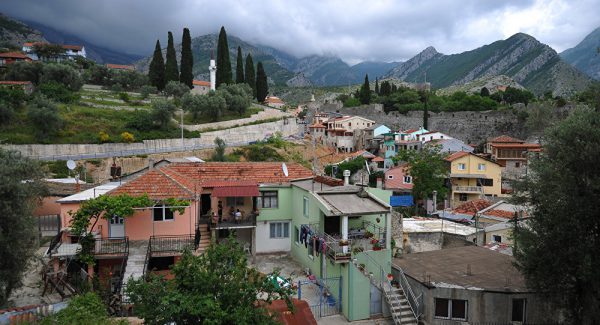
As the hysteria over the wholly fictional links between the Trump administration and Russia continues unabated, claims have been circulating about a supposed Russian plot to overthrow the government of Montenegro so as to prevent that country from joining NATO.
To say that the ‘evidence’ for this is thin would be an understatement. The best summary is in the Guardian :
Montenegrin police arrested a group of Serbian nationals on the eve of the 16 October vote and two Russian suspects are wanted over the alleged plot to seize parliament and assassinate former president and prime minister Milo Đukanović.
Montenegrin authorities had previously said the conspiracy was orchestrated by “Russian nationalists” but special prosecutor Milivoje Katnić went a step further on Sunday evening, suggesting that Russian authorities were involved.
“So far we have had evidence that Russian nationalist structures were behind [the plot], but now also that Russian state bodies were involved at a certain level,” Katnić told local media. “The organs of the Russian state must investigate which bodies are involved and open a criminal trial over these acts.”
A spokesman for the Russian president, Vladimir, Putin, dismissed the allegations. “These (are) absurd accusations … We do not interfere in the internal affairs of other countries, including Montenegro,” Dmitry Peskov said on Monday.
According to Katnić, a key witness, Aleksandar Sinđelić, a nationalist Serb, was invited to Moscow by Eduard Sismakov, a member of “Russian military structures”, to be cleared for the mission. Sismakov, using the alias Shirakov, “asked him to work first to prevent Montenegro from entering Nato. That is the sole motivation of these structures,” Katnić said. Montenegrin prosecutors suspect 25 people, mostly Serbs, of links to the alleged coup, and are searching for two Russians, including Sismakov, who is believed to be the main organiser.
In other words the entire weight of the claim of Russian involvement in the supposed coup rests on the supposed connection between the plotters and an individual identified as “Eduard Sismakov”. As to who Eduard Sismakov is, he has been identified by the BBC as a former deputy military attache to Poland.
It is just about conceivable that some fiery people in this small but proud Balkan Slav country with its tradition of friendship towards Russia might have come up with some crackbrained plan to overthrow the government in order to prevent it joining NATO. Given the long history of close contacts between Montenegro and Russia it is also just possible that they might have met with some people in Russia and got support from them. To construct from these facts a wild theory of a Russian plot to overthrow the government of Montenegro is however little short of absurd. Yet as leaks from the usual ‘anonymous officials’ to the Daily Telegraph show, the British government is trying to give credence to the whole affair.
It is barely conceivable that anyone in any senior position in Moscow would seriously contemplate the idea of a coup in Montenegro. Though the Russians would obviously prefer that Montenegro did not join NATO, the country is too small and too distant from Russia for this to be a serious issue for them. It beggars belief that anyone in authority in Moscow would take the totally reckless and irresponsible step of ordering a coup in a traditionally friendly country in order to prevent something which for Russia ultimately does not matter.
Moreover for the Russians to plan a coup in another country would be for them an extraordinary step to say the least. Whilst the US has a long history of organising or backing coups in foreign states going all the way back to the coup in Iran in 1953, the Russians have not played any role in any coup in Europe since the Czech coup of 1948. Nor have they engaged in much coup making elsewhere. The coup in Afghanistan in 1978 which they were once widely believed to have organised is now known to have caught them by surprise.
Given their traditional aversion to organising coups in other countries – and their lack of know-how in how to do it – it is scarcely conceivable that the Russians would attempt such a thing in Montenegro where the benefits are small and the risks are so obviously great.
In Montenegro itself the government’s plan to join NATO has come in for a great deal of criticism, and there are reports that the opposition to the government is claiming that the whole coup plot is a fiction fabricated by the government in order to discredit it.
I do not know whether that is true or not. However it is altogether more likely than the farfetched claims about Russian involvement in the plot which the Montenegro authorities are making.
February 21, 2017
Posted by aletho |
Deception, Fake News, Mainstream Media, Warmongering | Montenegro, NATO, Russia |
Leave a comment
As Democrats compete to become the new War Party – pushing for a dangerous confrontation with nuclear-armed Russia – some constituents are objecting, as Mike Madden did in a letter to Sen. Amy Klobuchar.
Dear Senator Klobuchar, I write with concern over statements you have made recently regarding Russia. These statements have been made both at home and abroad, and they involve two issues; the alleged Russian hack of the presidential election and Russia’s actions in the aftermath of the February 22, 2014 coup in Kiev.
U.S. intelligence services allege that President Vladimir Putin ordered an influence campaign to denigrate Hillary Clinton and help elect Donald Trump. The campaign is purported to include the production of fake news, cyber-trolling, and propaganda from Russian state-owned media. It is also alleged that Russia hacked the email accounts of the Democratic National Committee and Clinton campaign chair John Podesta, subsequently providing the emails to WikiLeaks.
Despite calls from many quarters, the intelligence services have not provided the public with any proof. Instead, Americans are expected to blindly trust these services with a long history of failure. Additionally, the former Director of National Intelligence, James Clapper, and the former Director of the Central Intelligence Agency, John Brennan, have both been known to lie to the public and to Congress, Mr. Clapper doing so under oath.
Meanwhile, WikiLeaks founder Julian Assange maintains the emails did not come from Russia (or any other state actor) and his organization has an unblemished record of revealing accurate information in the public interest that would otherwise remain hidden. While responsible journalists continue to use the word ‘alleged’ to describe the accusations, Republicans with an ax to grind against Russia, and Democrats wishing to distract from their own failings in the campaign, refer to them as fact. Indeed, on the ‘Amy in the News’ page of your own website, Jordain Carney of The Hill refers to the Russian meddling as “alleged”.
A congressional commission to investigate the alleged Russian hacking is not necessary. Even if all the allegations are true, they are altogether common occurrences, and they certainly don’t rise to the level of “an act of aggression”, “an existential threat to our way of life”, or “an attack on the American people” as various Democratic officials have characterized them. Republican Senator John McCain went full monty and called the alleged meddling “an act of war”.
Joining War Hawks
It is of concern that you would join Senator McCain and the equally belligerent Senator Lindsey Graham on a tour of Russian provocation through the Baltics, Ukraine, Georgia, and Montenegro. The announcement of your trip (December 28, 2016) on the ‘News Releases’ page of your website renewed the unproven claim of “Russian interference in our recent election”. It also claimed that the countries you were visiting were facing “Russian aggression” and that “Russia illegally annexed Crimea”.
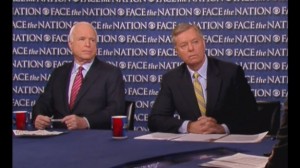
Sen. John McCain and Sen. Lindsey Graham
It is unfortunate that these claims have become truisms by sheer repetition rather than careful examination of the facts. Russia has not invaded eastern Ukraine. There are no regular units of the Russian military in the breakaway provinces, nor has Russia launched any air strikes from its territory. It has sent weapons and other provisions to the Ukrainian forces seeking autonomy from Kiev, and there are most certainly Russian volunteers operating in Ukraine.
However regrettable, it must be remembered that the unrest was precipitated by the February 22, 2014 overthrow of the democratically elected president Viktor Yanukovych which, speaking of meddling, was assisted by U.S. State Department, other American government agencies, and one Senator John McCain. The subsequent military and paramilitary operations launched by the coup government against the People’s Republics of Donetsk and Luhansk were described by President Putin as “uncontrolled crime” spreading into the south and east of the country. In American parlance, both the interim coup government in Kiev and the current government of President Petro Poroshenko have engaged in “killing their own people”.
Ignoring the Details
If Russia’s actions are to be considered “aggression” or an “invasion”, one must find a whole new word to describe what the United States did to Iraq in 2003. If, like your colleague Senator McCain, you hold the annexation of Crimea to be illegal under the 1994 Budapest Memorandum, I urge a closer look.
On February 21, 2014, an agreement brokered by the European Union was signed between President Yanukovych and the leaders of three major opposition parties. The agreement contained terms for a cessation of violence, immediate power sharing, and new elections. Smelling blood in the water, the opposition in Maidan Square did not withdraw from the streets or surrender their illegal weapons as agreed, but instead went on the offensive. Yanukovych, under threat to his life, fled Kiev along with many others in his Party of Regions.
Nor did the opposition party leaders honor the agreement. The next day, they moved to impeach Yanukovych, however they failed to meet several requirements of the Ukrainian Constitution. They failed to indict the president, conduct an investigation, and have that investigation certified by the Constitutional Court of Ukraine. Instead, they moved directly to a vote on impeachment and, even on that count, they failed to obtain the required three-fourths majority vote. So, even though the Budapest Memorandum did offer assurances of Ukrainian security and territorial integrity in exchange for surrender of Soviet-era nuclear weapons on its soil, the sovereign government of Ukraine had fallen in a violent unconstitutional putsch.
Yanukovych remained its legitimate president-in-exile and he, along with the prime minister of the Autonomous Republic of Crimea, requested Russian intervention on the peninsula to provide security and protect the human rights of ethnic Russians threatened by the new coup government and neo-Nazi elements within it.
One can now see how real that threat was by looking to eastern Ukraine where the Ukrainian military and neo-Nazi paramilitaries such as the Azov Battallion, have moved with force against the defenders of the Donbass region whose people seek autonomy from a government in Kiev that they do not recognize. Approximately 10,000 people have died in the Donbass War, whereas only six people were killed during the period of annexation (February 23-March19, 2014) in Crimea.
While the Donbass War drags on, Crimea remains stable today. The popular referendum conducted on March 16, 2014 lent legitimacy to the subsequent annexation. Official results claimed 82% turnout with 96% of voters favoring reunification with Russia. Independent polling conducted in the early weeks of March 2014 found 70-77% of all Crimeans favored reunification. Six years prior to the crisis in 2008, a poll found that 63% favored reunification. Even though many ethnic Ukranians and Tatars boycotted the election, rejoining Russia was clearly the will of the majority of Crimean people.
President Putin, characterizing the situation in Ukraine as a revolution, claimed that Russia had no agreements with the new state and therefore no obligations under the Budapest Memorandum. He also cited Chapter I: Article 1 of the United Nations Charter, which calls for respect for the principle of self-determination of peoples. The 1975 Helsinki Accords, which affirmed post-World War II borders, also allowed for the change of national boundaries by peaceful internal means.
The Kosovo Precedent
It is also useful to consider parallel occurrences in Kosovo. In 1998 ethnic cleansing by Serbian troops and paramilitaries led to a NATO intervention without U.N. authorization. There is little question that the move was illegal, but legitimacy was claimed due to the urgent humanitarian need. Ten years later, Kosovo would declare independence from Serbia and the disputed matter would end up before the International Court of Justice. In 2009 the United States provided the Court with a statement on Kosovo that read in part: “Declarations of independence may, and often do, violate domestic legislation. However, this does not make them violations of international law.”
The United States should accept the Russian annexation of Crimea both as a pragmatic matter, and one of principle. In 1990, during negotiations for the re-unification of Germany, the United States promised that there would be no eastward expansion of NATO. That promise has now been broken three times and eleven new nations have been added to the alliance. Ukraine has also entered in partnership with NATO, and at various times, full membership has been discussed. Russia has consistently expressed its disapproval. According to your website, an objective of your trip was “to reinforce support for NATO”. If this weren’t provocative enough, your three-senator delegation went to a front-line military outpost in Shirokino, Ukraine to incite an escalation to the Donbass War. Senator Graham told the assembled soldiers “Your fight is our fight, 2017 will be the year of offense”. The leader of your delegation, Senator McCain, said “I am convinced you will win and we will do everything we can to provide you with what you need to win”.
After the speeches were given, you are seen in a video of the New Year’s Eve event accepting what appears to be a gift from one of the uniformed soldiers. With all of the furor over former National Security Advisor Michael Flynn’s resignation, and possible violation of the Logan Act, for discussing alleviation of sanctions with a Russian ambassador, this appears to be a far more serious offense. Not only did your delegation advocate for a foreign policy that was not aligned with that of acting President Obama, it was also contrary to President-elect Trump’s approach to the region. And the results of your advocacy have the potential to be far more deadly than the mere alleviation of sanctions.
Sincerely, Mike Madden St. Paul, Minnesota
February 20, 2017
Posted by aletho |
Deception, Fake News, Mainstream Media, Warmongering, Progressive Hypocrite | Amy Klobuchar, CIA, John McCain, Lindsey Graham, NATO, Russia, Ukraine, United States |
Leave a comment
Will Happer is an eminent physicist at Princeton who has chosen (along with his colleague Freeman Dyson) to plant a flag on the skeptic side of the climate debate. I’ve had the pleasure of meeting Happer on a couple of occasions. Recently his name has been floated as a potential candidate for the position of Science Advisor to President Trump. (This is the position that has been held by eco-fanatic John Holdren during the Obama presidency.) Although it is not final, and others remain in the running, Happer has said that he will take the position if offered.
Yesterday Happer gave an interview to the Guardian newspaper. When it came to the issue of “climate change,” Happer didn’t pull any punches. Here is my favorite quote:
“There’s a whole area of climate so-called science that is really more like a cult,” Happer told the Guardian. “It’s like Hare Krishna or something like that. They’re glassy-eyed and they chant. It will potentially harm the image of all science.”
I would only comment that in my experience Hare Krishnas don’t takes tens of billions of dollars of government money for themselves, and don’t seek to impose energy poverty on everyone else while they themselves jet around on private jets. Other than that, Happer was spot on.
If you are still considering the question of whether what Happer calls “climate so-called science” is real science versus a cult, you may want to review a few articles from the New York Times about the recent California drought and its end. For example, from August 2015, we have an article headlined “California Drought Is Made Worse by Global Warming, Scientists Say.”
Global warming caused by human emissions has most likely intensified the drought in California by 15 to 20 percent, scientists said on Thursday, warning that future dry spells in the state are almost certain to be worse than this one as the world continues to heat up. . . . The paper provides new scientific support for political leaders, including President Obama and Gov. Jerry Brown of California, who have cited human emissions and the resulting global warming as a factor in the drought.
Or try this one from January 5, 2017 (just six weeks ago!), headlined “A Winery Battles Climate Change.”
After decades in the business, the Jacksons are sensitive to slight variations in the weather, and they are convinced of one thing: It is getting hotter and drier. . . . Climate change is forcing the Jacksons to confront questions both practical and existential: Can you make fine wine with less water? . . . Already, winemakers in the region are noticing distinct changes that signal a hotter, drier future.
And then, of course, things promptly turned around and the rains came — as they always do. Suddenly California is in the news because it has had so much rain that some of its dams are threatened with overflowing. Well, what caused that? You guessed it — climate change! From yesterday’s NYT, here is the lead headline from the National Section: “A Climate Change Warning for California’s Dams.” What, does “climate change” cause both wet and dry?
Scientists have said for years that a warming atmosphere should lead to more intense and frequent storms in many regions.
Now you tell us! As usual, climate change as the cause of everything is the classic unfalsifiable proposition. The word “cult” may be a little over the top, but whatever it is, it sure isn’t science.
February 20, 2017
Posted by aletho |
Deception, Mainstream Media, Warmongering, Science and Pseudo-Science, Timeless or most popular | New York Times, United States |
Leave a comment
Ecuador has come under fire for scrutinizing non-profits like Accion Ecologica, many of whom get millions from Europe and North America.
Ecuador, the tiny South American nation sandwiched between Colombia and Peru, rarely makes waves in the English-speaking world’s corporate mediascape. Last year, news traveled far on at least two occasions.
First, with an earthquake that killed at least 673 people. Second, when the government moved to investigate and potentially dissolve a nonprofit called Accion Ecologica in connection with deadly violence between members of an Amazonian tribe and police sent to protect a Chinese-operated mining project.
Ecologists and prominent activists friendly to the group, including heavy-weights such as Naomi Klein, called out what they characterized as a callous repression and criminalization of Indigenous people protecting the unparalleled richness of the Amazon and alleged state prejudice against an underdog non-profit organization that was only there to save the rainforest and its inhabitants.
Ecuador’s socialist government, on the other hand, sees the “underdog” label as misplaced.
NGOs may be seen as do-gooders, but that’s not always the case. As a country historically vulnerable to the whims of powers in the North, Ecuador has, under the administration of the outgoing President Rafael Correa, put up a guard against a new kind of public diplomacy from abroad that focuses on gaining the favor of civil society to indirectly execute their political priorities.
NGOs are flagged when they operate outside the bounds of the law and their stated objectives, indicators of potential pressure from outside funders to protect their interests rather than those of nationals.
“We’re an Ecuadorean NGO, born here in Ecuador and working for 30 years in the defense of the rights of the environment and of communities across the country, and for that work we are very well known, even at an international level,” Alexandra Almeida, president of Accion Ecologica, told teleSUR.
“But that doesn’t mean that a foreign organization could manipulate us with anything — with funds, with nothing — that’s how we operate.”
NGOs have rarely had to justify their work to anyone, let alone prove that they act for the good of the people only. But Ecuador is not an ordinary country. Rich in resources but export dependent, authorities are attempting to manage the many foreign hands trying to pull the country’s development in their favor.
Silent Action Meets Loud Reaction
This government is the first to scrutinize NGOs, but their scrutiny has not been limited to Accion Ecologica.
In 2012, Ecuadorean President Rafael Correa boldly declared that NGOs have been entering the country like never before during the previous decade. Many, backed by foreign states and foreign money, are out to destabilize the state, Ecuadorean leaders stated.
“Their interest is not the country, impoverished sectors, natural resources or strengthening democracies,” said Paola Pabon, director of the National Ministry of Political Management, which is responsible for tracking NGOs, in an interview with teleSUR last year. “What interests them is having control over governments, having influence over civil society to create elements of destabilization.”
Executive Decree 16, which went into effect in 2013, created a system to catalogue the financing, decision-making and activities of every registered social organization — a total of over 46,000 in the country, including non-profits, unions and community organizations, among others.
The resulting action saw 26 foreign NGOs expelled from the country for a lack of transparency and compliance with national law; in brief, for declaring themselves “non-governmental organizations” while acting on behalf of foreign governments. Among the more high-profile cases was Samaritan’s Purse, an evangelical missionary relief organization that received funding and support from USAID. Fifteen others were given two weeks to get their activities in order.
A handful of Indigenous organizations, which had previously mobilized against Correa’s government, attacked the decree via the Constitutional Court. Two years later, Ecuador reformed the regulations with Executive Decree 739, which fine-tuned the reasons for closing an NGO — the main one, “diverting from stated objectives” — and, caving to demand, eliminated the requirement for organizations to register projects financed from abroad.
Donor Nations: Generous or Greedy?
The trend that prompted Ecuador’s law was not without precedent.
Through the U.S. Agency for International Development, known as USAID, and the linked but publicly independent National Endowment for Democracy, known as NED, the United States pumped over US$100 million into Venezuela to create 300 new organizations credited with contributing to the coup d’etat against Hugo Chavez in 2002. In a similar move, USAID admitted that it tried to provoke a “Cuban Spring” by setting up Zunzuneo, a kind of Cuban Twitter, to circulate calls to protest.
The most common nonprofits close to foreign governments and private interests are those that stand tallest against their states. In Ecuador, that tends to be groups that work closely with Indigenous communities, with those protecting their right to their land and with those defending women and the environment. Funding by private foundations and corporations, while more widespread, is far less transparent and tougher to quantify. Big names like the Ford Foundation and Open Society, however, are well known for injecting funds into NGOs in the global south to advance specific political visions.
But the United States isn’t the only country to have funneled funds to Ecuador through NGOs.
Official numbers from Ecuador’s Chief Administrative Office of International Cooperation, or SETECI, show that since Correa assumed office in 2007 until 2015, foreign NGOs have managed over US$800 million from abroad. Top givers include the U.K. and Spain, followed by several European states.
No one, however, beats the United States. In that same period, the U.S. sent over twice the amount of money of the next-highest donor, with a total of over US$282 million and 780 projects, or 35 percent of all funding.
Of those funds, which only count NGOs based abroad that invested in local or regional projects, 13 went to projects in the Amazon led by non-profits like Care International, the Wildlife Conservation Society, the World Wildlife Fund, the Carnegie Endowment for International Peace and the Mitsubishi Corporation Foundation for the Americas. Projects based in Morona Santiago, the province where the anti-mining protests that led to the death of a police officer broke out, brought in over US$1 million from the U.S. since 2007.
The flow of funds is indicative of a broader attitude between receiver and giver, who “take advantage of the assumption that they have a perfect democracy, which is completely false – there’s a paternalistic attitude that must be regulated,” said Fernando Casado, research fellow at the National Institute for Higher Studies on public administration in Ecuador and Venezuela. Conversely, a flow in the opposite direction would immediately raise suspicion from developed countries, he added.
Yet money itself doesn’t tell the full tale: the funds are tied directly to foreign policy objectives, Casado told teleSUR. “The powers of the North have changed strategy.”
Each state has its own way. Germany, which has had 151 NGO projects in Ecuador since 2007, is known for meddling in affairs of developing countries through its Federal Ministry for Economic Cooperation and Development, or BMZ. When SETECI found that three-quarters of its funds went toward stopping another mining project in the Amazon’s Yasuni region last March, it kicked the German agency out of Ecuador.
The United States has several agencies do its work, the most prominent being USAID, NED — funded through money allocated to USAID by Congress — and the Broadcast Board of Governors. The stated missions: to promote development, democracy creation and a free press, respectively, while strictly adhering to U.S. foreign policy priorities.
“We should not have to do this kind of work covertly,” said former head of NED Carl Gershman on CIA missions to the New York Times in 1986. “It would be terrible for democratic groups around the world to be seen as subsidized by the CIA. We saw that in the 60s, and that’s why it has been discontinued. We have not had the capability of doing this, and that’s why the endowment was created.”
What Givers Want
The “work” the United States has set out for Ecuador — according to a 2016 Office of Inspector General report on the U.S. embassy leaked by WikiLeaks — is “to mitigate the effects of the contentious political environment created by the Ecuadorean Government” with the help of other government agencies, which play a “critical role.”
The report, intended for the eyes of the BBG and Congress, said the embassy was “actively engaged with civil society leaders and nongovernmental organizations to increase Ecuadorean awareness of and support for U.S. policies and values, promote Ecuadorean civil society and government accountability, and strengthen environmental initiatives.”
To set up a climate conducive to U.S. meddling, the U.S. Government Accountability Office included Ecuador on a shortlist with Colombia, Egypt and the West Bank/Gaza the year Correa was elected to closely study public opinion in “specific, targeted public awareness campaigns.”
It also either commissioned or was the beneficiary of a study from Stratfor, a secretive intelligence company contracted by the State Department and the U.S.’s multinational titans, which evaluated the extent to which Ecuador is manipulable by NGOs. The 2013 report, leaked by WikiLeaks, focused especially on how NGOs can influence trade policy and corporate regulation. Its conclusion: based on a scale likely defined in relation to other developing nations, Ecuador is fairly resilient to NGO pressure but has submitted in certain instances.
USAID sends hundreds of millions to local projects in Ecuador, some less explicitly political, but some indirectly benefiting opposition groups, according to U.S. Ambassador in Ecuador Adam Namm. BBG affiliate, TeleAmazonas, has been accused of fomenting strong opposition rhetoric against Correa. And the NED spends over US$1 million annually on dozens of local programs with broad objectives like “promoting citizen oversight of elected officials,” “monitoring due process and the independence of the judicial system,” “monitoring the use of public resources in government advertising” and “facilitating dialogue and consensus on democracy.”
Both Germany’s BMZ and USAID are back in Ecuador following a deluge of NGO activity after the April earthquake. The workload of the National Ministry of Political Management has peaked ever since, said Pabon.
The Sneaky Alliance With Mother Earth
One pet project of USAID was the Conservation in Managed Indigenous Areas, or Caiman, which ended before Correa took office but was among several USAID programs to conserve the country’s biodiversity and promote alliances between Indigenous communities and private businesses.
Caiman worked with various groups working in ecological and Indigenous rights, including Accion Ecologica. For several years, Caiman had Accion Ecologica help them battle against the Ministry of the Environment and train park rangers to oppose contamination from oil and mining.
Whether or not USAID or foreign foundations have funded Accion Ecologica directly is unclear. Unlike many others in the industry, the non-profit does not publish its financial information on its website, and refused multiple requests from teleSUR for copies of audits. When asked, the organization’s president said she does not know specifics on foreign funders and could not answer.
Almeida did say that Accion Ecologica receives funds from Europe — from individuals, “small organizations, alliances, groups that form” around fundraising events on ecological issues. She did not say how much or cite specific names but mentioned Italy and Belgium.
A 2012 investigation from Andes, an Ecuadorean state publication, found that both Accion Ecologica and the Regional Foundation of Human Rights Advising, another powerful nonprofit, are financed by the European Commission, Oilwatch, the Netherlands embassy and a few international ecological networks. Almeida said the accusations were false.
While Europe may be the principal interested party in the success of Accion Ecologica, the U.S. is also well known to have played an active role in similar battles.
In 2013, the year after Correa took the lead against foreign NGOs and a year before he expelled USAID, Bolivia accused USAID of spending US$22 million to divide Indigenous groups on the exploitation and nationalization of oil in their lands.
“Since the right can’t find arguments to oppose the process of change, it now turns to campesino, Indigenous and native leaders who are paid by several NGOs and foundations with perks to foment a climate of conflict with the national government to deteriorate the process of unification that the country is experiencing,” said Morales as he gave USAID the boot.
Beyond Accion Ecologica
“Theoretically speaking, NGOs shouldn’t exist,” said Casado. NGOs operate within a logic of narrowing, minimizing and weakening the role of the state so they can keep filling holes in public services and keep their jobs, which are at risk of disappearing if the state works as it should, added Casado.
“They elect themselves representatives of civil society in general,” and yet their role is limited and entirely reliant on and responsive to funding, which at the end of the day remains in their pockets. Other social organizations and popular movements, said Casado, operate only on conviction.
If an NGO is completely free to operate without regulations, a country would open itself to any corporate and foreign interest that found an open hand, he argued. Latin America is intimately familiar with that process — of consolidating power in the monied class — and NGOs back similar corporate interests, only with a more benevolent face.
It’s near-impossible to identify the perfect case of foreign intrusion — and, as in Accion Ecologica’s case, near-impossible to prove. Multiple factors are always at play, from the ideology of individual members to the decision-making process to however events play out on the ground. Casado said that the first step to uncovering hidden interests is financial transparency — a move that faces stiff opposition precisely for the interests that it could reveal.
Ecuador’s answer is to carefully collect records and draw a clear line between what is acceptable and what is not. Foreign NGOs, state the decree, cannot participate “in any form of party politics, any form of interference or proselytism, any threat to national security or public peace or any other activity not permitted under their migratory status.”
Case Closed?
When Accion Ecologica testified before the Interior Ministry and the Ministry of the Environment, it argued that it had been doing the same work — protecting the rainforest — for decades, always in a peaceful manner. The evidence presented showing they provoked violence through a series of tweets in and around the time of violent clashes was “a bit absurd, very absurd,” said Almeida.
In the end, the government’s case did not hold, and the Environment Ministry concluded there was not enough credible evidence to shut down the group. Accion Ecologica credited “pressure” from its supporters, as its representatives continue to urge for a deregulation of NGOs.
“It’s not only NGOs, but also any organization that will be at risk, especially their right to free expression and the right to free association” if the decree regulating NGOs remains intact, said Almeida.
Her position echoes those taken up by opposition politicians, whose one commonality is their depiction of Correa’s government as one systematically trouncing on citizens’ rights and freedoms.
In an election year, rhetoric makes the difference.
Dianileysis Cruz contributed reporting.
February 19, 2017
Posted by aletho |
Deception, Economics, Environmentalism, Malthusian Ideology, Phony Scarcity | Accion Ecologica, Bolivia, Ecuador, Latin America, Naomi Klein, NED, Samaritan’s Purse, UK, United States, USAID |
Leave a comment
As if the 2016 U.S. presidential election campaign hadn’t been horrendous enough, here comes another one: in France.
The system in France is very different, with multiple candidates in two rounds, most of them highly articulate, who often even discuss real issues. Free television time reduces the influence of big money. The first round on April 23 will select the two finalists for the May 7 runoff, allowing for much greater choice than in the United States.
But monkey see, monkey do, and the mainstream political class wants to mimic the ways of the Empire, even echoing the theme that dominated the 2016 show across the Atlantic: the evil Russians are messing with our wonderful democracy.
The aping of the U.S. system began with “primaries” held by the two main governing parties which obviously aspire to establish themselves as the equivalent of American Democrats and Republicans in a two-party system. The right-wing party of former president Nicolas Sarkozy has already renamed itself Les Républicains and the so-called Socialist Party leaders are just waiting for the proper occasion to call themselves Les Démocrates. But as things are going, neither one of them may come out ahead this time.
Given the nearly universal disaffection with the outgoing Socialist Party government of President François Hollande, the Republicans were long seen as the natural favorites to defeat Marine LePen, who is shown by all polls to top the first round. With such promising prospects, the Republican primary brought out more than twice as many volunteer voters (they must pay a small sum and claim allegiance to the party’s “values” in order to vote) as the Socialists. Sarkozy was eliminated, but more surprising, so was the favorite, the reliable establishment team player, Bordeaux mayor Alain Juppé, who had been leading in the polls and in media editorials.
Fillon’s Family Values
In a surprise show of widespread public disenchantment with the political scene, Republican voters gave landside victory to former prime minister François Fillon, a practicing Catholic with an ultra-neoliberal domestic policy: lower taxes for corporations, drastic cuts in social welfare, even health health insurance benefits – accelerating what previous governments have been doing but more openly. Less conventionally, Fillon strongly condemns the current anti Russian policy. Fillon also deviates from the Socialist government’s single-minded commitment to overthrowing Assad by showing sympathy for embattled Christians in Syria and their protector, which happens to be the Assad government.
Fillon has the respectable look, as the French say, of a person who could take communion without first going to confession. As a campaign theme he credibly stressed his virtuous capacity to oppose corruption.
Oops! On January 25, the semi-satirical weekly Le Canard Enchainé fired the opening shots of an ongoing media campaign designed to undo the image of Mister Clean, revealing that his British wife, Penelope, had been paid a generous salary for working as his assistant. As Penelope was known for staying home and raising their children in the countryside, the existence of that work is in serious doubt. Fillon also paid his son a lawyer’s fee for unspecified tasks and his daughter for supposedly assisting him write a book. In a sense, these allegations prove the strength of the conservative candidate’s family values. But his ratings have fallen and he faces possible criminal charges for fraud.
The scandal is real, but the timing is suspect. The facts are many years old, and the moment of their revelation is well calculated to ensure his defeat. Moreover, the very day after the Canard’s revelations, prosecutors hastily opened an inquiry. In comparison with all the undisclosed dirty work and unsolved blood crimes committed by those in control of the French State over the years, especially during its foreign wars, enriching one’s own family may seem relatively minor. But that is not the way the public sees it.
Cui bono?
It is widely assumed that despite National Front candidate Marine LePen’s constant lead in the polls, whoever comes in second will win the runoff because the established political class and the media will rally around the cry to “save the Republic!” Fear of the National Front as “a threat to the Republic” has become a sort of protection racket for the established parties, since it stigmatizes as unacceptable a large swath of opposition to themselves. In the past, both main parties have sneakily connived to strengthen the National Front in order to take votes away from their adversary.
Thus, bringing down Fillon increases the chances that the candidate of the now thoroughly discredited Socialist Party may find himself in the magic second position after all, as the knight to slay the LePen dragon. But who exactly is the Socialist candidate? That is not so clear. There is the official Socialist Party candidate, Benoît Hamon. But the independent spin-off from the Hollande administration, Emmanuel Macron, “neither right nor left”, is gathering support from the right of the Socialist Party as well as from most of the neo-liberal globalist elite.
Macron is scheduled to be the winner. But first, a glance at his opposition on the left. With his ratings in the single digits, François Hollande very reluctantly gave in to entreaties from his colleagues to avoid the humiliation of running for a second term and losing badly. The badly attended Socialist Party primary was expected to select the fiercely pro-Israel prime minister Manuel Valls. Or if not, on his left, Arnaud Montebourg, a sort of Warren Beatty of French politics, famous for his romantic liaisons and his advocacy of re-industrialization of France.
Again, surprise. The winner was a colorless, little-known party hack named Benoît Hamon, who rode the wave of popular discontent to appear as a leftist critic and alternative to a Socialist government which sold out all Holland’s promises to combat “finance” and assaulted the rights of the working class instead. Hamon spiced up his claim to be “on the left” by coming up with a gimmick that is fashionable elsewhere in Europe but a novelty in French political discourse: the “universal basic income”. The idea of giving every citizen an equal handout can sound appealing to young people having trouble finding a job. But this idea, which originated with Milton Friedman and other apostles of unleashed financial capitalism, is actually a trap. The project assumes that unemployment is permanent, in contrast to projects to create jobs or share work. It would be financed by replacing a whole range of existing social allocations, in the name of “getting rid of bureaucracy” and “freedom of consumption”. The project would complete the disempowerment of the working class as a political force, destroying the shared social capital represented by public services, and splitting the dependent classes between paid workers and idle consumers.
There is scant chance that the universal income is about to become a serious item on the French political agenda. For the moment, Hamon’s claim to radicality serves to lure voters away from the independent left-wing candidate Jean-Luc Mélenchon. Both are vying for support from greens and militants of the French Communist Party, which has lost all capacity to define its own positions.
The Divided Left
An impressive orator, Mélenchon gained prominence in 2005 as a leading opponent of the proposed European Constitution, which was decisively rejected by the French in a referendum, but was nevertheless adopted under a new name by the French national assembly. Like so many leftists in France, Mélenchon has a Trotskyist background (the Posadists, more attuned to Third World revolutions than their rivals) before joining the Socialist Party, which he left in 2008 to found the Parti de Gauche. He has sporadically wooed the rudderless Communist Party to join him as the Front de Gauche (the Left Front) and has declared himself its candidate for President on a new independent ticket called La France insoumise – roughly translated as “Insubordinate France”. Mélenchon is combative with France’s docile media, as he defends such unorthodox positions as praise of Chavez and rejection of France’s current Russophobic foreign policy. Unlike the conventional Hamon, who follows the Socialist party line, Mélenchon wants France to leave both the euro and NATO.
There are only two really strong personalities in this lineup: Mélenchon on the left and his adversary of choice, Marine LePen, on the right. In the past, their rivalry in local elections has kept both from winning even though she came out ahead. Their positions on foreign policy are hard to distinguish from each other: criticism of the European Union, desire to leave NATO, good relations with Russia.
Since both deviate from the establishment line, both are denounced as “populists” – a term that is coming to mean anyone who pays more attention to what ordinary people want than to what the Establishment dictates.
On domestic social policy, on preservation of social services and workers’ rights, Marine is well to the left of Fillon. But the stigma attached to the National Front as the “far right” remains, even though, with her close advisor Florian Philippot, she has ditched her father, Jean-Marie, and adjusted the party line to appeal to working class voters. The main relic of the old National Front is her hostility to immigration, which now centers on fear of Islamic terrorists. The terrorist killings in Paris and Nice have made these positions more popular than they used to be. In her effort to overcome her father’s reputation as anti-Semitic, Marine LePen has done her best to woo the Jewish community, helped by her rejection of “ostentatious” Islam, going so far as to call for a ban on wearing an ordinary Muslim headscarf in public.
A runoff between Mélenchon and LePen would be an encounter between a revived left and a revived right, a real change from the political orthodoxy that has alienated much of the electorate. That could make politics exciting again. At a time when popular discontent with “the system” is rising, it has been suggested (by Elizabeth Lévy’s maverick monthly Le Causeur) that the anti-system Mélenchon might actually have the best chance of winning working class votes away from the anti-system LePen.
Manufacturing Consent
But the pro-European Union, pro-NATO, neoliberal Establishment is at work to keep that from happening. On every possible magazine cover or talk show, the media have shown their allegiance to a “New! Improved!” middle of the road candidate who is being sold to the public like a consumer product. At his rallies, carefully coached young volunteers situated in view of the cameras greet his every vague generalization with wild cheers, waving flags, and chanting “Macron President!!!” before going off to the discotèque party offered as their reward. Macron is the closest thing to a robot ever presented as a serious candidate for President. That is, he is an artificial creation designed by experts for a particular task.
Emmanuel Macron, 39, was a successful investment banker who earned millions working for the Rothschild bank. Ten years ago, in 2007, age 29, the clever young economist was invited into the big time by Jacques Attali, an immensely influential guru, whose advice since the 1980s has been central in wedding the Socialist Party to pro-capitalist, neoliberal globalism. Attali incorporated him into his private think tank, the Commission for Stimulating Economic Growth, which helped draft the “300 Proposals to Change France” presented to President Sarkozy a year later as a blueprint for government. Sarkozy failed to enact them all, for fear of labor revolts, but the supposedly “left” Socialists are able to get away with more drastic anti-labor measures, thanks to their softer discourse.
The soft discourse was illustrated by presidential candidate François Hollande in 2012 when he aroused enthusiasm by declaring to a rally: “My real enemy is the world of finance!”. The left cheered and voted for him. Meanwhile, as a precaution, Hollande secretly dispatched Macron to London to reassure the City’s financial elite that it was all just electoral talk.
After his election, Hollande brought Macron onto his staff. From there he was given a newly created super-modern sounding government post as minister of Economy, Industry and Digital affairs in 2014. With all the bland charm of a department store mannequin, Macron upstaged his irascible colleague, prime minister Manuel Valls, in the silent rivalry to succeed their boss, President Hollande. Macron won the affection of big business by making his anti-labor reforms look young and clean and “progressive”. In fact, he pretty much followed the Attali agenda.
The theme is “competitiveness”. In a globalized world, a country must attract investment capital in order to compete, and for that it is necessary to lower labor costs. A classic way to do that is to encourage immigration. With the rise of identity politics, the left is better than the right in justifying massive immigration on moral grounds, as a humanitarian measure. That is one reason that the Democratic Party in the United States and the Socialist Party in France have become the political partners of neoliberal globalism. Together, they have changed the outlook of the official left from structural measures promoting economic equality to moral measures promoting equality of minorities with the majority.
Just last year, Macron founded (or had founded for him) his political movement entitled “En marche!” (Let’s go!) characterized by meetings with young groupies wearing Macron t-shirts. In three months he felt the call to lead the nation and announced his candidacy for President.
Many personalities are jumping the marooned Socialist ship and going over to Macron, whose strong political resemblance to Hillary Clinton suggests that his is the way to create a French Democratic Party on the U.S. model. Hillary may have lost but she remains the NATOland favorite. And indeed, U.S. media coverage confirms this notion. A glance at the ecstatic puff piece by Robert Zaretsky in Foreign Policy magazine hailing “the English-speaking, German-loving, French politician Europe has been waiting for” leaves no doubt that Macron is the darling of the trans-Atlantic globalizing elite.
At this moment, Macron is second only to Marine LePen in the polls, which also show him defeating her by a landslide in the final round. However, his carefully manufactured appeal is vulnerable to greater public information about his close ties to the economic elite.
Blame the Russians
For that eventuality, there is a preventive strike, imported directly from the United States. It’s the fault of the Russians!
What have the Russians done that is so terrible? Mainly, they have made it clear that they have a preference for friends rather than enemies as heads of foreign governments. Nothing so extraordinary about that. Russian news media criticize, or interview people who criticize, candidates hostile to Moscow. Nothing extraordinary about that either.
As an example of this shocking interference, which allegedly threatens to undermine the French Republic and Western values, the Russian news agency Sputnik interviewed a Republican member of the French parliament, Nicolas Dhuicq, who dared say that Macron might be “an agent of the American financial system”. That is pretty obvious. But the resulting outcry skipped over that detail to accuse Russian state media of “starting to circulate rumors that Macron had a gay extramarital affair” (The EU Observer, February 13, 2017). In fact this alleged “sexual slur” had been circulating primarily in gay circles in Paris, for whom the scandal, if any, is not Macron’s alleged sexual orientation but the fact that he denies it. The former mayor of Paris, Bertrand Delanoe, was openly gay, Marine Le Pen’s second in command Florian Philippot is gay, in France being gay is no big deal.
Macron is supported by a “very wealthy gay lobby”, Dhuicq is quoted as saying. Everyone knows who that is: Pierre Bergé, the rich and influential business manager of Yves Saint Laurent, personification of radical chic, who strongly supports surrogate gestation, which is indeed a controversial issue in France, the real controversy underlying the failed opposition to gay marriage.
The Deep State rises to the surface
The amazing adoption in France of the American anti-Russian campaign is indicative of a titanic struggle for control of the narrative – the version of international reality consumed by the masses of people who have no means to undertake their own investigations. Control of the narrative is the critical core of what Washington describes as its “soft power”. The hard power can wage wars and overthrow governments. The soft power explains to bystanders why that was the right thing to do. The United States can get away with literally everything so long as it can tell the story to its own advantage, without the risk of being credibly contradicted. Concerning sensitive points in the world, whether Iraq, or Libya, or Ukraine, control of the narrative is basically exercised by the partnership between intelligence agencies and the media. Intelligence services write the story, and the mass corporate media tell it.
Together, the anonymous sources of the “deep state” and the mass corporate media have become accustomed to controlling the narrative told to the public. They don’t want to give that power up. And they certainly don’t want to see it challenged by outsiders – notably by Russian media that tell a different story.
That is one reason for the extraordinary campaign going on to denounce Russian and other alternative media as sources of “false news”, in order to discredit rival sources. The very existence of the Russian international television news channel RT aroused immediate hostility: how dare the Russians intrude on our version of reality! How dare they have their own point of view! Hillary Clinton warned against RT when she was Secretary of State and her successor John Kerry denounced it as a “propaganda bullhorn”. What we say is truth, what they say can only be propaganda.
The denunciation of Russian media and alleged Russian “interference in our elections” is a major invention of the Clinton campaign, which has gone on to infect public discourse in Western Europe. This accusation is a very obvious example of double standards, or projection, since U.S. spying on everybody, including it allies, and interference in foreign elections are notorious.
The campaign denouncing “fake news” originating in Moscow is in full swing in both France and Germany as elections approach. It is this accusation that is the functional interference in the campaign, not Russian media. The accusation that Marine Le Pen is “the candidate of Moscow” is not only meant to work against her, but is also preparation for the efforts to instigate some variety of “color revolution” should she happen to win the May 7 election. CIA interference in foreign elections is far from limited to contentious news reports.
In the absence of any genuine Russian threat to Europe, claims that Russian media are “interfering in our democracy” serve to brand Russia as an aggressive enemy and thereby justify the huge NATO military buildup in Northeastern Europe, which is reviving German militarism and directing national wealth into the arms industry.
In some ways, the French election is an extension of the American one, where the deep state lost its preferred candidate, but not its power. The same forces are at work here, backing Macron as the French Hillary, but ready to stigmatize any opponent as a tool of Moscow.
What has been happening over the past months has confirmed the existence of a Deep State that is not only national but trans-Atlantic, aspiring to be global. The anti-Russian campaign is a revelation. It reveals to many people that there really is a Deep State, a trans-Atlantic orchestra that plays the same tune without any visible conductor. The term “Deep State” is suddenly popping up even in mainstream discourse, as a reality than cannot be denied, even if it is hard to define precisely. Instead of the Military Industrial Complex, we should perhaps call it the Military Industrial Intelligence Military Media Complex, or MIIMMC. Its power is enormous, but acknowledging that it exists is the first step toward working to free ourselves from its grip.
Diana Johnstone is the author of Fools’ Crusade: Yugoslavia, NATO, and Western Delusions. Her new book is Queen of Chaos: the Misadventures of Hillary Clinton. She can be reached at diana.johnstone@wanadoo.fr
February 18, 2017
Posted by aletho |
Deception, Fake News, Full Spectrum Dominance, Mainstream Media, Warmongering, Timeless or most popular | CIA, Emmanuel Macron, European Union, France, Marine LePen, Mélenchon, NATO, United States |
Leave a comment
Last week, Amnesty International published a report that was severely criticised for literally fabricating evidence to support implausible accusations against the Syrian government.[1] The report included a project of ‘Forensic Architecture’ that served in guiding the imagination as to the horrors that might be perpetrated in a building used for torture and execution. Computerised modelling of this kind may have its uses, but it clearly has limitations when it comes to determining who may have done what in a building. A computer can only simulate on the basis of inputs. The inputs come from elsewhere, and they may or may not be reliable or appropriately detailed.[2]
This week, Médecins Sans Frontières (MSF) announced that they too have been commissioning research in Forensic Architecture. This might seem a strange thing for an organisation of doctors to be doing. Still, their ostensible concern is that the bombing of hospitals – something contrary to the law of war and human morality – should not go unrecorded nor, ultimately, unpunished. An added difficulty is that ‘often, the only real redress available to MSF is to publicly denounce perpetrators of bombings in the hope that the damage to their image will incite them to modify their practices.’ Denunciations may have little enough effect, particularly when even the grounds for them is uncertain. Where there is a known threat of danger to the staff running a hospital, MSF prudently does not even attempt to operate. The organisation does sometimes offer support of some kind to medics who do work in war zones, however, like the province of Idlib in Syria.
Just over a year ago, the MSF-supported Ma’arat Al Numan hospital in Idlib province was hit by an airstrike. At the time, ‘Dr Mego Terzian, president of MSF’s French section, publicly accused the Russian-Syrian coalition of being responsible for the bombings – a conviction based on an analysis of the context, the military forces present and testimonies from Syrian civilians (some known to MSF for some time) who were at the scene.’ However, the accusation sparked ‘much heated debate within the MSF Movement. On what grounds is MSF accusing Russia and Syria? How reliable are the witness statements it is using to support its allegations?’ (See also my recent article on How We Were Misled About Syria by MSF.)
Now, MSF tells us, ‘The Forensic Architecture team has conducted an investigation based on videos and photographs circulating on social media, taken by medical personnel, activists and ordinary citizens.’
And?
‘While their investigation does not provide solid evidence, it does confirm MSF’s conviction as to the responsibility of Syrian and Russian forces in the bombing of the hospital in Ma’arat Al Numan.’
So, no evidence, and yet a confirmation of a ‘conviction’?
I think perhaps the research team promoting this new use of computerised modelling should make clear the limitations of its proper use. The recent case of Amnesty International appealing to the same source of non-evidence highlights an overreach that the researchers now risk seeming complicit in. The timing of the release of these dramatic pieces of non-evidence hardly looks accidental to any serious observer. Do the people at Forensic Architecture really want to be seen as partners in a continued drive to destabilise the Middle East?
As for MSF, and this goes for Amnesty International too, their publications on Syria sometimes read like the worst kind of tabloid journalism. Exaggerated headline claims backed up by no supporting evidence, and with crucial caveats, if included at all, tucked away where they are unlikely to register with any but the most cautious readers.
Is there something going on in the direction of those organisations that is not quite what ordinary supporters among the public believe?
[1] On the fabrication see Tony Cartalucci. The report was critically analysed by Rick Sterling as well as Moon of Alabama. The former UK Ambassador to Syria, Peter Ford, who had earlier visited the prison in question, stated the report ‘would not stand scrutiny’. A former prisoner there, who remains an opponent of Assad, stated that while atrocious things certainly occurred, the scale of Amnesty’s claims was preposterous. Further critical discussions are cited here.
[2] MSF say, ‘Investigations use amateur photographs and video footage to help reconstruct the “crime scene”‘. Specifically, they add, ‘Using cartography, image analysis, and legal and architectural expertise, research agency Forensic Architecture collects and analyses images taken of a crime committed by a State to establish the facts and ascertain who was responsible.’ An obvious question concerns the difference between establishing the facts of physical changes undergone by a structure and attributing responsibility for causing them, since the latter challenge necessarily involves input of extra-architectural data.
February 18, 2017
Posted by aletho |
Deception, Fake News, Mainstream Media, Warmongering | Middle East, MSF, Russia, Syria |
Leave a comment
That the New York Times demonstrates a systematic editorial bias in favor of Israeli state power and against Palestinian demands for self-determination and sovereignty is old news. Whether it is reporting on the Boycott, Divest and Sanction (BDS) movement, the deadly Gaza flotilla raid, cease fire violations between the IDF and Hamas, or any other aspect of the conflict between Israel and the Palestinians, the New York Times reliably acts as a mouthpiece for propagating Israeli hasbara (propaganda). Aside from its “objective” reporting, this editorial bias also manifests itself in the narratives that make their way into the Opinion section. On Tuesday, the paper allowed a spokesperson for the illegal settlers in the occupied territories to openly advocate violations of the Fourth Geneva Convention and the establishment an apartheid state in Mandatory Palestine.
“A Settler’s View of Israel’s Future” by Yishai Fleisher offers an alternative perspective about the future of the state of Israel than that envisioned by the Israeli government, which established a state nearly 70 years ago by forcibly dispossessing 50 percent of the native inhabitants from their land and subsequently maintaining a Jewish majority by preventing the natives from returning home because they were not Jewish. However, the perspective presented in the pages of the Times is not that of the colonized victims, but that of the settler-colonists who, like the white pioneers of the Plains in the United States, participate in the dispossession.
Unlike the Israeli and U.S. governments, which purport to seek a two-state solution while actively perpetuating the status quo in which Israel takes all the land and resources it wants from Mandatory Palestine while denying rights to the Palestinians, Fleisher makes no pretense of his rejectionist belief that Palestinians do not deserve a state of their own:
But for us settlers, the truth is clear: The two-state solution was misconceived, and will never come to pass, because Judea and Samaria belong to the Jewish people. Our right to this land is derived from our history, religion, international decisions and defensive wars.
The author rejects the position of every single nation on the planet – apart from Israel itself – that the West Bank belongs to its native inhabitants. This was famously imbued with the legitimacy of international law in UN Security Resolutions 242 and 338. The first resolution called unequivocally for the “(w)ithdrawal of Israel armed forces from territories occupied in the recent conflict” and the latter resolution demanded the implementation of resolution 242. This is consistent with international law’s prohibition against the acquisition of territory through military conquest.
Though Fleisher references international decisions and defensive wars, he is merely spouting baseless propaganda. UN General Assembly Resolution 181 was not legally binding in the first place, and even if it had been, it never would have withstood challenge in the World Court because a partion plan that granted majority rights to a group that made up a mere 1/3 of the population and owned 7 percent of the land is diametrically opposed to the principle of democracy. Likewise, whole books such as John Quigley’s The Six-Day War and Israeli Self-Defense, have meticulously dismantled the argument that Israel had any claim to self-defense in its 1967 conquest of the Gaza Strip, the Golan Heights and the West Bank.
Fleisher’s real argument for possession of the West Bank is history and religion, i.e., a religious text which he believes provides a more legitimate claim than the rights of the native inhabitants whose ancestors have lived on the land for hundreds of years.
Fleisher goes on to reject the core principle of democracy, that all citizens are inherently equal and should have the same political rights in government:
Arabs can live in Israel, as other minorities do, with personal rights, not national rights. But many Arabs reject that option because they do not recognize the legitimacy of a Jewish State, with or without settlements.
In other words, the country does not belong to its citizens but to an ethnic group that enforces legal discrimination against non-members of the group. This is a political system founded on the notion of ethnic supremacy, as was the state of apartheid South Africa. It is virtually impossible to imagine the Times lending the invaluable real estate of its Opinion section to rationalizations for the denial of civil rights to any other minority. That such overt discrimination can be promoted openly in 2017 is a testament to the rampant racism in popular culture as well as in elite media against Arabs and Muslims, and the persistence of the Orientalist mentality Edward Said analyzed so thoroughly 40 years ago. It seems true indeed that anti-Arab racism is the only type of racism still publicly condoned in American society.
To Fleisher’s credit, he points out rightly that many (actually all) Palestinians reject the idea that their nation should be organized on the principle of ethnic supremacy. However, he portrays this as an example of their intransigence. In reality, Palestinians reject a state that would treat them as second-class citizens because it is inherently unjust and is incompatible with the principles of equality and democracy. It is the same position that any reasonable person would take if they were offered an unfair and inferior political status. It is worth noting that Fleisher refuses to even refer to Palestinians as such, instead using the traditional technique of calling them “Arabs”, rhetorically denying their very existence.
He goes on to state that:
Most settlers say without ambivalence that the two-state solution is dead, and the time has come for a discussion of new options by which Israel would hold onto the West Bank and eventually assert Israel sovereignty there, just as we did with the Golan Heights and eastern Jerusalem. Yes, Israel will have to grapple with questions of the Arab population’s rights, and the issues of the country’s security and Jewish character, but we believe those questions can be worked out through the democratic process.
This represents unapologetic advocacy for violation of the Fourth Geneva Convention and the formal establishment of an apartheid regime over the territories. By referring to questions worked out through the democratic process, he means the democratic process of the colonizers, with no input from the colonized people who represent the actual owners of the land. This is a conception of democracy so far removed from the meaning of the word that it bears no relation at all to the actual concept.
Fleisher then presents what he calls five “credible” alternatives to the two-state solution, none of which are remotely compatible with international human rights law. One of the alternatives calls for outright ethnic cleansing by banishing Palestinians to Arab countries, rationalized by saying they would be “generously compensated” to emigrate voluntarily. This despite the fact that not only do the 5 million Palestinians in the occupied territory enjoy the inalienable right to live in their lands, but 5 million more Palestinian refugees retain the right of return, per UNGA Resolution 194, to the land they and/or their ancestors were forcibly removed from.
He says the new administration presents a new opportunity to solve the conflict, and opines that John Kerry’s proclamation that “there really is no viable alternative” to the two-state solution is contradicted by its manifest failure.
Indeed, the failure of the two-state plan is undeniable. However, there is another actual solution – apart from the five discriminatory and unjust proposals presented in Fleisher’s column – that goes unmentioned despite its long history. Pronounced in a 1969 PLO resolution, revived in 1999 by Edward Said after the failure of the Oslo Accords, and promoted widely today by Palestinian activists such as Ali Abunimah, it is a solution – indeed the only solution – that would be entirely compatible with international law and the principles of equality, democracy and human rights. The solution is one state with universal citizenship and equal rights for all residents of Mandatory Palestine, be they Jewish, Muslim or any other religion or ethnicity. Unfortunately, Times readers are left with only the fanatically extremist views of the settler-colonists who for decades have stolen Palestinian land and water while denying Palestinians self-determination.
February 18, 2017
Posted by aletho |
Civil Liberties, Deception, Ethnic Cleansing, Racism, Zionism, Mainstream Media, Warmongering, Timeless or most popular | Human rights, Israel, New York Times, Palestine, United States, Zionism |
Leave a comment
On the surface, the resignation of General Michael Flynn is being sold as a cut-and-dried case of the General getting ahead of his skis by calling the Russian Ambassador to discuss the lifting of sanctions. This was ostensibly then complicated by the General not being honest about his discussions, when queried about it by Vice President Mike Pence. However, as is always the case in these types of affairs, the real story will go untold and General Flynn’s “resignation” will have ramifications far beyond these first headlines.
In reality, the General’s early fall is a signal that the Deep State is not about to permit rapprochement with Russia. This is because any moves to defuse the New Cold War could threaten to undercut Obama’s $1 Trillion, 30 year nuclear arms rearmament program, which has been quietly moving forward for several years.
Flynn, the former head of the Defense Intelligence Agency (DIA), which is the military’s counterpart to the CIA, was originally fired by Obama for an intelligence assessment, which disputed information that Obama was being fed by the CIA. In retrospect, this report was rather prescient, since it noted that an infant ISIS was a much bigger threat than Obama was being told, while further advising that it was a mistake for the CIA to be supplying them with arms in their ill-fated effort to bring down Assad in Syria.
This put Flynn in direct conflict with then CIA Director, John Brennan, then Director of National Intelligence, John Clapper, and a whole cadre of Neo-Con Interventionists inside Hillary Clinton’s State Department. Flynn’s timing was also bad, since the War Hawks had only recently overthrown Gaddafi and, in the ecstasy of their “success”, no one, especially Obama, wanted to be told that rain clouds were already gathering over their parade.
When General Flynn reemerged as an advisor to Trump during the campaign, there was no immediate concern within the Deep State, since Trump was not seen as a serious factor. However, as Trump began to talk about rapprochement with Putin’s Russia on the campaign trail, Flynn was identified as one of the driving forces behind this idea and, as a result, the Clinton Campaign opened up a new front to denigrate him as a racist nut-case. This may very well have been true, but it does not, as a consequence, make him wrong in regard to his recognition of the necessity to defuse the New Cold War with Russia.
Flynn’s early departure is a big victory for the Deep State Thugs who are heavily invested in the New Cold War. It is most certainly also a signal to Trump that he can be removed, since MSM talking heads are already spinning stories about the fired DOJ Acting Attorney General, Sally Yates, having previously warned the White House that tapped phone calls, between Flynn and the Russian Ambassador, might make the General subject to “blackmail” by the Russians.
Indeed, not-so-subtle threats of impeachment are already being floated, with nuances of the famous question, “What did the President know and when did he know it?” One Neo-Con Flim-flam man has already gone so far as to refer to the “Russian Stench” and demanded to know what is behind this “Russian connection”, which, if anyone gave it any real thought, was essentially a move toward peace.
However, this was apparently just the warm up act for the big guns, since the next up was Thomas Friedman, the influential NY Times op-ed writer, who helped the Bush and Obama Administrations to lie us into several wars. Adopting a stern demeanor, while staring directly into the camera, Friedman demands no less than a full investigation into Trump’s associations with these pesky Russkies, who “undermined our election”, ominously concluding that this was an “event as significant as Pearl Harbor”.
Meanwhile, early rumblings from Moscow are noting that this could be bad news for future relations with the US and could ultimately lead to a deterioration of relations. This is a nice way of saying that they know that our Deep State is undermining the move toward rapprochement, while also sending a subtle message to Trump that they hope he’s not falling for it. Sadly, it may already be too late.
This is the first move to set up Trump for impeachment, with Mike Pence, a Neo-Con, sitting in the catbird seat. Those that celebrate the demise of Flynn and hope for the early fall of Trump should be careful in regard to their wishes. The ultimate result intended in all of this is that there will be no rapprochement with Russia and that the New Cold War might eventually develop into a hot one.
The Empire has struck back. Whether one likes Trump or not, no one should be distracted by the “Russian Connection” Sideshow. This is about the future of a major rearmament program and the Deep State has subtly enlisted the support of the Trump haters on the left to create the conditions for Trump’s early removal.
With many Neo-Cons on the right also poised to feed on the carcass of a guy they couldn’t stop in the primaries, the American People better wake up. This is not a question of left or right. It may very well be a question of survival.
February 17, 2017
Posted by aletho |
Deception, Militarism | CIA, Donald Trump, Michael Flynn, New York Times, NSA, United States |
Leave a comment
Kremlin spokesman Dmitry Peskov said that claims that Russian state media outlets were allegedly advised to decrease coverage related to US President Donald Trump are “fake news.”
Earlier, Bloomberg claimed citing sources that Russian state media outlets have allegedly received an order from the Kremlin to “cut way back on their fawning coverage of President Donald Trump, reflecting a growing concern among senior Russian officials that the new U.S. administration will be less friendly than first thought.”
“This is utter nonsence. Due to the fact that both [Russian] channels and other media outlets are absolutely free to determine their editorial policy, and such statements, this claim is yet another example of fake news,” Peskov said answering a question whether or not there any instructions from the presidential administration concerning state TV channels’ change of coverage of information about Donald Trump and the US.
When asked to clarify why a few days ago Russian television channels have started to decrease coverage of Trump’s actions as the new US president, the Kremlin spokesman said that “sincerely speaking, we do not follow the proportions of coverage related to events.”
“Moreover, all sources of information, whether it be television channels — both public and private cable networks and foreign ones — and the Internet, radio, newspapers etc., everything is absolutely available [in Russia], so in this case… there’s an extensive range of options.”
February 17, 2017
Posted by aletho |
Deception, Fake News, Mainstream Media, Warmongering | Russia, United States |
Leave a comment
When Gen. Michael Flynn was forced to resign as national security adviser, Bill Kristol purred his satisfaction, “If it comes to it, prefer the deep state to the Trump state.”
To Kristol, the permanent regime, not the elected president and his government, is the real defender and rightful repository of our liberties.
Yet it was this regime, the deep state, that carried out what Eli Lake of Bloomberg calls “The Political Assassination of Michael Flynn.”
And what were Flynn’s offenses?
In December, when Barack Obama expelled 35 Russian diplomats, Flynn spoke to the Russian ambassador. He apparently counseled the envoy not to overreact, saying a new team would be in place in a few weeks and would review U.S.-Russian relations.
“That’s neither illegal nor improper,” writes Lake.
Vladimir Putin swiftly declared that there would be no reciprocal expulsions and U.S. diplomats and their families would be welcome at the Kremlin’s Christmas and New Year’s parties.
Diplomatic crisis averted. “Great move … (by V. Putin),” tweeted Trump, “I always knew he was very smart.”
But apparently, this did not sit well with the deep state.
For when Vice President Pence told a TV show that Flynn told him that sanctions did not come up in conversation with the Russian ambassador, a transcript of Flynn’s call was produced from recordings by intelligence agencies, and its contents leaked to The Washington Post.
After seeing the transcript, the White House concluded that Flynn had misled Pence, mutual trust was gone, and Flynn must go.
Like a good soldier, Flynn took the bullet.
The real crime here, however, is not that the incoming national security adviser spoke with a Russian diplomat seeking guidance on the future president’s thinking. The real crime is the criminal conspiracy inside the deep state to transcribe the private conversation of a U.S. citizen and leak it to press collaborators to destroy a political career.
“This is what police states do,” writes Lake.
But the deep state is after larger game than General Flynn. It is out to bring down President Trump and abort any move to effect the sort of rapprochement with Russia that Ronald Reagan achieved.
For the deep state is deeply committed to Cold War II.
Hence, suddenly, we read reports of a Russian spy ship off the Connecticut, Delaware and Virginia coasts, of Russian jets buzzing a U.S. warship in the Black Sea, and Russian violations of Reagan’s INF treaty outlawing intermediate-range missiles in Europe.
Purpose: Stampede the White House into abandoning any idea of a detente with Russia. And it appears to be working. At a White House briefing Tuesday, Sean Spicer said, “President Trump has made it very clear that he expects the Russian government to … return Crimea.”
Is the White House serious?
Putin could no more survive returning Crimea to Ukraine than Bibi Netanyahu could survive giving East Jerusalem back to Jordan.
How does the deep state go about its work? We have seen a classic example with Flynn. The intelligence and investigative arms of the regime dig up dirt, and then move it to their Fourth Estate collaborators, who enjoy First Amendment immunity to get it out.
For violating their oaths and breaking the law, bureaucratic saboteurs are hailed as “whistleblowers” while the journalists who receive the fruits of their felonies put in for Pulitzers.
Now if Russians hacked into the DNC and John Podesta’s computer during the campaign, and, more seriously, if Trump aides colluded in any such scheme, it should be investigated.
But we should not stop there. Those in the FBI, Justice Department and intelligence agencies who were complicit in a conspiracy to leak the contents of Flynn’s private conversations in order to bring down the national security adviser should be exposed and prosecuted.
An independent counsel should be appointed by the attorney general and a grand jury impaneled to investigate what Trump himself rightly calls “criminal” misconduct in the security agencies.
As for interfering in elections, how clean are our hands?
Our own CIA has a storied history of interfering in elections. In the late ’40s, we shoveled cash into France and Italy after World War II to defeat the Communists who had been part of the wartime resistance to the Nazis and Fascists.
And we succeeded. But we continued these practices after the Cold War ended. In this century, our National Endowment for Democracy, which dates to the Reagan era, has backed “color revolutions” and “regime change” in nations across what Russia regards as her “near abroad.”
NED’s continued existence appears a contradiction of Trump’s inaugural declaration: “We do not seek to impose our way of life on anyone.”
The president and GOP should get out front here. Let Congress investigate Russia meddling in our election. And let a special prosecutor run down, root out, expose and indict those in the investigative and intel agencies who used their custody of America’s secrets, in collusion with press collaborators, to take down Trump appointees who are on their enemies lists.
Then put NED down.
Copyright 2017 Creators.com.
February 17, 2017
Posted by aletho |
Deception, Timeless or most popular | Michael Flynn, National Endowment for Democracy, United States |
Leave a comment
Beware ego, well two egos actually. Jared Kushner, President Trump’s son-in-law who seems to believe that he can solve the Palestinian-Israeli conflict and who is trying to persuade his father-in-law that “a foreign policy coup” can be his.
Behind the scenes, stand the dubious former British Prime Minister Tony Blair (lobbying via media baron Rupert Murdoch’s former wife Wendy Deng, who reportedly reconciled Kushner and Ivanka Trump after their 2008 split) and the equally dubious gambling magnate Sheldon Adelson, plus the Israeli Ambassador, Ron Dermer (who is a Bibi Netanyahu confidant, reportedly).
Trump would not be the first U.S. President to be glamour-struck by the prospect of being the one to solve the Palestinian conflict, if he should take the bait. He would be one of many. Yet it has proved to be a prize for none of these former Presidents, but rather has proved itself to be a poisoned chalice, time after time.
For Trump however, it would not be the standard hemlock imbibed by his predecessors, but more a case of welcoming into his Administration a Trojan Horse. It is, as journalist Robert Parry rightly asserts, a Trojan Horse carrying the neocons right back into the heart of foreign policy. It would result in “President Trump’s foreign policy sliding toward neoconservative orthodoxy on the Middle East …”.
What is “the bait” this time? Something very simple. Instead of Israel making peace with the Palestinians, leading to peace with the surrounding world, it would be the other way round: Israel would befriend the Arab world, which would then agree on some “solution” with Israel and impose it on the Palestinians.
This plan has been given a catchy sound-bite by Netanyahu: “Outside” (i.e. the Arab world), “in” (imposition on Palestinians), instead of “inside out.” The selling point is that the Palestinians are now so weak and divided, it is claimed, they have not the strength to object.
Leaving aside the fact that if the Israeli government had actually wanted a negotiated solution – the premise on which the 1993 Oslo Accords was founded (that it was in both parties’ interests to agree on a compromise) – there have been any number of occasions over the last quarter century, when Israel could have had one. History shows that Israel has always preferred continuing the (so-called) Peace Process to actually concluding peace. This understanding of the situation is common ground for both American and European officials, who have been part of “the process” over the years, (of which I was one).
The Wrong Starting Point
But for Trump, it is not the probability of failure in this venture that makes the Israeli initiative potentially so damaging, but rather that to launch his foreign policy from this platform may well prove lethal to his wider aims. Where you start matters. It matters a lot. It dictates the subsequent alignment of alliances.
Initially (and perhaps it still is so), Trump’s start point was détente with Russia. In terms of his aim to transform America’s foreign policy, that made sense. And one can understand why President Trump might be treading somewhat slowly on Russia, in the wake of the Deep State coup against Trump’s National Security Advisor Michael Flynn and the continuing attrition aimed against the President, but simply, were he to pursue his son-in-law’s plan, Trump will be handing over his foreign policy to the neocons.
Why? Because if Trump wants the Arab world (and Saudi Arabia in particular), to help Israel impose a settlement on the Palestinians, Trump will have to embrace Israel’s false narrative that Iran is the chief sponsor of terror in the Middle East. And, Trump equally will have to pay court to the equally false Israeli narrative of the threat of the Iranian “nuclear bomb.” He already has, at his meeting with Prime Minister Netanyahu. It has never been Iran’s non-existent “bomb” that has concerned Israeli security officials: It has been Iran’s conventional military power and even more so, its soft, revolutionary power.
It is precisely this back-to-front neocon world view that has so corrupted American foreign policy: America, for decades now, has aligned itself with Saudi Arabia and Gulf States who finance, arm and support terrorist movements (such as Al Qaeda), while labeling Iran, which actually fights and defeats these “jihadists,” as the chief sponsor of terror in the Middle East. One really cannot get it more back-to-front. This is now more widely understood by the American public, yet the neocons never pull back; they never desist in trying to tie America to the Saudi Arabia-Israeli axis and to promote phobia towards Iran.
Will President Trump see the danger? His vaunted “war” on radical Islam will be laughed off the stage in the Middle East – as was Obama’s – if he is seen to have aligned himself this way: with Israel, Saudi Arabia and Qatar. It will be viewed in the Middle East as another round of America “at war” with terrorism, and tucked up “in bed” with it, too.
Russian Doubts
And in Moscow, eyebrows too, will be raised at such a strategic alignment: Will Trump be any more serious than Obama in defeating radical jihadists, policy-makers in Russia may be asking? It will be yet another question mark to put beside the bigger question mark arising from President Trump’s acceptance of General Flynn’s resignation.
Journalist Pepe Escobar notes that “even before Flynn’s fall, Russian analysts had been avidly discussing whether President Trump is the new Victor Yanukovich – [the Ukrainian President] who failed to stop a color revolution on his doorstep.”
This has become a key question. Flynn’s conversation with the Russian Ambassador over an open telephone line (which he will have known to be routinely monitored by the security services), broke no rules: He spoke, as any diplomat about to assume office might. There was nothing improper in his conduct.
A British Shadow Foreign Secretary would be constantly in touch with foreign Ambassadors. It is expected, and required of him or her. If there were any breaking of rules, it would seem to have occurred elsewhere: in the intelligence services perhaps, or in the Department of Justice. The rules are that you do not intentionally tap your own officials (or about to be officials), and should this occur inadvertently, their identity and their contribution to the conversation should be minimized, i.e., redacted under privacy rules. Never should it leak.
And if there is a puzzle to this episode, it lies not so much in Flynn’s conduct, but in the response by the President. So, Vice President Mike Pence was miffed that General Flynn had been economical with his account of events to him. Why not call them both in: tell Flynn to apologize and Pence to accept the apology? End it there. Why give a scalp to Deep State opponents?
A puzzle it remains. Eli Lake on Bloomberg View draws out the wider implications: “…unanswered questions. It’s possible that Flynn has more ties to Russia that he had kept from the public and his colleagues. It’s also possible that a group of national security bureaucrats and former Obama officials are selectively leaking highly sensitive law enforcement information to undermine the elected government.
“Flynn was a fat target for the national security state. He has cultivated a reputation as a reformer and a fierce critic of the intelligence community leaders he once served with when he was the director the Defense Intelligence Agency under President Barack Obama. Flynn was working to reform the intelligence-industrial complex, something that threatened the bureaucratic prerogatives of his rivals.
“He was also a fat target for Democrats. Remember Flynn’s breakout national moment last summer was when he joined the crowd at the Republican National Convention from the dais calling for Hillary Clinton to be jailed.
“In normal times, the idea that U.S. officials entrusted with our most sensitive secrets would selectively disclose them to undermine the White House would alarm those worried about creeping authoritarianism. Imagine if intercepts of a call between Obama’s incoming national security adviser and Iran’s foreign minister leaked to the press before the nuclear negotiations began? The howls of indignation would be deafening.
“In the end, it was Trump’s decision to cut Flynn loose. In doing this he caved in to his political and bureaucratic opposition. [Chairman of the House Intelligence Committee, Devin] Nunes told me Monday night, that this will not end well. ‘First it’s Flynn, next it will be Kellyanne Conway, then it will be Steve Bannon, then it will be Reince Priebus,’ he said. Put another way, Flynn is only the appetizer. Trump is the entrée.”
Neutering Trump
So this is the question: Has the Deep State already neutered Trump’s foreign policy? It is too early to tell, but there are straws in the wind suggesting that Trump’s policy might be sliding towards neocon orthodoxy on Russia (as well as on Palestine), as Moon of Alabama web site observed:
“[On Feb. 14] the White House spokesperson said: President Trump has made it very clear that he expects the Russian government to deescalate violence in the Ukraine and return Crimea.
“[On Feb. 15] Trump tweeted: Donald J. Trump Verified account @realDonaldTrump
Crimea was TAKEN by Russia during the Obama Administration. Was Obama too soft on Russia?
4:42 AM – 15 Feb 2017
“That is a position Trump had not previously taken. ‘Return Crimea’ is a no-no to any current and future Russian government. If Trump insists on this, the prospective détente is already dead.”
Flynn’s sacrifice does not allow a final judgment to be made. On the bigger chessboard, Trump has decided that “a pawn” can be sacrificed. The General had certain qualities (the ruthlessness perhaps necessary to wield an axe to the intelligence agencies), but also he had displayed a lack of political “nous” and basic understanding in Flynn’s book, The Field of Fight, (that unwisely he had co-authored with neocon Michael Leeden). Trump chose not to risk a more important piece to defend a pawn (especially as one more important “piece” (Bannon) reportedly was calling for this pawn to be sacrificed).
The question, finally, is about Trump’s character: Has he the “steel” to “drain the swamp”? Can he recruit tough-minded allies within the Deep State, ready to conduct a vicious internal war and to purge it thoroughly? Can he eliminate the sleeper cells from within his own administration? Tweets will not be enough. He will have to act soon.
Or else, will he “slide” (towards the neocons), and take the Netanyahu bait. And fall into the embrace of the neocon alignment with the Saudi-Israeli axis – and, having absorbed the basic hook of Iranophobia, go on to try to split President Putin from Iran (and China), in true neocon style?
This portends a vicious internal war within the U.S. – for even were the Deep State “color revolution” to succeed, it would not represent the end of the war, but perhaps the loss of a major battle within the wider war.
Alastair Crooke is a former British diplomat who was a senior figure in British intelligence and in European Union diplomacy. He is the founder and director of the Conflicts Forum.
February 17, 2017
Posted by aletho |
Deception, Ethnic Cleansing, Racism, Zionism, Timeless or most popular | Donald Trump, Iran, Israel, Michael Flynn, Middle East, Palestine, Saudi Arabia, United States, Zionism |
Leave a comment
After reading my Asia Times column yesterday, World community sizes up a diminished Trump, a well-meaning warm-hearted friend, an American from New York, wrote to me to explain gently that what we are witnessing in the United States is a mere “tantrum” by a clutch of spooks whose jobs are under threat and their hangers-on in the intelligence services, along with the liberal press having a “parallel tantrum” who cannot believe that they lost the election to Donald Trump. I was in two minds after reading the mail. Should I have called it a “civil war”, after all?
That is, until this morning when I read the transcript of the extraordinary 75-minute press conference in the White House late Thursday night. The press conference was originally called by Trump to announce his new pick for Labour Secretary, but in no time degenerated into a verbal brawl between the President of the United States of America and the White House press corps with former NSA Michael Flynn and Russia ties at the epicenter. It was all so surreal, to say the least.
Not even in the darkest hour of the Vietnam War or in the shameful hours of the Watergate cover-up or the sly escapades of Bill Clinton in the Oval Office would the White House have witnessed anything like this. Perhaps, this becomes an unprecedented event in American political history – the US president openly trading insults with the journalists who cover his presidency in real time.
The good thing for us who are non-Americans, in this extraordinary free-for-all with tooth and claw is that we learn so much about the American political system, how it works, what dissimulation and falsehood it spreads abroad while staking claim to the hogwash of “values”.
Trump tore into the so-called “Deep State” in America and the unscrupulous media, which is serving as its stand-in. He denounced loudly and repeatedly the “illegal leaks” by sources within the military-intelligence apparatus within the establishment to defame his presidency. Funnily, when Trump denounced the media as the mouthpieces of the intelligence agencies – even nailing the flag carriers such as New York Times and Wall Street Journal – there was no dissenting voice, no protest. In fact, the journalists seemed to accept it as a statement of fact. They didn’t show the spunk to refute the accusation even for purposes of record. So much for the Fourth Estate in America and the freedom of the press!
In the process, Trump also blurted out certain remarks on issues of war and peace, which make highly combustible stuff and will make many world chancelleries sit up and worry. They are indeed extremely worrisome.
Referring to a Russian warship apparently on a surveillance mission off the US west coast – something which the US and NATO routinely and incessantly do to Russia – Trump says, “The greatest thing I could do is shoot that ship that’s 30 miles off shore right out of the water. Everyone in this country’s going to say ‘oh, it’s so great’… If I was just brutal on Russia right now, just brutal, people would say, you would say, ‘Oh, isn’t that wonderful’.”
Then, Trump went on to explain the implications: “We’re a very powerful nuclear country and so are they. I have been briefed. And I can tell you one thing about a briefing that we’re allowed to say because anybody that ever read the most basic book can say it, a nuclear holocaust would be like no other.”
One shudders at the very thought of it – that a potential nuclear war between the US Russia has been the stuff of a briefing taken by Trump.
Like puss oozing out of a tumor that is fast becoming terminal, the US political system is throwing into the open the cumulative eddies of decades of its interventionist policies – with the military-industrial complex and the intelligence agencies that fattened up on the countless wars and horrific destruction in foreign lands refusing to give up their privileges and make way for an upstart president who walked in from nowhere who, they think, has no business to be running the White House, and on top of it, has the impudence to say that he intends to “drain the swamp”. (A columnist wrote a couple of days ago, Yes, Trump can drain the swamp but he must do THIS first or get eaten by the alligators.)
Look at the extent to which the military-industrial complex and the intelligence establishment in Washington goes to thwart any attempt by Trump to improve US-Russia relations. It’s a sickening scenario that without wars and bloodshed America cannot have a future — that the prospect of detente, peace and co-existence becomes so abhorrent a proposition for the Deep State as to stage an insurrection against the elected head of state.
No, this is more than about swamps. What we see here is nothing else than metastatic cancer. The cancer cells in America’s body polity have broken away to enter the bloodstream and the lymph system. Doctors call it “stage 4” cancer.
The full transcript of Trump’s press conference is here.
February 17, 2017
Posted by aletho |
Deception, Militarism, Timeless or most popular | CIA, Donald Trump, Russia, United States |
Leave a comment
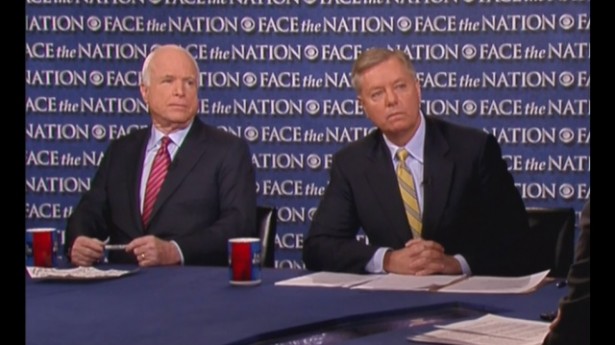
 Aletho News
