The Problem with Transparency International’s Corruption Perceptions Index
By Joseph Thomas – New Eastern Outlook – 13.02.2017
Transparency International puts out what it calls the “Corruption Perceptions Index.” It is an annual index it claims “has been widely credited with putting the issue of corruption on the international policy agenda.”
These carefully selected words, taken at face value appear benign, even progressive. But upon digging deeper into this organisation’s background it becomes clear that these “perceptions” are politically motivated, and the “international policy agenda” clearly favours a very specific region of the globe, particularly that region occupied by Washington, London and Brussels.
Transparency International claims upon its “Who We Are” page of its website that (our emphasis):
From villages in rural India to the corridors of power in Brussels, Transparency International gives voice to the victims and witnesses of corruption. We work together with governments, businesses and citizens to stop the abuse of power, bribery and secret deals. As a global movement with one vision, we want a world free of corruption. Through chapters in more than 100 countries and an international secretariat in Berlin, we are leading the fight against corruption to turn this vision into reality.
Before moving onto the organisation’s funding and financials, one would assume that above and beyond any other organisation in the world, Transparency International would carefully and diligently avoid any perceptions of conflicts of interest on its own part. Yet, not surprisingly, that isn’t the case.
An Anti-Corruption Org Swimming in Conflicts of Interest
Upon their page, “Who Supports Us,” Transparency International admits that it receives funding from government agencies including:
- The United Kingdom’s Department for International Development (DFID);
- Federal Foreign Office, Germany and;
- The US State Department.
Transparency International not only receives funding from the very governments it is tasked to investigate, hold accountable and “index” annually, constituting a major conflict of interest, it also receives money from the following:
- The National Endowment for Democracy;
- Open Society Institute Foundation and;
- Shell Oil.
Open Society in turn, is the sociopolitical fund employed by convicted financial criminal George Soros. The New York Times in its article, “French court upholds Soros conviction,” reported that:
The conviction of George Soros, the billionaire investor and former fund manager, on insider trading charges was upheld on Thursday by a French appeals court, which rejected his argument that his investment in a French bank in 1988 was not based on confidential information.
Soros, 74, now retired from money management but active as a philanthropist and author, was ordered to pay a fine of €2.2 million, or $2.9 million, representing the money made by funds he managed from an investment in Société Générale. He said the purchase had been part of a strategy to invest in a group of companies that had been privatized by the French government.
Were it not for the very serious impact Transparency International’s false perception globally as a reputable corruption watchdog has on nations targeted by its CPI reports, it would be almost comical that this so-called anti-corruption organisation is funded by not only the very governments it is supposed to be objectively detached from, but also funded by convicted criminals like Soros and organisations like the National Endowment for Democracy well known for their use of “democracy promotion” as cover in pursuit of their own self-serving interests.
Thus it is clear, that even at face value, Transparency International likewise serves as just such cover, but instead of hiding behind “democracy promotion” to advance what is a very specific, political agenda, it is hiding behind “fighting corruption.”
And even if impropriety wasn’t so blatant, Transparency International’s lack of better judgement regarding its funding and conflicts of interest discredit it as a legitimate corruption watchdog.
For nations around the world pressured by Transparency International and its CPI reports, dismissing them with this evidence in hand, as well as devising domestic (and credible) anti-corruption watchdogs as alternatives would be particularly useful.
Special interests using Transparency International to target and undermine nations and governments they seek to influence or coerce is not limited only to this organisation, but is a pattern repeated over and over again, from the National Endowment for Democracy’s Freedom House “Freedom in the World” index, to reports published by Human Rights Watch and Amnesty International, US-European special interests have honed this craft of using just causes as cover for corruption and coercion into a fine art.
Russia’s UK embassy brands Russian cyberattacks on UK ‘fake news’
‘No proof, just allegations’
RT | February 13, 2017
The Russian embassy in the UK fired back at the claims made by Britain’s cybersecurity chief in an interview to Sunday Times, in which he accused Moscow of ramping up state-sponsored attacks on the UK. It said there is still no evidence of such attacks.
“Anti-Russian campaign in British press and #fakenews production are going on? Piece contains no proof, just allegations,” The Russian Embassy in the UK tweeted, accompanying the message with a photo of the piece.
In the interview, Ciaran Martin, head of the new National Cyber Security Center (NCSC) and deputy director of the Government Communications Headquarters (GCHQ), claimed that the UK intelligence observed a surge in Russia-sponsored attacks aimed at stealing the UK’s sensitive defense and foreign policy documents for the last two years.
Martin attributed what he described as a “step change in Russian aggression in cyberspace” to Moscow’s intention to “assert power and influence against the West.”
While arguing that the attacks by Russia have been “very well evidenced by international partners and widely accepted,” he fell short of providing any examples of such attacks against the UK.
Nevertheless, Martin argued that the UK would inevitably face a “Category 1” cyberattack from Russia, referring to the large-scale hack that reportedly targeted the US Office of Personal Management in 2015.
He claimed that UK had sustained 188 attacks, including from Russia-sponsored hackers, classified as “Category 2 and 3” within last three months that have compromised UK security.
Ahead of the US presidential elections and in its immediate aftermath, Russia’s alleged hacking of the elections, which was repeatedly denied by Moscow as “nonsense,” has been grabbing international media attention. The blame game in the media went to great lengths, with NBC reporting in December that Russian President Vladimir Putin had ordered the hack himself to secure Trump’s victory.
RT and Sputnik News have been singled out as two of the main drivers behind the “propaganda campaign” aimed at swinging the US elections in favor of Donald Trump.
The anti-Russian hysteria in the US media has since spread to the UK. In December, The Times reported that “Moscow is behind a concerted drive to undermine the UK through espionage, misinformation, cyberattacks and fake news,” citing the opinion of unnamed sources in the British government.
The portrayal of Russian media as propaganda and “fake news” by the Sunday Times early February appeared to prompt some of the RT UK channel advertisers to pull airtime on the channel after they were pressed to comment by the newspaper on an upcoming investigative report on the matter.
The article, authored by Josh Boswell, cited Damian Collins, chairman of the UK House of Commons Culture, Media and Sport Select Committee, as saying that “British companies should not be advertising on channels that disseminate fake news designed to spread fear and confusion.”
Annie Machon, a former British intelligence officer, told RT that while all the recent accusatory statements by British intelligence appeared to be “intelligence-lite,” the US media seems to be preoccupied exclusively with what they present as a mounting “Russian threat.”
“There seems to be another step in the demonization of Russia, which started with the DNC hacks and the fake hacking of the elections and fake news, and the rest of that. So, it is sort of a slur. It is quite libelous, as well,” Machon said.
Machon believes that the excess focus on Russia’s cyber activities, in comparison to that of China and even that of the NSA, that “has been caught out massively hacking across Europe,” is due to “ongoing demonization for political gain.”
Read more:
>Sunday Times ‘propaganda’ probe targets RT advertisers, misquotes MP
New York Times Manipulates NOAA’s Climate Science Scandal
By Marc Morano | Climate Depot | February 12, 2017
If you were only to read the New York Times’ latest article on the most recent Climate Change scandal first reported by the Mail and the Daily Mail, you would never know that there was any scandal to speak of in the first place.
Headline: “No Data Manipulation in 2015 Climate Study, Researchers Say.” Well, not all researchers. The background of the data manipulation story revolves around accusations made by David Bates, a recently retired scientist at the National Oceanic and Atmospheric Administration (NOAA). Among his several accusations is that NOAA “rushed to publish a landmark paper that exaggerated global warming and was timed to influence the historic Paris agreement on climate change,” a paper which would have been welcomed with open arms by the Obama administration. On February 4, Bates wrote a lengthy blog post at his website detailing the accusations. Here is a brief list of some of the charges:
1. Climate scientist, Tom Karl, failed to archive the land temperature data set and thus also failed to “follow the policy of his own Agency [and] the guidelines in Science magazine for dataset archival and documentation.”
2. The authors also chose to “use a 90% confidence threshold for evaluating the statistical significance of surface temperature trends, instead of the standard for significance of 95%,” and according to Bates, the authors failed to give a justification for this when pressed.
3. Karl routinely “had his ‘thumb on the scale’ — in the documentation, scientific choices, and release of datasets — in an effort to discredit the notion of a global warming hiatus and rush to time the publication of the paper to influence national and international deliberations on climate policy.” Bates adds, “[a] NOAA NCEI supervisor remarked how it was eye-opening to watch Karl work the co-authors, mostly subtly but sometimes not, pushing choices to emphasize warming.”
4. Experimental datasets were used that were not run through operational readiness review (ORR) and were not archived.
To sum up, the “data manipulation,” as characterize by the Mail, consisted in not following proper protocols, selecting certain data sets which had not been properly analyzed, and manipulating scientific methodology with a political and not purely scientific end.
Reports that Moscow is to ‘gift’ Snowden to Trump meant to pressure new administration – Zakharova
RT | February 12, 2017
Recent reports that whistleblower Edward Snowden will be “gifted” to President Trump are meant to scandalize public opinion and show that the new administration continues to face pressure from opponents, said Russian Foreign Ministry spokeswoman.
“Today, US intelligence agencies have stepped up their work, updating two stale stories, ‘Russia can gift Snowden to Trump’ and ‘confirmation found on the details of the scandalous dossier on Trump allegedly collected by an ex-employee of British intelligence.’ But it may seem so only to those who do not understand the essence of the game,” Foreign Ministry spokeswoman Maria Zakharova wrote in a Facebook post on Sunday.
“None of these statements have been made by representatives of the special services, but is information coming from NBC and CNN, citing unnamed sources. The difference is obvious, but only to experts. Yet it is useful for scandalizing the public and maintaining a degree of [public outrage],” she said.
The official representative of the Russian Foreign Ministry said that the new administration’s foreign policy has still not been formed because political opponents in the US are hindering the White House’s efforts to begin proper work.
“It is evident that the pressure on the new administration on the part of political opponents within the United States continues, bargaining is going on. And that’s why the US foreign policy doctrine has not yet been formed,” she wrote.
“How Russia will work with the White House in the international arena is journalists’ main question. In an interview with Irada Zeynalova to be released on Sunday, Sergei Lavrov said: ‘we are waiting for the team to be formed. But what is more obvious: the delay is not due to the inertness of the new administration, but to the fact that it is simply not allowed to work,’” Zakharova said.
On Friday, NBC News reported that an unnamed “US senior official” had claimed that the Russian government was actively considering the possibility of handing over Snowden “to curry favor” with President Trump. The official said that he had drawn the conclusion upon studying a “series of highly sensitive intelligence reports.”
Another US intelligence source cited in the piece said that the intelligence, which was allegedly collected since Trump’s inauguration on January 20, contains the thoughts of Russian officials on how to get off on the right foot with the current administration. Yet, Snowden’s lawyer in Russia, Anatoly Kucherena, said he doesn’t believe Russia is prepared to hand over Snowden anytime soon, calling the article “speculation.” Snowden has been living in Russia since 2013 when he was granted asylum by the Russian government. It was subsequently extended for three years and was successfully renewed for two more in January. Trump is known to have an unforgiving opinion of Snowden, whom he has denounced as “a traitor and a disgrace.”
Zakharova mentioned another report, published on Saturday, which asserts that some of the details in the dodgy 35-page dossier that made so much noise last month are true. It apparently claims, above all, the allegations suggesting President Trump has ties with the Russian government have been confirmed. Zakharova pointed out that, although the report cites “multiple current and former US law enforcement and intelligence officials,” it gives no names or specific quotes from them.
The dossier, which was first published by BuzzFeed and CNN in early January, earned the two the title of “fake news,” which was even used by Trump himself to categorize the outlets. The release was followed by comments from the White House warning the media to stop trying to delegitimize the newly inaugurated president.
Amnesty International Stokes Syrian War
By Rick Sterling | Consortium News | February 11, 2017
Amnesty International (AI) has done some good investigations and reports over the years, which has won the group widespread support. However, less well recognized, Amnesty International has also carried out faulty investigations with bloody and disastrous consequences.
One prominent example is in Iraq, where AI “corroborated” the false story that Iraqi soldiers were stealing incubators from Kuwait, leaving babies to die on the cold floor. The deception was planned and carried out in Washington to influence the U.S. public and Congress.
A more recent example is from 2011 where false accusations were being made about Libya and Muammar Gaddafi as Western and Gulf powers sought to overthrow his government. AI leaders joined the campaign claiming that Gaddafi was using “mercenaries” to threaten and kill peacefully protesting civilians. The propaganda was successful in muting criticism of what became an invasion and “regime change.”
Going far beyond a United Nations Security Council resolution to “protect civilians,” NATO launched sustained air attacks and toppled the Libyan government leading to chaos, violence and a flood of refugees. AI later refuted the “mercenary” accusations but the damage was done.
Now, on Feb. 7, Amnesty International released a new report titled “Human Slaughterhouse: Mass Hangings and Extermination at Saydnaya Prison,” which accuses the Syrian government of executing thousands of political prisoners, a set of accusations that has received uncritical treatment in the mainstream news media.
Like the Iraq/Kuwait incubator story and the Libyan “mercenary” story, the “Human Slaughterhouse” report is coming at a critical time. It accuses and convicts the Syrian government of horrible atrocities against civilians – and AI explicitly calls for the international community to take “action.” But the AI report is deeply biased and amounts to a kangaroo-court conviction of the Syrian government.
AI’s Standards Ignored
The Amnesty International report violates the organization’s own research standards. As documented by Professor Tim Hayward here, the Secretary General of Amnesty International, Salil Shetty, claims that Amnesty does its research “in a very systematic, primary, way where we collect evidence with our own staff on the ground. And every aspect of our data collection is based on corroboration and cross-checking from all parties, even if there are, you know, many parties in any situation because of all of the issues we deal with are quite contested. So it’s very important to get different points of view and constantly cross check and verify the facts.”
But the Amnesty report fails on all counts: it relies on third parties, it did not gather its information from different points of view, and it did not cross-check with all parties. The report’s conclusions are not based on primary sources, material evidence or AI’s own staff; the findings are solely based on the claims of anonymous individuals, mostly in southern Turkey from where the war on Syria is coordinated.
Amnesty gathered witnesses and testimonies from only one side of the conflict: the Western- and Gulf-supported opposition. For example, AI consulted with the Syrian Network for Human Rights, which is known to seek NATO intervention in Syria. AI “liased” with the Commission for International Justice and Accountability, an organization funded by the West to press criminal charges against the Syrian leadership. These are obviously not neutral, independent or nonpartisan organizations.
If AI were doing what its Secretary General claims the organization always does, AI would have consulted with organizations within or outside Syria to hear different accounts of life at Saydnaya Prison. Since the AI report has been released, the AngryArab has published the account of a Syrian dissident, Nizar Nayyouf, who was imprisoned at Saydnaya. He contradicts many statements in the Amnesty International report, the type of cross-checking that AI failed to do for this important study.
Amnesty’s accusation that executions were “extrajudicial” is exaggerated or false. By Amnesty’s own description, each prisoner appeared briefly before a judge and each execution was authorized by a high government leader. We do not know if the judge looked at documentation or other information regarding each prisoner. One could argue that the process as described was superficial, but it’s clear that even if AI’s allegations are true, there was some kind of judicial process.
Amnesty’s suggestion that all Saydnaya prisoners are convicted is false. Amnesty quotes one witness who says about the court: “The judge will ask the name of the detainee and whether he committed the crime. Whether the answer is yes or no, he will be convicted.” But this assertion is contradicted by a former Saydnaya prisoner who is now a refugee in Sweden. In this news report, the former prisoner says the judge “asked him how many soldiers he had killed. When he said none, the judge spared him.” This is evidence that there is a judicial process of some sort and there are acquittals.
The Amnesty report includes satellite photographs with captions which are meaningless or erroneous. For example, as pointed out by Syrian dissident Nizar Nayyouf, the photo on page 30 showing a Martyrs Cemetery is “silly beyond silly.” The photo and caption show that the cemetery doubled in size. However, this does not prove hangings of prisoners who would never be buried in a “martyrs cemetery” reserved for Syrian army soldiers. On the contrary, it confirms the fact which Amnesty International otherwise ignores: Syrian soldiers have died in large numbers.
The Amnesty report falsely claims — based on data provided by one of the groups seeking NATO intervention — “The victims are overwhelmingly ordinary civilians who are thought to oppose the government.” While it’s surely true that innocent civilians are sometimes wrongly arrested, as happens in all countries, the suggestion that Saydnaya prison is filled with 95 percent “ordinary civilians” is preposterous. Amnesty International can only make this claim without facing ridicule because AI and other Western organizations have effectively “disappeared” the reality of Syria.
Missing Facts
Other essential facts, which are completely missing from the Amnesty report, include:
–Western powers and Gulf monarchies have spent billions of dollars annually since 2011 to recruit, fund, train, arm and support with sophisticated propaganda a violent campaign to overthrow the Syrian government;
–As part of this operation, tens of thousands of foreign fanatics have invaded Syria and tens of thousands of Syrians have been radicalized and paid by Wahhabi monarchies in the Gulf to overthrow the government;
–More than 100,000 Syrian Army and National Defense soldiers have been killed defending their country. Most of this is public information yet ignored by Amnesty International and other mainstream media in the West. This “regime change” operation has been accompanied by a massive distortion and cover-up of reality.
–Without providing evidence, Amnesty International accuses the highest Sunni religious leader in Syria, Grand Mufti Ahmad Badreddin Hassoun, of authorizing the execution of “ordinary civilians.” While the Grand Mufti is a personal victim of the war’s violence – his son was murdered by terrorists near Aleppo – he has consistently called for reconciliation. Following the assassination of his son, Grand Mufti Hassoun gave an eloquent speech expressing forgiveness for the murderers and calling for an end to the violence.
What does it say about Amnesty International that it makes specific personal accusations, against people who have personally suffered, yet provides no evidence of guilt?
In the report, Amnesty uses sensational and emotional accusations in place of factual evidence. The title of the report is “Human Slaughterhouse.” And what goes with a “slaughterhouse”? A “meat fridge.” So, the report uses the expression “meat fridge” seven separate times, presumably in an attempt to strengthen the central metaphor of a slaughterhouse.
Even the report’s opening quotation is hyperbolic: “Saydnaya is the end of life – the end of humanity.” The report is in sharp contrast with fact-based objective research and investigation; it appears designed to manipulate emotions and thus create new public support in the West for another escalation of the war.
Yet, Amnesty International’s accusations that the Syrian government is carrying out a policy of “extermination” are contradicted by the fact that the vast majority of Syrians prefer to live in government-controlled areas. When the “rebels” were finally driven out of East Aleppo in December 2016, 90 percent of civilians rushed into areas under government control.
In recent days, civilians from Latakia province who had been imprisoned by terrorists for the past three years have been liberated in a prisoner exchange. [This video shows Syrian President Bashar al-Assad and his wife meeting with some of the civilians.]
A Video
The Amnesty report is accompanied by a three-minute propaganda cartoon that reinforces the narrative that Syrian civilians who protest peacefully are imprisoned and executed. Echoing the theme of the report, the animation is titled “Saydnaya Prison: Human Slaughterhouse.” Amnesty International appears to be in denial that there are tens of thousands of violent extremists in Syria, setting off car bombs, launching mortars and otherwise attacking civilian areas every day.
Given the national crisis – with so many violent jihadists to confront – it makes little sense that Syrian security or prison authorities would waste resources on non-violent civilians although that does not mean that the Syrian government has clean hands either. Mistakes and abuses surely happen in this war like all wars.
But the AI report is more like the propaganda that has surrounded the Syrian conflict from the beginning, lacking in balance and reminiscent of the “perception management” used to justify the U.S. invasion of Iraq in 2003 and the West’s assault on Libya in 2011. AI’s hyperbole is also contradicted by the fact that Syria has many opposition parties that compete for seats in the National Assembly and campaign openly for public support from both the right and left of the Baath Party.
AI’s claim that Syrian authorities brutally repress peaceful protests further ignores the Syrian reconciliation process. For the past several years, armed opposition militants have been encouraged to lay down their weapons and peacefully rejoin society, a program largely unreported in Western media because it contradicts the “black hat” narrative of the Syrian government. [A recent example is reported here.]
The Amnesty report cites the “Caesar” photographs as supporting evidence for its “slaughterhouse” accusations but ignores the fact that nearly half those photographs show the opposite of what was claimed. The widely publicized “Caesar photographs” was a Qatari-funded hoax designed to sabotage the 2014 Geneva negotiations as documented here.
While the Amnesty report makes many accusations against the Syrian government, AI ignores the violation of Syrian sovereignty being committed by Western and Gulf countries. It is a curious fact that big NGOs such as Amnesty International focus on violations of “human rights law” and “humanitarian law” but ignore the crime of aggression, also called the crime against peace.
According to the Nuremberg Tribunal, aggression is “the supreme international crime, differing only from other war crimes in that it contains within itself the accumulated evil of the whole.” Former Nicaraguan Foreign Minister and former President of the U.N. General Assembly, Father Miguel D’Escoto, is someone who should know. He says, “What the U.S. government is doing in Syria is tantamount to a war of aggression, which, according to the Nuremberg Tribunal, is the worst possible crime a State can commit against another State.” Amnesty International ignores this reality.
Background and Context
The co-author of this Amnesty International report is Nicolette Waldman (Boehland), who was uncritically interviewed on DemocracyNow! on Feb. 9. The background and previous work of Waldman shows the inter-connections between influential Washington “think tanks” and the billionaires’ foundations that fund “non-governmental organizations” – NGOs – that claim to be independent but are clearly not.
Waldman previously worked for the “Center for Civilians in Conflict,” which is directed by leaders from George Soros’s Open Society, the Soros-funded Human Rights Watch, Blackrock Solutions and the Center for a New American Security (CNAS).
CNAS may be the most significant indication of political orientation since it is led by Michele Flournoy, who was expected to become Secretary of Defense if Hillary Clinton had won the election. CNAS has been a leading force behind neoconservative and liberal-interventionist plans to escalate the war in Syria. While past work or associations do not always define new or future work, in this case the sensational and dubious accusations seem to align with those political goals. [Soros’s Open Society has also provided funds to Amnesty International.]
So what to make of Amnesty International’s new report? The once widely respected human rights organization has, in the recent past, let itself be used as a propaganda tool to justify Western aggression against Iraq and Libya, which seems to be the role that AI is playing now in Syria.
The Amnesty International report is a mix of hearsay accusations and sensationalism that tracks with the Western propaganda themes that have surrounded the Syrian war from the start. Because of Amnesty’s undeserved reputation for independence and accuracy, the report has been picked up and broadcast widely. Liberal and supposedly progressive media outlets have joined in dutifully echoing the questionable accusations.
Little or no skepticism is applied when the target is the Syrian government, which has faced years of foreign-sponsored aggression. If this report justifies another escalation of the conflict, as Amnesty International seems to want, the group will again be serving as a rationalizer for Western aggression against Syria, just like it did in Iraq and Libya.
Rick Sterling is an investigative journalist based in the San Francisco Bay Area. He can be reached at rsterling1@gmail.com
The US Establishment’s Russian Scapegoat Veils the Real Enemy Within
By Mark Hackard | 21st Century Wire | February 10, 2017
Did Russian intelligence sway the outcome of the 2016 United States presidential race? Ask the CIA and mainstream Western media organs, and they’ll have you believe that yes, it was none other than Moscow’s shadowy operatives who managed to infiltrate Donald Trump into the newly gold-bedecked Oval Office. Blame the Russians, our betters declare, rather than a year of skewed coverage and loaded polls. While the theory has become popular among opposition to the new administration, it is based on exactly zero evidence – which means we should designate it under the establishment’s own rubric as “fake news.”
To bolster the charge, the US Intelligence Community (of Iraq WMD fame) has released a public report intimating that Vladimir Putin “hacked the election.” Through cyberwarfare, agents of influence and information campaigns, we are told, the Kremlin pulled off the unthinkable and effectively ran a regime-change operation in America. Warmongering neoconservatives and virtue-signaling liberals alike commenced their reenactment of Red Dawn. Piling on, CNN and Buzzfeed unveiled a sloppy, error-ridden and highly dubious dossier detailing Trump’s alleged Russian ties and sexual blackmail material (kompromat). None of these claims have been backed by a shred of credible proof presented to the public, so why should they be taken as an article of faith?
The more historically literate among purveyors of the Trump-Russia fantasy will point to the Soviet KGB’s use of “active measures” and disinformation as instruments of influence. Indeed, Soviet intelligence could boast a distinguished record of such programs all the way back to 1923, when the Bolsheviks formed a joint committee, the Disinformation Bureau, that developed and executed deception campaigns to aid specific policy goals. Contrary to the wild stories of defectors like Anatoly Golitsyn, these operations did not comprise some grand strategy to trick the West into embracing the joys of Marxism-Leninism. Rather, they were focused on concrete objectives, such as inflating data on Soviet defense capabilities, concealing military advantages, or obtaining economic concessions in international trade deals. A declassified document from the Disinformation Bureau outlines its main tasks:
• “A record of intelligence, flowing both to the GPU [successor service to the Cheka] and the Intelligence Directorate [Red Army] and other institutions, on the degree to which foreign intelligence services are informed about Russia;
• An accounting and characterization of intelligence that interests the opponent;
• Detecting the degree to which the opponent is informed about us;
• Composition and technical production of an entire series of false intelligence and documents giving the opponent an incorrect conception about the internal situation in Russia, on the organization and state of the Red Army, on the political work of leading Party and Soviet organs, on the work of the NKID [People’s Commissariat of Foreign Affairs], etc.;
• Carry out supplying the opponent with the aforementioned materials and documents through corresponding organs of the GPU and Intelligence Directorate;
• Development of a series of articles and notes for the periodical press; prepare the ground for the release of various fictitious materials into circulation and present them in each individual case for review by one of the secretaries of the Central Committee.”[i]
During the Cold War, Service A within the KGB’s First Chief Directorate (Foreign Intelligence) was dedicated to the arcane arts of deception, propaganda and influence campaigns[ii], all of which today would be classified under the term information warfare. Its wily progenitor, Major General Ivan Agayants, was a legend in the KGB for his erudition and sophisticated planning.[iii] Service A operated in five basic spheres: political; economic; scientific-technical; military; and counterintelligence. And in contrast to other units, its leadership had a comprehensive view of the secret war:
“Service A was the only element of the KGB (outside of the Information Analysis Directorate) to be routinely given copies of reports coming in from secret sources throughout the world. In fact, Agayants and Kondrashev – on a strictly personal basis – were given (by hand) information gleaned from the most sensitive of these sources: deciphered foreign communications, moles inside Western governments, and microphones in Western installations (although in a format concealing the identity and often even the general nature of the source).”[iv]
Disinformation programs in the political realm were directed at furthering Moscow’s foreign policy objectives – whether increasing friction amongst NATO allies, undermining the dominant US strategic role in Western Europe or discrediting anti-Soviet politicians. Documents and other evidence, real, altered or forged, could be fed to friendly journalists who would publish the damaging exposés. Agayants’ successor, Lieutenant General Sergei Kondrashev, knew well that the truth was often the KGB’s most potent weapon:
“An “active measure” – for example, the public release of documents of facts embarrassing a hostile Western government or statesman – may or may not involve “disinformation” – distortion, concealment, invention, or forgery. In practice, Kondrashev found that actions based on truth had greater impact. The distinction became clear when an officer would propose such a measure and Kondrashev would ask, “How much disinfo (deza) is in it?””[v]
 Economic active measures were deployed to the benefit of the Soviet state – such as playing the gold markets through the officially sanctioned release of false data. Bogus scientific information on industrial and defense technologies, meanwhile, was fed through double agents to the CIA so that US defense concerns would waste vast sums on non-viable projects. Another cell coordinated with the USSR General Staff in strategic concealment – maskirovka. And in the arena of counterintelligence, KGB Service A was able to deceive its adversaries in order to protect high-priority assets and moles who had burrowed their way deep into Western spy services.[vi]
In one form or another, Service A is likely still a component of the KGB First Chief Directorate’s contemporary successor, the SVR. Yet the continuing presence of a deception capability, now augmented by cyberwarfare, simply does not translate to the claim that Russia “hacked the election.” The closest pundits and government officials have to come to any kind of logical scheme of Russian interference in the 2016 presidential elections has been the assertion that Wikileaks, activist Julian Assange’s one-stop shop for hard evidence of government malfeasance, is a Kremlin front. This charge, however, has been shown to have no origin in reality. Former UK Ambassador Craig Murray, who has admitted to acting as a courier for Wikileaks, stated that the source for the explosive revelations from Democratic Party servers was an American whistleblower. Rather than functioning as the link in some Russian conspiracy, in all probability Wikileaks has been acting as a clearinghouse for compromising files supplied by dissident factions within the US Deep State.
Brace yourself for a shock: every great power spies. Russian intelligence remains unmatched in classical espionage (rivalled only by the Israelis and British) and fields an impressive cyberwarfare arm. Active intelligence collection in no way presupposes massive covert action, though, especially when not an iota of actual proof has been offered – spurious allegations by “unnamed sources” and the anti-Hillary editorial slant of Moscow outlets RT and Sputnik don’t qualify.
If anyone is known for hacking elections, it’s Lubyanka’s archenemy in Langley. Since its postwar inception in 1947, the CIA has covertly intervened in other nations’ elections and engineered coups with regularity in the service of multinational corporate interests. Rent-a-mobs and swarming technologies; bribery; assassinations; Color Revolutions; “freedom fighters;” financing wars and political campaigns through drug trafficking; and endless propaganda – all are sure favorites from the set list of the Company’s World Democracy Tour. From Iran, Guatemala, and Congo to Libya, Syria, and Ukraine, the CIA has blazed a path of subversion and destruction without parallel in the historical record. As the Congressional record made clear in 1975, the Agency admitted to running hundreds of well-paid assets occupying key editorial positions in American print, television and radio to shape public opinion under a program fittingly codenamed “Operation Mockingbird.” How’s that for fake news?
In attempting to undermine Trump, the CIA has now openly intervened in American politics, with none of the subtlety of Kennedy’s execution in Dealey Plaza. The nation is descending into McCarthyism 2.0. CIA auxiliaries in the media are denouncing those who question official wisdom – or dare advocate peaceful and productive relations between Russia and the United States – as ‘Putin’s agents,’ including even the US president.
While this contrived scandal will eventually flame out, the real-life Great Game continues unabated. In late January, Russia’s FSB (Federal Security Service) arrested three cyber security experts, including two from their own ranks. FSB officers Sergei Mikhailov and Dmitry Dokuchaev, along with Kaspersky Labs employee Ruslan Stoyanov, are reportedly being held under suspicion of having worked for Washington. Might this be the conclusive smoking gun that proves Russia ‘hacked’ the US election? Considering historical context and the fact that nothing presented so far by the US Intelligence Community would corroborate its claims, the possibility is low. Rather, whatever sources and methods the CIA presented in whirlwind briefings to a slew of US policymakers – who are determined to advance the “Russian meddling” trope – were likely ferreted out by the SVR and promptly delivered to Lubyanka. The CIA’s globalist brass may have thus blown their agent network in Moscow – thanks to a deception campaign they themselves unleashed.
We can only wonder what scenario of carnavalesque intrigue our masters will concoct next as the establishment narrative kaleidoscopes into absurdity.
Footnotes:
[i] Sluzhba vneshnei razvedki. Istoriia rossiiskoi vneshnei razvedki: Ocherki: Tom II: 1917-1933 gody. Moscow: Mezhdunarodnyie Otnosheniia, 2014.
[ii] Founded in 1959, the KGB First Chief Directorate’s disinformation unit was originally designated Department D (for disinformation). In 1966 it was upgraded to Service A. Komitet gosudarstvennoi bezopasnosti. “Otdel D – Sluzhba A.” http://shieldandsword.mozohin.ru/kgb5491/structure/1GU/A.htm
[iii] Sluzhba vneshnei razvedki. Istoriia rossiiskoi vneshnei razvedki: Ocherki: Tom V: 1945-1965 gody. Moscow: Mezhdunarodnyie Otnosheniia, 2014.
[iv] Bagley, Tennent. Spymaster: Startling Cold War Revelations of a Soviet KGB Chief. New York: Skyhorse Publishing, 2013.
[v] Ibid.
[vi] Ibid.
Author Mark Hackard is an independent foreign policy analyst, and founder and editor of Soul of the East. He earned a BA in Russian Language from Georgetown University and an MA in Russian, Eastern European and Eurasian Studies from Stanford University. He studies the intersection of political culture, religion and strategic issues, which he approaches from a traditionalist-conservative position. Some of his major influences are Joseph de Maistre, Juan Donoso Cortes, Fyodor Dostoevsky, Rene Guenon and Fr. Seraphim Rose.
US Cooks Up New Syrian Atrocities Amid Syrian Talks
By Tony Cartalucci | New Eastern Outlook | 10.02.2017
Amnesty International is inextricably compromised in its stated duty to hold nations accountable for human rights violations through its direct connections with Western political interests and their use of the organization as a tool of geopolitical influence and coercion.
The report itself states clearly (emphasis added): As such, reports like its most recent titled, “Syria: Human Slaughterhouse: Mass Hangings and Extermination at Saydnaya Prison, Syria,” begs belief. The report begs belief not just because of the systematic campaign of disinformation and war propaganda Amnesty International has been engaged in against Syria specifically, or the many fallacious reports it has published targeting Washington, London, and Brussels’ political enemies elsewhere, but particularly because of the report’s own admitted methodology.
The research for this report took place between December 2015 and December 2016. Amnesty International interviewed 31 men who were detained at Saydnaya (also spelt Sednaya) between 2011 and 2015.
The report also admits (emphasis added):
Amnesty International also interviewed four prison officials or guards who previously worked at Saydnaya; three former judges, one of whom served in the Military Court in the al-Mezzeh neighbourhood of Damascus; three doctors who worked at Tishreen Military Hospital; four Syrian lawyers; 17 international and national experts on detention in Syria, such as investigators, analysts and monitors; and 22 family members of people who were or still are believed to be detained at Saydnaya. The majority of these interviews took place in person in southern Turkey. The remaining interviews were conducted by telephone or through other remote means with interviewees still in Syria, or with individuals based in Lebanon, Jordan, European countries and the USA.
In essence, Amnesty International admits to having no actual, physical evidence. It also is admitting it never stepped foot on Syrian soil, let alone anywhere around or in the prison their 48 page report covers. The report itself admits:
Despite repeated requests by Amnesty International for access to Syria, and specifically for access to detention facilities operated by the Syrian authorities, Amnesty International has been barred by the Syrian authorities from carrying out research in the country and consequently has not had access to areas controlled by the Syrian government since the crisis began in 2011. Other independent human rights monitoring groups have faced similar obstacles.
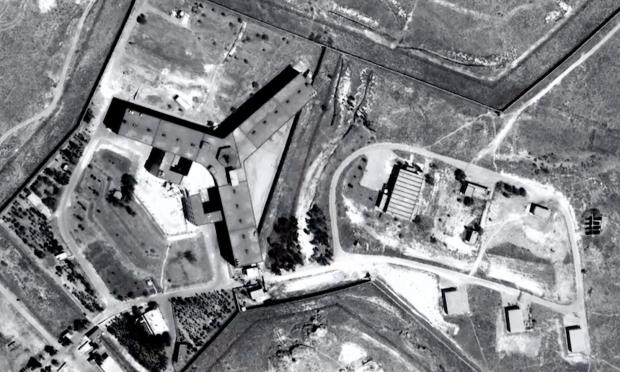
So distant was Amnesty International from actually obtaining physical evidence, their only images of the prison itself included in their report are satellite photographs taken from outer space. The only other photographs included are of three alleged prisoners, before and after their alleged detention, attempting to illustrate not torture, but weight loss.
Admittedly, Amnesty International interviewed members and organizations of the Syrian opposition, including those operating out of southern Turkey where much of the war was organized and launched against Syria from.
Despite these admissions, the Amnesty International report claims:
We therefore conclude that the Syrian authorities’ violations at Saydnaya amount to crimes against humanity. Amnesty International urgently calls for an independent and impartial investigation into crimes committed at Saydnaya.
Yet guilt cannot be established or assigned based solely on the witness accounts of individuals and organizations, let alone those that have a history of deceit and fabrications, and with clear motivations to deceive and fabricate accusations again regarding this latest report.
Without actual, physical evidence, Amnesty International’s report is merely another in a large pile of unverified accusations, or now verified fabrications, produced by both it and the many other organizations pursing a politically motivated agenda merely under the guise of advocating human rights.
A Matter of Timing
Reuters in its February 5, 2017 article, “Russia’s Lavrov backs renewal of U.N.-led Syria talks,” would report:
Russia said on Sunday that it supports the continuation of Syria peace talks under United Nations auspices, long-running negotiations which had been thrown into doubt by separate, Moscow-backed peace talks launched last month.
The latest round of U.N. talks had been planned to begin in Geneva on Feb. 8 but Russia’s Foreign Minister Sergei Lavrov said last week that they had been postponed.
Thus, the familiar pattern of US and European interests, through the use of their “human rights advocates,” continues with this latest, unsubstantiated report, attempting to place political pressure upon Syria and its allies to grant itself additional leverage at the negotiating table.
That Amnesty International has attempted to use its own carefully constructed reputation in an “appeal to authority,” further reflects on the organization’s true motives, methods, and mission.
It was also in late 2016 when the organizations Amnesty International collaborated with for this latest report, were caught fabricating the number of civilians trapped in eastern Aleppo before the Syrian military and foreign media moved into previously militant occupied districts to verify their claims as false.
Another crucial matter of timing includes the frame in which Amnesty International’s interviews were conducted, between December 2015 and December 2016. It was within this year that the tide of Syria’s long conflict finally, unquestionably turned in favor of Damascus and its allies. It was December 2016 when finally Syria’s northern city of Aleppo was fully freed from occupying militants.
The purpose of these fabrications was to give militants and their foreign sponsors leverage ahead of negotiations meant to prolong both their occupation of the city and the wider regional war. There is no reason to believe this latest apparent fabrication serves any other purpose.
US Claims of Russian Support for Taliban in Afghanistan False
Sputnik – 10.02.2017
 MOSCOW — Claims in the United States of Russian support for Taliban militants in Afghanistan to erode Washington’s influence there are false, the Russian Foreign Ministry told Sputnik on Friday.
“This is a simple lie… This is nonsense,” Zamir Kabulov, director of the ministry’s Second Asian Department, said.
Kabulov’s remarks came in response to US Senator John McCain accusing Russia of “meddling in Afghanistan in an apparent attempt to prop up the Taliban and undermine the United States” in a Thursday hearing.
“All of these are attempts to justify their own failures and the inability to stabilize the situation in Afghanistan. There is no other explanation to this,” Kabulov said.
On February 9, top US commander in Afghanistan Gen. John Nicholson made a statement during a hearing at the Senate Armed Services Committee accusing Russia of working to “legitimize and support” the Taliban in Afghanistan, declining to say in the open hearing in what way, he believes, Russia could be providing support for the terrorist organization.
US Lawmakers Call on Trump to Impose New Sanctions on Venezuela
teleSUR – February 9, 2017
A bipartisan group of 34 U.S. lawmakers urged President Donald Trump to apply new sanctions against Venezuela’s Bolivarian government, alleging that it supports corruption, human rights abuses, and “terrorism.”
Cuban-American right-wing congresspeople Rep. Ileana Ros-Lehtinen, R-Florida, and Sen. Robert Menendez, D-New Jersey, co-authored a letter sent to Trump endorsed by 32 other republican and democratic lawmakers.
The letter calls on Trump to investigate alleged drug trafficking and support for so-called Middle Eastern terror groups by the country’s new vice president, Tareck El Aissami, AP reported.
“Decisive, principled action in response to unfolding developments in Venezuela as one of the first foreign policy actions of your administration would send a powerful message to the Maduro regime and the Venezuelan people,” lawmakers said in the letter.
In addition to sanctioning Venezuelan officials and launching an investigation into the Bolivarian government’s alleged ties to terrorism, the U.S. lawmakers want to boost funding for right-wing opposition groups operating within the country.
Since 1999, the year former Venezuelan President Hugo Chavez took office, the U.S. government has provided opposition groups with hundreds of millions of dollars. Since 2014, US$5 million has been allocated in the federal budget to finance opposition activities inside the South American country, the Daily Mail reported.
These are the same groups that are responsible for the guarimbas — the violent practice of blocking roads, lighting tires on fire, and firing rocks and other materials at Venezuelan police. Members of opposition groups have also been caught hoarding and illegally selling foodstuffs for personal profit.
Despite the Venezuelan opposition’s well-recorded criminality, the bipartisan group of U.S. lawmakers is instead choosing to combat the democratically-elected government’s alleged “crimes.”
The lawmakers claim Venezuelan officials in charge of distributing food rations are “profiting” from shortages, citing a December 2016 report by AP. The investigation, however, quotes unsubstantiated claims made by opposition residents and former officials hostile to the incumbent government.
The lawmakers also claim El Aissami has connections to the Islamic Republic of Iran and Hezbollah in Lebanon, which they say automatically makes him complicit in supporting “terrorism,” but provided no evidence to back that accusation.
Trump’s administration has not commented on proposed plans to sanction and investigate Venezuela. Maduro’s administration continues to speak out against U.S. efforts to destabilize the democratically-elected government.
Moscow Regards Dutch Allegations of Russian Cyberattacks as ‘Hysteria’
Sputnik – 09.02.2017
Dutch allegations that Russia may carry out cyberattacks to influence the results of parliamentary elections in the Netherlands are manifestations of “hysteria,” Russian Foreign Ministry’s spokeswoman Maria Zakharova said Thursday.
Dutch experts claim that Russian hackers have targeted the Binnenhof complex, located in The Hague and housing Prime Minister Mark Rutte’s office, Zakharova added.
“Members of the state’s government are increasingly active in engaging in this hysteria, amplified by the media. They do not choose words, they do not have any proof, they publicly claim that Russia is a source of cyberthreats, without having any facts,” Zakharova said at a briefing in Moscow.
Zakharova recalled that former Dutch Foreign Minister and NATO’s ex-Secretary General Jaap de Hoop Scheffer had called the Netherlands attractive for Russian hackers in the light of the upcoming parliamentary elections.
On February 1, Dutch Interior Minister Ronald Plasterk expressed concern over the possibility that the results of the parliamentary elections could be manipulated and added that he considered Russia as one of the actors, which could be interested in influencing the vote.
In mid-January, Dutch Foreign Affairs Minister Bert Koenders said the state’s government had been on alert about the risk of Russian hacking ahead of the Dutch parliamentary elections, set for March 15.
Featured Video

The Search for Truth: Charlie Kirk’s Assassination One Year Later
or go to
Aletho News Archives – Video-Images
From the Archives
The 9/11 “Double-Cross” Conspiracy Theory
BY LAURENT GUYÉNOT • UNZ REVIEW • SEPTEMBER 6, 2022
Is it true that “9/11 was an inside job”? Yes, insofar as Israel is “inside” the U.S. But for the 9/11 truthers who have identified Israel as the main perpetrators, “9/11 was an inside job” is at best a half-truth, and at worst an integral part of the Zionist operation, like a secondary flag sewn as a lining under the false flag of Islamism. Victor Thorn (1963-2017) wrote in his book 9/11 made in Israel: The Plot Against America (2011): “In essence, the ‘9-11 truth movement’ was created prior to Sept. 11, 2001 as a means of suppressing news relating to Israeli complicity. . . . The slogan ‘9-11 was an inside job’ was quite possibly the greatest example of Israeli propaganda ever devised.” In milder terms, it is “controlled opposition”.
A genuine truth movement would have pointed to Israel as the prime suspect from the start. From day one, it was obvious who would benefit. … continue
Blog Roll
 Aletho News
- Europe’s mounting social chaos… chickens coming home to roost for proxy war against Russia
- US-Russia Diesel Deal Becomes Massive Defeat for Ukraine
- Hormuz and the Looming Economic Catastrophe
- Dhubab offensive, media blitz and the rapid unraveling of Saudi-backed coalition’s new gambit
- Putin Conveys to Trump Iran’s Vision on Possible Conflict Resolution – Kremlin
- The Search for Truth: Charlie Kirk’s Assassination One Year Later
- ‘Harsh reality’: Iran says France seeks monopoly on power and intimidation, not peace for all
- When Will This White House Madness End?
- Huckabee aide goes to ‘unusual lengths’ to portray ‘Israel’ positively
- Trump Announces Diesel Supply Deal With Putin Following Phone Call
- If Americans Knew
- Israeli forces kill another child in Gaza – Daily Update
- Gaza ceasefire exists in name only, say more than 100 organizations
- Nearly 2 Million in Gaza Need Urgent Shelter Assistance as Winter Looms: IOM Chief Warns
- Suppressing Palestinian resistance: US charity under fire for AI monitoring of Gaza classrooms
- Thousands Are Held in Israeli Torture Camps. This Is What Happens Inside
- Israel puts Gaza’s sick, injured, newborn in peril – Daily Update
- Report claimed Mark Levin used by Israeli government to influence Trump
- Over 2,000 Gazans have died awaiting medical evacuation amid Israel’s continued siege
- How a U.S. Diplomat Suppressed and Altered Reports Critical of Israel
- 5 Palestinians Die from Israeli Strikes in Gaza as Relentless Attacks Continue
- No Tricks Zone
- New Study: 50 Years Of The Most Aggressive ‘Net Zero’ Policies Can Only Affect The Global Climate By 0.03°C
- US September “Heat” Was No Record…Many Records Set Decades Ago
- Latest European Green Energy Debacle; Portugal’s Largest Flagship Solar Park Insolvent!
- Green Energy Debacle: German Expert Professor Fritz Vahrenholt Warns Of Severe Economic And Social Consequences
- Two More Paleo Reconstructions Affirm Meters-Higher Sea Levels Across Ireland, Brazil 7000-6000 Years Ago
- New Study: Earth And Venus Surface Warmth Largely Explained By Convection And Lapse Rate, Not CO2 Or Radiation
- 2025 Nature Paper Claiming Worsening Global Drought Gets RETRACTED …Heavily Flawed
- New Study: ‘Global Drought Shows No Detectable Recent Acceleration Under Climate Warming’
- Economic Masterminds: German Socialists Suggest Taxing Productivity Gains Stemming From Using AI
- The South China Sea Has Not Been Cooperating With The Climate Change Narrative