THE CIA MOVES TO INVALIDATE U.S. PRESIDENTIAL ELECTIONS BY BLAMING RUSSIAN HACKING
By The_Real_Fly | ZeroHedge | Dec 10, 2016
It’s happening. After careful analysis of all the media punditry and the ‘leaks’ coming out from the CIA, I can only conclude that there is a concerted effort taking place to invalidate the U.S. elections, in an effort to unseat Donald Trump. Last night the Washington Post reported a leak from inside the CIA, saying they had a report that showed evidence that Russia hacked the elections in order to elect Donald Trump. They’re being very specific about that point. Pay attention.
Source: Reuters
The CIA has concluded that Russia intervened in the 2016 election to help President-elect Donald Trump win the White House, and not just to undermine confidence in the U.S. electoral system, the Washington Post reported on Friday.
Citing U.S. officials briefed on the matter, the Post said intelligence agencies had identified individuals with connections to the Russian government who provided thousands of hacked emails from the Democratic National Committee and others, including the chairman of Hillary Clinton’s presidential campaign, to WikiLeaks.
The officials described the individuals as people known to the intelligence community who were part of a wider Russian operation to boost Trump and reduce Clinton’s chances of winning the election.
“It is the assessment of the intelligence community that Russia’s goal here was to favor one candidate over the other, to help Trump get elected,” the Post quoted a senior U.S. official as saying. “That’s the consensus view.”
The Post said the official had been briefed on an intelligence presentation made by the Central Intelligence Agency to key U.S. senators behind closed-doors last week.
The CIA, in what the Post said was a secret assessment, cited a growing body of evidence from multiple sources. Briefers told the senators it was now “quite clear” that electing Trump was Russia’s goal, the Post quoted officials as saying on condition of anonymity.
In October, the U.S. government formally accused Russia of a campaign of cyber attacks against Democratic Party organizations ahead of the Nov. 8 presidential election.
President Barack Obama has said he warned Russian President Vladimir Putin about consequences for the attacks. But Russian officials have denied all accusations of interference in the U.S. election.
A CIA spokeswoman said the agency had no comment on the report.
In response to the Washpo article, the Trump campaign issued the following statement.
“These are the same people that said Saddam Hussein had weapons of mass destruction,” Trump’s representatives said in a statement attributed to the transition team. “The election ended a long time ago … It’s now time to move on and ‘Make America Great Again.'”
Bob Baer, former CIA and current ‘Hunting Hitler’ shill, said in an interview today that if the evidence regarding Russia hacking the elections are true, then the only logical thing to do is to hold new elections.
‘If the evidence is there, I don’t see any other way than to vote again.’
Bear in mind, this is all in response to the Wikileaks revelations about the abject corruptness of both the DNC and the Hillary Clinton camp, via the Podesta emails. Instead of offering an explanation for their egregious actions, the elite cadre inside of the Clinton camp have instead gone on the offensive to blame the messenger. The media is running with this story with long strides, not only suggesting that Russia hacked the elections, but also saying Trump was — in fact — a ‘witting asset’ of Moscow. What’s next, an arrest order for Trump and his campaign staff for being covert Russian spies?
‘This nation was attacked by a cyber warfare operation.’
Whatever happened to the smug certainty that the elections wouldn’t be rigged? I suppose what Obama meant was they wouldn’t be rigged had Hillary won, yes?
Paul Joseph Watson offers some valuable insight, in regard to the naked hypocrisy of America’s ruling elite:
Russia interfered in the election! (no evidence).
LEFT FREAKS OUT.
Saudi Arabia provably bankrolled Clinton’s campaign
MEH
Facebook Suppresses Truth
By Craig Murray | December 11, 2016
So far 564 people believe they have shared on Facebook my article conclusively refuting the CIA’s invention of lies about Russia hacking the DNC, using the share button on this site. Another 78 have tried to share it from my Facebook page. The total amount of incoming traffic from these 650 people sharing? 22 people. Almost nobody can currently reach this site through Facebook, as the “came from” interface on my statcounter below shows. Nothing from Facebook. Facebook are actively colluding in preventing social media from contradicting the mainstream media lies about Russian involvement in the US election campaign.
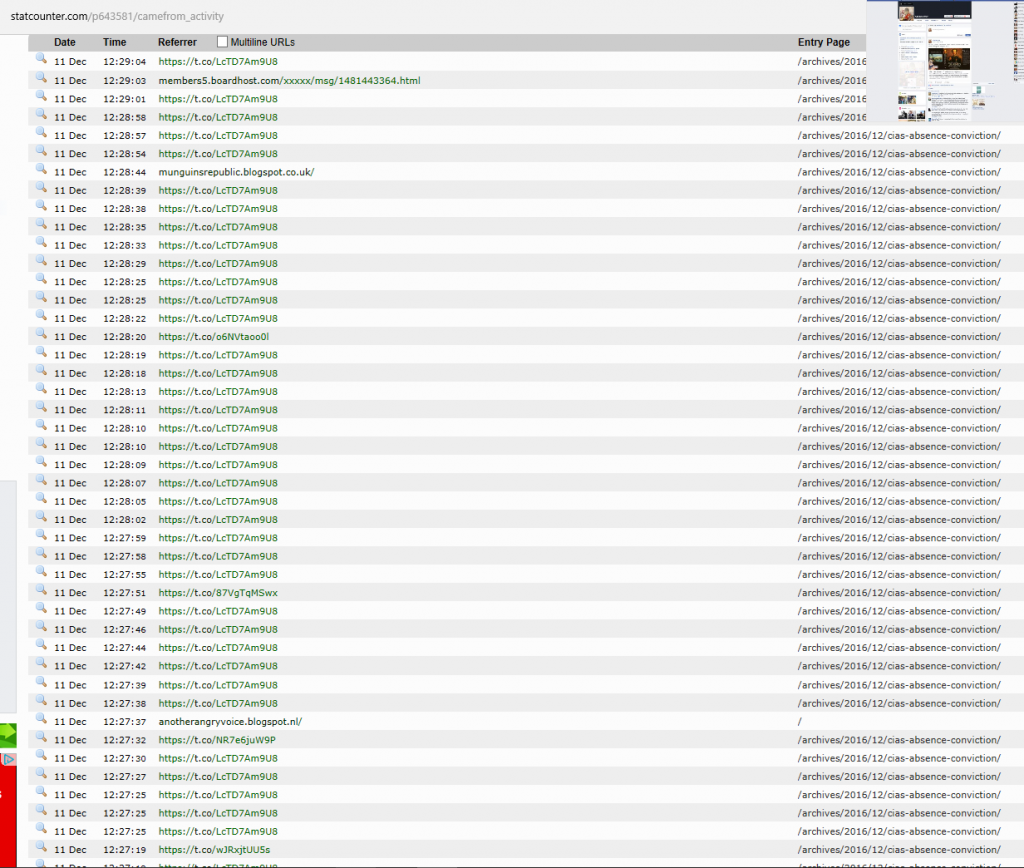
Don’t believe me? If you think you shared the article on Facebook, phone one of your Facebook friends and ask if it appeared for them.
The only way to defeat this is to republish the article yourself. I waive any copyright. If you have access to a blog, copy and paste it there and post a link to that blog on Facebook. Or simply cut and paste my whole article and copy it to your Facebook page, in sections if required.
I am similarly ghost banned on Twitter. The work round to this, which plenty of people have found, is to create a new tweet yourself with a link to my site, rather than retweet one of my tweets. As with the Facebook share, if you do retweet you will be unaware it doesn’t work.
There are profound implications for society in the compliance of the major social media corporations with establishment demands to prevent social media from effectively challenging the mainstream media narrative – and I cannot think of a more classic example than this case. I do urge you to take action as described above, to show that the people will not stand for it.
New Tempest Erupts over ‘Russian Hacking’… plus a suggestion for Donald Trump
By Richard Edmondson | Fig Trees and Vineyards | December 10, 2016
The Obama administration has ordered a full intelligence review into alleged efforts by Russian hackers to influence the outcome of the presidential election, with the president, according to media reports, requesting that a report on the matter to be completed before he leaves office on January 20.
Deputy White House Press Secretary Eric Schultz says he wants “to be clear” that this is not in any way an effort to undermine Trump’s legitimacy to hold office, only that there is a need to look at possible “malicious activity” carried out by the Russians.
“I think this is going to be a deep dive,” Schultz said, taking pains to clarify that the investigation will examine not only putative Russian manipulation of the most recent election, but also alleged tampering of the elections of 2012 and 2008.
I have a suggestion for Donald Trump. He probably won’t heed it, but I will offer it anyway: that immediately upon assuming office, he order the Office of Management and Budget to investigate how much tax money was squandered by the Obama administration in nearly six years of efforts to overthrow the government in Syria. Maybe Trump could order a ‘deep dive’ and ask the OMB to have the report completed within his first 60 days in office.
Many people, naturally, would see such a call as a retaliation for the investigation now being ordered by Obama–and certainly the media would report it that way–but the results of an investigation of this sort would be at least as beneficial, and probably a whole lot more interesting, than anything that might be turned up about Russians hacking into the computer systems of two thoroughly corrupt political parties.
We could find out, for instance, how much the US spent training and equipping Nour al-Din al-Zenki, the “moderate rebel” group which beheaded a 12-year-old Syrian child on video last July.
Yes, it would be nice if Trump were to order such an investigation… but I’m not going to hold my breath. In any event, we seem to be entering a new phase of anti-Russian propaganda in the media. The call for the intelligence review was made by an Obama administration official on Friday–the same day the Washington Post, in a report based almost solely on anonymous, unnamed “officials,” published allegations about a “secret CIA assessment” whose conclusion is that Russia sought to throw the election to Trump.
“The CIA has concluded in a secret assessment that Russia intervened in the 2016 election to help Donald Trump win the presidency, rather than just to undermine confidence in the U.S. electoral system, according to officials briefed on the matter,” reports the Post.
Repeat: it wasn’t just a case of Russia trying to undermine faith in America’s wonderful, spectacular democracy where office is generally for sale to the highest bidder. No, it was Russia deliberately trying to put Trump into the White House, according to the Post–which is a short step away from accusing Trump of being a Russian agent.
There is also the claim that the Russians hacked into the files of both the Republican Party and the DNC, but that they (the Russians) deliberately sat on the material stolen from the Republicans, choosing instead only to release material embarrassing to the Democrats.
Could any of this be credible? Hard to say, but it seems the vote recount effort has fizzled out, and the new call for an investigation could be a “plan B” aimed either at getting Hillary in the White House or at least weakening Trump to the point where he will essentially be unable to govern or pursue his own independent foreign policy. That’s one way of looking at it anyway.
It also could be designed to create a schism within the Republican Party in the sense that many Republicans could end up finding themselves faced with the difficult choice of having to avow loyalty to their president or loyalty to America. As the Post puts it:
On the other hand, if Republicans downplay the issue, they risk giving a pass to an antagonistic foreign power whom significant majorities of Americans and members of Congress don’t trust and who, if the evidence is accurate, wields significant power to wage successful cyber warfare with the United States.
 Two prominent Republicans in the Senate, Lindsey Graham and John McCain, have jumped on the bandwagon in support of a Senate probe into Russian hacking.
“I’m going after Russia in every way you can go after Russia,” said Graham. “I think they’re one of the most destabilizing influences on the world stage. I think they did interfere with our elections, and I want Putin personally to pay the price.”
It isn’t the US–a country that has been involved in one war or regime change after another for the last 25 years–that is “the most destabilizing influence on the world stage,” in Graham’s opinion; it is Russia.
Trump’s response has been to dismiss the allegations of Russian hacking, while also recalling lies of the past:
These are the same people that said Saddam Hussein had weapons of mass destruction. The election ended a long time ago in one of the biggest Electoral College victories in history. It’s now time to move on and ‘Make America Great Again.
How all this will play out remains to be seen, but it looks like the political divisions in America are widening rather than narrowing…and it also looks like the propaganda war against Russia will continue to be used to the advantage of one side–beyond the November election and on into the new administration.
If the Russians thought sanity would prevail after the transition of power in January, they’re probably in for a disappointment.
BREAKING: The CIA Never Ever Lies
By David Swanson | War Is A Lie | December 10, 2016
At moments like these, when every good responsible and enlightened liberal is recognizing the need to destroy the world in order to save it, by getting World War III started with Russia before Trump can move in and damage anything, I believe it is important to remember a few facts that will strengthen our resolve:
The oligarch who owns the Washington Post has CIA contracts worth at least twice what he paid to buy the Washington Post, thus making the Washington Post the most reliable authority on the CIA we have ever, ever had.
When the CIA concludes things in secret that are reported to the Washington Post by anonymous sources the reliability of the conclusions is heightened exponentially.
Phrases like “individuals with connections to the Russian government” are simply shorthand for “Vladimir Putin” because the Washington Post has too much good taste to actually print that name.
Claims to know extremely difficult things to know, like the motivations of said individuals, are essentially fact, given what we know of the CIA’s near perfect record over the decades.
Getting this wrong, much less questioning something or asking to see any evidence, would endanger us all and threaten innocent children with having false statements made about them in a Russian accent.
The fact that the group of people producing our information is referred to as “the Intelligence Community” means it is intelligent and communal, while the fact that people within that community refused to go along with its claims or allow them to become a so-called national intelligence estimate means that there are traitors right in the heart of our holy warriors’ sanctuary.
If you doubt that the CIA is always, always right you need only focus your attention on the fact that there are Republicans questioning these claims, including Republicans who are terrible people, on top of which Donald Trump is a racist, sexist pig.
Good people are loyal Democrats, and when the Democrats did the thing that we now know was revealed by Putin in order to make Trump president (namely cheating its politically and morally superior candidate out of its nomination) that was done as a generous sacrifice for us and our children.
Claims made without public evidence have never turned out to be false or exaggerated in the slightest in the past, certainly not in Ukraine, Syria, Libya, Iraq, Afghanistan, Yemen, Vietnam, Nicaragua, or any other part of the earth.
When I looked into every past war and discovered that they were always preceded by lies, it was because I had secret psychic information that at some future date Vladimir would reward me. I should wait patiently for his payment and then report it to the CIA/Washington Post.
Washington state sues Monsanto over ‘omnipresent and terrifically toxic material’
RT | December 9, 2016
PCB pollution is in “every waterway in the state,” Washington Attorney General Bob Ferguson said as he announced a lawsuit against Monsanto. It is the first time the agricultural biotech giant has ever been sued by a state.
Polychlorinated biphenyls, or PCBs, have been at the heart of multiple lawsuits brought against the multinational agrochemical corporation Monsanto by Seattle and Spokane, Washington, as well as cities in California and Oregon. However, this Thursday marked the first time a state government has sued the company over the potentially carcinogenic chemicals.
The lawsuit, which seeks monetary restitution for damages and cleanup caused by the use of PCBs, was filed in King County Superior Court. Washington Governor Jay Inslee (D) and the state’s Attorney General Bob Ferguson jointly announced the lawsuit in a press conference, claiming that Monsanto knew for years that it was polluting bays, lakes and rivers when it used the chemicals in coolants, hydraulic fluids, paints and sealants, Associated Press reported.
A win for the state could potentially reap hundreds of millions of dollars from Monsanto as well as two subsidiaries, Solutia Inc. and Pharmacia LLC.
Monsanto quit using PCBs when Congress banned them in 1979, but many say the damage had already been done and the chemicals’ impact are still felt today. From 1935 to 1979, Monsanto was the only company to produce PCBs, described by Ferguson as “one of the most pervasive pollutants in history,” the Seattle Post-Intelligencer reported.
Inslee called the chemicals “omnipresent and terrifically toxic,” adding that “one of the highest recorded [PCB concentrations] for any place on Earth” was in Washington’s southern resident orca population, according to the Post-Intelligencer.
The US Environmental Protection Agency classifies PCBs as a likely human carcinogen that also pose a risk of severe damage to the endocrine, immune, nervous and reproductive systems. Washington state’s Department of Health posted 13 different advisories against fish consumption due to risks of PCB pollution. Seattle’s Duwamish River is an EPA Superfund cleanup site, and one of its hazardous contaminants is PCB.
“Monsanto is responsible for producing a chemical that is so widespread in our environment that it appears virtually everywhere we look – in our waterways, in people and in fish – at levels that can impact our health,” Inslee said at the Thursday press conference, the Post-Intelligencer reported.
During the presser, Ferguson reportedly quoted from an internal Monsanto memo from 1937, which acknowledged lengthy exposure to PCB vapors having “systemic toxic effects.” Ferguson cited other records as well, charging that the corporation hid this sort of information from the public even though it knew of global PCB pollution in the 1960s.
Read more:
Monsanto’s ‘less-volatile’ dicamba herbicide receives quiet EPA approval
Israel defends fake Lebanon military buildup map as Hezbollah’s ‘war crime illustration’
RT | December 10, 2016
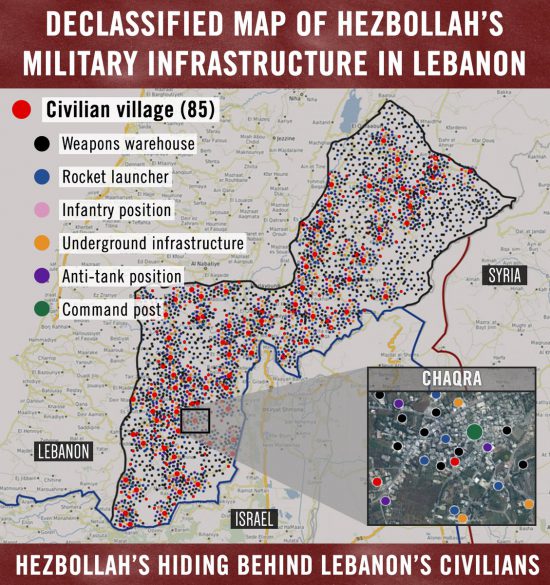
A “declassified” map of an alleged Hezbollah military buildup in southern Lebanon shared by the Israel Defense Forces (IDF) has been exposed by Twitter users as a fake, forcing the IDF to admit the picture was just a “visual illustration” of the militant group’s “war crimes.”
The map titled “Declassified map of Hezbollah’s military infrastructure in Lebanon” was posted on the official IDF Twitter account on Tuesday, highlighting 85 towns and villages in the southern part of the country.
Spots, showing civilian settlements were surrounded by numerous multicolored dots, labeled with names such as “weapon warehouse” or “rocket launcher” and other military facilities.
The tagline of the image said “Hezbollah’s hiding behind Lebanon’s civilians,” while the tweet’s caption was the simple and rather dramatic statement, “this is a war crime.”
Such a level of detail and awareness of alleged Hezbollah activities would be truly impressive, if the map had not turned out to be a fake. Some Twitter users pointed out that it was unlikely the image was a “declassified map,” since its history showed that it had been created using Google Maps via an IDF spokesperson account. The dots, marking the alleged “military buildup,” even featured a repetitive pattern.
IDF later said the map had been an “illustration,” and users simply misinterpreted it as a piece of declassified intelligence. The map’s title, tagline and caption were presumably “illustrative” too.
“The illustration reflects how Hezbollah has positioned its terrorist infrastructure within the civilian arena,” the spokesperson told The Times of Israel.
The map, despite its ”illustrative” nature, has been shown to almost every foreign diplomat visiting Israel, to demonstrate that while Hezbollah participates in the Syrian civil war, it continues preparations for conflict with Israel and hides among civilians located near the border, according to a Channel 2 report.
Israel has attacked targets allegedly linked to Hezbollah in neighboring countries, mainly in Syria. The most recent incident of this kind reportedly happened on Wednesday, when Israeli rockets hit the Mezzeh military airport near Damascus.
Israeli Defense Minister Avigdor Lieberman commented on the issue at a meeting with European Union envoys in Israel Wednesday.
“We are first and foremost making efforts to maintain the security of our citizens and protect our sovereignty, and trying to prevent the smuggling of sophisticated weapons, military equipment and weapons of mass destruction from Syria to Hezbollah,” Lieberman said.
Israeli Prime Minister Benjamin Netanyahu in April also admitted multiple strikes on targets in Syria in order to prevent Hezbollah from obtaining “game-changing” weaponry.
To err is Human, to Intervene and Destroy is Policy
By Salman Rafi Sheikh | New Eastern Outlook | 09.12.2016
The nature of international politics is often considered to be such that it continuously defies clear and absolute judgement; however, notwithstanding the complexity of inter-state relations, very often we come across such instances where understanding of the policy of a state, or of an alliance, does not defy understanding and judgement. From the very beginning of the crisis, it has been absolutely clear that the US and its allies are pursuing a regime-change policy in Syria—a policy that not only is still valid but also continues to define their strategy. Materialization of this objective pits the US against Syria and its allies and engages both parties in war—and in war soldiers are killed. Therefore, the US clarification about striking Syrian soldiers due to the so-called “human error” is only an attempt on its part to mystify the actual nature of its objectives in Syria. Nothing else can better explain the strike that killed around 80 soldiers than the fundamental reason for the US’ military engagement in Syria i.e., execution of regime change policy in Syria.
While one strike in itself was, and always is, far from sufficient to achieve this objective, a strike, however, does convey to its targets and to those who observe it the objective being pursued. In this case, the immediate objective was to inflict heavy damage on the Syrian army and render it vulnerable to attacks by other, western supported, militant groups. The objective was, to an extent, achieved. This is evident from the developments taking place immediately after the US-led strike. A weakened Syrian army unit enabled an ISIS advance on a hill overlooking the air base, which was specifically targeted by the US-led coalition. While the objective of this co-ordinated operation was to quickly capture the base, it was thwarted by timely action on the part of Russian warplanes that were called in to hit ISIS positions.
Had the attack been successful, it might have caused massive destruction. ISIS had, prior to the attack by the coalition, repeatedly attacked and failed to capture the government-held air base, which is an isolated enclave deep in extremist-held territory. The government controls the air base and parts of Dayr az Zawr city, while ISIS controls the entire province by the same name. An ISIS advance in Dayr az Zawr would have, and would still, endanger the lives of tens of thousands of civilians living in government-held areas and force the Syrian army out of the territory.
What would have such a scenario implied for the over-all situation of Syria is not so difficult to grasp. While the US has now stated it “regrets” the bombing, it has not, in any way, apologized to Syria for this wanton act of mayhem, thus confirming its unchanged position vis-à-vis Syria, which continues to remain a clear cut target of the regime-change conspiracy—a policy that has been applied by NATO in many countries since the end of the Second World War. The most recent cases of Afghanistan, Iraq, Libya and Syria confirm that this policy has remained unchanged.
The latest confirmation to the unabated continuation of this policy has come from one of the most important NATO allies, Turkey. On November 29, Turkey’s self-styled “caliph” said, reiterating NATO’s long held objective, that the Turkish military had launched its operations in Syria to end the rule of (the cruel) Syrian President Bashar al-Assad.
He further said, “Why did we enter? We do not have an eye on Syrian soil. The issue is to provide lands to their real owners. That is to say we are there for the establishment of justice. We entered there to end the rule of the tyrant al-Assad who terrorizes with state terror. [We didn’t enter] for any other reason.”
While this statement has come as a surprise to Russia, leading Kremlin spokesman Dmitry Peskov to say that they were hoping “our Turkish partners will provide us with some kind of explanation about this”, the move itself not only largely reflects the dual game Turkey is playing in Syria but also shows how the former fundamentally continues to adhere to NATO’s central objective in Syria, thus debunking the myth of Turkey’ estrangement with the US or the EU or the NATO itself.
The tacit continuity of co-operation between Turkey and the US is not limited to the perusal of identical objectives. On the contrary, it is co-operation on the ground that speaks volumes about Turkey’s actual position and policy vis-à-vis Syria. For instance, Turkey’s operation Euphrates Shield, which begun in August and which is supposedly aimed at rolling back ISIS from the Syrian region bordering Turkey, had actually begun, succeeded and territorially spread under the protection, assistance and advice provided by the US military. The US advisers assisted the operation from inside Turkey, while US warplanes conducted airstrikes alongside Turkish ones in support of the offensive. Could we still say that Turkey and the US were, or are, on a collision course since the failed coup attempt in Turkey in July 2016?
This co-ordinated attack was followed, in September, by a welcome note by the NATO chief about Turkey’s enhanced role in Syria against “terrorism” and attacks of all kinds.
The continued co-operation between Turkey, which had initially officially sent troops to Syria to fight ISIS, and the US and Erdogan’s recent claim that they are in Syria to send Assad home unambiguously show the way this alliance is working in the region. With Turkey’s operation Euphrates Shield expanding into operation occupation, and with Turkey equally seeking to enlist US support to capture al-Bab, there remains hardly any room to doubt that the US and Turkey are seeking to achieve what the ISIS had earlier achieved, and then lost, in terms of capturing Syrian territory.
With ISIS being itself unable to withhold the Syrian offensive being backed the Russian forces and Iran backed militias, Turkey and the US, as also their Arab and Western allies, were left with no other choice but to directly intervene in Syria to deny the Syrian army the opportunity to have the whole of Syria under its control.
This being the case-scenario of Syria, the Pentagon’s clarification about the September strike being a result of “human error” is erroneous. What, on the contrary, perfectly corresponds with the US policy and objectives it is pursuing in Syria is not this clarification but the strike itself—something that, had it been successful, might have allowed IS to bring an entire province under its sole control and considerably damage the Syrian army.
What this scenario reveals is that the earlier policy of bringing regime change in Syria through proxy groups is now being replaced by a policy of direct intervention and gradual insertion of NATO in the conflict via Turkey. Conflict in Syria is therefore not ending, only its dynamics are changing from in-direct to direct intervention.
Big Media’s Contra-Cocaine Cover-up
By Robert Parry | Consortium News | December 9, 2016
Amid the mainstream U.S. media’s current self-righteous frenzy against “fake news,” it’s worth recalling how the big newspapers destroyed Gary Webb, an honest journalist who exposed some hard truths about the Reagan administration’s collaboration with Nicaraguan Contra cocaine traffickers.
Webb’s reward for reviving that important scandal in 1996 – and getting the CIA’s inspector general to issue what amounted to an institutional confession in 1998 – was to have The New York Times, The Washington Post and Los Angeles Times lobby for, essentially, his banishment from journalism.
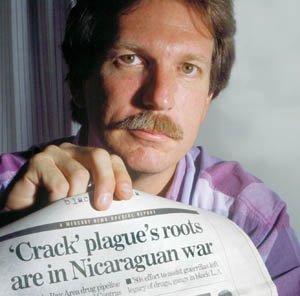
Journalist Gary Webb
The major media pile-on was so intense and so effective that Webb lost his job at the San Jose Mercury-News and could never find regular work in his profession again. Betrayed by his journalistic colleagues, his money gone, his family broken and his life seemingly hopeless, Webb committed suicide on Dec. 9, 2004.
Even then, the Los Angeles Times wrote up his obituary as if the paper were telling the life story of an organized-crime boss, not a heroic journalist. The Times obit was then republished by The Washington Post.
In other words, on one of the most significant scandals of the Reagan era, major newspapers, which now want to serve as the arbiters of truth for the Internet, demonstrated how disdainful they actually are toward truth when it puts the U.S. government in a harsh light.
Indeed, if it had been up to the big newspapers, this important chapter of modern history would never have been known. A decade earlier, in 1985, Brian Barger and I first exposed the Contra-cocaine connection for The Associated Press – and we watched as the big papers turned their backs on the scandal then, too.
The main point that Webb added to the story was how some of the Contra cocaine fed into the production of crack-cocaine that had such a devastating effect on America’s black communities in particular. Webb’s disclosure of the crack connection infuriated many African-Americans and the big papers acted as if it was their civic duty to calm down those inner-city folks by assuring them that the U.S. government would never do such a thing.
So, instead of doing their jobs as journalists, the major newspapers acted as the last line of defense against the people learning the truth.
A Solid Record
Yet, what’s remarkable now about the Contra-cocaine scandal is that – despite the cover-up efforts of the big papers – the truth is out there, available in official government documents, including the CIA’s inspector general’s report.
Collectively, the information also represents a damning indictment of The New York Times, The Washington Post and Los Angeles Times and demonstrates why they are unfit to lecture anyone about what’s real and what’s “fake.”
For instance, in 2013, at the National Archives annex in College Park, Maryland, I discovered a declassified “secret” U.S. law enforcement report that detailed how top Contra leader Adolfo Calero was casually associating with Norwin Meneses, described in the records as “a well-reputed drug dealer.” Meneses was near the center of Webb’s 1996 articles for the San Jose Mercury-News.
The report was typical of the evidence that the Reagan administration — and the big newspapers — chose to ignore. It recounted information from Dennis Ainsworth, a blue-blood Republican from San Francisco who volunteered to help the Contra cause in 1984-85. That put him in position to witness the strange goings-on of Contra leaders hobnobbing with drug traffickers and negotiating arms deals with White House emissaries.
Ainsworth also was a source of mine in fall 1985 when I was investigating the mysterious channels of funding for the Contras after Congress shut off CIA support in 1984 amid widespread reports of Contra atrocities inflicted on Nicaraguan civilians, including rapes, executions and torture.
Ainsworth’s first-hand knowledge of the Contra dealings dovetailed with information that I already had, such as the central role of National Security Council aide Oliver North in aiding the Contras and his use of “courier” Rob Owen as an off-the-books White House intermediary to the Contras. I later developed confirmation of some other details that Ainsworth described, such as his overhearing Owen and Calero working together on an arms deal as Ainsworth drove them through the streets of San Francisco.
As for Ainsworth’s knowledge about the Contra-cocaine connection, he said he sponsored a June 1984 cocktail party at which Calero spoke to about 60 people. Meneses, a notorious drug kingpin in the Nicaraguan community, showed up uninvited and clearly had a personal relationship with Calero, who was then the political leader of the Contra’s chief fighting force, the CIA-backed Nicaraguan Democratic Force (or FDN).
“At the end of the cocktail party, Meneses and Calero went off together,” Ainsworth told U.S. Attorney Joseph P. Russoniello, according to a “secret” Jan. 6, 1987 cable submitted by Russoniello to an FBI investigation code-named “Front Door,” a probe into the Reagan administration’s corruption.
After Calero’s speech, Ainsworth said Meneses accompanied Calero and about 20 people to dinner and picked up the entire tab, according to a more detailed debriefing of Ainsworth by the FBI.
Concerned about this relationship, Ainsworth said he was told by Renato Pena, an FDN leader in the San Francisco area, that “the FDN is involved in drug smuggling with the aid of Norwin Meneses who also buys arms for Enrique Bermudez, a leader of the FDN.” Bermudez was then the top Contra military commander.
Corroborating Account
Pena, who himself was convicted on federal drug charges in 1984, gave a similar account to the Drug Enforcement Administration. According to a 1998 report by the Justice Department’s Inspector General Michael Bromwich, “When debriefed by the DEA in the early 1980s, Pena said that the CIA was allowing the Contras to fly drugs into the United States, sell them, and keep the proceeds.
“Pena stated that he was present on many occasions when Meneses telephoned Bermudez in Honduras. Meneses told Pena of Bermudez’s requests for such things as gun silencers (which Pena said Meneses obtained in Los Angeles), cross bows, and other military equipment for the Contras. Pena believed that Meneses would sometimes transport certain of these items himself to Central America, and other times would have contacts in Los Angeles and Miami send cargo to Honduras, where the authorities were cooperating with the Contras. Pena believed Meneses had contact with Bermudez from about 1981 or 1982 through the mid-1980s.”
Bromwich’s report then added, “Pena said he was one of the couriers Meneses used to deliver drug money to a Colombian known as ‘Carlos’ in Los Angeles and return to San Francisco with cocaine. Pena made six to eight trips, with anywhere from $600,000 to nearly $1 million, and brought back six to eight kilos of cocaine each time. Pena said Meneses was moving hundreds of kilos a week. ‘Carlos’ once told Pena, ‘We’re helping your cause with this drug thing we are helping your organization a lot.”
Ainsworth also said he tried to alert Oliver North in 1985 about the troubling connections between the Contra movement and cocaine traffickers but that North turned a deaf ear.
“In the spring some friends of mine and I went back to the White House staff but we were put off by Ollie North and others on the staff who really don’t want to know all what’s going on,” Ainsworth told Russoniello.
When I first spoke with Ainsworth in September 1985 at a coffee shop in San Francisco, he asked for confidentiality, which I granted. However, since the documents released by the National Archives include him describing his conversations with me, that confidentiality no longer applies. Ainsworth also spoke with Webb for his 1996 San Jose Mercury-News series under the pseudonym “David Morrison.”
Though I found Ainsworth to be generally reliable, some of his depictions of our conversations contained mild exaggerations or confusion over details, such as his claim that I called him from Costa Rica in January 1986 and told him that the Contra-cocaine story that I had been working on with my AP colleague Brian Barger “never hit the papers because it was suppressed by the Associated Press due to political pressure primarily from the CIA.”
In reality, Barger and I returned from Costa Rica in fall 1985, wrote our story about the Contras’ involvement in cocaine smuggling, and pushed it onto the AP wire in December though in a reduced form because of resistance from some senior AP news executives who were supportive of President Reagan’s foreign policies. The CIA, the White House and other agencies of the Reagan administration did seek to discredit our story, but they did not prevent its publication.
An Overriding Hostility
The Reagan administration’s neglect of Ainsworth’s insights reflected the overriding hostility toward any information even from a Republican activist like Ainsworth that put the Contras in a negative light. In early 1987, when Ainsworth spoke with U.S. Attorney Russoniello and the FBI, the Reagan administration was in full damage-control mode, trying to tamp down the Iran-Contra disclosures about Oliver North diverting profits from secret arms sales to Iran to the Contra war.
Fears that the Iran-Contra scandal could lead to Reagan’s impeachment made it even less likely that the Justice Department would pursue an investigation into drug ties implicating the Contra leadership. Ainsworth’s information was simply passed on to Independent Counsel Lawrence Walsh whose inquiry was already overwhelmed by the task of sorting out the convoluted Iran transactions.
Publicly, the Reagan team continued dumping on the Contra-cocaine allegations and playing the find-any-possible-reason-to-reject-a-witness game. The major news media went along, leading to much mainstream ridicule of a 1989 investigative report by Sen. John Kerry, D-Massachusetts, who uncovered more drug connections implicating the Contras and the Reagan administration.
Only occasionally, such as when the George H.W. Bush administration needed witnesses to convict Panamanian dictator Manuel Noriega did the Contra-cocaine evidence pop onto Official Washington’s radar.
During Noriega’s drug-trafficking trial in 1991, U.S. prosecutors called as a witness Colombian Medellin cartel kingpin Carlos Lehder, who, along with implicating Noriega, testified that the cartel had given $10 million to the Contras, an allegation first unearthed by Sen. Kerry. “The Kerry hearings didn’t get the attention they deserved at the time,” a Washington Post editorial on Nov. 27, 1991, acknowledged. “The Noriega trial brings this sordid aspect of the Nicaraguan engagement to fresh public attention.”
But the Post offered its readers no explanation for why Kerry’s hearings had been largely ignored, with the Post itself a leading culprit in this journalistic misfeasance. Nor did the Post and the other leading newspapers use the opening created by the Noriega trial to do anything to rectify their past neglect.
Everything quickly returned to the status quo in which the desired perception of the noble Contras trumped the clear reality of their criminal activities. Instead of recognizing the skewed moral compass of the Reagan administration, Congress was soon falling over itself to attach Reagan’s name to as many public buildings and facilities as possible, including Washington’s National Airport.
Meanwhile, those of us in journalism who had exposed the national security crimes of the 1980s saw our careers mostly sink or go sideways. We were regarded as “pariahs” in our profession.
As for me, shortly after the Iran-Contra scandal broke wide open in fall 1986, I accepted a job at Newsweek, one of the many mainstream news outlets that had long ignored Contra-connected scandals and briefly thought it needed to bolster its coverage. But I soon discovered that senior editors remained hostile toward the Iran-Contra story and related spinoff scandals, including the Contra-cocaine mess.
After losing battle after battle with my Newsweek editors, I departed the magazine in June 1990 to write a book (called Fooling America) about the decline of the Washington press corps and the parallel rise of a new generation of government propagandists.
I was also hired by PBS Frontline to investigate whether there had been a prequel to the Iran-Contra scandal, whether those arms-for-hostage deals in the mid-1980s had been preceded by contacts between Reagan’s 1980 campaign staff and Iran, which was then holding 52 Americans hostage and essentially destroying Jimmy Carter’s reelection hopes. [For more on that topic, see Robert Parry’s Secrecy & Privilege and America’s Stolen Narrative.]
Finding New Ways
In 1995, frustrated by the growing triviality of American journalism, and acting on the advice of and with the assistance of my oldest son Sam, I turned to a new medium and launched the Internet’s first investigative news magazine, known as Consortiumnews.com. The Web site became a way for me to put out well-reported stories that my former mainstream colleagues ignored or mocked.
So, when Gary Webb called me in 1996 to talk about his upcoming series reviving the Contra-cocaine story, I explained some of this tortured history and urged him to make sure that his editors were firmly behind him. He sounded perplexed at my advice and assured me that he had the solid support of his editors.
When Webb’s “Dark Alliance” series finally appeared in late August 1996, it initially drew little attention. The major national news outlets applied their usual studied indifference to a topic that they had already judged unworthy of serious attention.
But Webb’s story proved hard to ignore. First, unlike the work that Barger and I did for AP in the mid-1980s, Webb’s series wasn’t just a story about drug traffickers in Central America and their protectors in Washington. It was about the on-the-ground consequences, inside the United States, of that drug trafficking, how the lives of Americans were blighted and destroyed as the collateral damage of a U.S. foreign policy initiative.
In other words, there were real-life American victims, and they were concentrated in African-American communities. That meant the ever-sensitive issue of race had been injected into the controversy. Anger from black communities spread quickly to the Congressional Black Caucus, which started demanding answers.
Secondly, the San Jose Mercury-News, which was the local newspaper for Silicon Valley, had posted documents and audio on its state-of-the-art Internet site. That way, readers could examine much of the documentary support for the series.
It also meant that the traditional “gatekeeper” role of the major newspapers, The New York Times, The Washington Post, and Los Angeles Times, was under assault. If a regional paper like the Mercury-News could finance a major journalistic investigation like this one, and circumvent the judgments of the editorial boards at the Big Three, then there might be a tectonic shift in the power relations of the U.S. news media. There could be a breakdown of the established order.
This combination of factors led to the next phase of the Contra-cocaine battle: the “get-Gary-Webb” counterattack. Soon, The Washington Post, The New York Times, and Los Angeles Times were lining up like some tag-team wrestlers taking turns pummeling Webb and his story.
On Oct. 4, 1996, The Washington Post published a front-page article knocking down Webb’s series, although acknowledging that some Contra operatives did help the cocaine cartels. The Post’s approach fit with the Big Media’s cognitive dissonance on the topic: first, the Post called the Contra-cocaine allegations old news, “even CIA personnel testified to Congress they knew that those covert operations involved drug traffickers,” the Post said, and second, the Post minimized the importance of the one Contra smuggling channel that Webb had highlighted in his series, saying it had not “played a major role in the emergence of crack.”
To add to the smug hoo-hah treatment that was enveloping Webb and his story, the Post published a sidebar story dismissing African-Americans as prone to “conspiracy fears.”
Next, The New York Times and Los Angeles Times weighed in with lengthy articles castigating Webb and “Dark Alliance.” The big newspapers made much of the CIA’s internal reviews in 1987 and 1988, almost a decade earlier, that supposedly had cleared the spy agency of any role in Contra-cocaine smuggling.
But the first ominous sign for the CIA’s cover-up emerged on Oct. 24, 1996, when CIA Inspector General Frederick Hitz conceded before the Senate Intelligence Committee that the first CIA probe had lasted only 12 days, and the second only three days. He promised a more thorough review.
Mocking Webb
But Webb had already crossed over from being treated as a serious journalist to becoming a target of ridicule. Influential Washington Post media critic Howard Kurtz mocked Webb for saying in a book proposal that he would explore the possibility that the Contra war was primarily a business to its participants. “Oliver Stone, check your voice mail,” Kurtz smirked.
Yet, Webb’s suspicion was no conspiracy theory. Indeed, Oliver North’s chief Contra emissary, Rob Owen, had made the same point in a March 17, 1986 message about the Contra leadership. “Few of the so-called leaders of the movement . . . really care about the boys in the field,” Owen wrote. “THIS WAR HAS BECOME A BUSINESS TO MANY OF THEM.” [Emphasis in original.]
Ainsworth and other pro-Contra activists were reaching the same conclusion, that the Contra leadership was skimming money from the supply lines and padding their personal wealth with proceeds from the drug trade.
According to a Jan. 21, 1987 interview report by the FBI, Ainsworth said he had “made inquiries in the local San Francisco Nicaraguan community and wondered among his acquaintances what Adolfo Calero and the other people in the FDN movement were doing and the word that he received back is that they were probably engaged in cocaine smuggling.”
In other words, Webb was right about the suspicion that the Contra movement had become less a cause than a business to many of its participants. Even Oliver North’s emissary reported on that reality. But truthfulness had ceased to be relevant in the media’s hazing of Gary Webb.
In another double standard, while Webb was held to the strictest standards of journalism, it was entirely all right for Kurtz, the supposed arbiter of journalistic integrity who was a longtime fixture on CNN’s “Reliable Sources,” to make judgments based on ignorance. Kurtz would face no repercussions for mocking a fellow journalist who was factually correct.
The Big Three’s assault, combined with their disparaging tone, had a predictable effect on the executives of the Mercury-News. As it turned out, Webb’s confidence in his editors had been misplaced. By early 1997, executive editor Jerry Ceppos, who had his own corporate career to worry about, was in retreat.
On May 11, 1997, Ceppos published a front-page column saying the series “fell short of my standards.” He criticized the stories because they “strongly implied CIA knowledge” of Contra connections to U.S. drug dealers who were manufacturing crack cocaine. “We did not have enough proof that top CIA officials knew of the relationship,” Ceppos wrote.
Ceppos was wrong about the proof, of course. At AP, before we published our first Contra-cocaine article in 1985, Barger and I had known that the CIA and Reagan’s White House were aware of the Contra-cocaine problem at senior levels. One of our sources was on Reagan’s National Security Council staff.
However, Ceppos recognized that he and his newspaper were facing a credibility crisis brought on by the harsh consensus delivered by the Big Three, a judgment that had quickly solidified into conventional wisdom throughout the major news media and inside Knight-Ridder, Inc., which owned the Mercury-News. The only career-saving move — career-saving for Ceppos even if career-destroying for Webb — was to jettison Webb and the Contra-cocaine investigative project.
A ‘Vindication’
The big newspapers and the Contras’ defenders celebrated Ceppos’s retreat as vindication of their own dismissal of the Contra-cocaine stories. In particular, Kurtz seemed proud that his demeaning of Webb now had the endorsement of Webb’s editor.
Ceppos next pulled the plug on the Mercury-News’ continuing Contra-cocaine investigation and reassigned Webb to a small office in Cupertino, California, far from his family. Webb resigned from the paper in disgrace. [See Consortiumnews.com’s “Hung Out to Dry.”]
For undercutting Webb and other Mercury-News reporters working on the Contra-cocaine project — some of whom were facing personal danger in Central America — Ceppos was lauded by the American Journalism Review and received the 1997 national Ethics in Journalism Award by the Society of Professional Journalists.
While Ceppos won raves, Webb watched his career collapse and his marriage break up. Still, Gary Webb had set in motion internal government investigations that would bring to the surface long-hidden facts about how the Reagan administration had conducted the Contra war.
The CIA published the first part of Inspector General Hitz’s findings on Jan. 29, 1998. Though the CIA’s press release for the report criticized Webb and defended the CIA, Hitz’s Volume One admitted that not only were many of Webb’s allegations true but that he actually understated the seriousness of the Contra-drug crimes and the CIA’s knowledge of them.
Hitz conceded that cocaine smugglers played a significant early role in the Contra movement and that the CIA intervened to block an image-threatening 1984 federal investigation into a San Francisco-based drug ring with suspected ties to the Contras, the so-called “Frogman Case.”
After Volume One was released, I called Webb (whom I had spent some time with since his series was published). I chided him for indeed getting the story “wrong.” He had understated how serious the problem of Contra-cocaine trafficking had been, I said.
It was a form of gallows humor for the two of us, since nothing had changed in the way the major newspapers treated the Contra-cocaine issue. They focused only on the press release that continued to attack Webb, while ignoring the incriminating information that could be found in the full report. All I could do was highlight those admissions at Consortiumnews.com, which sadly had a much, much smaller readership than the Big Three.
The major U.S. news media also looked the other way on other startling disclosures.
On May 7, 1998, for instance, Rep. Maxine Waters, a California Democrat, introduced into the Congressional Record a Feb. 11, 1982 letter of understanding between the CIA and the Justice Department. The letter, which had been requested by CIA Director William Casey, freed the CIA from legal requirements that it must report drug smuggling by CIA assets, a provision that covered the Nicaraguan Contras and the Afghan mujahedeen.
In other words, early in those two covert wars, the CIA leadership wanted to make sure that its geopolitical objectives would not be complicated by a legal requirement to turn in its client forces for drug trafficking.
Justice Denied
The next break in the long-running Contra-cocaine cover-up was a report by the Justice Department’s Inspector General Michael Bromwich. Given the hostile climate surrounding Webb’s series, Bromwich’s report also opened with criticism of Webb. But, like the CIA’s Volume One, the contents revealed new details about serious government wrongdoing.
According to evidence cited by Bromwich, the Reagan administration knew almost from the outset of the Contra war that cocaine traffickers permeated the paramilitary operation. The administration also did next to nothing to expose or stop the crimes.
Bromwich’s report revealed example after example of leads not followed, corroborated witnesses disparaged, official law-enforcement investigations sabotaged, and even the CIA facilitating the work of drug traffickers.
The report showed that the Contras and their supporters ran several parallel drug-smuggling operations, not just the one at the center of Webb’s series. The report also found that the CIA shared little of its information about Contra drugs with law-enforcement agencies and on three occasions disrupted cocaine-trafficking investigations that threatened the Contras.
As well as depicting a more widespread Contra-drug operation than Webb (or Barger and I) had understood, the Justice Department report provided some important corroboration about Nicaraguan drug smuggler Norwin Meneses, a key figure in Gary Webb’s series and Adolfo Calero’s friend as described by Dennis Ainsworth.
Bromwich cited U.S. government informants who supplied detailed information about Meneses’s drug operation and his financial assistance to the Contras. For instance, Renato Pena, the money-and-drug courier for Meneses, said that in the early 1980s the CIA allowed the Contras to fly drugs into the United States, sell them, and keep the proceeds. Pena, the FDN’s northern California representative, said the drug trafficking was forced on the Contras by the inadequate levels of U.S. government assistance.
The Justice Department report also disclosed repeated examples of the CIA and U.S. embassies in Central America discouraging DEA investigations, including one into Contra-cocaine shipments moving through the international airport in El Salvador. Bromwich said secrecy trumped all.
“We have no doubt that the CIA and the U.S. Embassy were not anxious for the DEA to pursue its investigation at the airport,” he wrote.
Bromwich also described the curious case of how a DEA pilot helped a CIA asset escape from Costa Rican authorities in 1989 after the man, American farmer John Hull, had been charged in connection with Contra-cocaine trafficking. [See Consortiumnews.com’s “John Hull’s Great Escape.”]
Hull’s ranch in northern Costa Rica had been the site of Contra camps for attacking Nicaragua from the south. For years, Contra-connected witnesses also said Hull’s property was used for the transshipment of cocaine en route to the United States, but those accounts were brushed aside by the Reagan administration and disparaged in major U.S. newspapers.
Yet, according to Bromwich’s report, the DEA took the accounts seriously enough to prepare a research report on the evidence in November 1986. One informant described Colombian cocaine off-loaded at an airstrip on Hull’s ranch.
The drugs were then concealed in a shipment of frozen shrimp and transported to the United States. The alleged Costa Rican shipper was Frigorificos de Puntarenas, a firm controlled by Cuban-American Luis Rodriguez. Like Hull, however, Frigorificos had friends in high places. In 1985-86, the State Department had selected the shrimp company to handle $261,937 in non-lethal assistance earmarked for the Contras.
Hull also remained a man with powerful protectors. Even after Costa Rican authorities brought drug charges against him, influential Americans, including Rep. Lee Hamilton, D-Indiana, demanded that Hull be let out of jail pending trial. Then, in July 1989 with the help of a DEA pilot — and possibly a DEA agent as well — Hull managed to fly out of Costa Rica to Haiti and then to the United States.
Despite these startling new disclosures, the big newspapers still showed no inclination to read beyond the criticism of Webb in the press release.
Major Disclosures
By fall 1998, Washington was obsessed with President Bill Clinton’s Monica Lewinsky sex scandal, which made it easier to ignore even more stunning Contra-cocaine disclosures in the CIA’s Volume Two, published on Oct. 8, 1998.
In the report, CIA Inspector General Hitz identified more than 50 Contras and Contra-related entities implicated in the drug trade. He also detailed how the Reagan administration had protected these drug operations and frustrated federal investigations throughout the 1980s.
According to Volume Two, the CIA knew the criminal nature of its Contra clients from the start of the war against Nicaragua’s leftist Sandinista government. The earliest Contra force, called the Nicaraguan Revolutionary Democratic Alliance (ADREN) or the 15th of September Legion, had chosen “to stoop to criminal activities in order to feed and clothe their cadre,” according to a June 1981 draft of a CIA field report.
According to a September 1981 cable to CIA headquarters, two ADREN members made the first delivery of drugs to Miami in July 1981. ADREN’s leaders included Enrique Bermudez and other early Contras who would later direct the major Contra army, the CIA-organized FDN which was based in Honduras, along Nicaragua’s northern border.
Throughout the war, Bermudez remained the top Contra military commander. The CIA later corroborated the allegations about ADREN’s cocaine trafficking, but insisted that Bermudez had opposed the drug shipments to the United States that went ahead nonetheless.
The truth about Bermudez’s supposed objections to drug trafficking, however, was less clear. According to Hitz’s Volume One, Bermudez enlisted Norwin Meneses the Nicaraguan cocaine smuggler, the friend of Adolfo Calero, and a key figure in Webb’s series to raise money and buy supplies for the Contras.
Volume One had quoted another Nicaraguan trafficker, Danilo Blandon, a Meneses associate (and another lead character in Webb’s series), as telling Hitz’s investigators that he (Blandon) and Meneses flew to Honduras to meet with Bermudez in 1982. At the time, Meneses’s criminal activities were well-known in the Nicaraguan exile community, but Bermudez told the cocaine smugglers that “the ends justify the means” in raising money for the Contras.
After the Bermudez meeting, Meneses and Blandon were briefly arrested by Honduran police who confiscated $100,000 that the police suspected was to be a payment for a drug transaction. The Contras intervened, gained freedom for the two traffickers and got them their money back by saying the cash, which indeed was for a cocaine purchase in Bolivia, belonged to the Contras.
There were other indications of Bermudez’s drug-smuggling complicity. In February 1988, another Nicaraguan exile linked to the drug trade accused Bermudez of participation in narcotics trafficking, according to Hitz’s report. After the Contra war ended, Bermudez returned to Managua, Nicaragua, where he was shot to death on Feb. 16, 1991. The murder has never been solved.
The Southern Front
Along the Southern Front, the Contras’ military operations in Costa Rica on Nicaragua’s southern border, the CIA’s drug evidence centered on the forces of Eden Pastora, another top Contra commander. But Hitz discovered that the U.S. government may have made the drug situation worse, not better.
Hitz revealed that the CIA put an admitted drug operative, known by his CIA pseudonym “Ivan Gomez,” in a supervisory position over Pastora. Hitz reported that the CIA discovered Gomez’s drug history in 1987 when Gomez failed a security review on drug-trafficking questions.
In internal CIA interviews, Gomez admitted that in March or April 1982, he helped family members who were engaged in drug trafficking and money laundering. In one case, Gomez said he assisted his brother and brother-in-law transporting cash from New York City to Miami. He admitted he “knew this act was illegal.”
Later, Gomez expanded on his admission, describing how his family members had fallen $2 million into debt and had gone to Miami to run a money-laundering center for drug traffickers.
Gomez said “his brother had many visitors whom [Gomez] assumed to be in the drug trafficking business.” Gomez’s brother was arrested on drug charges in June 1982. Three months later, in September 1982, Gomez started his CIA assignment in Costa Rica.
Years later, convicted drug trafficker Carlos Cabezas alleged that in the early 1980s, Ivan Gomez was the CIA agent in Costa Rica who was overseeing drug-money donations to the Contras. Gomez “was to make sure the money was given to the right people [the Contras] and nobody was taking . . . profit they weren’t supposed to,” Cabezas stated publicly.
But the CIA sought to discredit Cabezas at the time because he had trouble identifying Gomez’s picture and put Gomez at one meeting in early 1982 before Gomez started his CIA assignment. While the CIA was able to fend off Cabezas’s allegations by pointing to these minor discrepancies, Hitz’s report revealed that the CIA was nevertheless aware of Gomez’s direct role in drug-money laundering, a fact the agency hid from Sen. Kerry in his investigation during the late 1980s.
There was also more to know about Gomez. In November 1985, the FBI learned from an informant that Gomez’s two brothers had been large-scale cocaine importers, with one brother arranging shipments from Bolivia’s infamous drug kingpin Roberto Suarez.
Suarez already was known as a financier of right-wing causes. In 1980, with the support of Argentina’s hard-line anticommunist military regime, Suarez bankrolled a coup in Bolivia that ousted the elected left-of-center government. The violent putsch became known as the Cocaine Coup because it made Bolivia the region’s first narco-state.
By protecting cocaine shipments headed north, Bolivia’s government helped transform Colombia’s Medellin cartel from a struggling local operation into a giant corporate-style business for delivering vast quantities of cocaine to the U.S. market.
Flush with cash in the early 1980s, Suarez invested more than $30 million in various right-wing paramilitary operations, including the Contra forces in Central America, according to U.S. Senate testimony by an Argentine intelligence officer, Leonardo Sanchez-Reisse.
In 1987, Sanchez-Reisse said the Suarez drug money was laundered through front companies in Miami before going to Central America. There, other Argentine intelligence officers, veterans of the Bolivian coup, trained the Contras in the early 1980s, even before the CIA arrived to first assist with the training and later take over the Contra operation from the Argentines.
Inspector General Hitz added another piece to the mystery of the Bolivian-Contra connection. One Contra fund-raiser, Jose Orlando Bolanos, boasted that the Argentine government was supporting his Contra activities, according to a May 1982 cable to CIA headquarters. Bolanos made the statement during a meeting with undercover DEA agents in Florida. He even offered to introduce them to his Bolivian cocaine supplier.
Despite all this suspicious drug activity centered around Ivan Gomez and the Contras, the CIA insisted that it did not unmask Gomez until 1987, when he failed a security check and confessed his role in his family’s drug business.
The CIA official who interviewed Gomez concluded that “Gomez directly participated in illegal drug transactions, concealed participation in illegal drug transactions, and concealed information about involvement in illegal drug activity,” Hitz wrote.
But senior CIA officials still protected Gomez. They refused to refer the Gomez case to the Justice Department, citing the 1982 agreement that spared the CIA from a legal obligation to report narcotics crimes by people collaborating with the CIA who were not formal agency employees. Gomez was an independent contractor who worked for the CIA but was not officially on staff. The CIA eased Gomez out of the agency in February 1988, without alerting law enforcement or the congressional oversight committees.
When questioned about the case nearly a decade later, one senior CIA official who had supported the gentle treatment of Gomez had second thoughts. “It is a striking commentary on me and everyone that this guy’s involvement in narcotics didn’t weigh more heavily on me or the system,” the official told Hitz’s investigators.
Drug Path to the White House
A Medellin drug connection arose in another section of Hitz’s report, when he revealed evidence suggesting that some Contra trafficking may have been sanctioned by Reagan’s National Security Council. The protagonist for this part of the Contra-cocaine mystery was Moises Nunez, a Cuban-American who worked for Oliver North’s NSC Contra-support operation and for two drug-connected seafood importers, Ocean Hunter in Miami and Frigorificos De Puntarenas in Costa Rica.
Frigorificos De Puntarenas was created in the early 1980s as a cover for drug-money laundering, according to sworn testimony by two of the firm’s principals, Carlos Soto and Medellin cartel accountant Ramon Milian Rodriguez. (It was also the company implicated by a DEA informant in moving cocaine from John Hull’s ranch to the United States.)
Drug allegations were swirling around Moises Nunez by the mid-1980s. Indeed, his operation was one of the targets of my and Barger’s AP investigation in 1985. Finally reacting to the suspicions, the CIA questioned Nunez about his alleged cocaine trafficking on March 25, 1987. He responded by pointing the finger at his NSC superiors.
“Nunez revealed that since 1985, he had engaged in a clandestine relationship with the National Security Council,” Hitz reported, adding: “Nunez refused to elaborate on the nature of these actions, but indicated it was difficult to answer questions relating to his involvement in narcotics trafficking because of the specific tasks he had performed at the direction of the NSC. Nunez refused to identify the NSC officials with whom he had been involved.”
After this first round of questioning, CIA headquarters authorized an additional session, but then senior CIA officials reversed the decision. There would be no further efforts at “debriefing Nunez.”
Hitz noted that “the cable [from headquarters] offered no explanation for the decision” to stop the Nunez interrogation. But the CIA’s Central American Task Force chief Alan Fiers Jr. said the Nunez-NSC drug lead was not pursued “because of the NSC connection and the possibility that this could be somehow connected to the Private Benefactor program [the Contra money handled by the NSC’s Oliver North] a decision was made not to pursue this matter.”
Joseph Fernandez, who had been the CIA’s station chief in Costa Rica, confirmed to congressional Iran-Contra investigators that Nunez “was involved in a very sensitive operation” for North’s “Enterprise.” The exact nature of that NSC-authorized activity has never been divulged.
At the time of the Nunez-NSC drug admissions and his truncated interrogation, the CIA’s acting director was Robert Gates, who nearly two decades later became President George W. Bush’s second secretary of defense, a position he retained under President Barack Obama.
Drug Record
The CIA also worked directly with other drug-connected Cuban-Americans on the Contra project, Hitz found. One of Nunez’s Cuban-American associates, Felipe Vidal, had a criminal record as a narcotics trafficker in the 1970s. But the CIA still hired him to serve as a logistics coordinator for the Contras, Hitz reported.
The CIA also learned that Vidal’s drug connections were not only in the past. A December 1984 cable to CIA headquarters revealed Vidal’s ties to Rene Corvo, another Cuban-American suspected of drug trafficking. Corvo was working with Cuban anticommunist Frank Castro, who was viewed as a Medellin cartel representative within the Contra movement.
There were other narcotics links to Vidal. In January 1986, the DEA in Miami seized 414 pounds of cocaine concealed in a shipment of yucca that was going from a Contra operative in Costa Rica to Ocean Hunter, the company where Vidal (and Moises Nunez) worked. Despite the evidence, Vidal remained a CIA employee as he collaborated with Frank Castro’s assistant, Rene Corvo, in raising money for the Contras, according to a CIA memo in June 1986.
By fall 1986, Sen. Kerry had heard enough rumors about Vidal to demand information about him as part of his congressional inquiry into Contra drugs. But the CIA withheld the derogatory information in its files. On Oct. 15, 1986, Kerry received a briefing from the CIA’s Alan Fiers, who didn’t mention Vidal’s drug arrests and conviction in the 1970s.
But Vidal was not yet in the clear. In 1987, the U.S. Attorney’s Office in Miami began investigating Vidal, Ocean Hunter, and other Contra-connected entities. This prosecutorial attention worried the CIA. The CIA’s Latin American division felt it was time for a security review of Vidal. But on Aug. 5, 1987, the CIA’s security office blocked the review for fear that the Vidal drug information “could be exposed during any future litigation.”
As expected, the U.S. Attorney’s Office did request documents about “Contra-related activities” by Vidal, Ocean Hunter, and 16 other entities. The CIA advised the prosecutor that “no information had been found regarding Ocean Hunter,” a statement that was clearly false. The CIA continued Vidal’s employment as an adviser to the Contra movement until 1990, virtually the end of the Contra war.
Hitz also revealed that drugs tainted the highest levels of the Honduran-based FDN, the largest Contra army. Hitz found that Juan Rivas, a Contra commander who rose to be chief of staff, admitted that he had been a cocaine trafficker in Colombia before the war.
The CIA asked Rivas, known as El Quiche, about his background after the DEA began suspecting that Rivas might be an escaped convict from a Colombian prison. In interviews with CIA officers, Rivas acknowledged that he had been arrested and convicted of packaging and transporting cocaine for the drug trade in Barranquilla, Colombia. After several months in prison, Rivas said, he escaped and moved to Central America, where he joined the Contras.
Defending Rivas, CIA officials insisted that there was no evidence that Rivas engaged in trafficking while with the Contras. But one CIA cable noted that he lived an expensive lifestyle, even keeping a $100,000 Thoroughbred horse at the Contra camp. Contra military commander Bermudez later attributed Rivas’s wealth to his ex-girlfriend’s rich family. But a CIA cable in March 1989 added that “some in the FDN may have suspected at the time that the father-in-law was engaged in drug trafficking.”
Still, the CIA moved quickly to protect Rivas from exposure and possible extradition to Colombia. In February 1989, CIA headquarters asked that the DEA take no action “in view of the serious political damage to the U.S. Government that could occur should the information about Rivas become public.”
Rivas was eased out of the Contra leadership with an explanation of poor health. With U.S. government help, he was allowed to resettle in Miami. Colombia was not informed about his fugitive status.
Another senior FDN official implicated in the drug trade was its chief spokesman in Honduras, Arnoldo Jose “Frank” Arana. The drug allegations against Arana dated back to 1983 when a federal narcotics task force put him under criminal investigation because of plans “to smuggle 100 kilograms of cocaine into the United States from South America.” On Jan. 23, 1986, the FBI reported that Arana and his brothers were involved in a drug-smuggling enterprise, although Arana was not charged.
Arana sought to clear up another set of drug suspicions in 1989 by visiting the DEA in Honduras with a business associate, Jose Perez. Arana’s association with Perez, however, only raised new alarms. If “Arana is mixed up with the Perez brothers, he is probably dirty,” the DEA said.
Drug Airlines
Through their ownership of an air services company called SETCO, the Perez brothers were associated with Juan Matta-Ballesteros, a major cocaine kingpin connected to the 1985 torture-murder of DEA agent Enrique “Kiki” Camarena, according to reports by the DEA and U.S. Customs. Hitz reported that someone at the CIA scribbled a note on a DEA cable about Arana stating: “Arnold Arana . . . still active and working, we [CIA] may have a problem.”
Despite its drug ties to Matta-Ballesteros, SETCO emerged as the principal company for ferrying supplies to the Contras in Honduras. During congressional Iran-Contra hearings, FDN political leader Adolfo Calero testified that SETCO was paid from bank accounts controlled by Oliver North. SETCO also received $185,924 from the State Department for delivering supplies to the Contras in 1986. Furthermore, Hitz found that other air transport companies used by the Contras were implicated in the cocaine trade as well.
Even FDN leaders suspected that they were shipping supplies to Central America aboard planes that might be returning with drugs. Mario Calero, Adolfo Calero’s brother and the chief of Contra logistics, grew so uneasy about one air freight company that he notified U.S. law enforcement that the FDN only chartered the planes for the flights south, not the return flights north.
Hitz found that some drug pilots simply rotated from one sector of the Contra operation to another. Donaldo Frixone, who had a drug record in the Dominican Republic, was hired by the CIA to fly Contra missions from 1983 to 1985. In September 1986, however, Frixone was implicated in smuggling 19,000 pounds of marijuana into the United States. In late 1986 or early 1987, he went to work for Vortex, another U.S.-paid Contra supply company linked to the drug trade.
By the time that Hitz’s Volume Two was published in fall 1998, the CIA’s defense against Webb’s series had shrunk to a fig leaf: that the CIA did not conspire with the Contras to raise money through cocaine trafficking. But Hitz made clear that the Contra war took precedence over law enforcement and that the CIA withheld evidence of Contra crimes from the Justice Department, Congress, and even the CIA’s own analytical division.
Besides tracing the evidence of Contra-drug trafficking through the decade-long Contra war, the inspector general interviewed senior CIA officers who acknowledged that they were aware of the Contra-drug problem but didn’t want its exposure to undermine the struggle to overthrow Nicaragua’s leftist Sandinista government.
According to Hitz, the CIA had “one overriding priority: to oust the Sandinista government. . . . [CIA officers] were determined that the various difficulties they encountered not be allowed to prevent effective implementation of the Contra program.” One CIA field officer explained, “The focus was to get the job done, get the support and win the war.”
Hitz also recounted complaints from CIA analysts that CIA operations officers handling the Contras hid evidence of Contra-drug trafficking even from the CIA’s analysts.
Because of the withheld evidence, the CIA analysts incorrectly concluded in the mid-1980s that “only a handful of Contras might have been involved in drug trafficking.” That false assessment was passed on to Congress and to major news organizations, serving as an important basis for denouncing Gary Webb and his “Dark Alliance” series in 1996.
CIA Admission
Although Hitz’s report was an extraordinary admission of institutional guilt by the CIA, it went almost unnoticed by the big American newspapers.
On Oct. 10, 1998, two days after Hitz’s Volume Two was posted on the CIA’s Web site, the New York Times published a brief article that continued to deride Webb but acknowledged the Contra-drug problem may have been worse than earlier understood. Several weeks later, the Washington Post weighed in with a story that simply missed the point of the CIA’s confession. Though having assigned 17 journalists to tear down Webb’s reporting, the Los Angeles Times chose not to publish a story on the release of Hitz’s Volume Two.
In 2000, the House Intelligence Committee grudgingly acknowledged that the stories about Reagan’s CIA protecting Contra drug traffickers were true. The committee released a report citing classified testimony from CIA Inspector General Britt Snider (Hitz’s successor) admitting that the spy agency had turned a blind eye to evidence of Contra-drug smuggling and generally treated drug smuggling through Central America as a low priority.
“In the end the objective of unseating the Sandinistas appears to have taken precedence over dealing properly with potentially serious allegations against those with whom the agency was working,” Snider said, adding that the CIA did not treat the drug allegations in “a consistent, reasoned or justifiable manner.”
The House committee, then controlled by Republicans, still downplayed the significance of the Contra-cocaine scandal, but the panel acknowledged, deep inside its report, that in some cases, “CIA employees did nothing to verify or disprove drug trafficking information, even when they had the opportunity to do so. In some of these, receipt of a drug allegation appeared to provoke no specific response, and business went on as usual.”
Like the release of Hitz’s report in 1998, the admissions by Snider and the House committee drew virtually no media attention in 2000, except for a few articles on the Internet, including one at Consortiumnews.com.
Because of this journalistic misconduct by the Big Three newspapers, choosing to conceal their own neglect of the Contra-cocaine scandal and to protect the Reagan administration’s image, Webb’s reputation was never rehabilitated.
After his original “Dark Alliance” series was published in 1996, I joined Webb in a few speaking appearances on the West Coast, including one packed book talk at the Midnight Special bookstore in Santa Monica, California. For a time, Webb was treated as a celebrity on the American Left, but that gradually faded.
In our interactions during these joint appearances, I found Webb to be a regular guy who seemed to be holding up fairly well under the terrible pressure. He had landed an investigative job with a California state legislative committee. He also felt some measure of vindication when CIA Inspector General Hitz’s reports came out.
But Webb never could overcome the pain caused by his betrayal at the hands of his journalistic colleagues, his peers. In the years that followed, Webb was unable to find decent-paying work in his profession, the conventional wisdom remained that he had somehow been exposed as a journalistic fraud. His state job ended; his marriage fell apart; he struggled to pay bills; and he was faced with a forced move out of a house near Sacramento, California, and in with his mother.
On Dec. 9, 2004, the 49-year-old Webb typed out suicide notes to his ex-wife and his three children; laid out a certificate for his cremation; and taped a note on the door telling movers, who were coming the next morning, to instead call 911. Webb then took out his father’s pistol and shot himself in the head. The first shot was not lethal, so he fired once more.
Even with Webb’s death, the big newspapers that had played key roles in his destruction couldn’t bring themselves to show Webb any mercy. After Webb’s body was found, I received a call from a reporter for the Los Angeles Times who knew that I was one of Webb’s few journalistic colleagues who had defended him and his work.
I told the reporter that American history owed a great debt to Gary Webb because he had forced out important facts about Reagan-era crimes. But I added that the Los Angeles Times would be hard-pressed to write an honest obituary because the newspaper had ignored Hitz’s final report, which had largely vindicated Webb.
To my disappointment but not my surprise, I was correct. The Los Angeles Times ran a mean-spirited obituary that made no mention of either my defense of Webb, nor the CIA’s admissions in 1998. The obituary was republished in other newspapers, including the Washington Post.
In effect, Webb’s suicide enabled senior editors at the Big Three newspapers to breathe a little easier, one of the few people who understood the ugly story of the Reagan administration’s cover-up of the Contra-cocaine scandal and the U.S. media’s complicity was now silenced.
To this day, none of the journalists or media critics who participated in the destruction of Gary Webb has paid a price. None has faced the sort of humiliation that Webb had to endure. None had to experience that special pain of standing up for what is best in the profession of journalism, taking on a difficult story that seeks to hold powerful people accountable for serious crimes, and then being vilified by your own colleagues, the people that you expected to understand and appreciate what you had done.
On the contrary, many were rewarded with professional advancement and lucrative careers. For instance, for years, Howard Kurtz got to host the CNN program, “Reliable Sources,” which lectured journalists on professional standards. He was described in the program’s bio as “the nation’s premier media critic.” (His show later moved to Fox News, renamed “MediaBuzz.”)
But the Webb tragedy and the Contra-cocaine case remain relevant today because they underscore how the mainstream press cannot be trusted with decisions about what news is true and what is false. If such a Ministry of Truth had existed in the late 1990s, the dark chapter of the Reagan administration’s dealings with Nicaraguan drug traffickers would still be just a vague and easily dismissed rumor.
Investigative reporter Robert Parry broke many of the Iran-Contra stories for The Associated Press and Newsweek in the 1980s.
Twitter and Facebook Censorship and Mainstream Media Denial
By Craig Murray | December 8, 2016
I had never heard of ghost banning until I was ghost banned by twitter. That of course is the idea – they censor you without you realising that you are censored. People no longer get notifications when I post, and the tweet only turns up in the twitter line of followers who happen to be logged in at the time my tweet goes out. Those logging in later will no longer see tweets I issued while they were away. Most of my tweets no longer show up on twitter searches, and further restrictions are applied when people retweet my tweets.
Since ghost banning, traffic to my website from twitter has fallen 90%.
As twitter do not inform you that you have been ghost banned, it is hard to know exactly what prompted it, but I believe it immediately followed this tweet.
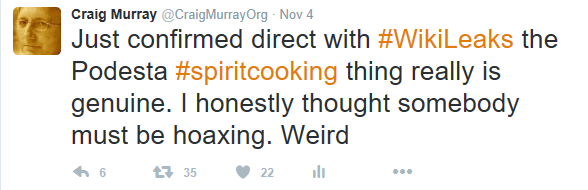
For anyone who gets their news through the mainstream media, the spirit cooking scandal referred to performance art by Marina Abramovic, to an intimate domestic display of which Clinton campaign chairman and paid Saudi lobbyist John Podesta was invited. The performance draws upon occult references and imagery – as an “artist” her inspiration appears to be early Hammer horror films. It involves painting with blood, milk and semen, presumably from animals. To add a frisson, Ms Abramovic has claimed it is art when performed in a gallery, but real when performed in a private home.
Personally, I view it as rubbish as art, and the sort of thing idiots with too much money pay for. I think the occult references give a frisson to the idle rich, like students playing with a Ouija board. Personally I believe that kind of thing is better avoided, but each to his own. What the Podesta emails undoubtedly show is that the rich are not like us. Just as David Cameron sticking his todger in the mouth of a dead pig was an upper class bonding ritual and not actual bestiality, I don’t actually think the Podestas are Satanists. Just weird.
But what is beyond doubt is that the #spiritcooking sensation on social media had a real effect on the US election, and in an election where the margins were so very close potentially an extremely important one. Tens of millions of people saw the images on social media. It galvanised evangelical Christians to vote for Trump and, perhaps much more crucially, it contributed materially to a massive depression of the African American vote for Hillary as millions of African American Christians, disgusted by seeing apparent endorsement of Abramovic’s voodoo and satanic references by the Clinton camp, sat at home and did not turn out to vote. That 2 million black Americans who voted for Obama did not vote for Hillary was not because they are racist – it was because they disliked Hillary for a number of reasons, and spirit cooking was a factor, especially as the famed Democratic machine is heavily reliant upon African American churches for the ground war. I should love to see the influence of the spirit cooking scandal measured, but given that the mainstream media who commission the polls are desperate to deny the effect of WikiLeaks on the election, they are not likely to measure it.
Instead what we have is the “post-truth” narrative. This holds that something is only true if the mainstream media says that it is. It is an easy trick to conflate a dozen ludicrous untrue stories released on social media, and then leap from there to saying everything on social media not endorsed by mainstream media is untrue. It is but a further step to argue that therefore social media must be censored. This is where we came in, with Twitter already doing this to me. Mark Zuckerberg has indicated that Facebook will take further action to prevent dissemination of “untrue” political information. Of course, they already do this, and again I am afraid to say in particular they do this to me. All my blog posts are posted to Facebook as well as twitter. Did you know when you share my post on Facebook, Facebook limits the number of your friends who can see it? In my case the limit is set to ensure that the percentage of incoming traffic to my site that comes through Facebook, is always precisely 5%. To do that, of course, they have to know precisely how much traffic is coming in to this site. Worrying, isn’t it? Before Facebook set the limitation -around the same time as twitter – the amount of incoming traffic from Facebook was around 30% of my traffic.
As with any grossly illiberal cause it is the Guardian which has led the charge for internet censorship in the UK. One hilarious recent Guardian article listed media bias towards Clinton as an example of a post-truth claim. The article did not mention the fact that senior CNN commentator Donna Brazile had been sacked by CNN after WikiLeaks revealed she had been feeding debate questions to Hillary Clinton in advance, nor Wikileaks’ numerous releases of emails detailing partisan collusion with the media to promote Hillary. It did not mention the deliberate and planned timing of primary elections and debates to disadvantage Sanders. In fact, it did not mention any of the inconvenient facts WikiLeaks had revealed. In that, it was absolutely typical mainstream media.
Mainstream media is not post-truth. It never had any connection to the truth.
To complete the chain of dishonesty, the trope of Russian interference in the election is getting a new airing. In a painfully obvious charade, Obama is being “pushed” by his own party to reveal security service information on “Russian interference” in the US election. The focus is particularly on the allegation that the Russian state hacked the Podesta and DNC emails and gave them to WikiLeaks.
The problem is there is no such evidence. There can’t be because both the DNC and Podesta emails were leaked by Washington insiders, to my certain knowledge. I repeat that, to my certain knowledge. Hillary’s pathetic election claim that the security services had information it was the Russians, depended on a statement that the leak was “consistent with Russian methods and objectives”. Look at that statement very carefully. It says “we have no evidence whatsoever, but the President has asked us to blame the Russians”. As I say, I know it wasn’t the Russians. The only “evidence” ever shown to me by those blaming the Russians is that an alleged hacker calling himself “Guccifer” sometimes uses Cyrillic. Which may or may not be true, but as “Guccifer” was neither the source of, nor a conduit for, the leaks it is utterly irrelevant.
Fear not. The truth is out there. People are trying to make it more difficult for you to find, but they will not succeed. In my own humble case, while visits from Facebook and Twitter are radically down, overall numbers are up. The internet somehow always finds a way to work around.
Featured Video
The Failed Air War Over Vietnam
or go to
Aletho News Archives – Video-Images
From the Archives
USS Liberty Massacre: A Pivotal Moment in the Hostile Takeover of America
By Kevin Barrett | Crescent | Dhu al-Qa’dah 24, 1445
In corporate America, hostile takeovers are commonplace. They occur when an aggressor—a larger corporation or rich individuals—seizes control of a smaller corporation without asking permission.
What few recognize is that the United States itself has been subjected to a hostile takeover. Since the aggressor, the illegitimate settler colony known as “Israel,” is much smaller than the US, the takeover has necessarily been surreptitious.
As of June, 2024, Israel’s gradual takeover of the US has become obvious and undeniable—a proverbial “elephant in the living room.” … continue
Blog Roll
 Aletho News
- Europe’s mounting social chaos… chickens coming home to roost for proxy war against Russia
- US-Russia Diesel Deal Becomes Massive Defeat for Ukraine
- Hormuz and the Looming Economic Catastrophe
- Dhubab offensive, media blitz and the rapid unraveling of Saudi-backed coalition’s new gambit
- Putin Conveys to Trump Iran’s Vision on Possible Conflict Resolution – Kremlin
- The Search for Truth: Charlie Kirk’s Assassination One Year Later
- ‘Harsh reality’: Iran says France seeks monopoly on power and intimidation, not peace for all
- When Will This White House Madness End?
- Huckabee aide goes to ‘unusual lengths’ to portray ‘Israel’ positively
- Trump Announces Diesel Supply Deal With Putin Following Phone Call
- If Americans Knew
- Israeli forces kill another child in Gaza – Daily Update
- Gaza ceasefire exists in name only, say more than 100 organizations
- Nearly 2 Million in Gaza Need Urgent Shelter Assistance as Winter Looms: IOM Chief Warns
- Suppressing Palestinian resistance: US charity under fire for AI monitoring of Gaza classrooms
- Thousands Are Held in Israeli Torture Camps. This Is What Happens Inside
- Israel puts Gaza’s sick, injured, newborn in peril – Daily Update
- Report claimed Mark Levin used by Israeli government to influence Trump
- Over 2,000 Gazans have died awaiting medical evacuation amid Israel’s continued siege
- How a U.S. Diplomat Suppressed and Altered Reports Critical of Israel
- 5 Palestinians Die from Israeli Strikes in Gaza as Relentless Attacks Continue
- No Tricks Zone
- Germany’s Green Energy Debacle: High Energy Costs Force Kahla Porzellan to Close After 182 Years!
- New Study: 50 Years Of The Most Aggressive ‘Net Zero’ Policies Can Only Affect The Global Climate By 0.03°C
- US September “Heat” Was No Record…Many Records Set Decades Ago
- Latest European Green Energy Debacle; Portugal’s Largest Flagship Solar Park Insolvent!
- Green Energy Debacle: German Expert Professor Fritz Vahrenholt Warns Of Severe Economic And Social Consequences
- Two More Paleo Reconstructions Affirm Meters-Higher Sea Levels Across Ireland, Brazil 7000-6000 Years Ago
- New Study: Earth And Venus Surface Warmth Largely Explained By Convection And Lapse Rate, Not CO2 Or Radiation
- 2025 Nature Paper Claiming Worsening Global Drought Gets RETRACTED …Heavily Flawed
- New Study: ‘Global Drought Shows No Detectable Recent Acceleration Under Climate Warming’
- Economic Masterminds: German Socialists Suggest Taxing Productivity Gains Stemming From Using AI

