5 Things You Really Need to Know About the Plot to Oust Brazil’s President Roussef
teleSUR | April 13, 2016
Brazil, Latin America’s largest economy and most populous nation, could be on the verge of major political change that could have ramifications not just across the region but globally.
A committee of the lower house of Congress voted 38-27 on Monday April 10 to recommend the impeachment of leftist President Dilma Rousseff.
The president could soon be ousted from her post in what could be the first impeachment of a Brazilian president since 1992 when Fernando Collor de Mello faced massive protests over corruption charges and resigned moments before his conviction by the Senate.
It’s Aimed at a President Elected by Millions
Dilma Rousseff is Brazil’s first woman president and took office on Jan. 1, 2011 after scoring a resounding victory in the presidential election held in October 2010 under promises she will improve the education system and cut inequality.
Rousseff’s victory in 2011 was also largely attributed to her close association with her predecessor, Luiz Inacio Lula da Silva, also of the Workers Party.
After a successful first term she was re-elected in 2014 seeing off Aécio Neves from the Brazilian Social Democracy Party (PSDB) amassing 52 percent of the electorate’s vote and 54 million vote.
The Workers Party, known as the PT, has now been in power for over a decade, much to the chagrin of the country’s conservative political forces.
Former President Lula da Silva has publicly suggested that efforts to impeach Rousseff are driven by politicians who want to take a shortcut to the presidency.
“Anyone who wants to become president, instead of trying to take down the president, they can run in an election. I ran three of them and didn’t get angry,” said Lula in a recent interview.
Political Opponents of Dilma Have a Majority in the Body That Will Decide Her Fate
The speaker of the lower chamber of Congress, Eduardo Cunha, a political opponent of Rousseff, accepted a petition for impeachment in what was described by the president’s supporters as a vengeful move. Cunha, who is under investigation for undeclared Swiss bank accounts totalling U.S. $5 million, only began impeachment proceedings when lawmakers from the PT voted to open an investigation.
A vote in the full lower house, which comprises of 513 lawmakers, is expected to take place on Sunday. If two-thirds vote in favor, the impeachment will be sent to the Senate. Should the Senate move forward with the impeachment process, Rousseff will immediately be suspended for up to six months while the Senate decides her fate.
In this scenario, Vice President Michel Temer – who comes from the same PMDB party as Cuhna, the man who helped push the call for impeachment – will take office as acting president.
The PT only has 57 lawmakers in the lower house, the PMDB has 67 while the rest are made up of smaller parties whose affiliations will be vital in deciding her fate.
Rousseff’s government has seen a number of defections, including the PMDB, the Progressive Party, and the Social Democratic Party, making it very likely that the lower house will vote for impeachment.
A total of 342 of the 513 lawmakers need to approve of Rousseff’s impeachment in order for the process to proceed to the Senate. The Senate will hold a simple-majority vote whether or not to convene a trial.
The Brasilia-based consultancy Arko Advice said committee votes for impeachment were higher than expected and it raised to 65 percent the odds of Rousseff being ousted by Congress.
The Senate trial would be overseen by the chief justice of the Supreme Federal Tribunal, Ricardo Lewandowski, and two-thirds of the 81 senators must vote for conviction to remove Rousseff from office. If no decision is reached within 180 days, the suspension of the president ends.
Like the lower house, the PT does not command a majority in the Senate, holding only 11 of the seats, meaning that many of Rousseff’s adversaries will be those deciding her fate.
The First Vote for Impeachment Was Dominated by Those Facing Corruption Charges
The committee, largely of comprising of Rouseff opponents, voted on Monday 38-27 in favor of continuing the impeachment process of the President. Amazingly, 36 out of the 65 members of the impeachment commission themselves are accused of corruption. Of those 36, 20 voted in favor of impeachment.
In other words, people accused of corruption voted to open an investigation into a president who has not been found guilty of any wrongdoing.
This is why Rousseff’s supporters say that impeachment without proof of a crime is a coup.
If Ousted, Economic Shock Therapy Will Be Implemented
Brazilian law stipulates that if a trial is convened in the Senate, the president must automatically step down. That means Temer could very soon be the president of Brazil, even if only on a temporary basis.
His party, the PMDB, has already revealed what they intend to do with power.
In a report revealed by “O estado de Sao Paulo,” the PMDB indicated that they would implement sweeping austerity reforms, including cuts to the lauded “Bolsa Familia” program.
The report also said the PMDB would consider cutting a large housing program for the poor and displaced workers and a program to make college education more accessible.
This Impeachment Process Isn’t Even About Corruption
Pressure began mounting on Rousseff in 2015 after Brazil’s once impressive economy shrank by 3.8 percent, the biggest decline since 1981 and a multi-billion dollar corruption scandal was exposed in the country’s state-run oil company Petrobras.
In the past two years, over 100 people have been arrested for their alleged involvement, including senators and top executives at Petrobras and members from both sides of the political spectrum. Dilma though has not been formally investigated.
Yet the investigation into the corruption scandal has taken a political course, with the lead investigator, Sergio Moro, coming under heavy criticism for his alleged anti-PT bias. Most of the politicians under investigation are not members of the PT, yet the cases involving the PT receive the most attention from the press and investigators.
Rousseff’s potential impeachment is totally unrelated to her or PT’s dealings with the state run oil company. Rather Rousseff is accused by her political opponents of breaking fiscal laws. They allege she manipulated government accounts to make the country’s deficit seems smaller than it was ahead of the 2014 presidential election to garner support for her re-election campaign.
The government maintains that the audit court is criticizing steps taken by the government to maintain social programs for Brazil’s poor, such as the widely-praised Bolsa Familia.
Syrian General Elections Update
By Stephen Lendman | April 14, 2016
On Thursday, 7,000 polling stations in 13 of Syria’s 15 provinces opened at 7AM, ISIS and Jabhat al-Nusra controlled Raqqa and Idlib excluded for obvious reasons.
Scheduled to remain open until 7PM, the deadline was extended to midnight to accommodate heavy turnout, results to follow when tabulations are completed.
US elections are farcical by comparison, meaningless money controlled exercises serving wealth, power and privilege exclusively.
Syrians have the real thing. Washington mocked their democratic process, saying it doesn’t reflect “the will of the people,” polar opposite reality.
Internally displaced Syrians and others in terrorist controlled areas could vote if able to get to polling stations anywhere in the country.
Washington and its rogue allies only recognize election results in countries under pro-Western regimes – including in ruthless ones like Saudi Arabia, other Gulf states, Egypt, Turkey, Israel and elsewhere.
The democratic “will of the people” is called illegitimate in sovereign independent states like Syria, Iran, Venezuela, Cuba and elsewhere.
Media scoundrels mocked Syria’s electoral process as expected, suppressing hard truths, featuring misinformation and Big Lies like always.
The New York Times mocked reality, calling Syria’s parliament “a largely powerless body… in a country where nearly every decision rests with President Bashar al-Assad.”
Thursday’s elections showed nationwide solidarity, genuine overwhelming support for Assad and his government. The Times turned truth on its head claiming they “highlight divisions and uncertainty.”
A litany of additional lies followed, including claiming low turnout in Damascus where huge crowds queued to vote, and suggesting some Assad supporters cast multiple ballot despite no evidence indicating voting irregularities.
The neocon Washington Post denounced what it called “a farce,” an utter perversion of truth. It claimed Thursday’s elections “snub(bed) Russia,” ignoring its Foreign Ministry spokeswoman Maria Zakharova, calling them a “major factor of stabilization in the country.”
Final results may be known later today. A follow-up article will discuss them.
Stephen Lendman can be reached at lendmanstephen@sbcglobal.net.
His new book as editor and contributor is titled “Flashpoint in Ukraine: US Drive for Hegemony Risks WW III.”
Putin: Ankara ‘not so much fights radicals as cooperates with them,’ civil war underway in Turkey
RT | April 14, 2016
The Turkish authorities are not so much fighting with the radicals, but working side by side with them instead, Russian President Vladimir Putin said during his annual Q&A session, noting that there is a civil war going on in southern Turkey.
“We believe that the current Turkish leadership not so much fights the radicals, but rather cooperates with them,” Putin said.
“In fact, there is a civil war going on in southern Turkey. We try to ignore it, the international community pretends not to notice it, but it’s a fact. Moreover, [the war goes on] with the use of heavy weaponry and equipment, artillery and so on,” he said, highlighting the fact that terrorist attacks take place in Turkey “nearly each week.”
Commenting on the possibility of Russian tourists returning to the ‘Turkish Riviera’, Putin said that there are no security guarantees for Russians in Turkey.
“The Turkish leadership will seek to ensure the safety of tourists, but the big question is whether they will succeed in doing this,” he added.
As in Libya, Avaaz Campaigns for Syria No-Fly Zone That Even Top Generals Oppose
By John Hanrahan | ExposeFacts | April 11, 2016
(First of two articles)
- “I worry sometimes that, when people say ‘impose a no-fly zone,’ there is this almost antiseptic view that this is an easily accomplished military task. It’s extraordinarily difficult. Having overseen imposing a no-fly zone in Libya, a force that is vastly inferior in air forces and air defenses to that which exists in Syria, it’s a pretty high-risk operation…It first entails — we should make no bones about it. It first entails killing a lot of people and destroying the Syrian air defenses and those people who are manning those systems. And then it entails destroying the Syrian air force, preferably on the ground, in the air if necessary. This is a violent combat action that results in lots of casualties and increased risk to our own personnel.” — Now-retired four-star General Carter Ham, former commander, U.S. Africa Command, who oversaw U.S. military enforcement of the Libyan no-fly zone in 2011 [CBS News]
- “It is quite frankly an act of war and it is not a trivial matter… I know it sounds stark, but what I always tell people when they talk to me about a no-fly zone is . . . it’s basically to start a war with that country because you are going to have to go in and kinetically take out their air defense capability.” — Four-star General Philip Breedlove, NATO’s current supreme allied commander, U.S. European Command [Stars and Stripes ]
- The New York Times reported that in 2012 General Martin E. Dempsey, chairman of the Joint Chiefs of Staff, told the White House that imposing a no-fly zone in Syria — in the Times paraphrasing — “would require as many as 70,000 American servicemen to dismantle Syria’s sophisticated antiaircraft system and then impose a 24-hour watch over the country.” [New York Times ] (Dismantle being a Times polite euphemism for bombing the bejeezus out of Syria’s antiaircraft defenses.)
Readers of the national edition of the June 18, 2015 New York Times were greeted with a dramatic full-page ad featuring a photo of an apparently injured baby fitted with a breathing device and being tended to by a partially visible adult beneath a big, bold-type headline: “PRESIDENT OBAMA, WHAT ARE YOU WAITING FOR?” (A partial picture of the ad can be found here.)
In smaller type, under the picture of the baby and the adult, was the message: “Trapped and under chemical attack, the Syrian people are desperate for help.”
And below that in slightly smaller type was the risky military operation that the ad’s sponsors wanted the reluctant President to undertake. To wit: “A majority of Americans support a No-Fly Zone in Syria to save lives and 1,093,775 people around the world [in an on-line petition] are calling for action now.”
The on-line petition cited in the ad also has an urgent headline calling for a “Safe zone for Syrians, now!” The body of the petition demands the establishment of an “air-exclusion zone in Northern Syria, including Aleppo, to stop the bombardment of Syria’s civilians and ensure that humanitarian aid reaches those most in need.” The petition — slightly different than the New York Times ad — was addressed not only to Obama, but also to Turkish President Recep Tayyip Erdogan, French President Francois Hollande, British Prime Minister David Cameron “and other world leaders.”
Now it’s not surprising to see such an expensive ad in the current political climate in which Syrian war fever has seized much of the U.S. political establishment. A climate in which Democratic presidential candidate Hillary Clinton (but not Bernie Sanders or Donald Trump), and every neoconservative and “humanitarian interventionist” and chicken-hawk in creation have, at the very least, called for a no-fly zone in northern Syria as part of a greater U.S. military involvement to remove President Bashar al-Assad.
What stood out about this ad, then, isn’t so much the neocon-like call to action — a move toward a wider war in Syria which could entail even more U.S. and western military air bombardments, as well as additional displacement and death for civilians — but rather the ad’s sponsors.
This ad wasn’t the product of a gaggle of bellicose Republicans or acolytes of the Brookings Institution’s war-enthusiast-in-chief Michael O’Hanlon — or even supporters of regime change advocate Hillary Clinton — offering one of their bold, armchair-military solutions to the many-sided, complex Middle East conflicts.
Rather, the ad and its supporting on-line petition were the handiwork of the Internet phenom activist organization Avaaz.org. With the staggering claimed number of 43.1-million members in 194 countries as of mid-March 2016 (anyone who has ever signed an Avaaz petition is considered by the organization to be a member), the New York City-based Avaaz is easily the largest and most influential Internet-based, international advocacy organization on the planet. (Having myself signed many Avaaz petitions over the years, I am counted as one of those 43 million.)
Avaaz, which means “voice” or “song” in many languages, was started in 2006 and officially launched in 2007 by the U.S. online powerhouse MoveOn.org Civic Action and the little known global advocacy group Res Publica. With initial significant financial backing from — and some blogger critics allege, continued influence of — financier and liberal philanthropist George Soros and his Open Society Foundations (then called Open Society Institute), Avaaz has grown at a mind-boggling pace each year. Since 2011, the organization has increased six-fold to its current membership of almost 43-million. (The second of our two articles on Avaaz will provide more background on the organization, its key issues, its founders and current officials, and funding sources.)
Although widely regarded as liberal to progressive in its campaigns, Avaaz stands alone on the left as the one major on-line activist organization to call for an escalation of the U.S. military role in Syria — just as before that it was alone on the left in 2011 in campaigning successfully for a no-fly zone for Libya, with subsequent disastrous consequences for that country. (More about this in a follow-up article.)
For this article, we submitted a series of questions to Avaaz media personnel, with an emphasis on obtaining specifics as to its rationale for its support for no-fly zones in Libya and Syria. These questions included why the organization had not informed its members of the warnings (cited above) of top U.S. generals and other experts about the potential dangers to civilians and military personnel inherent in the establishment of a no-fly zone in Syria.
After requests (and reminders) on five occasions in November, December and January, we finally received a response on February 11, but that addressed only a few of our specific questions. The organization ignored our question as to why Avaaz had not presented petition-signers with the potential dangers of a Syrian no-fly zone that the prominent generals had warned of. Our follow-up questions, submitted on February 12, have gone unanswered.
What Avaaz spokesperson Nell Greenberg did tell us is: “When it comes to Syria, millions of Avaaz members have repeatedly over the last six years demonstrated that they believe the world has an obligation to protect civilians in Syria as well as those who have fled the country as refugees. In addition to Avaaz members calling for a targeted no-fly zone back in spring of 2015, Avaaz members have called for diplomacy, negotiations and ceasefire as well as raising over a million dollars for the victims inside and outside Syria and volunteering to house and support refugees displaced by this war.”
Avaaz and signers of its no-fly zone petition, “see every human life as equally precious and deserving of protection,” Greenberg said, adding: “At the time of the Syria no-fly zone campaign, a majority* of our membership supported the call for a targeted no-fly zone in northern Syria. But there were deep questions and concerns brought up by other members of the Avaaz movement that we did not ignore. A Q and A was written to go along with the campaign that you can find here, which spoke to many of their questions and I think addresses the heart of yours: http://avaaz.org/en/syria_safe_zone_faq/. To be clear, this Q and A was written by the Avaaz Campaign Director [John Napier Tye] who developed this campaign and is his personal perspective, which is why he signed it. It is not a statement from the Avaaz community.” (* A majority of a random sample of 10,000 Avaaz members, not a majority of its entire membership, supported the campaign for a no-fly zone.)
What exactly those last two sentences of Avaaz’s statement mean is anyone’s guess. Someone ostensibly speaking for the organization is really speaking only for himself? The buck stops with John Tye and not with executive director Ricken Patel and others in the Avaaz hierarchy? And, curiously, the Q and A link cited above was disabled sometime in March and no longer worked as of this writing.
Interestingly, Tye himself is a former U.S. State Department official who upon leaving the agency in April 2014 filed a whistleblower complaint. The complaint alleged, as The New York Times reported, that the National Security Agency’s practices abroad — as authorized by Reagan-era Executive Order 12333 permitting the NSA to gather and use U.S. citizens’ communications overseas — “violated Americans’ Fourth Amendment rights” to be free from unreasonable searches and seizures. While at the State Department from 2011-2014, Tye “worked on Internet freedom issues and had top-secret clearance.” Unlike whistleblower Edward Snowden, Tye wrote in an opinion piece in The Washington Post that he had gone through channels in making his complaint and had not disclosed any classified information.
Greenberg’s response did not address my questions about the generals’ warnings about a no-fly zone in Syria. Instead, she stated: “In addition, as with all of our campaigns, the emails about this campaign included links to articles with multiple viewpoints to support deliberative discussion of the issue and provide resources for members to fact check and do more research on their own.”
Contrary to this statement, I found no link in the Avaaz materials to any article quoting the generals or other critics of imposing a no-fly zone in Syria. Nor did I see even a generic statement, suggesting this is a controversial issue that might merit further research before an Avaaz member would consider signing.
Avaaz Involved on the Ground in Syrian Conflict; Without Proof, Blamed Russians for ‘Coordinating Atrocities’ Against Journalists
It’s important to note that Avaaz’s past activities regarding Syria have gone far beyond petitions calling for a no-fly zone. In 2011-2012 (and perhaps beyond), Avaaz interjected itself into the Syrian conflict in a controversial manner not usually associated with on-line activism — spiriting several dozen western journalists in and out of Syria; helping rescue trapped journalists and other civilians; smuggling in medical supplies; training and then providing “citizen journalists” with cameras to document Syrian government forces’ war crimes; and serving as a major conduit of war information from inside Syria to western journalists outside the country.
As The New Republic’s Simon van Zuylen-Wood reported, Avaaz’s Wissam Tarif, a Lebanese activist, “helped smuggle medical supplies into Syria, as well as more than 35 western journalists… He also oversaw the training of ordinary Syrians who subsequently re-entered their country to report on what was going on. As Syria became increasingly dangerous and difficult to penetrate, Western journalists came to rely ever more on Avaaz’s daily e-mail briefings, which compiled information from 200 such Syrian ‘citizen journalists.’”
Several hundred reporters were reportedly receiving Avaaz’s email briefings at the time, putting the organization in a unique position of being the major source of anti-regime news and propaganda coming out of Syria. For example, as NPR’s Deborah Amos reported, Avaaz’s “citizen journalists” provided casualty figures that “Many media organizations, as well as United Nations officials” relied on “to track the violence inside the country.”
Amos reported in March 2012 that Avaaz “has given crucial support to the uprising and the Syrian activist networks that aim to topple the regime of President Bashar Assad.” Amos’s piece raised the question of whether Avaaz had overstepped its role by engaging in operations in which a large number of Syrian activists had been killed (as many as 23, Avaaz’s executive director Ricken Patel subsequently said).
Amos’s report appeared shortly after Avaaz, in February 2012, announced that it had coordinated the rescue of British photographer Paul Conroy of the London Sunday Times, who had been wounded when government security forces attacked the Baba Amr neighborhood in the city of Homs. Two journalists — Marie Colvin, also of the London Sunday Times, and French photographer Remi Ochlik — were killed in the attack. Conroy was evacuated by his rescuers to Lebanon. Thirteen Syrian activists were initially reported killed in the rescue operation, and Avaaz’s Patel told the BBC at the time that seven others were arrested by government forces and then “shot in the back of the head with their hands tied behind their backs.”
The Avaaz press release on the rescue said: “This operation was carried [out] by Syrians with the help of Avaaz. No other agency was involved” — a claim that Avaaz later had to retract.
Around the same time, in another interview with the BBC4 radio program PM, Patel stated that more than 50 Syrian activists had agreed to participate in the rescue operation — and 23 of them had been killed (a slightly higher number than initially cited.)
In that interview, Patel asserted that repeated attacks on the Homs media center by Assad’s forces were “targeted assassinations” of journalists — and he contended on the flimsiest of information that either the Russians or Iranians — most likely the Russians — “were coordinating these atrocities.” Asked about his evidence for this, Patel said that a drone constantly positioned over Baba Amr conducted surveillance of the area. “…(T)o our knowledge,” Patel said, “the Syrians certainly have not been able to build a drone themselves or own one, so it’s got to be coming from Russia or from Iran, actually coordinating these atrocities.”
Patel said he assumed the drone was Russian operated because the Russians were providing large amounts of military assistance to Assad. Patel said “common sense would suggest there is some sort of cooperation going on” between Russia and Syria’s government and the Russians would have to know the Syrians are “targeting citizens and civilians.”
The New Republic’s Zuylen-Wood subsequently challenged Avaaz’s initial claim of being the sole coordinator of the Conroy rescue, and got Patel to back off to correct both his earlier statement and the Avaaz press release. Patel said that he and Avaaz had made an honest mistake in the confusion and chaos of the rescue, and that the opposition Free Syria Army “played a significant role” in the operation but with substantial planning, input and backing from Avaaz. Although guilty of over-hype in claiming sole credit, Avaaz in its back-and-forth with The New Republic certainly showed that it had, indeed, played an important part in the rescue operation.
Whether this was an appropriate role for an activist organization is another question. Amos’s NPR piece raised the issue, stating: Given the deaths “of so many Syrian activists in the operation” this might suggest that “Avaaz has crossed a line, not just a border.”
For her report, Amos interviewed Randa Slim, a research fellow at the New America Foundation and a specialist in the Syrian opposition, who said: “I am not questioning their motives. But lives are at stake. Are they the right entity to do it. Is an NGO the right outlet?”
Answering press criticism at the time — and giving an indication of its success in getting the opposition’s view of the Syrian conflict to western journalists — Avaaz stated it was “proud of 18 months of outstanding work by our staff and our community to support the voices of the Syrian people to reach the world in thousands of news articles assisted by citizen journalists we have supported or helped connect to the media.”
Additionally, Avaaz commented, “Our community has donated almost $3 million for communications equipment, humanitarian aid and advocacy, and taken millions of actions including petition signatures, messages, phone calls and advocacy visits to press governments to take action to support the Syrian people.”
It is not clear whether Avaaz has continued to provide the same sort of on-the-ground assistance to opposition forces and civilians as it was offering a few years ago, although it indicated at the time that it would continue such activities.
In Forefront of Many Progressive Causes, Avaaz’s Advocacy for Military Actions in First Libya and Now Syria Seems Out of Sync
At first blush, the petition advocating for a Syria no-fly zone was a jolt to those not familiar with Avaaz’s swing toward “humanitarian” military action in recent years. It seemed surprising because Avaaz has on other occasions called for negotiated peaceful solutions to various conflicts (including in Syria itself), and has been substantially in sync with other major progressive organizations on scores of U.S. and international issues in its nine years of existence.
Based on the overwhelming majority of the hundreds of Avaaz petitions I have seen over the years and in preparation for this article, I had assumed that the organization adhered to a basic principle of nonviolence in international affairs — and it has even said so on occasion. But as one person who has had close connections to Avaaz noted to me: Although favoring diplomatic solutions, Avaaz does not rule out the use of military force, as its no-fly zone advocacy for Libya and Syria amply demonstrate.
On its website home page, Avaaz does not have an out-front display of its past campaign for a no-fly zone in Libya and its current one in Syria (and does not ever mention the ongoing disaster in Libya, or its support for a no-fly zone there). Rather, it focuses its out-front materials on its multitude of campaigns that involve nonviolent, political, diplomatic and public relations remedies. And even allowing for organizational self-hype, Avaaz has an impressive record of advocacy.
Through its petitions, street actions, billboards and newspaper ads, Avaaz has been highly visible on hundreds of issues worldwide — including Palestinian rights, support for U.S. government whistleblowers including Chelsea Manning and Edward Snowden, campaigns for endangered species, etc. This is, after all, an organization that played a major role along with 350.org and other activist groups in organizing the massive People’s Climate March in New York City in September 2014; it was also an organizer of the Global Climate March that was to coincide with the opening last November of the U.N. Climate Change Conference in France. That march was blocked by the French government in the aftermath of coordinated attacks attributed to ISIS that killed at least 130 people in Paris earlier in November.
Most — if not all — of Avaaz’s campaigns seem right in line with current day activism of various groupings on the political Left. Even on Syria, an Avaaz campaign urging the United States to take in more refugees is in a more traditional humanitarian vein (that is, one that doesn’t involve military hardware, needless to say). Typical was Avaaz’s full, back-page color ad in the March 10, 2016 Politico headlined (in a play on a Republican presidential debate topic): “IT TAKES BIG HANDS (and a Bigger Heart) TO WELCOME 25,000 SYRIAN REFUGEES.” The ad praised Canadian Prime Minister Justin Trudeau for “showing the world what it means to have a giant heart” through Canada’s acceptance and resettlement of 25,000 refugees in the previous four months — “while America debates the size of candidates’ hands” and has taken in fewer than 1,000 refugees. The ad urged President Obama and Congress to “do better, and show the world the size of our hearts, not our hands.”
Also recently, in February 2016, more than 749,000 people signed an Avaaz petition that called on members of the European Parliament (MEPs) and leaders of the United States, the United Kingdom, Canada, Germany and France to “suspend all arms deals with Saudi Arabia until they end their assaults in Yemen and begin a genuine peace process.” The campaign, which also included targeting MEPs with phone calls and personal messages, won a major success when the European Parliament voted on February 25 “for an embargo on arms sale to Saudi Arabia,” in response to a United Nations report documenting 119 Saudi violations of international law in Yemen. Because European Union states are not bound by the action, Avaaz is continuing the campaign to get the European governments and the United States to follow the European Parliament’s lead.
This Saudi campaign makes Avaaz’s repeat advocacy for a no-fly zone — first in Libya and now in Syria — appear on initial impression to be way out of sync with progressive thought and most other Avaaz campaigns, and so much in line with neocon and “humanitarian interventionist” regime-change advocates.
Avaaz Has Long Favored No-Fly Zone in Syria, Based in Part on the Dodgy Sarin Gas Story
The organization’s renewed campaign in the spring of 2015 for a Syrian no-fly zone was no sudden philosophical switch by Avaaz. In fact, as noted earlier, Avaaz had in 2011 campaigned for a no-fly zone in since-devastated Libya, and then turned its attention to a no-fly zone for Syria. It continued that Syrian effort in 2013-2014, while at the same time pushing for President Obama to get together with Iranian President Hassan Rouhani to work out a diplomatic solution. That diplomacy petition netted 1,126,000 signers.
This diplomatic approach seemed more in line with what progressive individuals and organizations could get behind. But with no such diplomatic talks forthcoming, Avaaz then continued with its no-fly zone strategy.
Even in calling for negotiations, though, as well as in points raised in its on-line advocacy for a no-fly zone, Avaaz has regularly repeated a now-questionable allegation against the Syrian government — made on numerous occasions by Secretary John Kerry and then President Obama. The U.S. leaders and war advocates used the allegation as a justification for war when it appeared that the United States was going to launch a bombing campaign against Syria in September 2013: Namely, that Assad’s forces had used sarin gas on the civilian population near Damascus in August 2013. This charge that Assad was using chemical weapons on his own people has provided a continuing emotional selling point for Avaaz and other interventionists in the campaign for upping the military ante against the Assad regime.
“Right now,” the message accompanying the Avaaz diplomacy petition stated, “the global drums of war are beating over Syria, but if enough of us make sure Rouhani and Obama know the world wants bold diplomacy, we could end the nightmare for thousands of terrified Syrian children under gas attacks. We have no time to lose…”
But as pointed out repeatedly by Robert Parry of Consortium News and a few other independent journalists over the last two years — as well as recently by an organization of former U.S. intelligence professionals, Veteran Intelligence Professionals for Sanity (VIPS) — the Obama administration has publicly offered not one shred of evidence to back up its early claims that Assad gassed his own people in August 2013.
To the contrary, recent disclosures in Turkey provide evidence that strongly suggest it was not Assad’s military that carried out the sarin gas attack.
As Parry recently wrote, summing up his findings from his earlier articles, there is “growing evidence that it was a jihadist group, possibly with the help of Turkish intelligence, that staged the outrage as a provocation to draw the U.S. military into the conflict against Syria’s military by creating the appearance that Assad had crossed Obama’s ‘red line’ on using chemical weapons.” The sarin gas attack, it should be recalled, came at a very tense time when Obama was considering military action against Assad, and seemed in the eyes of many hawks to provide final justification for attacking Syria and removing Assad from power.
The VIPS group, in a December 22, 2015 memorandum it sent to Kerry and to Foreign Minister of Russia Sergey Lavrov, noted comments made in the Turkish Parliament 12 days earlier by member Eren Erdem from the opposition Republican People’s Party. In his remarks in Parliament, and four days later in an RT television interview, Erdem confronted the Turkish government on its possible role in the sarin gas issue. He cited a closed criminal case, official reports and electronic evidence documenting a sarin gas smuggling operation that was allegedly carried out with Turkish government complicity.
In the RT interview, according to the VIPS memo, “Erdem said Turkish authorities had acquired evidence of sarin gas shipments to anti-government rebels in Syria, and did nothing to stop them.” The General Prosecutor in the Turkish city of Adana “opened a criminal case, and an indictment stated ‘chemical weapons components’ from Europe ‘were to be seamlessly shipped via a designated route through Turkey to militant labs in Syria.’” Erdem cited evidence implicating the Turkish Minister of Justice and the Turkish Mechanical and Chemical Industry Corporation in the smuggling of sarin.”
This bombshell piece of information, largely ignored by the mainstream news media, is a strong indication that the original sarin gas story linking the chemical attack to Assad’s forces is either false or at best unproven.
This information also undercuts one of the major shocking and emotion-filled underpinnings for Avaaz’s campaign for a no-fly zone — as well as the rationale repeatedly voiced by other advocates of stepped-up military action against the Syrian government.
Gassing your own people is about as low as a dictator can get. True or not, it’s a powerful piece of propaganda that provides a clinching bit of information to someone considering whether or not to sign something like the Avaaz no-fly zone petition. Since the mainstream media have ignored the Turkish Parliamentarian’s disclosures, it’s a safe bet that most of the petition signers to this day harbor no doubts about the source of the sarin gas attack, since no one in the Obama administration, much less Avaaz or other no-fly zone advocates, has ever publicly offered any contrary information to suggest it might not have been Assad who unleashed the attack.
The shaky nature of the sarin gas allegation is one of the areas about which ExposeFacts queried Avaaz further, but we have received no response to date.
Avaaz Didn’t Tell Members That Top U.S. Generals Warned Against Syria No-Fly Zone
Among our unanswered questions submitted to Avaaz were ones noting that the organization’s Syria petitions and accompanying supporting materials made no mention of the warnings by top U.S. generals (cited earlier) of the dangers inherent in establishing a no-fly zone there — including risking drastically expanding that bloody, many-sided war and thereby endangering civilians.
Without any indication of such dangers, potential petition signers could very easily get the idea that there is little down-side to a no-fly zone. And, after all, if lives could be saved and there is little down-side, isn’t that a course of action every compassionate human being could get behind? Especially if the organization calling for it has built up trust with its members through its hundreds of other liberal and progressive petitions?
Also, in information provided by Avaaz in its emails to members and on its website relating to its Syria no-fly zone petition, there was no mention of Libya, or any explanation of what Avaaz leaders thought, in retrospect, about the chaos, death, destruction, displacement and rise of ISIS there in the aftermath of the military intervention by NATO including its use of a no-fly zone. (Or, more recently, what Avaaz might think of news reports that the United States is going back into Libya with airstrikes and commando raids to counter ISIS — which did not exist in Libya until after the NATO bombing campaign and the killing of Libyan leader Muammar Gaddafi.)
Surely, you would think that the experience in Libya would limit an organization’s willingness to push once again for a no-fly zone, this time in Syria. Yet, despite that ongoing disaster in Libya, Avaaz was apparently not chastened. (See our follow-up article for an in-depth discussion of Avaaz’s advocacy for no-fly zone in Libya.)
As with our other questions, Avaaz did not answer whether the Libya experience made the organization’s leaders think twice about taking up the Syria no-fly zone issue. It was possibly obscurely referencing the Libya no-fly zone when it stated to us: “Much of what you’re asking for are reflection on past campaigns given the geopolitical landscape today. But based on the way we work, I cannot tell you how any Avaaz member would feel today about a past campaign without going back and asking them.”
Our follow-up question made it clear that we were not asking how any Avaaz member might feel about the Libya campaign, but rather how Avaaz’s leaders felt about proposing a no-fly zone for Syria when the Libya enterprise had turned out so disastrously.
No-Fly Zones As an Act of War
Regardless of the sincerity of petition-signers who believe no-fly zones can save civilians’ lives, the recent history in Iraq and Libya demonstrate that no-fly zones are actually precursors to — or accompanists of — stepped-up military action by the United States and other western powers to bring about regime change.
And many of those signing the Libya and Syria petitions — having developed trust in Avaaz after signing some of the organization’s previous, meritorious petitions — are inclined to accept Avaaz’s version of events and the benign explanation that a no-fly zone poses little risk and will save thousands of civilians’ lives.
Whatever humanitarian clothes you dress it up in, though, establishing a no-fly zone using air power is by its very nature a provocative act, an act of war, a threat to a sovereign nation (no matter how reprehensible that nation’s government might be).
It is one thing for an activist organization to push its members in support of a diplomatic solution, or to provide food, shelter and other humanitarian assistance to civilian war victims; it is quite another to buy into a dubious no-fly zone notion, which actual generals — not humanitarian armchair generals — warn would involve the deaths of multitudes of civilians.
Yet, in its petition and accompanying materials on Syria, Avaaz gives little hint that a no-fly zone is a move toward an expanded war and likely even more displacement and death for civilians. Instead, it appeals to people’s humanitarian instincts and downplays the risk to both civilians and military personnel.
Typical of the emotional appeal to members’ humanitarian instincts was a September 30, 2015 Avaaz posting that pressed the urgency of a no-fly zone even with the Russians having recently entered the air war in Syria in support of Assad’s government. On the basis of just one eyewitness to an alleged Russian bombing of civilian neighborhoods near Homs, Avaaz said this makes the further case for a no-fly zone.
The September 30 posting, in line with Avaaz’s general practice of casting the Russians as the arch-villains in the war in Syria, was headlined “Russian bombing of Syrian civilian neighbourhoods kills women and children – eyewitness,” and quoted Emma Ruby-Sachs, deputy director of Avaaz, thusly:
“Russia says it’s bombing ISIS, but eyewitnesses say their brutal attacks targeted areas way outside of ISIS control. This will only sow instability and radicalization and should be a wake-up call to the U.S. and its allies to enforce a targeted no-fly zone to save lives, counter ISIS and alleviate the refugee crisis. Syrian civilians need protection now, not further attacks from Russian bombs.”
Now it just might be that everything in this posting is true — that Russian planes bombed a bakery and a vegetable market, killing four children and two women — but we are asked to accept this on the word of just one person. We are also asked to accept that neither ISIS nor other anti-regime units operated in the area, on the basis of the one eyewitness who is apparently quoting local residents. We are also asked to believe that this is conclusive justification for going full speed ahead with a no-fly zone — never mind that the Russians might not want to give up Syrian air space without a fight and possibly send the ongoing disaster in Syria into a whole new dimension of slaughter.
Despite the lies and propaganda emitting from all of the many sides in the Syrian conflict, despite the uncertainties of just who is bombing whom in some situations, Avaaz sticks to its narrative that the Syrian regime — now along with its Russian bombing partners — are virtually alone in endangering civilians and that a no-fly zone is somehow going to make all that right without posing much of a problem, really.
The possibility that a no-fly zone could increase the likelihood of a direct U.S.-Russian confrontation and an even wider war was apparently not part of Avaaz’s equation. How the no-fly zone would counter ISIS is not explained, since ISIS does not have an air force, but Avaaz presents it and its claims of saving lives and easing the refugee crisis as some sort of sure thing.
Stephen Wrage, a professor of American foreign policy at the Naval Academy, and Scott Cooper, national security outreach director at Human Rights First and a retired Marine Corps aviator, make the point that a no-fly zone in Syria would fail in its mission to protect civilians. As they wrote last October in Defense One in an article titled, “The History of No-Fly Zones Doesn’t Bode Well for Syria”: “If the no-fly zone is a humanitarian instrument aimed at saving innocents…it will not be effective because it cannot separate the killers from their victims. Saddam and Qaddafi were constrained by geography: by Iraq’s Zagros Mountains and the Libyan Desert. In Syria, President Bashar al-Assad’s forces, now protected by Russian President Vladimir Putin’s air cover, would have no difficulty reaching the people he intends to kill.”
And as noted in the introduction to this article, the nation’s leading generals — no shrinking violets they — have repeatedly warned over the last several years of the drastic consequences of establishing a no-fly zone in Syria.
And all of these generals gave these warnings before Russian aircraft entered the fray.
It isn’t often I would say this, but in this instance of Syria the war-makers — the generals — are presenting the real-world, provocative implications of establishing a Syria no-fly zone, while Avaaz with its stated goal of protecting Syrian civilians presents a sugar-coated, little-harm version. And its petition and related materials, with a focus on the despicable Assad government’s violence against the civilian population, doesn’t adequately take into account the violence against civilians by ISIS and other opponents of Assad’s regime.
Near the end of each year, Avaaz (as do other on-line organizations) asks people on its email list to weigh in on a self-generated organizational list of priorities for the coming year. In no year has that list of priorities included setting up no-fly zones in, first, Libya, and now in Syria. The 2016 list of priorities, as voted on by members, includes a reference to peace in Syria, but no mention of a no-fly zone, stating: “Peace in Syria – campaign for the Syrian regime and all warring parties to stop brutal violence on innocent Syrian families, and ensure Syrian voices are heard in international peace talks.”
On its home page and in messages sent periodically to members to report on the organization’s campaigns and accomplishments, the call for a no-fly zone is not included as one of its showcase items. Nevertheless, Avaaz keeps raising the issue in dramatic ways throughout the year.
In an email sent to members last June, three days after publication of its New York Times ad, Avaaz renewed its call for a no-fly zone as it reported that a humanitarian worker had informed the organization that the “Syrian air force just dropped chlorine gas bombs on children.” Noting that a number of countries — including the United States, the United Kingdom, Turkey and France — were “seriously considering a safe zone in Northern Syria,” Avaaz added: “Advisors close to President Obama support it, but he is worried he won’t have public support. That’s where we come in… Let’s tell him we don’t want a world that watches as a dictator drops chemical weapons on families in the night. We want action.”
Avaaz said that the unnamed humanitarian worker told it that “I wish the world could see what I have seen with my eyes. It breaks my heart forever.”
Whatever the veracity of Avaaz’s source — and, again, it’s just one source at that moment — and whatever Avaaz’s good intentions, there is still that notion that setting up a no-fly zone is a walk in the park, rather than a dangerous move toward a wider war. The sense of frustration in that Avaaz missive is palpable: People are being slaughtered as the world watches. Something must be done. We want action!
Journalist and Middle East expert Charles Glass reported on the war in Syria in The New York Review of Books after a September 2015 trip there. Citing the United Nations’ latest “Report of the Independent International Commission of Inquiry on the Syrian Arab Republic,” Glass said the report “paints a depressing portrait of the population’s unimaginable torment at the hands of government and opposition forces alike.”
Wrote Glass: “The regime drops barrel bombs in Aleppo, and the rebels respond with gas canisters of explosives and shrapnel. ISIS rapes and brutalizes Yazidi women whom it has declared slaves to be bought and sold. The regime’s security forces practice torture on an industrial scale. Both sides besiege villages, and both sides commit massacres. The UN report’s forty-four pages of horrific war crimes should be sufficient for the outside powers to budge and call a halt to this war. What are they waiting for?”
Unlike Avaaz’s posture of diplomacy and a no-fly zone, Glass was calling strictly for diplomacy, not escalation of the violence. He was seeing the civilian population suffering “at the hands of government and opposition forces alike.”
Avaaz — unlike, for example, Human Rights Watch on occasion — does not emphasize human rights abuses or killings of civilians by all forces involved in the Syrian fighting, concentrating instead on the abuses by Assad’s forces.
In a 79-page report on Syria in March 2015, Human Rights Watch (HRW) concluded: “Opposition armed groups in Syria have indiscriminately attacked civilians in government-held territory with car bombs, mortars, and rockets…The attacks have killed and maimed hundreds of civilians and destroyed civilian infrastructure in violation of the laws of war…[The report] documents scores of attacks in heavily populated, government-controlled areas in Damascus and Homs between January 2012 and April 2014, and which continue into 2015. The findings are based primarily on victim and witness accounts, on-site investigations, publicly available videos, and information on social media sites.”
Many of the attacks, Human Rights Watch found, were indiscriminate, were carried out in areas where there were no government forces, and “seemed primarily intended to spread terror among the civilian population.”
An earlier 2013 HRW report, titled “Syria: Executions, Hostage Taking by Rebels — Planned Attacks on Civilians Constitute Crimes Against Humanity,” contained similar findings of abuses by opposition forces.
This is not about who is the worst human-rights abuser or murderer of civilians — Assad or ISIS or the various other groupings of the opposition — but rather about what a trusted organization such as Avaaz tells its members in getting them to sign a petition aimed at halting a humanitarian crisis that involves the killing and maiming of civilians. By its singular focus on Assad’s military and its supporters as the sole killers and abusers of the civilian population, Avaaz is not being straight with its members. It is holding back key information — information that just might make a potential signer think twice before opting for a military action that Avaaz is selling as a tactic that in its view would lessen a horrible humanitarian crisis.
Also absent in Avaaz’s pitch for no-fly zone signatures is any note to members that its stated humanitarian-inspired stance puts it in the company of the neocons, Democratic presidential candidate Hillary Clinton, and assorted congressional and think-tank war hawks who see a no-fly zone as part of a bigger military strategy to oust Assad from power. A no-fly zone, in the interventionists’ view, is a step toward this end, not an end in itself.
People like Anne-Marie Slaughter, a Clinton ally and president of the nonpartisan centrist think tank New America, who in an article last summer called — as she has before — for establishing a no-fly zone in Syria in order to save civilians’ lives. But that’s only the beginning. Slaughter, who was director of policy planning for the U.S. State Department for two years under Secretary Clinton, writes that the U.S. government had finally come to “the recognition that a new Syrian government is vital to defeat — or even contain — the Islamic State.”
While mentioning that civilians are also sometimes killed by rebel and Islamic State fighters, Slaughter posits that “Assad represents the greater threat, and thus will have to be removed from power before attention can be focused on defeating the Islamic State.” Hillary Clinton makes basically the same argument — and, like Slaughter, can’t really enlighten us as to what a successor Syrian government would look like.
Avaaz is thus allied with those for whom a no-fly zone is a euphemism for — a stalking horse for — regime change in Syria, regardless of the organization’s stated goal of protecting civilians and saving lives, and not of producing regime change.
But as Adam Johnson put it in an article for FAIR :
“… A no-fly zone would only be applied to Assad because anti-Assad forces don’t have an air force… While it may sound like a simple humanitarian stop gap — and that’s no doubt how it’s being sold — literally every no-fly zone in history has eventually led to regime change. Which is fair enough, but those pushing for one should at least be honest about what this means: the active removal of Assad by foreign forces. Indeed, if one recalls the NATO intervention in Libya was originally sold as a no-fly zone to prevent a potential genocide, but within a matter of weeks, NATO leaders had pivoted to full-on regime change.”
Johnson also makes the important point — in reference to the devastating, poignant picture late last summer of the drowned Syrian Kurdish refugee, 3-year-old Alan Kurdi, whose body washed up on a Turkish beach — that this boy and his family were not fleeing the Assad government’s bombing of cities. Rather, they were “escaping ISIS and the U.S. bombing of his hometown of Kobani, far from anything the Assad government is doing. A no-fly zone would not have saved his hometown…”
Since Johnson wrote that, and since Avaaz’s dramatic New York Times ad last June, the Russians entered the air war on the side of Assad and in opposition to rebel forces and ISIS. Although Russia announced its withdrawal from military action in Syria in mid-March, it is keeping in place “its powerful S-400 air defense system… That would maintain Russian dominance of Syrian airspace…” This would mean that any U.S./NATO effort to impose a no-fly zone would surely meet with Russian and Syrian resistance.
So the questions for Avaaz and other advocates of a no-fly zone in Syria include: Are you thinking beyond a no-fly zone? If not, why not? Doesn’t it matter? What comes next or in conjunction with a no-fly zone? Ousting Assad? Replacing him with whom? How? Full-scale bombardments and drone strikes that somehow miraculously avoid killing masses of civilians, and that avoid triggering more killings by Assad’s forces? More special ops assassination missions? Those “boots on the ground” so beloved of armchair militarists everywhere?
What if Turkey and Saudi Arabia invade Syria, as they have threatened to do? What happens in the fight against ISIS if Assad is out of the picture? What does Russia do? Does some minuscule crew of supposed Syrian moderates that the U.S. has identified take power, and ISIS just pauses while the new government organizes itself (or rather is organized for it by the ever-helpful United States, United Kingdom and other enlightened western governments)? What happens to Assad’s military? How will a no-fly zone affect not only government violence, but also ISIS violence, or other opposition violence, against civilians? And on and on.
Shouldn’t the still unfolding Libya tragedy make an organization like Avaaz a little gun-shy (so to speak) in calling for the same kind of policy in the even more complicated, confusing case of Syria — what with the Syrian military, various countries, the anti-Assad rebel opposition groups, ISIS and al Qaeda and al Nusra and their spinoff groups, and Kurds, and Assad loyalists all slugging it out to the death?
In a Syrian war with atrocities on all sides, isn’t there something to be learned from the Libya experience in which Gaddafi’s crimes were exaggerated to inflame the western public against his regime? As Patrick Cockburn of The Independent in London reported in November 2014, human rights groups in Libya “discovered that there was no evidence for several highly publicized atrocities supposedly carried out by Gaddafi’s forces that were used to fuel popular support for the air war in the U.S., Britain, France and elsewhere.”
These included, Cockburn continued, “the story of the mass rape of women by Gaddafi’s troops that Amnesty International exposed as being without foundation. The uniformed bodies of government soldiers were described by rebel spokesmen as being men shot because they were about to defect to the opposition. Video film showed the soldiers still alive as rebel prisoners so it must have been the rebels who had executed them and put the blame on the government.”
And, wrote Cockburn, “The majority of Libyans are demonstrably worse off today than they were under Gaddafi, notwithstanding his personality cult and authoritarian rule. The slaughter is getting worse by the month and is engulfing the entire country.”
Writing more than a year later, The New York Times reported on February 29, 2016 that in the aftermath of the killing of Gaddafi and regime change in Libya, that country “dissolved into chaos, leading to a civil war that would destabilize the region, fueling the refugee crisis in Europe and allowing the Islamic State to establish a Libyan haven that the United States in now desperately trying to contain.”
Syria, of course, is not Libya. But there is a lesson there that “humanitarian interventionists” should learn.
When Members Pushed Back, Avaaz Defended Its Syria No-Fly Zone Advocacy
Although Avaaz has ignored most of our specific questions, it did last summer post on its website a “Syria No Fly Zone Questions & Answers” page in response to “thoughtful concerns” expressed by members that, according to Avaaz, boiled down to these main objections: “a) Avaaz is relying on unverified news reports and has the facts wrong. b) Avaaz is pushing for more war in the Middle East. c) Avaaz is serving the imperial interests of western powers, notably the U.S.” (As noted earlier, the Q&A page was deleted sometime last month, and when you click on the above link you get a blank Avaaz page as of this writing.)
To this, I would again add, among other things, Avaaz completely ignoring — or not even considering — the warnings of top U.S. generals and other experts expressed earlier in this article. These warnings are not even mentioned in Avaaz’s Q&A, nor is there any mention of Avaaz’s previous disastrous “humanitarian” call (along with interventionists from across the political spectrum) for a no-fly zone in Libya.
In response to the criticisms, the previously mentioned Avaaz campaign director and former State Department official John Tye emphasized that his organization was only trying to save lives and was not seeking more war in the Middle East or doing the bidding of U.S. or other imperial interests. Tye wrote that with “more than 210,000 killed. Over 10 million people driven from their homes. More than half the country’s hospitals damaged or destroyed. Millions of children out of school. This is the worst refugee crisis since World War II… the humanitarian disaster of our generation, and it continues to crush innumerable lives.”
Tye went on to note that Avaaz had tried everything short of recommending military action to alleviate the plight of Syria’s civilians. Wrote Tye:
“… We supported civilians and non-violent activists to document human rights abuses, and gave millions of dollars for food, medicine, and humanitarian supplies and to put refugee children in school. We campaigned to stop arms dealers from sending weapons to the country, called for sanctions, and then urged the U.N. to help stop the fighting. More than a million of us from across the world called on the U.S. and Iran to come together to help craft a negotiated solution, and then once again we backed UN-sponsored negotiations. This community has worked for nearly four years to stop the war and help the needy, but the crisis continues and is spreading.”
Tye wrote that having tried all these other forums and methods, “it is up to a community like ours to continue to look for legal ways to intervene to stop the carnage.” And this is where the no-fly zone comes in.
Rather than being “the deceitful ‘pre-emptive war’ doctrine advocated by neo-conservatives looking to remake and dominate the Middle East,” Tye — presumably drawing primarily on his State Department and other governmental contacts — wrote that the Avaaz call for a no-fly zone (NFZ) “is a very serious strategy made only after intensive consultation with diplomats, regional experts, and Syrians to save tens of thousands of civilians’ lives. [My emphasis.] After four years of brutal violence on all sides, the war in Syria will be extremely difficult to end. But a NFZ could help curb the violence and bring the warring parties into peace negotiations. Right now Assad has no incentive to negotiate peace. He believes he can continue exterminating his people until they submit. A NFZ will show Assad that the world will act to stop this carnage, and it will change Assad’s calculus.”
Additionally, Tye wrote, a no-fly zone “will also provide a safe place for the Syrians who have been driven into extremists’ territory as they are fleeing from the regime’s terror. Lastly it would reinforce the international military campaign against ISIS.” He added that an NFZ “that protects civilians in northern Syria could strengthen the conditions for a negotiated, political solution to the conflict.”
Tye continued that the most common criticism of Avaaz is that it claims as fact certain allegations of Syrian government forces’ atrocities that had not been confirmed when Avaaz published them — such as Avaaz alleging chlorine gas attacks from the air killing civilians, when it lacked corroboration for the allegation. While acknowledging that “it continues to be difficult to independently and unequivocally confirm details on the ground in Syria,” Tye said the Syrian military “have relied on non-chemical weapons dropped from aircraft to kill thousands upon thousands of civilians in northern Syria. Even if, contrary to current evidence, it somehow turns out that the Assad regime was not responsible for this recent chlorine attack, it is still the case that a no-fly zone in northern Syria would dramatically reduce civilian deaths.”
As to the criticism from some Avaaz members that the organization is pushing for more war in Syria, Tye responded: “The answer is an unqualified ‘no’. U.S. and allied aircraft are already patrolling airspace in northern Syria, as part of the U.S.-led anti-IS coalition, so a no-fly zone would not require significant new deployments. Bloodshed in Syria will continue with or without a no-fly zone, but a no-fly zone would dramatically decrease civilian casualties.”
Yes, Tye is saying, take it from us that this is exactly how a no-fly zone would work out. Ignore those pesky generals who say otherwise — and I do mean ignore them. Do not let their warnings enter the Avaaz dialogue.
Avaaz’s only acknowledgement of possible dangers comes in this one paragraph from Tye: “As with any military mission, a no-fly zone may endanger the pilots enforcing it, or Assad forces trying to break it.”
Tye continued: “Those possibilities are real, but we know what will continue to happen until there is a no-fly zone: weaponized chlorine bombs will fall on sleeping families; and near daily barrel bombing will continue over Aleppo. Thousands and thousands of people will die, for years to come, if we turn away and wring our hands…Prior efforts to put an end to this, through diplomacy and sanctions, have all failed. If nothing changes, another 100,000 could be killed” in 2015 alone.
Note again, there is no mention that a no-fly zone could — and in Syria, likely would — endanger not only U.S. and NATO pilots and Assad’s forces, but the very civilians Avaaz says it wants to protect.
Responding to comparisons to U.S. involvement in Iraq, Tye said: “A no-fly zone over Syria is not the same as the disastrous war in Iraq… This campaign for Syria is not invasion or regime change, it’s about protecting defenseless families.”
As for one of the other criticisms — that Avaaz is serving U.S. and western interests “to (re)shape and exercise imperial ambitions in the Middle East,” Tye responded: “The answer again is a very definitive ‘no’. Our community regularly campaigns against morally unjustifiable foreign engagement in the Middle East, whether it be Israel’s brutal occupation of Palestinian lands or the U.S. and E.U.’s rapprochement with a new tyrant in Egypt. We understand the tragic and often cynical legacy of foreign engagement in the Middle East and North Africa.”
Tye wrote that he understands that a no-fly zone “could conjure up images of George W. Bush’s foreign policy and illegal Western interventions. This is a different thing.” In Avaaz’s vision, a targeted no-fly zone can’t just be a U.S. undertaking. “It must be an international effort, with a clear objective: the protection of civilians. And the states like Turkey, Saudi Arabia, United Arab Emirates that have openly called for a no-fly zone, and the protection of civilian populations in Syria, must take the lead in providing resources to implement it. France’s Socialist government has also voiced strong support for a targeted no-fly zone. But, these governments won’t act without some support from the United States, which has the diplomatic and military resources to serve as coordinator for a limited period of time — until the safety of civilians is secured.”
Finally, Tye said, Avaaz is a member organization and as such was responding to tens of thousands of Syrian members who were calling for a no-fly zone. It should be noted that Avaaz shows 54,000 members in Syria in a population of 23 million — which means that even if every Avaaz member supported a no-fly zone, this would still mean that only one of every 426 Syrians had “voted” for one.
Nevertheless, Tye concluded, “The Avaaz community has repeatedly stood behind the principle that defenseless civilian populations should be protected — and these tens of thousands of Syrian Avaaz members deserve no less.”
It seems an odd notion that it is “Syrian Avaaz members” — rather than Avaaz staffers in New York promulgating petitions for a no-fly zone — who are somehow responsible for the direction of this campaign. Seriously?
In its call for no-fly zones in Libya and Syria, Avaaz has turned the concept of progressive advocacy on its head and appears to be untrue to the direction it has followed in the overwhelming majority of its campaigns. Advocacy organizations should be about stopping wars, not asking their members to buy into a dubious military tactic for Syria that even leading U.S. generals say “entails killing a lot of people… [and is] a violent combat action that results in lots of casualties” for those very Syrian civilians that Avaaz argues it is trying to protect.
John Hanrahan, currently on the editorial board of ExposeFacts, is a former executive director of The Fund for Investigative Journalism and reporter for The Washington Post, The Washington Star, UPI and other news organizations. He also has extensive experience as a legal investigator. Hanrahan is the author of Government by Contract and co-author of Lost Frontier: The Marketing of Alaska. He wrote extensively for NiemanWatchdog.org, a project of the Nieman Foundation for Journalism at Harvard University.
US Nuclear Rearmament Under Guise of World Peace
By Finian CUNNINGHAM – Strategic Culture Foundation – 12.04.2016
This week US Secretary of State John Kerry visited Hiroshima, where nearly 71 years ago the US dropped the first ever atomic weapon killing 140,000 people. It was the first visit by a senior American official to the Japanese city owing to immense sensitivity surrounding that notorious event.
However, the occasion this week was said to underscore US President Obama’s vision of a nuclear weapons free world, said Kerry’s State Department.
The Japanese government of Shinzo Abe also got some good public relations value out of Kerry’s landmark visit to the Hiroshima peace memorial. As Voice of America noted, the occasion «helps to soften its global image» as Abe’s government steps up its military posture in recent years.
Obama is due to go to Japan in May to attend a G7 summit. It is being mooted that he too may pay respects to Hiroshima victims of the US atomic bombing, which occurred on August 6, 1945.
By the time Obama arrives in Japan, a shipment of Japanese radioactive plutonium is due to land on the US east coast. The highly dangerous cargo of 331 kilograms of weapons-grade plutonium reportedly left Japan on March 22 onboard an armed ship as part of an agreement with the US to act as a depository for the radioactive material. The cargo is reportedly sufficient material for the production 50 nuclear warheads.
The two-month seaborne transfer is a highly classified matter, the itinerary kept secret for security reasons. It is reportedly the first major transport of weapons-grade material from Japan since 1992. The plutonium is intended to be disembarked at a nuclear facility in Savannah, South Carolina.
The intake of plutonium from Japan by the US is supposedly part of a 2010 accord between the US and Russia which calls on both parties to begin disposal of highly enriched plutonium for the purpose of aiding weapons non-proliferation. Both sides are obligated to dispose of 34 tons of weapons-grade plutonium. Notwithstanding, on the US side the commitment has been largely unfulfilled, according to Professor Peter Kuznick, director of the Nuclear Studies Institute at American University in Washington DC.
Kuznick «estimates that on Obama’s watch little more than a ton of nuclear materials has been removed», reported the Guardian. Kuznick even went as far as accusing the American president of espousing the «height of hypocrisy» in light of his famous speech in Prague 2009 when he pledged to rid the world of nuclear weapons, and for which he was awarded the Nobel Peace Prize.
Further anomaly is in the fact that the Obama administration has committed Washington to spend $1 trillion over the next three decades in upgrading the country’s entire nuclear arsenal. A central part of the task is to replace the plutonium cores in all warheads – of which the US has roughly 1,500, on parity with Russia’s stockpile.
Therefore, it is very hard to see how Washington is implementing «Obama’s vision» of a nuclear-weapons-free world. The opposite is more to the point.
At the end of last month, Obama hosted 50 world leaders in Washington for a nuclear security summit. It was the fourth such event under his nearly eight-year presidency. Just before the gathering, Obama wrote an op-ed piece in the Washington Post which headlined: «How we can make our vision of a world without nuclear weapons a reality».
Notably, Russian President Vladimir Putin skipped the conference in Washington. The Kremlin said that was because the US side did not consult beforehand with Russian counterparts on what the agenda of the summit would be.
In his op-ed piece, Obama appeared to re-write his «Prague vision» by saying now that the «central pillar» is «preventing terrorists from obtaining and using a nuclear weapon». The president went on to say: «We’ll review our progress, such as successfully ridding more than a dozen countries of highly enriched uranium and plutonium».
So Obama deftly shifts the focus from international disarmament by nuclear powers – and his own county’s tardiness in particular to implement the nearly 50-year-old Non-Proliferation Treaty – to one of «preventing terrorists obtaining nuclear weapons».
This is where the shipment of plutonium from Japan comes into good public relations effect. As noted above, the cargo left Japan about a week before Obama’s nuclear security summit was held in Washington. That shipment tends to bolster the narrative that the US is «ridding more than a dozen countries of highly enriched uranium and plutonium» – thus ostensibly contributing to non-proliferation.
Obama also plugged the P5+1 accord with Iran in the same self-serving vein. He wrote: «We’ve succeeded in uniting the international community against the spread of nuclear weapons, notably in Iran. A nuclear-armed Iran would have constituted an unacceptable threat to our national security and that of our allies and partners. It could have triggered a nuclear arms race in the Middle East and begun to unravel the global non-proliferation regime».
Again, the intended effect is that Nobel Laureate Obama is seen to be doing his bit for world peace and nuclear disarmament. But with a trillion-dollar upgrade of the US nuclear arsenal underway, as designated by Obama, it should be evident that the exact opposite is the case.
Japan has reportedly accumulated about 50 tons of plutonium over several decades, with supplies sent there from Britain, France and the US, supposedly for the purpose of research and use as reactor fuel. There are apparently security concerns that such nuclear material could be hijacked by terror groups. And so the US has presented itself as stepping up to the plate to receive this stockpile from Japan on to its territory for «safe disposal».
But the alleged disposal of weapons-grade plutonium in the US does not stand up to scrutiny. Waste facilities in the US for nuclear storage have reached critical capacity limits. Major sites at Hanford, Washington, Lawrence Livermore, California, Rocky Flats, Colorado, and Oak Ridge, Tennessee, have been plagued for years with radioactive leakages. The main disposal facility at Savannah is straining at full capacity. South Carolina’s Governor Nikki Haley is threatening to sue the US Department of Energy in a multi-million-dollar lawsuit over delays in relieving the Savannah site from its toxic load.
Environmentalists in New Mexico state are alarmed that the federal government is now planning to shunt highly radioactive plutonium to an existing underground storage facility there as a contingency measure. The New Mexico site has been operating for 16 years and is the US’s only underground nuclear waste facility. However, the Waste Isolation Pilot Plant (WIPP) near Carlsbad is suitable solely for low-level nuclear waste.
It’s not only local environmentalists who are anxious. Former Secretary of Energy Bill Richardson has expressed concerns that the New Mexico site is being recklessly lined up to take the nuclear waste load off the site in Savannah.
«This is not a good idea for a variety of reasons, but mainly that WIPP is not suitable to be a high-level waste dump and New Mexico has done its share of accepting nuclear waste», wrote Richardson in an op-ed for the Las Cruces Sun News.
The obvious conclusion is that the US is in no position to «safely dispose» of weapons-grade plutonium from Japan, or anywhere else for that matter, since it doesn’t even have storage capacity for its own Cold War legacy of nuclear waste.
Taking in Japanese nuclear waste is dangerously adding more environmental burden to US communities. Tragically, the population of New Mexico appears to be set for a precarious experiment in disposing highly toxic nuclear material that it is not equipped to deal with.
It was 71 years ago, on July 16, 1945, that the US first tested its atomic weapon in the desert of New Mexico at the Trinity explosion site. Three weeks later the bomb was dropped on Hiroshima.
History appears to be turning full circle as New Mexico is once again being used to expand US nuclear weapons – under the guise of «disposing» plutonium. But the real reason for the «disposal» is to give the US the international image of working towards non-proliferation, when in reality it is scaling up its own nuclear arsenal – in complete violation of the Non-Proliferation Treaty that was first signed all the way back in 1968. Nearly half a century on, the US is paving the way for extending its weapons of mass destruction, not eliminating them.
Kerry’s «historic» visit to Hiroshima this week thus seems to be part of a carefully choreographed and ultimately cynical public relations exercise by the US government. Solemn words for the victims of America’s nuclear holocaust and lofty visions of disarmament jar with Washington’s conduct of rearming itself to the teeth.
Goldman Sachs: Just 5 Billion dollar Fine Compared to 13 Billion Dollar Taxpayer Bailout
By Craig Murray | April 11, 2016
Goldman Sachs aggressively sold sub-prime packages to investors as a first class product, while at the same time laying equally aggressive bets that those packages would fail. That is not my analysis; it is one of the things they have admitted as part of the deal in the United States that means that, in return for a 5 billion dollar fine, yet again no corrupt and fraudulent bankers are going to jail.
The ultimate irony is that the 5 billion dollar fine is dwarfed by the 13 billion dollar taxpayer bailout they received after the banks’ immoral antics caused massive economic collapse. So the net result of their appalling behaviour has been that they collect not only the profit from those bets the system would collapse, but an eight billion dollar net payment from ordinary taxpayers thrown in. Which eight billion dollars has been just a contribution to the bonuses and partner remuneration which have continued to bulge in their over-stuffed pockets since 2008, uninterrupted by the crash, thanks to the generosity of poor taxpayers struggling to balance their personal budgets.
This is a description of the position of Goldman Sachs in the United States, but it sums up the entire banking crisis worldwide and its result in the punishment of entirely the wrong people, and the continued rewards enjoyed by the crooks.
Due to new media (of which this blog is one atom in a mighty sea) public awareness of what is happening is growing, as is the desire for popular resistance to the super-rich. But they are not surrendering control any time soon. Which is why the call for Clinton to release the transcripts of the extravagantly paid talks she gave to Goldman Sachs is more than a question of political openness. It goes to the heart of the rot in the system.
The CIA and the Media: 50 Historical Facts the World Needs to Know
By James Tracy | Memory Hole Blog | August 26, 2015
Since the end of World War Two the Central Intelligence Agency has been a major force in US and foreign news media, exerting considerable influence over what the public sees, hears and reads on a regular basis. CIA publicists and journalists alike will assert they have few, if any, relationships, yet the seldom acknowledged history of their intimate collaboration indicates a far different story–indeed, one that media historians are reluctant to examine.
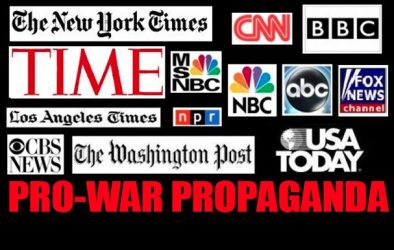 When seriously practiced, the journalistic profession involves gathering information concerning individuals, locales, events, and issues. In theory such information informs people about their world, thereby strengthening “democracy.” This is exactly the reason why news organizations and individual journalists are tapped as assets by intelligence agencies and, as the experiences of German journalist Udo Ulfkotte (entry 47 below) suggest, this practice is at least as widespread today as it was at the height of the Cold War.
Consider the coverups of election fraud in 2000 and 2004, the events of September 11, 2001, the invasions Afghanistan and Iraq, the destabilization of Syria, and the creation of “ISIS.” These are among the most significant events in recent world history, and yet they are also those much of the American public is wholly ignorant of. In an era where information and communication technologies are ubiquitous, prompting many to harbor the illusion of being well-informed, one must ask why this condition persists.
Further, why do prominent US journalists routinely fail to question other deep events that shape America’s tragic history over the past half century, such as the political assassinations of the 1960s, or the central role played by the CIA in international drug trafficking?
Popular and academic commentators have suggested various reasons for the almost universal failure of mainstream journalism in these areas, including newsroom sociology, advertising pressure, monopoly ownership, news organizations’ heavy reliance on “official” sources, and journalists’ simple quest for career advancement. There is also, no doubt, the influence of professional public relations maneuvers. Yet such a broad conspiracy of silence suggests another province of deception examined far too infrequently—specifically the CIA and similar intelligence agencies’ continued involvement in the news media to mold thought and opinion in ways scarcely imagined by the lay public.
The following historical and contemporary facts–by no means exhaustive–provides a glimpse of the power such entities possess to influence, if not determine, popular memory and what respectable institutions deem to be the historical record.
- The CIA’s Operation MOCKINGBIRD is a long-recognised keystone among researchers pointing to the Agency’s clear interest in and relationship to major US news media. MOCKINGBIRD grew out of the CIA’s forerunner, the Office for Strategic Services (OSS, 1942-47), which during World War Two had established a network of journalists and psychological warfare experts operating primarily in the European theatre.
- Many of the relationships forged under OSS auspices were carried over into the postwar era through a State Department-run organization called the Office of Policy Coordination (OPC) overseen by OSS staffer Frank Wisner.
- The OPC “became the fastest-growing unit within the nascent CIA,” historian Lisa Pease observes, “rising in personnel from 302 in 1949 to 2,812 in 1952, along with 3,142 overseas contract personnel. In the same period, the budget rose from $4.7 million to $82 million.” Lisa Pease, “The Media and the Assassination,” in James DiEugenio and Lisa Pease, The Assassinations: Probe Magazine on JFK, MLK, RFK and Malcolm X, Port Townsend, WA, 2003, 300.
- Like many career CIA officers, eventual CIA Director/Director of Central Intelligence (DCI) Richard Helms was recruited out of the press corps by his own supervisor at the United Press International’s Berlin Bureau to join in the OSS’s fledgling “black propaganda” program. “‘[Y]ou’re a natural,” Helms’ boss remarked. Richard Helms, A Look Over My Shoulder: A Life in the Central Intelligence Agency, New York: Random House, 2003, 30-31.
- Wisner tapped Marshall Plan funds to pay for his division’s early exploits, money his branch referred to as “candy.” “We couldn’t spend it all,” CIA agent Gilbert Greenway recalls. “I remember once meeting with Wisner and the comptroller. My God, I said, how can we spend that? There were no limits, and nobody had to account for it. It was amazing.” Frances Stonor Saunders, The Cultural Cold War: The CIA and the World of Arts and Letters, New York: The New Press, 2000, 105.
- When the OPC was merged with the Office of Special Operations in 1948 to create the CIA, OPC’s media assets were likewise absorbed.
- Wisner maintained the top secret “Propaganda Assets Inventory,” better known as “Wisner’s Wurlitzer”—a virtual rolodex of over 800 news and information entities prepared to play whatever tune Wisner chose. “The network included journalists, columnists, book publishers, editors, entire organizations such as Radio Free Europe, and stringers across multiple news organizations.” Pease, “The Media and the Assassination,” 300.
- A few years after Wisner’s operation was up-and-running he “’owned’ respected members of the New York Times, Newsweek, CBS, and other communication vehicles, plus stringers, four to six hundred in all, according to a CIA analyst. Each one was a separate ‘operation,’” investigative journalist Deborah Davis notes, “requiring a code name, a field supervisor, and a field office, at an annual cost of tens or hundreds of thousands of dollars—there has never been an accurate accounting.” Deborah Davis, Katharine the Great: Katharine Graham and the Washington Post, Second Edition, Bethesda MD: National Press Inc, 1987, 139.
- Psychological operations in the form of journalism were perceived as necessary to influence and direct mass opinion, as well as elite perspectives. “[T]he President of the United States, the Secretary of State, Congressmen and even the Director of the CIA himself will read, believe, and be impressed by a report from Cy Sulzberger, Arnaud de Borchgrave, or Stewart Alsop when they don’t even bother to read a CIA report on the same subject,” noted CIA agent Miles Copeland. Cited in Pease, “The Media and the Assassination,” 301.
- By the mid-to-late 1950s, Darrell Garwood points out, the Agency sought to limit criticism directed against covert activity and bypass congressional oversight or potential judicial interference by “infiltrat[ing] the groves of academia, the missionary corps, the editorial boards of influential journal and book publishers, and any other quarters where public attitudes could be effectively influenced.” Darrell Garwood, Under Cover: Thirty-Five Years of CIA Deception, New York: Grove Press, 1985, 250.
- The CIA frequently intercedes in editorial decision-making. For example, when the Agency proceeded to wage an overthrow of the Arbenz regime in Guatemala in 1954, Allen and John Foster Dulles, President Eisenhower’s CIA Director and Secretary of State respectively, called upon New York Times publisher Arthur Hays Sulzberger to reassign reporter Sydney Gruson from Guatemala to Mexico City. Sulzberger thus placed Gruson in Mexico City with the rationale that some repercussions from the revolution might be felt in Mexico. Pease, “The Media and the Assassination,” 302.
- Since the early 1950s the CIA “has secretly bankrolled numerous foreign press services, periodicals and newspapers—both English and foreign language—which provided excellent cover for CIA operatives,” Carl Bernstein reported in 1977. “One such publication was the Rome Daily American, forty percent of which was owned by the CIA until the 1970s.” Carl Bernstein, “The CIA and the Media,” Rolling Stone, October 20, 1977.
- The CIA exercised informal liaisons with news media executives, in contrast to its relationships with salaried reporters and stringers, “who were much more subject to direction from the Agency” according to Bernstein. “A few executives—Arthur Hays Sulzberger of the New York Times among them—signed secrecy agreements. But such formal understandings were rare: relationships between Agency officials and media executives were usually social—’The P and Q Street axis in Georgetown,’ said one source. ‘You don’t tell William Paley to sign a piece of paper saying he won’t fink.’” Director of CBS William Paley’s personal “friendship with CIA Director Dulles is now known to have been one of the most influential and significant in the communications industry,” author Debora Davis explains. “He provided cover for CIA agents, supplied out-takes of news film, permitted the debriefing of reporters, and in many ways set the standard for the cooperation between the CIA and major broadcast companies which lasted until the mid-1970s.” Deborah Davis, Katharine the Great: Katharine Graham and the Washington Post, Second Edition, Bethesda MD: National Press Inc, 1987, 175.
- “The Agency’s relationship with the Times was by far its most valuable among newspapers, according to CIA officials,” Bernstein points out in his key 1977 article. “From 1950 to 1966, about ten CIA employees were provided Times cover under arrangements approved by the newspaper’s late publisher, Arthur Hays Sulzberger. The cover arrangements were part of a general Times policy—set by Sulzberger—to provide assistance to the CIA whenever possible.” In addition, Sulzberger was a close friend of CIA Director Allen Dulles. “’At that level of contact it was the mighty talking to the mighty,’ said a high‑level CIA official who was present at some of the discussions. ‘There was an agreement in principle that, yes indeed, we would help each other. The question of cover came up on several occasions. It was agreed that the actual arrangements would be handled by subordinates…. The mighty didn’t want to know the specifics; they wanted plausible deniability.’” Bernstein, “The CIA and the Media.”
- CBS’s Paley worked reciprocally with the CIA, allowing the Agency to utilize network resources and personnel. “It was a form of assistance that a number of wealthy persons are now generally known to have rendered the CIA through their private interests,” veteran broadcast journalist Daniel Schorr wrote in 1977. “It suggested to me, however, that a relationship of confidence and trust had existed between him and the agency.” Schorr points to “clues indicating that CBS had been infiltrated.” For example, “A news editor remembered the CIA officer who used to come to the radio control room in New York in the early morning, and, with the permission of persons unknown, listened to CBS correspondents around the world recording their ‘spots’ for the ‘World News Roundup’ and discussing events with the editor on duty. Sam Jaffe claimed that when he applied in 1955 for a job with CBS, a CIA officer told him that he would be hired–which he subsequently was. He was told that he would be sent to Moscow–which he subsequently was; he was assigned in 1960 to cover the trial of U-2 pilot Francis Gary Powers. [Richard] Salant told me,” Schorr continues, “that when he first became president of CBS News in 1961, a CIA case officer called saying he wanted to continue the ‘long standing relationship known to Paley and [CBS president Frank] Stanton, but Salant was told by Stanton there was no obligation that he knew of” (276). Schorr, Daniel. Clearing the Air, Boston: Houghton Mifflin, 1977, 277, 276.
- National Enquirer publisher Gene Pope Jr. worked briefly on the CIA’s Italy desk in the early 1950s and maintained close ties with the Agency thereafter. Pope refrained from publishing dozens of stories with “details of CIA kidnappings and murders, enough stuff for a year’s worth of headlines” in order to “collect chits, IOUs,” Pope’s son writes. “He figured he’d never know when he might need them, and those IOUs would come in handy when he got to 20 million circulation. When that happened, he’d have the voice to be almost his own branch of government and would need the cover.” Paul David Pope, The Deeds of My Fathers: How My Grandfather and Father Built New York and Created the Tabloid World of Today, New York: Phillip Turner/Rowman & Littlefield, 2010, 309, 310.
- One explosive story Pope’s National Enquirer‘s refrained from publishing in the late 1970s centered on excerpts from a long-sought after diary of President Kennedy’s lover, Mary Pinchot Meyer, who was murdered on October 12, 1964. “The reporters who wrote the story were even able to place James Jesus Angleton, the CIA’s head of counterintelligence operations, at the scene.” Another potential story drew on “documents proving that [Howard] Hughes and the CIA had been connected for years and that the CIA was giving Hughes money to secretly fund, with campaign donations, twenty-seven congressmen and senators who sat on sub-committees critical to the agency. There are also fifty-three international companies named and sourced as CIA fronts .. and even a list of reporters for mainstream media organizations who were playing ball with the agency.” Pope, The Deeds of My Fathers, 309.
- Angleton, who oversaw the Agency counterintelligence branch for 25 years, “ran a completely independent group entirely separate cadre of journalist‑operatives who performed sensitive and frequently dangerous assignments; little is known about this group for the simple reason that Angleton deliberately kept only the vaguest of files.” Bernstein, “The CIA and the Media.”
- The CIA conducted a “formal training program” during the 1950s for the sole purpose of instructing its agents to function as newsmen. “Intelligence officers were ‘taught to make noises like reporters,’ explained a high CIA official, and were then placed in major news organizations with help from management. These were the guys who went through the ranks and were told ‘You’re going to he a journalist,’” the CIA official said.” The Agency’s preference, however, was to engage journalists who were already established in the industry. Bernstein, “The CIA and the Media.”
- Newspaper columnists and broadcast journalists with household names have been known to maintain close ties with the Agency. “There are perhaps a dozen well known columnists and broadcast commentators whose relationships with the CIA go far beyond those normally maintained between reporters and their sources,” Bernstein maintains. “They are referred to at the Agency as ‘known assets’ and can be counted on to perform a variety of undercover tasks; they are considered receptive to the Agency’s point of view on various subjects.” Bernstein, “The CIA and the Media.”
- Frank Wisner, Allen Dulles, and Washington Post publisher Phillip Graham were close associates, and the Post developed into one of the most influential news organs in the United States due to its ties with the CIA. The Post managers’ “individual relations with intelligence had in fact been the reason the Post Company had grown as fast as it did after the war,” Davis observes. “[T]heir secrets were its corporate secrets, beginning with MOCKINGBIRD. Phillip Graham’s commitment to intelligence had given his friends Frank Wisner an interest in helping to make the Washington Post the dominant news vehicle in Washington, which they had done by assisting with its two most crucial acquisitions, the Times-Herald and WTOP radio and television stations.” Davis, Katharine the Great: Katharine Graham and the Washington Post, 172.
- In the wake of World War One the Woodrow Wilson administration placed journalist and author Walter Lippmann in charge of recruiting agents for the Inquiry, a first-of-its-kind ultra-secret civilian intelligence organization whose role involved ascertaining information to prepare Wilson for the peace negotiations, as well as identify foreign natural resources for Wall Street speculators and oil companies. The activities of this organization served as a prototype for the function eventually performed by the CIA, namely “planning, collecting, digesting, and editing the raw data,” notes historian Servando Gonzalez. “This roughly corresponds to the CIA’s intelligence cycle: planning and direction, collection, processing, production and analysis, and dissemination.” Most Inquiry members would later become members of the Council on Foreign Relations. Lippmann would go on to become the Washington Post’s best known columnists. Servando Gonzalez, Psychological Warfare and the New World Order: The Secret War Against the American People, Oakland, CA: Spooks Books, 2010, 50.
- The two most prominent US newsweeklies, Time and Newsweek, kept close ties with the CIA. “Agency files contain written agreements with former foreign correspondents and stringers for both the weekly newsmagazines,” according to Carl Bernstein. “Allen Dulles often interceded with his good friend, the late Henry Luce, founder of Time and Life magazines, who readily allowed certain members of his staff to work for the Agency and agreed to provide jobs and credentials for other CIA operatives who lacked journalistic experience.” Bernstein, “The CIA and the Media.”
- In his autobiography former CIA officer E. Howard Hunt quotes Bernstein’s “The CIA and the Media” article at length. “I know nothing to contradict this report,” Hunt declares, suggesting the investigative journalist of Watergate fame didn’t go far enough. “Bernstein further identified some of the country’s top media executives as being valuable assets to the agency … But the list of organizations that cooperated with the agency was a veritable ‘Who’s Who’ of the media industry, including ABC, NBC, the Associated Press, UPI, Reuters, Hearst Newspapers, Scripps-Howard, Newsweek magazine, and others.” E. Howard Hunt, American Spy: My Secret History in the CIA, Watergate, and Beyond, Hoboken NJ: John Wiley & Sons, 2007, 150.
- When the first major exposé of the CIA emerged in 1964 with the publication of The Invisible Government by journalists David Wise and Thomas B. Ross, the CIA considered purchasing the entire printing to keep the book from the public, yet in the end judged against it. “To an extent that is only beginning to be perceived, this shadow government is shaping the lives of 190,000,000 Americans” authors Wise and Ross write in the book’s preamble. “Major decisions involving peace and war are taking place out of public view. An informed citizen might come to suspect that the foreign policy of the United States often works publicly in one direction and secretly through the Invisible Government in just the opposite direction.”Lisa Pease, “When the CIA’s Empire Struck Back,” Consortiumnews.com, February 6, 2014.
- Agency infiltration of the news media shaped public perception of deep events and undergirded the official explanations of such events. For example, the Warren Commission’s report on President John F. Kennedy’s assassination was met with almost unanimous approval by US media outlets. “I have never seen an official report greeted with such universal praise as that accorded the Warren Commission’s findings when they were made public on September 24, 1964,” recalls investigative reporter Fred Cook. “All the major television networks devoted special programs and analyses to the report; the next day the newspapers ran long columns detailing its findings, accompanied by special news analyses and editorials. The verdict was unanimous. The report answered all questions, left no room for doubt. Lee Harvey Oswald, alone and unaided, had assassinated the president of the United States.” Fred J. Cook, Maverick: Fifty Years of Investigative Reporting, G.P. Putnam’s Sons, 1984, 276.
- In late 1966 the New York Times began an inquiry on the numerous questions surrounding President Kennedy’s assassination that were not satisfactorily dealt with by the Warren Commission. “It was never completed,” author Jerry Policoff observes, “nor would the New York Times ever again question the findings of the Warren Commission.” When the story was being developed the lead reporter at the Times‘ Houston bureau “said that he and others came up with ‘a lot of unanswered questions’ that the Times didn’t bother to pursue. ‘I’d be off on a good lead and then somebody’d call me off and send me out to California on another story or something. We never really detached anyone for this. We weren’t really serious.’” Jerry Policoff, “The Media and the Murder of John Kennedy,” in Peter Dale Scott, Paul L. Hoch and Russell Stetler, eds., The Assassinations: Dallas and Beyond, New York: Vintage, 1976, 265.
- When New Orleans District Attorney Jim Garrison embarked on an investigation of the JFK assassination in 1966 centering on Lee Harvey Oswald’s presence in New Orleans in the months leading up to November, 22, 1963, “he was cross-whipped with two hurricane blasts, one from Washington and one from New York,” historian James DiEugenio explains. The first, of course, was from the government, specifically the Central Intelligence Agency, the FBI, and to a lesser extent, the White House. The blast from New York was from the major mainstream media e.g. Time-Life and NBC. Those two communication giants were instrumental in making Garrison into a lightening rod for ridicule and criticism. This orchestrated campaign … was successful in diverting attention from what Garrison was uncovering by creating controversy about the DA himself.” DiEugenio, Preface, in William Davy, Let Justice Be Done: New Light on the Jim Garrison Investigation, Reston VA: Jordan Publishing, 1999.
- The CIA and other US intelligence agencies used the news media to sabotage Garrison’s 1966-69 independent investigation of the Kennedy assassination. Garrison presided over the only law enforcement agency with subpoena power to seriously delve into the intricate details surrounding JFK’s murder. One of Garrison’s key witnesses, Gordon Novel, fled New Orleans to avoid testifying before the Grand Jury assembled by Garrison. According to DiEugenio, CIA Director Allen “Dulles and the Agency would begin to connect the fugitive from New Orleans with over a dozen CIA friendly journalists who—in a blatant attempt to destroy Garrison’s reputation—would proceed to write up the most outrageous stories imaginable about the DA.” James DiEugenio, Destiny Betrayed: JFK, Cuba, and The Garrison Case, Second Edition, New York: SkyHorse Publishing, 2012, 235.
- CIA officer Victor Marchetti recounted to author William Davy that in 1967 while attending staff meetings as an assistant to then-CIA Director Richard Helms, “Helms expressed great concerns over [former OSS officer, CIA operative and primary suspect in Jim Garrison’s investigation Clay] Shaw’s predicament, asking his staff, ‘Are we giving them all the help we can down there?’” William Davy, Let Justice Be Done: New Light on the Jim Garrison Investigation, Reston VA: Jordan Publishing, 1999.
- The pejorative dimensions of the term “conspiracy theory” were introduced into the Western lexicon by CIA “media assets,” as evidenced in the design laid out by Document 1035-960 Concerning Criticism of the Warren Report, an Agency communiqué issued in early 1967 to Agency bureaus throughout the world at a time when attorney Mark Lane’s Rush to Judgment was atop bestseller lists and New Orleans DA Garrison’s investigation of the Kennedy assassination began to gain traction.
- Time had close relations with the CIA stemming from the friendship of the magazine’s publisher Henry Luce and Eisenhower CIA chief Allen Dulles. When former newsman Richard Helms was appointed DCI in 1966 he “began to cultivate the press,” prompting journalists toward conclusions that placed the Agency in a positive light. As Time Washington correspondent Hugh Sidney recollects, “‘[w]ith [John] McCone and [Richard] Helms, we had a set-up when the magazine was doing something on the CIA, we went to them and put it before them … We were never misled.’ Similarly, when Newsweek decided in the fall of 1971 to do a cover story on Richard Helms and ‘The New Espionage,’ the magazine, according to a Newsweek staffer, went directly to the agency for much of the information. And the article … generally reflected the line that Helms was trying so hard to sell: that since the latter 1960s … the focus of attention and prestige within CIA’ had switched from the Clandestine Services to the analysis of intelligence, and that ‘the vast majority of recruits are bound for’ the Intelligence Directorate.” Victor Marchetti and John D. Marks, The CIA and the Cult of Intelligence, New York: Alfred A. Knopf, 1974, 362-363.
- In 1970 Jim Garrison wrote and published the semi-autobiographical A Heritage of Stone, a work that examines how the New Orleans DA “discovered that the CIA operated within the borders of the United States, and how it took the CIA six months to reply to the Warren Commission’s question of whether Oswald and [Jack] Ruby had been with the Agency,” Garrison biographer and Temple University humanities professor Joan Mellen observes. “In response to A Heritage of Stone, the CIA rounded up its media assets” and the book was panned by reviewers writing for the New York Times, the Los Angeles Times, the Washington Post, the Chicago Sun Times, and Life magazine. “John Leonard’s New York Times review went through a metamorphosis,” Mellen explains. “The original last paragraph challenged the Warren Report: ‘Something stinks about this whole affair,’ Leonard wrote. ‘Why were Kennedy’s neck organs not examined at Bethesda for evidence of a frontal shot? Why was his body whisked away to Washington before the legally required Texas inquest? Why?’ This paragraph evaporated in later editions of the Times. A third of a column gone, the review then ended: ‘Frankly I prefer to believe that the Warren Commission did a poor job, rather than a dishonest one. I like to think that Garrison invents monsters to explain incompetence.’” Joan Mellen, A Farewell to Justice: Jim Garrison, JFK’s Assassination, and the Case That Should Have Changed History, Washington DC: Potomac Books, 2005, 323, 324.
- CIA Deputy Director for Plans Cord Meyer Jr. appealed to Harper & Row president emeritus Cass Canfield Sr. over the book publisher’s pending release of Alfred McCoy’s The Politics of Heroin in Southeast Asia, based on the author’s fieldwork and Yale PhD dissertation wherein he examined the CIA’s explicit role in the opium trade. “Claiming my book was a threat to national security,” McCoy recalls, “the CIA official had asked Harper & Row to suppress it. To his credit, Mr. Canfield had refused. But he had agreed to review the manuscript prior to publication.” Alfred W. McCoy, The Politics of Heroin: CIA Complicity in the Global Drug Trade, Chicago Review Press, 2003, xx.
- Publication of The Secret Team, a book by US Air Force Colonel and Pentagon-CIA liaison L. Fletcher Prouty recounting the author’s firsthand knowledge of CIA black operations and espionage, was met with a wide scale censorship campaign in 1972. “The campaign to kill the book was nationwide and world-wide,” Prouty notes. “It was removed from the Library of Congress and from college libraries as letters I received attested all too frequently … I was a writer whose book had been cancelled by a major publisher [Prentice Hall] and a major paperback publisher [Ballantine Books] under the persuasive hand of the CIA.” L. Fletcher Prouty, The Secret Team: The CIA and Its Allies in Control of the United States and the World, New York: SkyHorse Publishing, 2008, xii, xv.
- During the Pike Committee hearings in 1975 Congressman Otis Pike asked DCI William Colby, “Do you have any people paid by the CIA who are working for television networks?” Colby responded, “This, I think, gets into the kind of details, Mr. Chairman, that I’d like to get into in executive session.” Once the chamber was cleared Colby admitted that in 1975 specifically “the CIA was using ‘media cover’ for eleven agents, many fewer than in the heyday of the cloak-and-pencil operations, but no amount of questioning would persuade him to talk about the publishers and network chieftains who had cooperated at the top.” Schorr, Clearing the Air, 275.
- “There is quite an incredible spread of relationships,” former CIA intelligence officer William Bader informed a US Senate Intelligence Committee investigating the CIA’s infiltration of the nation’s journalistic outlets. “You don’t need to manipulate Time magazine, for example, because there are Agency people at the management level.” Bernstein, “The CIA and the Media.”
- In 1985 film historian and professor Joseph McBride came across a November 29, 1963 memorandum from J. Edgar Hoover, titled, “Assassination of President John F. Kennedy,” wherein the FBI director stated that his agency provided two individuals with briefings, one of whom was “Mr. George Bush of the Central Intelligence Agency.” ” When McBride queried the CIA with the memo a “PR man was tersely formal and opaque: ‘I can neither confirm nor deny.’ It was the standard response the agency gave when it dealt with its sources and methods,” journalist Russ Baker notes. When McBride published a story in The Nation, “The Man Who Wasn’t There, ‘George Bush,’ C.I.A. Operative,” the CIA came forward with a statement that the George Bush referenced in the FBI record “apparently” referenced a George William Bush, who filled a perfunctory night shift position at CIA headquarters that “would have been the appropriate place to receive such a report.” McBride tracked down George William Bush to confirm he was only employed briefly as a “probationary civil servant” who had “never received interagency briefings.” Shortly thereafter The Nation ran a second story by McBride wherein “the author provided evidence that the Central Intelligence Agency had foisted a lie on the American people … As with McBride’s previous story, this disclosure was greeted with the equivalent of a collective media yawn.” Since the episode researchers have found documents linking George H. W. Bush to the CIA as early as 1953. Russ Baker, Family of Secrets: The Bush Dynasty, America’s Invisible Government, and the Hidden History of the Last Fifty Years, New York: Bloomsbury Press, 2009, 7-12.
- Operation Gladio, the well-documented collaboration between Western spy agencies, including the CIA, and NATO involving coordinated terrorist shootings and bombings of civilian targets throughout Europe from the late 1960s through the 1980s, has been effectively expunged from major mainstream news outlets. A LexisNexis Academic search conducted in 2012 for “Operation Gladio” retrieved 31 articles in English language news media—most appearing in British newspapers. Only four articles discussing Gladio ever appeared in US publications—three in the New York Times and one brief mention in the Tampa Bay Times. With the exception of a 2009 BBC documentary, no network or cable news broadcast has ever referenced the state-sponsored terror operation. Almost all of the articles referencing Gladio appeared in 1990 when Italian Prime Minister Giulio Andreotti publicly admitted Italy’s participation in the process. The New York Times downplayed any US involvement, misleadingly designating Gladio “an Italian creation” in a story buried on page A16. In reality, former CIA director William Colby revealed in his memoirs that covert paramilitaries were a significant agency undertaking set up after World War II, including “the smallest possible coterie of the most reliable people, in Washington [and] NATO.” James F. Tracy, “False Flag Terror and Conspiracies of Silence,” Global Research, August 10, 2012.
- Days before the April 19, 1995 bombing of the Alfred P. Murrah Federal Building in Oklahoma City DCI William Colby confided to his friend, Nebraska State Senator John DeCamp his personal concerns over the Militia and Patriot movement within the United States, then surging in popularity due to the use of the alternative media of that era–books, periodicals, cassette tapes, and radio broadcasts. “I watched as the Anti-War movement rendered it impossible for this country to conduct or win the Vietnam War,” Colby remarked. “I tell you, dear friend, that the Militia and Patriot movement in which, as an attorney, you have become one of the centerpieces, is far more significant and far more dangerous for American than the Anti-War movement ever was, if it is not intelligently dealt with. And I really mean this.” David Hoffman, The Oklahoma City Bombing and the Politics of Terror, Venice CA: Feral House, 1998, 367.
- Shortly after the appearance of journalist Gary Webb’s “Dark Alliance” series in the San Jose Mercury News chronicling the Agency’s involvement in drug trafficking, the CIA’s public affairs division embarked on a campaign to counter what it termed “a genuine public relations crisis for the Agency.” Webb was merely reporting to a large audience what had already been well documented by scholars such as Alfred McCoy and Peter Dale Scott, and the 1989 Kerry Committee Report on Iran-Contra—that the CIA had long been involved in the illegal transnational drug trade. Such findings were upheld in 1999 in a study by the CIA inspector general. Nevertheless, beginning shortly after Webb’s series ran, “CIA media spokesmen would remind reporters seeking comment that this series represented no real news,” a CIA internal organ noted, “in that similar charges were made in the 1980s and were investigated by the Congress and were found to be without substance. Reporters were encouraged to read the “Dark Alliance’ series closely and with a critical eye to what allegations could actually be backed with evidence.” http://www.foia.cia.gov/sites/default/files/DOC_0001372115.pdf
- On December 10, 2004 investigative journalist Gary Webb died of two .38 caliber gunshot wounds to the head. The coroner ruled the death a suicide. “Gary Webb was MURDERED,” concluded FBI senior special agent Ted Gunderson in 2005. “He (Webb) resisted the first shot [to the head that exited via jaw] so he was shot again with the second shot going into the head [brain].” Gunderson regards the theory that Webb could have managed to shoot himself twice as “impossible!” Charlene Fassa, “Gary Webb: More Pieces in the Suicided Puzzle,” Rense.com, December 11, 2005.
- The most revered journalists who receive “exclusive” information and access to the corridors of power are typically the most subservient to officialdom and often have intelligence ties. Those granted such access understand that they must likewise uphold government-sanctioned narratives. For example, the New York Times’ Tom Wicker reported on November 22, 1963 that President John F. Kennedy “was hit by a bullet in the throat, just below the Adam’s apple.” Yet his account went to press before the official story of a single assassin shooting from the rear became established. Wicker was chastised through “lost access, complaints to editors and publishers, social penalties, leaks to competitors, a variety of responses no one wants.” Barrie Zwicker, Towers of Deception: The Media Coverup of 9/11, Gabrioloa Island, BC: New Society Publishers, 2006, 169-170.
- The CIA actively promotes a desirable public image of its history and function by advising the production of Hollywood vehicles, such as Argo and Zero Dark Thirty. The Agency retains “entertainment industry liaison officers” on its staff that “plant positive images about itself (in other words, propaganda) through our most popular forms of entertainment,” Tom Hayden explains in the LA Review of Books. “So natural has the CIA–entertainment connection become that few question its legal or moral ramifications. This is a government agency like no other; the truth of its operations is not subject to public examination. When the CIA’s hidden persuaders influence a Hollywood movie, it is using a popular medium to spin as favorable an image of itself as possible, or at least, prevent an unfavorable one from taking hold.” Tom Hayden, “Review of The CIA in Hollywood: How the Agency Shapes Film and Television by Tricia Jenkins,” LA Review of Books, February 24, 2013,
- Former CIA case officer Robert David Steele states that CIA manipulation of news media is “worse” in the 2010s than in the late 1970s when Bernstein wrote “The CIA and the Media.” “The sad thing is that the CIA is very able to manipulate [the media] and it has financial arrangements with media, with Congress, with all others. But the other half of that coin is that the media is lazy.” James Tracy interview with Robert David Steele, August 2, 2014,
- A well-known fact is that broadcast journalist Anderson Cooper interned for the CIA while attending Yale as an undergraduate in the late 1980s. According to Wikipedia Cooper’s great uncle, William Henry Vanderbilt III, was an Executive Officer of the Special Operations Branch of the OSS under the spy organization’s founder William “Wild Bill” Donovan. While Wikipedia is an often dubious source, Vanderbilt’s OSS involvement would be in keeping with the OSS/CIA reputation of taking on highly affluent personnel for overseas derring-do. William Henry Vanderbilt III, Wikipedia.
- Veteran German journalist Udo Ulfkotte, author of the 2014 book Gekaufte Journalisten (Bought Journalists) revealed how under the threat of job termination he was routinely compelled to publish articles written by intelligence agents using his byline. “I ended up publishing articles under my own name written by agents of the CIA and other intelligence services, especially the German secret service,” Ulfkotte explained in a recent interview with Russia Today. “German Journo: European Media Writing Pro-US Stories Under CIA Pressure,” RT, October 18, 2014.
- In 1999 the CIA established In-Q-Tel, a venture capital firm seeking to “identify and invest in companies developing cutting-edge information technologies that serve United States national security interests.” The firm has exercised financial relationships with internet platforms Americans use on a routine basis, including Google and Facebook. “If you want to keep up with Silicon Valley, you need to become part of Silicon Valley,” says Jim Rickards, an adviser to the U.S. intelligence community familiar with In-Q-Tel’s activities. “The best way to do that is have a budget because when you have a checkbook, everyone comes to you.” At one point IQT “catered largely to the needs of the CIA.” Today, however, “the firm supports many of the 17 agencies within the U.S. intelligence community, including the National Geospatial-Intelligence Agency (NGA), the Defense Intelligence Agency (DIA) and the Department of Homeland Security Science and Technology Directorate.” Matt Egan, “In-Q-Tel: A Glimpse Inside the CIA’s Venture Capital Arm,” FoxBusiness.com, June 14, 2013.
- At a 2012 conference held by In-Q-Tel CIA Director David Patraeus declared that the rapidly-developing “internet of things” and “smart home” will provide the CIA with the ability to spy on any US citizen should they become a “person of interest’ to the spy community,” Wired magazine reports. “‘Transformational’ is an overused word, but I do believe it properly applies to these technologies,’ Patraeus enthused, ‘particularly to their effect on clandestine tradecraft’ … ‘Items of interest will be located, identified, monitored, and remotely controlled through technologies such as radio-frequency identification, sensor networks, tiny embedded servers, and energy harvesters — all connected to the next-generation internet using abundant, low-cost, and high-power computing,” Patraeus said, “the latter now going to cloud computing, in many areas greater and greater supercomputing, and, ultimately, heading to quantum computing.” Spencer Ackerman, “CIA Chief: We’ll Spy on You Through Your Dishwasher,” Wired, March 15, 2012.
- In the summer of 2014 a $600 million computing cloud developed by Amazon Web Services for the CIA began servicing all 17 federal agencies comprising the intelligence community. “If the technology plays out as officials envision,” The Atlantic reports, “it will usher in a new era of cooperation and coordination, allowing agencies to share information and services much more easily and avoid the kind of intelligence gaps that preceded the Sept. 11, 2001, terrorist attacks.” “The Details About the CIA’s Deal With Amazon,” The Atlantic, July 17, 2014.
Featured Video

Seyed M. Marandi: US-Iran War Inevitable: Kuwait and Bahrain May Fall
or go to
Aletho News Archives – Video-Images
From the Archives
Oil and the Israel Lobby
Reknowned economist M. Shahid Alam offers this excellent critique of Noam Chomsky’s defective analysis of the relative influence of Oil versus the Israel lobby over US foreign policy: … continue
Blog Roll
 Aletho News
- ICC ignored ‘very well-documented’ NATO crimes – ex-Libyan minister
- SNSC secretary dismisses US response to Iran’s conditions as ‘inadequate’
- Sanaa says Taiz roads open, secure for residents, warns Saudi forces
- Iraqi resistance group urges Saudi leadership to admit defeat, lift Yemen siege
- Trump’s Retreat: How Al-Aqsa Flood Took Down the US Empire
- Israel’s Military Actions in Lebanon Grossly Violate International Law — Lavrov
- Seyed M. Marandi: US-Iran War Inevitable: Kuwait and Bahrain May Fall
- Leaders Condemn Ansarallah Attack on Saudi Arabia While Ignoring Illegal War Against Yemen
- Leaked: Britain’s Covert Iraqi Psyops Network
- Yemeni Armed Forces Warn Airlines Against Using Saudi Airports, Exempt Mecca and Medina
- If Americans Knew
- After Oct 7, IDF policy allowed civilian casualties for even the lowest-ranking targets
- Israel’s Destruction of Southern Lebanon Intensified After the Cease-Fire
- The Last-Minute Decision That Gave Israel Its Name
- The American Conservative: How Trump Made the World Go Nuclear
- Meet the US generals and admirals advancing Israeli policy
- Opinion: Why news organizations should boycott Israel
- The Israeli witch hunt of Sami Abu Shehadeh exposes the lie of the ‘Jewish and democratic’ state
- No state has a ‘right’ to exist – least of all Israel
- Testimonies about Gaza’s civilian death toll expose Israel’s atrocities – Daily Update
- How Israel Conquered the Latin American Right
- No Tricks Zone
- Germany’s Green Energy Debacle: High Energy Costs Force Kahla Porzellan to Close After 182 Years!
- New Study: 50 Years Of The Most Aggressive ‘Net Zero’ Policies Can Only Affect The Global Climate By 0.03°C
- US September “Heat” Was No Record…Many Records Set Decades Ago
- Latest European Green Energy Debacle; Portugal’s Largest Flagship Solar Park Insolvent!
- Green Energy Debacle: German Expert Professor Fritz Vahrenholt Warns Of Severe Economic And Social Consequences
- Two More Paleo Reconstructions Affirm Meters-Higher Sea Levels Across Ireland, Brazil 7000-6000 Years Ago
- New Study: Earth And Venus Surface Warmth Largely Explained By Convection And Lapse Rate, Not CO2 Or Radiation
- 2025 Nature Paper Claiming Worsening Global Drought Gets RETRACTED …Heavily Flawed
- New Study: ‘Global Drought Shows No Detectable Recent Acceleration Under Climate Warming’
- Economic Masterminds: German Socialists Suggest Taxing Productivity Gains Stemming From Using AI

