ANKARA: Syrian Kurds Neglect 1st Rule of Terrorism – To Claim Responsibility…
The Burning Blogger of Bedlam | February 19, 2016
As Ankara has again been hit by deadly terrorism, Turkey’s Prime Minister, Ahmet Davutoğlu, has been very quick to assign blame for Wednesday evening’s car bomb in Ankara that killed 28 people.
All the evidence, he said, suggested that the Syrian Kurdish People’s Protection Units (YPG) were responsible.
Davutoğlu’s declarations should be viewed with suspicion for a number of reasons, particularly the speed with which he announced that Turkey’s security services had uncovered the identity, birthplace, personal history and affiliations of the alleged bomber – literally within hours of the attack. Verdicts that are reached and announced that quickly are often tell-tale indicators of a pre-planned narrative and false-flag operation.
For one thing, we should wonder why Salih Necer, the 24-year-old Syrian national blamed for the explosion, was someone the authorities had so much information on that they were able to declare him the perpetrator so immediately. If there was that much information on him, how was he able to carry out the attack in the first place?
Furthermore, both the Kurdish YPG and the PKK have denied any involvement in the attack. The PYD leader has also said his group was not involved.
That’s always a problem with these narratives; the first rule of terrorism is to claim responsibility. That’s the whole POINT of a terrorist attack – to claim responsibility. But all of the Kurdish groups – who may or may not be ‘terrorists’, depending on where you stand – have entirely denied involvement.
What this attack smells of is deep-state, false-flag terrorism to further an obvious agenda. Aside from the fact that the Turkish state has conducted false-flag terror attacks in the country before (including the nonsensical business of blaming Kurdish groups for attacks on Kurdish rallies), the Turkish government is currently trying to re-establish justifications for its attacks on Syrian Kurds across the border. It is also quite possibly trying to establish justifications for an invasion into Syria. Therefore a deadly terror attack by Syrian Kurds comes at the perfect time to both justify Turkey’s existing activities and to justify further activities that are likely imminent (see more on that here).
Turkish violations of Syria’s sovereignty have become so frequent and brazen that it has prompted Damascus to petition the UN to investigate the Turkish state’s actions. Further to Turkish military shelling of both Syrian Kurdish fighters and Syrian regime targets in recent days, Reuters reported that “the Syrian government says Turkish forces were believed to be among 100 gunmen it said entered Syria on Saturday accompanied by 12 pick-up trucks mounted with heavy machine guns, in an ongoing supply operation to insurgents fighting Damascus.”
And subsequent to that, it is reported that at least 500 more ‘rebels’ crossed the Turkish border into Syria on Wednesday – the same day as the Ankara bombing. They included rebels as well as Islamist fighters.
In its harsh campaign against both Syrian Kurds and the Kurds in southern Turkey, as well as against the government of Bashar Assad, the Turkish state needs ongoing justifications like this latest attack in Ankara – this is mostly in order to validate its behaviour, not so much domestically as to its international allies and critics.
Official talk also currently indicates Turkey wants to establish a “humanitarian zone” inside northern Syria. The stated reason for this is to protect refugees and prevent them from continuing the mass exodus; but it’s also worth noting that the desired establishment of these zones is entirely in keeping with the buffer zones or “safe zones” envisioned in the Brookings Insitution policy plan for Syria, the primary purpose of which is to create safe zones for armed rebels and anti-government fighters in Syria; which is perhaps all the more urgent now, as rebel groups in northern Syria are crumbling under the assaults from the Syrian Army and its Russian allies.
But the Turkish state’s problem, like that of Saudi Arabia, is that it appears to be hardheadedly committed to a singular outcome that it is unwilling to waver from or compromise on.
Warnings that Turkey, like its neighbour Syria, is in danger of sliding into its own civil war – one that could destabilise Europe even more than Syria has – should be of serious concern to the international community, the EU and Turkey’s allies.
As Turkish journalist Metin Munir correctly forecast back in August 2012, ‘Whichever way Syria goes, Turkey is in big trouble. Turkey’s active engagement in trying to depose Bashar al-Assad has been the country’s worst foreign-policy blunder since its independence’.
Letter to Doctors Without Borders
By Ronald Thomas West | February 17, 2016
Following the most recent attacks on clinics aligned with Médecins Sans Frontières (Doctors Without Borders) in Syria, Mego Terzian, President of MSF France, immediately blamed Russia and Assad. If the finger of superficial appearance had pointed to the NATO aligned nations, there would be calls for investigations rather than immediate trial and conviction by propaganda operations perpetrated in western media. Here is my response:
Dear MSF
A monthly donor of many years, I feel an explanation is in order for my cancellation and further refusal to participate as a MSF “Field Partner.” I am a former military special operations intelligence professional and anti-corruption investigator of many years. Based on my expertise in open source intelligence analysis and closely following several of the ongoing conflicts, including Ukraine and SYRIA, it has become clear MSF is becoming a tool for geopolitical ends. Either you’ve been penetrated by intelligence agencies for this purpose of promoting false flag information operations or your organization is being manipulated to same effect. I cannot, with clear conscious, be a party to this with further contributions.
The several NATO intelligence agencies are in full force pursuing anti-Russian propaganda operations, which likely include the recent attacks on MSF aligned Syrian clinics; purposeful and professional operations intended to smear Russia and President Putin for purposes of generating political capital for pursuit of geopolitical manipulations. Your organization immediately pointing the finger at Assad and/or the Russians, without time taken to properly investigate, is unethical.
NATO aligned intelligence agency false flag examples provided:
NATO’s Turkey suppressing investigation into their intelligence agency, MIT, providing sarin gas to al Nusra (al Qaida) that killed 1,400 Syrians at Ghouta, blamed on the Assad regime, in August, 2013. Turkish parliamentarians complain of the suppressed facts:
Noteworthy state sponsored crimes committed to demonize Putin include but are not limited to;
The Litvinenko report by the British
http://www.theguardian.com/world/2016/feb/05/litvinenko-report-get-it-wrong-putin
The Maidan snipers in Kiev trained by the CIA according to Member of European Parliament, backed by a leaked phone call between the EU foreign policy chief and the Estonian Foreign minister revealing the snipers were aligned with the new regime in Kiev. This crime had been blamed on the Russian aligned preceding government.
&
The crimes in Syria against MSF aligned facilities serve the same propaganda purposes and the Erdogan government cannot be ruled out as committing them, whereas it is NOT in the Russian interest to perpetrate these attacks. Here is a list of Turkish support for bad actors in Syria compiled by Jihad Watch:
It is sad to see MSF go the route of some other organizations and become a pawn of dirty players in geopolitics. I suggest your organization pursue a professional investigation to determine how, and by who, you’ve become manipulated to both a stooge and minion of evil.
Regards
Ron West
“The history of the great events of this world are scarcely more than a history of crime” -Voltaire
Plagued by dishonesty – The Israeli Media
By Miko Peled | American Herald Tribune | February 16, 2016
 As I write these words, Palestinian journalist Mohammad Alqiq is on the eighty-second day of his hunger strike, and may well be taking his last breaths, protesting his illegal and unjustifiable arrest by Israel. As this humanitarian drama is taking place, the Israeli media is obsessed with some infantile rivalry between Israeli Prime Minister Netanyahu and the Israeli President Rivlin, arguably, two of the stupidest men in the Middle East, and typically, the story of Alqiq barely gets mentioned. This of course is no surprise. The Israeli media is a combination of tabloid garbage and self-righteousness justifying Israeli crimes. In fact, trying to watch the news via the Israeli media is altogether a mind numbing experience, making Fox news seem like serious journalism.
With very few exceptions, the Israeli media reports as though their heads are so deep in the sand they can’t tell if it’s day or night. The racist segregation enforced by Israel is so effective that as an Israeli you can spend an entire lifetime living minutes away from Gaza and know nothing about Gaza other than what is offered by the Israel media. Unless it is commending the Israeli forces for their courage in fighting Hamas terrorists, or perhaps reporting about a funeral of a soldier who gave his or her life defending us from Hamas terrorists, there is rarely a word about the conditions in Gaza.
Lately, the Israeli press is obsessed with the fact the former Israeli Prime Minister Ehud Olmert is going to jail. Olmert was tried and after many years convicted for corruption that took place during his term as mayor of Jerusalem and now, finally after appeals and delays he is in jail.
Olmert will serve his prison term in a special VIP section of a minimum security prison. Because he is a former PM and needs secret service protection, a special secure section was built for him in the prison. So the Israel media ponders whether he will be lonely, will the odors and sounds of prison bother him. They also remembered to point out that Israel already has a former president behind bars and had a former cabinet member.
The Olmert story demonstrates the dishonesty which plagues Israeli society and is typical of the Israeli media. Olmert was Prime Minister during the Israeli massacre in Gaza that began in December 2008. A massacre Israel named “Cast Lead.” Ehud Olmert is a war criminal. He was directly responsible for the murder of at least one thousand and five hundred men, women and children in Gaza. He is responsible for untold thousands who were injured and made homeless in Gaza. But he was only charged for stealing money and will serve a symbolic nineteen-month prison sentence and not the life sentence a war criminal of such proportions deserves. But in Israel murdering Palestinians is not a crime.
No one in the Israeli media asked how is it that this war criminal was not charged with murder but only a symbolic corruption charge. This is because other than Gideon Levi and Amira Hass who write for Ha’aretz daily, there are no dissenting voices in the Israeli media. Even Ha’aretz, a liberal establishment paper is read by very few people, many of whom live abroad. What one learns from the Israeli media is that Palestine does not exist, Gaza had disappeared long ago, and all there is to write and talk about is tabloid news. On occasion, when a Palestinian breaks out and attacks an Israeli they take a moment to report the incident and they might even follow up with an “in-depth” report. For example, there was a report recently on Israeli television’s channel 10 called “Children Terrorists” looking into the reasons behind the phenomenon or young Palestinian child-terrorists.
This report conveniently glides over the fact that there is no such thing as “child-terrorists,” at least no Palestinian ones. There is a phenomenon of Israeli soldiers, police and plain civilian vigilantes murdering young Palestinians and then claiming that they were “terrorists.” There is no reference in the report that Israel has declared a war on Palestinian children, arresting and abusing children on a regular basis, as a policy. There is however “in-depth analysis” as to the influences that radicalized them. The reporters went into Shuafat refugee camp near Jerusalem to see these children first hand. In one instance, as the camera shows young children in the street, the reporter says: “these children know the ones who infiltrated Jerusalem intending to commit acts of terror. In fact, thousands of these children have been arrested and interrogated by the security forces.”
The slight of hand in which the lies are perpetuated is indicative of the Israeli PR magic show. The reporter is admitting that these children are constantly harassed by the police, though he leaves out that this is done without their parents being present and without access to a lawyer. The actions of the security forces are, of course “justified” and “prove” that there is indeed such a thing as a “Child-terrorist.” The report goes on to talk about the danger in which brave soldiers and police officers find themselves due to the incitement against them on Palestinian websites and by Palestinian extremists. Though it does not explore the possibility that young Palestinians may be driven from time to time to attack armed soldiers and police officers because of the constant harassment, beating and killings of Palestinians by the army and the police. Admitting that this is the case would make it clear that it is not terrorism but legitimate resistance.
There is constant debate in Israel whether or not the security forces do enough to fight Palestinian resistance. Most people agree that the Israeli military is not killing enough Palestinians and that the politicians are too weak and therefore the Palestinians continue to kill Israelis. Some voices, from time to time tell a different story. Ha’aretz newspaper just came out with a story that it is because of the Israeli army’s policy of leniency that the current uprising is not worse. “Had the army killed more Palestinians” they tell us, “or reduced the number of Palestinians allowed to work in Israel far more Palestinians would likely be participating in violent clashes.” So, according to the Israeli media, the Israeli army is lenient and should be commended for it, Palestinians are permitted to enter Israel to work and therefore should be happy, and the “clashes” could be worse. And this just in, a famous Rabbi convicted of bribing a senior Israeli police officer, will be joining former Prime Minister Olmert in Prison.
Miko Peled is an Israeli writer and activist living in the US. He was born and raised in Jerusalem. His father was the late Israeli General Matti Peled.
The NY Times Maps Jerusalem: Distilling the Worst of Israeli Propaganda
By Barbara Erickson – TimesWarp – February 15, 2016
In a new multimedia production The New York Times is now offering us “The Roots of the Recent Violence Between Israelis and Palestinians,” a series of 13 images accompanied by brief notes. The title promises much, and the teaser adds that this new offering presents us with “the geography of the issues surrounding the ongoing violence.”
Here, it seems, the newspaper has an opportunity to provide the context so often missing from Times stories about Palestine and Israel. With such an introduction readers might hope to learn about the historical beginnings of the conflict and to perceive the effects of occupation on the face of the land.
It was not to be. In fact, this slick presentation distills the worst of the Times reporting on the issue. The text never once mentions the occupation; it provides no historical context of any kind, and it blindly follows the preferred narrative of Israeli propagandists.
The visuals never leave Jerusalem, and the text sticks to events there. The presentation opens with an image of the Dome of the Rock and the Al Aqsa Mosque, accompanied by the comment that the violence “was set off in part over a dispute over Al Aqsa Mosque compound.” Nothing more is said about this complex issue.
The images then move on to highlight Jewish “neighborhoods” in Palestinian East Jerusalem and Jewish homes dotting the Palestinian neighborhoods, and we learn that the “neighborhoods” are “considered illegal settlements by most of the world.” This is the Times’ usual formulation, which distorts the fact that the entire international community—outside of Israel—deems the settlements illegal.
There is no mention of the impact these settlements have on Palestinians’ lives. We get nothing but maps and terse comments about who lives where, but the Times does finally provide a motive for the recent attacks: It comes from “frustration” over the lack of basic city services.
We are set up for this trivial claim in the fourth visual, which shows us Shuafat Refugee Camp in East Jerusalem surrounded by a yellow line. “Israel built a barrier in response to Palestinian attacks from the West Bank in the early 2000s,” the text notes. “While effective at stopping suicide bombers, it cut off several East Jerusalem neighborhoods from the rest of the city, leaving them without basic services.”
In the following image the narrative continues, “Palestinians say these frustrations are at the root of the recent attacks. Israelis officials accuse Palestinian leaders of inciting violence.”
There we have it. Not a word about loss of land, the confiscation of resources, military incursions and all the many miseries associated with military occupation. So much for the “roots” of the conflict.
Although the Times attempts a show of balance, by referring to both sides, the text is heavily weighted toward the Israeli point of view. It twice mentions Israeli actions as “responses” to violence and never suggests that Palestinians are responding to oppression.
It repeats the Israeli claim that Palestinians who died in the recent uprising were all involved in attacks or “clashes” with troops, omitting the reports of human rights groups and others who charge Israel with “street executions” of Palestinians who pose no possible threat to security forces or civilians.
In addition, the Times gives a distorted account of the Separation Barrier. It fails to say that the 2004 International Court of Justice decision held that the wall is illegal and that its route (85 percent of it inside the West Bank) threatens “de facto annexation.” The newspaper also repeats the Israeli claim that the wall “effectively stopped suicide bombers.”
As an Israeli journalist recently observed in 972 Magazine, the recent assaults have demolished this facile claim. The latest attackers could have come with bombs instead of knives; the wall did not keep them out. The bombings ended when militants abandoned the tactic.
If the Times truly intended to illustrate the “geography of the issues surrounding the ongoing violence,” it could have shown some dramatic effects of the occupation on the landscape, such as:
- The route of the Separation Barrier, snaking well inside the boundary between the West Bank and Israel
- The rows of dead parsley and spinach fields in Gaza, where Israel has deliberately sprayed herbicides on hundreds of acres
- The contrast between lush West Bank settlements, with their lawns and swimming pools, and parched Palestinian villages nearby
- The shrinking cantons of the West Bank, where Israel is illegally confiscating more and more Palestinian territory
- The dead strip of land inside Gaza, where Israel has imposed a firing zone and has frequently entered to bulldoze crops and soil
Images such as these might provide a real sense of the “roots” of the recent violence. Instead, the Times has chosen to encapsulate Israeli propaganda in this latest presentation, perpetuating its ingrained bias in a package of misleading notes and slick visual effects.
Follow @TimesWarp on Twitter
NATO’s Syria War Footing Under Cover of Migrant Crisis
By Finian CUNNINGHAM | Strategic Culture Foundation | 15.02.2016
The US-led NATO alliance is dispatching warships to the Mediterranean to allegedly help ease Europe’s refugee crisis. However, a closer look at the naval vessels in the NATO mission shows that this is no refugee rescue attempt – but rather a full-on war mobilization.
The timing comes just as US-Russian diplomatic talks on the Syrian crisis reach a make-or-break moment, suggesting that NATO is preparing military action in league with Turkey in order to salvage the covert war for regime change in Syria.
That war has seen rapidly mounting losses for the United States and its allies who have been fueling clandestine proxy militias to topple the Assad government since March 2011. Those losses have escalated since Russia began its aerial bombing campaign four months ago to help stabilize the allied Syrian state of President Bashar al-Assad.
After a meeting with NATO ministers in Brussels on Thursday, the alliance’s Secretary-General Jens Stoltenberg announced that «without delay» the Standing Maritime Group 2 would be dispatched and «will be tasked to conduct reconnaissance, monitoring and surveillance of the illegal [refugee smuggling] crossings in the Aegean Sea in cooperation with relevant authorities».
Significantly, in addition to the Aegean Sea crossing, the NATO mission will be tasked with monitoring the Syrian-Turkey border, again allegedly to combat human trafficking of refugees. That purported surveillance implies that the NATO vessels will be operating in the East Mediterranean, near Cyprus, where the Standing Maritime Group 2 is normally based.
«Mr Stoltenberg said reconnaissance and intelligence gathering was also being stepped up at the Turkey-Syria border», according to the BBC.
The mobilization has been ordered by NATO Supreme Commander General Philip Breedlove. Breedlove has distinguished himself previously for his rabid Cold War-style rhetoric against Russia. His new role, ostensibly, as a concerned humanitarian does not seem fitting.
The New York Times reported: «Gen. Philip M Breedlove of the United States Air Force, NATO’s supreme allied commander for Europe, has ordered ships to the Aegean, Mr Stoltenberg said. The vessels are from Canada, Germany, Greece and Turkey, officials said».

Breedlove is quoted by the NY Times as saying: «This mission has literally come together in the last 20 hours, and I have been tasked now to go back and define the mission. We had some very rapid decision making and now we have to go out to do some military work».
The NATO military commander appears to be dissembling. Last week, NATO reported that the Standing Maritime Group 2 had just completed «extensive» training operations with the Turkish navy in the East Mediterranean, according to the alliance’s own website.
The same group of vessels are now being sent allegedly on a «refugee rescue» mission. It beggars belief that General Breedlove, the top NATO military planner, claims that «this has literally come together in the last 20 hours».
Comprising the NATO Standing Maritime Group 2 are three ships: FGS Bonn (Germany), HMCS Fredericton (Canada) and a Turkish Barbaros vessel. These are heavy-duty warships, bigger than destroyer class, each bristling with an array of weaponry, including anti-aircraft, anti-ship, anti-submarine and anti-missile firepower.
When the NATO naval group – which is described as a «rapid reaction force» – conducted its exercises last week in the East Mediterranean, the maneuvers included drills with Turkish F-16 fighter jets and corvettes.
Britain’s Independent newspaper cites NATO’s secretary-general Stoltenberg as saying that the naval mission will involve five ships and that more vessels may be included.
The Independent added: «The extent to which the NATO vessels will interact with refugee boats remains unclear. NATO diplomats said that rather than direct intervention, intelligence gathered about people-smugglers is likely to be handed over to Turkish coastguards to allow them to combat the traffickers more effectively».
Stoltenberg said that the objective was «not about stopping or pushing back refugee boats» but about contributing «critical information and surveillance to help counter human trafficking and criminal networks».
If NATO ships are not there to interact with refugee vessels, then what are they for?
The notion that heavy-duty warships are sent to tackle human trafficking gangs is also not plausible. The traffickers rarely make the crossing on the overcrowded boats with the refugees. After the extortionate fees are handed over on Turkish shores, the boats are pushed out to sea by the traffickers who then disappear inland.
US Secretary of Defense Ash Carter was also attending the NATO meeting in Brussels. He said of the new putative rescue mission: «There is now a criminal syndicate that is exploiting these poor people and this is an organized smuggling operation. Targeting that is the way that the greatest effect can be had… That is the principal intent of this».
The apparent humanitarian intentions of this NATO mission lack credibility. As the BBC noted: «The decision marks the security alliance’s first intervention in Europe’s migrant crisis».
The question is: why now? Last year, more than 3,000 people perished in Mediterranean crossings and up to one million entered the EU. So, why is NATO suddenly finding a sense of urgency now in allegedly tackling Europe’s refugee problem? It doesn’t add up.
More glaringly incongruous is the vast mismatch in vessel types and the supposed humanitarian naval purpose. The Standing Maritime Group 2 is a war operation, not a coastguard formation.
Another clue is that the mission has been initiated by NATO members Germany and Turkey. Earlier this week, German Chancellor Angela Merkel was in Turkey where she publicly backed President Recep Tayyip Erdogan’s calls for Russia to halt its military operations in Syria. Merkel iterated the NATO propaganda line that Russian bombing has «inflicted civilian suffering» and is responsible for the latest surge in people fleeing the Syrian city of Aleppo to Turkey’s border.
Russia’s successful military support for Syrian government forces has enabled dramatic strategic gains against the anti-government militia, most of whom are al-Qaeda-linked foreign terror brigades who have been infiltrated and weaponized by the US and its NATO allies, including Turkey and regional partners Saudi Arabia and Qatar.
In a separate report this week, the New York Times disclosed that Washington and its allies are under increasing pressure from Russia’s military success in Syria. In a startling admission the NY Times reported: «The Russians have cut off many of the pathways the CIA has been using for the not-very-secret effort to arm rebel [read «terror»] groups, according to current and former [US] officials».
Losing the covert war in Syria because of Russia’s intervention, Washington is thus considering «Plan B», added the NY Times, which means «a far larger military effort directed at Assad».
The losing dynamic of the US-led covert war in Syria also explains why frustrations between Washington, Turkey and Saudi Arabia are bursting into the public sphere, with Erdogan in particular rebuking the Americans in speeches this week.
The deployment of NATO warships to the Mediterranean under the cover of «stemming Europe’s refugee crisis» may be a sop from Washington to Turkey to feign a more muscular response to the covert military losses in Syria, and thereby shut Erdogan up for a bit.
There again, it could be a sign of the adverted Plan B, and a real military contingency toward more direct US-led NATO intervention in Syria. Time will tell.
The Opposite of Transparency: What I Didn’t Read in the TIPP Reading Room
By Katja Kipping | CounterPunch | February 12, 2016
TTIP, the EU-US free trade deal, has secrecy written all over it. Those responsible for it live in dread of any public scrutiny. If it was up to me, I would give everyone who’s interested the chance to make up their own minds on the text of the agreement in its current form. Sigmar Gabriel, Minister for Economic Affairs and a top cheerleader for TTIP, has now set up a reading room in his ministry where since the beginning of February German MPs can each spend two hours looking at those texts on which consensus has already been reached.
A political friend of mine asked me the day before whether she could come with me into the reading room. I had to say no. After a long, tough struggle with the government, at least MPs are able to read the text, but they are the only ones. We are not even allowed to take security-cleared specialists with us into the reading room. As for members of the public, who will ultimately have to bear the brunt of TTIP, they are to have no access whatsoever to the secret text. Not what transparency looks like in my book!
Access ‘granted’
Even the registration procedure for the reading room speaks volumes. Once I’d registered, I was sent the instructions on how to use the room. The first thing that I noticed was that the terms and conditions had already been the subject of negotiations between the European Commission and the USA. Get your head round that: TTIP isn’t even signed yet, and already individual countries have lost the right to decide who gets to read the texts, and on what terms.
The following extract from the rulebook for MPs who, like me, want to use the reading room reveals the attitude towards democracy that lurks behind TTIP: “You recognise and accept that in being granted access to the TTIP texts you are being extended an exceptional degree of trust.”
Now I’d always thought that elected MPs have a right to information. Yet the TTIP negotiators (and who gave them their legitimacy?) reckon they are GRANTING us access out of the goodness of their hearts. Access as a sign of exceptional trust. Whoever wrote that – did they really think that we MPs would feel flattered? To me it smacks more of totalitarianism. ‘Granting access’ and ‘extending trust’ is not the language you use if you really believe in democracy.
Tuesday 2 February was my day. I’d registered for the reading room. A guard took me in through security and asked me to lock away my jacket and my bag. He checked that I wasn’t taking any camera or mobile phone into the reading room, and then knocked on a door. The heightened level of secrecy made me all the more excited as to what I was going to find, but the room itself was nothing special. There were eight computer work stations, and I was only allowed to sit at the one designated for me. A friendly woman sat in the room. She got me to sign the visitor rules – if you don’t sign, you don’t get in, so I signed. There was a thermos of coffee and a plate of biscuits in the corner. Yet no amount of caffeine or blood sugar would have made it possible to get through the 300 or so pages of text in the two hours I had available to me.
Fodder for crafty lawyers
The criticism has often been made that the TTIP texts only exist in English. Not every MP has grown up using English as a second language, and you can just imagine what would happen if US senators were only granted access to the texts in French. So much for equality between negotiating partners. There were dictionaries in the room but no internet access, and thus no way of using any translation apps, which didn’t make the translation of the technical legal wording any easier.
Even those MPs who have no difficulty reading official English texts are faced with a problem: without a legal commentary you are still in the dark as to the potential impacts of many of the terms used. Let me give an example that I expressly did not see in the reading room, but in an insider report coming out of Brussels.
The US side has assured the EU that there will be no restriction on its ability to introduce ‘science-based regulations’ in future. Any unbiased person might conclude from this that it will still be possible to restrict the use of certain types of genetically modified organisms within the EU. But the USA considers large parts of the EU’s food safety regime not to be ‘science-based’, so a resourceful trade barrister could make use of the clause in question to launch a successful lawsuit against those food safety regulations. For us MPs to have a proper understanding of the potential significance of the terms used, we’d need not only to have the full text of TTIP but also to get all the wording checked by international trade lawyers, and these are precisely the people we are not allowed to have in the room with us. In some cases, however, you don’t need that much imagination to work out how a crafty lawyer could make use of the wording – in the interest of big business, of course.
What I DIDN’T read
Given that Sigmar Gabriel claims that TTIP is going to be of particular benefit for small and medium-sized enterprises in Germany, I was naturally curious to read what the documents had to say about them. Now, I am not allowed to tell you anything about the text that I read. But I never signed anything to say that I can’t reveal what I DIDN’T read. So, for the record: I read nothing that even vaguely supported Gabriel’s claim.
Of course, this is no great surprise. A recently leaked Council document made no secret of the main objective of the EU negotiators in the TTIP talks, namely: access to the massive procurement contracts of the USA. The complex tendering processes involved are not the usual stamping ground of small businesses, either here or there.
The two hours I had in the reading room were obviously not enough to read all the documents. Yet afterwards I realised that nothing I had read would make me rethink any of my previous criticisms of TTIP. I read nothing to alleviate my concern that the US side wishes to make life more difficult for public and community enterprises and to secure better terms for transnational corporations in the battle for public tenders. I also read nothing to calm my fears that EU negotiators are prepared to sacrifice our social and environmental standards for the prospect of winning lucrative contracts for big European firms.
I read nothing that would lead me to reconsider my previous criticism that consumer protection plays no part in TTIP other than to proclaim free market competition to be the highest form of consumer protection that exists.
Crawling with typos
I hope I’m not breaking any state secret if I register my amazement that the documents are simply crawling with typos. The word ‘and’ is regularly written ‘andd’ and ‘the’ often appears as ‘teh’. Either the negotiators are really shoddy workers or this is one of those famous security measures we’ve heard about. Just in case anyone manages to get round the camera ban and copies a screenshot of the secret documents, these specially introduced ‘errors’ will enable the authorities to work out who was the source of any leak.
It is revealing in itself that the Ministry for Economic Affairs is prepared to go to such lengths in order to keep the text of TTIP under wraps. And they have every reason for doing so. Anyone who was going into these negotiations to enhance environmental protection, consumer protection and labour standards would have nothing to fear from transparency. Anyone who’s engaged in selling out democracy, on the other hand, is obviously going to want to avoid public scrutiny. If Sigmar Gabriel and the negotiators are really so convinced of the benefits of TTIP, why don’t they just make the text available to everyone online?
What Medvedev never said: Reuters misquotes Russian PM on ‘new world war’
RT | February 12, 2016

Russian Prime Minister Dmitry Medvedev © Ekaterina Shtukina/
A Reuters article quoted Russian Prime Minister Dmitry Medvedev as “raising the specter of a world war” in an interview to a German newspaper. The problem is – he didn’t say any such words.
The leading world news agency reported on an interview that Medvedev gave Germany’s Handelsblatt newspaper on the eve of talks on Syria in Munich.
“All sides must be compelled to sit at the negotiating table, instead of unleashing a new world war,” the agency quoted the head of the Russian government as saying.
The report referred to a German translation of his words, which is incorrect and implies that Russia is warning that a full-scale war between leading world powers may be ignited from the Syrian conflict.
The quote comes from the portion of the interview in which Medvedev argued against starting a foreign ground intervention against Syria, saying it would only prolong the armed conflict for years or decades to come.
Medvedev’s actual words, according to the Russian transcript on PM’s website were:
“What is necessary is to use strong measures, including those taken by Russia, by the Americans and even under certain provisions those that the Turks are trying to take, to sit at the negotiating table, instead of unleashing yet another war on Earth. We know all too well the scenarios leading to that.”
The misquotation incident is the second in February involving a senior world official and the Syrian conflict. Earlier, The Financial Times claimed that UN Secretary General Ban Ki-moon blamed Russia for the collapse of the Syrian peace talks.
In a letter to the FT viewed by RT, Ban’s office said that the quotes of the secretary general used in the article were “technically correct” but taken out of context and “framed in a way that attributes to him direct language that is incorrect.” In particular, author Sam Jones made it appear that Ban Ki-moon had singled out Russia and the Syrian government in describing the difficulties that the peace process is facing, which he didn’t do.
The office requested that a correction be published to accurately reflect what the Secretary-General actually said.


Democratizing the EU
By Steve Church | Dissident Voice | February 11, 2016
So, superstar Yanis Varoufakis is inaugurating his new outfit, DiEM25, the other day in Berlin, at the Volksbühne theatre, calling for the democratization of the European Union. What?, you say. Isn’t the EU already democratic?
It is if you think the United States is a democracy. The US was one of the prime movers behind the creation of the EU. And if you don’t believe me, read Circus Politicus (Deloire and Dubois, Albin Michel, 2012).
Post WW II, the US didn’t like the idea of all those foreigners experimenting with communism and socialism, getting the idea that unbridled capitalism maybe wasn’t in their best interests. Best to gather all those idiosyncratic, multi-lingual, multi-cultural, difficult-to-control tendencies under one big homogenized tent in Brussels, far from the prying eyes of the “people ,” and under the control of obedient, willing proxies taking their orders from thousands of Anglo-American lobbyists. This is one time that the mission was pretty much accomplished.
If you don’t believe me, just look at Greece. Or the EU’s support of the illegal interventions in the Middle East or Africa.

If you go to DiEM25’s web site and read the Manifesto, you’ll probably say to yourself that what they’re saying seems reasonable and just. And I would tend to agree if it were not for the idea that reforming the EU is like trying to reform capitalism. And trying to do it within the confines of the labyrinthine hazards of the system in place in Brussels by creating yet another layer of commissions and representatives will only hinder the process of liberation.
What happened to the idea that independent, sovereign countries can get along? Given our present means of communications, do we still need a separate, distant overlord to settle disputes of whatever nature? A distant collective of officials subject to the same pressures that exist in Brussels today? Whatever happened to the saying, “Think globally, act locally”?
I rather doubt that, without the propaganda of the globalized media, or their captive NGOs, we would have had all the conflicts that are tearing so many countries apart. How many Greeks really want to go around the world bombing other countries into democracy?
Plus, take a look at the outfits that are promoting the Varoufakis initiative. The European University Institute, sponsor of ROAR magazine. Or another outfit, European Alternatives, and take a look at their funders. Seems to be a lot of corporate, lords and ladies types there, and I doubt Jeremy Corbyn is their favorite politician. Reminds me of USAID or NED (or NPR, for that matter), or any of the other so-called democracy advocacy groups that go around funding and provoking “liberation” movements like what happened in the Ukraine.
Does that sound like fun?
Steve Church is a former teacher, skipper, and sheep herder living in France. Email him at: steve.church@orange.fr.
JEREMY SALT ON ANTI SYRIA PROPAGANDA ESCALATION
thewallwillfall | February 9, 2016
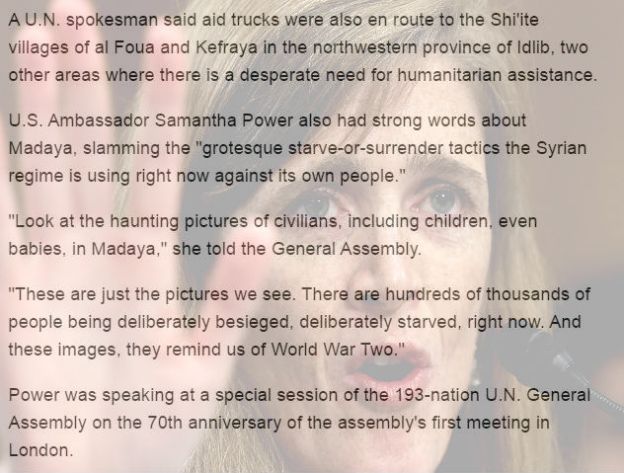
“I have looked through the report, it has all the characteristics of previous UN Human Rights reports on Syria. The timing is extremely suspect – released just as the Syrian army closes in on Aleppo.We have seen a great spike in propaganda in the past few days, against Russian air strikes and over the number of civilians building up on the Syrian border, said to be 35,000, but 70,000 are said to be coming and yesterday the Turkish deputy PM spoke of 600,000 on the way. All this can be seen as the possible prelude to establishing a buffer zone – we can’t look after any more in Turkey, so the only answer is to look after them inside Syria ….The UN Human Rights Council speaks of 500 interviews. There is no mention of who these people are, how the UN HRC got their names and where they were interviewed. The HRC’s answer is that names cannot be released but at the same time we cannot accept as credible any report that does not/will not provide such information.There is absolutely no means of verifying it and given the HRC’s previous record, its word cannot be trusted. You might remember Navi Pillai’s hysterical statements about Syria when she was head of this council . I had a run-in with one of the committee members when i criticised a report on Syria for the same reasons I am giving here. It made many lurid accusations without providing a skerrick of reliable information. In a very heated discussion she admitted what was not in the report, that most of the people interviewed were in Turkey or Jordan, and, I would imagine, in the refugee camps.I have no doubt that being in a Syrian prison is very unpleasant experience, perhaps as unpleasant as being in prison at Abu Ghraib, but extermination is an extremely powerful word and to make an accusation of a policy of extermination without providing the evidence anyone would need to know to back it up, exposes, I think, the true agenda of this group of people.Watch how its now going to be used by governments and groups like HRW. ” ~ Jeremy Salt
Featured Video
Armando Mema: Finland Used as New Frontline Against Russia
or go to
Aletho News Archives – Video-Images
New Documentary
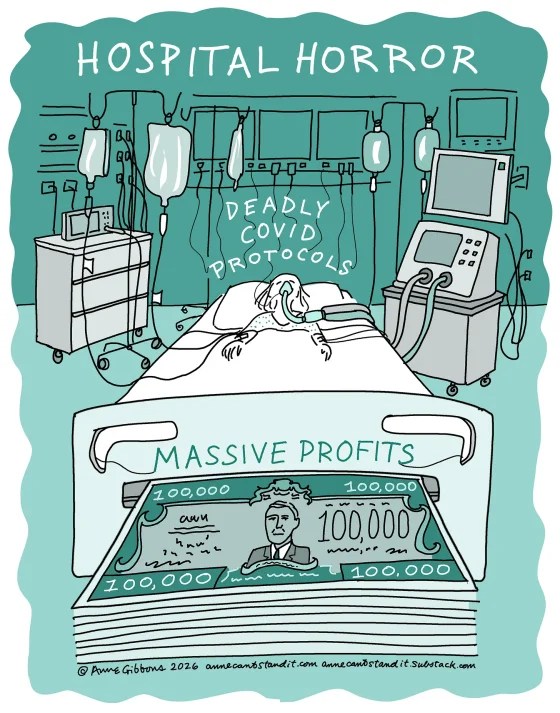
Hospital Horror
Documented in the film,“Bad Medicine”
Blog Roll
 Aletho News
- Armando Mema: Finland Used as New Frontline Against Russia
- Gestapo 2.0? Germany grants spy agencies sweeping new powers
- Franco-Palestinian group seeks court ban on Israeli real estate fair in Paris
- How British foreign policy is frozen in the ruins of empire
- EU risks investor exodus over Russian assets – Euroclear chief
- Moscow warns NATO over troop buildup
- EU leaders prolonging Ukraine conflict to stay in power – Swiss journalist
- Moscow car bombing injures former aide to Ukraine’s ex-PM Azarov
- Yemeni forces make major advances, complete Aden encirclement
- Trita Parsi: Trump’s Swiss Cheese Iran Plan & U.S. Break with Israel?
- If Americans Knew
- An error has occurred; the feed is probably down. Try again later.
- No Tricks Zone
- New Study: Barents Sea Temperatures Were Warmer And Sea Ice Less Extensive In The 1700s Than Today
- German Authorities Start Initiative To Evaluate Public Register For Climate “Disinformation” Spreaders!
- Zonal Asymmetry of Temperature Change in the Antarctic Circumpolar Current
- New Study: The Net Fossil Fuel Contribution To Rising Atmospheric CO2 Has Been Zero For 500 Years
- Germany’s Green Energy Transition Becoming Increasingly Expensive…Another 6 Trillion Euros!
- Sudden Stratospheric Warming, Powerful El Niño Combination May Lead To Extreme Europe Cold, Energy Crisis!
- Two New Studies Find Thwaites Glacier Melt Cannot Be Driven By Human Activity Or A Warming Ocean
- E-Cars Reduce CO2 Emissions By Only 41% Compared To Internal Combustion Engine Vehicles
- Predictions Made By Renowned Climate Professor Over Past Decades Have Been Proven To Be Poor
- New Study Suggests Large Regions Of The Pacific Ocean Have Been Cooling For The Last 80 Years

