Pentagon Blames Russia for Its Airstrikes on Syria’s Military
By Stephen Lendman | December 8, 2015
A previous article explained Syria’s Foreign Ministry reported US-led warplanes bombed its army camp in Deir ez Zor province – killing three soldiers, injuring 13 others, as well as destroying three armored vehicles, four military vehicles, an arms and ammunition depot, along with 23mm and 14.5mm machine guns.
The Pentagon denied being caught red-handed in its latest attempt to push back on Russia’s effective intervention against ISIS and other terrorists groups in Syria.
It blamed Moscow for its provocative aggression. An unnamed Pentagon spokesman lied, claiming it’s “certain” a Russian warplane carried out the attack. “We’ve got a radar track showing a Backfire bomber flying directly over the town that the Syrians named a few minutes before the first claims that we killed some Syrian troops.”
Who knows what Washington has or doesn’t have. It’s “certain” it bore full responsibility for the incident. Russian airstrikes are directed solely against ISIS and other terrorist groups with pinpoint accuracy, shown by photographic evidence each time.
A US-led anti-Assad coalition statement claiming attacks were conducted “against oil well heads” about 35 miles from the Syrian base was a bald-faced lie – compounded by saying its warplanes struck no “personnel targets…We have no indication any Syrian soldiers were near our strikes.”
The dead, injured and destruction tell another tale. Even the pro-Western, London-based, Syrian Observatory for Human Rights surprisingly reported US-led airstrikes attacked a Syrian military post near Ayyash in western Deir al-Zour on Sunday.
It bears repeating, the Pentagon was caught red-handed. Russia so far hasn’t commented on the incident or false accusations claiming its warplanes were responsible.
US, UK, French and other coalition partners continue bombing Syrian infrastructure and government targets. Sunday’s attack was the first known attack directed at Assad’s military – suggesting more provocative actions to come.
So far, they’ve included a Turkish warplane downing a Russia Su-24 bomber in Syrian airspace – OK’d by Washington, Ankara obstructing Russian sea traffic through the Bosphorus Strait and Dardanelles in either direction, international waterways in northwest Turkey connecting the Black Sea to the Mediterranean.
Erdogan is involved in stealing, smuggling, transporting, refining and black market selling industrial scale quantities of Iraqi and Syrian oil.
He’s illegally bombing Kurdish fighters in northern Syria and Iraq – on the phony pretext of combating ISIS. His troops operate illegally in northern Iraq, violating its sovereign territory – perhaps to keep oil smuggling routes open and aiming to expand Turkish borders, incorporating parts of northern Iraq and Syria.
Washington is sending more specials forces to Syria on top of thousands already there, along with additional numbers illegally to Syria, perhaps many more to follow.
Fars News reported “US experts” intend turning a “desolate airport… controlled by Kurdish forces in Syria’s Hasaka region… into a (US) military base.”
Runways are being constructed to accommodate US warplanes – the operation entirely illegal, uninvited on foreign soil.
Washington is upping the stakes, escalating things dangerously toward direct confrontation with Russia, a reckless act – complicit with Turkey, Britain and other coalition partners.
Obama earlier promising he’ll “not put American boots on the ground” proved false – one of his many Big Lies. Will full-scale US invasion follow – with thousands of US special forces and perhaps other combat troops, protected by US warplanes?
War winds are blowing dangerously toward gale force. Possible US instigated nuclear war is humanity’s greatest threat.
Stephen Lendman lives in Chicago. He can be reached at lendmanstephen@sbcglobal.net.
His new book as editor and contributor is titled “Flashpoint in Ukraine: US Drive for Hegemony Risks WW III.”
Baghdad Ankara ultimatum nearly up, Moscow to discuss Turkey military invasion at UNSC
RT | December 8, 2015
As a Baghdad-issued ultimatum for Turkish troops to leave the area is nearing its deadline, Russia intends to bring up Ankara’s invasion of northern Iraq without the country’s request at the UN Security Council on Thursday.
“The issue will be raised at a closed-door meeting,” TASS cited a diplomatic source within the organization as saying. The source also dismissed earlier reports that Moscow was going to call a separate UNSC meeting.
According to Iraqi media, Prime Minister Haider Al-Abadi has put the Iraqi Air Force on high alert and the ruling National Iraqi Alliance has given the prime minister the go-ahead to take “any measures” to ensure territorial integrity and protect its borders, including addressing the UN and the Arab League.
Turkish Foreign Ministry announced on Tuesday that the country is suspending further deployment of troops to Iraq, but refuses to withdraw servicemen and hardware already on Iraqi soil.
Baghdad was informed of Ankara’s decision in a phone conversation between the Turkish and Iraqi foreign ministers late on Monday.
Turkish Foreign Minister Mevlut Cavusoglu reiterated Ankara’s respect for Iraq’s territorial integrity, Foreign Ministry spokesman Tanju Bilgic told reporters.
In a separate statement, Turkish PM Davutoglu expressed readiness to visit Baghdad as soon as possible to discuss the current troop deployment crisis between Ankara and Baghdad.
Iraqi media reported earlier that on December 4 Iraq’s PM said: “Turkish troops numbering around one regiment armored with tanks and artillery entered Iraqi territory,” labeling the incident as a “serious breach of Iraqi sovereignty.” He added that the move “does not conform with good neighborly relations,” and called on to Ankara to “withdraw immediately from Iraqi territory.”
Ankara’s reaction has been offhand. It claimed up to 150 of its troops had crossed into Iraq to train forces battling Islamic State (IS, formerly ISIS/ISIL).
Although the US-led anti-IS coalition was aware of Turkey’s move, it emerged later that Ankara’s deployment is not part of the efforts of the US-led coalition battling Islamic State.
Turkish troops did not simply cross the Iraqi border into the Nineveh province, but penetrated 100 kilometer into Iraq, according to Reuters. They reached the Bashiqa region, about 10 kilometers northeast of Mosul, Iraq’s second largest city, which has been occupied by IS terrorists since June 2014.
Turkey is lying when it says it received Baghdad’s blessing to invade part of its territory, according to the Iraqi PM.
On Monday, the governor of the Iraqi province of Nineveh told Sputnik that the number of Turkish servicemen there has reached 900.
On December 6, Baghdad warned that “Iraq has the right to use all available options, including resorting to the UN Security Council if these forces are not withdrawn within 48 hours,” reiterating the same ultimatum on Monday giving Ankara 24 hours to leave the area.
Iraqi Defense Minister Khaled Obeidi turned down his Turkish counterpart’s invitation to visit Ankara. A spokesman for the Iraqi Defense Ministry said the visit will take place only after Turkey sends “positive signals” regarding the withdrawal of its troops from northern Iraq.
Ankara refused to extract its military, claiming that heavily armed troops deployed to a camp near Mosul are needed to protect an Iraqi Kurd training mission, which is taking place near the frontline with Islamic State.
“It is our duty to provide security for our soldiers providing training there,” the Guardian cited the Turkish Foreign Minister Mevlüt Çavuşoğlu as saying in an interview with Kanal 24 television. “Everybody is present in Iraq … The goal of all of them is clear. Train-and-equip advisory support is being provided. Our presence there is not a secret.”
The Walrus and the New York Times
BY John Hinderaker | PowerLine |December 1, 2015
As part of its cheerleading for the U.N. climate convention in Paris, the New York Times is running a series on What Climate Change Looks Like. First up are the walruses:

This week, we’re featuring images that show how global warming has already impacted the world.
Packed shoulder to shoulder, an estimated 35,000 Pacific walruses congregated on Alaska’s northwest coast near Point Lay last fall. Normally the mammals find ocean ice sheets to rest on, but as waters have warmed the ice sheets have disappeared. In seven of the last nine years swarms of walruses swam ashore for refuge, as shown above, according to the U.S. Geological Survey. The first time this happened was in 2007 when summer ice levels were at a record low.
The Times is peddling ignorance here. Actually, the congregation of walruses on land is an age-old phenomenon known as “hauling out.” It has nothing to do with the volume of sea ice at any given time. In fact, the Times is not just peddling ignorance, it is recycling it. Today’s Times piece is paraphrased from a much-derided column by Gail Collins that ran in October 2014.
We responded to that column in a post titled The Walrus and the Climate Hysterics. The best we can do is to quote what we wrote a year ago:
Like the other manifestations of climate hysteria, the walrus crisis is entirely fabricated. First, let’s note how great it is that you can find 35,000 Pacific walruses in one place. It is a sign of a thriving wildlife population, estimated to have doubled since the 1950s.
Climate Depot has a thorough debunking of the walrus hype, beginning with Dr. Susan Crockford, a zoologist:
The attempts by WWF and others to link this event to global warming is self-serving nonsense that has nothing to do with science… this is blatant nonsense and those who support or encourage this interpretation are misinforming the public.
To be fair, misinforming the public is the Times’s specialty.
Walruses have always swarmed on land during the fall. This is called a “haulout.” In 2007, Wikipedia said, in its entry on walruses:
In the non-reproductive season (late summer and fall) walruses tend to migrate away from the ice and form massive aggregations of tens of thousands of individuals on rocky beaches or outcrops.
That portion of the walrus entry was recently deleted. Hmm, wonder why?
Walrus haulouts have been observed for hundreds of years: “Dating back to at least 1604, there have been reports of large walrus gatherings or haul outs.”
The Times’s claim that “[t]he first time this happened was in 2007″ is a hilarious bit of ham-handed ignorance.
Shortly after we published the post quoted above, Steve added another that included this video:
If you want to learn a whole lot more about the walrus behavior in question, go here.
Because its writers are so ill-informed, the New York Times is an especially laughable purveyor of politically-motivated climate hysteria. But in reality, the whole warmist enterprise is one big fraud, as is demonstrated on a daily basis.
Hillary Clinton and a Venezuelan Murder Mystery: Who Killed Luis Manuel Díaz?
By Mark Weisbrot | The Huffington Post | December 4, 2015
On November 30, Hillary Clinton stated that she was “outraged at the cold blooded assassination of Luis Manuel Díaz on stage at a rally last week.” She was referring to the killing of a local opposition leader in Venezuela on November 25. It was clear from her remarks that she was blaming the government for the murder. Her statement appeared to be part of an international campaign to delegitimize Sunday’s congressional elections in Venezuela, and it spread quickly throughout the global media.
Clinton is familiar with these types of international campaigns for regime change. In her recent book, “Hard Choices” she acknowledges her role in helping prevent the democratically-elected president of Honduras, overthrown in a military coup, from returning to office in 2009; and recently released emails add further detail.
This shooting and its aftermath are worth looking at in some detail because they provide a compelling, if typical, example of how the international media has been manipulated, for more than 15 years, to create an image of Venezuela that conforms to certain objectives of U.S. foreign policy.
Within hours of the killing, facts began to emerge that cast doubt on the widely disseminated version of events. Venezuelan authorities started investigating the murder, and issued statements claiming that Díaz was part of a local mafia and was killed by rivals in revenge for a murder that he was implicated in.
For a day or two, these statements did not even appear in the English language media. As the days passed, more details began to emerge. According to these reports, Díaz, the victim, who was the local secretary general of the opposition party Acción Democrática (AD) in Guarico state, was himself on trial for involvement in a murder. He was allegedly a member of a local criminal group, “Los Plateados,” involved in a turf war with a rival gang, “El Maloni.” The 2010 murder in which he was accused of participating involved two members of the rival gang. According to witnesses, he rarely went out of his house for fear for his life. The man accused of killing him at the political rally, Oscar de Jesús Noguera Hernández, was a member of “El Maloni.”
Clearly there are two narratives: the government narrative that this was a mafia killing, resulting from a dispute between rival gangs; and the Hillary Clinton/Venezuelan opposition/international media narrative that it was a political killing linked to the government, intended to intimidate the opposition. Which one is most likely true?
One clue can be found by looking at the Venezuelan opposition’s response to the news and investigative reports about the involvement of Diaz and his accused killers in organized crime. Opposition politicians, who had quickly blamed the government for the murder when it happened, haven’t said anything. They are normally not shy about ridiculing the government for putting its spin on events. According to press reports, politicians from Acción Democrática, a Venezuelan political party, did not show up at Díaz’s funeral. The overall silence has been deafening. This could be because everyone has concluded that the government’s version of the story is basically true.
And reporters for the international and Venezuelan opposition media have shown no interest in the criminal investigation or related facts. Since this was a major event that has shaped perceptions of the electoral process in Venezuela in the middle of a hotly-contested campaign, one might think it would be of interest to reporters covering the campaign. (Another missed story: how did Acción Democrática end up with an organized crime figure as their statewide secretary general?)
So far, no journalist has even bothered to ask opposition politicians, or supporters such as Hillary Clinton or OAS Secretary General Luis Almagro, if they believe this was a political killing in light of the criminal investigation. Almagro has been campaigning against Venezuela since the election campaign started. Immediately after the murder, he issued a statement that strongly implied that the government was responsible.
On Thursday, Venezuela’s attorney general released a statement that one of the arrested suspects, Ronald Hernandez, had confessed to having fired the bullets that killed Díaz. As of this writing, no major English language news outlet has reported this news.
The wheels of justice grind slowly in Venezuela, so it will probably be a while before there is a trial of the accused perpetrators. But for the U.S. government, Hillary Clinton, and their opposition allies, it is mission accomplished. Probably 98 percent of the world who has heard anything about the Venezuelan elections now thinks that the Venezuelan government is assassinating political opponents. Proponents of “regime change” will take international public opinion into account when they decide whether to recognize the results of Sunday’s election, or take to the streets with violent demonstrations as they did in the 2013 presidential elections.
This is how public opinion is shaped when the U.S. government targets a country for regime change, whether it is a dictatorship like Iraq or a democracy like Honduras or Venezuela. It is good to keep this in mind when you are reading the international news.
Mark Weisbrot is a co-director of the Center for Economic and Policy Research in Washington, D.C., and the president of Just Foreign Policy. He is also the author of the new book “Failed: What the ‘Experts’ Got Wrong About the Global Economy” (2015, Oxford University Press).
PBS Newshour Fails the Public
Biased and Misleading Analysis on Syria, Russia, Turkey
By Rick Sterling | Dissident Voice | December 4, 2015
PBS Newshour is considered high quality journalism by many North Americans. But is it? A test case is their report on November 24 when a Russian jet was shot down and one pilot killed as he descended in parachute.
This was a significant international event and the situation is still dangerous. The conflict in Syria could get even worse. PBS Newshour presented a discussion/analysis of the event with two guests: Nicholas Burns and Angela Stent. The PBS Newshour host was Judy Woodruff.
This critique applies to the PBS Newshour broadcast on November 24 but the essential points apply to the present. The assumptions and bias regarding the Syrian conflict are pervasive and persistent. How can US foreign policy change if the public is continually fed biased and false information?
Here are specific points:
PBS Newshour selected two analysts with essentially the same viewpoint – U.S. Government and military/security establishment
Nicholas Burns is a former U.S. Ambassador to NATO. In early 2003 he urged the “unity” of NATO as some NATO allies expressed doubts about the U.S. the invasion of Iraq. In 2006 he urged punishing sanctions on Iran. In 2011 Burns wrote, “President Obama was surely right to commit the United States, however reluctantly, to the NATO campaign [to overthrow Libyan President Gaddafi].” Burns has a track record supporting Western aggression against other countries. He evidently has learned nothing from the resulting chaos, devastation and death.
Angela Stent is associated with conservative think tanks. She is a former State Dept and National Intelligence Officer. She is also author of the 2015 book The Limits of Partnership: US-Russian Relations in the 21st Century. Written in non-academic prose, the book explores what she considers four efforts by the US to reset or start new relations with Russia following the Cold War. Unfortunately the bias of the author is apparent and inconvenient history is not mentioned. For example, the Project for a New American Century and aggressive U.S. foreign policy under its influence have been “disappeared”. It’s a biased history which ignores or white-washes examples of US collusion and support of violent coups- from Venezuela to Honduras to Ukraine and Libya.
The analysts make false or exaggerated claims.
- Burns says the Russians “did violate Turkish air space” but he offers no evidence, and it now appears the Russian jet was shot down over Syrian air space.
- Both Burns and Stent claim the Russians violated Turkish air space “several” times or “repeatedly”. Woodruff refers to them as “invasions”. Contrary to the allegations, the only confirmed Russian violation of Turkish air space was on September 3 in bad weather when they were beginning the campaign.
The analysts failed to include relevant information
For instance:
- Air space violations occur frequently and Turkey is a major perpetrator.
- The normal practice is to usher an intruding plane out of the air space not shoot it.
The program fails to consider Putin’s comments that the action was “a stab in the back, carried out by the accomplices of terrorists”
Why wasn’t this comment discussed? A Columbia University researcher lists proof of Turkish collaboration with ISIS here. Another lengthy list is here. American Lebanese journalist Serena Shim documented Turkey’s pivotal role in this video . She was killed the day after publicly expressing fear of the Turkish Intelligence Agency (MIT). Why did the guests not mention any of this?
The analysts also ignore Turkey’s economic support of ISIS
For example, the son of the Turkish President, Bilal Erdogan, has been implicated in purchasing ISIS oil from Syria, mixing it with Iraqi Kurdish oil and shipping it abroad. Bilal is co-owner of BMZ oil and chemicals shipping company which has been buying additional ships. Burns talks about the importance of “history and context” but he leaves out essential facts and history about the conflict.
The analysts distort facts to support their biases
Analyst Burns claims “The Russians have been bombing Syrian Turkmen, ethnic Turkmen villages” Evidence indicates the Russians are not bombing random villages; they are bombing specific terrorist groups in the area. We know that terrorists are in the area because they have been raining missiles into Latakia city, killing 23 students and civilians on November 10. We know the terrorists are there because they video recorded themselves. Other video shows the downing of the aircraft, the pilots descending, the “rebels” shooting at the parachutists, and then the captured dead Russian pilot. Article 42 of Geneva Convention says, ““No person parachuting from a plane in distress shall be made the object of attack during his descent.” Why should Russia and Syria be criticized for attacking these terrorists? It has since emerged that the most vocal “rebel” leader in the video is a Turkish citizen.
Analyst Burns conflates a sectarian extremist fringe with an entire religious branch.
When he refers to “Sunni” groups he actually means the Wahabi/Takfiri opposition such as Jabhat al Nusra, Ahrar al Sham, ISIS, etc. Most Sunni Muslims in the world oppose the bastardization of their religious faith by the fanatic Wahabi element. Characterizing the jihadis as being “Sunni groups” is comparable to identifying the Ku Klux Klan as representing the “Christian group”. It’s additionally false and misleading because the majority of Syrian Army soldiers are Sunni.
The analysts are hypocritical about air space violations.
Burns claims that Russia’s alleged 17 second violation of Turkish air space “is clearly illegal under international law”. Yet the analysts say nothing about the frequent and much longer violations of Syrian air space by American jets and bombers that have NOT been authorized by the Syrian government.
The analysts ignore the fact that Syria has been the victim of severe violations of international law for over four years
Turkey, USA, Saudi Arabia, Qatar, France and UK have been training plus supplying weapons, logistics and salaries to armed opposition groups trying to violently overthrow the Syrian government. As confirmed by the International Court at the Hague in their ruling filed by Nicaragua against the United States, this is in breach of international law.
The analysts convey the confusion and contradiction of Western policy toward Syria
Stent says, “We disagree with the Russians on the fate of Assad and we disagree on who the enemy is.” In short: Stent and Burns think the West should be able to dictate who can be President of Syria; they also think Russia should refrain from bombing any group except ISIS. They want Russia to refrain from bombing Nusra/Al Qaeda, Ahrar al Sham and other terrorist groups. It is a duplicitous strategy.
The Russian position is much more logical. They have been clear from the start: They are there to oppose sectarian terrorists threatening the Syrian people and state. ISIS is one of these groups but there are many others. What is common among them is sectarianism and reliance on outside funding. One group consists of Uighurs of Chinese nationality. They are part of the “Army of Conquest” that made a big advance in northern Syria in Spring 2015. The idea that these sectarian terrorist groups should be allowed to roam free is illogical if your goal is to overcome terrorism. There are tens of thousands of sectarian fighters who are not in ISIS. Some of these groups threaten major population areas including Latakia and government controlled Aleppo. Other groups control border zones which allow for inflow of more weapons and jihadis. It is logical that the Russian Air Force and Syrian Army would prioritize attacks on these groups near major population centers and controlling border zones.
Regarding the “fate of Assad”, the Russians believe the Syrian Presidency should be determined by Syrians not foreigners. They have indicated they would accept internationally supervised elections. That policy is in keeping with international law. The policy of the West trying to dictate who can or cannot be President of Syria is a violation of the UN charter and International Law.
Stent engages is amateur psychology instead of policy analysis.
She speculates that Russia is intervening in the Syrian conflict because “they want the U.S. to come to them, they want to be the leader … There is some reckless behavior obviously.” It’s a silly analysis that ignores serious issues such as the US policy of “regime change”, the historic links between Syria and Russian, and the credible belief that the attack on Syria is a step toward attacking Iran.
Analyst Burns concludes with call for war via “No Fly Zone”
He says:
If the Russians don’t restrain the Syrian government from firing barrel bombs into civilian neighborhoods the US ought to consider a No Flight (sic) Zone with Turkey and other countries to shut down the Syrian Air Force. That’s what Secretary Clinton has been advocating and I think she’s right…. The way to save civilians and reduce the number of refugees is to shut down air traffic in the northern part of Syria. That’s an idea that the administration has to consider now given these events.
Thus Ambassador Burns goes from criticizing Russia for a 17 second intrusion into Turkish air space to calling for the take-over of northern Syrian air space. It’s a call for more war masquerading as a call for peace.
We can see where his call would lead by looking at consequences of the “No Fly Zone” in Libya. It has resulted in vastly more conflict, deaths, displaced persons and refugees. Since the NATO driven “regime change” in Libya, terrorism has exploded into neighboring countries.
Does Burns really want to take the US into a potential war with Syria and Russia by trying to take over northern Syria? What is wrong with following international law and letting the Syrian people determine their leader?
With Russian air support the Syrian Army is advancing on nearly all fronts. Is that what Turkey and other enemies of Syria are concerned about?
Conclusion
The US has been invading or surreptitiously overthrowing governments around the globe for the past 65 years. The US aggression has usually ended badly, especially for the target country but also for the US economy and population.
Why do these wars keep happening? To some extent it is media failure to expose what’s going on and encourage serious debate.
The PBS Newshour program on November 24 is an example of why the US public is confused about Syria.
PBS Newshour could have presented one of the analysts, Burns or Stent. They could have presented another analyst who would give a different analysis and challenged the biased perspective. It could have been someone from Veteran Intelligence Professionals for Sanity like Ray McGovern or someone from Russia or someone from Syria like the Syrian Ambassador to the United Nations. Instead we had a propaganda presentation, biased and misleading.
PBS Newshour is failing the public.
If you agree, consider letting the Ombudsman know. His email and phone contact is at here
Rick Sterling is a retired engineer and co-founder of Syria Solidarity Movement. He can be emailed at: rsterling1@gmail.com.
Attorney for Family in San Bernardino Shooting: Official Story “Implausible” & “Doesn’t Add Up”
After the tragic shooting in California this week, those close to the case have been finding giant holes in the “official narrative.”
By William N. Grigg | The Free Thought Project | December 4, 2015
The question of how Sayed Farook could have mutated into a human monster capable of mass murder is just one of many questions plaguing the family of the man accused of carrying out Tuesday’s terrorist attack in San Bernardino. In an interview with CNN, the family’s attorney describes numerous ways that the official story of that horrible crime “doesn’t add up.”
“There’s a lot of disconnects, and there’s a lot of unknowns, and a lot of things that quite frankly don’t add up,” insisted attorney David S. Chelsey, who represents Farooq’s family when asked by CNN correspondent Chris Cuomo how the family “could explain how he went from someone they knew and loved to someone who could do something so monstrous.”
Witnesses and investigators have both described a terrorist onslaught carried out with military precision by suspects who were trained and capable. Farook and his wife, Tashfeen Malik, didn’t appear to have the necessary background and skillset, according to Chelsey.
He expressed particular skepticism that Malik, who was nursing a newborn child, was suitable to carry out a depraved mission of that kind: “She was only about ninety pounds, so it’s unlikely she could even carry a weapon, or wear some type of a vest, or do any of this.”
The most provocative claim made by Chelsey dealt with the condition of the alleged terrorists when their bodies were found:
“Where the couple was found, from what I understand, is that they were handcuffed, lying face-down in this truck, shot up.”
By all accounts, Farook’s family is cooperating fully in the investigation.
“We sat with the FBI for three hours, and they tried to identify some characteristics or some affiliations that he might have had that have led him to act in this way, and they were totally stumped, totally frustrated,” Chelsey reports. “Everyone is clueless.”
According to CNN, the couple had left damaged cell phones in a trash bin on the scene. Citing unnamed “authorities,” the network said that this suggested that the couple “was trying to hide their tracks, and make it impossible for investigators to see what was on their cell phones.” Of course, this could have been done more easily by not bringing the incriminating cell phones with them, rather than discarding them at the scene of the massacre.
The hard drive on the couple’s computer is also missing, which has resulted in a subpoena to their Internet Service Provider. A dedicated member of a terror cell would try to destroy electronic information that could incriminate co-conspirators. According to defenders of the NSA’s all-encompassing electronic surveillance, Islamist radicals are being more careful to avoid leaving cyber-breadcrumbs that can be followed; merely removing a hard drive from a desktop computer wouldn’t be enough.
Another oddity, according to CNN reports, is the composition of the explosives found in the couple’s home: The recipe followed in making the pipe bombs does not match any of the formulas associated with al-Qaeda, ISIS, or other known terrorist groups.
According to Mustafa Kuko, director of the Islamic Center of Riverside, California, Farook regularly attended worship services until about two years ago.
“We were all shocked” by the news that Farook had allegedly murdered 14 people, Kuko told the Los Angeles Times. That shock was compounded by news that one of the victims in the attack, a social worker who survived multiple gunshot wounds, also attends the mosque.
“It’s very likely that they knew each other, and Farook must have known she was there,” Kuko points out. “It just doesn’t make any sense. Why would he do this?”
The answers to those insistent questions may cause Farook’s family and friends to revise their assessment of a man they considered to be peaceful, well-adjusted, and sincerely friendly. Those answers might also require significant revisions in the emerging official narrative of the atrocity in San Bernardino.
What No One Is Telling You About Mark Zuckerberg Donating 99% Of His Fortune To “Charity”
By Sadho Ram | SAYS | December 2, 2015
By now you must have heard that Mark Zuckerberg along with his wife Priscilla Chan has pledged to give away 99% of his estimated USD45 billion in Facebook stock to charity. Basically, Mark is giving away enough money to fund one of the world’s biggest charities for the next 45 years. Instead, he is funding his own. Here’s how:
The vehicle for his beneficence will be the Chan Zuckerberg Initiative LLC, a family-run foundation that he controls and through which he will maintain control of Facebook for “the foreseeable future.”
Which basically means:
Mark Zuckerberg will transfer ownership of his Facebook stock without paying capital gains taxes. He will also benefit from the possibility that his foundation will live beyond him, with his heirs and their heirs at the helm, untouched by estate taxes.
A Facebook PR, while confirming to BuzzFeed News, said that the initiative is structured as an LLC, and not as a charitable trust
Which means that unlike a charitable trust, which is compelled to spend its money on charity, Chan Zuckerberg Initiative, LLC will be able to spend its money on whatever it wants, including private, profit-generating investment.
While charity will certainly be one of the money’s destinations, it will be far from the only one. The money, according to a Facebook SEC filing, will go to “philanthropic, public advocacy, and other activities for the public good.”
One such activity: private investment. A Facebook release this afternoon stated as much.
“The Chan Zuckerberg Initiative will pursue its mission by funding non-profit organizations, making private investments and participating in policy debates, in each case with the goal of generating positive impact in areas of great need,” it said. “Any profits from investments in companies will be used to fund additional work to advance the mission.”
One more thing about his pledge:
The Facebook founder is not giving away 99% of his Facebook shares all at once. He will be doing it over the course of the rest of his life.
Also, Michael Maiello points out in this Daily Beast piece:
Mark will deduct the fair value of his gift to his foundation from his taxable income in the year he makes the donation. A donor like Mark could realize a tax benefit equal to about one-third of the value of his gift. In this case, he stands to benefit as much as USD333 million, based on the USD1 billion he plans as his first transfer.
Rather than give to existing nonprofits, Mark is doing what other business leaders have recently done. Increasingly siphoning their fortune into their own organisations and this can be problematic.
Alexander C. Kaufman of The Huffington Post explains how:
The desire for control leaves the massive pool of money set aside for charities — about $358 billion in the U.S. last year — divvied between the roughly 1.5 million nonprofits registered in this country. Creating a new organization every time a company or wealthy individual wants to foster change only shrinks the available slices of that pie.
“Just because you were successful in the for-profit world doesn’t mean that nonprofits are a bunch of bleeding-heart idiots that need you to come in and show them how it’s done,” Ken Berger, the managing director of the social-good data service Algorhythm, told The Huffington Post in October. He previously ran the nonprofit watchdog Charity Navigator. “We have one of the most complex and sophisticated nonprofit sectors ever seen. Partnering with others is the best approach.”
That last part is key.
To sum up, his money is not going to a charity, but to his own LLC, which will let him evade tax by moving his private assets into a foundation. See, Zuckerberg doesn’t need massive tax benefits to do whatever he wants. He can just do whatever he wants.
But he will get those tax benefits and estate planning benefits and he will be able to give up his stock while holding onto power over his company.
As Michael Maiello in his Daily Beast piece reveals, “when we pay people like Zuckerberg to fund their own foundations, we are really helping the rich and coddled few even as we thank and honor them for their charity.”
Why ‘Active Investigations’ Don’t Justify Keeping Police Video Secret
By Jay Stanley | ACLU | December 4, 2015
The Chicago police last week released video of 17-year-old Laquan McDonald being shot to death by a police officer. Release of the video showing the 16-shot barrage came only after a judge order its release, and after more than a year during which the police had refused to make it public. In Minneapolis, protesters have been clashing with police as the police similarly refuse to release video in the recent shooting death of another young Black man, 24-year-old Jamar Clark. In both cases the police have cited the need to keep video under wraps because there is an “ongoing investigation.”
The question of what police body camera video gets released to the public, and when, is an important one, and has become one of the central areas of dispute surrounding the technology. At issue are two sometimes conflicting values: privacy, and government transparency. Our position (as outlined in our body camera white paper and model policy) is that while most video footage should be kept private—held for a short period in case a complaint is filed, not analyzed or used for any other purpose, and then deleted within six months—some video footage is important for the public to see. We call for video of incidents to be releasable under state open records laws where there has been a use of force, a felony arrest, or a complaint against a police officer. Certainly in the case of a police shooting or other use of deadly force, the public’s interest in understanding how and why an officer took such an extreme measure is overwhelming.
Police departments, however, regularly refuse to release video citing their need not to release details of ongoing criminal investigations. Aside from the question of whether police should have exclusive control over videos in the first place, the question needs to be asked: does this general exception to public transparency make sense in the case of body camera or other video footage of police uses of force?
There are a limited and narrow range of purposes for which exemptions should legitimately be granted. Those purposes include:
- Protecting personal privacy
- Protecting confidential sources
- Not interfering with the investigation
- Protecting the right to a fair trial
Many state laws have active-investigation exceptions to their open-records laws, and these laws vary but generally include the above factors, as does the federal FOIA law (Exemption 7). The federal law also includes a broad catch-all exemption for circumstances where disclosure could “reasonably be expected to interfere with enforcement proceedings,” as well as an exemption for when it could “reasonably be expected to endanger the life or physical safety of any individual.” And, it contains an exemption for law enforcement guidelines, techniques, and procedures where “such disclosure could reasonably be expected to risk circumvention of the law.”
But none of these exemptions justify the withholding of video footage of a shooting or other use of force by a police officer. Exemptions to open-records laws for “ongoing investigations” were simply not created with police video of police shootings in mind, and do not make sense applied to such recordings. Yet police departments around the country are using these rules to block or delay release of video not because it would harm investigations, but because it makes them look bad. This is not how things are supposed to work in a democracy.
Let’s look at each justification for “active investigation” exemptions and how they apply—or not—to body camera footage.
Privacy: One purpose of these exemptions is to protect people from the stigma of being under investigation before the police have even finished assessing whether there is evidence of their involvement in a crime. A police officer who has used deadly force against a citizen has typically already been identified, and has no right to privacy in such circumstances as they are an employee of the public whose actions, ostensibly to protect the interests of that public, merit the highest levels of community scrutiny.
A concrete example of this was given to me recently by Laura Schauer Ives, a civil rights attorney in New Mexico (and former legal director for the ACLU there) who litigates on police use-of-force issues, including the infamous James Boyd shooting. As she pointed out,
The public needs to know if there are problematic officers. That’s why in Albuquerque, we know which officers have shot people three, four times. We have officers who have repeatedly used excessive force against citizens, and that’s the only way to know it, by knowing their names. And that is their job. You’re a police officer doing your public job.
In Chicago, where police and city officials fought to keep civilian complaints secret, the resulting lack of sunshine has allowed problematic officers to stay on the job unpunished (as we now know only because of a decade-long legal battle to bring that information to light).
When it comes to the privacy interests of the subject or victim of a use of force (or his or her survivors), typically they do not object to release of the video on privacy grounds; in the vast majority of cases under contention they are the ones clamoring for release. I recently wrote about an exception, where a shooting victim’s family sought to block release—but even there the public’s interest in monitoring the police force overcomes the privacy rights of the subject of police use of force. Should a video show bystanders with a legitimate privacy interest, their identity can be obscured through redaction of the video.
Protecting confidential sources: If an officer shown in the video is an undercover officer, his or her identity can ordinarily be obscured through redaction. While a case involving an undercover officer is theoretically possible, I have not heard of one. Redaction should also be sufficient should bystanders or others in a video happen to be informants. (And of course unredacted bystander video posted online can render any of these protections moot.) But this exemption to transparency has been abused: Ives told me that in New Mexico “we see the Albuquerque Police Department making the argument that officers who are not undercover, are undercover. If you’re out in public in a police vest that says APD, sorry but you’re not undercover.”
Interfering with the investigation: Another purpose of secrecy can be to avoid alerting suspects that they are under investigation (potentially spurring them to destroy evidence) or revealing what the authorities know about them and their possible crimes. But if there has been a police shooting, then the situation is different from those in which the above concerns apply. In a shooting, or if there has been a complaint, the involved officers know full well that they will be the subject of an investigation. (It is important to temporarily withhold the video from viewing by those under investigation—witnesses, arrestees, and the involved officers—until after they have given initial statements on the incident, as we have explained, but that does not justify any significant delay in release of the video to the public.)
Furthermore, the reason that police don’t want to release the details of an investigation to the public is that they don’t want one member of the public in particular—the perpetrator—to see that evidence. But in a police shooting, once the involved officer has seen that video, withholding it from the public no longer serves the purpose of keeping it from the person under investigation—now it serves only to prevent the public from seeing it. That’s not a legitimate goal on its own.
The right to a fair trial: It is important insofar as possible to protect defendants in criminal trials—whether they are arrestees or police officers—against pre-judgment by the community. Exposure to video evidence can harm not just the defense, but also the prosecution; one former Justice Department official whose job had included prosecuting police officers made the point to me that letting potential jurors in the community view a video before trial will shape and prejudice their impressions of what took place.
This is a legitimate concern, but generally does not hold up against the public’s critical need to engage in oversight of how its police are using force. There are also several factors that diminish the force of this consideration. Bystander video has so far been much more common in police shootings than bodycam video, and nothing can stop bystanders from exercising their First Amendment right to post their videos of an incident for the whole community to see. The courts have dealt with public bystander videos and they can deal with public bodycam videos—through the jury selection process for example, or change-of-venue motions that can be filed if the concern is particularly significant. In addition, it’s not clear how differently a video will prejudice a juror who views it on YouTube before joining a jury, compared to how they’ll interpret it when viewed at trial. It is far more important to get untainted initial testimony from witnesses and participants in a use of force case, than shielding the community at large.
The right to a day in court: There’s another reason it’s not okay to delay release of video until investigations and other legal processes around an incident have run their course: it prevents individuals from seeking justice for police wrongdoing in court. “It’s actually imperative that these things be public because of federal pleading requirements,” Laura Ives told me, explaining:
It used to be when you go to federal court with a claim of abuse, you just needed to make enough of a claim to get past a motion to dismiss. Now the federal standard under a case called Iqbal is that your claim needs to be “plausible.” To demonstrate that, you have to have enough information—you have to have evidence, you have to have a fairly strong claim going into the litigation, and even then you’re going to go up and back within a circuit on the qualified immunity issue before you ever get discovery, before you ever get to see a video or get a deposition. So getting video as a public record, seeing what happened in a shooting for example, is very, very important if you don’t want your lawsuit dismissed before you ever get to see discovery.
Overall, in some circumstances there can be sufficient reason to delay the release of certain evidentiary materials due to an active investigation, but when it comes to police body camera videos, the public’s interest in immediate oversight of how police officers use force is overwhelming, and it is hard to imagine circumstances in which the reasons for withholding such videos are not inapplicable or fatally weak—and even in the scenarios I can come up with, redaction would be sufficient.
Indeed last week’s release of the Laquan McDonald video followed a ruling by a judge who found that the Chicago police had failed to prove that releasing the video would hurt any ongoing investigation. But where existing state open records laws and jurisprudence do not clearly provide for the immediate release of police body camera video, state legislatures should take action to make clear that ongoing-investigations exceptions to open records laws do not apply to police body camera footage. If unusual situations should arise that we have not unanticipated, in which the harms such laws are intended to prevent would be brought about with sufficient severity to overcome the compelling public interest in disclosure, then withholding should be allowed if the police can establish the likelihood of those harms to a judge under a very high standard—and establish that redaction cannot solve the problem. And the videos should be released at the earliest possible moment that those extraordinary conditions no longer apply.
Finally, it’s important to note the significant harm that withholding video of police shootings does to trust and confidence in police and their relations with the community. Such withholding increases the sense of disrespect, and often appears to communities to be another example of police abusing their authority—not without reason, as our analysis here suggests. Police having exclusive control over, and then refusing to release, video of killings, which are disproportionately of Black men, frays even further any semblance of dignity and trust, and brings into sharp relief the use of authority to attempt to avoid accountability.
Daily Shooter: 21st Century Wire report on San Bernadino
By James Tracy • 21st Century Wire • December 4, 2015
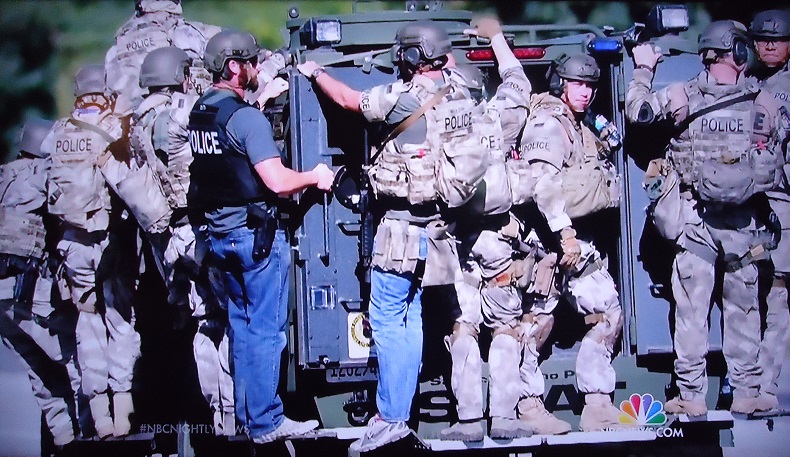
Another Daily Shooter event has taken place in San Bernardino, California. As we go to press, police marksmen appear to have shot-up a black SUV, with one suspect killed, one severely wounded [later pronounced dead] and another escaping on foot according to NBC News live coverage. It’s still unconfirmed whether the SUV passengers are actually the same men who were the original ‘active shooters’ at the original crime scene.
Earlier this afternoon at approximately 12pm PT, we’re told that 14 people were reported to have been killed and another 17 have been hospitalized with various injuries, after the 3 shooters are said to have opened fire with ‘long guns’ inside a conference venue, in the Inland Regional Center, a government-run disabled services office complex, located in San Bernardino. Police gave chase to suspects and claim that 3 assailants were masked (therefore could not be ID’d at the scene), heavily armed and possibly wearing body armor.
Made for TV
The later shoot-out was perfectly positioned for a Television News chopper to capture the drama unimpeded for national audiences, putting all the latest police military gear on display. Many hours after the initial event, Paramilitary Police units in armored MRAPs apparently shoot-up a black SUV, but it’s not known whether or not this was driven by one the original suspects, raising the possibility about whether the police have ‘accidentally’ shot-up the wrong vehicle. Despite the incredible media vantage point here, still no actual footage exists of the alleged deadly shoot-out other than a few photos seen afterwards, nor is there any footage of police removing the suspects dead bodies from the black SUV onto medical gurneys. […]
What happened to the CCTV footage of the shooters as they traveled into the parking lot, got out, and moved towards and throughout the building site? If past ‘Active Shooter’ drills are anything to go by, then it’s unlikely the public will be allowed to see any of this footage, unless it’s been heavily edited and supplied to the mainstream media. […]
Hard to Believe
We’re also old that many hours after the mass shooting incident, police miraculously track-down suspects in a black SUV only 1.5 miles from the original crime scene? Hard to believe, isn’t it?
The entire police case including its ability to pursue the black SUV with the alleged shooting suspects rests completely on a ‘police tip’ from one witness, a man named Glenn Willwerth, who we’re told owns a printing business, J&S Paper Southern, listed at 435 E Parkcenter Circle, San Bernardino, CA 92408 (oddly, this business has no website, only a Facebook page created on Sept 17, 2015), situated across the street from the Inland Regional Center. Willwerth said he saw the alleged shooters fleeing the initial scene in a black SUV, which police claim to have then followed back to the suspects’ residence before, incredibly, the suspects then headed back to the original scene of the crime many hours later.
The US media are already touting today’s event as, “the worst mass shooting since Sandy Hook in 2012.”
Following the take-down of the black SUV vehicle, tactical paramilitary police units escorting ATF and FBI agents then began performing armed, “door to door” searches of all homes in the vicinity of the SUV shooting scene.
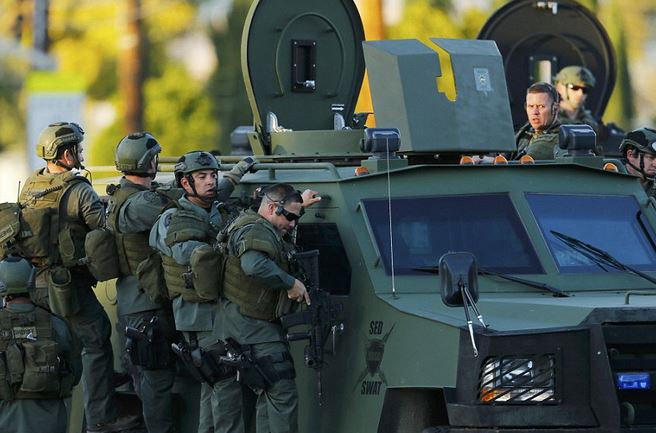
The city of San Bernadino has been placed into lock-down, with closures of all schools, court houses and public buildings with all residents ordered to ‘shelter in place’. According to one local news affiliate anchor, “San Bernardino is now under Martial Law.” […]
UPDATE: A number of media outlets, including the Israeli-run website Vocativ, came out to declare the San Bernardino event an ‘ISIS attack on American soil’:
“ISIS extremists began celebrating the mass shooting in San Bernardino hours after the massacre, creating the hashtag #America_Burning as police hunted for as many as three shooters, Vocativ discovered. The Islamic State, however, did not take credit for the shootings in the ghoulish postings.”
If this theme gains traction this week, then it will certainly trigger an all-out right-wing political campaign to call for US troops on the ground in Syria and Iraq. The timing of today’s shooting and Britain’s historic ‘war vote’ today should not be underestimated as the two appear to be feeding into the exact same talking points and foreign policy directives. […]
Even as the suspects were being pursued, President Barack Obama took to CBS News in order to lay out his case for gun control in America. Normally the present wait until after the event has settled before inserting himself in the conversation, but today he broke that tradition – even though none of the facts were in at that time. It’s as if the President already knew what the final narrative would be.
As far as social fall-out and manipulation is concerned, this event successfully covers both sides of the American political paradigm. Thanks to this event and the media’s calculated coverage of it, left-wing social media users are calling for “Gun Control” (led by President Obama), while right-wing crowd is calling for, “More ‘boots on the ground’ in Syria, and Iraq”. … Full article with updates
Featured Video

Saudi Led Destruction of Yemen’s heritage
or go to
Aletho News Archives – Video-Images
From the Archives
Israel: Strategic Ally or Liability?
By Stephen Sniegoski | My Catbird Seat | June 12, 2010
The claim that Israel serves as a valuable ally for the United States is made by both pro-Zionists and much of the anti-war and anti-Zionist Left that is influenced by Noam Chomsky. As a result of the Gaza flotilla massacre, which has caused a world-wide uproar against Israel, the value of Israel to the United States is being publicly questioned in more mainstream foreign policy forums. … continue
Blog Roll
 Aletho News
- The Houthis Are Not an Iranian Proxy
- Europe’s Energy Hypocrisy, Russian LNG Profits and US Dependence
- ICC ignored ‘very well-documented’ NATO crimes – ex-Libyan minister
- SNSC secretary dismisses US response to Iran’s conditions as ‘inadequate’
- Sanaa says Taiz roads open, secure for residents, warns Saudi forces
- Iraqi resistance group urges Saudi leadership to admit defeat, lift Yemen siege
- Trump’s Retreat: How Al-Aqsa Flood Took Down the US Empire
- Israel’s Military Actions in Lebanon Grossly Violate International Law — Lavrov
- Seyed M. Marandi: US-Iran War Inevitable: Kuwait and Bahrain May Fall
- Leaders Condemn Ansarallah Attack on Saudi Arabia While Ignoring Illegal War Against Yemen
- If Americans Knew
- It’s a Genocide, I’m Into It’: Seinfeld Mocks Protest over Palestinian Children Killed
- Universities fire dozens amid pressure from Zionist billionaires
- Gaza’s buildings are collapsing on top of us. But there’s nowhere else to shelter
- Israel kills four-year-old Gaza child – Daily Update
- After Oct 7, IDF policy allowed civilian casualties for even the lowest-ranking targets
- Israel’s Destruction of Southern Lebanon Intensified After the Cease-Fire
- The Last-Minute Decision That Gave Israel Its Name
- The American Conservative: How Trump Made the World Go Nuclear
- Meet the US generals and admirals advancing Israeli policy
- Opinion: Why news organizations should boycott Israel
- No Tricks Zone
- New Study Suggests Large Regions Of The Pacific Ocean Have Been Cooling For The Last 80 Years
- Germany’s Green Energy Debacle: High Energy Costs Force Kahla Porzellan to Close After 182 Years!
- New Study: 50 Years Of The Most Aggressive ‘Net Zero’ Policies Can Only Affect The Global Climate By 0.03°C
- US September “Heat” Was No Record…Many Records Set Decades Ago
- Latest European Green Energy Debacle; Portugal’s Largest Flagship Solar Park Insolvent!
- Green Energy Debacle: German Expert Professor Fritz Vahrenholt Warns Of Severe Economic And Social Consequences
- Two More Paleo Reconstructions Affirm Meters-Higher Sea Levels Across Ireland, Brazil 7000-6000 Years Ago
- New Study: Earth And Venus Surface Warmth Largely Explained By Convection And Lapse Rate, Not CO2 Or Radiation
- 2025 Nature Paper Claiming Worsening Global Drought Gets RETRACTED …Heavily Flawed
- New Study: ‘Global Drought Shows No Detectable Recent Acceleration Under Climate Warming’

