How Humberside police, CPS & UK govt conspired to cover up racist killing of Christopher Alder
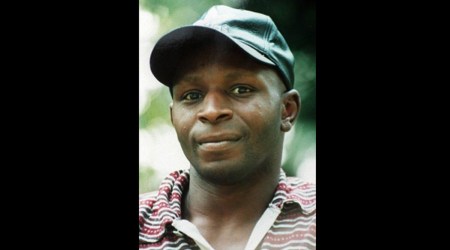
Christopher Alder / Wikipedia
By Dan Glazebrook | RT | August 2, 2015
Every obstacle will be put in the way of a successful outcome of this struggle, and those who seek justice are likely to find themselves subject to a vindictive campaign by the police. Nothing illustrates this more clearly than Janet Alder’s almost two-decade long campaign to establish what happened to her brother Christopher.
On April 1, 1998, Christopher Alder was on a night out in Hull. The 37-year-old was a former paratrooper who had served in the Falklands and Northern Ireland, and had been decorated for his service; he had two children, and was in training for a new career in computer programming. Later that night, however, outside the Waterfront nightclub, he got into a fight. After being punched in the face, Christopher was briefly knocked unconscious and lost a tooth. An ambulance was called, and Christopher was taken to Hull Royal Infirmary, accompanied by police officers. His injuries were not deemed life-threatening, and he was discharged, after which the police drove him to the police station.
Exactly what happened in that police van during the short one-mile journey remains shrouded in mystery; indeed it has never properly been investigated. What we do know is that by the time he arrived in the police station, he was unconscious again, had lost another tooth, and had received two additional injuries (a cut to the lip and a cut above the eye). He was then dragged into the custody suite with his trousers round his ankles and his belt missing, and left face down and handcuffed on the floor. No attempt was made to put him into the recovery position, and CCTV footage shows officers standing around chatting as he gasps for breath, still unconscious. Within 12 minutes he would be dead, with officers making racist comments and monkey noises over his corpse. It was a level of contempt that has characterized the state’s attitude towards Christopher and his family ever since.
Christopher’s sister Janet began campaigning for justice for her brother just three months after his death. Her tireless efforts have served to keep the case in the public eye, thwarting the police’s attempts to brush it under the carpet, and have resulted in some astounding revelations and admissions. Yet, to date, justice has still not been done; the police who caused his death have never been properly held to account or punished for their actions, whilst Janet has borne the brunt of a vindictive campaign against both her and her brother’s memory which continues to this day – but which began immediately after his death.
In the days following Christopher’s death, six officers raided his flat. The flat was then sealed off for two weeks whilst the police laboriously itemized and mapped out every item in the home. Needless to say this is not usual procedure for dealing with a possible murder victim; indeed, an official report by the Independent Police Complaints Commission (the IPCC) later noted that it was “more in keeping with what might be expected if Mr Alder were a suspect rather than a victim.” What seems likely is that this raid, far from having anything to do with investigating Christopher’s death, was rather a desperate attempt to find something – anything – that could be used to smear his name. For this is usual procedure: one only has to recall the lies that were put out following the executions of Mark Duggan and Jean Charles de Menezes to realize that the smearing by police of their victims following a death in custody is standard practice.
The raid, however, turned up nothing.
So the next step, it seems, was to smear his family. An investigation by the IPCC in 2006 revealed that following Christopher’s death, Humberside Police had dredged up social service records dating back to the births of all the Alder children – Christopher, Richard, Emmanuel, Stephen, and Janet, who were brought up in care. The IPCC report noted that the records “did not seem to have any relevance” to the case; it did not speculate on what the real purpose of obtaining the records might have been.
So the police were certainly busy in the aftermath of Christopher’s death. What they were not busy doing, however, was investigating the actual circumstances of his death.
Given that Christopher died at the hands of Humberside police, the investigation into their role in his death was carried out by West Yorkshire police. However, they proved unable – or more likely unwilling – to follow even the most routine of procedures. Whether he had been assaulted by any of the officers he encountered that night was never investigated. Worse, all the evidence which would help to establish this was allowed to be destroyed. The police van was cleaned, blood samples and clothing – both Christopher’s and the officers’ – were destroyed without being tested, and CS gas canisters from the police van were disposed of. Christopher’s missing belt and tooth were never located.
Humberside police, meanwhile, were mounting a prosecution of their own. Jason Paul had been involved in the fight with Christopher that night; initially trying to break it up, he ended up punching Christopher after receiving blows himself. Yet despite the pathologist’s conclusion that this punch had played no role in Christopher’s death, when Jason went to the police station to assist with the inquiry the following day he was arrested on suspicion of murder. He was eventually charged with “GBH with intent.” It would not be until three months later that the spurious charges were finally dropped. Jason Paul eventually mounted a successful civil court case against the police, which found that he had been falsely imprisoned and the prosecution had been malicious. The jury unanimously agreed that it was “more likely than not that the police charged [Mr Paul] with causing GBH with intent to deflect potential criticism of the [actual] circumstances of Christopher Alder’s death.” … Full article
Prosecutor declines to bring charges against Cincinnati cops who lied to protect killer of Samuel DuBose
By Evan Blake | WSWS | August 1, 2015
The University of Cincinnati put police officers Phillip Kidd and David Lindenschmidt on paid administrative leave Thursday for the course of an internal investigation into their reports of the July 19 killing of Samuel DuBose by officer Ray Tensing.
The family of DuBose has demanded that Kidd be charged for making false statements on a police incident report, claiming that he saw DuBose’s car dragging Tensing. This came after the release of the two officers’ body camera footage, in which they can be heard corroborating Tensing’s false claim that he only shot DuBose after being dragged by his car.
Tensing himself pleaded not guilty to murder and voluntary manslaughter and was released from jail Thursday after his father paid $100,085 bond. Tensing had pulled DuBose over for not having a front license plate, and soon sought to physically remove DuBose from his car, prompting DuBose to attempt to flee. Roughly a second after DuBose started his car, Tensing shot him once in the head, killing him.
Tensing claims that he became caught and dragged along, prompting him to shoot DuBose in the head. His body camera footage clearly refutes this story and in fact indicates that Tensing intended to kill DuBose, as he draws his weapon immediately after DuBose starts his car and fires at his head almost instantaneously.
On Friday, Hamilton County Prosecutor Joe Deters announced that a grand jury had heard testimony regarding Kidd and Lindenschmidt’s falsifications and declined to indict them for corroborating Tensing’s false story. Grand juries routinely operate under the direct advice of the prosecutor, meaning that Deters likely sought a nonindictment for Tensing’s two accomplices.
Kidd and Lindenschmidt’s body camera footage reveals that neither was in a position to see whether Tensing was caught in DuBose’s car. Lindenschmidt was sitting in his patrol car, parked directly behind Tensing’s patrol car, when the shooting took place. Kidd’s body camera is not turned on until he is chasing DuBose’s car with Tensing and Lindenschmidt. However, the footage from Lindenschmidt’s camera shows Kidd running on the sidewalk, also behind Tensing’s car, indicating that his view of the shooting was obstructed by both Tensing and DuBose’s car.
The Guardian revealed Friday that two of the officers who corroborated Tensing’s story—Eric Weibel, who wrote the initial police report, and Kidd—were also involved in the 2010 police killing of Kelly Brinson, an unarmed, mentally ill black man who had been hospitalized at Cincinnati’s University hospital.
After suffering a psychotic episode, Brinson was shocked with a Taser three times and then “rushed” by seven University of Cincinnati officers, including Weibel and Kidd. Surveillance video shows officers smothering Brinson, and at one point an officer grabs him by the neck, choking him. During this beating, Brinson suffered a respiratory cardiac arrest and died three days later.
Brinson’s family ultimately settled their civil suit against University of Cincinnati police and the hospital for $638,000, with the expectation that the officers would be removed from the force outright. The only disciplinary measure taken, however, was to remove them from patrolling duties at the psychiatric wards at the hospital.
Shocked at learning that Weibel and Kidd were involved in attempting to falsify Tensing’s murder of DuBose, Kelly Brinson’s brother, Derek, declared: “They should be held accountable for perjury and they should be accessories to the DuBose murder.”
Weibel wrote the police report so as to bolster Tensing’s false account of the shooting, writing, “I could see that the back of his pants and shirt looked as if it had been dragged over a rough surface.”
Kidd falsely claimed to have seen firsthand Tensing being dragged by DuBose’s car, repeatedly declaring, “Yeah, I saw that.”
Lindenschmidt also lied in an attempt to bolster Tensing’s story, telling another officer: “I just arrived to back him [Tensing] up, the guy took off. The officer was stuck in the vehicle. He fired one round.”
Commenting on the significance of the body camera footage, DuBose’s sister Terina DuBose Allen declared: “I think that if there had not been a body camera that Sam would have been left with the memory of everyone saying he was basically trying to kill a police officer. They would have turned a nonviolent man who was loved into a poster child for violence against police officers.”
Texas House County Affairs Committee Chairman said brutal arrest of Sandra Bland was the “catalyst” for her death
The Texas House County Affairs Committee began its legislative inquiry into the arrest and subsequent death of Sandra Bland Thursday. The meeting involved committee members questioning Steven McCraw, the director of the Department of Public Safety, the department for which state trooper Brian Encinia works.
At the inquiry, committee chairman Garnet Coleman, a Democrat from Houston, described the brutal arrest of Bland by Encinia as the “catalyst” that led to her death. Coleman sought to place responsibility for Bland’s death entirely on Encinia, saying, “What he did triggered the whole thing.”
Police claim to have found Bland hanging in her jail cell July 13. The official report states that she was found hanging from a plastic trash bag attached to a bathroom partition—which was roughly equal to her height—with her feet touching the ground.
Despite the protestations of her family, officials have continually sought to portray Bland as suicidal, with Waller County Prosecutor Warren Diepraam last week declaring that an official autopsy found her cause of death to be a suicide.
On Tuesday, officials in Waller County released hours of footage showing Sandra Bland alive in the Waller County jail, in a further attempt to silence those questioning what led to her death. The released videos, however, fail to document the crucial hour before her death, which was missing from the initially released footage taken from a hallway that does not even show her cell.
Vox’s “Plutonium Plant”: Explainer Site Still Doesn’t Understand Arak
By Nima Shirazi | Wide Asleep In America | July 17, 2015
On the heels of the recently announced historic multilateral agreement over Iran’s nuclear program, self-described explanatory journalism outlet Vox.com has posted a number of infographics to explain certain parameters of the deal. The images were produced by Vox‘s graphics editor Javier Zarracina, who previously worked at the Los Angeles Times and the Boston Globe. The text accompanying the graphics, however, appears to derive largely from previous Vox posts, most likely ones penned by the site’s content manager Max Fisher.
While the post is not as error-laden as some of the site’s previous articles and supposedly explanatory maps, one mistake is glaring and deserves both attention and correction.
In its copious coverage of the Iranian nuclear program, Vox – and Mr. Fisher in particular – routinely refers to Iran’s heavy water research reactor at Arak as a “plutonium plant,” a description that is not only factually inaccurate but also deliberately alarmist. The new post is unfortunately no different.
In its brief section on the nuclear facilities Iran will continue to operate under deal and the specific restrictions agreed to pertaining to these facilities, Zarracina produced the following map:
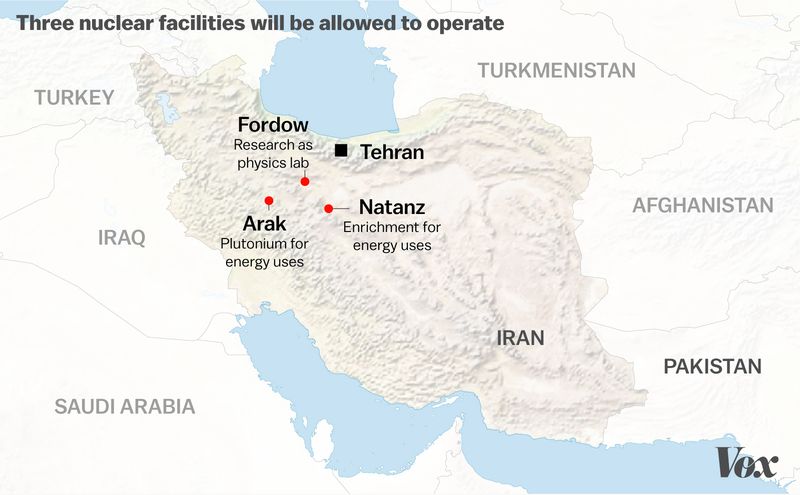
The bold text at the top of the map above is misleading. Iran currently has 18 nuclear facilities and nine additional locations (all hospitals) where nuclear material is used. All of these facilities – not just three, as Vox says – will continue to operate. All of them have long been declared to the International Atomic Energy Agency (IAEA) and all are under agency safeguards and open to regular monitoring and inspection. At least four times a year for the past dozen years, the IAEA has consistently continued to “verify the non-diversion of declared nuclear material at these facilities” to military and weaponization programs.
The three facilities Zarracina focuses on, however, are especially important. Two – Natanz and Fordow – are operational enrichment facilities; the other is a nuclear research reactor still under construction at the Arak complex.
In his explanation of the limitations Iran has accepted on its nuclear program, Zarracina claims the following:
The Arak facility matters because Iran has used it to develop plutonium, another nuclear fuel that can be used for energy or for a weapons program. Iran will be required to restructure its plutonium plant at Arak such that it will only make energy-grade plutonium, and will ship out its spent plutonium. The Arak facility will also be monitored.
Each of Zarracina’s three sentences contains either egregious errors or is explicitly misleading. His explanation is, as a result, just the opposite – an embarrassing exercise in ignorance and disinformation.
Let’s take the sentences one by one:
“The Arak facility matters because Iran has used it to develop plutonium, another nuclear fuel that can be used for energy or for a weapons program.”
For starters, the reactor at Arak remains under construction and has never been operational; therefore, Iran has never – ever – “used it to develop plutonium.” The reactor has in fact never been “used” to do anything. It’s never even been turned on.
Zarracina is clearly confused as to what facilities Arak contains, what those facilities do, and what Iran has done with these facilities. At Iran’s Arak complex, two facilities are relevant in this discussion: one is the IR-40 heavy water research reactor, the other is a heavy water production plant (HWPP). There is no such thing as a “plutonium plant” on the site.
The half-built IR-40 reactor is under full IAEA safeguards and is visited regularly by inspectors; the production plant, however, is not under safeguards and thus not legally subject to inspections. This is less alarming than it might sound and here’s why: heavy water is not nuclear material, it merely acts as a moderator and coolant in nuclear reactors that use natural uranium rather than enriched uranium. Still, Iran voluntarily provided IAEA inspectors access to HWPP in August 2011 and again in December 2013, even though this exceeded Iran’s legal obligations to the agency.
The IR-40 reactor at Arak – like all reactors – produces energy, not nuclear fuel. It runs on nuclear fuel. And once that fuel is used, it becomes irradiated and must be extracted from the reactor and replaced with new fuel.
All reactors that use uranium (natural or enriched) as fuel produce plutonium as a waste product. Ever heard of nuclear waste? Yeah, that includes plutonium, which hypothetically can be used to produce nuclear weapons. The amount of weapons-capable plutonium produced as a byproduct in the spent nuclear fuel of a heavy water reactor is usually more than what naturally occurs in the spent fuel from light water reactors, which run on enriched uranium and use normal water as coolant. This is why the Arak reactor in particular is considered by some to be an unacceptable proliferation risk.
But there’s more: weapons-grade plutonium present in irradiated (used) fuel must be extracted through a process known as reprocessing before it can be used for anything else. Iran has no reprocessing facility and has for years agreed never to build one. The new Iran deal simply reaffirms this past decision.
As nuclear expert Martin Sevior has explained, “Going the plutonium route to nuclear weapons is more difficult than using highly enriched uranium” because Iran “would have to build a sophisticated reprocessing plant which would be very hard to conceal while constructing, and requires even greater skill to conceal while operating.” Considering Iran has the single most scrutinized nuclear energy program on the planet and is constantly spied on by its adversaries,
Vox‘s writers seem to think that once a heavy water reactor is switched on, out pops weapons-grade plutonium, ready to be loaded into the nose cone of a ballistic missile bound for Tel Aviv or Boca Raton. This is not the case.
“Iran will be required to restructure its plutonium plant at Arak such that it will only make energy-grade plutonium, and will ship out its spent plutonium.”
Ok, again, there is no such thing as a “plutonium plant at Arak,” so that’s wrong. As part of the final agreement between Iran and its six negotiating partners, the Arak reactor will be redesigned and rebuilt so that it runs on 3.67% enriched uranium, not natural uranium, and no longer produces weapons-grade plutonium as a waste product. This essentially means Arak will be converted from a heavy water reactor to a light water reactor.
Once operational, the Arak reactor will be used for “peaceful nuclear research and radioisotope production for medical and industrial purposes,” just as Iran originally intended.
Zarracina compounds his misunderstanding of what nuclear reactors do and what they produce with the claim that Iran “will ship out its spent plutonium.” Reactors don’t produce “spent plutonium.” They produce spent uranium, the substance that actual fuels reactors, which, after irradiation, contains (along with many other radioactive byproducts) both plutonium isotopes Pu-239, which is suitable for weapons, and Pu-241, which is not. Plutonium enriched to more than 97% Pu-239 is dangerous; the more it is contaminated by Pu-241, the less danger it poses. The length of time nuclear fuel stays in a reactor determines how much of each plutonium isotope is leftover once the fuel is used up and removed from the reactor core. The longer the fuel stays in the less Pu-239 there is and the more Pu-241 there is. That’s why Pu-239, which is combustible, is referred to as “weapons grade,” while Pu-241 is known as “reactor-” or “energy-grade” plutonium. None of this plutonium, in whatever form, is used to fuel reactors; it is the byproduct of fuel, not the fuel itself.
And, again, for this plutonium byproduct to ever be used in a nuclear weapon, it must first be isolated and extracted from the spent fuel through reprocessing, which Iran is not incapable of – and not interested in – doing.
“The Arak facility will also be monitored.”
Ok, here’s an easy one. In simple terms, yes, Zarracina is correct. Arak will be monitored. But this statement is misleading without context. As mentioned already, Arak is already monitored by the IAEA – this is not a new development as a positive consequence of the Iran deal. Zarracina makes it sound like Iran finally agreed to put Arak under IAEA safeguards, but that’s not even remotely true.
In truth, even before Hassan Rouhani was elected president, Iran’s delegates to the IAEA under Mahmoud Ahmadinejad were urging international “nuclear monitors to use powerful new detection technologies to dispel international concern that the Persian Gulf country is seeking to build atomic weapons,” reported Bloomberg News. “We always welcome the agency to have more sophisticated equipment, to have more accuracy in their measurements, so that technical matters will not be politicized,” Iranian Ambassador to the IAEA Ali Asghar Soltanieh said in early June 2013, adding that Iran “won’t object to IAEA monitors using new technologies to determine whether plutonium is being extracted from spent fuel at its new reactor in Arak.”
Ignoring Facts and Avoiding Responsibility
Writers and editors at Vox have a responsibility not to mislead their readers. Sure, nuclear technology is complex and journalists on deadline don’t always have time to study a lot of the details. But once errors are pointed out, Vox‘s editors should do their best to own up to and correct their mistakes and those of their writers. When it comes to their Iran coverage, this tends not to happen at Vox. Quite the contrary, fact-checking Vox on Iran’s nuclear program often results in hostility and dismissal from Vox staff.
At the very least, Vox should immediately stop referring to the research reactor at Arak as a “plutonium plant.” This is easy to do: call it what it is and stop misleading readers. Instead, due to either a stubborn allegiance to ignorance or extreme laziness, Vox has continued to misinform it audience about the Iranian nuclear program. Unless facile and faulty explanations are its editorial mission, Vox should do better.
Vaccines and National Security
By Ulson Gunnar – New Eastern Outlook – 04.05.2015
One can easily see in the emerging information and cyber war that a nation having its own IT infrastructure, its own hardware, and its own versions of social media platforms is quickly becoming a matter of national security. Without control over these assets, a nation must depend on foreign suppliers for their computers, peripheries and software. Already, this dependence has opened nations up to now evident threats including malware embedded into hardware and software that is otherwise impossible to detect until the damage is already done.
Likewise, a nation’s food supply can and has throughout history, been a source of vulnerability in times of conflict. The inability to grow one’s own food invites blockades and their modern equivalent, sanctions, undermining a nation’s strength and stability and eventually setting the stage for its ultimate demise. Iraq is an example of this.
In the long-term, a nation’s food supply controlled by foreign corporations, particularly in the realm of genetically engineered organisms, can have disastrous effects. As a nation’s wealth is slowly drained from their shores and into the coffers of corporations like Bayer, Monsanto and Syngenta, inferior, expensive and environmentally devastating crops wreak havoc on the very socioeconomic fabric of a nation. India is increasingly becoming an example of this.
And what of healthcare? Surely the same applies. But even as nations and communities are just now understanding the importance of protecting their food supplies from predatory multinational corporations and the hegemonic ambitions they represent, there seems to be some latency in understanding this likewise in regards to healthcare and in particular pharmaceuticals and vaccines.
The Danger of Big-Pharma’s Vaccines
Imagine a gang member knocking at your door with a syringe in one hand, demanding you roll up your sleeve and allow him to inject its contents into your bloodstream. Likely there would be no hesitation to call the police and barricade the door until they arrived. Allowing a criminal to inject a substance known or unknown into your body would be an unimaginable risk no sane person would accept.
Now imagine that gang member is wearing a suit, has a multi-million dollar marketing budget, doctors and researchers working for him (paid via an expansive bribery network) and instead of knocking at your door, he invited you to one of his doctors’ offices to receive the injection. What we’ve just done here is describe big-pharma.
Immense pharmaceutical corporations like GlaxoSmithKline (GSK) have been caught numerous times engaged in immense criminality.
In 2012, the London Guardian would report in its article GlaxoSmithKline fined $3bn after bribing doctors to increase drugs sales that:
The pharmaceutical group GlaxoSmithKline has been fined $3bn (£1.9bn) after admitting bribing doctors and encouraging the prescription of unsuitable antidepressants to children. Glaxo is also expected to admit failing to report safety problems with the diabetes drug Avandia in a district court in Boston on Thursday.
The company encouraged sales reps in the US to mis-sell three drugs to doctors and lavished hospitality and kickbacks on those who agreed to write extra prescriptions, including trips to resorts in Bermuda, Jamaica and California.
In early 2014, the London Telegraph would report in its article GlaxoSmithKline ‘bribed’ doctors to promote drugs in Europe, former worker claims that:
GlaxoSmithKline, Britain’s largest drug company, has been accused of bribing doctors to prescribe their medicines in Europe.
Doctors in Poland were allegedly paid to promote its asthma drug, Seretide, under the guise of funding for education programme, a former sales rep has claimed.
Medics were also said to have been paid for lectures in the country which did not take place.
Then in late 2014, the BBC would report in its article GlaxoSmithKline fined $490m by China for bribery that:
China has fined UK pharmaceuticals firm GlaxoSmithKline $490m (£297m) after a court found it guilty of bribery.
The record penalty follows allegations the drug giant paid out bribes to doctors and hospitals in order to have their products promoted.
The court gave GSK’s former head of Chinese operations, Mark Reilly, a suspended three-year prison sentence and he is set to be deported.
These three news stories establish without doubt that an immense pharmaceutical giant, still allowed to conduct business to this very day, has been engaged in systematic, global criminality. The first story regarding its criminal conduct in the United States should be of particular concern, where the pharmaceutical giant encouraged doctors to peddle harmful substances to children. How exactly is that any different than your local pusher?
And it should be alarming to know that GSK is one of several pharmaceutical giants promoting the use of vaccines. Who would trust vaccines produced and peddled by the same corporation convicted multiple times of immense fraud, corruption and the endangerment of children?
But corrupt corporations peddling poison for profits still isn’t the greatest danger. State sanctioned bioweapons masquerading as vaccines is.
South Africa’s Vaccines Against “Being Black”
 The apartheid regime in South Africa infamously waged war on its black population. So intent was the regime on subduing and/or exterminating black communities, its biological warfare program began developing a bioweapon that would infect only blacks, and planned to administer it covertly under the cover of a vaccine program.
The United Nations in a report titled Project Coast: Apartheid’s Chemical and Biological Warfare Programme would admit:
One example of this interaction involved anti-fertility work. According to documents from RRL [Roodeplaat Research Laboratories], the facility had a number of registered projects aimed at developing an anti-fertility vaccine. This was a personal project of the first managing director of RRL, Dr Daniel Goosen. Goosen, who had done research into embryo transplants, told the TRC that he and Basson had discussed the possibility of developing an anti-fertility vaccine which could be selectively administered—without the knowledge of the recipient. The intention, he said, was to administer it to black South African women without their knowledge.
Unscrupulous corporations with global reach, married to unscrupulous ideologies seeking to covertly kill off entire segments of their population constitutes nightmare scenarios generally confined to the realm of science fiction. However, here are the ingredients, right before our very eyes.
Vaccines and National Security
It is very clear then, why communities and nations must take control of their healthcare systems entirely. Not a single aspect of it can depend on foreign suppliers any more than national IT infrastructure, the food supply, power production, or military hardware can.
No nation would “outsource” the protection of its head of state to foreigners. Why would they outsource the protection of their people’s health? Dependence on big-pharma has already put countless lives in danger with untold disease, disabilities and death following in the wake of their unhinged global criminality. It should be noted, that despite their rampant criminality, they are all still very much in business, a testament to the unwarranted power and influence their immense profits and the lobbying efforts they purchase has afforded them.
If vaccines are determined to be beneficial to a nation’s population, they should be developed by that nation and administered only by that nation. There should be no multinational pharmaceutical corporations, because no nation should leave their population’s health to the whims of foreign entities who have already demonstrated the well-being of their customers is the least of their concerns.
And while nations taking up this responsibility and pushing out foreign pharmaceutical corporations is a good start, one must still consider the case of South Africa, where a government sought to destroy entire communities within their borders under the guise of vaccination programs. Individual communities and individuals themselves would be wise to think twice before allowing anyone to inject something into their body.
If vaccinations are so important, then the information required to make them should be made open source and all invited to examine how and why they are made and how to make them in community laboratories located at local universities and hospitals. If that can’t be done, then they probably aren’t that important to begin with nor any more legitimate or necessary than the dangerous antidepressants GSK peddled to little children in America, and surely something society could do well without.
The Fake War on ISIS: US and Turkey Escalate in Syria
By Eric Draitser – New Eastern Outlook – 02.08.2015
It is late July 2015, and the media is abuzz with the news that Turkey will allow US jets to use its bases to bomb Islamic State (ISIS) targets in Syria. There is much talk about how this development is a “game-changer,” and how this is a clear escalation of the much ballyhooed, but more fictional than real, US war on ISIS: the terror organization that US intelligence welcomed as a positive development in 2012 in their continued attempts to instigate regime change against the Syrian government led by Bashar al-Assad.
The western public is told that “This is a significant shift… It’s a big deal,” as a US military official told the Wall Street Journal. What the corporate media fail to mention, however, is the fact that Turkey has been, and continues to be, a central actor in the war in Syria and, consequently, in the development and maintenance of ISIS. So, while Washington waxes poetic about stepping up the fight against the terror group, and lauds the participation of its allies in Ankara, the barely concealed fact is that Turkey is merely further entrenching itself in a war that it has fomented.
Of equal importance is the simple fact that a “war on ISIS” is merely a pretext for Turkey’s military engagement in Syria and throughout the region. Not only does Turkey’s neo-Ottoman revanchist President Erdogan want to flex his military muscles in order to further the regime change agenda in Syria, he also is using recent tragic events as political and diplomatic cover for waging a new aggressive war against the region’s Kurds, especially Turkey’s longtime foe the Kurdish Workers Party (PKK).
In this way, Turkey’s recent moves should be seen as merely a new phase of its engagement in the regional war that it has helped foment. Contrary to western corporate media talking points, Turkey has not just recently become actively engaged in the conflict; Ankara has merely shifted its strategy and its tactics, moving from covert engagement to overt participation.
Same War, New Phase
The immediate justification for the launching of renewed airstrikes by Turkey and the US is the expansion of the war against ISIS. In the wake of the bombing in Turkey’s majority Kurdish town of Suruç, which killed 32 youth activists, the Turkish government has allegedly struck hard against both ISIS and PKK targets. It is against this backdrop that any analysis of the new phase of this war must be presented.
First and foremost is the fact that even if one were to accept the Turkish government’s official story – the suicide bomber was linked to the Islamic State (ISIS) – not at all a certainty, the question of ultimate responsibility becomes central. While Ankara would have the world believe that its hands are clean, and that it is the innocent victim of international terrorism, the reality is that Turkey has done everything to foster and promote the growth of ISIS from the very beginning. As such, it is the Turkish government who must shoulder much of the blame for the Suruç bombing.
Since at least 2012, Turkey has been the principal conduit for weapons flowing into Syria. In June of that year, the NY Times confirmed that the CIA was smuggling weapons to anti-Assad forces from the Turkish side of the border using agents of the Syrian Muslim Brotherhood, long-time assets of US intelligence. Also in 2012, Reuters revealed that Turkey had “set up a secret base with allies Saudi Arabia and Qatar to direct vital military and communications aid to Syria’s rebels from a city near the border… ‘It’s the Turks who are militarily controlling it. Turkey is the main coordinator/facilitator. Think of a triangle, with Turkey at the top and Saudi Arabia and Qatar at the bottom,’ said a Doha-based source.”
It is now also documented fact that Turkish intelligence (MIT) has been an active player in the ongoing campaign to arm and resupply the terror groups such as the al Nusra Front and others. The evidence of this fact was made public by the Turkish daily Cumhuriyet which published video footage along with transcripts from wiretaps confirming what many eyewitnesses have stated: Turkish security forces have been directly involved in shelling and support operations for Nusra front and other jihadi groups in and around Kassab, Syria, among other sites. Many of the very same terrorists who have been armed and supported by the Turkish government are today being held up as enemies of Turkey, and rationalization of the need for Turkish military intervention.
So, with the inescapable understanding that Turkey’s government is the primary supporter and sponsor of terrorist groups in Syria, the justification for war becomes flimsy at best. But, if it’s not about fighting terror, then what exactly is Ankara’s objective? What does it hope to gain?
At the top of Erdogan’s agenda is using ISIS as a pretext for effecting the regime change in Syria that he has failed to bring about for these past four years. Despite providing weapons and cash, training sites and political cover, Turkey’s terror proxies have been roundly defeated by the Syrian Arab Army, Hezbollah, and allied forces. As such, Erdogan now needs to provide the overwhelming military superiority required to get the job done. This means air support and a “No Fly Zone” along the Turkey-Syria border, one which ostensibly will allow Turkey to fight ISIS, but in actuality is a means of securing territory for the terrorists who otherwise have been unable to do so. It is a de facto military intervention into Syria. Perhaps not even de facto, but outright declaration of war – a clear war crime.
Secondly, the alleged war on ISIS is a politically expedient cover for Erdogan to wage a full-scale war on the Kurds, and the PKK specifically. Within hours of announcing the new phase of the war, Turkish forces were bombing Kurdish targets in Syria and Iraq, effectively declaring war on both countries, in blatant violation of international law, to whatever extent such a thing still exists. Indeed, Erdogan made his position quite clear when he stated, “It is not possible for us to continue the peace process with those who threaten our national unity and brotherhood.” Essentially, Erdogan has declared war on all Kurds of the region.
Perhaps most important, and almost never discussed in the West, is the simple fact that Turkey is perpetuating an outright myth in their supposed strategy to create “Islamic State-free zones” along the border; Turkey plans to work with “moderate opposition” and “Free Syrian Army” in this endeavor. However, the fact remains that there is really no such thing as the “moderates,” and those terrorists that had at one time been labeled such have all either gone home, fled the country, gone over to the Al Qaeda-affiliated Nusra Front, or are now fighting under the ISIS banner. And so, by stating such a plan, Erdogan is unwittingly admitting what this author has already reported numerous times – Turkey acts as military muscle for ISIS and al Qaeda in Syria and now Iraq.
But of course, were Turkey the only relevant party, these developments would not be of nearly the same global significance. Rather, it is the participation and collusion of the US and NATO that makes this troubling escalation far more dangerous.
Making Overt the Covert War
As of writing, NATO has not yet been convened to discuss Turkey’s war on Syria and the Kurds, though Ankara has called for the meeting under Article 4 of the NATO treaty which provides for consultation, but not necessarily collaborative military action. However, regardless of how the meeting proceeds, Turkey has been given overt support in its war by the US, which is, in effect, NATO.
Although the US feigns concern for the Kurds and the expansion of the war, Washington has in fact endorsed Turkey’s policy. White House spokesman Alistair Baskey noted that the US “strongly condemns” recent attacks by the PKK, reiterating the fact that Turkey is an important US and NATO ally. As Obama’s close adviser on national security matters Ben Rhodes stated, “The US, of course, recognises the PKK specifically as a terrorist organisation. And, so, again Turkey has a right to take action related to terrorist targets.”
While it would appear that Washington is taking a measured approach, cautiously supporting Turkey while trying to limit the scope of the operation, that illusion is merely for appearance’s sake. In fact, the Brookings Institution just last month issued a policy paper entitled Deconstructing Syria: Towards a regionalized strategy for a confederal country, which brazenly laid out a plan to, as political analyst Tony Cartalucci astutely pointed out, “divide, destroy, then incrementally occupy” Syria using the pretext of ISIS and terrorism. And that is precisely what we’re witnessing now.
But neither Cartalucci, nor this author, nor any other colleagues who have predicted this turn of events are clairvoyant. Rather, this development was very much expected. As noted above, those terrorists who now provide the rationale for a new war were the very same ones openly supported by the countries now waging the war. It was clear at the time that this would be their ultimate role. Sadly, the world has not effectively mobilized to stop this imperialist war thus far.
The question remains: will Syria survive? The answer depends on the continued resolve of the Syrian Arab Army and its allies, and on the global Resistance’s capacity to organize itself to effectively oppose the Empire in Syria and beyond.
Ecuador’s Indigenous Groups Question Call for ‘Uprising’

Many indigenous groups have opted to enter the national dialogue (teleSUR)
teleSUR | July 30, 2015
Many in Ecuador’s robust indigenous movement are questioning a call by the Confederation of Indigenous Nationalities of Ecuador, also known as CONAIE, for a national uprising against the government of President Rafael Correa.
CONAIE has rejected a call for dialogue sponsored by the government and have instead have called for an indigenous-led uprising, which will begin with marches on Aug. 2 in the Zamora province and conclude in Quito for an uprising on Aug. 10.
“Everyone needs to know that CONAIE is not the only indigenous voice in the country,” Franklin Columba, leader of the National Confederation of Campesino, Indigenous and Black Organizations (FENOCIN) told teleSUR English on Thursday. “Here there are many organizations that also have their own processes.”
CONAIE’s demands are varied. For many indigenous activists government withdrawal from their land and a repeal of water laws are essential. Others have joined protests lead by the wealthy right-wing opposition leaders that have rejected of the capital gains bill and inheritance tax proposed by the national government to redistribute wealth.
“This march is to try and force the national government reconsider its political positions that they have been imposing. This uprising is demanding that the national government give concrete responses to our historic demands, our concrete demands in this country,” said President of CONAIE Jorge Herrera to the press.
The organization has taken a hardline to those who question their tactics, saying that they will sanction indigenous leaders who refuse to participate in the August uprising.
Columba told teleSUR that FENOCIN has rejected CONAIE’s uprising and it’s call for a national strike because “we as a national organization are not going to lend ourselves to playing the right’s game,” referring to the wealthy right-wing opposition who have used the momentum of current protests to denounce laws to redistribute the wealth in the country.
This is not the first indigenous uprising which has been called for in Ecuador. Indigenous nationalities from across the country converged on Quito on May 28, 1990. They blocked highways, held hunger strikes and occupied public spaces until they reached an agreement with the national government on June 11.
During the 1990 uprising CONAIE received popular support, as many of their demands represented those who lived harsh lives in Ecuadorean society. The movement is today under new leadership, and analysts have pointed to the fact that Pachakutik, the political party representing CONAIE, seems to be forging alliances with right-wing parties like former presidential candidate Guillermo Lasso’s CREO party.
“The alliances which we have seen Pachakutik make, the political arm, party of the indigenous movement of CONAIE and the Ecuarunari movement, are with right-wing groups. They are having meetings. This is a blow to their own ideological principles. They have always said that any type of relationship with the right would be impossible, because of what the right stands for,” said analyst Werner Vasquez to teleSUR English.
“(The right-wing) is the symbol of historic repression and exploitation suffered by the indigenous population. So it seems impossible to try to understand these alliances. I think it comes from them wanting to align themselves with those who are also opposed to the Citizen’s Revolution, and who have a common enemy, which is the state.”
Many indigenous organizations who participated in the 1990 uprising today feel that CONAIE no longer represents their interests. Some organizations, like FEI, agree that the land and water laws need to be revised, but they have chosen to participate in the National Dialogue on Equality and Social Justice to discuss these measures.
“We have proposed for this dialogue to cover fundamental issues, transcendental issues, like the agrarian revolution, also putting this in the context of diversifying production in the country, to support small and medium scale producers, campesinos and indigenous peoples,” said Jose Agualsaca, president of the Indigenous Federation of Ecuador (FEI) following a meeting with representatives of the national government to teleSUR English.
He went on to say, “We believe that these marches and this uprising wants to destabilize the country, and what they really want is to overthrow President Rafael Correa from power. But it would not end there, they want to take him out, then convoke a new constitutional assembly, and make a new constitution which would serve the interests of the richest sectors of society. This is the position of the FEI.”
Indigenous organizations across Ecuador are finding themselves at odds with CONAIE’S leadership, which has been viewed as moving further and further away from its historic support base. These groups are opting for dialogue, discussing their concerns and ideas with national authorities, in an effort to become key participants in constructing the future of the country.
Why Russia Shut Down NED Fronts
By Robert Parry | Consortium News | July 30, 2015
The Washington Post’s descent into the depths of neoconservative propaganda – willfully misleading its readers on matters of grave importance – apparently knows no bounds as was demonstrated with two deceptive articles regarding Russian President Vladimir Putin and why his government is cracking down on “foreign agents.”
If you read the Post’s editorial on Wednesday and a companion op-ed by National Endowment for Democracy President Carl Gershman, you would have been led to believe that Putin is delusional, paranoid and “power mad” in his concern that outside money funneled into non-governmental organizations represents a threat to Russian sovereignty.
The Post and Gershman were especially outraged that the Russians have enacted laws requiring NGOs financed from abroad and seeking to influence Russian policies to register as “foreign agents” – and that one of the first funding operations to fall prey to these tightened rules was Gershman’s NED.
The Post’s editors wrote that Putin’s “latest move, announced Tuesday, is to declare the NED an ‘undesirable’ organization under the terms of a law that Mr. Putin signed in May. The law bans groups from abroad who are deemed a ‘threat to the foundations of the constitutional system of the Russian Federation, its defense capabilities and its national security.’
“The charge against the NED is patently ridiculous. The NED’s grantees in Russia last year ran the gamut of civil society. They advocated transparency in public affairs, fought corruption and promoted human rights, freedom of information and freedom of association, among other things. All these activities make for a healthy democracy but are seen as threatening from the Kremlin’s ramparts. …
“The new law on ‘undesirables’ comes in addition to one signed in 2012 that gave authorities the power to declare organizations ‘foreign agents’ if they engaged in any kind of politics and receive money from abroad. The designation, from the Stalin era, implies espionage.”
But there are several salient facts that the Post’s editors surely know but don’t want you to know. The first is that NED is a U.S. government-funded organization created in 1983 to do what the Central Intelligence Agency previously had done in financing organizations inside target countries to advance U.S. policy interests and, if needed, help in “regime change.”
The secret hand behind NED’s creation was CIA Director William J. Casey who worked with senior CIA covert operation specialist Walter Raymond Jr. to establish NED in 1983. Casey – from the CIA – and Raymond – from his assignment inside President Ronald Reagan’s National Security Council – focused on creating a funding mechanism to support groups inside foreign countries that would engage in propaganda and political action that the CIA had historically organized and paid for covertly. To partially replace that CIA role, the idea emerged for a congressionally funded entity that would serve as a conduit for this money.
But Casey recognized the need to hide the strings being pulled by the CIA. “Obviously we here [at CIA] should not get out front in the development of such an organization, nor should we appear to be a sponsor or advocate,” Casey said in one undated letter to then-White House counselor Edwin Meese III – as Casey urged creation of a “National Endowment.”
NED Is Born
The National Endowment for Democracy took shape in late 1983 as Congress decided to also set aside pots of money — within NED — for the Republican and Democratic parties and for organized labor, creating enough bipartisan largesse that passage was assured. But some in Congress thought it was important to wall the NED off from any association with the CIA, so a provision was included to bar the participation of any current or former CIA official, according to one congressional aide who helped write the legislation.
This aide told me that one night late in the 1983 session, as the bill was about to go to the House floor, the CIA’s congressional liaison came pounding at the door to the office of Rep. Dante Fascell, a senior Democrat on the House Foreign Affairs Committee and a chief sponsor of the bill. The frantic CIA official conveyed a single message from CIA Director Casey: the language barring the participation of CIA personnel must be struck from the bill, the aide recalled, noting that Fascell consented, not fully recognizing the significance of the demand.
The aide said Fascell also consented to the Reagan administration’s choice of Carl Gershman to head the National Endowment for Democracy, again not recognizing how this decision would affect the future of the new entity and American foreign policy. Gershman, who had followed the classic neoconservative path from youthful socialism to fierce anticommunism, became NED’s first (and, to this day, only) president.
Though NED is technically independent of U.S. foreign policy, Gershman in the early years coordinated decisions on grants with Raymond at the NSC. For instance, on Jan. 2, 1985, Raymond wrote to two NSC Asian experts that “Carl Gershman has called concerning a possible grant to the Chinese Alliance for Democracy (CAD). I am concerned about the political dimension to this request. We should not find ourselves in a position where we have to respond to pressure, but this request poses a real problem to Carl.”
Currently, Gershman’s NED dispenses more than $100 million a year in U.S. government funds to various NGOs, media outlets and activists around the world. The NED also has found itself in the middle of political destabilization campaigns against governments that have gotten on the wrong side of U.S. foreign policy. For instance, prior to the February 2014 coup in Ukraine, overthrowing elected President Viktor Yanukovych and installing an anti-Russian regime in Kiev, NED was funding scores of projects.
A second point left out of the Post’s editorial was the fact that Gershman took a personal hand in the Ukraine crisis and recognized it as an interim step toward regime change in Moscow. On Sept. 26, 2013, Gershman published an op-ed in the Washington Post that called Ukraine “the biggest prize” and explained how pulling it into the Western camp could contribute to the ultimate defeat of Russian President Putin.
“Ukraine’s choice to join Europe will accelerate the demise of the ideology of Russian imperialism that Putin represents,” Gershman wrote. “Russians, too, face a choice, and Putin may find himself on the losing end not just in the near abroad but within Russia itself.” In other words, NED is a U.S. government-financed entity that has set its sights on ousting Russia’s current government.
A third point that the Post ignored is that the Russian law requiring outside-funded political organizations to register as “foreign agents” was modeled on a U.S. law, the Foreign Agent Registration Act. In other words, the U.S. government also requires individuals and entities working for foreign interests and seeking to influence U.S. policies to disclose those relationships with the U.S. Justice Department or face prison.
If the Post’s editors had included any or all of these three relevant factors, you would have come away with a more balanced understanding of why Russia is acting as it is. You might still object but at least you would be aware of the full story. By concealing all three points, the Post’s editors were tricking you and other readers into accepting a propagandistic viewpoint – that the Russian actions were crazy and that Putin was, according to the Post’s headline, “power mad.”
Gershman’s Op-Ed
But you might think that Gershman would at least acknowledge some of these points in his Post op-ed, surely admitting that NED is financed by the U.S. government. But Gershman didn’t. He simply portrayed Russia’s actions as despicable and desperate.
“Russia’s newest anti-NGO law, under which the National Endowment for Democracy on Tuesday was declared an “undesirable organization” prohibited from operating in Russia, is the latest evidence that the regime of President Vladimir Putin faces a worsening crisis of political legitimacy,” Gershman wrote, adding:
“This is the context in which Russia has passed the law prohibiting Russian democrats from getting any international assistance to promote freedom of expression, the rule of law and a democratic political system. Significantly, democrats have not backed down. They have not been deterred by the criminal penalties contained in the ‘foreign agents’ law and other repressive laws. They know that these laws contradict international law, which allows for such aid, and that the laws are meant to block a better future for Russia.”
The reference to how a “foreign agents” registration law conflicts with international law might have been a good place for Gershman to explain why what is good for the goose in the United States isn’t good for the gander in Russia. But hypocrisy is a hard thing to rationalize and would have undermined the propagandistic impact of the op-ed.
So would an acknowledgement of where NED’s money comes from. How many governments would allow a hostile foreign power to sponsor politicians and civic organizations whose mission is to undermine and overthrow the existing government and put in someone who would be compliant to that foreign power?
Not surprisingly, Gershman couldn’t find the space to include any balance in his op-ed – and the Post’s editors didn’t insist on any.
~
Investigative reporter Robert Parry broke many of the Iran-Contra stories for The Associated Press and Newsweek in the 1980s. You can buy his latest book, America’s Stolen Narrative, either in print here or as an e-book (from Amazon and barnesandnoble.com).
Russian Duma dares to limit Imperial power
OffGuardian | July 29, 2015
In a brazen move, designed to ensure that Russia is ruled by Russians, the Duma has passed laws limiting the powers of Non-Governmental Organisations (NGOs) to operate inside Russia. The first target being the National Endowment for Democracy. This is a terrible blow for freedom around the world, according to The Guardian, because the NED is simply an oasis of decency in Putin’s Empire of Evil:
The National Endowment for Democracy, a Washington-based nonprofit funded largely by the US Congress, has become the first group to be banned in Russia under a law against “undesirable” international nongovernmental organisations.
According to its website, the National Endowment for Democracy (NED) is “dedicated to the growth and strengthening of democratic institutions around the world” and has funded local non-governmental organisations in more than 90 countries. But in a statement on Tuesday, the prosecutor general’s office said it “poses a threat to the constitutional order of the Russian Federation and the defensive capability and security of the government”. [our emphasis]
Really? Really Guardian ? In order to inform us about what the NED is you just went to their own website and did copy/paste? Even the HuffPo, which is no one’s idea of hard-hitting investigative journalism can do better than that. Here’s an article it published by Mark Taliano about the NED:
Democracy is usually the first victim of the National Endowment for Democracy (NED), a U.S. agency that promotes the U.S Empire’s foreign policy beneath the false guise of “promoting democracy”.
Considered a “soft” tool of Empire, NED and its subsidiaries work to transform societal fissures in target countries into gaping holes, through which covert agendas can metastize before exploding into illegal regime changes.
Funding flows from the congressional budget of USAID, to NED and its subsidiaries, and finally to factions within target countries whose political economies do not align with globalized economic models of monopoly capitalism.
Beneath NED’s democratic veneer is a Board of Directors replete with members who also represent Fortune 500 companies. Additionally, board members include signatories to the pro-war, pro-corporatocracy think tank Project For A New American Century: Francis Fukuyama, Zalmay Khalizad, Will Marshall, and Vin Weber.

You’ll notice they don’t say whose freedom.
Which makes the Russian Duma’s decision to boot these guys out a tad more understandable, no?
Since the Graun apparently doesn’t do its own research any more, maybe it could at least copy/paste the Huff’s article in place of the contents from NED’s own About page? Or will that conflict with their GCHQ brief?
Why Obama’s “Safe Zone” in Syria Will Inflame the War Zone
By Shamus Cooke | CounterPunch | July 31, 2015
The road to war is paved with a thousand lies. A fresh fib was tossed on the lie-cluttered warpath to Syria, when it was announced that the U.S. and Turkey would create a “safe zone” inside of Syria — supposedly to be aimed against ISIS.
This “safe zone” is a major escalation of war, but it was described in soft tones by the media. In reality a “safe zone” is a “no-fly zone,” meaning that a nation is planning to implement military air superiority inside the boundaries of another nation. It’s long recognized by the international community and U.S. military personnel as a major act of war. In a war zone an area is made “safe” by destroying anything in it or around that appears threatening.
Turkey has been demanding this no-fly zone from Obama since the Syrian war started. It’s been discussed throughout the conflict and even in recent months, though the intended target was always the Syrian government.
And suddenly the no-fly zone is happening — right where Turkey always wanted it — but it’s being labeled an “anti-ISIS” safe zone, instead of its proper name: “Anti Kurdish and anti-Syrian government” safe zone.
The U.S. media swallowed the name change without blinking, but many international media outlets knew better.
For instance, the International Business Times reported “ [the safe zone deal]… could mark the end of [Syrian President] Assad…”
And the Middle East Eye reported:
“…[the safe zone] marks a breakthrough for Turkey in its confrontation with the Bashar al-Assad government in Syria. If the no-fly zone does come into being it will be a body blow for Assad and his supporters”
Even U.S. media outlets acknowledged that the primary goal of Obama’s safe zone ally, Turkey, was defeating the Kurdish fighters and the Syrian government, both of whom have been the most effective fighters against ISIS.
Syrian regime change is also the goal of the ground troops who will be filling the void left by ISIS, who the New York Times labeled “relatively moderate Syrian insurgents,” a telling euphemism.
The New York Times confirmed the goals of the safe zone allies:
“…both the Turks and the Syrian insurgents see defeating President Bashar al-Assad of Syria as their first priority…”
If the Syrian government wasn’t the target of the safe zone, then Syrian government troops would be the ones to control the safe zone post ISIS, as they did before ISIS. And if regime change wasn’t the target, then the Syrian government would have been consulted and coordinated with to attack ISIS, since Syria is involved with heavy fighting against ISIS in the same region that the safe zone is being carved out.
These steps weren’t taken because the “safe zone” plan is much bigger than ISIS.
Obama hasn’t detailed who the “relatively moderate” fighters are that will control the safe zone, but it’s easy to guess. We only have to look at the Syrian rebels on the ground who are effective fighters and control nearby territory.
The most powerful non-ISIS group in the region recently re-branded itself as the “Conquest Army,” a coalition of Islamic extremists led by Jabhat al-Nusra — the official al-Qaeda affiliate — and the group Ahrar al-Sham, whose leader previously stated that his group was “the real al Qaeda.” The Conquest Army actively coordinates with Turkey and Saudi Arabia, and is also populated with U.S.-trained fighters.
These groups share the ideology and tactics of ISIS, the only difference being their willingness to work with the United States and Turkey. It’s entirely likely that once the “safe zone” operation starts, many ISIS troops will simply change shirts and join Jabhat al-Nusra, since there is no principled difference.
Obama knows that the foreign ground troops controlling the “safe zone” are targeting the Syrian government; consequently, U.S. military planes will be acting as the de-facto air force for Al-Qaeda against the Syrian government.
Thus, direct military confrontation with the Syrian government is inevitable. President Assad is already attacking ISIS in the area that the U.S.-Turkey alliance wants to make “safe” via its coordinated military operation. Syrian fighter jets will eventually be targeted, since the goal is to allow extremist groups a “safe zone” to continue their attacks on the Syrian government after ISIS is dealt with.
This danger was also acknowledged by the New York Times:
“Whatever the goal, the plan [safe zone] will put American and allied warplanes closer than ever to areas that Syrian aircraft regularly bomb, raising the question of what they will do if Syrian warplanes attack their partners [“relatively moderate rebels”] on the ground.”
The answer seems obvious: U.S. and Turkish fighter jets will engage with Syrian aircraft, broadening and deepening the war until the intended aim of regime change has been accomplished.
This is exactly how events developed in Libya, when the U.S.-NATO led a “no-fly zone” that was supposedly created to allow a “humanitarian corridor,” but quickly snowballed into its real goal: regime change and assassination of Libya’s president. This epic war crime is still celebrated by Obama and Hillary Clinton as a “victory,” while Libyans drown in the Mediterranean to escape their once-modern but now obliterated country.
If Obama’s goal in Syria was actually defeating ISIS, this could have been achieved at any time, in a matter of weeks. It would simply take a serious and coordinated effort with U.S. regional allies, while coordinating with the non-allies already fighting ISIS: Syria, Iran, and Hezbollah.
If Turkey, Saudi Arabia, Israel, and Jordan were involved in the fight on ISIS it would be quickly strangled of cash, guns, and troops, and be massively out-powered. War over.
The only reason this hasn’t happened is that the U.S. and its allies have always viewed ISIS as a convenient proxy against Syria, Hezbollah, and Iran, not to mention leverage against the Iran-friendly government of Iraq.
Turkey remains the biggest obstacle to defeating ISIS, since it’s been helping it for years. ISIS has long used the Turkish border to escape Syrian government attacks, seek medical assistance, and get supplies and reinforcements. ISIS is so welcomed inside Turkey that ISIS promotes Turkey on social media as the international transit hub for jihadis wanting to join ISIS. Turkish immigration and customs looks the other way as does the Turkish border control.
In discussing the “safe zone,” the U.S. media always ignore the concept of national sovereignty — the basis for international law. The boundaries of countries are sacred from the standpoint of international law. The only just war is a defensive one. When one country implements a no-fly zone in another country, national boundaries are violated and international law is broken by an act of war.
The Obama administration is aware of the above dynamics, but has again tossed caution to the wind as he did in 2013, during the ramp up to its aborted bombing campaign against the Syrian government.
A U.S.-Turkish no-fly zone will deepen an already regional war: Iran and Hezbollah have recently ramped up direct support of the Syrian government. As Turkish and the U.S. military enter the war space for the first time, confrontation is inevitable. Confrontation is the plan.
Viet Nam a Half Century Later

By David Swanson | War Is A Crime | July 30, 2015
Jimmy Carter called a war waged in Vietnam by the United States — a war that killed 60,000 Americans and 4,000,000 Vietnamese, without burning down a single U.S. town or forest — “mutual” damage. Ronald Reagan called it a “noble” and “just cause.” Barack Obama promotes the myth of the widespread mistreatment of returning U.S. veterans, denounces the Vietnamese as “brutal,” and has launched a 13-year, $65 million propaganda program to glorify what the Vietnamese call the American War:
As we observe the 50th anniversary of the Vietnam War, we reflect with solemn reverence upon the valor of a generation that served with honor. We pay tribute to the more than 3 million servicemen and women who left their families to serve bravely, a world away . . . They pushed through jungles and rice paddies, heat and monsoon, fighting heroically to protect the ideals we hold dear as Americans.
Which ideals might those have been? Remember, this was the bad war in contrast to which World War II acquired the ridiculous label “good war.” But the Pentagon is intent on undoing any accurate memory of Vietnam. Members of the wonderful organization, Veterans For Peace, meanwhile have launched their own educational campaign to counter the Pentagon’s at VietnamFullDisclosure.org, and the Vietnam Peace Commemoration Committee has done the same at LessonsOfVietnam.com. Already, the Pentagon has been persuaded to correct some of its inaccurate statements. Evidence of the extent of the killing in Vietnam continues to emerge, and it has suddenly become universally acceptable in academia and the corporate media to acknowledge that presidential candidate Richard M. Nixon secretly sabotaged peace talks in 1968 that appeared likely to end the war until he intervened. As a result, the war raged on and Nixon won election promising to end the war, which he didn’t do. There would seem to be at work here something like a 50-year limit on caring about treason or mass-murder. Imagine what it might become acceptable to say about current wars 50 years hence!
And yet, many lies about Vietnam are still told, and many truths are too little known. After Nixon sabotaged peace negotiations, U.S. and Vietnamese students negotiated their own People’s Peace Treaty, and used it to pressure Nixon to finally make his own.
“Suppose Viet Nam had not enjoyed an international solidarity movement, particularly in the United States,” writes Madame Nguyen Thi Binh. “If so, we could not have shaken Washington’s aggressive will.”
The People’s Peace Treaty began like this:
Be it known that the American and Vietnamese peoples are not enemies. The war is carried out in the names of the people of the United States and South Vietnam but without our consent. It destroys the land and people of Vietnam. It drains America of its resources, its youth and its honor.
We hereby agree to end the war on the following terms, so that both peoples can live under the joy of independence and can devote themselves to building a society based on human equality and respect for the earth. In rejecting the war we also reject all forms of racism and discrimination against people based on color, class, sex, national origin, and ethnic grouping which form the basis of the war policies, past and present, of the United States government.
1. The Americans agree to the immediate and total withdrawal of all U.S. forces from Vietnam.
2. The Vietnamese pledge that, as soon as the U.S. government publicly sets a date for total withdrawal, they will enter discussions to secure the release of all American prisoners, including pilots captured while bombing North Vietnam.”
Nine leaders of the U.S. antiwar movement of the 1960s have put their current thoughts down in a forthcoming book called The People Make the Peace: Lessons from the Vietnam Antiwar Movement. The movement of the 1960s and early 1970s was widespread and dynamic beyond what we know today. It was part of a wider culture of resistance. It benefitted from the novelty of televised war and televised protest. It benefitted from hugely flawed but better-than-today economic security, media coverage, and election systems, the impact of the draft, and — of course — the creativity and courage and hard work of peace activists.
Those contributing to this book, and who recently returned to Vietnam together, are Rennie Davis, Judy Gumbo, Alex Hing, Doug Hostetter, Jay Craven, Becca Wilson, John McAuliff, Myra MacPherson, and Nancy Kurshan. Their insights into the war, the Vietnamese culture, and U.S. culture, and the peace movement are priceless.
This was a war that Vietnamese and Americans killed themselves to protest. This was a war in which Vietnamese learned to raise fish in bomb craters. This was a war in which U.S. peace activists illegally traveled to Vietnam to learn about the war and work for peace. This is a war in which people still die from weapons that explode these many years later or from poisons that take this long to kill. Third-generation victims with birth defects live in the most contaminated areas on earth.
Nixon recorded himself fretting about the People’s Peace Treaty with his staff. Two years later, he eventually agreed to similar terms. In the meantime, tens of thousands of people died.
And yet the Vietnamese distinguish clearly, as they always did, U.S. peace advocates from the warmongering U.S. government. They love and honor Norman Morrison who burned himself to death at the Pentagon. They carry on without bitterness, hatred, or violence. The rage still roiling the United States from the U.S. Civil War is not apparent in Vietnamese culture. Americans could learn from Vietnamese attitudes. We could also learn the lesson of the war — and not treat it as a disease called “the Vietnam syndrome” — the lesson that war is immoral and even on its own terms counter-productive. Recognizing that would be the beginning of health.
Featured Video

Why Hamas Really Attacked Israel on Oct. 7
or go to
Aletho News Archives – Video-Images
From the Archives
Israel: Strategic Ally or Liability?
By Stephen Sniegoski | My Catbird Seat | June 12, 2010
The claim that Israel serves as a valuable ally for the United States is made by both pro-Zionists and much of the anti-war and anti-Zionist Left that is influenced by Noam Chomsky. As a result of the Gaza flotilla massacre, which has caused a world-wide uproar against Israel, the value of Israel to the United States is being publicly questioned in more mainstream foreign policy forums. … continue
Blog Roll
 Aletho News
- Why Hamas Really Attacked Israel on Oct. 7
- Declassified UK exposes British man who fought for ‘Israel’ in Gaza
- West’s death cult in a theater near you
- How the Yandex ‘Russian bots’ lie fell apart
- Burnham’s ‘Russia did Brexit’ ruse crumbles
- Estonia making movies and games to encourage war against Russia
- Four in five new UK jobs taken by foreigners – report
- Here’s what Trump’s latest U-turn really means for Russia and Ukraine
- The Houthis Are Not an Iranian Proxy
- Europe’s Energy Hypocrisy, Russian LNG Profits and US Dependence
- If Americans Knew
- Activists Abused By Israel Return to New Freedom Flotilla Mission
- 60 Minutes won’t tell the full truth about Israeli settler violence
- Nearly 50,000 women, girls killed or severely injured in Gaza since October 2023: UN Women
- ADL is working with AI companies to suppress alleged ‘antisemitism’
- Israeli occupation forces using social media surveillance unit to target hundreds of Palestinians in the West Bank
- Israel’s New – and Terrifying – Security Doctrine
- Israeli Attacks Kill Five in Gaza, Including a four-year-old and a woman
- Air Force Major Who Called for Trump’s Impeachment Held in Solitary Confinement
- It’s a Genocide, I’m Into It’: Seinfeld Mocks Protest over Palestinian Children Killed
- Universities fire dozens amid pressure from Zionist billionaires
- No Tricks Zone
- New Study Suggests Large Regions Of The Pacific Ocean Have Been Cooling For The Last 80 Years
- Germany’s Green Energy Debacle: High Energy Costs Force Kahla Porzellan to Close After 182 Years!
- New Study: 50 Years Of The Most Aggressive ‘Net Zero’ Policies Can Only Affect The Global Climate By 0.03°C
- US September “Heat” Was No Record…Many Records Set Decades Ago
- Latest European Green Energy Debacle; Portugal’s Largest Flagship Solar Park Insolvent!
- Green Energy Debacle: German Expert Professor Fritz Vahrenholt Warns Of Severe Economic And Social Consequences
- Two More Paleo Reconstructions Affirm Meters-Higher Sea Levels Across Ireland, Brazil 7000-6000 Years Ago
- New Study: Earth And Venus Surface Warmth Largely Explained By Convection And Lapse Rate, Not CO2 Or Radiation
- 2025 Nature Paper Claiming Worsening Global Drought Gets RETRACTED …Heavily Flawed
- New Study: ‘Global Drought Shows No Detectable Recent Acceleration Under Climate Warming’


