Were US Arms to Egypt Ever Really Frozen?
By PAUL GOTTINGER | CounterPunch | April 12, 2015
On February 31, Obama announced the lifting of what the New York Times called “an arms freeze on Egypt”.
The US arms export restrictions the Times is referring to had been put in place following a 2013 coup, which removed Egypt’s democratically elected president Mohamed Morsi.
This Times piece titled, “Obama Removes Weapons Freeze Against Egypt” states:
“President Obama on Tuesday lifted an arms freeze against Egypt that he had first imposed after the military overthrow of the country’s democratically elected government nearly two years ago.”
The piece states that the “freeze” was imposed after the coup. Given this, readers will naturally assume the Obama administration enacted a significant policy shift towards the Egyptian government as a result of this affront to democracy.
But the Times quickly qualifies the extent of this arms freeze by listing the very small number of “big ticket” items which had been restricted.
The piece states:
“Mr. Obama cleared the way for the delivery of F-16 aircraft, Harpoon missiles and M1A1 Abrams tanks, weapons prized by Egyptian leaders, who have smoldered at the suspension.”
NPR handled this same issue in a more confused way. An NPR story called “US Ends Freeze on Military Aid to Egypt” stated:
“Certain types of training and military equipment never stopped flowing. But in 2013, the flow of weapons deliveries was halted after Egypt’s military takeover.”
These seemingly contradictory sentences seem to both admit US arms deliveries never really ended, but then also imply that they in fact had stopped.
Both the Times and NPR do correctly point out that F-16s, Harpoons, and M1A1 Tanks were held up by the Obama administration, and that now these items—along with the full allotment of the $1.3 billion in this year’s military assistance—will again flow to Egypt.
However, what the Times and NPR didn’t mention is that in essence US military aid to Egypt was never really frozen. The ‘freeze”, it turns out, was little more than a light frost.
Export data from the US Census Department shows that in 2014 alone the US shipped Egypt almost $44 million in parts for military aircraft, over $36 million in parts for armored fighting vehicles, and over $68 million in guided missiles.
In addition, both the NPR and Times piece fail to mention the 10 Apache helicopters, which the US delievered to Egypt in October of 2014 (worth $171 million), and which were previously included in the so called “arms freeze”.
What both the Times and NPR do mention is that these weapons are going to an Egyptian government which may be a titch less than perfect. However, they both completely fail to explain the depth of the abuses.
The Times piece mentions that Egyptian authorities have arrested over 40,000 people since the coup, and the NPR story states there are at least 20,000 political prisoners.
Both reports brush over how Abdel Fattah el-Sisi, the now president of Egypt, seized control of Egypt following the coup and immediately instituted a serious crackdown on human rights, which continues to this day.
Neither NPR nor the Times mention the 1,300 protesters killed, the mass death sentences, that a major political party has been deemed a terrorist organization, that media outlets have been closed, that activists and journalists remain detained, that protest is essentially outlawed, and that there have been no serious steps towards democracy taken.
Despite these very serious human rights abuses, the US continued shipping, not only parts for advanced weapons systems like jets, helicopters, and tanks, but also smaller arms, which could be used against the Egyptian population.
In 2014, the US shipped a small number of military machine guns, military rifles, as well as over $600,000 worth of parts for military rifles.
These exports are especially troubling given that in August of 2013 the Egyptian security forces opened fire on a protest camp killing at least 1,000 people and injuring almost 4,000. This is a massacre similar in scale to the one in Tiananmen Square in 1989.
Perhaps it’s not surprising that the Times and NPR faithfully played their servile role by peddling the myth that the US froze arms to Egypt. But surely human rights groups got the story right? Well, no.
Human Rights Watch have documented rights abuses perpetrated by the Egyptian government, however they haven’t documented much on the US responsibility for these abuses. This is especially true when it comes to US military support and US arms exports.
Egypt receives the second largest amount of US military aid, and the US and Egypt have a decades long history of military cooperation. Given this, the US could exert a significant amount of influence in Egypt. However, this context is absent in both the Times and NPR articles.
The Times, NPR, and HRW also all fail to mention that the end of US arms restrictions to Egypt means that the last remaining aid and weapons to Egypt, which had been held-up, have now been released.
This means that after a military coup, a massacre, systematic human rights abuses, and even continued detention of Americans, Egypt didn’t lose a single dollar of US taxpayer funded aid, or a single weapons shipment.
Shamefully, NPR, the Times, and HRW all lead readers to falsely believe that the US significantly changed its policy towards Egypt to respond to concerns for democracy and human rights. Unfortunately, the data says otherwise.
Paul Gottinger is a journalist based in Madison, WI whose work focuses on the Middle East. He can be reached via Twitter @paulgottinger or email: paul.gottinger@gmail.com
Argentine president says West seeking to destabilize Latin America

Press TV – April 12, 2015
Argentine President Cristina Fernandez de Kirchner has slammed the West’s “soft” campaign to destabilize Latin American countries.
During her address at the 35-nation Summit of the Americas in Panama City on Saturday, she said the attempts always originate in some NGOs that “we never know who finance them.”
She warned that the destructive attempts “aim at the destabilization of governments in the region, of the governments that have done the most for equality, for education and social inclusion.”
Pointing to the “major accomplishments” of the Latin American governments in the areas of human rights, social inclusion, health, and education, Kirchner said the West lends support to “governments with neoliberal policies that shattered people.”
She also denounced the Western attempts to combat “governments that can show their credentials of having been the ones that have included their countrymen the most.”
Elsewhere in her remarks, the Argentine president criticized the UK for considering her nation a “threat” and thus justifying an increase in its military presence in the Malvinas Islands, known as the Falklands to the British.
“The United Kingdom declared my country a threat to its won territory, the Malvinas Islands: 2.3 percent of UK’s budget is allocated to defense. It is also absurd,” she added.
Britain declared Malvinas as part of its overseas territories in 1833. Argentina calls it an occupation and has time and again challenged the British military presence in the archipelago, which is about 500 kilometers (310 miles) east of Argentina’s coast.
Row over the islands turned into a bloody war in 1982. The conflict then claimed the lives of 649 Argentine soldiers, 255 Britons and three islanders.
Tensions between Argentina and the UK mounted again in 2013, after a London-backed referendum asking the islanders to decide whether to remain under the British rule. Some 99.8 percent people voted to remain a British territory. The Argentine government challenged the vote calling it “a British maneuver lacking legal value”.
Mother of convicted ‘Boston Bomber’ says FBI framed sons, Americans the ‘real terrorists’
By Brandon Martinez | Non-Aligned Media | April 11, 2015
Dzhokhar Tsarnaev has been convicted on all 30 counts relating to his alleged involvement in the April 2013 Boston Marathon bombing.
Dzhokhar and his deceased brother Tamerlan were accused of organizing and executing the attack which claimed the lives of three people and wounded hundreds of others.
But like most ‘official stories,’ the Boston Bombing is replete with holes and oddities which do not conform with the US government’s narrative.
Zubeidat Tsarnaeva, the mother of the alleged bombers, has accused the FBI of framing her sons for the attack. From the beginning, she has held that her sons are innocent and that the FBI itself is responsible for the bombing in Boston, using “fake blood” and crisis actors. “I am 100 percent sure this is a set up,” she told Russia Today, adding that the FBI had been watching and “controlling” her sons for several years preceding the attack in 2013.
“The [real] terrorists are the Americans and everyone knows it,” she recently told the Vocativ website.
One major anomaly is that the Boston Globe announced hours beforehand that local authorities were intending to do a controlled explosion as part of ‘bomb squad activities’ in the precise location and on the same day of the marathon bombings. Another glaring indication of government complicity was the fact that Boston police were running a ‘terror drill/exercise’ on the same day, at the same time, and in the same place of the explosions at the Boston Marathon; a textbook procedure during staged attacks.
If the ‘Boston Bombing’ wasn’t a state-sponsored false flag, then the incident would be an exception to the rule.
Since 9/11, which was itself a staged-managed black op engineered by Israel’s Mossad and the CIA, American authorities have attempted to manufacture ‘terror incidents’ by using informants and plants to cultivate terrorists or otherwise induce them to act.
In his informative book The Terror Factory, investigative reporter Trevor Aaronson describes how the FBI has built up a network of 15,000 informants who have been tasked with infiltrating American-Muslim communities, but not for the purposes of weeding out real potential terrorists. Rather, the aim of the FBI’s vast army of informers has been to create terrorists when there would otherwise be few, if any at all.
The FBI, acting as one of many enforcement arms of the Bolshevistic US Security State, seeks to use the false fear of terrorism to justify draconian legislation which gives government virtually unlimited powers. All Western governments do this, following Washington’s lead after the synthetic terror of 9/11. Canada, Britain, Australia, New Zealand, France, Germany, among other servants of the Zio-Anglo-American financial nexus, deftly fell in line with the ‘terror scare program’ of Stasi-like mass surveillance and authoritarian control mechanisms.
All Western governments know 9/11 was a lie, that al-Qaeda had nothing to do with it, and that the US and Israeli regimes are to blame. But all Western governments are unable to voice the truth about the ‘grand deception’ of 9/11 because they are effectively economic and political vassals of the Zio-American empire. They cannot ‘speak up,’ fearing their economies would literally be ‘shut down.’
The Boston Bombing is just another corny episode in an endless wave of fabricated, government-scripted and produced terror spectacles designed to confound the already gullible masses, bolster the police state, and re-energize the putrid ‘war on terror’ which is one of the greatest political hoaxes ever executed on the world.
To maintain its military supremacy and dominance over world markets, the US and its Israeli partner in crime must continuously manufacture and spread fear and panic amidst the general public so as to micro-manage the ‘cattle classes’ of plebs and commoners who are not supposed to think for themselves or act independently of government dictates in any area of their lives.
Copyright 2015 Non-Aligned Media
Israel refuses to probe bombing of civilians in Gaza
MEMO | April 10, 2015
Chief Military Advocate General Danny Efroni said he refuses to probe the bombing of civilians in the Gaza Strip during last summer’s war, but will probe potential acts of looting and robbery committed by Israeli soldiers.
Efroni said: “You will never hear me say, ‘The IDF is the most moral army in the world’.”
Nearly 2,200 Palestinians were killed during the air, naval and ground strikes on Gaza, the overwhelming majority of whom were civilians. A quarter of the victims were children.
In an interview with Haaretz newspaper, published yesterday, Efroni said: “We will not put soldiers on trial only in order to satisfy the media, which is disturbed by the large number of civilians killed in the war. I am not investigating in order to satisfy anyone. I will not file indictments in order to arrange the statistics of B’Tselem,” which criticised the small number of indictments in the past.
An indication of Efroni and the army’s general approach is the fact that despite the passing of over eight months since the end of the war, no decision has been made regarding whether or not a military probe into the incident in Rafah that has become known as “Black Friday” on 1 August, when the IDF implemented the Hannibal Directive after the abduction of Second Lt. Hadar Goldin.
This criminal and brutal operation involved the launching of very heavy artillery fire and intensive air, ground and naval strikes, resulting in the death of dozens of Palestinian civilians. Some estimates indicate that 150 Palestinians were killed in the attack, the vast majority of whom were civilians. The Israeli army has admitted that it did not warn the civilians in the Rafah area to leave their homes before they launched the intense strike.
Despite this, Efroni said that a Military Police probe is not an insurance policy for the IDF protecting them from being prosecuted at The Hague. “If the probe is a whitewash and not a true investigation, nothing will stop the ICC,” he added.
Israeli human rights organisations B’Tselem and Yesh Din claimed that the investigation system in the IDF is “a failure” and that Israel “is not interested and not capable of investigating violations of Palestinians’ human rights by the security forces.”
B’Tselem also claimed that the IDF investigations do not arrive at the truth, noting that of the 52 Military Police probes opened after Operation Cast Lead, carried out in late 2008 and early 2009, only three resulted in the filing of indictments – and the harshest punishment was for a soldier who stole a credit card.
Seven Steps of Highly Effective Manipulators
White Helmets, Avaaz, Nicholas Kristof and Syria No Fly Zone
By Rick Sterling | Dissident Voice | April 9, 2015
You might think that after seeing the consequences of their campaign for “freedom and democracy” in Libya, journalists like Nicholas Kristof and “humanitarian campaigners” like Avaaz would have some qualms.
Unfortunately they have learned nothing. They have generally not been held to account, with a few nice exceptions such as this Greenwald/Hussain article. And now they are at it again. Many well-intentioned but naive members of the U.S. and international public are again being duped into signing an Avaaz petition based on fraud and misinformation. If the campaign succeeds in leading to a No Fly Zone in Syria, it will result in vastly increased war, mayhem and bloodshed.
The following illustration shows the sequence and trail of deceit leading to Avaaz’s call for a No Fly Zone in Syria.
 Following is a brief description documenting the flow of misinformation and deceit, beginning at the Source and ending with Avaaz’s campaign for NATO/US attack on Syria.
Source
The “Source” is unknown at this time. It might be some US agency with or without the approval of the Obama administration. Or it might be another foreign government which seeks, in plain violation of international law, the overthrow the Syrian government. In addition to the U.S., Turkey, Saudi Arabia, France, Britain and Qatar have each spent hundreds of millions and even billions in heavy weaponry plus 3,000 tons of weapons via Croatia plus arming, training, supplying and paying the salaries of thousands of domestic and international mercenaries sowing mayhem and destruction in Syria.
At this point we do not know but there is a REWARD: $100 finders fee to the first person who can provide credible evidence identifying the SOURCE.
PURPOSE Inc.
This is an international PR firm. CEO is Jeremy Heimans, a co-founder of Avaaz.
President is Kevin Steinberg, previous CEO of World Economic Forum USA (antithesis of World Social Forum). Their website describes their goal:
“Purpose builds and accelerates movements to tackle the world’s biggest problems.”
In this case the “problem” is reluctance to take over Syrian skies and land.
For a hefty fee, “Purpose” will dupe the public and break down that reluctance.
Toward that end, Purpose created “The Syria Campaign”.
The Syria Campaign
The Syria Campaign began in spring 2014. One of their first efforts was to work to prevent publicity and information about the Syrian Presidential Election of June 2014. Accordingly, “The Syria Campaign” pressured Facebook to remove advertisements or publicity about the Syrian election. Since then Syria Campaign has engineered huge media exposure and mythology about their baby, the “White Helmets” using all sorts of social and traditional media. The campaigns are largely fact free. For example, the Syrian election was dismissed out of hand by them and John Kerry but taken seriously by many millions of Syrians.
The Syria Campaign is managed by Anna Nolan, who grew up in northern Ireland and has very likely never been to Syria. In addition to promoting the White Helmets, Syria Campaign promotes a new social media campaign called “Planet Syria”. It features emotional pleas for the world to take notice of Syria in another thinly veiled effort pushing for foreign intervention and war.
According to their website, The Syria Campaign received start-up funding from the foundation of Ayman Asfari, a billionaire who made his money in the oil and gas services industry.
White Helmets
White Helmets is the newly minted name for “Syrian Civil Defence”. Despite the name, Syria Civil Defence was not created by Syrians nor does it serve Syria. Rather it was created by the UK and USA in 2013. Civilians from rebel controlled territory were paid to go to Turkey to receive some training in rescue operations. The program was managed by James Le Mesurier, a former British soldier and private contractor whose company is based in Dubai.
The trainees are said to be ‘nonpartisan’ but only work in rebel-controlled areas of Idlib (now controlled by Nusra/Al Queda) and Aleppo. There are widely divergent claims regarding the number of people trained by the White Helmets and the number of people rescued. The numbers are probably highly exaggerated especially since rebel-controlled territories have few civilians. A doctor who recently served in a rebel-controlled area of Aleppo described it as a ghost town. The White Helmets work primarily with the rebel group Jabat al Nusra (Al Queda in Syria). Video of the recent alleged chlorine gas attacks starts with the White Helmet logo and continues with the logo of Nusra. In reality, White Helmets is a small rescue team for Nusra/Al Queda.
But White Helmets primary function is propaganda. White Helmets demonizes the Assad government and encourages direct foreign intervention. A White Helmet leader wrote a recent Washington Post editorial. White Helmets are also very active on social media with presence on Twitter, Facebook etc. According to their website, to contact White Helmets email The Syria Campaign which underscores the relationship.
Nicholas Kristof/New York Times
The “White Helmets” campaign has been highly successful because of uncritical media promotion. Nicholas Kristof of the New York Times was an advocate of the NATO/US attack on Libya. According to him, villagers who had been shot, injured and their homes destroyed were not bitter, they were thankful! “Hugs from Libyans” is how he viewed it. It was, of course, nonsense, helping to pave the way in the invasion and destruction of the country.
Now Kristof is uncritically promoting the White Helmets, aiding and abetting their political and propaganda message seeking foreign intervention in Syria.
Avaaz
Avaaz is an online lobby organization founded in 2007 by Jeremy Heimans (now CEO of Purpose) and others. Start-up funding was provided by George Soros’ foundation. While Avaaz has promoted some worthy causes, they have been prominent in promoting neoliberal foreign policies in keeping with the U.S. State Department. Accordingly, they had a major disinformation campaign against Venezuela last year.
Avaaz very actively promoted a No Fly Zone in Libya. They are now very actively promoting the same for Syria.
In-depth research and exposure of Avaaz can be found here. The titles give some indication: “Faking It: Charity Communications in the Firing Line”, “Syria: Avaaz, Purpose & the Art of Selling Hate for Empire”, “Avaaz: Imperialist Pimps for Militarism”.
Avaaz justifies its call for No Fly Zone in part on White Helmets. Given the close interconnections between Avaaz and Purpose, they are surely aware that White Helmets is a media creation. This calls into question their sincerity.
Conclusion
The manipulators rely on emotional images and messages, not facts. They depend on willing partners in the mainstream media who amplify the easy and glib characterizations of who and what is good and bad. The manipulators depend on their audience not asking questions or investigating on their own. In these times of rapid spread of visual and text information via social media, the potential for deceit is huge.
Snapshots
 Avaaz Petition for Libya No Fly Zone — 2011
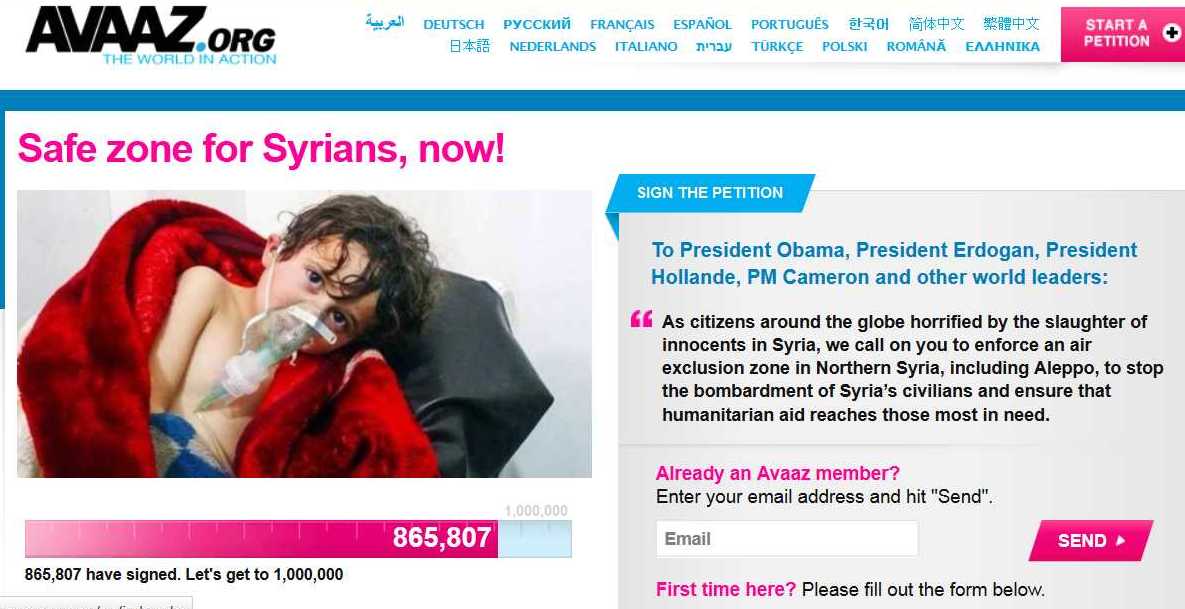 Avaaz Petition for Syria No Fly Zone — 2015 (Syria Campaign Posting)
 Kristoff/New York Times/2011
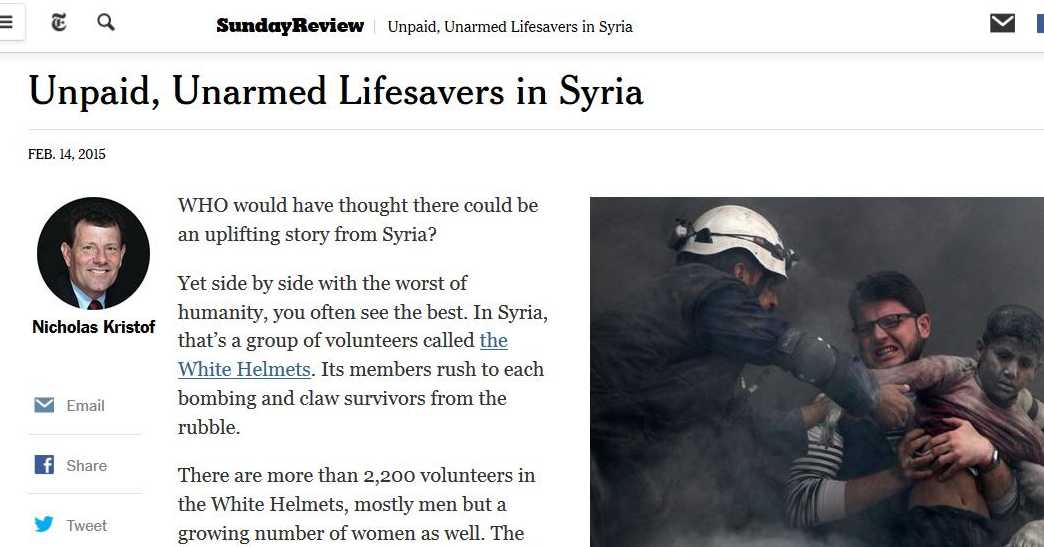 Kristoff/New York Times/2015

 The Real White Helmet Purpose: Propaganda
Who’s Protesting in Brazil and Why?
By Bryan Pitts – NACLA – 04/09/2015
Reading the English-language press these days, one could be forgiven for thinking that Brazil is in the throes of a democratic uprising against a singularly corrupt government, a politically incompetent president, and a floundering economy. Since late last year, the center-left Worker’s Party (PT) government headed by President Dilma Rousseff has been rocked by an ever-widening scandal involving over-inflated contracts and kickbacks to government-allied politicians at the state-owned oil giant Petrobrás. Indignant PT militants—rather than lamenting corruption in a party that once ran on its anti-corruption credentials—have tended to attack the media for highlighting PT corruption after ignoring abuses during the 1995-2002 administration of Fernando Henrique Cardoso, as well as similar scandals in state governments controlled by the opposition Party of Brazilian Social Democracy (PSDB).
In part due to the collapse of Petrobrás’s stock, down 67% since the start of September, the Brazilian currency has plunged nearly 40% against the dollar since then. Inflation over the last year has reached nearly 8%, the highest since 2005, inviting Brazilians to nervously recall the hyperinflation of the 1980s and early 1990s. On March 15, nationwide demonstrations organized on social media gathered anywhere from 300,000 to two million protesters in dozens of cities. They brandished signs saying, “Out with the PT!” and demanded Rousseff’s impeachment, although the one-time head of Petrobrás has not been implicated in the kickback scheme and can constitutionally only be impeached for crimes committed during her presidency. In the wake of the demonstrations, the percentage of Brazilians rating her government as “excellent” or “good” dropped to an abysmal 12%, while 64% rated it “poor” or “terrible.” This disapproval rating is the highest for any president since Fernando Collor de Mello’s 68% on the eve of his own impeachment for corruption in 1992. (Incidentally, Collor, now an opposition senator, is one of 47 politicians currently under investigation for their role in the Petrobrás scandal.)
Foreign media outlets have seized on Rousseff’s supposedly lackluster response to the Petrobrás scandal and Brazil’s gloomy macroeconomic outlook to speculate whether the collapse of the PT’s economic and political model, which has relied on cautiously redistributive policies and moderately increased government involvement in the economy, is imminent. Their sense of hope is palpable: “Brazil’s poor turn their back on Rousseff,” one headline gleefully reported on March 16. Another article insisted that the protests’ “cheerfully democratic multitudes” sought contrition from Rousseff for her party’s graft and economic mismanagement, but that the President had so far ignored their indignation. An opinion piece in a British daily expressed hope that “popular dissatisfaction” would persuade Rousseff to take the steps needed to solve Brazil’s economic problems – a reduced role for state credit agencies, increased independence for Petrobrás and monetary authorities, tax reform, brakes on special interests, and increased openness to foreign trade. The New York Times added an editorial on March 20 blasting Rousseff’s foreign policy, which, it suggested, should draw closer to the United States – despite Eric Snowden’s revelations of NSA spying on Rousseff’s communications.
It’s no secret that most foreign correspondents are neither politically well connected nor fluent in Portuguese. Part of the explanation for their bias, then, comes from their dependence upon Brazil’s notoriously one-sided media, owned by a few elite families and corporate groups. The major newspapers are all staunchly anti-government, their reporting on Rousseff’s administration universally negative. The Globo television network dedicated much of its March 15 programming to recruiting attendees for what it called, “peaceful demonstrations against corruption, with women, the elderly, and children asking for democracy and out with Dilma.” Indeed, the Brazilian and foreign press are engaged in an endless echo chamber of self-validation: foreign journalists get their information from anti-government media outlets, which then breathlessly report the foreign “analysis” in order to invalidate their own bias. For example, a March 21 story in the Folha de S. Paulo and Veja reported favorably on the New York Times’ foreign policy editorial. If foreigners say it, it must be true.
Perhaps the most notorious recent example of press bias occurred when Brian Winter, Reuters’ chief Brazil correspondent, interviewed Fernando Henrique Cardoso. Published in Portuguese by Reuters Brasil, the story contained a paragraph admitting that one of the Petrobrás officials involved in the corruption scheme claims that it dated to Cardoso’s administration. The paragraph was followed by a parenthetical note, apparently penned by one of the Brazilian editors, that accidentally remained undeleted: “We can take this part out if you want.” To his credit, Winter didn’t remove the paragraph, but the gaffe shows the inner-workings of the Brazilian branch of an American media outlet, where protecting the opposition and attacking the PT trumps even a casual relationship with the truth. Although the article was hastily corrected (without any indication that it had been modified), it was too late: attentive readers had already posted the gaffe to Twitter, under the hashtag #PodemosTirarSeAcharMelhor.
Amidst predictions of Rousseff’s demise, the mainstream media has consistently downplayed, and occasionally outright ignored, one fact: the social backgrounds of protesters. It is not “the Brazilian people” who are in the streets, but rather a very specific segment of the population whose economic interests are historically opposed to those of the majority. They are largely middle and upper class and, consequently, mainly white. In the 2014 elections they sensed that their time had come to get rid of the PT, only to see their favored candidate, former Minas Gerais PSDB governor Aécio Neves, lose in Brazil’s closest-ever presidential contest. Despite the very real and serious flaws of the current government, this discontent with the PT finds its true source in centuries of elite fear of popular mobilization and a deep resentment of the gains working class people have made since Lula took office in 2003.
Of course, if one asks the demonstrators in the streets why they are protesting, no one will say that it’s because the poor aren’t as poor anymore. Indeed, 44% of demonstrators in Porto Alegre told pollsters that they were attending to speak out against corruption. And, responding to a question that permitted multiple answers, 58% indicated that their greatest disappointment lies with the political class overall, as compared to 44% that identified the PT and 29% Rousseff. A further 78% argued that political parties, including the opposition, should have no role in their movement. Could it be the case that the demonstrations were, in fact, overwhelmingly democratic and targeted primarily at corruption? Several clues indicate that this is not the case.
Although they represented a small minority of demonstrators, a vocal contingent was not satisfied with calls for impeachment. In a chilling scene for those who remember the repression unleashed during Brazil’s 1964-1985 military dictatorship, protesters carried signs emblazoned with slogans like “Military intervention now” and “SOS Armed Forces.” A banner in Rio de Janeiro featured a swastika and read, “Armed Forces, liberate Brazil.” Another read (in English), “Army, Navy, and Air Force. Please save us once again of [sic] communism.” “The best communist is a dead communist. Dilma, Maduro, Hugo, Fidel, Cristina, Lula: the world’s garbage.” Their signs were eerily reminiscent of the media’s enthusiastic response to Brazil’s 1964 coup, when the country’s press overwhelmingly cheered the military’s ouster of João Goulart—another mildly-leftist, so-called “communist” president—as a victory for democracy.
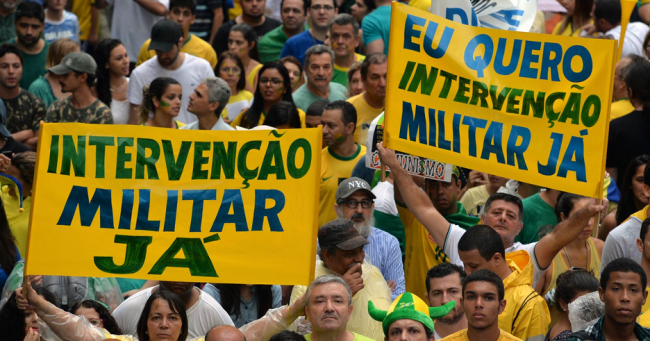
Protesters in São Paulo Plead for a Military Coup, March 15, 2015 (Source: Nelson Almeida / AFP)
In response to the pleas for military intervention, a spokesman for Revoltados ON LINE, a grassroots group that helped organize the protests and has 750,000 Facebook likes, commented, “The people asking for [military] intervention want to remove the PT from power. That is the sole focus. The participation of a variety of groups strengthens the group as a whole.” Though a military coup still looks unlikely, it is widely known that many in the military are incensed with the Rousseff administration over the final report of the National Truth Commission, which blasted the armed forces for torture and disappearances during its rule.
If those waxing nostalgic for dictatorships of yore were in the minority, what of the rest of the protesters? Despite attempts to highlight the supposed multi-class composition of the crowds on March 15, they represented, above all, Brazil’s white, university-educated economic elite. As Gianpaolo Baiocchi and Marcelo K. Silva recently pointed out, in Porto Alegre, nearly 70% of protesters were college-educated, in contrast with 11% of the general population, while over 40% belonged to the top income brackets, which make up but 3% of the population. Photographs confirm this; in a country with a high correlation between skin color and economic class, where over half of the population identifies as black or brown, the crowds had a decidedly lighter hue. A viral Tumblr account poked fun at the similarities with the upper-class, yellow-and-green-clad crowds that attended pricey World Cup matches last year by challenging visitors to determine if the photographs posted came from a March 15 demonstration or the World Cup.
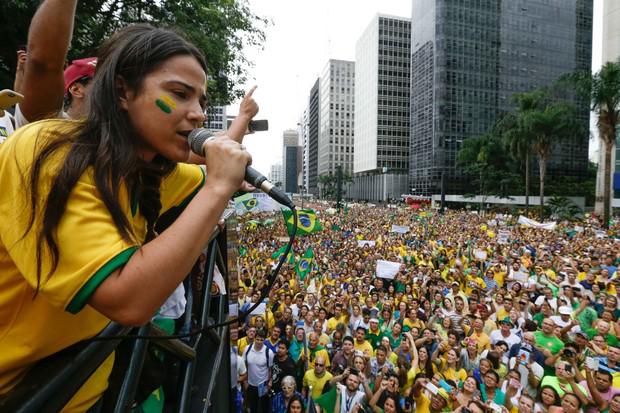
Singer Wanessa Camargo performs the National Anthem for a largely white crowd in São Paulo, March 15, 2015 (Source: Vanessa Carvalho / BPP / AGNEWS)
Of course, the fact that the demonstrations largely consisted of white middle- and upper-class Brazilians does not automatically mean that they were anti-democratic. At the same time, it would be a grave mistake to interpret the class composition of the crowds outside the context of Brazil’s historic inequalities of class, race, and region. What does it mean if the majority of demonstrators demanding the ouster of a moderately redistributive center-left party come from the social classes and regions that have least benefited from its policies? What problems do they see with corruption, the PT, or Rousseff that are insufficient to motivate the working classes or people from the impoverished Northeast of the country to take to the streets?
Since the colonial period, political and economic power has been wielded by a tiny European-descended elite, and since the collapse of the Northeastern plantation sugar economy in the nineteenth century, economic power has been concentrated in the Southeast and South, especially in the coffee and industrial powerhouse of São Paulo—today the epicenter of the opposition. An influx of European immigration in the late nineteenth and early twentieth centuries only heightened the disdain light-skinned, prosperous Southeasterners felt for their mixed-race Northeastern and Northern countrymen and women, and after the 1950s, that prejudice was turned against Northeastern migrants who came to work in the region’s expanding industries. Brazil’s middle class of government bureaucrats, small business owners, and professionals, tied to the landowning and industrial elite by socialization and patronage, has in turn largely identified with elite interests. Whenever Brazilian leaders, be they the populist dictator and later elected president Getúlio Vargas (1930-1945, 1950-1954), or the left-leaning would-be reformer João Goulart (1961-1964), have proposed reforms that would decrease inequality and broaden political representation, they have been ousted by an indignant elite and middle class – at precisely the moments when the minimum wage was growing the fastest.
The leveling results of the last 12 years are striking, if still far short of what Brazil needs to comprehensively address income inequality. In January 2003, the Inter-union Department of Socioeconomic Statistics and Studies (DIEESE) calculated that in order to provide a living wage, the minimum wage should be 6.93 times what it actually was; by February 2015, the ratio had fallen to 4.03. The unemployment rate when Lula took office was 11.2%; today, it is 5.9% (though it has risen from 4.4% in November 2014). At the same time, the gains were not evenly spread out; between 2001 and 2013, the income of the poorest 10% of the population grew at nearly three times the rate of that of the richest 10%. The result was a Gini coefficient that, while still among the highest in the world at 0.527 in 2012, reached its lowest level since 1960. In sum, then, though economic growth between 2003 and 2014 benefited the whole population, it benefited the poor and working class the most, largely as a result of real increases in the minimum wage. As economist Luiz Carlos Bresser Pereira, a cabinet minister under Cardoso, put it, “This hatred [against the PT] is a result of the fact that the government revealed a strong and clear preference for workers and the poor.”
The persistence of prejudice against the poor and Northeasterners manifested itself most clearly on social media in the wake of the 2014 elections—when the Northeast voted overwhelmingly for Rousseff. “These Northeastern sons of bitches need to die in a drought; good-for-nothings, sucking on the government’s teat, ignorant sons of bitches,” read one tweet. “Northeasterners don’t have a brain, they have no culture; it’s the slum of Brazil,” read another. Even former president Cardoso, a one-time leftist sociologist and champion of the struggle against the military dictatorship, grumbled, “The PT relies on the least informed, who happen to be the poorest.” Much like in the United States, in the wake of government efforts to reduce inequality, the wealthy and middle class have reacted with racially inflected charges of laziness, dependency, and ignorance. And so far it has largely been the same social groups who voted for Neves and blasted Northeasterners who have been participating in the demonstrations against Rousseff.
If the March 15 demonstrations expressed the concerns of the middle class and elite, what are the implications for Rousseff’s government? First, despite Rousseff’s dismal approval ratings, the PT’s base of support in the working class and poor is not ready to abandon it. The PT has retained their support through policies like the wildly popular conditional cash transfer program Bolsa Família, the expansion of the federal university system, and race and class-based quotas in college admissions that have yielded tangible improvements in their daily lives. Unless the economy deteriorates to the point where the working class and poor join the demonstrations – and even Brazil’s small leftist press admits that this is not impossible – it’s hard to imagine the protests gaining further traction. Second, despite the common class interests of the demonstrators, a message decrying working class gains is not politically feasible. In the absence of this message, which in fact is the real motivator of the protests, the demonstrators are left in the tenuous position of calling for the ouster of the PT through a legally invalid impeachment, with no agreement at all about, or what should, happen afterwards.
The same groups that organized the March 15 demonstrations are planning another round for April 12. Will they attract working class support? What developments in the Petrobrás scandal might affect their success? Will calls for military intervention become more prominent or fade into the background? One thing remains certain: In the absence of a mass working-class defection from the PT, proof of crimes justifying impeachment, or military interest in a coup, the prospects for a change in government are remote. Yet this is unlikely to dampen the hopes of wealthy and highly educated protesters, who will continue to use corruption as an excuse to protest against the socioeconomic ascension of those they see as their inferiors. As sociologist Jesse de Souza pointedly explains, “What distinguishes Brazil from the United States, Germany, and France, who we admire so much,” isn’t the level of corruption, “but the fact that we accept maintaining a third of the population in subhuman conditions.” The PT governments of the last 12 years made progress toward improving those conditions, but in the process they threatened the Brazilian elite’s deeply ingrained sense of superiority. Whether conscious or not, class and regional prejudice—not corruption—is the driving force behind the demonstrations.
Bryan Pitts is visiting assistant professor of History at Duke University and a Fulbright Scholars postdoctoral fellow at the Instituto de Ciência Política of the Universidade de Brasília (UnB).
Obama’s Legacy Set to Fail in Latin America
By Eva Golinger | TeleSur | April 3, 2015
As Latin America prepares for the upcoming Summit of the Americas in Panama City on May 9-10, the big elephant in the room is not going to be the long awaited reunion of Cuba with the organization, from which it was excluded over fifty years ago under U.S. pressure, but rather President Obama’s latest act of aggression against Venezuela.
The entire region has unanimously rejected Obama’s Executive Order issued March 9, 2015, declaring Venezuela “an unusual and extraordinary threat to U.S. national security and foreign policy” and has called on the U.S. president to rescind his decree.
In an unprecedented statement on March 26, 2015, all 33 members of the Community of Latin American and Caribbean States (CELAC), which represents the entire region, expressed opposition to U.S. government sanctions against Venezuelan officials, referring to them as “the application of unilateral coercive measures contrary to International Law”.
The statement went on to manifest CELAC’s “rejection of the Executive Order issued by the Government of the United States of America on March 9, 2015”, and its consideration “that this Executive Order should be reversed”.
Even staunch U.S. allies such as Colombia and Mexico signed onto the CELAC statement, along with U.S.-economically dependent Caribbean states Barbados and Trinidad, amongst others. This may be the first time in contemporary history that all Latin American and Caribbean nations have rejected a U.S. policy in the region, since the unilateral U.S. blockade against Cuba.
Ironically, President Obama’s justification to thaw relations with Cuba, announced in a simultaneous broadcast with President Raul Castro on December 17, 2014, was primarily based on what he called Washington’s “failed policy” towards the Caribbean island.
More than fifty years of unilateral sanctions and political hostility had only served to isolate the U.S. internationally, while Cuba strengthened its own relations with most countries around the world and gained international recognition for its humanitarian assistance and solidarity with sister nations.
Almost without pause, Obama opened the door to Cuba, admitting Washington’s failure, and then shut it on Venezuela, implementing an almost identical policy of unilateral sanctions, political hostility and false accusations of threats to U.S. national security. Before the region even had time to celebrate the loosening of the noose around Cuba’s neck, it was tightened on Venezuela’s.
Why, the region wondered, would President Obama impose a proven failed policy against another nation in the hemisphere, especially during a period of renewed relations?
Considering the ongoing U.S. war on terrorism that qualifies any alleged threat to U.S. security, by anyone or anywhere, to be a viable target of its vast military power, Venezuela was not about to sit quiet in the face of imminent attack.The South American nation immediately launched an international campaign to denounce Obama’s Executive Order as an act of aggression against a country that poses it no real threat.
President Nicolas Maduro published an Open Letter to the People of the United States in the March 17, 2015 edition of the New York Times alerting readers to the dangerous steps the Obama administration was taking against a peaceful, non-threatening neighboring state. The letter urged U.S. citizens to join calls for Obama to retract his Executive Order and lift the sanctions against Venezuelan officials.
The region reacted quickly. Just 48 hours before Obama’s Executive Order was issued, a delegation of Foreign Ministers from the Union of South American Nations (UNASUR), representing all twelve South American countries, had traveled to Venezuela to meet with government officials, opposition representatives and members of civil society. UNASUR had been mediating dialogue between the government and opposition since anti-government protests erupted last year and caused over 40 deaths in the country and widespread instability. The fact that Obama’s decree came right after UNASUR had reignited mediation efforts in Venezuela was perceived as an offensive disregard of Latin America’s capacity to resolve its own problems. Now the U.S. had stepped in to impose its will. UNASUR responded with a scathing rejection of Obama’s Executive Order and demanded its immediate abolition.
Additionally, countries issued individual statements rejecting Washington’s sanctions against Venezuela and its designation of the South American country as an “unusual and extraordinary threat” to its national security. Argentina considered it “implausible to any moderately informed person that Venezuela or any country in South America or Latin America could possibly be considered a threat to the national security of the United States”, and President Cristina Fernandez made clear that any attempt to destabilize Venezuela would be viewed as an attack on Argentina as well. Bolivian President Evo Morales expressed full support for President Maduro and his government and lashed out at Washington, “These undemocratic actions of President Barack Obama threaten the peace and security of all countries in Latin America and the Caribbean”.
Ecuadorian President Rafael Correa tweeted that the Obama Decree must be a “bad joke”, recalling how such an outrageous action, “reminds us of the darkest hours of our Latin America, when we received invasions and dictatorships imposed by imperialism…Will they understand that Latin America has changed?”
Nicaragua called the Obama Executive Order “criminal”, while wildly popular ex Uruguayan president José Pepe Mujica called anyone who considers Venezuela a threat “crazy”.
Beyond Latin America, 100 British parliamentarians signed a statement rejecting U.S. sanctions against Venezuela and called on President Obama to rescind his Executive Order labeling the country a threat.
More than five million people have signed petitions in Venezuela and online demanding the Executive Order be retracted.
Furthermore, the United Nations G77+China group, which represents 134 countries, also issued a firm statement opposing President Obama’s Executive Order against Venezuela. “The Group of 77+China deplores these measures and reiterates its firm commitment to the sovereignty, territorial integrity and political independence of the Bolivarian Republic of Venezuela… The G77+China calls on the Government of the United States to evaluate and put into practice alternatives of dialogue with the Government of the Bolivarian Republic of Venezuela, under principles of respect for sovereignty and self-determination. As such, we urge that the Executive Order be abolished”.
And then there’s the CELAC statement. The entirety of Latin America has rejected Obama’s latest regional policy, just when he thought he had made groundbreaking inroads south of the border. Unsurprisingly, the White House has miscalculated regional priorities once again, underestimating the importance sovereignty, independence and solidarity hold for the people of Latin America.
While Latin America celebrates the easing of tensions between the U.S. and Cuba, the region will not stand by and let Venezuela come under attack.
If the Obama administration truly wants to be a regional partner, then it will have to accept and respect what Latin America has become: strong, united and bonded by a collective political vision of independence and integration. Any other means of engagement with the region, beyond respectful, equal relations based on principles of non-interventionism, will only have one outcome: failure.
Hiding America’s War Crimes in Laos, While Reporting on the Grim Results
NY Times Covers Up Washington’s Monstrous Evil

By Dave Lindorff | This Can’t Be Happening | April 7, 2015
The NY Times on Monday ran a lengthy piece (“One Woman’s Mission to Free Laos from Millions of Unexploded Bombs”) on Channapha Khamvongas, a 42-year-old Laotian-American woman on a mission to get the US to help Laos clean up the countless unexploded anti-personnel “bombis” that it dropped, which are still killing peasants — especially children — half a century after the so-called “Secret War” by the US against Laos ended.
The article explained that Khamvongas, as a young adult in Virginia, had read a book by anti-war activist Fred Branfman, Voices from the Plain of Jars: Life Under an Air War (originally published in 1972 and reissued in 2013), which featured accounts and hand drawings by refugees from that war of the deadly US aerial attacks and bombings of their farms and villages. It was a book that sparked revulsion in the US over the saturation bombing of Southeast Asia’s smallest and least developed country — a nation of under six million people.
While the Times article mentioned that the secret air war, launched by Lyndon Johnson against Laos in 1964 and continued by Richard Nixon through 1973, was “one of the most intensive air campaigns in the history of warfare,” and that it had made Laos, a country the size of Great Britain with a population of only a few million peasants, into “one of the most heavily bombed places on earth.” What it did not make clear was that this bombing and strafing campaign, which Branfman’s research showed was so intense that US jets were even killing individual water buffalo, and so continuous that any Lao person, including children, who dared to venture out from underground shelters during the daytime, was targeted.
Instead, Times reporter Thomas Fuller simply parrots the official US line about the Laos air war, which was kept secret from the American public at the time, writing that the campaign’s “targets were North Vietnamese troops — especially along the Ho Chi Minh Trail, a large part of which passed through Laos — as well as North Vietnam’s Laotian Communist allies,” the Pathet Lao.
This is a patent falsehood.
The Ho Chi Minh Trail ran through Laos but along its lengthy eastern boarder with Vietnam. The bombing of Laos, though, was extensive, covering the whole country, and especially the large region of Northern Laos known as the Plain of Jars — an agricultural region in the center of Northern Laos (named for the many neolithic jars found there) that was so heavily bombed that it resembled the surface of the moon (today the circular craters that dot the place are now mostly ponds and breeding grounds for mosquitos). And the goal of the country-wide bombing campaign, as Branfman’s interviews of its refugee survivors made clear, was to disrupt agriculture and kill anything that moved in the country, in hopes of defeating the Pathet Lao insurgency.
Not once in the article is the term “war crime” mentioned, though clearly what the US did to Laos in its Secret War against the people of Laos was a war crime of almost unrivaled horror. (During the war, the Pathet Lao forces, at their greatest, numbered about 35,000, yet the US bombing is estimated to have killed over 100,000 Laotians, which would be about 1.5 percent of the country’s population. The equivalent today in the US would be if some country bombed and killed 3.2 million Americans.)
Not only was this little country bombed. It was littered with anti-personnel bombs that spread tennis-ball sized shrapnel-producing “bombis,” only some 70% of which exploded as intended. The rest remain buried in the soft earth, where they can explode decades later if struck by a plow, or found by a too curious child.
I visited Laos in 1995 as a journalist, and witnessed the continuing horror of this US war crime. Though the Secret War had ended more than 20 years earlier, I kept seeing young kids hobbling along on crutches, with stump legs, or missing hands, some missing both legs. Asking about this, I was told they had been blown up by bombis left over from the war.
Visiting the US Embassy in Laos, which at the time, at least, featured on a flagpole both the US flag and the black-and-white POW/MIA flag of the right-wing pro-war National League of Families, I asked the Press and Cultural Affairs attache about the plague of left-over bombis in the country, and why the US was doing nothing to help clear them away. He said Congress had blocked any such humanitarian action because of pressure from the National League of Families, which was pushing its absurd claim that Communist Laos, two decades after the war ended, was still secretly holding US POWs and MIAs, and was not accounting for America’s dead. He acknowledged off the record that the whole idea of impoverished Laos still holding US prisoners of war was ridiculous, and agreed that Laos — a heavily jungled and sparsely populated country — had not accounted for many of its own MIAs, much less missing Americans who had died or been killed. But he claimed there was nothing that could be done until that issue was resolved.
Of course there is a second matter. Just as the US has done nothing to help Vietnam clean up the massive amount of bombs and the carcinogenic Agent Orange herbicide that was spread across their land by US forces during the war, and has done nothing to help the post-war victims of US anti-personnel weapons and of Agent Orange in that country, not wanting to admit to its war crimes, it has also been loath to assume responsibility for cleaning up the anti-personnel weapons legacy in Laos for the same reason.
It appears that Ms. Khamvongas and her organization, Legacies of War, are finally having some success now at getting the US to belatedly start providing at least some of that assistance — reportedly about $14 million last year. It’s a drop in the bucket considering some 580,000 bombing missions were flown during the air campaign, dropping 270 million bombs. And nearly a third of that ordinance — an estimated 80 million bombs and bombis — are still out there, unexploded, waiting to be disturbed so they can complete their deadly missions.
Some 20,000 Laotians have been killed by unexploded bombs — 40% of them children — mostly by the fragmentation bombis, subsequent to the end of the war in 1973. Far more have been maimed and permanently injured.
Khamvongas doesn’t talk about blame, and that may be understandable for someone who is simply trying to get the US to pony up the money to help get the job done. (A number of countries that are blameless, including Ireland, Japan, Norway and Switzerland, as well as one that shares some of the blame, Australia, are contributing another $25 million a year to the bomb-removal effort.)
But the fact that Khamvongas doesn’t want to focus on blame doesn’t excuse the Times from having to be honest about what actually happened to Laos and its people, and about America’s criminality in blanketing the country with anti-personnel weapons whose main victims, by design, were and sadly still are civilians, including a disproportionate number of children.
At a time when the US is running a new kind of air war, one involving the use of attack drones, a war which is reportedly also killing primarily civilians, and which is similarly operating in secret from the American people in numerous countries of the world, it is critical that news organizations like the Times, which are always quick to parrot US government calls for war crimes prosecutions of other countries like Syria, Serbia, ISIS or the breakaway Donbass Republics, also call out the war crimes of the United States.
Silence on such grave matters is not just reprehensible journalism; it is a case of aiding and abetting America’s crimes.
Featured Video

Why Hamas Really Attacked Israel on Oct. 7
or go to
Aletho News Archives – Video-Images
From the Archives
Confronting the Threat of Ethnic Bioweapons
By Tony Cartalucci – New Eastern Outlook – 29.11.2017
The United States Air Force’s 59th Medical Wing’s molecular biology branch recently was revealed to have been collecting specifically Russian RNA and synovial (connective) tissue samples, prompting fears in Russia of a possible US directed ethnic-specific bioweapons program. … continue
Blog Roll
 Aletho News
- Why Yemen Is Bombing Saudi Arabia’s Airports: The War Behind the Headlines
- Sally Rooney’s books pulled from UK over support for Palestine Action
- Bombs for Tel Aviv, Promises for Riyadh
- Israeli ad agency conducted vast global espionage campaign using online ads: Report
- Oct. 7 Forever Marks The Big Reveal: ‘We See You, Israel, We Revile You, We Reject You!’
- Meet the US generals and admirals advancing Israeli policy
- Israel’s Straw Widow Protocol: The Kill Zones Where Civilians Were Labelled ‘Terrorists’
- Leading Israeli Think Tank Publishes Psychotic Israeli ‘National Security’ Doctrine
- Are the United States and Israel in Decline-and-Fall Mode?
- Why Hamas Really Attacked Israel on Oct. 7
- If Americans Knew
- Israeli firm used online ads to run vast spy operation, researchers say
- No, the world zionist movement is not an antisemitic conspiracy theory
- Hundreds of IDF investigations into killings still have no public outcome, BBC Verify finds
- After Ashley Moody Epstein Probe, Donors Linked to Him Poured Money Into her Senate Campaign
- Worried about Russian meddling in UK politics? Wait till you see what Israel is up to
- Israeli settlers attack West Bank center for disabled children, church leader calls for int’l action
- Pulling Out Teeth Just to Live: How Israel Has Devastated Dental Care in Gaza
- Gaza’s “ceasefire” death toll passes 1,500 – Daily Update
- Activists Abused By Israel Return to New Freedom Flotilla Mission
- 60 Minutes won’t tell the full truth about Israeli settler violence
- No Tricks Zone
- New Study Suggests Large Regions Of The Pacific Ocean Have Been Cooling For The Last 80 Years
- Germany’s Green Energy Debacle: High Energy Costs Force Kahla Porzellan to Close After 182 Years!
- New Study: 50 Years Of The Most Aggressive ‘Net Zero’ Policies Can Only Affect The Global Climate By 0.03°C
- US September “Heat” Was No Record…Many Records Set Decades Ago
- Latest European Green Energy Debacle; Portugal’s Largest Flagship Solar Park Insolvent!
- Green Energy Debacle: German Expert Professor Fritz Vahrenholt Warns Of Severe Economic And Social Consequences
- Two More Paleo Reconstructions Affirm Meters-Higher Sea Levels Across Ireland, Brazil 7000-6000 Years Ago
- New Study: Earth And Venus Surface Warmth Largely Explained By Convection And Lapse Rate, Not CO2 Or Radiation
- 2025 Nature Paper Claiming Worsening Global Drought Gets RETRACTED …Heavily Flawed
- New Study: ‘Global Drought Shows No Detectable Recent Acceleration Under Climate Warming’


