Monsanto’s Deep Legacy of Corruption and Cover-Up
By Barbara Minton | Natural Society | March 6, 2015
Monsanto is now instantly recognized as the company dominating the global food supply with its more than 7000 current worldwide patents. But today’s Monsanto is not a corporate newcomer. Although its literature heralds the company as having a clear and principled code of conduct and a pledge to demonstrate integrity, respect, ethical behavior, and honesty in everything they do, the truth is that this company has a legacy of contamination and cover-up that dates back more than a century.
The Rise of one of ‘The Worst Corporations in the World’
At the turn of the 19th century, John Queeny founded Monsanto Chemical Works to produce such nefarious products as saccharin, synthetic vanillin, and laxative and sedative drugs. The company was well positioned as a leading force in the dawning American chemical industry.
From the 1920’s until the late 1960’s, Queeny’s son, Edgar Monsanto Queeny, expanded the company into a global franchise, and changed its name to Monsanto Chemical Company in 1933. He added sulfuric acid, PCBs, DDT, synthetic fibers, and an array of plastics that included polystyrene to the product line.
During this time, Monsanto also created Agent Orange, one of the herbicides and defoliants used by the U.S. military as part of its herbicidal warfare program, Operation Ranch Hand, during the Vietnam War from 1961 to 1971.
Agent Orange was a combination of equal parts of two herbicides, 2,4,5-T and 2,4-D. The 2,4,5-T used to produce Agent Orange threw off dioxin as a byproduct, a compound the World Health Organization classes as highly toxic. Dioxin can cause reproductive and developmental problems, damage to the immune system, hormone disruption, and the initiation of cancer. Dioxin persists in the environment and accumulates in the body, even at minimal exposure.
In areas where Agent Orange was used, the concentration of dioxin was hundreds of times greater than the levels considered safe by the Environmental Protective Agency (EPA). This resulted in a host of terrible health consequences for anyone exposed. and led to decades of litigation during which Monsanto fought tooth and nail to avoid paying for the horrific damage military personnel suffered from. The class action case that followed was settled out of court in 1984 for $180 million, reportedly the latest settlement of its kind at the time.
More than 60 years of Contamination and Cover Up
Dioxin Leak at Nitro – $93 Million Settlement
 From 1929 until 1995, Monsanto operated a chemical plant in the small town of Nitro, West Virginia, where it manufactured Agent Orange. In 1949, a pressure valve blew on a tank of the herbicide, sending plumes of smoke and vapors containing dioxin throughout the town, coating residents and the homes they lived in with powdery residue.
In a short time, some people developed skin eruptions and were diagnosed with an enduring and disfiguring condition known as chloracne. Others had prolonged pain extending from their chest to their feet. According to a medical report following the explosion, “It caused a systemic intoxication in the workers involving most major organ systems.”
Monsanto’s reaction? The company down-played it, claiming the chemical was slow-acting and just a minor irritant.
To get rid of the dioxin, the company dumped it into storm drains, streams and sewers, and stored it in landfills. Dioxin persisted in waterways and in the fish that lived in them. When residents sued for damages, they were told by Monsanto that their allegations had no merit and that the company would defend itself vigorously.
The residents of Nitro or their descendants finally received $93 million from Monsanto in 2012.
PCBs Contaminate the Town of Anniston, Alabama
PCBs (polychlorinated biphenyls) are used in many industries as hydraulic fluids, sealants, and lubricants. These chemicals have been demonstrated to cause cancer, as well as a variety of other adverse health effects on the immune, reproductive, nervous, and endocrine systems.
Monsanto’s plant in Anniston, Alabama produced PCBs from 1929 to 1971. Since then, tons of contaminated soil have been hauled away from the plant, but the site continues to be one of the most highly polluted areas in the country.
Why was it such a mess? During its production years, waste PCBs were dumped into a nearby open landfill, poured into a creek that ran alongside the plant, or just allowed to run off the property during storms. During those years, the townspeople drank from their wells, ate fish they caught, and swam in the creeks, oblivious of the PCBs. When public awareness began to mount, authorities found high levels of PCBs all over the place, and in the bodies of those people, where it will remain forever.
In 1966, a Monsanto biologist testing waterways near the Anniston plant found that when live fish were added to the water, “All 25 fish lost equilibrium and turned on their sides in 10 seconds and all were dead in 3 1/2 minutes.”
In 1970, the FDA found high levels of PCBs in fish near the Anniston plant, and Monsanto jumped into cover-up mode. A leaked internal memo from a company official outlined steps for the company to take to limit disclosure. The strategy called for engaging public officials to fight the battle for them. “Joe Crockett, Secretary of the Alabama Water Improvement Commission will try to handle the problem quietly without release of the information to the public at this time,” the memo promised.
A statement eventually released from Monsanto’s world headquarters in St. Louis stated, “Quoting both plant management and the Alabama Water Improvement Commission, the PCB problem was relatively new, was being solved by Monsanto and, at this point, was no cause for public alarm.”
The class action suit for Anniston was finally settled in 2003, when Monsanto was forced to pay $700 million.
More PCBs Dumped into the Environment
In 1977, Monsanto closed its PCB plant in Whales, but not before dumping thousands of tons of waste into the quarry of the town of Groesfaen. Authorities there say the site is still one of the most contaminated in Britain.
Internal papers indicate that Monsanto knew about the PCB dangers as early as 1953, when toxicity tests on the effects of PCBs killed more than 50% of the lab rats subjected to them. In 2011, Monsanto reluctantly agreed to help in the clean up after an environmental agency found 67 chemicals at the quarry site that were exclusively manufactured by Monsanto. Yet that effort remained underfunded and the quarry remains contaminated.
The Guardian reported that Monsanto wrote an abatement plan in 1969 which admitted “the problem involves the entire United States, Canada, and sections of Europe, especially the UK and Sweden.”
Navy Rejects Monsanto Product Because it was ‘Too Toxic’
Monsanto tried to sell its hydraulic fluid, known as Pydraul 150, to the navy in 1956, and supplied test results in their sales pitch. But the navy decided to do its own testing, and the company was informed that there would be no sale because the product proved to be too toxic. In an internal memo divulged during a court proceeding, Monsanto’s medical director stated that “no matter how we discussed the situation, it was impossible to change their thinking that Pydraul 150 is just too toxic for use in submarines.”
Monsanto Moves into Food, Biotechnology
Monsanto’s move into biotech began in the 1970’s, and in 1983 the first genetic modification of a plant cell had been achieved. Synthetic bovine growth hormone (rBST) was on the horizon. Monsanto’s public relations department portrayed GM seeds as a panacea for alleviating poverty and feeding the hungry. In 1985, the company bought NutraSweet artificial sweetener, a branded version of aspartame – the compound responsible for 75% of the complaints reported to the FDA’s adverse reaction monitoring system.
Monsanto Seeks Clean Image, Creates Solutia
In the late 1990’s, Monsanto created a new company known as Solutia, and off-loaded its chemical and fiber businesses. L. Bartlett and James B. Steele, chronicling the rise of Monsanto for Vanity Fair magazine, noted the reason for the spinoff was to channel the bulk of Monsanto’s mounting chemical lawsuits and liabilities into the spun-off company, thereby creating a clean image for Monsanto. Solutia became Monsanto’s solution!
As the company, now known simply as Monsanto, moves through the 21st century, it has a ‘new cleaned-up image,’ and a fine sounding mission statement. It refers to itself as a relatively new company that promotes sustainable agriculture and delivering products that support farmers around the world.
Except Monsanto is the 3rd most hated company in the world.
Monsanto’s legacy of contamination and cover-up should be a wake up call for you to run from the GMOs they have spawned. Remember the old adage that says leopards can’t change their spots?
How the US Funds Dissent against Latin American Governments
teleSUR | March 12, 2015
“A lot of what we do today was done covertly 25 years ago by the CIA.”
NED founding father, Allen Weinstein
The U.S. government and military have a long history of interfering in the affairs of numerous countries in Latin American and the Caribbean.
By the end of the 19th century, there had been at least 10 U.S. military interventions across the hemisphere including Argentina (1890), Chile (1891), Haiti (1891), Panama (1895), Cuba (1898), Puerto Rico (1898) and Nicaragua (1894, 1896, 1898 and 1899).
From this time onward, successive U.S. administrations applied different strategies and tactics for involvement in the region as a means to secure and protect its geopolitical and economic interests. However, only recently has there been wider acknowledgement about the role that U.S. funding to nongovernmental organizations, or NGOs, particularly from the National Endowment for Democracy (NED) and the United States Agency for International Development (USAID), plays in furthering U.S. foreign policy. For example, in 2012 governments of the Bolivarian Alliance for the Peoples of Our America (ALBA) collectively signed a resolution to expel USAID from each of the signing countries. Those countries included Bolivia, Cuba, Ecuador, Dominica, Nicaragua, and Venezuela.
The National Endowment for Democracy (NED)
Created by the administration of former U.S. President Ronald Reagan in 1983, the NED operates as a foundation that provides grants for “democracy promotion.” The foundation is structured as an umbrella with an almost corporatist flavor, housing four other organizations reflecting U.S. sectoral and party interest: the U.S. labor affiliated American Center for International Labor Solidarity (ACILS) and Chamber of Commerce linked Center for International Private Enterprise (CIPE), along with the National Democratic Institute for International Affairs (NDI) and the International Republican Institute (IRI), both of which reflect Democrat and Republican affiliations, respectively.
In many ways the NED resembles previous CIA efforts in the 1950s, 60s and 70s to provide mostly public money for secret operations aimed to bolster pro-U.S. governments and movements abroad. In South America for example, between 1975 and 1978 the U.S. helped with the creation and implementation of Operation Condor. The U.S. provided right-wing dictatorships in Argentina, Bolivia, Brazil, Chile, Paraguay, Uruguay, Colombia, Peru, Venezuela and Ecuador with technical and military support for the goal of hunting down and killing political opponents. Some estimate that Operation Condor killed between 60,000 and 80,000 people.
In 1986, then president of the NED Carl Gershman explained to the New York Times, “We should not have to do this kind of work covertly … It would be terrible for democratic groups around the world to be seen as subsidized by the C.I.A. We saw that in the 60s, and that’s why it has been discontinued. We have not had the capability of doing this, and that’s why the endowment was created.”
U.S. citizens unknowingly fund the NED with public money. The U.S. government allocates part the budget of the United States Agency for International Development (USAID) under the U.S. State Department to the NED – which is most of the NED’s funding source. Although it receives practically all of its funding from the U.S. government, the NED is itself an NGO headed by a Board of Directors. The current board includes:
- Political economist, author and free market universalist Francis Fukuyama,
- Elliott Abrams, former deputy assistant and deputy national security adviser on Middle East policy in the administration of President George W. Bush,
- Moises Naim, Venezuelan Minister of Trade and Industry during the turbulent early 1990s and former Executive Director of the World Bank, and
- Former Deputy Secretary of State under George W. Bush (2005 – 2006) and Vice Chairmanship at Goldman Sachs Group, Robert B. Zoellick.
The scope of activity of the NED is truly impressive. According to the NED website, it supports more than 1,000 NGO projects in more than 90 countries.
At its inception in the early 1980s, its funding allocation was set at US$18 million and reached its peak in the late 1990s and early 2000s. Allocations for 2014 and 2015 have been approved for US$103.5 million, while over US$7 million was directed primarily to opposition organizations in Ecuador, Bolivia, Venezuela and Cuba in 2013.
Within the U.S. State Department Justification of Request documents which outline the reasons for funding requests, it is clear that funding priorities in Latin America and the Caribbean reflect the NED’s modern strategy of overtly carrying out old covert objectives.
Michel Chossudovsky, a professor emeritus of economics at the University of Ottawa in Canada, sees this funding as an element in “manufacturing dissent” against governments that the U.S. government dislikes. However, these funders do not work alone. “The NED (and USAID) are entities linked with the U.S. state department, but they operate in tandem with a whole of other organizations,” said Chossudovsky.
In May 2010 the Foundation for International Relations and Foreign Dialogue released their report Assessing Democracy Assistance in Venezuela which revealed that in addition to NED and USAID funding, a broad range of private and European based foundations funded opposition-aligned NGOs in the country with between US$40-50 million annually.
According to Dan Beeton, International Communications Director at the Center for Economic and Policy Research (CEPR) in Washington, D.C., NED funds in Latin American have been directed at “a lot of what are kind of the old guard political entities that are now kind of discredited,” such as the Trade Union Confederation of Venezuela (CTV), which was instrumental in the 2002 coup in Venezuela, as well as older political parties that are now marginal forces in their country’s political landscapes in spite of their considerable outside funding.
The United States Agency for International Development
Created in 1961 as a foreign assistance program under President John F. Kennedy, USAID commands a much larger budget and broader scope than NED. While U.S. diplomats continue to stress that USAID funding does not have a political basis, USAID documents nonetheless acknowledge its role in “furthering America’s interests” while carrying out “U.S. foreign policy by promoting broad-scale human progress at the same time it expands stable, free societies, creates markets and trade partners for the United States.” But critics are skeptical of USAID’s missionary work, noting how their strategy has changed over time.
“(USAID’s) mandate is to provide development aid and historically it has provided development aid, tied into debt negotiations and so on. Subsequently with the evolution of the development aid program it has redirected its endeavours on funding NGOs,” said Chossudovsky.
While the range of activities undertaken by NGOs can be broad and some of these programs may not have political intentions, Beeton nonetheless argues that this funding “ultimately can and often does serve a political end when the U.S. wants these grantees to help it fulfill its goals in these countries.”
The extent of U.S. political ambitions recently came into the international spotlight with the revelation that USAID had secretly spent US$1.6 million to fund a social messaging network in Cuba called ZunZuneo, with the stated purpose of “renegotiat(ing) the balance of power between the state and society.” The project was headed up by Joe McSpedon of the USAID’s Office of Transition Initiatives (OTI).
Other USAID officials accused of active political meddling in the affairs of sovereign countries include regional head Mark Feierstein. According to Venezuelan investigative journalist Eva Golinger, in 2013 Feierstein met Venezuelan opposition figures including right-wing politicians Maria Corina Machado, Julio Borges and Ramon Guillermo Avelado as well as political strategist Juan Jose Rendon to devise a plan to undermine the Venezuelan government.
At the State Department budgetary hearing, Feierstein also confirmed “a long-standing program in place to support those who are advocating and fighting on behalf of democracy and human rights in Venezuela … and we are prepared to continue those under any scenario.”
State Department cables revealed by WikiLeaks also brought to light previous activities by USAID/OTI in Venezuela, including the development of a five point, anti-government strategy for U.S. embassy activities, as well as the confirmation that grantees had been active in promoting street demonstrations in 2009.
Machado, a former anti-Chavista National Assembly member, was among the signatories of the Carmona decree following the Venezuelan coup in 2002, which abolished the legislative and judiciary powers, as well as the constitution. She was also among the most prominent promoters of last year’s opposition violence that claimed the lives of 43 people.
In Bolivia, local rural workers’ groups and the government expelled the U.S.-based Chemonics International Inc. after their US$2.7 million USAID-funded “Strengthening Democracy” program was accused of financing destabilization attempts against the government. Chemonics operates in approximately 150 countries, offering various technical services and “consulting.”
The Bolivian government publicly outlined what they argued was proof of USAID-funded programs to mobilize the indigenous population against the government, in particular an indigenous march protesting the construction of a highway. USAID funded programs were active in these areas, and had funded some of the leading organizations such as the Eastern Bolivia Indigenous Peoples and Communities Confederation (CIDOB).
“USAID refused to reveal who it was funding and the Bolivian government had strong reasons to believe that it had ties and coordination with opposition groups in the country which at the time was involved in violence and destructive activities aimed at toppling the Morales government,” said Beeton. “Now we know through WikiLeaks that that’s what really was going on.”
President Evo Morales also revealed transcripts of phone calls between the anti-highway march organizers and U.S. embassy officials. The U.S. embassy confirmed the calls, but explained that they were merely trying to familiarize themselves with the country’s political and social situation.
Officials also denounced the lack of accountability to the Bolivian government or to the recipient constituencies of USAID funds.
The head of the Eastern Bolivia Indigenous Peoples and Communities Confederation (CIDOB), Lazaro Taco, confirmed that they had received “external support for our workshops,” but would not identify the source.
These and other USAID activities led Bolivian President Evo Morales to claim that the agency was conspiring against his government. The government expelled USAID from the country in May 2013, while USAID denied any wrongdoing.
In June of 2012, an Ecuadorian daily revealed that 4 NGOs based in Ecuador were recipients of over US$1.8 million for a project called Active Citizens, whose political bend was critical of the Correa government.
Shortly afterwards, the Technical Secretariat for International Cooperation (Seteci) of Ecuador announced it would also investigate the “Costas y Bosques” (Coasts and Forests) conservation project, which received US$13.3 million in funding from USAID. The project, based in the provinces of Esmeraldas, Guayas and Manabí, was also being undertaken by the Chemonics International Inc, the same organization expelled from Bolivia.
Mireya Cardenas, National Secretary of Peoples, Social Movements and Citizen Participation, said that “there is every reason to consider USAID a factor of disturbance that threatens the sovereignty and political stability (of Ecuador)”. While the U.S. Ambassador in Ecuador Adam Namm tried to reassert that USAID did not fund political parties, he did confirm that certain opposition groups such as Fundamedios was funded “indirectly.”
In November 2013 the Ecuadorean government sent a letter to the U.S. embassy in the country’s capital Quito, ordering that “USAID must not execute any new activity” in Ecuador. USAID canceled its aid shortly after.
For Beeton, “lack of transparency is probably the biggest problem (with USAID) in that it really prevents the governments in the host countries from finding something objectionable, or even coordinating better”. This was in large part the principle concern from the Ecuadorian Seteci, who questioned the extent of expenditures on certain project and the lack of coordination.
In the wake of the devastating 2010 earthquake, CEPR conducted an extensive evaluation of USAID funding to Haiti, including the history of funding, and found transparency and coordination with local government to be a significant problem, especially when the local government experienced tensions with U.S. foreign policy.
“The U.S. government has been perfectly happy to not coordinate with governments, and that has a lot to do with politics… it was under [former Haitian President] Aristide really saw a lot of assistance bypass the Haitian government and go to NGO, including violent opposition groups and so called democratic opposition groups much like what you are seeing recently in Venezuela and Bolivia,” said Beeton.
For 2013, the combined NED and USAID allocations for Cuba, Venezuela, Ecuador and Bolivia alone totaled over US$60 million, with the bulk of these funds destined to Cuba and Ecuador. For the government and progressive social movements of these countries, there is a growing concern that these funds could be used to undertake what Chossudovsky qualified as a “consistent process of destabilizing government as part of non-conventional warfare, meaning you don’t send in the troops but you destabilize the government through so called colored revolutions or infiltrations.”
Nuland’s Mastery of Ukraine Propaganda
By Robert Parry | Consortium News | March 11, 2015
An early skill learned by Official Washington’s neoconservatives, when they were cutting their teeth inside the U.S. government in the 1980s, was how to frame their arguments in the most propagandistic way, so anyone who dared to disagree with any aspect of the presentation seemed unpatriotic or crazy.
During my years at The Associated Press and Newsweek, I dealt with a number of now prominent neocons who were just starting out and mastering these techniques at the knee of top CIA psychological warfare specialist Walter Raymond Jr., who had been transferred to President Ronald Reagan’s National Security Council staff where Raymond oversaw inter-agency task forces that pushed Reagan’s hard-line agenda in Central America and elsewhere. [See Consortiumnews.com’s “The Victory of ‘Perception Management.’”]
One of those quick learners was Robert Kagan, who was then a protégé of Assistant Secretary of State Elliott Abrams. Kagan got his first big chance when he became director of the State Department’s public diplomacy office for Latin America, a key outlet for Raymond’s propaganda schemes.
Though always personable in his dealings with me, Kagan grew frustrated when I wouldn’t swallow the propaganda that I was being fed. At one point, Kagan warned me that I might have to be “controversialized,” i.e. targeted for public attack by Reagan’s right-wing media allies and anti-journalism attack groups, like Accuracy in Media, a process that did indeed occur.
Years later, Kagan emerged as one of America’s top neocons, a co-founder of the Project for the New American Century, which opened in 1998 to advocate for the U.S. invasion of Iraq, ultimately gaining the backing of a large swath of the U.S. national security establishment in support of that bloody endeavor.
Despite the Iraq disaster, Kagan continued to rise in influence, now a senior fellow at the Brookings Institution, a columnist at the Washington Post, and someone whose published criticism so alarmed President Barack Obama last year that he invited Kagan to a White House lunch. [See Consortiumnews.com’s “Obama’s True Foreign Policy Weakness.”]
Kagan’s Wife’s Coup
But Kagan is perhaps best known these days as the husband of neocon Assistant Secretary of State for European Affairs Victoria Nuland, one of Vice President Dick Cheney’s former advisers and a key architect of last year’s coup in Ukraine, a “regime change” that toppled an elected president and touched off a civil war, which now has become a proxy fight involving nuclear-armed United States and Russia.
In an interview last year with the New York Times, Nuland indicated that she shared her husband’s criticism of President Obama for his hesitancy to use American power more assertively. Referring to Kagan’s public attacks on Obama’s more restrained “realist” foreign policy, Nuland said, “suffice to say … that nothing goes out of the house that I don’t think is worthy of his talents. Let’s put it that way.”
But Nuland also seems to have mastered her husband’s skill with propaganda, presenting an extreme version of the situation in Ukraine, such that no one would dare quibble with the details. In prepared testimony to the House Foreign Affairs Committee last week, Nuland even slipped in an accusation blaming Russia for the July 17 shoot-down of Malaysia Airlines Flight 17 though the U.S. government has not presented any proof.
Nuland testified, “In eastern Ukraine, Russia and its separatist puppets unleashed unspeakable violence and pillage; MH-17 was shot down.”
Now, it’s true that if one parses Nuland’s testimony, she’s not exactly saying the Russians or the ethnic Russian rebels in eastern Ukraine shot down the plane. There is a semi-colon between the “unspeakable violence and pillage” and the passive verb structure “MH-17 was shot down.” But anyone seeing her testimony would have understood that the Russians and their “puppets” shot down the plane, killing all 298 people onboard.
When I submitted a formal query to the State Department asking if Nuland’s testimony meant that the U.S. government had developed new evidence that the rebels shot down the plane and that the Russians shared complicity, I received no answer.
Perhaps significantly or perhaps not, Nuland presented similarly phrased testimony to the Senate Foreign Relations Committee on Tuesday but made no reference to MH-17. So, I submitted a new inquiry asking whether the omission reflected second thoughts by Nuland about making the claim before the House. Again, I have not received a reply.
However, both of Nuland’s appearances place all the blame for the chaos in Ukraine on Russia, including the 6,000 or more deaths. Nuland offered not a single word of self-criticism about how she contributed to these violent events by encouraging last year’s coup, nor did she express the slightest concern about the actions of the coup regime in Kiev, including its dispatch of neo-Nazi militias to carry out “anti-terrorist” and “death squad” operations against ethnic Russians in eastern Ukraine. [See Consortiumnews.com’s “Nuclear War and Clashing Ukraine Narratives.”]
Russia’s Fault
Everything was Russia’s fault – or as Nuland phrased it: “This manufactured conflict — controlled by the Kremlin; fueled by Russian tanks and heavy weapons; financed at Russian taxpayers’ expense — has cost the lives of more than 6,000 Ukrainians, but also of hundreds of young Russians sent to fight and die there by the Kremlin, in a war their government denies.”
Nuland was doing her husband proud. As every good propagandist knows, you don’t present events with any gray areas; your side is always perfect and the other side is the epitome of evil. And, today, Nuland faces almost no risk that some mainstream journalist will dare contradict this black-and-white storyline; they simply parrot it.
Besides heaping all the blame on the Russians, Nuland cited – in her Senate testimony – some of the new “reforms” that the Kiev authorities have just implemented as they build a “free-market state.” She said, “They made tough choices to reduce and cap pension benefits, increase work requirements and phase in a higher retirement age; … they passed laws cutting wasteful gas subsidies.”
In other words, many of the “free-market reforms” are aimed at making the hard lives of average Ukrainians even harder – by cutting pensions, removing work protections, forcing people to work into their old age and making them pay more for heat during the winter.
Nuland also hailed some of the regime’s stated commitments to fighting corruption. But Kiev seems to have simply installed a new cast of bureaucrats looking to enrich themselves. For instance, Ukraine’s Finance Minister Natalie Jaresko is an expatriate American who – before becoming an instant Ukrainian citizen last December – ran a U.S. taxpayer-financed investment fund for Ukraine that was drained of money as she engaged in lucrative insider deals, which she has fought to keep secret. [See Consortiumnews.com’s “Ukraine’s Finance Minister’s American ‘Values.’”]
Yet, none of these concerns were mentioned in Nuland’s propagandistic testimony to the House and Senate – not that any of the committee members or the mainstream press corps seemed to care that they were being spun and even misled. The hearings were mostly opportunities for members of Congress to engage in chest-beating as they demanded that President Obama send U.S. arms to Ukraine for a hot war with Russia.
Regarding the MH-17 disaster, one reason that I was inquisitive about Nuland’s insinuation in her House testimony that the Russians and the ethnic Russian rebels were responsible was that some U.S. intelligence analysts have reached a contrary conclusion, according to a source briefed on their findings. According to that information, the analysts found no proof that the Russians had delivered a BUK anti-aircraft system to the rebels and concluded that the attack was apparently carried out by a rogue element of the Ukrainian military.
After I published that account last summer, the Obama administration went silent about the MH-17 shoot-down, letting stand some initial speculation that had blamed the Russians and the rebels. In the nearly eight months since the tragedy, the U.S. government has failed to make public any intelligence information on the crash. [See Consortiumnews.com’s “The Danger of an MH-17 ‘Cold Case.’”]
So, Nuland may have been a bit duplicitous when she phrased her testimony so that anyone hearing it would jump to the conclusion that the Russians and the rebels were to blame. It’s true she didn’t exactly say so but she surely knew what impression she was leaving.
In that, Nuland appears to have taken a page from the playbook of her husband’s old mentor, Elliott Abrams, who provided misleading testimony to Congress on the Iran-Contra Affair in the 1980s – and even though he was convicted of that offense, Abrams was pardoned by President George H.W. Bush and thus was able to return to government last decade to oversee the selling of the Iraq War.
~
Investigative reporter Robert Parry broke many of the Iran-Contra stories for The Associated Press and Newsweek in the 1980s. You can buy his latest book, America’s Stolen Narrative, either in print here or as an e-book (from Amazon and barnesandnoble.com).
New Video Dispels the “Reached for My Gun” Myth of LAPD Cops in Killing of Homeless Man
By Matt Agorist | The Free Thought Project | March 11, 2015
Los Angeles, CA — Following the shooting of a homeless man in LA’s Skid Row last week, controversy arose over why the three LAPD officers pulled their triggers.
Chief Charlie Beck said that the video showed ‘Africa,’ the man killed by police, reach for a rookie officers gun. The rookie, who was just short of completing his probationary period, can be heard yelling out, “He has my gun. He Has my gun.”
The reason that a human life was ended that day by the LAPD had everything to do with the rookie yelling out those fateful words.
But did Africa really have this rookie’s gun? Were the officers’ lives ever at risk? Or, did these officers gun down a man in cold blood over this rookie’s fearful mistake?
According to the LAPD, the officer’s gun was found partly cocked and jammed with a round of ammunition in the chamber and another in the ejection port, indicating a struggle for the weapon.
Seems believable, right?
However, the holster that this rookie officer had on makes it nearly impossible to rack the slide while it is holstered.
From the LAPD’s images, we can see that the type of holster that the rookie was wearing, and that the majority of police officers wear, is a Dual Retention Hooded Holster, with optional hood guard.
The Free Thought Project spoke to former LAPD officer Alex Salazar, and he confirmed that most, if not all of the LAPD officers use these holsters.

This holster is specially made to prevent the exact scenario that the LAPD are claiming happened.
The “hood,” or the strap that holds the weapon in the hard plastic holster must be pushed down from a particular angle and then pushed forward, prior to exposing the back of the weapon.
During a struggle, it is entirely possible that the hood could have been pushed down, leaving the rear of the slide exposed.
However, this officer’s holster appears to be equipped with a hood guard. The hood guard adds another entirely new level of pistol retention as it is specially designed to prevent an assailant from pushing down the hood.
But we will give LAPD the benefit of the doubt here and say that this man was somehow able to get past the hood guard and push down the hood while being beaten and tasered.
However, these holsters have yet another line of retention. The third line of retention in this officer’s holster does not allow for the pistol to be removed, nor the slide pulled back, without knowing exactly how to lift it out of the holster.
This holster and holsters similar in design have a tension screw in place that allows for its users to set the desired level of friction needed to remove the pistol. However, if someone tries to pull the pistol out of the holster in any direction other than the officer’s set preference, the slide will not rack, nor will the pistol come out.
Knowing the specific functions of this rookie officer’s holster makes believing the official narrative on the shooting of this man hard to believe.
It is highly unlikely, if not completely impossible for a man, who is being aggressed against by multiple police officers, to do what police say he did.
The LAPD would like the public to believe that Africa supposedly maintained his composure and bypassed the hood guard on the officer’s pistol. After somehow bypassing the guard, he was then able to push down the hood and slide it forward. After this, he then was able to pull the slide back, and jam a round in the chamber, while laying on his back, fighting for his life, with tens of thousands of volts pumping through his body, while multiple officers beat him with batons.
Police accountability activist and friend to the Free Thought Project, Tom Zebra, conducted a similar investigation into the officer’s holster. Below is the well-made video by Zebra illustrating the holster’s retention properties.
Human Rights Watch FAIL: Uses Photo of American Bombing Destruction To Condemn Assad
Activist Post | March 9, 2015
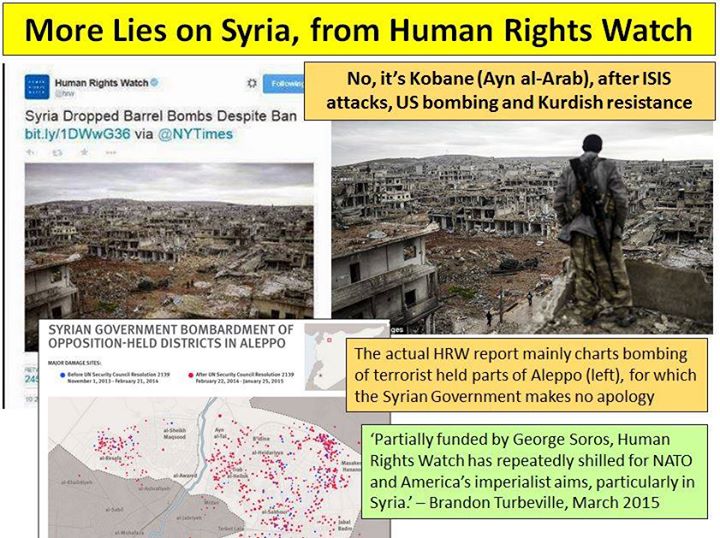
Putting its hypocritical and biased nature on full display once again, the alleged human rights organization, Human Rights Watch, was recently caught in an attempt to fabricate “evidence” of Assad’s use of barrel bombs in civilian areas for the purposes of further demonizing the secular Syrian government.
On February 25, HRW posted a photo of a devastated civilian area in Syria with the tagline “Syria dropped barrel bombs despite ban.” The “ban” HRW is referring to is the ban on bombing civilian areas that applies to both sides in Aleppo after the United Nations stepped in to save the Western-backed terrorists from annihilation. Assad’s forces had surrounded the city and had cut off a major supply route for the death squads from Turkey thus making the ultimate elimination of the jihadist forces a virtual inevitability.
As Somini Sengupta wrote for the New York Times on February 24,
Human Rights Watch said Tuesday that the Syrian government had dropped so-called barrel bombs on hundreds of sites in rebel-held towns and cities in the past year, flouting a United Nations Security Council measure.
In a report released Tuesday, the group said it relied on satellite images, photos, videos and witness statements to conclude that the Syrian government had bombarded at least 450 sites in and around the southern town of Daraa and at least 1,000 sites in Aleppo in the north.
The report focused on the period since Feb. 22, 2014, when the Security Council specifically condemned the use of barrel bombs, which are large containers filled with explosives and projectiles that can indiscriminately hurt civilians and are prohibited under international law.
There was only one problem with HRW’s tweet – the photograph the organization provided was not Aleppo.
In fact, the damage that had been wrought upon the civilian area in the photograph was not committed by the Syrian military but by the United States.
The photo was actually a picture of Kobane (Ayn al-Arab), the city which has been the site of heavy US aerial bombardment over the last several months as the US engages in its program of death squad herding and geographical reformation of sovereign Syrian and Iraqi territory.
But, while HRW was content to use the destruction of the city as a reason to condemn the Assad government and continue to promote the cause for US military action in Syria, the “human rights organization” was apparently much less interested in the exact same destruction wrought by US forces.
In other words, if Assad’s forces bomb a civilian area into the stone age, it is an atrocity, a war crime, and justification for international military involvement. If the United States bombs a civilian area into the stone age, it’s no biggie.
Partially funded by George Soros, Human Rights Watch has repeatedly shilled for NATO and America’s imperialist aims, particularly in Syria.
For instance, when Western media propaganda had reached a crescendo regarding the outright lie that Assad had used chemical weapons against his own people, HRW stood right beside Barack Obama and John Kerry in their effort to prove Assad’s guilt. HRW even went so far as to repeat the lie that the UN report suggested that Assad was the offending party, driving the final nail into the coffin of any credibility HRW may have had.
When a last-minute chemical weapons deal was secured by Russia in an effort to avoid yet another US/NATO invasion of Syria, HRW did not rejoice for the opportunity of peaceful destruction of chemical weapons and a chance to avoid war, it attacked the deal by claiming that it “failed to ensure justice.” Of course, the deal did fail to ensure justice. There were no provisions demanding punishment of the death squads who actually used the weapons or the US/NATO apparatus that initiated and controlled the jihadist invasion to begin with.
Regardless, when Mother Agnes Mariam of the Cross released her report that refuted what the US/NATO was asserting in regards to chemical weapons in Syria, HRW embarked upon a campaign of attack against her and her work.
Even as far back as 2009, however, HRW was showing its true colors when it apparently signed off on and supported renditions – the process of kidnapping individuals off the street without any due process and “rendering” them to jails and prisons in other countries where they are often tortured – in secret talks with the Obama administration.
If HRW ever had any credibility in terms of the question of actual human rights, then all of that credibility has assuredly been lost. HRW is nothing more than a pro-US, pro-NATO NGO that acts as a smokescreen for the continuation of the violation of human rights across the world – that is, unless those violations are committed by America’s enemies.
Washington’s Al Qaeda Ally Now Leading ISIS in Libya
By Eric Draitser – New Eastern Outlook – 09.03.2015
The revelations that US ally Abdelhakim Belhadj is now leading ISIS in Libya should come as no surprise to those who have followed US policy in that country, and throughout the region. It illustrates for the umpteenth time that Washington has provided aid and comfort to precisely those forces it claims to be fighting around the world.
According to recent reports, Abdelhakim Belhadj has now firmly ensconced himself as the organizational commander of the ISIS presence inside Libya. The information comes from an unnamed US intelligence official who has confirmed that Belhadj is supporting and coordinating the efforts of the ISIS training centers in eastern Libya around the city of Derna, an area long known as a hotbed of jihadi militancy.
While it may not seem to be a major story – Al Qaeda terrorist turns ISIS commander – the reality is that since 2011 the US and its NATO allies have held up Belhadj as a “freedom fighter.” They portrayed him as a man who courageously led his fellow freedom-lovers against the “tyrannical despot” Gaddafi whose security forces at one time captured and imprisoned many members of the Libyan Islamic Fighting Group (LIFG), including Belhadj.
Belhadj served the US cause in Libya so well that he can be seen receiving accolades from Sen. John McCain who referred to Belhadj and his followers as heroes. He was initially rewarded after the fall of Gaddafi with the post of military commander of Tripoli, though he was forced to give way to a more politically palatable “transitional government” which has since evaporated in that chaotic, war-ravaged country.
Belhadj’s history of terrorist activity includes such “achievements” as collaboration with Al Qaeda in Afghanistan and Iraq, and of course his convenient servitude to the US-NATO sponsored rampage across Libya that, among other things, caused mass killings of black Libyans and anyone suspected of being part of the Green Resistance (those loyal to the Libyan Arab Jamahiriya led by Gaddafi). Although the corporate media tried to make a martyr of Belhadj for his alleged torture via the CIA rendition program, the inescapable fact is that wherever he goes he leaves a violent and bloody wake.
While much of this information is known, what is of paramount importance is placing this news in a proper political context, one that illustrates clearly the fact that the US has been, and continues to be, the major patron of extremist militants from Libya to Syria and beyond, and that all talk of “moderate rebels” is merely rhetoric designed to fool an unthinking public.
The Enemy of My Enemy is My Friend… Until He Isn’t
There is ample documented evidence of Belhadj’s association with Al Qaeda and his terrorist exploits the world over. Various reports have highlighted his experiences fighting in Afghanistan and elsewhere, and he himself has boasted of killing US troops in Iraq. However, it was in Libya in 2011 where Belhadj became the face of the “rebels” seeking to topple Gaddafi and the legal government of Libya.
As the New York Times reported:
The Libyan Islamic Fighting Group was formed in 1995 with the goal of ousting Colonel Qaddafi. Driven into the mountains or exile by Libyan security forces, the group’s members were among the first to join the fight against Qaddafi security forces… Officially the fighting group does not exist any longer, but the former members are fighting largely under the leadership of Abu Abdullah Sadik [aka Abdelhakim Belhadj].
So, not only was Belhadj a participant in the US-NATO war on Libya, he was one of its most powerful leaders, heading a battle-hardened jihadist faction that constituted the leading edge of the war against Gaddafi. Nowhere was this more clearly demonstrated than when the Libyan Islamic Fighting Group (LIFG) took the lead in the attack on Gaddafi’s compound at Bab al-Aziziya. In this regard, LIFG was provided intelligence, and likely also tactical support, from US intelligence and the US military.
This new information about Belhadj’s association with the suddenly globally relevant ISIS certainly bolsters the argument that this writer, among many others, has made since 2011 – that the US-NATO war on Libya was waged by terrorist groups overtly and tacitly supported by US intelligence and the US military. Moreover, it dovetails with other information that has surfaced in recent years, information that shines a light on how the US exploited for its own geopolitical purposes one of the most active terrorist hotbeds anywhere in the world.
According to the recent reports, Belhadj is directly involved with supporting the ISIS training centers in Derna. Of course Derna should be well known to anyone who has followed Libya since 2011, because that city, along with Tobruk and Benghazi, were the centers of anti-Gaddafi terrorist recruitment in the early days of the “uprising” all through the fateful year of 2011. But Derna was known long before that as a locus of militant extremism.
In a major 2007 study entitled “Al-Qa’ida’s Foreign Fighters in Iraq: A First Look at the Sinjar Records” conducted by the Combating Terrorism Center at the US Military Academy at West Point, the authors noted that:
Almost 19 percent of the fighters in the Sinjar Records came from Libya alone. Furthermore, Libya contributed far more fighters per capita than any other nationality in the Sinjar Records, including Saudi Arabia… The apparent surge in Libyan recruits traveling to Iraq may be linked the Libyan Islamic Fighting Group’s (LIFG) increasingly cooperative relationship with al-Qa’ida which culminated in the LIFG officially joining al-Qa’ida on November 3, 2007… The most common cities that the fighters called home were Darnah [Derna], Libya and Riyadh, Saudi Arabia, with 52 and 51 fighters respectively. Darnah [Derna] with a population just over 80,000 compared to Riyadh’s 4.3 million, has far and away the largest per capita number of fighters in the Sinjar records.
And so, the US military and intelligence community has known for nearly a decade (perhaps longer) that Derna has long been directly or indirectly controlled by jihadis of the LIFG variety, and that that city had acted as a primary recruiting ground for terrorism throughout the region. Naturally, such information is vital if we are to understand the geopolitical and strategic significance of the notion of ISIS training camps associated with the infamous Belhadj on the ground in Derna.
This leads us to three interrelated, and equally important, conclusions. First, Derna is once again going to provide foot soldiers for a terror war to be waged both in Libya, and in the region more broadly, with the obvious target being Syria. Second is the fact that the training sites at Derna will be supported and coordinated by a known US asset. And third, that the US policy of supporting “moderate rebels” is merely a public relations campaign designed to convince average Americans (and those in the West generally) that it is not supporting terrorism, despite all the evidence to the contrary.
The Myth of ‘Moderate Rebels’
The news about Belhadj and ISIS must not be seen in a vacuum. Rather, it should be still further proof that the notion of “moderates” being supported by the US is an insult to the intelligence of political observers and the public at large.
For more than three years now, Washington has trumpeted its stated policy of support to so-called moderate rebels in Syria – a policy which has at various times folded such diverse terror groups as the Al Farooq Brigades (of cannibalism fame) and Hazm (“Determination”) into one large “moderate” tent. Unfortunately for US propagandists and assorted warmongers however, these groups along with many others have since voluntarily or forcibly been incorporated into Jabhat al-Nusra and ISIS/ISIL.
Recently, there have been many reports of mass defections of formerly Free Syrian Army factions to ISIS, bringing along with them their advanced US-supplied weaponry. Couple that with the “poster boys” for Washington policy, the aforementioned Hazm group, now having become part of Jabhat al Nusra, the Al Qaeda linked group in Syria. Of course these are only a few of the many examples of groups that have become affiliated with either the ISIS or Al Qaeda brand in Syria, including Liwaa Al-Farouq, Liwaa Al-Qusayr, and Liwaa Al-Turkomen to name just a few.
What has become clear is that the US and its allies, in their unending quest for regime change in Syria, have been overtly supporting extremist elements that have now coalesced to form a global terror threat in ISIS, Nusra, and Al Qaeda.
But of course, this is nothing new, as the Belhadj episode in Libya demonstrates unequivocally. The man who was once Al Qaeda, then became a “moderate” and “our man in Tripoli,” has now become the leader of the ISIS threat in Libya. So too have “our friends” become our enemies in Syria. None of this should surprise anyone.
But perhaps John McCain would like to answer some questions about his long-standing connections with Belhadj and the “moderates” in Syria. Would Obama like to explain why his “humanitarian intervention” in Libya has become a humanitarian nightmare for that country, and indeed the whole region? Would the CIA, which has been extensively involved in all of these operations, like to come clean about just who they’ve been supporting and what role they’ve played in fomenting this chaos?
I doubt any such questions will ever be asked by anyone in the corporate media. Just as I doubt any answers will ever be furnished by those in Washington whose decisions have created this catastrophe. So, it is for us outside the corporate propaganda matrix to demand answers, and to never let the establishment suppress our voices… or the truth.
Washington and ISIS: The Evidence

By Tim Anderson | teleSUR | March 8, 2015
Reports that US and British aircraft carrying arms to the Islamic State group – better known as ISIS – have been shot down by Iraqi forces have been met with shock and denial in western countries. Few in the Middle East doubt that Washington is playing a ‘double game’ with its proxy armies in Syria, but some key myths remain important amongst the significantly more ignorant Western audiences.
A central myth is that Washington now arms ‘moderate Syrian rebels’, to both overthrow the Syrian Government and supposedly defeat the ‘extremist rebels’. This claim became more important in 2014, when the rationale of US aggression against Syria shifted from ‘humanitarian intervention’ to a renewal of Bush’s ‘war on terror’.
A distinct controversy is whether the al-Qaida-styled groups (especially Jabhat al-Nusra and ISIS) have been generated as a sort of organic reaction to the repeated US interventions, or whether they are actually paid agents of Washington.
Certainly, prominent ISIS leaders were held in US prisons. ISIS leader, Ibrahim al-Badri (aka Abu Bakr al-Baghdadi) is said to have been held for between one and two years at Camp Bucca in Iraq. In 2006, as al-Baghdadi and others were released, the Bush administration announced its plan for a ‘New Middle East’, a plan which would employ sectarian violence as part of a process of ‘creative destruction’ in the region.
According to Seymour Hersh’s 2007 article, ‘The Redirection’, the US would make use of ‘moderate Sunni states’, not least the Saudis, to ‘contain’ the Shia gains in Iraq brought about by the 2003 US invasion. These ‘moderate Sunni’ forces would carry out clandestine operations to weaken Iran and Hezbollah, key enemies of Israel. This brought the Saudis and Israel closer, as both fear Iran.
While there have been claims that the ISIS ‘caliph’ al-Baghdadi is a CIA or Mossad trained agent, these have not yet been well backed up. There are certainly grounds for suspicion, but independent evidence is important, in the context of a supposed US ‘war’ against ISIS. So what is the broader evidence on Washington’s covert links with ISIS?
Not least are the admissions by senior US officials that key allies support the extremist group. In September 2014 General Martin Dempsey, head of the US military, told a Congressional hearing ‘I know major Arab allies who fund [ISIS]’. Senator Lindsey Graham, of Armed Services Committee, responded with a justification, ‘They fund them because the Free Syrian Army couldn’t fight [Syrian President] Assad, they were trying to beat Assad’.
The next month, US Vice President Joe Biden went a step further, explaining that Turkey, Qatar, the UAE and Saudi Arabia ‘were so determined to take down Assad … they poured hundreds of millions of dollars and tens, thousands of tons of weapons into anyone who would fight against Assad … [including] al-Nusra and al- Qaida and extremist elements of jihadis coming from other parts of the world … [and then] this outfit called ISIL’. Biden’s admissions sought to exempt the US from this operation, as though Washington were innocent of sustained operations carried out by its key allies. That is simply not credible.
Washington’s relationship with the Saudis, as a divisive sectarian force in the region, in particular against Arab nationalism, goes back to the 1950s, when Winston Churchill introduced the Saudi King to President Eisenhower. At that time Washington wanted to set up the Saudi King as a rival to President Nasser of Egypt. More recently, British General Jonathan Shaw has acknowledged the contribution of Saudi Arabia’s extremist ideology: ‘This is a time bomb that, under the guise of education. Wahhabi Salafism is igniting under the world really. And it is funded by Saudi and Qatari money’, Shaw said.
Other evidence undermines western attempts to maintain a distinction between the ‘moderate rebels’, now openly armed and trained by the US, and the extremist groups Jabhat al-Nusra and ISIS. While there has indeed been some rivalry (emphasised by the London-based, Muslim Brotherhood-aligned, Syrian Observatory of Human Rights), the absence of real ideological difference is best shown by the cooperation and mergers of groups.
As ISIS came from Iraq in 2013, its Syrian bases have generally remained in the far eastern part of Syria. However Jabhat al-Nusra (the official al-Qaida branch in Syria, from which ISIS split) has collaborated with Syrian Islamist groups in western Syria for several years. The genocidal slogan of the Syrian Islamists, ‘Christians to Beirut and Alawis to the Grave’, reported many times in 2011 from the Farouk Brigade, sat well with the al-Qaida groups. Farouk (once the largest ‘Free Syrian Army’ group) indeed killed and ethnically cleansed many Christians and Alawis.
Long term cooperation between these ‘moderate rebels’ and the foreign-led Jabhat al-Nusra has been seen around Daraa in the south, in Homs-Idlib, along the Turkish border and in and around Aleppo. The words Jabhat al-Nusra actually mean ‘support front’, that is, support for the Syrian Islamists. Back in December 2012, as Jabhat al-Nusra was banned in various countries, 29 of these groups reciprocated the solidarity in their declaration: ‘We are all Jabhat al-Nusra’.
After the collapse of the ‘Free Syrian Army’ groups, cooperation between al-Nusra and the newer US and Saudi backed groups (Dawud, the Islamic Front, the Syrian Revolutionary Front and Harakat Hazm) helped draw attention to Israel’s support for al-Nusra, around the occupied Golan Heights. Since 2013 there have been many reports of ‘rebel’ fighters, including those from al-Nusra, being treated in Israeli hospitals. Prime Minister Netanyahu even publicised his visit to wounded ‘rebels’ in early 2014. That led to a public ‘thank you’ from a Turkey-based ‘rebel’ leader, Mohammed Badie (February 2014).
The UN peacekeeping force based in the occupied Golan has reported its observations of Israel’s Defence Forces ‘interacting with’ al-Nusra fighters at the border. At the same time, Israeli arms have been found with the extremist groups, in both Syria and Iraq. In November 2014 members of the Druze minority in the Golan protested against Israel’s hospital support for al-Nusra and ISIS fighters. This in turn led to questions by the Israeli media, as to whether ‘Israel does, in fact, hospitalize members of al-Nusra and Daesh [ISIS]’. A military spokesman’s reply was hardly a denial: ‘In the past two years the Israel Defence Forces have been engaged in humanitarian, life-saving aid to wounded Syrians, irrespective of their identity.’
The artificial distinction between ‘rebel’ and ‘extremist’ groups is mocked by multiple reports of large scale defections and transfer of weapons. In July 2014 one thousand armed men in the Dawud Brigade defected to ISIS in Raqqa. In November defections to Jabhat al-Nusra from the Syrian Revolutionary Front were reported. In December, Adib Al-Shishakli, representative at the Gulf Cooperation Council of the exile ‘ Syrian National Coalition’, said ‘opposition fighters’ were ‘increasingly joining’ ISIS ‘for financial reasons’. In that same month, ‘rebels’ in the Israel-backed Golan area were reported as defecting to ISIS, which had by this time began to establish a presence in Syria’s far south. Then, in early 2015, three thousand ‘moderate rebels’ from the US-backed ‘Harakat Hazzm’ collapsed into Jabhat al-Nusra, taking a large stock of US arms including anti-tank weapons with them.
ISIS already had US weapons by other means, in both Iraq and Syria, as reported in July, September and October 2014. At that time a ‘non aggression pact’ was reported in the southern area of Hajar al-Aswad between ‘moderate rebels’ and ISIS, as both recognised a common enemy in Syria: ‘the Nussayri regime’, a sectarian way of referring to supposedly apostate Muslims. Some reported ISIS had bought weapons from the ‘rebels’.
In December 2014, there were western media reports of the US covert supply of heavy weapons to ‘Syrian rebels’ from Libya, and of Jabhat al-Nusra getting anti-tank weapons which had been supplied to Harakat Hazm. Video posted by al-Nusra showed these weapons being used to take over the Syrian military bases, Wadi Deif and Hamidiyeh, in Idlib province.
With ‘major Arab allies’ backing ISIS and substantial collaboration between US-armed ‘moderate rebels’ and ISIS, it is not such a logical stretch to suppose that the US and ‘coalition’ flights to ISIS areas (supposedly to ‘degrade’ the extremists) might have become covert supply lines. That is precisely what senior Iraqi sources began saying, in late 2014 and early 2015.
For example, as reported by both Iraqi and Iranian media, Iraqi MP Majid al-Ghraoui said in January that ‘an American aircraft dropped a load of weapons and equipment to the ISIS group militants at the area of al-Dour in the province of Salahuddin’. Photos were published of ISIS retrieving the weapons. The US admitted the seizure but said this was a ‘mistake’. In February Iraqi MP Hakem al-Zameli said the Iraqi army had shot down two British planes which were carrying weapons to ISIS in al-Anbar province. Again, photos were published of the wrecked planes. ‘We have discovered weapons made in the US, European countries and Israel from the areas liberated from ISIL’s control in Al-Baqdadi region’, al-Zameli said.
The Al-Ahad news website quoted Head of Al-Anbar Provincial Council Khalaf Tarmouz saying that a US plane supplied the ISIL terrorist organization with arms and ammunition in Salahuddin province. Also in February an Iraqi militia called Al-Hashad Al-Shabi said they had shot down a US Army helicopter carrying weapons for the ISIL in the western parts of Al-Baqdadi region in Al-Anbar province. Again, photos were published. After that, Iraqi counter-terrorism forces were reported as having arrested ‘four foreigners who were employed as military advisers to the ISIL fighters’, three of whom were American and Israeli. So far the western media has avoided these stories altogether; they are very damaging to the broader western narrative.
In Libya, a key US collaborator in the overthrow of the Gaddafi government has announced himself the newly declared head of the ‘Islamic State’ in North Africa. Abdel Hakim Belhaj was held in US prisons for several years, then ‘rendered’ to Gaddafi’s Libya, where he was wanted for terrorist acts. As former head of the al-Qaida-linked Libyan Islamic Fighting Group, then the Tripoli-based ‘Libyan Dawn’ group, Belhaj has been defended by Washington and praised by US Congressmen John McCain and Lindsey Graham.
Some image softening of the al-Qaida groups is underway. Jabhat al-Nusra is reported to be considering cutting ties to al-Qaida, to help sponsor Qatar boost their funding. Washington’s Foreign Affairs magazine even published a survey claiming that ISIS fighters were ‘surprisingly supportive of democracy’. After all the well published massacres that lacks credibility.
The Syrian Army is gradually reclaiming Aleppo, despite the hostile supply lines from Turkey, and southern Syria, in face of support for the sectarian groups from Jordan and Israel. The border with Lebanon is largely under Syrian Army and Hezbollah control. In the east, the Syrian Army and its local allies control most of Hasaka and Deir e-Zour, with a final campaign against Raqqa yet to come. The NATO-GCC attempt to overthrow the Syrian Government has failed.
Yet violent destabilization persists. Evidence of the covert relationship between Washington and ISIS is substantial and helps explain what Syria’s Deputy Foreign Minister Fayssal Mikdad calls Washington’s ‘cosmetic war’ on ISIS. The extremist group is a foothold Washington keeps in the region, weakening both Syria and Iraq. Their ‘war’ on ISIS is ineffective. Studies by Jane’s Terrorism and Insurgent database show that ISIS attacks and killings in Iraq increased strongly after US air attacks began. The main on the ground fighting has been carried out by the Syrian Army and, more recently, the Iraqi armed forces with Iranian backing.
All this has been reported perversely in the western media. The same channels that celebrate the ISIS killing of Syrian soldiers also claim the Syrian Army is ‘not fighting ISIS’. This alleged ‘unwillingness’ was part of the justification for US bombing inside Syria. While it is certainly the case that Syrian priorities have remained in the heavily populated west, local media reports make it clear that, since at least the beginning of 2014, the Syrian Arab Army has been the major force engaged with ISIS in Hasaka, Raqqa and Deir eZour. A March 2015 Reuters report does concede that the Syrian Army recently killed two ISIS commanders (including Deeb Hedjian al-Otaibi) along with 24 fighters, at Hamadi Omar.
Closer cooperation between Iran, Iraq, Syria and Lebanon’s Hezbollah is anathema to Israel, the Saudis and Washington, yet it is happening. This is not a sectarian divide but rather based on some clear mutual interests, not least putting an end to sectarian (takfiri) terrorism.
It was only logical that, in the Iraqi military’s recent offensive on ISIS-held Tikrit, the Iranian military emerged as Iraq’s main partner. Washington has been sidelined, causing consternation in the US media. General Qasem Suleimani, head of Iran’s Quds Force is a leading player in the Tikrit operation. A decade after Washington’s ‘creative destruction’ plans, designed to reduce Iranian influence in Iraq, an article in Foreign Policy magazine complains that Iran’s influence is ‘at its highest point in almost four centuries’.
Select references
Mahdi Darius Nazemroaya (2006) Plans for Redrawing the Middle East: The Project for a ‘New Middle East’
Seymour Hersh (2007) The Redirection
http://www.newyorker.com/magazine/2007/03/05/the-redirection
Al Akhbar (2011) Syria: What Kind of Revolution?
http://english.al-akhbar.com/node/540
The New Yorker (2013) Syrian Opposition Groups Stop Pretending
http://www.newyorker.com/news/news-desk/syrian-opposition-groups-stop-pretending
RT (2014) Anyone but US! Biden blames allies for ISIS rise
Iraqi News (2015) American aircraft dropped weapons to ISIS, says MP
Washington Post (2015) Syrian rebel group that got U.S. aid dissolves
David Kenner (2015) For God and Country, and Iran, Foreign Policy
Reuters (2015) Syrian air strike kills two Islamic State commanders
http://www.reuters.com/article/2015/03/07/us-mideast-crisis-syria-islamicstate-idUSKBN0M30F720150307
A Perspective on the Rise of ISIS
By Ruben Rosenberg Colorni | NEWS JUNKIE POST | March 10, 2015
One of the most popular pieces of “information” that is being circulated on the internet and newspapers in my own country of birth, Italy, is an announcement of the imminent arrival of ISIS fighters on our shores. According to United States intelligence agencies, which are not exactly impartial or neutral sources, throngs of Islamic terrorists are about to be shipped to our boot-shaped Mediterranean country from Libya. Panic. Fear. Insecurity. These are the words that are being thrown around like stale bread to the birds. Few column inches in the Italian national press, and elsewhere for that matter, have been devoted to any analysis of the validity of the threats or their inherent origins. Alas, this is a well-known technique: capitalize on those points that suit the needs of international interests and national politicians, and omit the information that really matters. It’s a dirty trick that causes entire populations to be plagued by short-term memory loss.
Sponsoring proxy armies
ISIS was founded in 1999 by a shadowy figure, Abu Musab al-Zarqawi. He has been reported killed and resurrected numerous times, as has been its successor. Let us not dwell on the first 12 years of ISIS, when it was a spinoff of al-Qaeda in Iraq. Instead, let us fast forward to 2011, when the NATO powers, led by France and the UK, engaged in an aerial offensive against Libya to topple Gaddafi and replace him with a pro-West government. This approach has been standard geopolitical operating procedure for the US and its Western-European allies for decades in places such as Nicaragua, Bolivia, Ecuador, Mexico, Brazil, Vietnam, Iran, Yemen, Afghanistan, Chile and many more, where despotic regimes have been installed after Western-engineered coups. Often, the major powers do not get directly involved or send their own troops to die on foreign lands, because this would have severe repercussions on the standing of politicians in the public opinion. The praxis is to sponsor, fund and arm ruthless bands of “rebels” to fight against an established government. These groups are first funded to serve geopolitical interests, and when they are unwilling to do so any longer, they become an excuse to invade. Once in power, in fact, these groups tend to believe that they can stand on their own two feet without the support of their previous benefactors and often turn against them. Power beckons, and history indeed repeats itself. This is precisely the case with ISIS.
Libya: using the pretext of the Arab Spring
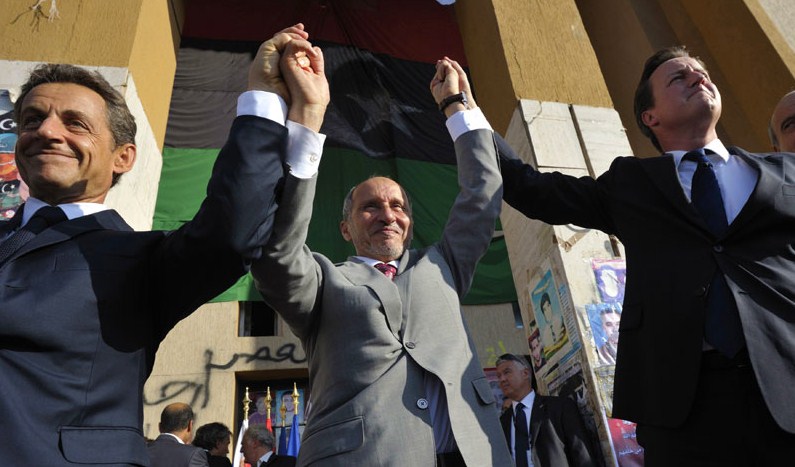
The meteoric rise of ISIS to power is not a coincidence or byproduct of innocent geopolitical mistakes. ISIS was initially created, for the sake of foreign-policy interests, to remove uncooperative governments like those in Libya, and then Syria which arguably became the pivotal point for the rise of ISIS. Until 2011 Libya was largely secular, sovereign, and fairly prosperous; now this country lies in ruins and is portrayed as having been invaded by a horde of foreign “Islamists”. The reality, however, is that France, Italy, the UK, and the US sponsored a small group of discontents to fight Gaddafi in 2011. They called themselves the Shabab, and they later constituted the “Libyan Transitional Council” which is now in government. The Libyan rebels were portrayed to the Western public as being “freedom fighters” who sought greater government accountability and increased liberties. In reality, it almost immediately became apparent that Islamic extremists had taken the leadership of the movement; the western powers were certainly aware of this.
Numerous reports warned that many of the fighters were affiliated with Al-Qaeda, another organization originally made powerful by the US to fight against the Soviet Union in Afghanistan. From the start, the global left had denounced these pseudo-revolutionaries as being violent as well as extreme in their religious zeal: in short, bad news for everybody. Nobody heeded their calls. The demonization of Gaddafi continued in the mainstream Western media, and the glorification and support for the rebels grew to the point when NATO’s governments felt secure that their public would support bombing Libya. So they did. Let us also remember that the Libyan army was sufficiently well trained and disciplined to have almost neutralized the opposition, and it would have done so if NATO had not intervened. In short, if Gaddafi’s government existed today, ISIS might not.
It was not made widely public that many of Libya’s rebels were not Libyans but Iraqis from Al-Qaeda in Iraq. This organization cleverly re-branded itself to confuse the public, and it became ISIS. Abdel Hakim-Belhadj was the commander of the Libyan Islamic Fighting Group that helped NATO to depose Gaddafi. It is almost unknown that Hakim-Belhadj was in fact an al-Qaeda lieutenant, turned double agent after being in the care of the CIA, and released back into operation. “The US was fully aware of and facilitating the delivery of weapons to the Al Qaeda-dominated rebel militias throughout the 2011 rebellion”, as stated by The Citizen’s Commission on Benghazi’s interim report. Far from the US being able to claim ignorance, this program was run and administered by Hillary Clinton, then the Secretary of State.
With NATO’s air support, the Libyan rebels captured Gaddafi (he was murdered by the rebels in a horror show that the mainstream media did not hesitate to broadcast). With Gaddafi gone, Hakim-Belhadj was rewarded by NATO and Washington with the title of Governor of Tripoli. With this position, he ensured the recruitment of Jihadists into Libya and the smuggling of hundreds of them to Syria through Turkey. This would create the backbone of what would eventually, and ironically, be named the “Free Syrian Army”. There is no equivocation on the fact that the very same members of the Libyan Islamic Fighting Group were flying the Al-Qaeda and ISIS flags following the murder of Gaddafi. This happened “before and during the time they were shipped on to fight in Syria against Bashar al Assad’s government forces – on behalf of those very same NATO-allied agencies” as reported by the 21st Century Wire.
Syria: toppling Assad
One year later, the Free Syrian Army arguably brought us to the brink of World War III by using chemical weapons against Syrian civilians, and they attempted to frame Assad for it. They are the same fighters who were using weapons shipped by Saudi Arabia and Qatar, with logistic support from the CIA operating in Jordan, and they were also funded by the Saudis, Qataris and Americans. All of this, despite their benefactors’ knowledge that the weapons were falling in the hands of the Jihadists rather than the secular opposition. With help from the CIA, these governments and that of Turkey sharply increased their support for the Syrian rebels throughout 2013, expanding exponentially an airlift of arms and equipment for the uprising against Assad.
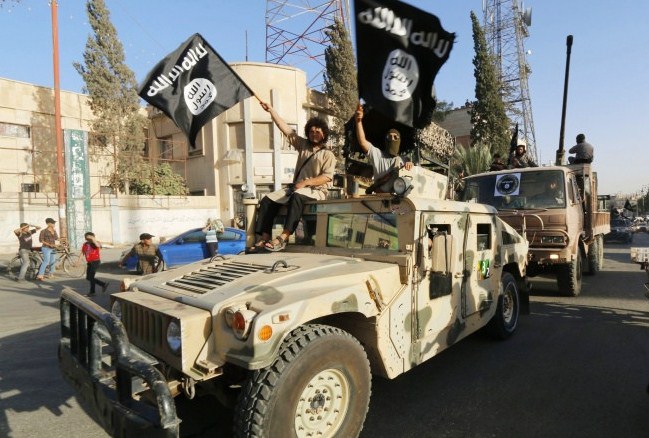
With the Jihadization of Damascus having failed, ISIS was born, led by the infamous al-Baghdadi, who was being sponsored just a few months before by the US to fight against Assad. This was achieved through missions coordinated by the likes of John McCain, who to this day maintains that he “knows these people very well” and they “are not terrorists”. The cognitive dissonance does not register in the minds of the majority of the western public. It is not understood that the people who are being paid by the US and NATO in Syria to get rid of Assad are the same people that we must supposedly fight in Libya. Politicians lie, the media parrots, and the populace believes. The infamous “Caliph” al-Baghdadi is now the new bogeyman, the new Bin Laden, the new scapegoat upon which the neocons of the world can capitalize. With Jeb Bush poised to be the leading US Republican candidate for the presidency, the parallels with his brother George W. Bush and his crusade against Al-Qaeda to justify the invasions of Afghanistan and Iraq are simply too sinister to ignore. It hardly matters whether one believes that ISIS is under direct control of the US or not. The point is that ISIS has achieved its primary role: that of creating an atmosphere of fear that can be exploited and manipulated to justify military and political interventions abroad.
We have to wonder about the goal of ISIS in bombing in Libya. If ISIS really wants to attack Rome, it can easily do so with home-grown members rather than risk the laborious task of smuggling fighters from Libya. Could it be to influence the US elections in favor of a neoconservative? Or to pretend to be fighting ISIS while bombing the pro-Gaddafi militias that have re-taken most of the southern regions of Libya? Whatever the reason, it appears that the support from the US to the supposed enemies of the US is allegedly not waning. The Pentagon is set to send 1,000 troops to aid the Syrian rebels, and in June 2014 Obama requested $500 million from the US Congress to train and arm the group that potentially includes ISIS combatants. This comes amidst claims from an alleged Islamic State commander in Pakistan that the US is directly funding ISIS fighters on the ground there, and from the Iraqi parliament that their army has downed two British military planes that were carrying weapons and explosives to be allegedly air-dropped on ISIS-controlled areas. Saudi Arabia, Qatar, Turkey, and the NATO powers are not the only ones who have at least indirectly supported ISIS; Israel too has also thrown its lot with these unsavory characters. For 18 months the Israeli “Defense” Forces provided medical and technical help to opposition groups fighting inside Syria, as observed by the UN peacekeeping missions in the Golan Heights.
If a hand strikes you, do you blame the hand that hit you or the mind that commanded it? The situation with ISIS is similar, and so the real question to be asked is the following: Who is the greatest enemy to our security here, ISIS or the US? For those willing to see, the truth is in plain sight.
The Guardian’s Homan Square story was huge on the internet—but not in Chicago media
By Jackie Spinner | Columbia Journalism Review | March 4, 2015
CHICAGO, IL — On Election Day just over a week ago, as this city’s reporters and editors focused on whether the incumbent mayor with ties to the White House would win big or be forced into a historic run-off, an out-of-town newspaper produced a startling account of alleged abuse at a police facility called Homan Square.
The blockbuster story, published in The Guardian and written by Brooklyn-based journalist Spencer Ackerman, described the warehouse as the “domestic equivalent of a CIA black site,” where secretive police units operate and detainees are “disappeared,” with no access to lawyers or relatives and no immediate record of their whereabouts.
With its comparisons to war-on-terror practices and allegations of police brutality, the story landed big on the internet, with well more than 100,000 social shares and write-ups across the Web. The one place it didn’t get much traction: Chicago media.
The city’s two main dailies, the Chicago Tribune and Chicago Sun-Times, quickly reported that city police denied any wrongdoing in pieces that offered little original reporting. The CBS affiliate in Chicago also reported the police denial. The local papers and TV stations have since covered protests from groups demanding that the facility be shuttered.
But more than a week after the initial story, local enterprise reporting remains scant. The most notable examples are a few oddly framed stories, from the Tribune and public radio station WBEZ, suggesting that the focus on Homan Square is misplaced and that, according to local defense attorneys, abusive detentions and interrogations may actually be routine and widespread. If true, that would seem to be worth digging into—but the local coverage, especially in the Tribune, put as much emphasis on possible overreach by The Guardian as it did on police abuse. … Full article
Once upon a TIME
By Margarita Simonyan, RT Editor-in-Chief | March 9, 2015
Once upon a time – last October, to be precise – I gave an interview to a TIME magazine correspondent for the publication’s in-depth profile on RT. Late last week that piece finally appeared on America’s newsstands.
The opus is an object lesson in writing about RT, which over the last year or so has blossomed into its own cottage industry: full of half-truths, half-quotes and full-on commitment to fitting your subject into an existing narrative box, rather than an attempt to understand or discover anything new.
In an effort to give the article a sense of timeliness, the author uses the backdrop of Boris Nemtsov’s murder to frame the RT story. How did RT treat this tragic, headline-grabbing event that reverberated around the world, and the tens of thousands-strong Moscow march that followed it? According to TIME : “On March 1, when a massive march began in Moscow to protest Nemtsov’s murder – with many carrying signs that read propaganda kills – RT was showing a documentary about American racism and xenophobia.”
Would you like to know what TIME was writing about on March 1? It was comparing the merits of two new models of the Samsung smartphone. A poignant story indeed!
If this example seems like an attempt to purposefully mislead the audience about the quality of TIME’s journalism, it’s because it is. But it’s the same as TIME’s deliberate avoidance of the fact that the Nemtsov mourning rally was the lead story on RT’s March 1 hourly news bulletins from 8am till midnight, with live updates published across our websites and social media platforms throughout the day.
If the introductory presentation of RT is based on brazen omissions, then the next part is a classic example of misdirection, and concerns every mainstream media hound’s favorite bone – RT’s financing. Now, I can empathize with the challenge of trying to write an honest-to-goodness sad-sack story about the outspent (and new favorite epithet, ‘outgunned’) Western media at a time when RT is broadcasting multiple 24/7 TV channels around the world for the mind-blowing sum of $225 million, while the UK’s BBC World Service and the US’ Broadcasting Board of Governors (BBG, which includes Voice of America and Radio Free Europe) – both running predominantly online and radio services with small and sporadic television presences in a handful of regions – receive $375 million and $721 million respectively.
But TIME certainly gets an A for effort. First, this stateside magazine with a largely US audience pretends that American government-funded BBG doesn’t exist. Then, it compares the financing of RT to the BBC World Service (with the BBC correctly coming out as more generously subsidized, even though TIME uses RT’s obsolete budget figure to narrow the gap), but pivots to a qualifier: “The BBC’s International Service is the biggest broadcast newsgathering operation in the world.”
To achieve this kind of status on such a relatively conservative budget would be remarkable indeed – if only it were true. The problem is that BBC’s “International Service” isn’t a thing in and of itself. It is the newsgathering department of BBC News (budget – $530 million), which is part of the British Broadcasting Corporation (budget – over $7 billion), funded through the license fee that is charged to every UK household with a TV.
This department feeds a substantial part of the content of BBC World News, the UK’s global news channel and RT’s closest counterpart. Formally, BBC World News is set up as a private entity (it is owned by BBC Global News Ltd, the commercial arm of the BBC) and its budget is unknown. BBC News also lends its resources (from newsgathering to the newsroom space) to the BBC World Service (that’s the mostly radio and online service with a $375-million budget that TIME talks about – also funded through the UK TV license). If by now all those structural and budgetary cross-overs seem a little murky, it’s because they are. TIME is obviously counting on its readers to gloss over the details.
So TIME laments: “What is the West to do in the face of a form of richly endowed propaganda?” Yes, what IS the West – with its BBG, BBC News/World News/World Service, CNN International (that has never contradicted a State Department position), Deutsche Welle, France 24, Euronews, and countless newspapers and magazines (including TIME ) read around the world – to do in the face of RT and its $225 million? Poor dears!
But the pièce de résistance of the article is my actual interview. Back in October, the TIME correspondent and I spoke in my offices for an hour-and-a-half. This discussion is reduced to some 60 words (in an essay of 2,800) spread across five quotes, plus there is one more quote from our London correspondent. So much for the “inside” look at RT, touted in the headline.
One of the quotes is from our discussion of what makes up the Russian point of view, the presentation of which is one of RT’s stated goals. I said that this worldview is “defined by certain principles expressed by the state: by representatives of the Russian state, if you talk to people on the street, if you look at different polls with Russian people as a whole – you will see that one of the important things that we do not like in the existing world order is the desire of Western countries to make unilateral judgments about what is good, what is bad in the countries far removed from them, about which they know very little, and take military actions based on those unilateral judgments.”
This is what is left of this quote in print: the worldview is “defined by certain principles expressed by the state, by representatives of the Russian state.” Notice a difference? Of the constituencies that are part of the Russian state and define its views, goals and grievances only state representatives make the cut. The opinion of the Russian people is irrelevant. A decade ago I might have been surprised.
By the way, sometimes those representatives call me on my “old yellow telephone” – in plain sight in my office where I give most of the interviews – “to discuss secret things.” What kinds of secret things? Mostly budgets (seeing as RT is publicly funded) and the president’s travel details to coordinate the work of our pool reporters. I said as much to the TIME reporter. Of course, only the conspiratorial-sounding “secret things” comment made the cut. Again, in the good old days I expected higher standards from the Western press…
There are also smaller, funnier fact- and bias-fails that have crept into the piece, like the detail that I gave my interview in the office just across the river from the Kremlin (did we move and I hadn’t noticed? At least someone remembered to pack the phone).
Or that in 2002 I “got a job as a reporter for state TV in Moscow, assigned to the Kremlin pool” – never mind that I’ve already been with the same employer for years, heading up the channel’s regional bureau and continuing my work as a war reporter, which started in 1999 in Chechnya, then took me to Abkhazia in 2001 and Beslan, North Ossetia in 2004.
(Side note: does TIME have a quota for how often Kremlin must be mentioned in an article about RT?)
Or that the “propaganda war” that the West is ostensibly losing is desperately “one-sided” (except for the headlines screaming about Russia’s “Uncontrolled Violence,” “Putin’s Missile”, “The Fascist in the Kremlin,” or how “Russia Wants to Restore Soviet Union”).
But if I had to nit-pick every piece of nonsense said or written about RT, I’d have no time left to run “Putin’s on-air machine.”
~

Margarita Simonyan is RT’s Editor-in-Chief.
US Intel Vets Oppose Brennan’s CIA Plan
Consortium News | March 9, 2015
The original idea of the CIA was to have independent-minded experts assessing both short- and longer-term threats to U.S. national security. Mixing with operations and politics was always a danger, which is now highlighted by CIA Director Brennan’s reorganization, opposed by a group of U.S. intelligence veterans.
MEMORANDUM FOR: The President
FROM: Veteran Intelligence Professionals for Sanity
SUBJECT: John Brennan’s Restructuring Plan for CIA
Mr. President, the CIA reorganization plan announced by Director John Brennan on Friday is a potentially deadly blow to the objective, fact-based intelligence needed to support fully informed decisions on foreign policy. We suggest turning this danger into an opportunity to create an independent entity for CIA intelligence analysis immune from the operational demands of the “war on terror.”
On Feb. 5, 2003, immediately after Colin Powell’s address to the UN, members of VIPS sent our first VIPS memorandum, urging President George W. Bush to widen the policy debate “beyond the circle of those advisers clearly bent on a war for which we see no compelling reason and from which we believe the unintended consequences are likely to be catastrophic.”
The “former senior officers” whom Brennan asked for input on the restructuring plan are a similar closed, blinkered circle, as is the “outstanding group of officers from across the Agency” picked by Brennan to look at the Agency’s mission and future. He did not include any of the intelligence community dissidents and alumni who fought against the disastrous politicization of intelligence before the attack on Iraq. Nor does Brennan’s plan reflect the lessons learned from that debacle.
You have continued to express confidence in Brennan despite the CIA’s mediocre record under his leadership. We urge you to weigh Brennan’s plan against the backdrop of Harry Truman’s prophetic vision for the CIA. We need to stop wasting time and energy trying to prevent the baby Truman never wanted from being thrown out with the bathwater. Let the bathwater run off, with the baby high and dry.
An independent group for intelligence analysis would be free to produce for you and your National Security Council the medium- and long-term strategic intelligence analysis that can help our country steer clear of future strategic disasters. And we offer ourselves as advisers as to how this might be accomplished.
Our concern over what we see as the likely consequences stemming from what Brennan intends, together with our many years of experience in intelligence work, have prompted this memo, which we believe can profit from some historical perspective.
—
President Harry Truman wanted an agency structure able to meet a president’s need for “the most accurate … information on what’s going on everywhere in the world, and particularly of the trends and developments in all the danger spots.” In an op-ed appearing in the Washington Post exactly one month after the assassination of President John F. Kennedy, Truman added, “I have been disturbed by … the way CIA has been diverted from its original assignment … and has become an operational and at times policy-making arm of the Government.”
Truman added that the “most important thing” was to guard against the chance of intelligence being used to influence or lead the President into unwise decisions. His warning is equally relevant now – 52 years later.
Bay of Pigs
Truman was referring to how CIA Director Allen Dulles tried to mousetrap President Kennedy into committing U.S. armed forces to finish what a rag-tag band of CIA-trained invaders of Cuba began by landing at the Bay of Pigs in April 1961, a few months before you were born. Kennedy had repeatedly warned the CIA brass and covert action planners that under no circumstances would he commit U.S. forces. But they were old hands; they knew better; they thought the young President could be had.
Allen Dulles’s handwritten notes discovered after his death show how he drew Kennedy into a plan that was virtually certain to require the support of U.S. forces. Dulles wrote that Kennedy would be compelled by “the realities of the situation” to give whatever military support was necessary “rather than permit the enterprise to fail.”
Kennedy fired Dulles, a quintessential Washington Establishment figure – something one does only at one’s own peril. As young CIA officers at the time, some of us experienced first-hand the deep reservoir of hate in which many a CIA covert action operator swam. Many could not resist venting their spleen, calling Kennedy a “coward” and even “traitor.”
Analysis Also Corrupted
You are fully aware, we trust, that our analysts’ vaunted ethos of speaking unvarnished truth to power was corrupted by Director George Tenet and Deputy Director John McLaughlin, who outdid themselves in carrying out the instructions of President Bush and Vice President Dick Cheney. The new ethos boiled down to this: If the President wants to paint Iraq as a strategic threat, it is our job to come up with the “evidence” – even if it needs to be manufactured out of whole cloth (or forged, as in “yellowcake uranium from Africa” caper).
Honest analysts were admonished not to rock the boat. A concrete example might help to show this in all its ugliness. When the only U.S. intelligence officer to interview “Curve Ball” before the war saw a draft of Powell’s Feb. 5, 2003 speech citing “first-hand descriptions” by an Iraqi defector of a fleet of mobile bioweapons laboratories, he strongly questioned the “validity of the information.” The interviewer had, from the outset, expressed deep reservations about Curveball’s reliability.
Here’s what the interviewer’s supervisor, the Deputy Chief of the CIA’s Iraqi Task Force, wrote in an email responding to his misgivings:
“Let’s keep in mind the fact that this war’s going to happen regardless of what Curve Ball said or didn’t say, and that the Powers That Be probably aren’t terribly interested in whether Curve Ball knows what he’s talking about. However, in the interest of Truth, we owe somebody a sentence or two of warning, if you honestly have reservations.”
This was not an isolated occurrence. Commenting on the results of a bipartisan Senate Intelligence Committee five-year study of pre-Iraq-war intelligence, Chairman Jay Rockefeller described it as “unsubstantiated, contradicted, or even nonexistent.” He was alluding to information (in)famously described as a “slam dunk” by then-CIA Director George Tenet who was singularly responsible for advancing the career of John Brennan.
In a departure from customary diplomatic parlance, then-Assistant Secretary of State for Intelligence Carl Ford, speaking to the authors of Hubris: The Inside Story of Spin, Scandal, and the Selling of the Iraq War, had harsh words for Tenet and his deputy John McLaughlin. Ford said that the evidence and analysis they gave policy makers was “not just wrong, they lied … they should have been shot.”
It is unfortunately true that – short of quitting and blowing the whistle – there is little one can do to prevent the skewing of “intelligence” when it is directed from the top – whether by the Bush-Tenet-McLaughlin consequential deceit on the threat from Iraq, or the ideological/careerist conceit of William Casey-Robert Gates in insisting up until the very end of the Soviet regime that the Soviet Communist Party would never relinquish power and that Soviet leader Mikhail Gorbachev was merely cleverer than his predecessors.
Thankfully, Not All Gave Up
There is hope to be drawn from those occasions where senior intelligence officials with integrity can step in, show courageous example, and – despite multiple indignities and pitfalls in the system – can force the truth to the surface. We hope that you have been made aware that, after the no-WMD-anywhere debacle on Iraq, Assistant Secretary of State for Intelligence Thomas Fingar did precisely that during 2007, supervising a watershed National Intelligence Estimate on Iran that concluded unanimously, “with high confidence,” that Iran had stopped working on a nuclear weapon in 2003.
President Bush concedes in his memoir that this put the kibosh on his and Dick Cheney’s earlier plan to attack Iran during their last year in office. So, character (as in Fingar) counts, and people of integrity can make a difference – and even help thwart plans for war – even in the most politicized of circumstances.
Restructuring
Accordingly, the primary objective in any restructuring should be to make it easier for people of integrity, like Thomas Fingar, to create an atmosphere in which analysts feel free to tell it like it is without worry about possible harm to their careers, should they come up with a politically “incorrect” conclusion – as the one on Iran clearly was.
The problem is that the Brennan restructuring effort does just the opposite. It puts the politicization on steroids. Placing intelligence analysts and operations officers together fosters a quite different kind of atmosphere – the kind that increases the likelihood of what Truman called the “most important thing” to guard against – leading “the President into unwise decisions.”
Truman saw the general problem and went even further, saying he “would like to see the CIA restored to its original assignment as the intelligence arm of the President … and its operational duties terminated or properly used elsewhere.” We think Truman was right then; and he is right now.
Decades of experience show that Truman’s fears were well founded. Indeed, from the outset, putting analysis and covert action operations together in the same agency was the first structural fault, so to speak, when it was created in 1947.
It was occasioned primarily by insistence that WWII OSS operatives who could match the KGB in what is now called “regime change” remain in government, and then a myopic choice to place them with the analysts in the newly created CIA. As Melvin Goodman points out in his The Failure of Intelligence: the Decline and Fall of the CIA, the early “CIA leadership itself was opposed to having responsibility for covert action, believing that the clandestine function would ultimately taint the intelligence product, a prescient observation.”
During the 1980s, President Reagan’s Secretary of State, George Shultz, correctly accused CIA Director William Casey and his deputy, Robert Gates, of slanting intelligence, charging that their operational involvement “colored” the Agency’s analysis. Shultz openly charged William Casey with giving President Reagan “faulty intelligence” to bolster Casey’s own policy preferences, including the ill-conceived arms-for-hostages-swap with Iran.
Shultz added that, because he had a sense of this analysis-operations toxic mix, he harbored “grave doubts about the objectivity and reliability of some of the intelligence I was getting.” Shultz was a strong advocate of separating the analysis from operations, likening the need to that of separating investment from commercial banking.
“War on Terrorism” as Business Model
The business model chosen by Brennan is fashioned to the “War on Terrorism,” and he holds up the Counterterrorism Center (CTC) as a model to emulate. There the analysts and operations officers sit side by side charged primarily with hunting, targeting, and killing in that war.
But truth, it has been pointed out, is the first casualty of war. This can be seen right off the bat in the exaggerated way the supposed “successes” of the Center are advertised. Some of us have worked in or closely with these CIA Centers, after which ten new “Mission Centers” are patterned. And we are taken aback by the hyperbolic plaudits being given them – and especially to the CTC.
That a quintessential politicizer, and big Curve Ball promoter, like former CIA Deputy Director John McLaughlin is reported to have advised Brennan on the restructuring, and lauds the benefits of “putting analysts and operators together” adds to our concern.
Very much in step, former CIA Deputy Director Michael Morell, for instance, claims that existing Centers have “proven to be a very powerful combination” and that the Counterterrorism Center is “the most successful agency component over the last decade.”
Morell remains focused on the business model of war. Just days ago he conceded that he did not think he would live to see the end of al-Qaeda: “My children’s generation and my grandchildren’s generation will still be fighting this fight,” said Morell.
Does it occur to Morell or others who have played senior intelligence roles that there ought to be a different kind of center, like what used to exist in parts of the Directorate of Intelligence, where analyst talent might be used not simply for targeting terrorists, but for figuring out what their grievances are, and whether there may be more promising ways to address them?
Do we really believe that terrorists slip out of the womb screaming “I hate America”? And is there a cost to drone-killing them as the preferred method of eliminating terrorists (together with others who may be in the wrong place at the wrong time)?
Brennan has announced that the new Centers will “bring the full range of operational, analytic, support, technical, and digital personnel and capabilities to bear on the nation’s most pressing security issues and interests.”
We need to learn more of the specifics, but the integrated Mission Centers sound very much like fertile field for politicization and centralized control under which subordinates will feel pressure to fall in line with prosecuting the war de jour and to sign on to politically correct solutions dictated from the 7th floor under guidance from your staff in the White House.
Is this the kind of CIA we need — everyone marching in step, as major parts of the Agency are transformed into a private army at your disposal, with virtually no Congressional oversight? We don’t think so.
A Watershed
With the present restructuring plan we see little promise for the kind of agenda-free, substantive intelligence that you and other senior policy makers need. But the train seems to have left the station headed toward Brennan’s restructuring plan. The sweeping reorganization scheme is of such importance that it should be the subject of hearings in the intelligence committees of House and Senate, but there is no indication that either committee intends to do so.
Let the analysts inclined toward targeting terrorists and providing other direct operational support to war sign up for these war-on-terror and like Centers. You and your successors will still need an agency devoted to unfettered intelligence analysis able to critique honestly the likely medium- and long-term consequences of the methods used to wage the “war on terror” and other wars.
We can assure you it is far better for those analysts doing this demanding substantive work NOT to be simultaneously “part of the team” implementing that policy.
It is time to revert to what Truman envisaged for the CIA. We are ready to make ourselves available to assist you and your staff in thinking through how this might be done. That it needs to be done is clear to us, and this would seem an opportune time.
In our view, we need to stop wasting time and energy trying to prevent the baby from being thrown out with the bathwater. Let the bathwater run off. Save the baby, even if that means a separate institution in which analysts of the kind that completed that NIE on Iran in 2007 can flourish. This just might help stop a new unnecessary war, as the combat support officers try to bring an end to old ones.
In sum, we are convinced that a separate entity for intelligence analysis – the kind of agency Truman envisaged for his CIA – would be an invaluable asset to you and your successors as president.
For the Steering Group, Veteran Intelligence Professionals for Sanity (VIPS)
Fulton Armstrong, National Intelligence Officer for Latin America (ret.)
Larry Johnson, CIA analyst & State Department/counterterrorism, (ret.)
John Kiriakou, Former CIA Counterterrorism Officer
David MacMichael, USMC & National Intelligence Council (ret.)
Ray McGovern, Army Infantry/Intelligence officer & CIA presidential briefer (ret.)
Elizabeth Murray, Deputy National Intelligence Officer for the Near East, National Intelligence Council (ret.)
Torin Nelson, former HUMINT Officer, Department of the Army
Coleen Rowley, retired FBI Agent and former Minneapolis Division Legal Counsel
Peter Van Buren, former diplomat, Department of State (associate VIPS)
Kirk Wiebe, Senior Analyst, SIGINT Automation Research Center, NSA (ret.)
Lawrence Wilkerson, Colonel (USA, ret.), Distinguished Visiting Professor, College of William and Mary
Ann Wright, retired U.S. Army reserve colonel and former US diplomat (resigned in March 2003 in opposition to the Iraq War)
Featured Video

Matt Bracken: US Plans Massive MOAB Strike on Iran?
or go to
Aletho News Archives – Video-Images
From the Archives
Confronting the Threat of Ethnic Bioweapons
By Tony Cartalucci – New Eastern Outlook – 29.11.2017
The United States Air Force’s 59th Medical Wing’s molecular biology branch recently was revealed to have been collecting specifically Russian RNA and synovial (connective) tissue samples, prompting fears in Russia of a possible US directed ethnic-specific bioweapons program. … continue
Blog Roll
 Aletho News
- Matt Bracken: US Plans Massive MOAB Strike on Iran?
- Russia accuses France of ‘piracy’ over tanker seizure
- Why Yemen Is Bombing Saudi Arabia’s Airports: The War Behind the Headlines
- Sally Rooney’s books pulled from UK over support for Palestine Action
- Bombs for Tel Aviv, Promises for Riyadh
- Israeli ad agency conducted vast global espionage campaign using online ads: Report
- Oct. 7 Forever Marks The Big Reveal: ‘We See You, Israel, We Revile You, We Reject You!’
- Meet the US generals and admirals advancing Israeli policy
- Israel’s Straw Widow Protocol: The Kill Zones Where Civilians Were Labelled ‘Terrorists’
- Leading Israeli Think Tank Publishes Psychotic Israeli ‘National Security’ Doctrine
- If Americans Knew
- Israeli firm used online ads to run vast spy operation, researchers say
- No, the world zionist movement is not an antisemitic conspiracy theory
- Hundreds of IDF investigations into killings still have no public outcome, BBC Verify finds
- After Ashley Moody Epstein Probe, Donors Linked to Him Poured Money Into her Senate Campaign
- Worried about Russian meddling in UK politics? Wait till you see what Israel is up to
- Israeli settlers attack West Bank center for disabled children, church leader calls for int’l action
- Pulling Out Teeth Just to Live: How Israel Has Devastated Dental Care in Gaza
- Gaza’s “ceasefire” death toll passes 1,500 – Daily Update
- Activists Abused By Israel Return to New Freedom Flotilla Mission
- 60 Minutes won’t tell the full truth about Israeli settler violence
- No Tricks Zone
- New Study Suggests Large Regions Of The Pacific Ocean Have Been Cooling For The Last 80 Years
- Germany’s Green Energy Debacle: High Energy Costs Force Kahla Porzellan to Close After 182 Years!
- New Study: 50 Years Of The Most Aggressive ‘Net Zero’ Policies Can Only Affect The Global Climate By 0.03°C
- US September “Heat” Was No Record…Many Records Set Decades Ago
- Latest European Green Energy Debacle; Portugal’s Largest Flagship Solar Park Insolvent!
- Green Energy Debacle: German Expert Professor Fritz Vahrenholt Warns Of Severe Economic And Social Consequences
- Two More Paleo Reconstructions Affirm Meters-Higher Sea Levels Across Ireland, Brazil 7000-6000 Years Ago
- New Study: Earth And Venus Surface Warmth Largely Explained By Convection And Lapse Rate, Not CO2 Or Radiation
- 2025 Nature Paper Claiming Worsening Global Drought Gets RETRACTED …Heavily Flawed
- New Study: ‘Global Drought Shows No Detectable Recent Acceleration Under Climate Warming’

